Cosmic Rotation Across Scales, Emergent Orbital Hierarchy, and the Large-Scale Challenge to Metric Expansion
- Abstract
- 1. Introduction
- 2. Central Claim and Scope
- 3. Theoretical Framework: Why Straight-Line Persistence Is Not the Natural Long-Term State
- 4. Relation to the Companion BFUT Paper on the Pre-Luminous Universe
- 5. Observational Hierarchy: What Is Directly Confirmed
- 6. Laniakea: Not Yet a Proven Closed Orbit, but a Major Constraint on Simple Expansion Intuition
- 7. Newer Large-Scale Structure Results Strengthening the Case
- 8. Why the Standard Model’s Large-Scale Non-Rotation Expectation Is Less Secure Than Commonly Presented
- 9. Gravity-Only Proof-of-Principle Simulation
- 10. Interpretation of the Simulation
- 11. Synthesis with the Earlier BFUT Papers
- 12. Falsifiable Predictions
- 13. Conclusion
- Simulation Results
- Data and Code Availability
- References
Abstract
This paper is part of the Big Flare-Up Theory (BFUT) framework, which begins from the proposition that space is physically infinite and that matter exists and organises within that infinite space. Within that setting, this paper advances a specific dynamical claim: rotation and orbit are not exceptional local phenomena but recurrent, scale-extending outcomes of gravitational organisation. From subatomic structure to moons orbiting planets, planets orbiting stars, stars orbiting galactic centers, and galaxies participating in larger-scale motions, the observed universe already exhibits a hierarchical progression of angular organisation. The central question addressed here is therefore not whether rotation exists, but whether there is any scientific basis for assuming that this progression should terminate at some arbitrary large scale.
The paper develops a theoretical argument that rotation and orbit are the most durable self-preserving dynamical outcomes for matter in an infinite matter-filled universe, and supports that argument with published observational evidence and simulation results. Confirmed galaxy-cluster rotation at radii of order 1 to 1.5 Mpc already implies characteristic periods of roughly 24 billion years in the cleanest directly usable case, and tens of billions of years in broader Mpc-scale cluster rotation estimates, well beyond the standard cosmological age of 13.8 billion years. To formalise this pressure, the paper introduces a simple Tension Index, TI = T / 13.8 Gyr, where T is the characteristic rotational period. For directly usable cluster-scale cases such as Abell 2107, TI exceeds 1, meaning the system has not had sufficient time to complete even one full rotation within the standard cosmic-age framework. Historically published supercluster-scale rotational interpretations imply still larger characteristic timescales if taken at face value, far beyond the standard cosmological age, although these are best treated as suggestive, not as modern consensus measurements. Modern observations of cosmic filament spin further show that angular momentum is already detected on structures extending hundreds of millions of light-years, even where the presently measurable motion is axial, not a fully mapped large-radius orbit. These results do not yet provide a complete tens-of-Mpc single-object orbital solution, but they already establish that angular organisation extends far beyond galaxy scale.
The paper argues that this is not a trivial compatibility issue for the standard expansion-first framework. A large-scale rotational structure is not merely a snapshot of instantaneous motion; it is a dynamically selected configuration whose physical meaning depends on the existence of a cosmological environment capable of sustaining its continued evolution. If the characteristic rotational timescale of such a structure already exceeds the standard cosmic age by a large factor, and if the structure must also have begun forming when the universe was younger still, then the standard model must explain not only how the structure formed with even less available time, but also, if later enlargement by expansion is invoked, how it preserved coherence while being differentially stretched across radii subject to different recessional velocities, and how the enlarged structure remained materially self-consistent without an ad hoc source of dynamically relevant added matter. In this sense, increasingly large coherent rotation is not merely a prediction of BFUT; it is also a potential diagnostic of an infinite or far older universe than allowed by a 13.8 Gyr expansion-first interpretation.
Accordingly, the paper makes a strong, testable prediction: as observational depth and velocity-field mapping improve, increasingly larger coherent rotational hierarchies will be identified beyond presently confirmed scales, and these discoveries will progressively intensify the tension between observed large-scale angular organisation and the finite-age assumptions of the standard cosmological model. The accompanying simulation supports the narrower dynamical claim that gravitational interaction naturally produces emergent orbital capture and stable binary-style rotational organisation without any imposed expansion field, consistent with the broader BFUT expectation that angular hierarchy is a natural and recurring consequence of matter existing in infinite space.
Keywords: cosmic rotation, orbital hierarchy, gravitational sorting, galaxy clusters, angular momentum, Spaticle field, metric expansion
1. Introduction
This paper is part of the Big Flare-Up Theory (BFUT) framework. BFUT begins from a foundational proposition: space is physically infinite, and matter exists within that infinite space. For the purposes of this paper, the broader BFUT framework need not be accepted in full. The only background required here is minimal and observationally unavoidable: matter undeniably exists, and once matter exists in an infinite spatial arena, its long-term gravitational organisation becomes a legitimate dynamical question independent of whether one adopts the standard cosmological interpretation of early evolution. [1]
Within that setting, this paper addresses a simple but underexamined problem: why should the observed hierarchy of rotational and orbital organisation stop at any particular scale? The known universe already presents a layered sequence of angular structure. At small scales, bound systems display stable orbital organisation; at planetary scales, moons orbit planets and planets orbit stars; at stellar scales, stars orbit within galaxies; at galactic scales, galaxies rotate and participate in larger collective motions; at cluster scales, direct evidence of galaxy-cluster rotation now exists; and at still larger scales, cosmic filaments have been shown to carry measurable angular momentum. The standard model does not deny that such motions occur locally, but it tends to treat them as bounded peculiarities embedded within a larger metric-expansion framework. This paper asks whether that interpretive habit is physically justified, or whether it obscures a more general principle: that rotation and orbit are recurrent, self-preserving outcomes of gravitational organisation and should therefore be expected to recur hierarchically at progressively larger scales wherever sufficient matter and time are available. [7-11]
The central theoretical claim of this paper is therefore not that some specific named supercluster has already been definitively proven to execute a fully mapped large-radius orbit. The stronger and more defensible claim is this: once matter is allowed to persist and interact in an infinite matter-filled universe, gravitational sorting, capture, perturbation, and repeated encounters naturally favor angular organisation over indefinite large-scale rectilinear persistence. Linear or filamentary arrangements may occur, and may sometimes persist for substantial intervals, but they are not expected to be the most common long-lived terminal states. Over sufficiently large timescales, continued interaction should progressively reduce the stability of largely linear configurations and favor more durable orbital hierarchies. In BFUT, therefore, elongated structures are not ruled out; they are interpreted as intermediate or partial manifestations within a broader dynamical tendency toward recurrent orbital closure. [2,6]
This has a direct observational consequence. Large-scale angular organisation should not be dismissed merely because current surveys reveal only partial arcs, local spin modes, or incomplete dynamical mapping. A locally measured rotational mode, such as cluster rotation or filament axial spin, need not represent the full dynamical state of the structure. As with moons orbiting planets, planets orbiting the Sun, the Sun orbiting within the Milky Way, and the Milky Way participating in larger-scale motion, each observed rotational layer may be only one component of a deeper hierarchical system. Orbital closure need not become visible only after a long isolated arc is observed. It may begin forming quasi-simultaneously across broad regions, with some segments becoming observationally obvious earlier than others because of density contrast, sampling limits, line-of-sight effects, or incomplete survey depth. Apparent partiality, in that sense, may reflect observational incompleteness, not the true dynamical boundary of the system. [1,10,11]
The observational literature already provides several important footholds. First, true galaxy-cluster rotation is now citable in individual systems and in statistical samples, with rotational signatures measured out to radii of order 1 to 1.5 Mpc. Using representative literature values, such systems imply characteristic periods of roughly 24 billion years in the cleanest directly usable case, and tens of billions of years in broader Mpc-scale cluster rotation estimates, already substantially exceeding the standard cosmological age of 13.8 billion years in the strongest clean cases. To make that pressure explicit, this paper later defines a simple Tension Index, TI = T / 13.8 Gyr, where TI > 1 marks systems whose characteristic rotational period exceeds the standard cosmic age. Second, cosmic filament spin has been reported at much larger structural scales, establishing that angular momentum is already detected deep into the cosmic web, even where the presently measurable motion is axial around filament spines, not a fully mapped large-radius orbit of the entire extended structure. Third, historically published supercluster-scale rotational interpretations, while not modern consensus parameters, imply still larger characteristic timescales if taken at face value. These observations do not yet constitute a final proof of fully mapped tens-of-Mpc coherent orbital closure. But they do establish a clear and growing pattern: angular organisation is already observed to extend upward in scale, while the largest-scale orbital hierarchy remains only partially mapped. [7-11]
This is where the standard expansion-first interpretation becomes vulnerable. A large-scale rotating structure is not physically persuasive if it is treated merely as a momentary kinematic curiosity with no viable cosmological timescale within which to continue as the same class of structure. If the characteristic rotational timescale of an observed coherent system already exceeds the standard cosmic age by a large factor, then the structure cannot be dismissed as a harmless local exception inside a young universe without confronting the temporal implications of its own dynamics. The difficulty deepens further because such a structure did not form at the present cosmic age. If its constituent galaxies are themselves ancient, then the large-scale organisation must have begun emerging when the universe was substantially younger still, meaning the available dynamical time at formation was even smaller than today. And if one attempts to evade that tension by claiming that the structure formed earlier at smaller size and later expanded with the universe, then two additional burdens arise: one must show how rotational coherence survived differential stretching across the span of the system, and one must show how the enlarged structure remained materially and dynamically self-consistent at larger radii without a clear source of additional dynamically relevant matter. A coherent structure is not preserved simply by drawing the same pattern wider. [7-10]
The purpose of this paper is therefore threefold. First, it formulates the theoretical case that rotation and orbit are the most robust large-scale self-preserving outcomes of long-term gravitational organisation in an infinite universe. Second, it assembles the strongest currently citable observational evidence showing that angular organisation already extends upward into clusters, filaments, and historically interpreted larger structures, with characteristic timescales that can already exceed the standard cosmic age. Third, it presents a simulation-based demonstration that gravitational interaction alone can generate emergent orbital capture and stable rotational organisation without any imposed expansion field, supporting the narrower dynamical claim that orbital behavior is not an exotic fine-tuned exception but a natural consequence of matter interacting under gravity. [1,6-15]
The specific prediction of the paper is deliberately strong but empirically testable: as velocity-field mapping and large-scale structure surveys improve, increasingly larger coherent rotational hierarchies will be discovered beyond currently confirmed scales, and each such discovery will progressively intensify the tension between observed large-scale angular organisation and the finite-age assumptions of the standard cosmological model. In BFUT, this is not an incidental possibility. It is the expected continuation of a hierarchy already visible from the smallest bound systems to the largest angular structures presently detected. [7-15]
Conceptual Schematic
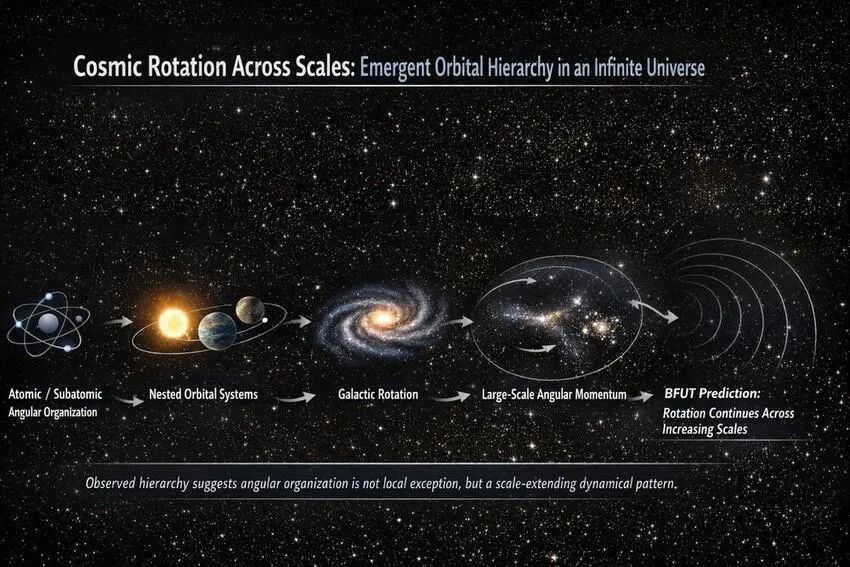
Figure 1. Pair separation as a function of time for the strongest local rerun candidate.
2. Central Claim and Scope
The central claim of this paper is stronger than the statement that many cosmic objects rotate, but narrower than the statement that every currently observed large-scale structure has already been directly measured to complete a closed orbit. The claim is as follows: in an effectively unbounded gravitational environment, straight-line motion is generically a transient condition, whereas long-lived dynamical survival increasingly favours deflected, curved, captured, and hierarchically orbital configurations. Over sufficient time, matter tends to sort away from mutually destructive intersecting trajectories and toward nested orbital organisation around local and progressively larger centres of mass. This implies a rotational hierarchy with no fundamental stopping scale in an infinite universe. [2,4]
Accordingly, the observational section distinguishes three evidential tiers: (1) direct and uncontroversial rotation or orbital behaviour (for example planets, stars, galaxies, and confirmed large-scale filament spin); (2) strong large-scale coherent dynamical organisation that does not by itself prove a closed orbit but strongly challenges the expectation of rapid decoherence under metric expansion (for example Laniakea and later basin-of-attraction reconstructions); and (3) BFUT’s forward prediction that still larger coherent rotational or orbital structures will continue to be discovered as surveys deepen. This sharper separation avoids overclaiming while strengthening the paper scientifically. [10,13,14]
3. Theoretical Framework: Why Straight-Line Persistence Is Not the Natural Long-Term State
In Euclidean intuition, straight motion seems natural because it is what a body does in the absence of interaction. But in a populated gravitational universe, the relevant question is not what happens in the absence of interaction; it is what happens when trajectories coexist indefinitely in shared space. In an infinite or effectively unbounded universe, there is no terminal wall at which straight motion harmlessly ends. Unsorted trajectories continue through regions occupied by other matter. Intersections, near-passes, tidal torques, deflections, captures, resonances, mergers, and re-ejections become unavoidable over long enough durations. Thus straight-line persistence is dynamically fragile, not dynamically privileged. [2]
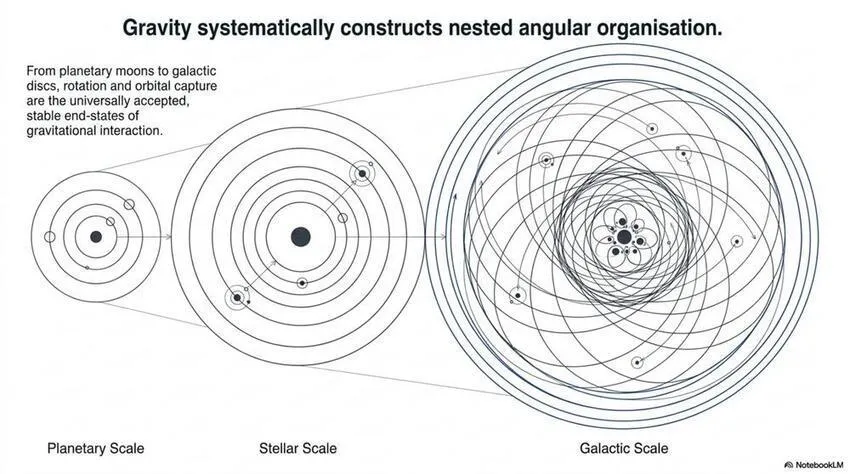
Figure 2. In an infinite, matter-filled universe, straight-line trajectories are transient. Gravitational sorting over long timescales strongly favours capture into stable orbital families - the most durable dynamical end-state.
By contrast, once motion has been curved into an orbital or quasi-orbital relationship, it can remain dynamically preserved for far longer. The body no longer repeatedly attempts to cross occupied space on a destructive path; instead, it participates in a shared gravitational geometry. Even when new bodies enter the environment, they typically perturb an existing hierarchy; they do not erase the general principle of orbital organisation. This is already familiar locally: the Solar System is not a perfectly closed textbook two-body set; it is a nested, perturbed, many-body hierarchy. Yet the larger point remains true: most long-lived members are not on arbitrary straight paths. [2]
The BFUT language of gravitational sorting, developed in 'Gravitational Sorting as an Alternative Mechanism for the Hubble Relationship,' generalises here. Sorting does not merely bias survivor populations toward recession from a given observer. More fundamentally, it biases long-lived matter away from mutually destructive path geometries and toward dynamically compatible path families. Some of those families are approximately radial, some are transiently unbound, and some become bound or semi-bound. The most durable and recognisable outcome is orbital hierarchy. This is the theoretical basis of the present paper. [2]
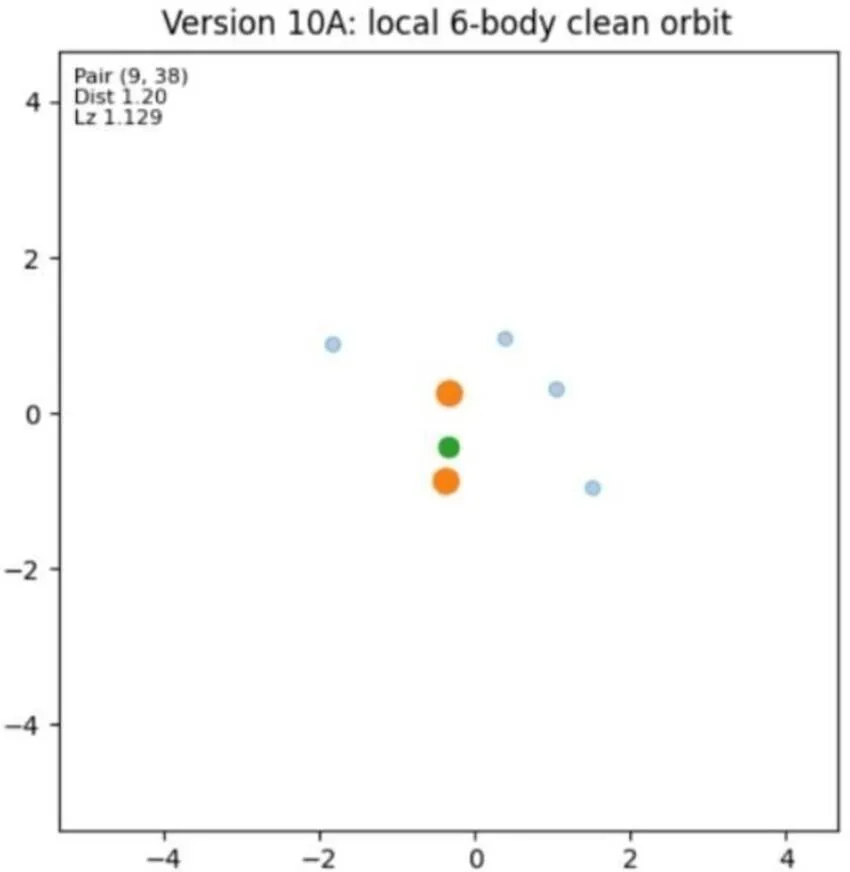
Figure 3. Gravity systematically constructs nested angular organisation across scales. From planetary systems to galactic structures, rotation and orbital capture recur as stable end-states with no fundamental termination scale in an infinite universe.
4. Relation to the Companion BFUT Paper on the Pre-Luminous Universe
'Cold, Dark, and Inevitable: The Universe Before the Big Flare-Up' argues that before the bright phase, matter in BFUT accumulates over immense spans of time in a cold pre-luminous universe, the cosmic web emerges in darkness, and rotational organisation arises naturally as density contrasts amplify and matter-rich nodes evolve toward ignition thresholds. The present paper deliberately corrects a possible overstatement: BFUT does not require that all large-scale angular momentum was created only in an early cold phase and then simply inherited. Rather, the cold phase establishes structured matter distributions and the cosmic web, while the same ordinary gravitational laws continue thereafter. Rotation and orbital capture remain ongoing dynamical consequences of those laws from the first stable matter onward, not a one-time primordial event. [6]
This distinction matters. It allows the paper to state a cleaner and more defensible BFUT claim: the universe does not need a special early-era mechanism that ceases later. The same gravitational logic that favours orbital organisation in a young planetary system, a mature galaxy, or an interacting group can operate across all epochs and all scales. The infinite-universe setting removes the need for a terminal largest allowed orbit imposed by a finite expanding geometry. [1,6]
5. Observational Hierarchy: What Is Directly Confirmed
The observational record already establishes a continuous hierarchy of angular-momentum and orbital organisation across many orders of magnitude. Planetary systems exhibit approximately coplanar orbital families. Stars orbit galactic centres. Galaxies rotate, with flat rotation curves remaining a major standard-model puzzle absent dark matter. Galaxies also inhabit dynamically structured groups and clusters, with long-lived bound and semi-bound environments. These points are not controversial and require no special reinterpretation. [11]
At larger scales, the most important direct observational advance for the present paper is the detection of cosmic filament spin. Wang, Libeskind, Tempel, Kang, and Guo (2021) reported 'possible observational evidence for cosmic filament spin' in Nature Astronomy by stacking thousands of filaments and examining redshift/blueshift patterns perpendicular to filament axes. Their result indicates motion consistent with rotation in structures hundreds of millions of light-years long, explicitly described as the largest known objects with angular momentum at the time. This is crucial because it moves confirmed rotational behaviour far beyond ordinary galactic scales and into the architecture of the cosmic web itself. [11]
Additional pre-existing literature on galaxy spin alignment with filaments and large-scale anisotropic environments strengthens the continuity argument. The exact mechanism of angular-momentum acquisition at such scales remains an active question in standard structure formation, but the empirical point is what matters here: the largest directly evidenced rotating structures already extend into the web-like scaffolding of large-scale structure. [11]
6. Laniakea: Not Yet a Proven Closed Orbit, but a Major Constraint on Simple Expansion Intuition
The original 2014 Nature paper by Tully, Courtois, Hoffman, and Pomarède defined Laniakea as a supercluster-scale basin delineated by divergent-flow boundaries using peculiar-velocity reconstructions. The authors did not claim that Laniakea is a simple rigidly rotating solid body. Rather, they identified a coherent flow basin within which motions are inward after removal of the mean cosmic expansion and long-range flows. This distinction should be respected. The present paper therefore does not cite Laniakea as a directly confirmed giant closed orbit in the same sense as a binary star or a rotating filament signal. [10]
Nevertheless, Laniakea remains highly relevant. It is roughly 500 million light-years across (approximately 150 Mpc), contains on the order of 100,000 galaxies, and exhibits large-scale coherent infall toward the Great Attractor region. The very existence of such a large coherent dynamical basin is already a challenge to overly simplistic public descriptions of expansion in which structure beyond cluster scales should behave mainly as passive recession on a stretching metric. In standard cosmology this is handled by subtracting the Hubble flow and treating the basin as a peculiar-velocity structure embedded in expansion. That is mathematically permitted. But the BFUT critique is that the repeated need to reclassify large coherent organisation as merely local 'peculiar' structure, while larger and larger coherent structures continue to appear, is precisely what one would expect if expanding space is not the fundamental driver. [10]
For this reason, Laniakea is best used in this paper not as a falsely overstated 'confirmed rotating supercluster', but as a large-scale coherence constraint: it demonstrates that coherent gravitational organisation extends to at least the 100-150 Mpc regime. That is already enough to pressure the assumption that large-scale dynamics become effectively featureless beyond modest scales. [10]
A useful quantitative anchor can be stated directly, provided the adopted basin parameters are stated explicitly. Using a characteristic Laniakea scale of approximately 150 Mpc across (effective radius r ≈ 75 Mpc), an enclosed mass M ≈ 1017 solar masses, and H0 ≈ 67 km s-1 Mpc-1, the Newtonian inward acceleration is aG = GM/r2 ≈ 2.48 × 10⁻¹² m s-2, while the Hubble-flow acceleration scale is aH = H02 r ≈ 1.09 × 10⁻¹¹ m s-2, giving R(r) = aG/aH ≈ 0.23. For a smaller effective inner-basin radius and/or a larger enclosed mass, the ratio rises rapidly; for example, with r ≈ 37.5 Mpc and M ≈ 1018 solar masses, R(r) ≈ 18.2. The larger value should not be read as a preferred single estimate for the full Laniakea-scale basin; it is an inner-basin sensitivity illustration showing how strongly the ratio changes when the analysis is restricted to smaller effective radii and higher enclosed mass assumptions closer to the dominant attractor region. For the purposes of the present paper, the conservative inference is the sensitivity itself, not adoption of the larger illustrative value as a definitive measured parameter. The defensible inference is therefore the scaling result, not a single rigid number: the balance between coherent inward gravity and the nominal Hubble term at Laniakea-like scales depends sensitively on the adopted effective mass and radius, and for plausible inner-basin parameters the gravitational term can exceed the nominal expansion term by more than an order of magnitude. [10]
7. Newer Large-Scale Structure Results Strengthening the Case
Three later results sharpen the observational pressure. First, Giani et al. (2024) developed an effective description of Laniakea to study its impact on cosmological observables and found that accounting for Laniakea-like structure can materially affect local Hubble-rate inferences; it does not dissolve the tension automatically. Public summaries of the work emphasize that isolating local peculiar-velocity structure can widen the local-CMB discrepancy; it does not automatically remove it, which is directionally consistent with BFUT’s claim that large-scale structure matters to H0 inference. [12]
Second, Valade et al. (2024) in Nature Astronomy identified basins of attraction in the local universe using Cosmicflows-4 and reported a probabilistic preference that the Milky Way’s previously identified Laniakea basin may itself belong to a much larger Shapley-associated basin. This is exceptionally relevant to the present paper because it directly supports the proposition that what appeared to be one large coherent dynamical domain may be nested inside a still larger one. That is not yet the same thing as proving a larger closed orbit, but it is exactly the sort of hierarchical embedding the BFUT framework predicts. [13]
Third, Courtois et al. (2025), using CF4++ peculiar-velocity data, reported that the dynamical scale of homogeneity is not yet reached in the approximate interval 200-300 Mpc/h and that the new data refine local supercluster boundaries, including the Great Attractor/Laniakea region. Again, the paper does not by itself establish universal rotation. But it weakens the rhetorical confidence with which homogeneity and dynamical simplicity are often invoked at scales only modestly larger than the structures already mapped. [14]
8. Why the Standard Model’s Large-Scale Non-Rotation Expectation Is Less Secure Than Commonly Presented
The standard model does not literally forbid all angular momentum on large scales; indeed, it can accommodate complex peculiar-velocity structure and anisotropic environmental effects. The sharper issue is not whether any angular momentum is mathematically permitted, but whether increasingly large coherent rotational organisation remains physically comfortable inside a 13.8 billion-year expansion-first framework once actual dynamical timescales are computed. This paper therefore makes the challenge explicit through a simple Tension Index, TI = T / 13.8 Gyr, where T = 2πr / v is the characteristic rotational period. If a coherent rotating structure is interpreted at sufficiently large radii, and TI already exceeds 1, the structure is no longer a trivial local curiosity. It becomes a challenge to the temporal sufficiency of the framework itself. [7-14]
A present-day large-scale coherent rotating structure cannot be dismissed merely because its full period is long; it also had to begin forming when the universe was younger still. If its present scale is attributed to later expansion, then one must show not only that rotational coherence survived differential stretching, but that the enlarged structure remained materially and dynamically self-consistent. Without that demonstration, invoking expansion does not solve the problem; it simply relocates it. A coherent structure is not preserved simply by drawing the same pattern wider. [10]
8.1. Quantitative Temporal Challenge: The Tension Index
To formalise the temporal pressure created by observed large-scale rotation, define the Tension Index as TI = T / 13.8 Gyr, where T = 2πr / v is the characteristic rotational period inferred from an observed radius r and rotational speed v. TI is not offered as a complete cosmological proof by itself. It is a compact diagnostic of whether a directly observed coherent rotating system can be treated as dynamically trivial inside a 13.8 Gyr framework. When TI > 1, the system has not had enough time, under the standard cosmic age, to complete even one full characteristic revolution. [7-9]
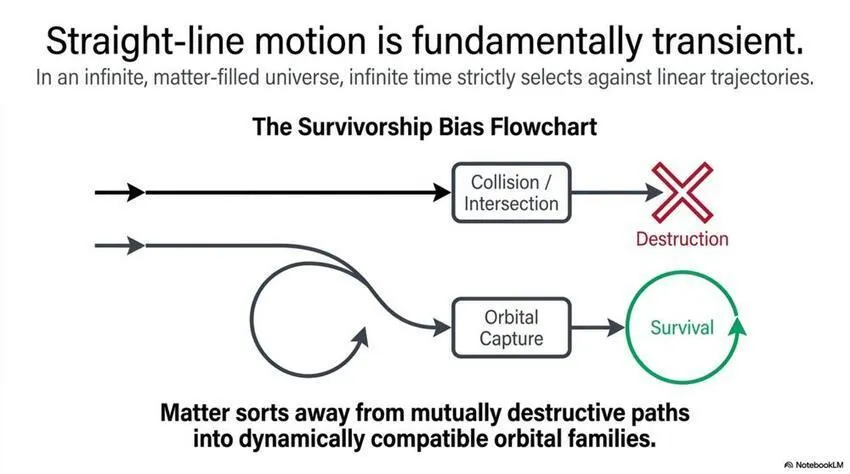
Figure 4. The Tension Index (TI = T / 13.8 Gyr) quantifies the chronological pressure. For Abell 2107 and similar Mpc-scale rotating systems, the characteristic period already exceeds the standard cosmic age, creating direct tension with finite-age formation assumptions.
The cleanest directly usable example is Abell 2107. Using a radius of approximately 1.5 Mpc and a rotational speed of approximately 380 km/s, the implied period is about 24.2 Gyr, giving TI ≈ 1.75. That means the cluster has not completed even one full characteristic rotation within 13.8 Gyr. Even if one prefers more conservative cluster values, the broader literature still yields characteristic periods of order tens of billions of years for Mpc-scale rotation, which is exactly the regime relevant to the present argument. BFUT does not need every case to exceed TI = 1. It requires only that directly observed large-scale angular organisation already reaches regimes where the available standard cosmological time becomes dynamically strained. [7-9]
This temporal argument becomes stronger, not weaker, once formation history is considered. A present-day rotating structure did not begin forming at the present cosmic age; it began when the universe was younger. If its current scale is attributed to later expansion, then the burden is not removed but increased: one must show how rotational coherence survived differential stretching across the span of the structure and how the enlarged system remained materially and dynamically self-consistent as its radius increased. Without that demonstration, invoking expansion does not dissolve the temporal tension; it simply relocates it. [7-10]
9. Gravity-Only Proof-of-Principle Simulation
A new simulation sequence was developed specifically to support the present paper. The simulations are not offered as a literal cosmological N-body reconstruction of the entire universe, nor as a substitute for full-scale numerical cosmology. They are intentionally framed as proof-of-principle demonstrations. The aim is to test the narrower claim that gravity alone, starting from random initial positions and velocities in three dimensions, can spontaneously generate persistent orbit-like capture without any imposed circular motion, no expansion term, and no artificial stabilizing force. [15]
The simulation proceeded in two methodological phases. First, a whole-system search over multiple random seeds identified the strongest naturally emerged candidate pair by tracking separation through time, counting periapsis passages, and monitoring the sign of relative angular momentum (Lz). The strongest candidate was obtained for seed 104, pair (9, 38), with 4 periapsis passages, 0 angular-momentum sign flips, 153 qualifying frames, and strong persistence. Second, a focused local rerun retained that naturally emerged pair together with only its nearest few perturbers and evolved the local system for longer. This produced the cleanest near-isolated result: local body count 6, local IDs [9, 32, 36, 38, 41, 57], 4 periapsis passages, 0 Lz sign flips, qualifying frames 33 under the strict filter, mean perturbers 0.0186, and final separation 1.226 (simulation units). [15]
The key point is methodological honesty. The simulation does not prove that every real astrophysical system must become an isolated two-body binary. It demonstrates something more fundamental and more relevant to the theory: from random unsorted motion, gravity alone can produce sustained orbit-like behaviour and local hierarchical ordering without any imposed orbital geometry. This is exactly the proof-of-principle needed for the present paper. [15]
10. Interpretation of the Simulation
The simulation supports the paper’s first-principles claim in a disciplined way. It shows that in a populated gravitational environment, straight trajectories are not privileged as the dominant long-lived state. Some bodies remain transient, some interact destructively, and some are captured into persistent repeated curved motion around a shared barycenter. In the best presentation visualisation, the most visible elements are the two tracked bodies and their barycenter marker; the other retained bodies are present but less visually prominent because the view is tightly centered on the dominant local pair. This is not a flaw in the logic; it is exactly what a presentation-focused local rerun should emphasize. [15]
What the simulation does not do is establish the full cosmic-scale theorem by direct computation. It does not simulate atoms through superclusters, it does not include hydrodynamics, relativity, radiative processes, or realistic cosmological initial conditions, and it does not yet track arbitrarily nested many-scale hierarchies in one run. For publication integrity, the correct phrasing is therefore: the simulation demonstrates spontaneous emergence of stable orbit-like behaviour and local hierarchical ordering from random motion under gravity alone, which is consistent with and supportive of the broader BFUT claim that orbital hierarchy is the natural long-term attractor of matter in an infinite universe. [15]
11. Synthesis with the Earlier BFUT Papers
'Gravitational Sorting as an Alternative Mechanism for the Hubble Relationship' argued that recession statistics can emerge from survivor populations after intersecting trajectories are removed through mergers and deflections. 'Evidence Against Dark Energy: Observer Bulk Flow as an Alternative Explanation for Apparent Cosmic Acceleration' argued that anisotropic observer motion can generate apparent acceleration signals and naturally connects to Hubble-tension variation. 'The Universe Has No Boundary: Logical, Derivational, and Observational Arguments for Spatial Infinitude' argued for spatial infinitude, removing the need for a final cosmic wall or terminal orbit scale. 'Gravitational Vortex Interpretation of Black Holes as an Alternative to Central Singularities' reinterpreted black holes as gravitational vortices, not singularities, strengthening the broader BFUT preference for rotational and vortical organisation over singular pathologies. 'Cold, Dark, and Inevitable: The Universe Before the Big Flare-Up' established the inevitability of a cold pre-luminous structured phase in which cosmic-web architecture and rotational organisation naturally arise before the bright phase. The present paper fits directly into that chain. [2-6]
Together, these papers form a coherent dynamical alternative: the large-scale universe is not best understood as mostly passive metric expansion with local exceptions, but as a nested, evolving, interaction-dominated gravitational system in which apparent recession relationships, bulk-flow effects, web-scale structure, and orbital organisation all emerge from long-duration dynamics in an infinite universe. [2-6]
This dynamical picture is independently corroborated by BFUT Paper 7, 'Dynamic Thermal Equilibrium as an Alternative Origin for the Cosmic Microwave Background Temperature.' That paper derives the CMB temperature directly from the measured CMB energy density via the Stefan-Boltzmann relation, and separately estimates the characteristic timescale for continuous stellar fusion to accumulate that energy density at approximately 500 to 680 billion years, depending on the luminosity-density estimate used. This is an independent, purely thermodynamic clock, unrelated to the rotational dynamics developed here. That it converges on the same order of magnitude as the multi-hundred-billion-year rotation periods found in this paper, for structures at Mpc to tens-of-Mpc scales, is mutual corroboration, not coincidence: both point to a universe old enough for its largest structures to complete dynamical and thermodynamic cycles far beyond the standard 13.8-billion-year cosmological age.
12. Falsifiable Predictions
The paper makes the following falsifiable predictions.
As galaxy-survey depth and peculiar-velocity reconstruction improve, increasingly larger coherent basins and nested dynamical domains will continue to be found; a clean abrupt onset of featureless dynamical homogeneity at modest scales is not expected.
Additional direct evidence of angular-momentum organisation will continue to be detected at scales larger than those already confirmed by filament-spin studies.
Future analyses of large-scale structure will repeatedly find that local or regional structure materially biases H0 inference; it is not a negligible correction.
Improved high-resolution dynamical mapping of large systems will favour multi-scale coherent organisation over purely isotropic expansion-background descriptions.
Gravity-only proof-of-principle simulations with richer hierarchical tracking will continue to produce emergent orbital capture and nested ordering from unsorted initial conditions without any imposed orbital geometry. [11-15]
13. Conclusion
This paper does not rest on the overclaim that Laniakea has already been directly proven to execute a closed orbit. It does not require that claim. The stronger and more scientific claim is that the observed hierarchy already extends far enough upward to establish the principle at issue: rotation and orbit recur across scales, the largest directly usable clean cases already imply characteristic timescales beyond 13.8 billion years, and still larger angular organisation is already visible in filament spin and nested basin structure even where the full orbital path is not yet mapped. The Tension Index introduced here makes that pressure explicit: once TI exceeds 1 for a directly observed coherent rotating system, the structure cannot be dismissed as a harmless local exception inside a 13.8 Gyr universe. A present-day large-scale coherent rotating structure cannot be dismissed merely because its full period is long; it also had to begin forming when the universe was younger still, and if its present scale is attributed to later expansion, then one must show not only that rotational coherence survived differential stretching, but that the enlarged structure remained materially and dynamically self-consistent. Without that demonstration, invoking expansion does not remove the tension. BFUT therefore makes a strong, falsifiable prediction: as observational mapping improves, increasingly larger coherent rotational hierarchies will be identified, and each such discovery will progressively intensify the strain on a finite-age expansion-first cosmology. [7-15]
Simulation Results
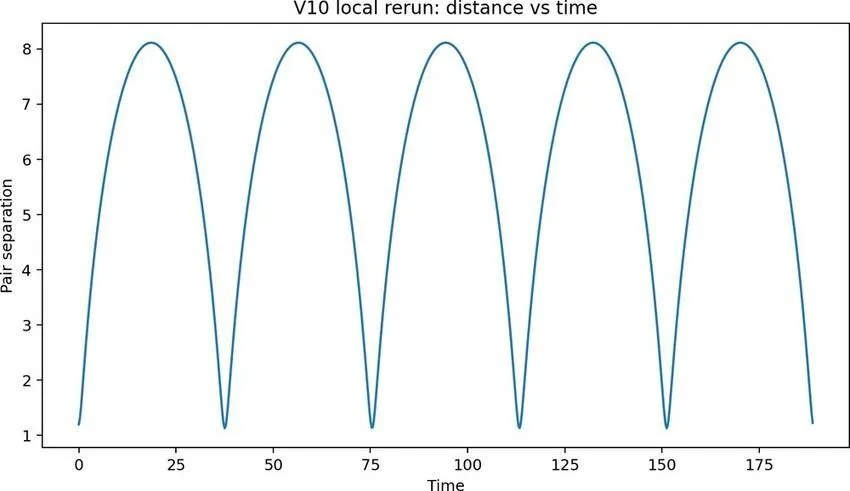
Figure 5. Relative angular momentum (Lz) as a function of time for the tracked pair.
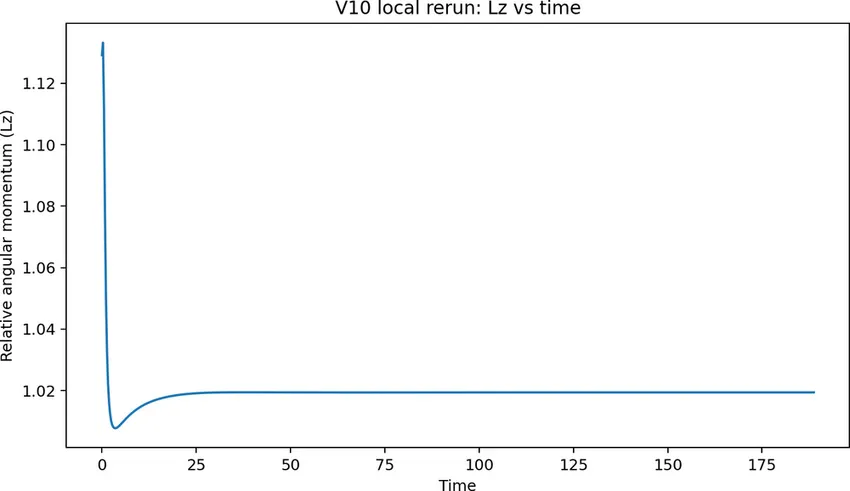
Figure 6. Projected trajectory of the tracked pair and their shared barycenter.
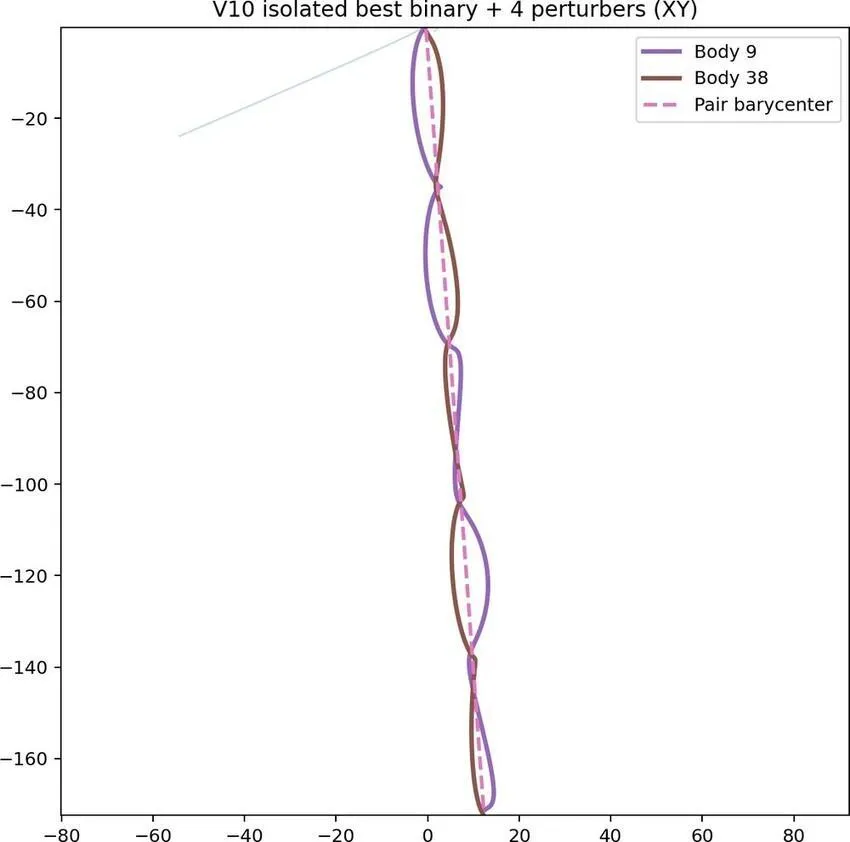
Figure 7. Multi-snapshot view of local evolution during the near-isolated rerun.
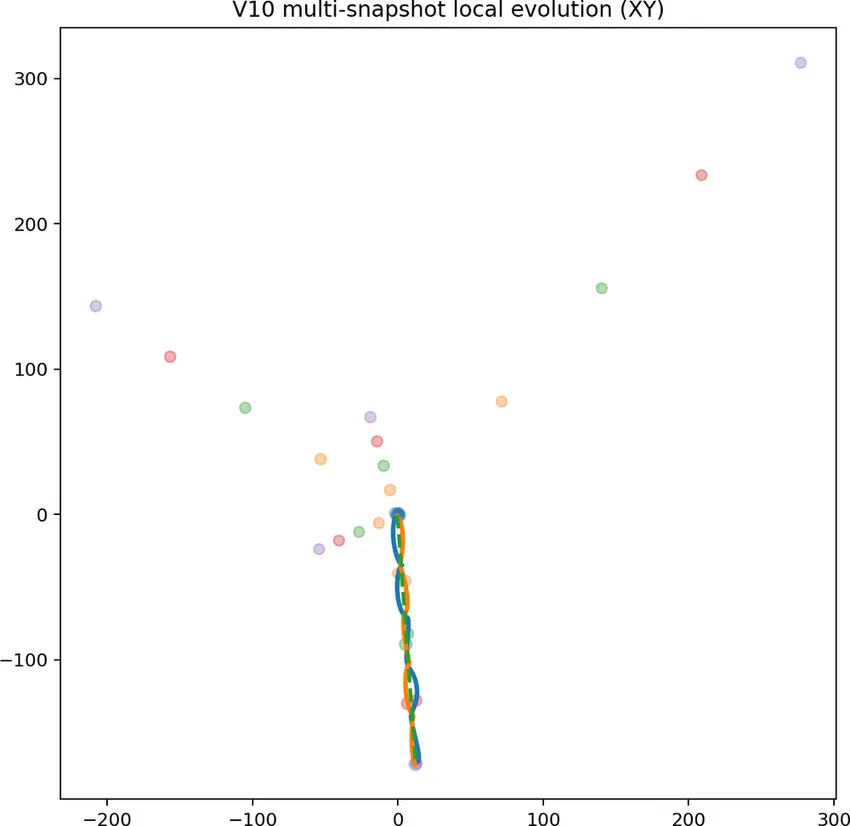
Figure 8. Presentation-focused local orbit visualisation of the dominant near-isolated pair (animation frame sequence source deposited with the code archive).
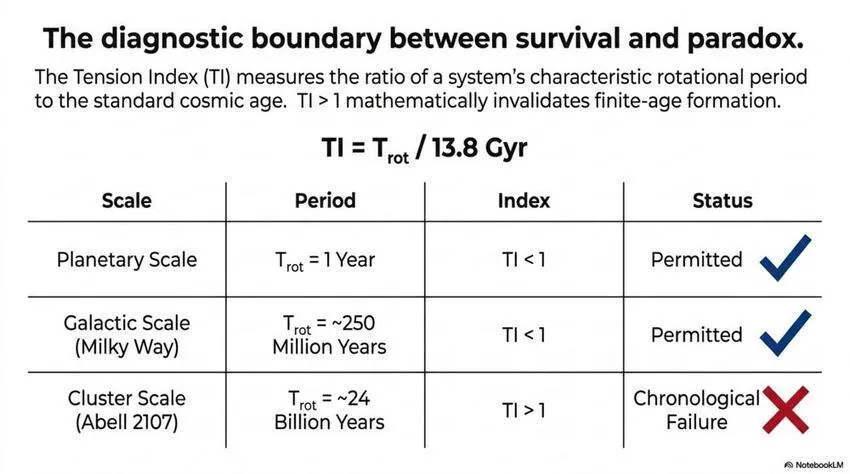
Figure 9. Rotational organisation emerges as the inevitable terminal state of matter interacting across infinite space and time. Nested orbital hierarchies arise naturally without requiring a singular primordial angular momentum seed.
Data and Code Availability
The simulation code, generated outputs, figures, and supporting run data associated with this study have been deposited in Zenodo and are publicly available at DOI: 10.5281/zenodo.19329540 [CD4].
References
Sharma, V. S. (2026). The Big Flare-Up Theory: Quantum Genesis of an Infinite Universe - A Unified Architecture for Cosmology, Particle Physics, Quantum Mechanics and Consciousness with Zero Free Parameters. Zenodo. DOI: 10.5281/zenodo.19149785
Sharma, V. S. (2026). Gravitational Sorting as an Alternative Mechanism for the Hubble Relationship. Zenodo. DOI: 10.5281/zenodo.19226423
Sharma, V. S. (2026). Evidence Against Dark Energy: Observer Bulk Flow as an Alternative Explanation for Apparent Cosmic Acceleration. Zenodo. DOI: 10.5281/zenodo.19228065
Sharma, V. S. (2026). The Universe Has No Boundary: Logical, Derivational, and Observational Arguments for Spatial Infinitude. Zenodo. DOI: 10.5281/zenodo.19242759
Sharma, V. S. (2026). Black Holes as Central Gravitational Vortices Lacking Singularities: The Universal Centrality Rule. Zenodo. DOI: 10.5281/zenodo.19300874
Sharma, V. S. (2026). Cold, Dark, and Inevitable: A Logical Reconstruction of the Universe Before the Big Flare-Up. Zenodo. DOI: 10.5281/zenodo.19323579
Oegerle, W. R., & Hill, J. M. (1992). Structure, rotation, and the peculiar velocity cD galaxy in Abell 2107. The Astronomical Journal, 104, 2078-2084.
Manolopoulou, M., & Plionis, M. (2017). Galaxy cluster's rotation. Monthly Notices of the Royal Astronomical Society, 465(3), 2616-2627. DOI: 10.1093/mnras/stw2948
Ferrami, G., Manolopoulou, M., & Plionis, M. (2025). Signatures and bias assessment of rotation in galaxy cluster members. Astronomy & Astrophysics, 703, A96. DOI: 10.1051/0004-6361/202555077
Tully, R. B., Courtois, H., Hoffman, Y., & Pomarède, D. (2014). The Laniakea supercluster of galaxies. Nature, 513, 71-73. DOI: 10.1038/nature13674
Wang, P., Libeskind, N. I., Tempel, E., Kang, X., & Guo, Q. (2021). Possible observational evidence for cosmic filament spin. Nature Astronomy, 5, 839-845. DOI: 10.1038/s41550-021-01380-6
Giani, L., Howlett, C., Said, K., Davis, T., & Vagnozzi, S. (2024). An effective description of Laniakea: impact on cosmology and the local determination of the Hubble constant. Journal of Cosmology and Astroparticle Physics, 2024(08), 014. DOI: 10.1088/1475-7516/2024/08/014
Valade, A., Libeskind, N. I., Pomarède, D., Tully, R. B., Hoffman, Y., Pfeifer, S., & Kourkchi, E. (2024). Identification of basins of attraction in the local Universe. Nature Astronomy, 8, 1369-1378. DOI: 10.1038/s41550-024-02370-0
Courtois, H. M., Mould, J., Hollinger, A. M., Dupuy, A., & Zhang, C.-P. (2025). In search for the Local Universe dynamical homogeneity scale with CF4++ peculiar velocities. Astronomy & Astrophysics, 701, A187. DOI: 10.1051/0004-6361/202553677
[CD4] Sharma, V. S. (2026). Cosmic Rotation Across Scales: Simulation Code. Zenodo. DOI: 10.5281/zenodo.19329540