Cold, Dark, and Inevitable: A Logical Reconstruction of the Universe Before the Big Flare-Up
- Abstract
- 1. Introduction: A Different Kind of Cosmological Paper
- 2. The Infinite Dark: Stage One
- 3. The Age of Accumulation: Stage Two
- 4. The Cosmic Web in Darkness: Stage Three
- 5. The Threshold Event: Stage Four
- 6. The Big Flare-Up Is Not the Beginning of the Universe
- 7. Simulation as a Flagship Prediction of BFUT
- 8. Direct Predictions of This Paper
- 9. Broader Explanatory Reach of the BFUT Research Programme
- 10. Conclusion
- References
Abstract
This paper reconstructs the universe immediately before the Big Flare-Up within the Big Flare-Up Theory (BFUT). Starting from three core premises already developed in the BFUT research programme, that the universe is spatially infinite, that space-time has a real physical substrate in the form of the Spaticle field, and that stable ordinary matter emerges from that field, the paper shows that a long cold, pre-luminous cosmological phase is not optional but inevitable. Over immense spans of time, matter accumulates, gravity amplifies statistical unevenness, pre-luminous filament-node-void structure forms, rotational organization arises naturally, and dense nodes approach ignition thresholds. The Big Flare-Up is therefore not a singular origin, not a universal explosion, and not the beginning of time. It is the universe-wide onset of the bright phase throughout the infinite universe, produced through innumerable near-concurrent ignition transitions in already structured matter-rich environments, with local cascades following within connected structures. The paper further notes that the public BFUT simulation programme already provides proof-of-concept support for this pre-luminous structural sequence and states direct predictions: that increasingly deep observations will continue to reveal broadly similar mature structures, recurring cosmic-web architecture, persistent apparent observational centrality, and no final physical edge or unique universal origin surface. In BFUT, the bright universe is not the beginning of reality. It is the inevitable luminous phase of an eternal process.
Keywords: cold universe, pre-stellar universe, Big Flare-Up, Spaticle field, matter emergence, gravitational collapse, cosmic filaments, living universe, infinite universe, eternal universe, Big Flare-Up Theory, BFUT
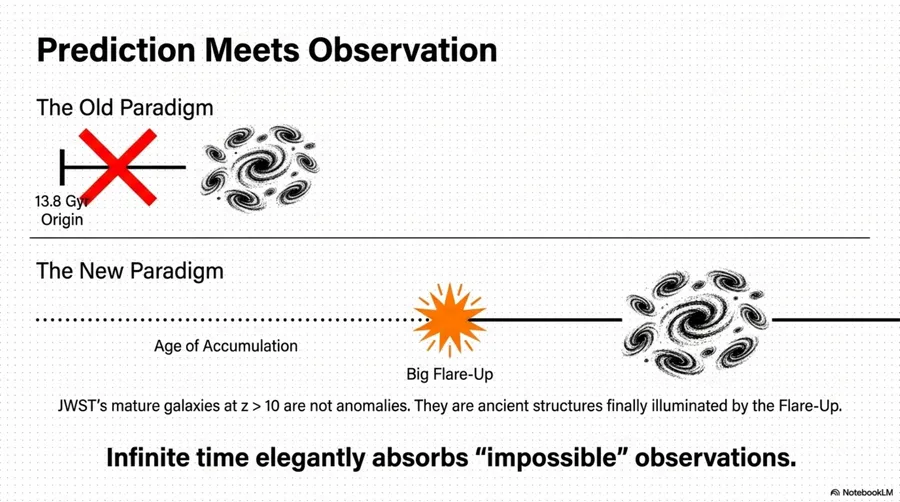
Figure 1. Prediction Meets Observation: JWST's mature galaxies at z > 10 are not anomalies in BFUT. They are ancient structures finally illuminated by the Flare-Up after a long Age of Accumulation.
1. Introduction: A Different Kind of Cosmological Paper
Most cosmological papers begin after the universe is already luminous. This paper begins before there was anything to see.
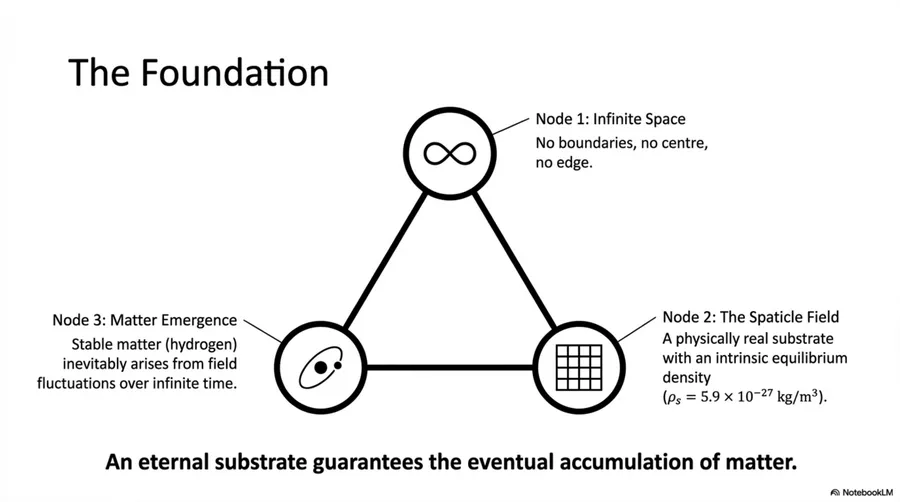
Figure 2. The Problem with a Singular Origin: JWST mature structures at z > 10 exist where standard models predict only primitive early structure. The universe was "born" too old.
The cold universe is not a literary metaphor. It is the necessary pre-luminous phase of a real cosmological process. Within the Big Flare-Up Theory (BFUT), once three conclusions are accepted, everything described in this paper follows as the natural physical sequence.
Premise 1: The universe is spatially infinite, as established in the companion paper on spatial infinitude [1].
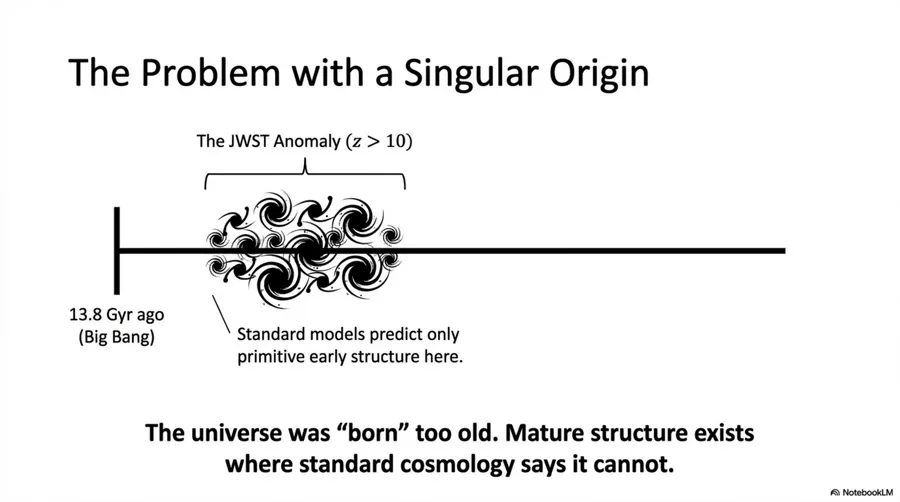
Figure 3. The Foundation: three-node logical structure of BFUT - Infinite Space, Spaticle Field substrate, and inevitable Matter Emergence from field fluctuations over infinite time.
Premise 2: Space-time is not empty but physically real. Its underlying substrate is the Spaticle field, whose ontological necessity is developed in the BFUT research programme and formalised in the companion paper on the physical substrate of space-time [2].
Premise 3: Matter can and does emerge from the Spaticle field. Over infinite space and infinite time, even extremely rare stable matter emergence is not an optional possibility. It becomes a cosmological certainty.
From these premises and ordinary gravitational physics, the dark pre-luminous universe is not merely conceivable. It is unavoidable.
This paper traces that sequence in four stages: the infinite dark, the age of accumulation, the cosmic web in darkness, and the threshold transition into the bright phase. It stops at the onset of the Big Flare-Up throughout the infinite universe.
The Big Flare-Up is not treated here as a single universal explosion or a one-origin cascade. It is the transition by which innumerable matter-rich regions across an infinite cold, non-luminous universe reach ignition thresholds throughout the infinite universe in broadly similar cosmic conditions, producing near-concurrent luminous onset throughout the infinite universe, with local cascades then propagating through connected dense structures. Throughout the infinite universe, this transition defines the onset of the bright phase. It does not define the beginning of existence.
1.1 A Note on Scale and Applicability
Nothing in the logic of this paper is confined to a tiny local pocket of the cosmos. BFUT does not recognise a physically meaningful scale at which gravitational organisation suddenly becomes irrelevant and a fundamentally different cosmic regime takes over. The same framework that motivates spatial infinitude, weakens the necessity of metric expansion as the universal master-description, and supports coherent structure across very large scales also supports the pre-luminous gravitational history described here.
The process outlined in this paper therefore applies generically: matter emerges in darkness, accumulates, self-organises under gravity, forms pre-luminous filamentary structure, and eventually crosses local ignition thresholds. The only variable is not whether this happens, but where and when.
2. The Infinite Dark: Stage One
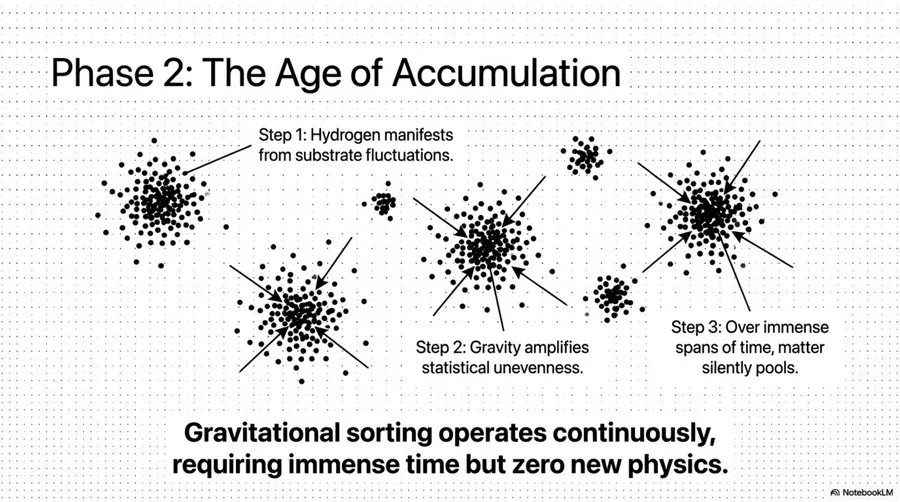
Figure 4. Phase 1 - The Infinite Dark: before light there was only the Spaticle substrate. No stars, no fusion. Trillions of years of absolute cold darkness preceded the luminous universe.
2.1 The State of the Universe Before Luminous Structure
Begin at an arbitrary moment in the deep past throughout the infinite universe that has not yet entered its bright phase.
At that stage there are no stars, no galaxies, no fusion light, no planets, no hot plasma backgrounds in the later observational sense. There is only the Spaticle field in its low-energy state, extending without boundary in every direction.
This state is not nothing. It is a physically real cosmological substrate. In BFUT, the cosmological constant is not treated as a mysterious bookkeeping term or an independent late-time anti-gravity fluid. It is read as the energy-density signature of the underlying substrate itself:
ρSpaticle = Λ c2 / (8 π G)
The field therefore already possesses energy density, structure-bearing capacity, and quantum activity. The cold, non-luminous universe is not empty. It is full of the medium from which the luminous universe will eventually emerge.
2.2 Matter Emergence Is Not Optional in an Infinite Eternal Universe
If matter emergence from the Spaticle field were literally impossible, the BFUT universe would remain eternally dark in every region. But that is not the picture supported by the BFUT framework or by the broader modern field picture. Modern physics has already abandoned the idea of truly empty space.
Quantum field activity, vacuum structure, and real particle emergence in known contexts establish the broader principle that a field-filled vacuum is not a sterile nothingness.
Within BFUT, the stronger claim is that stable matter emergence from the Spaticle field is real. The exact microphysical channel need not be restricted in advance in this paper. It may involve proton-electron survival, baryonic assembly pathways, or deeper substructure not yet fully described by current mainstream models. This paper does not depend on prematurely freezing the ontology at one specific first surviving particle species. It depends only on the physically decisive fact that stable matter emerges.
Once that is granted, infinite space and infinite time do the rest. Any non-zero stable emergence rate, however small, guarantees eventual accumulation across the whole. Not maybe. Not probably. Inevitably.
3. The Age of Accumulation: Stage Two
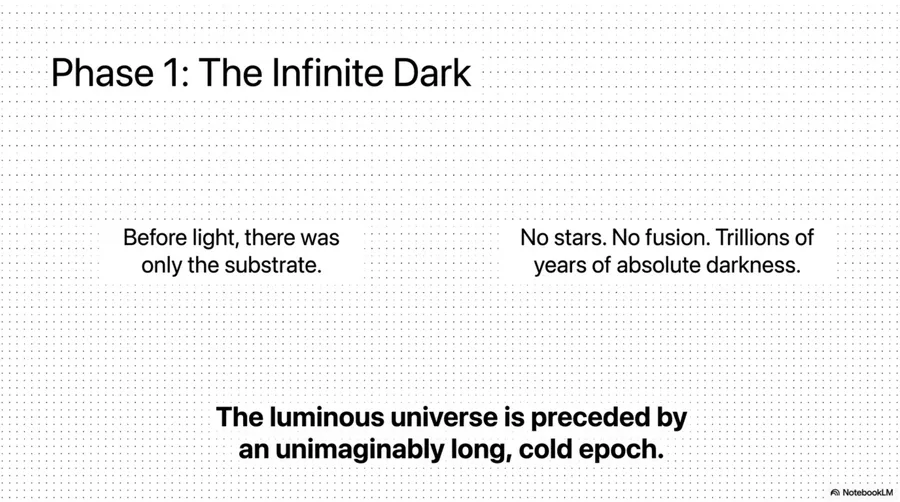
Figure 5. Phase 2 - The Age of Accumulation: hydrogen manifests from substrate fluctuations; gravity amplifies statistical unevenness; over immense time, matter silently pools into dense regions.
3.1 The First Persistent Matter Reservoirs
The earliest long-lived matter throughout the infinite universe need not be specified dogmatically as a single exact species in this paper. What matters is that stable ordinary matter appears and survives.
Over immense durations, this ordinary matter accumulates. Some of it may later reside predominantly in hydrogen-rich cold reservoirs, because hydrogen is the simplest and most durable large-scale baryonic storage state under broad conditions. But BFUT does not require that neutral hydrogen be the only or the first direct persistent product. The essential point is simpler and stronger: stable ordinary matter emerges from the Spaticle field and begins to build mass density where previously there was only physical substrate of spacetime.
Its earliest large-scale distribution is not a perfect mathematical uniformity. Any real emergence process across an infinite domain generates statistical unevenness. Even tiny deviations are enough. Gravity does not need dramatic initial contrast. It only needs something to work with.
3.2 Gravitational Thresholds in a Cold Universe
As accumulation continues, overdense regions begin to outcompete their surroundings. In a cold pre-luminous universe, thermal pressure is minimal compared with later stellar and radiative epochs. That makes collapse easier, not harder. The familiar Jeans logic therefore supports the central qualitative conclusion: once sufficient mass gathers in sufficiently cool regions, self-gravity wins.
From that point onward, gravitational amplification is no longer a remote possibility. It is the dominant organiser of the next stage.
4. The Cosmic Web in Darkness: Stage Three
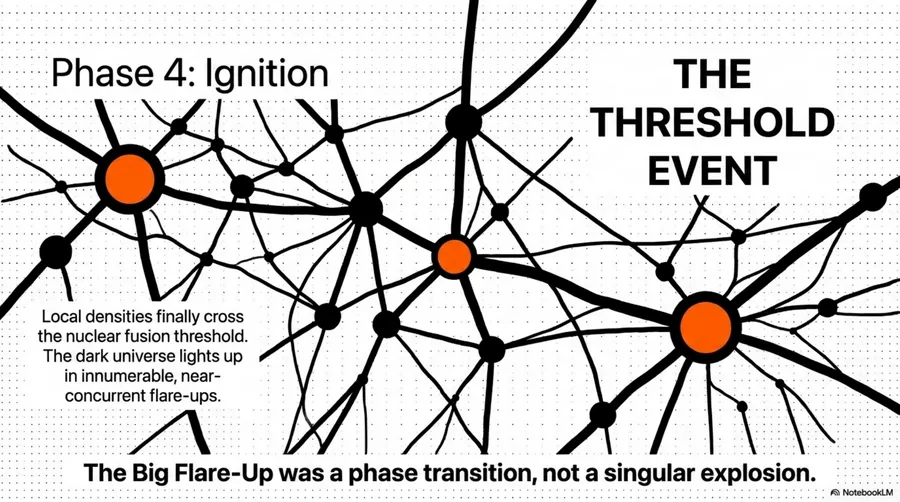
Figure 6. Phase 3 - The Invisible Loom: the cosmic web (filament-node-void architecture) is woven in total darkness before any star ignites. Structure is not born in light.
4.1 Gravitational Sorting Before First Light
Once self-gravity begins to dominate, the universe does not first become bright. It first becomes structured.
Dense regions pull in more matter. Intervening regions are progressively evacuated. Filaments form along preferred gravitational pathways between growing nodes. Voids deepen as matter drains away. The large-scale cosmic web is therefore not born in light. It is woven in darkness.
BFUT argues that dark matter is not required to explain galactic and related dynamical anomalies traditionally used to motivate dark-matter halos; see Black Holes as Central Gravitational Vortices Lacking Singularities: The Universal Centrality Rule [10].
This is one of the central claims of BFUT: the filament-node-void architecture of the cosmos is established in the cold pre-luminous phase before widespread fusion illumination reveals it.
The public BFUT simulation suite directly supports this picture as a proof-of-concept demonstration [4]. In particular, The Invisible Loom simulation shows matter emerging and self-organising under gravity in a cold, non-luminous universe, producing filamentary structure, nodes, and evacuated regions before any luminous phase is assumed. The live simulation is publicly viewable at vijayshankarsharma.com/loom, and the deposited code is publicly downloadable via Zenodo [4]. This matters because the BFUT claim is not merely verbal. It is already implemented in an open simulation programme that others can inspect, test, extend, or scale.
4.2 Rotation and Vortex Structure Arise Naturally
As matter falls toward dense regions, neighbouring overdensities and asymmetries generate torques. Angular momentum is therefore not an exotic special gift that must be inserted by hand. It is a natural and generic outcome of gravitational collapse in a non-uniform field of attraction.
The cold, non-luminous universe therefore builds not only structure, but rotating structure. Filaments can acquire coherent flow. Nodes can acquire spin. Proto-galactic and proto-stellar systems can inherit rotational organisation long before the universe in that region becomes luminous. The bright universe does not create the dynamical architecture. It reveals an architecture already built in darkness.
5. The Threshold Event: Stage Four
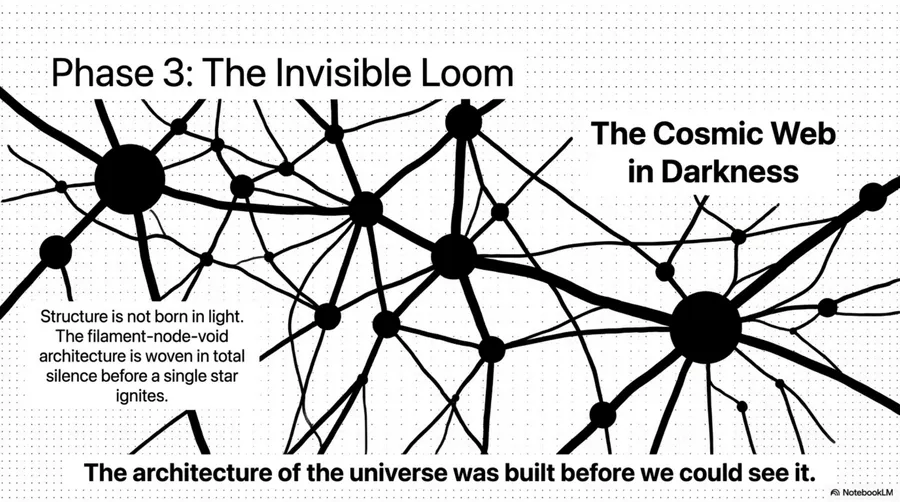
Figure 7. Phase 4 - Ignition / The Threshold Event: local densities cross nuclear fusion thresholds. Innumerable near-concurrent flare-ups light up the pre-structured dark universe. The Big Flare-Up is a phase transition, not a singular explosion.
5.1 Multi-Node Ignition All Over the Infinite Universe
As collapse continues inside sufficiently dense nodes, some objects eventually cross nuclear ignition thresholds. The first such ignition in any given connected region marks the local end of the purely cold phase there.
But the Big Flare-Up is not a single-source event. It is not one star igniting in one place and somehow lighting the whole universe from that one origin. In an infinite universe where matter has been accumulating across immense spans, innumerable regions can reach threshold across the infinite universe. The correct BFUT picture is therefore multi-regional: billions of matter-rich regions across the infinite cold, non-luminous universe can approach ignition conditions and enter their luminous phase in broadly concurrent eras.
In each such region, the earliest ignitions occur within already-formed pre-luminous structure: dense nodes, connected filaments, and proto-stellar environments built during the cold age.
5.2 The Big Flare-Up as Regional Transition and Local Cascade
Within any one connected structure-rich region, local triggering and accelerated ignition can follow. Once the earliest stars ignite, radiation, shocks, ionisation fronts, and local dynamical disturbances can help push nearby proto-stellar systems closer to threshold. That local amplification is physically natural in the BFUT picture.
But the stronger and more accurate statement is this: the Big Flare-Up is a distributed cosmological phase transition, not a single propagating fire starting from one universal spark. Many regions ignite because many regions have independently spent vast durations accumulating matter and building pre-luminous structure. Local cascades may then unfold within those regions and along nearby connected filaments, illuminating what gravity had already assembled.
This is why the Big Flare-Up should be understood as a class of threshold events across the infinite universe, not as a once-for-all singular origin event.
5.3 One Moment After
The paper stops here: one moment after the luminous phase has begun throughout the infinite universe.
Nearby nodes have already ignited. Other nearby nodes are close to threshold. Filaments that existed invisibly are beginning to reveal themselves in patches as radiation propagates through and around the structure. Less dense zones remain comparatively dim. The architecture was already present. Illumination has only begun to expose it.
After the Big Flare-Up, the same underlying process that led to the Big Flare-Up continues, but now within an already luminous universe in which energy and nuclear fusion already exist. For that reason, a second universe-wide Big Flare-Up is not expected; instead, local flare-ups and local ignitions continue wherever conditions dictate.
6. The Big Flare-Up Is Not the Beginning of the Universe
This distinction is decisive.
The Big Bang is conventionally framed as a singular universal origin: one beginning, one event, one moment from which all space, time, matter, and radiation supposedly emerged.
The Big Flare-Up is nothing of the sort.
In BFUT, the Big Flare-Up is the onset of the bright phase after matter-rich regions across the infinite universe have already spent immense durations in a cold, pre-luminous state. That preparatory phase may have lasted trillions, quadrillions, or vastly longer spans of years before widespread ignition thresholds were crossed. It is not the origin of the universe. It is not the origin of matter as such. It is not the beginning of time. It is the ignition threshold being crossed after a long gravitational prehistory.
The universe entered its bright phase through innumerable near-concurrent flare-up zones throughout the infinite universe, with local cascades illuminating connected dense structures. After the Big Flare-Up, the same underlying process that led to it continues, but now within an already luminous universe in which energy and nuclear fusion already exist. For that reason, a second universe-wide Big Flare-Up is not expected; instead, local flare-ups and local ignitions continue wherever conditions dictate.
The most important consequence is conceptual: once the universe is understood as infinite, eternal, and substrate-based, the bright observable cosmos becomes one phase of a much larger living process. The universe is not a fossil left over from a single primordial blast. It is a continuously active system in which matter manifestation, pre-luminous accumulation, structure formation, ignition, equilibrium, and reorganisation continue everywhere across endless scale and time.
7. Simulation as a Flagship Prediction of BFUT
The open BFUT simulation programme is already one of the strongest public-facing supports for this paper's central picture [4]. It demonstrates qualitatively that when matter is allowed to emerge in darkness and gravity is allowed to act continuously, structure resembling the pre-luminous cosmic web naturally emerges.
But the deeper BFUT claim is stronger than the current proof-of-concept.
A large, high-resolution, supercomputer-scale simulation that begins with matter emerging from the Spaticle field and then applies gravity and ordinary physical laws, without imposing a Big Bang singularity and without requiring exotic dark matter as a separate substance, should reproduce, in large-scale form, the major behaviours described across the BFUT paper series.
That includes: ordinary matter accumulation from the Spaticle field, pre-luminous filament-node-void structure, gravitational sorting behaviour, rotational and vortex organisation, large-scale dynamics commonly attributed to dark matter without requiring dark matter as a separate ontological component, multiple regional ignition zones, and the broad phenomenology of the Big Flare-Up.
7.1 A Brief Observational Note Beyond the Present Scope
The pre-luminous accumulation era described here also implies a broader observational program: the duration of the dark phase may one day be constrained empirically rather than merely inferred from the framework.
Astronomers already observe and photograph gas clouds and matter-rich regions at different apparent densities. In BFUT, such differing densities are not merely relic leftovers from a single primordial event. They are part of the evidence telescopes are already recording that matter manifestation and accumulation continue, and that different regions remain at different stages of the same long cosmological process.
If future observations can repeatedly measure density changes in gas clouds or comparable matter-rich structures across sufficiently long intervals, and if those measurements can be correlated across clouds of different initial densities, then an empirical relation may eventually be built between density state and characteristic accumulation timescale. Such a program could eventually constrain the order of magnitude of the pre-flare-up dark era. A dedicated treatment of that question belongs in a separate paper.
This is not yet a completed calculation. It is only a brief pointer to a future observational program. It matters because it rejects the assumption that all matter-rich clouds must be interpreted only as leftovers from a single Big Bang event. In BFUT, they can instead be read as living evidence that matter manifestation and threshold approach continue.
Gas clouds, stellar nurseries, and ongoing post-flare-up matter accumulation are natural continuations of the same underlying process and are treated in dedicated companion work. The dynamics of that continuation are beyond the scope of the present paper, which ends at the onset of the bright phase.
BFUT does not require waiting for future instruments to reveal this process. The relevant evidence is already being recorded by existing telescopes in the form of gas clouds of differing densities, stellar nurseries, luminous structures, and repeated large-scale self-similar patterns. The issue is not lack of observation, but incorrect interpretation.
8. Direct Predictions of This Paper
Because this paper reconstructs the pre-luminous build-up to the Big Flare-Up in an infinite universe, it yields several direct observational predictions that follow naturally from the scenario itself.
First, as observations extend deeper throughout the infinite universe, astronomers will continue to find broadly similar classes of developed structures throughout the infinite universe: galaxies, galaxy groups, clusters, superclusters, filamentary organization, node-like concentrations, and void-like separations. No observation can exhaust the infinite universe.
Second, observers will continue to find themselves apparently centered within the observable universe at every location, not because any location is physically privileged, but because in an infinite universe every point generates its own observationally centered horizon.
Third, the filament-node-void architecture of the cosmic web will continue to recur throughout the infinite universe. It will not be geometrically uniform, periodic, or cell-like in any rigid sense. Yet the same underlying process of matter emergence, gravitational sorting, collapse, and ignition will continue to generate broadly similar web-like organization across the infinite universe.
Fourth, increasingly mature and highly organized structures will continue to be discovered as observations extend deeper, including filamentary and clustered systems appearing earlier than standard age-limited cosmological assumptions comfortably prefer. This is not an anomaly in BFUT. It is expected.
Fifth, increasing observational depth will not reveal a final physical edge, terminal boundary, or unique universal origin surface. Wherever and however deeply the universe is observed, it will continue to present itself as part of an ongoing infinite process rather than as the aftermath of a single finite beginning.
This prediction is already receiving early support. JWST has identified early filamentary structures described in mainstream astronomy itself as some of the earliest observed strands of the cosmic web, showing that filamentary large-scale organization is already visible at very early observational depths. In BFUT, that is not surprising. It is exactly the kind of recurring large-scale structure expected in an infinite universe.
9. Broader Explanatory Reach of the BFUT Research Programme
More broadly, the BFUT program proposes that the physical substrate of spacetime offers a route toward dissolving the conceptual divide between general relativity and quantum field theory, as developed further in the master synthesis paper.
Within the same framework, deuterium need not be treated as a relic of a single primordial origin, and the hydrogen-helium abundance relationship need not be attributed to one-time primordial nucleosynthesis; these broader consequences are developed further in the master synthesis paper.
The BFUT program provides an explicit account of the long-standing lithium discrepancy, resolving the discrepancy by deriving a steady-state balance between production and consumption that matches the observed Spite plateau value without invoking a primordial relic; see A Steady-State Nucleosynthesis Resolution of the Cosmological Lithium Problem [5].
The BFUT program also proposes an alternative account of the CMB acoustic peak structure and baryon acoustic oscillation phenomenology without requiring a one-time primordial origin event; see A Living-Universe Reinterpretation of the CMB Acoustic Peak Pattern and the Baryon Acoustic Oscillation Feature in the Big Flare-Up Theory Framework [11], together with the associated publicly deposited simulation code [12].
The BFUT program further argues that the CMB can be explained without a singular origin event, including an account of its observed temperature scale; see Dynamic Thermal Equilibrium as an Alternative Origin for the Cosmic Microwave Background Temperature [6], together with the associated publicly deposited simulation code [7].
BFUT also argues that the phenomena commonly attributed to dark energy can be reinterpreted without invoking dark energy as a separate entity; see Observer Bulk Flow as an Alternative Explanation for Apparent Cosmic Acceleration [8].
BFUT argues that dark matter is not required to explain galactic and related dynamical anomalies traditionally used to motivate dark-matter halos; see Black Holes as Central Gravitational Vortices Lacking Singularities: The Universal Centrality Rule [10].
The present paper extends the BFUT program by showing that the pre-luminous cosmic web can arise naturally from ordinary matter manifestation and gravitational organization throughout the infinite universe, without requiring dark matter as a separate ontological scaffold.
The existence of a real physical substrate of spacetime, the Spaticle field, and the physical identification of the cosmological constant as the geometric signature of that substrate's equilibrium density are developed in Dissolving the Cosmological Constant Problem: The Spaticle Substrate, One Quantum Field, and the Category Error of QFT Vacuum Energy [2], with the broader synthesis developed further in the master synthesis paper.
BFUT begins by arguing that space is infinite rather than finite, eliminating the need for a single finite beginning boundary; see The Universe Has No Boundary: Logical, Derivational, and Observational Arguments for Spatial Infinitude [3].
10. Conclusion
The universe did not begin bright. In BFUT, the bright phase was preceded by a vast dark age of accumulation that may have lasted trillions, quadrillions, or any larger span permitted by an eternal universe before widespread ignition thresholds were reached.
The Spaticle field existed first as the physically real substrate of space-time. Matter emerged from it. Stable ordinary matter accumulated. Gravity organised that matter into pre-luminous filamentary structure. Rotation and vortex behaviour arose naturally during collapse. Dense nodes approached ignition. Then, across many regions of the infinite universe, luminous thresholds were crossed and the bright phase began.
That is the Big Flare-Up: not a local accident, but the universe-wide transition into the bright phase across the infinite universe. After that transition, the same underlying process continues, but now within an already luminous universe where local flare-ups and local ignitions continue wherever conditions dictate.
It is not a singular origin. It is not a universal explosion. It is not the beginning of time. It is the inevitable transition by which cold, dark, matter-rich regions of an infinite eternal universe enter the luminous phase.
The Big Flare-Up was cold, dark, and inevitable.
And because matter manifestation continues everywhere, density growth continues everywhere, and ignition remains a threshold process, the same fundamental sequence still continues now, only now within an already luminous universe where local flare-ups continue instead of another universe-wide Big Flare-Up.
References
Sharma, V. S. (2026). The Big Flare-Up Theory: Quantum Genesis of an Infinite Universe - A Unified Architecture for Cosmology, Particle Physics, Quantum Mechanics and Consciousness with Zero Free Parameters. Zenodo. DOI: 10.5281/zenodo.19149785
Sharma, V. S. (2026). Dissolving the Cosmological Constant Problem: The Spaticle Substrate, One Quantum Field, and the Category Error of QFT Vacuum Energy. Zenodo. DOI: 10.5281/zenodo.19242083
Sharma, V. S. (2026). The Universe Has No Boundary: Logical, Derivational, and Observational Arguments for Spatial Infinitude. Zenodo. DOI: 10.5281/zenodo.19242759
[CD1] Sharma, V. S. (2026). BFUT Simulation Suite: Proof-of-Concept Interactive Simulations. Zenodo. DOI: 10.5281/zenodo.19124509
Sharma, V. S. (2026). A Steady-State Nucleosynthesis Resolution of the Cosmological Lithium Problem. Zenodo. DOI: 10.5281/zenodo.19205920
Sharma, V. S. (2026). Dynamic Thermal Equilibrium as an Alternative Origin for the Cosmic Microwave Background Temperature. Zenodo. DOI: 10.5281/zenodo.19302025
[CD2] Sharma, V. S. (2026). CMB Dynamic Thermal Equilibrium: Simulation Code. Zenodo. DOI: 10.5281/zenodo.19299978
Sharma, V. S. (2026). Observer Bulk Flow as an Alternative Explanation for Apparent Cosmic Acceleration. Zenodo. DOI: 10.5281/zenodo.19228065
Sharma, V. S. (2026). Gravitational Sorting as an Alternative Mechanism for the Hubble Relationship. Zenodo. DOI: 10.5281/zenodo.19226423
Sharma, V. S. (2026). Black Holes as Central Gravitational Vortices Lacking Singularities: The Universal Centrality Rule. Zenodo. DOI: 10.5281/zenodo.20090706
Sharma, V. S. (2026). A Living-Universe Reinterpretation of the CMB Acoustic Peak Pattern and the Baryon Acoustic Oscillation Feature in the Big Flare-Up Theory Framework. Zenodo. DOI: 10.5281/zenodo.19303398
Sharma, V. S. (2026). CMB Acoustic Peak and BAO Reinterpretation: Simulation Code. Zenodo. DOI: 10.5281/zenodo.19124364