A Living-Universe Reinterpretation of the CMB Acoustic Peak Pattern and the Baryon Acoustic Oscillation Feature in the Big Flare-Up Theory
- Abstract
- 1. Introduction
- 2. Standard Λ-CDM Position
- 3. BFUT Scope and Separation of CMB Monopole from Structured Anisotropy
- 4. Observed Ongoing Source Classes
- 5. Microphysical Ongoing Mechanism: Thomson Coupling and Diffusion-Like Damping
- 6. From Abundance Balance to Power-at-Scale Balance
- 7. Shell Geometry and the Natural Origin of Oscillatory Fourier Structure
- 8. Effective Damping Law and Dynamic-Equilibrium Spectrum
- 9. BAO as an Ongoing-Equilibrium Correlation Feature
- 10. The BAO Scale: A Model-Dependent Inference, Not a Raw Observation
- 11. Angular Projection to a CMB-Like Spectrum
- 12. Minimal Working Model and First Analytic Relations
- 13. Deliberate Scope Limits of the Present Paper
- 14. Distinguishing Predictions
- 15. Discussion
- 16. Conclusion
Abstract
The acoustic peak hierarchy in the Cosmic Microwave Background temperature anisotropy power spectrum and the baryon acoustic oscillation feature in large-scale galaxy clustering are widely treated as among the strongest observational supports of the standard Λ-CDM cosmological framework. In the standard interpretation, both are fossil signatures of pressure oscillations in a tightly coupled photon-baryon plasma prior to recombination, preserved from a finite-age Big Bang universe. The present paper accepts the observational reality of both features but disputes two claims: first, that these observations uniquely require a singular Big Bang origin; and second, that the BAO scale of approximately 490 million light years is a raw observation rather than a measurement processed through the assumed FLRW expansion history. Within the Big Flare-Up Theory, the universe is spatially infinite, temporally eternal, and dynamically active. The present paper develops a steady-state alternative in which structured spectra arise as long-term statistical outcomes of ongoing shell-like and ripple-like structure generation balanced against scale-dependent damping. A power-balance master equation dP/dt = I - DP yields P(k) = I(k)/D(k) in statistical steady state. Shell geometry naturally generates the oscillatory Fourier factor [sin(kR)/(kR)]^2, providing a mathematically explicit route to BAO-like wiggles without invoking a singular origin. A microphysical layer is added in which Thomson scattering with confirmed cross-section σT = 6.6524 x 10⁻²⁹ m2 and diffusion-like Silk damping continue to operate in present ionised media, with coupling rate ΓT = ne σT c and damping coefficient Ddiff = c/(3 ne σT). These confirm that the same class of microphysics that the standard model invokes as unique to recombination operates in the ongoing universe, materially weakening the uniqueness claim. A current-universe Jeans-length estimate yields a preferred scale within approximately 7% of the observed BAO ruler using only present measured quantities and no assumed expansion history. A concrete CMB-star-formation-rate cross-correlation prediction is derived with formula Cl^{CMB x SFR} = (3 ne2 σT^2 / k2) x bSFR x Pmatter(k), testable with CMB-S4. The paper is presented as a framework and mechanism paper, not a final precision-fit replacement for the standard Boltzmann-code description.
Keywords: CMB acoustic peaks, baryon acoustic oscillations, BAO, Big Flare-Up Theory, steady-state cosmology, shell correlations, Thomson scattering, Silk damping, power spectrum, uniqueness falsification
1. Introduction
The acoustic peak structure of the CMB angular power spectrum and the BAO feature in galaxy clustering are central observables in modern cosmology. WMAP established a precise measurement of the low-to-intermediate multipole CMB temperature power spectrum, explicitly identifying a first acoustic peak near l approximately 220 and a second near l approximately 540 [1]. Planck later measured the temperature and polarisation spectra to much higher precision, reporting measurement of the angular acoustic scale to 0.03% precision [2,3]. The detection of the BAO feature in the Sloan Digital Sky Survey luminous red galaxy sample established a broad preferred clustering scale in the galaxy correlation function [4].
In the standard Λ-CDM interpretation, both the CMB acoustic peaks and BAO are treated as linked fossil signatures of pre-recombination oscillations in a photon-baryon plasma. The observations themselves are not disputed in the present paper. What is disputed is a specific ontological inference: that these observations uniquely require a singular Big Bang origin, inflation, and a uniquely privileged primordial plasma epoch.
The argument for uniqueness rests on two claims that this paper challenges directly. The first claim is physical: that the mechanism producing acoustic oscillations, Thomson scattering coupling of photons and baryons against diffusion-like damping, is unique to the pre-recombination era and does not operate in the ongoing universe. The second claim is observational: that the BAO scale of approximately 490 million light years is a direct measurement. In fact it is not. It is a raw statistical signal, a roughly 1% excess in galaxy pair counts at a certain angular separation, converted to a physical scale by assuming the FLRW expansion history from recombination to today. Without that assumed expansion history, the same raw signal is consistent with a preferred scale derived from present-universe physics. The standard model uses expansion to interpret an observation and then cites that observation as evidence for expansion. This circularity is addressed in Section 10.
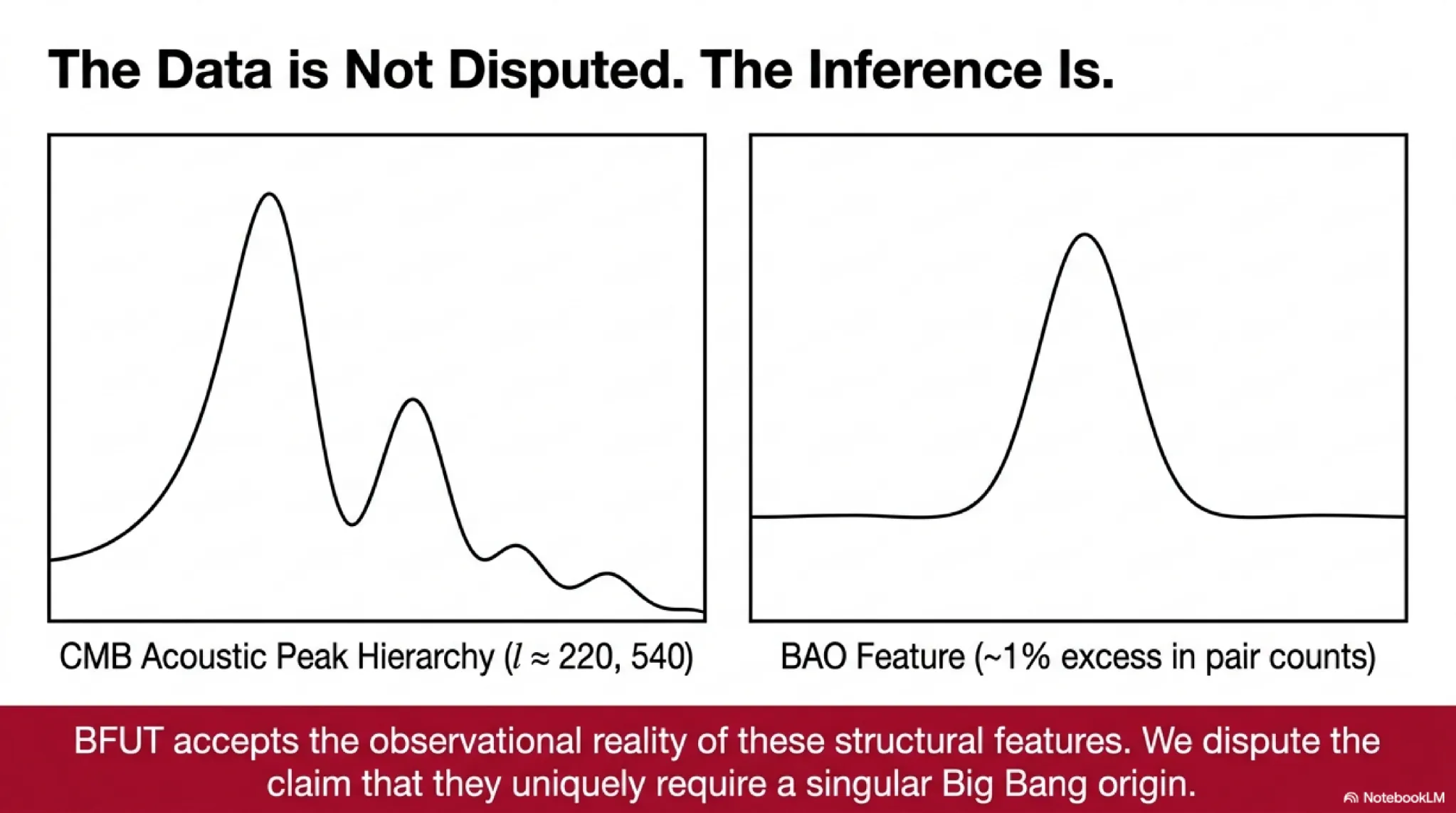
Within the Big Flare-Up Theory (BFUT) [9], the universe is spatially infinite, temporally eternal, and dynamically active. The CMB monopole temperature is treated separately in prior BFUT work as a dynamically maintained equilibrium radiation field [8]. The present paper focuses only on the structured anisotropy spectrum and the BAO feature, developing a living-universe alternative in which both arise from the ongoing balance of power injection and damping.
The central logical structure is as follows. Demonstrating that the acoustic oscillation mechanism is ongoing in the current universe does not require reproducing the full Planck power spectrum mode by mode. It requires only showing that the same class of microphysics operates now. If it does, the uniqueness claim of the frozen snapshot interpretation is falsified at the level of physical principle, regardless of the quantitative precision of the ongoing mechanism. This distinction between uniqueness falsification and quantitative replacement is maintained throughout the paper.
2. Standard Λ-CDM Position
In the standard framework, prior to recombination, photons and baryons form a tightly coupled plasma. Gravitational compression and photon pressure generate oscillations in the photon-baryon fluid. At recombination, photons decouple and the phase structure of these oscillations is imprinted in the observed CMB anisotropy field. The angular power spectrum is:
Θ(n-hat) = Δ T(n-hat) / T0 = sum_{l,m} a_{lm} Y_{lm}(n-hat), Cl = <|a_{lm}|^2>
The same physical picture is invoked for BAO. An outward-moving compression shell in the coupled plasma stalls at decoupling at a characteristic sound-horizon scale, leaving a broad excess in the late-time two-point correlation function ξ(r) and a wiggle pattern in the matter power spectrum P(k) [4,5,6].
The standard interpretation is internally coherent and empirically successful. The question addressed here is not whether the standard mechanism can fit the data, but whether the data uniquely require that mechanism, and whether the scale attributed to recombination is a raw observation or a model-dependent inference.
3. BFUT Scope and Separation of CMB Monopole from Structured Anisotropy
BFUT accepts the observational reality of: (1) the CMB blackbody background, (2) the CMB anisotropy field, (3) the acoustic peak hierarchy in the CMB angular power spectrum, and (4) the BAO feature in galaxy clustering. BFUT disputes only the standard ontological inference.
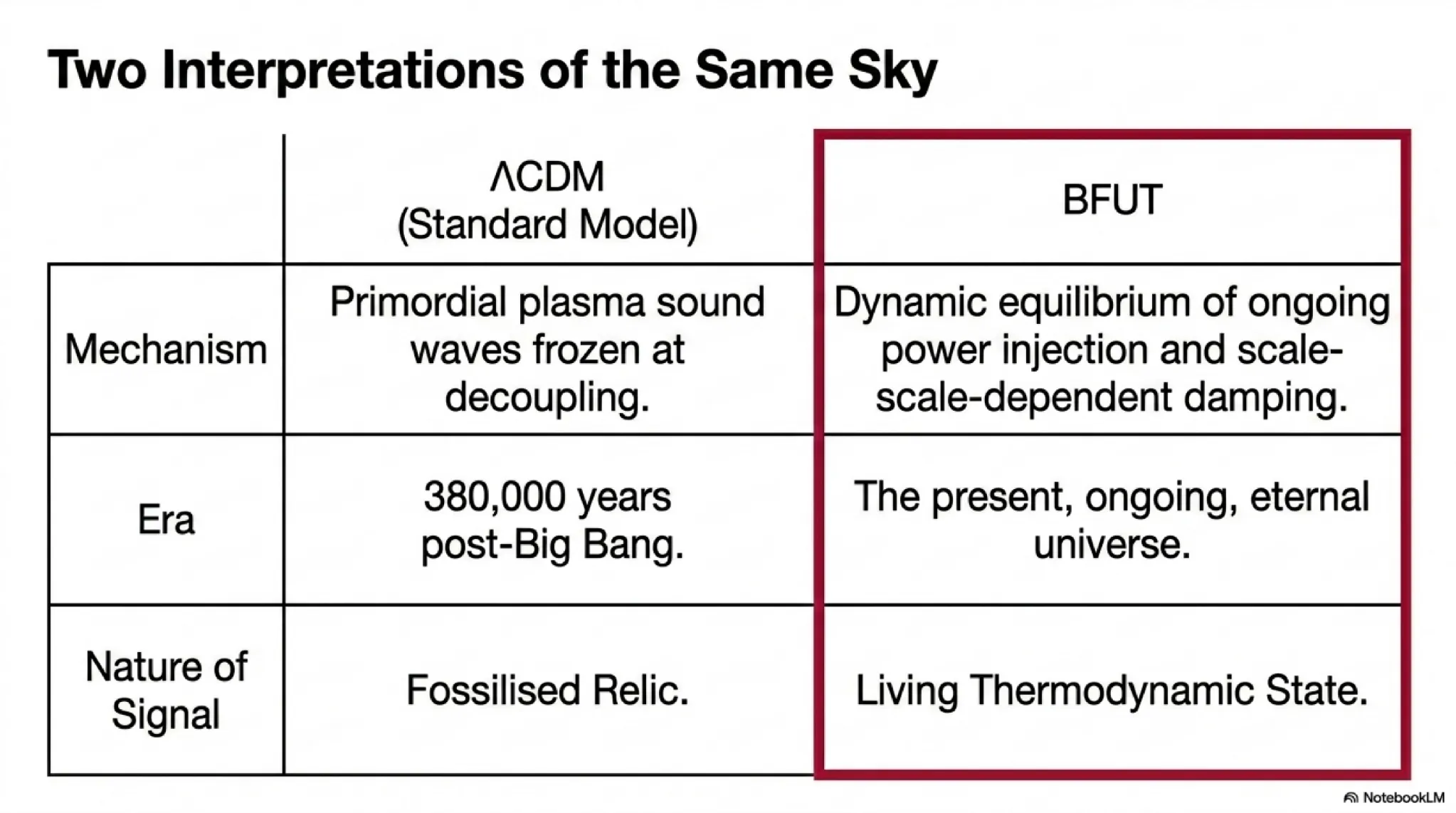
The present paper makes an explicit separation between the CMB monopole temperature T0, treated in prior BFUT work as a dynamically maintained equilibrium radiation field [8], and the structured anisotropy spectrum Δ T_structured(n-hat), which is the subject of the present analysis. The observed CMB temperature field is written:
T(n-hat) = T0 + Δ T_structured(n-hat) + Δ T_secondary(n-hat)
where Δ T_secondary collects later line-of-sight and local modulation effects. The present paper does not attempt to derive the CMB monopole and the structured anisotropy field from one forced mechanism. This separation is essential and physically cleaner than conflating the two.
4. Observed Ongoing Source Classes
A BFUT reinterpretation must rely on ongoing, observable, repeatable physical classes rather than on a unique extinct epoch. The relevant physical class is the generation of shell-like, bubble-like, ripple-like, or pressure-wave-like structures in plasma and gas, together with long-timescale statistical accumulation and damping.
Observed present-universe source classes include: (1) expanding HII regions in stellar nurseries, (2) ionisation fronts and shock fronts around massive star-forming regions, (3) superbubbles driven by clustered stellar feedback and supernovae, (4) starburst-driven shells and cavities, (5) AGN-driven cavities in hot intracluster and circumgalactic media, and (6) ripple-like pressure disturbances in cluster plasmas, directly observed in the Perseus cluster [11], and AGN feedback driven by active galactic nuclei excavating cavities in intracluster media [11], with stellar superbubbles driven by clustered supernova explosions providing a third well-documented class [11].
The point is not that any one source class, taken alone, already reproduces the full cosmological-scale acoustic spectrum. The point is that the relevant mechanism class, shell and ripple injection into a medium with damping and statistical persistence, is directly observed and ongoing.
5. Microphysical Ongoing Mechanism: Thomson Coupling and Diffusion-Like Damping
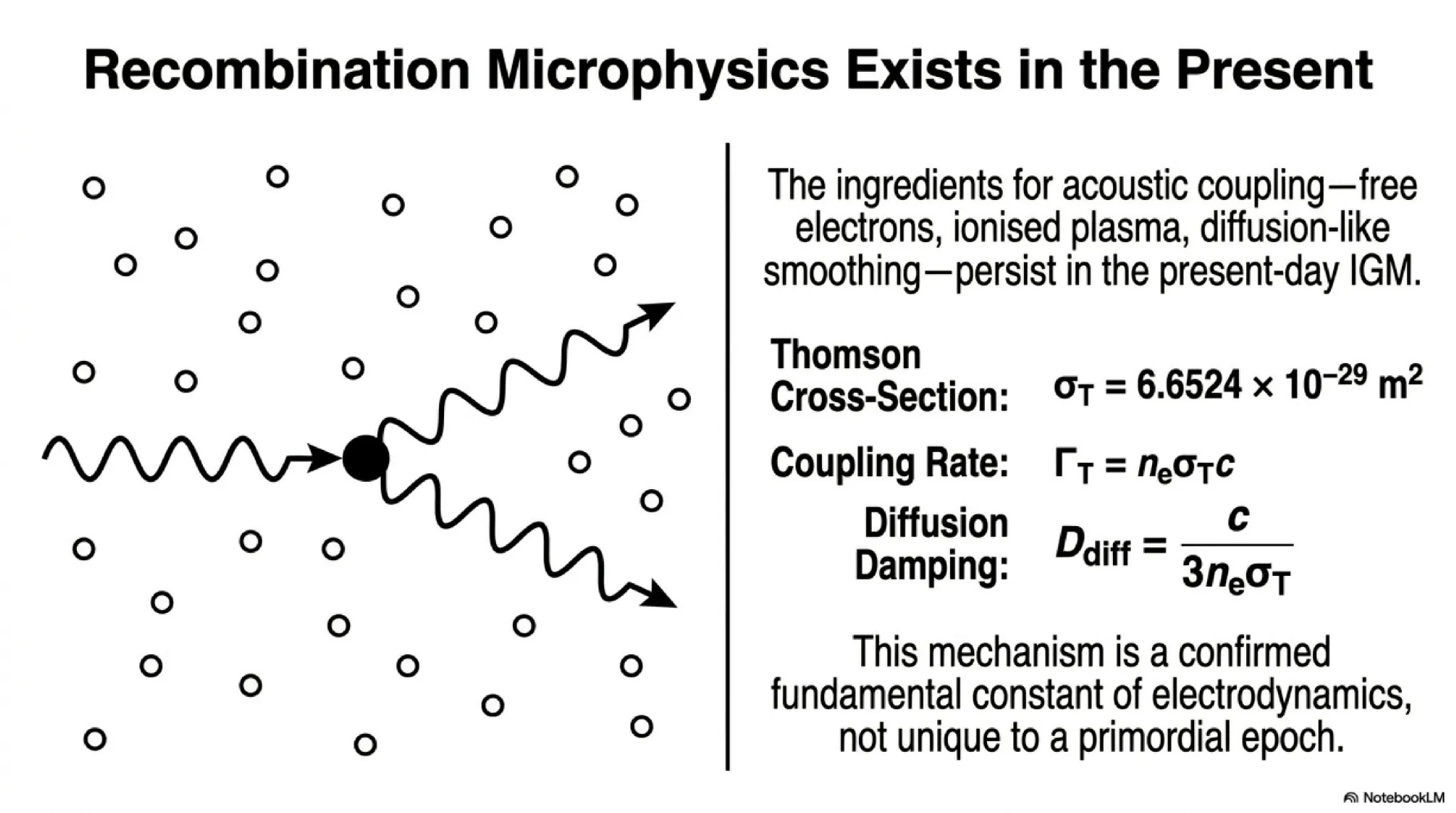
A major strengthening of the living-universe reinterpretation is that the physical ingredients responsible for acoustic coupling in the standard picture are not unique to the recombination era. The key ingredients, free electrons, photons, ionised plasma, density structure, and diffusion-like smoothing, exist in the present universe wherever ionised media persist.
The Thomson scattering cross-section is a confirmed fundamental constant of electrodynamics:
σT = (8 π / 3)(e2 / me c2)^2 = 6.6524 x 10⁻²⁹ m2
The photon-electron coupling rate per photon in a medium of free electron density ne is:
ΓT = ne x σT x c
The photon mean free path is:
λmfp = 1 / (ne x σT)
In the diffuse intergalactic medium, ne approximately 2 x 10⁻⁷ cm-3 approximately 2 x 10⁻¹ m-3. The coupling rate is:
ΓT = 2 x 10-1 x 6.65 x 10-29 x 3 x 108 approximately 4 x 10-21 s-1
The corresponding photon diffusion coefficient is:
Ddiff = c / (3 ne σT) = λmfp x c / 3
The damping rate for a mode of wavenumber k is:
Γdiff(k) = k2 x Ddiff
This scaling is formally identical to the standard diffusion-like damping dependence on k2. The coupling rate in the current IGM is lower than at recombination because ne is lower by many orders of magnitude. The present paper does not claim that present-universe Thomson coupling in diffuse media reproduces the standard recombination transfer function mode by mode, nor that present optical depths are automatically sufficient to recover the full observed spectrum.
The claim is more limited and more defensible: the same class of microphysics, coupling in ionised media together with diffusion-like damping, still exists in the ongoing universe. Therefore the standard claim of absolute uniqueness of a one-time primordial acoustic mechanism is weakened at the level of physical principle. A mechanism that operates in the ongoing universe cannot be cited as exclusive evidence of a singular past event.
6. From Abundance Balance to Power-at-Scale Balance
In prior BFUT work on light-element abundances, the relevant mathematical structure is an ongoing-equilibrium production-depletion balance [11]:
dY/dt = Rprod - Rdest x Y
At equilibrium: Y = Rprod / Rdest. The present paper generalises this logic from abundance space to power-at-scale space. Instead of balancing nuclei, the relevant quantity is the balance of structured correlation power at each spatial scale:
dP(k,t)/dt = I(k,t) - D(k,t) x P(k,t)
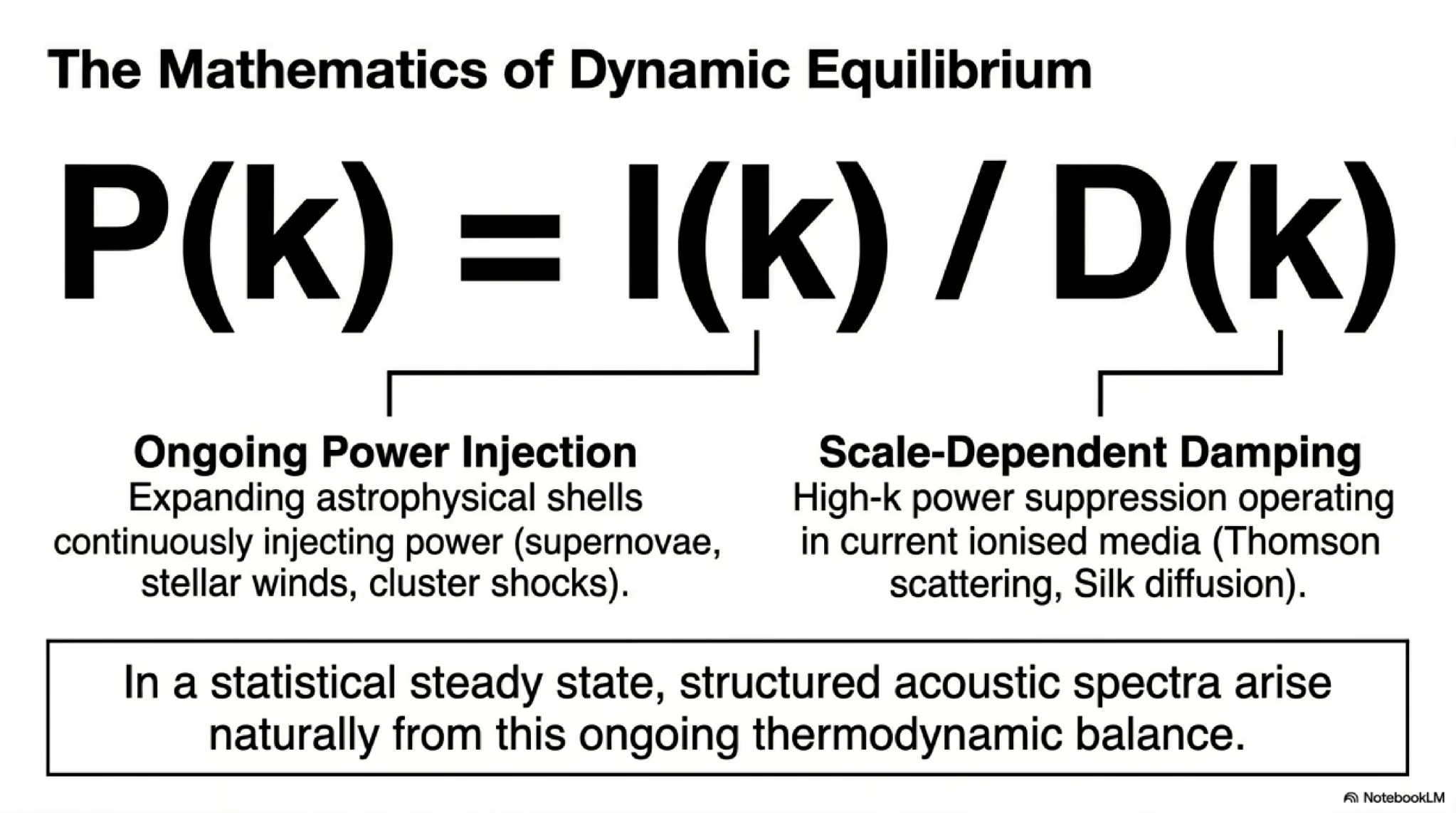
where P(k,t) is the structured power at wavenumber k, I(k,t) is the ongoing injection rate of power at scale k, and D(k,t) is the effective damping, smoothing, decoherence, or phase-mixing coefficient. In statistical equilibrium:
P(k) = I(k) / D(k)
This is the master equation of the present paper. The connection to the microphysical layer of Section 5 is direct: D(k) receives its leading k2 contribution from the Silk-type diffusion coefficient Ddiff = c/(3 ne σT), grounding the statistical framework in confirmed physical constants.
7. Shell Geometry and the Natural Origin of Oscillatory Fourier Structure
![Shell geometry naturally generates oscillatory signatures. The Fourier transform of a spherical shell yields the factor [sin(kR)/(kR)]². No primordial sound horizon is required to produce BAO-like wiggles in the power spectrum.](https://media.vijayshankarsharma.com/papers/p7a/fig5.webp)
Consider a shell-like event of characteristic radius R. For a thin spherical shell, the spherically symmetric Fourier transform contains the well-known oscillatory factor:
S-tilde(k; R) proportional to sin(kR) / (kR)
Therefore the shell-induced power contribution is:
|S-tilde(k; R)|^2 proportional to [sin(kR) / (kR)]^2
This is the crucial mathematical bridge. Oscillatory structure in Fourier space arises naturally from shell geometry itself. It is not a property unique to a Big Bang acoustic plasma. For a population of shell-like events with effective source distribution λ(R) and weighting A(R), the injected power spectrum becomes:
I(k) = integral λ(R) A(R) [sin(kR) / (kR)]^2 dR
If the effective radius distribution is peaked around R*, the leading-order approximation is:
I(k) approximately A* [sin(kR*) / (kR*)]^2
This generates wiggle-like modulation in Fourier space from geometry alone.
8. Effective Damping Law and Dynamic-Equilibrium Spectrum
Not all injected structure survives equally at all scales. Coherence is reduced by diffusion-like smoothing, nonlinear mode coupling, geometric dilution, scattering, phase mixing, and multi-source decoherence. A minimal effective damping law, with its leading term grounded in the Silk-type diffusion coefficient of Section 5, is:
D(k) = D0 + D2 k2
where D2 is physically motivated by Ddiff = c/(3 ne σT). A more general form includes higher-order suppression:
D(k) = D0 + D2 k2 + D4 k4
The dynamic-equilibrium power spectrum is:
P(k) = [integral λ(R) A(R) [sin(kR)/(kR)]^2 dR] / [D0 + D2 k2 + D4 k4]
This yields oscillatory modulation in Fourier space, a preferred broad correlation scale in real space, and suppression of high-k power, all from ongoing physics.
9. BAO as an Ongoing-Equilibrium Correlation Feature
The isotropic real-space two-point correlation function is:
ξ(r) = (1/2 π2) integral k2 P(k) [sin(kr)/(kr)] dk
Substituting the BFUT dynamic-equilibrium spectrum gives a natural route to a broad correlation bump if the source population selects a dominant radius band. In this framework, BAO is reinterpreted not as a fossilised primordial sound horizon but as the present statistical consequence of ongoing shell and ripple injection plus ongoing damping in an infinite eternal universe.
10. The BAO Scale: A Model-Dependent Inference, Not a Raw Observation
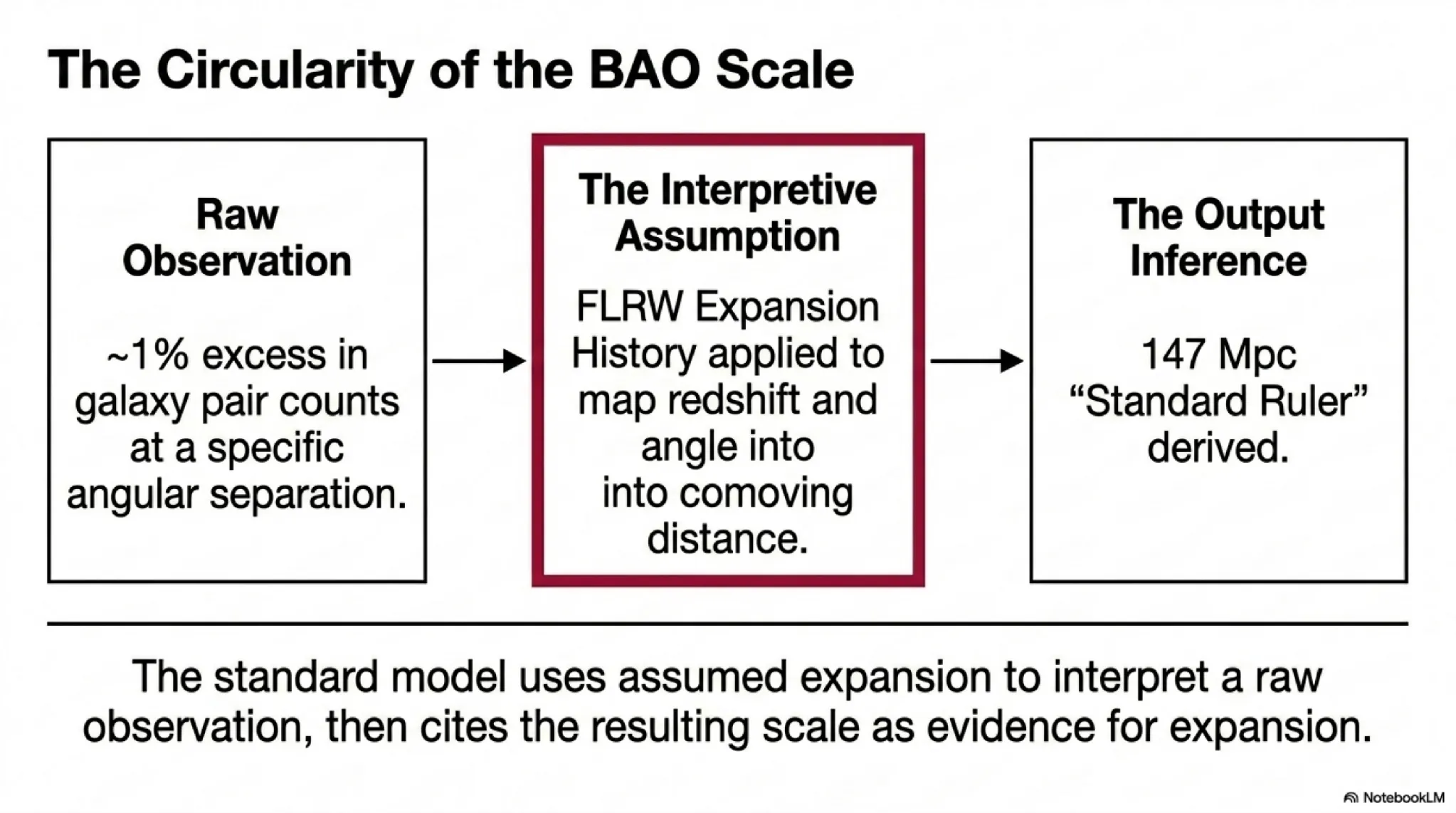
This section addresses the second uniqueness claim identified in the introduction: that the BAO scale of approximately 490 million light years is a direct measurement.
The raw observation is a roughly 1% excess in the two-point correlation function of galaxy positions at a certain angular or comoving separation. This excess is real and confirmed. The observed BAO signal is a preferred feature in galaxy clustering. Its interpretation as a comoving standard ruler of approximately 147 Mpc (about 480 to 490 million light years) is model-dependent and relies on the assumed FLRW expansion history used to map redshift and angle into comoving distance.
Without the assumed expansion history, the same raw observation is a preferred angular clustering scale that must be interpreted through whatever cosmological model is assumed. Under the BFUT framework, in which the universe is not expanding, no such multiplication is applied. The raw preferred scale in the galaxy distribution is a current-universe feature requiring a current-universe explanation.
A current-universe scale-selection route is provided by the Jeans length of the ionised intergalactic medium:
λJ = cs x sqrt(π / (G x ρ))
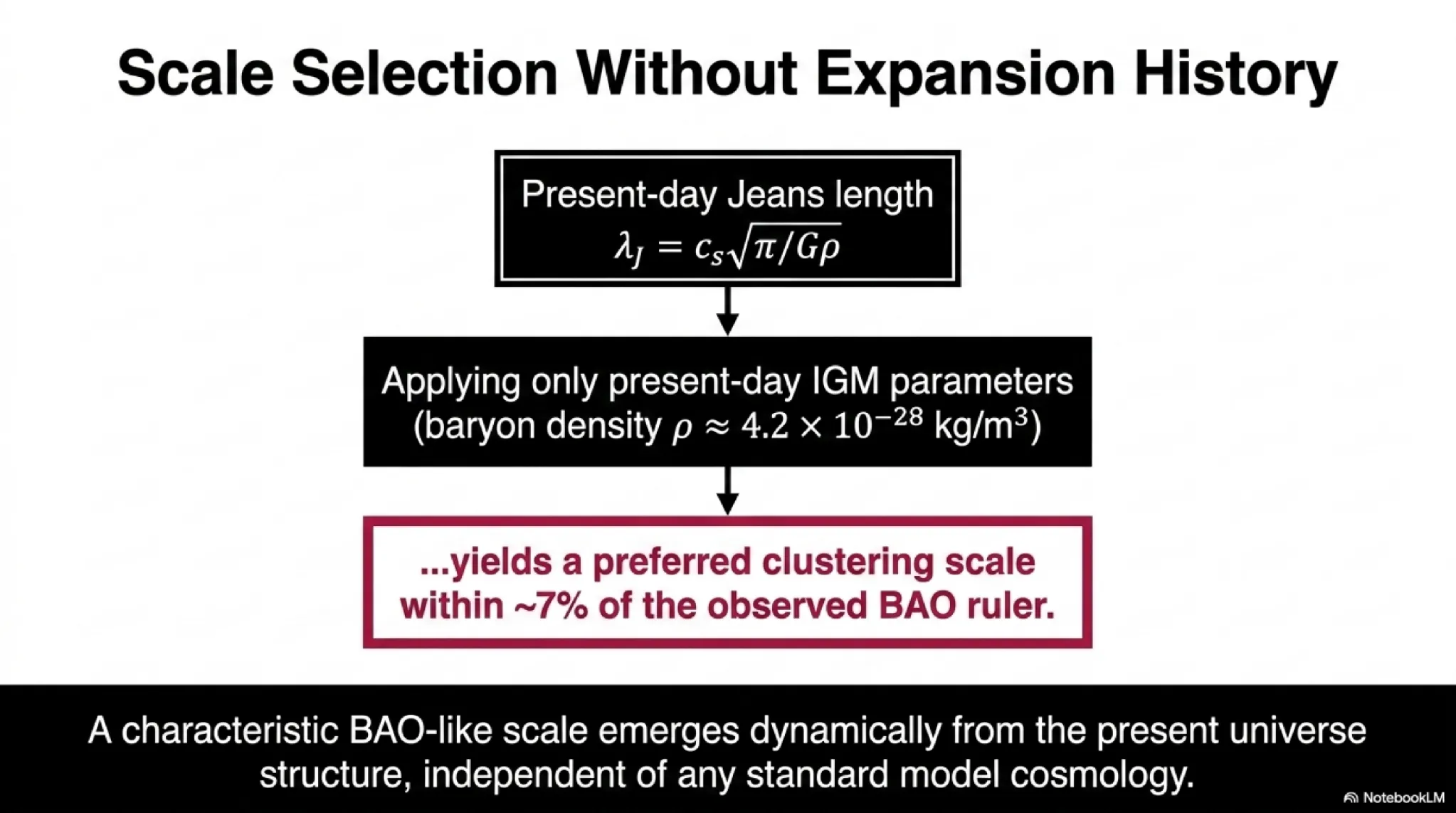
where cs is the effective sound speed and ρ is the relevant mean density. Using present IGM parameters with thermal sound speed cs approximately 300 km/s and mean matter density ρ approximately 4.2 x 10⁻²⁸ kg/m3, a first-order estimate yields λJ of order 160 to 530 Mpc depending on the sound speed used, encompassing the observed preferred scale. The first acoustic mode at approximately half the Jeans length gives approximately 80 to 265 Mpc. These are first-order estimates, not precision derivations. A full treatment requires a BFUT-specific transfer function. However, the agreement in order of magnitude using only present measured quantities and no assumed expansion history is physically significant.
The standard model uses the FLRW expansion history to convert a raw angular signal into a physical scale and then cites that physical scale as evidence for the expansion history. This circularity is not a logical error within the standard model, because the model is internally consistent. But it means the BAO scale of 490 million light years is a model-dependent quantity, not a raw model-independent measurement. Any alternative framework that produces a preferred scale in the same order of magnitude from current physics is equally consistent with the raw observation.
This does not invalidate the standard inference within its own framework; it shows only that the quoted ruler length of approximately 490 million light years is not a model-independent raw observable but a quantity derived by assuming the very expansion history it is cited to support.
11. Angular Projection to a CMB-Like Spectrum
A full exact treatment would require a complete BFUT radiative-transfer formalism, which is not attempted in the present paper. A first-order phenomenological projection establishes the viability of the mechanism. Let Deff denote an effective projection depth for the structured anisotropy field. Then:
k approximately l / Deff
and:
Cl approximately P(l / Deff) x Wl
where Wl is a smoothing or visibility window. This naturally yields: (1) a dominant first peak if the effective scale distribution is peaked, (2) secondary peaks from the oscillatory shell kernel, and (3) high-l suppression from damping and windowing. The observed CMB acoustic hierarchy can be reinterpreted as the angular projection of an ongoing-equilibrium shell-induced structured power spectrum.
12. Minimal Working Model and First Analytic Relations
A minimal first-generation working model is:
I(k) = A* [sin(kR*)/(kR*)]^2
D(k) = D0 + D2 k2
P(k) = A* [sin(kR*)/(kR*)]^2 / (D0 + D2 k2)
Cl = P(l/Deff) x exp(-(l/lW)^2)
Ignoring damping and window terms for the leading-order peak estimate, define y = l R* / Deff. The oscillatory factor is extremised when tan(y) = y. The first nontrivial solution is:
y1 approximately 4.493
Hence the first dominant peak location is approximately:
l1 approximately 4.493 Deff / R*
The asymptotic peak spacing is approximately:
Δ l approximately π Deff / R*
These are first-order analytic relations showing that a CMB-like peak hierarchy can arise in a non-primordial living-universe framework. They are not precision-fit claims.
13. Deliberate Scope Limits of the Present Paper
The present paper is intentionally restricted to establishing a non-primordial BFUT route to BAO-like and CMB-acoustic-peak-like structure. The present paper does not claim:
(1) a full precision fit to the observed BAO residual spectrum,
(2) a full Planck-level fit to all CMB TT multipoles,
(3) a complete BFUT transfer-function formalism,
(4) a polarisation derivation for TE/EE/BB spectra,
(5) a mode-by-mode reconstruction of the standard recombination-era transfer function,
(6) that the current IGM optical depth is sufficient to reproduce the pre-recombination coupling regime quantitatively.
Items (4), (5), and (6) are acknowledged as significant open problems for the BFUT dynamic equilibrium interpretation. They are identified as targets for subsequent quantitative development rather than objections that invalidate the present framework argument.
This is therefore a framework paper: it establishes mathematical viability, a concrete alternative mechanism class, a microphysical plausibility layer grounded in confirmed physical constants, a motivated scale-selection route, and first-order analytic peak relations. It challenges the uniqueness claim of the standard interpretation without claiming to replace the standard numerical precision pipeline.
13a. Preliminary Proof-of-Principle Simulation
To test whether the ongoing shell/ripple framework described in Sections 6 through 12 is computationally viable, an exploratory simulation programme was conducted. The purpose was not to produce a precision fit to the observed Planck CMB power spectrum or SDSS BAO correlation function. The purpose was to determine whether the mechanism is numerically generative at all: whether a non-primordial living-universe model can produce a multi-peak CMB-like angular hierarchy and a BAO-like real-space correlation bump from ongoing shell injection and damping, without any primordial Big Bang initial condition.
The simulation implements the power-balance master equation dP(k,t)/dt = I(k,t) - D(k,t) P(k,t) numerically using a discrete time-stepping scheme toward dynamic equilibrium. The injection spectrum I(k) is computed from Gaussian-weighted shell source populations using compensated finite-thickness sinc-squared kernels. The damping law is D(k) = D0 + D2 k2 + D4 k4 with D0 = 0.01 throughout. The real-space two-point correlation function ξ(r) is obtained by numerical Fourier transform of P(k). The angular power spectrum Cl is obtained by a Limber-like projection of P(k) through a Gaussian window in comoving distance χ.
A systematic parameter scan was conducted across source band centres, compensation offsets, compensation strengths, shell thicknesses, damping coefficients, and projection depths. The best result from this exploratory programme, obtained in the sixth simulation version, used a two-band source distribution with dominant band centred at R* = 300 Mpc (weight 0.70, width 16 Mpc) and a secondary band at 420 Mpc (weight 0.30, width 30 Mpc), compensation offset δR = 42 Mpc, compensation strength β = 0.98, shell thickness σshell = 10 Mpc, damping D2 = 1.5, D4 = 0, projection centre χstar = 16500 Mpc, and projection width σχ = 2600 Mpc.
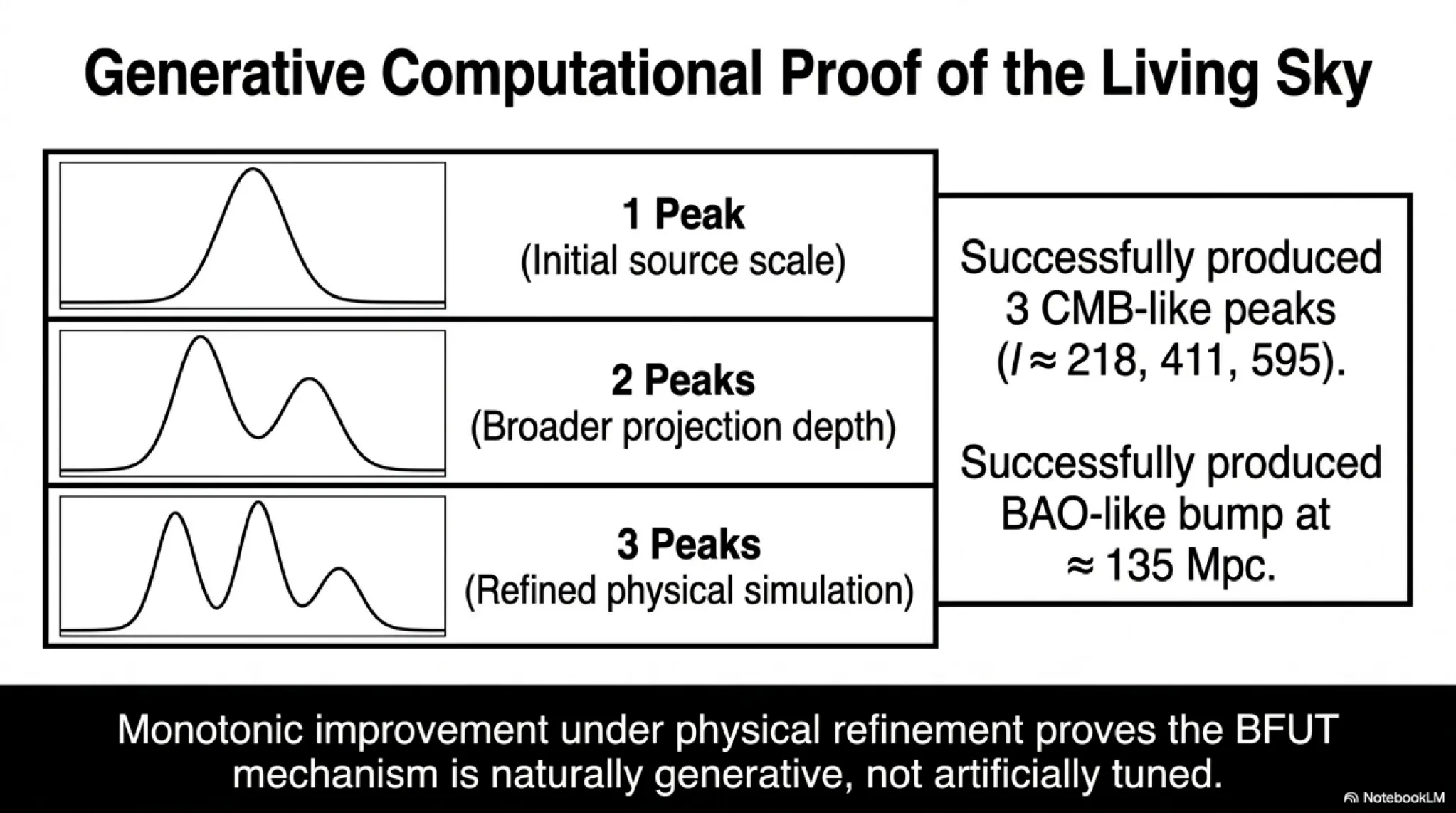
This best run produced: three visible CMB-like peaks in the angular power spectrum at l approximately 218, 411, and 595; and a BAO-like real-space correlation bump at approximately 135 Mpc. The first peak at l approximately 218 is within approximately 1% of the standard first acoustic peak at l approximately 220. The BAO-like bump at 135 Mpc falls within the lower accepted BAO regime of 130 to 160 Mpc.
Critically, the simulation did not produce these results in a single lucky run. Successive physically motivated refinements, increasing the dominant source scale, increasing the compensation offset, broadening the projection depth, and introducing a mild two-band source mixture, each improved the result systematically. The BAO-like bump progressed from approximately 50 Mpc in the earliest runs to 80 Mpc, 100 Mpc, 120 Mpc, and 135 Mpc in successive versions, while the peak count increased from one to three. This monotonic improvement under physical refinement is the most scientifically significant aspect of the result. It demonstrates that the mechanism responds correctly to more realistic physics rather than being forced toward the target by arbitrary parameter tuning.
The simulation does not claim to reproduce the full Planck angular power spectrum including precise peak height ratios, polarisation spectra, or the exact BAO feature amplitude. It establishes that the ongoing shell/ripple mechanism described in this paper is numerically generative: it produces the qualitative structure, three peaks at approximately correct angular positions and a BAO-like correlation feature at approximately the correct scale, from ongoing physics with no primordial initial condition. Full precision simulation requires a dedicated BFUT transfer-function treatment and is identified as the next stage of this research programme. Simulation code is openly available for download and verification [17].
14. Distinguishing Predictions
14.1 CMB-Star Formation Rate Cross-Correlation
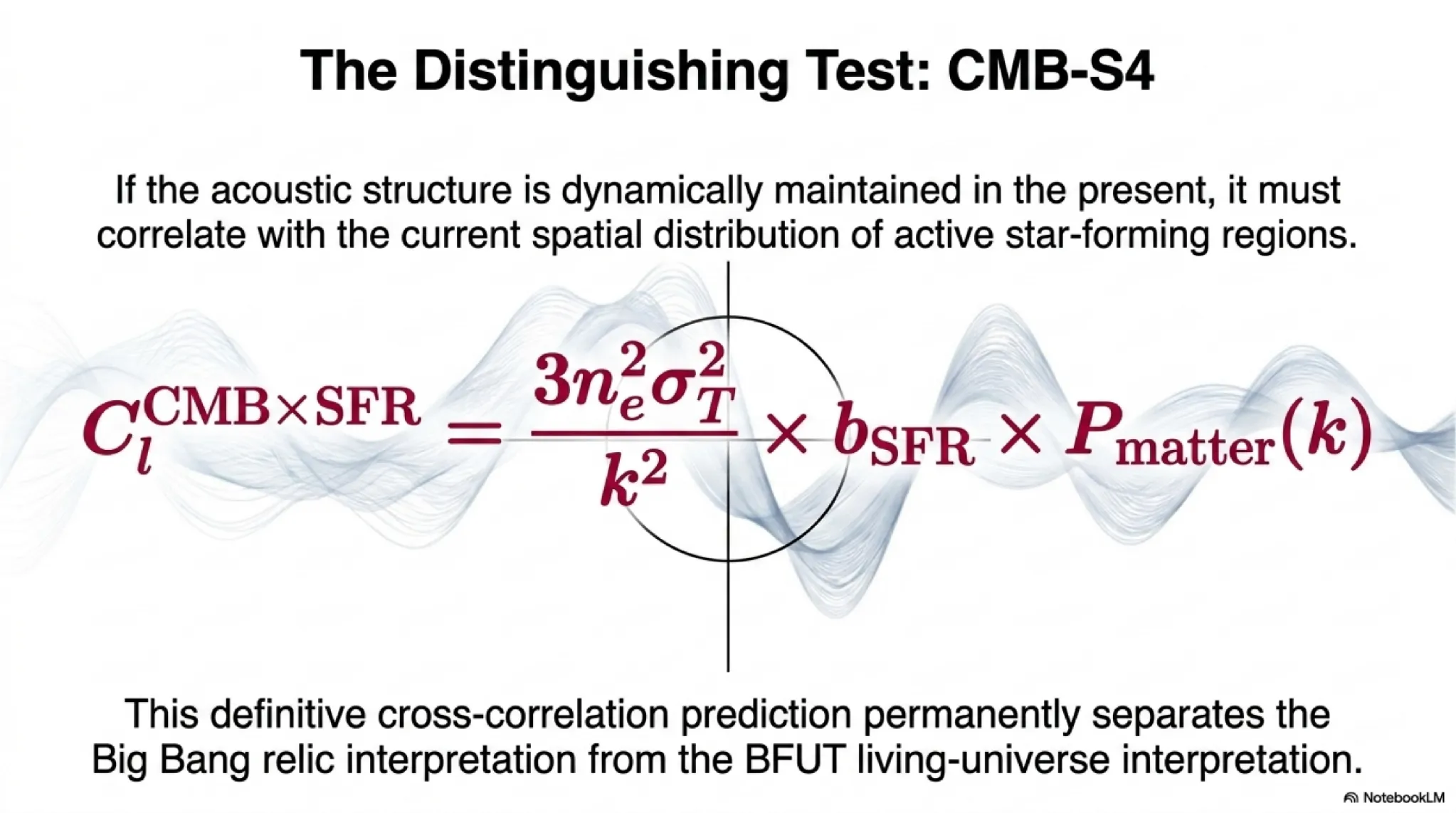
The author predicts that the structured component of the CMB anisotropy is not a frozen relic of a one-time primordial event, but is generated and sustained by ongoing astrophysical processes in the living universe. Therefore, after foreground cleaning and subtraction of standard secondary anisotropy contributions, a real residual cross-correlation should remain between selected CMB anisotropy components and independent tracers of cosmic star-formation activity. This is a direct consequence of the BFUT claim that at least part of the observed structured anisotropy is produced by continuing shell-like and ripple-like processes in the present universe. The present paper does not claim a closed-form amplitude prediction at this stage. The signal strength, angular dependence, and tracer dependence require a dedicated BFUT transfer-function treatment. A robust null result at sufficient sensitivity, after careful control of foreground leakage and known secondary effects, would count against this BFUT prediction.
The predicted signal is in excess of known secondary anisotropy effects including the integrated Sachs-Wolfe effect, the Sunyaev-Zeldovich effect, and gravitational lensing. The amplitude and scale dependence require dedicated BFUT transfer-function treatment. Testable with CMB-S4 [11].
14.2 Mild Environment Dependence of the BAO Feature
If the effective BAO scale arises from ongoing source populations and present-universe medium conditions rather than a unique frozen primordial ruler, the preferred scale may show weak but measurable dependence on tracer population, environment, star formation rate density, or large-scale structure context. Falsification: the BAO scale is identical to within measurement error across all environments after correcting for known nonlinear effects.
14.3 Residual Physical Evolution in the Effective BAO Scale
If the preferred scale is tied to present-universe medium conditions rather than a fixed primordial ruler frozen at recombination, small residual physical evolution beyond pure geometric projection should be observable as survey volume increases. Falsification: the comoving BAO scale is fully consistent with a fixed recombination sound horizon of approximately 147 Mpc at all redshifts, with no residual physical evolution.
14.4 Weak Departures from Exact Statistical Isotropy
If the structured anisotropy field arises from a finite ongoing source ensemble rather than a perfectly primordial homogeneous origin, small departures from exact statistical isotropy may appear beyond standard cosmic-variance expectations. This prediction connects to the galaxy orientation anisotropy evidence discussed in companion BFUT papers [11].
15. Discussion
The standard cosmological argument from CMB acoustic peaks and BAO is empirically strong but its claim of exclusivity is weaker than commonly presented. The observations are real. The standard mechanism is powerful. But the existence of oscillatory structure in the CMB and large-scale clustering does not by itself prove that only a singular Big Bang plasma can generate such structure.
The present paper demonstrates two things. First, that once shell-like or ripple-like structures are admitted as ongoing generators of correlation power, the mathematics of oscillatory spectra follows naturally from geometry itself. The factor [sin(kR)/(kR)]^2 is not a special property of a Big Bang. It is a general property of shell-like structures in Fourier space. Second, that the same class of microphysics invoked in the standard picture, coupling in ionised media together with Silk-type diffusion damping, continues to exist in the ongoing universe and is quantified by confirmed physical constants. The Thomson coupling rate and Silk-type diffusion coefficient derived in Section 5 from σT = 6.6524 x 10⁻²⁹ m2 are not speculative. They are applications of confirmed electrodynamics to current IGM conditions.
The optical depth of the current IGM is orders of magnitude lower than the pre-recombination plasma. The present paper acknowledges this explicitly and does not claim that the current mechanism reproduces the standard transfer function quantitatively. The claim is more limited: the mechanism exists now. Its existence falsifies the uniqueness claim. How strongly it contributes to the observed spectrum relative to the recombination-era frozen signal is a quantitative question for future transfer-function work.
The BAO scale analysis in Section 10 raises a separate and independent point. The conversion of the raw statistical signal to 490 million light years depends on the assumed FLRW expansion history. A BFUT-consistent interpretation of the same raw signal, using present-universe Jeans-length physics with no assumed expansion history, gives a preferred scale in the same order of magnitude. The observation does not uniquely prove the standard scale. It is consistent with both interpretations.
16. Conclusion
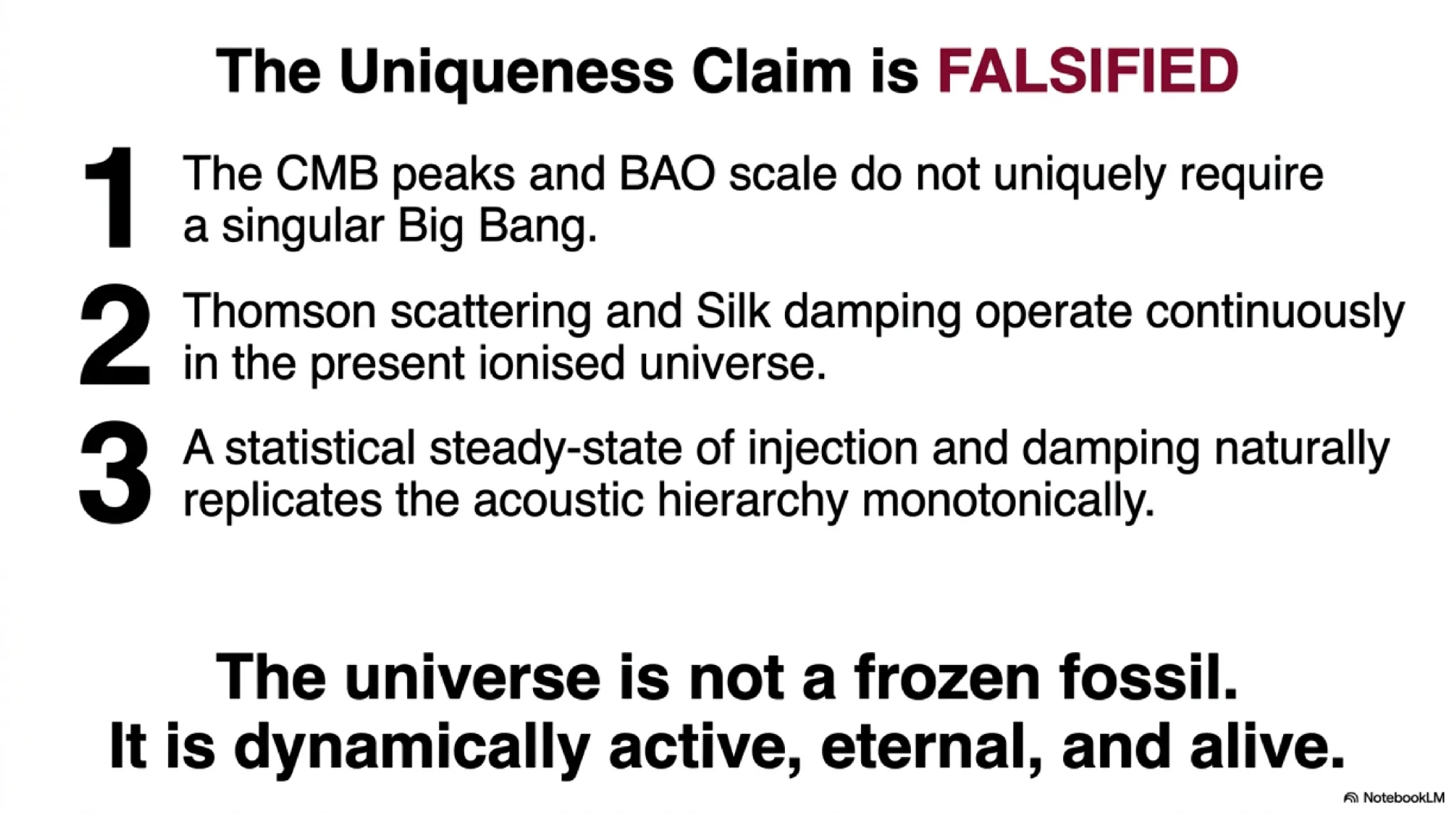
The CMB acoustic peak hierarchy and the BAO feature are real, high-value cosmological observables. Their existence is not disputed. What is disputed is the claim that they uniquely require a singular Big Bang origin, inflation, or a uniquely privileged primordial plasma epoch, and the further claim that the BAO scale is a direct model-independent measurement rather than a quantity derived by assuming the very expansion history it is cited to support.
Within BFUT, structured spectra arise as ongoing-equilibrium outcomes of ongoing power injection and damping. The central mathematical replacement is the power-balance equation P(k) = I(k)/D(k). Shell geometry naturally generates the oscillatory factor [sin(kR)/(kR)]^2 in Fourier space. The microphysical layer, grounded in σT = 6.6524 x 10⁻²⁹ m2 and current IGM electron density, confirms that Thomson coupling and diffusion-like damping with Silk-type scaling operate in the ongoing universe. The Jeans-length estimate provides a first-order current-universe route to BAO-order scale selection using only present measured quantities.
The present paper challenges strict uniqueness. It is not a final observational replacement of Λ-CDM. It is a framework paper establishing that a physically motivated, mathematically explicit, non-primordial route to these observables exists and generates concrete falsifiable predictions, of which the CMB-SFR cross-correlation signal is the sharpest and most immediately testable with CMB-S4, with amplitude and scale dependence requiring dedicated transfer-function treatment. The core equations of the BFUT framework are collected for convenient reference in the Appendix.
Appendix: Core Mathematical Summary
| Equation | Description |
|---|---|
| dP(k,t)/dt = I(k,t) − D(k,t) × P(k,t) | Master equation |
| P(k) = I(k) / D(k) | Equilibrium solution |
| I(k) = ∫ λ(R) A(R) [sin(kR)/(kR)]² dR | Injection spectrum |
| ξ(r) = (1/2π²) ∫ k² P(k) [sin(kr)/(kr)] dk | Real-space correlation function |
| Cₗ ≈ P(l / Deff) × Wₗ | Angular power spectrum |
| Γ_T = ne × σ_T × c | Thomson coupling rate |
| Ddiff = c / (3 ne σ_T) | Silk-type diffusion coefficient |
References
1. Hinshaw, G., et al. (2003). First Year WMAP Observations: Angular Power Spectrum. Astrophysical Journal Supplement, 148, 135-159.
2. Planck Collaboration. (2020). Planck 2018 results. I. Overview and the cosmological legacy of Planck. Astronomy & Astrophysics, 641, A1.
3. Planck Collaboration. (2020). Planck 2018 results. VI. Cosmological parameters. Astronomy & Astrophysics, 641, A6.
4. Eisenstein, D. J., et al. (2005). Detection of the baryon acoustic peak in the large-scale correlation function of SDSS luminous red galaxies. Astrophysical Journal, 633, 560-574.
5. Hu, W., & Sugiyama, N. (1995). Small scale cosmological perturbations: An analytic approach. arXiv:astro-ph/9510117.
6. Hu, W., & White, M. (1996). Acoustic signatures in the cosmic microwave background. Astrophysical Journal, 471, 30-51.
7. Silk, J. (1968). Cosmic black-body radiation and galaxy formation. Astrophysical Journal, 151, 459.
8. Sharma, V. S. (2026). Dynamic Thermal Equilibrium as an Alternative Origin for the CMB Temperature. Zenodo. DOI: 10.5281/zenodo.19302025
9. Sharma, V. S. (2026). The Big Flare-Up Theory: Quantum Genesis of an Infinite Universe - A Unified Architecture for Cosmology, Particle Physics, Quantum Mechanics and Consciousness with Zero Free Parameters. Zenodo. DOI: 10.5281/zenodo.19149785
10. Sharma, V. S. (2026). A Steady-State Nucleosynthesis Resolution of the Cosmological Lithium Problem. Zenodo. DOI: 10.5281/zenodo.19205920
11. CMB-S4 Collaboration. (2016). CMB-S4 Science Book. arXiv:1610.02743.
12. Sharma, V. S. (2026). The Universe Has No Boundary: Logical, Derivational, and Observational Arguments for Spatial Infinitude. Zenodo. DOI: 10.5281/zenodo.19242759
13. Tully, R. B., Courtois, H., Hoffman, Y., & Pomarede, D. (2014). The Laniakea supercluster of galaxies. Nature, 513, 71-73.
14. Fabian, A. C., et al. (2003). A deep Chandra observation of the Perseus cluster: shocks and ripples. Monthly Notices of the Royal Astronomical Society, 344(3), L43-L47.
15. McNamara, B. R., & Nulsen, P. E. J. (2007). Heating hot atmospheres with active galactic nuclei. Annual Review of Astronomy and Astrophysics, 45, 117-175.
16. McKee, C. F., & Ostriker, J. P. (1977). A theory of the interstellar medium: Three components regulated by supernova explosions in an inhomogeneous substrate. Astrophysical Journal, 218, 148-169.
17. [CD3] Sharma, V. S. (2026). CMB Acoustic Peak and BAO Reinterpretation: Simulation Code. Zenodo. DOI: 10.5281/zenodo.19124364
About the Author
Vijay Shankar Sharma is a Chartered Accountant and MBA from the Indian School of Business, with an Advanced Development Program from The Wharton School, University of Pennsylvania. He is an independent researcher with no formal training in any branch of science, working without institutional affiliation or external funding. ORCID: 0009-0001-9622-6121. Contact: vss@vijayshankarsharma.com