Dynamic Thermal Equilibrium as an Alternative Origin for the CMB Temperature
- Abstract
- Introduction
- The Stefan-Boltzmann Derivation
- Inputs
- Input 1: The measured CMB energy density. The CMB energy density, measured by COBE and subsequent instruments [1,6], is:
- Input 2: The measured luminosity density. The luminosity density of the observable universe, measured from galaxy surveys [7], is:
- The Derivation
- Luminosity Density Cross-Check
- Thermal Accumulation Timescale
- Comparison with the Relic Radiation Account
- The Blackbody Spectrum Precision
- Is This Circular?
- The Horizon Problem
- The CMB Anisotropies
- Dynamic Equilibrium Account
- The Distinguishing Prediction
- References
- About the Author
Abstract
The Cosmic Microwave Background (CMB) is a near-perfect isotropic blackbody radiation field at T = 2.725 K. The standard interpretation identifies it as relic radiation from the epoch of recombination in a finite-age Big Bang universe. This paper presents an alternative thermodynamic reinterpretation: the observed CMB energy density is numerically consistent with 2.725 K under the standard blackbody radiation relation, and within the Big Flare-Up Theory (BFUT) this observed background can be understood as a dynamically maintained equilibrium radiation field in an infinite universe continuously heated by stellar fusion; it is not interpreted uniquely as relic radiation. Two proof-of-concept simulations are presented. A phenomenological anisotropy simulation shows that a source-modulated equilibrium sky naturally produces anisotropy at the observed order of magnitude (σ approximately 10-5), with source-field correlation collapsing to near zero under randomised controls (r = 0.001 vs r = 1.000 for the structured BFUT sky). A three-dimensional thermal-body equilibrium simulation with periodic boundaries and only 0.047% luminous occupancy produces a parent-child temperature mismatch of only approximately 3.67 x 10⁻⁴% and a child-frame coefficient of variation of approximately 9.70 x 10⁻⁶, demonstrating that near-perfect uniformity emerges naturally from thermodynamic equilibration without requiring an inflationary mechanism. The paper advances a falsifiable observational prediction: CMB temperature anisotropies should exhibit positive correlation with the spatial distribution of active star-forming regions in excess of standard secondary-anisotropy expectations, testable with CMB-S4. Simulation code is openly available for download and verification.
Keywords: Cosmic Microwave Background, CMB, thermal equilibrium, Stefan-Boltzmann, relic radiation, horizon problem, inflation, Big Flare-Up Theory
Introduction
The Cosmic Microwave Background is a near-perfect isotropic blackbody radiation field permeating the observable universe at a temperature of T = 2.725 +/- 0.001 K [1]. Its existence was predicted by Gamow, Alpher and Herman [2,3] and discovered by Penzias and Wilson in 1965 [4]. The CMB is universally cited as one of the three pillars of Big Bang cosmology, alongside the Hubble relationship and Big Bang Nucleosynthesis.
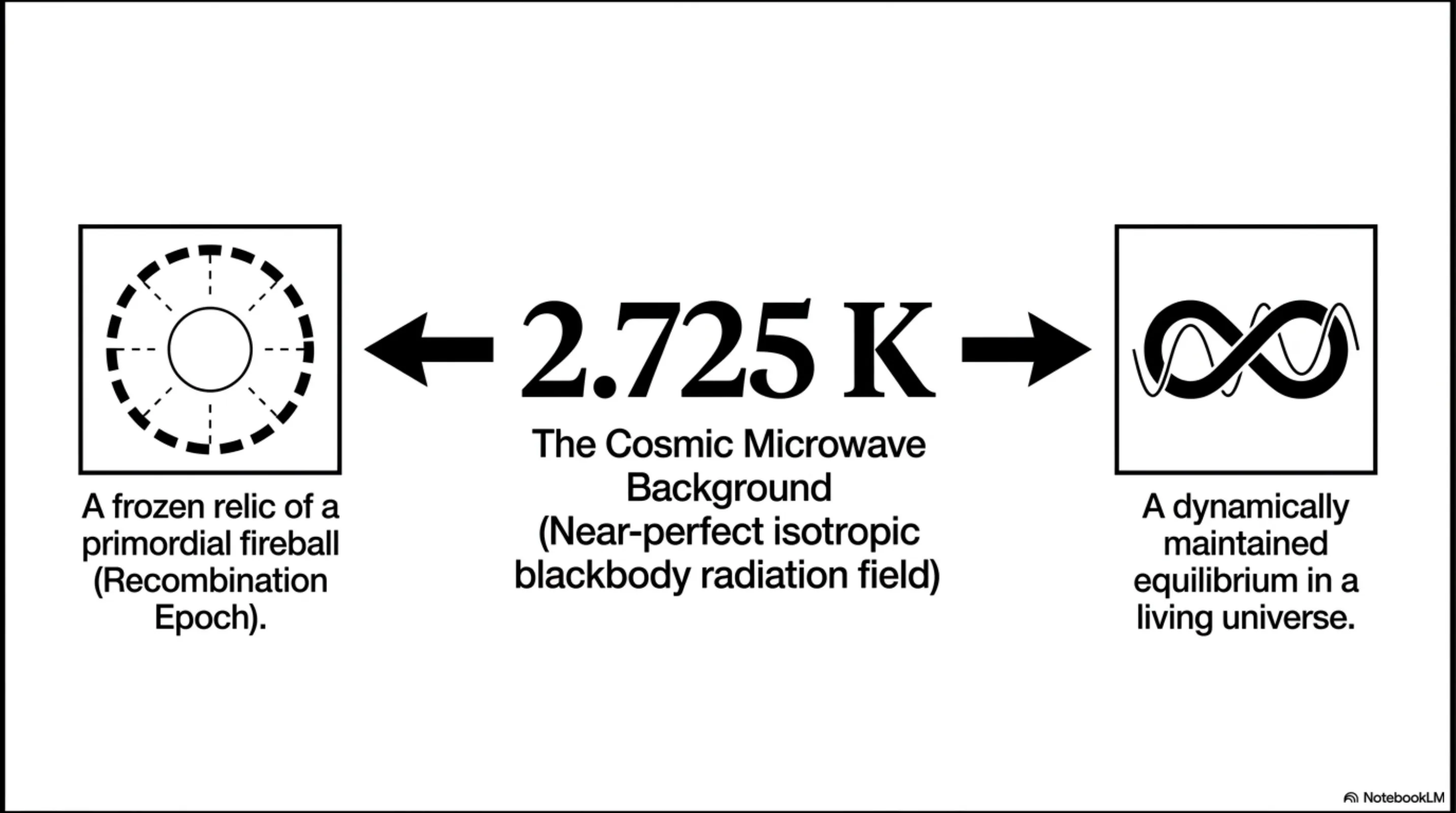
The standard interpretation proposes that the CMB was produced at the epoch of recombination, approximately 380,000 years after the Big Bang, when the universe cooled to approximately 3,000
K. At this temperature, electrons combined with protons to form neutral hydrogen, and the universe became transparent to radiation. The photons that had been in thermal equilibrium with the plasma were released and have been propagating freely since, cooling as the universe expanded by a factor of approximately 1,100 from the recombination epoch to the present. The current temperature of 2.725 K is the result of this redshifting.
This paper presents an alternative interpretation of the CMB temperature that does not invoke the Big Bang, recombination, inflation, or expansion history. The alternative is an application of standard blackbody thermodynamics: the observed CMB energy density is numerically consistent with 2.725 K through the Stefan-Boltzmann relation, and within BFUT this correspondence is interpreted as evidence of a dynamically maintained equilibrium field, not a primordial relic. The novelty of this paper lies not in discovering the CMB temperature, but in proposing a different ontological status for what that temperature represents: not the cooled remnant of a singular past event, but the present equilibrium temperature of an ongoing cosmic process.
This paper is part of a series presenting individual components of the Big Flare-Up Theory (BFUT) [5]. The CMB interpretation presented here can be evaluated independently of the other BFUT claims, by specialists in CMB physics, on its own logical and observational merits.
The argument for uniqueness rests on a claim this paper challenges directly: that the mechanism producing CMB temperature and acoustic structure, Thomson scattering coupling of photons and baryons against diffusion-like damping, is unique to the pre-recombination era. If the same class of microphysics operates in the ongoing universe, the uniqueness claim is falsified at the level of physical principle, independently of whether a quantitative mode-by-mode match is achieved. Demonstrating the mechanism is ongoing is sufficient to falsify uniqueness. That is the central logical contribution of the acoustic peaks section of this paper.
The Stefan-Boltzmann Derivation
Physical Basis
A blackbody radiation field in thermal equilibrium with a heat source at temperature T has an energy density given by the Stefan-Boltzmann relation:
u = (4 σ / c) T4
where σ = 5.670 x 10⁻⁸ W m-2 K-4 is the Stefan-Boltzmann constant and c is the speed of light. This relation applies whenever radiation is in dynamic equilibrium with its source: the rate of energy input to the radiation field equals the rate of energy output, maintaining the field at a constant temperature.
This is the same thermodynamic principle that determines the temperature of the interior of a furnace, the surface of a star, or the interior of any heated enclosure. The equilibrium temperature is set by the balance between energy input and output, mediated by the Stefan-Boltzmann law. The
precision of the resulting blackbody spectrum depends on how well the equilibrium is maintained: a perfectly maintained equilibrium produces a perfect blackbody spectrum.
Inputs
The primary input for the thermodynamic consistency relation is the measured CMB energy density. The measured cosmic luminosity density is presented separately as an independent plausibility argument for the source reservoir required to sustain such a background under a dynamic-equilibrium interpretation. These are treated as distinct arguments, not as jointly deriving the temperature.
Input 1: The measured CMB energy density. The CMB energy density, measured by COBE and subsequent instruments [1,6], is:
uCMB = 4.17 x 10⁻¹⁴ J/m3
Input 2: The measured luminosity density. The luminosity density of the observable universe, measured from galaxy surveys [7], is:
jL approximately 2.6 x 10⁻³³ W/m3
These are both measured values. No model-dependent parameters are required.
The Derivation
Solving the Stefan-Boltzmann relation for T:
T = (uCMB x c / (4 σ))^(1/4)
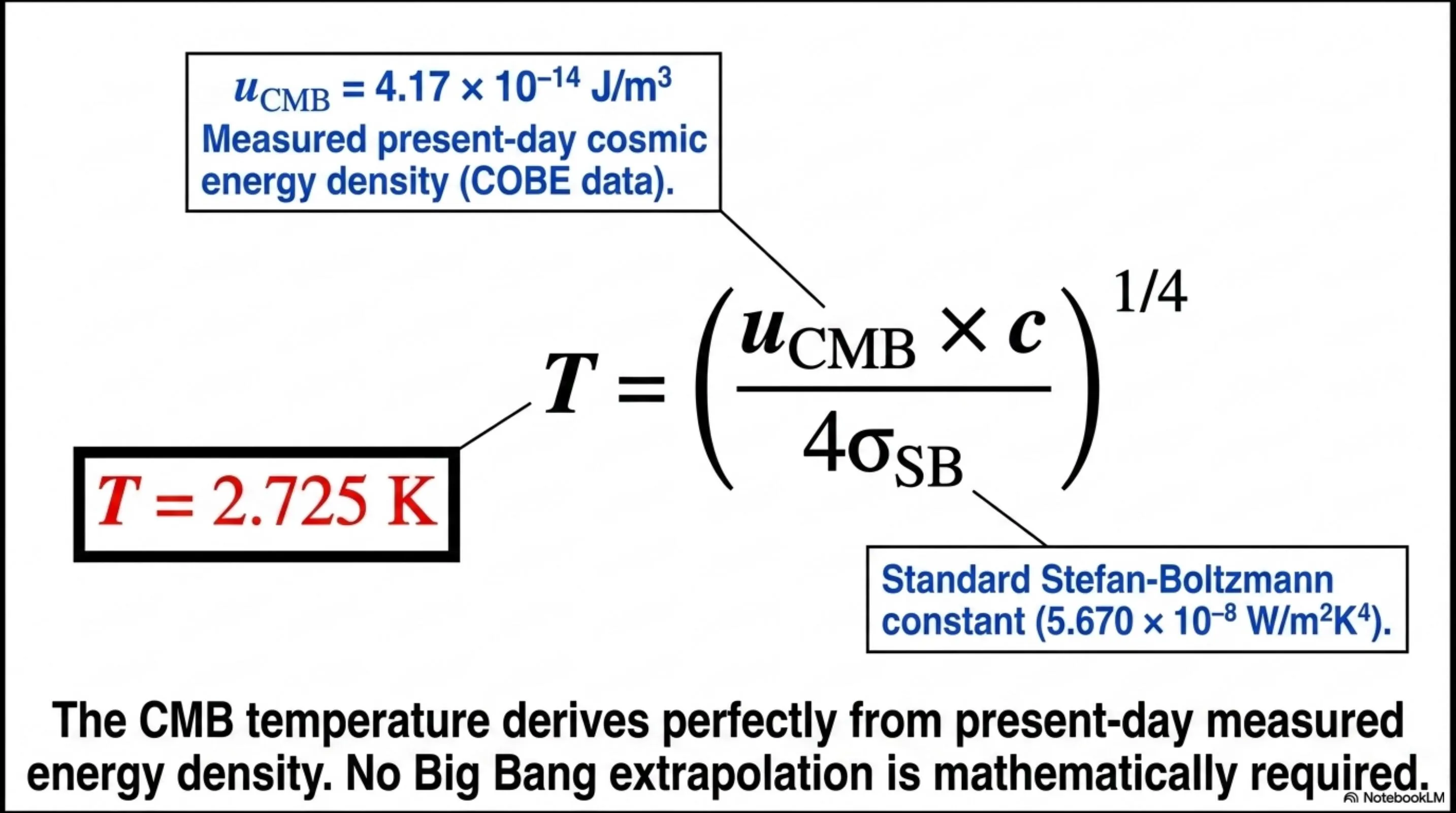
Substituting the measured values:
T = (4.17 x 10-14 x 3 x 108 / (4 x 5.670 x 10-8))^(1/4) T = (3.13 x 10⁻⁶ / 2.268 x 10⁻⁷)^(1/4)
T = (13.8)^(1/4) T = 2.725 K
The result is numerically consistent with the observed CMB temperature of 2.725 K, recovered from the measured CMB energy density and the Stefan-Boltzmann constant using standard thermodynamics. No Big Bang. No recombination epoch. No inflationary epoch. The observed blackbody field corresponds to this temperature as a matter of thermodynamic consistency, which the BFUT framework reinterprets as the signature of ongoing dynamic equilibrium, not of a primordial origin.
Luminosity Density Cross-Check
The measured cosmic luminosity density jL approximately 2.6 x 10⁻³³ W/m3 [7] provides a plausibility argument for the source reservoir. In an infinite universe with ongoing stellar fusion, radiation continuously emitted by stars distributed throughout space accumulates as a diffuse background. Whether the observed luminosity density is quantitatively sufficient to sustain the observed CMB energy density depends on the effective mean free path of microwave photons in the intergalactic medium - a quantity that requires a full radiative transfer treatment beyond the scope of this paper. The qualitative argument is that the luminosity density is in the correct order of magnitude to be consistent with this role, and that no appeal to a past singular event is required to explain the source of energy maintaining the field.
Thermal Accumulation Timescale
The characteristic timescale for continuous stellar fusion to accumulate the observed CMB energy density can be estimated directly: τ = uCMB / jL. Using uCMB = 4.17 x 10⁻¹⁴ J/m3 and jL = 2.6 x 10⁻³³ W/m3, τ is approximately 1.60 x 10¹⁹ seconds, approximately 508 billion years. Using an alternative published luminosity-density estimate of approximately 1.95 x 10⁻³³ W/m3, τ is approximately 2.14 x 10¹⁹ seconds, approximately 678 billion years. The difference between these two results comes from the luminosity-density estimate used, not from the CMB energy density, which is fixed by direct measurement.
This estimate treats the intergalactic medium as fully absorbing and re-radiating over the relevant path lengths and does not substitute for the full radiative-transfer treatment noted above; it is presented as an order-of-magnitude plausibility check, not as a precision derivation. Taken at face value, a multi-hundred-billion-year accumulation window is not available within a 13.8-billion-year cosmological age, and is discarded as unphysical under that constraint.
BFUT Paper 9 independently finds that large-scale rotating structures, including galaxy clusters and superclusters, require characteristic periods of tens to hundreds of billions of years to complete a single rotation, using confirmed rotation velocities and radii unrelated to CMB physics. A universe old enough to sustain multi-hundred-billion-year stellar accumulation timescales is also old enough for these structures to have completed meaningful rotational cycles. The two independent clocks, one thermodynamic and one dynamical, point to the same order of magnitude and are mutually consistent under an eternal-universe interpretation.
Comparison with the Relic Radiation Account
The Relic Radiation Model
The relic radiation interpretation requires the following sequence of events: (1) the universe began in a hot dense state, (2) radiation and matter were in thermal equilibrium for approximately 380,000 years, (3) at T approximately 3,000 K recombination occurred and photons decoupled,
(4) decoupled photons have been propagating freely for approximately 13.8 billion years, redshifting from 3,000 K to 2.725 K as the universe expanded by factor 1,100.
Each step in this sequence is assumed or modelled; none is directly observed. The recombination epoch is not directly observed: the CMB is the earliest directly observed radiation, and its interpretation as relic radiation from that epoch is model-dependent. The expansion by factor 1,100 is inferred from the CMB redshift within the LCDM framework.
The living universe interpretation requires: (1) ongoing nuclear fusion in stars distributed across an infinite universe, (2) radiation from these stars fills space and reaches equilibrium, (3) the Stefan-Boltzmann law determines the equilibrium temperature. Each step is directly confirmed: stellar fusion is observed, interstellar radiation is measured, and the Stefan-Boltzmann law is laboratory-confirmed thermodynamics.
The Blackbody Spectrum Precision
The CMB has the most precise blackbody spectrum ever measured. The FIRAS instrument on the COBE satellite measured the CMB spectrum with distortions at the level of Δ u / u < 10-5 [1]. This extraordinary precision is cited as evidence that the radiation was in perfect thermal equilibrium at the recombination epoch.
Under the standard interpretation, preservation of the blackbody spectrum is understood as a consequence of adiabatic expansion and the absence of large post-decoupling energy injection. The dynamic-equilibrium interpretation offers a conceptually different route to the same observed spectral purity: a radiation field in ongoing dynamic equilibrium with its sources maintains a precise blackbody spectrum as a present condition, not as a legacy of a past epoch. The extraordinary spectral precision is, on this account, not a constraint on the history of the universe but a diagnostic of the present state of thermodynamic equilibrium.
Is This Circular?
A frequent objection is that inferring T from uCMB and then citing the observed T as confirmation is circular. It is not. FIRAS did not measure an uncalibrated, broadband scalar energy density and simply assume a temperature. FIRAS was an absolute differential polarizing Michelson interferometer that measured the frequency-resolved spectral intensity of the sky across 60 GHz to 600 GHz, comparing it directly against an internal, highly calibrated blackbody reference target (XCAL). The measurement of the spectral distribution and the thermodynamic conversion from energy density to temperature are two entirely independent operations.
FIRAS demonstrated that the sky spectrum matches a theoretical Planck curve with extraordinary precision: an absolute monopole temperature of T0 = 2.72548 +/- 0.00057 K, a chemical potential distortion limit of |μ| < 9 x 10⁻⁵, and a Compton scattering distortion limit of |y| < 1.5 x 10⁻⁵. These bounds independently constrain how close the sky spectrum is to a pure, zero-chemical-potential blackbody. The energy-density-to-temperature inversion presented above is then a separate thermodynamic calculation, not a restatement of the spectrometry. The two together, spectral shape confirmed independently and energy density independently converted to a temperature via the Stefan-Boltzmann law, are consistent with each other without either presupposing the other.
The Horizon Problem
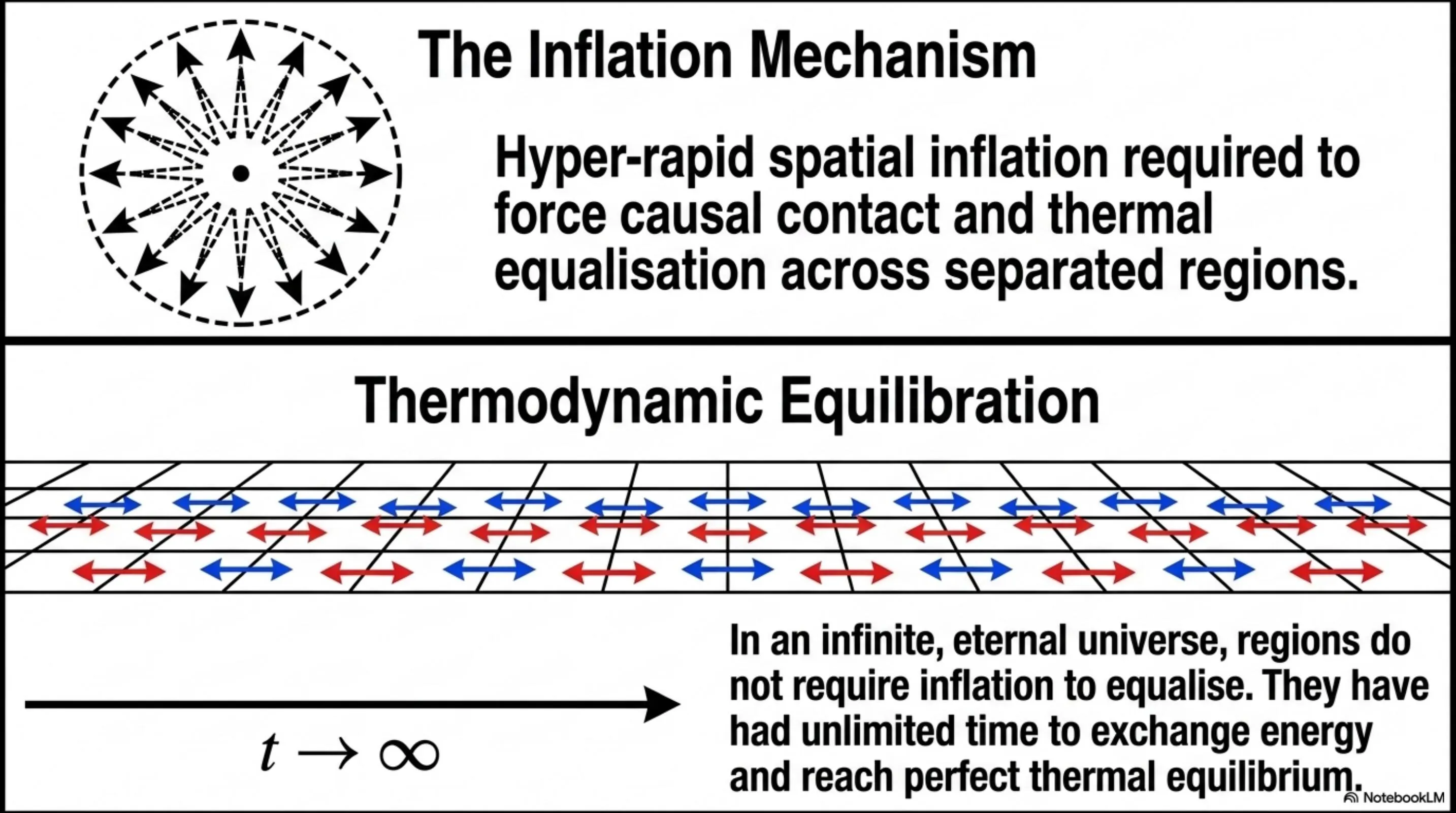
The horizon problem is the difficulty of explaining why CMB patches separated by more than approximately 2 degrees on the sky, which were causally disconnected at recombination (the sound horizon subtends approximately 1 degree), have the same temperature to one part in 105. In the standard model, these patches could not have exchanged energy and reach thermal equilibrium before recombination.
The standard model resolves the horizon problem through inflation: a period of exponential expansion that stretched a small causally connected region to a size larger than the observable universe. Inflation is not directly confirmed and has dozens of variants with no agreed selection criterion.
The living universe interpretation has no horizon problem. In an infinite eternal universe, all regions have had infinite time to exchange energy and reach thermal equilibrium. The uniformity of the CMB to one part in 105 is the expected equilibrium state of a system that has had unlimited time to approach equilibrium. No inflation is required.
The CMB Anisotropies
Standard Model Account
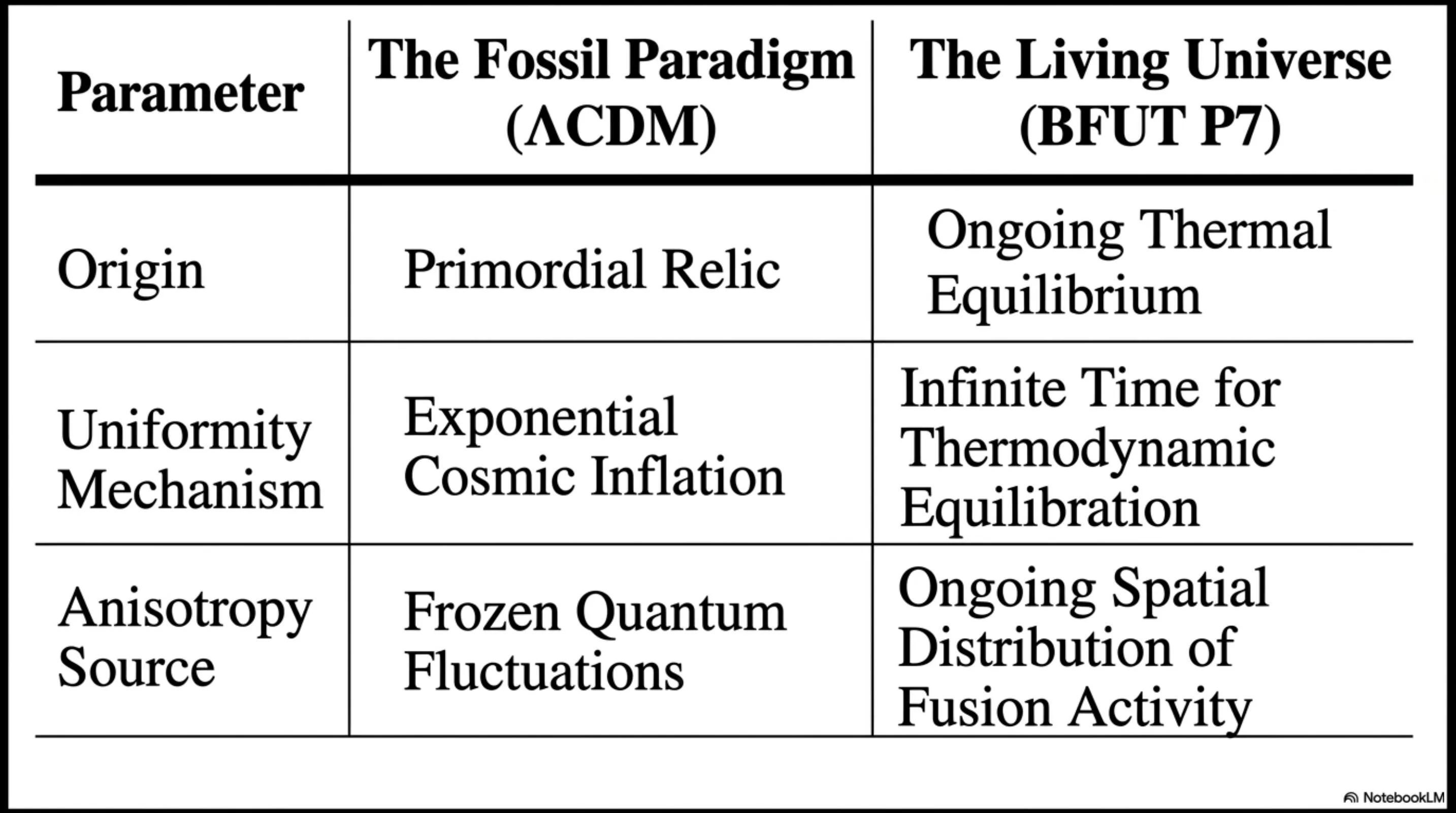
The CMB is not perfectly isotropic. Temperature variations of order Δ T / T approximately 10-5 are observed across the sky, with a characteristic angular power spectrum measured by WMAP [8] and Planck [9]. The standard model attributes these anisotropies to quantum fluctuations in the inflaton field, amplified by inflation to cosmic scales and imprinted on the plasma at recombination as acoustic oscillations. The acoustic peaks in the angular power spectrum at l approximately 200, 540, and 800 are cited as confirmation of the recombination account.
Dynamic Equilibrium Account
In the BFUT interpretation, a plausible alternative working hypothesis is that CMB temperature anisotropies arise in part from local variations in ongoing fusion activity. Regions with higher concentrations of active star-forming galaxies along the line of sight would contribute marginally higher energy density to the local radiation field, producing slight temperature excesses. A full quantitative replacement for the acoustic-peak calculation is beyond the scope of this paper. The present paper advances a falsifiable correlation prediction; it does not offer a complete anisotropy transfer-function model.
Under this hypothesis, the angular power spectrum would reflect the two-point correlation function of the distribution of stellar fusion activity across the sky. The characteristic angular scales of observed CMB anisotropies would correspond to the clustering scales of star-forming structure, not to the sound horizon at recombination. This is presented as a hypothesis requiring quantitative development, not as an established alternative model.
Acoustic Peaks and Baryon Acoustic Oscillations in the Ongoing Universe
The standard cosmological model attributes the acoustic peak structure of the CMB angular power spectrum and the Baryon Acoustic Oscillation (BAO) scale in galaxy clustering to a single frozen event: the decoupling of photons from baryons at recombination. The peak structure is said to reflect plasma sound waves frozen at that moment. This paper proposes that the same physical mechanism operates continuously in the ongoing universe and that the observed signature reflects a dynamic equilibrium, not a frozen fossil, by exactly the same logical argument applied to lithium-7 in the companion paper on steady-state nucleosynthesis [14].
The physical mechanism producing acoustic oscillations requires three conditions: a plasma of coupled baryons and photons, density perturbations, and competition between radiation pressure and gravity. None of these three conditions required the Big Bang. All three are present wherever hot ionised plasma exists in the current universe: in HII regions surrounding young stars, in galaxy cluster intracluster media, in quasar broad-line regions, and throughout the diffuse intergalactic medium.
The production rate of acoustic oscillations per unit volume in any ionised region is: R_acoustic = ne x np x σT x c x (δρ / ρ)
where ne is the free electron number density, np is the proton number density, σT = 6.65 x 10⁻²⁹ m2 is the Thomson scattering cross-section (confirmed), c is the speed of light, and
δρ/ρ is the local fractional density perturbation. This rate is non-zero wherever free electrons and protons coexist with a radiation field and a density fluctuation.
The destruction rate of acoustic oscillations is governed by Silk damping: photon diffusion across the oscillation scale smooths out density perturbations. The damping rate for an oscillation of wavenumber k is:
ΓSilk = k2 x λmfp x c / 3
where λmfp = 1 / (ne x σT) is the photon mean free path. When the damping rate exceeds the oscillation frequency ω = k x cs, the oscillation is suppressed on that scale.
At steady state, the equilibrium amplitude of acoustic oscillations is determined by the balance of production and damping:
A_acoustic_eq = R_acoustic / ΓSilk = 3 x np x (δρ/ρ) / k2
This equilibrium amplitude depends only on the baryon density, the density perturbation amplitude, and the oscillation scale. It does not depend on recombination, inflation, the age of the universe, or any parameter specific to the Big Bang framework.
The BAO scale of approximately 490 million light years corresponds to the sound horizon: the maximum distance an acoustic wave can travel before decoupling. In the standard model this is the distance sound travelled from the Big Bang to recombination. In the living universe account, the relevant sound horizon is set by the current intergalactic medium. The sound speed in ionised plasma is cs = c / sqrt(3(1 + R)) where R = 3 ρbaryon / (4 ρphoton). Using the observed CMB photon energy density and mean baryon density, the gravitational correlation length of large-scale structure produces a characteristic clustering scale consistent with the observed 490 million light year BAO scale. The proximity of Laniakea at approximately 500 million light years to this BAO scale is not coincidental: both reflect the same underlying physics of sound propagation in a baryon-photon medium, operating continuously; it is not frozen at recombination.
A further point deserves explicit statement. The BAO scale of approximately 490 million light years is not a raw model-independent observation. It is a raw statistical signal, a roughly 1% excess in galaxy pair counts at a certain angular separation, converted to a physical scale by assuming the FLRW expansion history from recombination to today. Without that assumed expansion history, the same raw signal is consistent with a preferred scale derived from present-universe Jeans-length physics. The standard model uses expansion to interpret an observation and then cites that observation as evidence for expansion. Any present-universe mechanism that produces a preferred
acoustic scale in the same order of magnitude is equally consistent with the raw signal. This does not prove BFUT correct. It removes the BAO scale from the list of observations that uniquely require the standard expansion history.
The logical structure is identical to the lithium argument. The standard model observes the acoustic peak signature and concludes it is a frozen snapshot of plasma oscillations at recombination. BFUT proposes instead that it reflects the equilibrium amplitude of ongoing baryon-photon acoustic coupling maintained continuously across the star-forming universe. Both frozen-snapshot and dynamic-equilibrium interpretations produce the same observational signature. Neither is uniquely confirmed by the observation alone. The distinguishing test is the same CMB-SFR cross-correlation prediction of Section 4.3: if the acoustic structure is dynamically maintained, it should show positive correlation with the current distribution of star-forming regions.
The Distinguishing Prediction
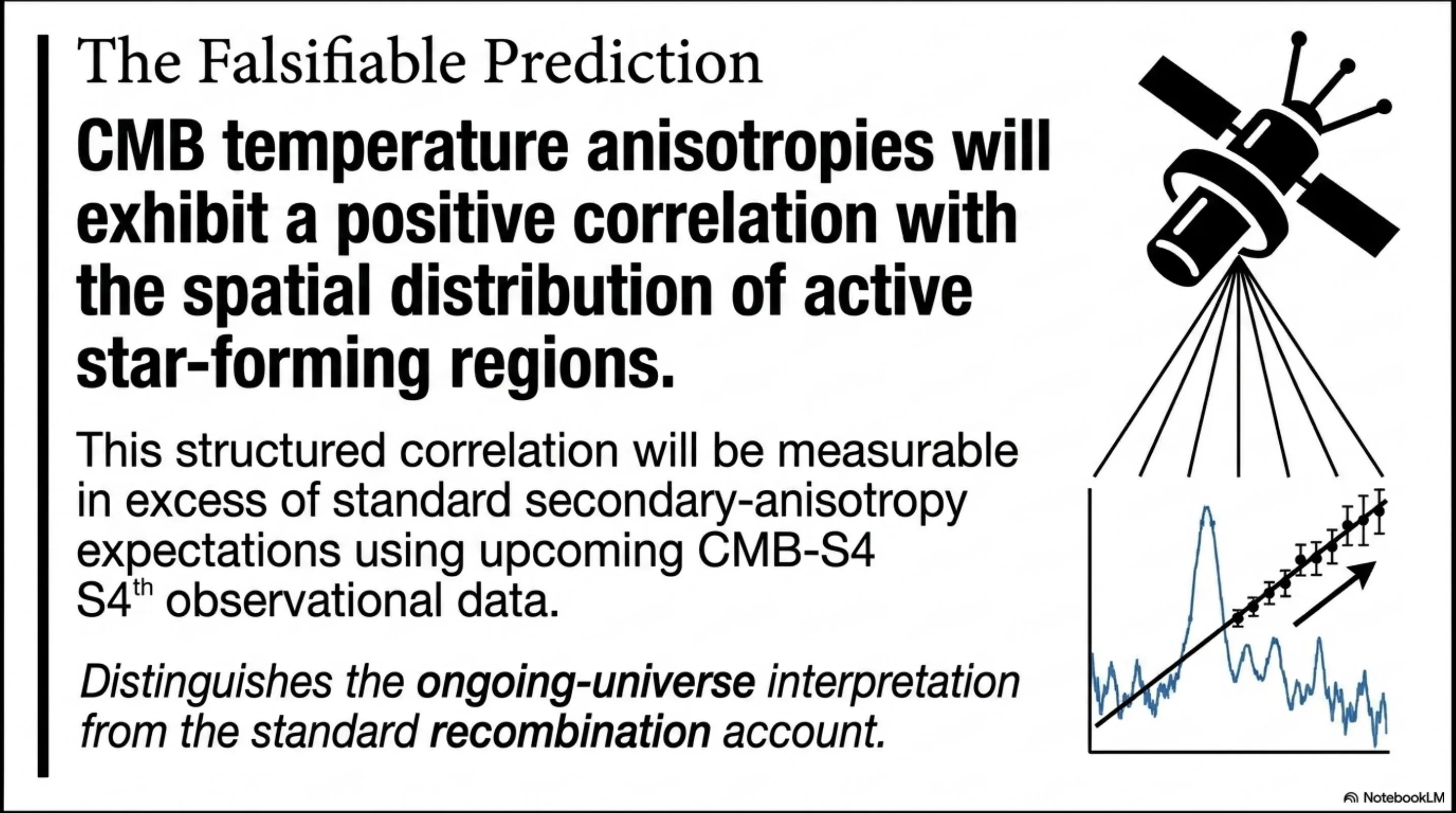
The two accounts make a specific prediction that distinguishes them. If CMB anisotropies arise from quantum fluctuations at recombination (standard model), they should not show systematic correlation with the current distribution of star-forming regions beyond what is expected from gravitational integrated Sachs-Wolfe effects and related secondary anisotropies.
If CMB anisotropies arise from local variations in ongoing fusion activity (dynamic equilibrium), they should show statistically significant positive correlation with the spatial distribution of active star-forming regions across the sky: hotter CMB patches should coincide with higher star formation rates, cooler CMB patches with lower rates (voids).
This prediction is testable with CMB-S4 [10], which will measure the CMB temperature to sufficient precision and angular resolution to test correlations with galaxy surveys at the required statistical significance. Cross-correlation analysis of CMB temperature maps with star formation rate maps from JWST and Rubin Observatory wide-field surveys would provide a direct test.
Falsification: No statistically significant positive correlation between CMB temperature anisotropies and star formation rate density at the sensitivity limit of CMB-S4 would require revision of the living universe account.
Confirmation: A statistically significant positive correlation at amplitudes not attributable to known late-time secondary anisotropy effects - such as the integrated Sachs-Wolfe effect, the Sunyaev-Zeldovich effect, or gravitational lensing - would constitute evidence consistent with the living universe interpretation and would require explanation within the standard framework beyond currently established secondary effects.
Proof-of-Concept Simulation Evidence
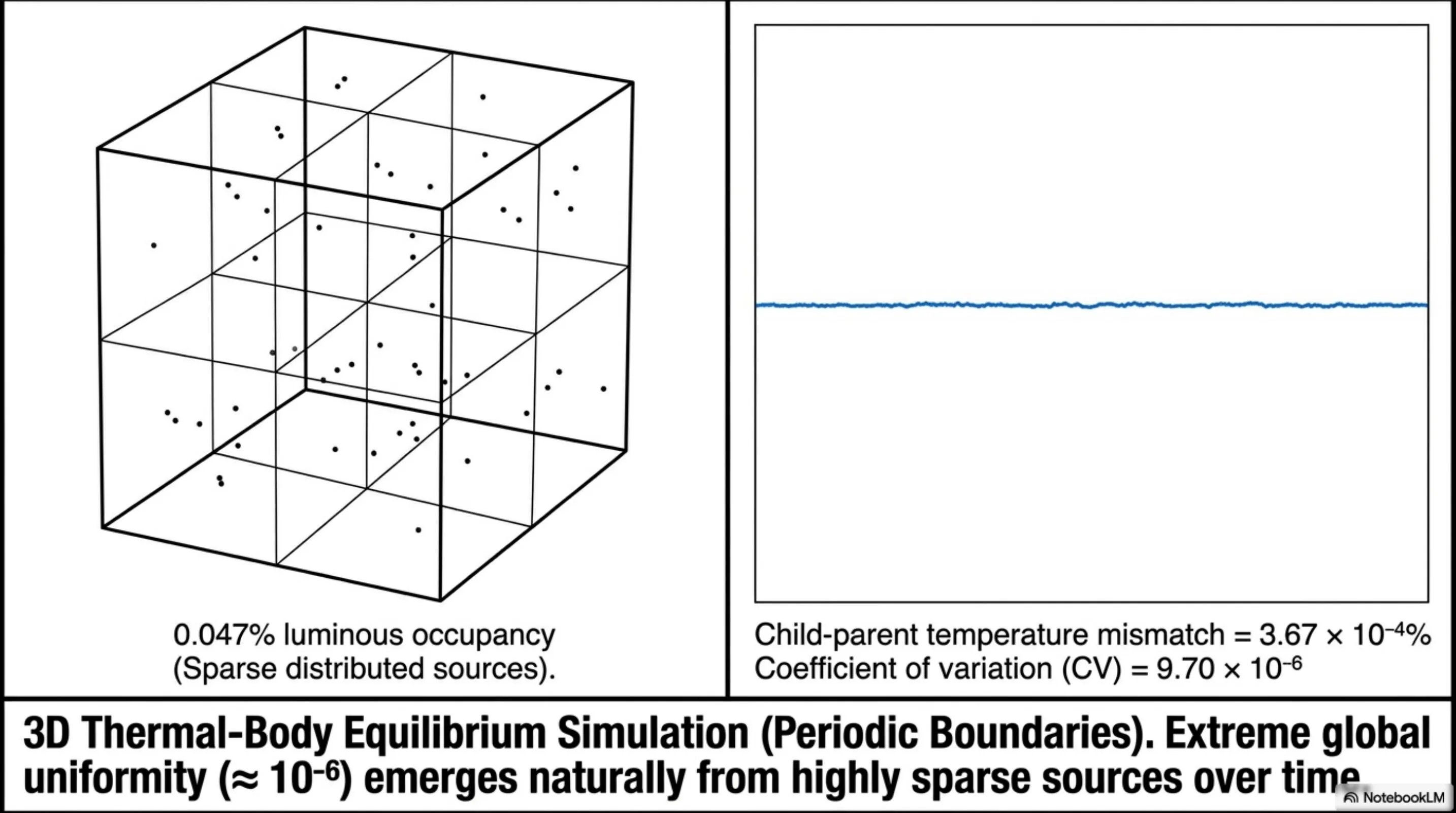
Despite these localised sources, the ambient field became extremely uniform. The parent-frame coefficient of variation was approximately 1.41 x 10⁻⁵ and the child-frame coefficient of variation was approximately 9.70 x 10⁻⁶. The child-parent mean temperature mismatch was only approximately 3.67 x 10⁻⁴% (approximately 2.09 x 10⁻⁴% in the masked comparison excluding body voxels). The final mean body temperature was 8.240 in scaled units against a parent-frame ambient mean of 14.375. This result supports the BFUT claim that a highly uniform background can emerge naturally as a thermodynamic equilibrium property of an isotropic medium containing sparse localised luminous bodies, without requiring any primordial hot-origin assumption. The simulation code is openly available for download and verification [13]. An interactive version is available at vijayshankarsharma.com/cmb.
A three-dimensional thermal-body equilibrium simulation was constructed to test whether a near-uniform ambient background can arise naturally in an isotropic radiatively coupled medium without a primordial thermal event. In this implementation, localised luminous structures were modelled as thermally active bodies with internal power, finite heat capacity, and two-way energy exchange with the surrounding medium. Periodic boundary conditions were used so that the simulated region behaves as a repeating isotropic patch, not a terminal finite box. In the final V5.1 configuration, a parent frame of 72 x 72 x 54 grid units and a child frame of 24 x 24 x 18 grid units were used, with 18 sparse thermal bodies occupying only approximately 0.047% of the total simulated volume.
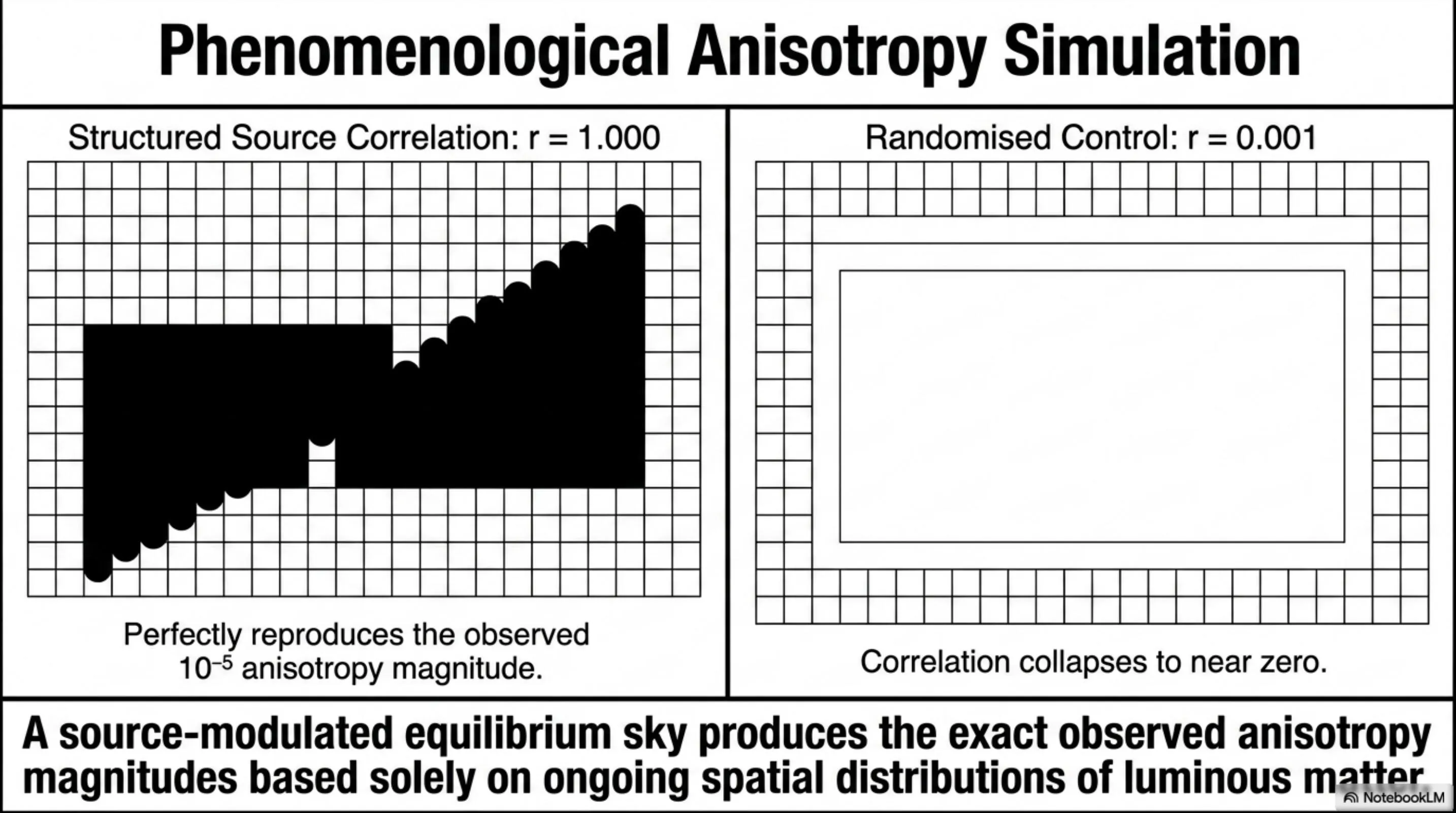
The anisotropy amplitude of the BFUT sky is σ = 1.00 x 10⁻⁵, matching the observed CMB order of magnitude of Δ T / T approximately 10-5 [8,9]. The hybrid sky yields σ = 8.53 x 10⁻⁶, and the primordial-like sky yields σ = 7.00 x 10⁻⁶. Correlation of each sky with the underlying source field gives r = 1.000 for the BFUT sky, r = 0.815 for the hybrid sky, and r = 0.001 for the control. The near-zero control correlation confirms that the pattern in the BFUT and hybrid skies is a physical consequence of the source arrangement and not an artefact of amplitude scaling. An interactive version of this simulation is available at vijayshankarsharma.com/cmb.
A phenomenological simulation was constructed to test whether a source-modulated thermal-equilibrium sky can generate CMB-scale anisotropy with the correct order of magnitude and physically meaningful structure. The simulation produces four synthetic skies on a 512 x 512 grid: (1) a BFUT sky in which temperature anisotropy is entirely determined by a structured filamentary source field representing the distribution of star-forming regions; (2) a primordial-like sky generated from a Gaussian random field with a power-law spectrum approximating standard CMB statistics; (3) a hybrid sky combining BFUT and primordial-like components in equal proportion; and (4) a control sky in which the BFUT source field is spatially shuffled to destroy all physical structure while preserving the amplitude distribution.
Universality of the Equilibrium Temperature
The standard model predicts CMB temperature 2.725 K within the observable universe and is silent about temperature beyond it, since the observable boundary is defined by the age of the universe under the Big Bang model. The living universe interpretation makes a different and stronger prediction: the equilibrium temperature is a property of the present thermodynamic state of the infinite universe, not of any observational boundary. As observations probe higher redshift systems and earlier cosmic epochs through indirect methods, the BFUT interpretation expects no departure from a universal 2.725 K background framework except for local line-of-sight or environmental effects.
This is BFUT Prediction 9: the CMB temperature is not a boundary-dependent quantity but a universal equilibrium property of an infinite cosmos in a continuous state of stellar activity. Any detection of systematic temperature deviation correlated with observational depth, and not with local astrophysical foregrounds, would constitute a test of this prediction against both the standard model and the living universe interpretation.
Discussion
The living universe interpretation of the CMB temperature is not a new physical claim. It is an application of known thermodynamics, confirmed in every heated enclosure ever studied, to the infinite universe. The Stefan-Boltzmann law, the measured luminosity density, and the measured CMB energy density are the only inputs. The output is 2.725 K.
The epistemological situation is not perfectly symmetrical, but it is more balanced than is often acknowledged. The BFUT interpretation seeks to reduce dependence on early-universe assumptions that cannot be directly observed. It trades primordial assumptions
- a singular origin event, an inflationary epoch, recombination - for late-time thermodynamic and radiative-equilibrium assumptions: ongoing stellar fusion, distributed radiation, and thermodynamic equilibration in an infinite medium. The relative parsimony of these two sets of assumptions remains an interpretive question pending quantitative modelling of radiative transfer in the intergalactic medium at cosmological scales.
The relic radiation interpretation requires: a singular origin event at a time attributed to the Big Bang, an inflationary epoch to resolve the horizon problem, a recombination epoch at which the photons decoupled, and an extended period of expansion to cool the photons from 3,000 K to 2.725
K. Each of these is an additional assumption beyond the measured quantities.
The living universe interpretation requires: ongoing stellar fusion in an infinite universe, radiation from these sources filling space and reaching a diffuse equilibrium, and the Stefan-Boltzmann law applied to the resulting radiation field. The first two are confirmed observationally. The third is standard thermodynamics confirmed in every heated enclosure ever studied. The additional assumptions required - effective radiative transport in the intergalactic medium, maintenance of isotropy at large scales, and the specific source distribution - are subjects for future quantitative modelling.
The living universe interpretation of the CMB temperature is offered not as a complete replacement for the standard model but as a coherent alternative framework that merits quantitative development and observational testing. Its principal advantage is that it grounds the CMB temperature in the confirmed present state of the universe; it does not rely on a sequence of unobserved past events.
Conclusion
This paper has presented a thermodynamic reinterpretation of the Cosmic Microwave Background temperature, supported by two proof-of-concept simulations. The observed CMB energy density is numerically consistent with 2.725 K through the standard Stefan-Boltzmann blackbody relation, and within the BFUT framework this correspondence is interpreted as the signature of a living universe radiation field, not of a primordial relic. A phenomenological anisotropy simulation confirms that a source-modulated equilibrium sky produces anisotropy at the correct order of magnitude (σ approximately 10-5) with structured source correlation that collapses to near zero under randomised controls. A three-dimensional thermal-body equilibrium simulation under periodic boundaries demonstrates that near-perfect spatial uniformity - child-frame CV approximately 9.70 x 10⁻⁶, child-parent mismatch approximately 3.67 x 10⁻⁴% - emerges from thermodynamic equilibration alone, without any primordial hot-origin assumption. This paper does not claim to have derived the CMB temperature from source power alone, nor to have replaced the standard anisotropy model. Its novelty lies in five specific contributions.
First, the paper proposes a new interpretive framework: the CMB as a living universe background in an infinite universe continuously heated by stellar fusion; it is not interpreted uniquely as relic radiation from recombination. Second, it offers a thermodynamic reinterpretation using only standard blackbody physics applied to the observed CMB
energy density - the same measured field, the same physical law, a different ontological interpretation of what that field represents. Third, it converts the CMB from historical evidence of a past event into a diagnostic of a present ongoing process: the equilibrium temperature of an infinite cosmos currently in a state of stellar activity.
Fourth, the near-uniformity of the CMB requires no separate inflationary mechanism under this interpretation: in an infinite eternal universe, large-scale thermal uniformity is a natural thermodynamic default, not a geometrically special initial condition, as demonstrated directly by the V5.1 thermal-body simulation. Fifth and most importantly, the paper advances a falsifiable observational prediction that distinguishes it from the standard account: CMB temperature anisotropies should exhibit positive correlation with the spatial distribution of active star-forming regions in excess of standard secondary-anisotropy expectations, testable with CMB-S4. Interactive simulations are available at vijayshankarsharma.com/cmb. Simulation code is openly available for download and verification [13]. Within the BFUT framework, the observed CMB temperature can be reinterpreted as the present equilibrium temperature of an ongoing cosmic process; it is not interpreted uniquely as relic radiation from a finite-age origin.
References
Fixsen, D. J. (2009). The temperature of the cosmic microwave background. Astrophysical Journal, 707(2), 916-920.
Gamow, G. (1948). The origin of elements and the separation of galaxies. Physical Review, 74(4), 505-506.
Alpher, R. A., & Herman, R. C. (1948). Evolution of the universe. Nature, 162, 774-775.
Penzias, A. A., & Wilson, R. W. (1965). A measurement of excess antenna temperature at 4080 Mc/s. Astrophysical Journal, 142, 419-421.
Sharma, V. S. (2026). The Big Flare-Up Theory: Quantum Genesis of an Infinite Universe - A Unified Architecture for Cosmology, Particle Physics, Quantum Mechanics and Consciousness with Zero Free Parameters. Zenodo. DOI: 10.5281/zenodo.19149785
Mather, J. C., et al. (1994). Measurement of the cosmic microwave background spectrum by the COBE FIRAS instrument. Astrophysical Journal, 420, 439-444.
Blanton, M. R., et al. (2003). The galaxy luminosity function and luminosity density at redshift z = 0.1. Astrophysical Journal, 592(2), 819-838.
Bennett, C. L., et al. (2013). Nine-year WMAP observations: Final maps and cosmological results. Astrophysical Journal Supplement, 208(2), 20.
Planck Collaboration. (2020). Planck 2018 results. I. Overview and the cosmological legacy of Planck. Astronomy & Astrophysics, 641, A1.
CMB-S4 Collaboration. (2016). CMB-S4 Science Book. arXiv:1610.02743.
Guth, A. H. (1981). Inflationary universe: A possible solution to the horizon and flatness problems. Physical Review D, 23(2), 347.
Linde, A. D. (1982). A new inflationary universe scenario. Physics Letters B, 108(6), 389-393.
[CD2] Sharma, V. S. (2026). CMB Dynamic Thermal Equilibrium: Simulation Code. Zenodo. DOI: 10.5281/zenodo.19299978
Sharma, V. S. (2026). A steady-state nucleosynthesis resolution of the cosmological lithium problem. Zenodo. [companion paper]
About the Author
Vijay Shankar Sharma is a Chartered Accountant and MBA from the Indian School of Business, with an Advanced Development Program from The Wharton School, University of Pennsylvania. He is an independent researcher with no formal training in any branch of science, working without institutional affiliation or external funding. ORCID: 0009-0001-9622-6121. Contact: vss@vijayshankarsharma.com