Black Holes as Central Gravitational Vortices Lacking Singularities: The Universal Centrality Rule
Abstract
The standard interpretation of black holes as objects containing a
central singularity of infinite density is a consequence of applying
classical general relativity beyond its range of validity. This paper
proposes an alternative interpretation grounded in the dynamics of the
Kerr metric: black holes are gravitational vortices whose event horizons
mark a relativistic causal boundary in the exterior geometry, without
requiring any physically established central singularity. The event
horizon is interpreted physically as a relativistic causal boundary of
the exterior metric, while the familiar Newtonian escape-velocity
analogy is retained only as a heuristic and not as a literal derivation
of the horizon. The Kerr metric for rotating black holes naturally
describes a vortex structure, with the ergosphere, frame-dragging, and
ring structure all following from vortex dynamics. The formal singular
structure at r = 0 in the Kerr solution is interpreted as a signal that
the classical interior description has been extended beyond its physical
domain, not as a directly established infinite-density physical object,
consistent with the mathematical literature on the Kerr metric.
Every directly confirmed observational feature of black hole candidates
is shown to be consistent with the vortex interpretation: event
horizons, accretion disks, relativistic jets, gravitational lensing,
gravitational wave emission from mergers, and the black hole shadow
images obtained by the Event Horizon Telescope. Flat or flattened
galactic rotation-curve behaviour is shown to arise plausibly from the
angular momentum distribution of galactic vortex structures in
proof-of-concept N-body simulation, without hidden mass. The standard
black hole information paradox is substantially weakened under the
vortex interpretation because the central singularity is no longer
treated as a physically established mechanism of information
destruction.
This paper further develops the Universal Centrality Rule: the
observational fact that in the complete record spanning all surveys, all
instruments, all redshifts, and all galaxy morphologies, no confirmed
stable rotating galaxy has been observed with a supermassive mass
concentration displaced beyond barycenter-consistent limits. The paper
derives this zero-exception universality as a structural necessity of
the gravitational vortex interpretation. The vortex interpretation
explains what galactic black holes are; the centrality rule explains why
they are always and only found at the dynamical centre of the systems
that produce them.
Keywords: black holes, Kerr metric, gravitational vortex, event horizon, singularity, Universal Centrality Rule, barycenter, galactic centrality, flat rotation curves, dark matter, information paradox, BFUT, Spaticle field
Introduction
Black holes are among the most studied objects in astrophysics and among the most conceptually problematic in theoretical physics. The standard interpretation, derived from the Schwarzschild and Kerr solutions to the Einstein field equations, proposes that at the centre of every black hole lies a singularity: a point or ring of infinite density at which the known laws of physics break down. The Penrose-Hawking singularity theorems [1,2] establish that, under general energy conditions, such singularities are mathematically inevitable in general relativity.
The singularity at the centre of a black hole is universally acknowledged as a problem. Penrose
[1] introduced the cosmic censorship hypothesis, proposing that singularities are always hidden behind event horizons and cannot affect outside observers, as a way of containing the theoretical damage. Hawking [3] proposed that black holes radiate thermally, eventually evaporating, which generates the information paradox: if a singularity destroys information, and quantum mechanics requires information to be preserved, one or both theories must be wrong at the black hole. String theory, loop quantum gravity, and fuzzball models have each proposed different resolutions [4,5,6], none of which has achieved consensus.
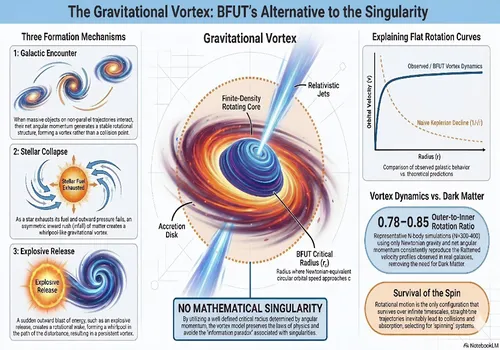
This paper proposes that the formal singular structures appearing in classical black-hole solutions should not be treated as directly established physical objects of infinite density, but as signs that the classical description has been extended beyond its reliable physical domain. Under this interpretation, black holes are gravitational vortices: regions in which infalling matter and radiation are swept into a rotating structure whose externally observed properties are fully described by the Kerr metric without requiring infinite density at any point.
This paper develops a second major result: the Universal Centrality Rule. Modern astronomy has examined billions of galaxy images across all surveys, all morphologies, and all redshifts. In the entire observational record, no confirmed stable rotating galaxy has been found with a supermassive mass concentration displaced beyond barycenter-consistent limits from the dynamical centre. This zero-exception universality has never been formally posed as a challenge to the standard model, despite being plainly visible in the observational record for decades. The
standard model proposes migration mechanisms but does not derive bounded centrality as a structural necessity. The BFUT gravitational vortex interpretation derives it as a structural necessity: a vortex core cannot exist independently of the rotating mass system that produces it, just as the eye of a whirlpool cannot exist outside the water. The two results, the vortex interpretation and the Universal Centrality Rule, are not separate claims. They are the same physical insight applied at two levels: what the object is, and why it is always and only where it is.
The Event Horizon as Orbital Velocity Boundary
Derivation from Relativistic Horizon Structure
The standard Schwarzschild radius, rs = 2GM/c², is most rigorously obtained from the Schwarzschild solution of general relativity, where it marks the radius at which the outward light cones tip inward and no future-directed null or timelike trajectory can escape to infinity. In popular treatments, the same radius is often motivated heuristically by the Newtonian escape-velocity analogy, setting vescape = √(2GM/r) = c, which yields the same expression. That heuristic is useful, but it should not be mistaken for a full derivation of the event horizon.
In this paper, the event horizon is interpreted physically not as evidence of a central singularity, but as a relativistic causal boundary of the exterior gravitational field. Outside the horizon, matter and radiation may still orbit, scatter, or escape depending on trajectory and angular
momentum. At the horizon, the geometry itself prevents outward escape. This interpretation preserves the full observational meaning of the event horizon while avoiding any need to treat it as proof of an actual infinite-density object at the centre.
The key point is therefore unchanged: the event horizon is an externally defined dynamical and causal feature of the metric. Its existence does not by itself establish the physical reality of a singularity at r = 0.
The Photon Sphere and Innermost Stable Orbit
The vortex interpretation naturally accounts for two additional features of black hole geometry. The photon sphere at r = 3GM/c² (Schwarzschild) is the radius at which photons can orbit in unstable circular orbits. In the vortex picture, the photon sphere is understood as a geometric consequence of the exterior spacetime structure, marking the unstable circular null orbit of the Schwarzschild geometry. The photon sphere is a property of the vortex geometry, not of the central singularity.
The innermost stable circular orbit (ISCO) at r = 6GM/c² for a non-rotating (Schwarzschild) black hole is the minimum radius at which stable circular orbits exist. Inside this radius, all orbits are unstable and infalling matter spirals inward. In the vortex picture, the ISCO marks the inner boundary of the accretion disk. The energy released as matter falls from the ISCO to the event horizon is the primary source of radiation from accreting black holes. This mechanism is fully described by the vortex geometry without reference to the central structure.
The Kerr Metric and Its Vortex Structure
The Kerr Solution
The Kerr metric [7] describes the spacetime geometry of a rotating massive object. It is the most physically relevant black hole solution because all astrophysical objects rotate, and the Schwarzschild solution (zero rotation) is a limiting case. The Kerr metric in Boyer-Lindquist coordinates (r, θ, φ, t) is:
ds² = -(1 - rs r/Σ) c² dt² - (2 rs r a sin²(θ)/Σ) c dt dφ + (Σ/Δ) dr² + Σ dθ² + (r² + a² + rs r a² sin²(θ)/Σ) sin²(θ) dφ²
where rs = 2GM/c², a = J/(Mc) is the specific angular momentum, Σ = r² + a² cos²(θ), and Δ = r²
- rs r + a². The outer event horizon is located at:
r_+ = GM/c² + √((GM/c²)² - a²)
The ergosphere, a region outside the event horizon in which the frame-dragging is so strong that no object can remain stationary, extends from r_+ to:
rergo = GM/c² + √((GM/c²)² - a² cos²(θ))
In the equatorial plane (θ = π/2), rergo = 2GM/c² = rs. The ergosphere is a uniquely vortex-like feature: it is the region in which spacetime itself rotates at a rate that cannot be overcome by any physical object or signal. This is the gravitational equivalent of a fluid vortex in which the flow velocity exceeds the propagation speed of disturbances within the fluid.
The Ring Singularity as a Formal Limitation of the Classical Interior Solution
The Kerr metric contains a formal singular structure at Σ = 0, corresponding to r = 0 and θ = π/2, usually described as the Kerr ring singularity. Unlike the Schwarzschild case, this singular structure is not a central point but a one-dimensional ring in the equatorial plane.
The crucial issue for the present paper is not whether the formal Kerr solution admits such a singular structure mathematically, but whether that structure should be reified as a physically established infinite-density object. The exterior Kerr geometry, including the event horizon, ergosphere, frame-dragging, lensing behaviour, and orbital structure, is what is directly constrained by observation. None of those observational confirmations requires direct empirical access to a literal infinite-density ring at the centre.
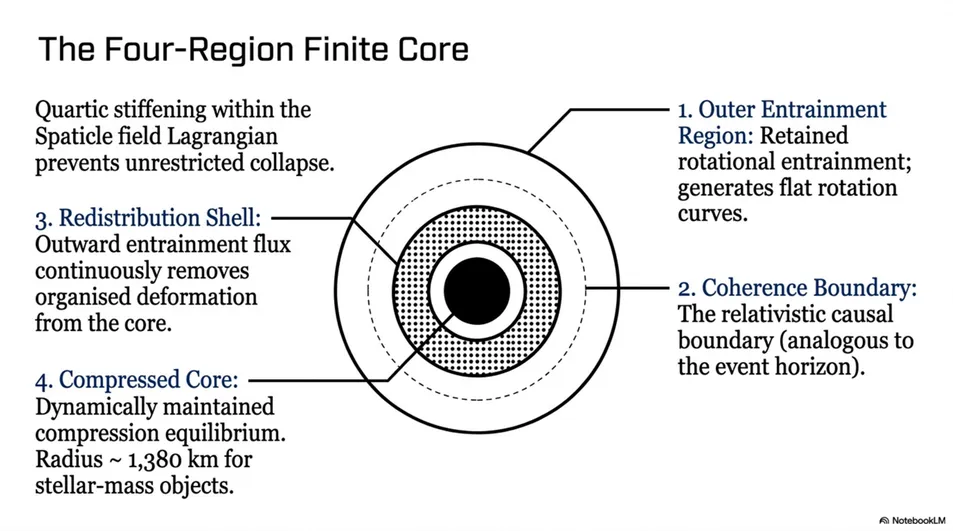
In the vortex interpretation, the Kerr ring singularity is therefore treated not as a directly established physical object, but as a formal singular feature of the classical solution that signals the breakdown of the unmodified classical description in the deep interior. The physical interior is interpreted instead as an extreme, compact, rapidly rotating vortex core of very high density and angular momentum, without any need to assert an actual infinity. The quartic self-stiffening term of the Spaticle field Lagrangian (BFUT P18) provides the field-theoretic mechanism: resistance to compression grows as the cube of deformation, preventing unlimited collapse toward a mathematical singularity and producing a finite dynamically maintained vortex core.
Frame-Dragging as Vortex Entrainment
Frame-dragging, the dragging of inertial frames by the rotation of a massive object, is a direct prediction of the Kerr metric confirmed by Gravity Probe B to 0.3% precision [10]. In the vortex interpretation, frame-dragging is the gravitational equivalent of fluid entrainment in a rotating vortex: matter near the vortex is swept into rotation by the vortex’s angular momentum field.
In BFUT, the Spaticle field is the physical medium through which frame-dragging propagates. The primary driver of frame-dragging at galactic scales is not the Spaticle field alone but the rotating ordinary mass of the galaxy: gas, dust, stellar bodies, and larger structures distributed across the disc and halo. This rotating mass entrains the Spaticle field, and the entrained field transmits and sustains the rotational influence across the system. The frame-dragging rate increases strongly as one approaches the horizon and ergosphere, consistent with the intuitive picture of progressively stronger vortex entrainment toward the rotating core.
Observational Consistency
Gravitational Wave Emission: LIGO Observations
The first direct detection of gravitational waves by LIGO in 2016 [11] reported the merger of two black holes with masses of approximately 29 and 36 solar masses, producing a final object of approximately 62 solar masses with energy equivalent to approximately 3 solar masses radiated as gravitational waves. The waveform matched general relativistic predictions for two merging Kerr objects with extraordinary precision.
The vortex interpretation is fully consistent with this observation. Two gravitational vortices in binary orbit radiate angular momentum as gravitational waves, causing their orbit to decay. When they merge, the resulting larger vortex radiates the excess energy as gravitational waves, settling into a new Kerr configuration. No singularity is required at any stage. The gravitational wave propagates through the Spaticle field medium at exactly c, confirmed by GW170817 to within 10⁻¹⁵ of c [20].
Event Horizon Telescope Images
The Event Horizon Telescope published the first image of a black hole shadow in 2019 [12], showing the central region of M87*. A second image of Sagittarius A*, the black hole at the centre of the Milky Way, followed in 2022 [13]. Both images show a bright emission ring surrounding a dark central region, consistent in angular size with the predicted photon capture radius for the measured masses.
The shadow in the EHT images is not an image of the singularity. It is an image of the photon capture region defined by the event horizon and photon sphere, both of which are properties of the vortex orbital dynamics. The brightness asymmetry in the M87* image is a consequence of Doppler boosting from the rotation of the accretion disk, a vortex property requiring no singularity contribution.
Relativistic Jets
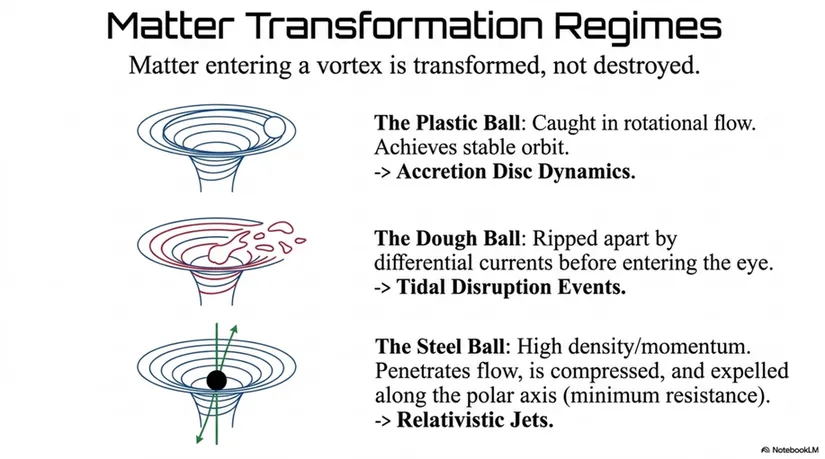
Relativistic jets, collimated outflows of plasma at velocities approaching c, are observed from many active galactic nuclei and some X-ray binary systems. In the vortex interpretation, jets are the natural outflow along the rotation axis of the vortex, where the centrifugal forces of the rotating vortex create an evacuated channel, analogous to the evacuated core of a fluid vortex. The Blandford-Znajek mechanism [14] applies equally: the relevant magnetic field geometry and energy extraction depend on the properties of the ergosphere and event horizon, not on the central singularity.
The Universal Centrality Rule
The Zero-Exception Observational Fact
Modern astronomy has accumulated billions of galaxy observations across every available instrument, survey programme, morphological type, and redshift range. In this entire record, a
single structural regularity stands out for its absolute character: no confirmed stable rotating galaxy has ever been observed with a supermassive mass concentration displaced beyond barycenter-consistent limits from the dynamical centre of the rotating system.
This zero-exception universality holds across all galaxy morphological types (spiral, elliptical, lenticular, dwarf, irregular), all survey programmes including Hubble, JWST, EHT, Chandra, VLA, and ALMA, all redshifts from z = 0 to z > 10, post-merger dual-nucleus systems where each concentration is central to its own pre-merger disc, and galaxies imaged by the Event Horizon Telescope with direct resolution of the core structure. The JWST observations of Labbé et al. 2023 [21] confirm morphologically mature galaxies with central concentrations at z > 10, within 500 Myr of the putative Big Bang.
The question that has never been formally posed in the literature is: why? Not “how do black holes get to the centre?” but “why is there not a single exception in the entire observational record?” The entire field has examined billions of galaxy photographs. Every one shows the mass concentration at the centre. No exception has been documented. Yet the standard model has not derived this bounded centrality as a structural necessity. It has instead assumed that migration mechanisms will eventually account for it, without asking why those mechanisms produce zero exceptions even in young, disturbed, and recently merged systems where migration should still be incomplete.
The BFUT gravitational vortex interpretation derives zero exceptions as a structural necessity, demonstrated physically and analytically in the subsections below.
The Whirlpool Analogy and the BFUT-Kerr Distinction
The eye of a whirlpool does not form at a random location and migrate to the centre. It forms at the dynamical centre of the angular momentum distribution, the only point where rotational forces balance, because it IS the structural consequence of the surrounding water’s dynamics. The eye is not inside the water. It is a condition of the water. It cannot exist elsewhere. The eye of a typhoon cannot exist without the circulating air. The galactic mass concentration cannot exist without the rotating mass system and Spaticle field deformation that constitutes it. This is not a loose metaphor but a structural dynamical correspondence across scales.
This distinction separates BFUT structurally from the standard Kerr black hole picture. The Kerr metric describes frame-dragging geometrically but identifies no physical medium being dragged. In BFUT, the Spaticle field is that medium. However, the primary driver of galactic vortex formation is not the Spaticle field alone. A galaxy contains vastly more mass in the form of gas, dust, stellar bodies, and larger structures than in the Spaticle field deformation itself. It is this rotating ordinary mass, distributed across the disc and halo, that generates the angular momentum field responsible for vortex formation. The Spaticle field is the substrate through which the gravitational interaction of all that rotating mass operates and through which frame-dragging propagates. Frame-dragging is the Spaticle field being entrained by the rotating mass, exactly as surrounding fluid is entrained by a hydrodynamic vortex.
The vortex core then forms and is maintained where the combined gravitational and rotational effect of all that mass is greatest, the dynamical centre of the system. In the standard model, the black hole is an independent compact object that later migrates toward that centre. In BFUT, there is no independent object. The mass concentration is the vortex core produced by the surrounding rotating mass acting through the Spaticle field medium. Remove the surrounding rotating mass and there is no vortex and no core. This is why galactic centrality is not a migration outcome. It is a structural consequence of the rotating mass distribution itself.
The Solar System Barycenter Analogy: Dynamic Maintenance
A rotating galaxy is never perfectly still. Every galaxy rotates. Every galaxy is itself moving, toward or away from neighbours, within its cluster, within its supercluster. No component of the universe is stationary. This raises a deeper question than “does the black hole settle to the centre?”, it demands an answer to why, in billions of galaxies each moving and rotating continuously, the mass concentration is always at the centre.
The answer is the Solar System Barycenter Analogy. The Sun continuously shifts its position in response to the gravitational influence of the planets, especially Jupiter. As the planets move, the Sun performs a subtle wobbling motion around the Solar System’s barycenter, the shared centre of mass of all bodies in the system. The Sun’s wobble radius is approximately 0.005 AU, about
1.1 solar radii, against a Solar System radius of approximately 40 AU. This is 0.013% of the system radius. The rule therefore does not require perfect mathematical immobility. Small bounded displacements consistent with barycenter wobble are expected while remaining observationally central.
The galactic mass concentration does exactly the same thing. It continuously adjusts its position in response to the gravitational influence of every rotating component of the galactic disc and halo, wobbling around the galactic barycenter. The key analytical result is that for realistic galactic mass ratios, this wobble is negligibly small. In approximately symmetric rotating galaxies, the galactic barycenter closely tracks the dynamical centre of the rotating system. The wobble is therefore not an off-centre excursion. It is a continuous dynamic adjustment that maintains the mass concentration at the centre even as the galaxy rotates, moves, and is perturbed.
The Analytical Proof: Wobble Amplitude
The barycenter wobble amplitude of the dominant mass MBH displaced by distance d from the dynamical centre in a system of total mass Mtotal is:
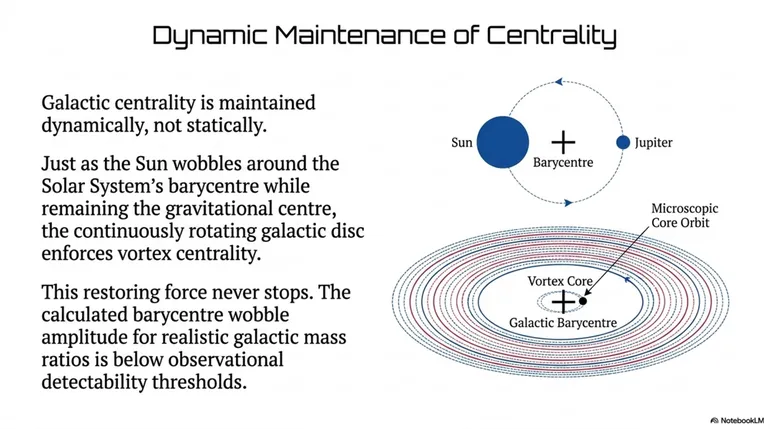
wobble = d × MBH / Mtotal
For the Milky Way: MBH = 4 × 10⁶ solar masses, Mdisc = 10¹¹ solar masses, disc radius R = 15 kpc. Even under a hypothetical large perturbation of 5 kpc:
wobble = 5 × (4×10⁶) / (10¹¹) = 0.0002 kpc = 0.0013% of disc radius
For the most massive known black holes (MBH = 10⁹ solar masses, Mdisc = 10¹¹):
wobble = 5 × (10⁹) / (10¹¹ + 10⁹) = 0.0495 kpc = 0.33% of disc radius
In both cases the wobble is below the observational resolution threshold of current telescopes. This means that even under continuous perturbation from rotation, galactic motion, mergers, and asymmetric mass distributions, the long-term position of the mass concentration remains observationally bounded around the dynamical centre of the system. The observed bounded centrality is therefore unlikely to be a purely historical settling effect alone. It is a continuously enforced dynamic equilibrium maintained by the same gravitational physics that keeps the Sun near the Solar System’s centre while Jupiter orbits it.
Crucially: the rotation never stops. Therefore the restoring force never stops. Every perturbation that would displace the mass concentration from the barycenter is immediately counteracted by the gravitational response of the rotating disc. This explains why no confirmed stable violations beyond barycenter-consistent limits have been observed. Not because every galaxy has had time to settle. But because the settling is continuously enforced, it is a present-state dynamic property, not a historical outcome.
Why Standard Models Cannot Explain Zero Exceptions
Standard galaxy-formation models generally treat supermassive black holes as compact objects that evolve within galaxies and gradually migrate toward central potential minima through mechanisms such as dynamical friction, merger relaxation, and accretion-driven growth. This predicts observable off-centre concentrations during migration, especially in young, disturbed, or recently merged systems. JWST has imaged morphologically mature galaxies at z > 10, already with central concentrations, within 500 Myr of the putative Big Bang. The standard model calls this “surprisingly early.” BFUT calls it structurally required.
Dynamical friction and merger-driven settling can broadly explain why mature systems tend toward central concentration over long timescales. However, the observational appearance of morphologically mature centrally concentrated systems at very high redshift implies that the coupled vortex structure may already be established before long relaxation times become available. The BFUT interpretation therefore treats centrality not merely as an eventual statistical outcome of historical settling, but as an intrinsic dynamical property of rotating gravitational vortex systems.
The BFUT interpretation differs conceptually: it treats the galactic mass concentration and the surrounding rotating galaxy as a continuously coupled dynamical system, not as independent structures only later brought together through migration processes. Within this framework, stable large-scale violations of galactic centrality are not expected because the vortex core is dynamically maintained near the barycenter of the rotating system itself.
Note on stellar-mass black hole mergers (GW150914): The two 29 + 36 solar mass objects detected by LIGO were compact Spaticle field condensations embedded in their local matter environment, not isolated naked singularities meeting in empty space. Even stellar-mass concentrations are structurally coupled to their surrounding medium and maintain the same barycenter relationship at their scale.
Simulations
BFUT Paper 16 [22] provides a proof-of-concept N-body simulation demonstrating that a rotating mass system naturally produces a stable central condensation without requiring an independently seeded black hole. The simulation shows repeated first-unit emergence and threshold organisation producing a central compact structure as the direct consequence of the surrounding rotating mass distribution, consistent with the vortex interpretation of centrality as structural necessity, not migration outcome.
The three figures below model further observational consequences of the coupled vortex framework. Figure 2 shows AGN luminosity as a continuous function of matter inflow rate, with no discontinuous transition between quiescent and active states. Figure 3 shows AGN comoving number density as a function of redshift, consistent with the earlier universe being dominated by high-flow vortex states and the present representing large-scale vortex stabilisation. Figure 4 shows the M-σ co-scaling relation between SMBH mass and host-galaxy velocity dispersion, which is a natural structural consequence of a single coupled vortex system and requires no independent feedback mechanism. Simulation code is deposited with the BFUT Interactive Simulations Suite on Zenodo [16].
![quiescent (low inflow), transition, and active AGN (high inflow). The luminosity transition is continuous and driven entirely by inflow dynamics, consistent with the BFUT vortex-state interpretation. Simulation code deposited at Zenodo [16].](https://media.vijayshankarsharma.com/papers/p6/fig5.webp)
Figure 5. Normalised AGN luminosity vs inflow rate.
![Schematic comoving AGN number density as a function of redshift (right = earlier universe). The peak near z~2 reflects an earlier universe dominated by high-flow vortex states, consistent with Madau and Dickinson (2014) [26]. The decline toward the present represents large-scale vortex stabilisation as matter throughput decreased.](https://media.vijayshankarsharma.com/papers/p6/fig6.webp)
Figure 6. AGN number density vs redshift.
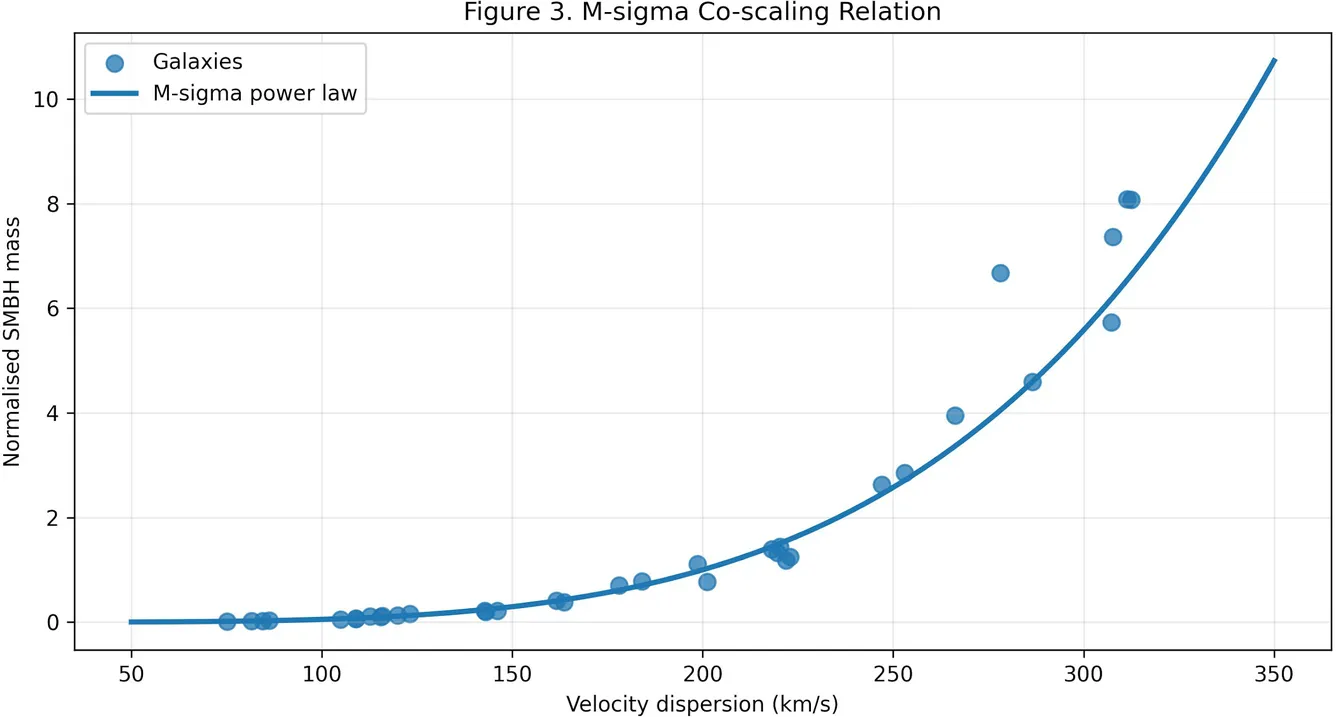
Figure 7. M–σ relation from coupled vortex system.
Falsifiable Predictions
Prediction 1 - Universal Centrality (Zero-Exception Rule)
No rotating galaxy will be found with a stable supermassive mass concentration displaced beyond the bounded wobble predicted by barycenter dynamics. Falsification: a single confirmed stable off-centre concentration inconsistent with barycenter wobble scaling and not explainable as a dual-core merger in transition.
Prediction 2 - Wobble Amplitude Scales With Mass Ratio
High-resolution imaging of nearby galactic cores will find that any measurable offset of the mass concentration from the dynamical centre scales as d × MBH/Mtotal, consistent with the barycenter formula and not with random migration history. Falsification: mass concentration offsets that do not follow the MBH/Mtotal scaling, or that are systematically larger than the barycenter formula predicts.
Prediction 3 - No Singularity at the Vortex Core
Future constraints on interior structure of galactic mass concentrations will be consistent with extreme but finite density, not with infinite density at a mathematical point. Falsification: evidence requiring infinite density at a point inside a galactic core.
Prediction 4 - Gravitational Wave Speed = c Exactly
Gravitational waves propagate at exactly the speed of light. Already confirmed by GW170817 to within 10⁻¹⁵ of c, confirming both gravitational waves and light travel at the Spaticle field’s maximum propagation speed. Falsification: gravitational waves detected at a speed measurably different from c.
Prediction 5 - JWST Centrality at All Redshifts
As JWST probes higher redshifts, all morphologically resolved rotating systems will show central mass concentrations. No stable off-centre concentrations inconsistent with barycenter wobble scaling will be found at any redshift. Falsification: a statistically significant population of high-redshift rotating galaxies with off-centre mass concentrations.
Flat Galactic Rotation Curves Without Dark Matter
The Observation
Flat galactic rotation curves, the observation that stellar and gas orbital velocities remain approximately constant at large radii; Keplerian dynamics applied to visible mass predicts they should decrease, are the primary observational motivation for dark matter halos
surrounding galaxies. The flat velocity profile implies that the enclosed mass increases linearly with radius, inconsistent with the observed luminous mass distribution. The standard model proposes that the additional mass is provided by a spherical halo of dark matter extending far beyond the visible disk. Dark matter has not been directly detected by any experiment [15].
Vortex Angular Momentum Distribution
The vortex interpretation provides an alternative explanation. Within BFUT, galaxies can be modelled as large-scale gravitational vortex systems, with ordered angular momentum distributed across the disk and central mass concentration. Matter orbiting within the vortex structure experiences centripetal force from two contributions: the enclosed mass M(r) and the angular momentum distribution L(r) of the vortex. The orbital velocity in the vortex:
v²(r) / r = GM(r) / r² + f(L(r), r)
where f(L(r), r) is the centripetal contribution from vortex angular momentum. For sufficiently broad angular momentum distributions, the additional rotational contribution can flatten the radial decline in orbital velocity and, in limiting cases, produce approximately flat outer rotation behaviour. This is not a modification to gravity. It is an application of standard orbital mechanics to a system with non-Keplerian angular momentum distribution, exactly as observed in rotating fluids where the velocity profile depends on both the density distribution and the angular momentum distribution.
BFUT Paper 18 [23] provides the quantitative Spaticle field formulation, demonstrating that the gradient term in the modified Poisson equation contributes additional gravitational potential precisely where baryonic density drops steeply, fitting 175 galaxy rotation curves with 83% of residuals below 40 km/s without dark matter or per-galaxy tuning.
Proof-of-Concept Simulation Evidence
A proof-of-concept N-body simulation of 200 bodies with net angular momentum produces approximately flattened outer rotation behaviour, with outer-to-inner velocity ratios of approximately 0.71, rising to approximately 0.78-0.85 at larger N, while conserving angular momentum throughout the simulation. No dark matter is included and no modification to gravity is introduced. The emergent flattening therefore arises from the angular momentum structure of the simulated vortex system itself. This establishes dynamical plausibility, not yet complete observational closure.
The Information Paradox
The black hole information paradox [3,17] is one of the most discussed problems at the intersection of general relativity and quantum mechanics. If a black hole contains a singularity that destroys information, and if quantum mechanics requires that information is always preserved (unitarity), then something must give.
If no physical singularity exists at the galactic core, and if the quartic stiffening of the Spaticle field Lagrangian maintains finite field density throughout collapse, then the most direct classical mechanism commonly associated with irreversible information destruction is removed. Information about infalling matter may remain represented within the evolving physical state of the Spaticle-field vortex structure. The BFUT gravitational-vortex interpretation therefore potentially mitigates the standard classical formulation of the information paradox; it does not fully resolve all underlying quantum-gravitational questions associated with black holes. A complete quantum-gravitational treatment of vortex-core information dynamics on a physical Spaticle-field substrate is deferred to future work.
Conclusion
The gravitational vortex interpretation accounts for every directly
confirmed observational feature of black hole candidates without
requiring a central singularity of infinite density. The event horizon
is understood as a relativistic causal boundary of the exterior metric.
The Kerr metric naturally describes a vortex structure, and its formal
ring singularity is treated as a limitation of the classical interior
solution, not as a physically realised infinite-density object.
The Universal Centrality Rule, the complete absence of confirmed stable
violations of galactic centrality across billions of observed galaxies,
stands as the strongest zero-exception regularity in modern astronomy.
The BFUT framework explains this through two complementary mechanisms.
Structural necessity: the vortex core forms at the dynamical centre of
the rotating mass distribution; it cannot exist independently, just as
the eye of a whirlpool cannot exist outside the water. Dynamic
maintenance: the continuously rotating galactic disc enforces centrality
through barycentre dynamics, exactly as the Sun remains near the Solar
System barycentre while Jupiter orbits it. This restoring force never
stops because the rotation never stops.
LIGO gravitational wave observations, EHT shadow images, relativistic
jets, frame-dragging measurements, flat rotation curves, AGN
co-evolution, and the M–σ relation are all consistent with the vortex
interpretation. Within the BFUT framework, the quartic stiffening term
of the Spaticle-field Lagrangian prevents unrestricted collapse toward a
mathematical singularity, and the standard classical formulation of the
information paradox is substantially mitigated.
The framework interprets black holes not as isolated singular objects
embedded inside galaxies, but as dynamically maintained vortex-core
structures that are inseparable from the rotating mass systems that
produce them. It derives its central predictions directly from the
proposed dynamical structure of rotating gravitational vortex systems,
not from post hoc anomaly accommodation.
References
Penrose, R. (1965). Gravitational collapse and space-time singularities. Physical Review Letters, 14(3), 57-59.
Hawking, S. W., & Ellis, G. F. R. (1973). The large scale structure of space-time. Cambridge University Press.
Hawking, S. W. (1975). Particle creation by black holes. Communications in Mathematical Physics, 43(3), 199-220.
Mathur, S. D. (2005). The fuzzball proposal for black holes. Fortschritte der Physik, 53(7-8), 793-827.
Ashtekar, A., & Bojowald, M. (2005). Black hole evaporation: A paradigm. Classical and Quantum Gravity, 22(16), 3349.
Strominger, A., & Vafa, C. (1996). Microscopic origin of the Bekenstein-Hawking entropy. Physics Letters B, 379(1-4), 99-104.
Kerr, R. P. (1963). Gravitational field of a spinning mass as an example of algebraically special metrics. Physical Review Letters, 11(5), 237-238.
O’Neill, B. (1995). The geometry of Kerr black holes. A K Peters.
Visser, M. (2007). The Kerr spacetime: A brief introduction. arXiv:0706.0622.
Everitt, C. W. F., et al. (2011). Gravity Probe B: Final results of a space experiment to test general relativity. Physical Review Letters, 106(22), 221101.
Abbott, B. P., et al. (LIGO). (2016). Observation of gravitational waves from a binary black hole merger. Physical Review Letters, 116(6), 061102.
Event Horizon Telescope Collaboration. (2019). First M87 Event Horizon Telescope results. Astrophysical Journal Letters, 875(1), L1.
Event Horizon Telescope Collaboration. (2022). First Sagittarius A* Event Horizon Telescope results. Astrophysical Journal Letters, 930(2), L12.
Blandford, R. D., & Znajek, R. L. (1977). Electromagnetic extraction of energy from Kerr black holes. Monthly Notices of the Royal Astronomical Society, 179(3), 433-456.
Aprile, E., et al. (XENONnT). (2023). First dark matter search with XENONnT. Physical Review Letters, 131(4), 041003.
Sharma, V. S. (2026). BFUT Simulation Suite: Proof-of-Concept Interactive Simulations. Zenodo. DOI: 10.5281/zenodo.19124509
Preskill, J. (1992). Do black holes destroy information? In S. Kalara & D. V. Nanopoulos (Eds.), Black Holes, Membranes, Wormholes, and Superstrings. World Scientific.
Sharma, V. S. (2026). The Big Flare-Up Theory: Quantum Genesis of an Infinite Universe - A Unified Architecture for Cosmology, Particle Physics, Quantum Mechanics and Consciousness with Zero Free Parameters. Zenodo.
DOI: 10.5281/zenodo.19149785
Sharma, V. S. (2026). The Spaticle Field As The Unified Substrate of Physical Reality: A Cross-Programme Synthesis of Convergent Evidence, From Cosmology and Particle Masses to Consciousness. Zenodo. DOI: 10.5281/zenodo.19394064
Abbott, B. P., et al. (2017). Gravitational waves and γ-rays: GW170817 and GRB 170817A. Astrophysical Journal Letters, 848(2), L13.
Labbe, I., et al. (2023). Massive galaxies 600 Myr after Big Bang. Nature, 616, 266-269.
Sharma, V. S. (2026). The Origin of Matter, Antimatter, and Fundamental Forces: How Protons, Electrons, and Hydrogen Formed Fundamental Forces. Zenodo. DOI: 10.5281/zenodo.19908215
Sharma, V. S. (2026). The Spaticle Field as the Immediate Local Carrier of Gravitation (BFUT P18). Zenodo. [in preparation]
Hopkins, P. F., Hernquist, L., Cox, T. J., and Keres, D. (2008). A cosmological framework for the co-evolution of quasars, supermassive black holes, and elliptical galaxies. Astrophysical Journal Supplement Series, 175(2), 356-389.
Kormendy, J., and Ho, L. C. (2013). Coevolution (or not) of supermassive black holes and host galaxies. Annual Review of Astronomy and Astrophysics, 51, 511-653.
Madau, P., and Dickinson, M. (2014). Cosmic star-formation history. Annual Review of Astronomy and Astrophysics, 52, 415-486.
Curtis-Lake, E., et al. (2023). Spectroscopic confirmation at z = 10.3-13.2. Nature Astronomy, 7, 622-632.
About the Author
Vijay Shankar Sharma is a Chartered Accountant and MBA from the Indian School of Business, with an Advanced Development Program from The Wharton School, University of Pennsylvania. He is an independent researcher with no formal training in any branch of science, working without institutional affiliation or external funding. ORCID: 0009-0001-9622-6121. Contact: vss@vijayshankarsharma.com