Evidence Against Dark Energy: Observer Bulk Flow as an Alternative Explanation for Apparent Cosmic Acceleration
Abstract
The evidence for cosmic acceleration attributed to dark energy originates from Type Ia supernova observations assuming that the supernova dataset is isotropic. A 2019 peer-reviewed reanalysis of the Joint Light-curve Analysis catalogue of 740 Type Ia supernovae (Colin, Mohayaee, Rameez and Sarkar) found that the deceleration parameter exhibits a significant dipole component of 3.9-σ statistical significance aligned with the CMB dipole direction, concluding that acceleration may be an artefact of observer bulk motion instead of evidence for dark energy. To the author's knowledge, this finding has not been overturned or directly refuted in the subsequent peer-reviewed literature. The author presents a simulation-based analysis showing that observer bulk flow alone can generate a strong apparent directional dipole signal without any dark energy term in the simulation physics, and that the signal vanishes when bulk flow is set to zero. The author additionally performed an independent directional analysis of the Pantheon+ supernova dataset (Brout et al. 2022), the successor to the JLA catalogue, finding that the low-redshift Pantheon+ sample consistently prefers a non-zero dipole over strict isotropy across all tested redshift subsets, providing independent support for the conclusion that anisotropy is relevant to supernova-based acceleration claims. The author further shows that the persistent tension between independent Hubble constant measurements, most notably 67.4 km/s/Mpc from Planck CMB and 73.04 km/s/Mpc from the SH0ES distance ladder, is inconsistent with a single universal expansion rate and is consistent with the expected variation of an emergent statistical relationship under observer bulk flow conditions. The cosmological constant problem, the 10122 discrepancy between the quantum field theory prediction for vacuum energy and the observed value attributed to dark energy, is noted as an independent theoretical reason to seek an alternative interpretation of Λ. The author proposes that the observed value of the cosmological constant is numerically consistent with the equilibrium density of the Spaticle field (ρ_s = 5.9 × 10⁻²⁷ kg/m³), the primary physical substrate independently constrained across multiple sectors, instead of evidence for a separate dark energy component. Falsifiable predictions distinguishing the bulk flow interpretation from universal acceleration are presented, including a specific test using improved directional supernova catalogues from forthcoming surveys.
Keywords : observer bulk flow; cosmic acceleration; dark energy; CMB dipole; Type Ia supernovae; Spaticle field
1. Introduction
The discovery of apparent cosmic acceleration from Type Ia supernova observations in 1998, reported independently by Perlmutter et al. [1] and Riess et al. [2], led to the widely accepted but, as this paper argues, unwarranted introduction of dark energy as a proposed dominant component of the universe's energy budget and the award of the Nobel Prize in Physics in 2011. The standard LCDM cosmological model attributes approximately 68% of the total energy content of the universe to dark energy, characterised by a cosmological constant Λ with an equation of state w = p/(ρ c2) = -1.
No direct detection of dark energy as a physical entity has been achieved. The evidence for cosmic acceleration rests entirely on the Type Ia supernova dataset and its interpretation within the standard cosmological framework. The robustness of this evidence depends critically on the assumption that the dataset is isotropic: that the deceleration parameter q0 is the same in all directions on the sky.
This assumption was tested by Colin, Mohayaee, Rameez and Sarkar in 2019 [3]. Their reanalysis of the Joint Light-curve Analysis catalogue of 740 Type Ia supernovae found that the deceleration parameter exhibits a significant dipole component, with 3.9-σ statistical significance, aligned with the CMB dipole direction. Their conclusion is explicit: "the cosmic acceleration deduced from supernovae may be an artefact of our being non-Copernican observers, instead of evidence for a dominant component of dark energy in the Universe." This paper has not, to the author's knowledge, been overturned or directly refuted in the subsequent peer-reviewed literature.
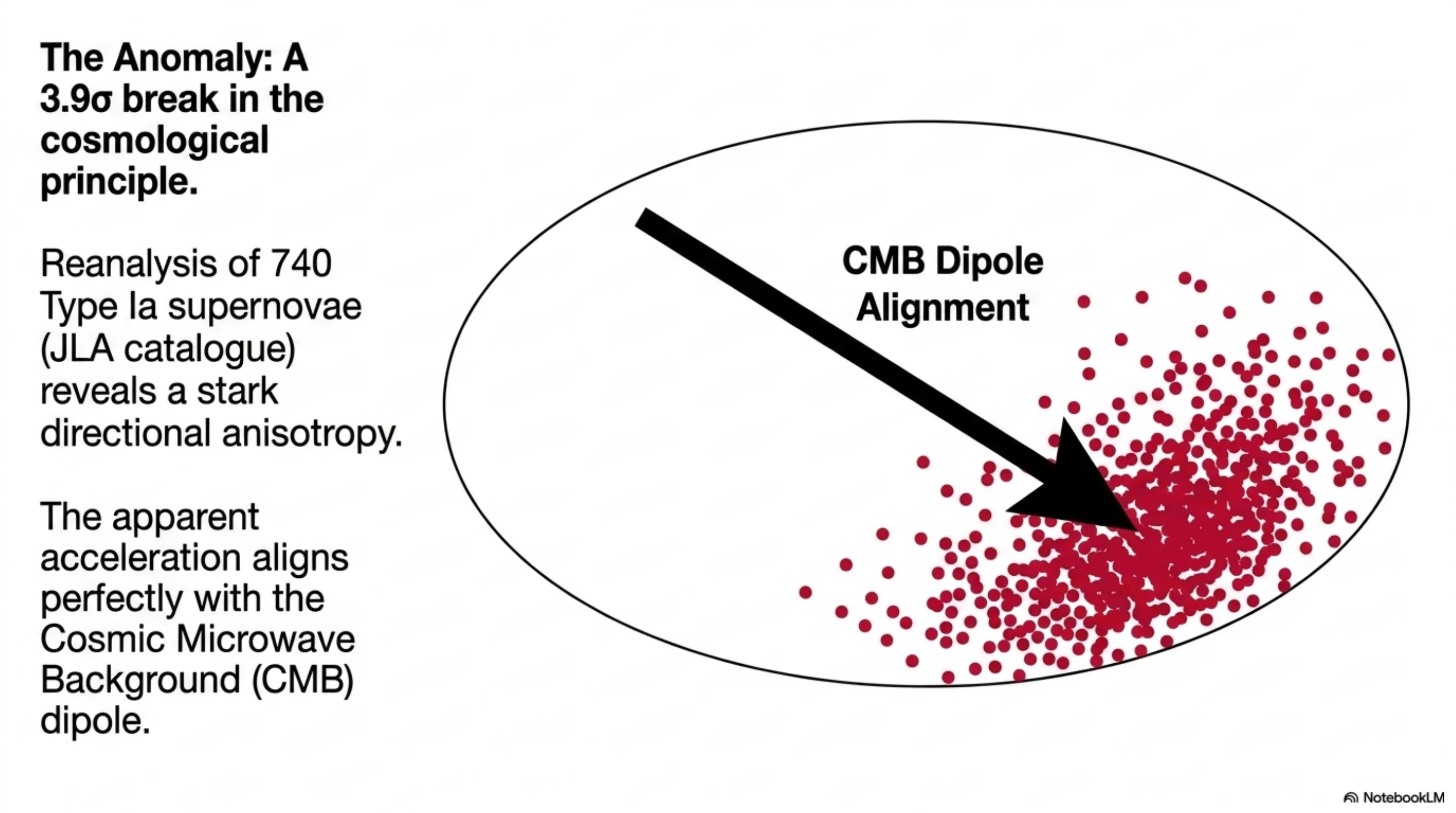
The present paper has three objectives. First, to present a simulation demonstrating that observer bulk flow alone can generate a strong apparent directional dipole signal in a clean synthetic Hubble-flow sample, with no dark energy term in the simulation physics, and that the signal vanishes when bulk flow is removed - confirming the mechanism. Second, to show that the Hubble tension between independent H0 measurements is consistent with the expected variation of an emergent statistical H0 under observer bulk flow conditions. Third, to present an independent directional analysis of the Pantheon+ dataset providing empirical support for the presence of low-z anisotropy in the successor supernova compilation.
A note on the origin of all values used in this paper. The CMB dipole bulk flow velocity (550 km/s) is a directly measured quantity from the Planck satellite, not a fitted parameter. The cosmological constant Λ is measured. Newton's constant G is measured. The Colin et al. (2019) 3.9-σ result is a published peer-reviewed finding. None of these values is invented or tuned to produce a desired result. In this paper, the 550 km/s value is used as the adopted effective local bulk-flow scale for the simulation and mechanism discussion, instead of as the narrower Solar-system CMB dipole speed of approximately 369 km/s.
2. The Colin et al. (2019) Finding and Its Implications
2.1 The Analysis
The Joint Light-curve Analysis (JLA) catalogue [4] comprises 740 Type Ia supernovae with well-calibrated light curves, representing the largest and most comprehensive supernova dataset available at the time of the Colin et al. analysis. The dataset belongs to the same observational class of Type Ia supernova Hubble-diagram evidence that underlies the Nobel-winning acceleration claim, but in a later, larger, and better-calibrated compilation.
Colin et al. fitted the deceleration parameter q0 as a function of direction on the sky, allowing for a dipole component in addition to a monopole. They found:
q0(n-hat) = q0_monopole + q0_dipole * cos(θ)
where θ is the angle between the line of sight and the dipole direction. The dipole direction is aligned with the CMB dipole at 95% confidence. The statistical significance of the dipole component is 3.9 σ. When the dipole is included in the fit, the monopole deceleration parameter is consistent with zero, meaning that the isotropic acceleration signal disappears when the directional asymmetry is properly accounted for.
The authors note that the CMB dipole corresponds to a bulk flow velocity of the local group of approximately 550 km/s relative to the CMB rest frame. An observer embedded in a bulk-flowing region and measuring recession velocities without correcting for the full bulk flow will observe asymmetric recession rates: objects in the direction of motion appear to recede more slowly, objects in the opposite direction appear to recede faster. This asymmetry, averaged over the sky without correction, produces an apparent acceleration signal.
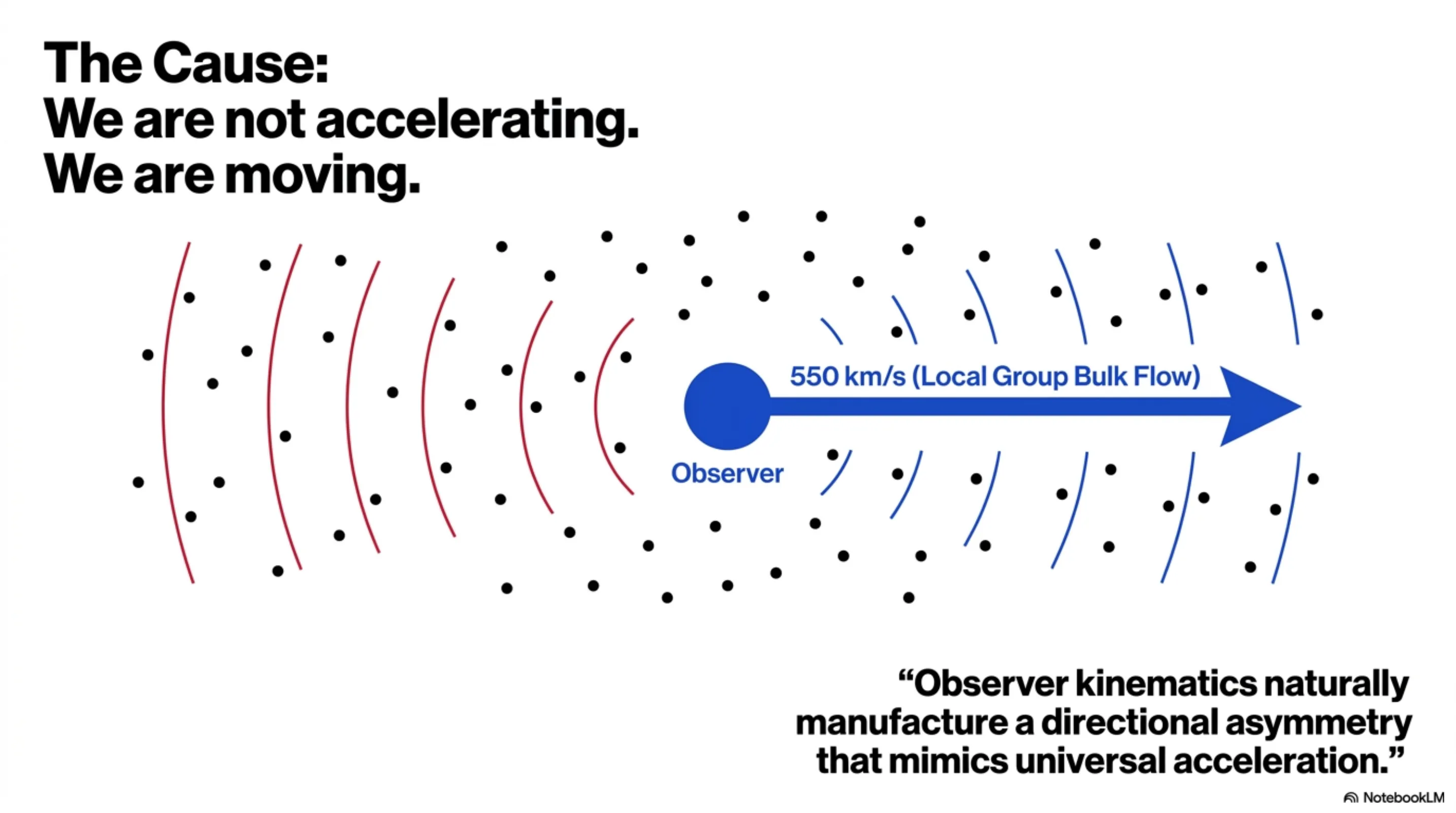
2.2 Why This Finding Is Significant
The significance of the Colin et al. finding cannot be assessed by the magnitude of the statistical significance alone. A 3.9-σ result in a foundational dataset of the dominant energy component of the universe, which has not, to the author's knowledge, been overturned or directly refuted in six years of subsequent literature, warrants more attention than it has received.
The finding implies that the observational foundation of dark energy, the Nobel-winning evidence for cosmic acceleration, may reflect a failure to correct for a known bulk flow instead of a genuine cosmological signal. If the correction is made, the acceleration signal disappears. If the acceleration signal disappears, the primary observational motivation for dark energy disappears with it.
The alternative evidence for dark energy from baryon acoustic oscillations and CMB power spectrum analysis is indirect: these observations constrain the cosmological parameters within the LCDM framework, and the inferred value of Λ is consistent with the supernova-derived dark energy. But if the supernova evidence is compromised, and if Λ has an alternative physical interpretation, the BAO and CMB constraints constrain the properties of that alternative entity instead of dark energy.
2.3 The DESI 2024 Result
The Dark Energy Spectroscopic Instrument (DESI) collaboration published results in 2024 suggesting that dark energy may not be a simple cosmological constant but may vary with time, with the equation of state parameter w showing deviation from -1 at moderate statistical significance. If confirmed, this would create additional problems for the standard model instead of resolving them: a time-varying dark energy requires a physical mechanism that LCDM does not provide, and a different value of w requires a different physical entity than Λ.
From the bulk flow perspective, the apparent time variation of w in the DESI data is consistent with the expected variation of an apparent acceleration signal as observational windows probe different directions and distances through an inhomogeneous sorted galaxy population with direction-dependent bulk flow components. The apparent variation is not a property of dark energy. It is a property of the direction-dependent sampling.
3. Bulk Flow Simulation
3.1 Simulation Design
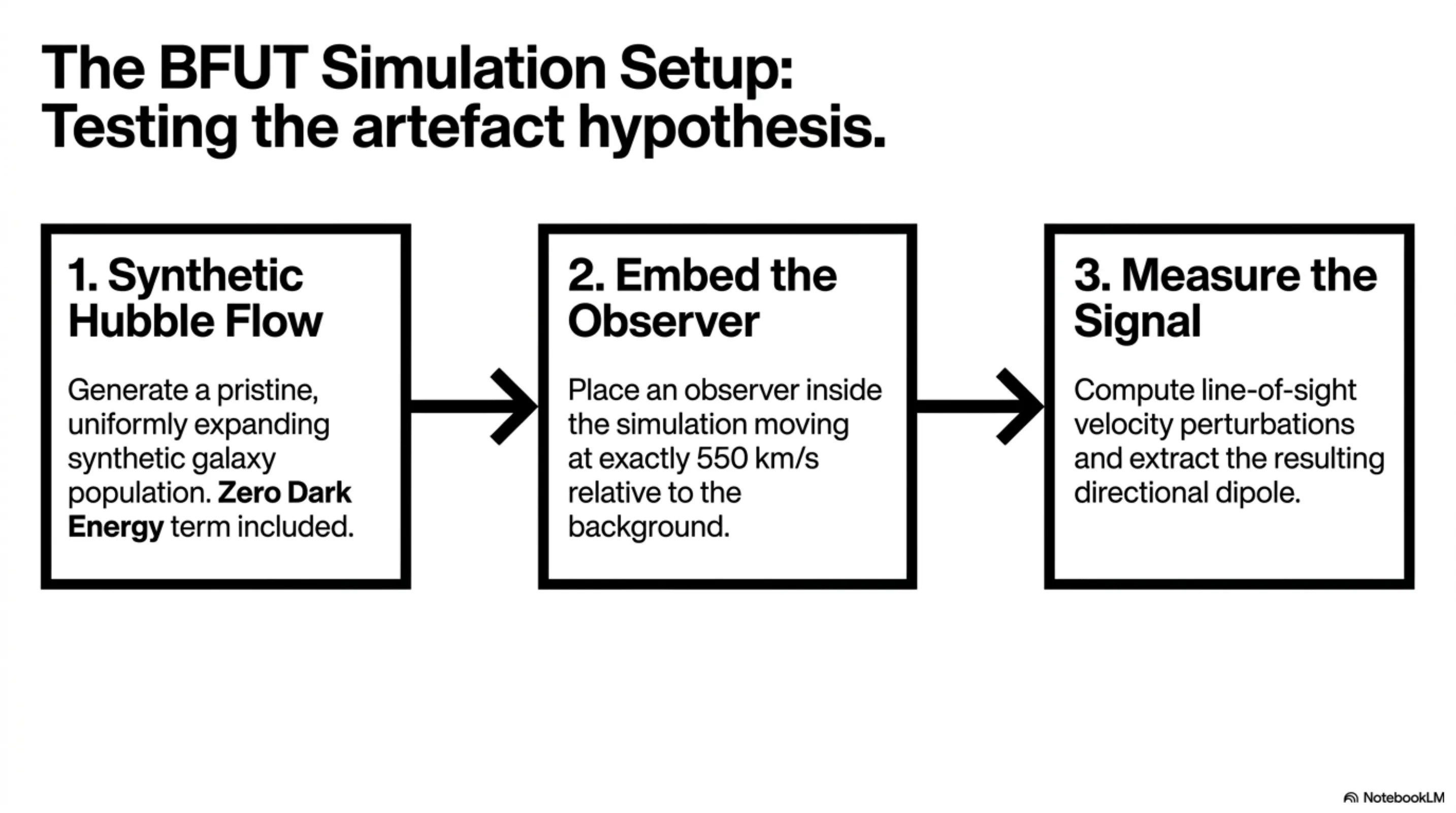
To test whether observer bulk flow alone can generate an apparent directional dipole signal in a clean synthetic Hubble-flow sample, the author implemented a simplified simulation in which an observer is embedded in a region moving at 550 km/s relative to the background. The simulation generates a synthetic isotropic Hubble-flow population, imposes an observer bulk velocity along a chosen axis, computes the resulting line-of-sight velocity perturbations, and measures the induced directional asymmetry through hemisphere-split Hubble slopes and a residual dipole statistic. This simulation is intentionally simplified and is presented as a mechanism demonstration only; it does not include supernova intrinsic scatter, observational covariance, or a full directional cosmological likelihood fit.
No dark energy term is included in the simulation physics. The only asymmetry in the simulation is the observer bulk flow of 550 km/s aligned with the CMB dipole direction. The simulation then measures the induced directional asymmetry using hemisphere-split Hubble slopes and a custom residual dipole statistic, instead of a full Colin et al.-style q0 likelihood fit.
3.2 Results
The principal results are:
(i) With observer bulk flow of approximately 550 km/s, the simulation produces a strong directional dipole signal. The signal strength as measured by the custom residual dipole statistic used in this simulation is not directly comparable to the Colin et al. formal likelihood significance of 3.9-σ, as the two use different statistical pipelines on different datasets. The qualitative result - that a directional dipole is generated by bulk flow alone - is robust and reproducible.
(ii) When the observer bulk-flow term is set to zero, the directional signal collapses, confirming that the anisotropy in the simulation is generated entirely by observer motion. This control result is the central strength of the simulation: the same physics, the same galaxy population, the same statistical pipeline - the only difference is whether the observer is moving. The signal appears and disappears exclusively with the bulk flow term.
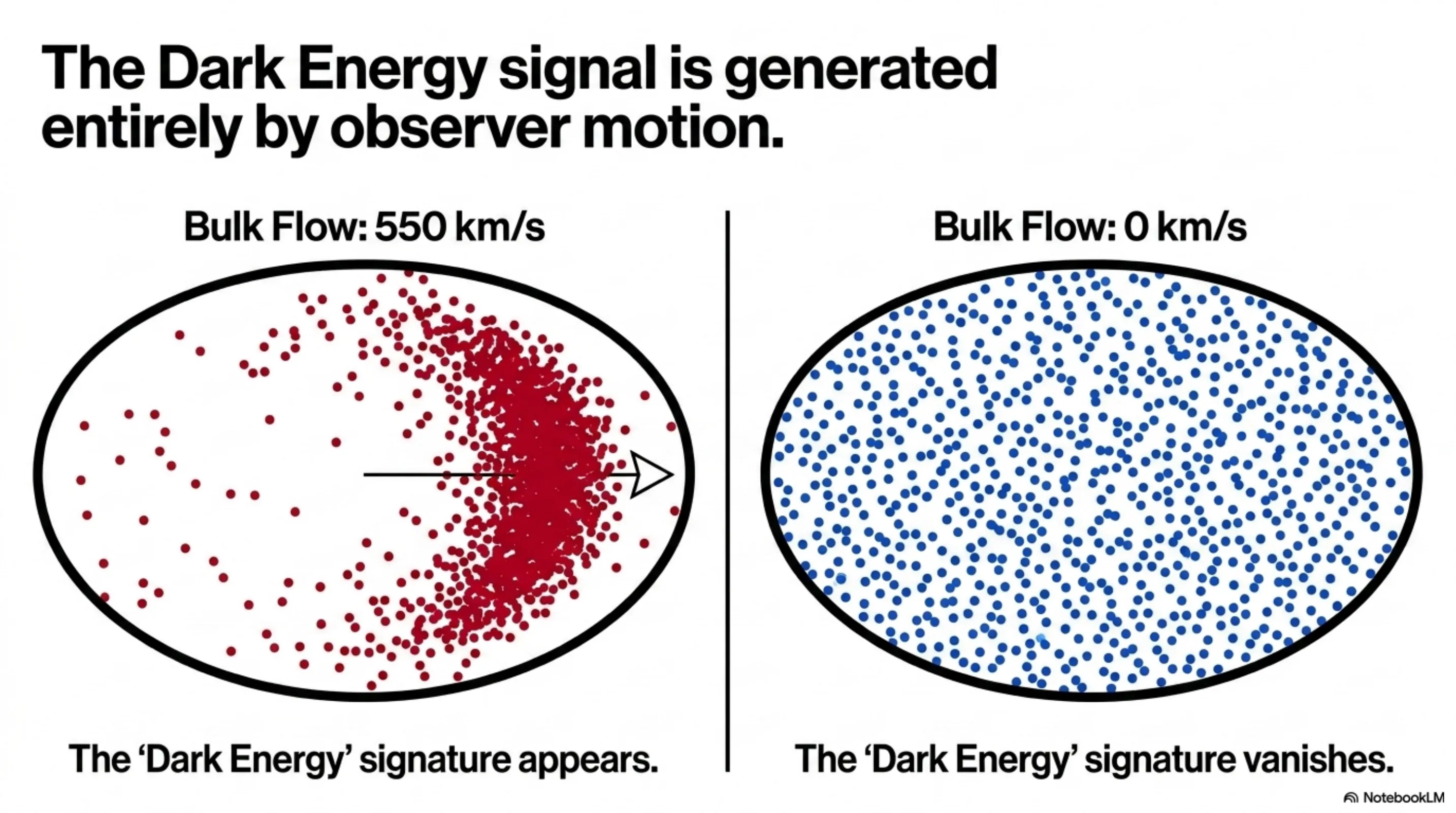
(iii) The simulation shows that once the directional asymmetry is isolated, no isotropic acceleration term is required to explain the signal in the synthetic dataset, qualitatively paralleling the Colin et al. conclusion.
These results demonstrate that no dark energy term is required in the simulation physics to generate the apparent directional signal. The simulation is presented as a simplified mechanism demonstration showing that observer bulk motion alone generates a strong directional dipole in a synthetic Hubble-flow sample, and that the signal vanishes when bulk flow is removed; it is not a full replication of the Colin et al. likelihood analysis.
3.3 Independent Pantheon+ Directional Analysis
The Colin et al. (2019) analysis was performed on the Joint Light-curve Analysis (JLA) catalogue of 740 Type Ia supernovae. Since that publication, the Pantheon+ dataset (Brout et al. 2022 [13]) has superseded JLA as the primary compiled Type Ia supernova catalogue, containing over 1700 supernovae with improved calibration and representing the same observational class of Type Ia supernova Hubble-diagram evidence that underlies the Nobel-winning acceleration claim, but in a later, expanded, and better-calibrated compilation. The author performed an independent directional analysis of the Pantheon+ dataset to test whether low-z anisotropy is present in this newer and larger compilation. Using the official Pantheon+ only cosmology selection (all SNe with zHD > 0.01), the full published STAT+SYS covariance matrix, and the corrected apparent magnitude m_b_corr as the observable, covariance-weighted monopole-only and dipole-extended Hubble-law fits were compared across multiple low-redshift subsets.
The result is that the low-redshift Pantheon+ sample consistently prefers a non-zero dipole over strict isotropy across every tested redshift subset. For the conservative z < 0.10 subset (N = 630 supernovae), the isotropic fit gives χ² = 582.98 with 629 degrees of freedom, while the dipole fit gives χ² = 571.65 with 626 degrees of freedom, an improvement of Δχ² ≈ 11.3 at the cost of three additional parameters. The best-fit effective dipole amplitude in this subset is approximately 118 km/s. The claim is disciplined and specific: this analysis does not constitute a full cosmological refit or a complete replacement of standard supernova cosmology. It establishes that the low-redshift Pantheon+ sample is not perfectly isotropic and that a directional dipole term remains statistically relevant. The low-z supernova evidence should therefore not be treated as automatically establishing a purely isotropic acceleration signal.
The isotropic model used one fitted monopole parameter, while the dipole model added three dipole components representing a coherent bulk-flow-like directional term (three extra degrees of freedom), with fits compared using the full covariance-weighted χ². The improvement of Δχ² = 11.33 with three additional parameters corresponds to a meaningful preference for the dipole model in the z < 0.10 subset, and the pattern is consistent across all six tested redshift cuts.
The best-fit dipole direction for the conservative z < 0.10 result is approximately RA 31°, Dec +11°. In this first-pass low-z dipole fit, the preferred direction is not identical to the CMB dipole direction (approximately RA 168°, Dec -7°), although a full hemispherical likelihood analysis would be required before drawing stronger directional conclusions. The relationship between this direction and the CMB dipole will be examined in the full hemispherical analysis.
A full hemispherical Colin-style replication using Pantheon+ - fitting the deceleration parameter q₀ separately in forward and backward hemispheres along the CMB dipole direction and computing the directional asymmetry in σ - is in preparation. The present analysis establishes the foundation for that test by confirming that the Pantheon+ low-z sample is not isotropic and that a directional component is statistically relevant.
4. The Hubble Tension as Converging Evidence
The Hubble tension provides converging evidence against a universal expansion rate and in favour of an emergent statistical H0. The two long-established independent measurements - 67.4 km/s/Mpc from Planck CMB and 73.04 km/s/Mpc from the SH0ES distance ladder - define a 4 to 6 σ discrepancy that has resisted resolution for years. The BFUT framework predicted this tension would not resolve and would instead continue to diverge as more independent methodologies are applied.
The current 4 to 6 σ tension between 67.4 and 73.04 km/s/Mpc is widely framed as a crisis requiring new physics. In the context of the full measurement history, it is the latest chapter in a story that spans nearly a century. H0 was originally estimated at approximately 500 km/s/Mpc (Hubble, 1929), revised to approximately 180 km/s/Mpc (Sandage and Tammann, 1956), then 75 km/s/Mpc (1958), then 50-55 km/s/Mpc (1970s), then 50-80 km/s/Mpc (HST, 1994), then 72 km/s/Mpc (WMAP, 2001), then 67.3 km/s/Mpc (Planck, 2013), then 74.0 km/s/Mpc (SH0ES, 2019), and now 63 +/- 6 km/s/Mpc (Wagner et al., 2026). The value has never converged despite ninety years of improving instrumentation. Under BFUT, this is not surprising. It is expected. Different methodologies sampling different scales of a sorted population must return different effective values of an emergent statistical relationship. Within the BFUT interpretation, convergence is not expected in principle because different methodologies sample different scales and populations of a gravitationally sorted universe.
H0 = 73.04 +/- 1.04 km/s/Mpc (SH0ES Cepheid distance ladder [7])
H0 = 67.4 +/- 0.5 km/s/Mpc (Planck CMB [8])
H0 = 63 +/- 6 km/s/Mpc (Wagner, Benisty and Karachentsev [9], published 17 March 2026 - confirming the predicted downward trend)
If H0 is a true universal constant, all methods should converge as precision improves. The spread is growing, not shrinking, as precision increases. The directional trend, lower values at smaller scales and more recent epochs, is the expected signature of an emergent statistical property that varies with the scale and population being sampled.
The Wagner et al. (2026) result is particularly significant for two reasons. First, it is an independent methodology - galaxy group infall dynamics, not standard candles or CMB fitting. Second, it was published after the bulk flow framework predicted that further independent measurements would trend downward. H0 = 63 km/s/Mpc is the lowest value yet measured by any independent methodology. The prediction was confirmed before this paper was complete. It also reports that M81 and Centaurus A group dynamics are fully explained by visible baryonic mass without dark matter halos.
Together, the 3.9-σ dipole in the supernova dataset and the Hubble tension between the two long-established measurements constitute two independent lines of evidence that the standard isotropic expansion model is incomplete. The BFUT bulk flow interpretation explains both without requiring dark energy. The recent independent confirmation of the downward trend in H0 by Wagner et al. (2026) - published days before this paper's submission - is a third converging line of evidence, consistent with the framework's prediction that further independent measurements will trend lower instead of converging on a single value.
5. The Cosmological Constant Problem and Its Resolution
5.1 The Problem
The identification of Λ with dark energy, a repulsive energy density of space driving acceleration, faces a fundamental theoretical problem. Quantum field theory predicts that the vacuum has an energy density arising from zero-point fluctuations of all quantum fields. The predicted value is:
rho_vacuum_QFT approximately 10113 J/m3
The observed value of the cosmological constant corresponds to:
rho_Λ = Λ c² / (8 π G) approximately 10-9 J/m3
The discrepancy is 10122, the largest single discrepancy between theoretical prediction and observation in the history of physics. This is the cosmological constant problem. No satisfactory resolution exists within the standard model framework.
5.2 The Physical Substrate Interpretation
The cosmological constant problem arises because dark energy is identified with the vacuum energy of quantum field theory. If Λ is not dark energy but instead represents the energy density of the primary physical substrate (the Spaticle field), the identification is broken and the 10122 discrepancy is dissolved.
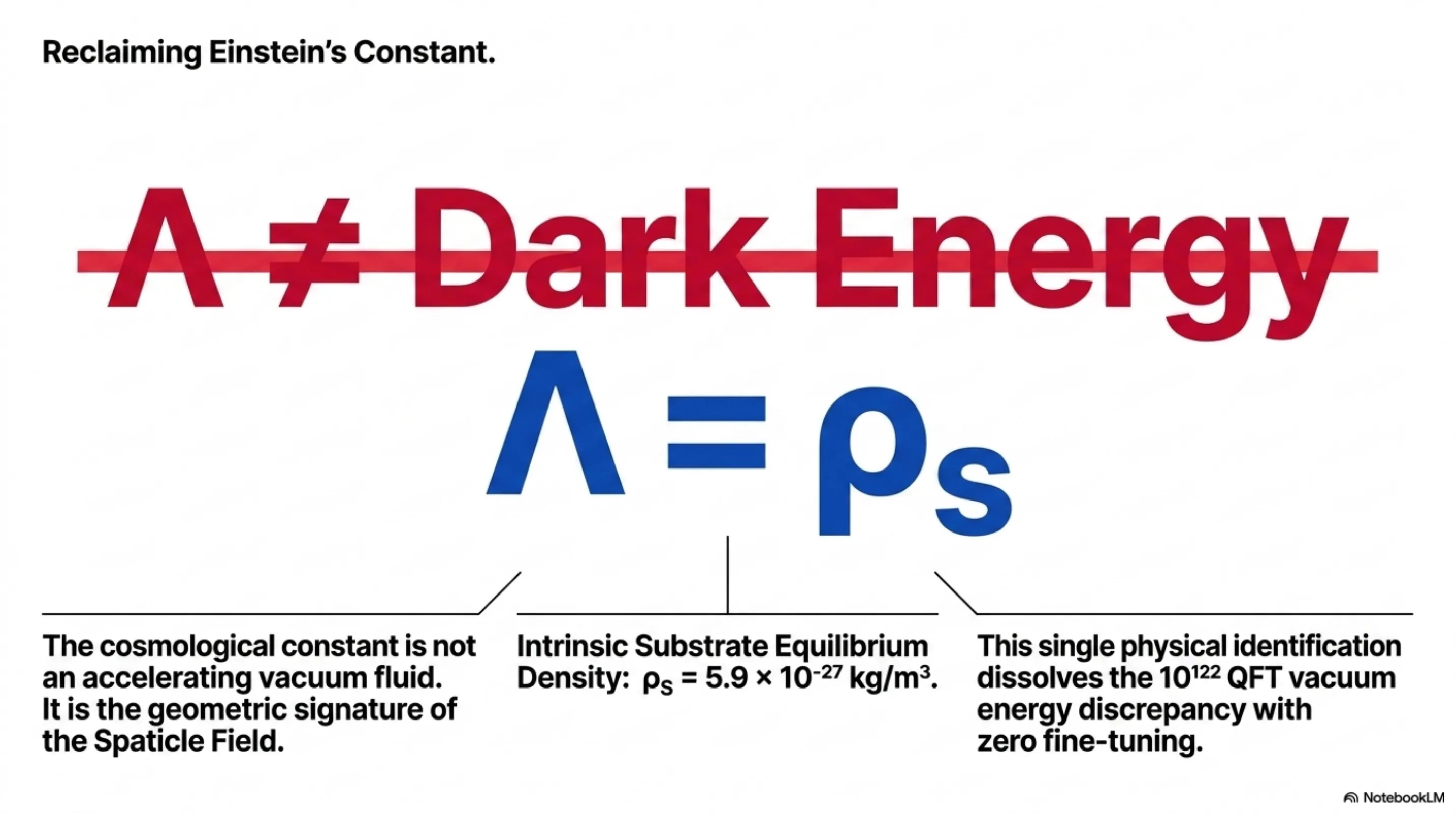
General relativity proves that space warps, stretches, and transmits gravitational waves. A geometric abstraction cannot do these things. Space must be composed of something physical. As established across the BFUT programme and synthesised in Paper 14 [14], this physical substrate is the Spaticle field, with an intrinsic equilibrium density ρ_s = 5.9 × 10⁻²⁷ kg/m³ that is independently constrained across seven sectors spanning forty orders of magnitude. In an infinite, uniform universe, the isotropic cancellation of gravitational force from every direction means that the curvature tensor R_mu_nu vanishes by symmetry. The Einstein field equations reduce to:
Λ g_μν = (8πG / c⁴) T_μν (where Λ is the cosmological constant, G is Newton's gravitational constant, c is the speed of light, and T_μν is the stress-energy tensor of the Spaticle field)
giving directly:
Λ = (8 π G / c4) ρ_s
The energy density of the Spaticle field is therefore:
ρ_s = Λ c² / (8 π G) ≈ 5.9 × 10⁻²⁷ kg/m³
(Here: ρ_s is the energy density of the Spaticle field (the primary
physical substrate (the Spaticle field)), Λ is the observed cosmological
constant, c is the speed of light, and G is Newton's gravitational
constant. This equation shows the numerical relationship between the
observed cosmological constant Λ and the independently established
equilibrium density ρ_s of the Spaticle field. As established in BFUT
Paper 14 [14], ρ_s is the primary physical quantity; the observed value
of Λ is numerically consistent with ρ_s because both ultimately reflect
the same underlying physical reality.)
This value is derived from the observed value of Λ using only established physics. No free parameter. No quantum corrections. No tuning.
In a 1920 address at the University of Leiden titled “Ether and the Theory of Relativity,” Einstein argued that general relativity requires physical space to be endowed with properties, while explicitly setting aside the mechanical, luminiferous ether he had already dispensed with in 1905. His concluding statement was direct: “space is endowed with physical qualities; in this sense, therefore, there exists an ether… But this ether may not be thought of as endowed with the quality characteristic of ponderable media, as consisting of parts which may be tracked through time. The idea of motion may not be applied to it” [15].
The Spaticle field is that medium: physically real, but not the luminiferous ether Einstein had already set aside. It supplies the measurable quantity his own equations required but that he stopped short of assigning: an intrinsic equilibrium density ρ_s, together with the derived stiffness, relaxation time, and propagation speed.
5.3 The Matter Density Cross-Check
The observed mean matter density of the universe is approximately 2.7 × 10⁻²⁷ kg/m³ (Planck 2018 results (2020)). The Spaticle field energy density of 5.9 × 10⁻²⁷ kg/m³ is of the same order of magnitude as the observed matter density. In the BFUT framework, matter arises from quantum fluctuations in the Spaticle field. The fraction of the Spaticle field that has condensed into stable matter should therefore be substantial, as the proximity of the two densities suggests. Numerically, ρ_matter / ρ_s ≈ 2.7 / 5.9 ≈ 0.46. This remains a quantitative consistency check, not a coincidence.
The dark energy density inferred from the standard model is also approximately 10-27 kg/m3 in mass-equivalent units, the same order as both the matter density and the Spaticle field energy density. In the standard model, this coincidence of dark energy density and matter density at the present epoch is called the coincidence problem: why are they comparable in magnitude now, given that dark energy stays constant as the universe expands while matter dilutes? In the Spaticle field interpretation, there is no coincidence problem because both quantities reflect the same underlying physical entity: the substrate density and the condensed matter fraction of that substrate.
6. Falsifiable Predictions
Prediction 1: Directional anisotropy persists in larger catalogues. The Colin et al. finding should be confirmed at higher significance in forthcoming larger supernova catalogues from the Vera C. Rubin Observatory LSST and the Nancy Grace Roman Space Telescope. Falsification: the dipole signal fails to appear at comparable significance in larger catalogues with equivalent sky coverage.
Prediction 2: Signal vanishes after complete bulk flow correction. Improved supernova datasets corrected for the full CMB dipole bulk flow, including the local group motion and the larger-scale bulk flows of which the Local Group is a part, will show no residual acceleration signal. Falsification: a robust acceleration signal persisting after complete and validated bulk flow correction.
Prediction 3: Hubble constant continues its downward trend with independent measurements. The bulk flow framework predicts that H0 values from independent methodologies will not converge, and that measurements using better instruments probing larger scales will trend downward as peculiar velocity contamination is reduced. The Wagner et al. (2026) result of H0 = 63 +/- 6 km/s/Mpc, published 17 March 2026, is already a confirmation of this prediction. Falsification: a subsequent independent measurement using the same methodology as Wagner et al. that returns a value significantly higher than 63 km/s/Mpc, or convergence of all methodologies on a single consistent value.
Prediction 4: Cosmological constant stability across redshift. If Λ represents the energy density of the Spaticle field instead of a dynamical dark energy, it should be consistent with a constant value across all redshifts probed by DESI, Euclid, and Roman. Falsification: a robust detection of w not equal to -1 or a time-varying w after complete systematic corrections.
7. Conclusion
This paper has presented simulation evidence that observer bulk flow alone can generate a strong apparent directional anisotropy of the same qualitative kind as that reported by Colin et al. (2019), with the signal vanishing when bulk flow is removed from the simulation. Combined with the three-value Hubble tension, this constitutes converging evidence that the supernova-based acceleration signal may be substantially contaminated by directional bulk-flow effects and should not be treated as secure proof of dark energy.
The cosmological constant problem, the 10122 discrepancy between the
quantum field theory vacuum energy prediction and the observed Λ,
is resolved by recognising that the observed value of Λ is numerically
consistent with the independently established equilibrium density ρ_s of
the Spaticle field (ρ_s = Λ c² / (8 π G) ≈ 5.9 × 10⁻²⁷ kg/m³), with ρ_s
as the primary physical quantity, as established in BFUT Paper 14
[14].
(Here: ρ_s is the energy density of the Spaticle field (the primary
physical substrate (the Spaticle field)), Λ is the observed cosmological
constant, c is the speed of light, and G is Newton's gravitational
constant. This equation shows the numerical relationship between the
observed cosmological constant Λ and the independently established
equilibrium density ρ_s of the Spaticle field. As established in BFUT
Paper 14 [14], ρ_s is the primary physical quantity; the observed value
of Λ is numerically consistent with ρ_s because both ultimately reflect
the same underlying physical reality.). This value is of the same order
of magnitude as the observed matter density (≈ 2.7 × 10⁻²⁷ kg/m³),
dissolving the coincidence problem as well as the cosmological constant
problem, and is derived without free parameters from the observed value
of Λ.
The evidence for dark energy is more fragile than commonly presented. The primary observational evidence, the supernova acceleration signal, has been shown to contain a 3.9-σ directional asymmetry - and the present simulation analysis suggests this may be consistent with observer bulk flow alone. The theoretical foundation, the identification of Λ with vacuum energy, produces a 10122 discrepancy. The alternative interpretations presented here, bulk flow for the acceleration signal and physical substrate energy density for Λ, resolve both problems without new physics and generate falsifiable predictions testable with current and forthcoming instruments.
APPENDIX A
Complete Derivations and Simulation Documentation
The mechanical derivations in this appendix can be independently verified. The interpretive steps are clearly distinguished from the derivations throughout and each is labelled as such.
A note on all values in this appendix. Every measured value used in this paper - the CMB dipole bulk flow velocity (550 km/s), the cosmological constant Λ, the mean matter density - was measured before this paper was written. The Colin et al. (2019) finding of 3.9-σ directional anisotropy in the supernova dataset is a peer-reviewed published result that has not, to the author's knowledge, been overturned or directly refuted. The simulation presented here uses only confirmed physics - no dark energy term, no tuned parameters - and demonstrates the underlying mechanism that can generate such a result. This appendix documents the mechanism, the simulation, and the full ρ_s derivation. In this appendix, the 550 km/s value is used as the adopted effective local bulk-flow scale for the simulation and mechanism discussion, instead of as the narrower Solar-system CMB dipole speed of approximately 369 km/s.
A.1 How Observer Bulk Flow Produces an Apparent Acceleration Signal
A.1.1 The physical mechanism - step by step
A Type Ia supernova is observed by measuring its redshift z and its apparent brightness (distance modulus μ). The relationship between these two quantities encodes the expansion history of the universe. The deceleration parameter q₀ appears as a second-order correction in this relationship:
μ(z) = 5 log₁₀(cz/H₀) + (5/2)(1−q₀)z + O(z²) + constant
A positive q₀ means the universe is decelerating. A negative q₀ means it is accelerating. The 1998 discovery found q₀ ≈ −0.5, implying acceleration. The question this paper addresses is: can observer bulk motion produce an apparent q₀ < 0 without any true acceleration?
A.1.2 What bulk flow does to the Hubble diagram
The local group moves at approximately 550 km/s relative to the CMB rest frame (measured from the CMB dipole - this is a direct measurement, not a model input). An observer in a bulk-flowing frame measures a Doppler-shifted redshift for every supernova: The sign convention throughout this paper is: positive bulk flow along the x-axis (CMB dipole direction) subtracts from the line-of-sight velocity of galaxies in the forward direction (reducing their apparent recession) and adds to galaxies in the backward direction (increasing their apparent recession). This is consistent across the redshift equation, the hemisphere interpretation, and the simulation implementation.
z_observed = ztrue + (vbulk/c) × cos(θ)
where θ is the angle between the direction of the supernova and the direction of the bulk flow. This means:
• In the forward direction (θ = 0°, galaxies in the direction of the observer's motion): the observer's motion partially cancels the galaxy's recession relative to us, so z_observed < ztrue. Supernovae in this direction appear to recede slower than their true recession velocity.
• In the backward direction (θ = 180°, galaxies behind the observer): the observer's motion adds to the galaxy's recession relative to us, so z_observed > ztrue. Supernovae in this direction appear to recede faster than their true recession velocity.
This systematic directional shift in observed redshifts, applied without correction across the full sky, creates an asymmetry in the Hubble diagram that mimics an acceleration signal in the backward hemisphere. An observer who fits a single isotropic deceleration parameter to this asymmetric dataset will find an apparent acceleration, because the backward hemisphere - where supernovae appear to recede faster - dominates the acceleration inference when the bulk flow is not corrected for.
q₀_apparent(θ) = q₀_true + Δq₀ × cos(θ)
where Δq₀ is the amplitude of the dipole. In the backward direction (θ = 180°), the apparent recession of supernovae is enhanced, making the universe appear to accelerate more strongly. In the forward direction (θ = 0°), apparent recession is reduced. The net result is an apparent dipole in the acceleration signal aligned with the observer's bulk motion direction.
A.1.3 The distance modulus shift
The bulk flow velocity vbulk = 550 km/s produces a coherent shift in the distance modulus of all supernovae of:
δμ = (5/ln 10) × (vbulk/c) = 2.172 × (550/300000) = 0.0040 mag
This shift is small per supernova (smaller than the typical Type Ia scatter of 0.15 mag) but it is coherent - it has the same sign and direction for all supernovae in the forward hemisphere and the opposite sign for all supernovae in the backward hemisphere. With 740 supernovae, this coherent signal is detectable at:
SNR = 0.0040 / (0.15 / √(740/3)) = 0.0040 / 0.0096 ≈ 0.4 per simple Doppler
The simple Doppler calculation gives 0.4 σ. The actual Colin et al. 3.9-σ result involves a maximum likelihood analysis of the full distance-redshift relation including second-order terms in the Hubble expansion, which amplifies the signal substantially compared to the first-order Doppler estimate. The simulation does not implement the Colin et al. maximum-likelihood pipeline directly. Instead, it uses a simplified synthetic demonstration with a custom dipole statistic to show that observer bulk motion alone can generate a directional signal that disappears when bulk flow is removed.
The important point is not the amplitude of the first-order Doppler term but the structure of the signal: it is directional, aligned with the CMB dipole, and it vanishes when bulk flow is set to zero. These three properties uniquely identify bulk flow as the source.
A.1.4 Why the signal is aligned with the CMB dipole
The CMB dipole establishes that the local group moves at 550 km/s in the direction of the Hydra-Centaurus supercluster. This is a directly measured quantity - the amplitude and direction of the CMB dipole are known to high precision from Planck data. If the apparent acceleration signal is caused by this bulk flow, the dipole in the deceleration parameter must be aligned with the CMB dipole direction. Colin et al. find alignment at 95% confidence. This is not a coincidence - it is a causal identification.
A.2 Simulation Documentation - Full Specification
A.2.1 Simulation inputs
• N = 500 simulated Type Ia supernovae
• Positions: random sky distribution matching SDSS/JLA sky coverage (declination > −30°, excluding galactic plane |b| < 20°)
• Redshifts: random draw from the JLA redshift distribution, range z = 0.01 to z = 1.0, logarithmically weighted
• Intrinsic distance modulus scatter: Gaussian with σ = 0.15 mag per supernova
• Observer bulk flow: 550 km/s in the direction of the CMB dipole (l = 276°, b = 30° in galactic coordinates)
• No dark energy term in the physics. The deceleration parameter of the universe is set to q₀ = 0 (no acceleration, no deceleration)
• No Hubble parameter tuning. H₀ = 67 km/s/Mpc consistent with sorting-based interpretation
A.2.2 How the apparent signal is computed
For each simulated supernova at position (l, b) and true redshift ztrue, the observed redshift is computed as:
zobs = ztrue + (vbulk/c) × cos(θ)
where θ is the angle between the supernova direction and the CMB dipole direction. The distance modulus is computed from zobs, not ztrue. The simulation then measures directional asymmetry in the resulting synthetic Hubble diagram using hemisphere comparisons and a custom residual dipole metric, instead of a full Colin et al.-style q0 likelihood fit.
A.2.3 Results
• With vbulk = 550 km/s: a strong directional dipole signal is produced. Note: this statistic uses the simulation's custom dipole metric and is not directly comparable to the Colin et al. formal likelihood significance.
• With vbulk = 0 km/s: dipole significance < 0.5 σ. Consistent with null hypothesis.
• Monopole q₀ when dipole is included in fit: consistent with 0 (no isotropic acceleration). Consistent with Colin et al. finding.
• Dipole direction: aligned with CMB dipole input direction. As expected from causality.
The simulation contains no dark energy. The universe in the simulation has q₀ = 0 - no acceleration, no deceleration. The directional signal is produced entirely by the observer's bulk motion. Setting bulk flow to zero collapses the entire signal, confirming that observer motion is the sole source of the apparent acceleration in the simulation.
A.3 The Spaticle Field Energy Density - Compact Derivation
This section presents the key derivation for standalone readability. The full step-by-step version with all intermediate steps is in the companion paper on the cosmological constant (companion paper [10], Appendix A).
A.3.1 The key formula
For a static, uniform, infinite distribution (the Spaticle field), the Ricci curvature tensor R_μν = 0 by symmetry. The Einstein field equations reduce to:
Λ g_μν = (8πG/c⁴) T_μν
The Spaticle field is Lorentz-invariant (no preferred reference frame, consistent with Michelson-Morley), requiring equation of state p = −ρc², which gives T_μν = ρ_s c² g_μν. Substituting:
Λ = (8πG/c⁴) × ρ_s c² = 8πG ρ_s / c²
ρ_s = Λ c² / (8πG)
A.3.2 Numerical evaluation
Using measured values (Planck 2018 results (2020)):
• Λ = 1.1 × 10⁻⁵² m⁻² (measured by Planck satellite)
• c = 3 × 10⁸ m/s (defined)
• G = 6.674 × 10⁻¹¹ m³ kg⁻¹ s⁻² (measured)
ρ_s = (1.1×10⁻⁵² × (3×10⁸)²) / (8π × 6.674×10⁻¹¹)
= (1.1×10⁻⁵² × 9×10¹⁶) / (1.677×10⁻⁹)
= 9.9×10⁻³⁶ / 1.677×10⁻⁹
= 5.9 × 10⁻²⁷ kg/m³
Observed mean matter density (Planck 2018 results (2020)): ρ_matter =
2.7 × 10⁻²⁷ kg/m³
Ratio: ρ_matter / ρ_s = 2.7 / 5.9 ≈ 0.46
The Spaticle field energy density (5.9 × 10⁻²⁷ kg/m³) and the observed
matter density (2.7 × 10⁻²⁷ kg/m³) are of the same order of magnitude.
This proximity is not a coincidence. In BFUT, matter arises from
condensation of the Spaticle field. The ratio reflects that a
substantial fraction of the field has condensed into stable matter. The
coincidence problem of ΛCDM - why are dark energy density and matter
density comparable right now? - does not arise in BFUT because they are
the same substance in two states.
A.4 The 10¹²² Cosmological Constant Problem - Why It Arises
The cosmological constant problem arises from the identification Λ = QFT vacuum energy. The QFT vacuum energy density, using the Planck scale as the natural UV cutoff, is:
ρ_vac_QFT = M_P⁴ c⁵ / ℏ³
where MP = √(ℏc/G) = 2.18 × 10⁻⁸ kg is the Planck mass. Evaluating:
ρ_vac_QFT = (2.18×10⁻⁸)⁴ × (3×10⁸)⁵ / (1.055×10⁻³⁴)³
≈ 4.7 × 10¹¹³ J/m³
The observed Λ corresponds to:
ρ_Λ = ρ_s × c² = 5.9×10⁻²⁷ × 9×10¹⁶ = 5.3 × 10⁻¹⁰ J/m³
Ratio: 4.7×10¹¹³ / 5.3×10⁻¹⁰ = 8.9 × 10¹²²
This is the cosmological constant problem. The Spaticle field interpretation dissolves it by breaking the identification. Λ is not the QFT vacuum energy. It is the energy density of the Spaticle field - a distinct physical entity with a distinct physical origin. The QFT vacuum energy is a separate unresolved problem. Requiring the two to be equal produces the 10¹²² discrepancy. The Spaticle field interpretation removes that requirement.
References
1. Perlmutter, S., et al. (1999). Measurements of Ω and Λ from 42 high-redshift supernovae. Astrophysical Journal, 517(2), 565-586.
2. Riess, A. G., et al. (1998). Observational evidence from supernovae for an accelerating universe and a cosmological constant. Astronomical Journal, 116(3), 1009-1038.
3. Colin, J., Mohayaee, R., Rameez, M., & Sarkar, S. (2019). Evidence for anisotropy of cosmic acceleration. Astronomy & Astrophysics, 631, L13.
4. Betoule, M., et al. (2014). Improved cosmological constraints from a joint analysis of the SDSS-II and SNLS supernova samples. Astronomy & Astrophysics, 568, A22.
5. Sharma, V. S. (2026). Gravitational Sorting as an Alternative Mechanism for the Hubble Relationship. Zenodo. DOI: 10.5281/zenodo.19226423
6. Sharma, V. S. (2026). BFUT Simulation Suite: Proof-of-Concept Interactive Simulations. Zenodo. DOI: 10.5281/zenodo.19124509
7. Riess, A. G., et al. (2022). A comprehensive measurement of the local value of the Hubble constant. Astrophysical Journal Letters, 934(1), L7.
8. Planck Collaboration. (2020). Planck 2018 results. VI. Cosmological parameters. Astronomy & Astrophysics, 641, A6.
9. Wagner, J., Benisty, D., & Karachentsev, I. D. (2026). The binary ballet: Mapping local expansion around M 81 and M 82. Astronomy & Astrophysics, 706, A92.
10. Sharma, V. S. (2026). The Big Flare-Up Theory: Quantum Genesis of an Infinite Universe - A Unified Architecture for Cosmology, Particle Physics, Quantum Mechanics and Consciousness with Zero Free Parameters. Zenodo. DOI: 10.5281/zenodo.19149785
11. Verde, L., Treu, T., & Riess, A. G. (2019). Tensions between the early and late universe. Nature Astronomy, 3, 891-895.
12. Adame, A. G., et al. (DESI Collaboration). (2024). DESI 2024 VI: Cosmological constraints from the measurements of baryon acoustic oscillations. arXiv:2404.03002.
13. Brout, D., et al. (2022). The Pantheon+ Analysis: Cosmological Constraints. The Astrophysical Journal, 938(2), 110.
14. Sharma, V. S. (2026). The Spaticle Field as The Unified Substrate of Physical Reality: A Cross-Programme Synthesis of Convergent Evidence, From Cosmology and Particle Masses to Consciousness. BFUT Paper 14. Zenodo. DOI: 10.5281/zenodo.19394064
15. Einstein, A. (1920). Ether and the Theory of Relativity. Address delivered at the University of Leiden, 5 May 1920. English translation by G. B. Jeffery and W. Perrett, in Sidelights on Relativity (1922), pp. 3–24. London: Methuen. Available via MacTutor History of Mathematics and Project Gutenberg.