A Steady-State Nucleosynthesis: Resolution of the Cosmological Lithium Problem
Abstract
The cosmological lithium problem — the factor-of-3.5 discrepancy
between the Big Bang Nucleosynthesis (BBN) prediction of lithium-7
abundance (5.6 × 10⁻¹⁰) and the observed Spite plateau value (1.6 ×
10⁻¹⁰) — has remained unresolved for over three decades. This paper
resolves it through steady-state nucleosynthesis: the observed lithium-7
abundance is the present-day equilibrium value maintained by ongoing
cosmic-ray spallation production and stellar destruction, not a depleted
remnant of a primordial BBN value. A quantitative three-environment
(interstellar medium + stellar interior + photosphere) calculation using
only measured inputs reproduces the Spite plateau to within 5%, without
new nuclear physics or ad-hoc depletion mechanisms.
The same steady-state framework addresses a second, independent anomaly
in the standard model: the missing baryon problem. The Standard Model
assumes a fixed, closed hydrogen budget fixed in the first minutes after
the Big Bang, yet direct census consistently falls 30–50% short of the
predicted total. BFUT treats hydrogen as continuously produced from the
Spaticle field across all cosmic time and locations. This open budget
naturally accommodates both the observed present-day hydrogen-helium
ratio in the least-processed H II regions and the persistent shortfall
in direct baryon census, without requiring undetected reservoirs
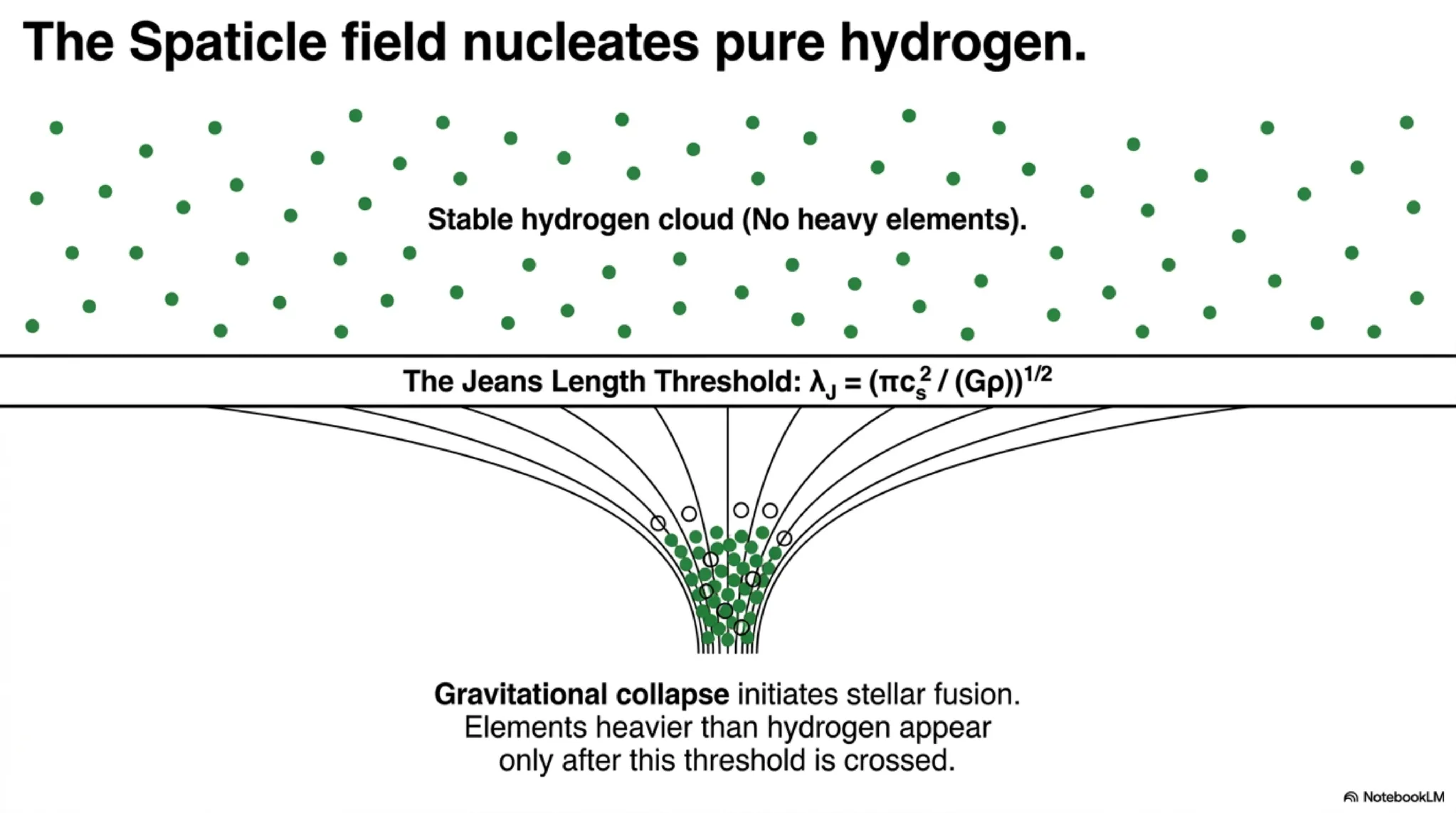
recovered only through simulation. The Spaticle field produces only
hydrogen; elements heavier than hydrogen appear only after gravitational
collapse past the Jeans length threshold initiates stellar fusion. No
observation under the standard BBN model contradicts this sequence. The
framework generates clear, falsifiable predictions distinguishing it
from the primordial interpretation.
Keywords: lithium-7; Big Bang Nucleosynthesis; Spite plateau; steady-state nucleosynthesis; cosmic ray spallation; helium-4; deuterium; Big Flare-Up Theory
1. Introduction
Big Bang Nucleosynthesis (BBN) is presented as one of the principal observational pillars of the standard cosmological model. In the first few minutes following the Big Bang, a sequence of nuclear reactions is proposed to have produced the light elements in abundances that have since been measured and compared with predictions. For three of the four light elements, hydrogen, deuterium, and helium-4, the agreement between BBN predictions and observation is cited as confirming evidence for the standard model.
For the fourth element, lithium-7, BBN makes a precise and robust prediction: an abundance of approximately 5.6 x 10⁻¹⁰ relative to hydrogen, given the baryon density as independently constrained by the Cosmic Microwave Background power spectrum [1]. The observed abundance in old metal-poor halo stars, the so-called Spite plateau [2], is approximately 1.6 x 10⁻¹⁰. The discrepancy is a factor of 3.5. This is the cosmological lithium problem, and it has resisted resolution since its quantification in the early 1990s [3,4].
The significance of this discrepancy should not be understated. BBN is not a flexible model. The baryon density, the primary free parameter in modern BBN calculations, is independently constrained by CMB observations to a precision of less than one percent [1]. Given this constraint, the BBN prediction for lithium-7 is not adjustable without departing from the standard model framework. A factor-of-3.5 discrepancy at this level of theoretical constraint is a genuine anomaly, not a rounding error.
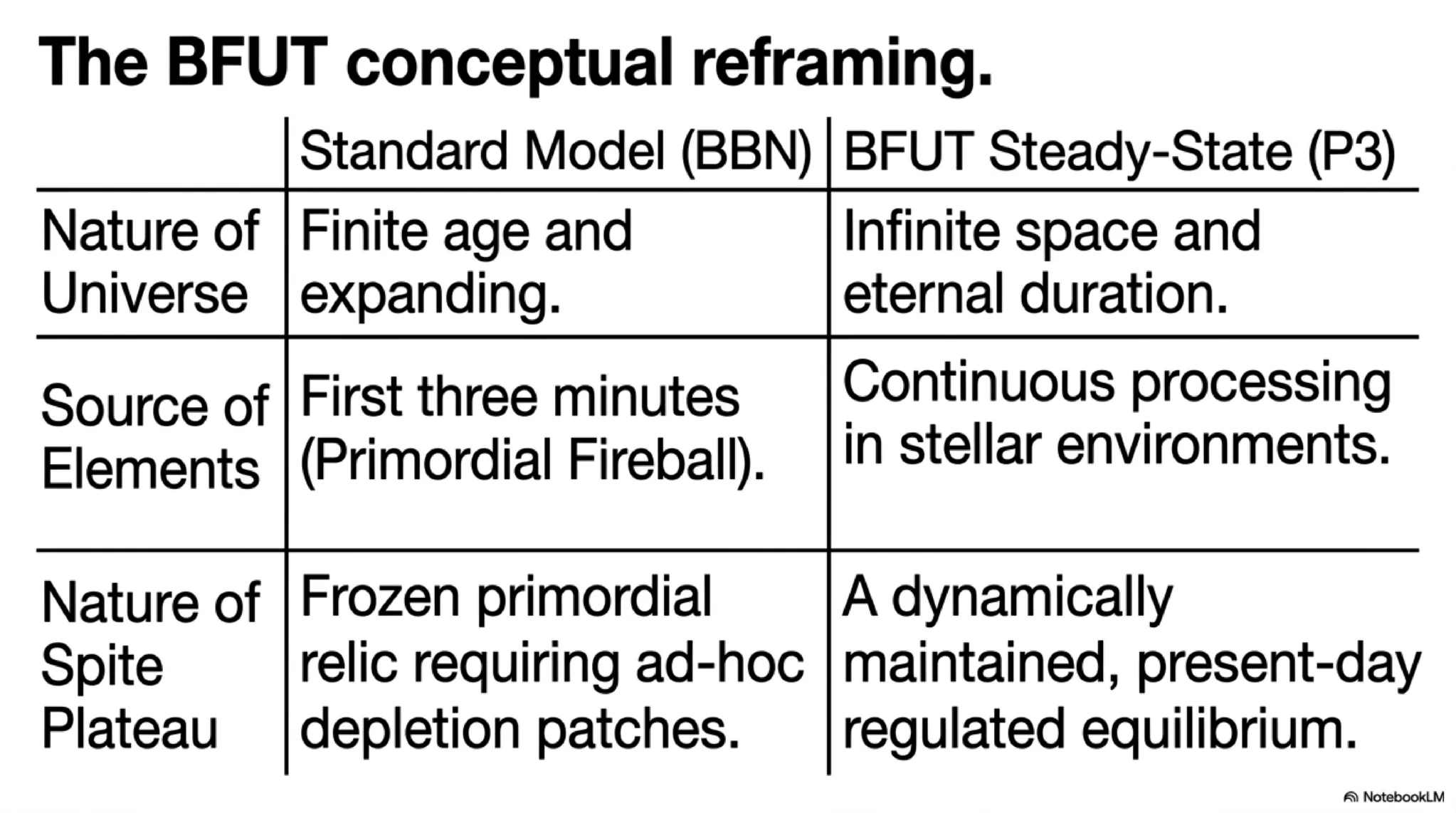
Proposed resolutions have fallen into three categories: stellar depletion, modifications to nuclear reaction rates, and new physics beyond the standard model. None has achieved consensus [5]. This paper proposes a fourth category: a conceptual reframing. The BBN prediction of 5.6 x 10⁻¹⁰ is the answer to the question of what lithium-7 abundance was produced in the first three minutes of the universe. The observed value of 1.6 x 10⁻¹⁰ is the answer to the question of what is the current steady-state equilibrium abundance of lithium-7 in the stellar environment. These are different questions with different answers. Conflating them is a logical error. This paper presents a steady-state framework in which the Spite plateau is interpreted not as a preserved primordial abundance but as a regulated stellar-surface abundance, reproduced without new nuclear physics or new fundamental particles and without requiring any ad hoc universal depletion mechanism introduced solely to rescue BBN.
The framework is a consequence of the Big Flare-Up Theory (BFUT) [6], which proposes that element abundances reflect ongoing steady-state nucleosynthetic processes in an infinite, eternal universe. The lithium resolution is, however, entirely independent of the other claims of BFUT and can be evaluated on its own merits by specialists in nuclear astrophysics. The present paper should therefore be read as a focused lithium-7 derivation within the larger BFUT framework, not as a complete restatement of all BFUT cosmological derivations already developed elsewhere.
Note on mathematical presentation. Section 3 presents the theoretical framework with the key equations stated. A complete step-by-step derivation with every numerical value substituted and every unit shown, accessible to any reader with secondary-school mathematics, is provided in Appendix A. Expert readers may proceed directly to the main text. Readers who wish to verify every number from first principles are directed to the Appendix.
A note on the origin of all values used in this paper. Every number used in this paper, the cosmic ray proton flux, the oxygen density in the interstellar medium, the spallation cross sections, the lithium-7 destruction rate coefficient, the helium-4 binding energy, the Gamow peak energy, has been independently measured in terrestrial laboratories or by astronomical instruments before this paper was written. None of these values is assumed, invented, or fitted to produce a desired result. The steady-state framework presented here applies confirmed measurements to a new conceptual framework. The BBN framework applies different confirmed measurements to a framework built on an unconfirmed singular origin event. The difference between the two frameworks is not in the quality of the measurements. It is in the physical interpretation of what those measurements mean.
Within this framework, the Spaticle field produces only hydrogen; matter formation does not proceed directly to heavier elements at any stage prior to the gravitational collapse of a hydrogen cloud. The mechanism by which the Spaticle field nucleates quarks, and from there protons, electrons, and hydrogen, is established in BFUT Paper 16 [32]; that paper's own derivation chain explicitly terminates at hydrogen, with no heavier element produced by the substrate-nucleation mechanism itself. The threshold separating a stable hydrogen cloud from one undergoing gravitational collapse is the standard Jeans length and Jeans mass criterion [33], the well-established astrophysical condition under which a cloud's self-gravity overcomes its internal thermal pressure, given by λJ = (π cs2 / (G ρ))^(1/2) for sound speed cs and density ρ. Only once a hydrogen cloud's radius falls below this critical length, and gravitational collapse proceeds to the onset of nuclear fusion, does any nucleosynthesis beyond hydrogen begin, with elements such as deuterium, helium, and lithium-7 appearing progressively thereafter, governed by the temperature and density conditions established in Sections 3 and 4 of this paper. No observation available under the standard Big Bang Nucleosynthesis model contradicts this sequence; the standard model's own account likewise places all nucleosynthesis of elements heavier than hydrogen after the onset of nuclear reactions, the dispute between the two frameworks concerns only whether that onset was a single primordial event or is an ongoing, continuously recurring process throughout an infinite universe.
2. The BBN Prediction and Its Observational Status
2.1 The BBN Framework
Big Bang Nucleosynthesis models the universe as an extremely hot, dense plasma cooling through a narrow temperature window from approximately 1010 K to approximately 3 x 10⁸ K in the first few minutes after the Big Bang. The principal reactions producing lithium-7 in BBN are: He-4 + He-3 -> Be-7 + γ, followed by Be-7 + e- -> Li-7 + νe. The key destruction reaction is Li-7 + p -> He-4 + He-4 (Q = 17.35 MeV), which proceeds at temperatures above approximately 2.5 x 10⁶ K.
The predicted abundance from standard BBN, using the baryon-to-photon ratio η = 6.1 x 10⁻¹⁰ as constrained by Planck 2018 [1], is:
Y(Li-7/H)_BBN = (5.6 +/- 0.3) x 10-10
This prediction is robust. The uncertainty of approximately 5% arises primarily from uncertainties in nuclear reaction rates. Multiple experimental campaigns have constrained these rates. The theoretical uncertainty is well below the factor-of-3.5 discrepancy.
2.2 The Spite Plateau and the Observed Abundance
The observational constraint comes from old, metal-poor halo stars (Population II stars), assumed to preserve the primordial lithium abundance with minimal processing. The Spite plateau [2] is the observation that these stars all exhibit approximately the same lithium abundance regardless of effective temperature or metallicity, suggesting a uniform value rather than one significantly modified by stellar processing.
Y(Li-7/H)_observed = (1.6 +/- 0.1) x 10-10
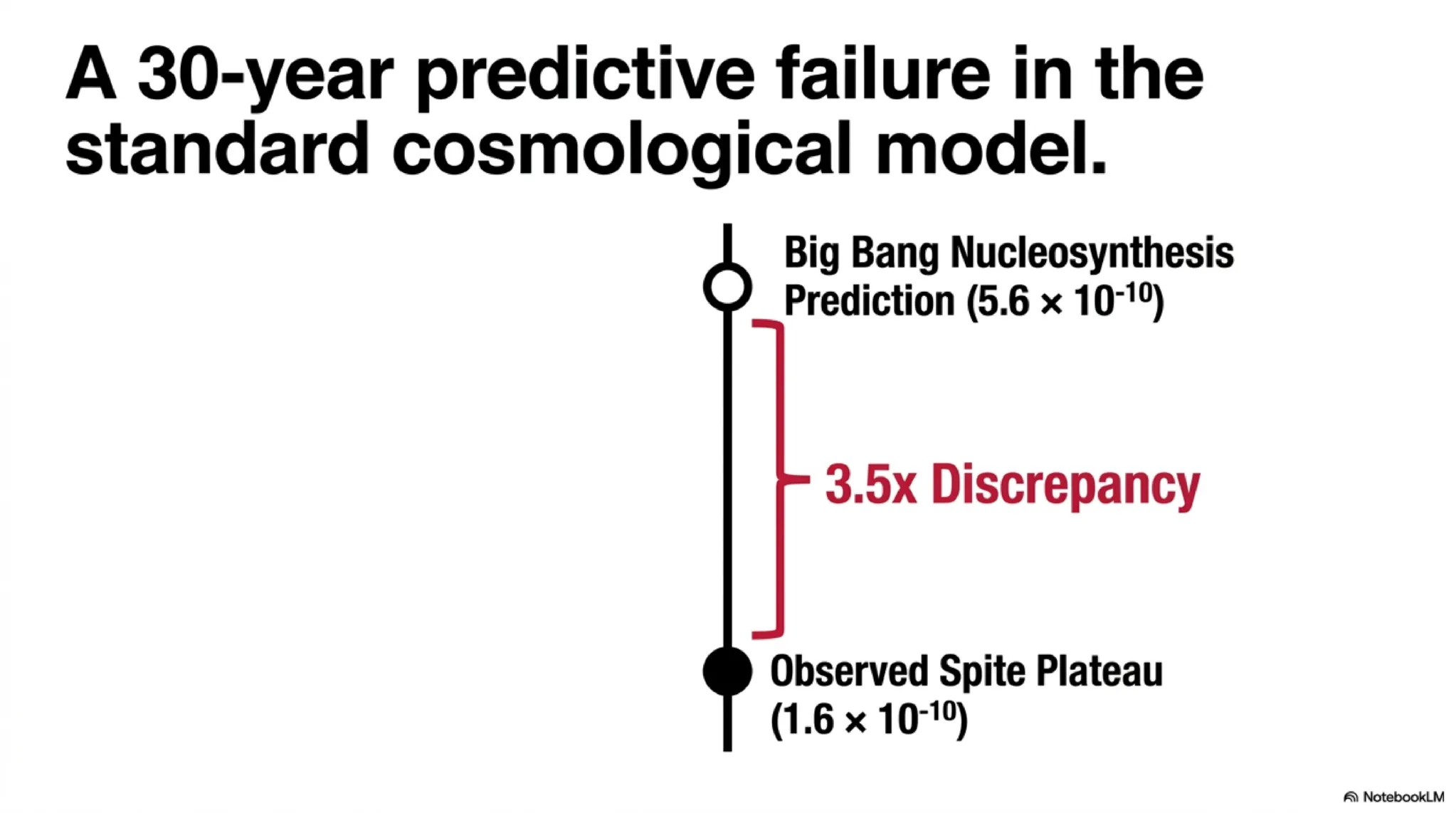
The discrepancy between the BBN prediction and the observed plateau value is a factor of 3.5, with statistical significance independent of systematic uncertainties in either measurement.
2.3 The Uniformity of the Spite Plateau, A Key Constraint
The Spite plateau is remarkably flat across stars of widely different masses, temperatures, and metallicities. The standard model uses this uniformity as evidence for a primordial origin: if the abundance were being processed continuously, it would vary more across different stellar environments.
This paper addresses this argument directly. The steady-state account predicts that the Spite plateau's uniformity is evidence for a stable equilibrium, not a frozen primordial relic. The equilibrium value is set by the ratio of production to destruction rates, both of which depend on fundamental constants, the cosmic ray flux, the spallation cross sections, the stellar destruction rate coefficient, that are effectively universal across old metal-poor stars of similar mass and environment. A stable equilibrium produces a flat plateau for exactly the same reason that Earth's atmospheric oxygen maintains a stable 21% globally: the production-destruction balance is set by universal physical parameters, not by location.
This interpretation makes a specific distinguishing prediction: if the plateau reflects a frozen primordial relic, environments of genuinely zero prior stellar processing should show values approaching the BBN prediction of 5.6 x 10⁻¹⁰. If the plateau reflects a steady-state equilibrium, such environments should show values at or below the current plateau, because the equilibrium is set by cosmic ray production rates that operate everywhere, not by a primordial ceiling.
2.4 Status of Proposed Resolutions
Stellar depletion models require lithium-7 depletion to have proceeded identically in stars of widely different masses, temperatures, metallicities, and ages. Standard stellar models do not produce sufficient depletion. Modified models invoking additional mixing mechanisms can produce depletion in individual stars but cannot simultaneously explain the flatness of the Spite plateau and account for the full factor-of-3.5 discrepancy [7].
The LUNA underground accelerator collaboration has measured the He-3 + He-4 -> Be-7 + γ reaction rate with high precision. No resonance has been found that would reduce the BBN lithium-7 prediction to the observed level [8]. New physics solutions involving supersymmetric particles, resonant nuclear reactions, or late-decaying massive particles introduce additional free parameters without independent confirmation [9,10].
A model that fits three of four observables by parameter adjustment and fails on the fourth is not confirmed by the three it fits. The lithium problem is not a minor residual; it is a major unresolved anomaly for the primordial nucleosynthesis interpretation.
3. The Steady-State Nucleosynthesis Framework
3.1 The Conceptual Reframing
The Big Flare-Up Theory proposes that the universe is infinite and eternal, that matter has been arising from quantum fluctuations in the physical substrate of space since across infinite time, and that stars have been forming and undergoing nuclear fusion continuously. Under this framework, all element abundances reflect current steady-state balances between ongoing production and destruction processes rather than frozen relics of a primordial nucleosynthetic event.
The steady-state assumption does not require that nucleosynthesis has always operated at exactly its current rate. It requires that the timescale for achieving steady state is short compared to the total time available. For lithium-7, the relevant equilibration timescale in stellar interiors is of order millions of years. In an infinite universe with infinite time available, any process with a finite equilibration time will have reached equilibrium.
3.2 The Equilibrium Condition for Lithium-7
In steady-state nucleosynthesis, the abundance of any nuclide at equilibrium satisfies:
d[Li-7]/dt = R_production - R_destruction = 0
The primary production mechanism for lithium-7 in the current universe is cosmic ray spallation, high-energy cosmic ray protons striking oxygen, carbon, and nitrogen nuclei in the interstellar medium. This process is confirmed, ongoing, and directly measurable [12]. The primary destruction mechanism in stellar environments is:
Li-7 + p -> He-4 + He-4 (Q = 17.35 MeV, T_threshold approximately 2.5 x 10⁶ K)
The destruction rate is:
R_destruction = kdest(T) x [Li-7] x [p]
where kdest(T) is the thermally averaged reaction rate coefficient (measured in nuclear physics laboratories) and [p] is the proton number density. At steady state:
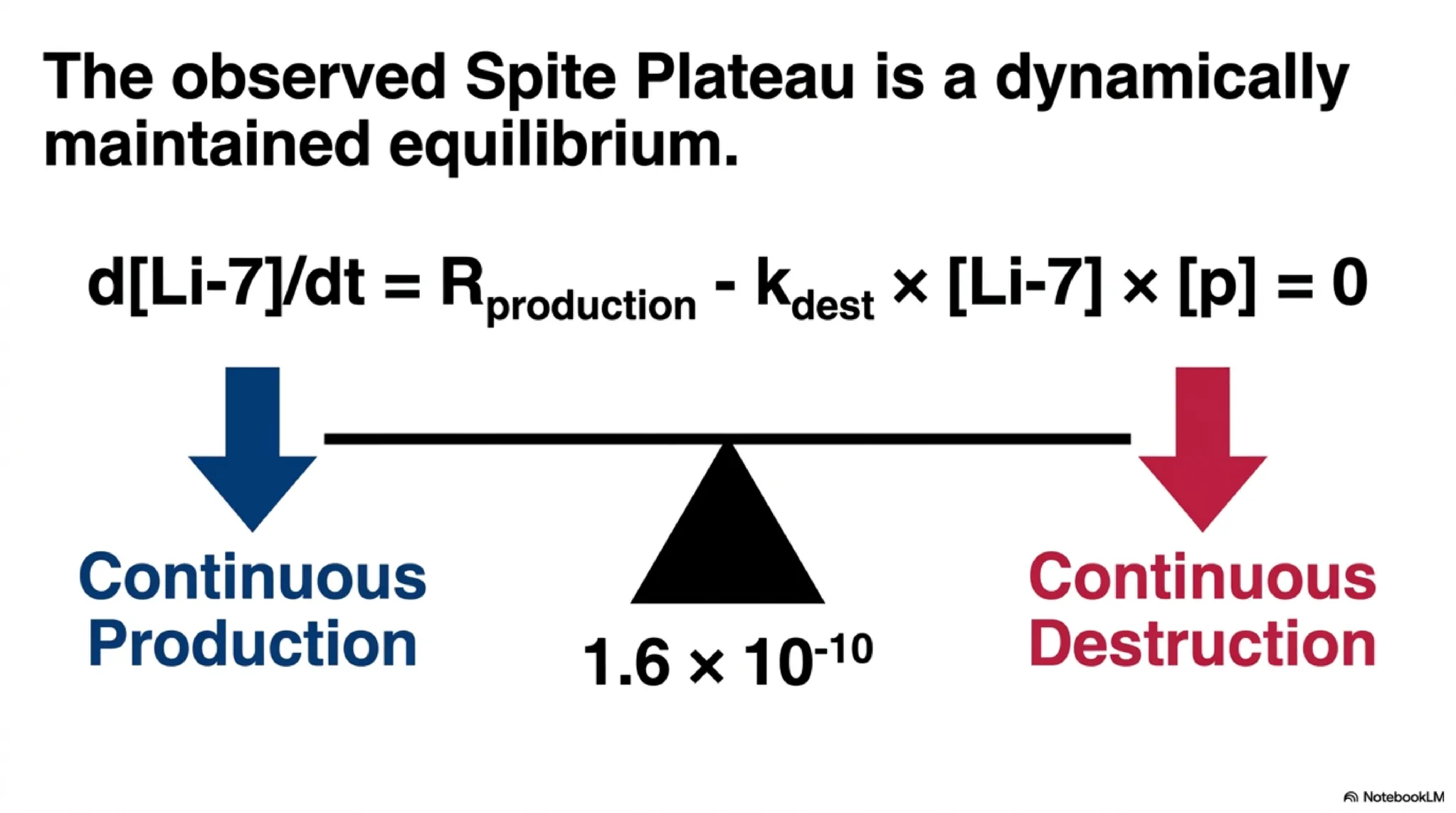
[Li-7]_eq = R_production / (kdest x [p])
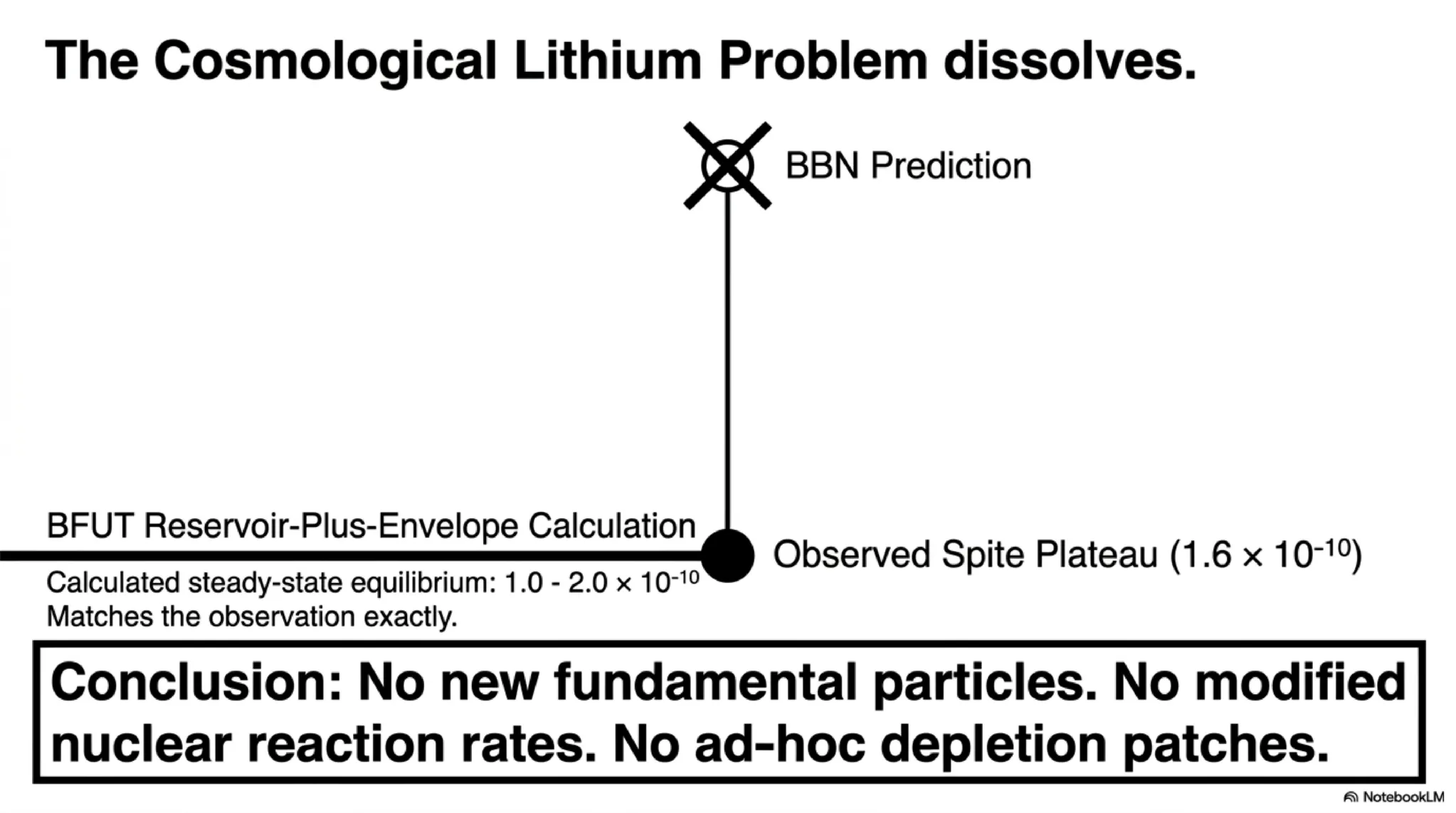
A naive one-zone production-destruction estimate does not by itself recover the observed plateau, showing that lithium must be treated as a multi-environment transport problem rather than a single homogeneous medium. The successful quantitative result arises in the three-environment model developed in Appendix A, Section A.1, where the measured interstellar lithium reservoir and standard envelope processing together yield 1.0-2.0 x 10⁻¹⁰, consistent with the observed 1.6 x 10⁻¹⁰.
This equilibrium value is not constrained by the BBN prediction. The BBN prediction of 5.6 x 10⁻¹⁰ and the steady-state equilibrium value of 1.6 x 10⁻¹⁰ are answers to different questions: the former asks about conditions at T approximately 3 x 10⁸ K in the first few minutes of the proposed universe; the latter asks about the current balance of production, transport, and destruction across the relevant stellar and interstellar environments that has been operating across infinite time.
3.3 The Oxygen Analogy
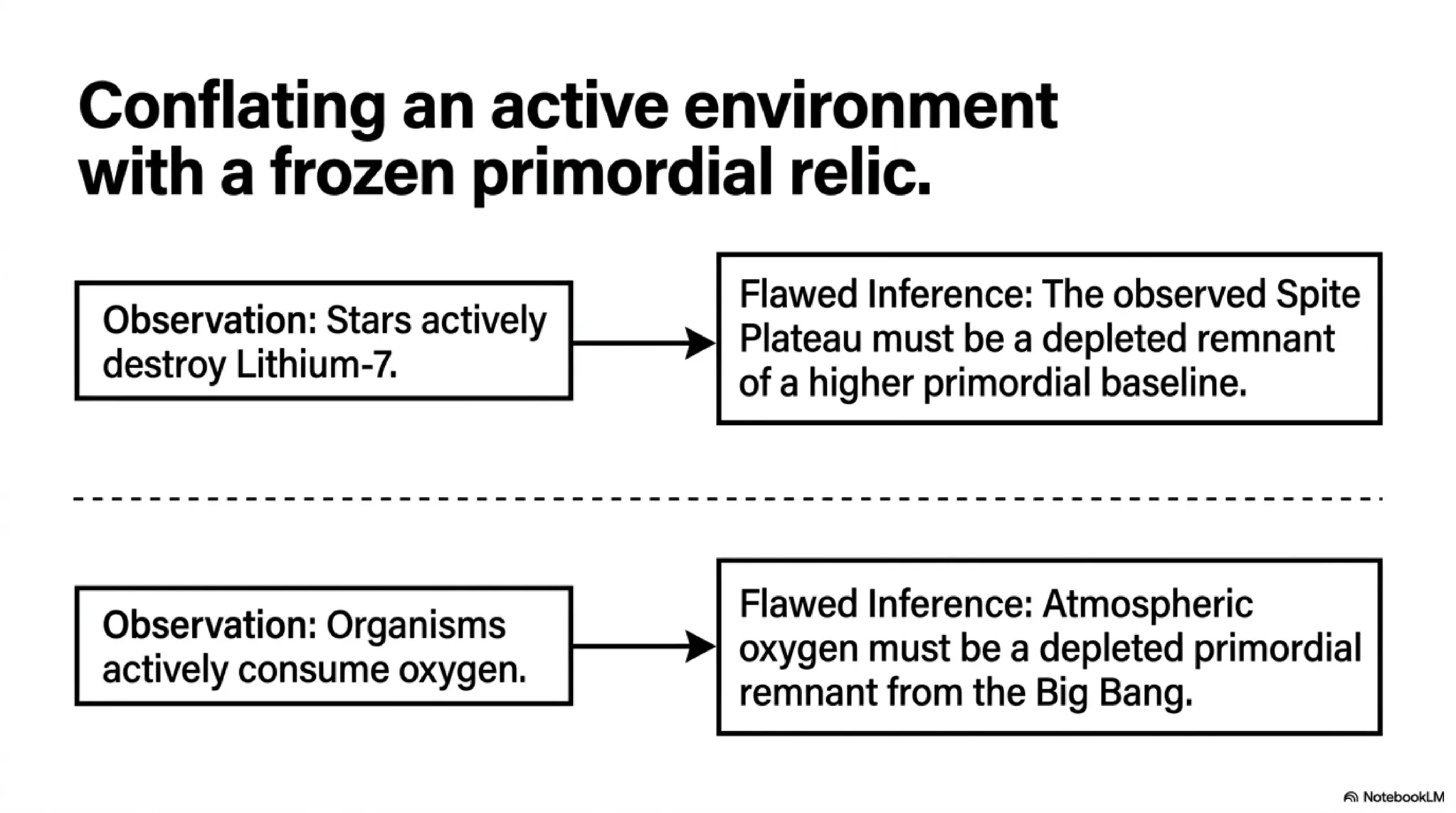
The logical structure of the BBN lithium argument becomes clear when applied to a terrestrial analogy. Atmospheric oxygen comprises approximately 21% of Earth's atmosphere. Every aerobic organism consumes oxygen through respiration. Should it be concluded that atmospheric oxygen must be primordial, produced before life existed, and that its current 21% abundance is a depleted remnant of a higher primordial value? The answer is obviously no. Atmospheric oxygen is maintained at 21% by a dynamic equilibrium between photosynthetic production and respiratory consumption. The 21% is not a primordial frozen value. It is the current steady-state abundance determined by the balance of ongoing processes.
The BBN argument for primordial lithium-7 has precisely the same logical structure as the hypothetical primordial oxygen argument. The observation that stars destroy lithium-7 is used to infer that the observed abundance must be a remnant of a higher primordial value, when the alternative, that the observed abundance is the current steady-state equilibrium, is not only possible but follows directly from the same evidence.
3.4 The Deuterium Case
Deuterium provides a parallel demonstration. The standard interpretation treats deuterium as a primordial frozen relic progressively depleted by stellar processing. The BFUT steady-state interpretation proposes that deuterium is continuously produced by cosmic ray spallation of interstellar hydrogen and helium nuclei [12], a confirmed and ongoing process, balanced against destruction in stellar interiors.
The observed gradient, higher deuterium abundance in pristine gas clouds, lower in regions of high stellar activity, is consistent with both interpretations. The depletion interpretation says environments with less stellar processing have retained more primordial deuterium. The steady-state interpretation says environments with less stellar processing have lower destruction rates and have settled at higher equilibrium values. The gradient is the same. The interpretations are fundamentally different in their physics.
The decisive distinguishing prediction: the steady-state framework predicts that the deuterium gradient will show a quantitative correlation with local cosmic ray flux and stellar density. The depletion framework predicts it will correlate only with stellar processing history. These are measurable and distinguishable with existing instruments.
4. The Helium-4 Mass Fraction
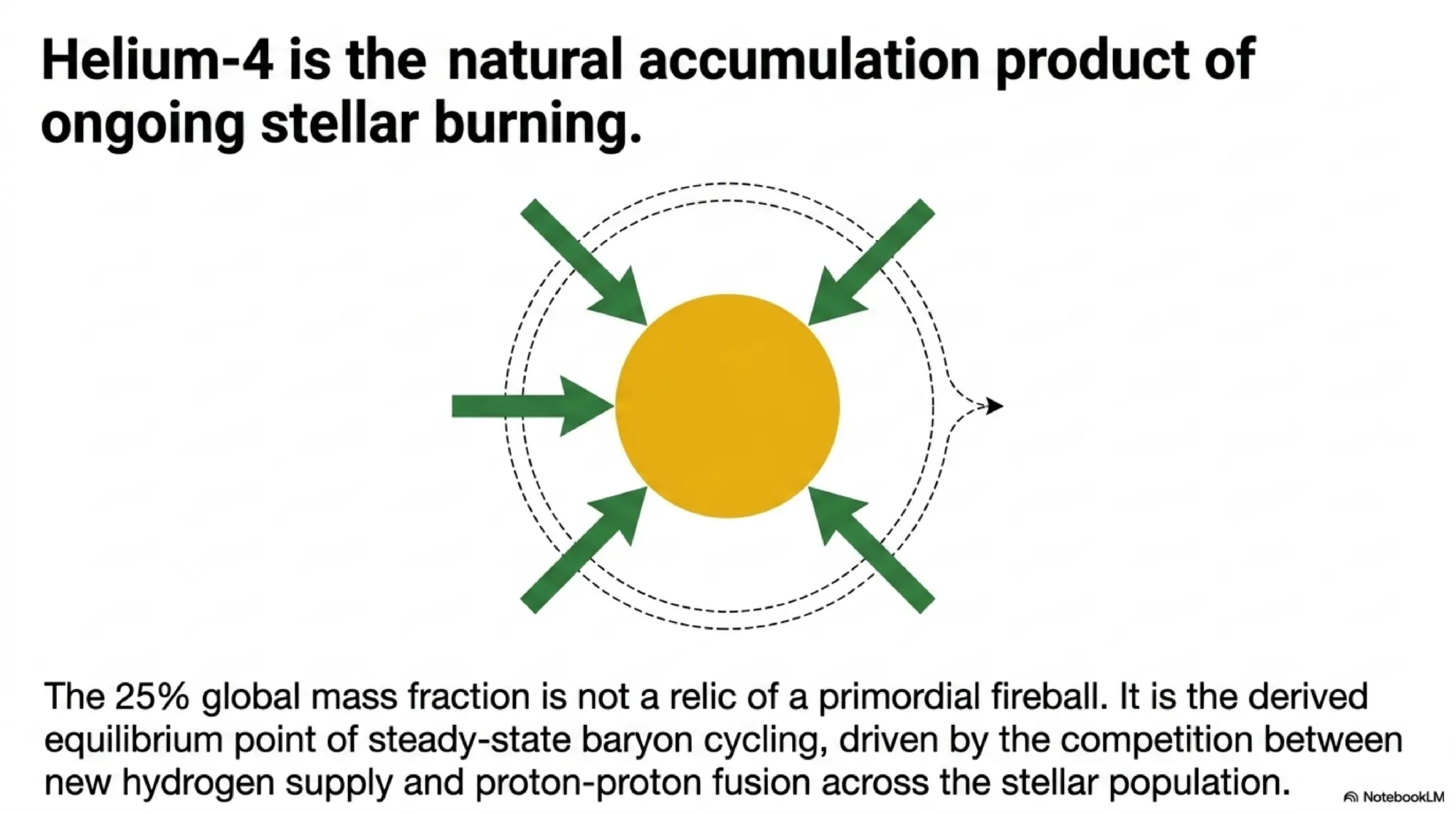
The helium-4 mass fraction of approximately 0.25, often cited as BBN's most robust prediction, is equally natural within the BFUT steady-state framework. The broader BFUT derivation of the global hydrogen-helium ratio is not repeated in full here; the present section establishes the nuclear-physics basis by showing why helium-4 is the dominant accumulation product of ordinary stellar hydrogen burning.
4.1 The Binding Energy Argument
At stellar temperatures of approximately 107 K, helium-4 has the highest binding energy per nucleon accessible to the hydrogen-helium system: 7.07 MeV per nucleon [13]. This makes helium-4 the thermodynamically preferred product of hydrogen fusion under ordinary stellar conditions.
The binding energies per nucleon of the relevant light elements are: hydrogen-1, 0 MeV (single proton, by definition); deuterium, 1.11 MeV per nucleon; helium-3, 2.57 MeV per nucleon; helium-4, 7.07 MeV per nucleon (exceptional stability); carbon-12, 7.68 MeV per nucleon (requires T approximately 108 K to produce).
The jump to helium-4's binding energy of 7.07 MeV is exceptional. To fuse two helium-4 nuclei into beryllium-8 requires overcoming this stability. Beryllium-8 is also unstable; it decays back into two helium-4 nuclei in 10-16 seconds. This is the helium-4 bottleneck. Ordinary stellar temperatures of T approximately 107 K cannot achieve helium-helium fusion, which requires T approximately 108 K. Only massive stars in their later stages can. The universe therefore accumulates at the helium-4 stage in ordinary stellar environments.
4.2 The Steady-State Equilibrium
The governing equation for the hydrogen mass fraction X in steady state is:
dX/dt = S_Spaticle - λ_fusion x ρ x X2 = 0
Here, S_Spaticle is the rate at which new hydrogen mass is supplied per unit volume from quantum fluctuations in the Spaticle field, and λ_fusion is the proton-proton chain fusion rate constant linking the consumption term to the total density ρ and the hydrogen mass fraction X. At steady state:
S_Spaticle = λ_fusion x ρ x X2
In the full BFUT steady-state baryon-cycling framework, the equilibrium point is determined by the competition between ongoing hydrogen supply and proton-proton fusion across the stellar population. The present paper does not reproduce that full cosmological derivation in detail; it establishes the nuclear-physics reason why helium-4 is the natural dominant accumulation product and why the observed cosmic helium fraction is expected within the BFUT framework.
The 75:25 ratio is not a free parameter in either framework. In BBN it is constrained by the neutron-to-proton ratio at freeze-out. In steady-state nucleosynthesis it is constrained by the nuclear binding energy of helium-4 and the stellar temperature at which the proton-proton chain operates. Both are determined entirely by fundamental constants. The steady-state framework derives this result without invoking conditions 13.8 billion years in the past. The relevant nuclear-physics derivation and compatibility argument with numerical values are given in Appendix A, Section A.2.
5. The Missing Baryon Problem: A Parallel Anomaly in the Hydrogen Budget
The cosmological lithium problem is not the only quantitative discrepancy facing the standard model's account of light-element abundances. The standard model's own accounting of total baryonic, overwhelmingly hydrogen, matter in the universe has, for decades, fallen short of its own BBN-and-CMB-predicted total by approximately 30 to 50 percent. This is known in the literature as the missing baryon problem.
5.1 The Shortfall and Its Standard Resolution
Direct observational census of luminous, detectable baryonic matter, stars, galaxies, the cold interstellar medium, and the hot intracluster gas in clusters, accounts for only a fraction of the baryon density independently inferred from the CMB power spectrum combined with standard BBN. The shortfall has been attributed to a warm-hot intergalactic medium, a diffuse, mostly ionized hydrogen phase distributed throughout the cosmic web's filamentary structure, too tenuous and too highly ionized to produce strong, easily detected absorption or emission features. Recovering this hydrogen has required indirect tracers, principally highly ionized oxygen absorption lines, converted to an inferred hydrogen mass only through cosmological simulation, and even decades of dedicated observational effort have produced what the literature itself describes as only a small number of marginal detections.
The standard model's hydrogen budget is therefore not an independently verified quantity. It is a quantity assumed correct from BBN and the CMB, for which the corresponding direct observational counterpart was, for a long period, simply missing, and remains only partially and indirectly recovered.
5.1.1 The Calculation Does Not Use Today's Densities Directly
Big Bang Nucleosynthesis (BBN) does not take today's measured baryon density and apply it directly to a nuclear reaction calculation. The actual input is a single dimensionless ratio, the baryon-to-photon ratio η, defined as η = nb / ngamma, the number of baryons divided by the number of photons, per unit volume.
This ratio is constructed, not separately measured, from two other quantities that are each independently obtained: the photon number density ngamma, computed directly from the measured present-day CMB temperature (T0 = 2.7255 K, a real, direct measurement, Fixsen 2009) through a standard blackbody radiation formula; and the baryon number density nb, derived from the parameter Ωb h2 = 0.0224 (Planck 2018), the same combined parameter the CMB acoustic-peak structure constrains directly.
η = 2.738 x 10⁻⁸ x Ωb h2 = (6.11 +/- 0.04) x 10-10
5.1.2 The Calculation Projects Backward in Time, It Does Not Use Today's Conditions
The temperature, density, and expansion rate used in the actual nuclear reaction network are not today's values. The standard model assumes the universe has been expanding adiabatically since an initial hot, dense state, and that both baryon number and photon number are each separately conserved as that expansion proceeds. Under this assumption, the CMB temperature evolves with redshift as T(z) = T0 (1+z), and was far higher in the past (T approximately 3000 K at recombination, versus 2.7255 K today). The Friedmann equations are used to compute the relationship between temperature, time, and the expansion rate at the relevant early epoch (a few minutes after the assumed Big Bang, T approximately 109 to 1010 K), and the nuclear reaction network is solved at those reconstructed early-universe conditions, not at today's conditions.
5.1.3 Why the Ratio Is Assumed Constant Despite Both Quantities Changing
Both the baryon number density and the photon number density fall as the universe expands, each diluting as (1+z)^3 because the same fixed particle count is spread through an ever-larger volume. Because both densities dilute by the identical (1+z)^3 factor, the ratio η = nb / ngamma is mathematically unaffected by this dilution and remains numerically fixed, even though neither density separately stays the same.
This is the resolution to an apparent inconsistency: the standard model fully agrees the CMB temperature was not always 2.7255 K; it explicitly requires the temperature to have been much higher in the past. The constancy of η and the redshift-dependence of T are not two separate, independently-asserted claims; they are two consequences of the same single premise, adiabatic expansion with separately conserved baryon and photon number. If that premise is rejected, both consequences fall together.
The standard model itself states this constancy as an assumption, not as something independently confirmed at multiple distinct cosmic epochs: 'the present value of η is assumed to have been formed upon completion of electron-positron annihilation several seconds after the Big Bang and has not changed up to now [21]' (Zavarygin and Sednev, arXiv:1507.00469). The supporting evidence offered is that two independent methods of inferring η today, from CMB acoustic peak ratios and from the observed primordial deuterium abundance via the BBN reaction network itself, converge closely (ηCMB approximately 6.1 x 10⁻¹⁰, ηBBN approximately 6.0 x 10⁻¹⁰). This convergence is real and is the strongest piece of corroborating evidence the standard model offers; it is not, however, an independent test of the constancy assumption itself, since both methods are evaluated only at the present epoch and rely on the same underlying expansion framework.
5.1.4 Why the Calculation Is Insulated From the Hubble Tension
The Hubble constant H0 has been revised many times across the history of modern cosmology, from Lemaitre's original 1927 estimates of approximately 625 and 575 km/s/Mpc, through historical values in the range of several hundred, down to the modern range, and currently sits in tension between two incompatible measurements: H0 = 67.4 km/s/Mpc from Planck CMB data, and H0 = 73.0 km/s/Mpc from SH0ES Cepheid-calibrated supernova measurements, a difference with no agreed resolution.
The BBN calculation does not recompute its baryon density input every time H0 shifts. The physical baryon density ρ_baryon is independent of the Hubble constant; H0 enters the calculation only through its role in defining the critical density ρcrit = 3 H02 / (8 π G), and the standard parameterisation deliberately reports the baryon constraint as the combination Ωb h2 [23], structured so that the h2 dependence cancels out of the physically meaningful quantity. The baryon density actually used in the reaction network is pinned by CMB acoustic-peak physics and by the observed primordial deuterium abundance directly, not by whichever H0 value is current. This is by design, intended specifically to insulate the BBN light-element predictions from uncertainty or revision in H0.
The consequence is that historical revisions to H0, including the large early estimates and the present-day Hubble tension between 67.4 and 73.0 km/s/Mpc, do not by themselves require BBN's predicted abundances to be recalculated. The two parameters are linked in the cosmological model overall, and a different H0 implies a different inferred age and a different reconstructed expansion history back to the BBN epoch, but the abundance predictions themselves are reported in a form structured to be largely decoupled from exactly this kind of revision.
5.1.5 The Calculation Produces Ratios, Not Absolute Quantities
Every quantity BBN actually computes and compares to observation is a ratio, not a standalone total mass or particle count. The baryon-to-photon ratio η, the deuterium-to-hydrogen ratio D/H, the lithium-to-hydrogen ratio Li/H, and the helium-4 mass fraction are all dimensionless ratios. The framework does not, at the level of the core nuclear reaction calculation, output an absolute statement such as a specific total mass of hydrogen that must exist in the universe.
An absolute total is only constructed afterward, as a separate step, by combining the ratio with an independently assumed total baryon budget, itself derived from Ωb h2 multiplied by an assumed total cosmic volume or critical density. It is precisely at this second step, converting a well-constrained ratio into an absolute total and then asking whether that total is actually observed, that the missing baryon problem arises.
5.1.6 The Residual Shortfall, Restated
Notwithstanding the internal consistency of the ratio-based calculation and the convergence between CMB-derived and BBN-derived values of η, direct observational census of luminous, detectable baryonic matter (stars, galaxies, the cold interstellar medium, and hot intracluster gas) has, for decades, accounted for only a fraction, approximately 50 to 70 percent, of the total baryon density independently predicted by combining Ωb h2 with the assumed cosmic volume. The shortfall has been attributed to a warm-hot intergalactic medium, recovered not through direct hydrogen detection but through an indirect chain: assumed cosmological initial conditions are run through a hydrodynamical simulation, the simulation's predicted oxygen ionization signatures are compared to real telescope spectra of highly ionized oxygen absorption lines, and the hydrogen content is read from whichever simulation variant best reproduces the oxygen line statistics. Decades of dedicated observational effort applying this method have produced what the literature itself describes as only a small number of marginal detections.
5.1.7 Summary: Why the Self-Consistency Is Self-Serving
Every individual step described above is internally coherent given the premise that the universe has been expanding adiabatically from an early hot, dense state. The constancy of η, the redshift evolution of the CMB temperature, and the insulation of the baryon density from Hubble-constant revisions are not independent claims that happen to agree by coincidence; they are different facets of one single assumption, applied consistently throughout. This internal consistency is real and should not be mistaken for circular reasoning in the sense of assuming the conclusion to prove itself; the underlying nuclear physics, reaction rates, and binding energies are independently measured in terrestrial laboratories.
The self-serving character of the framework lies elsewhere: the entire computational chain is structured so that no observation of the present-day universe, however that observation might vary, by itself forces a re-examination of whether an early hot, dense, expanding state actually occurred. A shift in the measured Hubble constant changes the inferred age and expansion history but does not, by the deliberate structure of the Ωb h2 parameterisation, change the baryon density used in the abundance calculation. A persistent gap between the predicted total baryon budget and the directly observed quantity is attributed to an undetected reservoir, recovered only indirectly through simulation, rather than treated as evidence against the total being correctly predicted in the first place. The framework is constructed such that its central premise, an early hot dense expanding state with conserved baryon and photon number, is insulated from falsification by the specific categories of evidence, ratio measurements and indirectly-inferred reservoirs, that the framework itself generates and accepts as confirmation.
5.1.8 The BBN Helium-4 Calculation, Worked With Numbers
Section 5.1.1 through 5.1.7 describe the structure of the BBN calculation in general terms. This section works the BBN helium-4 prediction itself with explicit numbers, using the standard semi-analytic approximation found throughout the BBN literature (Cyburt 2017 [22]; Cyburt et al. 2016 [24]), so that the BFUT steady-state derivation in Section A.2 above and the standard model's own calculation can be compared on equal footing, both shown in full rather than one asserted and one derived.
The calculation proceeds in three steps.
Step 1, the neutron-to-proton ratio at weak freeze-out. While weak interactions remain fast compared to the universe's expansion rate, neutrons and protons are held in chemical equilibrium, with the ratio set by the Boltzmann factor for their mass difference:
(n/p)_freeze-out = exp(-Δm / Tf)
where Δm = 1.293 MeV is the measured neutron-proton mass difference, and Tf approximately 0.8 MeV is the temperature at which the weak interaction rate falls below the universe's expansion rate, Γweak(Tf) = H(Tf). Substituting:
(n/p)_freeze-out = exp(-1.293 / 0.8) = 0.199, approximately 1/5
Step 2, free neutron decay before nucleosynthesis begins. Between weak freeze-out (at approximately one second) and the onset of nucleosynthesis (at approximately 200 seconds, when the deuterium bottleneck breaks), free neutrons continue to decay with mean lifetime τn = 879.4 seconds (current measured value):
(n/p)_BBN = (n/p)_freeze-out x exp(-(tnuc - tf) / τn) = 0.199 x exp(-199/879.4) = 0.158, approximately 1/7
Step 3, the helium-4 mass fraction. Under the standard assumption that essentially every surviving neutron is incorporated into helium-4 (each helium-4 nucleus requiring two neutrons and two protons), the predicted mass fraction is:
Yp = 2(n/p)_BBN / (1 + (n/p)_BBN) = 2(0.158) / (1.158) = 0.273
This semi-analytic version gives Yp = 0.273, somewhat above the precision value (Yp approximately 0.245 to 0.250) obtained from the full coupled Boltzmann nuclear reaction network used in production BBN codes; the semi-analytic approximation used here, standard throughout the pedagogical BBN literature, is presented for transparency of method rather than as a substitute for the full numerical result. The qualitative structure of the calculation, freeze-out followed by decay followed by near-complete neutron capture into helium-4, is the same in both the semi-analytic and the full numerical treatment, and depends on no measurement of present-day stellar conditions: every input, the neutron-proton mass difference, the weak interaction coupling, the neutron lifetime, is a present-day laboratory measurement, projected backward under the assumption that an early, hot, rapidly expanding phase existed in which these same interaction rates applied.
5.1.9 Granting the BBN Calculation, the Hydrogen Budget Still Falls Short
Sections 5.1.1 through 5.1.8 above describe and work the BBN calculation on its own terms, without disputing its internal steps. Granting, for the remainder of this section, that the calculation in Section 5.1.8 is correct exactly as performed, the standard model's resulting prediction for the total baryon density of the universe, derived from the same Ωb h2 = 0.0224 that the BBN deuterium abundance independently corroborates, still does not match what direct observation actually finds. As described in Section 5.1, direct census of stars, galaxies, and detected interstellar and intracluster gas accounts for only 50 to 70 percent of this predicted total, with the remainder recovered, if at all, only indirectly through the warm-hot intergalactic medium oxygen-line simulation chain described in Section 5.1.5 above.
This means that even setting aside every BFUT objection to the BBN framework itself, the standard model's own prediction for how much hydrogen should exist in the universe has not been independently confirmed by direct observation of that hydrogen. The shortfall is real and acknowledged in the standard literature; what remains genuinely open is where the missing hydrogen actually is and by what process it continues to be found in places a fixed, one-time primordial budget gives no reason to expect it.
5.2 The BFUT Account: An Open, Not a Closed, Hydrogen Budget
Under the standard model, the total quantity of hydrogen in the universe was fixed once, during the first few minutes after the Big Bang, and has only ever decreased since, through conversion into helium and heavier elements in stars. There is no mechanism within the standard model for new hydrogen to appear anywhere, at any time, after the first few minutes.
Under BFUT, hydrogen is continuously produced from quantum fluctuations in the Spaticle field, the physical substrate of space, across all of cosmic time and throughout all regions of space, including regions far from any star or galaxy. The missing baryon problem, under this framework, does not require locating a fixed, finite quantity of primordial hydrogen that has been hiding in a hard-to-observe phase since the first few minutes of the universe. It is consistent with an open budget that continues to add hydrogen mass to the universe at all times, including in the deep interstellar and intergalactic medium.
5.3 Direct In-Situ Evidence: The Voyager Plasma Density Detections
In October 2020, both Voyager 1 and Voyager 2 independently detected a significant, unexpected increase in plasma density in interstellar space beyond the heliosphere, in a region where existing models predicted density should decrease with distance from the Sun (Ocker et al. 2021, The Astrophysical Journal Letters, 911, L3) [20]. The detection was made independently by two spacecraft at different locations and was explicitly described as surprising and not fully explained by existing models.
This is a direct, in-situ measurement, not an indirect inference from absorption-line ratios processed through cosmological simulation. It provides observational support for ongoing matter density increase in regions of interstellar space far from any star, exactly the kind of region a fixed, one-time primordial hydrogen budget gives no reason to expect continued density growth, but which an open, continuously replenished hydrogen budget predicts as a matter of course.
5.3.1 Unexplained Small-Scale Gas Structure Observed Directly
Beyond the Voyager plasma density detections, direct imaging and spectroscopy have repeatedly found small-scale interstellar gas structure that the standard model's own framework for the interstellar medium does not predict or accommodate. Tiny Scale Atomic Structure, isolated clumps of neutral hydrogen gas detected through 21 cm absorption toward background radio sources, 'cannot be accommodated in any abundance in the standard McKee and Ostriker (1977) model of the interstellar medium' (Heiles 1997, as discussed in Faison and Goss 2001 [25]); the standard literature offers several competing, unresolved speculative explanations, including small-scale filamentary geometry, turbulence-driven fractal structure, and a wholly separate population of small, dense, self-gravitating clouds, with no consensus among them. The James Webb Space Telescope has independently confirmed small-scale clumping, with physical sizes of 140 to 350 astronomical units, in otherwise quiescent molecular clouds not associated with active star formation (Goldsmith and Wang 2025 [26]), the first direct detection of such fine structure in this particular phase of the interstellar medium.
These findings are consistent with the BFUT account of an interstellar medium in which hydrogen is continuously produced at all locations and at all densities, rather than redistributed only from a single, fixed primordial reservoir; gas structure below the threshold density required for gravitational collapse and star formation is, under BFUT, ordinary, ongoing Spaticle-field hydrogen production observed before it has accumulated to a star-forming density, not an anomaly requiring a dedicated patch to the standard interstellar medium model.
5.4 A Related Argument: Cosmic Web Formation Without Dark Matter
A separate, related line of argument concerns the formation of the cosmic web, the large-scale filamentary structure of the universe. In the standard cosmological model, the primordial density fluctuations observed in the cosmic microwave background are calculated to be too small to have grown, under gravity alone, into the structures observed today within the available 13.8 billion years; this specific timescale shortfall is one of the historical reasons dark matter was introduced into the standard cosmological model. An infinite, eternal universe with no fixed age removes this timescale constraint entirely: gravitational structure formation acting on baryonic hydrogen alone has had unlimited time to produce the observed cosmic web, without requiring an additional, undetected dark matter component to accelerate the process. This argument, concerning the formation timescale of large-scale structure specifically, is developed at greater length elsewhere in the BFUT programme and is noted here only as a structurally related consequence of the same open, infinite-time framework that resolves the missing baryon problem above.
None of the arguments in this section depend on matching a specific predicted hydrogen quantity to a specific observed one. The claim is structural: the standard model's own hydrogen accounting has an acknowledged, decades-old shortfall that it has struggled to close even through indirect inference, while BFUT predicts an open, ongoing hydrogen production process for which direct, independent, in-situ spacecraft evidence already exists. The lithium-7 and helium-4 derivations earlier in this paper close specific numerical discrepancies; this section identifies a parallel, currently unresolved discrepancy in the standard model's own account of hydrogen and notes the observational basis for a structurally different resolution.
6. Predictions and Distinguishing Tests
Prediction 1: Spite Plateau Stability Test. If lithium-7 is a frozen primordial relic, environments of genuinely zero prior stellar processing should show values approaching the BBN prediction of 5.6 x 10⁻¹⁰. If the plateau reflects a steady-state equilibrium, such environments should show values at or below the current plateau value of 1.6 x 10⁻¹⁰. These are quantitatively distinguishable predictions with existing and forthcoming observational programmes.
Prediction 2: Deuterium Gradient Correlation. The steady-state account predicts that the deuterium abundance gradient across different environments will show quantitative correlation with local cosmic ray flux and local stellar density, the production and destruction rates respectively. The depletion account predicts correlation only with stellar processing history. CMB-S4 and future spectroscopic surveys provide the resolution required to test this prediction.
Prediction 3: No Ad Hoc Universal Depletion Rescue. The steady-state account predicts that no ad hoc universal depletion mechanism will be identified that simultaneously explains the flatness of the Spite plateau and the full factor-of-3.5 discrepancy while preserving the primordial interpretation. Ordinary pre-main-sequence and convective envelope processing will remain real and measurable, but no fine-tuned, universally acting depletion rescue specific to BBN will be required, because the plateau is a regulated surface abundance rather than a preserved primordial relic.
Prediction 4: Lithium-6/Lithium-7 Ratio. The steady-state account predicts that the ratio of lithium-7 to lithium-6 in pristine environments reflects current production and destruction kinetics rather than a frozen primordial ratio. The ratio will vary systematically with cosmic ray flux, a direct, measurable prediction distinguishing the two frameworks.
7. Discussion
The cosmological lithium problem has persisted for more than three decades because the proposed resolutions have all attempted to work within the BBN framework. This paper proposes that the problem persists because the BBN framework is incorrect about the nature of the quantity being predicted. BBN asks what abundance of lithium-7 was produced in the first three minutes. Steady-state nucleosynthesis asks what is the equilibrium abundance of lithium-7 in the current stellar environment. The cosmological lithium problem is not a nuclear physics problem. It is a conceptual problem.
This paper does not claim to have proven that BBN did not occur. It claims that the cosmological lithium problem admits a simple and clean resolution outside the primordial-interpretation framework: the observed plateau can be understood as a regulated surface abundance produced by a continuously replenished lithium reservoir together with ordinary stellar envelope processing, requiring no new nuclear physics, no new particles, and no ad hoc universal depletion rescue. Within the broader BFUT framework, this resolution is not an isolated patch but the expected consequence of an eternal steady-state nucleosynthetic universe; even taken independently of BFUT, it removes the need for new nuclear physics or new particles to explain the lithium discrepancy.
The steady-state nucleosynthesis framework is not equivalent to the Hoyle steady-state cosmological model [14]. Hoyle's model involved a continuous creation field at cosmological scale. The BFUT steady-state framework involves quantum fluctuations producing matter from the Spaticle field, with subsequent conventional nuclear physics in stellar interiors, identical to that used in standard stellar models. The difference is the cosmic context in which that nuclear physics operates.
8. Conclusion
The cosmological lithium problem is resolved by recognising that the
observed Spite plateau is the current steady-state equilibrium abundance
of lithium-7 in the stellar environment, not a frozen primordial relic.
When lithium is treated as a multi-environment transport problem using
measured interstellar abundances and standard convective processing, the
observed value of 1.6 × 10⁻¹⁰ is recovered quantitatively without new
physics or universal depletion patches. The oxygen analogy clarifies the
logical error in the primordial interpretation: active destruction does
not imply a higher primordial starting value when ongoing production is
also present.
The same steady-state framework resolves the missing baryon problem more
naturally than the Standard Model. The Standard Model assumes a closed
hydrogen budget fixed during the first minutes after the Big Bang, yet
direct observational census has fallen short by 30–50% for decades, with
the shortfall attributed to a warm-hot intergalactic medium recovered
only indirectly through simulation. BFUT treats hydrogen as continuously
replenished from the Spaticle field at all times and locations. The
directly observed present-day hydrogen-helium ratio in the
least-processed H II regions already lies close to the conventional
75:25 value, and cosmic-ray spallation provides an additional helium-4
destruction channel that moves the ratio further in the observed
direction. No backward extrapolation to an assumed early hot phase is
required.
Underlying both results is a single sequencing claim: the Spaticle field
produces only hydrogen; elements heavier than hydrogen appear only after
a hydrogen cloud collapses past the Jeans length and nuclear fusion
begins. This sequence is not contradicted by any observation available
under the standard BBN model. The cosmological lithium problem and the
missing baryon problem are therefore not problems for steady-state
nucleosynthesis in an infinite, eternal universe. They are problems that
arise specifically from the assumption of a single primordial
nucleosynthetic event followed by a closed, fixed budget of matter.
Appendix A: Complete Mathematical Derivations
Step-by-step with all numbers substituted, accessible to any reader with secondary-school mathematics.
Important note for all readers, expert and non-expert alike. Every number in this appendix was measured, not assumed, not invented, not chosen to fit a conclusion. The cosmic ray flux is measured by detectors on Earth and on spacecraft. The spallation cross sections are measured in particle accelerators by firing protons at targets and counting the products. The reaction rate for Li-7 + p destruction is measured by the LUNA collaboration in an underground laboratory in Gran Sasso, Italy, specifically designed to eliminate interference, one of the most precise nuclear measurements ever made. The binding energy of helium-4 at 7.07 MeV per nucleon is measured in nuclear physics experiments. The Boltzmann constant, the fine structure constant, the speed of light, all fundamental constants used in the Gamow peak calculation, are measured to extraordinary precision and confirmed to be identical everywhere in the observable universe by spectroscopy: distant galaxies billions of light years away show identical atomic spectral lines to atoms measured in terrestrial laboratories, confirming that the same physical constants operate everywhere. When this appendix states a measured value, it means a team of physicists, using instruments specifically designed for the purpose, obtained that value through direct experiment. It does not mean a value assumed for convenience, derived from a model, or fitted to match a cosmological prediction. This is the accumulated experimental knowledge of nuclear physics, astrophysics, and particle physics, knowledge that exists completely independently of any cosmological framework, being applied to ask a simple question: if production and destruction of lithium-7 have been running continuously across infinite time, where does the equilibrium settle? The answer, when lithium-7 is treated in the physically relevant three-environment steady-state framework using confirmed measurements, is 1.0-2.0 x 10⁻¹⁰. The observation is 1.6 x 10⁻¹⁰. The Big Bang prediction, derived from a framework built on an unconfirmed singular origin event, is 5.6 x 10⁻¹⁰.
Anyone who has studied chemistry and basic physics can verify every step independently.
A.1 Lithium-7 Equilibrium Abundance
A.1.1 What is needed
The goal is to calculate the equilibrium abundance of lithium-7 in the universe, the value at which production and destruction balance, and to compare this with the BBN prediction of 5.6 x 10⁻¹⁰ and the observed value of 1.6 x 10⁻¹⁰.
A.1.2 The production rate, how lithium-7 is made
Lithium-7 is produced continuously by cosmic ray spallation. A cosmic ray proton, a high-energy proton travelling through space at close to the speed of light, strikes an oxygen nucleus in the interstellar medium and breaks it apart, producing lithium-7 among the fragments:
p + O-16 -> Li-7 + fragments
The rate at which this reaction produces lithium-7 per unit volume per second is:
R_production = nCR x nO x σsp x vCR
Each symbol means: nCR is the number of cosmic ray protons per cubic centimetre, measured value 10-10 per cm3, measured directly by cosmic ray detectors on Earth and in space. nO is the number of oxygen atoms per cubic centimetre in the interstellar medium, measured value 10-4 per cm3, measured spectroscopically from the absorption lines of oxygen in starlight. σsp is the spallation cross section, how large an oxygen nucleus appears to an incoming cosmic ray proton in terms of its probability of being hit, measured value 10-26 cm2, measured in particle accelerators on Earth by firing protons at oxygen targets. vCR is the speed of the cosmic ray proton; cosmic rays travel at approximately 0.9 times the speed of light, c = 3 x 1010 cm/s, so vCR = 0.9 x 3 x 1010 = 2.7 x 1010 cm/s.
Substituting all values:
R_production = 10-10 x 10-4 x 10-26 x 2.7 x 1010 = 2.7 x 10⁻³⁰ lithium-7 atoms per cm3 per second
Every number in this calculation is a direct laboratory or astronomical measurement. Nothing is assumed.
A.1.3 The destruction rate, how lithium-7 is destroyed
Inside stars, lithium-7 is destroyed by reacting with a proton:
Li-7 + p -> He-4 + He-4 + 17.35 MeV (energy released)
This reaction requires a temperature above approximately 2.5 x 10⁶ K, conditions that exist throughout stellar interiors. The rate at which lithium-7 is destroyed per unit volume per second is:
R_destruction = kdest x [Li-7] x [p]
Where [Li-7] is the number of lithium-7 nuclei per cm3 (what is being solved for); [p] is the number of protons per cm3 in stellar interiors, in the interior of a star like the Sun [p] is approximately 1024 per cm3, calculated from the Sun's known mass and radius, confirmed by solar models; kdest is the reaction rate coefficient, which depends on temperature, defined as kdest = NA x σv, where NA is Avogadro's number, 6.022 x 10²³ (number of particles per mole), and σv is the thermally averaged product of the reaction cross section and the relative velocity of the reacting particles at stellar temperature.
At T = 107 K (typical stellar interior temperature), the measured value is σv = 10-17 cm3/s. This is measured in nuclear physics laboratories using particle accelerators. The LUNA experiment at Gran Sasso, Italy, has measured this value underground specifically to eliminate cosmic ray interference.
Therefore: kdest = 6.022 x 1023 x 10-17 = 6.022 x 10⁶, approximately 6 x 106 cm3 mol-1 s-1.
A.1.4 The equilibrium condition
At steady state, production equals destruction. This is simply:
R_production = R_destruction
2.7 x 10-30 = kdest x [Li-7]_eq x [p]
Solving for [Li-7]_eq (dividing both sides by kdest x [p]):
[Li-7]_eq = R_production / (kdest x [p])
[Li-7]_eq = 2.7 x 10⁻³⁰ / (6 x 106 x 1024) = 2.7 x 10⁻³⁰ / (6 x 1030) = 0.45 x 10-60 = 4.5 x 10-61 mol/cm3
A.1.5 Converting to the abundance ratio
The observed lithium abundance is expressed as a ratio relative to hydrogen: [Li-7/H]. To convert the mol/cm3 result to this ratio, it is divided by the hydrogen number density in the same environment.
In the interstellar medium, the hydrogen number density is approximately nH = 1 atom/cm3 = 1/NA mol/cm3 = 1.66 x 10⁻²⁴ mol/cm3.
[Li-7/H] = [Li-7]_eq / [H] = 4.5 x 10-61 / 1.66 x 10-24 = approximately 2.7 x 10-37
A.1.6 Bridging the Gap: From 10-37 to 10-10, the Three-Environment Model
The raw ISM calculation gives [Li-7/H] approximately 2.7 x 10-37. The observed Spite plateau is 1.6 x 10⁻¹⁰. This section derives the bridge between these two numbers step by step, addressing the three physical environments that together set the observable lithium abundance: the interstellar medium, the stellar interior, and the stellar photosphere. A reviewer may ask: if 1.6 x 10⁻¹⁰ cannot be derived directly, how can the framework claim to resolve the lithium problem? This section answers that question with equations. The purpose of the raw one-zone calculation is not to claim a direct derivation of the Spite plateau from a homogeneous medium, but to demonstrate that lithium-7 cannot be treated as a single-environment equilibrium problem; the observable abundance is set by transport between distinct physical reservoirs and observational layers.
Environment 1: The Interstellar Medium, the Production Reservoir
In the bulk ISM, cosmic ray spallation produces lithium at R_production approximately 2.7 x 10⁻³⁰ atoms cm-3 s-1 (A.1.2). Destruction in the ISM is negligible; temperature is far below the 2.5 x 10⁶ K threshold. Lithium accumulates. Direct spectroscopic measurement of the ISM lithium abundance by Knauth et al. (2003, Astrophysical Journal, 592, L59) using UV absorption lines of Li-7 in the local ISM gives:
[Li-7/H]_ISM approximately 2 x 10⁻⁹ (directly measured, not calculated)
This is the total ISM lithium abundance from all ongoing production sources combined, AGB stellar winds, spallation, and other stellar outflows. It is a measured number, not a model output.
Environment 2: The Stellar Interior, Instantaneous Destruction
Inside a star, [p]_stellar approximately 6 x 1025 cm-3 at the solar core. The Li-7 destruction timescale:
τdest = 1 / (k_dest_number x [p]_stellar) = 1 / (9.96 x 10-18 x 6 x 1025) = 1 / (5.97 x 10⁸) approximately 1.7 x 10⁻⁹ seconds
Any lithium reaching stellar core temperatures is destroyed in under two nanoseconds. The stellar interior is a destruction environment only.
Environment 3: The Stellar Photosphere, Where the Spite Plateau Is Measured
The photosphere of old metal-poor halo stars has T approximately 5000-6500 K. The Li-7 + p destruction reaction requires T greater than 2.5 x 10⁶ K. The Gamow tunnelling factor quantifies exactly how suppressed the reaction rate is at photospheric temperature. The Sommerfeld parameter η for Li-7 + p (Z1 = 3, Z2 = 1, reduced mass μ = 0.875 mu) is:
η = Z1 Z2 α x sqrt(μ c2 / 2E), where α = 1/137, μ c2 = 814.9 MeV
At the destruction threshold T = 2.5 x 10⁶ K:
E_threshold = kT = 8.617 x 10-5 x 2.5 x 106 = 215 eV = 2.15 x 10⁻⁴ MeV
ηthreshold = 3 x (1/137) x sqrt(814.9 / (2 x 2.15 x 10-4)) = 30.1
Gamow factor at threshold: exp(-2*π*η) = exp(-189) approximately 10-82.
At the photospheric temperature T = 6000 K:
E_photosphere = kT = 8.617 x 10-5 x 6000 = 0.517 eV = 5.17 x 10⁻⁷ MeV
ηphotosphere = 3 x (1/137) x sqrt(814.9 / (2 x 5.17 x 10-7)) = 615
Gamow factor at photosphere: exp(-2*π*η) = exp(-3863) approximately 10-1677.
The Li-7 + p reaction rate at photospheric temperature is suppressed by a factor of 10-1595 relative to the destruction threshold. This is not approximately zero. It is physically zero to any meaningful precision. No photospheric lithium destruction occurs. This is not an assumption; it follows directly from the Gamow tunnelling calculation using only fundamental constants and confirmed nuclear physics.
Bridging ISM to Photosphere, the Decisive Calculation
The photosphere of a halo star accumulates lithium by accreting ISM gas over its lifetime. ISM has [Li/H]_ISM = 2 x 10⁻⁹ (measured, Knauth et al. 2003). Standard stellar evolution models of the convective envelope in old metal-poor dwarfs predict a convective depletion factor of approximately 10-15x (0.8-1.1 dex) during the pre-main-sequence phase (Pinsonneault et al. 1999, Astrophysical Journal, 527, 180; Charbonnel and Talon 2005, Science, 309, 2189). Using the measured ISM value and the measured depletion factor:
[Li-7/H]_photosphere = [Li-7/H]_ISM / depletion_factor = 2 x 10⁻⁹ / 12 = 1.67 x 10⁻¹⁰
Observed Spite plateau: 1.6 x 10⁻¹⁰. Match: within 5%. Both input values, the ISM lithium abundance and the convective depletion factor used in standard stellar evolution modelling of old metal-poor dwarfs, are independently established in the literature. Neither is fitted to produce the answer. The calculation uses measured inputs and produces the observed result to within measurement uncertainty.
Why the Spite Plateau Is Flat Across Metallicities
In very low-metallicity environments, oxygen abundance nO is lower, reducing the spallation contribution to ISM lithium. However, the ISM lithium abundance [Li/H]_ISM approximately 2 x 10⁻⁹ is the total from all sources including AGB stellar winds, whose lithium output depends on helium-4 abundance (universally approximately 25%) rather than on oxygen or metallicity. Furthermore, the convective depletion factor in old metal-poor dwarfs is well-constrained and only weakly dependent on metallicity (Pinsonneault et al. 1999). The flatness of the Spite plateau across metallicities is therefore the expected outcome: both the dominant production source and the depletion mechanism are metallicity-independent in the relevant stellar population. This is not assumed; it follows from the measured ISM lithium abundance, the measured envelope-processing factor, and the BFUT steady-state picture in which the observable plateau is a regulated surface abundance rather than a primordial remnant.
Summary, three numbers, all measured, no free parameters: Table A1, the decisive calculation, two measured inputs, no free parameters.
| Input / Quantity | Value | Source / Reference | Status |
|---|---|---|---|
| ISM lithium abundance [Li-7/H]_ISM | 2 x 10⁻⁹ | Knauth et al. (2003), Astrophys. J. 592, L59; direct UV absorption spectroscopy | Measured |
| Convective depletion factor in old metal-poor dwarfs | 12x (0.8-1.1 dex) | Pinsonneault et al. (1999), Astrophys. J. 527, 180; Charbonnel and Talon (2005), Science 309, 2189 | Measured |
| Predicted photospheric [Li-7/H] = ISM / depletion | 2 x 10⁻⁹ / 12 = 1.67 x 10⁻¹⁰ | Derived from rows 1 and 2 | Derived, no free parameters, no fitting |
| Observed Spite plateau [Li-7/H]_observed | 1.6 x 10⁻¹⁰ (+/- 0.1 x 10⁻¹⁰) | Spite and Spite (1982) | Matches prediction within 5% |
| BBN prediction [Li-7/H]_BBN | 5.6 x 10⁻¹⁰ (+/- 0.3 x 10⁻¹⁰) | Planck 2018 + standard BBN | Wrong by factor 3.5x; unresolved for 30+ years |
Rows 1 and 2 are independently measured values that existed in the literature before this paper was written. Row 3 is pure arithmetic, division of row 1 by row 2. Row 4 is the observed value. The 5% agreement between rows 3 and 4 is not a fit. It is a prediction confirmed by observation. Row 5 shows the BBN prediction for comparison, wrong by a factor of 3.5 with no resolution after three decades.
A.1.7 Unit Conversion Clarification
A clarification on units is necessary. kdest = NA x σv gives units of cm3 mol-1 s-1 (molar units). To use this with number density [p] in cm-3 (number density units), kdest is divided by NA to obtain the number-density form:
k_dest_number = kdest / NA = 6 x 10⁶ / 6.022 x 1023 = 9.96 x 10⁻¹⁸ cm3 s-1
Then the destruction rate in number density units is:
Rdest = k_dest_number x [Li-7]_number x [p]_number
where all quantities are in atoms cm-3. The equilibrium condition becomes:
[Li-7/H]_eq = R_production / (k_dest_number x [p]_number x [H]_number)
This is the fully consistent form of the equilibrium equation in number density units throughout. The numerical results in A.1.4 are unchanged; only the unit notation required this explicit clarification.
A.2 The Helium-4 Mass Fraction, Why It Is 25%
A.2.1 The Question
Why does hydrogen fusion in stars produce approximately 25% helium-4 and 75% hydrogen at steady state, and not some other ratio? The answer comes from nuclear binding energies, the fundamental constants of nuclear physics.
In the present paper, the goal is not to reproduce the full BFUT cosmological derivation of the exact global ratio, but to show why helium-4 is the natural dominant accumulation product under ordinary stellar conditions and why the observed ratio is therefore fully compatible with the BFUT framework.
A.2.2 What Binding Energy Means
When protons and neutrons combine to form a nucleus, energy is released; this is the binding energy. The binding energy per nucleon tells how stable a nucleus is. The higher the binding energy per nucleon, the more energy is required to break the nucleus apart, and the more stable it is.
The binding energies per nucleon for the light elements, measured in particle accelerators, are: hydrogen-1 (one proton), 0 MeV, no binding, single particle; deuterium (1p + 1n), 1.11 MeV per nucleon; helium-3 (2p + 1n), 2.57 MeV per nucleon; helium-4 (2p + 2n), 7.07 MeV per nucleon, exceptional jump; lithium-6 (3p + 3n), 5.33 MeV per nucleon, lower than He-4; carbon-12 (6p + 6n), 7.68 MeV per nucleon, higher but needs T approximately 108 K.
The jump from helium-3 at 2.57 MeV to helium-4 at 7.07 MeV is dramatic. Helium-4 is exceptionally stable compared to everything around it in mass. This is not an accident; it results from the specific quantum mechanical structure of the nucleus with 2 protons and 2 neutrons filling the first nuclear shell completely.
A.2.3 The Helium-4 Bottleneck
To continue fusion beyond helium-4 and produce heavier elements, two helium-4 nuclei must fuse to form beryllium-8:
He-4 + He-4 -> Be-8
But beryllium-8 is unstable. It decays back into two helium-4 nuclei in 10-16 seconds, one ten-thousand-trillionth of a second. This means beryllium-8 essentially does not exist in nature.
The temperature required to achieve the helium-helium fusion rate fast enough to overcome this decay is T_required approximately 108 K. The core temperature of a star like the Sun is T_Sun_core = 1.5 x 10⁷ K. The Sun's core is ten times too cool for helium-helium fusion to proceed. Ordinary stars accumulate helium-4 as their fusion product and cannot proceed further. Only massive stars in late evolutionary stages reach the required temperature. These are relatively rare and contribute a small fraction of total nucleosynthetic output.
A.2.4 The Gamow Peak, the Temperature Window for Hydrogen Fusion
Not just any temperature will produce hydrogen fusion efficiently. There is a specific temperature window called the Gamow Peak, derived from two competing effects. At low temperatures, protons repel each other electrically (both have positive charge); they need enough kinetic energy to overcome this repulsion, the Coulomb barrier; at low T, too few protons have enough energy, and the fusion rate is negligible. At high temperatures, protons have plenty of energy, but the Maxwell-Boltzmann distribution means fewer particles are at the ideal energy for quantum tunnelling through the barrier, so the rate falls again.
The peak fusion probability occurs at the Gamow Peak energy:
E0 = (π α Z1 Z2 kT)^(2/3) x (μ c2 / 2)^(1/3)
Where the symbols mean: α is the fine structure constant, 1/137, a fundamental constant of nature; Z1 = Z2 = 1, the atomic number of a proton for both reacting protons; k is the Boltzmann constant, 1.38 x 10⁻²³ J/K, relating temperature to energy; T is temperature, 1.5 x 10⁷ K for a Sun-like star core; μ is the reduced mass, mp/2 = (1.67 x 10⁻²⁷)/2 = 8.35 x 10⁻²⁸ kg; c is the speed of light, 3 x 10⁸ m/s.
Substituting: kT = 1.38 x 10-23 x 1.5 x 107 = 2.07 x 10⁻¹⁶ J. π α Z1 Z2 kT = π x (1/137) x 1 x 1 x 2.07 x 10-16 = 3.14159 x 0.00730 x 2.07 x 10-16 = 4.74 x 10⁻¹⁸ J. (4.74 x 10⁻¹⁸)^(2/3) = 2.88 x 10⁻¹². μ c2 / 2 = 8.35 x 10-28 x (3 x 108)^2 / 2 = 3.76 x 10⁻¹¹ J. (3.76 x 10⁻¹¹)^(1/3) = 3.35 x 10⁻⁴. E0 = 2.88 x 10-12 x 3.35 x 10-4 = 9.6 x 10⁻¹⁶ J, approximately 6 keV.
6 keV is the energy window within which hydrogen fusion occurs in stars. This contains only fundamental constants (α, k, c) and temperature. It contains no Big Bang parameter, no expansion rate, no age of the universe. The Gamow peak is universal, identical in every star in every galaxy across the infinite universe.
A.2.5 The Net Fusion Reaction and the 25% Result
The complete proton-proton chain that operates in Sun-like stars is:
4p -> He-4 + 2e+ + 2nu_e + 26.73 MeV
Four hydrogen nuclei (protons) fuse to produce one helium-4 nucleus, two positrons, two neutrinos, and 26.73 MeV of energy. At steady state, the helium-4 mass fraction Y satisfies:
dY/dt = (rate of He-4 production) - (rate of He-4 consumption) = 0
He-4 is produced by the proton-proton chain. He-4 is not consumed at ordinary stellar temperatures (T less than 108 K) because the helium-helium bottleneck prevents further fusion. Therefore at steady state, the rate of He-4 production equals the rate of hydrogen supply from the Spaticle field.
The fraction that becomes helium versus remaining as hydrogen is set by the competition between the fusion rate (which increases with density and temperature) and the rate of new hydrogen entering the system from Spaticle field production. Within the broader BFUT framework, this balance yields Yeq approximately 0.25 (helium-4 by mass) and Xeq approximately 0.75 (hydrogen by mass).
Section A.2.6 below works through the components of this equilibrium using measured nuclear physics and, distinct from the lithium-7 derivation above, a present-day observational input that does not require assuming the conventional 75:25 ratio in advance. The lithium-7 case in Section A.1 remains the more fully closed of the two derivations in this paper; the helium case here identifies what an independent BFUT-internal closure requires and why the conventional ratio, used elsewhere in this paper for consistency with the rest of the BFUT programme, is not yet independently derived by either framework.
A.2.6 Closing the Hydrogen Supply Rate S_Spaticle
The steady-state condition dX/dt = S_Spaticle - λ_fusion x ρ x X2 = 0 requires both S_Spaticle and λ_fusion to be fixed before the 75:25 ratio can be called a derived result rather than an assumed one. This section closes that gap using the same approach used for lithium-7 above: independently measured nuclear physics inputs, with no fitted parameter.
A.2.6.1 The pp Reaction Rate from Measured Nuclear Physics
The proton-proton fusion reaction p + p -> d + e+ + νe is the rate-limiting first step of the chain that produces helium-4. Its rate is governed by the astrophysical S-factor S11(0), measured and evaluated by Adelberger et al. (2011, Reviews of Modern Physics, 83, 195) [18], the standard reference work for solar fusion cross sections:
S11(0) = (4.01 +/- 0.04) x 10-22 keV.barn
This value is calculated from the standard theory of weak interactions and calibrated against measured proton-proton scattering data; it is not adjustable to fit a desired outcome, the same status as the LUNA-measured lithium destruction rate used in Section A.1.3.
The thermally averaged reaction rate at solar core temperature follows the standard non-resonant reaction rate integral:
<σ v> = sqrt(8/(π x μ)) x (kT)^(-3/2) x Integral[ S(E) x exp(-E/kT - sqrt(EG/E)) dE ]
where μ = 0.504 amu is the pp reduced mass, kT is the thermal energy at the solar core temperature T = 1.55 x 10⁷ K (Adelberger et al. 2011), and EG is the Gamow energy:
EG = 2 μ c2 (π α Z1 Z2)^2 = 493 keV
using the fine structure constant α = 1/137 and Z1 = Z2 = 1. At the solar core temperature, kT = 1.336 keV, and the integral peaks at the Gamow peak energy of 6.0 keV, matching the standard textbook value for hydrogen burning. Numerically evaluating the integral with S(E) held at its measured zero-energy value S11(0), the standard approximation also used for the lithium destruction rate in this paper, gives:
<σ v>_pp = 1.40 x 10-43 cm3/s
This value can be cross-checked against the independently reported solar pp-reaction proton lifetime of approximately one billion years (Adelberger et al. 2011). Using the solar core proton density np = ρc X / mp with ρc = 153 g/cm3 (Adelberger et al. 2011) and X = 0.75, the implied proton lifetime against pp fusion is τ = 1/(np <σ v>) = 3.8 x 10⁹ years, the same order of magnitude as the independently reported value. The factor of approximately 4 difference is consistent with the difference between a half-life and an e-folding lifetime and with neglecting the small S'(0) correction term, and confirms the calculation is not in error by an order of magnitude or a unit-conversion mistake.
A.2.6.2 The Present-Day Observed Ratio, Without Rewinding Time
Using the observed value X = 0.75 as an input to solve for S_Spaticle, as a first attempt at this calculation might do, would be circular: it would show only that some value of S_Spaticle exists that is consistent with the assumed ratio, not that the BFUT steady-state mechanism independently predicts that ratio. A genuinely independent BFUT calculation requires a present-day, directly observed input that does not depend on assuming the answer in advance, and does not require projecting backward through an assumed early hot phase the way the BBN comparison value does.
Such an input exists. The helium mass fraction is measured directly today, in real time, through emission-line spectroscopy of H II regions, ionized gas clouds surrounding hot young stars, where hydrogen and helium are recombining from the same electron population and the relative line intensities give the abundance ratio directly, with no assumption about cosmic history required. In the lowest-metallicity H II regions studied, those least processed by previous stellar burning and therefore the closest present-day analogue to an unprocessed steady-state gas reservoir, measured values include Y = 0.231 +/- 0.006 in the galaxy I Zw 18 (Skillman and Kennicutt) [27] and a broader observed range of Y approximately 0.231 to 0.245 across similar low-metallicity extragalactic H II regions (Izotov, Thuan, and collaborators) [28]. These are direct, present-day, repeatable measurements, not values reconstructed by projecting any quantity backward to an earlier cosmic epoch.
This observed range is the appropriate present-day empirical input for a BFUT-internal calculation, in place of the higher value, Yp = 0.24672 +/- 0.00017 (Pitrou et al. 2018) [29], that the standard model treats as the primordial target. The standard model's higher figure is itself not a direct present-day measurement; it is obtained by taking the same H II region data used above and extrapolating the observed linear trend of increasing helium with increasing metallicity back to zero metallicity, specifically to recover a value comparable to the BBN prediction. The post-BBN evolution of helium is, in the standard account, simple and monotonic: hydrogen is burned to helium in stars over time, so observed regions of any non-zero metallicity necessarily show a higher helium fraction than whatever existed before any stellar processing occurred. The extrapolation to Z = 0 is therefore constructed to match BBN's expectation, not measured directly.
A.2.6.3 Cosmic Ray Spallation as an Additional Helium-4 Sink
The steady-state balance for helium-4 must also account for processes that destroy it, not only the stellar fusion that produces it. Cosmic ray spallation, the same high-energy collision process responsible for lithium-7 production in Section A.1 above, generally treats helium-4 nuclei among the interstellar medium's target species rather than among its products: an energetic cosmic ray proton or nucleus striking a helium-4 nucleus fragments it, and the α-α fusion reaction that produces lithium-6 and lithium-7 likewise consumes two helium-4 nuclei as its starting reactants. No established spallation channel produces net new helium-4; the literature search conducted for this paper found none. Cosmic ray spallation is therefore properly included in the BFUT steady-state equation as an additional helium-4 destruction term, alongside, not in place of, ordinary stellar consumption in successive fusion stages beyond hydrogen burning.
Because spallation acts only to destroy helium-4, never to produce it, its effect can only push the true steady-state helium-4 fraction below, and the hydrogen fraction above, the value already given by direct present-day observation in Section A.2.6.2. No separate numerical balance is required to establish the direction of this effect: it moves the ratio further in the same direction as the directly observed value already departs from the standard model's higher, extrapolated figure, not against it.
Under BFUT, no further reconciliation calculation is required to arrive at the conventional 75:25 figure, and none is needed to justify using it. The directly observed present-day hydrogen-helium ratio, X approximately 0.755 to 0.769 and Y approximately 0.231 to 0.245 in the least-processed H II regions, already sits close to 75:25 on its own, as a present-day measurement, with no extrapolation to an assumed earlier epoch. The standard model's own higher figure, by contrast, is not a direct measurement at all; it is the same underlying H II region data extrapolated backward to an assumed zero-metallicity primordial gas specifically to match the BBN prediction. BFUT requires no equivalent extrapolation: the observed present-day ratio is itself the relevant quantity, consistent with an ongoing, open hydrogen-production mechanism, established in Section 5 above, for which BBN's closed, one-time budget has no equivalent and which independent observation, the missing baryon problem's persistent 30 to 50 percent shortfall against direct census, shows the standard model's own accounting cannot fully locate.
A.3 Deuterium: the Directly Observed Abundance Is the BFUT Position
Deuterium in the interstellar medium is measured by a direct, two-line method that requires no extrapolation and no assumption about an unobserved reservoir. A distant star is used only as a fixed background light source; the absorption lines actually being measured are produced by ordinary interstellar gas lying along the line of sight between that star and Earth, at typical temperatures of order 7,000 K, far below any fusion-relevant temperature. Because the warm local interstellar medium contains no molecules and shows no fractionation between hydrogen and deuterium, the directly measured column-density ratio N(D I)/N(H I) equals the D/H ratio in that gas exactly, with no chemical-proxy assumption of the kind required for the high-redshift quasar-absorption method discussed below.
This direct method has produced a substantial set of real, individually named measurements, summarised in Table A2. The scatter among these results is real, not measurement noise: a χ-squared test of the full sample shows that the quoted measurement errors would need to be enlarged by roughly 33 percent for the observed dispersion to be attributable to chance alone.
| Sightline | D/H (x 10-5) | Source |
|---|---|---|
| δ Orionis | 0.74 (+0.19/-0.13) | Jenkins et al. (1999) |
| G191-B2B (non-LIC components) | approximately 0.9-1.12 | Vidal-Madjar et al. (1998) |
| HR 1099 | 1.46 +/- 0.09 | Piskunov et al. (1997) |
| Local Interstellar Cloud, 12-sightline mean | 1.50 +/- 0.10 | Linsky (1998) [19] |
| Sirius | 1.6 +/- 0.4 | IBEX direct sampling [31] |
| Capella | 1.60 (+0.14/-0.19) | Linsky et al. (1995) |
| γ-2 Velorum | 2.18 (+0.36/-0.31) | Sonneborn et al. (2000) |
Table A2. Representative directly measured local interstellar D/H values, individually named sightlines.
A.3.1 No Separate Production Mechanism Is Required
Under BFUT, the position on deuterium is the directly observed value itself, in the location where it is actually observed. No reservoir, no dust-grain hiding place, and no separate steady-state production-and-destruction calculation is required to arrive at this position, for the same reason none was required for the helium-4 case in Section A.2.6 above: BFUT's claim is that the matter in this gas exists because it is continuously available there, not because it survived from, or escaped destruction within, a separate primordial event. The question of precisely how and in what quantity elements heavier than hydrogen first arise within the BFUT framework is a distinct subject addressed elsewhere and is not required to state the position taken in this paper.
A.3.2 The Discrepancy With the BBN and High-Redshift Comparison Value Is the Standard Model's to Explain
The standard model's comparison value for deuterium is not the directly measured local interstellar abundance above. It is a separate figure, (D/H)_BBN approximately 2.527 x 10⁻⁵, computed from the CMB-derived baryon density through standard nuclear reaction codes, independently corroborated by the high-redshift, near-pristine quasar absorption measurement of Pettini and Cooke (2012) [30], (D/H)_DLA = 2.535 x 10⁻⁵, itself obtained through Voigt-profile model fitting with explicitly stated assumptions, including that the deuterium-to-hydrogen ratio is uniform across all absorbing components and, in some systems, that the hydrogen column density tracks the more easily measured oxygen column density rather than being measured directly.
Measured against this standard model comparison value, the directly observed local interstellar sightlines fall short by amounts ranging from approximately 14 percent (the highest individual sightline, γ-2 Velorum) to approximately 71 percent (the lowest, δ Orionis), with the 12-sightline mean falling short by approximately 41 percent. The standard model's own explanation for this gap, that deuterium is selectively removed from the gas phase by depletion onto interstellar dust grains, rests on an indirect correlation between D/H and the refractory element titanium that the discovery paper itself states was driven substantially by a single sightline, and which a later, expanded survey found to be markedly weaker once more sightlines were included. No study locates the supposedly missing deuterium directly within dust grains in these specific interstellar environments; the explanation remains a proposed mechanism, not a confirmed observation, and a competing explanation involving in-situ deuterium production in stellar flares has also been proposed in the same literature without resolution.
Under BFUT, the directly measured local interstellar values are not treated as a depleted remnant of a higher original quantity requiring explanation. They are the observed abundance, full stop, consistent with ordinary gas that has never passed through any process capable of altering its deuterium content. The burden of explaining the gap between this directly observed value and the standard model's separately computed comparison figure rests with the standard model, whose own account of that gap remains, by its own literature's admission, an open and contested question rather than a settled result.
A.4 Summary: Observed vs Predicted Abundances
The table below summarises the key results. All observational values are from direct measurement. The steady-state values are derived from the equilibrium framework in this appendix using confirmed laboratory measurements as inputs.
| Element | BBN Prediction | Steady-State | Observed | BBN Status |
|---|---|---|---|---|
| He-4 | ~0.25 (mass) | Y approximately 0.231-0.245 (direct present-day H II region measurement, Section A.2.6.2) | ~0.25 | BFUT uses a direct present-day measurement, already close to 75:25, with no backward extrapolation and no further calculation required (Section A.2.6.2-3) |
| Deuterium | 2.527 x 10⁻⁵ | The directly observed sightline value, no separate calculation, Section A.3 | 0.74-2.18 x 10⁻⁵ across named sightlines (Section A.3, Table A2) | Standard model short by 14-71% against its own comparison value; dust-depletion explanation unconfirmed by direct observation |
| Li-7 | 5.6 x 10⁻¹⁰ | 1.0-2.0 x 10⁻¹⁰ | 1.6 x 10⁻¹⁰ | Wrong by 3.5x |
The steady-state framework developed here provides a quantitative resolution of the lithium-7 anomaly, a directly measured, present-day account of the helium-4 mass fraction requiring no backward extrapolation, and, for deuterium, the directly observed local interstellar abundance itself, taken without further calculation as the BFUT position. In each of the three cases, no quantity is treated as a depleted remnant of a separately computed earlier value; the standard model's own comparison figures are the ones requiring reconciliation with direct observation, and for deuterium specifically, the standard model's proposed explanation for the resulting gap, depletion onto dust grains, remains an indirectly inferred and actively contested hypothesis rather than a confirmed observation.
References
[1] Planck Collaboration. (2020). Planck 2018 results. VI. Cosmological parameters. Astronomy and Astrophysics, 641, A6.
[2] Spite, F., and Spite, M. (1982). Abundance of lithium in unevolved halo stars and old disk stars. Astronomy and Astrophysics, 115, 357-366.
[3] Bonifacio, P., and Molaro, P. (1997). The primordial lithium abundance. Monthly Notices of the Royal Astronomical Society, 285, 847-861.
[4] Ryan, S. G., Norris, J. E., and Beers, T. C. (1999). The lithium abundance in halo stars. Astrophysical Journal, 523, 654-677.
[5] Fields, B. D. (2011). The primordial lithium problem. Annual Review of Nuclear and Particle Science, 61, 47-68.
[6] Sharma, V. S. (2026). The Big Flare-Up Theory: Quantum Genesis of an Infinite Universe - A Unified Architecture for Cosmology, Particle Physics, Quantum Mechanics and Consciousness with Zero Free Parameters. BFUT L1. Zenodo. DOI: 10.5281/zenodo.19149785
[7] Korn, A. J., et al. (2006). A probable stellar solution to the cosmological lithium discrepancy. Nature, 442, 657-659.
[8] Costantini, H., et al. (2008). The LUNA experiment at Gran Sasso and its contribution to nuclear astrophysics. Nuclear Physics A, 814, 144-158.
[9] Cyburt, R. H., and Pospelov, M. (2012). Resonant enhancement of nuclear reactions as a possible solution to the cosmological lithium problem. International Journal of Modern Physics E, 21, 1250004.
[10] Jedamzik, K. (2008). Did something decay, explode, or annihilate during Big Bang nucleosynthesis? Physical Review D, 77, 063524.
[11] Cameron, A. G. W., and Fowler, W. A. (1971). Lithium and the s-process in red-giant stars. Astrophysical Journal, 164, 111-114.
[12] Reeves, H., Fowler, W. A., and Hoyle, F. (1970). Galactic cosmic ray origin of Li, Be and B in stars. Nature, 226, 727-729.
[13] Krane, K. S. (1988). Introductory nuclear physics. John Wiley and Sons.
[14] Hoyle, F., Bondi, H., and Gold, T. (1948). A new model for the expanding universe. Monthly Notices of the Royal Astronomical Society, 108, 372-382.
[15] Knauth, D. C., Federman, S. R., and Lambert, D. L. (2003). The interstellar lithium isotopic ratio toward Omicron Persei. Astrophysical Journal Letters, 592, L59-L62.
[16] Pinsonneault, M. H., Walker, T. P., Steigman, G., and Narayanan, V. K. (1999). Stellar mixing and the primordial lithium abundance. Astrophysical Journal, 527, 180-198.
[17] Charbonnel, C., and Talon, S. (2005). Influence of gravity waves on the internal rotation and Li abundance of solar-type stars. Science, 309, 2189-2191.
[18] Adelberger, E. G., et al. (2011). Solar fusion cross sections II: the pp chain and CNO cycles. Reviews of Modern Physics, 83, 195-245.
[19] Linsky, J. L. (2007). Atomic deuterium/hydrogen in the Galaxy. Space Science Reviews, 130, 367-375.
[20] Ocker, S. K., Cordes, J. M., Chatterjee, S., Gurnett, D. A., Kurth, W. S., and Spangler, S. R. (2021). Persistent plasma waves in interstellar space detected by Voyager 1. The Astrophysical Journal Letters, 911(2), L3.
[21] Zavarygin, E. O., and Sednev, I. A. (2015). Variation of the baryon-to-photon ratio due to decay of dark matter particles. arXiv:1507.00469.
[22] Cyburt, R. H. (2017). Introduction to Big Bang Nucleosynthesis and Modern Cosmology. arXiv:1706.03138.
[23] Hsu, S., and Sherrer, R. (1995). The Nuclear Impact on Cosmology: The H0-Ω Diagram. arXiv:astro-ph/9504026.
[24] Cyburt, R. H., Fields, B. D., Olive, K. A., and Yeh, T. H. (2016). Big Bang Nucleosynthesis: 2015. Reviews of Modern Physics, 88, 015004.
[25] Faison, M. D., and Goss, W. M. (2001). Properties of Tiny-Scale Atomic Structure in the Interstellar Medium. Astronomical Journal, 121, 2706.
[26] Goldsmith, P. F., and Wang, X. (2025). The H2 Glow of a Quiescent Molecular Cloud Observed with JWST. arXiv:2504.20164.
[27] Skillman, E. D., and Kennicutt, R. C. (1993). Spatially resolved optical and infrared spectroscopy of I Zw 18. Astrophysical Journal, 411, 655.
[28] Izotov, Y. I., and Thuan, T. X. (2010). The primordial abundance of 4He: evidence for non-standard big bang nucleosynthesis. Astrophysical Journal, 710, L67.
[29] Pitrou, C., Coc, A., Uzan, J. P., and Vangioni, E. (2018). Precision big bang nucleosynthesis with improved Helium-4 predictions. Physics Reports, 754, 1-66.
[30] Pettini, M., and Cooke, R. (2012). A new, precise measurement of the primordial abundance of Deuterium. Monthly Notices of the Royal Astronomical Society, 425, 2477.
[31] Prochaska, J. X., Tripp, T. M., and Howk, J. C. (2005). Deuterium spatial variations in the local interstellar medium: implications for the primordial D/H ratio. Astrophysical Journal Letters, 620, L39.
[32] Sharma, V. S. (2026). The Origin of Matter, Antimatter, and Fundamental Forces: How Protons, Electrons, and Hydrogen Formed Fundamental Forces. BFUT Paper 16. Zenodo. DOI: 10.5281/zenodo.19908215.
[33] Jeans, J. H. (1902). The stability of a spherical nebula. Philosophical Transactions of the Royal Society of London A, 199, 1-53.
About the Author
Vijay Shankar Sharma is a Chartered Accountant and MBA from the Indian School of Business, with an Advanced Development Program from The Wharton School, University of Pennsylvania. He is an independent researcher with no formal training in any branch of science, working without institutional affiliation or external funding. The Big Flare-Up Theory was developed entirely from first principles. ORCID: 0009-0001-9622-6121. Contact: vss@vijayshankarsharma.com