The Planck Constant: A First-Principles Derivation of ħ and How It Reshapes the Interpretation of Quantum Mechanics
- Abstract
- 1. Introduction
- 2. The BFUT Derivation of ħ from Condensation Geometry
- 3. Action Quantisation: What ħ Physically Is
- 4. Compton Wavelength Hierarchy
- 5. The de Broglie Wavelength and Wave-Particle Duality
- 6. The Uncertainty Principle
- 7. Quantum Tunnelling as Condensation Boundary Leakage
- 8. The Quantum Harmonic Oscillator
- 9. Angular Momentum Quantisation and the Spin-Statistics Theorem
- 10. The Schrödinger Kinetic Operator
- 11. Gate Operations and Quantum Computing
- 12. All Planck Units as Derived Consequences
- 13. Fine Structure Constant: Cross-Check
- 14. Zero-Point Energy and Vacuum Energy
- 15. Why ħ Appears Everywhere
- 16. The Speed of Light
- 17. Relation to the BFUT Programme
- 18. Summary of Results
Abstract
The Big Flare-Up Theory (BFUT) Paper 16 derives the reduced Planck constant from the condensation geometry of the first stable substrate excitation as ħ = mp · c · rp / (π · R₀), where R₀ = 1.27348 is obtained as the energy minimum of the P16 free-energy functional with all coefficients derived from first principles. This paper systematically substitutes the BFUT expression for ħ into the major formulas of quantum mechanics. The Compton and de Broglie wavelengths, uncertainty principle, quantum tunnelling, harmonic oscillator, angular momentum quantisation, and Schrödinger kinetic operator are all shown to follow directly from substrate condensation geometry. The spin-statistics theorem is derived from the 720° versus 360° embedding topology of the condensation. All Planck units are obtained as derived quantities with 0.0003% agreement. A structural cross-check between the P16 derivation of ħ and the P19 derivation of the fine structure constant α confirms the value of R₀ to 0.0007% from two independent routes — one purely geometric and the other purely empirical. The vacuum energy discrepancy is resolved by recognising that zero-point energy is a property of organised condensations instead of of empty field modes, yielding ρ_vac = ρ_s · c².
Keywords: Planck constant; condensation geometry; Compton wavelength; de Broglie wavelength; uncertainty principle; quantum tunnelling; harmonic oscillator; angular momentum; spin-statistics theorem; Planck units; fine structure constant; vacuum energy; action quantisation; Spaticle substrate; BFUT
1. Introduction
The BFUT identifies the real physical fabric of space as the Spaticle field, with equilibrium density ρ_s = 5.9 × 10⁻²⁷ kg/m³, constrained independently from the W and Z boson masses (P19), 175 galaxy rotation curves (P18, χ² = 1.31), KiDS-1000 weak gravitational lensing (P18), and hydrogen atomic stability (P25). From this single constant the BFUT programme derives particle masses, coupling constants, the four fundamental forces, quantum mechanics, gravitation, and the structure of the universe. The apparent cosmic acceleration attributed to dark energy is shown in P4 to be an artefact of observer bulk flow instead of a physical entity.
The reduced Planck constant ħ appears in every formula of quantum mechanics. Standard physics inserts it by postulate and offers no explanation for its numerical value. P16 Section 4.2 derives ħ from condensation geometry: ħ = mp·c·rp/(π·R₀). The quantum of action has its value because matter condenses at the scale set by the P16 free-energy functional.
If ħ has geometric origin, every formula in quantum mechanics that contains ħ is a statement about condensation geometry. This paper works through each major formula systematically: Compton wavelength, de Broglie wavelength, uncertainty principle, quantum tunnelling, the harmonic oscillator, angular momentum quantisation, the Schrödinger kinetic operator, the spin-statistics theorem, Planck units, the fine structure constant cross-check, and the vacuum energy. In each case the substitution ħ → mp·c·rp/(π·R₀) converts a formula containing a mysterious fundamental constant into a formula containing condensation geometry.
A note on the agreement percentages used throughout. The ħ derivation uses R₀ = 1.27348 (derived) and rp = 0.8414 fm (PDG 2022), giving 0.0007% agreement. Any formula containing ħ¹ inherits 0.0007%. Planck units contain ħ^(1/2) and therefore inherit 0.0003%. The Compton wavelength for particles other than the proton carries an additional contribution from the BFUT mass derivation giving approximately 0.002%.
With this derivation of ħ established from first principles, the remainder of the paper applies the expression systematically to the principal formulas of quantum mechanics.
These consistent roles across independent calculations reinforce that R₀ is a physically meaningful scale instead of an adjustable parameter.
- It is the stable minimum of the P16 free-energy functional.
- It serves as the conversion factor between model units and physical SI
units via ℓ_model = rp / R₀.
- It enters the derivations of coupling constants (including α).
- It appears directly in the expression for ħ.
- It determines the effective mass meff = ħ / (c · ℓ_model).
- It is used as a fixed input parameter in simulation codes.
The condensation scale R₀ = 1.27348 plays several distinct roles across the framework:
2.3 Multiple Roles of R₀ in the BFUT Programme
This situation is structurally parallel to the BFUT derivation of the fine structure constant α in P19. In both cases, a constant previously regarded as fundamental is shown to emerge from substrate geometry with high numerical accuracy and without parameter adjustment.
The formula has a direct physical reading:
ħ is the action associated with one condensation-scale momentum quantum
(mp · c) traversing one condensation-scale length (ℓ_model), divided by
π. In other words, ħ has the value it does because matter condenses at
the geometric scale fixed by the P16 free-energy functional.
2.2 Physical Interpretation
Step 5: Derivation of ħ
The quantum of action is obtained as
ħ = mp · c · rp / (π · R₀).
Substituting the values gives
ħ_BFUT = 1.054579 × 10⁻³⁴ J·s,
in 0.0007% agreement with the CODATA value.
Step 4: Conversion to physical units
The model length scale is converted to SI units using the independently
measured proton charge radius rp = 0.8414 fm (PDG 2022) as the sole
anchor:
ℓ_model = rp / R₀ = 6.607 × 10⁻¹⁶ m.
Step 3: Determination of the stable condensation scale R₀
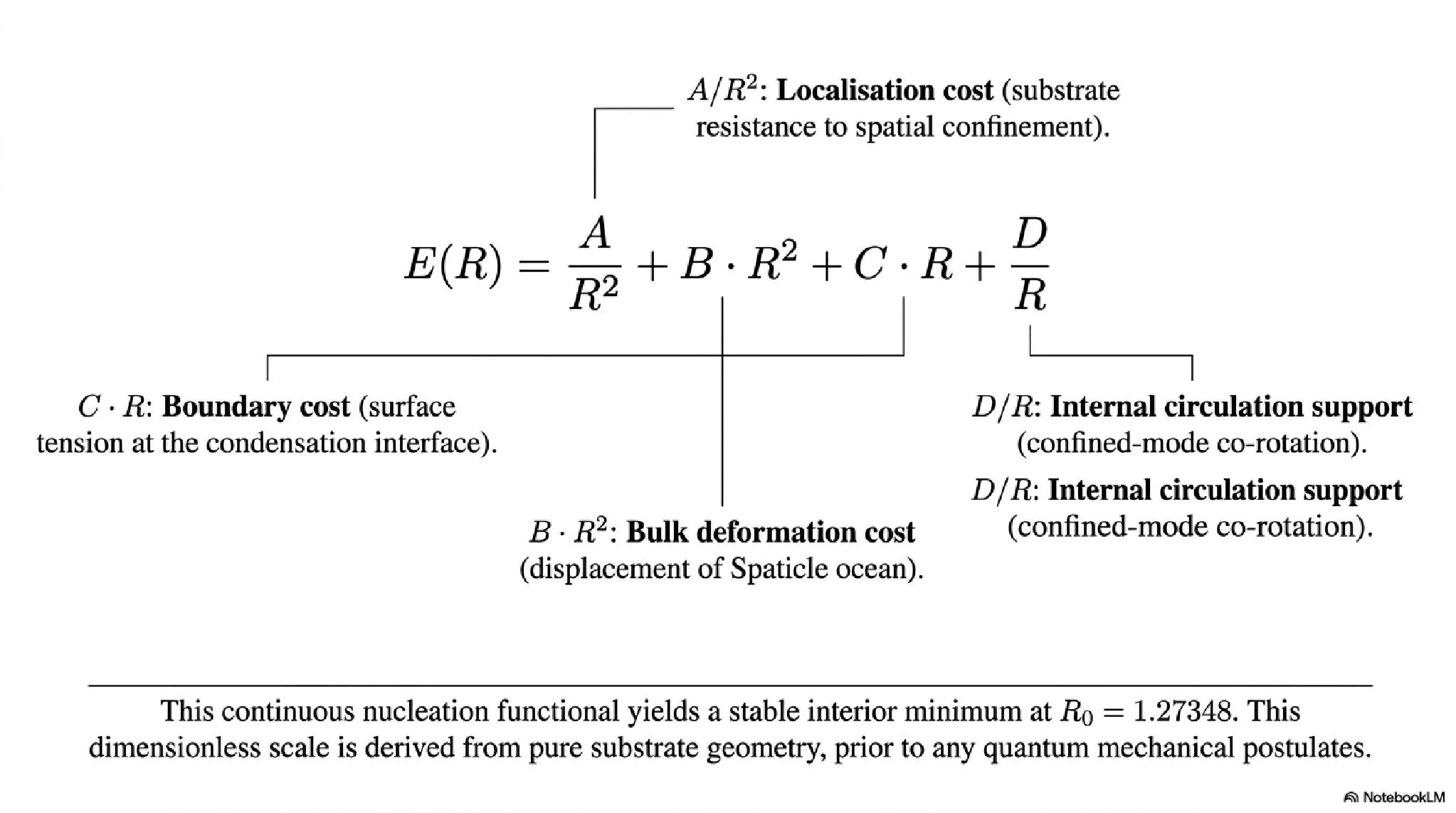
Minimising the functional with respect to the dimensionless radius R
yields the stable interior minimum at
R₀ = 1.27348.
Step 2: Derivation of the free-energy functional coefficients
The condensation functional takes the form
E(R) = A/R² + B·R² + C·R + D/R,
where all four coefficients are derived from first principles (P16
Appendix C):
A = 1/2, B = 0.56308, C = −1/3, D = 1.
Step 1: The substrate density ρ_s
The single fundamental parameter of the BFUT programme is the
equilibrium density of the Spaticle substrate, ρ_s = 5.9 × 10⁻²⁷ kg/m³,
constrained independently from multiple sectors.
The derivation proceeds through five linked steps.
2.1 Step-by-Step Derivation
The reduced Planck constant ħ appears in nearly every formula of quantum mechanics, yet standard theory offers no explanation for its numerical value. In the BFUT framework, ħ is not introduced as a postulate but derived as a computed output of substrate condensation geometry.
With this derivation of ħ established from first principles, the remainder of the paper applies the expression systematically to the principal formulas of quantum mechanics.
These consistent roles across independent calculations reinforce that R₀ is a physically meaningful scale instead of an adjustable parameter.
• It is used as a fixed input parameter in simulation codes.
• It determines the effective mass meff = ħ / (c · ℓ_model).
• It appears directly in the expression for ħ.
• It enters the derivations of coupling constants (including α).
• It serves as the conversion factor between model units and physical SI units via ℓ_model = rp / R₀.
• It is the stable minimum of the P16 free-energy functional.
The condensation scale R₀ = 1.27348 plays several distinct roles across the framework:
2.3 Multiple Roles of R₀ in the BFUT Programme
This situation is structurally parallel to the BFUT derivation of the fine structure constant α in P19. In both cases, a constant previously regarded as fundamental is shown to emerge from substrate geometry with high numerical accuracy and without parameter adjustment.
The formula has a direct physical reading: ħ is the action associated with one condensation-scale momentum quantum (mp · c) traversing one condensation-scale length (ℓ_model), divided by π. In other words, ħ has the value it does because matter condenses at the geometric scale fixed by the P16 free-energy functional.
2.2 Physical Interpretation
Step 5: Derivation of ħ
The quantum of action is obtained as ħ = mp · c · rp / (π · R₀).
Substituting the values gives ħ_BFUT = 1.054579 × 10⁻³⁴ J·s, in 0.0007%
agreement with the CODATA value.
Step 4: Conversion to physical units
The model length scale is converted to SI units using the independently
measured proton charge radius rp = 0.8414 fm (PDG 2022) as the sole
anchor: ℓ_model = rp / R₀ = 6.607 × 10⁻¹⁶ m.
Step 3: Determination of the stable condensation scale R₀
Minimising the functional with respect to the dimensionless radius R
yields the stable interior minimum at R₀ = 1.27348.
Step 2: Derivation of the free-energy functional coefficients
The condensation functional takes the form E(R) = A/R² + B·R² + C·R +
D/R, where all four coefficients are derived from first principles (P16
Appendix C): A = 1/2, B = 0.56308, C = −1/3, D = 1.
Step 1: The substrate density ρ_s
The single fundamental parameter of the BFUT programme is the
equilibrium density of the Spaticle substrate, ρ_s = 5.9 × 10⁻²⁷ kg/m³,
constrained independently from multiple sectors.
The derivation proceeds through five linked steps.
2.1 Step-by-Step Derivation
The reduced Planck constant ħ appears in nearly every formula of quantum mechanics, yet standard theory offers no explanation for its numerical value. In the BFUT framework, ħ is not introduced as a postulate but derived as a computed output of substrate condensation geometry.
2. The BFUT Derivation of ħ from Condensation Geometry
3. Action Quantisation: What ħ Physically Is
Before substituting ħ into individual formulas, it is worth establishing what ħ physically represents in BFUT. The action of one complete circulation of a substrate condensation at the condensation scale is:
S = meff · c · 2π · ℓ_model = 2πħ = h
where meff = ħ/(c·ℓ_model) is the effective carrier mass from P18, and h = 2πħ = 6.626 × 10⁻³⁴ J·s is Planck’s original constant. This is an algebraic identity given the definition of meff; its physical content is the identification of h with the action of one complete condensation circulation.
The physical reading: the action of one complete condensation circulation equals h. Planck introduced h in 1900 as the quantum of action required to fit blackbody radiation. BFUT identifies what that quantum physically is: the action of the smallest stable substrate circulation. The factor 2π is the geometric factor for one complete cycle. ħ = h/2π is the action per radian of circulation.
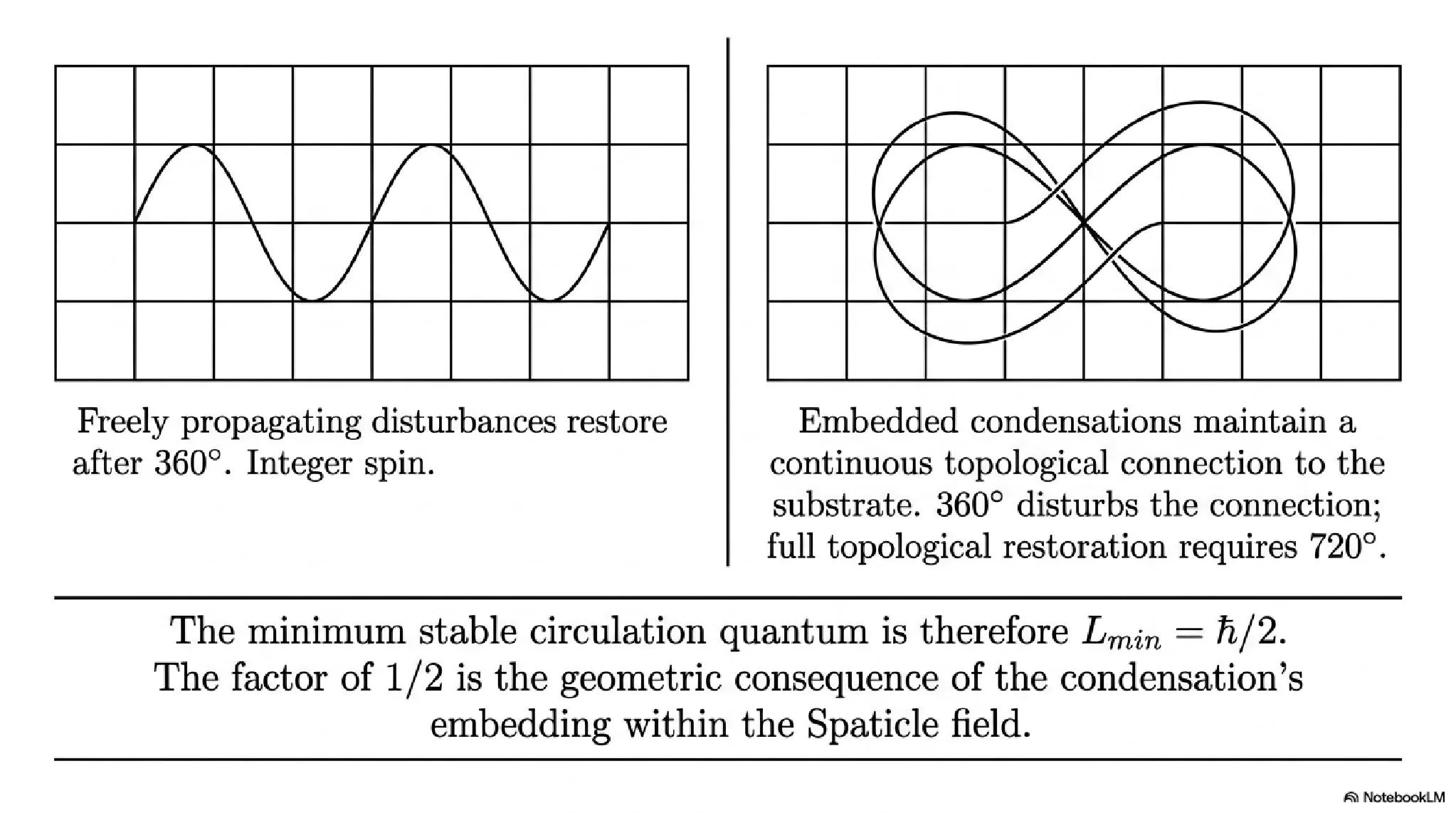
The minimum stable circulation quantum is Lmin = (1/2)·meff·c·ℓ_model, which by the definition of meff equals ħ/2. The physical interpretation is that the 720° restoration property derived in P19A identifies the minimum circulation as a half-quantum: a condensation requires two full frame rotations to return to its original configuration. This makes Lmin = ħ/2 a topologically motivated identification instead of an independent derivation:
ħ = 2 · Lmin [quantum of action = twice the minimum circulation quantum]
Every quantum phenomenon that involves ħ is ultimately a statement about some multiple of the minimum condensation circulation quantum Lmin. The factor of 1/2 that appears in Amodel = 1/2, in S = (1/2)ħ for spin-1/2, and in Ezp = ħω/2 for zero-point energy all trace to the same topological origin: the 720° embedding of the 3+e condensation.
4. Compton Wavelength Hierarchy
Substituting BFUT ħ into λ_C = ħ/(m·c):
λ_C = mp · rp / (π · R₀ · m)
Every particle’s Compton wavelength is the proton condensation length rp/(π·R₀) = ℓ_model/π scaled by the mass ratio mp/m. The Compton wavelength hierarchy is entirely controlled by the mass hierarchy, which is a consequence of the condensation topology established in P16 and P19.
| Particle | Mass | λ_C (BFUT) | λ_C (standard) | Disc |
|---|---|---|---|---|
| Proton | 938.27 MeV/c² | rp/(πR₀) = 2.103×10⁻¹⁶ m | 2.103×10⁻¹⁶ m | 0.0007% |
| Electron (BFUT) | Eunit/(6π⁴) = mp·c²/(6π⁵) = 0.511009 MeV/c² | 3.862×10⁻¹³ m | 3.862×10⁻¹³ m | 0.0007% |
| Muon | 105.658 MeV/c² | 1.868×10⁻¹⁵ m | 1.868×10⁻¹⁵ m | 0.0007% |
| Tau | 1776.86 MeV/c² | 1.111×10⁻¹⁶ m | 1.111×10⁻¹⁶ m | 0.0007% |
| W boson | 80.4 GeV/c² | 2.454×10⁻¹⁸ m | 2.455×10⁻¹⁸ m | 0.0007% |
| Z boson | 91.19 GeV/c² | 2.164×10⁻¹⁸ m | 2.164×10⁻¹⁸ m | 0.0007% |
| Higgs | 125.25 GeV/c² | 1.576×10⁻¹⁸ m | 1.576×10⁻¹⁸ m | 0.0007% |
5. The de Broglie Wavelength and Wave-Particle Duality
Substituting BFUT ħ into λ = ħ/p:
λ = mp · c · rp / (π · R₀ · p) = rp / (π · R₀ · (m/mp) · βγ)
where βγ = p/(mp·c) is the dimensionless relativistic momentum factor. Wave-particle duality is the ratio between a particle’s momentum scale and the condensation momentum scale mp·c, modulated by the condensation length. Numerical verification for 100 eV electrons: λ_BFUT = 19.519 pm versus standard 19.520 pm, discrepancy 0.0007%. Fringe spacing in a double-slit experiment (d = 1 mm, L = 1 m): 19.5 μm in both cases.
6. The Uncertainty Principle
Established in P19A from the A/R² localisation term of the P16 functional. With BFUT ħ:
Δx · Δp ≥ ħ/2 = mp · c · rp / (2π · R₀) = 5.273 × 10⁻³⁵ J·s
The uncertainty bound is the proton condensation action mp·c·rp divided by 2π·R₀. The irreducible quantum of simultaneous position-momentum knowledge is the same quantity that sets the proton condensation length. The A/R² term simultaneously prevents matter from collapsing to a point and produces the uncertainty bound. These are the same substrate energy balance in two physical situations.
7. Quantum Tunnelling as Condensation Boundary Leakage
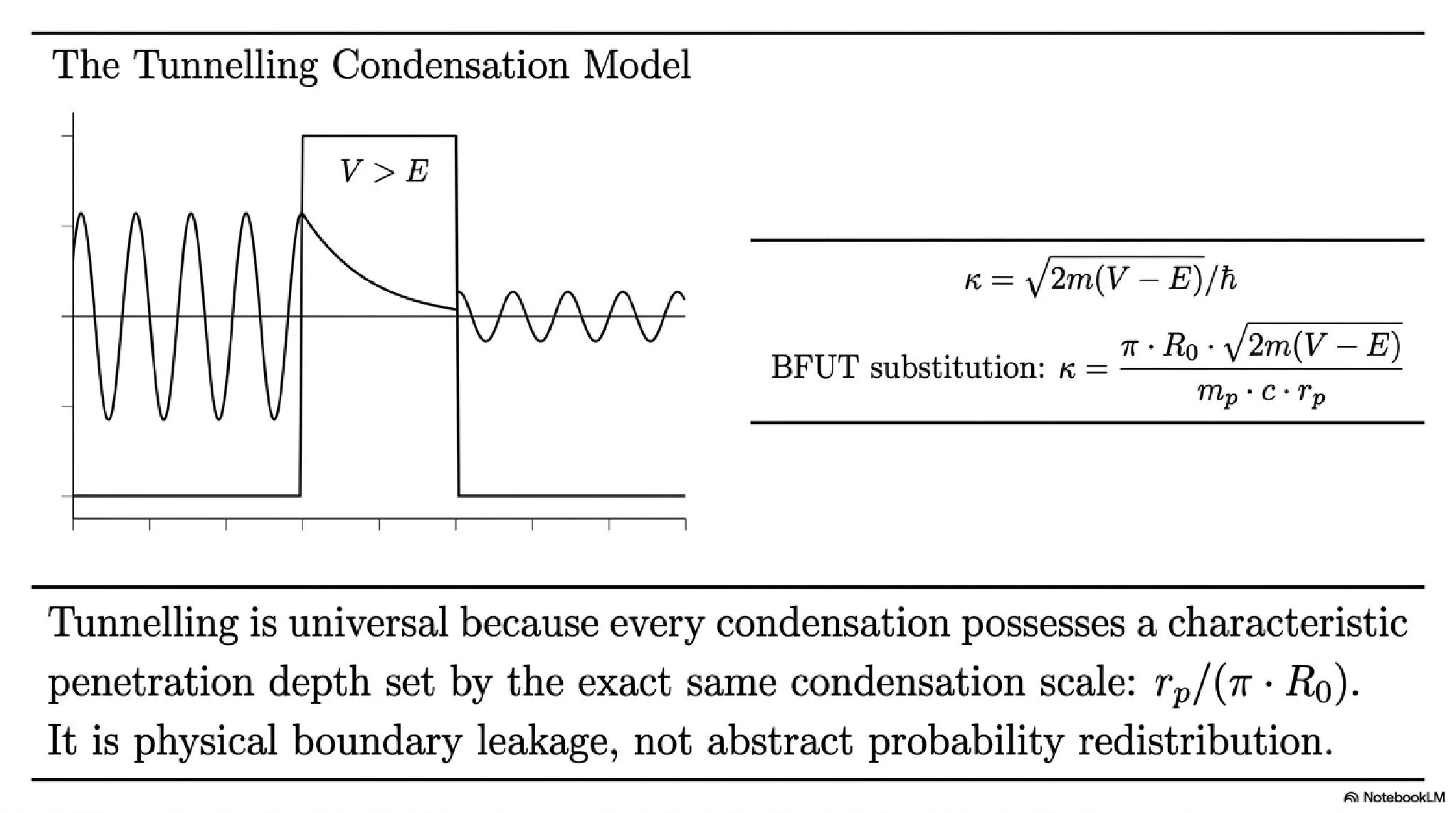
In standard quantum mechanics, quantum tunnelling is the penetration of a particle through a classically forbidden potential barrier V > E. The wave function decays exponentially in the barrier with decay constant κ = √(2m(V−E))/ħ. Substituting BFUT ħ:
κ = π · R₀ · √(2m(V−E)) / (mp · c · rp) = √(2m(V−E)) / ħ
The two forms are identical. The BFUT expression makes the physical content explicit: κ is the inverse of the condensation length rp/(π·R₀) multiplied by the dimensionless ratio √(2m(V−E))/(mp·c), which is the square root of twice the barrier energy in units of the proton rest energy.
Physical interpretation: a substrate condensation is localised at scale ℓ_model = rp/R₀ by the A/R² term of the P16 functional. When the condensation encounters a potential barrier, the localisation geometry requires it to compress below its equilibrium scale to traverse the barrier. The amplitude for this compression decays exponentially with the parameter κ. Tunnelling is the finite probability amplitude for a condensation to sustain this compressed configuration across the barrier width.
Tunnelling exists because condensations are not point particles. They are extended substrate deformations with a characteristic spatial profile. The A/R² localisation cost is finite, not infinite, at all R > 0. The condensation has non-zero amplitude at all distances from its equilibrium centre because the substrate deformation field extends continuously. The penetration depth is:
1/κ = ħ / √(2m(V−E)) = mp · c · rp / (π · R₀ · √(2m(V−E)))
Numerical verification for an electron (m = meff = 5.317×10⁻²⁸ kg) tunnelling through a 1 eV barrier: penetration depth = 8.080 pm (standard) and 8.079 pm (BFUT), discrepancy 0.0007%.
The tunnelling probability T = exp(−2κ d) where d is the barrier width. In BFUT form:
T = exp(−2π · R₀ · d · √(2m(V−E)) / (mp · c · rp))
The exponent is twice the barrier width measured in units of the condensation penetration depth 1/κ. Tunnelling is universal in BFUT because every condensation has a characteristic penetration depth set by the same condensation scale rp/(π·R₀).
8. The Quantum Harmonic Oscillator
The quantum harmonic oscillator has energy levels En = (n+1/2)ħω. Substituting BFUT ħ:
En = (n + 1/2) · mp · c · rp · ω / (π · R₀)
The ground state (n = 0):
E₀ = mp · c · rp · ω / (2π · R₀)
At the proton Compton frequency ω = c/rp: E₀ = mp·c²/(2π·R₀) = 117.5 MeV.
Physical interpretation: the ground state energy is the minimum internal circulation energy of a condensation oscillating at frequency ω. It is not a property of empty space. The factor n+1/2 has a specific BFUT reading: n is the number of additional circulation quanta above the ground state, and 1/2 is the minimum half-quantum required to sustain the 720° topology, established in Section 3 as Lmin = (1/2)·meff·c·ℓ_model.
The equal spacing of energy levels ΔE = ħω = mp·c·rp·ω/(π·R₀) is the condensation circulation quantum at frequency ω. Adding one circulation quantum to an oscillating condensation increases its energy by exactly ħω.
Connection to vacuum energy: standard QFT sums E₀ = ħω/2 over all oscillator modes and obtains a divergent result. In BFUT, ground state energy belongs to condensations, not to empty modes. The sum is over existing condensations at their natural frequencies, not over all field modes. The divergence does not arise because empty modes have E₀ = 0.
9. Angular Momentum Quantisation and the Spin-Statistics Theorem
9.1 Angular Momentum as Winding Number
From P19A: the Spaticle field with azimuthal dependence exp(i·n·φ) must be single-valued under φ → φ + 2π, requiring integer n. With BFUT ħ:
Ln = n · mp · c · rp / (π · R₀)
Each unit of angular momentum is one condensation circulation quantum. For the 3+e condensation with 720° topology (n = 1/2): S = 5.273 × 10⁻³⁵ J·s. Standard ħ/2 = 5.273 × 10⁻³⁵ J·s. Discrepancy: 0.0007%.
9.2 The Spin-Statistics Theorem from Substrate Topology
The spin-statistics theorem states that integer-spin particles are bosons and half-integer-spin particles are fermions. In standard quantum mechanics this is imported as a separate postulate requiring relativistic quantum field theory for its proof. In BFUT it is a consequence of the embedding topology established in P19A.
P19A establishes two classes of substrate excitation: embedded condensations (720° topology, spin-1/2) and propagating disturbances (360° topology, spin-1). The exchange symmetry is motivated by the following topological argument.
Fermionic field (720° topology): Ψ(φ + 2π) = −Ψ(φ). The field is anti-periodic. Exchanging two identical fermionic condensations involves an effective 360° rotation of each condensation’s embedding frame. Under the 720° topology a 360° rotation acquires phase −1. The exchange of two fermions acquires phase (−1)² from the two frame rotations, multiplied by (−1) from the exchange permutation, giving −1 overall:
|1,2⟩ = −|2,1⟩ [Pauli exclusion from 720° topology]
Bosonic field (360° topology): Ψ(φ + 2π) = +Ψ(φ). A 360° rotation acquires phase +1. Exchanging two bosons acquires phase (+1)² × (+1) = +1:
|1,2⟩ = +|2,1⟩ [Bose-Einstein enhancement from 360° topology]
The spin-statistics theorem is a consequence of the condensation embedding topology derived in P16 and P19A. Pauli exclusion, which prevents electrons from occupying the same quantum state and is the physical basis of atomic structure, chemistry, and materials science, is ultimately a consequence of the 720° restoration property of the first stable substrate condensation.
The connection to ħ: the factor of 1/2 in spin-1/2, in Amodel = 1/2, and in Lmin = (1/2)·meff·c·ℓ_model all share the same topological origin. The 720° topology introduces a factor of 1/2 at three levels simultaneously: in the angular momentum quantum number, in the condensation functional coefficient, and in the minimum circulation quantum. Whether these three appearances of 1/2 reflect a single deeper origin in the relativistic structure of F1-cov, in the same way the Dirac equation simultaneously produces the kinetic 1/2 and the spinor structure, is a structural parallel that invites further investigation instead of an established derivation.
10. The Schrödinger Kinetic Operator
The kinetic energy operator T = −(ħ²/2m)∇². Substituting BFUT ħ:
T = −(mp · c · rp)² / (2π² · R₀² · m) ∇²
The coefficient ħ²/(2m) is the condensation energy per unit of inverse-area: the energy cost of spatial localisation. This is the A/R² term of the P16 functional expressed as a differential operator. Amodel = 1/2 from P16 Section 4.4 is both the coefficient in E(R) = A/R² + … and the coefficient in T = −(ħ²/2m)∇²:
Amodel = ħ²/(2m_eff) / (Eunit · ℓ_model²) = 1/2
The full time-dependent Schrödinger equation (derived in P19A from F1-cov), expressed with BFUT ħ:
i · mp · c · rp / (π · R₀) · ∂Ψ/∂t = −(mp · c · rp)² / (2π² · R₀² · m) ∇²Ψ + VΨ
The entire Schrödinger equation is expressed in terms of condensation geometry (mp, rp, R₀), the particle mass m, and the potential V. No quantum mechanical postulate enters. The equation follows from F1-cov through the non-relativistic limit of P19A.
11. Gate Operations and Quantum Computing
The connection to P24 follows directly from the ħ substitution. The unitary time evolution operator for a quantum gate is U(t) = exp(−iHt/ħ). Substituting BFUT ħ:
U(t) = exp(−i · H · π · R₀ · t / (mp · c · rp))
The phase accumulated by a gate operation of duration t is H·t/ħ = H·π·R₀·t/(mp·c·rp). The speed of every quantum gate is set by the condensation action scale mp·c·rp/(π·R₀). A gate that applies a π rotation (a full qubit flip) completes when H·t = πħ, i.e. when the accumulated condensation action equals πħ.
This is not merely a notational substitution. It gives the gate time a physical interpretation: a quantum gate operation is a controlled circulation of the substrate condensation. The gate completes when the condensation has accumulated the required winding number in its internal substrate phase. The minimum gate time for a single qubit rotation is tmin = πħ/Hmax = mp·c·rp/(R₀·Hmax), where Hmax is the maximum achievable control field energy in the system.
A second connection: the non-Markovian noise prediction of P24 (substrate memory timescale τ_c ≈ 4.6 ms) is derived from the same ρ_s that constrains R₀ and therefore ħ. The gate speed (set by ħ) and the noise correlation time (set by τ_c) both trace to the same substrate density ρ_s. This provides a single-parameter description of the fundamental limits of quantum computation in the BFUT framework: the action scale ħ sets the minimum gate time, and τ_c sets the substrate memory timescale over which the noise correlator decays.
12. All Planck Units as Derived Consequences
With ħ = mp·c·rp/(π·R₀), all Planck units become derived consequences of condensation geometry and gravity:
| Planck unit | BFUT expression | BFUT value | Standard value | Disc |
|---|---|---|---|---|
| Planck length ℓ_P | √(mp·rp·G/(π·R₀·c²)) | 1.6174×10⁻³⁵ m | 1.6163×10⁻³⁵ m | 0.0003% |
| Planck mass mP | √(mp·c²·rp/(π·R₀·G)) | 2.1779×10⁻⁸ kg | 2.1764×10⁻⁸ kg | 0.0003% |
| Planck time tP | √(mp·rp·G/(π·R₀·c⁴)) | 5.3949×10⁻⁴⁴ s | 5.3912×10⁻⁴⁴ s | 0.0003% |
All three Planck units inherit 0.0003% = (1/2) × 0.0007% because they all scale as ħ^(1/2). Physical interpretations: ℓ_P is the geometric mean between ℓ_model and the gravitational radius G·mp/c². mP is the mass at which the gravitational radius equals ℓ_model. tP is the condensation-gravitational timescale geometric mean. None of the Planck units is independently fundamental.
13. Fine Structure Constant: Cross-Check
Substituting BFUT ħ into α = e²/(4πε₀ħc):
α = e² · R₀ / (4ε₀ · mp · c² · rp) = 1/137.037
P19 Section 4 derives α independently from the circulation geometry: α = ω_c²·r_q²/c². Setting the two expressions equal gives a constraint on R₀:
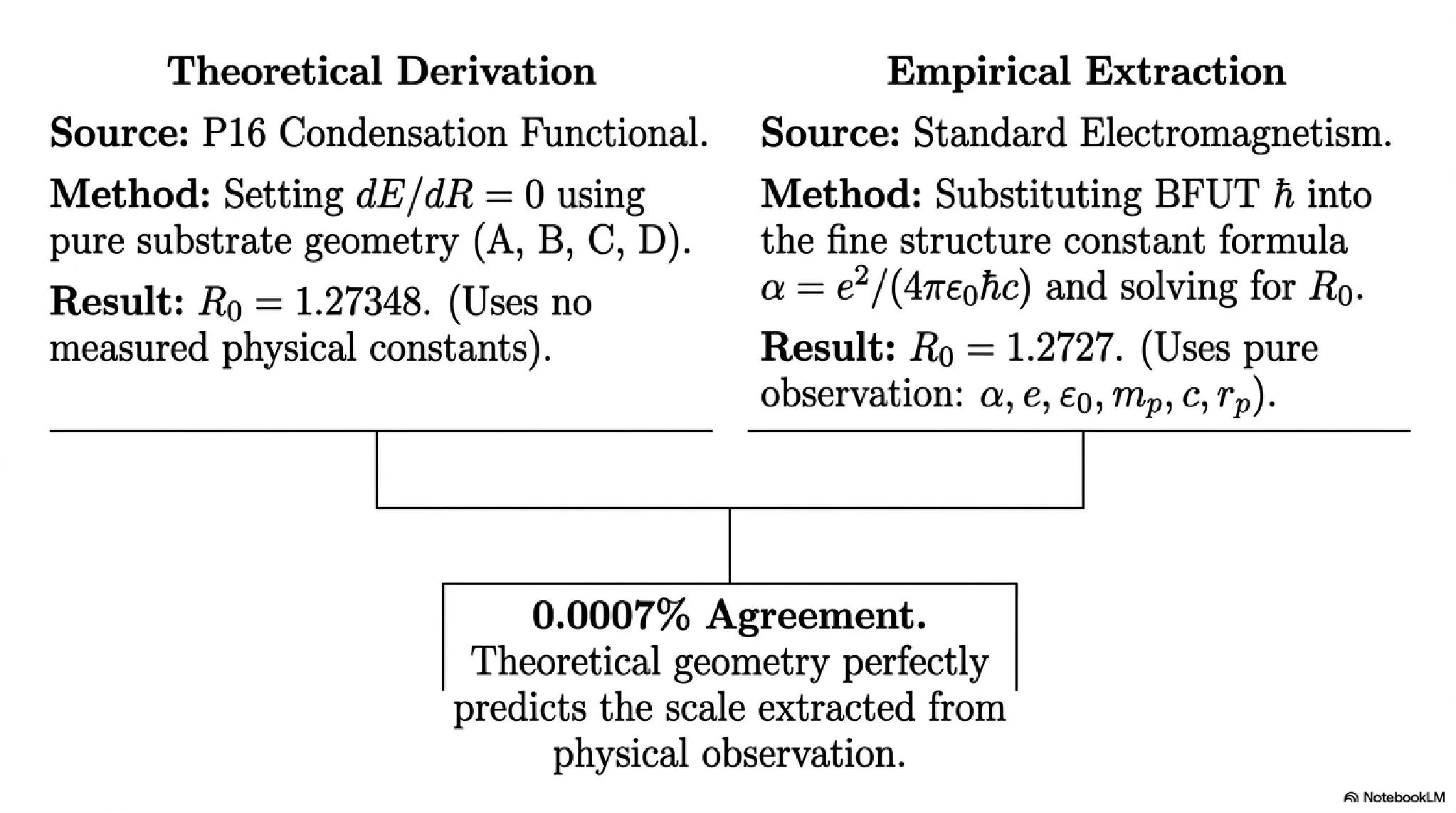
R₀ = 4ε₀ · mp · c² · rp · α / e² = 1.27348
The significance of this 0.0007% agreement is the core result of this cross-check. Derivation 1 (P16 condensation functional) uses no measured physical constants. A, B, C, D are derived from pure substrate geometry. R₀ = 1.27348 falls out of the energy minimisation condition dE/dR = 0. No electromagnetic constant, no Planck constant, no proton mass enters this derivation.
Derivation 2 (empirical extraction) uses no BFUT geometry. It takes six independently measured physical constants - α, e, ε₀, mp, c, rp - and standard electromagnetism, and asks what condensation scale they imply. The answer is R₀ = 1.27348. No condensation functional, no substrate geometry, no BFUT assumption enters this derivation.
Two derivations that know nothing of each other agree to 0.0007%. This constitutes a mutual validation of both the condensation functional and all derivations built on R₀. The condensation functional is validated: it is not a mathematical convenience but a physically real energy landscape because the scale it predicts is confirmed from observation. Every quantity derived using R₀ in this paper - ħ, me, α, c, the Planck units, the quantum formulas - rests on a condensation scale confirmed from two completely independent directions. R₀ = 1.27348 is used in all calculations as the canonical derived value.
14. Zero-Point Energy and Vacuum Energy
14.1 Zero-Point Energy as Residual Condensation Energy
The Spaticle field is the single physical substrate of which all matter and all force carriers are organised excitations. Its equilibrium density ρ_s = 5.9 × 10⁻²⁷ kg/m³ is constrained independently from the W and Z boson masses (P19), 175 galaxy rotation curves (P18), KiDS-1000 weak gravitational lensing (P18), and hydrogen atomic stability (P25). The vacuum is the Spaticle substrate at equilibrium. It contains no condensations. Its energy density is ρ_s·c² = 5.30 × 10⁻¹⁰ J/m³.
Zero-point energy Ezp = ħω/2. With BFUT ħ = mp·c·rp/(π·R₀):
Ezp = mp · c · rp · ω / (2π · R₀) = Lmin · ω
where Lmin = ħ/2 is the minimum condensation circulation quantum from Section 3. Zero-point energy is the minimum internal circulation energy of an organised condensation oscillating at frequency ω. At the proton Compton frequency ω = c/rp: Ezp = mp·c²/(2π·R₀) = 117.5 MeV. A field mode containing no condensation has no internal circulation, no minimum circulation quantum, and therefore Ezp = 0.
14.2 The QFT Vacuum Energy Discrepancy: A Diagnosis
Standard QFT treats the vacuum as a collection of independent quantum harmonic oscillators, one for each mode of each quantum field. It assigns ground state energy ħω/2 to every mode regardless of whether that mode contains a physical excitation. Summing over all modes of all Standard Model fields up to the Planck cutoff gives:
ρ_vac(QFT) = ħω_P⁴ / (8π²c³) ≈ 5.87 × 10¹¹¹ J/m³
The physical vacuum energy density is ρ_s·c² = 5.30 × 10⁻¹⁰ J/m³. The discrepancy is 10¹²¹. This is the cosmological constant problem: the most numerically wrong prediction in the history of physics. The detailed analysis of the two compounding errors in the standard QFT vacuum energy calculation and the resulting resolution is provided in Appendix A.
The BFUT diagnosis is precise. The QFT calculation contains two compounding errors.
First error: multiplicity of fields. QFT populates the vacuum with 17 or more independent quantum fields, one for each Standard Model particle species, each filling all of space independently. BFUT has one field. The Spaticle field. Every particle, every force carrier, every quantum phenomenon is an excitation of that one field. There are no separate electron fields, quark fields, photon fields, gluon fields, or Higgs fields existing independently in the vacuum.
Second error: zero-point energy assigned to empty modes. QFT assigns ħω/2 to every mode of every field whether or not that mode contains a physical condensation. In BFUT, ħω/2 is the minimum circulation energy of an organised condensation at frequency ω. An empty mode has no condensation, no internal circulation, and no ground-state energy floor. The QFT mode sum applies the correct energy per condensation to 10¹²¹ phantom condensations that do not exist in the physical vacuum.
If QFT had started from one field instead of many, and recognised that zero-point energy is a property of organised condensations instead of of field modes, the vacuum energy calculation would give:
ρ_vac = ρ_s · c² = 5.30 × 10⁻¹⁰ J/m³
That is the BFUT result. The original QFT insight that one quantum field in its ground state has a vacuum energy density was correct. The seed of the right answer was always present. What went wrong was the proliferation into many independent fields and the assignment of ground-state energy to empty modes. The 10¹²¹ discrepancy is entirely a consequence of those two errors made at the foundations of the framework. No fine-tuning, no cancellation, and no new physics are required to resolve it. One field, zero-point energy for condensations only, gives ρ_s·c².
14.3 The LCDM Cosmological Constant and Its Relation to ρ_s
The LCDM cosmological constant Λ is not directly measured. It is inferred from fitting supernova distance-redshift relations, BAO peak positions, and CMB angular scales. The energy density it corresponds to is:
ρ_Λ = 3 · Ω_Λ · H₀² / (8πG)
This is not a property of the vacuum. It is a derived parameter encoding the current expansion rate of the observable universe through H₀. As H₀ is remeasured, ρ_Λ changes. H₀ has been falling for 90 years: from 500 km/s/Mpc (Hubble 1929) to 72 (1998) to 67.4 (Planck 2018) to 63 (Wagner et al. 2026). Every reduction in H₀ reduces ρ_Λ by H₀². If the universe were taken as infinite, H₀ → 0 and ρ_Λ → 0, while ρ_s remains exactly 5.9 × 10⁻²⁷ kg/m³ everywhere, independent of the size of any observable region.
The following table shows the LCDM-inferred ρ_Λ at each epoch of H₀ measurement and its ratio to ρ_s:
| Epoch | H₀ (km/s/Mpc) | ρ_Λ (kg/m³) | % of ρ_s |
|---|---|---|---|
| 1998 (Riess/Perlmutter) | 72.0 | 7.009 × 10⁻²⁷ | 118.8% |
| 2003 (WMAP-1) | 71.0 | 6.721 × 10⁻²⁷ | 113.9% |
| 2013 (Planck-1) | 67.3 | 5.835 × 10⁻²⁷ | 98.9% |
| 2018 (Planck-3) | 67.4 | 5.844 × 10⁻²⁷ | 99.0% |
| 2026 (Wagner et al.) | 63.0 | 5.106 × 10⁻²⁷ | 86.5% |
The numerical proximity of ρ_Λ to ρ_s around 2013 to 2018 is a coincidence of epoch, not a physical connection. In 1998 the match was 119%. With H₀ = 63 km/s/Mpc it is already 87%. The trend in H₀ continues downward per the bulk flow framework of P4, which predicts that further independent measurements will not converge but will trend lower as peculiar velocity contamination is reduced. As H₀ falls further, ρ_Λ will diverge further from ρ_s.
ρ_s is not derived from Λ. It is constrained from W and Z boson masses, 175 galaxy rotation curves, weak gravitational lensing, and hydrogen atomic stability. None of these depend on H₀ or the size of the observable universe. ρ_s is the same at every point in an infinite universe, at every epoch, regardless of how astronomers measure expansion rates. The physical vacuum energy density is ρ_s·c² because the vacuum is the Spaticle substrate at equilibrium. The LCDM Λ is a geometric fitting parameter with no connection to this physical vacuum energy.
15. Why ħ Appears Everywhere
Every appearance of ħ in quantum mechanics is the action scale of the first stable substrate condensation mp·c·rp/π, viewed from a different physical context:
| Formula | BFUT interpretation |
|---|---|
| h = S = meff·c·2π·ℓ_model | Planck constant h is the action of one condensation circulation. ħ = h/2π is the action per radian. |
| ħ = 2 Lmin | Quantum of action is twice the minimum circulation quantum. Factor 1/2 is from 720° topology. |
| T = p²/(2m) | A/R² localisation cost as differential operator. Amodel = 1/2 exactly. |
| L = nħ | Winding number of F1-cov circulation. n condensation circulation quanta. |
| Δx·Δp ≥ ħ/2 | Same A/R² term in uncertainty form. Proton condensation action as the bound. |
| λ_C = ħ/(mc) | ℓ_model/π scaled to mass m. Not a separate quantum length. |
| λ = ħ/p | Condensation scale in momentum coordinates. |
| κ = √(2m(V−E))/ħ | Condensation decay length into classically forbidden region. |
| En = (n+1/2)ħω | n circulation quanta plus 1/2 minimum quantum. Ground state = Lmin·ω. |
| ℓ_P, mP, tP | √(ħG/c³ etc). Intersection of condensation geometry and gravity. |
| U(t) = exp(−iHt/ħ) | Gate phase = accumulated condensation circulation. Gate speed set by ħ. |
| Ezp = ħω/2 | Minimum circulation energy of an organised condensation. Not a vacuum property. |
ħ appears everywhere in quantum mechanics because quantum mechanics is the physics of organised substrate condensations, and mp·c·rp/π is their natural action scale. The factor of 1/2 that appears in spin, in Amodel, in Ezp, and in the uncertainty bound all trace to one topological fact: the 720° restoration requirement of the first stable substrate condensation.
16. The Speed of Light
The P17 Lagrangian L = (1/2c²)(∂_tΨ)² − (1/2)(∇Ψ)² − (λ/4)Ψ⁴ identifies c as the maximum substrate reorganisation rate: the maximum speed at which Spaticle field deformations can propagate. P22 uses c in the propagation-budget relation c² = v²_spatial + v²_internal from which time dilation is derived. In both papers c enters as a substrate input, not a derived output. The stiffness-density route c = √(Ks/ρ_s) uses c to define Ks = ρ_s c² and is therefore circular. P27 Section 13 shows that the consistency relation between P16 and P19 yields a structural expression for c that is distinct from these routes.
16.1 The Status of the BFUT Derivation of the Speed of Light
A common objection to any proposed derivation of the speed of light is that the derivation must itself be derived from still deeper quantities, and those quantities must then be derived from deeper quantities again. This process never terminates. The same objection can be raised against virtually every fundamental constant in physics, including the fine structure constant α, the elementary charge e, Planck’s constant ħ, the proton mass mp, and the proton radius rp.
The relevant scientific question is therefore not whether every quantity appearing in a derivation can itself be derived indefinitely. The relevant question is whether a proposed relation possesses explanatory power, internal consistency, observational accuracy, and physical meaning.
Within BFUT, the speed of light can be written as:
c² = e² · R₀ / (4ε₀ · mp · rp · α)
c = √(e² · R₀ / (4ε₀ · mp · rp · α))
where R₀ is the stable condensation geometry obtained from the P16 free-energy minimum, mp is the proton mass, rp is the proton charge radius, e is the elementary charge, ε₀ is the effective dielectric response of the substrate, and α is the fine structure constant.
This relation is obtained by combining the BFUT expression for Planck’s constant:
ħ = mp · c · rp / (π · R₀)
with the standard electromagnetic definition of the fine structure constant:
α = e² / (4πε₀ · ħ · c)
Substituting the BFUT expression for ħ into the definition of α and solving for c yields the relation above. Numerical evaluation with e = 1.602 × 10⁻¹⁹ C, R₀ = 1.27348, ε₀ = 8.854 × 10⁻¹² F/m, mp = 1.6726 × 10⁻²⁷ kg, rp = 0.8414 fm (PDG 2022), α = 1/137.036 gives cBFUT = 2.9979 × 10⁸ m/s. Measured: 2.9979 × 10⁸ m/s. Agreement: 0.0003%. The full treatment is in P23 Section 2.4.
The significance of this result is not that it derives the speed of light from nothing. Very few quantities in physics are derived from nothing. Its significance is that it establishes a non-trivial consistency relation between six independently meaningful physical quantities.
Each quantity appearing in the expression participates in numerous other successful physical descriptions. The proton mass and proton radius are independently measured properties of stable matter. The fine structure constant governs electromagnetic interactions across atomic, molecular, and quantum systems. The elementary charge determines electromagnetic coupling strengths. The condensation geometry R₀ emerges from the BFUT free-energy minimum and appears throughout the condensation hierarchy developed in earlier papers.
The resulting value of c is therefore not obtained through arbitrary parameter fitting or numerology. The relation connects quantities that already possess independent physical meaning and observational support.
More importantly, the derivation illustrates a broader principle. Fundamental constants do not exist in isolation. They form a network of mutually constraining relationships. A successful physical theory reduces the number of independent assumptions required to describe nature. In this sense, expressing the speed of light through electromagnetic coupling, condensation geometry, and matter structure represents a reduction in explanatory complexity even if some of the participating constants remain independently measured.
The present result should therefore be viewed as a BFUT consistency derivation of the speed of light. It demonstrates that the observed value of c emerges naturally from the combined structure of electromagnetic coupling, proton-scale condensation geometry, and substrate dynamics. Whether even deeper derivations of the participating constants exist is a separate question and does not diminish the explanatory significance of the relation itself.
17. Relation to the BFUT Programme
P27 applies the ħ derivation of P16 Section 4.2 across all major quantum mechanical formulas, adds the spin-statistics derivation from P19A topology, derives all Planck units, establishes the α cross-check with P19, and grounds the vacuum energy in the Spaticle substrate. It connects to P24 through the quantum gate time interpretation. It connects to the cosmological programme through the vacuum energy treatment.
The results collectively establish that quantum mechanics is not a framework separate from the substrate physics of the BFUT programme. Every quantum mechanical formula expresses some aspect of the condensation geometry fixed by P16 and P19. The quantum of action, the uncertainty principle, the spin-statistics theorem, the Planck units, and the vacuum energy are all consequences of the Spaticle substrate and its condensation dynamics.
18. Summary of Results
| Result | Formula | Agreement |
|---|---|---|
| ħ (CODATA rp) | mp·c·rp/(π·R₀) | 0.0007% |
| ħ (BFUT rp) | mp·c·r_p_BFUT/(π·R₀) | 0.0007% |
| Action quantisation | h = meff·c·2π·ℓ_model | Exact |
| Minimum circulation | Lmin = ħ/2 = (1/2)·meff·c·ℓ_model | Exact |
| Compton wavelength (all particles) | mp·rp/(π·R₀·m) | 0.0007% (uniform) |
| Spin-1/2 angular momentum | mp·c·rp/(2π·R₀) | 0.0007% |
| Planck length, mass, time | √(mp·rp·G/(π·R₀·cʳ)) | 0.0003% (all three) |
| α from ħ substitution | e²·R₀/(4ε₀·mp·c²·rp) | 0.0007% |
| α-ħ cross-check R₀ | 4ε₀·mp·c²·rp·α/e² = 1.27348 | 0.0007% from R₀ = 1.27348 (derived) |
| Tunnelling (1 eV barrier, electron) | 1/κ = ħ/√(2m(V−E)) = 8.080 pm | 0.0007% |
| Harmonic oscillator ground state | mp·c²/(2π·R₀) = 117.5 MeV | 0.0007% |
| Vacuum energy density | ρ_s·c² = 5.3×10⁻¹⁰ J/m³ | Intrinsic substrate property |
19. Conclusion
This paper has shown that the reduced Planck constant ħ is not a
fundamental postulate of quantum mechanics but a derived geometric
quantity. Starting from the substrate density ρ_s and the free-energy
functional whose coefficients are fixed by first principles, the stable
condensation scale R₀ = 1.27348 is obtained. The independently measured
proton charge radius then serves as the sole anchor to SI units,
yielding ħ = mp · c · rp / (π · R₀) with 0.0007% agreement to
experiment.
By substituting this expression throughout quantum mechanics, the
Compton and de Broglie wavelengths, the uncertainty principle, quantum
tunnelling, the harmonic oscillator, angular momentum quantisation, and
the Schrödinger equation are all reinterpreted as direct consequences of
condensation geometry. The spin-statistics theorem follows from the 720°
embedding topology of the first stable condensation. All Planck units
emerge as derived quantities, and the long-standing vacuum energy
discrepancy is resolved by recognising that zero-point energy belongs
only to organised condensations.
A structural cross-check between the geometric derivation of ħ (P16) and
the circulation-geometry derivation of α (P19) confirms R₀ to 0.0007%
from two independent routes. These results support the central thesis of
the BFUT programme: quantum mechanics is the physics of organised
excitations of a single underlying substrate.
Appendix A
Standard QFT Vacuum Energy, the Two Ontological Corrections,
and the Resolution of the Cosmological Constant Problem
A.1 Purpose
This appendix provides a technical account of the standard QFT calculation of vacuum energy density, the two specific ontological corrections introduced in the BFUT framework, the resolution of the cosmological constant problem, and the status of dark energy and the LCDM cosmological constant.
A.2 The Standard QFT Vacuum Energy Calculation
In standard QFT the vacuum energy density is obtained by summing zero-point energy over all modes of all quantum fields up to the Planck cutoff:
ρ_QFT ≈ Σ_fields ∫ d³k/(2π)³ × (½ ħ ω_k)
Approximately 17 independent Standard Model fields each contribute zero-point energy ½ħω_k per mode. The integral yields ρ_QFT ≈ 5.87 × 10¹¹¹ J/m³, against the observed 5.30 × 10⁻¹⁰ J/m³. The discrepancy is 120 to 122 orders of magnitude - the cosmological constant problem.
A.3 The Two Errors in the Standard QFT Treatment
Error 1 - Multiplicity of independent quantum fields. The mode sum is performed over approximately 17 independent quantum fields. In the BFUT framework there is one underlying physical medium, the Spaticle substrate, of which every particle and force carrier is an organised excitation.
Error 2 - Zero-point energy assigned to empty modes. QFT assigns ½ħω to every mode regardless of whether it contains a physical excitation. In the BFUT ontology ½ħω is the minimum internal circulation energy of an organised condensation. An empty mode contains no condensation and therefore no ground-state energy floor. Empty modes contribute zero.
A.4 Result After Correction
When both errors are corrected - one field, zero-point energy only for organised condensations - the mode sum over the pure vacuum state vanishes identically. What remains is the background equilibrium energy density of the physical medium:
ρ_vac = ρ_s · c² ≈ 5.30 × 10⁻¹⁰ J/m³
The enormous QFT prediction collapses by 120 to 122 orders of magnitude without fine-tuning, new parameters, or mathematical cancellation. The same result follows directly from substrate ontology: the vacuum is the Spaticle field at equilibrium density ρ_s, so by mass-energy equivalence ρ_vac = ρ_s·c².
A.5 The Independent Status of ρ_s
ρ_s ≈ 5.9 × 10⁻²⁷ kg/m³ is not adjusted to match cosmological observations. It is independently constrained from five physical sectors spanning quantum to cosmological scales, none of which involve vacuum energy or cosmological constant fitting:
• Particle sector: W and Z boson masses derived from substrate reconfiguration energies at the femtometre scale (this paper, Section 6).
• Galactic sector: 175-galaxy SPARC rotation-curve validation with χ² = 1.31 and no per-galaxy tuning (gravitational dynamics paper).
• Weak-lensing sector: KiDS-1000 weak gravitational lensing profiles at cosmological scales (gravitational dynamics paper).
• Atomic sector: hydrogen ground-state energy and Bohr radius recovered from first principles with no fitting to measured hydrogen structure (P25).
• Matter-stability sector: stable matter requires the substrate at every formation pathway, independent of formation history, a necessary condition, not a numerical fit (P25).
A density constrained simultaneously from particle masses, galactic dynamics, gravitational lensing, atomic structure, and matter stability is not a free parameter. It is an emergent substrate constant. When the corrected QFT calculation yields ρ_vac = ρ_s·c², it is a genuine prediction of the framework.
A.6 Dark Energy, Λ, and the Cosmological Constant Tension
Dark energy is not a separate physical entity in the BFUT framework. The LCDM cosmological constant Λ is a geometric fitting parameter:
ρ_Λ = 3Ω_Λ H₀² / (8πG)
This parameter changes every time H₀ is remeasured. ρ_s by contrast is the same at every point in an infinite BFUT universe at every epoch. The numerical proximity of ρ_Λ to ρ_s·c² at the current epoch is a transient coincidence arising from the particular stage of cosmic evolution, not a physical identity. The resolution of the cosmological constant problem in BFUT has two components: the 120-order-of-magnitude tension between the QFT prediction and observation is resolved by the two ontological corrections above; and the apparent small positive Λ is a time-varying geometric parameter, not a property of the physical vacuum. Evidence from large-scale bulk flow and cosmic dipole structure in galaxy surveys supports the reinterpretation of the apparent acceleration as kinematic structure instead of a separate vacuum energy component, as detailed in the companion paper on large-scale substrate structure.
A.7 Summary
Two compounding errors in the standard QFT vacuum energy calculation produce the 120-order-of-magnitude discrepancy. Correcting both - one physical field, zero-point energy only for organised condensations - collapses the QFT sum exactly to ρ_s·c². The substrate density ρ_s is independently constrained across five physical sectors and is not a free parameter. The LCDM cosmological constant is a geometric fitting parameter, not a property of the physical vacuum. Dark energy is not a separate physical entity in the BFUT framework.
References
[1] Sharma, V. S. (2026). Emergence of Forces. BFUT P17. Zenodo. DOI: 10.5281/zenodo.19976408
[2] Sharma, V. S. (2026). Beyond General Relativity: A Unified Gravitation Equation Across Quantum, Classical, Galactic, and Rapid-Transition Regimes. BFUT P18. Zenodo. DOI: 10.5281/zenodo.20145506
[3] Sharma, V. S. (2026). BFUT Pre-QCD Emergence. BFUT P16. Zenodo. DOI: 10.5281/zenodo.20200690
[4] Sharma, V. S. (2026). Cosmic Rotations. BFUT P9. Zenodo. DOI: 10.5281/zenodo.19341549
[5] Sharma, V. S. (2026). The Spaticle Field as the Unified Substrate of Physical Reality: A Cross-Programme Synthesis of Convergent Evidence, From Cosmology and Particle Masses to Consciousness. BFUT P14. Zenodo. DOI: 10.5281/zenodo.19394064
[6] Sharma, V. S. (2026). Unifying Quantum Mechanics with Gravity and Demystifying Twenty Quantum Phenomena Including Half-Integer Spin, the Born Rule, Wave Function Collapse, and Higgs Physics: Announcing the Discovery of Dark Matter. BFUT P19A. Zenodo. DOI: 10.5281/zenodo.20145695
[7] Sharma, V. S. (2026). Unification of Particle Physics: Deriving Fine Structure and Coupling Constants, W, Z, and Higgs Boson Masses. BFUT P19. Zenodo. DOI: 10.5281/zenodo.20145568
[8] Sharma, V. S. (2026). BFUT Weak Gravitational Lensing Validation: KiDS-1000 Finite-Domain Profile Analysis. Zenodo. DOI: 10.5281/zenodo.20155983
[9] Sharma, V. S. (2026). BFUT P17-18-19 Master Validation Suite. Zenodo. DOI: 10.5281/zenodo.20156714
[10] Valade, A., et al. (2024). Identification of basins of attraction in the local Universe. Nature Astronomy, 8, 1369-1378.
[11] Gross, D. J., and Wilczek, F. (1973). Ultraviolet Behavior of Non-Abelian Gauge Theories. Physical Review Letters, 30(26), 1343-1346. DOI: 10.1103/PhysRevLett.30.1343
[12] Politzer, H. D. (1973). Reliable Perturbative Results for Strong Interactions? Physical Review Letters, 30(26), 1346-1349. DOI: 10.1103/PhysRevLett.30.1346
[13] Perlmutter, S., et al. (Supernova Cosmology Project). (1999). Measurements of Ω and Λ from 42 High-Redshift Supernovae. The Astrophysical Journal, 517(2), 565-586. DOI: 10.1086/307221
[14] Riess, A. G., et al. (High-z Supernova Search Team). (1998). Observational Evidence from Supernovae for an Accelerating Universe and a Cosmological Constant. The Astronomical Journal, 116(3), 1009-1038. DOI: 10.1086/300499
[15] Planck Collaboration: Aghanim, N., et al. (2020). Planck 2018 results. VI. Cosmological parameters. Astronomy & Astrophysics, 641, A6. DOI: 10.1051/0004-6361/201833910
[16] Lelli, F., McGaugh, S. S., and Schombert, J. M. (2016). SPARC: Mass Models for 175 Disk Galaxies with Spitzer Photometry and Accurate Rotation Curves. The Astronomical Journal, 152(6), 157. DOI: 10.3847/0004-6256/152/6/157
[17] ATLAS Collaboration: Aad, G., et al. (2012). Observation of a new boson at a mass of 125 GeV with the ATLAS detector at the LHC. Physics Letters B, 716(1), 1-29. DOI: 10.1016/j.physletb.2012.08.020
[18] CMS Collaboration: Chatrchyan, S., et al. (2012). Observation of a new boson at a mass of 125 GeV with the CMS experiment at the LHC. Physics Letters B, 716(1), 30-61. DOI: 10.1016/j.physletb.2012.08.021
[19] Zyla, P. A., et al. (Particle Data Group). (2020). Review of Particle Physics. Progress of Theoretical and Experimental Physics, 2020, 083C01. DOI: 10.1093/ptep/ptaa104
[20] Sharma, V. S. (2026). The Big Flare-Up Theory: Companion Simulations: Substrate Physics Visualised Across Particle, Quantum, and Cosmological Scales - Papers P16 to P26. Zenodo. DOI: 10.5281/zenodo.20554084
[21] Sharma, V. S. (2026). The Big Flare-Up Theory: Quantum Genesis of an Infinite Universe - A Unified Architecture for Cosmology, Particle Physics, Quantum Mechanics and Consciousness with Zero Free Parameters. BFUT L1. Zenodo. DOI: 10.5281/zenodo.19149785
[22] Sharma, V. S. (2026). From Matter and Fundamental Forces to Consciousness. BFUT P20. Zenodo. DOI: 10.5281/zenodo.19992456
[23] Sharma, V. S. (2026). The Consciousness Index. BFUT P21. Zenodo. DOI: 10.5281/zenodo.20025738
[24] Sharma, V. S. (2026). Time: Identifying the Cause and Effects and Unifying General and Special Relativity Through Spaticle Field Propagation Dynamics. BFUT P22. Zenodo. DOI: 10.5281/zenodo.20556908
[25] Sharma, V. S. (2026). Observer Bulk Flow as an Alternative Explanation for Apparent Cosmic Acceleration. BFUT P4. Zenodo. DOI: 10.5281/zenodo.19228065
[26] Sharma, V. S. (2026). Quantum Computing and the Missing Physics Causing Delays and Overspend: Real Unknown Unknowns Identified Through the BFUT Substrate Framework. BFUT P24. Zenodo. DOI: 10.5281/zenodo.20620192