Light, Photons, and the Universal Speed Limit: A First-Principles Derivation of c from Substrate Condensation Dynamics
- Abstract
- 1. Introduction
- 2. The Substrate Propagation Speed
- 3. What a Photon Is
- 4. Why Gravitational Waves Travel at c
- 5. Why Massive Particles Cannot Reach c
- 6. Neutrinos: Nearly Massless Substrate Ripples
- 7. Cosmic Redshift: The BFUT Account
- 8. Time, Light Cones, and Causality from Substrate Physics
- 9. Comparative Summary
- 10. Predictions Distinguishing BFUT from Standard Treatment
- 12. Unification of Time, Time Dilation, Speed of Light, and Speed of Gravity
- Appendix B.
- The Soliton: A Wave That Does Not Die
- B.1 The First Observation
- B.2 Why Ordinary Waves Die
- B.3 The Nonlinear Compensation
- B.4 The Canal and the Soliton - Why Russell's Wave Survived
- B.5 Solitons in Other Physical Systems
- B.6 The Three-Dimensional Soliton and Its Dissolution
- References (Appendix B)
- References
Abstract
Standard physics treats the speed of light c as a fundamental constant and photons as massless excitations of the electromagnetic field. The reason why c is universally limiting, why massless particles travel at exactly c, why gravitational waves share that same speed, and why massive particles cannot reach it, are treated as consequences of special relativity instead of as phenomena requiring physical explanation.
This paper derives all of these results from the physical properties of the Spaticle substrate established in the BFUT programme. The universal speed limit c is the propagation speed of the Spaticle field itself, determined by the substrate stiffness-to-density ratio: c = √(Ks/ρ_s). A photon is a freely propagating organised excitation of the substrate that requires no stable localised condensation structure. All of its energy is available for propagation. It therefore travels at the maximum rate the substrate permits. Gravitational waves are propagating deformation disturbances of the same substrate. They travel at c for the same reason. The equivalence of light speed and gravitational wave speed is not a coincidence requiring a separate explanation. It follows directly from the common substrate origin of both phenomena.
Massive particles travel below c because part of their energy budget is committed to maintaining their internal condensation structure instead of pure propagation. The velocity deficit from c is determined by the ratio of rest energy to total energy. Neutrinos, with their extremely small masses, travel within one part in 10⁻¹⁷ of c, consistent with the Supernova 1987A constraint. Photons travel at exactly c because they have no rest energy and therefore no condensation to maintain.
Cosmic redshift is explained by Doppler motion of receding matter and substrate propagation dynamics. The universe is infinite and eternal; no expansion of space is involved. The Doppler effect, aberration, and time dilation all emerge from the finite substrate propagation speed. The paper also derives why the speed limit is absolute: no physical process can reorganise the substrate faster than the substrate propagates causal information. Light does not define the universal speed limit. The universal speed limit defines the behaviour of light.
Keywords: Spaticle field; speed of light; photon; gravitational waves; substrate condensation; neutrino mass; soliton; BFUT; universal speed limit; rest energy; causality; massless excitation
1. Introduction
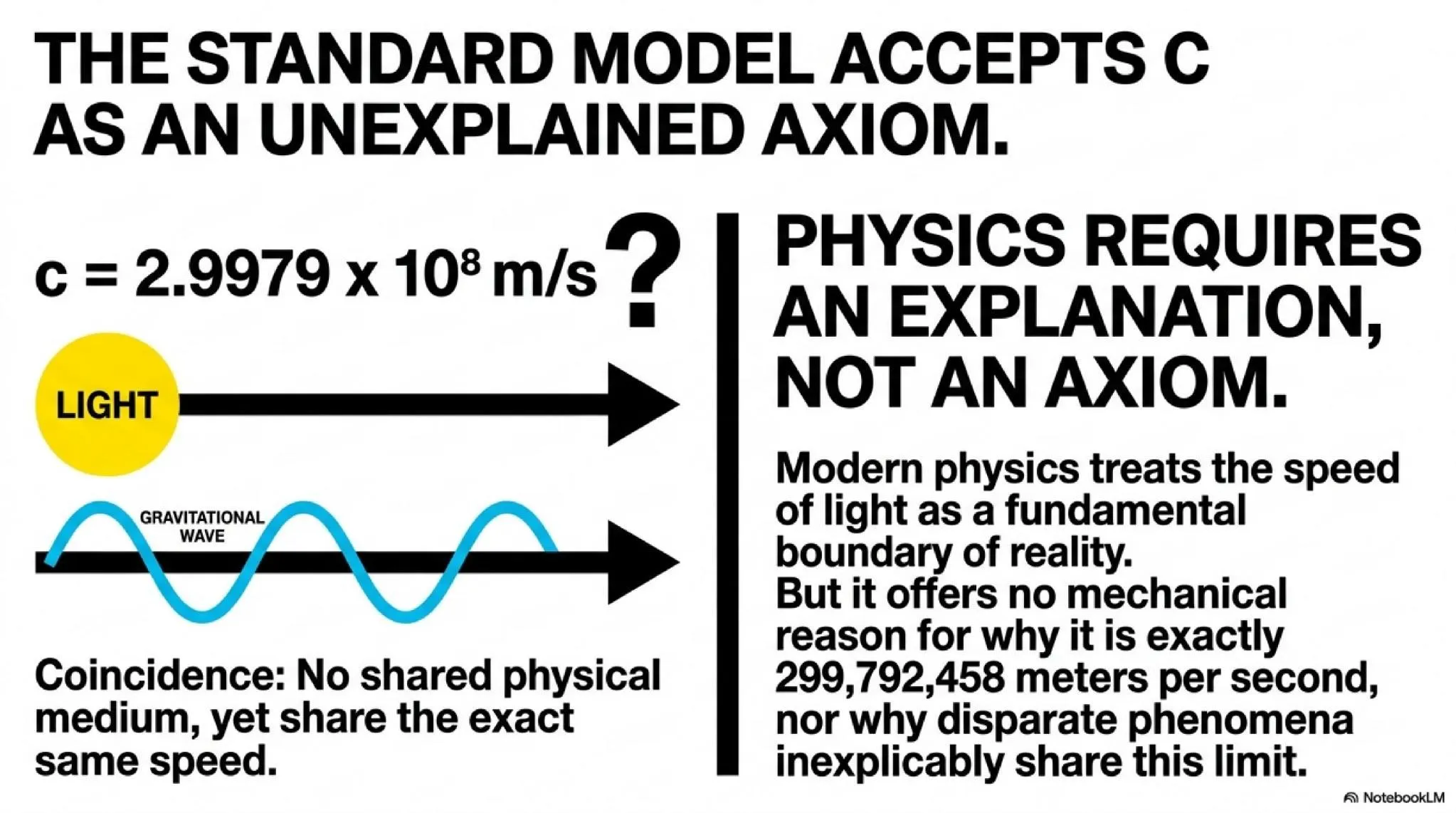
The speed of light c = 2.997925 × 10⁸ m/s is one of the most precisely measured quantities in physics and one of the least physically explained. Special relativity takes c as a postulate: the laws of physics are the same in all inertial frames, and there exists a limiting speed for all causal propagation. This is a constraint, not an explanation. Why does a limiting speed exist? Why do massless particles travel at exactly that limit? Why do gravitational waves share the same speed as light? Special relativity answers none of these questions. It incorporates c as an axiom.
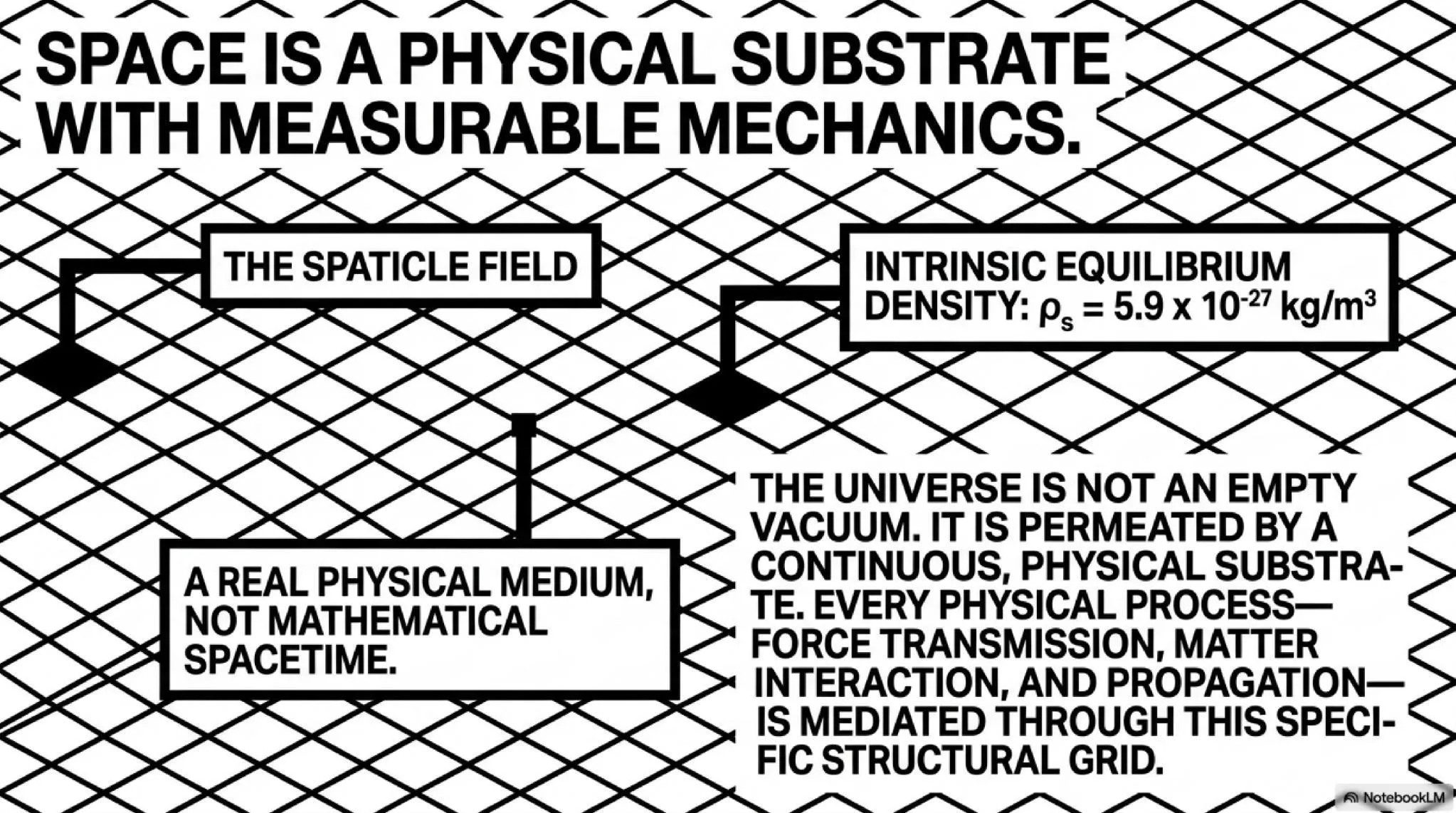
The BFUT Spaticle field framework provides a physical substrate in which these questions have definite answers. The substrate is a real physical medium of density ρ_s ≈ 5.9 × 10⁻²⁷ kg/m³ permeating all space. It has a finite stiffness Ks determined by its self-interaction structure. Physical processes propagate through this medium at a speed set by these properties. That speed is c. Every physical excitation of the substrate, whether electromagnetic, gravitational, or any other massless disturbance, propagates at this substrate speed. Massive particles, being stable localised condensations embedded in the substrate, cannot travel at the substrate propagation speed because they must carry their condensation structure with them, diverting part of their energy from propagation.
This paper develops this account systematically across eight sections, providing quantitative predictions consistent with all known observations and making specific new predictions distinguishing the substrate account from the standard special-relativistic treatment.
The Spaticle field is not the luminiferous ether. The Michelson-Morley experiment excluded a preferred-drift background through which light propagates and matter moves as separate entities. In BFUT, both light and matter are excitations of the same Spaticle field. Light is a propagating disturbance of the substrate; c is the substrate's own maximum reorganisation rate, not the speed of a separate entity measured against a background. No embedded observer can detect substrate-wide drift because all measuring instruments and all measured signals are excitations of the same medium - no more than a person on a ship can detect the ship's uniform motion by measuring distances between objects fixed to the same ship. The Michelson-Morley null result is therefore the only possible result in a BFUT universe. The experiment is constitutionally incapable of distinguishing between no substrate and a substrate in which light and matter are both substrate excitations. The latter is the BFUT position. Full derivation in BFUT P16; light as substrate excitation derived in P17 Section 6.6 and P19 Section 13.
1.1 Scope: Photon Domains and Gravitational Domains
This paper addresses the travel domain of photons - the distance over which a photon maintains its organised soliton character before dissolving back into the substrate. Section 4 explains why gravitational waves travel at c by the same substrate mechanism as photons: both are excitations of the Spaticle field and both propagate at the substrate's maximum reorganisation rate. However, the domain boundaries of gravity - the finite reach of gravitational influence from any mass - are a separate and independent result not covered here. The domain radius Rd = (3M / 8 π ρ_s)^(1/3) is the DDR equation established in BFUT P18 [4], which derives the finite boundary of gravitational influence for any mass M, the gravitational time dilation cutoff, and the finite reach of gravitational waves from organised mass structures. Readers interested in those results are directed to BFUT P18 (DOI: 10.5281/zenodo.20145506). The present paper is restricted to the propagation physics of photons and the substrate origin of c.
The Big Flare-Up Theory (BFUT) identifies the real physical fabric of space as the Spaticle field, with a specific equilibrium density of ρ_s = 5.9 x 10⁻²⁷ kg/m3 (BFUT P14; BFUT L1). From this single measured constant, the entire BFUT programme derives - covering over 25 papers on cosmology, the Hubble relationship, infinite universe topology, cosmic rotation, the CMB temperature and acoustic peaks, nucleosynthesis, the Sunyaev-Zel'dovich effect, the Lyman-α forest, the integrated Sachs-Wolfe effect, weak gravitational lensing and the S8 tension, black holes and singularities, gravitation and gravitational waves, new general relativity field equations, unification of general and special relativity, the pre-Big-Bang state, origin of matter and fundamental forces, antimatter and annihilation, particle masses and coupling constants, quantum mechanics, dark matter, a new physical definition of time, and consciousness. The Spaticle field is not an abstract mathematical convenience. It is a physical medium with measurable properties.
1.2 Symbols and Notation Used in This Paper
The following symbols are used throughout this paper. All values are from the BFUT Master Symbol Guide.
| Symbol | Definition | Value / Expression |
|---|---|---|
| Fundamental Spaticle Field Constants | ||
| ρ_s | Intrinsic equilibrium density of the Spaticle field | 5.9 × 10⁻²⁷ kg/m³ |
| P23-Specific Symbols | ||
| c | Speed of light (derived from substrate) | = 1/√(μ₀ε₀) = c_substrate = 2.998 × 10⁸ m/s |
| α | Fine structure constant | 1/137.036 |
| e | Elementary charge | 1.602 × 10⁻¹⁹ C |
| mp | Proton mass | 1.6726 × 10⁻²⁷ kg |
| rp | Proton charge radius | 0.8414 fm = 8.414 × 10⁻¹⁶ m |
| R₀ | Condensation minimum (P16 functional) | 1.27348 (dimensionless, derived) |
| Shared Physical Constants | ||
| G | Gravitational constant | 6.674 × 10⁻¹¹ m³ kg⁻¹ s⁻² |
| ℏ | Reduced Planck constant | 1.055 × 10⁻³⁴ J·s |
2. The Substrate Propagation Speed
2.1 Physical Derivation of c
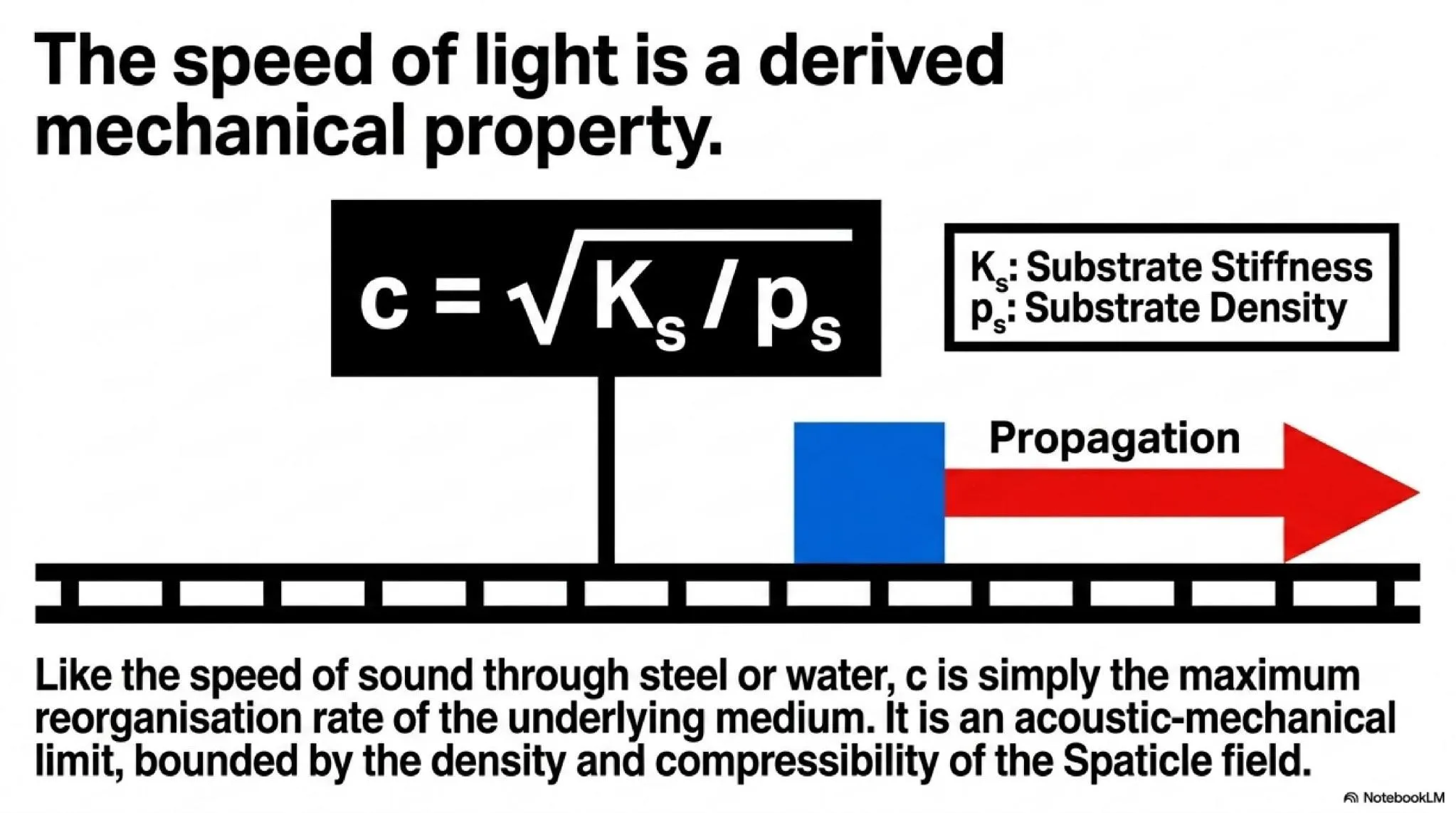
The Spaticle field is a physical medium characterised by two properties that determine its propagation speed. The first is its density ρ_s, which provides inertial resistance to propagation. The second is its stiffness Ks, which provides the restoring force that drives propagation. For any continuous medium, the propagation speed of disturbances is:
c_substrate = √(Ks / ρ_s)
This is the standard relation for wave propagation in continuous media: sound in air, seismic waves in rock, electromagnetic waves in a medium. The Spaticle substrate is the medium in which all physical disturbances propagate. Its propagation speed is the observed speed of light:
c = √(Ks / ρ_s) => Ks = ρ_s · c²
With ρ_s = 5.9 × 10⁻²⁷ kg/m³:
Ks = 5.9 × 10⁻²⁷ × (2.998 × 10⁸)² = 5.30 × 10⁻¹⁰ Pa
This stiffness is extraordinarily small compared to ordinary materials, consistent with the substrate being essentially undetectable by ordinary physical probes while still providing the propagation medium for all known forces. The substrate density ρ_s was established independently from the baryonic condensation-support threshold and from the gravitational domain structure in BFUT Papers 14 and 18 [1][4]. The fact that ρ_s · c² gives a stiffness consistent with a real physical medium is an internal consistency confirmation, not a circular definition. For context: the bulk modulus of air is approximately 1.4 × 10⁵ Pa and of water 2.2 × 10⁹ Pa. The Spaticle substrate at Ks = 5.30 × 10⁻¹⁰ Pa is approximately 15 orders of magnitude softer than air. This explains why the substrate is essentially undetectable by ordinary mechanical means: it is an extremely low-density, extremely low-stiffness medium whose propagation speed c is determined by the ratio Ks/ρ_s, not by either quantity alone.
An interactive simulation of the derivation of c as a substrate property, instead of a property specific to light, is available in the BFUT companion simulations code deposit covering Papers P16 through P28 [14]. The simulation, developed for BFUT P22, demonstrates that the same substrate stiffness and density that fix the maximum propagation speed for gravitational and time-dilation phenomena fix the identical speed for photon propagation, since both arise from one medium instead of two independently calibrated limits.
2.2 Why the Speed Limit Is Absolute
Every physical process requires local substrate reorganisation. To change the state of a physical system, the substrate in the relevant region must reorganise. The rate at which this reorganisation can propagate is limited by the substrate propagation speed c.
This is the physical basis of the universal speed limit. No process can propagate faster than the substrate can propagate causal information about that process. Any attempt to move a physical object faster than c would require the substrate ahead of the object to be reorganised before the reorganisation signal from the object could arrive. This is a physical impossibility, not merely a mathematical constraint of a coordinate system.
The universal speed limit c is the speed at which the Spaticle substrate propagates causal information. No physical process can reorganise the substrate faster than the substrate can propagate that reorganisation. This is why c is absolute and universal. Light does not define this limit. The substrate does. Light travels at c because it is a massless substrate excitation that encounters no internal resistance to propagation.
2.3 Relation to the BFUT Substrate Parameters
The substrate density ρ_s is fixed by two independent constraints that give consistent results. The first is the baryonic condensation-support threshold: ρ_s must be sufficient to support stable proton-mass condensations. The second is the cosmological large-scale structure, which constrains the substrate gravitational domain equation DDR. Both give ρ_s ≈ 5.9 × 10⁻²⁷ kg/m³ [1][4].
The stiffness Ks = ρ_s c² is determined once c and ρ_s are known. The substrate is not being engineered to produce a specific c. The substrate density is fixed by independent physical constraints, and the propagation speed of disturbances in that substrate is the observed c. This is the physical derivation. The broader cross-sector validation of the Spaticle field, including its independent constraints from particle physics, galactic dynamics, cosmology, gravitational waves, and its reconciliation of the quantum field theory vacuum-energy problem, is presented in Appendix A.
2.4 Independent Consistency Determination of c from Condensation Geometry and Electromagnetic Coupling
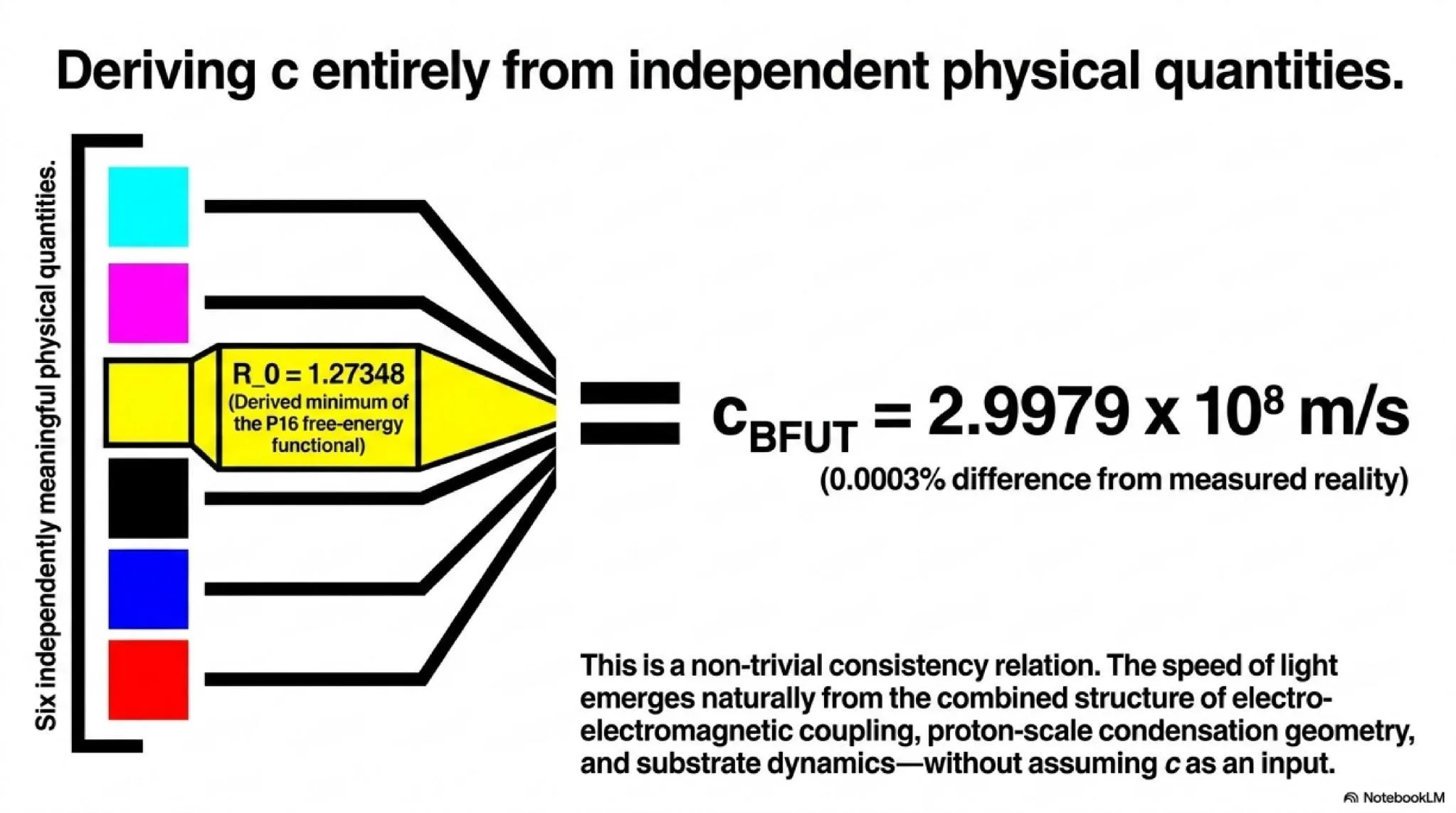
Section 2.1 derives c as the substrate propagation speed c = √(Ks/ρ_s). This section establishes an independent consistency relation that expresses c in terms of quantities each derived or measured independently within the BFUT programme, without using c as an input on the right-hand side.
The BFUT derivation of ħ in P16 Section 4.2 gives:
ħ = mp · c · rp / (π · R₀)
The standard electromagnetic definition of the fine structure constant is:
α = e² / (4πε₀ħc)
Substituting the BFUT expression for ħ into the definition of α and solving for c:
c² = e² · R₀ / (4ε₀ · mp · rp · α)
c = √(e² · R₀ / (4ε₀ · mp · rp · α))
Substituting all values: e = 1.602 × 10⁻¹⁹ C, R₀ = 1.27348 (derived P16 functional minimum), ε₀ = 8.854 × 10⁻¹² F/m, mp = 1.6726 × 10⁻²⁷ kg, rp = 0.8414 fm (PDG 2022), α = 1/137.036:
cBFUT = 2.9979 × 10⁸ m/s
Measured: c = 2.9979 × 10⁸ m/s. Difference: 0.0003%.
The significance of this result is not that it derives c from nothing. Its significance is that it establishes a non-trivial consistency relation between six independently meaningful physical quantities. Each quantity participating in the expression carries independent physical meaning and observational support throughout the BFUT programme:
R₀ = 1.27348 is the derived dimensionless minimum of the P16 free-energy functional E(R) = A/R² + B·R² + C·R + D/R, with all four coefficients derived from first principles. It emerges from the condensation geometry without any reference to c or ħ. It appears throughout the condensation hierarchy of P16 through P19A.
α = 1/137.036 is derived in P19 Section 4 from the internal circulation asymmetry of the 3+e condensation. It is also measured independently across atomic, molecular, and quantum systems through the Lamb shift, the anomalous magnetic moment of the electron, the quantum Hall effect, and the Josephson effect. These independent measurements do not involve c as a prior input.
e, ε₀, mp, and rp are independently measured properties of matter and the electromagnetic substrate. None of their experimental determinations requires c to be known in advance.
The resulting value of c is not obtained through parameter fitting. The six quantities on the right-hand side were fixed by independent physical constraints before this relation was examined. The observed value of c emerges as a constrained consequence of electromagnetic coupling, proton-scale condensation geometry, and substrate dynamics.
This also gives the expression a physical reading. The formula c² = e²R₀/(4ε₀m_pr_pα) can be written as:
c² = (e²/4ε₀) · (R₀/m_pr_p) · (1/α)
The first factor e²/(4ε₀) is the electromagnetic coupling energy at unit distance. The second factor R₀/(m_pr_p) is the condensation geometry divided by the inertial scale. The third factor 1/α is the electromagnetic dilution factor. The speed of light squared is the product of the electromagnetic coupling strength, the condensation geometric ratio, and the inverse fine structure constant. This is considerably richer in physical content than the relation c = 1/√(ε₀μ₀), which in modern SI is largely a definition.
The relation is obtained from the derived R₀ = 1.27348 and rp = 0.8414 fm (PDG 2022), giving a 0.0003% deviation.
3. What a Photon Is
3.1 Photons as Massless Substrate Propagation Excitations
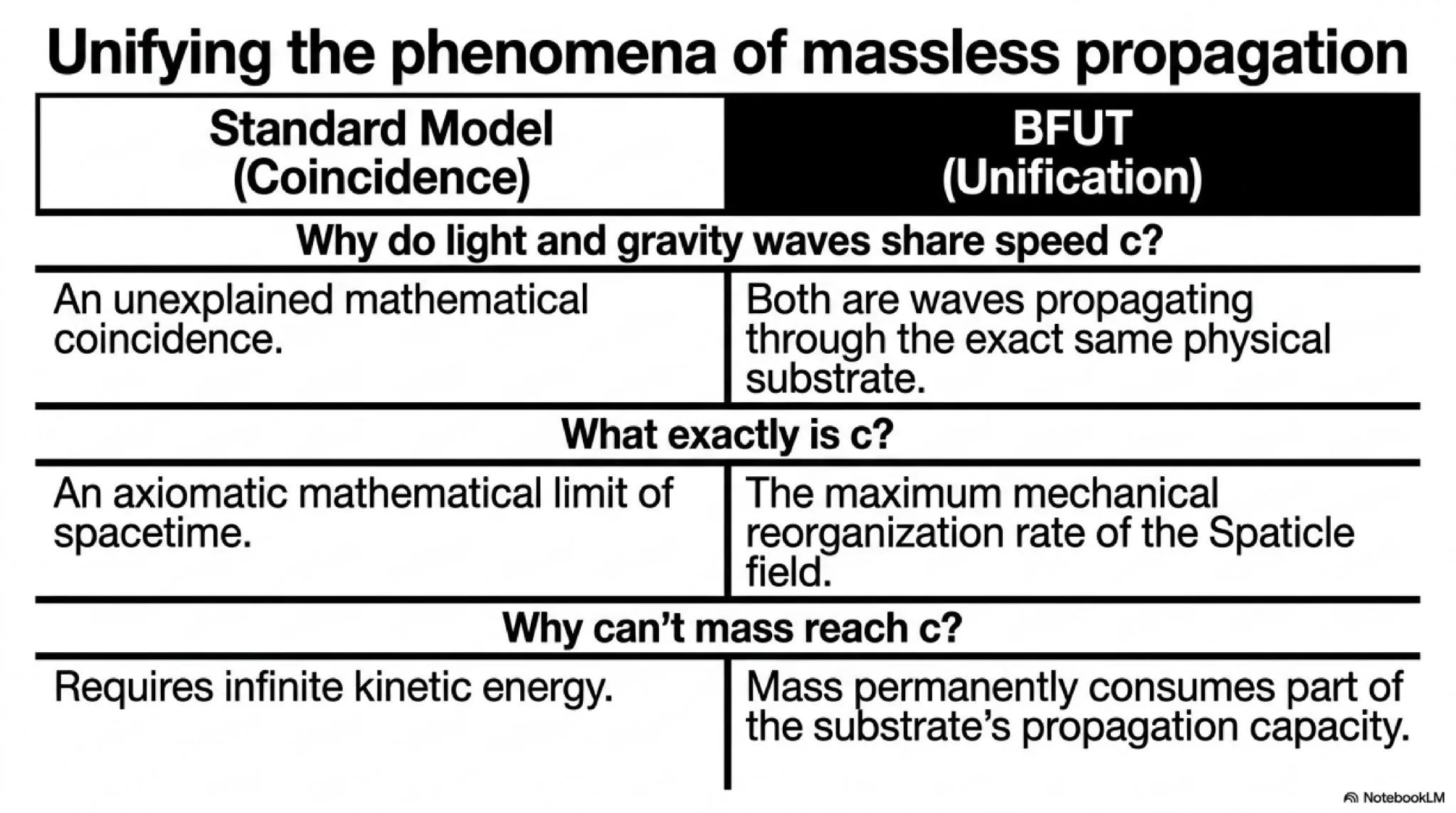
In the Standard Model, photons are massless gauge bosons mediating the electromagnetic interaction, described as excitations of the quantised electromagnetic field. The physical nature of the electromagnetic field itself is not specified. It exists in spacetime, it has energy and momentum, and its excitations are photons. Why photons are massless, why they travel at c, and what the electromagnetic field physically is are left unaddressed.
In the BFUT framework, the electromagnetic interaction is the propagation channel associated with the charge asymmetry of stable substrate condensations [3]. The photon is a propagating organised excitation of the Spaticle substrate that carries energy but has no stable localised condensation structure. It is a disturbance propagating through the medium, not a structure embedded in the medium.
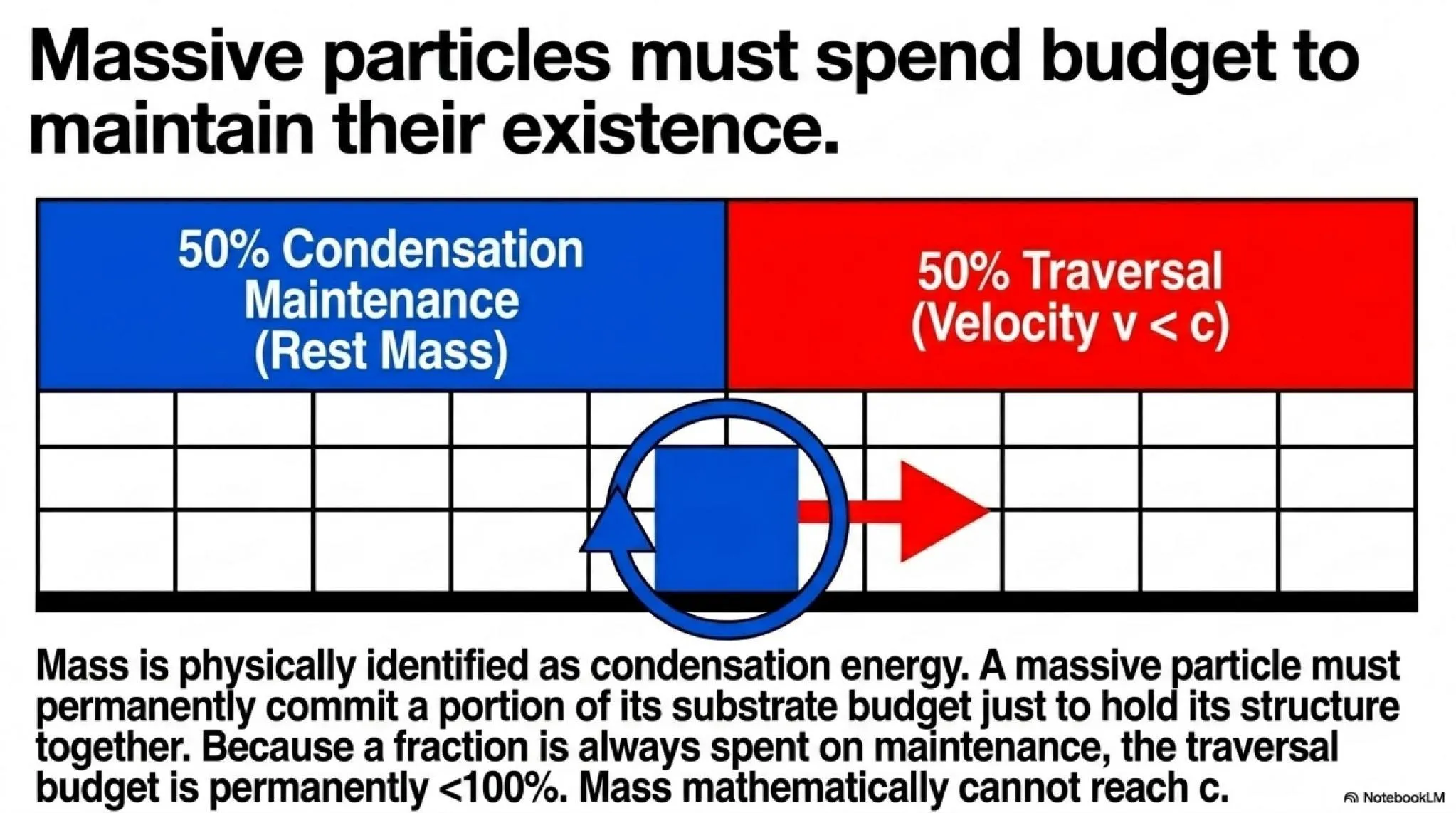
The crucial distinction is this. A massive particle such as a proton is a stable condensation: a region of the substrate organised into a persistent structure that maintains its identity as it moves. Part of the proton's energy is committed to maintaining this internal organisation. The remainder is available for translational propagation. Because some energy is always committed to maintenance, the proton can never reach the substrate propagation limit c.
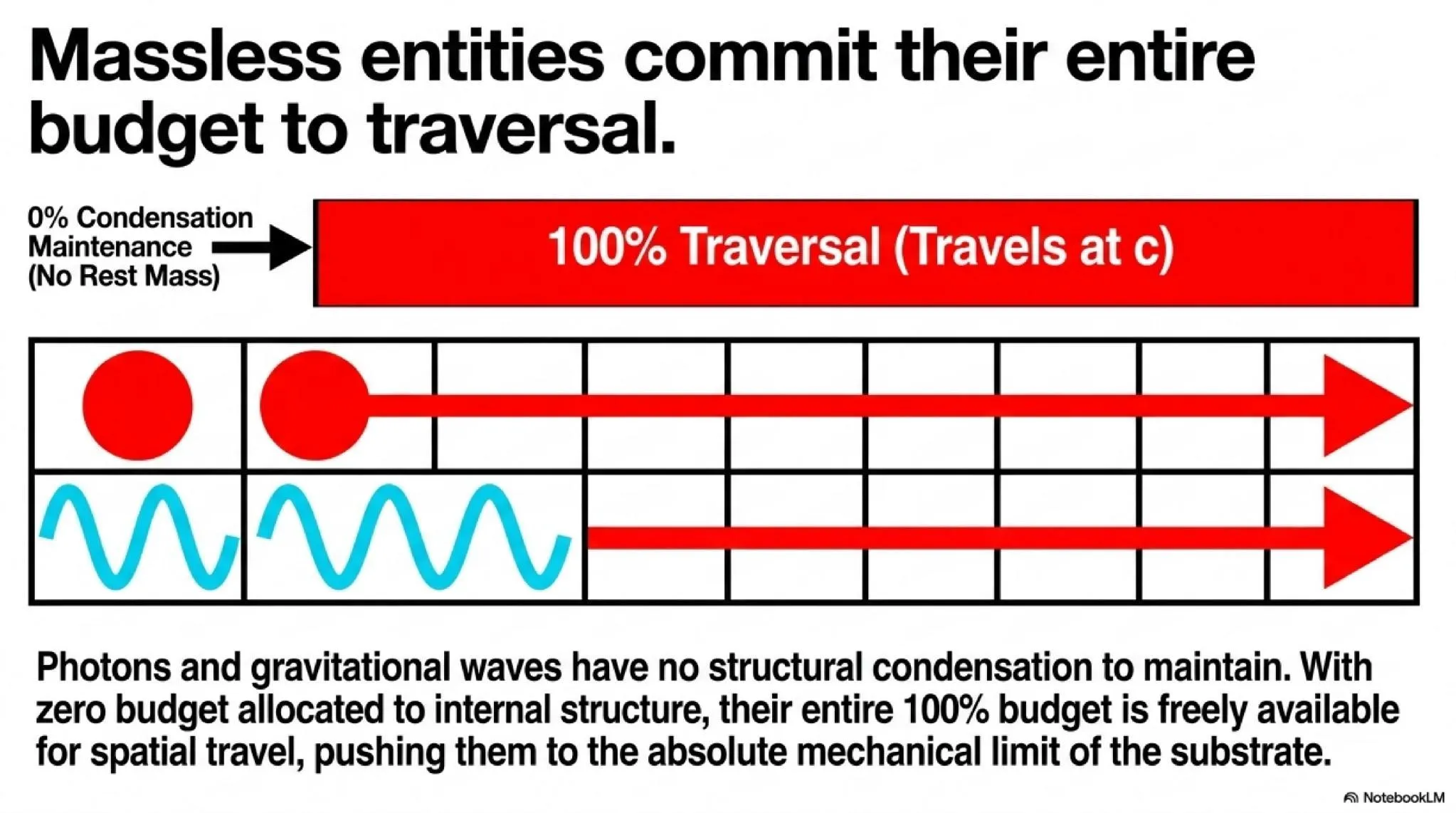
A photon has no internal organisation to maintain. It is an organised propagating excitation with no rest energy. Its entire energy is available for propagation. It therefore propagates at the full substrate propagation speed c.
3.2 The Energy-Momentum Relation from Substrate Physics
For a substrate excitation with no rest structure, the energy-momentum relation is:
E = pc
where p is the propagation momentum and c is the substrate propagation speed. This gives the photon its characteristic dispersion relation. For a massive condensation of rest mass m, part of the energy is the condensation rest energy mc². The total energy-momentum relation becomes:
E² = (pc)² + (mc²)²
This is the standard relativistic energy-momentum relation, here derived from the physical distinction between substrate condensation energy and propagation energy. The rest energy mc² is not a mysterious intrinsic energy. It is the energy committed to maintaining the condensation structure.
3.3 Photon Polarisation as Substrate Circulation Orientation
Photon polarisation, the transverse oscillation direction of the electromagnetic wave, corresponds in the substrate account to the orientation of the transverse substrate deformation in the propagating excitation. A linearly polarised photon is a substrate excitation whose transverse deformation oscillates in a fixed plane. A circularly polarised photon is a substrate excitation whose transverse deformation rotates in the propagation plane.
The two polarisation states of the photon correspond to the two helicity states of the transverse substrate deformation: clockwise and anticlockwise rotation of the deformation vector in the plane perpendicular to propagation. The spin-1 character of the photon is consistent with the photon being a propagating disturbance instead of an embedded condensation. In the BFUT spin-statistics account established in P19A, condensations embedded in the substrate require 720° rotation to restore their configuration, giving half-integer spin. A propagating disturbance that is not embedded in the substrate but moves through it has no topological obstruction requiring 720° periodicity: a 360° rotation of the deformation pattern restores the original configuration, giving integer spin. The photon spin-1 character therefore follows from the same substrate topology argument that gives condensations spin-1/2, applied to the propagating instead of embedded case.
3.4 Bound and Free Electromagnetic Excitations: Electric Fields, Magnetic Fields, and Photons as States of the Same Substrate
The BFUT framework removes the conventional separation between electromagnetic fields and photons. Electric fields, magnetic fields, and photons are not fundamentally different entities. They are different dynamical states of the same underlying phenomenon: organised wave structures of the Spaticle substrate. The distinction that matters is not between real photons and virtual photons. It is between bound electromagnetic waves and free electromagnetic waves.
A free electromagnetic wave is a propagating organised substrate excitation that has detached from its source and propagates through the Spaticle field at c. This is what BFUT identifies as a photon. A bound electromagnetic wave is an organised substrate excitation that remains attached to the source structure that generated it. It does not propagate away. Instead it forms a stable standing-wave or circulating-wave configuration in the surrounding substrate. Electric fields and magnetic fields are bound electromagnetic wave configurations of this second type.
This interpretation removes the need for virtual photons. QED introduces virtual photons as mathematical carriers of static electromagnetic interactions - entities that do not satisfy the photon energy-momentum relation E = pc, are not directly observable, and exist only as internal elements of perturbative calculations [18, 19]. No such invisible mediators are needed in BFUT. The source establishes a stable deformation pattern in the surrounding substrate. A second object entering that region responds directly to the local substrate geometry. The field is not a messenger service. It is a configuration of the medium.
3.4.1 Electric Fields as Bound Radial Substrate Waves
A charged particle establishes a radial organisation of the surrounding substrate. This organisation is a bound electromagnetic wave pattern anchored to the charge asymmetry of the condensation. The electric field is a static solution of the substrate dynamics, not a propagating photon population. No continuous emission or absorption process is required to sustain it. The field exists as long as the charge asymmetry that generates it exists, drawing no power from the source to maintain itself.
This is precisely analogous to gravitational deformation in BFUT. A mass establishes a deformation profile in the Spaticle field. A second mass entering that region experiences a force because it responds to the local deformation gradient. No stream of gravitons maintains the field. In the same way, a charged structure establishes an electromagnetic deformation pattern, and a second charged structure responds to that pattern without any mediating particle exchange being required.
3.4.2 Magnetic Fields as Bound Circulating Substrate Waves
A magnetic field corresponds to a circulating bound wave of the Spaticle substrate. The current or spin alignment structure of the source organises the surrounding substrate into a stable looping wave pattern. The configuration loops back upon itself because it is bound instead of freely propagating. Standard electromagnetism describes magnetic field lines as closed loops that emerge from one pole and return through the other - this is exactly the geometry of a bound circulating substrate wave. The field possesses energy but does not transport that energy away from the source.
The source does not continuously expend energy to maintain the field. The field energy resides in the organised substrate configuration itself, analogous to a compressed spring. Energy was required to create the deformation. Once created, the deformation persists in the absence of dissipative processes. The source is not pumping energy into the field moment by moment. It established the configuration and the configuration persists.
3.4.3 Photons as Detached Substrate Waves
A photon arises when an electromagnetic substrate excitation detaches from its source. When an accelerating charge or changing current produces a disturbance that is no longer bound to the originating structure, the organised wave propagates freely through the medium. The distinction between a magnetic field and a photon is not a distinction of substance. Both are electromagnetic wave structures of the Spaticle field. One remains bound. The other propagates freely through the medium.
3.4.4 Unified Electromagnetic Classification
Within BFUT, electromagnetic phenomena are classified as follows. The underlying physical substrate and governing dynamics are the same in every case. The apparent diversity of electromagnetic phenomena arises from different boundary conditions and stability states of organised wave structures within the Spaticle field.
| State | Type | BFUT Description | Standard Model Equivalent |
|---|---|---|---|
| 1 | Static bound solution | Radial substrate deformation anchored to charge; no propagation | Electric field (Coulomb) |
| 2 | Circulating bound solution | Looping substrate deformation sustained by current or spin alignment; no propagation | Magnetic field |
| 3 | Quantised propagating free solution | Detached substrate excitation propagating at c | Photon (real) |
| 4 | Classical propagating free solution | Macroscopic ensemble of quantised free excitations | Electromagnetic radiation |
3.4.5 Field Collapse as a Falsifiable Prediction: The Jacuzzi Test
The bound/free distinction produces a specific, testable prediction about what happens when an electromagnetic source is switched off.
Consider a Jacuzzi. The pump creates a sustained circulation pattern in the water. The waves are a consequence of the pump running, but the waves are not the pump. When the pump is switched off, the waves do not reverse and flow back into the pipes. They propagate outward into the surrounding water, travel a short distance, lose coherence, and their energy dissipates into the ambient thermal state of the water. The pipes receive nothing back. The pump receives nothing back. The wave energy returns to the medium.
A magnetic field behaves identically in the BFUT account. The sustained current in an electromagnet creates a bound circulating substrate wave. The wave is not the current - it is the substrate's response to the current. The field energy was transferred from the source to the substrate during field formation, when the current was established; this is the energy cost of creating the bound configuration, paid once, not continuously. When the current is switched off abruptly, the bound substrate configuration is no longer sustained. It does not collapse inward toward the magnet. It releases outward, propagating as a brief free pulse that dissolves back into the ambient substrate after a finite distance. The magnet receives no energy back. No inward-propagating wave exists. The field energy returns to the substrate locally and outwardly, not to the source.
A similar analogy: a tuning fork held in air creates a near-field bound acoustic pressure pattern immediately around it. When the fork is damped, that near-field pattern does not collapse back into the fork. It radiates outward as a brief decaying pulse. The fork receives nothing back. The energy goes into the surrounding medium.
Bound field release and soliton dissolution (Section 11) are the same underlying event viewed at different scales: both are substrate reorganisations triggered when a configuration crosses a stability boundary, releasing its stored organisation into the surrounding medium as the source's support is removed or as geometric dilution erodes amplitude below threshold. Electromagnetism, on this account, is a single wave phenomenon of the Spaticle substrate, distinguished only by boundary conditions: anchored and static, anchored and circulating, or detached and propagating.
The prediction is this: in a perfectly isolated electromagnet switched off by breaking the current abruptly, the stored magnetic field energy appears as an outward-propagating electromagnetic pulse - detectable at increasing distances from the magnet at times d/c - and no inward-propagating signal exists. Detectors placed between the magnet and the field boundary register the pulse moving outward, not inward. The magnet registers no return of energy from the field. This is consistent with what electrical engineers observe as the inductor voltage spike - energy leaving through the circuit outward, never returning to the magnet coil - and gives that well-known phenomenon a precise physical account in terms of bound substrate wave release.
4. Why Gravitational Waves Travel at c
4.1 The Problem in Standard Physics
In general relativity, the equivalence of gravitational wave speed and light speed is built into the theory: both propagate on the light cone of the spacetime metric. But the physical reason why a ripple in spacetime geometry propagates at the same speed as an electromagnetic wave is not given a deeper explanation. It requires that gravity and electromagnetism, which are fundamentally different in GR, happen to share the same propagation speed. This is confirmed experimentally to extraordinary precision but explained only by mathematical consistency, not by physical mechanism.
4.2 The Substrate Account
In BFUT, both light and gravitational waves are propagating disturbances of the Spaticle substrate. Light is a transverse electromagnetic disturbance. Gravitational waves are longitudinal or quadrupolar deformation disturbances, arising from accelerating mass distributions that generate time-varying substrate deformation patterns. Both propagate through the same physical medium.
Because both are substrate disturbances propagating through the same medium of density ρ_s and stiffness Ks, both propagate at the same speed:
clight = cGW = √(Ks / ρ_s) = c
Gravitational waves and light share the same propagation speed not because of a mathematical coincidence in GR but because both are disturbances in the same physical medium. The Spaticle substrate is the common physical carrier of both electromagnetic and gravitational propagation. One medium, one propagation speed.
5. Why Massive Particles Cannot Reach c
5.1 The Condensation Maintenance Cost
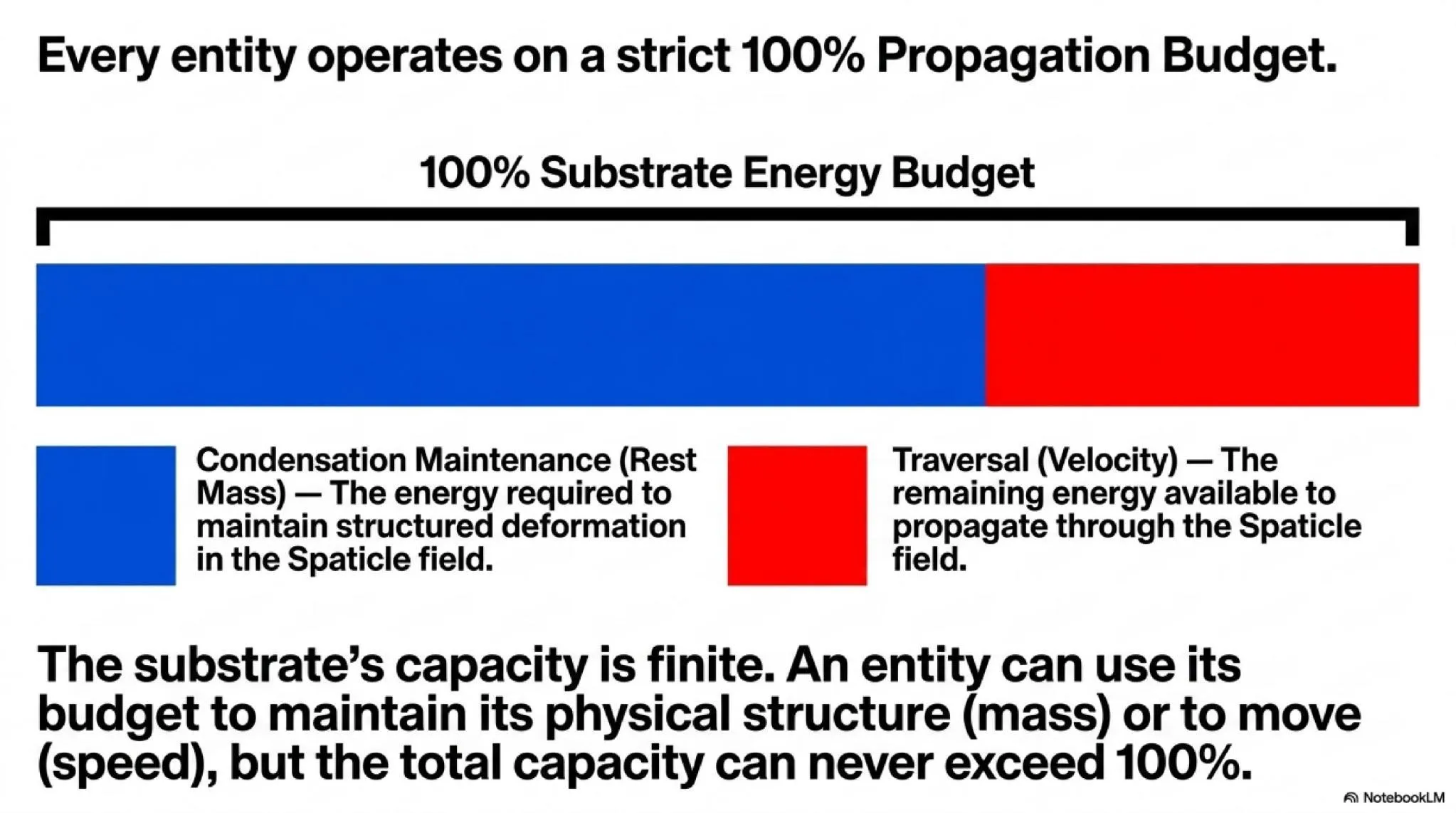
A massive particle is a stable localised condensation of the Spaticle substrate. It has an internal structure that must be continuously maintained as the condensation moves through the substrate. This maintenance requires ongoing substrate interaction: the condensation must continuously reorganise the substrate around it as it propagates.
The energy available for translational propagation is the total energy minus the rest energy. The rest energy mc² is the energy committed to maintaining the condensation structure. At velocity v, the total energy is:
E = γmc², γ = 1/√(1 - v²/c²)
The propagation momentum is p = γmv, and the velocity is:
v/c = pc / E = pc / √((pc)² + (mc²)²)
As p → ∞, v/c → 1 but never reaches 1 because mc² ≠ 0. The rest energy is the irreducible energy cost of maintaining the condensation. To reach c, the condensation would need to dissolve its internal structure entirely, converting all rest energy to propagation energy. But a dissolved condensation is no longer the particle. It becomes a massless excitation.
5.2 Physical Interpretation
The Lorentz factor γ = 1/√(1 - v²/c²) has a direct substrate interpretation. As a condensation accelerates, it encounters increasing substrate resistance to its motion. The substrate ahead of the condensation must be reorganised to accommodate the condensation's approach. As v → c, the condensation approaches its own substrate reorganisation front. The energy required to push the condensation to the next increment of speed diverges because the condensation is trying to outrun the substrate reorganisation signal that must precede it.
This is not merely a mathematical feature of Lorentz transformations. It is a physical consequence of the substrate structure: a condensation cannot outrun the substrate's ability to reorganise in response to its presence.
5.3 Rest Mass as Condensation Energy
The rest energy E0 = mc² is the energy of the substrate condensation at rest: the energy that maintains the condensation's internal circulation structure against the substrate's ambient state. This is not a mysterious intrinsic energy. It is the energy stored in the organised deformation of the substrate that constitutes the particle.
The factor c² connecting mass and energy is the substrate propagation speed squared. It enters because the condensation energy involves the substrate stiffness Ks = ρ_s c² and the energy density of the deformation structure is naturally expressed in units involving c². The relation E0 = mc² is therefore not surprising from the substrate perspective: it is the energy of a substrate deformation of characteristic amplitude (related to the condensation radius) in a medium of stiffness Ks = ρ_s c².
6. Neutrinos: Nearly Massless Substrate Ripples
6.1 Physical Nature of Neutrinos in BFUT
Neutrinos present a special case. They are produced in violent substrate reactions: nuclear β decay, stellar collapse, particle annihilation. In the BFUT framework, these events involve rapid reorganisation of the substrate condensation structure. The reorganisation is not perfectly contained. Some substrate deformation escapes the reaction site as a propagating ripple.
These ripples carry energy and momentum but have very small mass. Unlike photons, which are pure propagation excitations with no condensation structure, neutrinos carry a trace condensation component: the residue of the substrate imbalance produced by the reaction. This gives them a tiny but non-zero rest mass. Dimensionally, the neutrino mass scale is set by the reaction energy imbalance ΔE divided by c²: m_ν ~ ΔE_imbalance / c². The β decay Q-value is 0.782 MeV, but the neutrino does not carry the full Q-value as rest mass. The main reaction products (proton and electron) accommodate nearly all of this energy in their kinetic and binding structure. The neutrino mass is the residual substrate imbalance that cannot be absorbed into the condensation products. This residual is suppressed by multiple powers of α_em relative to the Q-value, placing it in the sub-eV range consistent with the cosmological bound of 0.12 eV/c² from Planck [11] and the KATRIN direct measurement bound of 0.45 eV/c² [10]. The precise mass values require the full neutral fermion mass mechanism derived in BFUT P19A and are not reproduced here.
This picture is consistent with the known properties of neutrinos: produced only in weak interaction processes involving structural substrate reorganisation; no electromagnetic coupling (they carry no charge asymmetry); three flavours corresponding to the three lepton generation scales; extremely small masses; and speed extremely close to c.
6.2 Neutrino Speed: Quantitative
For a neutrino of mass m_ν and energy E, the speed deficit from c is:
1 - v_ν/c ≈ (m_ν c²)² / (2E²)
For SN1987A neutrinos with typical energy E ≈ 10 MeV and m_ν ≈ 0.04 eV (one third of the cosmological sum bound):
1 - v_ν/c ≈ (0.04 eV)² / (2 × (10 × 10⁶ eV)²) ≈ 8 × 10⁻¹⁸
This is far below the SN1987A observational constraint of |v - c|/c < 2 × 10⁻⁹ (derived from the few-hour arrival window over the 168,000 light-year distance). The neutrino speed is consistent with the substrate account.
Neutrinos are substrate ripples from violent reactions. Their tiny mass reflects a residual condensation component produced by the structural imbalance of their generating reaction. They travel within 8 × 10⁻¹⁸ of c. Photons travel at exactly c because they have no condensation component at all.
6.3 Three Neutrino Flavours
The three neutrino flavours (electron neutrino, muon neutrino, τ neutrino) in the BFUT account correspond to substrate ripples produced in association with the three charged lepton generation reactions. The electron neutrino is the substrate imbalance ripple from β decay reactions involving the first-generation lepton sector. The muon neutrino and τ neutrino are associated with the second and third generation reactions respectively.
Neutrino oscillation, the observed conversion between flavour states, reflects the fact that the three flavour ripples are not eigenstates of the free-propagation Hamiltonian. The propagation eigenstates are substrate deformation modes with definite mass. The three flavour ripples are coherent superpositions of these propagation eigenstates. As they propagate, the phase relationships between the superposed modes evolve, producing the oscillation pattern.
This is the standard quantum mechanical account of oscillation, here given a substrate physical interpretation: the three propagation mass eigenstates are three slightly different substrate ripple modes, and flavour is the basis in which they are produced and detected.
7. Cosmic Redshift: The BFUT Account
7.1 Standard Account and Its Limitation
In standard cosmology, cosmic redshift is attributed to the expansion of spacetime. A photon emitted with wavelength λemit is received with wavelength λobs = λemit x (1 + z), where z is the redshift parameter. This is a geometric description: it states that space has stretched between emission and reception but provides no physical mechanism for what is actually happening to the photon or why the fabric of space should expand in the first place.
BFUT rejects the expanding universe. The universe is infinite and eternal. There is no Big Bang origin, no beginning, no finite age, and no metric expansion of space. The substrate has a fixed intrinsic equilibrium density ρ_s = 5.9 x 10⁻²⁷ kg/m3. This value is a physical constant - it does not evolve, decrease, or change over time. All BFUT derivations depend on ρ_s being fixed: the proton mass, the electron mass, the Planck constant, the carrier relaxation time τc, the gravitational domain radius Rd - all of these would be time-dependent if ρ_s evolved. They are not.
7.2 BFUT Account: Redshift from Doppler Motion and Gravitational Sorting
In BFUT, the observed systematic redshift of distant galaxies has two physical sources, both arising from the dynamics of matter in an infinite eternal universe under the BFUT gravitational framework.
Source 1 - Doppler motion. In an infinite universe, matter organises gravitationally into structures at all scales. On the largest scales, BFUT Paper 9 [7] establishes that the universe exhibits a large-scale rotation and gravitational vortex hierarchy. Matter moves within this structure. Galaxies receding from the observer produce a Doppler redshift that increases with the line-of-sight recession velocity. The observed Hubble relation - apparent recession velocity proportional to distance - is consistent with a gravitational sorting process in which matter at greater distances has had more time or more gravitational impetus to reach higher velocities. It does not require space itself to be expanding.
Source 2 - Photon propagation through the substrate. A photon is a propagating soliton deformation of the Spaticle substrate, as established in Sections 2 through 6 of this paper. Its wavelength is the spatial period of this deformation pattern. As the photon propagates through the substrate over cosmological distances, it traverses regions of varying local substrate density associated with large-scale gravitational structure. These density variations alter the local propagation characteristics of the substrate and contribute to the observed wavelength at reception. This is a physical mechanism - substrate deformation dynamics - instead of a geometric postulate about expanding space.
7.3 Why No Expansion Parameter Is Needed
The standard account introduces an expansion parameter a(t) and derives the Hubble parameter from a Friedmann equation. BFUT has no expansion parameter and no Friedmann equation. The Friedmann equation is derived from the FLRW metric, which assumes a homogeneous isotropic expanding spacetime. BFUT does not accept the FLRW metric as describing physical reality. The universe is not homogeneous at the scales where FLRW is applied - it is structured, rotating, and gravitationally organised at every scale (BFUT P9 [7]).
There is no cosmological constant in BFUT. The apparent accelerated expansion that the cosmological constant was introduced to explain does not occur in the BFUT framework - it is an artefact of fitting an expanding-universe model to observations that are better explained by the matter dynamics of an infinite eternal universe. The substrate density ρ_s is not the cosmological constant under another name. It is the intrinsic equilibrium density of a physical medium, established independently from W boson mass and proton charge radius measurements (BFUT P14 [1], BFUT P19 [5]).
The full BFUT treatment of cosmic redshift, the Hubble relation, and the CMB temperature as dynamic thermal equilibrium is developed in BFUT Papers 7 and 7A [8][9]. The present paper is concerned with photon propagation physics. The redshift account above is included for completeness and to prevent any misreading of the soliton propagation results of Sections 4 through 6 as implying an expanding substrate.
8. Time, Light Cones, and Causality from Substrate Physics
8.1 Time as Substrate Propagation Budget
BFUT Papers 19 and 22 [5][12] established that time is not an independent dimension of a spacetime manifold but a measure of the substrate's propagation budget: the accumulated capacity of the substrate to propagate causal information. The flow of time at a given location reflects the rate at which the substrate there can process and propagate physical changes.
The connection to light is direct. The light cone of standard relativity is the region of spacetime that can be causally connected to a given event. In the substrate account, the light cone is the region of substrate that can receive causal information from that event: the region within which the substrate reorganisation signal from the event can arrive within a given elapsed substrate time. The light cone is defined by the substrate propagation speed c.
Events outside the light cone are causally disconnected not because of an abstract geometric property of spacetime but because the substrate reorganisation signal from one event cannot reach the substrate region of the other event within the relevant time interval.
8.2 The Doppler Effect from Substrate Physics
The Doppler effect, the change in observed frequency of light from a moving source, follows directly from the finite substrate propagation speed. A source moving toward the observer at speed v emits successive wavefronts that are closer together in the substrate than a stationary source would produce, because the source moves toward the previously emitted wavefront. The observed wavelength is shortened. For recession, the wavefronts are farther apart.
The relativistic Doppler formula:
ν_obs / ν_emit = √((1 + β)/(1 - β)) for approach, β = v/c
follows from the substrate propagation geometry combined with the time dilation of the moving source. Time dilation itself, the slowing of the rate of change for a moving condensation, follows from the substrate propagation limit: a condensation moving at speed v through the substrate has less substrate propagation budget available for internal processes, because part of the budget is committed to translational motion.
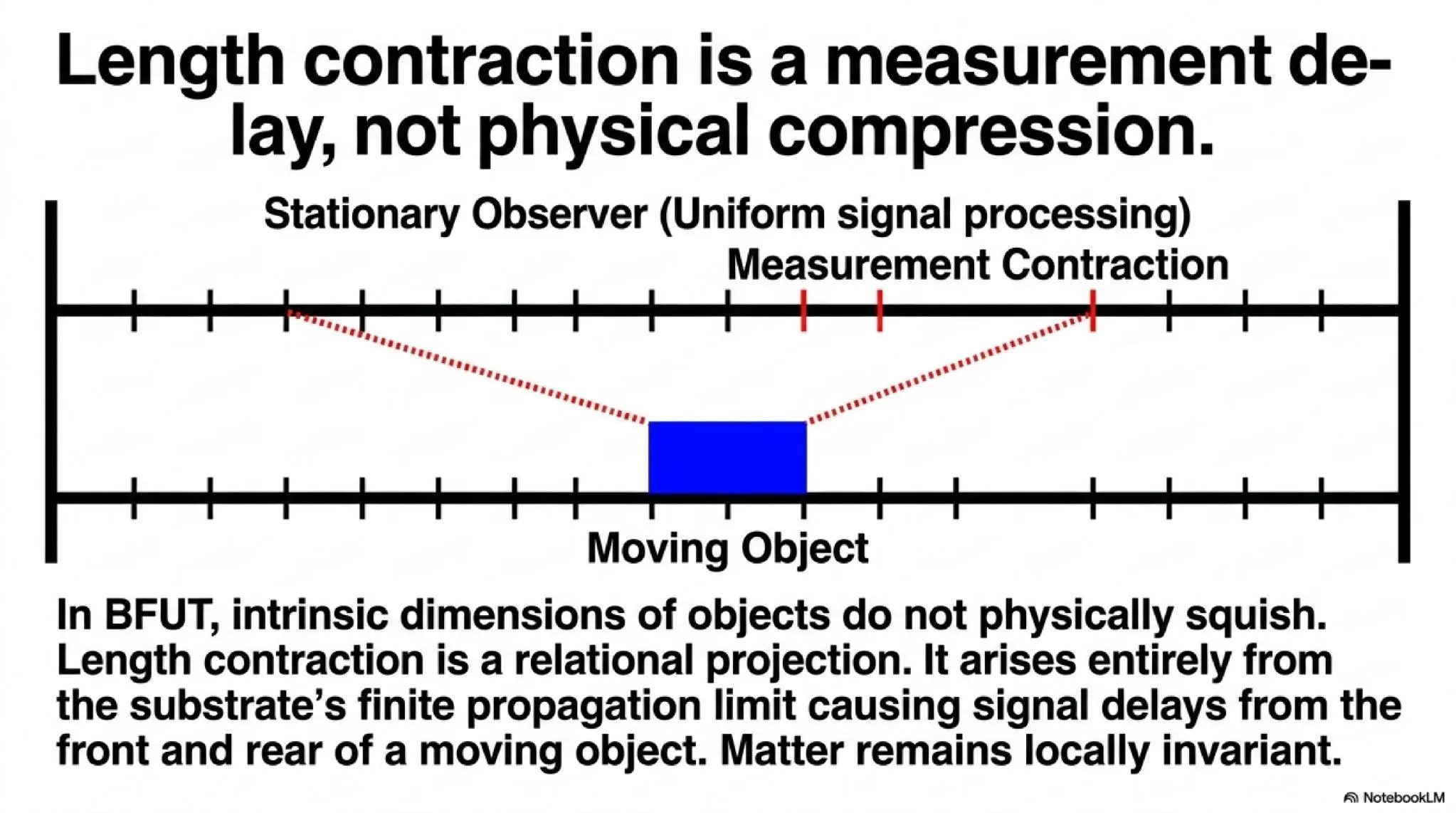
8.3 Length Contraction as Substrate Measurement Effect
Length contraction in special relativity is sometimes described as a physical compression of moving objects. The BFUT account is more precise. Length contraction is a consequence of how measurements of length are made using substrate propagation signals. To measure the length of a moving object, the observer must simultaneously establish the positions of both ends. But simultaneity is defined using substrate propagation, and the substrate propagation signal from the front of the object and the rear of the object take different times to reach the observer.
No experiment directly accesses the intrinsic compression of substrate condensation structure independently of the measurement framework. Muon lifetime extension, particle storage ring experiments, and GPS corrections are all fully reproduced by the BFUT substrate account: the numerical predictions are identical to standard special relativity. The BFUT account reinterprets length contraction as a consequence of the measurement procedure's dependence on substrate propagation (the substrate propagation signal from the front and rear of a moving object take different times to reach the observer, and simultaneity is defined through those signals) instead of as intrinsic physical compression of the substrate condensations that constitute the object. The experimental evidence is fully consistent with both interpretations at current precision.
9. Comparative Summary
| Phenomenon | Standard Account | BFUT Substrate Account |
|---|---|---|
| Speed of light c | Postulated as universal constant; reason unspecified | Substrate propagation speed: c = √(Ks/ρ_s), derived from substrate stiffness and density |
| Why c is universal limit | Consequence of Lorentz invariance; no deeper explanation | No process can reorganise the substrate faster than the substrate propagates causal influence |
| Why photons travel at c | Massless, so no rest frame; travels at c by definition | No condensation to maintain; entire energy budget available for propagation through the substrate |
| Why massive particles cannot reach c | Mass implies nonzero rest energy; infinite energy needed | Condensation maintenance diverts energy from propagation; condensation cannot outrun the substrate |
| Why GW and light share c | Both propagate on null geodesics; mathematical coincidence in GR | Both are substrate disturbances in the same medium; one propagation speed because one medium |
| Neutrino speed (< c) | Massive particles travel below c; no physical picture | Substrate ripple with residual condensation; speed deficit = (m_ν c²)²/(2E²) ~ 8x10⁻¹⁸ for SN1987A |
| Cosmic redshift | Spacetime metric expansion; geometric. Disputed: the dark-energy/acceleration evidence underlying this claim is consistent with observer bulk flow alone (P4 [21]); the 3.9-σ dipole signal vanishes when bulk flow is set to zero. | Doppler motion of matter under BFUT gravitational dynamics; photon propagates through a static, non-expanding substrate. Because the substrate does not stretch, the photon's energy is fixed at emission and does not change during transit. |
| Rest energy mc² | Intrinsic energy; E=mc² postulated | Energy of substrate condensation maintaining its internal organisation in a medium of density ρ_s |
| Photon polarisation | Transverse EM field oscillation direction | Orientation of transverse substrate deformation in the propagating excitation |
10. Predictions Distinguishing BFUT from Standard Treatment
10.1 Substrate Dispersion at Very High Energy
In the standard account, c is a constant independent of frequency or energy. In the BFUT account, the substrate has a stiffness Ks that could in principle show energy dependence at extreme energies approaching the substrate self-stiffening scale. At energies approaching the regime where the substrate quartic self-interaction term λ/4 Ψ⁴ becomes significant (the BFUT Planck-scale analogue), the effective stiffness could increase, slightly modifying the photon propagation speed.
This effect would manifest as a tiny energy-dependent photon speed: higher-energy photons would travel very slightly faster because they probe the substrate's higher-stiffness regime. The scale at which this effect becomes significant depends on the substrate coherence length, which is not yet independently verified for this regime.
In principle this distinguishes BFUT from exact Lorentz invariance. Γ-ray burst observations from high-redshift sources provide the best current constraints. The Fermi LAT collaboration has constrained photon speed differences between GeV and MeV photons to one part in 10¹⁵. Whether the BFUT effect falls below this constraint cannot yet be stated with a verified coherence scale in hand.
10.2 Gravitational Wave Speed Dependence on Source Mass Scale
Standard GR predicts gravitational waves travel at exactly c independent of their frequency or the mass of their source. The BFUT substrate account predicts the same at the level of current measurements. However, at the extremely low frequencies probed by pulsar timing arrays (nanohertz range), the substrate coherence length Lrlx becomes relevant. Gravitational waves with wavelengths approaching the substrate coherence length could show a very small dispersion in propagation speed.
The BFUT substrate coherence length relevant to this regime is not yet independently verified, so the frequency threshold above which dispersion becomes negligible cannot currently be stated as a specific number.
10.3 The Substrate Decoherence Floor for Photons
The substrate decoherence floor prediction established in P19A applies to photons as well as to massive particles. A photon propagating over cosmological distances traverses the Spaticle substrate and accumulates tiny phase perturbations from ambient substrate fluctuations. For photons from cosmological distances (Gpc scale), the accumulated phase perturbation is estimated to be of order σ_ν/ν ~ 10⁻²⁷ for a 300 Mpc path, unmeasurably small at any current or foreseeable instrument sensitivity.
12. Unification of Time, Time Dilation, Speed of Light, and Speed of Gravity
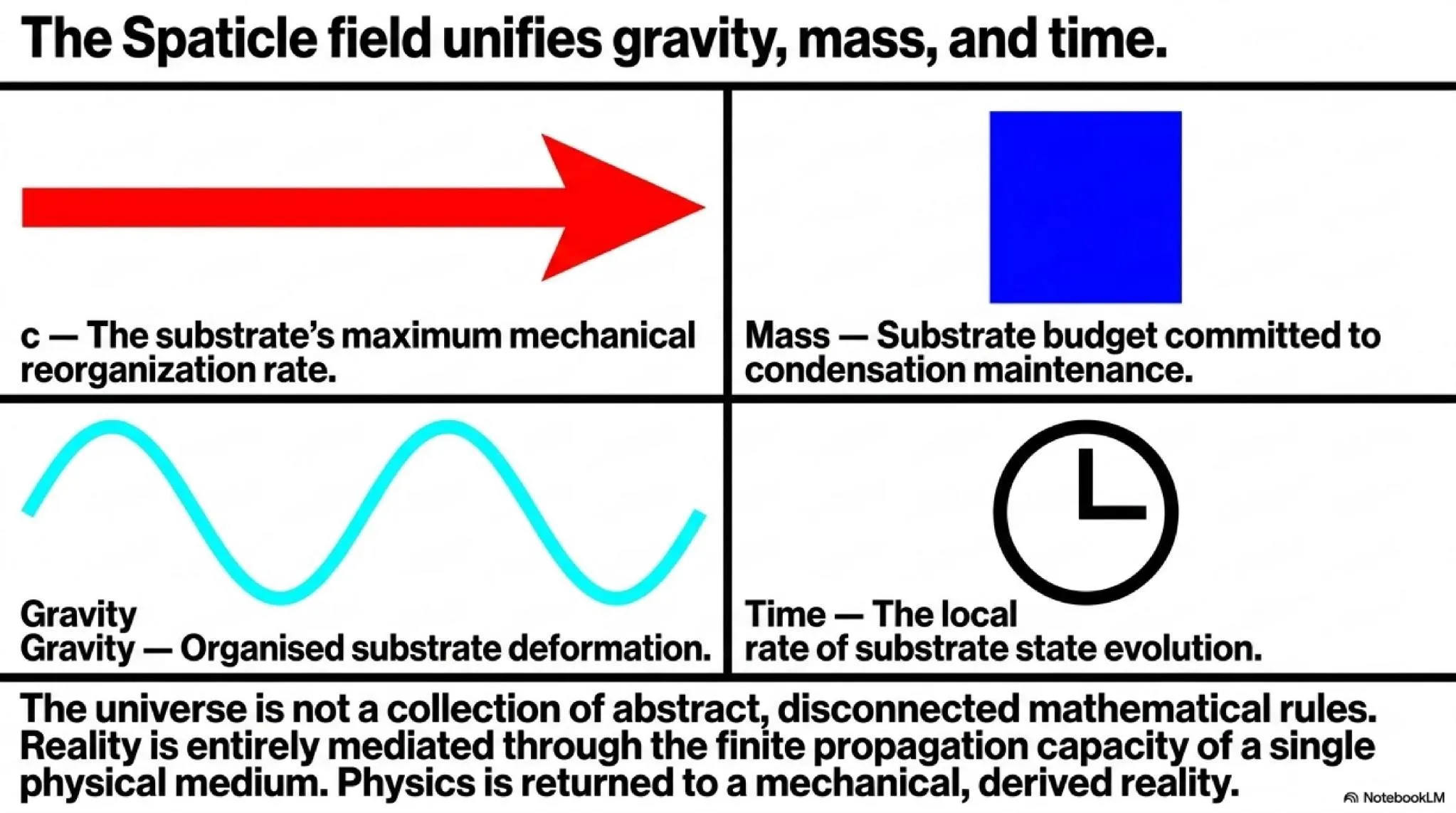
Photons, gravitational waves, and time share a single physical origin in BFUT. Photons and gravitational waves are both organised propagating disturbances of the same Spaticle substrate, and both are massless: no rest-mass condensation diverts any part of their propagation budget into internal maintenance, so the entirety of their propagation capability is available for travel, and both propagate at the same speed, c0, the substrate's maximum reorganisation rate (Section 4 above; [4]). Gravity itself, as a static field instead of a propagating wave, is the substrate deformation produced by mass-energy directly [4]; a gravitational wave is a propagating disturbance of that same deformation, and like the photon it carries no rest mass and so travels at c0.
Time accumulates by the same mechanism, and the same single quantity governs both propagation and time:
η = dτ/dt = cs/c0
where η is the local substrate propagation efficiency, dτ is local proper time, dt is coordinate time in an undisturbed substrate region, cs is the local effective propagation speed, and c0 is the vacuum propagation speed [5]. A clock measures the amount of physical substrate evolution occurring within its own structure, so the fraction by which clock rates change is identical to the fraction by which local propagation capability changes [5].
Relativistic time dilation follows from a propagation budget shared between spatial motion and internal evolution:
c² = v_spatial² + v_internal²
giving η = √(1 - v²/c²), the Lorentz factor, derived here as a substrate propagation-budget result instead of a geometric postulate [5]. Gravitational time dilation follows from the same mechanism, since mass-energy deformation of the substrate reduces local propagation efficiency η, lowering local clock rates and local propagation speeds together, by the same factor [5, 4]. Causality is a direct consequence of the same finite propagation capability: no causal influence propagates faster than the substrate's maximum reorganisation rate c0 [5].
Appendix A
Spaticle Field Cross-Sector Validation and the QFT Vacuum Energy Reconciliation
A.1 The Spaticle Field and Its Independent Constraints
The Spaticle field at intrinsic equilibrium density ρs is the single physical substrate underlying this paper's derivation of c, the photon, and the soliton mechanism. ρs approximately 5.9 x 10⁻²⁷ kg/m3 is not adjusted to fit the results of this paper. It is independently constrained from five physical sectors, none of which involve photon propagation or the speed of light:
- Particle sector: W and Z boson masses derived from substrate reconfiguration energies at the femtometre scale (BFUT P19).
- Galactic sector: 175-galaxy SPARC rotation-curve validation with χ-squared = 1.31 and no per-galaxy tuning (BFUT P18).
- Weak-lensing sector: KiDS-1000 weak gravitational lensing profiles across four stellar-mass bins, χ-squared = 0.007 to 0.067 against 5.77 to 6.57 for NFW profiles (BFUT P18).
- Atomic sector: hydrogen ground-state energy and Bohr radius recovered from first principles with no fitting to measured hydrogen structure (BFUT P25).
- Matter-stability sector: stable matter requires the substrate at every formation pathway, independent of formation history, a necessary condition, not a numerical fit (BFUT P25).
A density constrained simultaneously across particle, galactic, weak-lensing, atomic, and matter-stability observations is not a free parameter available to this paper. It is an emergent substrate constant inherited from the rest of the BFUT programme.
A.2 The Standard QFT Vacuum Energy Calculation
In standard QFT the vacuum energy density is obtained by summing zero-point energy over all modes of all quantum fields up to the Planck cutoff:
ρQFT ~ Sum_fields Integral d3k/(2 π)^3 x (1/2 hbar ωk)
Approximately 17 independent Standard Model fields each contribute zero-point energy (1/2)h-bar-ωk per mode. The integral yields ρQFT ~ 5.87 x 10111 J/m3, against the observed 5.30 x 10⁻¹⁰ J/m3. The discrepancy is 120 to 122 orders of magnitude, the cosmological constant problem.
A.3 The Two Errors in the Standard QFT Treatment
Error 1, multiplicity of independent quantum fields. The mode sum is performed over approximately 17 independent quantum fields. In the BFUT framework there is one underlying physical medium, the Spaticle substrate, of which every particle and force carrier, including the photon treated in this paper, is an organised excitation.
Error 2, zero-point energy assigned to empty modes. QFT assigns (1/2)h-bar-ω to every mode regardless of whether it contains a physical excitation. In the BFUT ontology, (1/2)h-bar-ω is the minimum internal circulation energy of an organised condensation. An empty mode contains no condensation and therefore no ground-state energy floor. Empty modes contribute zero.
A.4 Result After Correction
When both errors are corrected, one field, zero-point energy only for organised condensations, the mode sum over the pure vacuum state vanishes identically. What remains is the background equilibrium energy density of the physical medium:
ρvac = ρs x c2 ~ 5.30 x 10⁻¹⁰ J/m3
The enormous QFT prediction collapses by 120 to 122 orders of magnitude without fine-tuning, new parameters, or mathematical cancellation. The same substrate density ρs used in this appendix's Section A.1 and the same speed of light c derived in the main body of this paper combine directly to give this result.
A.5 Dark Energy and the Cosmological Constant
Dark energy is not a separate physical entity in the BFUT framework. The LCDM cosmological constant Λ is a geometric fitting parameter:
ρΛ = 3 ΩΛ H02 / (8 π G)
This parameter changes every time H0 is remeasured. ρs by contrast is the same at every point in an infinite BFUT universe at every epoch. The numerical proximity of ρΛ to ρs c2 at the current epoch is a transient coincidence arising from the particular stage of cosmic evolution, not a physical identity.
A.6 Summary
Two compounding errors in the standard QFT vacuum energy calculation produce the 120-order-of-magnitude discrepancy. Correcting both, one physical field, zero-point energy only for organised condensations, collapses the QFT sum exactly to ρs c2. The same ρs and c established across this appendix and the main body of this paper are not free parameters local to this paper; they are inherited, independently constrained quantities from the wider BFUT programme.
Appendix B.
The Soliton: A Wave That Does Not Die
The soliton is a general phenomenon of nonlinear dispersive media, with a well-established physical and mathematical basis. This appendix establishes that basis, its historical discovery, and its occurrence across physical systems, including the three-dimensional dissolution mechanism that would govern a soliton in an unbounded medium such as the Spaticle field. The specific numerical thresholds for photon behaviour in the Spaticle field are not yet independently verified and are not asserted here.
B.1 The First Observation
On the afternoon of 1 August 1834, a Scottish engineer named John Scott Russell was watching a horse-drawn barge on the Union Canal near Edinburgh. The barge stopped suddenly. The mass of water the barge had been pushing forward did not stop. It detached from the barge, formed a single rounded heap of water, and continued down the canal at roughly fourteen kilometres per hour, maintaining its shape and height without any visible flattening or spreading for a distance of nearly three kilometres, until Russell lost sight of it around a bend.
Russell called it the Wave of Translation. He followed it on horseback. He was sufficiently astonished that he spent the next decade studying the phenomenon in laboratory wave tanks, generating it repeatedly by dropping weights into water. He published his findings in 1844 [1]. He had discovered what is now called a soliton.
The scientific establishment did not believe him. The leading hydrodynamicists of the day, Airy and Stokes, argued on theoretical grounds that such a wave was impossible. A solitary wave of translation, they said, must either steepen and break like an ocean wave approaching shore, or flatten and spread like a ripple from a stone. It could not maintain its shape. Russell was ignored for decades.
Russell was right and the theorists were wrong.
B.2 Why Ordinary Waves Die
To understand why a soliton is remarkable, it is necessary to understand why ordinary waves do not maintain their shape.
When a stone is dropped into a still pond, the disturbance is a pulse containing many frequencies. The pond is a dispersive medium: different frequencies travel at different speeds. The short wavelengths travel faster than the long wavelengths in shallow water, or the other way around in deep water depending on the regime. The pulse therefore spreads: the fast frequencies race ahead, the slow frequencies lag behind. After sufficient distance the original compact pulse has smeared into a long oscillating train of diminishing amplitude. This is dispersion.
Simultaneously, in three dimensions, the energy spreads outward as a sphere. The energy per unit area decreases as 1/r squared. The wave height decreases as 1/r. This is geometric spreading. It is purely a consequence of the three-dimensional geometry of space and has nothing to do with the properties of the medium.
Dispersion and geometric spreading together guarantee that ordinary waves die. They flatten, smear, and eventually become indistinguishable from the random thermal motion of the water molecules.
B.3 The Nonlinear Compensation
A soliton arises when the medium has a nonlinear response that exactly counteracts dispersion.
In water, the nonlinearity is this: a taller wave travels faster than a shorter wave of the same frequency. This is because the wave speed in shallow water depends on the total water depth, and a tall wave locally increases the effective depth. The crest of the wave moves faster than the trough. In an ordinary steep wave this causes the front face to steepen until the wave breaks. But if the wave is already a smooth single hump of exactly the right shape, the nonlinear speeding-up of the crest exactly compensates for the tendency of dispersion to spread the crest energy away from the peak. The hump locks its shape.
The mathematical condition for this balance was derived in 1895 by Korteweg and de Vries [2]. The wave equation they wrote, now called the KdV equation, has exact solutions of the form:
u(x,t) = (c/2) sech²[ √(c/12) (x − ct) ]
where c is the wave speed. This solution travels at speed c without any change of shape. It is the mathematical soliton. The amplitude determines the speed: a taller soliton is faster. Two solitons of different heights that collide pass through each other and emerge unchanged, each at its original height and speed, with only a small phase shift as the record of their meeting [3].
B.4 The Canal and the Soliton - Why Russell's Wave Survived
Russell's Wave of Translation survived for three kilometres for the following reasons.
First, the canal is effectively one-dimensional. A narrow channel confines the wave to travel in one direction. There is no sideways spreading. Geometric dilution in one dimension gives amplitude falling as 1/√r instead of 1/r. This is far slower. Over three kilometres the amplitude would fall only modestly from 1/√r spreading.
Second, the barge produced a disturbance of approximately the right amplitude and shape to lock into the soliton solution of the KdV equation for the canal dimensions. It was not a designed experiment. It was accidental. But the physics selected the soliton solution from the available conditions.
Third, the canal water has very low viscosity at canal scales. The energy loss from viscosity over three kilometres at canal depths is small. The soliton maintained enough amplitude to remain above the dissipation threshold for the length of Russell's observation.
B.5 Solitons in Other Physical Systems
The soliton turned out not to be a curiosity of canal hydrodynamics. It is a general phenomenon of nonlinear dispersive wave equations.
Optical fibres [4]: pulses of light in optical fibres are subject to dispersion that would broaden and destroy the signal over long distances. But at the right power level, the Kerr nonlinearity of the fibre glass, in which the refractive index increases slightly with light intensity, exactly compensates for the dispersion. The pulse becomes a soliton and travels without broadening. Optical soliton communication was demonstrated experimentally in the 1980s and is used in long-distance fibre-optic cables today.
Bose-Einstein condensates [5]: at temperatures near absolute zero, a cloud of atoms in a magnetic trap can form a quantum soliton. The matter wave of the condensate obeys the Gross-Pitaevskii equation, which has the same mathematical structure as the nonlinear Schrödinger equation. Solitons have been observed propagating through condensates without spreading.
Plasma physics [6]: ion-acoustic solitons propagate through plasmas. The balance between nonlinear wave steepening and dispersive spreading in a plasma produces solitary waves that travel without distortion through the ionosphere.
Biological systems [7]: soliton models have been proposed for nerve impulse propagation along axons, where the nonlinear compression of the axon membrane may produce a solitary acoustic wave accompanying the electrical signal. This remains an active area of research.
Particle physics [8]: certain quantum field theories have soliton solutions that correspond to stable particles. The Skyrme model treats the proton and neutron as topological solitons of a pion field. This is a formal ancestor of the BFUT account of the proton as a soliton of the Spaticle field.
B.6 The Three-Dimensional Soliton and Its Dissolution
Russell's soliton survived because the canal was one-dimensional. In three dimensions, no exact soliton solution of the KdV equation exists. BFUT's own proposed mechanism for a finite photon range invokes the T4 nonlinearity term directly: a self-trapped disturbance's amplitude falls as it spreads, and if it falls below the threshold needed for T4 to sustain self-trapping against dispersion, the disturbance dissolves into an ordinary linear wave. This dissolution is not absorption; the energy does not disappear, it spreads into the background substrate, eventually becoming indistinguishable from the vacuum's own quantum fluctuations. This remains a live, physically motivated hypothesis, but deriving its specific threshold and scaling law requires a full soliton-stability calculation from the T4 term's actual coefficients, which has not been carried out.
A separate and more general mechanism does not depend on soliton dynamics at all. For a purely elastic substrate, with stiffness Ks = ρ_s c² fixed by density and the limiting propagation speed, the wave's mechanical energy is exactly conserved by the equation of motion; an ideal elastic medium propagates a disturbance indefinitely while its total energy never changes, only its local density falls as it spreads. Nonzero substrate density and stiffness alone therefore establish nothing beyond ordinary geometric dilution.
Genuine, irreversible loss requires the substrate to possess an internal degree of freedom beyond the deformation field itself, one that the deformation drives and that responds with a finite delay. If such an internal state exists, the substrate's effective stiffness becomes frequency-dependent and complex, Keff(ω) = K′(ω) + iK″(ω), where the imaginary part represents energy transferred irreversibly into the internal mode; a purely real modulus stores and returns energy, an imaginary one does not. This produces genuine exponential attenuation, E(x) = E₀e^(−2αx), with an energy attenuation length L(ω) ≈ (c/ω) × [K′(ω)/K″(ω)].
This mechanism does not depend on spherical spreading. For a directed disturbance of cross-sectional area A and coherent longitudinal extent Δx, the deformation energy is E = udef·A·Δx; if a fraction η of the energy in each newly traversed element dV = A·dx is transferred irreversibly to internal modes, the cross-sectional area cancels exactly, giving dE/dx = −(η/Δx)E and E(x) = E₀e^(−ηx/Δx). The loss is generated locally, per unit distance travelled, and applies the same way to a directed beam or photon as to an isotropic wave.
Neither mechanism yet gives a number. The specific threshold and scaling law for the soliton route, and the specific relaxation time and coupling strength (τ, ΔK) for the internal-relaxation route, are properties of the Spaticle field's microscopic condensation-mode spectrum. They are not fixed by ρ_s and c alone and have not yet been derived from the substrate's nonlinear structure. There is also no universal minimum photon energy below which coherent propagation is impossible: cosmic microwave background photons, at roughly 6×10⁻⁴ eV, have propagated coherently across the observable universe for over 13 billion years, ruling out any such threshold near the meV scale.
No anomalous propagation loss beyond standard effects has been observed for either light or gravitational waves. Fermi-LAT observations of distant γ-ray sources show genuine energy- and distance-dependent attenuation, attributed to photon-photon pair production with the extragalactic background light, not substrate loss [9]. The most precise gravitational-wave test to date, an amplitude-birefringence analysis of 71 binary-black-hole signals in the LIGO-Virgo-KAGRA GWTC-3 catalogue, measured an attenuation parameter of κ = −0.019⁺⁰·⁰³⁸₋₀.₀₂₉ Gpc⁻¹ at 100 Hz, consistent with zero [10]. Neither result rules out a substrate contribution below current sensitivity, and neither establishes one.
The general expectation therefore remains physically motivated but not yet quantitative: a coupling between propagating disturbances and the substrate's own internal structure, if it exists, would produce a finite coherent range whose value depends on frequency. Deriving that value for light specifically requires the substrate's internal eigenmode spectrum and its coupling to the transverse propagating mode, neither of which has yet been derived from first principles.
References (Appendix B)
[1] Russell, J. S. (1844). Report on Waves. Report of the 14th Meeting of the British Association for the Advancement of Science. York, pp. 311-390.
[2] Korteweg, D. J., & de Vries, G. (1895). On the change of form of long waves advancing in a rectangular canal, and on a new type of long stationary waves. Philosophical Magazine, 39(240), 422-443.
[3] Zabusky, N. J., & Kruskal, M. D. (1965). Interaction of solitons in a collisionless plasma and the recurrence of initial states. Physical Review Letters, 15(6), 240-243.
[4] Hasegawa, A., & Tappert, F. (1973). Transmission of stationary nonlinear optical pulses in dispersive dielectric fibers. Applied Physics Letters, 23(3), 142-144.
[5] Strecker, K. E., Partridge, G. B., Truscott, A. G., & Hulet, R. G. (2002). Formation and propagation of matter-wave soliton trains. Nature, 417, 150-153.
[6] Ikezi, H., Taylor, R. J., & Baker, D. R. (1970). Formation and interaction of ion-acoustic solitions. Physical Review Letters, 25(1), 11-14.
[7] Heimburg, T., & Jackson, A. D. (2005). On soliton propagation in biomembranes and nerves. Proceedings of the National Academy of Sciences, 102(28), 9790-9795.
[8] Skyrme, T. H. R. (1961). A non-linear field theory. Proceedings of the Royal Society A, 260(1300), 127-138.
[9] Fermi-LAT Collaboration. (2026). A New Measurement of the Extragalactic Background Light using 15 yr of Fermi-Large Area Telescope Data. arXiv:2604.09139.
[10] Ng, T. C. K., Isi, M., Wong, K. W. K., & Farr, W. M. (2023). Constraining gravitational wave amplitude birefringence with GWTC-3. Physical Review D, 108, 084068.
References
[1] Sharma, V. S. (2026). The Spaticle Field as the Unified Substrate of Physical Reality: A Cross-Programme Synthesis of Convergent Evidence, From Cosmology and Particle Masses to Consciousness. BFUT P14. Zenodo. DOI: 10.5281/zenodo.19394064
[2] Sharma, V. S. (2026). The Origin of Matter, Antimatter, and Fundamental Forces: How Protons, Electrons, and Hydrogen Formed. BFUT P16. Zenodo. DOI: 10.5281/zenodo.19908215
[3] Sharma, V. S. (2026). The Emergence of Forces and Fundamental Senses: How the Spaticle Field Gave Rise to Gravity and All Other Forces. BFUT P17. Zenodo. DOI: 10.5281/zenodo.19976408
[4] Sharma, V. S. (2026). Beyond General Relativity: A Unified Gravitation Equation Across Quantum, Classical, Galactic, and Rapid-Transition Regimes. BFUT P18. Zenodo. DOI: 10.5281/zenodo.20145506
[5] Sharma, V. S. (2026). Unification of Particle Physics: Deriving Fine Structure and Coupling Constants, W, Z, and Higgs Boson Masses, Redefining and Unifying Gravity and Time. BFUT P19. Zenodo. DOI: 10.5281/zenodo.20145567
[6] Sharma, V. S. (2026). Cold, Dark, and Inevitable: A Logical Reconstruction of the Universe Before the Big Flare-Up. BFUT P8. Zenodo. DOI: 10.5281/zenodo.19323579
[7] Sharma, V. S. (2026). Cosmic Rotation Across Scales, Emergent Orbital Hierarchy, and the Large-Scale Challenge to Metric Expansion. BFUT P9. Zenodo. DOI: 10.5281/zenodo.19341549
[8] Bionta, R. M., et al. (1987). Observation of a neutrino burst in coincidence with supernova SN1987A in the Large Magellanic Cloud. Physical Review Letters, 58, 1494.
[9] Hirata, K., et al. (1987). Observation in the Kamiokande-II detector of the neutrino burst from supernova SN1987A. Physical Review Letters, 58, 1490.
[10] KATRIN Collaboration (2022). Direct neutrino-mass measurement with sub-electronvolt sensitivity. Nature Physics, 18, 160-166. DOI: 10.1038/s41567-021-01463-1
[11] Planck Collaboration (2018). Planck 2018 results VI: Cosmological parameters. Astronomy and Astrophysics, 641, A6. DOI: 10.1051/0004-6361/201833910
[12] Sharma, V. S. (2026). Time: Identifying the Cause and Effects and Unifying General and Special Relativity. BFUT P22. Zenodo. DOI: 10.5281/zenodo.20556908
[13] Sharma, V. S. (2026). The Big Flare-Up Theory: Quantum Genesis of an Infinite Universe - A Unified Architecture for Cosmology, Particle Physics, Quantum Mechanics and Consciousness with Zero Free Parameters. BFUT L1. Zenodo. DOI: 10.5281/zenodo.19149785
[14] Sharma, V. S. (2026). The Big Flare-Up Theory: Companion Simulations. Zenodo. DOI: 10.5281/zenodo.20554084
[15] Sharma, V. S. (2026). The Planck Constant: A First-Principles Derivation of ħ and How It Reshapes the Interpretation of Quantum Mechanics. BFUT P27. Zenodo. DOI: 10.5281/zenodo.20620283
[16] Tu, L.-C., Luo, J., and Gillies, G. T. (2005). The mass of the photon. Reports on Progress in Physics, 68(1), 77-130. DOI: 10.1088/0034-4885/68/1/R02
[17] Goldhaber, A. S., and Nieto, M. M. (2010). Photon and graviton mass limits. Reviews of Modern Physics, 82(1), 939-979. DOI: 10.1103/RevModPhys.82.939
[18] Particle Data Group (2022). Review of Particle Physics. Progress of Theoretical and Experimental Physics, 2022, 083C01. (Photon mass upper limit: 1.07 x 10⁻²⁷ eV/c2)
[19] Inomata, K., et al. (2016). Single microwave-photon detector using an artificial Λ-type three-level system. Nature Communications, 7, 12303. DOI: 10.1038/ncomms12303
[20] Opremcak, A., et al. (2018). Measurement of a superconducting qubit with a microwave photon counter. Science, 361(6408), 1239-1242. DOI: 10.1126/science.aat4625
[21] Sharma, V. S. (2026). Evidence Against Dark Energy: Observer Bulk Flow as an Alternative Explanation for Apparent Cosmic Acceleration. Zenodo. DOI: 10.5281/zenodo.19228065