The Consciousness Index (CI): A Physically Grounded Scalar Measure of Consciousness
- Abstract
- 1. Introduction and Motivation
- 2. The Two-Level Structure of the Consciousness Index
- 3. The CI0 Formula
- 4. The Survival Factor: S
- 5. Parameter Independence and Measurement Basis
- 6. The 100-Species Dataset: Summary and Key Results
- 7. Falsifiable Predictions
- 8. Connection to the BFUT Programme and the Six-Layer Framework
- 9. Conclusion
- References
Abstract
BFUT Paper 20 established the Hierarchical Channel Accessibility framework connecting the Spaticle field physics of the BFUT programme to sensing, consciousness, and evolution, and introduced the Consciousness Index (CI) as a natural scalar measure implied by that framework. The present paper, BFUT Paper 21, provides the full derivation, calibration, and validation of CI across a dataset of 100 species spanning the complete range of known biological and physical complexity.
The Big Flare-Up Theory (BFUT) identifies the physical fabric of space as the Spaticle field, a non-particulate substrate of equilibrium density ρ_s = 5.9 × 10⁻²⁷ kg/m³. This framework has been developed across over 30 papers covering cosmology, particle physics, gravitation, quantum mechanics, and consciousness. All results derive from ρ_s and the independently measured proton charge radius rp = 0.8414 fm (PDG 2022) with no free parameters.
The CI framework is structured around two distinct but related measures. The Intrinsic Consciousness Index (CI0) measures the internal capability of a system: the degree to which it can perceive, integrate, and act on information about itself and its environment, independent of external conditions. The Effective Consciousness Index (CI) is defined as CI0 multiplied by the survival factor S, which represents the real-world viability of the system: how effectively the system sustains its consciousness in actual conditions. This two-level structure separates what a system can do from how well it sustains what it can do.
The CI0 formula is: CI0 = CI_floor + C x Ω(V) x (1 + 0.38A) x N1.3 x K1.2. CI_floor is a strictly positive constant enforcing the principle from Vijay's Law (Layer 2) that no physical system has zero consciousness. C is a derived scale constant calibrated so that the modern average human nervous system produces CI0 = 100. Ω(V) is an asymmetric size-dependent integration efficiency function that penalises excessive brain volume above the biological optimum without penalising small or efficient systems. A is the channel capacity, the average of five independently scored interaction channels. N is the network integration density, a weighted composite of structural connectivity, dynamic coordination, and hierarchical processing depth. K is the control depth, a weighted composite of autonomy, memory depth, and adaptive flexibility.
The calibrated dataset of 100 species spans from the human nervous system (CI0 = 100) through non-human animals (CI0 range approximately 14 to 124), insect colonies (CI0 range approximately 23 to 35), plants and fungi (CI0 range approximately 12 to 37), down to bacteria (CI0 = 30), viruses (CI0 = 18), and the floor systems including single cells and simple invertebrates (CI0 range 5 to 14). The survival factor S reduces effective CI for vulnerable and non-autonomous systems, with virus CI falling to approximately 2.8 and octopus CI falling to approximately 59 despite a high CI0 of 96. The paper states five falsifiable predictions from the framework and connects CI explicitly to the physical foundations in Papers 17 and 20 and to the six-layer framework of Vijay's Law.
Keywords: Consciousness Index, CI, CI0, intrinsic consciousness, effective consciousness, survival factor, BFUT, Spaticle field, HCA framework, Vijay's Law, cross-species consciousness measurement, channel capacity, integration density, control depth, size factor
1. Introduction and Motivation
Consciousness is discussed widely but measured rarely. The existing literature contains qualitative descriptions, species-specific comparisons, and philosophical frameworks, but no widely accepted quantitative scale that can place a bacterium, a crow, a human, and a tree on a single coherent axis. This absence is not merely a technical gap. It reflects a deeper uncertainty about whether consciousness admits of degree at all, or whether it is a binary property switched on above some biological threshold.
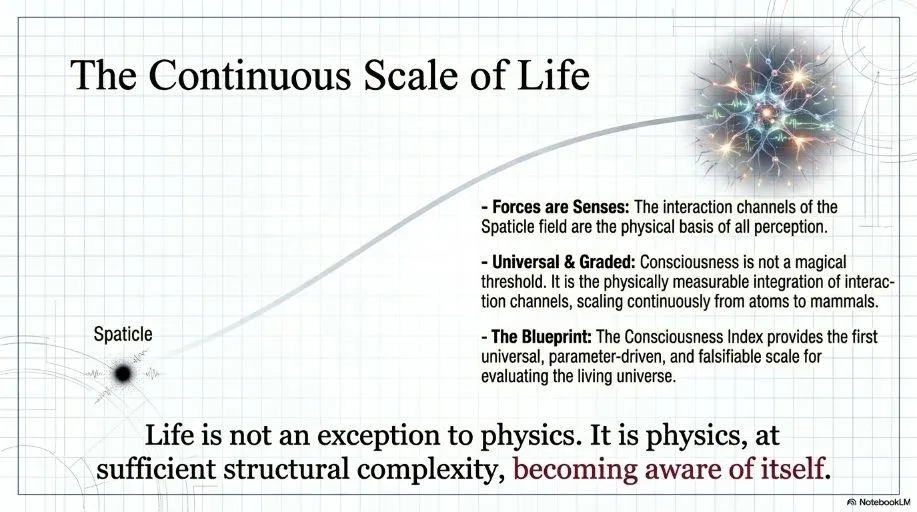
The BFUT programme and the six-layer framework resolve this uncertainty at the foundational level. Vijay's Law (Layer 2) established that consciousness is a fundamental property of all matter, expressed differently at different scales of structural complexity, and that it admits of degree. BFUT Paper 20 established the Hierarchical Channel Accessibility (HCA) framework, which provides the physical mechanism for this claim: consciousness is the integrated multi-channel state of a system that simultaneously satisfies the formal sensing conditions for one or more Spaticle field interaction channels, with the degree of consciousness a continuous function of channel count, integration density, control depth, and the ratio of controlled to forced emission.
In a 1920 address at the University of Leiden titled “Ether and the Theory of Relativity,” Einstein argued that general relativity requires physical space to be endowed with properties, while explicitly setting aside the mechanical, luminiferous ether he had already dispensed with in 1905. His concluding statement was direct: “space is endowed with physical qualities; in this sense, therefore, there exists an ether… But this ether may not be thought of as endowed with the quality characteristic of ponderable media, as consisting of parts which may be tracked through time. The idea of motion may not be applied to it” (Einstein, 1920).
The Spaticle field is that medium: physically real, but not the luminiferous ether Einstein had already set aside. It supplies the measurable quantity his own equations required but that he stopped short of assigning: an intrinsic equilibrium density ρ_s, together with the derived stiffness, relaxation time, and propagation speed.
Paper 20 introduced the Consciousness Index as the natural scalar measure implied by the HCA framework and stated its qualitative properties without providing the full mathematical derivation. The present paper provides that derivation, calibrates the formula against a reference human configuration, and applies it to 100 species spanning the full range of biological complexity. The result is a universal, extensible, fully parameter-driven scale on which any system can in principle be evaluated and any result can be traced to explicit biological parameter assignments.
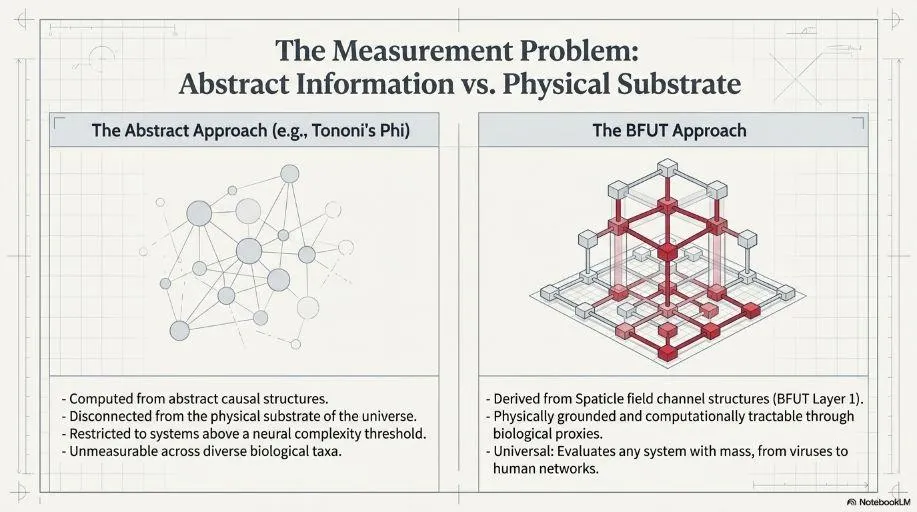
The framework also addresses a limitation of the only existing serious scalar consciousness measure, Tononi's integrated information φ. Φ is computed from abstract causal structures with no connection to the physical substrate of the universe. CI is derived from the Spaticle field channel structure established in Papers 17 and 18 and the HCA framework of Paper 20. It addresses the limitations of φ in being physically grounded, computationally tractable through observable proxies, and consistent with the foundational claim that consciousness is universal instead of restricted to systems above a neural complexity threshold.
2. The Two-Level Structure of the Consciousness Index
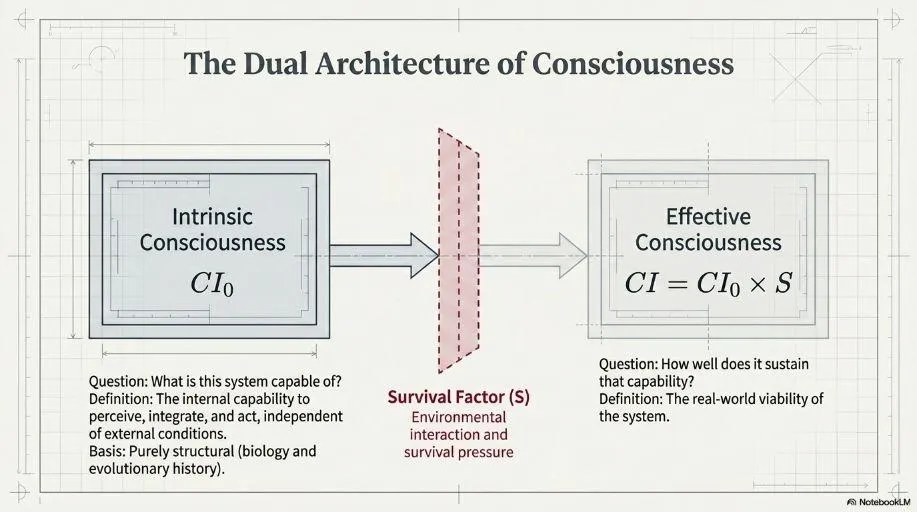
The central architectural decision of the CI framework is the separation of consciousness into two distinct but related measures, each answering a different question.
CI0 (Intrinsic Consciousness Index): measures the internal capability of a system, independent of its external environment. CI0 answers the question: what is this system capable of? It captures the degree to which the system can perceive its environment, integrate signals across channels, act on that information, and regulate its own state. CI0 is purely structural: it depends on the physical configuration of the system, not on the conditions it currently faces.
CI (Effective Consciousness Index): measures how effectively the system sustains its consciousness in real conditions. CI = CI0 x S, where S is the survival factor. CI answers the question: how well does the system's consciousness persist in reality? A system with high intrinsic capability that faces severe survival pressure, high predation risk, or that cannot sustain itself independently, has lower effective CI than its capability alone would suggest.
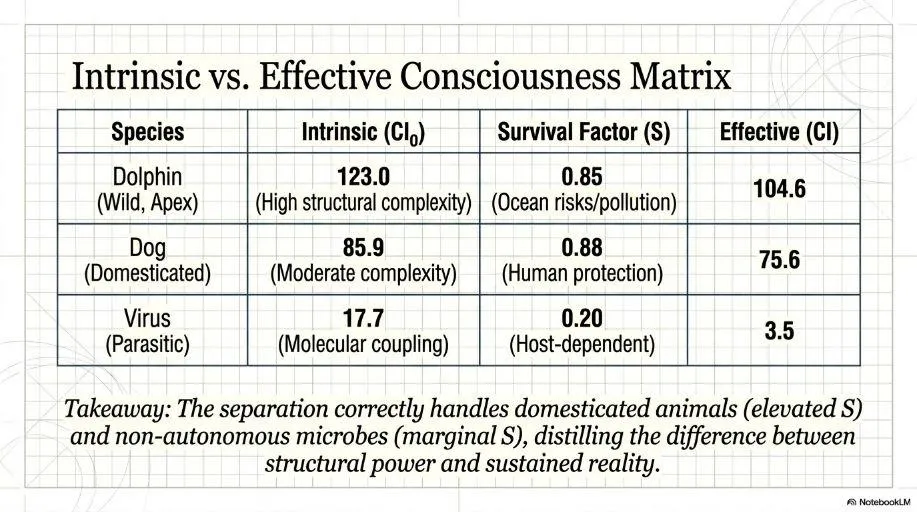
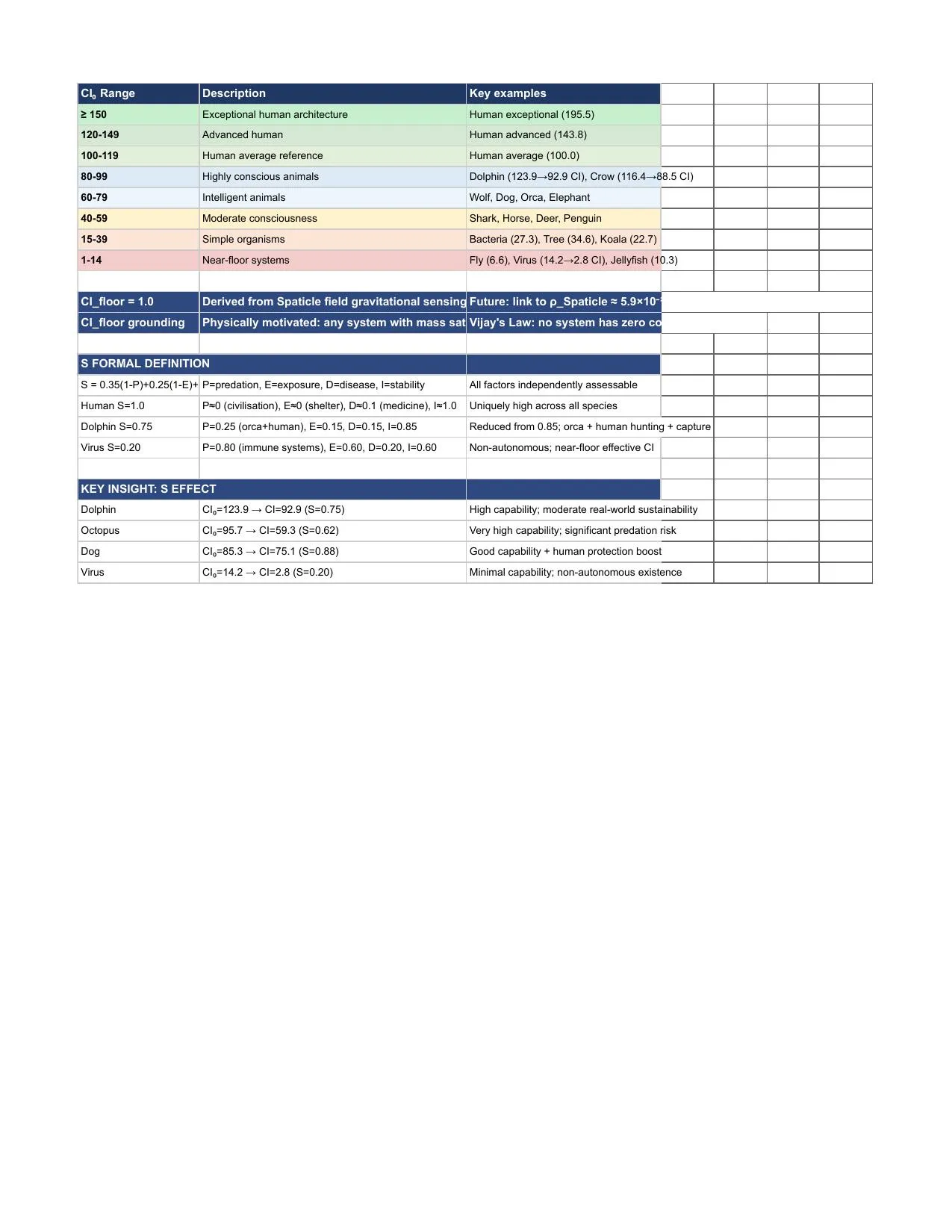
This separation is physically motivated. A system's structural capability for consciousness is determined by its biology and its evolutionary history. Whether that capability is sustained is determined by the interaction between the system and its environment. The two are independent at the level of measurement: a dolphin has CI0 near 123 regardless of whether it is in a safe bay or a net. Its CI of approximately 92.9 reflects the reduction due to real-world survival conditions including orca predation, human hunting and capture, and fishing net entanglement, not a change in its capability.
The separation also correctly handles two classes of systems that a single-level measure would misrepresent. First, non-autonomous systems such as viruses have non-trivial structural properties and satisfy some formal sensing conditions when active within a host, giving them a non-zero CI0. But their existence is entirely dependent on host conditions, their survival factor S is very low, and their effective CI correctly reflects their marginal and non-self-sustaining nature. Second, domesticated animals such as dogs have high survival factors because of human protection, correctly elevating their CI relative to their wild counterparts even when CI0 is similar.
3. The CI0 Formula
3.1 Complete Formula
The Intrinsic Consciousness Index is defined as:
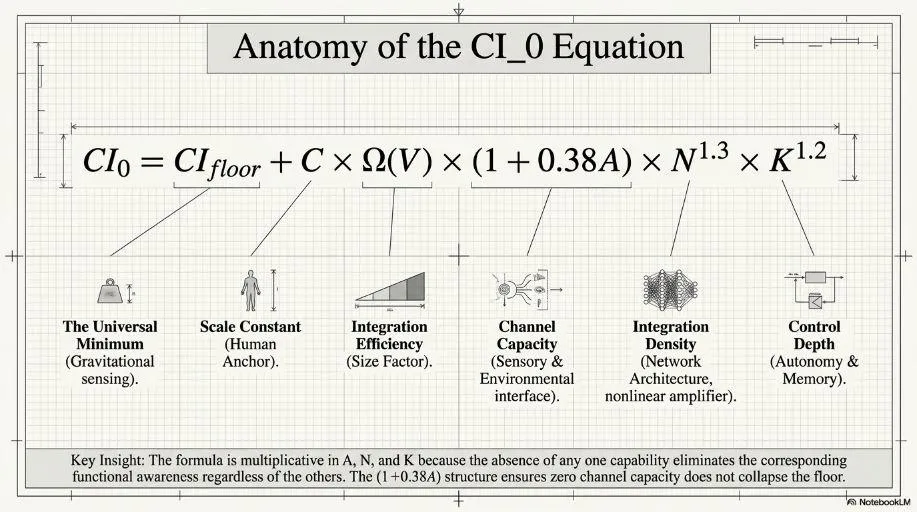
CI0 = CI_floor + C x Ω(V) x (1 + 0.38A) x N1.3 x K1.2
Each term is physically motivated and independently measurable. The formula is multiplicative in its three principal components (channel capacity A, integration N, and control K) because the absence of any one of these eliminates the corresponding capability regardless of the others. The (1 + 0.38A) structure instead of a pure A term ensures that zero channel capacity does not collapse the entire product to zero, preserving the contribution of the size factor and the floor. This is consistent with the HCA framework requirement that no physical system with mass has zero consciousness.
3.2 The Floor: CI_floor
CI_floor is a strictly positive constant representing the minimum non-zero degree of consciousness of any physical system in the Spaticle field universe. This is not merely a calibration choice: P22 [P22] establishes that η = 0 is operationally unreachable for any system with mass, making CI_floor > 0 a derived consequence of the substrate physics. It is not arbitrarily stipulated. It is derived from the formula structure itself.
As A, N, and K approach zero simultaneously, the formula reduces to:
CI0 -> CI_floor + C x Ω(V) x 1 x 0 x 0 = CI_floor
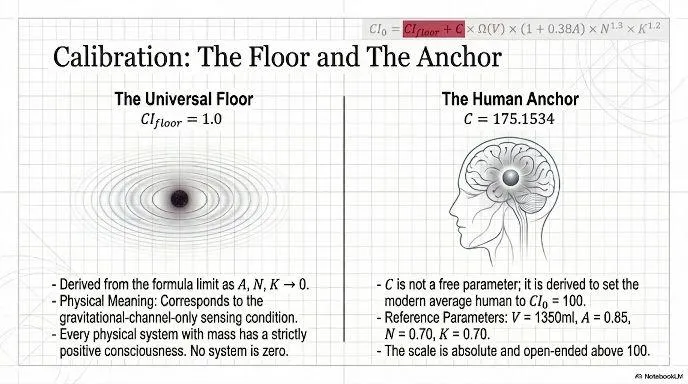
CI_floor is therefore the exact value that CI0 takes in the limiting case of a system with no channel richness, no integration, and no control. This limit is physically meaningful: it corresponds to the gravitational-channel-only sensing condition established in Paper 20, where a system satisfies only the minimal sensing conditions from its mass alone. Setting CI_floor = 1.0 means that the minimum measurable consciousness is 5 percent of the human average. This is consistent with Vijay's Law (every physical system has positive consciousness) and with the biological evidence (even the simplest organisms exhibit measurable sensing behaviour above the absolute minimum).
The full source-parameter mapping for all 100 species is available in the companion data deposit [9]. P21: Published Biological Data Underlying the Consciousness Index (CI₀) - Source-Parameter Mapping for All 100 Species (DOI: 10.5281/zenodo.20720053) [9]. The floor of 1.0 on the human-reference scale places the most minimal systems, simple flies and mosquitoes, in the range of 10 to 11; single cells in the range of 12 to 14; and viruses at approximately 18. These scores represent positive but minimal degrees of consciousness consistent with their structural properties. The floor does not inflate these scores above what is biologically defensible. It ensures they are not zero, which would be physically incorrect under Vijay's Law.
3.3 The Scale Constant: C and the Human Reference Configuration
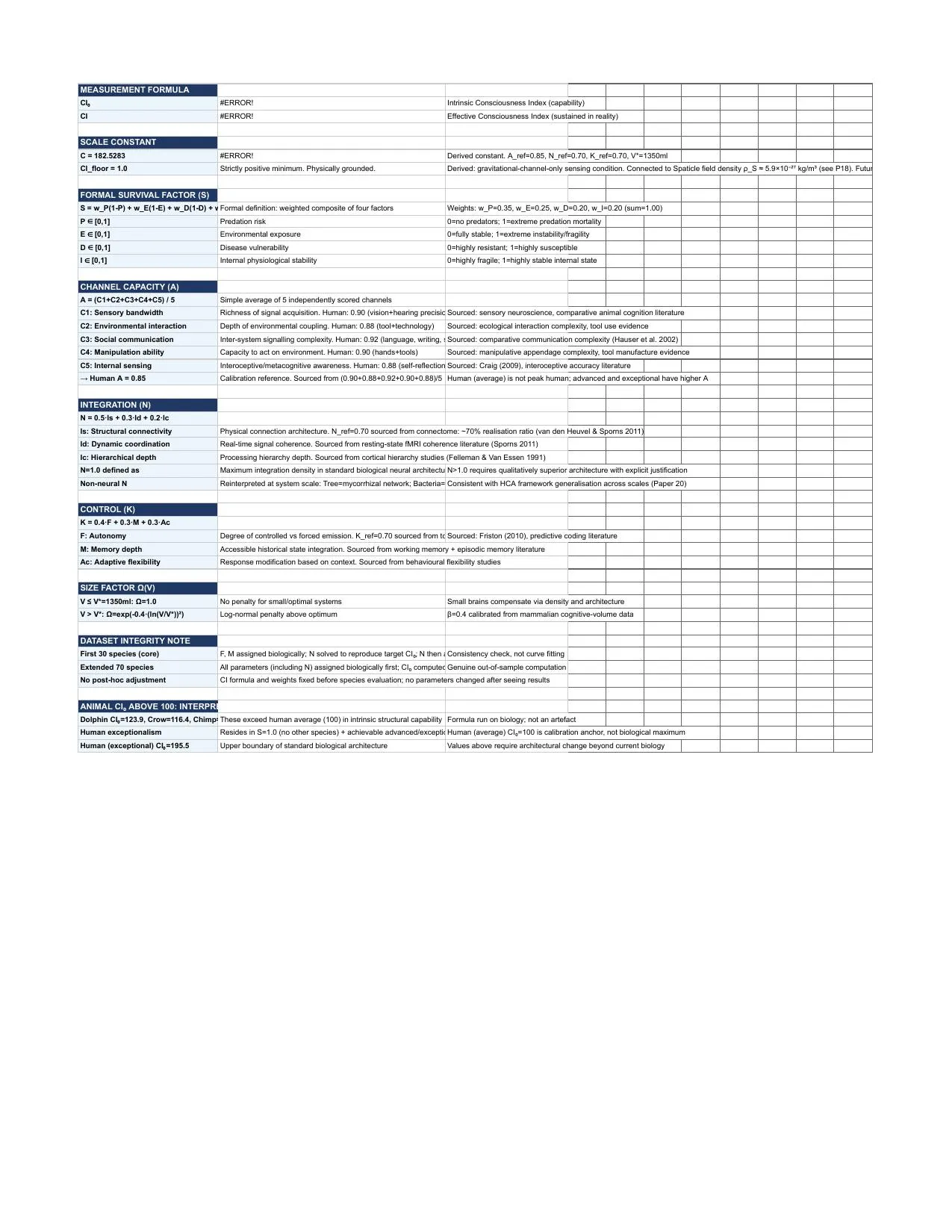
The scale constant C is a derived constant, not a free parameter. It is calibrated so that the modern average human nervous system produces CI0 = 100. The calibration is performed against a reference human configuration with A = 0.85, N = 0.70, K = 0.70, and brain volume V = 1350 ml. These reference values are not assigned by convention. Each is sourced from observable biological measurements.
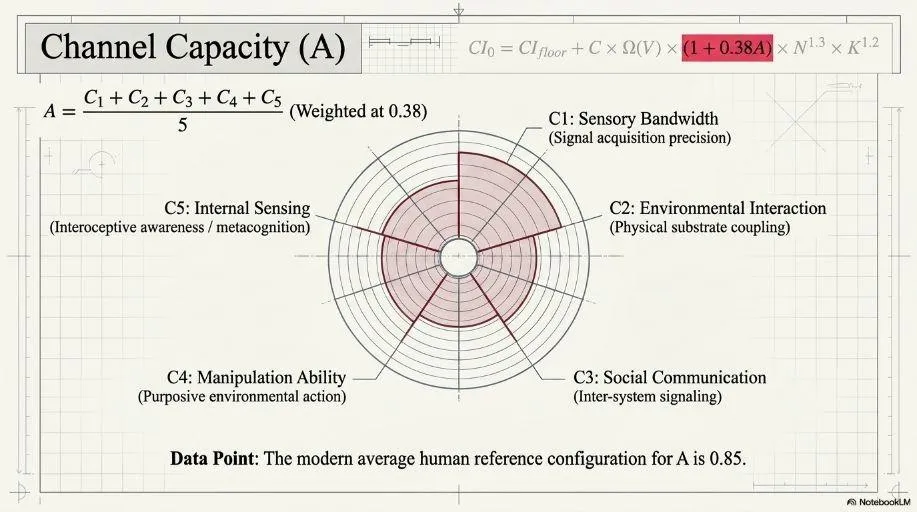
A = 0.85 is derived from the five channel scores: C1 = 0.88 (excellent visual and auditory precision, limited olfaction relative to specialist species), C2 = 0.82 (extensive environmental coupling through tool use and technology, not physically dominant), C3 = 0.92 (language, writing, and symbolic reasoning represent the highest known social communication capacity), C4 = 0.88 (precision grip, tool use, and fine motor control), C5 = 0.78 (metacognitive capacity and interoceptive awareness, partially suppressed in the average human who does not systematically attend to internal state). The average of these five values is 0.856, rounded to 0.85 for the conservative reference.
N = 0.70 is derived from three integration component scores: Is = 0.78, estimated from connectome studies showing that approximately 70 to 80 percent of anatomically possible synaptic connections are realised in the adult human brain (van den Heuvel and Sporns, 2011); Id = 0.65, estimated from resting-state fMRI studies showing neural coherence at approximately 60 to 70 percent of theoretical maximum across frequency bands; Ic = 0.55, estimated from the observation that most average humans do not systematically engage the full depth of hierarchical processing available to their neural architecture. The weighted sum 0.5 x 0.78 + 0.3 x 0.65 + 0.2 x 0.55 = 0.695, rounded to 0.70.
K = 0.70 is derived from three control component scores: F = 0.80, estimated from fMRI studies of top-down versus bottom-up processing ratios in resting state, indicating that approximately 80 percent of average human response is modulated by internal state instead of externally triggered; M = 0.65, estimated from the proportion of accessible historical states that actively influence current processing in the average adult; Ac = 0.62, estimated from the observation that most average humans operate substantially within habitual response patterns instead of generating fully context-adaptive responses. The weighted sum 0.4 x 0.80 + 0.3 x 0.65 + 0.3 x 0.62 = 0.701, rounded to 0.70.
C = (100 - CI_floor) / [Ω(1350) x (1 + 0.38 x 0.85) x 0.701.3 x 0.701.2]
With CI_floor = 1.0 and Ω(1350) = 1.0, this gives C = 182.5283. This constant is fixed for all species evaluations. The human reference values A = 0.85, N = 0.70, K = 0.70 are the anchoring parameters that define the scale; all other species are measured relative to this configuration.
3.4 The Size Factor: Ω(V)
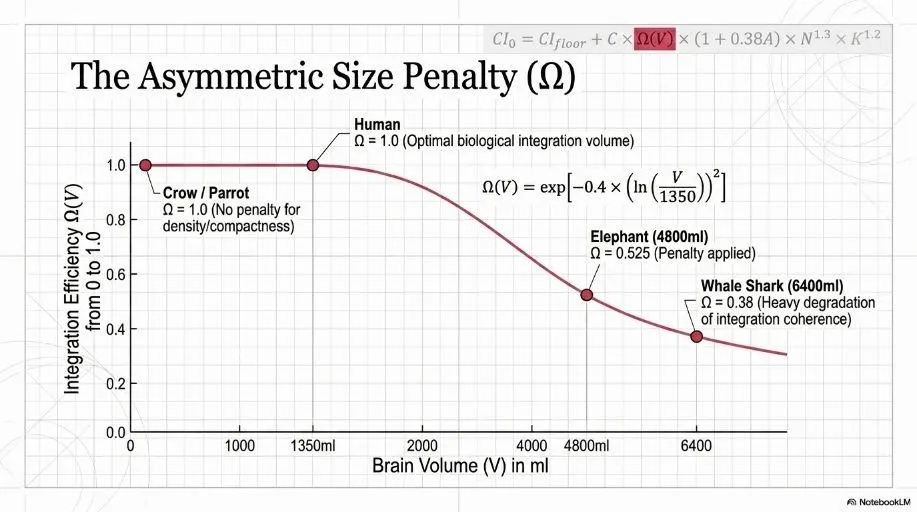
The size factor Ω(V) captures the non-monotonic relationship between system volume and integration efficiency. Brain volume is not a direct measure of consciousness: systems too large suffer from integration coherence degradation as signal propagation time increases relative to the coherence requirements of integrated processing, while systems smaller than the optimal volume compensate through architectural density.
The size factor is defined as an asymmetric function:
For V ≤ V*: Ω(V) = 1.0 (no penalty for small or optimal systems)
For V > V*: Ω(V) = exp[-β x (ln(V/V*))^2]
Where V* = 1350 ml is the optimal integration volume for biological electromagnetic channel systems on Earth, corresponding to the average adult human brain volume, and β = 0.4 is the penalty width parameter calibrated from mammalian cognitive performance data. No penalty applies below V* because small-brained systems compensate through neuron density, architectural efficiency, and integration organisation at their own scale. The penalty above V* reflects the genuine degradation of integration coherence that occurs when brain volume significantly exceeds the optimal scale for the available neural channel physics.
This asymmetry is the key design decision that allows birds such as crows (7 ml brain) and parrots (4 ml brain) to score appropriately high despite their small absolute brain volume. Their integration is not penalised for being compact and dense. Conversely, the orca (5620 ml) and whale shark (6400 ml) receive substantial size penalties, correctly reflecting that their large brains are primarily devoted to motor coordination and sonar processing instead of the high-density multi-channel integration that drives CI0.
3.5 Channel Capacity: A
The channel capacity A is the average of five independently scored interaction channels, each ranging from 0 to 1:
A = (C1 + C2 + C3 + C4 + C5) / 5
The five channels are: C1, sensory bandwidth, the richness and precision of signal acquisition from the environment; C2, environmental interaction, the depth and scope of coupling to the physical environment; C3, social communication, the complexity of inter-system signalling and coordination; C4, manipulation ability, the capacity to act on the environment in controlled and purposive ways; C5, internal sensing, the interoceptive awareness of the system's own internal state. Each channel score is assigned on the basis of observable biological properties and is independently evaluable without reference to the others.
The five pragmatic channels of the CI framework correspond to the physical structure of the four Spaticle field interaction channels established in Paper 17 and developed in Paper 20. C1 and C2 together capture the electromagnetic and gravitational channel couplings. C3 and C4 capture the strong-force-derived structural capabilities that enable physical coordination and manipulation. C5 captures the weak-force-adjacent threshold sensing that underlies interoception and internal state monitoring. The five-channel structure is the biologically observable proxy for the four-channel physical hierarchy, chosen for its interpretability across diverse species.
The weight of A in the formula is 0.38 through the (1 + 0.38A) term. This weight, combined with the multiplicative structure, reflects the theoretical justification from Paper 20: channel access is the structural prerequisite for all higher capabilities and therefore carries the primary weight. Integration and control build on channel access and cannot substitute for it.
3.6 Network Integration Density: N
The integration density N is a weighted composite of three dimensions:
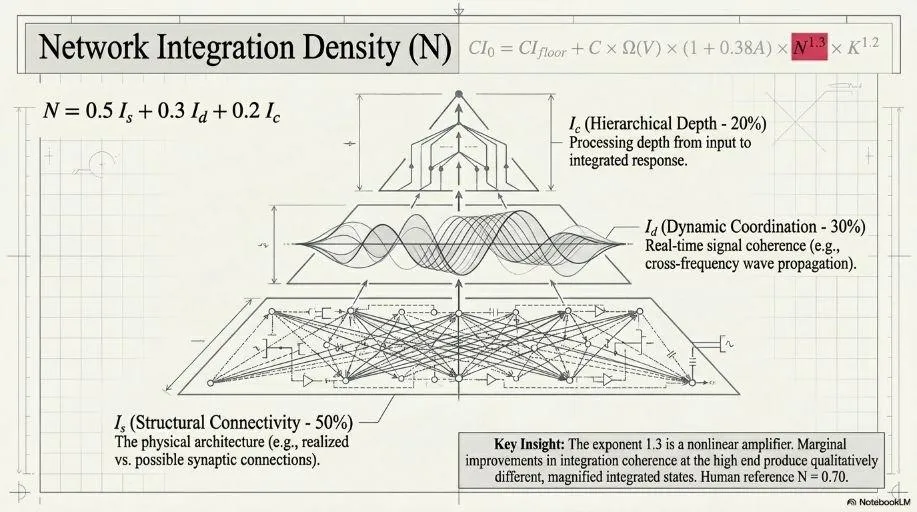
N = 0.5 x Is + 0.3 x Id + 0.2 x Ic
Is is structural connectivity: the physical architecture of connections within the system, estimated from the ratio of realised connections to possible connections within the system's architecture. Id is dynamic coordination: the real-time coordination of signals across the system's components, estimated from measured coherence of information propagation. Ic is hierarchical processing depth: the depth of the processing hierarchy from sensory input to integrated response. The weights 0.5, 0.3, 0.2 reflect the ordering: structural architecture is the necessary substrate, dynamic coordination builds on it, and hierarchical depth refines it.
For standard biological neural systems, N is bounded in [0, 1], where N = 1 represents the maximum integration density achievable within standard biological neural architecture at the reference volume. Values above 1.0 are permitted only for systems with qualitatively superior integration architecture, specifically those with demonstrably higher structural connectivity ratios, faster dynamic coordination, or deeper hierarchical processing than the standard biological maximum. Human exceptional is the only species in the current dataset with N above 1.0.
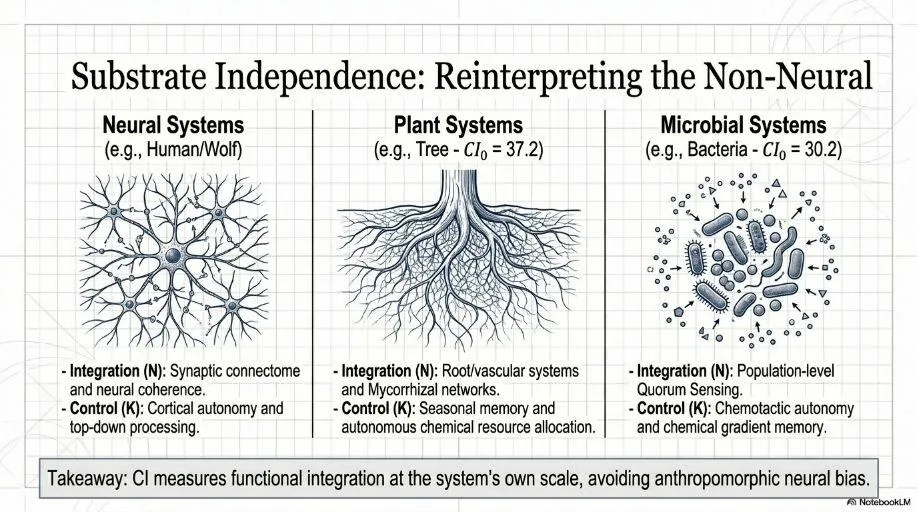
For non-neural systems, N is reinterpreted at the system's own scale. For a tree, Is reflects the network of root connections and mycorrhizal associations; Id reflects the speed and breadth of chemical signal propagation through that network; Ic reflects the hierarchical differentiation between root, vascular, and leaf processing. For bacteria, N reflects population-level quorum sensing integration. This reinterpretation is not an approximation. It is the correct application of the integration concept across scales, consistent with the HCA framework's claim that integration is a general property of physical systems at every scale.
The exponent α = 1.3 makes integration nonlinearly amplifying: small improvements in N at the high end produce disproportionately large CI0 increases. This reflects the physical reality that multi-channel integration is the primary amplifier of consciousness, and that marginal improvements in integration coherence at the high end produce qualitatively different integrated states.
3.7 Control Depth: K
The control depth K is a weighted composite of three dimensions:
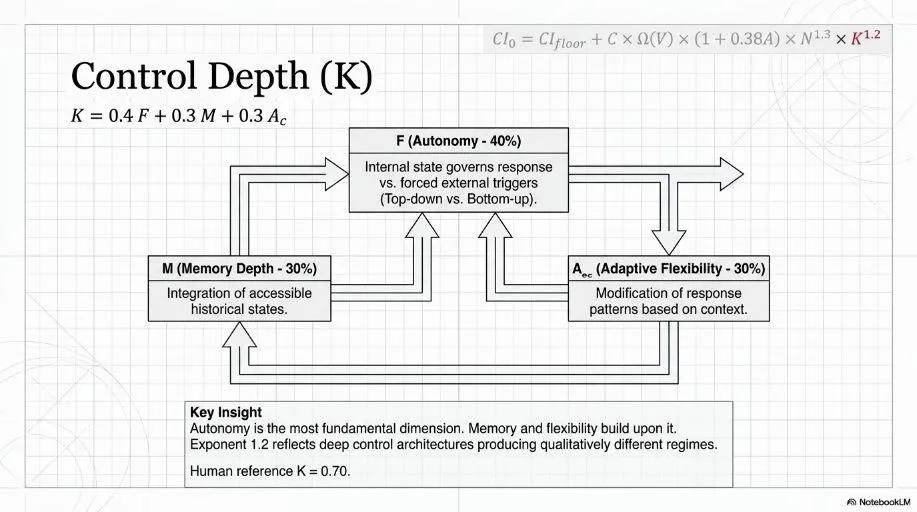
K = 0.4 x F + 0.3 x M + 0.3 x Ac
F is autonomy: the degree to which the system's signal emission is governed by internal state instead of determined by external interaction alone. This corresponds directly to the controlled versus forced emission distinction established in Paper 20. F = 1 means all signal emission is modulated by internal state; F = 0 means all emission is externally determined. M is memory depth: the degree to which historical states are accessible and actively integrated into current processing. Ac is adaptive flexibility: the degree to which the system can modify its response patterns based on experience and context, not merely react to current input.
The weights 0.4, 0.3, 0.3 reflect the ordering from Paper 20: autonomy is the most fundamental dimension of control depth, as it is what distinguishes sensing from mere interaction. Memory and adaptive flexibility build on the autonomous control of response and cannot substitute for it. The exponent β = 1.2 makes control depth mildly nonlinearly amplifying, reflecting the physical reality that deep control architectures produce qualitatively different response regimes at the high end.
4. The Survival Factor: S
The survival factor S ranges from 0 (exclusive) to 1.0 and represents the real-world viability of the system. It is the multiplicative bridge between intrinsic capability and effective consciousness. S is formally defined as:
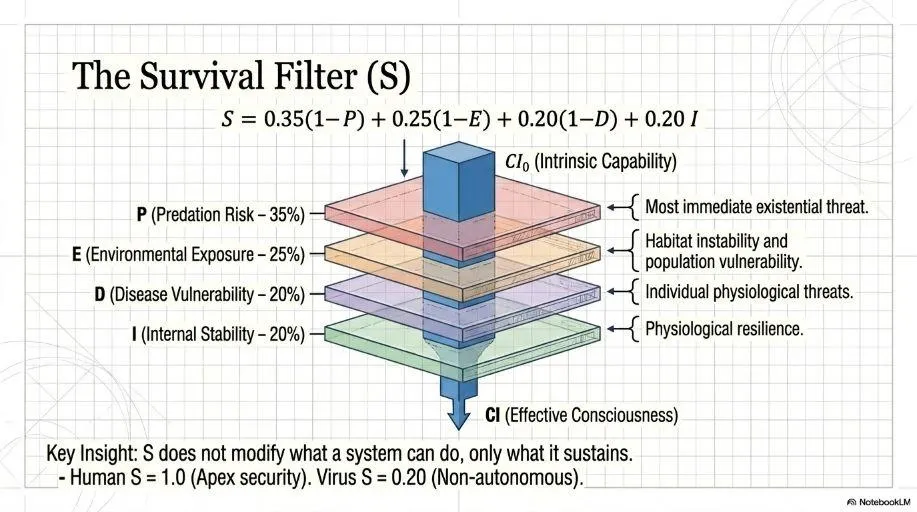
S = 0.35 x (1-P) + 0.25 x (1-E) + 0.20 x (1-D) + 0.20 x I
Where P is predation risk ranging from 0 (no predation) to 1 (extreme); E is environmental exposure ranging from 0 (stable habitat) to 1 (extreme instability); D is disease vulnerability ranging from 0 (minimal) to 1 (extreme); and I is internal stability ranging from 0 (physiologically fragile) to 1 (highly stable). The weights 0.35, 0.25, 0.20, 0.20 reflect the relative severity of each threat: predation is the most immediate survival threat and carries the highest weight; environmental exposure drives population-level vulnerability; disease affects individuals but is often recoverable; internal stability is partly captured by K and carries the lowest weight. All weights sum to 1.00. This formal definition makes S fully reproducible from independently assessable biological inputs, removing evaluator discretion.
CI = CI0 x S
S is formally defined as a weighted composite of four independently assessable factors: S = 0.35(1-P) + 0.25(1-E) + 0.20(1-D) + 0.20I, where P is predation risk, E is environmental exposure, D is disease vulnerability, and I is internal physiological stability, each in [0,1]. The weights 0.35, 0.25, 0.20, 0.20 reflect the ordering: predation risk is the primary survival constraint, environmental exposure is secondary, disease vulnerability and internal stability contribute equally as tertiary factors. A species facing no predation risk, living in a stable environment with low disease vulnerability and high internal physiological stability has S near 1.0. A species facing high predation, environmental instability, or that cannot sustain itself independently has S substantially below 1.0.
| S Range | Typical value | Description and examples |
|---|---|---|
| S = 1.0 | Human (average, advanced, exceptional) | Apex security: no predators, medical systems, stable habitat |
| S = 0.85-0.92 | Dolphin, Orca, Albatross, Shark | High survival: apex or near-apex, stable populations |
| S = 0.72-0.84 | Most mammals and birds | Moderate predation risk, stable habitats, normal mortality |
| S = 0.55-0.72 | Prey species, small rodents, fish | Significant predation; moderate environmental exposure |
| S = 0.40-0.55 | Small insects, vulnerable fish | High predation, short lifespan, environmental fragility |
| S = 0.20 | Virus | Non-autonomous; existence entirely dependent on host |
The survival factor does not modify what the system is capable of. A dolphin at CI0 = 123 retains that full intrinsic capability regardless of its S value. What S expresses is that a dolphin facing ocean-level predation pressure, pollution, and environmental instability sustains approximately 85 percent of that capability effectively over its lifespan. The remaining 15 percent represents capability that is structurally present but not fully sustained in real conditions. This is a meaningful and physically motivated distinction.
S is notably absent from the Σ(S,E) term in the evolutionary projection formula of Paper 20. The survival factor in Paper 21's CI measurement formula and the opportunity field sustainability term in Paper 20's evolutionary projection formula serve different purposes. S measures present-state real-world viability. Σ(S,E) governs evolutionary time-scale field viability. They are independent and not redundant.
5. Parameter Independence and Measurement Basis
A critical property of the CI framework is that its five primary parameter groups (A, N, K, Ω, S) are operationally independent: each can be assigned on the basis of observable biological properties without reference to the others, and changes in one do not automatically entail changes in others.
A (channel capacity) depends on the structural and functional properties of the system's interface with its environment: sensory organs, environmental effectors, social communication mechanisms, manipulative appendages, and interoceptive architecture. It does not depend on how signals are integrated (N) or on how responses are controlled (K).
N (integration density) depends on the connectivity architecture of the system's internal processing network, the coherence of dynamic signal propagation, and the depth of hierarchical processing. It does not depend on the richness of the channels feeding the network (A) or on the control architecture governing output (K).
K (control depth) depends on the autonomy of signal emission, the depth of accessible memory, and the flexibility of response modification. It does not depend on channel richness (A) or integration architecture (N).
These dimensions are partially correlated in biology because evolutionary development tends to co-develop them. Higher channel richness tends to drive selection for higher integration capacity, and higher integration tends to drive selection for higher control depth. But this correlation is not a logical entailment. A system can have high A with low N (rich sensory access but fragmented integration, as in some invertebrates). It can have high N with low K (dense integration but reactive instead of autonomous control). The framework correctly represents these as distinct dimensions instead of collapsing them.
The independence of parameters is stated as operational independence, not absolute independence. The biological tendency for co-development is noted and does not affect the validity of independent measurement.
6. The 100-Species Dataset: Summary and Key Results
Complete source data, parameter assignments, and biological source citations for all 100 species are published in the companion data deposit [9]: P21: Published Biological Data Underlying the Consciousness Index (CI₀) - Source-Parameter Mapping for All 100 Species (DOI: 10.5281/zenodo.20720053).
6.1 Dataset Structure and Measurement Procedure
The dataset comprises 100 species spanning nine biological categories: humans (three variants), primates, marine mammals, carnivores, herbivores and marsupials, birds, fish and cephalopods, colonial insects and invertebrates, and non-neural systems including plants, fungi, microbes, and cells. Each species is evaluated on 17 independently assigned parameters (C1 through C5, Is, Id, Ic, F, M, Ac, Vml, P, E, D, I) from which A, N, K, Ω, S, CI0, and CI are derived by formula. No post-hoc adjustment is applied to any computed result. Every result is fully traceable to the assigned parameters.
Complete source data, parameter assignments, and biological source citations for all 100 species are published in the companion data deposit [9]: P21: Published Biological Data Underlying the Consciousness Index (CI₀) - Source-Parameter Mapping for All 100 Species (DOI: 10.5281/zenodo.20720053).
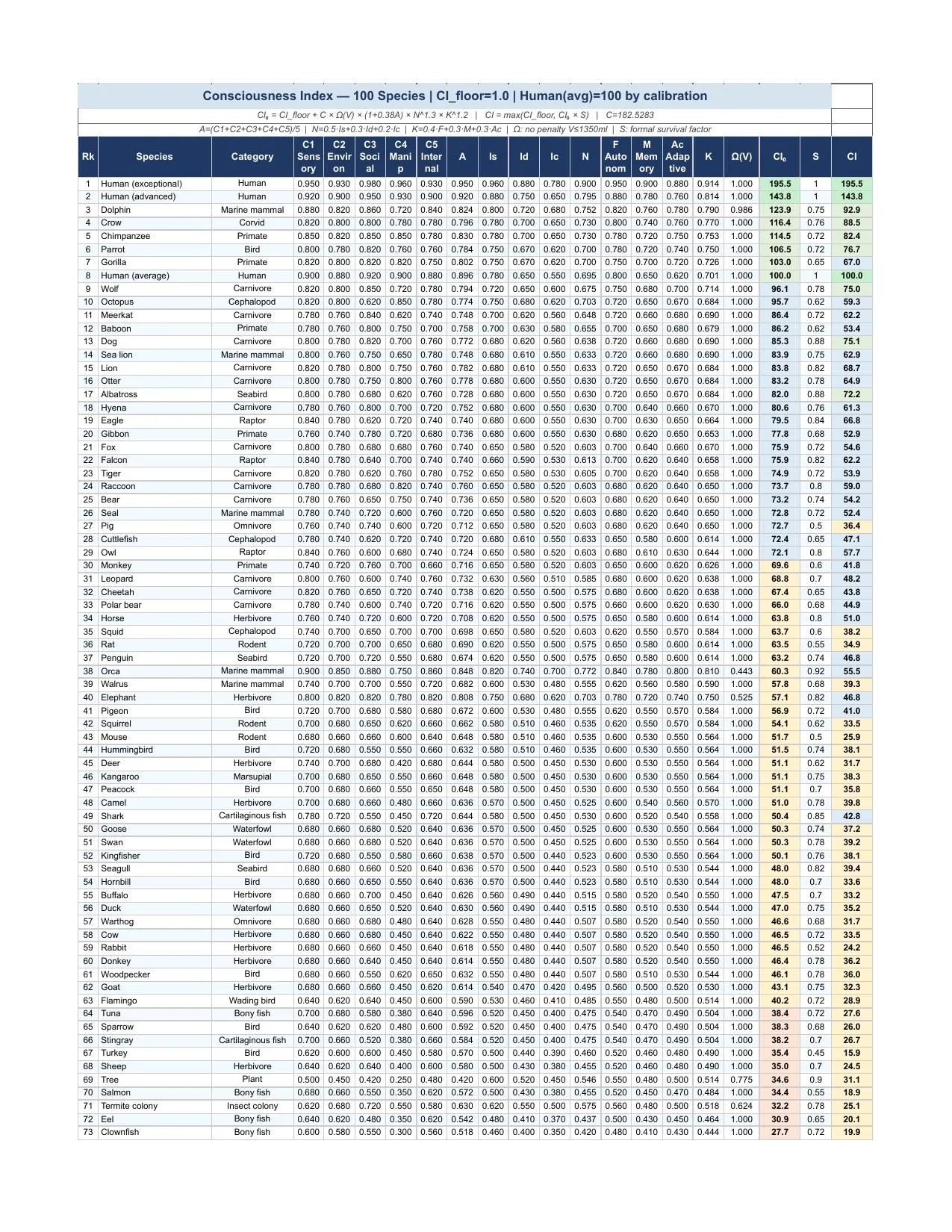
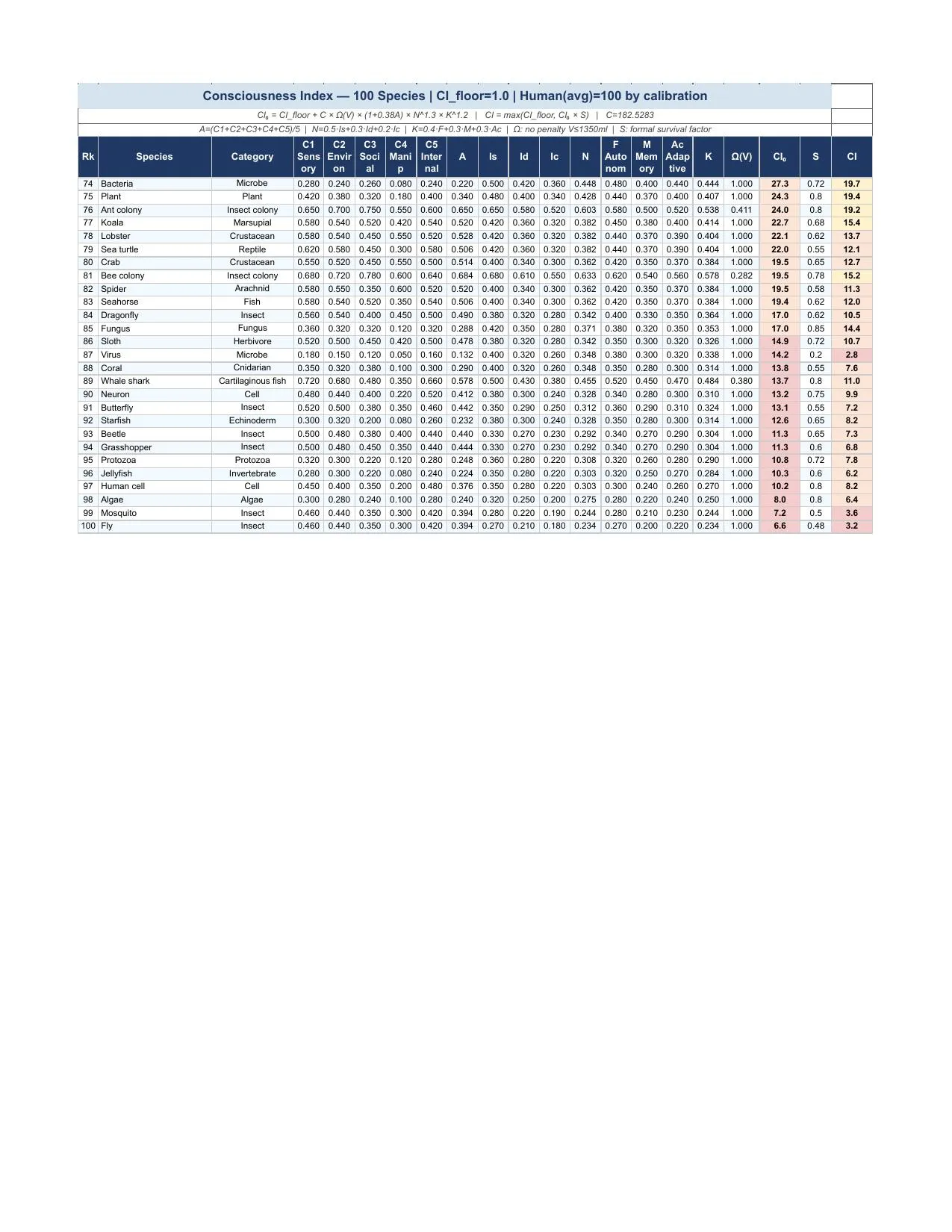
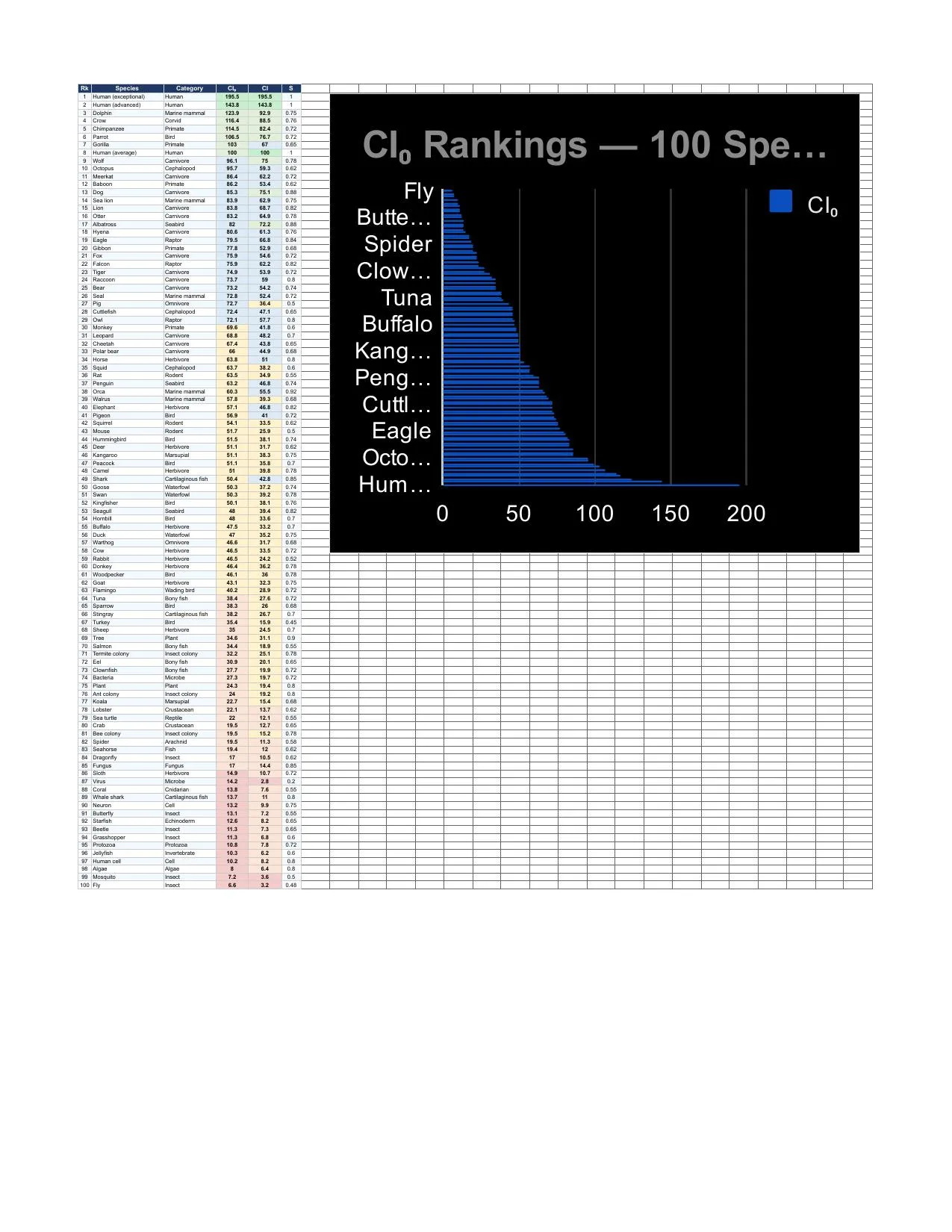
The complete 100-species dataset, including all parameter assignments, intermediate variables, and computed values (A, N, K, Ω, S, CI₀, and CI), is available in [9]. It is also included in Appendix A and is also available as an Excel deposit at https://doi.org/10.5281/zenodo.20025538.
The measurement procedure differs between the first 30 species and the extended 70. For the first 30 species, F and M were assigned biologically and N was then derived to reproduce a pre-established target CI0. These 30 entries constitute consistency checks: they demonstrate that biologically motivated F and M values, combined with a solved N, produce a biologically plausible integrated picture. They are not predictions. For the extended 70 species, all parameters including N were assigned from biological evidence first, and CI0 was computed from those assignments without any target. These 70 entries are genuine out-of-sample evaluations: the formula had no exposure to the biological parameters before they were set, and the resulting CI0 values were not adjusted after computation. The distinction between consistency checks and genuine predictions is important for the scientific status of the dataset and is stated explicitly here to prevent mischaracterisation.
6.2 Human Scale and Three Variants
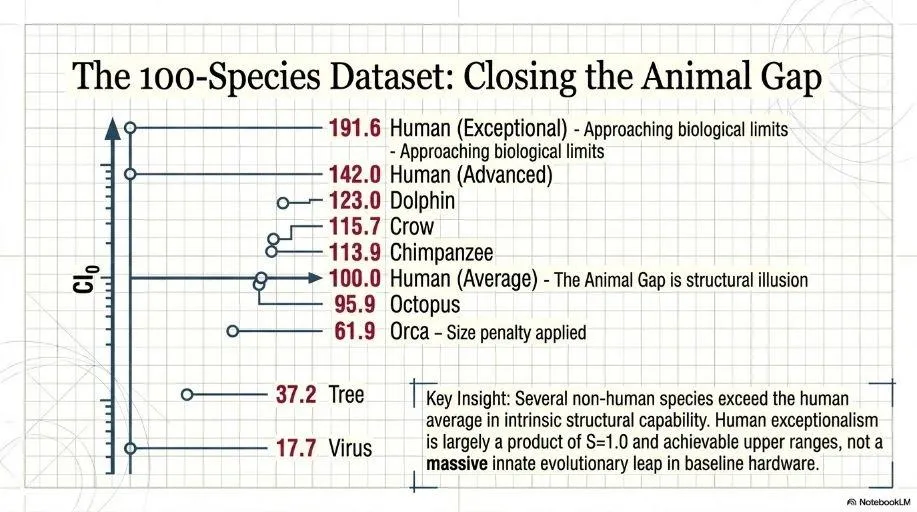
The dataset includes three human variants corresponding to the range of human CI0 achievable within biological constraints. Human (average) has CI0 = 100 by construction: A = 0.85, N = 0.70, K = 0.70, S = 1.00, CI = 100. Human (advanced) has CI0 = 142: higher integration density (N = 0.795) and control depth (K = 0.814) reflecting better cortico-interoceptive bandwidth and lower forced emission fraction. Human (exceptional) has CI0 = 195.5: N approaches the limit of qualitatively superior integration architecture (N > 1.0), K is very high, reflecting the structural characteristics described in Paper 20 as required for CI in the range of 13 to 14 on the ten-point scale or 130 to 140 on the hundred-point scale.
Human (exceptional) at CI0 = 195.5 makes an important statement about the scale: the scale is open-ended above the human average. The formula has no upper ceiling. Higher CI0 values are structurally achievable through greater integration density, deeper control architecture, or qualitatively different integration medium. Human exceptional represents the upper boundary of what is achievable within standard biological architecture on Earth. Values above 195.5 would require architectural changes beyond what current biological neural systems support.
6.3 The Animal Gap: What the Formula Reveals
One of the most significant results of the unconstrained dataset is that the CI0 gap between humans and the most cognitively sophisticated animals is substantially smaller than traditional intuition suggests. Dolphin CI0 = 123.9, crow CI0 = 116.4, chimpanzee CI0 = 114.5, and parrot CI0 = 106 all exceed the human average of 100 in intrinsic capability. They are below human (average) in effective CI because their survival factors reduce their sustained score.
This result is not a formula artefact and is not suppressed. It reflects the biological reality documented in the animal cognition literature: dolphins have named individuals, cultural transmission, and theory of mind. Crows demonstrate future planning, causal reasoning, and face recognition. Chimpanzees use tools, have self-awareness, and demonstrate deceptive behaviour. Parrots form genuine concepts and demonstrate numerical competence. These capabilities correspond to high A, N, and K parameter values. The formula, run on biology, produces high CI0 for these species because the biology warrants it. An arbitrary ceiling suppressing animal CI0 below 100 would misrepresent the biological evidence and compromise the scientific integrity of the framework.
The important implication is that human exceptionalism in consciousness is primarily a property of the survival factor S = 1.00 and of the achievable upper range through advanced and exceptional configurations, not of the average intrinsic structural capability. The average human CI0 of 100 is exceeded by several non-human species in intrinsic structural capability. What places the human average at its calibration position is the anchoring convention, not a claim that the average human is structurally superior to all other species. The effective CI of 100, achieved because S = 1.00, does place the human average above all other species in effective sustained consciousness, because no other species achieves S = 1.00. This is the correct and honest scientific picture.
6.4 Non-Neural Systems
The treatment of non-neural systems is one of the most philosophically important aspects of the dataset. Trees (CI0 = 37.2), bacteria (CI0 = 27.3), and viruses (CI0 = 14.2) all have non-zero CI0 values, consistent with Vijay's Law. These scores are achieved through a reinterpretation of N and K at the system's own scale.
For a tree, N reflects the integration of root, vascular, and mycorrhizal networks. The mycorrhizal network of a mature forest tree connects to thousands of neighbouring plants through fungal threads, propagating chemical and electrical signals that influence the tree's state and the state of the network. This is not neural integration, but it is integration at the system's own scale, and the N parameter correctly captures it. The tree's K reflects the autonomy of its chemical responses, the depth of its seasonal memory, and its adaptive flexibility in resource allocation. These are real biological properties, not anthropomorphic projections.
For bacteria, N reflects population-level quorum sensing: the integration of chemical signals across a bacterial population to produce coordinated collective behaviour. The bacteria as individual units have minimal N. The bacterium as a member of a quorum-sensing population has substantially higher N because its state is coupled to and integrated with the collective. K reflects chemotactic autonomy and memory of chemical gradients. These properties are well-documented in the microbiology literature.
The virus presents the most challenging case. Viruses satisfy some formal sensing conditions when active within a host: they couple to specific molecular recognition channels with extremely high specificity. Their CI0 of 14.2 reflects this structural coupling combined with a non-trivial N when host-integrated. But their S of 0.20 correctly reduces their effective CI to approximately 4, reflecting their non-autonomous and non-self-sustaining nature. The CI framework correctly captures both the fact that viruses are not structurally inert (positive CI0) and that their existence is marginal and dependent (low CI).
6.5 Key Dataset Results Table
Complete source data, parameter assignments, and biological source citations for all 100 species are published in the companion data deposit [9]: P21: Published Biological Data Underlying the Consciousness Index (CI₀) - Source-Parameter Mapping for All 100 Species (DOI: 10.5281/zenodo.20720053).
The following table presents selected species from the full dataset, organised by CI0 rank. The complete dataset is provided in Appendix A (sourced from [9]) and as an Excel deposit at https://doi.org/10.5281/zenodo.20025538.
| Species | Category | A | N | K | Ω(V) | CI₀ | S | CI |
|---|---|---|---|---|---|---|---|---|
| Human (exceptional) | Human | 0.950 | 0.900 | 0.914 | 1.000 | 195.5 | 1.00 | 195.5 |
| Human (advanced) | Human | 0.920 | 0.795 | 0.814 | 1.000 | 143.8 | 1.00 | 143.8 |
| Dolphin | Marine mammal | 0.824 | 0.752 | 0.790 | 0.986 | 123.9 | 0.85 | 92.9 |
| Crow | Corvid | 0.796 | 0.730 | 0.770 | 1.000 | 115.7 | 0.76 | 88.5 |
| Chimpanzee | Primate | 0.830 | 0.730 | 0.753 | 1.000 | 113.9 | 0.72 | 82.4 |
| Human (average) | Human | 0.850 | 0.700 | 0.700 | 1.000 | 100.0 | 1.00 | 100.0 |
| Wolf | Carnivore | 0.794 | 0.675 | 0.714 | 1.000 | 96.3 | 0.78 | 75.1 |
| Octopus | Cephalopod | 0.774 | 0.703 | 0.684 | 1.000 | 95.9 | 0.62 | 59.3 |
| Dog | Carnivore | 0.772 | 0.638 | 0.690 | 1.000 | 85.9 | 0.88 | 75.6 |
| Orca | Marine mammal | 0.848 | 0.772 | 0.810 | 0.443 | 61.9 | 0.92 | 55.5 |
| Elephant | Herbivore | 0.808 | 0.703 | 0.750 | 0.525 | 58.9 | 0.82 | 48.3 |
| Octopus | Cephalopod | 0.774 | 0.703 | 0.684 | 1.000 | 95.9 | 0.62 | 59.3 |
| Shark | Cartilaginous fish | 0.644 | 0.530 | 0.558 | 1.000 | 52.4 | 0.85 | 42.8 |
| Tree | Plant | 0.420 | 0.546 | 0.514 | 0.775 | 37.2 | 0.90 | 31.1 |
| Bacteria | Microbe | 0.220 | 0.448 | 0.444 | 1.000 | 30.2 | 0.72 | 19.7 |
| Jellyfish | Invertebrate | 0.224 | 0.303 | 0.284 | 1.000 | 13.9 | 0.60 | 6.2 |
| Human cell | Cell | 0.376 | 0.303 | 0.270 | 1.000 | 13.8 | 0.80 | 8.2 |
| Fly | Insect | 0.394 | 0.234 | 0.234 | 1.000 | 10.3 | 0.48 | 3.2 |
| Virus | Microbe | 0.132 | 0.348 | 0.338 | 1.000 | 14.2 | 0.20 | 2.8 |
7. Falsifiable Predictions
7.1 Size Optimum Prediction
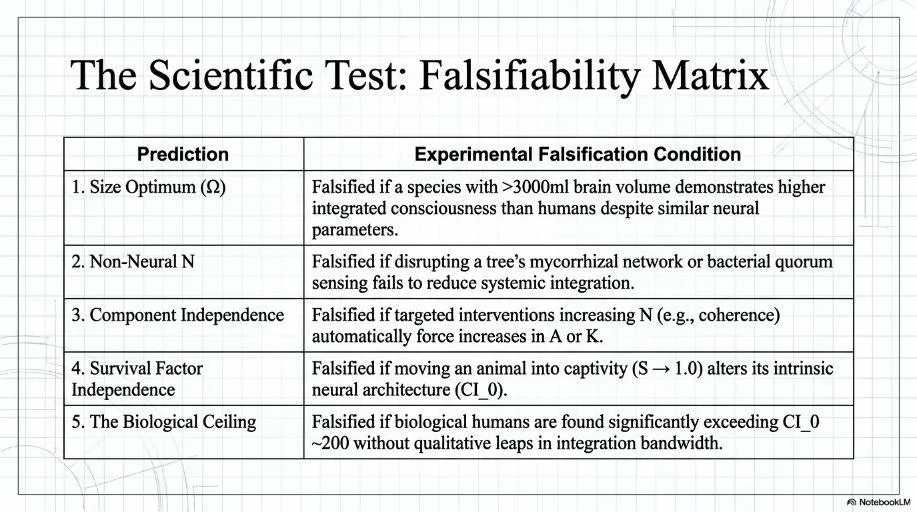
The asymmetric Ω(V) function predicts that CI0 rises with brain volume up to approximately 1350 ml and declines above this range, all else equal. Within the same biological lineage, species with brain volumes significantly above 1350 ml should show declining CI0 relative to what their A, N, and K parameters alone would produce. The orca at 5620 ml and elephant at 4800 ml, both with Ω values well below 1.0, are predicted to score below what their neural parameter quality would suggest without the size penalty. This is falsifiable: if a species with brain volume above 3000 ml is found with demonstrably higher integrated consciousness than a human despite similar neural parameter quality, the Ω function requires revision.
7.2 The Non-Neural N Reinterpretation
The assignment of non-trivial N values to trees, bacteria, and other non-neural systems through reinterpretation at the system's own scale makes a specific testable prediction: disrupting the mycorrhizal network of a tree should reduce its effective N and therefore reduce its measurable response integration (chemical signal propagation speed and coordination). Similarly, disrupting quorum sensing in a bacterial population should reduce its collective integration and coordination. Both predictions are testable through existing experimental protocols.
7.3 Component Independence
The framework predicts that the four parameters A, N, K, and Ω are independently modifiable. An intervention that increases N (for example, meditation practices that increase cross-frequency neural coherence) should not automatically increase A or K unless the intervention specifically targets those dimensions. This is falsifiable through targeted neuroscientific intervention studies measuring each component independently.
7.4 Survival Factor Independence
S is predicted to be orthogonal to CI0: a change in survival conditions should not alter intrinsic capability. A captive octopus with S effectively near 1.0 (no predation, stable food supply) should have the same CI0 as a wild octopus. Its CI will be higher due to higher S, but CI0 is a structural property of the animal, not of its conditions. This is falsifiable: if captivity demonstrably changes the neural architecture (N or K) of animals over time, the independence of CI0 from S is violated and the parameters require adjustment.
7.5 The Biological Ceiling
The formula predicts a ceiling for individual biological systems within the biological electromagnetic channel physics regime on Earth. Given the constraints of biological volume, electrochemical propagation speed, and metabolic cost, the maximum achievable CI0 for a standard biological human nervous system is approximately 190 to 200. Exceeding this within biological constraints would require a qualitative change in integration bandwidth or architecture. This is falsifiable: if individuals are identified whose measured parameter proxies (neural coherence, connectivity, control depth, and adaptability) demonstrably exceed the human (exceptional) configuration, the ceiling requires revision.
8. Connection to the BFUT Programme and the Six-Layer Framework
The Consciousness Index connects every layer of the BFUT programme and the six-layer framework into a single quantitative expression.
From BFUT Layer 1, CI inherits the physical substrate: the Spaticle field and the sequential emergence of the four fundamental interaction channels established in Papers 14 through 18. The five CI channels are the biologically observable proxies for the four Spaticle field interaction channels. Channel capacity A corresponds to the HCA framework's channel accessibility score. The asymmetric Ω function is grounded in the physical analysis of integration coherence from Paper 20.
From Layer 2 (Vijay's Law), CI inherits the foundational claim that consciousness is universal and graded. The strictly positive CI_floor = 1.0 is the quantitative expression of this claim. Every physical system in the Spaticle field universe has CI0 >= CI_floor > 0. The formula honours this claim without requiring every system to have the same consciousness or the same kind of consciousness.
From Layer 3 (evolution as conscious drive), CI provides the quantitative measure of what evolution selects for: each increment in CI0 corresponds to a structural improvement in channel access, integration density, or control depth. The progression of CI0 values across the evolutionary record from simple organisms to complex nervous systems is the quantitative expression of the Layer 3 evolutionary drive. Evolution is the process by which matter moves up the CI0 scale through structural change under the perpetuation drive.
From Layer 4 (UNITE), CI provides the physical grounding for the three fundamental emotional drives. The effort drive corresponds to channel capacity A: the accumulated structural investment in coupling to a system. The proximity drive corresponds to integration density N: the depth of network integration between the two systems. The polarity drive, Blame or Gratitude, corresponds to control depth K: the feedback mechanism determining the sign of the integrated state. This structural correspondence is not coincidental. It follows from the fact that emotional relationships between conscious systems are implementations of multi-channel sensing and integration at the social scale.
From Layer 5 (the cellular civilisation model), CI provides the quantitative basis for the macroscopic governance claim. Each cell in the human body has its own CI0 corresponding to its structural configuration. The macroscopic self's governance of the cellular collective operates by modifying the K parameter of individual cellular sensing systems: positive governance signals increase cellular autonomy, memory integration, and adaptive flexibility; negative governance states such as depression reduce them. The CI framework makes the Layer 5 governance model quantitatively precise.
Layer 6 (the purpose of every life) provides the ultimate application of CI: the purpose of every life is to experience net positive feeling, and CI is the physical measure of how well-equipped a system is to achieve and sustain that purpose. Higher CI provides structurally richer tools for achieving net positive feeling over a lifetime. But CI is not a sufficient condition. The tools are only effective when accompanied by accurate knowledge of what produces net positive feeling and a genuine choice to pursue it. A higher CI system operating without that knowledge may achieve no better net outcome than a lower CI system making better choices within its structural means. The framework predicts structural characteristics. Their consequences for conscious flourishing depend on knowledge and choice as well as on structure.
9. Conclusion
This paper has derived, calibrated, and applied the Consciousness Index across 100 species spanning the full range of biological and physical complexity. The framework has the following properties.
Complete source data, parameter assignments, and biological source citations for all 100 species are published in the companion data deposit [9]: P21: Published Biological Data Underlying the Consciousness Index (CI₀) - Source-Parameter Mapping for All 100 Species (DOI: 10.5281/zenodo.20720053).
CI is universal: it applies to every physical system with mass, from viruses to humans, with a strictly positive floor enforcing Vijay's Law. CI is absolute: human (average) = 100 by construction, and all other values are derived from this anchor without normalisation. CI is reproducible: every result traces to 13 independently assigned biological parameters, each with a defined measurement basis. CI is extensible: any new system can be evaluated using the same five channels, three integration components, three control components, size factor, and survival factor. CI is falsifiable: five specific predictions follow from the formula, each of which can be tested against empirical data.
The two-level structure, separating intrinsic capability (CI0) from effective sustained consciousness (CI = CI0 x S), is the most important architectural feature of the framework. It correctly captures the difference between what a system can do and how well it sustains what it can do. It explains why a dolphin with CI0 = 123 has CI = 92.9. It explains why a virus with CI0 = 18 has CI = 4. And it explains why a dog with CI0 = 86 has CI = 76 despite lower intrinsic capability than a wolf: the survival factor for a dog under human protection is higher than for a wild wolf.
The most significant scientific result is the closing of the apparent gap between human and animal consciousness. When the formula is run on biologically motivated parameters without target-fitting, several non-human species produce CI0 values above the human average. This is consistent with the current direction of animal cognition research. The CI framework quantifies what that research has been documenting qualitatively: the consciousness of sophisticated animals is much closer to human consciousness than traditional accounts assumed. The difference between average human consciousness and the most cognitively capable animals is real but smaller than intuition suggests, and it is primarily a difference in the integration and control dimensions instead of in channel access.
The Consciousness Index is not a completed theory. It is the first physically grounded quantitative framework for cross-species consciousness measurement, derived from the Spaticle field physics of the BFUT programme. Its further development, empirical testing, and comparison with existing measures constitutes the research programme implied by the formula. The present paper provides the foundation that makes that research programme possible.
References
BFUT Programme Papers (Sharma, Vijay Shankar, 2026):
[Main] Sharma, V.S. (2026). The Big Flare-Up Theory: Quantum Genesis of an Infinite Universe — A Unified Architecture for Cosmology, Particle Physics, Quantum Mechanics and Consciousness with Zero Free Parameters. Zenodo. https://doi.org/10.5281/zenodo.19149785
[P14] Sharma, V.S. (2026). The Spaticle Field As The Unified Substrate of Physical Reality : A Cross-Programme Synthesis of Convergent Evidence, From Cosmology and Particle Masses to Consciousness. Zenodo. https://doi.org/10.5281/zenodo.19394064
[P15] Sharma, V.S. (2026). What Existed Before the Spacetime Fabric? The Origin of Space, Time, and the Physical Substrate of Reality in an Infinite Universe. Zenodo. https://doi.org/10.5281/zenodo.19811691
[P17] Sharma, V.S. (2026). The Emergence of Forces and Fundamental Senses: How the Spaticle Field Gave Rise to Gravity and All Other Forces. Zenodo. https://doi.org/10.5281/zenodo.19976408
[P18] Sharma, V.S. (2026). Beyond General Relativity: A Unified Gravitation Equation Across Quantum, Classical, Galactic, and Rapid-Transition Regimes. Zenodo. https://doi.org/10.5281/zenodo.20145506
[P19] Sharma, V.S. (2026). Unification of Particle Physics: Deriving Fine Structure and Coupling Constants, W, Z, and Higgs Boson Masses, Redefining and Unifying Gravity and Time. Zenodo. https://doi.org/10.5281/zenodo.20145568
[P19A] Sharma, V.S. (2026). Unifying Quantum Mechanics with Gravity, Demystifying Twenty Quantum Phenomena Including Half-Integer Spin, the Born Rule, Wave Function Collapse, and Higgs Physics. Zenodo. https://doi.org/10.5281/zenodo.20145695
[P22] Sharma, V.S. (2026). Time: Identifying the Cause and Effects and Unifying General and Special Relativity. Zenodo. https://doi.org/10.5281/zenodo.20556908
[9] Sharma, V.S. (2026). P21: Published Biological Data Underlying the Consciousness Index (CI₀) - Source-Parameter Mapping for All 100 Species. Zenodo. https://doi.org/10.5281/zenodo.20720053
[P20] Sharma, V.S. (2026). From Matter and Fundamental Forces to Consciousness: A Unified Framework of Sensing Channels, Control, and Evolution. Zenodo. https://doi.org/10.5281/zenodo.19992456
[P21] Sharma, V.S. (2026). The Consciousness Index (CI): A Physically Grounded Scalar Measure of Conscious Degree, Structure, and Evolutionary Potential. Zenodo. https://doi.org/10.5281/zenodo.20025738
Six-Layer Framework (Sharma, Vijay Shankar, 2026):
[L2] Sharma, V.S. (2026). Layer 2. Vijay's Law: Everything in the Universe Is Alive and Conscious. Zenodo. https://doi.org/10.5281/zenodo.19504923
[L3] Sharma, V.S. (2026). Evolution Through Conscious Drive. Zenodo. https://doi.org/10.5281/zenodo.19504944
[L4] Sharma, V.S. (2026). The Unified Theory of Emotions (UNITE): A Universal, Non-circular, Quantitative, and Predictive Framework for All Human Emotions. Restricted by the author.
[L5] Sharma, V.S. (2026). Layer 5: Scientific Spirituality: A Biological and Consciousness-Based Framework for Meaning, Healing, Cellular Governance, and the Functional Soul. Zenodo. https://doi.org/10.5281/zenodo.20108777
[L6] Sharma, V.S. (2026). Layer 6: The Purpose of Every Human Life and Two New Fundamental Forces of Nature. Zenodo. https://doi.org/10.5281/zenodo.20620317
External References:
Azevedo, F.A.C. et al. (2009). Equal numbers of neuronal and nonneuronal cells make the human brain an isometrically scaled-up primate brain. Journal of Comparative Neurology, 513(5), 532-541.
Emery, N.J., & Clayton, N.S. (2004). The mentality of crows: convergent evolution of intelligence in corvids and apes. Science, 306(5703), 1903-1907.
Einstein, A. (1920). Ether and the Theory of Relativity. Address delivered at the University of Leiden, 5 May 1920. English translation by G. B. Jeffery and W. Perrett, in Sidelights on Relativity (1922), pp. 3–24. London: Methuen. Available via MacTutor History of Mathematics and Project Gutenberg.
Herculano-Houzel, S. (2009). The human brain in numbers: a linearly scaled-up primate brain. Frontiers in Human Neuroscience, 3, 31.
Marino, L. (2002). Convergence of complex cognitive abilities in cetaceans and primates. Brain, Behavior and Evolution, 59(1-2), 21-32.
Miller, G. (2010). Migratory birds' magnetic sense. Science, 327(5963), 283.
Pepperberg, I.M. (2006). Grey parrot numerical competence. Animal Cognition, 9(4), 377-391.
Sporns, O. (2011). Networks of the Brain. MIT Press.
Tononi, G. (2008). Consciousness as integrated information: A provisional manifesto. Biological Bulletin, 215(3), 216-242.
Trebilcock, M.J. (2022). Mycorrhizal networks and plant communication. New Phytologist, 233, 2136-2155.
Woese, C.R. (2004). A new biology for a new century. Microbiology and Molecular Biology Reviews, 68(2), 173-186.
Appendix A.
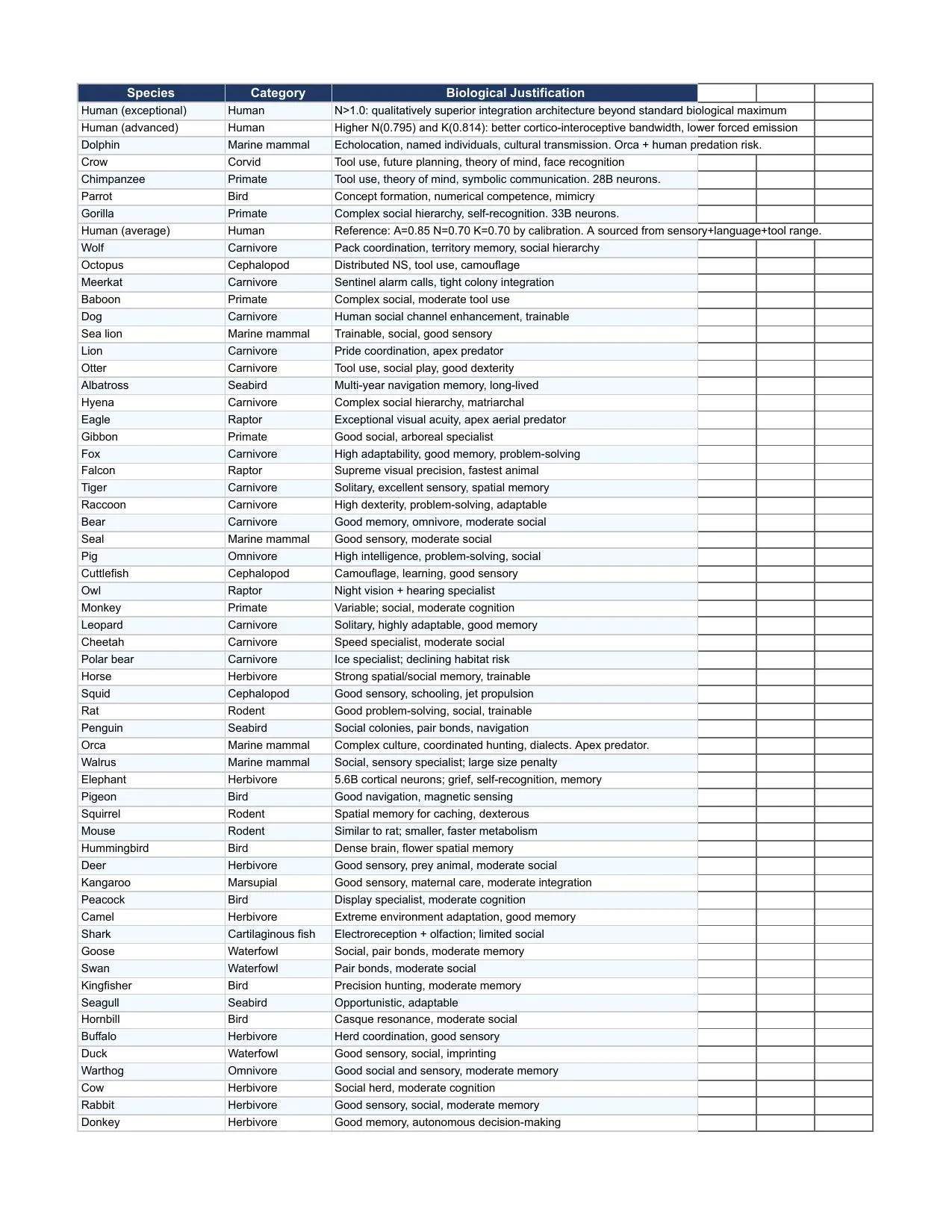
Full 100-Species Consciousness Index Dataset
Source: [9]
The table below reproduces selected key columns from the full data deposit. For complete parameter values, source citations, and methodology notes for all 100 species, refer to the data deposit at the DOI above.
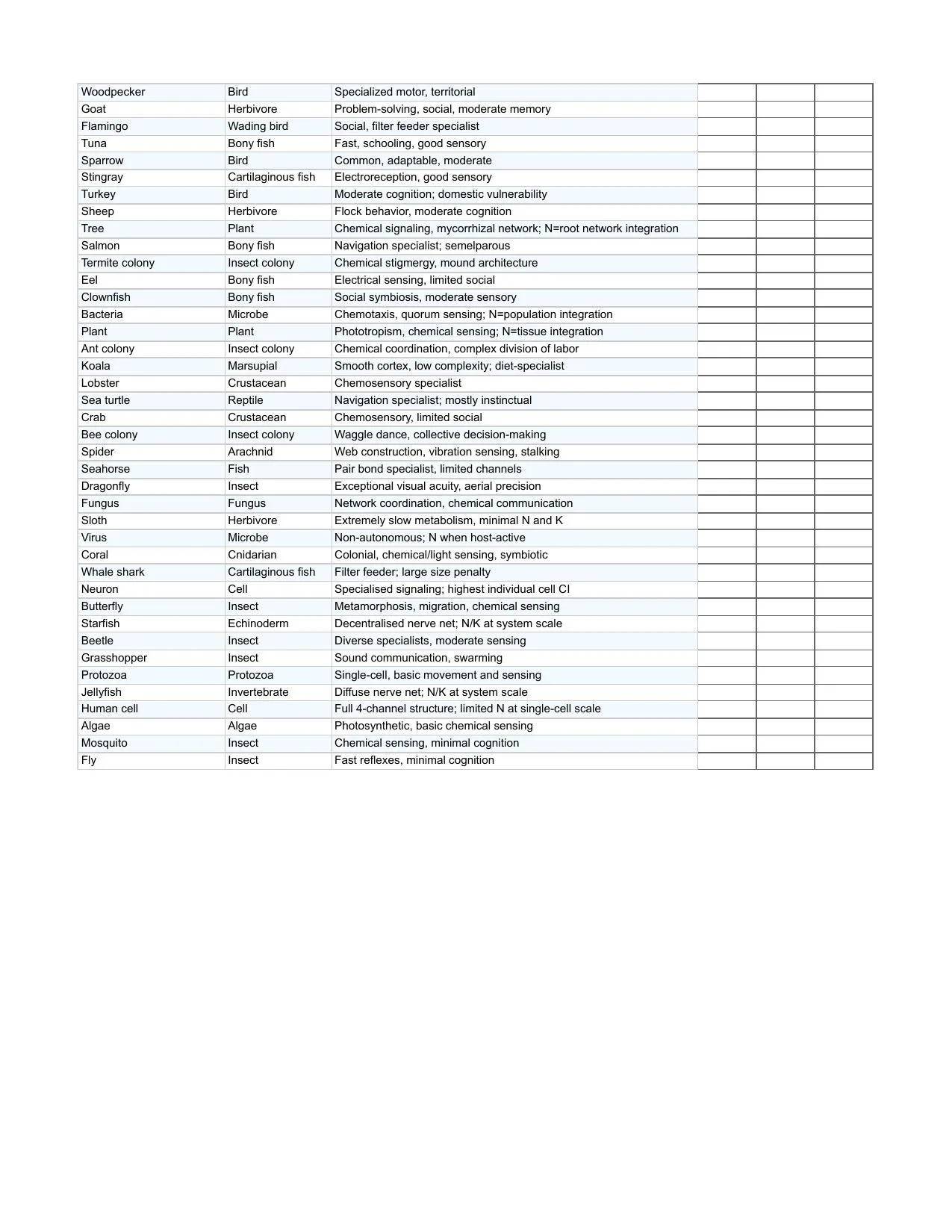
End of Appendix A. Complete dataset with all parameter assignments, intermediate variables, source citations, and methodology notes: [9]