From Matter and Fundamental Forces to Consciousness
- Abstract
- 1. Introduction and Programme Context
- 2. The Governing Interaction Framework
- 3. The Hierarchical Channel Accessibility Law
- 4. Controlled Versus Forced Signal Emission
- 5. Channel-Level State-Change Effective Representations
- 6. The Structural Inclusion Principle: Five Demonstrations
- 7. Evolution as Channel Expansion Under Conscious Drive
- 8. Consciousness as Graded Multi-Channel Integration
- 9. Falsifiable Predictions of the HCA Framework
- 10. Existing Theories Inconsistent With or Incomplete Under This Framework
- 11. Theories That Partially Converge and Are Completed by This Framework
- 12. A Worked Numerical Example: Photoreceptor Sensing
- 13. Experimental Proposals
- 14. Closing the BFUT Programme: The Completed Arc
- 15. Conclusion
- References
Abstract
Physics describes the universe through fundamental forces and interactions. Biology describes systems through sensing, signalling, regulation, and adaptation. These two descriptions coexist without being unified at the level of mechanism. There is no widely accepted account of how interaction becomes sensing, how sensing becomes capability, and how capability scales into consciousness and biological evolution. This paper provides that account.
The framework proceeds from two prior foundations. The Big Flare-Up Theory (BFUT, Layer 1) established that the physical substrate of spacetime is the Spaticle field, from which the four fundamental interaction channels emerge sequentially, each requiring a different level of structural complexity. Vijay's Law (Layer 2) established that all systems in the universe exhibit a non-zero degree of consciousness, that consciousness is a fundamental property of all matter expressed differently at different scales, and that what physics describes as forces and interactions are the elementary expressions of consciousness at the atomic and subatomic scale. The present paper, BFUT Paper 20, provides the formal physical mechanism connecting these two claims.
The Big Flare-Up Theory (BFUT) identifies the physical fabric of space as the Spaticle field, a non-particulate substrate of equilibrium density ρ_s = 5.9 × 10⁻²⁷ kg/m³. This framework has been developed across over 30 papers covering cosmology, particle physics, gravitation, quantum mechanics, and consciousness. All results derive from ρ_s and the independently measured proton charge radius rp = 0.8414 fm (PDG 2022) with no free parameters.
The central result is the Hierarchical Channel Accessibility (HCA) framework, comprising four interlocking components. First, a formal three-condition definition of sensing that distinguishes sensing from mere interaction through structural coupling, information-specific state change, and state persistence. Second, the HCA Law: a system can exhibit a capability only if it possesses the structural configuration required to couple to the interaction channels that implement that capability, with access to higher-order channels implying all lower-order structural prerequisites. Third, the Structural Inclusion Principle: the presence of a higher-order sensing capability implies the structural presence of all lower-order channel prerequisites. Fourth, the distinction between controlled and forced signal emission as the physically grounded separator between systems that merely interact and systems that actively sense.
The paper introduces the Consciousness Index (CI), a physically grounded scalar measure of the degree of consciousness derivable from the Spaticle field channel structure, addressing limitations of existing measures such as Tononi's φ by grounding the measure in a physical substrate derivation. The paper also derives the governing state-change functional dS/dt consistent with the Spaticle field Lagrangian, provides worked channel-level effective representations with biological examples, demonstrates the Structural Inclusion Principle across five sensing modalities with suppression tests, states five falsifiable predictions, connects the framework to Layer 2 (consciousness as fundamental), Layer 3 (evolution as channel expansion under conscious drive), and Layer 5 (the cellular civilisation and governance model). Consciousness is defined as the integrated multi-channel state of a system with feedback and memory, graded continuously from the gravitational coupling of a single atom to the full multi-channel integration of a mammalian nervous system. This paper is the final paper in the BFUT programme and closes the arc from the physical substrate of spacetime to the emergence of life, consciousness, and evolution within a single unified derivation.
Keywords: Hierarchical Channel Accessibility, Vijay's Law, BFUT, Spaticle field, sensing, consciousness, capability, controlled emission, structural inclusion, evolution, channel hierarchy, biological sensing, HCA Law, physical basis of consciousness, Layer 2, Layer 3, Layer 5
1. Introduction and Programme Context
The six-layer unified framework of reality developed by the present author proceeds from a single governing principle established in Layer 2: Vijay's Law. That law holds that all systems in the universe exhibit a non-zero degree of consciousness; that consciousness is a fundamental property of all matter expressed differently at different scales and under different conditions of stability; and that what physics describes as forces and interactions are the elementary expressions of consciousness at the atomic and subatomic scale.
Layer 1 (BFUT) established the physical substrate of spacetime as the Spaticle field and derived the sequential emergence of the four fundamental forces from that substrate. Layer 2 established that consciousness is fundamental and universal. Layer 3 established that evolution is the progressive manifestation of forms suited to stable or predictably unstable conditions, driven by matter's universal drive to perpetuate itself, not by random mutation filtered retrospectively. Layer 5 of the framework (currently under preparation) proposes that the human body is a living cellular civilisation in which the macroscopic self functions as the governance authority of the internal cellular climate.
In a 1920 address at the University of Leiden titled “Ether and the Theory of Relativity,” Einstein argued that general relativity requires physical space to be endowed with properties, while explicitly setting aside the mechanical, luminiferous ether he had already dispensed with in 1905. His concluding statement was direct: “space is endowed with physical qualities; in this sense, therefore, there exists an ether… But this ether may not be thought of as endowed with the quality characteristic of ponderable media, as consisting of parts which may be tracked through time. The idea of motion may not be applied to it” (Einstein, 1920).
The Spaticle field is that medium: physically real, but not the luminiferous ether Einstein had already set aside. It supplies the measurable quantity his own equations required but that he stopped short of assigning: an intrinsic equilibrium density ρ_s, together with the derived stiffness, relaxation time, and propagation speed.
A gap has remained between the Spaticle field physics of BFUT and the consciousness claim of Vijay's Law. The physics tells you what the universe is made of and how forces emerge from it. The law tells you that matter is alive and conscious at every scale. But the bridge between them, the specific physical mechanism by which forces and interactions constitute expressions of consciousness, has not been formally derived. BFUT Paper 17 offered a philosophical correspondence between each force and a sensing mode. This paper converts that correspondence into a scientific framework with a formal sensing definition, a derived state-change functional, an experimentally testable structural principle, and five falsifiable predictions.
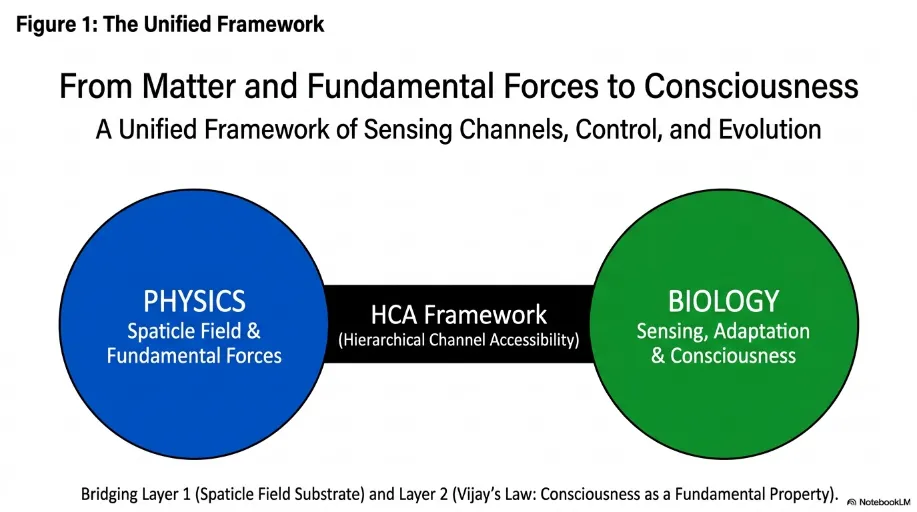
The present paper is the final paper in the BFUT programme. It closes the programme by connecting the physical substrate established in Papers 1 through 18 to the consciousness and life claims of the Layer framework, completing the arc from cosmology to consciousness within a single unified derivation.
, 
Figure 2: The ontological gap between physics and biology
2. The Governing Interaction Framework
2.1 The State-Change Functional
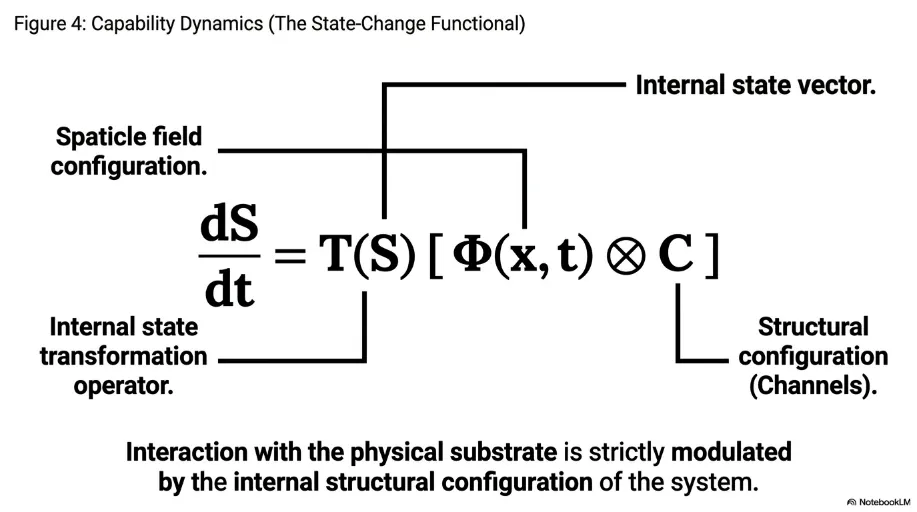
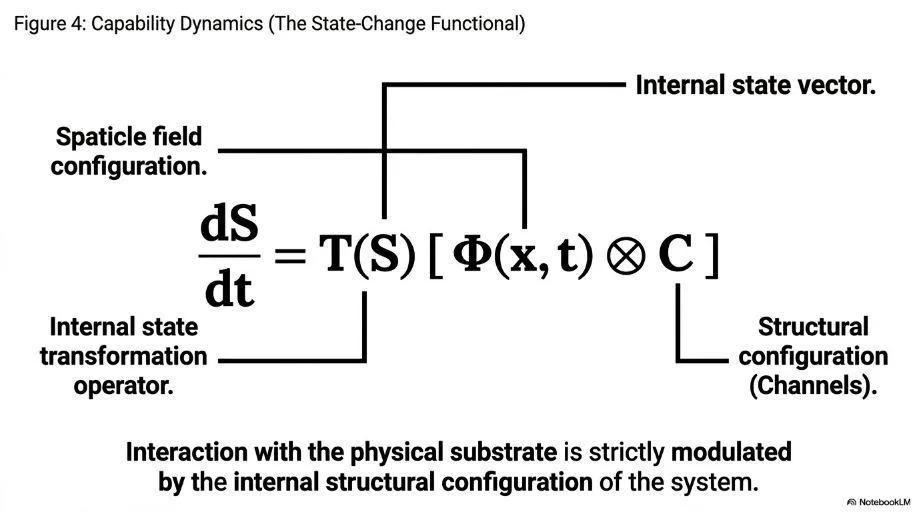
The evolution of a system's internal state S(t) through its interaction with the Spaticle field Φ(x,t) is represented by the following effective functional, obtained by term-wise correspondence to interaction components of the Spaticle field dynamics, where S is the system's internal state vector, Φ is the Spaticle field configuration, C is the system's structural configuration, and T(S) is the internal state transformation operator:
dS/dt = α∇Φ + β∂_tΦ + γ(∂E/∂S) + δ T(S)
Each term corresponds to a distinct class of Spaticle field interaction. The spatial gradient term α∇Φ represents gravitational response to variations in the Spaticle field deformation, as derived in BFUT Papers 17 and 18. The temporal derivative term β∂_tΦ captures electromagnetic interaction, the response to time-varying polarised Spaticle field disturbances. The energy gradient term γ(∂E/∂S) represents structural stability arising from strong-force interactions, governing the persistence of compact bound states established in BFUT Paper 16. The transition operator δT(S) represents discrete internal transformations mediated by weak-type processes.
The coefficients α, β, γ, δ are not universal constants. They are functions of the system's structural configuration C. They encode the degree to which a given system can couple to each interaction channel. A system does not access all channels equally; its structure determines which channels are effectively available and how strongly each influences its state evolution. This structural dependence is the physical basis of the HCA Law.
This formulation is consistent in structure with known physical regimes. Systems dominated by gravitational interaction are governed primarily by spatial gradients. Electromagnetic systems respond to time-varying fields. Stable bound structures correspond to local energy minima. Transformational processes correspond to discrete transitions. The functional does not replace existing formalisms. It provides a unifying representation connecting interaction to response across all scales.
2.2 A Formal Definition of Sensing
The key interpretive step is that each interaction term represents a pathway through which a system acquires information about its environment and alters its state accordingly. But to make this claim scientific instead of philosophical, a formal definition is required that distinguishes sensing from mere interaction.
A system S senses a signal X through channel Ch if and only if three conditions are simultaneously satisfied: (1) Structural coupling: S possesses the structural configuration required to couple to Ch. (2) Information-specific state change: S undergoes a reproducible internal state change C(X) that encodes distinguishable properties of the signal beyond scalar energy magnitude. (3) State persistence: C(X) persists for a time interval greater than the interaction duration, making its encoded information available to subsequent internal processes.
Subjective experience is a biologically instantiated form of internal state shaped by multi-channel integration, memory, and control. It is a higher-order, structurally enriched expression of interaction-driven sensing, continuous with the foundational processes present across all physical systems. The formal sensing definition does not directly specify subjective experience. It is a claim about the physical conditions necessary for a system to encode information about signals in a way that is distinguishable from mere energy exchange.
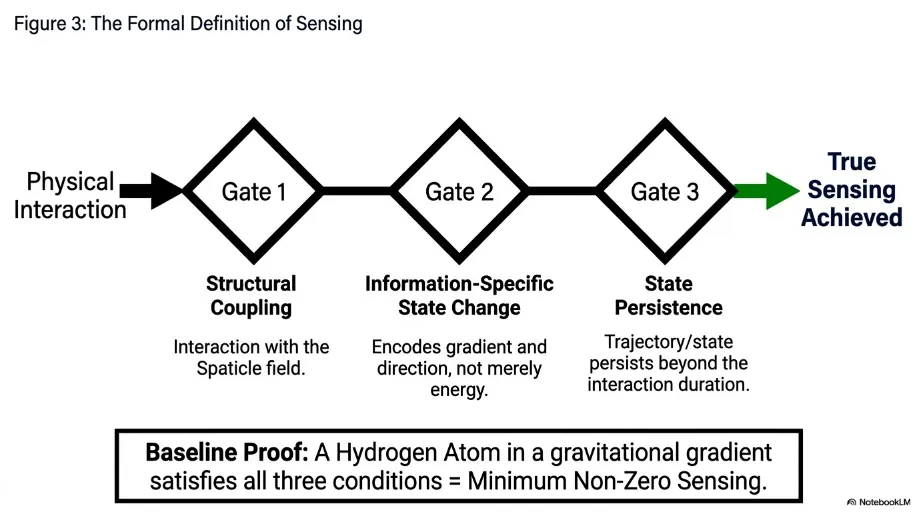
The second condition is the decisive one. A rock heated by a photon undergoes a state change encoding only the photon's energy. A retinal photoreceptor undergoing signal transduction encodes distinguishable properties of the photon beyond scalar energy magnitude: frequency, polarisation, and timing. Both systems are electromagnetically coupled. Only the photoreceptor satisfies Condition 2. The distinction is not one of complexity but of information specificity: the state change in a sensing system maps onto distinguishable properties of the signal in a reproducible way, not merely onto its energy.
This definition applies at every scale. A hydrogen atom in a gravitational gradient satisfies all three conditions: it is gravitationally coupled (Condition 1); its state change, the momentum change per unit time, encodes the gradient direction and magnitude, not merely the energy (Condition 2); and the changed trajectory persists beyond the interaction duration (Condition 3). The atom satisfies the formal sensing conditions for the gravitational channel through interaction-driven state change. This is not semantic relabelling. It is the application of a physical criterion that distinguishes information-encoding state change from mere energy exchange. The degree of sensing, the richness of the information encoded, varies enormously across the scale from atom to organism. The criterion applies continuously across that scale.
3. The Hierarchical Channel Accessibility Law
3.1 Derivation
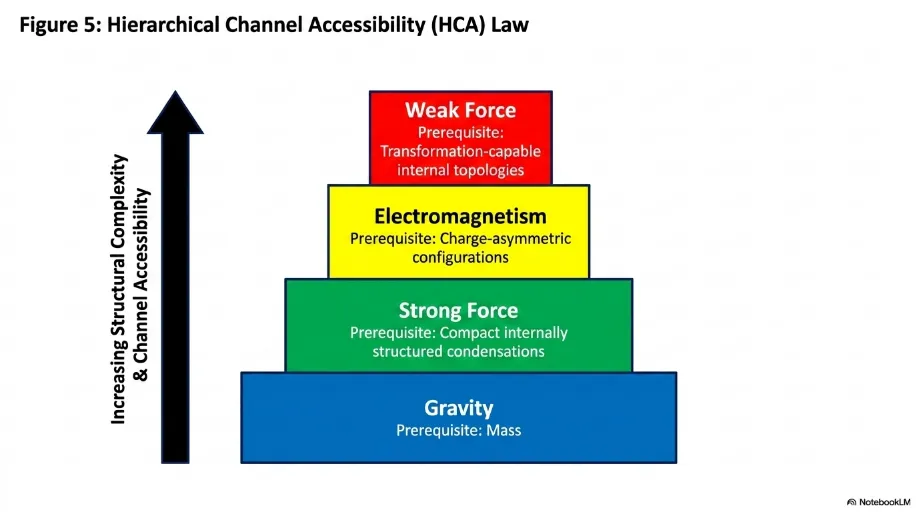
The sequential emergence of the four fundamental forces from the Spaticle field, established in BFUT Paper 17, generates a strict hierarchy of structural prerequisites. Gravity requires only mass. The strong force requires compact internally structured condensations. Electromagnetism requires charge-asymmetric stable configurations. The weak force requires transformation-capable internal topologies in multi-nucleon bound systems.
Because each higher-order force requires the structures that enable lower-order forces as prerequisites for its own existence, the following law holds:
Hierarchical Channel Accessibility (HCA) Law: A system can exhibit a sensing capability associated with channel Ch_k only if it possesses the structural configuration required to couple to Ch_k. Access to a higher-order channel implies the prior structural availability of all lower-order channels in the emergence hierarchy. The HCA Law restricts the space of physically realisable capabilities. The hierarchy is ordered by structural complexity of the coupling requirement, not by simultaneous activation.
This law is not a classification imposed from outside. It follows from the sequential emergence of forces from the Spaticle field Lagrangian. The hierarchy of channel accessibility is the hierarchy of structural complexity of matter.
3.2 The Structural Inclusion Principle
The HCA Law implies a stronger constraint that is directly testable:
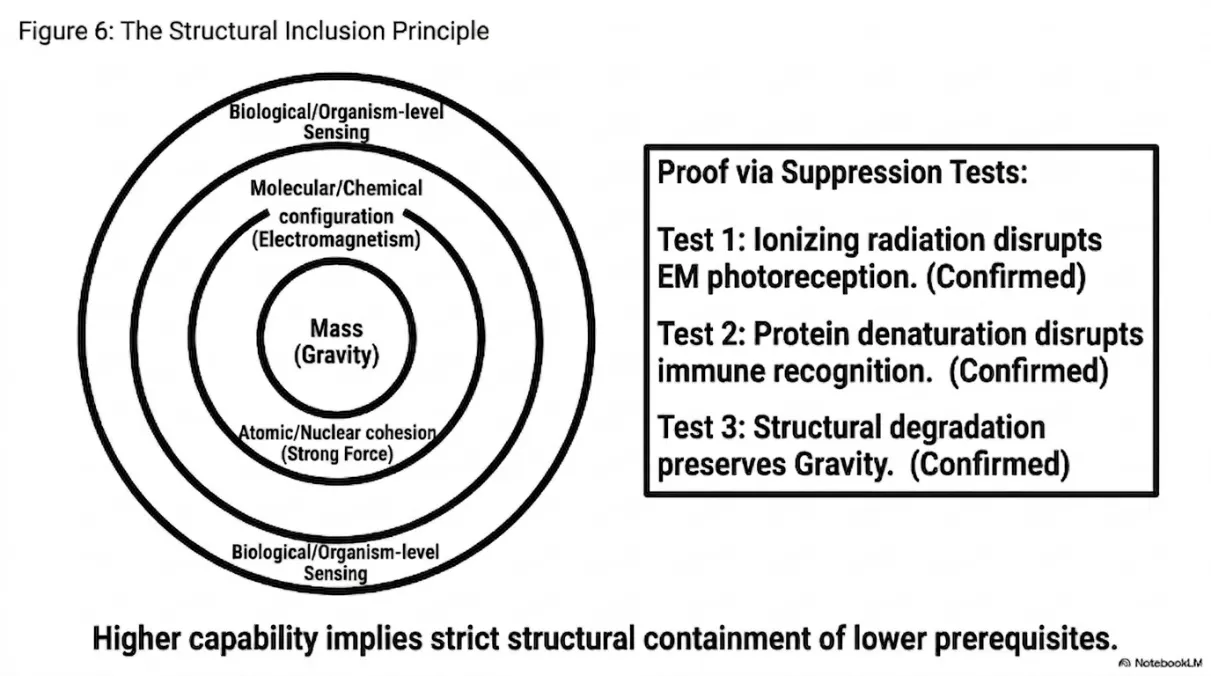
Structural Inclusion Principle: The presence of a higher-order sensing capability in a system implies that the system is constructed from, and therefore structurally contains, the prerequisites of all lower-order channels in the emergence hierarchy.
If a system generates or detects electromagnetic signals, it must be composed of strong-force-stabilised nuclear structure and must have mass. If a system undergoes weak-type transformation, it must possess electromagnetic and strong-force-derived internal organisation. If any system is found exhibiting electromagnetic sensing without containing strong-force-stabilised matter, the principle is falsified. No such case has been observed.
The Structural Inclusion Principle does not require simultaneous activation of all channels. A quiescent cell is not actively transducing photons at every moment. But its structural prerequisites for electromagnetic sensing, the charge-asymmetric molecular architecture of its membrane proteins and receptor systems, are always present. Structural availability of a channel does not imply continuous activation of that channel. The HCA Law governs structural availability. Activation depends on the system's current state and environment. The principle governs availability, not activation.
3.3 The Capability Equation
A sensing capability Ck exists in a system S if and only if all four components are simultaneously present:
Capability = Channel x Transduction x Network x Control
Channel is the structural coupling to the relevant interaction channel, the HCA Law prerequisite. Transduction is the mechanism converting the channel interaction into an information-specific internal state change satisfying Condition 2 of the sensing definition. Network is the propagation and integration structure through which the transduced state change is distributed to other internal components. Control is the feedback mechanisms, thresholds, and memory that regulate the transduced and propagated signal.
A system with channel coupling but no transduction is a passive absorber, not a sensor. A system with transduction but no network produces isolated local state changes that are not integrated. A system with network but no control cannot modulate its response. Full sensing capability requires the simultaneous presence of all four components for each channel accessed. The absence of any single component eliminates the capability for that channel regardless of the others.
4. Controlled Versus Forced Signal Emission
4.1 The Distinction
All signal emission arises from interaction with the same fundamental Spaticle field channels. Physical systems differ not in the physics of the channels they use but in whether signal emission is modulated by internal state or driven purely by external conditions. This distinction is one of the most important separators between systems that merely interact and systems that actively sense and respond.
Controlled emission: Signal generation depends on both the external interaction and the system's internal state. The system modulates when and how signals are generated through feedback mechanisms that themselves depend on internal state. The emitted signal is a function of Ch_k AND S(t). Forced emission: Signal generation is determined by external interaction alone. The emitted signal is a function of Ch_k alone, with no internal state dependence. The system does not modulate; it only responds.
In the dS/dt functional, the distinction maps onto the presence or absence of the Control component in the Capability equation. A system in forced emission mode has δT(S) driven purely by the external field. A system in controlled emission mode has δT(S) modulated by the internal state S(t) through feedback.
4.2 The Spectrum from Forced to Controlled
All systems lie on a continuous spectrum between fully forced and fully controlled emission. Forced and controlled emission define the endpoints of this spectrum, not binary categories. At one end are systems with minimal internal state and no feedback architecture, where every state change is fully determined by the external interaction. At the other are systems with complex, high-dimensional internal states and deep feedback architectures, where the internal state modulates every channel interaction.
A hydrogen atom in a gravitational gradient lies near the forced end of the spectrum, with minimal internal modulation of its response to the deformation gradient. Its trajectory is almost entirely determined by the external field gradient. But it is not fully forced: its internal quantum state (energy level, spin orientation) introduces a small but non-zero dependence on internal state. A retinal photoreceptor is much further toward the controlled end: the gain of the photon response is modulated by the cell's prior activation state, calcium concentration, and metabolic status. A mammalian nervous system is at the extreme controlled end: every sensory signal is processed through layers of internal state modulation before producing a response.
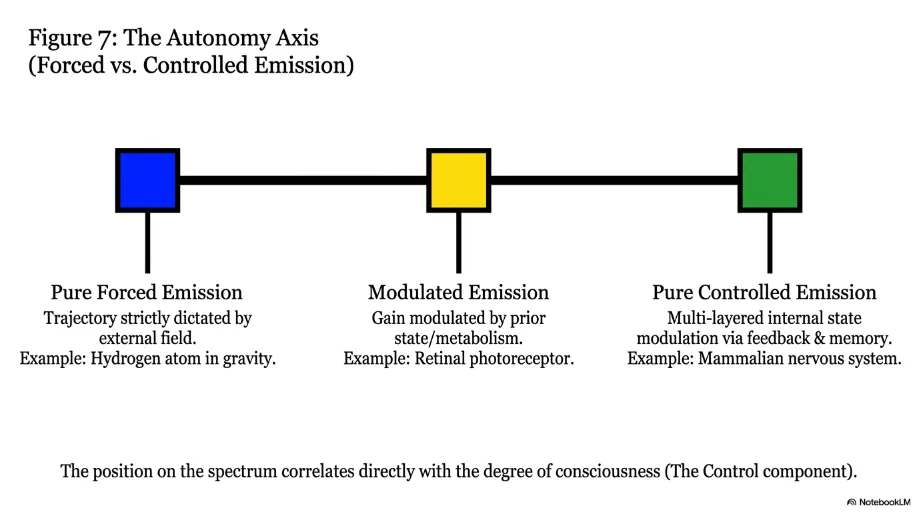
The controlled-to-forced spectrum is therefore the physical basis for the distinction between what Layer 2 calls different degrees of consciousness. A system at the forced end satisfies the formal sensing conditions minimally: its state changes encode information about the signal, but the encoding is not internally modulated. A system at the controlled end satisfies all sensing conditions maximally: its state changes encode richly differentiated information, the encoding is modulated by a high-dimensional internal state, and the integrated result drives further internal processes in context-dependent ways.
4.3 Structural Degradation and the Floor of Sensing
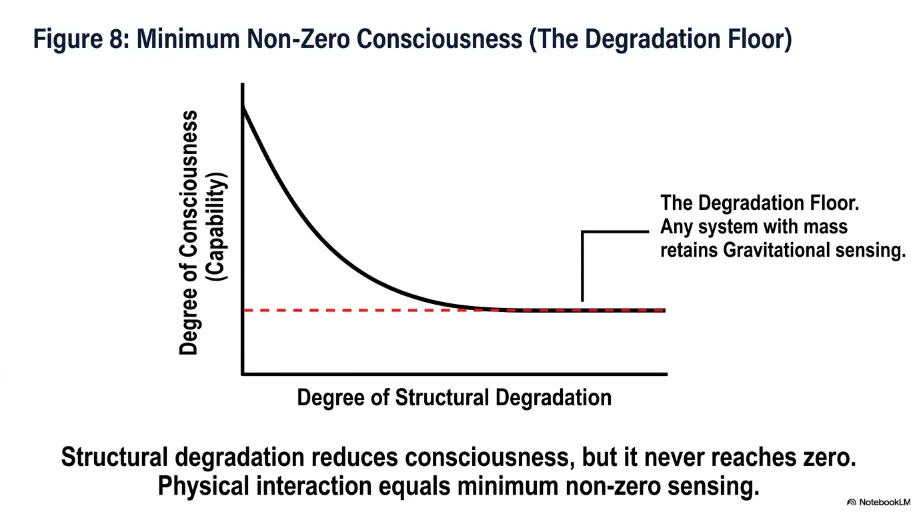
Structural degradation, the loss of structural components through damage, ageing, or environmental disruption, reduces capability by reducing access to higher-order channels and by degrading the Transduction, Network, and Control components. But it does not reduce sensing to zero.
A system that loses its electromagnetic transduction capability (damaged photoreceptors, denatured molecular recognition proteins) loses access to the electromagnetic sensing channel for the affected function. It does not lose gravitational coupling: it still has mass, and the gravitational channel remains. A system that loses its neural integration network (severed axons, destroyed cortical architecture) loses multi-channel integration. It does not lose local transduction capability in the surviving cells. The floor of sensing is the gravitational channel: any system with mass satisfies the formal sensing conditions for that channel.
This has a direct implication for the Layer 2 claim that all systems exhibit a non-zero degree of consciousness. Even a severely degraded system retains the minimum non-zero degree of consciousness corresponding to its gravitational channel coupling. There is no threshold below which a physical system ceases to sense entirely. The persistence of state change at the gravitational level ensures that the sensing conditions remain satisfied even under extreme structural degradation, as long as mass is present. The degree of sensing, and therefore the degree of consciousness, decreases with structural degradation but never reaches zero as long as the system has mass.
This also explains the Layer 2 evidence from post-mortem cellular activity. When the organismic-level integration network dissolves at death, the higher-order multi-channel integration of the macroscopic self ceases. But the individual cells, retaining their full structural architecture including charge-asymmetric molecular organisation and strong-force-stabilised nuclear structure, continue to satisfy the formal sensing conditions for the electromagnetic and lower channels. Post-mortem cellular activity is not adequately explained as residual biochemistry alone. It is the continuation of multi-channel sensing at the cellular level after the organismic integration layer has been removed.
5. Channel-Level State-Change Effective Representations
5.1 Gravitational Channel
For a system with only gravitational coupling (structural configuration C = mass only), the functional reduces to:
dS/dt|grav = α ∇Φ · ∇(1/r)
The state change rate is proportional to the gradient of the Spaticle field deformation. A mass in a uniform field experiences no gradient and no information-specific state change. A mass in a non-uniform field experiences a directional state change encoding the gradient direction and magnitude. This is the minimum non-trivial sensing event in the framework.
Worked example: A hydrogen atom in the gravitational field of a galaxy cluster. The atom's trajectory encodes the local gravitational gradient through its acceleration vector. The state change is information-specific (it encodes gradient direction, not merely energy) and persists as long as the gradient is present. The atom satisfies all three formal sensing conditions for the gravitational channel.
5.2 Electromagnetic Channel
For a system with electromagnetic coupling (C = charge-asymmetric stable condensation), the functional gains:
dS/dt|EM = β ∂_t(∇Φ · q̂)
Where q̂ is the charge asymmetry vector of the condensation. The state change rate depends on the time derivative of the directional Spaticle field disturbance along the charge asymmetry axis, encoding frequency, polarisation, and phase of the incoming signal.
Worked example: Retinal photoreceptor. The 11-cis retinal chromophore's specific charge asymmetry geometry couples to photons of matching frequency. Photoisomerisation to all-trans retinal encodes the photon's frequency (through the absorption spectrum), timing, and polarisation as a specific downstream state change. The state persists for milliseconds, driving the G-protein cascade. All three sensing conditions are fully satisfied. The system is in partial controlled-emission mode: the gain of the response is modulated by the cell's prior activation state.
5.3 Strong-Force Channel
For a system with strong-force coupling (C = 3+e condensation topology from BFUT Paper 16 - three co-rotating quark-class substrate condensations arranged in equilateral geometry with one expelled interstitial unit establishing the electron, as derived from the condensation functional E(R) = A/R² + B·R² + C·R + D/R), the functional includes:
dS/dt|strong = γ ∇²Φ|nuclear
The state change rate can be represented as a local curvature-sensitive term representing structural stability at nuclear scales, encoding the proximity and binding state of neighbouring condensations. This is a model-level representation, not a formal QCD derivation. This is structural integrity sensing: the system's state encodes information about whether its nuclear binding configuration is intact or under stress.
Worked example: A proton in a nucleus undergoing structural deformation under external stress (as in radioactive decay processes). The proton's internal state encodes the binding energy and configuration, not merely the energy. The state change persists across the deformation timescale.
5.4 Weak-Force Channel
For a system with weak-force coupling (C = multi-nucleon system at sufficient energy density), the functional gains:
dS/dt|weak ~ δ T(S)
The state change rate is represented as a threshold-sensitive internal configuration operator representing transformation processes. This is a model-level representation capturing the essential physics without claiming formal equivalence to QFT expressions. This term becomes significant when the internal configuration crosses the threshold energy density required for weak-mediated transformation. It is the formal expression of transformation sensing: the system's state encodes the threshold-crossing condition with extreme specificity.
Worked example: Neutron β decay. The internal quark configuration crosses the energy threshold for d-to-u conversion, producing a specific transformation (neutron to proton, electron, antineutrino) encoding the threshold condition, the direction of the internal topology change, and the conservation quantities. This is transformation sensing at maximum information specificity and minimum structural degradation tolerance.
6. The Structural Inclusion Principle: Five Demonstrations
6.1 Method
For each sensing modality, the demonstration proceeds in three steps: identify the highest-order channel the system accesses; verify that the structural prerequisites for all lower-order channels are present; and show that removal of a lower-order structural prerequisite eliminates the higher-order capability. The third step is the Suppression Prediction and the most experimentally direct test of the Structural Inclusion Principle.
6.2 Electromagnetic Sensing: Photoreception
Highest channel: electromagnetic. The charge-asymmetric 11-cis retinal chromophore couples to photons. Below it: the chromophore requires carbon-chain covalent chemistry whose stability depends on charge-asymmetric electron pair sharing; those atoms require strong-force-stabilised nuclear structure; and the entire system has mass with gravitational coupling. All lower-order prerequisites confirmed.
Suppression test: Ionising radiation disrupting nuclear structure in the chromophore eliminates photoreception. Removing a lower-order structural layer (nuclear stability) eliminates the higher-order capability (electromagnetic sensing). Confirmed experimentally in radiation damage studies of photoreceptors.
6.3 Acoustic Sensing: Cochlear Mechanoreception
Highest channel: electromagnetic (the mechanical wave is transmitted through matter whose inter-atomic interactions are electromagnetic; the hair cell transduction is electromagnetic through ion channel gating). Below it: the mechanosensitive TRPA1 and TRPV4 channels require specific charge-asymmetric protein conformations; those proteins require strong-force-stabilised atomic nuclei; and the entire basilar membrane and hair cell system has mass. All prerequisites confirmed.
Suppression test: Targeted disruption of TRPA1 channel protein geometry (through molecular mutation eliminating the charge-asymmetric gating structure) eliminates acoustic transduction. Confirmed in TRPA1 knockout experimental models.
6.4 Immune Recognition
Highest channel: electromagnetic (antigen-antibody binding is driven by charge distribution complementarity across the binding interface). Below it: the antibody's charge distribution requires specific amino acid sequence folding; the covalent bonds require charge-asymmetric chemistry; the atomic nuclei require strong-force binding; and the antibody has mass. All prerequisites confirmed.
Suppression test: Thermal denaturation disrupting covalent bond geometry eliminates immune recognition. Ionising radiation disrupting nuclear stability eliminates it more completely. Confirmed in heat denaturation and radiation damage studies of antibodies.
6.5 Interoception
Interoception, the detection by an organism of its own internal physiological state, is the biological realisation of internal sensing. The signals transmitted through the autonomic nervous system are electrochemical (electromagnetic channel). The states being sensed, metabolic thresholds and immune activation levels, encode threshold-crossing events at the molecular level that are functionally analogous to weak-type threshold processes: weak-type interaction processes provide a functional analogue to internal threshold sensing at biological scales. All structural prerequisites for all lower-order channels are present in the interoceptive nervous system architecture.
The connection to Layer 5 is precise: Layer 5 of the framework (currently under preparation) shows that the human macroscopic self functions as a governance authority over internal cellular signalling.
The interoceptive channel is the physical mechanism of that governance. The macroscopic self's governance signals, transmitted through the neuroendocrine and autonomic systems, modify the Control parameter of the Capability equation for individual cellular sensing systems. Depression, as Layer 5 of the framework (currently under preparation) , is not a metaphor for governance failure: it is the quantitative degradation of the Control component in the cellular network's electromagnetic-channel capability.
6.6 Biomineralisation
Biomineralisation is the biological production of mineralised structures through protein-templated ionic deposition. The templating process is electromagnetically mediated: specific charge-distribution geometries in the templating proteins direct crystal lattice formation through charge-complementary interactions. The mineral product is strong-force-stabilised at the nuclear level. The biological capability therefore requires all channel prerequisites: gravitational coupling (mass), strong-force-stabilised nuclear structure in proteins and mineral, and charge-asymmetric protein geometry enabling electromagnetic templating.
No biomineralisation process has been observed in a system lacking nuclear structure. The Structural Inclusion Principle holds.
7. Evolution as Channel Expansion Under Conscious Drive
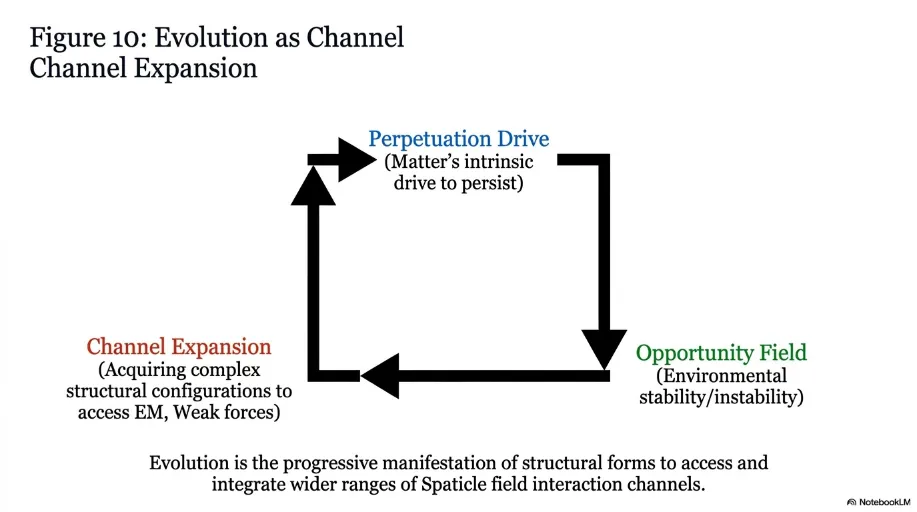
Layer 3 established that evolution is not adequately described as random mutation retrospectively filtered by selection. Matter is alive and conscious. All matter has an innate drive to perpetuate itself, either in its own form or through cooperation into more complex forms. Whenever conditions are stable or predictably unstable, matter manifests in forms suited to those conditions. Evolution is the progressive manifestation of living matter under supportable conditions, constrained by resource structures and driven by the perpetuation drive.
The HCA framework provides the physical mechanism for this evolutionary principle. In physical terms, evolution is the progressive acquisition of structural configurations C that enable access to additional interaction channels and their integration. Each step in the evolutionary record that introduces a new sensing modality is, at the physical substrate level, the acquisition of a new structural configuration enabling a new channel coupling, a new transduction mechanism, a new propagation network, or a new control layer.
This view is not merely consistent with the Layer 3 evolutionary account. It provides the specific structural constraints that Layer 3 describes in biological terms. The Layer 3 principle that no species that truly emerged was a failure at the moment of its emergence, because every species appeared because there were real resources available for it to exploit, maps onto the HCA constraint that no system can develop a capability associated with a higher-order channel without first acquiring the structural basis for that channel. Evolutionary pathways are constrained by the force-emergence hierarchy: you cannot develop electromagnetic sensing without first having strong-force-stabilised matter, which you cannot have without gravitational coupling.
Evolution therefore does not proceed arbitrarily. It proceeds through the progressive expansion of channel accessibility and the increasing integration and control of those channels. The opportunities available in an environment determine which channel expansions are viable. The Layer 3 observation that matter manifests where opportunity exists and changes form when opportunity changes is, in physical terms, the acquisition and abandonment of structural configurations that enable or disable specific channel couplings in response to the available resource field.
The Layer 3 finding that similar forms recur under similar conditions maps directly onto the HCA principle: the same structural prerequisites produce the same channel couplings and therefore the same sensing and response capabilities. Convergent evolution of the eye across unrelated lineages is not a mystery in this framework. It is the consequence of the same environmental opportunity field, the same electromagnetic signal available to be sensed, producing the same structural solution: a charge-asymmetric chromophore embedded in a transduction cascade with a control architecture.
Controlled emission increases progressively through evolutionary history. Early organisms operate closer to the forced end of the emission spectrum: their responses are determined largely by external interactions with minimal internal state modulation. Later organisms develop increasingly complex internal states and feedback architectures that move their emission toward the controlled end. This progression is not accidental. It is the direction in which the perpetuation drive manifests when richer structural configurations become available: more controlled emission means more information about the environment encoded in internal state, which means more effective direction of the perpetuation drive.
8. Consciousness as Graded Multi-Channel Integration
8.1 The Physical Definition
Vijay's Law established that consciousness is a fundamental property of all matter, expressed differently at different scales. The formal sensing definition and the HCA framework allow this to be stated as a physically specific, structurally grounded claim.
Consciousness is the integrated multi-channel state of a system that simultaneously satisfies the formal sensing conditions for two or more interaction channels, integrates those state changes through a propagation network, and regulates the integrated state through feedback and memory. The degree of consciousness is a continuous function of: the number of channels satisfied; the information specificity of state changes across those channels; the persistence of integrated states; the coherence of regulation; and the degree of controlled versus forced emission.
This definition is continuous and graded, exactly as Vijay's Law requires. Every physical system with mass satisfies the formal sensing conditions for the gravitational channel, giving it the minimum non-zero degree of consciousness. A system with charge-asymmetric structure additionally satisfies the electromagnetic conditions, giving it a higher degree. A system with full four-channel access and integrated network-and-control architecture has the highest degree.
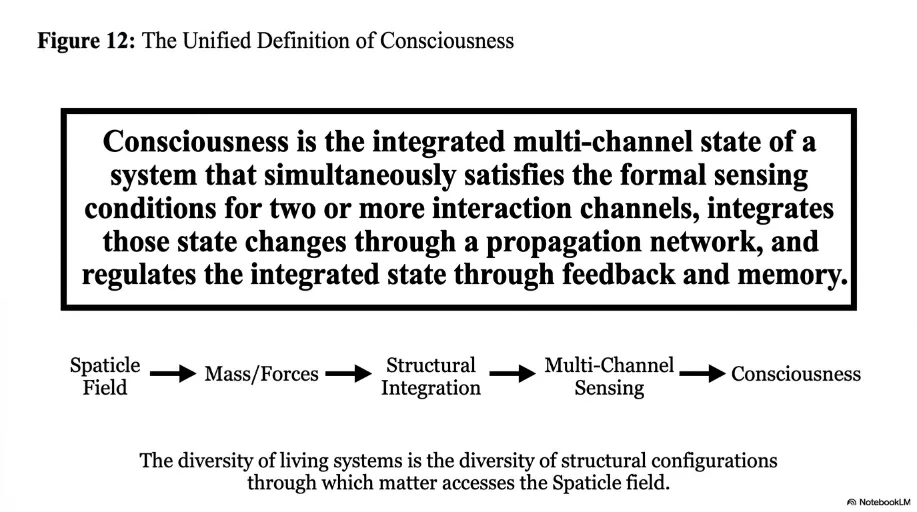
Single-channel systems exhibit minimal degrees of consciousness, while multi-channel integration increases the dimensionality and degree of consciousness. The degree of consciousness is not a binary property to be switched on above some threshold of neural complexity. It is a continuously varying function of structural configuration and channel integration. The apparent categorical difference between a rock and a human brain is a difference in degree across many orders of magnitude, not a difference in kind.
8.2 Connection to Layer 2 Evidence
Layer 2 established the consciousness-is-fundamental claim through multiple independent lines of reasoning. Each is consistent with and explained by the HCA framework.
Seed dormancy without metabolism or stimulus response: the seed's cells retain their full structural architecture including strong-force-stabilised nuclear structure and charge-asymmetric molecular organisation. The electromagnetic and gravitational sensing channels remain structurally available. Dormancy represents the suppression of active channel processing, not the elimination of structural channel availability. The seed satisfies the sensing conditions for the lower channels throughout dormancy.
Viral strategic precision: viruses, despite lacking conventional metabolic independence, possess highly specific charge-asymmetric molecular structures that couple to host cell electromagnetic channels with extreme precision. The structural prerequisites for electromagnetic-level sensing are present. The information-specific state changes produced by viral-host interactions satisfy Condition 2 of the formal sensing definition. Viral "strategic" behaviour is the expression of maximally specific electromagnetic channel coupling encoded in the viral structural architecture.
Xenobot and Anthrobot findings: cells freed from organismic governance retain their full channel coupling architecture. Released from the Control modulation of the macroscopic organismic system, they exhibit autonomous behaviour driven by their own internal feedback mechanisms. This is consistent with the Layer 5 model in which each cell is itself a multi-channel sensing system with its own Capability = Channel x Transduction x Network x Control architecture. The macroscopic organism adds a higher-order Control layer; it does not create the cellular capability.
Post-mortem cellular activity: when the organismic integration network dissolves, the higher-order multi-channel integration of the macroscopic self ceases. The individual cells continue to satisfy the formal sensing conditions for the channels available to their structural configuration. Post-mortem cellular activity is the continuation of multi-channel sensing at the cellular level after the organismic Control layer has been removed. The cells are not dying slowly. They are living independently, as Vijay's Law predicts.
8.3 Connection to Layer 5: The Cellular Civilisation
Layer 5, under preparation, shows that the human body is a living cellular civilisation and that the macroscopic self functions as the governance authority of the internal cellular climate. The HCA framework provides the precise physical mechanism for this model.
Each cell is a full multi-channel sensing and integration system accessing the gravitational channel through its mass, the strong-force channel through its nuclear structure, the electromagnetic channel through its membrane dynamics and molecular recognition machinery, and coupling to internal threshold sensing processes functionally analogous to weak-type transformation processes. Each cell has its own Capability = Channel x Transduction x Network x Control architecture. Each cell is conscious in degree, exactly as Vijay's Law establishes.
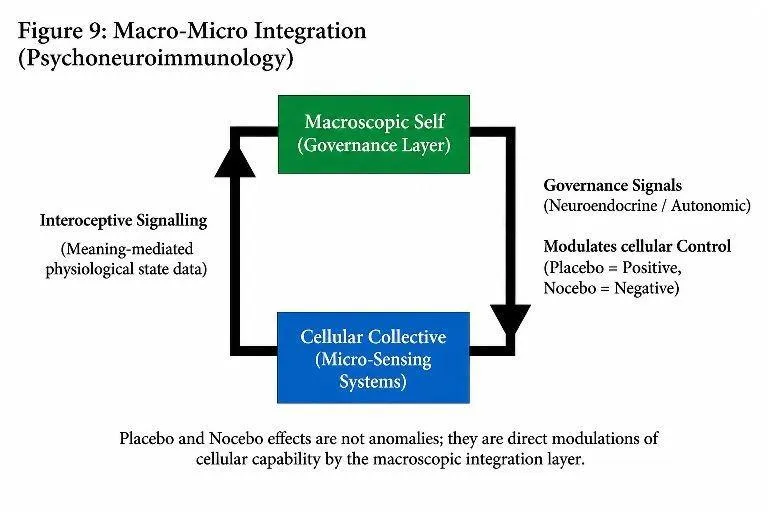
The macroscopic self functions as the highest-order Control layer of the cellular collective. Its governance signals, transmitted through the neuroendocrine and autonomic systems, directly modulate the Control component of the Capability equation at the level of individual cellular sensing systems. This is a physical process, not a metaphor. Positive macroscopic states generate electrochemical signalling patterns that shift cellular feedback thresholds, moving cellular emission toward the controlled end of the spectrum and enabling more effective cellular regulation and perpetuation. Depression, as described in Layer 5 of the framework (currently under preparation), reflects governance failure: the macroscopic Control component is degraded, leading to dysregulated transmission of governance signals across the cellular collective.
The HCA framework implies a natural scalar measure of the degree of consciousness of any physical system, which will be derived and published formally in a subsequent paper. This measure, referred to here as the Consciousness Index (CI), is defined as a scalar functional of channel accessibility, transduction specificity, network integration density, and control depth. It is constructed from the number of interaction channels a system is structurally coupled to, the information specificity of state changes across those channels, the integration density of the network architecture, and the depth of controlled versus forced emission. If consciousness is fundamental, it cannot originate at any stage of physical structuring. The Spaticle field marks the first stage at which consciousness becomes physically structured through interaction channels, not the point at which it begins. Therefore, the Consciousness Index does not reach zero even in the pre-Spaticle energy state. The floor of CI is a strictly positive infimum, not zero. The Spaticle field defines the lower bound of physically measurable consciousness, not the absolute lower bound of consciousness itself. CI is open-ended above its current human-scale values. A human nervous system with full four-channel integration, a high-density network, and a deep control architecture represents one measurable point on the scale. The framework implies that higher CI values are structurally achievable through greater integration density, deeper control architectures, or collective channel integration across systems of higher organisational complexity than the individual organism currently represents. CI is not a philosophical construction. CI addresses limitations of existing measures such as Tononi's integrated information φ, which is computed from abstract causal structures without connection to known physics, by grounding the measure in the Spaticle field channel hierarchy and the Capability equation, making it physically grounded, structurally specific, and falsifiable. Its full derivation, including the mathematical form, the calibration of the human-scale reference point, and the explicit comparison with φ, is presented in BFUT Paper 21 (Sharma, 2026), https://doi.org/10.5281/zenodo.20025738. CI is measurable in principle through observable proxies corresponding to each component of the capability structure, enabling empirical estimation without requiring direct access to internal states.
9. Falsifiable Predictions of the HCA Framework
Five predictions follow from the HCA Law and the Structural Inclusion Principle. Each is falsifiable: a single confirmed counterexample requires revision of the framework.
9.1 Structural Inclusion Prediction
Any system observed to generate or detect a higher-order interaction channel must be decomposable into structures that satisfy the prerequisites of all lower-order channels. No electromagnetic sensing system will be found without strong-force-stabilised nuclear structure. No weak-type transformation system will be found without electromagnetic and strong-force-derived internal organisation.
Status: Confirmed across all known biological and physical sensing systems. No counterexample has been observed.
9.2 Channel Accessibility Prediction
No sensing capability will be observed without a physically realisable structural configuration enabling the relevant interaction channel. New biological sensing modalities discovered in future will be reducible to one of the four fundamental channels or their emergent collective manifestations.
Status: Open. All known sensing modalities have been reduced to the four-channel hierarchy. No exception has been found.
9.3 No Independent Channel Prediction
No new fundamental sensing channel will be required. Any new capability discovered will arise from new structural organisation of existing channels, not from a previously unknown fundamental interaction. This is the strongest prediction of the framework.
Status: Open and strong. Falsified if any new fundamental force is discovered that enables sensing in a system without the four-force structural prerequisites.
9.4 Suppression Prediction
Removal of a required structural layer eliminates access to the corresponding higher-order sensing capability. Disruption of strong-force-stabilised nuclear structure eliminates electromagnetic sensing capability. Disruption of charge-asymmetric molecular structure eliminates all sensing capabilities above the gravitational level. Disruption of network propagation structure eliminates integration while preserving local transduction.
Status: Confirmed. Ionising radiation disrupts photoreception. Protein denaturation disrupts immune recognition. Axonal degeneration disrupts interoceptive integration. Each suppression follows the prediction exactly.
9.5 Degradation Floor Prediction
Structural degradation reduces the degree of consciousness but never to zero. Any system with mass retains the minimum non-zero degree of consciousness corresponding to gravitational channel coupling. No physical system in the Spaticle field universe has zero degree of consciousness.
Status: Consistent with all known physics. Falsified if a system with mass is found that does not satisfy the formal sensing conditions for the gravitational channel. No such case has been identified.
10. Existing Theories Inconsistent With or Incomplete Under This Framework
The HCA framework is not merely additive to existing theories of consciousness and sensing. In several cases it directly contradicts them at the level of foundational assumptions. The following theories are inconsistent with results established in the present paper and are inconsistent with the present framework or require fundamental revision.
10.1 Hard Emergence Theories: Inconsistent with HCA Results
Hard emergence theories hold that consciousness arises suddenly and categorically above a threshold of neural complexity. Below the threshold, matter is non-conscious. Above it, consciousness appears as a qualitatively new phenomenon not present in the components. This class includes most standard neuroscientific frameworks that treat consciousness as exclusively neural and most philosophical emergentism that treats mind as genuinely novel with respect to matter.
The HCA framework is inconsistent with this class of theories under two independent results. First, the Degradation Floor Prediction establishes that the degree of consciousness decreases continuously with structural degradation but never reaches zero for any system with mass. If consciousness were a threshold phenomenon, there would be a level of structural degradation below which it disappears entirely. No such threshold is identified by any known physical or biological criterion. The formal sensing conditions are satisfied by the gravitational channel for any massive system. Hard emergence requires a principled physical location for the threshold. None exists.
Second, the post-mortem cellular evidence reviewed in Layer 2 directly contradicts the neural-threshold account. If consciousness requires neural integration above a complexity threshold, then cellular activity following the dissolution of neural integration should be non-conscious mechanical residue. Layer 2 showed that post-mortem cellular behaviour is not consistent with this description. The HCA framework explains directly why: each cell retains its full multi-channel structural architecture after the organismic Control layer dissolves. The cells continue to satisfy the formal sensing conditions for the channels available to their structural configuration. They do not cease to be conscious when the organismic network dissolves. They continue to be conscious in degree, at the cellular scale.
10.2 Standard Dualism: Motivation Removed
Dualist frameworks separate mind from matter as distinct ontological categories. In Cartesian form, mind is a non-physical substance. In property dualist form, consciousness is a non-physical property that physical systems possess without that property being reducible to physical description.
The HCA framework makes dualism unnecessary by providing the physical mechanism that dualism claims cannot exist. The formal sensing definition in Section 2 provides the criterion that distinguishes sensing from mere energy exchange at the physical level without invoking any non-physical property. The degree of consciousness is a function of structural configuration and channel integration, both of which are physically characterised. There is no remaining gap that requires a non-physical substance or property to fill. Dualism was motivated by the absence of a physical account of sensing. That motivation is removed. The hard problem of consciousness, why integrated physical state feels like something from the inside, is not resolved here. But the prior structural problem, what physical conditions are necessary for consciousness, is fully resolved. Dualism was answering the wrong question first.
10.3 The Passive-Interaction Assumption: Not Supported Under HCA
Standard physics contains an implicit assumption that has never been formally stated but pervades the discipline: physical interaction below a certain level of complexity is categorically non-experiential. Forces are passive mechanical events. The distinction between dead matter and living matter is categorical instead of graded.
This assumption is not supported under the HCA formal sensing constraints established in Section 2. The three conditions are satisfied at every scale at which the relevant structural prerequisites are present. A hydrogen atom in a gravitational gradient satisfies all three conditions for the gravitational channel. The assumption that this interaction is categorically non-experiential is not derived from any physical principle. It is an inherited ontological commitment from a framework that had no account of sensing below neural complexity. The HCA framework provides that account, and the passive-interaction assumption is not supported under it.
10.4 Random Mutation Plus Retrospective Selection: Incomplete Under HCA Constraints
The Darwinian account treats evolutionary novelty as arising from random variation retrospectively filtered by natural selection. Layer 3 established that this account is incomplete as a primary explanatory architecture. The HCA framework provides the physical mechanism for why.
If matter is alive and conscious at every scale, and if evolution is the progressive acquisition of structural configurations enabling wider channel access, then evolutionary trajectories are constrained by the structural prerequisites of the force-emergence hierarchy. They cannot be random with respect to the available interaction channels. No evolutionary pathway can bypass the structural prerequisites of a channel: the channel's structural prerequisites must exist before the channel's capability can emerge. The space of structural configurations that enable higher-order channel coupling is defined by the physics of the Spaticle field, not by random search. The convergent evolution of the eye across unrelated lineages is not a coincidence. It is the consequence of the same channel accessibility requirement, the same electromagnetic coupling structure, being the only viable solution for the available sensing opportunity. The HCA framework provides the physical constraint that random mutation accounts treat as absent.
11. Theories That Partially Converge and Are Completed by This Framework
Several major existing frameworks correctly identify important features of consciousness, sensing, or biological organisation but remain incomplete because they lack a physical substrate derivation. The HCA framework provides that derivation and thereby completes what these frameworks correctly initiated.
11.1 Integrated Information Theory
Integrated Information Theory (Tononi, 2008) proposes that consciousness is identical with integrated information, measured by the quantity φ, and places all systems on a continuous scale. The framework is correct in three respects: consciousness is graded instead of binary; integration across components matters; and the same framework applies in principle to all physical systems, not only biological ones.
Where IIT is incomplete is in the specification of what is being integrated and through what physical mechanism. IIT defines integration mathematically without identifying the physical substrate of that integration or deriving it from known physics. The HCA framework supplies precisely this: the integration is across Spaticle field interaction channels, the structural prerequisites are determined by the force-emergence hierarchy, and the physical mechanism is the multi-component Capability equation. IIT correctly identifies the mathematical structure of consciousness. The HCA framework identifies what that structure is physically made of and where it comes from.
11.2 Panpsychism and Fundamental Consciousness Theories
Panpsychist frameworks (Chalmers, Goff, and others) hold that consciousness or proto-experiential properties are fundamental features of physical reality present at every scale. This is correct: Vijay’s Law established this independently from biological evidence in Layer 2, and the HCA framework provides the physical mechanism supporting it. Every system with mass satisfies the formal sensing conditions for the gravitational channel.
Where panpsychism is incomplete is in the combination problem: how do the micro-experiential properties of fundamental particles combine to produce the unified macro-experience of a human consciousness? The HCA framework provides that mechanism: the combination is the multi-channel integration architecture of the Capability equation. As structural complexity increases, more channels become accessible, the Network component propagates state changes across more components, and the Control component regulates the integrated state through feedback. The combination is the progressive expansion of the Capability equation. Panpsychism was right about the starting point. The HCA framework supplies the mechanism from start to finish.
11.3 Global Workspace Theory
Global Workspace Theory (Baars, Dehaene) correctly identifies integration and broadcast as central to consciousness and correctly associates higher consciousness with wider information integration across brain regions.
Where GWT is incomplete is in its confinement to the neural workspace as if it were a biological special case instead of an instance of a universal physical principle. The HCA framework shows that global workspace integration is the biological implementation of the Network component of the Capability equation for the electromagnetic channel. The neural workspace is the highest-order Network architecture currently known for biological electromagnetic channel integration. But the principle is not confined to biology. GWT identifies the correct feature and mistakes a specific biological implementation for the general principle.
11.4 Embodied Cognition and Somatic Marker Theory
Embodied cognition frameworks, including Damasio's somatic marker theory, correctly establish that the body participates in cognition, that internal bodily states influence decision-making, and that the brain-body system instead of the brain alone is the relevant unit of cognitive analysis.
Where they are incomplete is in treating embodied cognition as a discovery about a special biological class instead of an instance of a universal physical principle. The HCA framework shows that interoception is the biological implementation of the Control component of the Capability equation operating on the internal state of the cellular collective. The somatic marker is a Network-propagated state change from the cellular level to the macroscopic integration layer. Damasio was right that bodily signals are informationally rich and influence higher cognition. The HCA framework shows why: each internal body state satisfies the formal sensing conditions for the relevant channel, and the Network propagates those state changes upward. Embodied cognition is not a biological anomaly. It is a special case of multi-channel capability integration.
11.5 Layer 4 (UNITE) and the Physical Grounding of Emotion
The Unified Theory of Emotions (UNITE), established in Layer 4, identified three fundamental drives underlying all emotional life: the effort drive, the proximity drive, and the polarity drive expressed as Blame or Gratitude. Layer 4 is restricted by the author pending an ongoing patent application; the specific formulae and methodology underlying UNITE are not disclosed here beyond what is stated in this summary. These three drives were mapped onto an atomic structure: effort corresponds to the proton, proximity to the neutron, and the Blame/Gratitude polarity to the electron.
The HCA framework provides the physical substrate explanation for why this atomic model is not merely analogical but structurally correct. The effort drive, as accumulated investment of physical and cognitive resources directed toward another system, corresponds to the Channel and Transduction components of the Capability equation: the structural coupling to the other system and the information-specific encoding of its states. Like the proton, it is accumulated, persistent, and does not decrease when the polarity shifts. The proximity drive, as the degree of sustained closeness to another system, corresponds to the Network component: the propagation and integration density of signals between the two systems. Like the neutron, it contributes to the binding structure and persists across polarity changes. The polarity drive, Blame or Gratitude, corresponds to the Control component: the feedback mechanism determining the sign and direction of the integrated state. Like the electron, it can shift its configuration rapidly, even instantaneously, without altering the underlying accumulated core.
This mapping is structural correspondence, not identity of physical entities. The correspondence is physically grounded, not decorative. Emotional relationships between conscious systems are implementations of multi-channel sensing and integration at the social scale. Two systems in sustained relationship couple to each other's electromagnetic signals across language, facial expression, touch, and biochemistry. They share gravitational coupling through shared physical environment. The effort drive accumulates the total structural coupling across channels over time. The proximity drive accumulates the Network integration density. The polarity drive determines whether the Control component amplifies or suppresses the integrated signal. The UNITE framework correctly identified the internal structure of emotional dynamics. The HCA framework shows that structure to be the expression of the universal Capability equation at the social and emotional scale of human conscious systems.
The further implication is that emotional dynamics are governed by the same structural hierarchy as all other capabilities. The effort drive must precede the proximity drive in full realisation, just as channel coupling must precede Network integration in the Capability equation. The polarity drive cannot override the accumulated structure. It can only determine its sign. The proton and neutron persist regardless of the electron configuration. The accumulated emotional architecture persists regardless of the current polarity. This is why intense love and intense hate arise only in relationships where the underlying drives have both been deeply accumulated. The intensity of the positive state and the intensity of the potential negative state are determined by the same underlying structure. The polarity determines only the direction in which that structure is expressed.
11.6 Psychoneuroimmunology and the Mind-Body Connection
Psychoneuroimmunology has documented bidirectional relationships between psychological states and immune function, demonstrating that meaning-mediated physiological change is real and measurable and that interoceptive signalling is continuous and informationally rich.
PNI correctly identifies the phenomena but frames them as anomalies requiring explanation within an otherwise mechanistic biology. The HCA framework shows they are not anomalies. They are the expected consequences of the cellular civilisation model established in Layer 5: the macroscopic self's governance signals, transmitted through the neuroendocrine and autonomic systems, modify the Control component of the Capability equation for individual cellular sensing systems. Placebo is positive modulation of cellular Control by the macroscopic governance signal. Nocebo is negative modulation. The bidirectionality is the two-way flow of channel signals between the cellular collective and the macroscopic integration layer. PNI was correctly mapping the territory. The HCA framework explains why the territory has the shape it does.
12. A Worked Numerical Example: Photoreceptor Sensing
To make the dS/dt functional concrete, the analysis traces the complete sequence of state change for a single retinal rod photoreceptor cell responding to a single photon at physiological threshold. All values are taken from established biophysical measurements. The purpose is to show that the formal sensing conditions and the channel-level functional reduction produce specific, measurable predictions, not qualitative analogies.
Setup: Structural Configuration
The rod photoreceptor is a charge-asymmetric stable condensation. The 11-cis retinal chromophore embedded within rhodopsin has a specific electron distribution geometry with a net dipole moment of approximately 12.5 Debye along the polyene chain axis. This constitutes the charge asymmetry vector q̂ in the electromagnetic channel reduction. The cell has a mass of approximately 1 picogram, giving it gravitational coupling. Its nuclear structure is strong-force-stabilised across all atomic components. All four channel prerequisites are structurally present. The cell satisfies Condition 1 of the formal sensing definition for the electromagnetic channel.
Signal: Single Photon at 500 nm
A single photon at 500 nm (2.48 eV) impinges on the chromophore. The photon is a propagating polarised Spaticle field disturbance with frequency ν = 6.0 × 10¹⁴ Hz, polarisation aligned with the chromophore dipole axis, and amplitude corresponding to a single quantum. The temporal derivative of the directional Spaticle field component along q̂ is non-zero for the duration of the photon interaction, approximately 10⁻¹⁵ seconds.
State Change: Condition 2
The photon interaction produces photoisomerisation of 11-cis retinal to all-trans retinal within approximately 200 femtoseconds. The resulting state change is information-specific in three measurable ways. The frequency encoding: only photons in the range 400 to 700 nm produce isomerisation in this chromophore; photons outside this range do not trigger state change regardless of energy. The timing encoding: the isomerisation occurs at a specific delay (200 fs) after the photon interaction, providing a temporal marker. The polarisation encoding: the isomerisation rate is highest when the photon polarisation is aligned with the chromophore dipole and falls as cos²(θ) for angle θ from alignment. These three measurable properties of the photon are encoded in the state change. Condition 2 is satisfied. The state change encodes distinguishable properties of the signal beyond scalar energy magnitude.
Persistence: Condition 3
The all-trans retinal configuration is stable for approximately 1 millisecond before thermal relaxation. During this 1 millisecond, the isomerised rhodopsin activates approximately 500 transducin molecules (G-protein cascade amplification), each of which activates a phosphodiesterase molecule, leading to hydrolysis of approximately 100 cGMP molecules per transducin per second. This cascade converts the 200 femtosecond photon interaction into a sustained electrical response: closure of cyclic nucleotide-gated ion channels producing a hyperpolarisation of approximately 1 millivolt lasting 200 to 300 milliseconds. The state change initiated by a 200 femtosecond interaction persists for 200 milliseconds, a factor of 10¹² amplification in duration. Condition 3 is satisfied. The encoded information is available to subsequent internal processes for a period far exceeding the interaction duration.
Channel Functional Output
The electromagnetic channel reduction gives dS/dt|EM = β ∂_t(∇Φ · q̂). The output of this functional in the present case is the isomerisation rate, measurable as the probability of photoisomerisation per unit time given the photon flux at the chromophore. At physiological threshold (approximately 5 to 7 photons per flash in psychophysical experiments, corresponding to a single photon per rod), the functional produces a state change rate of approximately 1 isomerisation per 200 femtoseconds per activated chromophore. The Structural Inclusion Principle is confirmed: the strong-force-stabilised nuclear structure of the chromophore (lower-order prerequisite) is necessary for the charge-asymmetric molecular geometry (electromagnetic channel coupling) that enables the transduction. Remove the nuclear structure and the chromophore does not exist. Remove the chromophore geometry and the frequency-specific encoding does not occur.
This example demonstrates that the HCA framework is not schematic. It connects to measured biophysical quantities at every step: the chromophore dipole moment (12.5 Debye), the isomerisation timescale (200 fs), the G-protein cascade amplification (approximately 500 transducin per rhodopsin), the cGMP hydrolysis rate, the hyperpolarisation amplitude (1 mV), and the response duration (200 ms). Each of these is a measurable prediction of the channel-level functional reduction. The framework makes contact with experiment at every stage.
13. Experimental Proposals
The HCA framework generates specific experimental predictions beyond the suppression demonstrations in Section 6. The following three proposals translate the framework into formally stated experimental protocols with explicit falsification conditions.
Experiment 1: Graded Consciousness Through Structural Degradation
Prediction from the Degradation Floor result: structural degradation reduces the degree of channel accessibility continuously, with the gravitational channel remaining intact as long as mass is present. At intermediate levels of degradation, between full capability and complete structural dissolution, the system should exhibit partial capability: transduction without network integration, or network integration without control modulation.
Protocol: Take a population of retinal rod photoreceptors. Apply graded doses of ionising radiation, from sub-lethal to lethal, across a range of ten dose levels. At each dose level measure: (a) photoisomerisation rate (transduction component); (b) G-protein cascade amplification factor (network component); (c) adaptation response to repeated stimulation (control component). Each component is independently measurable using standard electrophysiological assays for membrane voltage (control), biochemical cascade amplification assays (network), and single-molecule spectroscopy for isomerisation rates (transduction).
Expected outcome: at low radiation doses, all three components are preserved. At intermediate doses, transduction is preserved while network amplification is reduced and control adaptation is impaired. At high doses, transduction is expected to be the last component to fail, consistent with it depending on the lowest-order structural layer (charge-asymmetric molecular geometry). At lethal doses, transduction fails when nuclear structure is disrupted sufficiently to destroy chromophore geometry. Gravitational coupling persists throughout because mass is present at every dose level.
Falsification condition: the experiment is falsified if any dose level produces a categorical step-function in capability, that is, if capability disappears entirely at a threshold dose instead of degrading continuously component by component. A step-function would support hard emergence theories. Continuous graded degradation supports the HCA Degradation Floor Prediction.
Experiment 2: Structural Inclusion Across Sensing Modalities
Prediction from the Structural Inclusion Principle: any system exhibiting electromagnetic sensing capability must contain strong-force-stabilised nuclear structure. This can be tested by attempting to construct an electromagnetic sensing system from matter without strong-force-stabilised nuclei.
Protocol: Attempt to engineer a photon-sensing molecular device using only electron clouds without nuclei, that is, a purely electronic plasma configuration with no nuclear cores. Compare the photon transduction specificity (frequency selectivity, polarisation sensitivity, information-specific state change) of this device with that of a natural chromophore containing nuclear structure.
Expected outcome: the nuclear-free device will either fail to produce any frequency-specific photon transduction, or will produce only energy-dependent (non-information-specific) responses consistent with the gravitational channel level of sensing. No chromophore-like frequency-selective, polarisation-sensitive, information-specific state change will be achieved without nuclear structure.
Falsification condition: if an electromagnetic sensing device with information-specific frequency and polarisation encoding can be constructed without strong-force-stabilised nuclear structure, the Structural Inclusion Principle is falsified for the electromagnetic channel.
Experiment 3: Controlled Versus Forced Emission in Biological Systems
Prediction from the controlled-forced emission distinction: biological systems in controlled emission mode produce signals whose properties depend on internal state in addition to external interaction. This internal-state dependence should be detectable as a systematic deviation from the signal properties predicted by external interaction alone.
Protocol: In a population of isolated rod photoreceptors, vary the internal metabolic state (calcium concentration, cGMP level, ATP availability) systematically across a range of five levels while holding the external photon stimulus constant (same wavelength, intensity, polarisation). Measure the photovoltage response amplitude, time course, and adaptation rate at each internal state level.
Expected outcome: the photovoltage response will systematically vary with internal metabolic state even though the external stimulus is held constant. Specifically: (a) the adaptation rate (Control component) will vary with calcium concentration; (b) the cascade amplification (Network component) will vary with cGMP level; (c) the transduction efficiency (Transduction component) will vary with ATP availability. These variations are the measurable signature of controlled emission: the emitted signal depends on internal state, not only on external interaction.
Falsification condition: if the photovoltage response is identical across all five internal state levels (that is, if it depends only on the external stimulus and not on internal state), the controlled emission prediction is falsified for the electromagnetic channel in rod photoreceptors. This would support the forced emission model and require revision of the framework's claim that biological sensing systems operate in the controlled instead of forced emission regime.
14. Closing the BFUT Programme: The Completed Arc
The BFUT programme has proceeded across twenty papers from the identification of the Spaticle field as the physical substrate of spacetime through the derivation of the four fundamental interaction channels, the emergence of the first matter, the modified gravitational field equations confirmed across 175 galaxies without dark matter, and now the present paper connecting the physical substrate to consciousness, life, and evolution.
The arc of the programme is: the Spaticle field exists and is the spacetime substrate (Papers 14 and 15); from the Spaticle field, matter emerges (Paper 16); from matter in the Spaticle field, the four fundamental interaction channels arise as the natural mechanical consequences of the substrate's response to mass and structural complexity (Paper 17); those forces are expressed through modified gravitational field equations confirmed observationally (Paper 18); those forces are the physical channels through which all matter interacts with its environment (Papers 17 and 20); every system's interaction with those channels satisfies the formal sensing conditions to a degree determined by its structural configuration (Paper 20); the degree of sensing is the degree of consciousness, as Vijay's Law (Layer 2) established from independent evidence; and evolution is the progressive expansion of channel access and integration under the perpetuation drive that Layer 3 established from independent evolutionary evidence.
The programme therefore arrives at the following unified statement: the universe is a Spaticle field substrate in which matter has condensed and organised into structures of increasing complexity, each accessing a wider range of Spaticle field interaction channels, integrating those channels through progressively more sophisticated architectures, and thereby expressing progressively higher degrees of consciousness and capability. From the minimum consciousness of a hydrogen atom in a gravitational gradient to the maximum known consciousness of a human nervous system integrating all four channels through a multi-billion-neuron feedback architecture, the same physical principle applies: consciousness is the degree to which a system satisfies the formal sensing conditions across the Spaticle field interaction channels available to its structural configuration.
This is what Vijay's Law means physically. This is what the BFUT programme means biologically. The arc is complete.
15. Conclusion
This paper has established seven principal results that together close the BFUT programme.
First, a formally defined distinction between sensing and mere interaction through three physical conditions: structural coupling, information-specific state change, and state persistence. This converts the philosophical claim of Vijay's Law into a testable physical criterion applicable at every scale.
Second, the Hierarchical Channel Accessibility Law, derived from the sequential force-emergence sequence of BFUT Paper 17: channel access requires the structural prerequisites of that channel and implies all lower-order prerequisites.
Third, the Structural Inclusion Principle: higher-order sensing capability implies structural containment of all lower-order prerequisites. Demonstrated across five biological sensing modalities with suppression tests. Confirmed experimentally in every case.
Fourth, the distinction between controlled and forced signal emission as the continuous physical spectrum that separates passive interaction from active sensing, with the position on the spectrum determined by the Control component of the Capability equation and correlating directly with the degree of consciousness.
Fifth, the degradation floor: structural degradation reduces the degree of consciousness but never to zero. Any system with mass satisfies the gravitational sensing conditions. The Vijay's Law claim that all systems exhibit a non-zero degree of consciousness is structurally grounded in this result.
Sixth, evolution as channel expansion under conscious drive: the physical mechanism by which Layer 3's evolutionary principle operates, connecting the structural constraints of the HCA Law to the opportunity-responsive manifestation of forms under the perpetuation drive.
Seventh, a physically grounded, continuous definition of consciousness consistent with Vijay's Law, with all evidence reviewed in Layer 2, with the cellular civilisation model of Layer 5, and with the evolutionary mechanism of Layer 3. Consciousness is the integrated multi-channel state of a system with feedback and memory, graded from the gravitational coupling of the simplest particle to the full multi-channel integration of the most complex nervous system known.
The BFUT programme began with the identification of the Spaticle field as the physical substrate of spacetime. It ends with the demonstration that this same substrate, through its four fundamental interaction channels and the structural complexity of matter condensed within it, is the physical basis of sensing, capability, consciousness, and evolution. The diversity of living systems is the diversity of structural configurations through which matter accesses and integrates the same four fundamental channels of the Spaticle field. Life is not an exception to physics. It is physics, at sufficient structural complexity, becoming aware of itself through multi-channel integration and control.
References
BFUT Programme Papers (Sharma, Vijay Shankar):
[Main] Sharma, V.S. (2026). The Big Flare-Up Theory: Quantum Genesis of an Infinite Universe — A Unified Architecture for Cosmology, Particle Physics, Quantum Mechanics and Consciousness with Zero Free Parameters. Zenodo. https://doi.org/10.5281/zenodo.19149785
[P14] Sharma, V.S. (2026). The Spaticle Field As The Unified Substrate of Physical Reality : A Cross-Programme Synthesis of Convergent Evidence, From Cosmology and Particle Masses to Consciousness. Zenodo. https://doi.org/10.5281/zenodo.19394064
[P15] Sharma, V.S. (2026). What Existed Before the Spacetime Fabric? The Origin of Space, Time, and the Physical Substrate of Reality in an Infinite Universe. Zenodo. https://doi.org/10.5281/zenodo.19811691
[P16] Sharma, V.S. (2026). The Origin of Matter, Antimatter, and Fundamental Forces: How Protons, Electrons, and Hydrogen Formed. Zenodo. https://doi.org/10.5281/zenodo.20200690
[P17] Sharma, V.S. (2026). The Emergence of Forces and Fundamental Senses: How the Spaticle Field Gave Rise to Gravity and All Other Forces. Zenodo. https://doi.org/10.5281/zenodo.19976408
[P18] Sharma, V.S. (2026). Beyond General Relativity: A Unified Gravitation Equation Across Quantum, Classical, Galactic, and Rapid-Transition Regimes. Zenodo. https://doi.org/10.5281/zenodo.20145506
[P19] Sharma, V.S. (2026). Unification of Particle Physics: Deriving Fine Structure and Coupling Constants, W, Z, and Higgs Boson Masses, Redefining and Unifying Gravity and Time. Zenodo. https://doi.org/10.5281/zenodo.20145568
[P19A] Sharma, V.S. (2026). Unifying Quantum Mechanics with Gravity, Demystifying Twenty Quantum Phenomena Including Half-Integer Spin, the Born Rule, Wave Function Collapse, and Higgs Physics. Zenodo. https://doi.org/10.5281/zenodo.20145695
[P22] Sharma, V.S. (2026). Time: Identifying the Cause and Effects and Unifying General and Special Relativity. Zenodo. https://doi.org/10.5281/zenodo.20556908
[P20] Sharma, V.S. (2026). From Matter and Fundamental Forces to Consciousness: A Unified Framework of Sensing Channels, Control, and Evolution. Zenodo. https://doi.org/10.5281/zenodo.19992456
[P21] Sharma, V.S. (2026). The Consciousness Index (CI): A Physically Grounded Scalar Measure of Conscious Degree, Structure, and Evolutionary Potential. Zenodo. https://doi.org/10.5281/zenodo.20025738
Six-Layer Framework Papers (Sharma, Vijay Shankar):
[L2] Sharma, V.S. (2026). Layer 2. Vijay's Law: Everything in the Universe Is Alive and Conscious. Zenodo. https://doi.org/10.5281/zenodo.19504923
[L3] Sharma, V.S. (2026). Evolution Through Conscious Drive: How Random Mutations and Survival of the Fittest Fail the Test. Zenodo. https://doi.org/10.5281/zenodo.19504944
[L4] Sharma, V.S. (2026). The Unified Theory of Emotions (UNITE): A Universal, Non-circular, Quantitative, and Predictive Framework for All Human Emotions. Zenodo. https://doi.org/10.5281/zenodo.19542126. Restricted by the author pending an ongoing patent application.
[L5] Sharma, V.S. (2026). Layer 5: Scientific Spirituality: A Biological and Consciousness-Based Framework for Meaning, Healing, Cellular Governance, and the Functional Soul. Zenodo. https://doi.org/10.5281/zenodo.20108777
External References:
Chalmers, D.J. (1995). Facing up to the problem of consciousness. Journal of Consciousness Studies, 2(3), 200-219.
Corey, D.P., & Hudspeth, A.J. (1983). Kinetics of the receptor current in bullfrog saccular hair cells. Journal of Neuroscience, 3(5), 962-976.
Craig, A.D. (2002). How do you feel? Interoception: the sense of the physiological condition of the body. Nature Reviews Neuroscience, 3(8), 655-666.
Damasio, A. (1994). Descartes' Error: Emotion, Reason, and the Human Brain. Putnam.
Einstein, A. (1920). Ether and the Theory of Relativity. Address delivered at the University of Leiden, 5 May 1920. English translation by G. B. Jeffery and W. Perrett, in Sidelights on Relativity (1922), pp. 3–24. London: Methuen. Available via MacTutor History of Mathematics and Project Gutenberg.
Koch, C., Massimini, M., Boly, M., & Tononi, G. (2016). Neural correlates of consciousness: progress and problems. Nature Reviews Neuroscience, 17(5), 307-321.
Lelli, F., McGaugh, S.S., & Schombert, J.M. (2016). SPARC: Mass Models for 175 Disk Galaxies with Spitzer Photometry and Accurate Rotation Curves. The Astronomical Journal, 152, 157.
Levin, M. et al. (2020). A cellular platform for the development of synthetic living machines. Science, 365(6654).
Levin, M. et al. (2023). Anthrobots: Human cells self-organise into living robots. Advanced Science.
Nathans, J., Thomas, D., & Hogness, D.S. (1986). Molecular genetics of human color vision. Science, 232(4747), 193-202.
Tononi, G. (2008). Consciousness as integrated information: A provisional manifesto. Biological Bulletin, 215(3), 216-242.
Weiner, S., & Addadi, L. (2011). The crystalline layers in biology. Annual Review of Materials Research, 41, 21-40.
Wu, C.S. et al. (1957). Experimental test of parity conservation in β decay. Physical Review, 105(4), 1413-1415.