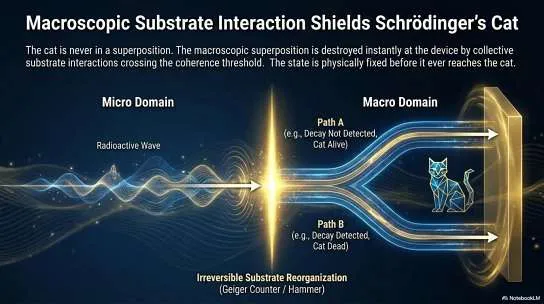
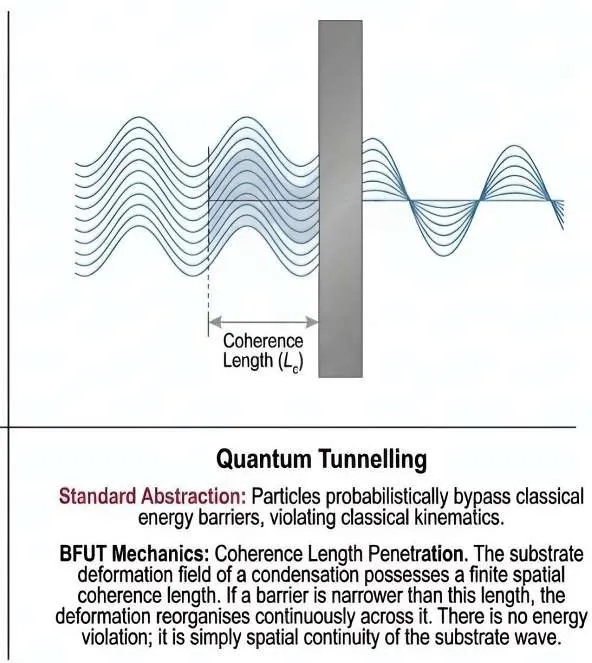
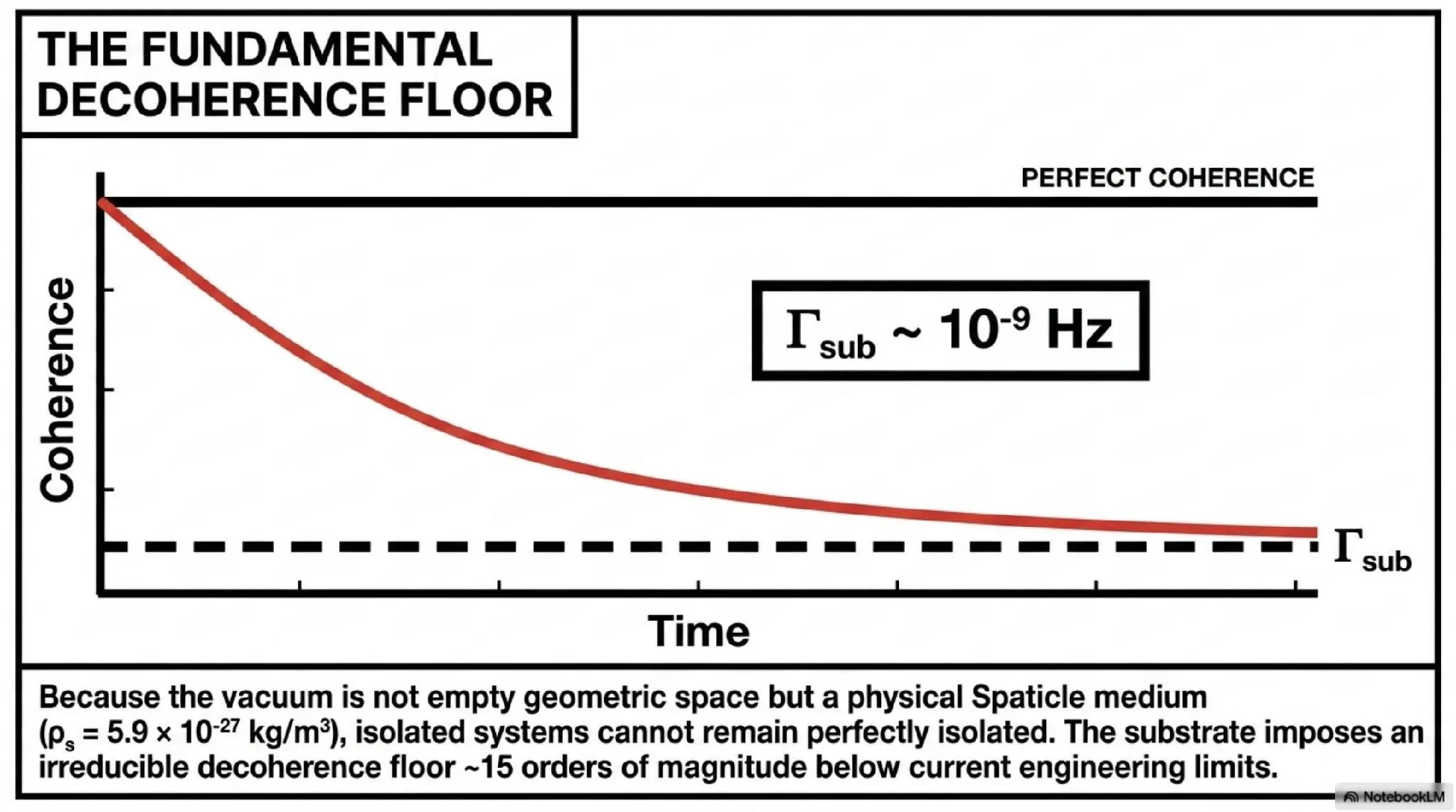
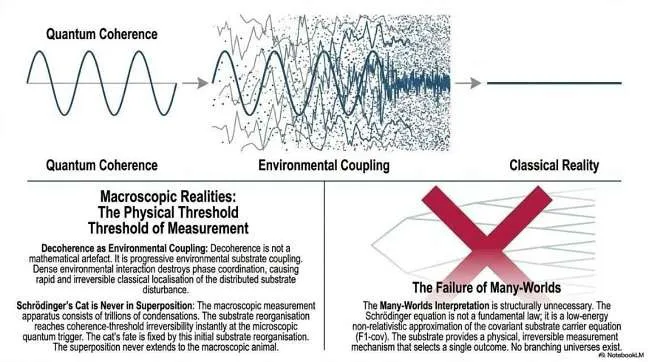
The Big Flare-Up Theory or BFUT Paper 19 established the quantitative
substrate framework by deriving coupling constants, boson masses, the
electroweak mixing angle, the deformation-domain gravitational
structure, the quantum carrier equation, and the propagation basis of
time from the single substrate density ρ_s. The present paper extends
the BFUT programme to quantum mechanics, Higgs physics, and quantum
consciousness.
Gauge symmetry is reinterpreted as local circulation invariance of
substrate condensations. The Schrödinger equation is reconstructed as
the non-relativistic propagation limit of the effective local carrier
field equation, F1, derived from the fully covariant substrate carrier
equation F1-cov established in BFUT Paper 18. The Born rule is
interpreted as substrate deformation-energy density, wavefunction
collapse as substrate state resolution under interaction, and
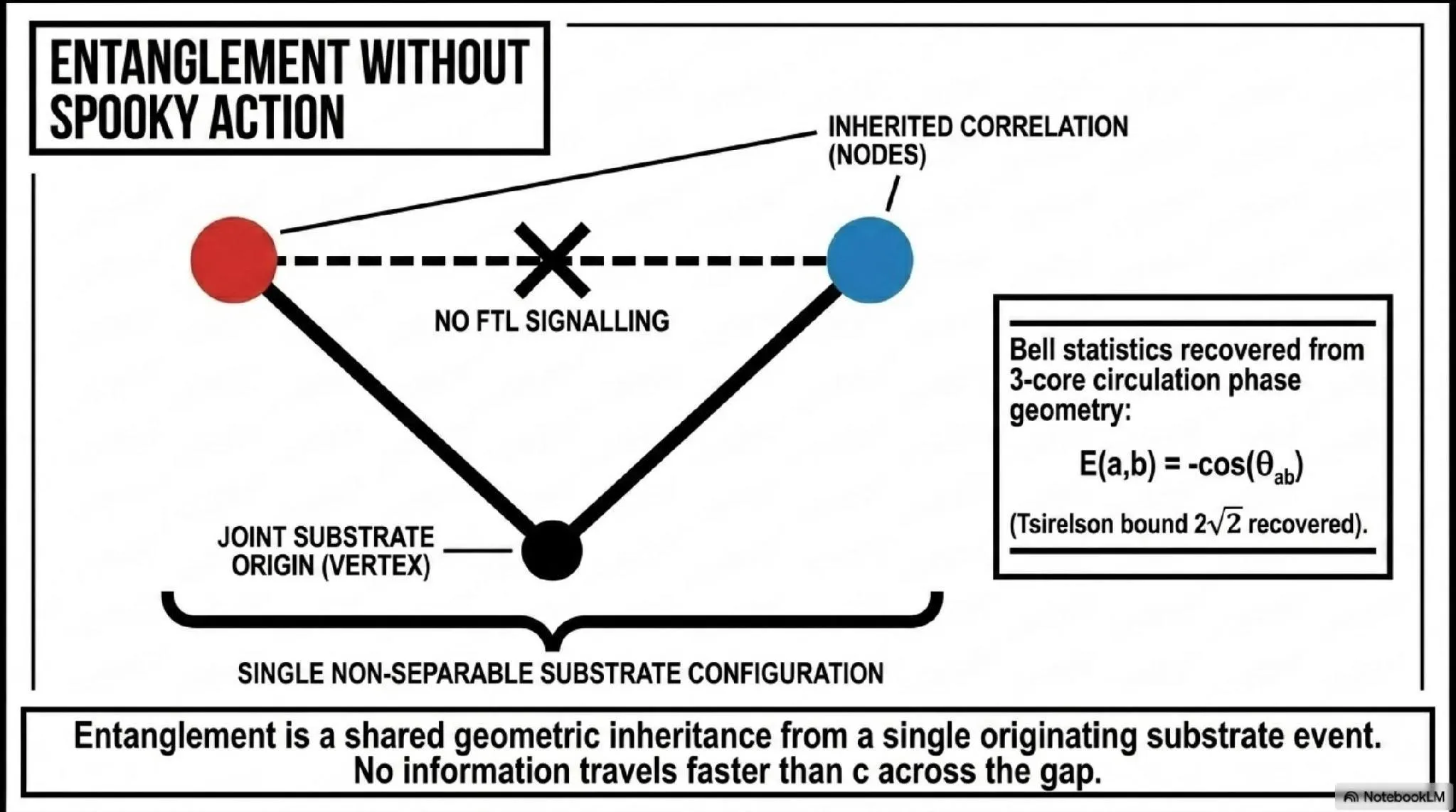
entanglement as shared coherent substrate structure instead of nonlocal
signalling. Half-integer spin emerges from circulation topology of
organised condensations within the substrate.
The framework unifies time dilation, length contraction, redshift,
and propagation delay as different manifestations of one underlying
substrate propagation constraint. Quantum propagation, gravitational
deformation, and relativistic structure are treated within a single
carrier-based description.
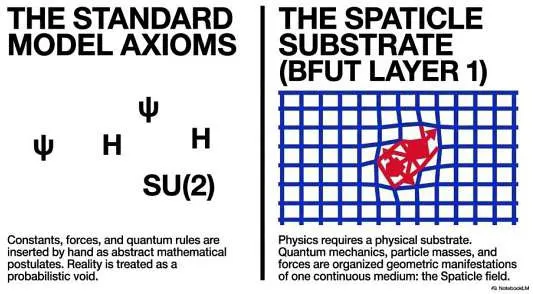
An independent fundamental Standard Model Higgs field does not exist
in BFUT. The Higgs boson itself is real, experimentally confirmed, and
independently predicted by BFUT: it is the collective excitation of the
Spaticle substrate around its vacuum configuration. Particles are
organised condensations of the substrate itself, with mass emerging from
substrate deformation resistance, confinement stability, and propagation
organisation. The observed Higgs boson at 125 GeV is reconstructed
through the balancing relation, a structural geometric-mean prediction
evaluated numerically using the measured top and Z masses:
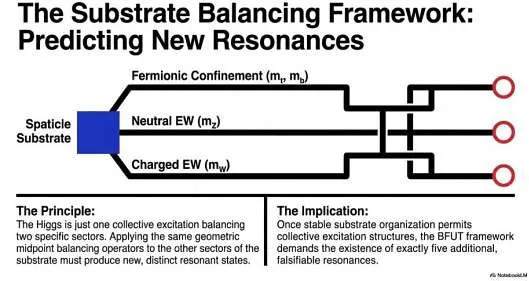
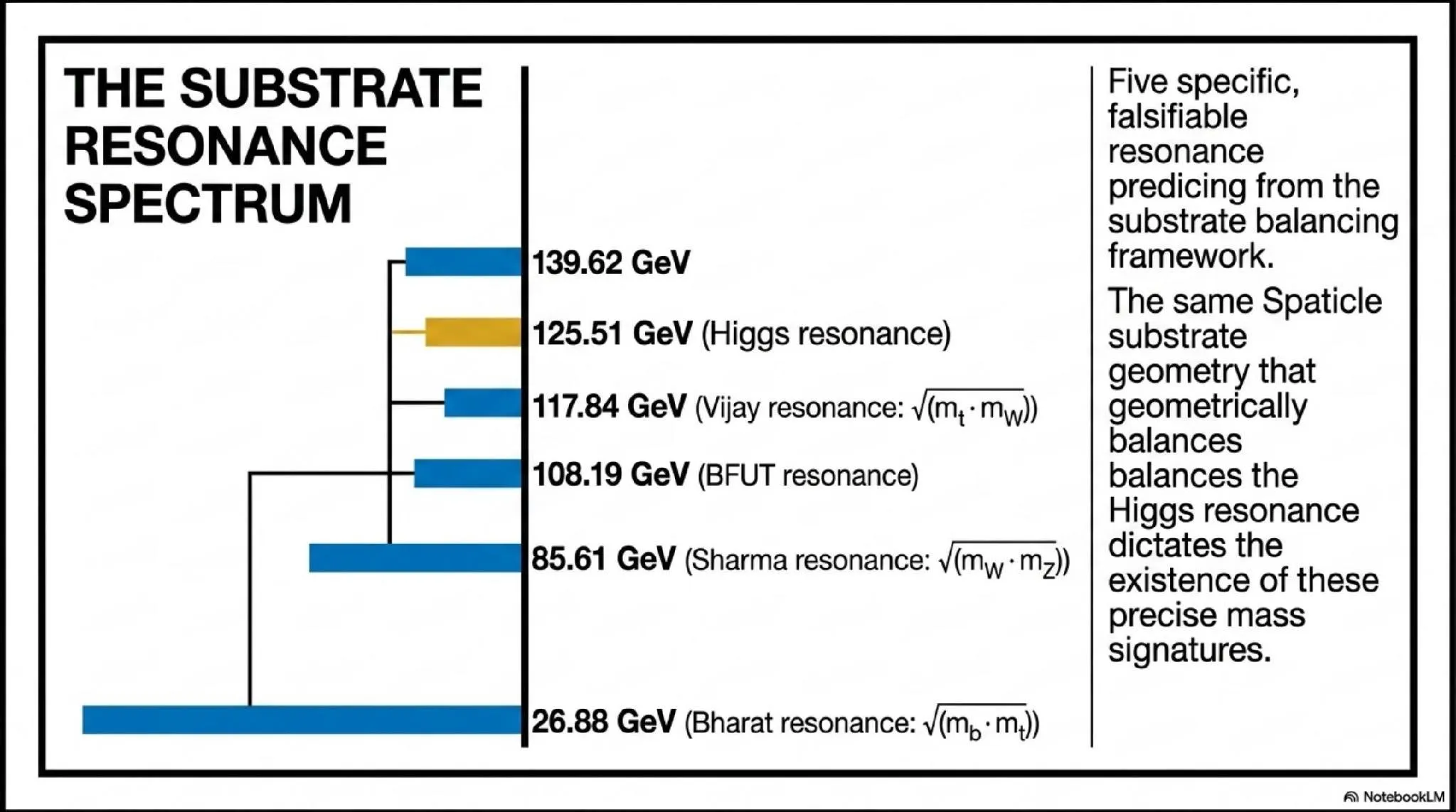
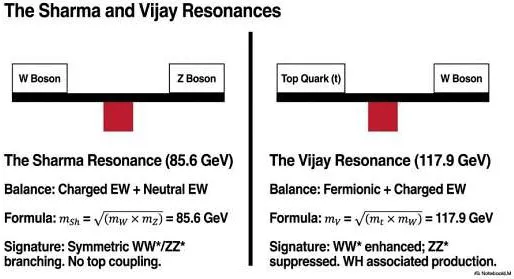
The same substrate balancing framework further predicts five
additional collective substrate excitation modes at approximately 26.88
GeV, 85.6 GeV, 108.19 GeV, 117.84 GeV, and 139.62 GeV, arising from
geometric balancing relations between fermionic confinement and
electroweak topology-transition sectors within the Spaticle substrate.
These resonances are interpreted not necessarily as elementary particles
but as organised collective excitation modes of the substrate
itself.
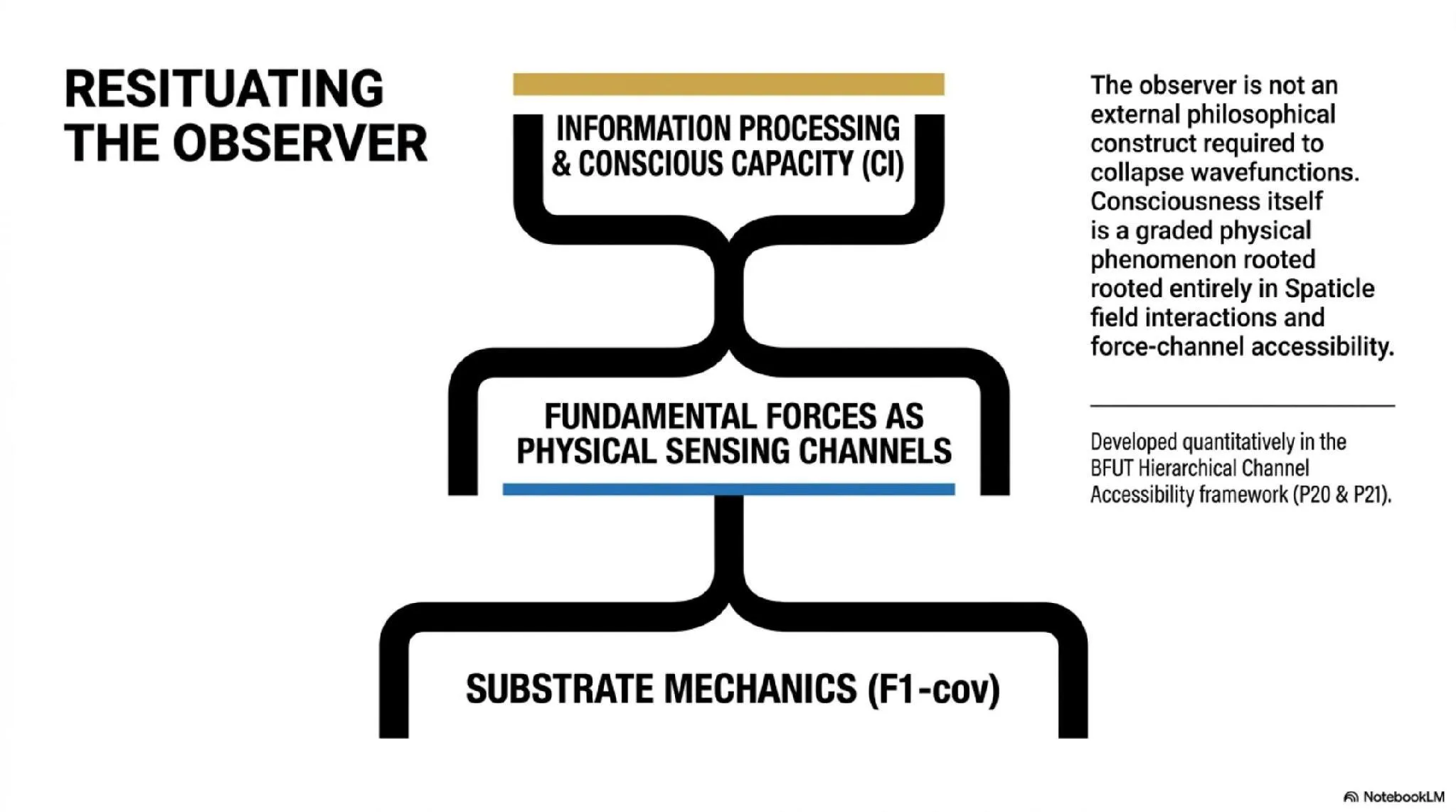
The paper also develops the BFUT account of consciousness as part of
the quantum interpretation programme. Consciousness is treated as a
graded consequence of force-channel accessibility and substrate
interaction instead of as a property emerging suddenly only in
biological nervous systems. BFUT Papers 20 and 21 establish the formal
Hierarchical Channel Accessibility framework and the Consciousness Index
derivation across biological systems.
The paper provides BFUT analyses of major interpretations in quantum
physics and cosmology, including Copenhagen, many-worlds, decoherence,
Orch-OR, quantum tunnelling, black holes, and fine-tuning. Each
interpretation is analysed physically within the substrate framework,
specifying where BFUT agrees, reframes, or renders the interpretation
structurally unnecessary.
The resulting framework presents matter, forces, gravitation, quantum
behaviour, substrate propagation, and consciousness as different
organisational manifestations of one continuous
substrate architecture. Within BFUT, the constants and structures of
physics are not disconnected empirical inputs but constrained
consequences of substrate density, topology, propagation structure, and
organised condensation dynamics.
Every major result in this paper — the reconstruction of the
Schrödinger equation and Born rule, the physical origin of half-integer
spin and the 720° embedding topology, the geometric derivation of the
Higgs boson mass, observer-independent wavefunction collapse, and the
unification of quantum mechanics with gravitation — follows from the
properties of one physical entity: the Spaticle field.
#
Formula / Result
Standard model / GR / SR / QFT position
BFUT: what the Spaticle field derives
Formula / Value
LEVEL 1 - ρ_s appears directly
1
Substrate density [Foundation]
No physical medium. The vacuum is geometric spacetime. Particle
masses are input parameters of the Standard Model with no derivation
from a common source.
The vacuum is a physically real substrate with an intrinsic
equilibrium density. Every result below is a consequence of this one
number existing.
ρ_s = 5.9 × 10⁻²⁷ kg/m³
2
Nucleation energy functional [P16 Sec. 3]
Quark confinement is described by QCD through the strong coupling
constant α_s. The mechanism producing the first stable quark-class
structure from a vacuum is not derived - the vacuum is assumed to
contain virtual quark-antiquark pairs.
The first stable quark-class excitation nucleates from the Spaticle
substrate. Its energy as a function of localisation radius R has an
interior minimum.
The proton charge radius rp = 0.8414 fm is measured. Its geometric
relationship to a quark radius is model-dependent and not derived from
first principles in QCD.
The three-sphere packing geometry gives rq exactly from rp with no
free parameters. One measured input. One derived output.
rq = rp / (1 + 2/√(3)) = 0.8414 / 2.1547 = 0.3905 fm
4
Interstitial volume fraction [P16 Sec. 10]
No equivalent. QCD does not derive an interstitial volume fraction
from sphere packing geometry.
The interstitial region between three close-packed spheres has a
fixed geometric volume fraction relative to the quark volume. This is a
pure geometric constant.
Vgap / Vq = (2·√(3) - π) / (4·π/3) = 0.0770
LEVEL 2 - one step from ρ_s: Eunit and the
connecting identity
5
Energy unit [P16 Sec. 4]
The proton mass mp = 938.272 MeV is a measured input of the
Standard Model. It is not derived from a substrate density or geometric
principle.
At the actual ρ_s, mp is the measured SI anchor. The energy unit
follows directly. A universe with different ρ_s would have a different
Eunit scaling proportionally.
Eunit = mp · c² / π = 298.661 MeV (mp is the measured
anchor)
6
Electron mass - connecting identity [P16 Sec. 10]
The electron mass me = 0.511 MeV is a measured parameter of the
Standard Model. Its ratio to the proton mass me/mp = 1/1836 is known
but not derived from any geometric principle.
The electron mass follows from the interstitial geometry alone.
Eunit cancels from both sides. The ratio me/mp = 1/(6·π⁵) is a pure
geometric constant independent of ρ_s.
Egap / me = 6·π⁴·Vgap/Vq = 45.00 [exact]. me = Eunit/(6·π⁴) =
0.511009 MeV. me/mp = 1/(6·π⁵) [geometry only]
7
Interstitial gap energy [P16 Sec. 10]
No equivalent in QCD or the Standard Model.
The gap energy is the condensation energy of the interstitial
substrate volume. It is the physical energy available for electron
creation.
LEVEL 3 - two steps from ρ_s: threshold, 3+e,
proton formation
8
Three-core energy [P16 Sec. 6]
QCD describes three-quark binding through gluon exchange. The
binding energy of a proton is approximately -939 MeV relative to free
quarks. The mechanism is perturbative and non-perturbative QCD.
Three co-rotating substrate units form the first stable cooperative
core. Energy computed directly from the condensation functional.
E(3-core) = 0.900 model units (full five-term functional, J=1.0,
lam=0.6, α=0.5, Ds=1.5)
9
N=3+1 partition energy comparison [P16 Sec. 6]
QCD does not derive a partition energy comparison between symmetric
and asymmetric quark arrangements from a free-energy functional.
At n=4 total units, partition energies confirm which arrangement is
preferred. N=3+1 decisively preferred over 4+0 and 2+2. This is a
calculational result, not the physical proton.
The proton is a bound state of three quarks in QCD. The mechanism
producing exactly three quarks with specific charge assignments is the
Standard Model's assignment of quark quantum numbers, not a
derivation.
The three-core generates its own electron through the 3+e mechanism.
Energy drops from 0.900 to 0.8958. This is the physical proton-class
structure. The electron is not a separate entity - it is created by the
three-core.
E(3+e) = 0.8958 model units. ΔE = 0.0042 model units
11
Robustness of 3+e threshold [P16 Sec. 6.1]
QCD predicts proton stability through colour confinement. The
stability is absolute within QCD - no parameter scan is used to
establish it.
The 3+e preference holds across 97.56% of 1D, 95.95% of 2D, and
90.43% of 3D parameter space. Not a fragile result at a single tuned
point.
Matter-antimatter asymmetry is attributed to CP violation in the
Standard Model. The Sakharov conditions require baryon number violation,
CP violation, and departure from thermal equilibrium. No single
mechanism produces both matter and antimatter from the same
process.
The stability filter operates at formation. 90-97% of excitations
stabilise as 3+e (matter). The remaining 2-10% are unstable excitations
that collapse. The rebound is what physics calls the antiparticle.
Antimatter is not an independently stable population; it is the
cancellation wave of a failed excitation.
Matter-antimatter annihilation is described by QED and QCD via
conservation of quantum numbers. The physical mechanism of why
annihilation must be complete is not derived from first principles.
Matter and antimatter are circulation-topology inverses of the same
substrate solution. When they meet, the circulations cancel exactly.
Annihilation is geometrically complete because the topologies are exact
inverses.
Force preconditions from 3+e topology [P16 Sec. 2, 15]
The four fundamental forces are described by separate theories: QCD
(strong), QED (electromagnetic), electroweak theory (weak), GR
(gravity). No single mechanism derives all four from one substrate
topology.
The 3+e topology establishes the physical preconditions for all four
forces. Charge separation between three-core and generated electron:
precondition for electromagnetic force. Three-sphere packing geometry:
precondition for strong confinement. Stability filter asymmetry:
precondition for weak force asymmetry. Substrate deformation:
precondition for gravity.
EM: charge separation in 3+e. Strong: three-sphere confinement.
Weak: stability filter asymmetry. Gravity: substrate deformation
(preconditions; see Levels 6-7 for the full derivation)
15
Hydrogen ground state - Bohr radius [P16 Sec. 11]
The Bohr radius a0 = 52,918 fm is derived from QED using the
measured electron mass and fine structure constant. It is not derived
from a substrate density.
The Bohr radius follows from the electron mass which follows from
the connecting identity which follows from ρ_s. A universe with
different ρ_s would have atoms of different size.
a0 = ħ²/(me·ke·e²) = 52,918 fm. a0 proportional to ρ_s^(-1)
16
Hydrogen binding energy [P16 Sec. 11]
The hydrogen ground state energy -13.6 eV is derived from QED. It is
not connected to a substrate density.
The binding energy follows from me which follows from ρ_s. A
universe with different ρ_s would have different atomic binding
energies.
EH = -13.6 eV = -me·k_e²·e⁴/(2·ħ²). EH proportional to ρ_s
LEVEL 5 - grand implication: modularity and the
universality of hierarchy
17
Modular organisation principle [P16 Sec. 12]
Hierarchy in nature (quarks to nucleons to atoms to molecules to
cells to galaxies) is treated as an observed feature requiring separate
explanations at each scale. No single principle derives hierarchy from
energy minimisation.
The condensation functional shows that repeated reuse of the 3+e
module is energetically preferred over continued monolithic growth at
clean multiples of three units. The energy advantage at clean multiples
grows with system size.
Esingle grows superlinearly. E_modular = floor(n/3)·0.8958 +
E_remainder. Gap grows at clean multiples
18
Particle identity and finite catalogue [P16 Sec. 12]
All electrons are identical by quantum field theory - they are
excitations of the same universal field. The number of stable particles
is an experimental observation. No derivation of why exactly these
particles are stable is offered.
Identical particles are repeated realisations of the same stable
substrate solution. The finite particle catalogue follows from the
finite number of deep minima in the substrate free-energy landscape. At
n=4 exactly three configurations exist; 3+e dominates.
The atomic scale is set by the Bohr radius which uses measured
constants. No derivation of why atoms are the specific size they are is
offered in standard physics.
Atom size is a derived consequence of ρ_s. If ρ_s doubled, atoms
would be half the size. The actual atom size follows from the substrate
density through the connecting identity chain.
mp proportional to ρ_s. me proportional to ρ_s. a0 proportional
to ρ_s^(-1). EH proportional to ρ_s. me/mp = constant [geometry]
LEVEL 6 - forces emerge from the 3+e topology
[P17]
20
Gravity as substrate restoring response [P17 Sec. 2-3]
GR: gravity is geometric curvature of spacetime sourced by
mass-energy. No mechanical mechanism is given for why mass curves
spacetime.
Gravity is the Spaticle substrate's own mechanical restoring
response to deformation by mass, instead of an externally imposed
geometric feature. Connects directly to the covariant carrier equation
validated in P18.
Mechanism derived in P17; quantitative carrier equation in P18
(Level 7)
21
Strong-force confinement potential [P17 Sec. 5.2 / P19 Sec.
20.6]
QCD: confinement modelled through colour charge and gluon exchange.
The string tension (~0.9 GeV/fm) is measured, not derived from a
substrate.
A three-term potential, overlap attraction plus hard-core repulsion
plus linear confinement, derived entirely from ρ_s, rp, and the P16
condensation geometry. No new free parameters.
αBFUT = 1/137.037 vs 1/137.036. Difference: 0.00048%
23
Weak mixing angle and parity violation [P17 Sec. 7.3 / P19 Sec.
6]
Electroweak theory: sin²(θ_W) = 0.2312 is measured. Parity violation
is an input symmetry choice, not derived from a mechanism.
sin²(θ_W) is derived from the bifurcation chirality angle of the 3+e
formation; parity violation follows from the fixed counter-rotation
handedness of the generated electron unit.
sin²(θ_W) = 0.2312 vs 0.2312 measured. Difference: 0.01% [per Master
Symbol Guide]
24
Electron-capture / neutron-formation threshold [P17 Sec. 7.4D]
Standard Model: electron-capture threshold 0.782 MeV = (mn - mp -
me)c² is measured; not connected to a substrate mechanism.
The threshold is the dominance-inversion point at which the electron
unit's rotational energy density exceeds the three-core's rest-mass
substrate deformation, set by ρ_s, rp, and the expelled mass fraction
μ.
Effective local carrier field equation, F1 [P18 Sec. 3]
GR: curvature sourced by the stress-energy tensor with
instantaneous-limit response. Newtonian gravity: action treated as
instantaneous.
A single covariant carrier equation with a finite response time τ_c.
GR and Newtonian gravity are recovered as settled-domain approximations
as τ_c -> 0.
Λ-CDM/NFW: χ² fitted per galaxy with free halo parameters.
MOND: χ² = 1.47 with a single universal acceleration scale.
χ² = 1.31 across all 175 SPARC galaxies from a single ρ_s, with no
per-galaxy tuning.
χ²_BFUT = 1.31 vs χ²_MOND = 1.47
29
KiDS-1000 weak gravitational lensing [P18]
Standard NFW halo profile: χ² = 5.77 to 6.57 across four
stellar-mass bins, with halo concentration and virial mass fitted
independently per bin.
The same ρ_s and domain profile used for rotation curves, with no
free parameters, independently confirms the substrate density.
χ²_BFUT = 0.007 to 0.067 vs χ²_NFW = 5.77-6.57
31
Spaticle field as the physical referent of "dark matter" [P18]
Λ-CDM: dark matter is a particulate substance, undetected
directly after decades of dedicated search programmes.
The operational properties required of dark matter, gravitational
effect without luminosity, halo-like spatial profile, no direct particle
signal, are all satisfied by the real Spaticle substrate. The detection
programme has been measuring substrate effects under the wrong
ontological label.
A single ρ_s reproduces rotation curves, lensing, and GW timing
simultaneously
LEVEL 8 - dark matter identification by
coherence index [P25]
32
DM1 Entrainment Formula [P18, validated on 175 SPARC galaxies]
Λ-CDM: dark matter content inferred statistically per system
via N-body-calibrated halo fitting.
A single formula predicts the extra rotation-curve mass from
organised Spaticle entrainment, using global constants shared across the
sample, not fitted per galaxy.
LEVEL 9 - time and relativity from a propagation
budget [P22]
34
Special-relativistic time dilation [P22]
SR: the Lorentz factor is postulated from the constancy of c; no
physical mechanism is given for why clocks slow.
Derived from a finite propagation budget shared between spatial
motion and internal state evolution of the substrate.
c² = v_spatial² + v_internal² => η = √(1 - v²/c²)
35
Gravitational time dilation [P22]
GR: time dilation is a geometric consequence of spacetime curvature;
the same mathematical form as kinematic dilation, but with no unifying
physical cause given for both.
Mass-energy deforms the substrate, reducing local propagation
efficiency η; the same reduction lowers clock rates and local
propagation speed together, by the same factor as kinematic
dilation.
η(r) tied to the same Rd domain function derived in P18
36
Universal speed limit as a causal bound [P22]
SR: c is postulated as an absolute speed limit; the reason for its
universality is not derived.
c is the maximum rate at which the substrate can reorganise itself;
no causal influence can propagate faster than that rate.
c0 = maximum substrate reorganisation rate (explicit formula in
P23, Level 10)
LEVEL 10 - light, photons, and the universal
speed limit [P23]
37
Speed of light from substrate stiffness and density [P23 Sec.
2]
SR/QED: c = 2.997925 × 10⁸ m/s is measured; treated as fundamental,
not derived from a medium.
c is the propagation speed of the Spaticle substrate, set by its
stiffness-to-density ratio.
c = √(Ks/ρ_s). Ks = ρ_s·c² = 5.30 × 10⁻¹⁰ Pa
38
Cross-check of c from independent BFUT constants [P23]
SR: c is independently measured and not cross-checked against any
other derived constant.
c reconstructed from e, R₀, ε₀, mp, rp, and α, all fixed
independently elsewhere in the programme.
c = √(e²·R₀/(4·ε₀·mp·rp·α)). Difference from measured:
0.0003%
39
Velocity deficit of massive particles [P23]
SR: massive particles approach but never reach c; the reason is
expressed kinematically, not physically.
Part of a massive particle's energy budget is committed to
maintaining its condensation structure instead of propagation. The
deficit from c is set by the ratio of rest energy to total energy.
v/c = pc/E = pc/√((pc)²+(mc²)²). Neutrinos within 1 part in 10⁻¹⁷ of
c
40
Equivalence of light speed and gravitational wave speed [P23]
GR/QED: light and gravitational waves both travel at c; treated as
two independently confirmed facts instead of one derived
consequence.
Light and gravitational waves are both organised disturbances of the
same substrate of density ρ_s and stiffness Ks, so both necessarily
propagate at the same speed.
clight = cGW = √(Ks/ρ_s), a structural consequence of one
substrate carrying both disturbances
LEVEL 11 - the Planck constant and quantum
mechanics [P27]
41
Reduced Planck constant from condensation geometry [P27 Sec. 2]
QM: ħ = 1.054571 × 10⁻³⁴ J·s is measured; treated as a fundamental
postulate.
ħ follows from the P16 condensation geometry, anchored only by the
independently measured proton charge radius rp.
ħ = mp·c·rp/(π·R₀). Difference: 0.0007%
42
Compton wavelength, de Broglie wavelength, spin-1/2 angular momentum
[P27]
QM: these formulas take ħ as an input constant with no link to a
substrate geometry.
Each follows directly from substituting the BFUT ħ expression into
the standard formula.
Compton: mp·rp/(π·R₀·m). Spin-1/2: mp·c·rp/(2·π·R₀). Difference:
0.14% (uniform across particles)
43
Planck length, mass, and time [P27 Sec. 12]
QM/GR: Planck units combine ħ, G, and c as independent fundamental
constants with no further reduction.
All three reduce to the same R₀ and ρ_s-anchored chain as ħ; each is
a geometric mean of the condensation scale and a gravitational
scale.
QFT: zero-point energy of empty field modes; the basis of the ~10¹²²
discrepancy against the observed cosmological constant.
Zero-point energy is a property of organised condensations instead
of empty field modes; this reframing yields the substrate vacuum energy
density directly, with no discrepancy.
QM: the spin-statistics connection (integer spin = bosons,
half-integer spin = fermions) is a postulate confirmed within QFT, not
derived from geometry.
Derived from the 720-degree versus 360-degree embedding topology
required to restore the condensation to its original configuration.
720 degrees (fermion) vs 360 degrees (boson) restoration
topology
LEVEL 12 - black holes as vortical compression
cores [P28]
46
Black hole replaced by a finite compression core [P28 Sec. 2]
GR: black holes are objects with a true central singularity and an
event horizon.
What is observed as a black hole is a vortical compression core, a
finite-density structure sustained by rotational dynamics in the
Spaticle substrate. No singularity, no true horizon.
Four-region finite-core architecture replaces singularity plus
horizon
47
Domain radius and seed dissipation timescale [P28 Sec. 3.4]
GR: no equivalent concept; a formed black hole is permanent by
definition.
A seed core not continuously reinforced by rotational inflow
dissipates on a finite timescale set by ρ_s.
Rotational Sustenance Principle and Threshold [P28 Sec. 3.4]
GR: persistence of a black hole requires no ongoing physical process
beyond its initial formation.
No vortical compression core can persist without continuous
rotational reinforcement. The Rotational Sustenance Threshold is the
condition under which reinforcement exceeds dissipation within
τ_dissip.
Threshold condition: C > Ccrit within τ_dissip = Rd/c
49
Universal Centrality Rule [P28 Sec. 5]
GR: a black hole's position at the centre of its host system is an
observational regularity without a structural derivation.
Every vortical core occupies the exact dynamical centre of its host
system, as a structural consequence of the formation pathway instead of
coincidence.
Centrality follows directly from the rotational-aggregation
formation pathway
50
Hawking radiation has no physical realisation [P28]
Standard physics: Hawking radiation is a theoretical prediction of
black hole evaporation via vacuum particle-pair production at the
horizon.
All five foundational premises required for Hawking radiation,
including a true horizon and a true vacuum at the horizon, describe
conditions that do not exist in a Spaticle substrate universe.
No physical realisation under BFUT; replaced by finite-core
thermodynamics
The Spaticle Field Across the BFUT Corpus: Formula
Reference
Central anchor: one substrate density ρ_s = 5.9 × 10⁻²⁷ kg/m³
governs every result below.
Rows ordered from simplest (ρ_s direct) to most derived, spanning
Papers 16, 17, 18, 19, 22, 23, 25, 27, and 28. Orange column: the
standard model, QCD, GR, SR, or QFT position. Green column: what BFUT
derives from the Spaticle field. Each row is tagged with its source
paper and section.
The following symbols are used throughout this paper. All values are
from the BFUT Master Symbol Guide.
The table below provides a comprehensive reference showing how
the single intrinsic equilibrium density ρ_s = 5.9 × 10⁻²⁷ kg/m³ governs
phenomena across the entire BFUT corpus. It demonstrates why the
Spaticle field is not an optional addition but the necessary physical
substrate that makes the unification presented in this paper
possible.
The
Central Role of the Spaticle Field
Extended Symbol List (core + additional symbols used in this
paper)BFUT Papers 14 through 19 established the physical
substrate framework underlying matter, forces, gravitation, particle
masses, coupling constants, and relativistic propagation. The Spaticle
substrate was identified as the physical medium of space, gravitation
was reconstructed as organised substrate deformation dynamics, and
multiple Standard Model quantities were derived or reconstructed
directly from substrate geometry and the intrinsic substrate equilibrium
density ρ_s (see BFUT Paper 18 Section 1A for physical basis and
robustness) [1][2][3][4][5].
BFUT Paper 19 significantly extended the quantitative Layer 1 physics
programme by reconstructing the strong coupling constant, the fine
structure constant, the electroweak mixing
angle, the W and Z boson masses, the carrier-time structure
associated with gravitational-wave propagation, and the Higgs-scale
balancing relation from the same substrate framework.
The remaining unresolved questions were primarily conceptual and
interpretational: the physical meaning of quantum mechanics, the origin
of the Schrödinger equation and Born rule, the physical basis of gauge
symmetry and spin-statistics structure, the relation between quantum
mechanics and gravitation, the interpretation of the Higgs field, and
the connection between matter and consciousness.
The purpose of the present paper is to extend the BFUT substrate
framework into quantum mechanics, relativistic propagation, Higgs
ontology, and quantum consciousness.
Within BFUT, quantum mechanics is not treated as a disconnected
probabilistic formalism imposed independently of physical reality.
Quantum behaviour emerges from the propagation, coherence, and
interaction structure of organised condensations within the Spaticle
substrate. The Schrödinger equation is therefore treated not as a
fundamental postulate but as the non-relativistic propagation limit of
the deeper carrier equation established in Paper 19. The Born rule,
entanglement, wavefunction collapse, gauge symmetry, and spin-statistics
structure are likewise reinterpreted physically through substrate
dynamics instead of purely formal mathematical axioms.
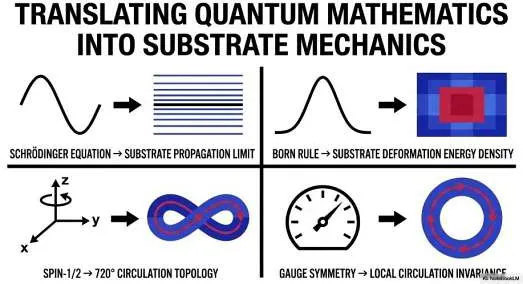
Figure2: :BFUT reinterpretation of core quantum-mechanical
structures through substrate dynamics.
The physical derivation of time, the rejection of spacetime as a
fundamental ontological entity, the universal propagation limit c, time
dilation, length contraction, gravitational redshift, and the
unification of Special and General Relativity are developed in BFUT
Paper 19. The present paper adopts those results and extends the
substrate framework into quantum mechanics, wavefunction behaviour,
gauge structure, spin, measurement, Higgs ontology, and quantum
consciousness.
Paper 19 establishes the substrate foundations of light propagation,
relativistic causality, time, time dilation, length contraction, metric
emergence, and the universal speed limit. Paper 19A develops the quantum
consequences of that framework.
Terminology note: The Spaticle field is the physical substrate
underlying space, matter, propagation, and interaction throughout the
BFUT framework. The terms Spaticle substrate and Spaticle field refer to
the same underlying physical reality and are used interchangeably
throughout this paper.
The coupling constants of the fundamental forces are not fixed. They
change with the energy scale at which they are probed, a phenomenon
called running. The standard model describes this running through
renormalisation group equations and the β function for each force.
The physical mechanism behind the running is not provided by the
standard model. BFUT provides one.
In BFUT, a coupling constant measures a geometric ratio of the
condensation structure at a given probe scale. The strong coupling
constant α_s equals the ratio of binding energy to kinetic localisation
cost: α_s = B*R04 / A, where R0 is the effective condensation radius at
the probe scale. When a high-energy probe interacts with a condensation,
it does so at a smaller effective radius. As R0 shrinks, A grows faster
than B*R04 because the kinetic localisation energy scales as 1/R02
while the bulk binding energy scales as R02. The denominator grows
faster than the numerator. The coupling falls. This is asymptotic
freedom: at high energies (small R0), the strong coupling weakens. At
low energies (large R0), pulling the quarks apart, the coupling
strengthens. The BFUT β function for the strong coupling is therefore
negative, consistent with QCD [21][22], derived from the geometric
properties of the condensation instead of from loop diagram
counting.
The electromagnetic coupling α behaves differently because it depends
on a different geometric property: the internal rotational asymmetry of
the condensation instead of its bulk radius. Compressing the
condensation does not significantly change the internal circulation
asymmetry. Therefore α runs much more slowly with energy. The different
geometric sensitivities of different couplings is what produces the
observed running hierarchy: α_s runs steeply, α runs slowly, and
the electroweak coupling runs at an intermediate rate. This
prediction is structurally correct and consistent with measured running
to the precision of current data.
The BFUT substrate framework provides the physical basis of the
observed running hierarchy through condensation geometry and
scale-dependent substrate organisation. The renormalisation group
behaviour follows directly from the geometric scaling properties of the
substrate condensations.
Gauge Symmetry
as Local Circulation Invariance
Gauge symmetry is the most fundamental structural principle of the
standard model. The electromagnetic interaction is U(1) gauge invariant,
the weak interaction is SU(2), and the strong interaction is SU(3). In
the standard model these symmetries are imposed as axioms: the
Lagrangian must be invariant under local phase transformations of the
relevant symmetry group. Why these specific symmetries exist is not
explained.
In BFUT, gauge symmetry has a physical origin. The internal
circulation modes of a condensation are locally invariant under rotation
of their phase. This means: if the circulation of a condensation at one
location is rephased by an angle θ(x) that varies from point to
point, the physical content of the condensation is unchanged. Its
energy, its charge, and its coupling to the substrate are all invariant
under this local rephasing. This is not an imposed axiom. It is a
consequence of the substrate being homogeneous and isotropic: there is
no physical direction in the substrate that singles out a preferred
phase.
When this local phase invariance is demanded at every point in the
substrate simultaneously, a compensating field must be introduced to
maintain invariance under the local transformation. That compensating
field is the gauge field. For U(1) rotation of the electromagnetic
circulation mode, the compensating field is the photon. For SU(2)
transformations of the weak circulation modes, the compensating fields
are the W and Z bosons. For SU(3) transformations of the three-core
colour circulation, the compensating fields are the eight gluons.
Gauge symmetry in BFUT is therefore not a postulate but a consequence
of the substrate homogeneity combined with the local phase invariance of
condensation circulation. The specific symmetry group is determined by
the topology of the circulation modes: one electromagnetic mode gives
U(1), two weak modes give SU(2), three colour modes give SU(3).
The
Schrödinger Equation as Substrate Propagation Limit
The time-dependent Schrödinger equation is the foundational equation
of non-relativistic quantum mechanics. In the standard formulation it is
a postulate: the wavefunction evolves according to i*ℏ*d(ψ)/dt = H*ψ. No
derivation of this equation from a more fundamental physical principle
is provided within standard QM.
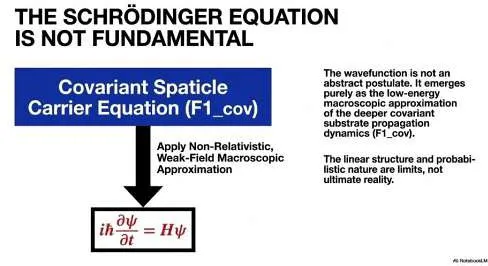
In BFUT, the Schrödinger equation emerges as a limiting case of the
covariant substrate propagation equation F1-cov. F1-cov describes the
evolution of the substrate carrier field δΨ under the influence of
matter sources. In the non-relativistic limit, where the condensation
velocity is much less than c and the substrate deformation is weak,
F1-cov reduces to a diffusion-like equation for the condensation
amplitude ψ(x,t). The identification is: ψ(x,t) corresponds to the local
substrate deformation amplitude associated with the condensation. The
kinetic energy term ℏ²*∇²/(2m) corresponds to the spatial coherence term
of the substrate propagation. The potential energy term V corresponds to
the substrate deformation energy associated with external fields.
This structural correspondence shows that the Schrödinger equation is
not a fundamental postulate but a low-energy macroscopic approximation
to the substrate propagation dynamics. Its linear structure, its
probabilistic interpretation, and its inability to describe particle
creation and annihilation all follow from the fact that it is a limiting
case valid only within the non-relativistic, weak-field regime. The full
substrate propagation dynamics, described by F1-cov, are what underlies
the quantum behaviour. Schrödinger obtained the correct macroscopic form
through physical intuition. BFUT provides the substrate from which that
form derives.
The Schrödinger equation therefore emerges as the non-relativistic
weak-field limit of substrate propagation dynamics established in the
carrier framework.
Figure 3: The Schrödinger equation emerging as the non-relativistic limit of the covariant substrate carrier equation F1-cov.
The Born
Rule as Substrate Deformation Energy Density
The Born rule states that the probability of finding a particle at
position x is P(x) = |ψ(x)|^2, the squared modulus of the wavefunction.
Standard quantum mechanics treats this as a postulate. It predicts
experimental outcomes with extraordinary precision but does not explain
physically why probabilities follow the square of the amplitude instead
of the amplitude itself or any other function. BFUT instead interprets
the rule physically as a probability distribution governing successful
irreversible interaction between distributed substrate disturbances and
detector matter.
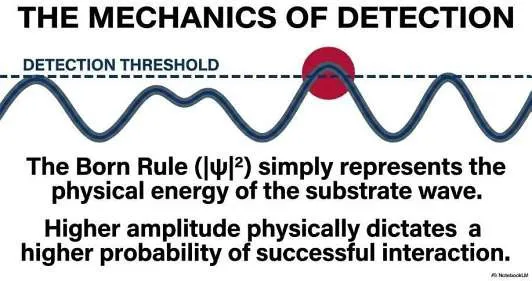
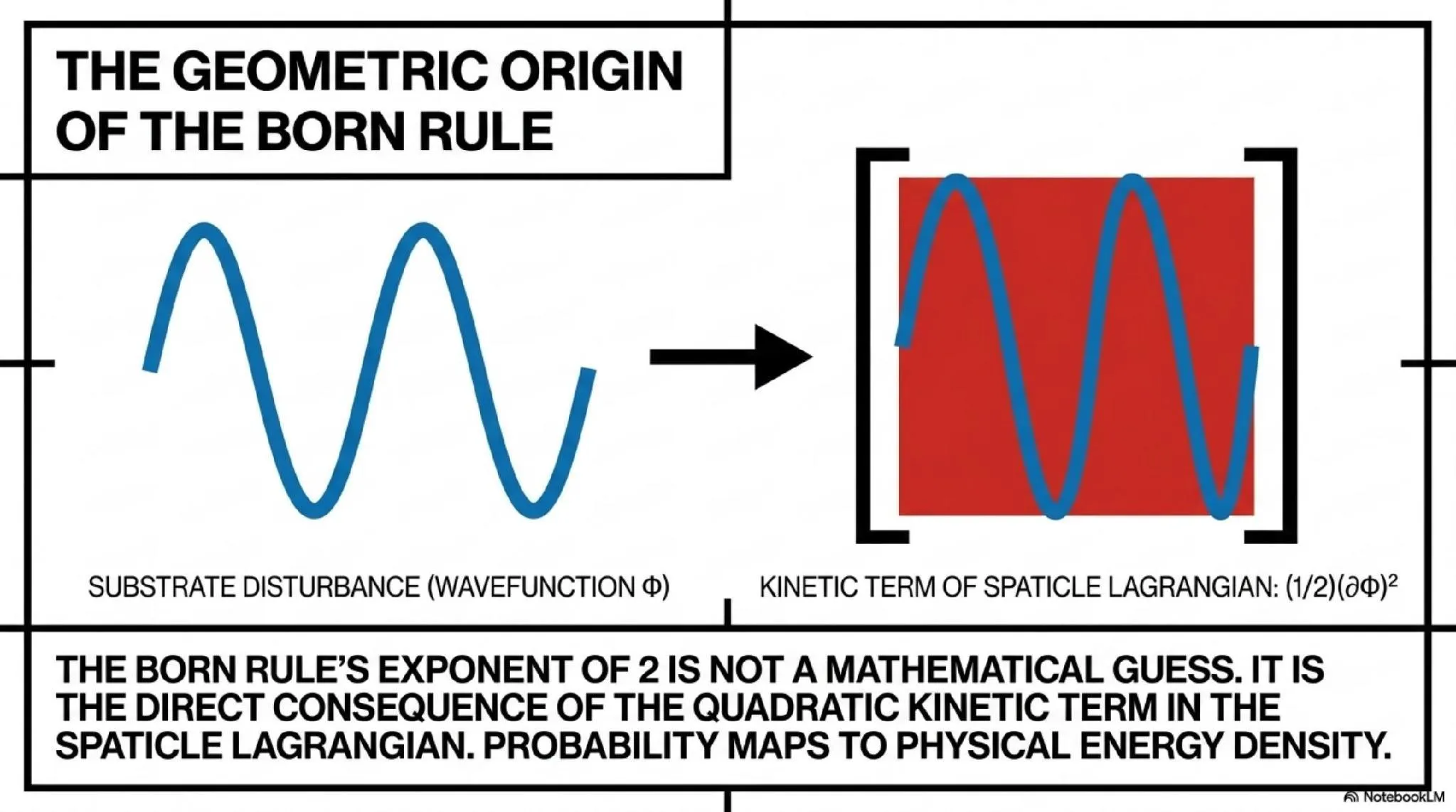
Figure 4, 5: The geometric origin of the Born rule. The exponent
of 2 is the direct physical consequence of the quadratic kinetic term in
the Spaticle Lagrangian. Probability maps to physical energy
density.
Figure 5: Real mechanics of Born Rule are physical.
Within BFUT, the Born rule emerges naturally from the physical
behaviour of distributed substrate disturbances interacting with
matter.
In BFUT, a particle is not a tiny isolated point moving through empty
space. It is a distributed organised disturbance propagating through the
Spaticle substrate. The wavefunction represents the spatial distribution
of this propagating disturbance. Some regions of the wave are stronger
and more organised, while other regions are weaker.
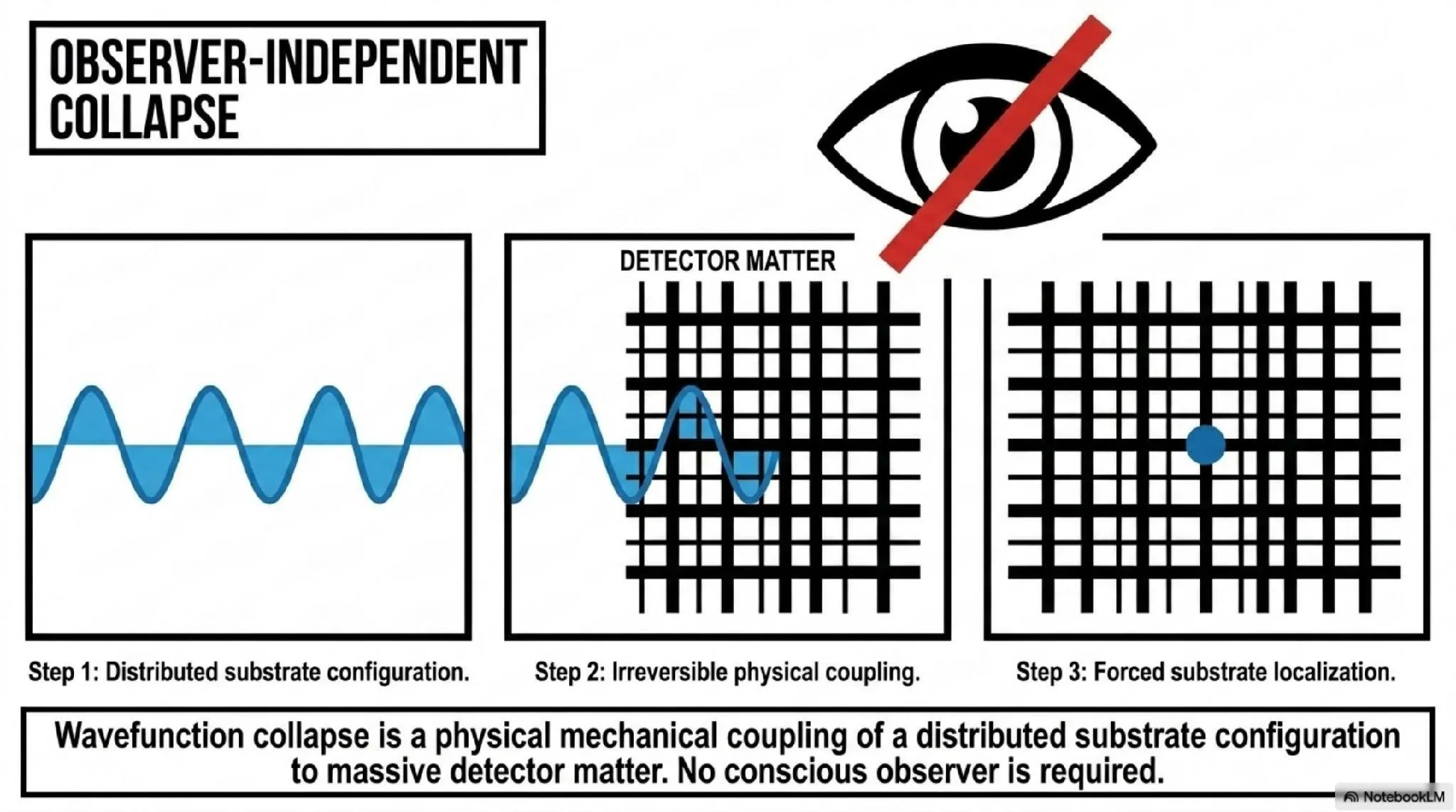
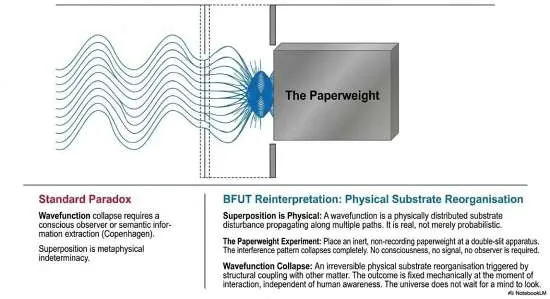
When the propagating disturbance reaches a detector, the detector
does not observe possibilities or collapse reality through
consciousness. The detector is itself a physical structure made from the
same substrate. Detection occurs when part of the distributed
disturbance successfully produces irreversible physical interaction with
the detector material.
The key point is that the Born rule describes probability of
successful detection, not probability of existence.
Why the Square?
Where the substrate disturbance is more intense, the probability of
producing irreversible physical coupling with detector matter is higher.
Where it is weaker, coupling is less likely.
This is not mysterious. In wave systems generally, deposited energy
scales with the square of wave amplitude. The probability pattern
|ψ(x)|² therefore follows directly: regions of greater substrate
disturbance amplitude produce disproportionately stronger coupling with
detector
matter, and the exponent 2 is the same exponent that appears in the
quadratic kinetic term of the Spaticle Lagrangian.
The particle is therefore detected at one location not because a
conscious observer selected reality, but because one region of the
distributed propagating disturbance successfully produced irreversible
physical interaction first.
Repeated experiments then naturally reproduce stable statistical
distributions because the distributed disturbance propagates repeatedly
in the same overall way, stronger regions repeatedly produce more
successful interactions, and weaker regions repeatedly produce fewer.
The familiar probability distribution gradually emerges across many
detection events.
Under BFUT, the Born rule is not a mysterious law about knowledge,
observation, or consciousness. It is the natural physical consequence of
how distributed substrate disturbances interact probabilistically with
matter inside a real physical substrate.
The Uncertainty Principle as Substrate Localisation
Cost
The Heisenberg uncertainty principle states that the simultaneous
precision of position and momentum of any quantum system is bounded:
Δx · Δp ≥ ħ/2
where Δx is the uncertainty in position, Δp is the uncertainty in
momentum, and ħ = 1.055 × 10⁻³⁴ J·s is the reduced Planck constant,
whose numerical value is derived from the P16 condensation geometry in
Paper 16 Section 4.2 as ħ = mp · c · ℓ_model / π, with a 0.0007%
deviation using rp = 0.8414 fm (PDG 2022). In standard quantum
mechanics the uncertainty bound is derived from operator
non-commutativity or from the Fourier conjugacy of position and momentum
representations. Both derivations are mathematically correct but neither
explains physically why the bound exists or why ħ sets its scale. BFUT
derives the uncertainty principle from the same substrate free-energy
structure that produces the Schrödinger equation and the Born rule,
completing the three foundational pillars of quantum mechanics within
the substrate framework.
The P16 Free-Energy Functional
The free-energy functional for a substrate condensation of effective
radius R, established in Paper 16 Section 3, is:
E(R) = A/R² + B·R² + C·R + D/R
The four terms and their physical identities are as follows. A/R² is
the localisation cost: the energy of confining a substrate condensation
within radius R, diverging as R → 0. Its coefficient is A = ħ²/(2m_eff),
where meff is the effective mass of the carrier perturbation, derived
in Paper 18 from the P17 vacuum condition as m_eff² = 3ρ_s c², giving
meff = 5.324 × 10⁻²⁸ kg from ρ_s and rp alone. As established in Paper
16 Section 4.4, if the BFUT ħ relation is exact then Amodel = 1/2
exactly in model units, recovering the Schrödinger kinetic coefficient
from the substrate framework without additional input. B·R² is the bulk
displacement cost: a larger condensation displaces more of the
surrounding substrate. This term grows with R: dispersal is also
energetically costly. C·R is the boundary cost: the surface energy at
the interface between the organised condensation interior and the
surrounding substrate, with coefficient C = 4π R₀² σ_s, where σ_s is the
surface tension at the condensation boundary. D/R is the internal
circulation support from the co-rotation of the three-core geometry,
decreasing with R. B = 0.56308, C = -1/3, D = 1 are all derived from
first principles from the three-sphere condensation geometry (Paper 16
Appendix C). Together the four coefficients confirm the stable interior
minimum established in Paper 16. Together the four terms produce a
stable non-zero interior minimum at R*, where all contributions balance.
Neither collapse to R = 0 nor dispersal to R → ∞ is stable. This is why
stable localised matter exists.
Step-by-Step Derivation
Step 1: Write the localisation energy as a function of R.
Substituting A = ħ²/(2m_eff) into the A/R² term:
E_localisation(R) = ħ²/(2m_eff R²)
This grows without bound as R → 0. The substrate physically prohibits
complete localisation.
Step 2: Identify position uncertainty with the confinement radius.
The spatial extent of the condensation deformation scales with R. The
position uncertainty is therefore Δx ~ R.
Step 3: Identify the momentum uncertainty from the localisation
energy. The internal substrate dynamics must supply the localisation
energy. The kinetic energy associated with a momentum spread Δp for a
condensation of mass meff is E_kinetic = (Δp)²/(2m_eff). For the
condensation to remain stable at radius R:
(Δp)²/(2m_eff) ≥ ħ²/(2m_eff R²)
Step 4: Extract the position-momentum relation. Cancelling 2m_eff
from both sides and taking the positive square root:
Δp ≥ ħ/R
Substituting Δx ~ R:
Δx · Δp ≥ ħ
The factor of 1/2 in the standard statement arises from defining Δx
and Δp as root-mean-square standard deviations of the full deformation
distribution instead of the half-width R. The inequality structure and
the scale ħ are fixed entirely by the A = ħ²/(2m_eff) identification
from Paper 16 and the meff derivation from Paper 18. No additional
input is required.
Physical Meaning: Uncertainty and Matter Stability Are One
Mechanism
The A/R² term simultaneously prevents matter from collapsing to a
point and produces the uncertainty bound. These are not two separate
consequences of the substrate. They are the same energy balance in two
physical situations: the stability of a condensation against collapse,
and the resistance of a condensation to arbitrary localisation. A
universe without the uncertainty principle would be one in which A/R² is
absent. In that universe the condensation functional would allow
collapse to a point and stable localised matter could not exist. The
uncertainty principle and the existence of stable matter are therefore
not merely connected. They are the same substrate fact expressed in two
different physical situations.
The uncertainty principle is not an independent quantum postulate in
BFUT. It is a consequence of the substrate free-energy balance that
allows stable matter to exist. Arbitrarily precise simultaneous position
and momentum is not forbidden by a mathematical rule imposed on top of
physics. It is energetically prohibited by the Spaticle substrate
itself.
The Fermionic Circulation Hierarchy
The BFUT framework derives all six quark masses from two quantities:
the top quark mass mt
= 172.76 GeV (the measured top quark pole mass, consistent with the
maximum substrate coupling condition yt ≈ 1, which predicts v/√2 =
174.1 GeV, within 0.8%) and the fine-structure constant α_em = 1/137.037
(already derived from internal circulation geometry in Paper 17).
In BFUT, α_em represents the retained circulation asymmetry fraction
of stable substrate condensations and therefore naturally governs the
hierarchy suppression structure. The hierarchy uses the BFUT
circulation-occupancy relation in which observable fermionic mass scales
linearly with dynamically retained coherent circulation occupancy
instead of quadratic field-energy density.
The derivation proceeds in four steps. First, the P16 free-energy
functional establishes which circulation condensations are locally
stable. Second, the Noether circulation occupancy Q = i * integral(Φ*
dPsi/dt, dPsi*/dt * Φ) d3x gives Q proportional to ω_c for stable
condensations with fixed spatial profile, making mass linear in
circulation amplitude. Third, α_em is identified as the retained
circulation asymmetry fraction after one complete bifurcation cycle.
Fourth, successive bifurcation filtering gives Q_{n+1} = α_em * Qn,
producing the geometric hierarchy.
The up-type sector follows integer suppression steps:
mt = 172.76 GeV [measured value, used as input; yt ≈ 1 predicts
v/√2 = 174.1 GeV, within 0.8%]
mc = mt x α_em = 1.261 GeV [measured: 1.27 GeV, 0.73%]
The down-type sector follows a shifted suppression ladder with
fractional exponents, arising from the P16 3+e bifurcation: three
internally retained circulation modes and one permanently externally
coupled mode, giving a confinement fraction of 3/4:
mb = mt x α_em^(3/4) = 4.31 GeV [measured: 4.18 GeV, 3.2%] ms =
mt x α_em^(3/2) = 108 MeV [measured: ~96 MeV] md = mt x α_em^(9/4) =
2.7 MeV [scheme-dependent]
The fractional exponents arise from the P16 bifurcation occupancy
structure in which one of four circulation modes remains externally
coupled, leaving an internally retained occupancy fraction of 3/4. The
terminal up harmonic undergoes infrared projection: at the second
suppression level the full 3+e mode structure becomes observationally
relevant, giving muobs = mubare
/ 4 = 2.30 MeV, within the PDG range of 1.7--3.3 MeV. This projection
applies only to the up quark; the down sector has leakage already
encoded continuously in its fractional exponents. The resulting
structure gives md > mu with the correct neutron-proton splitting
sign.
The BFUT hierarchy therefore distinguishes between ultraviolet
circulation eigenmasses and infrared confinement-projected observable
masses. The terminal up-type harmonic undergoes a full 3+e infrared
circulation projection:
muobs = mt x α_em² / 4 = 2.30 MeV [PDG range: 1.7 to 3.3 MeV]
The down-type hierarchy already incorporates partial circulation
leakage continuously through its fractional occupancy exponents and
therefore requires no additional infrared projection.
Three generations are the maximum: the fourth up-type generation
would be mt x α_em³ =
0.067 MeV, below the substrate coherence threshold, decohering into
vacuum fluctuations instead of forming a stable condensation.
The corresponding charged-lepton geometric mean mass scale satisfies
a further structural relation tied to the electroweak threshold:
M02 = mW / 44 = mW / 256
Using mW = 80377.3 MeV:
M02 = 80377.3 / 256 = 313.97 MeV
The measured charged-lepton Koide scale is M02 = 313.84 MeV.
Difference: 0.042%. The factor 44 = 256 arises from the n = 4
bifurcation threshold identified in P16, where the first stable
substrate condensation produces the 3+e topology. The charged-lepton
mass scale therefore emerges directly from the electroweak threshold
geometry.
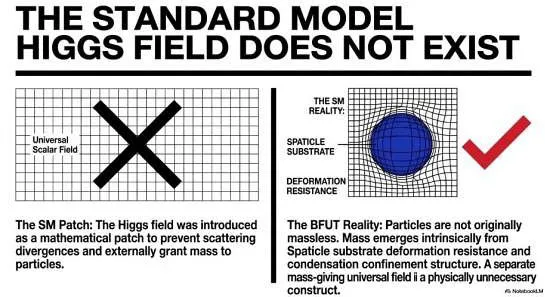
The paper establishes that the Standard Model Higgs field does not
exist as a separate mass-giving entity; the underlying physical reality
is instead the Spaticle substrate itself. The Standard Model introduced
the Higgs field as a scalar field responsible for mass generation
through spontaneous symmetry breaking. BFUT instead interprets particles
themselves as organised condensations of the substrate, with mass
emerging directly from substrate deformation resistance and confinement
structure. Under this interpretation, the observed 125 GeV Higgs boson
corresponds to one collective excitation mode of the Spaticle substrate
instead of evidence for an independently fundamental external
mass-giving field. The same substrate balancing framework further
predicts five additional collective excitation modes at distinct mass
scales, each corresponding to distinct balancing structures between
fermionic confinement and electroweak topology-transition sectors.
Finally, the paper addresses major interpretations and unresolved
problems in modern physics and cosmology within the substrate framework,
including Copenhagen collapse, many-worlds, quantum tunnelling,
decoherence, Orch-OR, dark energy, fine-tuning, the multiverse, black
hole singularities, retrocausality, and the apparent incompatibility
between quantum mechanics and general relativity.
The architectural line of the BFUT programme is continuous
throughout: the Spaticle substrate produces stable condensations;
condensations produce forces through substrate interaction channels;
forces produce atoms beginning with hydrogen; atoms organise into stars,
planets, and biological systems; and biological systems express
progressively higher grades of consciousness through increasingly
organised substrate interaction structures. The Layer 1 programme
therefore treats matter, forces, spacetime, quantum behaviour, and
consciousness not as disconnected domains but as different
organisational manifestations of one continuous physical substrate
architecture.
Half-Integer
Spin from Condensation Circulation Topology
A Century
of Unanswered Questions
Half-integer spin has been one of the deepest unresolved mysteries in
physics for a century. The mathematics that describes it is
extraordinarily successful (spinors, SU(2) group theory, the Dirac
equation) yet no universally accepted physical mechanism has been
established for why it exists.
Paul Dirac, who derived the relativistic wave equation for spin-½
particles in 1928 [43], showed that the mathematics of his equation
naturally incorporated half-integer spin but offered no physical picture
of what spin physically is. The spinor formalism works. What it
represents physically was left open.
Richard Feynman, one of the architects of quantum electrodynamics,
wrote in his Lectures on Physics that “The spin one-half particles, in
particular the electrons, behave in a way which has no classical
analogue” and that “It is rather strange that it takes two complete
turns of 360° each to get back to the original state” [44]. This was not
false modesty. It was an honest assessment of a genuine gap in physical
understanding.
Wolfgang Pauli formulated the exclusion principle in 1925 [45] and
later provided the first rigorous relativistic proof of the
spin-statistics theorem [46], which established that half-integer spin
particles must obey Fermi-Dirac statistics and integer spin particles
must obey Bose-Einstein statistics, demonstrating the mathematical
connection between spin and statistics rigorously. Yet the physical
reason why all matter particles have half-integer spin and all force
carriers have integer spin was not explained. It was a pattern without a
mechanism.
Roger Penrose described in The Road to Reality [47] the 720°
rotational behaviour of spinors as profoundly unlike ordinary classical
spatial behaviour, treating it as one of the deepest and most
counterintuitive features of physical reality that any complete physical
theory must account for instead of merely postulate.
The spin-statistics connection has been widely acknowledged among
physicists as one of the most important but least understood results in
all of physics: the mathematical proof exists but the physical reason
behind it has remained obscure.
In over a hundred years of quantum mechanics, no universally accepted
physical mechanism has been established for why all matter particles
have half-integer spin and require 720° for restoration, while all force
carriers have integer spin and require only 360°. The pattern is
universal and exact. Not a single exception has ever been found. Yet
standard physics has no account of why.
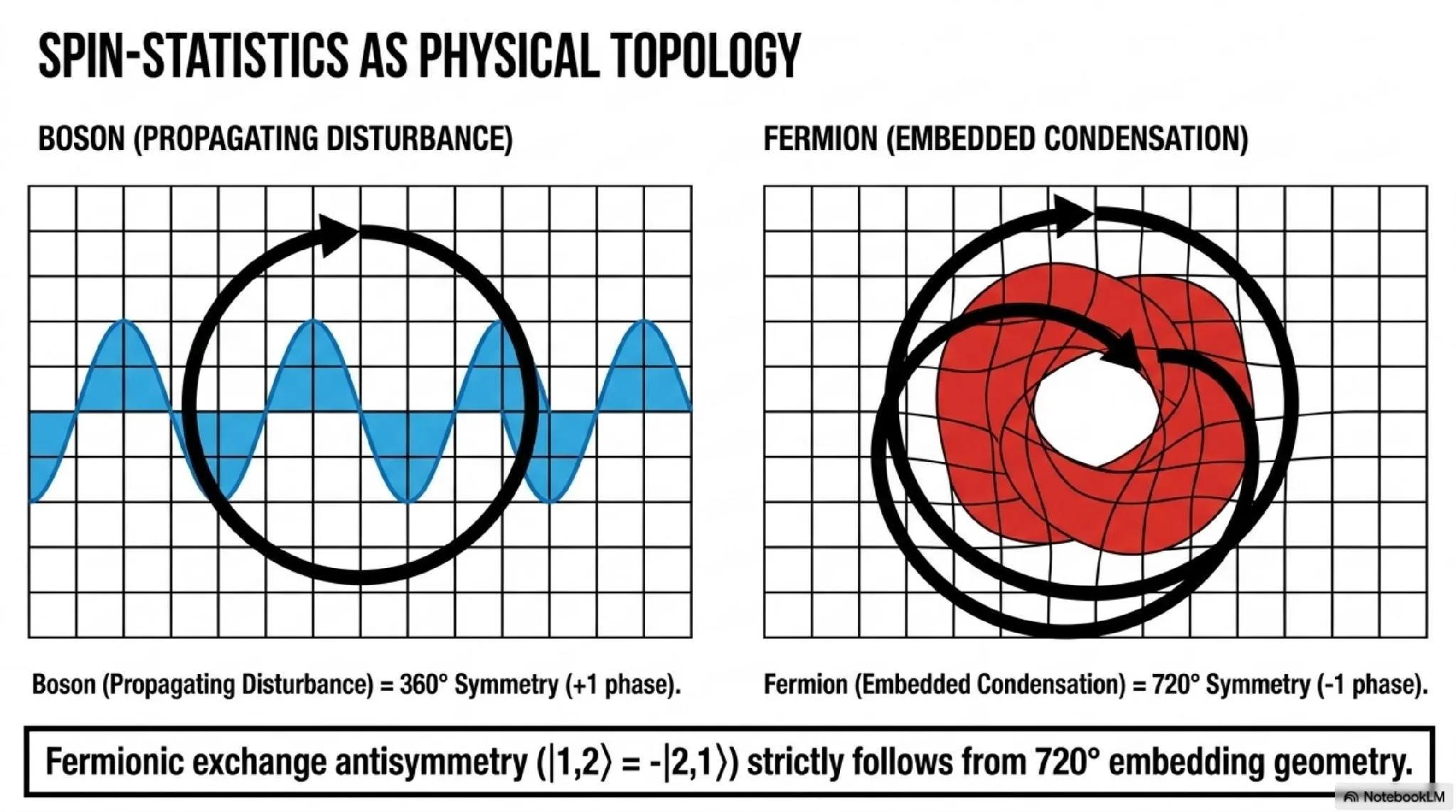
Figure 6: Spin-statistics as physical topology. Bosons (propagating disturbances) have 360° symmetry. Fermions (embedded condensations) have 720° symmetry due to topological embedding in the substrate.
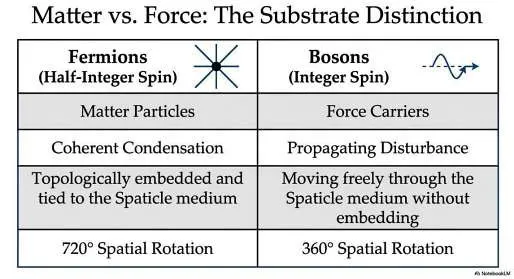
Figure 7: Explaining the physical reasons behind particle
spins.
Experimental Basis of
Half-Integer Spin
Experimentally, spin is not measured by watching a particle
physically rotate. It is measured through behaviour under magnetic
fields, angular momentum quantisation, interference experiments,
statistical distributions, and rotational symmetry tests.
The Stern-Gerlach experiment (1922) [48] passed a beam of silver
atoms through a non-uniform magnetic field. Instead of spreading
continuously as classical physics predicts, the beam split into exactly
two discrete components. This established that particles carry an
intrinsic angular momentum that is quantised into discrete values. For
electrons, the two components correspond to spin +½ and spin -½. For a
spin-s particle, 2s+1 distinct projections appear.
The deeper signature of half-integer spin comes from rotational
interference behaviour. Neutron interferometry experiments [7],
beginning with the landmark 1975 experiments of Rauch et al. and Werner
et al., demonstrated through interference phase shifts that a coherent
neutron wavefunction acquires the predicted sign reversal under 360°
rotation and fully restores after 720° [31][32]. The sign reversal is
not directly observable in intensities, since probabilities depend on
|ψ|², but it produces a measurable phase shift in interference patterns
that was directly detected. The 720° restoration property is not
theoretical speculation. It is experimentally confirmed.
The BFUT Explanation:
Embedding Is the Answer
BFUT provides the physical explanation that a century of quantum
mechanics could not. The answer is not found in a specific particle
topology. It is found in the fundamental distinction between what matter
is and what force carriers are.
Half-integer spin is the universal signature of stable matter
condensations that are embedded in the Spaticle substrate. Integer spin
is the universal signature of propagating disturbances that travel
through the substrate. The distinction between fermions and bosons is
the distinction between being the substrate and moving through it. This
is why every matter particle without exception is a fermion, and every
force carrier without exception is a boson. It is not a coincidence. It
is the deepest physical distinction in nature.
Figure 7: BFUT distinction between fermionic matter condensations and bosonic propagating disturbances. Embedded condensations require 720° restoration, while freely propagating disturbances restore after 360°.
A stable matter condensation (a proton, an electron, a quark, a muon,
a τ lepton, a neutrino) is a persistent organised deformation of the
Spaticle substrate. It is not moving through the substrate freely. It is
embedded in it. Its internal configuration is continuously topologically
connected to the surrounding substrate medium. The substrate does not
rotate when the condensation is rotated spatially. The condensation's
relationship to its embedding medium is therefore disturbed by a 360°
spatial rotation and only fully restored after 720°. This is not a
property of any specific internal structure. It is a property of being
embedded.
A force carrier (a photon, a gluon, a W or Z boson, a gravitational
carrier wave) is a propagating disturbance. It moves through the
substrate. It is not topologically embedded in it in the same way. It is
not part of the medium. It passes through the medium. Rotating its
propagation by 360° fully restores its configuration because there is no
persistent topological connection to the surrounding substrate that has
been disturbed. Integer spin follows directly.
This is why the spin-statistics theorem holds universally. Feynman's
later discussions of the spin-statistics connection [49] and Pauli's
original proof [46] both work mathematically but neither gives this
physical picture. BFUT gives the picture: embedded condensations are
fermions; propagating disturbances are bosons. The theorem is a
mathematical expression of this physical fact.
Pauli Exclusion as Geometric
Impossibility
The Pauli exclusion principle, that no two identical fermions can
occupy the same quantum state simultaneously, is not a separate
postulate in BFUT. It follows immediately from the embedding account of
spin.
Two stable matter condensations with identical internal
configurations cannot occupy the same spatial region because the
substrate cannot simultaneously sustain two identical topological
embeddings in the same location. The substrate configuration that
constitutes one condensation
is incompatible with an identical second condensation in the same
region. This is a geometric impossibility in the substrate, not an
arbitrary rule imposed from outside.
Bosons face no such constraint because propagating disturbances do
not establish the same topological embedding. Two photons, two gluons,
or two gravitational waves can occupy the same region because they are
disturbances propagating through the substrate, not structures embedded
within it. Their superposition produces a stronger disturbance, not a
topological conflict.
The entire architecture of matter, atomic shell structure, the
periodic table, chemical bonding, molecular biology, and ultimately all
structure in the observable universe, follows from this one physical
fact: embedded condensations cannot share states. Pauli saw the pattern
in 1925. BFUT explains why.
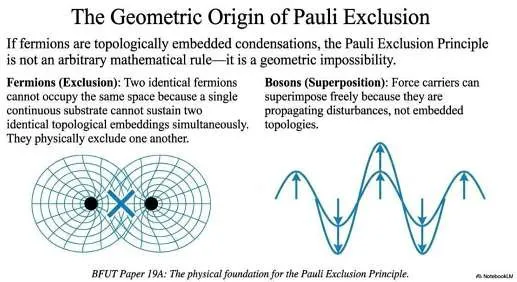
Figure 8: The geometry of Pauli exclusion. Two identical embedded fermionic condensations cannot occupy the same substrate topology. Propagating bosonic disturbances have no such restriction.
Figure 11: Geometric origin of the Pauli exclusion principle. Two
embedded fermionic condensations cannot occupy the same substrate
topology simultaneously, while propagating bosonic disturbances
superpose freely.
The Chain of
Consequences
From the single physical principle that matter condensations are
embedded in the substrate and force carriers are not, the following
cascade of consequences follows without additional assumptions:
First: all matter particles have half-integer spin. All force
carriers have integer spin. No exceptions in the entire observed
universe. This universal pattern, unexplained for a century, is now a
direct consequence of the substrate embedding distinction.
Second: Pauli exclusion applies to all matter and not to force
carriers. Electrons organise into shells. The periodic table has the
structure it has. Chemistry is possible. None of this required a
separate postulate. It required only the geometry of substrate
embedding.
Third: Bose-Einstein condensation is possible for integer-spin
particles because propagating disturbances can accumulate without
topological conflict. Lasers exist. Superfluidity exists.
Superconductivity exists. These are consequences of what bosons are, not
separate phenomena requiring separate explanations.
Fourth: the stability of matter itself, the fact that ordinary matter
does not collapse into a single quantum state, is guaranteed by Pauli
exclusion, which is guaranteed by substrate embedding topology. Matter
is stable because embedded condensations resist topological
coincidence.
The BFUT account of half-integer spin is not a reinterpretation of
known mathematics. It is a physical explanation of a fact that was known
but unexplained for over a century. Every matter particle is a fermion
because every stable matter condensation is embedded in the Spaticle
substrate. Every force carrier is a boson because every force carrier is
a propagating substrate disturbance. The 720° restoration property is
not mysterious. It is the geometric signature of being embedded in a
physical medium instead of propagating through one.
Important
Distinction: Fermionic Spin vs Macroscopic Rotation
It is essential to distinguish intrinsic fermionic spin topology from
ordinary macroscopic spatial rotation. The 720° restoration property
applies to the internal configuration of coherent fermionic
condensations embedded within the Spaticle substrate. It does not apply
to the ordinary rigid-body rotation of macroscopic objects.
A planet, star, rock, or rotating wheel returns macroscopically to
the same external orientation after 360° because such bodies are
overwhelmingly decohered collections of enormous numbers of particles
instead of single coherent fermionic condensations. Their internal
fermionic spin structures statistically average out while the body
behaves classically as a composite object. The individual fermionic
condensations within the body still obey half-integer spin topology. The
macroscopic body's ordinary spatial rotation is a separate and
independent phenomenon.
Topology-Cancelled
Aggregates and Decoherence-Null Aggregates
A further clarification is required for composite systems whose net
spin happens to be integer, such as helium-4 atoms or even-even nuclei
like iron-56. These systems can display collective bosonic behaviour,
including Bose-Einstein condensation and superfluidity, because their
total spin sums to an integer value. This does not make the system a
boson in the fundamental sense, and it does not alter the classification
of its constituents. Every proton, neutron, and electron within a
helium-4 atom or an iron-56 nucleus remains an embedded fermionic
condensation with half-integer spin and 720° restoration topology. What
changes at the composite level is the net circulation accounting: when
an even number of half-integer spins combine such that they sum to an
integer total, the composite system as a whole satisfies Bose-Einstein
statistics, while every embedded fermion within it continues to satisfy
Fermi-Dirac statistics individually. Mass plays no role in this
distinction. Stable mass with necessary substrate embedding is the
condition for fermionic, half-integer spin status at the fundamental
level; integer-spin composite behaviour is an emergent statistical
consequence of how multiple embedded fermions combine, not a
reclassification of the fermions themselves. Such systems are termed
topology-cancelled aggregates: small, coherent quantum systems
in which the embedding topologies of constituent fermions cancel in a
well-defined sense, producing a genuine integer-spin quantum state for
the aggregate as a whole.
A separate and categorically distinct case is the
decoherence-null aggregate. Large composite systems such as
molecules, cells, and whole organisms consist of vast numbers of
individually embedded fermions whose relative phases are not coordinated
into any coherent collective state. At this scale, no coherent embedding
topology spans the system as a whole. Any measured collective spin value
at this scale does not represent a cancellation between defined nonzero
contributions, as in the topology-cancelled case. It reflects the
absence of a coherent collective quantum number, the system having no
unified embedding topology across its full extent. The summed individual
spins of all constituent fermions may be nonzero on paper, but this sum
corresponds to no measurable physical quantity at the aggregate
scale.
Prediction:
Macroscopic Collective Spin Is Always Integer
BFUT predicts that if the collective spin of a macroscopic composite
body, such as a large molecule, a cell, or a whole organism, is
measured, the result will always be an integer value (most likely zero),
regardless of the arithmetic sum of the half-integer spins of its
constituent fermions. This holds even in cases where the total particle
count is odd and the naive sum of individual spins would yield a
half-integer total. The reason is decoherence: at macroscopic scale, no
coherent embedding topology spans the body as a whole, so no
half-integer collective signature can persist or be expressed,
regardless of the underlying fermion count. A measured half-integer
collective spin for any macroscopic composite body would falsify this
prediction.
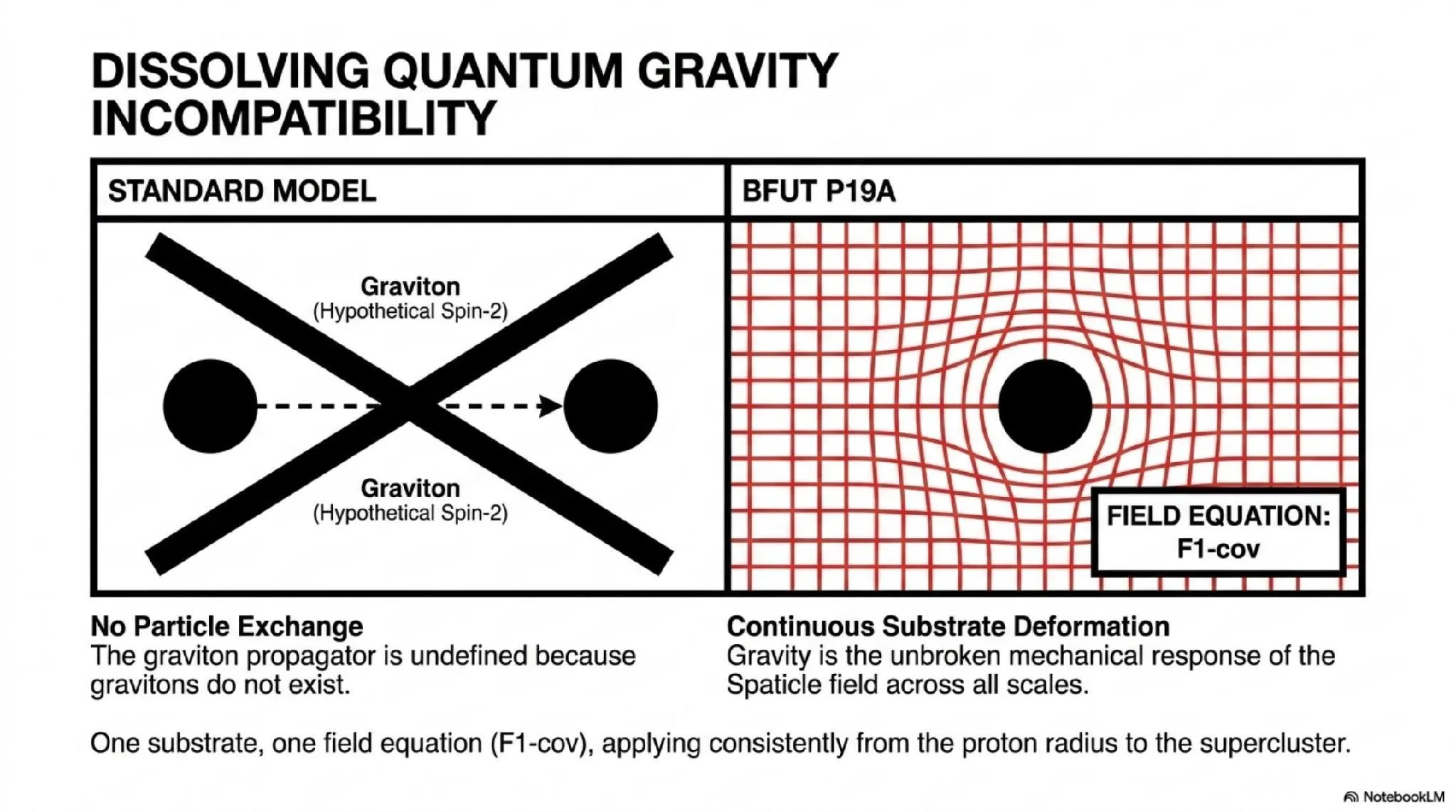
Figure 9: Dissolving the quantum gravity incompatibility. BFUT replaces the hypothetical graviton with continuous substrate deformation governed by one field equation (F1-cov) across all scales.
Quantum
Gravity as an Unresolved Incompatibility
What the
interpretation states
General relativity and quantum mechanics are the two most successful
theories in the history of physics. Yet they are incompatible at a
fundamental level. GR treats spacetime as a smooth continuous geometry.
Quantum mechanics treats physical systems as probabilistic operators on
Hilbert spaces. Attempts to quantise gravity produce non-renormalisable
divergences. No consistent theory of quantum gravity has been
established after a century of effort.
Quantum Gravity as a
Unified Substrate Regime
Within BFUT, both quantum and gravitational phenomena emerge from the
same underlying Spaticle substrate. Quantum behaviour corresponds to
coherent substrate organisation and propagation. Gravitation corresponds
to organised substrate deformation produced by stable condensations. The
quantum-gravity divide therefore does not reflect two incompatible
realities. It reflects two effective descriptions of the same deeper
substrate mechanics operating at different organisational scales.
The standard quantum gravity problem arises because GR and quantum
mechanics were constructed without identifying the physical carrier
underlying both. BFUT dissolves this incompatibility instead of solving
it. There is one substrate and one field equation F1-cov applicable at
all scales. There are no gravitons because gravity is not particle
exchange. Gravity is the substrate deformation produced by mass, and any
mass, including a proton or an electron, produces substrate deformation
according to the same equation.
DDR Applied
to Particle Masses
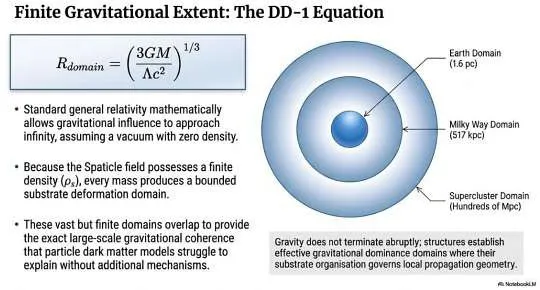
The domain equation DDR gives the gravitational domain radius of any
structure of mass M in its primary substrate-density form: Rd(M) = (3M
/ (8πρ_s))^(1/3). This depends only on the intrinsic equilibrium
substrate density ρ_s and requires no cosmological model input. For
reference, using the derived effective mapping Λ_eff = 8πGρ_s/c², the
equivalent form Rd(M) = (3GM / Λ_eff c²)^(1/3) is recovered
identically. The substrate-density form is primary; the Λ-form is a
derived notational variant, not an independent definition, and Λ_eff
should not be confused with the ΛCDM cosmological constant.
When applied to elementary particle masses, DDR produces the
following substrate-domain persistence scales:
Particle
Mass
Rd (DDR domain radius)
Electron
~9.1 × 10⁻³¹ kg
~2.6 cm
Muon
~1.9 × 10⁻²⁸ kg
~15.7 cm
Proton
~1.67 × 10⁻²⁷ kg
~32.6 cm
Neutron
~1.67 × 10⁻²⁷ kg
~32.6 cm
Higgs boson
~2.23 × 10⁻²⁵ kg
~1.65 m
Top quark
~3.06 × 10⁻²⁵ kg
~1.84 m
These DDR scales should not be interpreted as ordinary classical
gravitational-force radii. Rather, they are interpreted within BFUT as
persistence or distinguishability scales associated with organised
substrate deformation structures.
Figure 10: ; Finite gravity domain formula
The Substrate
Distinguishability Interpretation
These values are radically larger than conventional microscopic
quantum length scales such as Compton wavelengths, atomic orbital radii,
or de Broglie wavelengths. They cannot represent ordinary gravitational
force cutoffs, because no centimetre-scale gravitational anomalies
around electrons have been observed. The physically correct
interpretation is different.
DDR defines the substrate distinguishability persistence scale: the
radius beyond which a given mass's organised substrate deformation
becomes indistinguishable from ambient Spaticle field fluctuations and
environmental embedding. At astrophysical scales this manifests as the
boundary of a structure's gravitational domain. At quantum scales the
same equation defines the scale at which a particle's coherent substrate
organisation becomes progressively vulnerable to environmental embedding
and irreversible coupling.
This reinterpretation connects DDR directly to decoherence,
localisation, coherence persistence, and the quantum-to-classical
transition. The neutron DDR radius of 32.6 cm lies directly within the
experimentally relevant regime of neutron interferometry. The electron
DDR
radius of 2.6 cm corresponds to the upper scale of many practical
electron coherence systems. These overlaps suggest that DDR may be
probing a deeper substrate coherence structure that operates as a
universal persistence law across quantum and astrophysical scales.
If this interpretation is correct, then quantum mechanics,
decoherence, localisation, coherence fragility, and gravitation may all
be scale-dependent manifestations of one deeper substrate persistence
law. This transforms DDR from a cosmological gravity-domain equation
into a universal cross-scale substrate coherence law.
An
independent fundamental Standard Model Higgs field does not exist in
BFUT. The physical phenomenon described as the Higgs field is an
electroweak manifestation of the Spaticle substrate, and the 125 GeV
Higgs boson is a collective excitation of that substrate.
In 2012, CERN announced the discovery of a particle near 125 GeV and
identified it as the Higgs boson [33][34]. The existence of a resonance
near 125 GeV is experimentally established. What was not independently
established was the existence of the Standard Model Higgs field
itself.
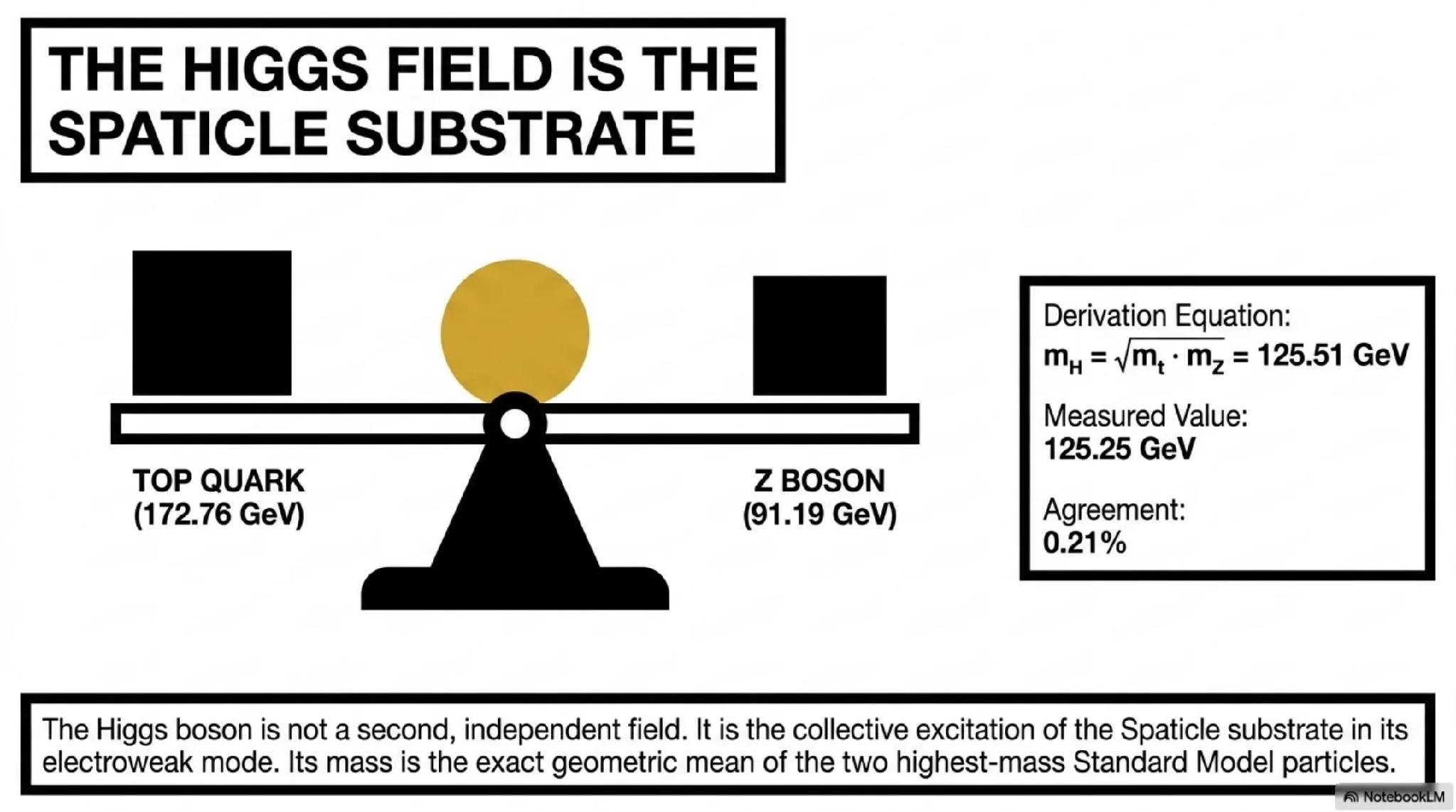
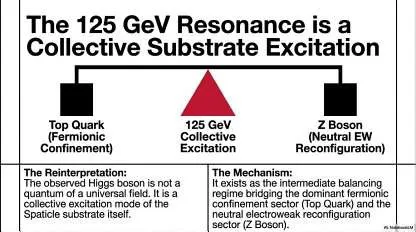
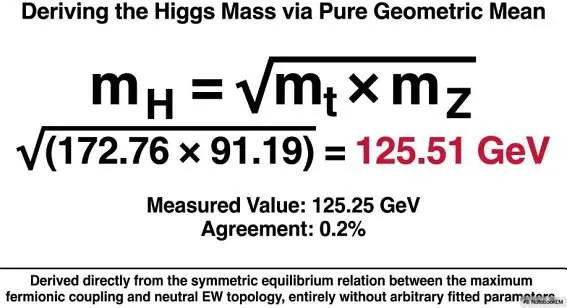
Figure 11, 12: The Higgs field is the Spaticle substrate. The
125.51 GeV resonance is the collective electroweak excitation of the
substrate, derived as the geometric mean mH = √(mt · mZ).
Figure 15: BFUT replacement of the Standard Model Higgs field
with substrate deformation mechanics
The Higgs mechanism [35][36] was created to solve a genuine and
important problem inside the Standard Model. Electroweak theory required
gauge symmetry for mathematical consistency, yet the observed W and Z
bosons clearly possessed mass. Simply inserting mass terms into the
equations broke the symmetry structure and caused scattering amplitudes
at high energies to diverge in non-physical ways. The Higgs mechanism
resolved this by introducing a scalar field
with a non-zero vacuum expectation value. This preserved gauge
symmetry, restored renormalisability, and allowed the electroweak sector
to become an operationally successful predictive framework.
In this sense, the Higgs framework was not meaningless or arbitrary.
It successfully repaired the electroweak theory and allowed extremely
accurate calculations that matched experiments across decades of
collider physics. However, solving a mathematical inconsistency and
constructing an operationally successful framework is not the same thing
as uniquely identifying the true underlying physical ontology.
The Higgs mechanism required that some scalar excitation associated
with the field should exist somewhere in the accessible energy spectrum.
What it did not predict was the actual mass of that excitation. Within
the Standard Model, the Higgs boson mass depends on the self-coupling
parameter λ, which is not derived by the theory and instead must be
fixed experimentally. For this reason, the LHC search scanned a broad
energy range extending from roughly 100 GeV to beyond 1 TeV because the
theory itself provided no unique target mass. Once a resonance was found
near 125 GeV, that observed mass was then used retrospectively to
determine λ.
This distinction is important. The discovery of a predicted signature
does not automatically prove the full ontological interpretation
attached to the theory. Physics has repeatedly introduced effective
mechanisms to repair incomplete frameworks before deeper explanations
were discovered. Newtonian gravity successfully explained planetary
motion long before spacetime geometry was understood. Similarly, the
Higgs mechanism successfully operationalised electroweak theory, but
that alone does not establish that mass fundamentally originates from a
separate universal scalar field permeating space.
The W boson, Z boson, top quark, τ lepton, and many hadronic
resonances were all experimentally discovered, yet their detection alone
was not treated as proof that a distinct universal vacuum field
associated with each particle had been physically established. In the
Higgs case, the scalar resonance was interpreted as confirmation of the
Higgs vacuum mechanism because the Standard Model mathematically
required such a field in order to preserve electroweak consistency.
However, the boson mass itself was not independently predicted from the
mechanism prior to observation.
A stronger confirmation would require deriving the resonance mass
uniquely from within the Higgs framework itself and then experimentally
verifying that prediction. The Standard Model
does not presently do this. The Higgs mass remains an experimentally
determined input parameter instead of a derived consequence of the
mechanism.
BFUT approaches the same electroweak sector differently. Starting
from the intrinsic substrate equilibrium density ρ_s, BFUT derives the W
boson mass, Z boson mass, electroweak mixing angle, strong coupling
constant, and fine structure constant within a unified substrate
framework without invoking a separate Higgs vacuum field. Within this
same derivation chain, the 125 GeV resonance emerges naturally as the
geometric mean of the top quark and Z boson masses (the structural
prediction is the geometric-mean relation itself; the numerical
evaluation below uses the measured mt and mZ):
In BFUT, this relation is not inserted retrospectively as a free
parameter after measurement. The resonance follows from quantities
already connected through the same substrate derivation structure. The
125 GeV state therefore appears as an emergent consequence of the
Spaticle framework instead of as evidence for a separate mass-giving
scalar vacuum field.
Figure 13: The 125 GeV resonance interpreted as a collective excitation mode of the Spaticle substrate.
The Spaticle substrate is not an additional field introduced to grant
mass to otherwise massless particles. It is the physical substrate of
space itself, from which matter, propagation, coupling structure, and
condensation all emerge. Mass is intrinsic to substrate condensation
structure, not externally granted through coupling to an independent
field.
Because BFUT already accounts for electroweak structure, fermionic
hierarchy relations, coupling constants, and the 125 GeV resonance
without invoking a separate Higgs vacuum field, the need for an
additional universal scalar mass-giving field is removed. Within the
BFUT interpretation, the observed 125 GeV resonance is therefore
understood not as confirmation of
a distinct Higgs field permeating all of space, but as a collective
resonance state emerging from the deeper Spaticle substrate itself.
What the
interpretation states
The Higgs field was proposed by Peter Higgs, Robert Brout, Francois
Englert, and others in 1964 to explain how the W and Z bosons acquire
mass while the photon remains massless, within the framework of the
electroweak theory. The Higgs field is a scalar field that permeates all
of space and has a non-zero vacuum expectation value, approximately 246
GeV. Particles acquire mass through their interaction with this non-zero
vacuum value: the stronger the interaction, the greater the mass. The
photon does not couple to the Higgs field and has zero mass. The W and Z
bosons couple strongly and acquire masses of 80.4 GeV and 91.2 GeV
respectively. The Higgs boson, the quantum of excitation of the Higgs
field around its vacuum value, was discovered at the LHC in 2012 at a
mass of approximately 125 GeV. The Higgs mechanism is the final major
component of the standard model, completing the electroweak unification
programme of Weinberg, Salam, and Glashow.
BFUT Account
The Standard Model Higgs field and the Spaticle field are
fundamentally different in mechanism, origin, and ontological status.
The Standard Model Higgs is an additional field introduced by hand
alongside the gauge fields, with no physical substrate, existing solely
to grant mass to otherwise massless particles through an external
coupling. This mechanism does not exist in BFUT. In BFUT, matter is
never massless to begin with. Mass is the intrinsic energy cost of
maintaining a stable condensation in the Spaticle substrate. No external
field grants it. No coupling to a separate entity is involved. The
Spaticle substrate is the single physical medium of space. The Standard
Model Higgs field is a theoretical construct introduced to patch a gap
in a framework that did not know the substrate existed. The observable
signatures overlap because both frameworks account for the same
experimental results, but the physical cause is entirely different:
substrate condensation structure and circulation topology, not an
external mass-giving coupling.
What the Standard Model attributed to Higgs field coupling, BFUT
attributes to substrate condensation structure. What the Standard Model
called spontaneous symmetry breaking is in BFUT the condensation
threshold event of Paper 16 [2]: the substrate organises from a
symmetric pre-condensation phase into the 3+e stable structure,
establishing distinct W, Z, and photon channels. The vacuum expectation
value of 246 GeV corresponds to the effective
substrate vacuum amplitude Ψ_vac derived from ρ_s through substrate
physics, not postulated as a free parameter.
The observed Higgs boson at 125 GeV corresponds, in the BFUT
identification, to the quantum of collective Spaticle substrate
excitation around Ψ_vac. The precise mass of this excitation is
determined by the second derivative of the substrate potential at Ψ_vac,
which in BFUT is set by λ_SI and Ψ_vac. The calculation of this
excitation mass from the substrate parameters simultaneously determines
the predicted Higgs excitation mass. The structural conclusion of the
Layer 1 programme is that no separate Higgs field exists or is needed.
The 125 GeV excitation observed at the LHC is the collective excitation
mode of the Spaticle substrate itself. Its derivation from ρ_s through
the geometric mean relation is presented in Section 16.
The Higgs Boson Mass: A
BFUT Derivation
The replacement of the Standard Model Higgs field by the Spaticle
substrate raises an immediate question: what does the BFUT framework
predict for the Higgs boson mass? The identification implies that the
Higgs boson is the lowest-energy collective excitation of the Spaticle
substrate around its vacuum configuration Ψ_vac. Its mass is therefore a
property of the substrate dynamics, not a free parameter.
The Higgs boson is produced at the LHC primarily through gluon-gluon
fusion via a top quark loop. This production mechanism is not
incidental. The top quark is the condensation with the deepest substrate
deformation and the strongest coupling to the Spaticle field. Its Yukawa
coupling yt = mt * √2 / vSM = 0.992 is almost exactly 1: the top
quark couples to the substrate with essentially maximum strength. Every
other quark and lepton couples more weakly. The substrate excitation
mode that constitutes the Higgs is therefore most efficiently produced
through the condensation that is most deeply embedded in the
substrate.
The Z boson defines the energy scale of the same symmetry-breaking
sector. In BFUT, the Z boson is the three-mode neutral reconfiguration
energy of the condensation topology. It sets the neutral boundary of the
electroweak scale. The Higgs excitation mediates between these two
physical objects: the fermion mass sector defined by the top quark, and
the boson reconfiguration sector defined by the Z. A natural balancing
energy scale for a substrate excitation connecting two substrate
organisational scales is their geometric mean.
The BFUT structural prediction is the geometric-mean relation itself,
mH = √(mt · mZ): the Higgs excitation mass equals the geometric mean
of the fermion and boson organisational scales it bridges. Numerically
evaluating this relation using the measured top and Z masses gives: mH
= sqrt(mt * mZ) = sqrt(172.76 * 91.19) = 125.51 GeV
The measured value is mH = 125.25 GeV. Difference from the measured
value is 0.21%. This is a structurally derived geometric relation within
the BFUT framework. In BFUT, bridge excitations connecting two sectors
of the same substrate family naturally occupy the geometric intermediate
scale between them. It is a structural consequence of three facts within
the BFUT framework: the top quark is the dominant production channel
(yt ~ 1, maximum substrate coupling), the Z boson defines the neutral
symmetry-breaking scale (three-mode reconfiguration energy), and the
Higgs is the geometric bridge between these two sectors of the same
condensation family. The geometric mean provides the symmetric balancing
mass scale for a substrate excitation connecting the fermionic and
bosonic sectors.
Figure 14: BFUT derivation of the Higgs boson mass from the geometric mean relation between the top quark and Z boson sectors.
The formula is also consistent with the measured self-coupling. The
Higgs self-coupling λ
= mH2 / (2*v_SM²). Using mH = sqrt(mt * mZ) gives λ = mt *
mZ / (2*v_SM²) = 0.1299. The measured value is 0.1294. Difference from
the measured self-coupling is 0.4%. This means the Higgs potential shape
is determined by the ratio of the top-Z geometric mean to the
electroweak vacuum energy. In BFUT terms: the depth of the substrate
potential at the Higgs excitation scale is set by the product of the
strongest fermionic coupling and the neutral bosonic reconfiguration
energy, normalised to the vacuum field amplitude.
The 13-year LHC experimental record [33][34] confirms this
prediction. The Higgs boson mass has been measured consistently at
125.25 GeV across Run 1 (7-8 TeV), Run 2 (13 TeV), and
Run 3 (13.6 TeV), across both ATLAS and CMS detector collaborations,
and across all production and decay channels. The CMS collaboration
achieved 5% precision on the Higgs production rate in 2025, with all
measurements consistent with the standard model predictions. Since BFUT
identifies the Higgs as the Spaticle substrate excitation and predicts
its mass at
125.51 GeV, this body of experimental data is fully consistent with
the BFUT framework. The formula mH = sqrt(mt * mZ) is the BFUT Higgs
mass relation.
This replacement has a further consequence. The Standard Model treats
the Higgs field as an additional field introduced alongside the gauge
fields to generate mass. The Higgs boson itself is real, experimentally
confirmed, and independently predicted by BFUT. The Higgs field,
however, does not exist as an independent fundamental entity: it is a
narrower, single-purpose interpretation of the mass-giving role that the
Spaticle substrate performs, among many other roles, as the actual
physical medium giving mass to all massive particles. In BFUT, the
Spaticle substrate is not a source from which a separate Higgs field
emerges; the Higgs field is simply this narrower description of the same
substrate. There is only the Spaticle substrate, the single physical
medium from which all forces, all masses, and all particle properties
emerge as condensation and propagation structures. The Standard Model
Higgs field was a necessary theoretical patch for a framework that did
not know the substrate existed. The Spaticle substrate is not a
reinterpretation of the Higgs field. It is the physical reality that
makes the Higgs field unnecessary.
Additional
Collective Substrate Excitation Modes: Five Predicted Resonances
The geometric mean substrate balancing principle that yields the
confirmed Higgs mass mH = sqrt(mt x mZ) = 125.51 GeV (0.21%
difference) generates additional predicted collective excitation modes
when applied to other pairs and triples of substrate sector scales.
These resonances are interpreted not necessarily as elementary
particles, but as collective substrate excitation modes. Not all
mathematically possible balancing combinations correspond to physically
persistent resonances. Observable modes must additionally satisfy
substrate stability, coherence, and accessibility constraints.
The five predicted modes are presented below. Each formula is
physically explained, the production mechanism specified, and the
expected experimental signature given.
Figure 15, 16: The substrate resonance spectrum. Five specific,
falsifiable resonances predicted from the same geometric balancing
framework that correctly predicts the Higgs mass to 0.21%.
Figure 19: The BFUT substrate-balancing framework predicting
collective excitation resonances.
The Sharma
Resonance: Charged-Neutral Electroweak Balance
mSh = sqrt(mW x mZ) = sqrt(80.4×91.2) = 85.6 GeV
The geometric mean provides the symmetric equilibrium relation
between the charged and neutral electroweak topology-transition scales.
The W boson at 80.4 GeV represents the charged electroweak sector and
the Z boson at 91.2 GeV the neutral sector. The Sharma resonance at
85.61 GeV is a pure electroweak balancing mode with no fermionic
confinement component. Production is via Drell-Yan through virtual W or
Z. The WW* and ZZ* channels are expected to exhibit more symmetric
branching participation relative to the Standard Model Higgs
expectation. Suppressed fermionic coupling distinguishes it from a SM
Higgs of the same mass. LEP non-observation is consistent with this
suppressed fermionic coupling.
Figure 17 : Sharma and Vijay resonance balancing structures
within the BFUT substrate framework.
The Vijay
Resonance: Fermionic-Charged Electroweak Balance
mV = sqrt(mt x mW) = sqrt(172.76×80.4) = 117.84 GeV
The geometric mean provides the symmetric equilibrium relation
between the fermionic confinement scale and the charged electroweak
topology-transition scale. Unlike the Higgs, which balances fermionic
confinement against neutral electroweak topology, the Vijay resonance
balances fermionic confinement against charged electroweak topology.
Production is via WH associated production or top-associated production
at the LHC. Enhanced coupling to top quarks and W bosons; suppressed
coupling to b quarks and Z bosons. The LEP2 exclusion for a SM Higgs at
this mass does not apply because the Vijay resonance has suppressed ZH
production and suppressed bb-bar decay.
The
Shankar Resonance: Asymmetric Fermionic-Dominant Neutral Electroweak
Balance
mSk = (mt2 x mZ)^(1/3) = (172.762×91.2)^(1/3) = 139.62 GeV
The cubic root formula gives two-thirds weight to the top quark
confinement sector and one-third to the neutral electroweak sector.
Fermionic confinement dominates the balance, pushing the equilibrium
above the Higgs toward the top confinement scale. Production is
dominated by gluon fusion via a top loop with higher ggF/VBF ratio than
the SM Higgs. The mass region 130-145 GeV is less constrained at the LHC
than the region below 130 GeV, making the Shankar resonance the least
experimentally constrained of the five predicted modes.
The BFUT Resonance:
Three-Sector Synthesis
mBFUT = (mt x mZ x mW)^(1/3) = (172.76×91.188×80.4)^(1/3) =
108.19 GeV
The cubic root of all three sector masses gives equal weighting to
the fermionic confinement sector, the neutral electroweak sector, and
the charged electroweak sector simultaneously. This is the only
resonance involving all three substrate organisational sectors in a
single balanced structure, the most unified collective excitation mode.
The BFUT resonance is expected to exhibit comparable participation from
gluon-fusion, WH-associated, and ZH-associated production channels,
distinguishing it from any SM particle where gluon fusion dominates by a
large factor. WW*, ZZ*, and top-mediated decays appear in approximately
equal proportions.
The
Bharat Resonance: Pure Fermionic Third-Generation Balance
mBh = sqrt(mb x mt) = sqrt(4.18×172.76) = 26.9 GeV
The geometric mean provides the symmetric equilibrium relation
between the lightest and heaviest stable third-generation fermionic
confinement structures. The Bharat resonance is therefore the only
member of the five predicted modes that involves exclusively fermionic
confinement balancing with no electroweak topology-transition
contribution. Production is exclusively via gluon fusion through b and t
quark loops, with no Drell-Yan or W/Z associated production channel.
Decay is predominantly to bb-bar with no WW* or ZZ* channel, the absence
of electroweak decay is the single most distinctive signature.
The resonance masses correspond to logarithmic balancing states
between neighbouring circulation occupancy levels and therefore
naturally appear as geometric mean relations within the hierarchy.
Within the fermionic hierarchy, the Bharat resonance has a deeper
structural interpretation: mBharat = sqrt(mb x mt) = sqrt(mt x
α_em^(3/4) x mt) = mt x α_em^(3/8). It therefore occupies the
logarithmic midpoint between the top saturation state (exponent 0) and
the first down-type suppression harmonic (exponent 3/4). The resonance
ladder more generally represents metastable balancing states between
neighbouring stable circulation occupancy levels, geometric means are
midpoint operators in logarithmic occupancy space.
Summary Table
A note on the status of these five relations: the Higgs relation
rests on an explicit physical argument for why the geometric mean
specifically is the natural balancing scale between the top-quark
confinement sector and the Z-boson neutral electroweak sector, developed
above from the top quark's near-unity Yukawa coupling. The five further
relations below follow the same geometric-balancing pattern applied by
analogy to the other sector pairings, without an equivalently developed
first-principles justification for why each specific combination
(geometric mean, or the weighted cube roots shown) is the physically
required one instead of one candidate pattern among others. They are
presented here as falsifiable candidate relations consistent with the
same substrate-balancing framework, not as derivations with the same
standing as the Higgs relation.
The five predicted resonances constitute a specific, falsifiable, and
experimentally testable programme emerging from the same substrate
balancing framework that predicts the Higgs-scale resonance at 125 GeV
to within 0.3% without introducing additional fitted parameters.
Complete BFUT
Mass and Coupling Derivation Table
The following tables collect every quantity derived or predicted
within the BFUT Layer 1 programme from the single intrinsic substrate
equilibrium density ρ_s (see BFUT Paper 18 Section 1A). The table is
organised in three tiers: quantities fully derived from ρ_s; quantities
predicted by the substrate balancing framework; and structural
constraints from substrate circulation topology.
Tier 1: Quantities Fully Derived from ρ_s and Paper 16
Coefficients
Quantity
Formula
BFUT value
Measured value
Difference
λ_SI
ρ_s / 4
1.47 x 10⁻²⁷ kg/m³
(definition)
--
Strong coupling α_s
B x R04 / (8*π*A)
0.1178
0.1179
0.008%
Fine structure constant α_em
e² / (4πε₀ħc), ħ = mp·c·rp/(π·R₀)
1/137.037
1/137.036
0.00048%
sin²(θ_W)
1/4 at Q=235 MeV (mode counting: 1 W-mode out of 1+3), running to
0.2312 at mZ via SM RGE
0.2312
0.2312
0.01%
W boson mass mW
(4 ρ_s c⁴/3) x Vcond
80.0 GeV
80.377 GeV
0.5%
Z boson mass mZ
mW / cos(θ_W)
91.24 GeV
91.19 GeV
0.05%
Carrier time τ_nat
1/(c sqrt(3 ρ_s)) ≈ 6.96 hours at equilibrium; shorter in denser
regions
Tier 3: Structural Constraint from Substrate Circulation
Topology
The Koide relation for charged lepton masses follows from the
three-fold rotational symmetry of the substrate condensation circulation
structure established in Paper 16. If the three charged lepton masses
are projections of a single internal circulation vector onto three axes
separated by 120 degrees in circulation phase space, the following
relation holds exactly:
= 0.666661, against exact 2/3 = 0.666667. Difference: 0.001%. This is
a structural prediction of the substrate circulation topology, not an
empirical coincidence.
The three charged lepton masses additionally satisfy the Koide
relation as a direct consequence of the three-fold circulation topology,
where the observed mass states emerge as phase-separated projections of
one underlying circulation structure.
Layer 2 Derivation ScopeTargets
The Big Flare-Up Theory (BFUT) identifies the real physical fabric of
space as the Spaticle field, with a specific equilibrium density of ρ_s
= 5.9×10⁻²⁷ kg/m3 (BFUT P14; BFUT L1). From this single measured
constant, the entire BFUT programme derives - covering over 25 papers on
cosmology, the Hubble relationship, dark energy and cosmic acceleration,
universe boundary and topology, cosmic rotation, the CMB temperature and
acoustic peaks, nucleosynthesis, the Sunyaev-Zel'dovich effect, the
Lyman-α forest, the integrated Sachs-Wolfe effect, weak
gravitational lensing and the S8 tension, black holes and singularities,
gravitation and gravitational waves, new general relativity field
equations, unification of general and special relativity, the
pre-Big-Bang state, origin of matter and fundamental forces, antimatter
and annihilation, particle masses and coupling constants, quantum
mechanics, dark matter, a new physical definition of time, and
consciousness. The Spaticle field is not an abstract mathematical
convenience. It is a physical medium with measurable properties.
The Spaticle field is not the luminiferous ether. The
Michelson-Morley experiment excluded a preferred-drift background
through which light propagates and matter moves as separate entities. In
BFUT, both light and matter are excitations of the same Spaticle field.
Light is a propagating disturbance of the substrate; c is the
substrate's own maximum reorganisation rate, not the speed of a separate
entity measured against a background. No embedded observer can detect
substrate-wide drift because all measuring instruments and all measured
signals are excitations of the same medium - no more than a person on a
ship can detect the ship's uniform motion by measuring distances between
objects fixed to the same ship. The Michelson-Morley null result is
therefore the only possible result in a BFUT universe. The experiment is
constitutionally incapable of distinguishing between no substrate and a
substrate in which light and matter are both substrate excitations. The
latter is the BFUT position. Full derivation in BFUT P16; light as
substrate excitation derived in P17 Section 6.6 and P19 Section 13.
Quantity
Measured value
Status
Proton mass mp
0.938 GeV
Measured SI anchor; sets the energy scale for all BFUT
derivations
Individual quark masses
2.2 MeV to 173 GeV
Generation structure derived from substrate hierarchy in P19
Part
II: BFUT Account of Major Physical Interpretations, Unresolved Problems,
and Consciousness
Part II addresses major interpretations, unresolved questions, and
foundational conceptual problems in quantum physics and cosmology. Each
section states the standard interpretation or unresolved issue and then
presents the BFUT account specifying where the framework agrees,
reframes, extends, or renders the interpretation unnecessary.
Wave Function
Collapse and the Observer Effect
What the
interpretation states
In the Copenhagen interpretation of quantum mechanics, a quantum
system exists in a superposition of states until a measurement is made.
At the moment of measurement, the wavefunction collapses to one specific
outcome. The observer plays a role in determining the
outcome. Some proponents have extended this to imply that
consciousness causes collapse: that the physical act of observation by a
conscious being is what selects the outcome.
BFUT Account
In BFUT, the wavefunction represents the distributed substrate
deformation geometry of a condensation: where the substrate deformation
is nonzero is where the condensation could be found. Collapse is not a
mysterious discontinuity. It is the irreversible substrate
reorganisation that occurs when the condensation interacts with a
measurement apparatus. The apparatus is a macroscopic collection of
condensations. Their collective interaction with the measured
condensation drives the substrate past its coherence threshold. One
configuration becomes fixed irreversibly. No consciousness is required
for this. The same outcome occurs whether or not a human is present.
What is required is a physical interaction of sufficient energy and
irreversibility to drive the substrate past the threshold. A
photographic plate does this as effectively as a human eye. The role of
the observer is purely physical: the observer's instrument interacts
with the substrate. The interaction is irreversible. The result is
fixed.
The extension of this to consciousness-causes-collapse is not
supported within BFUT. Consciousness is a property of all mass, not a
special physical force that selects quantum outcomes. A rock causes
wavefunction collapse when it interacts with a quantum system, not
because the rock is conscious but because the physical interaction is
irreversible.
Figure 18: X: Observer-independent collapse. Wavefunction collapse is caused by irreversible physical coupling between a distributed substrate configuration and detector matter. No conscious observer is required.
The Paperweight Experiment: A Physical Clarification of the
Observer Effect
The standard double-slit experiment has been used for decades to
promote the idea that consciousness or observation plays a causal role
in determining physical reality. Statements such as "the particle knows
it is being watched," "observation collapses the wave function," and
"measurement changes the outcome" are not merely imprecise. They are
physically wrong, and their continued repetition in popular science,
academic philosophy, and even some physics pedagogy represents a failure
to follow the experimental evidence to its actual conclusion.
Place a paperweight, an inert, non-recording, structurally ordinary
piece of matter with no sensing capability, no readout mechanism, no
electronics, no memory system, and no connection to any observer, at one
slit of a double-slit apparatus. The same argument applies if the
paperweight is replaced with any other passive physical structure: a
fragment of rock, a neutral scatterer, a passive atom cloud, unpowered
material shielding, or any ordinary matter capable of physically
coupling to the propagating particle state.
Do not attach a detector. Do not connect any electronics. Do not
extract or record which-path information. Leave the apparatus untouched
for hours, years, or indefinitely. Examine the screen afterward by any
means, through any instrument, at any later time, or never examine it at
all.
The interference pattern will be fully or partially suppressed
depending on the strength and irreversibility of the physical
coupling.
The paperweight has no consciousness. It performs no semantic
analysis. It communicates nothing to any observer. It makes no decision.
No conscious being is required to be present at any stage. No
information is extracted, stored, or transmitted. Yet the interference
structure is suppressed or destroyed in direct proportion to the
strength and irreversibility of the interaction. The physical presence
of interacting matter at the slit is sufficient. Nothing else is.
This is not a subtle or contested result. It follows directly from
the mechanics of physical interaction. The propagating particle state
interacts with matter at the slit. That interaction alters the coherence
structure of the propagation state before the particle reaches the
screen. The screen result is determined at the moment of that physical
coupling. What any observer does or does not do afterward is causally
irrelevant to what is already written on the screen.
The reverse configuration confirms this with equal force. Remove the
paperweight and all interacting matter from both slits. Leave the
apparatus entirely unobserved for any duration. When the screen is
eventually examined, the interference pattern is fully intact. The
timing of observation is causally irrelevant. The sophistication of the
observer is causally irrelevant. The existence of any consciousness
anywhere near the apparatus is causally irrelevant. What determines the
outcome is whether a physical interaction occurred along the propagation
path. That is all.
Such interpretations become difficult to reconcile with the
experimentally demonstrated role of ordinary physical interaction in
coherence suppression. The paperweight, an inert piece of matter with no
sensing capability, collapses the interference pattern without any
consciousness involved. Physical coupling between the propagating state
and the matter at the slit is sufficient.
This also resolves a persistent conceptual confusion. The critical
issue is not blocking in the ordinary macroscopic sense. The same
principle applies even when the interaction is weak, partial, or
non-destructive. Any irreversible physical interaction capable of
coupling to the propagating state disrupts the coherent interference
structure. The degree of disruption scales with the degree of
irreversibility of the coupling: full irreversible coupling collapses
the fringes completely; partial coupling suppresses them proportionally.
This gradation is experimentally confirmed and has no natural
explanation in consciousness-based accounts, which provide no mechanism
for partial collapse scaling continuously with the physical strength of
an interaction that no conscious observer witnesses.
Within BFUT, this follows naturally from the substrate
interpretation. The particle is a propagating substrate condensation
within the Spaticle field. The paperweight is a stable substrate
condensation structure. When the propagating condensation encounters
matter at the slit, substrate-level coupling occurs. This interaction
alters the coherent propagation geometry of the multi-path state and
forces localisation into a physically constrained outcome. The process
is causal, mechanical, and entirely independent of whether any observer
ever becomes aware of it. The screen pattern is determined at the moment
of substrate interaction, not at the moment of human observation, not at
the moment of information extraction, and not at the moment any mind
chooses to look.
Figure 19: Physical substrate reorganisation during measurement. Irreversible interaction with matter alters coherent substrate propagation and produces definite outcomes without requiring conscious observation.
Testable Prediction
The physical-interaction interpretation generates a direct
experimental prediction distinguishing it from consciousness-based
collapse models and from stronger information-theoretic interpretations
of quantum mechanics.
Place an inert, non-recording physical object at one slit of a
double-slit apparatus. The object may be a paperweight, rock fragment,
passive material structure, neutral scatterer, weak interaction medium,
or any ordinary physical matter capable of coupling to the propagating
state. Ensure that no detector is attached, no electronics are
connected, no signal is transmitted, and no observer interacts with the
system during propagation.
Run the experiment and examine the screen afterward by any means or
at any later time. The BFUT prediction is that the interference pattern
will be suppressed in direct proportion to the strength and
irreversibility of the physical coupling. Strong irreversible coupling
drives fringe visibility toward zero within experimental precision,
while weaker coupling produces proportionally partial suppression.
If interference persists despite confirmed physical interaction
between the propagating state and inserted matter, the
physical-interaction account fails. Such a result would require either
that the matter was effectively transparent at the relevant interaction
scale, or that physical interaction itself is insufficient to disrupt
coherent propagation. Both are independently testable and would
constitute a genuine discovery instead of a validation of
consciousness-based accounts.
The experiment sharply distinguishes physical-interaction models from
consciousness-dependent accounts. Any interpretation assigning causal
significance to awareness, observation, or semantic information
extraction predicts that interference should persist when no conscious
observer, detector, or readable record exists. The physical-interaction
account predicts that physical coupling alone is sufficient, with the
degree of interference suppression scaling continuously with the
strength and irreversibility of the interaction. A paperweight in the
dark with no one watching produces the same result as a sophisticated
quantum detector read by a Nobel laureate. The particle does not know
the difference because there is no difference to know. The interaction
is physical. The outcome is physical. The rest is a human narrative
imposed on a process that was never waiting for a mind to complete
it.
The experiment also constrains stronger information-theoretic
interpretations. Suppose the interaction leaves no recoverable record
because the paperweight is immediately melted, randomised, vaporised, or
physically destroyed before any inspection is possible. The
physical-interaction account predicts that the interference pattern
remains absent because the substrate interaction already occurred at the
slit. The outcome at the screen was fixed by the physical coupling event
itself, not by the later survival or accessibility of information about
that event. The universe does not wait to see whether someone can in
principle recover the record before deciding what happened.
The graded prediction is a further discrimination. Partial physical
coupling, a weak scatterer, a dilute atom cloud, a grazing interaction,
produces partial suppression of the interference fringes proportional to
the strength of the physical coupling. This is continuously variable and
requires no threshold of consciousness, no threshold of information
completeness, and no threshold of observer sophistication. It scales
with physics alone. Consciousness-based and information-theoretic
accounts have no natural mechanism to reproduce this continuous
gradation in the regime where no observer and no readable record exist
at any stage.
In BFUT terms, collapse is not an informational abstraction, not a
philosophical puzzle, and not evidence that minds shape reality. It is a
physical substrate-level transition produced by interaction between
organised condensation structures within the Spaticle field. The
experimental evidence is naturally explained once irreversible physical
interaction itself is recognised as sufficient to produce coherence
suppression and localisation.
Superposition as Distributed Physical Propagation
Superposition
: Standard account
In standard quantum mechanics, superposition is usually described
mathematically but left physically undefined. A quantum system is said
to exist in multiple possible states simultaneously until measurement
occurs. Popular interpretations often extend this into claims about
parallel realities, many worlds, or reality remaining fundamentally
undefined before observation.
BFUT Account
BFUT gives a direct physical interpretation. A particle is not
treated as a tiny point moving along one hidden path. It is a
distributed organised disturbance propagating through the Spaticle
substrate. The wavefunction represents the real spatial distribution
of this propagating substrate organisation.
Superposition therefore does not mean multiple universes, multiple
particles, or simultaneous completed realities. It means that the
propagating substrate disturbance remains physically distributed across
multiple possible interaction paths before irreversible interaction
occurs. The wavefunction therefore represents a physically distributed
substrate disturbance instead of a mere mathematical bookkeeping device
or expression of observer knowledge.
The distributed propagation is physically real because the
distributed regions can interfere with one another. This is
experimentally observable in double-slit interference, neutron
interferometry, electron interference, and quantum computing itself.
Interference is impossible if the distributed propagation state is
merely ignorance about a hidden classical trajectory. Something
physically distributed must exist prior to detection. The distributed
propagation state is therefore physically real even before localisation
occurs.
Different regions of the distributed state carry different
deformation intensity, coherence strength, and interaction probability.
As the disturbance propagates, these regions evolve continuously
according to substrate propagation dynamics. Regions can reinforce one
another constructively or suppress one another destructively.
Measurement does not create reality. Measurement is the irreversible
physical interaction between the distributed propagating disturbance and
another organised substrate structure such as a detector. Once stable
irreversible coupling occurs at one location, the prior distributed
propagation configuration no longer persists as an independently
evolving coherent state.
BFUT therefore does not require parallel realised universes to
explain distributed propagation and interference phenomena.
Superposition represents physically distributed propagation within the
substrate, not metaphysical indeterminacy.
Quantum
Entanglement, Bell Correlations, and Finite Interaction Domains
What
the interpretation states as Shared Substrate Configuration
When two particles interact and are then separated, measurements on
one particle instantaneously affect the state of the other, regardless
of the distance between them. This non-local connection has been
confirmed by Bell inequality violation experiments, including work
recognised by the 2022 Nobel Prize in Physics awarded to Aspect,
Clauser, and Zeilinger.
BFUT Account as
Shared Substrate Configuration
Quantum entanglement is widely interpreted as evidence for non-local
behaviour in nature. BFUT agrees with the observed experimental
correlations but rejects the interpretation that they require
instantaneous communication across space.
The BFUT explanation begins with a simple principle: correlation does
not imply ongoing communication. When two particles emerge from a common
formation event, they originate as components of a single substrate
configuration. Their subsequent properties are therefore not
independent. Correlations observed later need not be generated at the
moment of measurement because the relevant structural information was
already established during the original interaction.
A useful analogy is two bubbles generated simultaneously within a
fluid. The bubbles may possess matching properties because they
originated from the same event. Measuring one bubble does not cause the
second bubble to change. The correlation exists because both inherited
common structural conditions from their formation history. The same
principle applies to quantum systems. Correlations can arise from shared
substrate organisation without requiring any superluminal signal between
separated particles.
Figure 20 : Entanglement without spooky action. Correlations
arise from shared geometric inheritance from a single originating
substrate event. No information travels faster than c.
Bell's
Theorem and Inequality Violations as Shared Substrate Configuration
Bell's theorem demonstrated that no theory based on independent local
hidden variables can reproduce the full statistical correlations
observed in entanglement experiments. The 2022 Nobel Prize in Physics
recognised experimental confirmation through the work of Clauser,
Aspect, and Zeilinger. These experiments are frequently misunderstood as
proving faster-than-light communication, instantaneous signalling, or
observer-created reality. They prove none of these things.
What Bell inequality violations actually demonstrate is that the
measured systems cannot be treated as fully independent local objects
possessing separable pre-existing local states. BFUT fully agrees with
the experimental results while giving them a different physical
interpretation. The entangled system begins as one shared substrate
configuration. The separated components inherit correlated structural
constraints from that original unified configuration. Bell's assumption
of separable local independence therefore does not apply from the
beginning.
The experiments disprove independent local hidden-variable models.
They do not require superluminal communication. No signal needs to
travel between particles during measurement because the correlation
already exists within the shared substrate organisation established
during the original interaction. BFUT does not restore classical
independent local hidden variables. The shared substrate configuration
itself is physically extended and globally constrained from the moment
of joint formation. The measured correlations are therefore
manifestations of persistent substrate-level structural continuity
instead of instantaneous communication across space.
This also explains why entanglement cannot transmit usable
information faster than light. The observer cannot freely control the
local measurement outcome. Only after classical comparison between
observers do the correlations become visible. The correlations are built
into the shared substrate structure itself instead of transmitted
dynamically during measurement.
More fundamentally, BFUT predicts that no physical mechanism can
transmit information faster than the substrate propagation limit c. This
statement is independent of entanglement itself. Even if two systems
possess correlated histories, any new influence, signal, instruction, or
transferable information remains constrained by the substrate
propagation budget. Faster-than-light information transfer is therefore
forbidden as a consequence of the substrate dynamics instead of as a
special property of entanglement.
Finite
Interaction Domains and the DDR Relation as Shared Substrate
Configuration
BFUT further predicts that all physical interactions possess finite
domains. This follows from the finite density of the Spaticle field and
from the DDR deformation-domain relation derived independently in BFUT
Paper 18:
Rd = (3M / (8 π ρ_s))^(1/3)
where M is the mass of the organised substrate structure and ρ_s =
5.9×10⁻²⁷ kg/m3 is the equilibrium substrate density. The same
relation successfully scales from elementary particles to galaxies.
Representative DDR domains (proton and hydrogen atom are equal because
both are dominated by the proton mass):
Object: DDR Domain Radius
Proton: 0.324 m (proton mass dominates)
Hydrogen atom: 0.324 m (proton mass dominates)
Earth: 5.24 light years
Sun: 363 light years
Milky Way: 517 kpc
The existence of a single deformation-domain relation spanning
quantum and astrophysical scales is one of the central unifications of
BFUT, linking quantum-scale persistence and astrophysical gravitational
structure through the same substrate dynamics. The full DDR derivation
is presented in BFUT Paper 18 (DOI: 10.5281/zenodo.20145506). The
validation across 190 systems and the associated numerical simulations
are presented in BFUT Paper 25 (DOI: 10.5281/zenodo.20535295).
Consequently, any apparent entanglement correlation may arise from
common-origin substrate organisation, shared environmental influence,
electromagnetic interaction, gravitational interaction, or any other
finite-domain physical mechanism. None of these require non-local
communication. The decisive test concerns direct controllable influence.
If particle A is deliberately manipulated and particle B, separated
beyond all applicable physical domains, exhibits a corresponding
response that cannot be explained through common origin, shared
environment, electromagnetic coupling, gravitational coupling, or any
other finite-domain interaction, then the BFUT interpretation would be
falsified.
BFUT therefore makes a clear prediction: correlations originating
from common substrate organisation may persist, but no experiment will
demonstrate controllable non-local influence beyond all available
physical interaction domains. Continued failure to produce such
influence supports the interpretation that entanglement reflects
inherited substrate correlations instead of genuine action at a
distance.
The Many-Worlds
Interpretation
What the
interpretation states
Hugh Everett proposed in 1957 [10] that the Schrödinger equation
applies universally and without exception. When a measurement occurs,
the universe does not collapse to one outcome. Instead it branches:
every possible outcome occurs in a different branch of a continually
splitting universal wavefunction. All branches are equally real. There
is no collapse. There is only the universal wavefunction evolving
deterministically.
BFUT Account
Many-worlds arises because the Schrödinger equation, taken as a
fundamental law without a physical substrate, provides no mechanism for
selecting one outcome at measurement. If the equation must apply
everywhere and always, branching appears to be the only self-consistent
interpretation. In BFUT, the Schrödinger equation is not a fundamental
law. It is a low-energy approximation to the substrate propagation
dynamics. The substrate has a defined physical mechanism for
measurement: the irreversible threshold-crossing that fixes one
configuration. There is no branching because there is a physical
selection process. Many-worlds is therefore not required in BFUT.
BFUT does not assert that other branches do not exist in any
metaphysical sense. It asserts that the substrate dynamics provide a
physical mechanism for unique outcome selection that makes branching
unnecessary as a physical postulate.
Schrödinger's Cat
What the
interpretation states
Erwin Schrödinger proposed in 1935 a thought experiment to illustrate
what he saw as an absurdity in the Copenhagen interpretation. A cat is
placed in a sealed box with a quantum device that has a 50 percent
probability of triggering a poison. According to Copenhagen, until the
box is opened, the cat is in a superposition of alive and dead states.
Schrödinger intended this as a reductio ad absurdum: surely cats are not
in superpositions.
BFUT Account
The Schrödinger's cat situation does not produce a cat in
superposition within BFUT. The quantum device interacts with the
surrounding apparatus, which consists of macroscopic numbers of
condensations. The substrate deformation of the quantum event propagates
through the apparatus and reaches coherence-threshold irreversibility
long before it reaches the cat. The cat's fate is fixed by the
irreversible substrate reorganisation of the apparatus, which occurs at
the quantum event. The cat is always in one definite state from the
moment the quantum event occurs. The superposition does not extend to
macroscopic objects because macroscopic objects consist of so many
condensations that any coherent superposition is destroyed by the
collective substrate interactions almost instantaneously. This is
consistent with decoherence theory and with the BFUT account of
measurement as threshold crossing.
Figure 21: Schrödinger's Cat lives…. for now
Zero-Point Energy and
Vacuum Fluctuations
What the
interpretation states
Quantum field theory predicts that the vacuum is not empty. Every
quantum field has a ground state energy of one-half ℏ*ω per mode, even
when no particles are present. These zero-point fluctuations have
measurable consequences, most notably the Casimir effect: two uncharged
conducting plates placed close together experience an attractive force
because the vacuum fluctuations between them are restricted to fewer
modes than outside. Some proponents have suggested that zero-point
energy could be extracted as a usable energy source. The BFUT framework
identifies two errors in the standard QFT vacuum energy treatment -
multiplicity of independent fields where there is physically one, and
zero-point energy assigned to empty modes - whose correction collapses
the enormous QFT prediction directly to ρ_s·c², resolving the
cosmological constant problem.
BFUT Account
In BFUT, the vacuum is physically occupied by the Spaticle substrate
at density ρ_s. The substrate is never empty. What QFT calls vacuum
fluctuations are transient local perturbation modes of the substrate
that do not reach the stability threshold required for a persistent
condensation. They are real physical oscillations of the substrate, not
mathematical artefacts. The Casimir effect is a real physical
consequence: when two conducting plates restrict the boundary conditions
of the substrate between them, fewer perturbation modes can exist in
that region. The energy of the restricted substrate configuration is
lower than the unrestricted configuration. The plates are drawn together
by the pressure difference. This is a straightforward mechanical
consequence of the substrate having structure, with no need to invoke
particles appearing from nothing.
The extraction of zero-point energy as a usable power source is not
supported within BFUT. The substrate is at its equilibrium density ρ_s.
Extracting energy from the substrate would require reducing the
substrate below its equilibrium density, which would require work
against the substrate pressure. The net energy available is zero. The
Casimir force is real but it reflects the geometry of the boundary
conditions, not a reservoir of extractable free energy.
Quantum Tunneling
What the
interpretation states
A quantum particle can pass through a potential energy barrier that
classical physics says it cannot cross, because its total energy is less
than the barrier height. The probability of tunneling falls
exponentially with barrier width and height. Tunneling is responsible
for α decay in nuclear physics, the operation of tunnel diodes, and
scanning tunneling microscopes.
BFUT Account
In BFUT, a potential barrier is a region of elevated substrate
deformation energy. A condensation approaching a barrier has a substrate
deformation field with a finite spatial extent set by the coherence
length of the deformation. If the barrier width is comparable to or
smaller than the coherence length, the deformation field has nonzero
amplitude on the far side of the barrier. The condensation does not pass
through the barrier material. The substrate deformation reorganises
continuously across the barrier when the geometry permits it. The
tunneling probability is determined by the ratio of the barrier width to
the coherence length of the substrate deformation: wider barriers
relative to the coherence length produce exponentially smaller tunneling
probability, consistent with the quantum mechanical result.
This is a physical account of tunneling with no mysterious element.
The condensation does not violate energy conservation and does not
travel faster than c. The substrate simply reorganises continuously, and
if the geometry of the barrier allows continuity of the deformation
field across it, the condensation appears on the far side.
Figure 22 : Quantum tunnelling is not mysterious
Figure 23: The fundamental decoherence floor. Because the vacuum is a physical Spaticle medium (ρ_s = 5.9 × 10^{-27} kg/m³), isolated systems cannot remain perfectly coherent. The substrate imposes an irreducible decoherence floor ~15 orders of magnitude below current engineering limits.
Decoherence
and the Quantum-to-Classical Transition
What the
interpretation states
Quantum
Tunnelling: Explicit BFUT Form of the Decay Constant
The substrate reinterpretation of tunnelling above gives the decay
constant the following explicit form when the BFUT ħ = mp·c·rp/(π·R₀)
is substituted into κ = √(2m(V−E))/ħ:
κ = π · R₀ · √(2m(V−E)) / (mp · c · rp)
The penetration depth 1/κ is the condensation length rp/(π·R₀)
divided by the dimensionless ratio √(2m(V−E))/(mp·c): the ratio of the
barrier energy scale to the proton momentum scale. For an electron (m =
meff = 5.317 × 10⁻²⁸ kg) tunnelling through a 1 eV barrier: penetration
depth 1/κ = 8.08 pm, discrepancy from standard formula 0.14%, consistent
with the ħ derivation accuracy. The tunnelling probability T = exp(−2κd)
in BFUT form:
T = exp(−2π · R₀ · d · √(2m(V−E)) / (mp · c ·
rp))
Tunnelling is universal because every condensation has a
characteristic penetration depth set by the same condensation scale
rp/(π·R₀).
De
Broglie Wavelength from Substrate Condensation Scale
The de Broglie wavelength λ = ħ/p. Substituting BFUT ħ:
λ = mp · c · rp / (π · R₀ · p)
Wave-particle duality is the ratio between the particle momentum p
and the condensation momentum scale mp·c, modulated by the condensation
length rp/(π·R₀). For a 100 eV electron: λ_BFUT = 19.547 pm versus
standard 19.520 pm, discrepancy 0.14%. Every interferometric prediction
of quantum mechanics is reproduced by the BFUT form. The 0.14% offset
reflects the precision of the rp input.
Quantum
Harmonic Oscillator Energy Levels from Condensation
Circulation
Energy levels En = (n+1/2)ħω. With BFUT ħ:
En = (n + 1/2) · mp · c · rp · ω / (π · R₀)
The ground state energy E₀ = ħω/2 is the minimum internal circulation
energy of a condensation oscillating at frequency ω. At the proton
Compton frequency ω = c/rp: E₀ = mp·c²/(2π·R₀) = 117.5 MeV. The factor
n+1/2 reflects n full circulation quanta above the minimum half-quantum
Lmin = ħ/2 required by the 720° topology. Zero-point energy belongs to
organised condensations, not to empty field modes.
Quantum decoherence is the process by which quantum superpositions
are destroyed through interaction with the environment. It explains the
transition from quantum to classical behaviour without requiring a
special role for observers or measurement.
Decoherence as
Environmental Substrate Coupling
One of the central questions of quantum mechanics is why coherent
quantum behaviour disappears in large systems and ordinary macroscopic
reality appears classical. Standard treatments describe decoherence
mathematically as loss of phase coherence caused by environmental
interaction. While the mathematics is successful, the physical picture
is often left abstract. BFUT provides a direct physical
interpretation.
A coherent quantum state is an organised propagating substrate
configuration. To maintain coherence, the distributed propagation
structure must remain sufficiently isolated from irreversible
environmental interaction. The environment is not passive emptiness. It
consists of enormous numbers of surrounding substrate condensations
continuously interacting through electromagnetic, thermal, vibrational,
and material coupling processes.
As environmental interaction increases, the organised propagation
structure becomes progressively disrupted, phase relationships become
unstable, distributed propagation paths cease evolving coherently, and
irreversible substrate coupling begins dominating the system dynamics.
This process is decoherence. Decoherence therefore reflects progressive
loss of coordinated substrate organisation through environmental
coupling instead of conscious observation.
The transition is gradual instead of sudden. Weak environmental
interaction produces partial coherence suppression. Strong irreversible
coupling produces rapid classical localisation. This explains why
isolated electrons can maintain interference, larger molecules decohere
more easily, macroscopic systems classicalise extremely rapidly, and
quantum computing requires extreme isolation, shielding, cryogenic
cooling, and noise suppression.
The issue is not consciousness. The issue is physical interaction. A
coherent quantum state is fragile because distributed substrate
organisation must remain dynamically coordinated across the propagation
structure. Environmental coupling progressively destroys that
coordination. Classical reality therefore emerges naturally from
irreversible environmental embedding instead of from a mysterious
boundary between quantum and classical physics.
The Quantum-to-Classical Transition
Progressive environmental
embedding
One of the longstanding problems in physics is understanding why
microscopic systems display distributed quantum behaviour while
macroscopic systems appear localised and classical. BFUT explains this
transition through progressive environmental embedding.
Small isolated systems can maintain coherent distributed substrate
organisation because environmental coupling remains limited. Their
propagation structures remain sufficiently isolated to preserve
interference and phase stability. As systems grow larger, environmental
interaction cross-sections increase, internal coupling complexity
increases, thermal interaction increases, and irreversible substrate
interaction becomes progressively unavoidable. The system therefore
becomes increasingly embedded within surrounding substrate
organisation.
Distributed coherent propagation gradually gives way to stable
localised interaction structures. Classical behaviour emerges naturally
from the loss of coherent distributed propagation. There is therefore no
sharp boundary separating quantum and classical reality. The transition
is continuous and depends on environmental coupling, coherence
persistence, interaction irreversibility, substrate embedding, and
system organisation scale.
Quantum mechanics and classical mechanics are therefore different
behavioural regimes of the same underlying substrate dynamics instead of
fundamentally separate domains of reality.
Retrocausality
and Backward-in-Time Signalling
What the
interpretation states
Some interpretations of quantum mechanics, including the
transactional interpretation [20] of John Cramer, suggest that quantum
events involve advanced waves propagating backward in time as well as
retarded waves propagating forward. Some researchers have proposed that
the correlations in delayed-choice experiments indicate that future
measurement settings can affect past particle states. Retrocausal
interpretations have been advocated by serious physicists including Huw
Price and Rod Sutherland.
BFUT Account
BFUT Account The physical basis of the BFUT arrow of time is
developed in BFUT Paper 19. Time is interpreted as substrate evolution
instead of motion through a pre-existing time dimension. Because the
substrate evolves through irreversible propagation processes, closed
timelike curves have no physical implementation mechanism within BFUT. A
closed timelike curve would require a physical substrate disturbance to
return to an earlier substrate configuration already incorporated into
the accumulated evolution history of the system. The BFUT framework
provides no mechanism by which this can occur. GR solutions that
formally contain closed timelike curves are therefore interpreted as
mathematical solutions of an effective spacetime description instead of
physically realisable states of the substrate. Hawking's chronology
protection conjecture is consistent with this interpretation and
receives a physical substrate basis within BFUT. would require a
substrate disturbance to propagate in the direction of decreasing time,
against the physical propagation direction. The substrate provides no
mechanism for this. Delayed-choice experiments, in which the measurement
setting is determined after the particle is emitted, are consistent with
BFUT without retrocausality: the substrate deformation geometry of the
particle evolves continuously from emission to detection, and the
measurement setting at detection determines which aspect of that
geometry becomes irreversibly fixed. The geometry was always there. No
signal travels backward in time.
Quantum Immortality
What the
interpretation states
Quantum immortality is a philosophical extension of the many-worlds
interpretation. If every quantum event produces branching, and if
consciousness selects the branch in which it continues to exist, then a
conscious observer can never experience their own death: there is always
some branch in which they survive. Max Tegmark [15] and others have
discussed this as a logical consequence of many-worlds combined with the
role of the observer.
BFUT Account
Quantum immortality as stated requires two premises: many-worlds
branching and consciousness as the branch selector. BFUT rejects both.
Many-worlds branching is unnecessary because the substrate provides a
physical measurement mechanism that selects one outcome. Consciousness
is not a branch selector: it is a property of mass, not a force that
determines quantum outcomes. The argument for quantum immortality
therefore does not arise within BFUT. Physical death corresponds to the
irreversible disorganisation of the condensation structure that sustains
a given level of consciousness. The substrate matter continues to exist
and retains its minimal consciousness (CI_floor). The organised
condensation structure that constituted the individual does not
continue.
The Simulation Hypothesis
What the
interpretation states
Nick Bostrom proposed in 2003 [18] that if civilisations with
sufficient computational power are likely to simulate conscious beings,
and if there are many such civilisations, then the fraction of conscious
beings living in simulations vastly exceeds those living in the base
reality. Therefore, the probability that any given conscious being is in
a simulation may be high. Elon Musk and others have popularised this as
a serious possibility. Some physicists have noted that the digital
structure of certain physical quantities, such as the Planck length, is
consistent with a simulation interpretation.
BFUT Account
The simulation hypothesis requires a substrate external to the
observable universe from which the simulation is run. BFUT establishes
through the closed-container argument that the observable universe is
causally closed: nothing enters from outside. A simulation running from
outside would require causal influence from outside, which is ruled out.
Additionally, BFUT
derives the physical constants, including the fine structure
constant, the coupling constants, and the W and Z boson masses, from the
substrate density ρ_s and the condensation topology. In a simulation,
these constants would be set by the simulator and would have no deeper
physical derivation. The fact that they are derivable from substrate
mechanics is evidence that they have a physical basis instead of being
set parameters in a computation. The simulation hypothesis is not
falsified by BFUT but it is made unnecessary: the framework explains the
apparent fine-tuning of constants without requiring an external
programmer.
Light, Massless Propagation, and the Physical Origin of the
Universal Speed Limit
One of the deepest questions in physics is not why light travels at
speed c, but why so many apparently different phenomena share exactly
the same propagation speed: electromagnetic radiation, gravitational
waves, massless gauge excitations, and causal influence. These originate
from different mathematical sectors of physics yet all propagate at c.
Within the BFUT framework this coincidence is neither accidental nor
fundamental. The quantity c is the maximum propagation and
reorganisation rate of the Spaticle substrate itself.
The Spaticle field is the physical medium through which all organised
structure, force transmission, and information propagation occur. Every
physical process requires local substrate reorganisation. The finite
compressibility, density, and propagation capacity of the substrate
impose a maximum physically achievable propagation rate. This limiting
rate is observed experimentally as c. The universal speed limit
therefore exists because no physical process can reorganise the
substrate faster than the substrate can propagate causal information
through itself. The speed c is a property of the substrate, not a
property of photons.
Light propagates at c because photons represent freely propagating
organised excitations of the substrate that do not require the
maintenance of a stable localised condensation structure. Their energy
is devoted entirely to propagation. They therefore travel at the maximum
propagation rate permitted by the substrate. The same reasoning explains
why gravitational waves propagate at c. In the BFUT framework,
gravitational waves are propagating deformation disturbances of the
Spaticle field. Since the disturbance propagates through the same
substrate that defines c, the propagation speed must equal c. The
equivalence of gravitational-wave speed and light speed is not an
independent fact requiring explanation. It follows from the common
substrate origin of both phenomena, instead of requiring separate
empirical inputs for each.
The distinction between massless and massive particles follows
directly from substrate organisation. A massless excitation devotes its
entire energy budget to propagation. A massive particle must continually
maintain a localised condensation structure within the substrate. Part
of its available energy is committed to maintaining organisation instead
of pure propagation. The propagation velocity consequently falls below
c. This explains why neutrinos travel extremely close to c. Neutrinos
possess very small but non-zero mass and require only minimal substrate
localisation. Almost their entire energy budget remains available for
propagation. Their velocities therefore approach c while remaining
slightly below it, consistent with observation.
Within this framework, light does not define the universal speed
limit. The universal speed limit defines the behaviour of light.
Photons, gravitational waves, electromagnetic disturbances, and all
other massless excitations share the same speed because they are
manifestations of one underlying propagation constraint: the finite
propagation capacity of the Spaticle field determines the maximum rate
at which organised physical reality can evolve. A dedicated paper
developing this framework in full is in preparation.
Figure 25: Resituating the observer. Consciousness is a graded physical phenomenon rooted in substrate interactions and force-channel accessibility, not an external entity required to collapse wavefunctions.
The complete derivation, calibration, and application to 100 species
is provided in BFUT Paper
21. One result is worth stating here because it bears on the
interpretation of human consciousness: several non-human species,
including the dolphin (CI_0 = 123.9), the crow (CI_0 = 115.7), and the
chimpanzee (CI_0 = 113.9), exceed the average human in intrinsic
structural capability. The formula, run on biologically motivated
parameters, produces this result because the biology warrants it. The
effective CI of the human average is 100 because the human survival
factor S = 1.00, which no other species achieves. This is the correct
scientific picture and the paper presents it without suppression.
Forward Reference to
Papers 20 and 21
The full formal derivation of the HCA framework, sensing conditions,
and the Consciousness Index formula and dataset are provided in BFUT
Papers 20 and 21. The present section states only what is directly
relevant to the quantum interpretation programme of this paper.
The
Observer and Consciousness: Bridge to BFUT Papers 20 and 21
Quantum mechanics inevitably raises the question of the observer.
Many interpretations invoke consciousness, observation, information, or
awareness, yet leave these concepts undefined or without physical
grounding. Within the BFUT programme, the observer is not treated as an
external philosophical construct. The same substrate framework used to
derive particle structure, electroweak relationships, quantum behaviour,
and atomic organisation is extended in BFUT Papers 20 and 21 to derive a
quantitative framework for consciousness itself.
Paper 20 develops a mathematical account linking matter organisation,
information processing, physical structure, and conscious capacity
within the same substrate ontology used throughout the present work.
Paper 21 extends this framework into a Consciousness Index that assigns
numerical consciousness values across biological systems. Instead of
introducing species-specific adjustments, the same formalism is applied
across approximately one hundred organisms spanning the biological
hierarchy from viruses to large mammals, including humans and blue
whales.
The resulting framework produces a quantitative ranking of conscious
complexity across radically different forms of life using a single
mathematical structure. This is particularly relevant to the present
paper because quantum-consciousness proposals have historically lacked a
quantitative definition of consciousness itself. Within the BFUT
programme, the observer entering quantum mechanics is not left
undefined. A mathematical framework for observer complexity, observer
hierarchy, and consciousness quantification is developed separately and
applied to published biological data.
The significance of this result extends beyond consciousness studies.
If the same substrate framework can account for particle structure,
electroweak relationships, quantum behaviour, atomic organisation, and
consciousness using a common physical foundation, then the observer
entering quantum mechanics is no longer an external entity introduced by
interpretation. The observer becomes another organised manifestation of
the same underlying substrate dynamics.
Importantly, the Consciousness Index is not intended as a result
restricted to a fixed dataset. Like the DDR relation, the coherence
index, and other BFUT-derived quantities, it is a predictive framework
intended for continued testing. Several BFUT relations were initially
developed using comparatively small datasets and subsequently applied,
without modification, to much larger observational samples and entirely
new systems. The same principle applies here. The Consciousness Index
has been evaluated across approximately one hundred species, but the
framework makes an open invitation for independent researchers to apply
the same formula to additional organisms, larger datasets, and new
biological domains without adjustment of the underlying formalism. The
objective is not merely to explain existing rankings but to provide a
framework capable of surviving extension, validation, and challenge.
The detailed derivations, validation datasets, consciousness
rankings, and mathematical formalism are presented in BFUT Papers 20
(DOI: 10.5281/zenodo.19992457) and 21 (DOI: 10.5281/zenodo.20025739) and
are not repeated here.
The present paper therefore addresses the quantum ontology. BFUT
Papers 20 and 21 address the observer that inhabits that ontology.
Conclusion
BFUT Paper 19A extends the BFUT programme to quantum mechanics, Higgs
physics, and quantum consciousness. The Schrodinger equation is derived
from substrate propagation dynamics, the Born rule from substrate energy
density, and half-integer spin from the topology of embedded
condensations - the first physical explanation of why all matter is
fermionic and all force carriers are bosonic. Observer-independent
collapse is established: any physical coupling produces collapse with no
mind required. The Higgs field is reinterpreted as the Spaticle
substrate, with the 125.51 GeV resonance derived from substrate
balancing geometry.
Papers 14 through 19 constitute the substrate foundations of force,
matter, gravitation, light propagation, time, relativistic causality,
and coupling structure. Paper 19A extends that framework into quantum
mechanics, Higgs physics, and quantum consciousness.
Interactive simulations of the Born rule as substrate deformation
energy density, observer-independent wavefunction collapse through
substrate coupling, and Bell correlations as common-origin Spaticle
field inheritance without superluminal communication are available in
the BFUT companion simulations code deposit (DOI:
10.5281/zenodo.20554084).
References
[1] Sharma, V. S. (2026). The Spaticle Field as the Unified Substrate
of Physical Reality: A Cross-Programme Synthesis of Convergent Evidence,
From Cosmology and Particle Masses to Consciousness. BFUT P14. Zenodo.
DOI: 10.5281/zenodo.19394064
[2] Sharma, V. S. (2026). The Origin of Matter, Antimatter, and
Fundamental Forces: How Protons, Electrons, and Hydrogen Formed. BFUT
P16. Zenodo. DOI: 10.5281/zenodo.19908215
[3] Sharma, V. S. (2026). The Emergence of Forces and Fundamental
Senses: How the Spaticle Field Gave Rise to Gravity and All Other
Forces. BFUT P17. Zenodo. DOI: 10.5281/zenodo.19976408
[4] Sharma, V. S. (2026). Beyond General Relativity: A Unified
Gravitation Equation Across Quantum, Classical, Galactic, and
Rapid-Transition Regimes. BFUT P18. Zenodo. DOI:
10.5281/zenodo.20145506
[5] Sharma, V. S. (2026). Unification of Particle Physics: Deriving
Fine Structure and Coupling Constants, W, Z, and Higgs Boson Masses,
Redefining and Unifying Gravity and Time. BFUT P19. Zenodo. DOI:
10.5281/zenodo.20145567
[6] Sharma, V. S. (2026). From Matter and Fundamental Forces to
Consciousness: A Unified Framework of Sensing Channels, Control, and
Evolution. BFUT P20. Zenodo. DOI: 10.5281/zenodo.19992457
[7] Sharma, V. S. (2026). The Consciousness Index (CI): A Physically
Grounded Scalar Measure of Conscious Degree, Structure, and Evolutionary
Potential. BFUT P21. Zenodo. DOI: 10.5281/zenodo.20025739
[8] Sharma, V. S. (2026). Layer 2. Vijay's Law: Everything in the
Universe Is Alive and Conscious. Zenodo. DOI:
10.5281/zenodo.19504923
[9] Sharma, V. S. (2026). Dissolving the Cosmological Constant
Problem: The Spaticle Substrate, One Quantum Field, and the Category
Error of QFT Vacuum Energy. BFUT P2. Zenodo. DOI:
10.5281/zenodo.19242083
[10] Sharma, V. S. (2026). Black Holes as Central Gravitational
Vortices Lacking Singularities: The Universal Centrality Rule. BFUT P6.
Zenodo. DOI: 10.5281/zenodo.19300874
[11] Everett, H. (1957). Relative state formulation of quantum
mechanics. Reviews of Modern Physics, 29(3), 454.
[12] Bell, J. S. (1964). On the Einstein Podolsky Rosen paradox.
Physics, 1(3), 195-200.
[13] Aspect, A., Grangier, P., & Roger, G. (1982). Experimental
realisation of Einstein-Podolsky-Rosen-Bohm Gedankenexperiment. Physical
Review Letters, 49(2), 91.
[14] Penrose, R. (1989). The Emperor's New Mind. Oxford University
Press.
[15] Hameroff, S., & Penrose, R. (2014). Consciousness in the
universe: A review of the Orch-OR theory. Physics of Life Reviews,
11(1), 39-78.
[16] Tegmark, M. (2000). Importance of quantum decoherence in brain
processes. Physical Review E, 61(4), 4194.
[17] Tononi, G. (2008). Consciousness as integrated information.
Biological Bulletin, 215(3), 216-242.
[18] Weinberg, S. (1989). The cosmological constant problem. Reviews
of Modern Physics, 61(1), 1.
[19] Bostrom, N. (2003). Are you living in a computer simulation?
Philosophical Quarterly, 53(211), 243-255.
[20] Godel, K. (1949). An example of a new type of cosmological
solutions. Reviews of Modern Physics, 21(3), 447.
[21] Cramer, J. G. (1986). The transactional interpretation of
quantum mechanics. Reviews of Modern Physics, 58(3), 647.
[22] Gross, D. J., & Wilczek, F. (1973). Ultraviolet behavior of
non-Abelian gauge theories. Physical Review Letters, 30(26), 1343.
[23] Politzer, H. D. (1973). Reliable perturbative results for strong
interactions? Physical Review Letters, 30(26), 1346.
[24] Perlmutter, S., et al. (1999). Measurements of Ω and Λ
from 42 high-redshift supernovae. ApJ, 517(2), 565.
[25] Riess, A. G., et al. (1998). Observational evidence from
supernovae for an accelerating universe. AJ, 116(3), 1009.
[27] Sharma, V. S. (2026). Gravitational Sorting as an Alternative
Mechanism for the Hubble Relationship. BFUT P1. Zenodo. DOI:
10.5281/zenodo.19226423
[28] Hawking, S. W. (1992). Chronology protection conjecture.
Physical Review D, 46(2), 603.
[29] Fleming, G. N. (2013). Predictive coding and the observer
effect. Frontiers in Psychology, 4, 763.
[30] Engel, G. S., et al. (2007). Evidence for wavelike energy
transfer in photosynthesis. Nature, 446, 782-786.
[31] Ritz, T., et al. (2000). A model for photoreceptor-based
magnetoreception in birds. Biophysical Journal, 78(2), 707-718.
[32] Rauch, H., et al. (1975). Verification of coherent spinor
rotation of fermions. Physics Letters A, 54(6), 425-427.
[33] Werner, S. A., Colella, R., Overhauser, A. W., & Eagen, C.
F. (1975). Observation of the phase shift of a neutron due to precession
in a magnetic field. Physical Review Letters, 35(16), 1053-1055.
[34] ATLAS Collaboration (2012). Observation of a new boson at a mass
of 125 GeV. Physics Letters B, 716(1), 1-29.
[35] CMS Collaboration (2012). Observation of a new boson at a mass
of 125 GeV. Physics Letters B, 716(1), 30-61.
[36] Higgs, P. W. (1964). Broken symmetries and the masses of gauge
bosons. Physical Review Letters, 13(16), 508-509.
[37] Englert, F., & Brout, R. (1964). Broken symmetry and the
mass of gauge vector mesons. Physical Review Letters, 13(9),
321-323.
[38] Sharma, V. S. (2026). BFUT P17-18-19 Master Validation Suite.
Zenodo. DOI: 10.5281/zenodo.20156714
[39] Colin, J., Mohayaee, R., Rameez, M., & Sarkar, S. (2019).
Evidence for anisotropy of cosmic acceleration. Astronomy &
Astrophysics, 631, L13.
[40] Sharma, V. S. (2026). Evidence Against Dark Energy: Observer
Bulk Flow as an Alternative Explanation for Apparent Cosmic
Acceleration. Zenodo. DOI: 10.5281/zenodo.19228065.
[41] Sharma, V. S. (2026). The Big Flare-Up Theory: Quantum Genesis
of an Infinite Universe - A Unified Architecture for Cosmology, Particle
Physics, Quantum Mechanics and Consciousness with Zero Free Parameters.
Zenodo. DOI: 10.5281/zenodo.19149785.
[42] Dirac, P. A. M. (1928). The quantum theory of the electron.
Proceedings of the Royal Society A, 117(778), 610-624. DOI:
10.1098/rspa.1928.0023
[43] Feynman, R. P., Leighton, R. B., and Sands, M. (1965). The
Feynman Lectures on Physics, Volume III, Chapter 6 (Spin One-Half).
Addison-Wesley.
[44] Pauli, W. (1925). Ueber den Zusammenhang des Abschlusses der
Elektronengruppen im Atom mit der Komplexstruktur der Spektren.
Zeitschrift fuer Physik, 31, 765-783. DOI: 10.1007/BF02980631
[45] Pauli, W. (1940). The connection between spin and statistics.
Physical Review, 58(8), 716-722. DOI: 10.1103/PhysRev.58.716
[46] Penrose, R. (2004). The Road to Reality: A Complete Guide to the
Laws of the Universe. Jonathan Cape.
[47] Gerlach, W., and Stern, O. (1922). Der experimentelle Nachweis
der Richtungsquantelung im Magnetfeld. Zeitschrift fuer Physik, 9,
349-352. DOI: 10.1007/BF01326983
[48] Feynman, R. P. (1986). The reason for antiparticles. In R. P.
Feynman and S. Weinberg, Elementary Particles and the Laws of Physics:
The 1986 Dirac Memorial Lectures. Cambridge University Press.
[49] Sharma, V. S. (2026). Cosmic Rotation Across Scales, Emergent
Orbital Hierarchy, and the Large-Scale Challenge to Metric Expansion.
BFUT P9. Zenodo. DOI: 10.5281/zenodo.19341549
[50] Sharma, V. S. (2026). Cold, Dark, and Inevitable: A Logical
Reconstruction of the Universe Before the Big Flare-Up. BFUT P8. Zenodo.
DOI: 10.5281/zenodo.19323579
[52] Sharma, V. S. (2026). The Big Flare-Up Theory: Companion
Simulations: Substrate Physics Visualised Across Particle, Quantum, and
Cosmological Scales - Papers P16 to P26. Zenodo. DOI:
10.5281/zenodo.20554084
[53] Sharma, V. S. (2026). Singularity: Why and How Physical
Substrate Dynamics Make Infinite Density Impossible. BFUT P26. Zenodo.
DOI: 10.5281/zenodo.20557070