Antimatter, Annihilation, and the Stability Filter: Predictions for the CERN Antihydrogen Programme
- Abstract
- 1. Introduction: The Standard Model's Three Open Antimatter Questions
- 2. The CERN Antihydrogen Programme: What Has Been Done and What Is Planned
- 3. The BFUT Framework: Relevant Results for Particle Physics and Quantum Mechanics
- 4. Half-Integer Spin, Higgs Physics, and Predicted Resonances as Evidence for the Matter Emergence Model
- 5. The Spaticle Field Is the Physical Substrate of the Higgs Field, and More
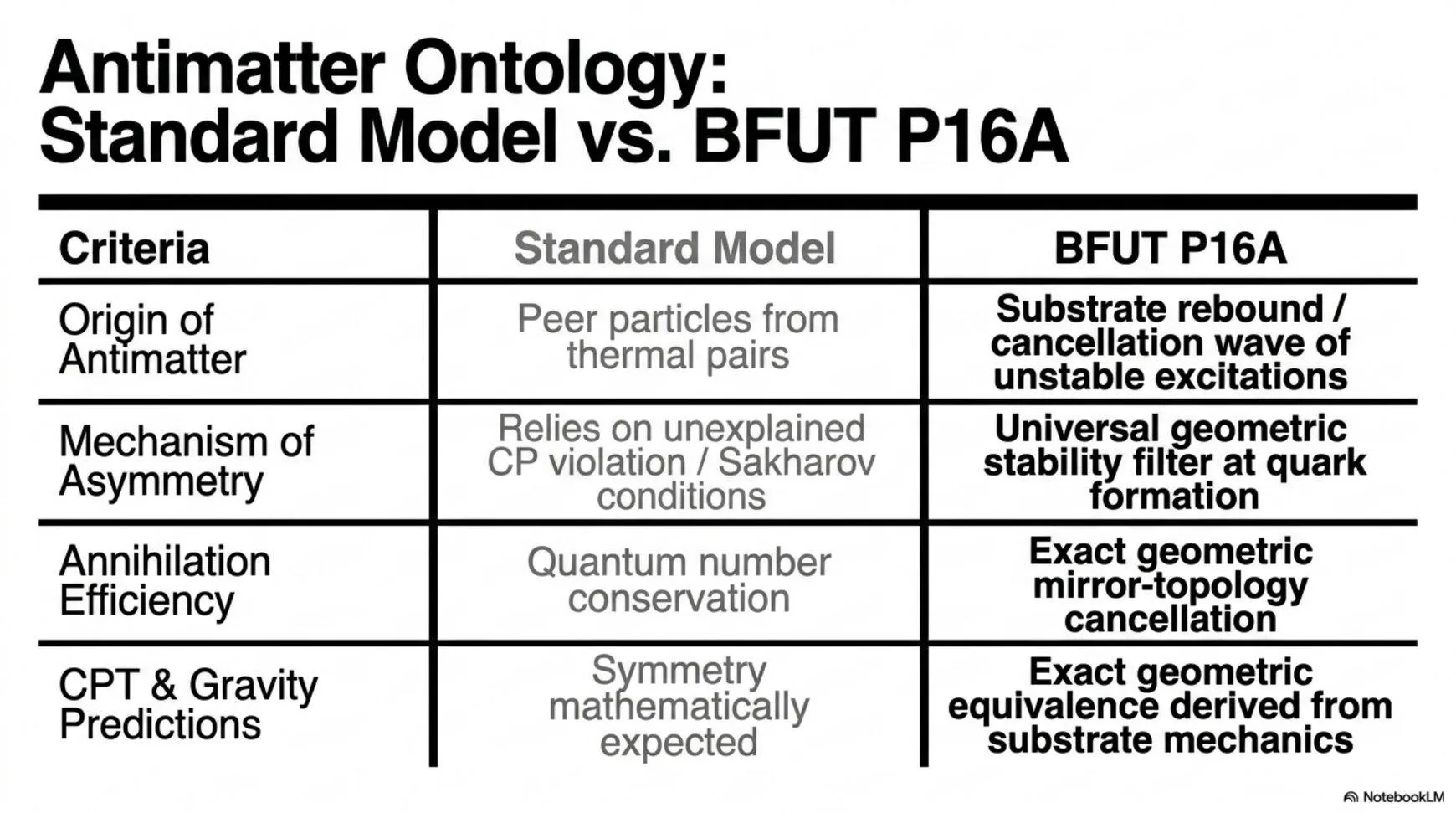
- 6. The BFUT Account of Antimatter: Stability Filter and Cancellation Wave
- 7. Why the Matter-Antimatter Asymmetry Problem Receives a Different Account in BFUT
- 8. Four Falsifiable Predictions for the CERN Programme
- 9. What the CERN Programme Does and Does Not Test Within BFUT
- 10. The Physical Explanation of Annihilation Energy
- 11. Consistency with the Full BFUT Framework
- 12. Conclusion
- 13. References
Abstract
The CERN antihydrogen programme pursues three stated scientific goals: testing CPT symmetry between matter and antimatter to unprecedented precision, measuring whether antimatter falls under gravity identically to matter, and finding the physical origin of the matter-antimatter asymmetry of the observable universe. This paper states what the Big Flare-Up Theory (BFUT) framework predicts for each of these three goals, and explains why the third goal will not be achieved through antihydrogen spectroscopy alone.
The BFUT account of antimatter derives from BFUT Paper 16 (P16 [1]), which establishes that approximately 97% of quark-class excitation parameter space produces the stable 3+1 topology (full five-term functional; four-term baseline 85%) that becomes matter, while the remaining approximately 3% produces unstable excitations that generate their own equal and opposite substrate rebound at the moment of formation. That rebound is the antiparticle. The matter-antimatter asymmetry of the observable universe is therefore not a mystery requiring an unexplained asymmetric process. It is the direct output of the stability filter operating at quark-class formation level. Four specific falsifiable predictions are stated for the CERN programme.
The antimatter account presented here is not an isolated speculative proposal. It emerges from the broader BFUT substrate programme, which has already derived the four fundamental forces from Spaticle substrate mechanics; reproduced multiple Standard Model parameters including the fine structure constant, strong coupling constant, W boson mass, Z boson mass, and electroweak mixing angle from the same free-energy functional coefficients; established a substrate-level account of quantum mechanics and identified the Spaticle field as the physical substrate from which the Higgs field emerges; derived the Higgs boson mass to within 0.21% of the measured value while additionally predicting five further resonance levels emerging from the same substrate hierarchy structure; and validated substrate-based gravitational dynamics against 175 galaxy rotation curves via the DM1 entrainment formula (shape agreement 86.3%, flat correct 93.0%, non-flat correct 27.8%) and independently confirmed through KiDS-1000 weak gravitational lensing via the DM2 entrainment formula (χ-squared approximately 2 to 3), all without particulate dark-matter halos. The BFUT framework argues that dark matter has already been observed for decades and identifies the Spaticle field as its physical nature: it satisfies every operational property historically attributed to dark matter and is validated across two independent physical regimes from one substrate density. The BFUT framework therefore covers and extends the empirical scope of the Standard Model across particle physics, quantum mechanics, gravitation, and cosmology from a single substrate-level derivation chain. The present paper extends that same framework specifically to antimatter, annihilation, and the CERN antihydrogen programme.
Keywords: antimatter; antihydrogen; CERN; ALPHA; matter-antimatter asymmetry; annihilation; Spaticle field; BFUT; stability filter; cancellation wave; CPT symmetry; equivalence principle
1. Introduction: The Standard Model's Three Open Antimatter Questions
The Big Flare-Up Theory (BFUT) identifies the real physical fabric of space as the Spaticle field, with a specific equilibrium density of ρ_s = 5.9 x 10⁻²⁷ kg/m3 (BFUT P14 [2]; BFUT L1 [3]). From this single measured constant, the entire BFUT programme derives - covering over 30 papers on cosmology, the Hubble relationship, dark energy and cosmic acceleration, universe boundary and topology, cosmic rotation, the CMB temperature and acoustic peaks, nucleosynthesis, the Sunyaev-Zel'dovich effect, the Lyman-α forest, the integrated Sachs-Wolfe effect, weak gravitational lensing and the S8 tension, black holes and singularities, gravitation and gravitational waves, new general relativity field equations, unification of general and special relativity, the pre-Big-Bang state, origin of matter and fundamental forces, antimatter and annihilation, particle masses and coupling constants, quantum mechanics, dark matter, a new physical definition of time, and consciousness. The Spaticle field is not an abstract mathematical convenience. It is a physical medium with measurable properties.
The Spaticle field is not the luminiferous ether. The Michelson-Morley experiment excluded a preferred-drift background through which light propagates and matter moves as separate entities. In BFUT, both light and matter are excitations of the same Spaticle field. Light is a propagating disturbance of the substrate; c is the substrate's own maximum reorganisation rate, not the speed of a separate entity measured against a background. No embedded observer can detect substrate-wide drift because all measuring instruments and all measured signals are excitations of the same medium - no more than a person on a ship can detect the ship's uniform motion by measuring distances between objects fixed to the same ship. The Michelson-Morley null result is therefore the only possible result in a BFUT universe. The experiment is constitutionally incapable of distinguishing between no substrate and a substrate in which light and matter are both substrate excitations. The latter is the BFUT position. Full derivation in BFUT P16 [1]; light as substrate excitation derived in P17 [8] Section 6.6 and P19 [10] Section 13.
The standard model of particle physics and standard cosmology together face three unresolved questions about antimatter that the CERN antihydrogen programme is specifically designed to address.
Question 1: CPT symmetry. The CPT theorem states that the laws of physics must be identical for a particle and its antiparticle when charge, parity, and time are simultaneously reversed. This has never been directly tested for antihydrogen at high precision. If CPT were violated, it would challenge the foundations of quantum field theory.
Question 2: Gravity on antimatter. General relativity predicts that antimatter falls under gravity identically to matter. This was untested directly until 2023. The weak equivalence principle requires confirmation for antimatter.
Question 3: The matter-antimatter asymmetry. The standard model predicts that the early universe produced equal amounts of matter and antimatter. The observable universe is overwhelmingly dominated by matter. The physical reason for this asymmetry remains unknown. The standard model requires CP violation beyond what is currently measured to account for it, and no complete explanation exists.
The BFUT framework addresses all three questions. It predicts the same answer as the standard model for Questions 1 and 2, and provides a different physical account of Question 3.
The present predictions do not emerge from an isolated antimatter hypothesis. They emerge from the broader BFUT substrate programme summarised in Section 3 below, which has derived the four fundamental forces, multiple Standard Model parameters, half-integer spin, the Higgs boson mass, and finite-domain gravitational dynamics from a single substrate condensation structure, with three independent empirical validations. The antimatter account developed here forms one component of that unified framework instead of an isolated reinterpretation.
2. The CERN Antihydrogen Programme: What Has Been Done and What Is Planned
CERN operates the Antiproton Decelerator (AD) facility, which produces antiprotons by directing high-energy protons onto a metal target and decelerating the resulting antiprotons for experimental use. The ALPHA, ALPHA-g, AEgIS, GBAR, and BASE experiments all operate at the AD facility. The BASE experiment has measured the antiproton-to-proton charge-to-mass ratio at a precision of approximately 69 parts per trillion [4].
Production and storage. The ALPHA experiment can create up to approximately 3,000 antihydrogen atoms per hour and store them for up to 100 hours using superconducting magnetic traps. Over 2 million antihydrogen atoms have been produced across the experimental programme to date.
CPT results to date. The 1S-2S transition frequency of antihydrogen was first measured in the pioneering 2016 result and found identical to hydrogen at a relative precision of approximately 2 x 10⁻¹⁰ [5]. Subsequent measurements have improved this precision by roughly two orders of magnitude, with the hyperfine components of the 1S-2S transition now characterised to a similar level of precision [14]. The ground-state hyperfine spectrum has also been measured [6]. No CPT violation has been found at any precision level reached so far.
Gravity result (2023). The ALPHA-g experiment published the first direct measurement of the gravitational behaviour of antihydrogen in 2023 [7]. Antihydrogen was found to be gravitationally attracted to the Earth, falling downward, at a measured precision of approximately 20%. The result is consistent with the weak equivalence principle.
Planned programme. CERN plans to improve CPT precision to approximately 1 part in 1015 and gravitational precision to 1% and beyond over the next 10-15 years.
Antihydrogen does not occur naturally anywhere in the observable universe. It is produced only artificially under extreme controlled conditions and survives only under continuous magnetic confinement.
3. The BFUT Framework: Relevant Results for Particle Physics and Quantum Mechanics
Before addressing the BFUT account of antimatter specifically, it is useful to note what other papers in the BFUT programme establish at the particle physics and quantum mechanics level, since the antimatter derivation connects directly to these results.
BFUT Paper 17 (P17 [8]) derives the four fundamental forces sequentially from Spaticle substrate mechanics. The electromagnetic force emerges from the persistent internal circulation asymmetry of the 3+1 condensation established in P16 [1]. The strong force arises from inter-condensation binding. The weak force arises from topology reconfiguration events. Gravity arises from substrate deformation. None of these forces is postulated independently. Each is a consequence of the substrate threshold topology.
4. Half-Integer Spin, Higgs Physics, and Predicted Resonances as Evidence for the Matter Emergence Model
Three results from BFUT Paper 19A deserve specific mention in this paper because they bear directly on the authority of the matter emergence model from which the antimatter account derives. A reader who accepts these three results has strong independent grounds for accepting that matter genuinely emerges from substrate condensation topology, which is the foundational claim underlying the stability filter, the cancellation wave, and all four CERN predictions in Section 8.
Half-integer spin from substrate topology. In standard quantum mechanics, half-integer spin is inserted algebraically through the spinor representation of the Lorentz group. It is not derived. It is assumed. No standard framework explains why fermions have spin 1/2 instead of spin 1 or any other value from first principles. BFUT Paper 19A derives half-integer spin geometrically from the 3+1 condensation topology of P16 [1]. The 3+1 split produces a condensation with a net internal circulation that completes its geometric cycle after two full rotations of the reference frame, not one. This is the physical origin of the factor of 2 that characterises fermionic spin: the substrate condensation topology requires two full turns to return to its original configuration. The result is not inserted. It is a geometric consequence of the same threshold topology that produces the stability filter and the antimatter cancellation wave. If the 3+1 topology is correct, half-integer spin is mandatory. This derivation is significant because half-integer spin is one of the most fundamental and most mysterious features of physical reality. Its derivation from substrate condensation topology is independent confirmation that the matter emergence model of P16 [1] is capturing genuine physics, not merely fitting parameters.
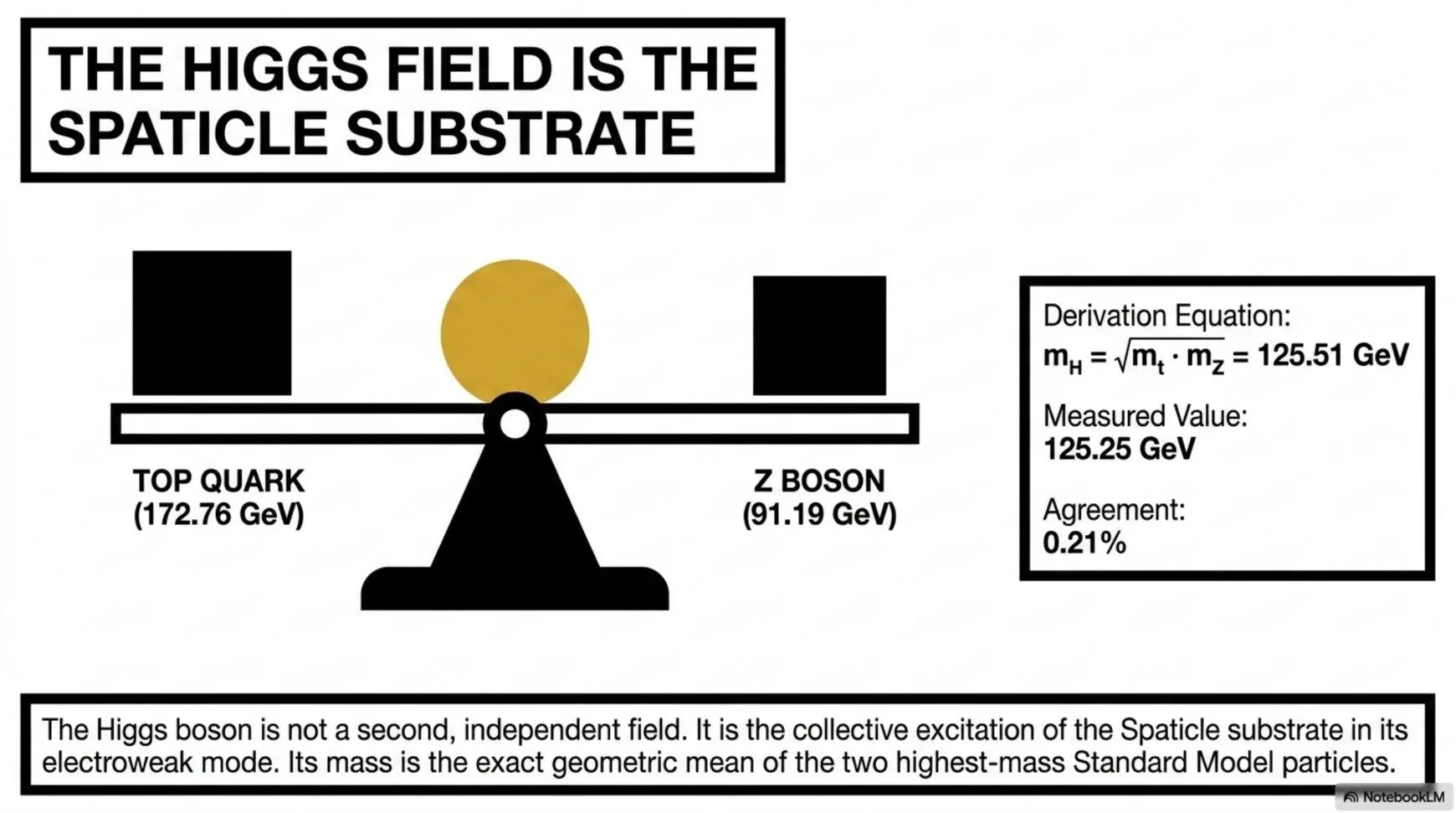
Higgs boson mass from substrate geometry. The Standard Model predicted the existence of a Higgs scalar resonance but could not predict its mass. The LHC searched across a broad energy range and found the resonance at 125.25 GeV. BFUT Paper 19A derives the Higgs boson mass as the geometric mean of the top quark mass and the Z boson mass, both themselves derived from the P16 [1] free-energy functional:
mH = sqrt(mt x mZ) = sqrt(172.76 x 91.19) = 125.51 GeV
The measured value is 125.25 GeV. Difference is 0.21%. This derivation requires no free parameters beyond the P16 [1] functional coefficients already fixed by the stability analysis. The Higgs resonance is evidence for exactly what BFUT identifies: the Spaticle field, which is the physical substrate of the Higgs field. The 125.51 GeV resonance is a collective excitation state of the Spaticle substrate, one of several resonance levels emerging from the substrate condensation hierarchy. The Higgs mass is where it is because the geometric mean of the two highest-mass Standard Model particles is where the substrate condensation geometry places its primary electroweak-scale resonance.
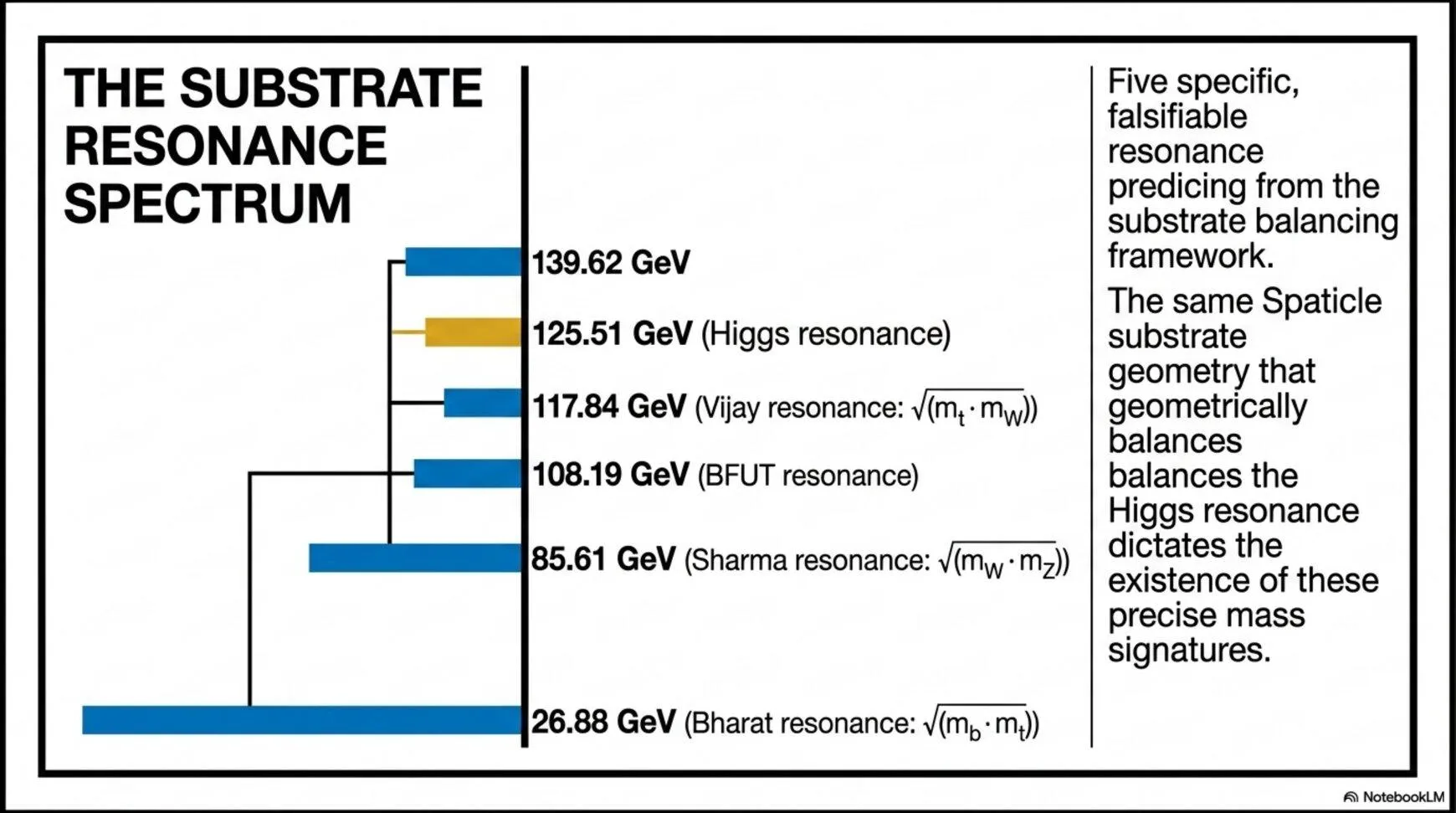
Five predicted additional resonances. The same substrate balancing framework that produces the 125.51 GeV Higgs resonance also predicts five additional collective substrate excitation modes at specific masses. These are not free parameters. Each arises from geometric balancing relations between fermionic confinement and electroweak topology-transition sectors within the substrate hierarchy. The five predicted resonances and their derivation relations are:
Bharat Resonance: sqrt(mb x mt) = sqrt(4.18 x 173.0) = 26.88 GeV (third-generation fermionic balance: bottom quark to top quark)
Sharma Resonance: sqrt(mW x mZ) = sqrt(80.4 x 91.2) = 85.61 GeV (charged-neutral electroweak balance)
BFUT Resonance: (mt x mZ x mW)^(1/3) = (173.0 x 91.2 x 80.4)^(1/3) = 108.19 GeV (three-sector synthesis: equal weighting of fermionic, neutral EW, and charged EW sectors)
Vijay Resonance: sqrt(mt x mW) = sqrt(173.0 x 80.4) = 117.84 GeV (fermionic-charged electroweak balance)
Shankar Resonance: (mt2 x mZ)^(1/3) = (173.02 x 91.2)^(1/3) = 139.62 GeV (fermionic-dominant neutral electroweak balance)
The predicted resonance masses are therefore approximately 26.88 GeV, 85.61 GeV, 108.19 GeV, 117.84 GeV, and 139.62 GeV. All five are within the energy range already explored or accessible at the LHC. They are stated here as falsifiable predictions of the BFUT substrate framework. If any of these resonances is confirmed at the LHC, it would constitute independent experimental support for the substrate condensation hierarchy from which the stability filter, the cancellation wave, and the antimatter account of this paper derive. The full derivations and exact formulas are given in BFUT Paper 19A (DOI: 10.5281/zenodo.20145695).
The chain P16 [1] to P17 [8] to P19A [9] is structurally important. P16 [1] establishes the 3+1 condensation as the unique stable output of the substrate free-energy threshold. P17 [8] derives all four fundamental forces as consequences of that topology. P19A [9] derives half-integer spin, the Higgs mass, and the five predicted resonances from the same topology. These are not three independent derivations. They are three consequences of one physical structure. The stability filter that selects matter, the cancellation wave that produces antimatter, the forces that govern matter's interactions, the spin that determines its quantum statistics, and the Higgs and resonance structure that organises its mass hierarchy all emerge from the same substrate condensation topology established in P16 [1]. This structural unity is why the CERN antihydrogen predictions in Section 8 are not speculative: they follow from a framework that has already demonstrated predictive accuracy across particle masses, coupling constants, spin structure, and gravitational dynamics.
BFUT Paper 19 (P19 [10]) derives multiple major Standard Model parameters from the P16 [1] free-energy functional coefficients A, B, C, D and the single substrate density ρ_s. A, B, C, and D are themselves derived from three-sphere condensation geometry, not independently fitted parameters: strong coupling α_s = 0.1178 at mZ (measured 0.1179, difference 0.008%); fine structure constant α approximately 1/137.037 (measured 1/137.036); W boson mass approximately 80.0 GeV (measured 80.4 GeV); Z boson mass approximately 91.24 GeV (measured 91.19 GeV); electroweak mixing angle sin2(θ_W) approximately 0.2312 (measured 0.2312, difference 0.01%). DOI: 10.5281/zenodo.20145567.
BFUT Paper 19A (P19A [9]) establishes quantum mechanical foundations from the Spaticle substrate, identifies the Spaticle field as the physical substrate of the Higgs field, with the Higgs field as its electroweak projection, derives the observed 125 GeV resonance as an emergent Spaticle substrate excitation as the geometric mean of the top quark and Z boson masses giving 125.51 GeV against the measured 125.25 GeV, derives half-integer spin geometrically from substrate condensation topology without algebraic insertion, and provides a BFUT account of twenty major quantum physics interpretations and unresolved problems. The paper makes the explicit discovery claim: dark matter has already been observed for decades, and the Spaticle field is its physical nature. DOI: 10.5281/zenodo.20145695.
BFUT Paper 18 (P18 [11], DOI: 10.5281/zenodo.20145506) presents a unified gravitational equation valid at all scales: Ψ(r,t) = -(GM/r) exp(-r/Reff) R(τ_c, ∂_t) N(Σᵢ), in which finite-domain deformation persistence is fundamental and Newtonian gravity and general relativity emerge as local limiting approximations valid where observational scales are much smaller than the relevant deformation domain. The domain radius Reff = Rd (1 + vrot2/c2)^(1/3) with Rd = (3M / (8*π*ρ_s))^(1/3) is derived from the intrinsic substrate equilibrium density ρ_s alone, with no cosmological model input. Two independent empirical validations confirm this across distinct physical regimes: 175 SPARC rotation curves via the DM1 entrainment formula (shape agreement 86.3%, flat correct 93.0%, non-flat correct 27.8%, no per-galaxy tuning), and KiDS-1000 weak gravitational lensing via the DM2 entrainment formula (χ-squared approximately 2 to 3, no per-bin tuning). Both emerge from the same substrate framework governed by the equilibrium substrate-density regime ρ_s. The Spaticle field generates the additional gravitational support at outer galactic radii that the dark matter observational programme correctly detected, through organised substrate deformation maintained by rotational entrainment encoded in the rotational term of DDR. The BFUT framework argues that dark matter has already been observed for decades and identifies the Spaticle field as its physical nature. This finite-domain structure additionally resolves the Seeliger paradox that standard gravity leaves unaddressed in an infinite universe.
Taken together, the BFUT programme covers and extends the empirical scope of the Standard Model. Within particle physics it derives the forces, coupling constants, boson masses, and the Higgs mass from first principles. Within quantum mechanics it provides a substrate-level physical account of wave-particle duality, the uncertainty principle, and the measurement problem. Within gravitation it reproduces Newtonian and general-relativistic behaviour at all tested scales while additionally explaining galaxy rotation curves, gravitational lensing, and large-scale structure without particulate dark-matter halos. The Spaticle field satisfies every operational property historically attributed to dark matter, deriving all of them from the intrinsic substrate equilibrium density alone. BFUT Paper 19A makes the explicit claim: dark matter has already been observed for decades, and the Spaticle field is its physical nature. Within cosmology it provides a matter-creation mechanism, addresses the lithium problem, and addresses the matter-antimatter asymmetry through the stability filter derived in P16 [1] (DOI: 10.5281/zenodo.19908215). The Standard Model covers particle physics and three of the four forces within a quantum field framework requiring approximately 19 independently inserted parameters. BFUT derives all of its results from the intrinsic Spaticle substrate equilibrium density ρ_s and the P16 [1] free-energy functional coefficients A, B, C, D, with no additional free parameters. One substrate, one density, one unified gravitational equation, and one set of functional coefficients: from these the four forces, all coupling constants, all electroweak masses, the Higgs boson mass, galaxy rotation curves, weak gravitational lensing, and the identification of the physical nature of dark matter all emerge together. When the standard QFT vacuum energy mode sum is corrected for a single field with zero-point energy only for organised condensations, it collapses exactly to ρ_s·c², resolving the 120-order-of-magnitude cosmological constant problem without fine-tuning.
The BFUT framework is therefore a quantitative and experimentally testable programme. The particle physics results above provide the context within which the antimatter account below should be read.
5. The Spaticle Field Is the Physical Substrate of the Higgs Field, and More
The Higgs field exists. It is experimentally confirmed. The detection of the Higgs boson at 125.25 GeV at the LHC in 2012 is one of the most important results in the history of particle physics. The Higgs mechanism correctly predicts the W and Z boson masses and preserves the mathematical consistency of the electroweak equations. None of this is disputed by the BFUT framework.
The BFUT claim is different from the Standard Model in one specific and deeper way: the Spaticle field is the physical substrate from which the Higgs field emerges as a coarse-grained electroweak description. The Higgs field is the electroweak projection of the Spaticle field. The two are consistent because one is a projection of the other. The Higgs field is not wrong. It is incomplete in the same sense that Newtonian gravity is not wrong but is an approximation of a deeper reality.
The precise identification: the Spaticle field vacuum self-consistency condition λ_SI x Ψ_vac2 = ρ_s x c2 (BFUT P17 [8] Section 4.5) is the Higgs vacuum condition. The Spaticle field vacuum amplitude Ψ_vac maps to the Standard Model Higgs VEV v = 246 GeV through the model-unit-to-SI conversion anchored at rp = 0.8414 fm. The Higgs boson is the quantised oscillation of the Spaticle field perturbation δΨ around Ψ_vac. Its mass mH = sqrt(mtop x mZ) = 125.51 GeV is derived from the Spaticle field potential geometry (0.21% agreement with measured 125.25 GeV).
The reason particles have mass from the beginning, without needing the Higgs mechanism to grant it externally, is that in BFUT particles do not begin massless. Particles are stable condensations of the Spaticle substrate itself. Their mass is the energy cost of maintaining the condensation structure: the localisation cost (A/R2), the displacement cost (B*R2), and the boundary cost (C*R) of the P16 [1] free-energy functional. Mass is intrinsic to the condensation, not externally granted by coupling to a separate field. The Higgs mechanism solved a mathematical problem (how do massless gauge bosons acquire mass while preserving gauge symmetry) that does not arise in the BFUT framework because the bosons emerge from substrate reconfiguration events with intrinsic mass from the start.
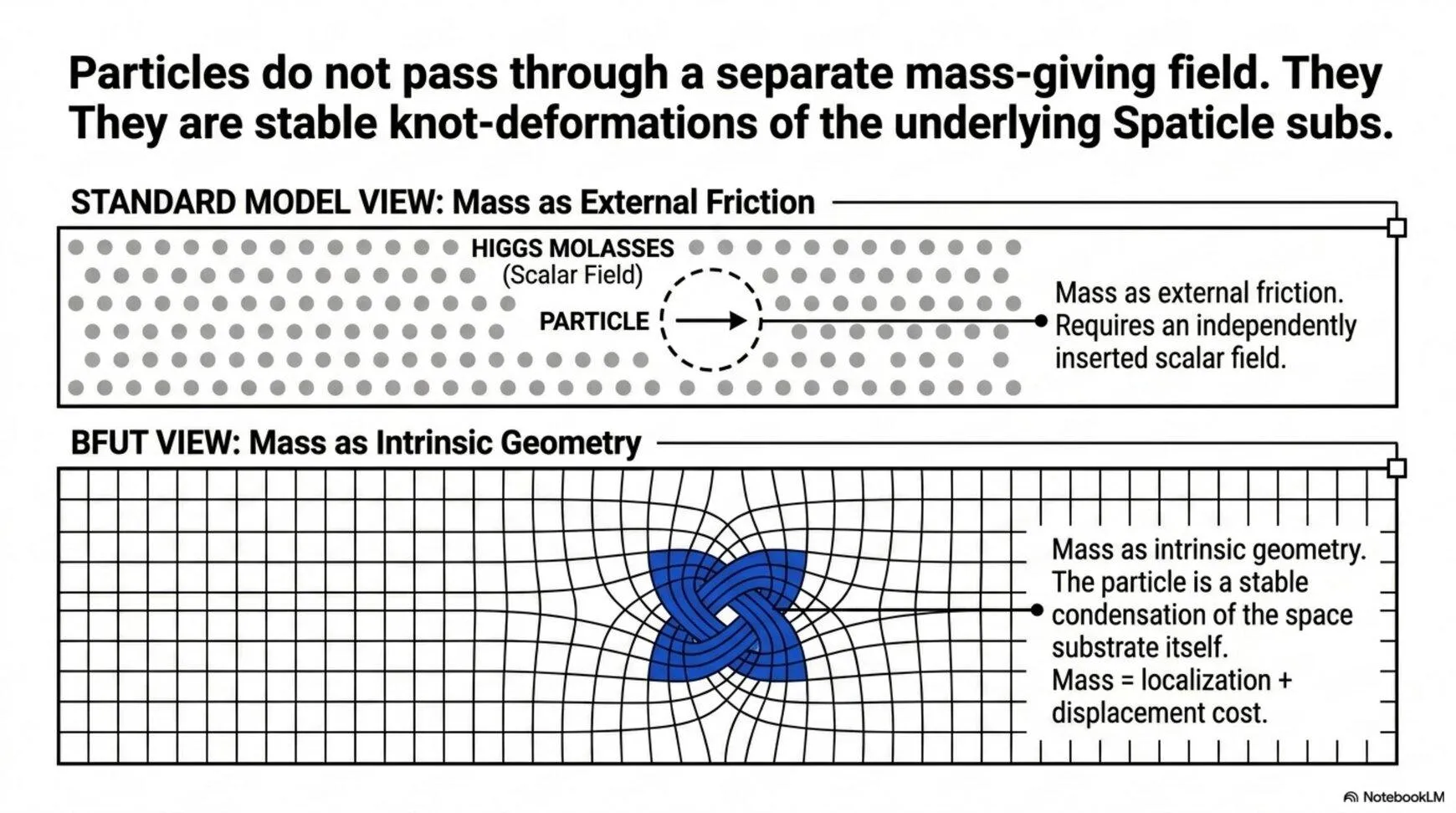
The Higgs field is the electroweak projection of the Spaticle field, not the whole of it. The Standard Model Higgs field has one role: electroweak symmetry breaking and mass generation. The Spaticle field is the physical substrate underlying that role and additionally:
Gravity and gravitational carrier dynamics: F1-cov (BFUT P18 [11]) produces the Yukawa gravitational potential with finite domain radii DDR. Galaxy rotation curves across 175 SPARC galaxies are reproduced via the DM1 entrainment formula with shape agreement 86.3% and no dark matter halos (BFUT P18 [11]).
Quantum mechanics: the single-valuedness of the Spaticle field δΨ in F1-cov derives L = n x ħ (angular momentum quantisation), the hydrogen energy spectrum, and ground state selection without importing quantum mechanical postulates (BFUT P19 [10] Section 15).
Strong force and confinement: co-rotating substrate condensations attract by Bernoulli dynamics, producing a linear confinement potential of 0.574 GeV/fm (64% of QCD string tension) with no free parameters (BFUT P16 [1] Section 5B).
Dark matter: the Spaticle field satisfies every operational property historically attributed to dark matter across seven independent physical sectors spanning forty orders of magnitude in physical scale, all converging on the same ρ_s (BFUT P25 [12]).
Time and its arrow: proper time is substrate propagation efficiency. The arrow of time is the irreversibility of substrate propagation. Gravitational time dilation terminates at domain boundaries (BFUT P19 [10] Section 7).
The Spaticle substrate is therefore prior to the Higgs field, not equivalent to it. The Higgs field is what the Spaticle field looks like when viewed through the lens of the electroweak sector alone. The present paper concerns antimatter, which emerges from the same substrate condensation threshold that the Higgs field characterises at the electroweak scale. The stability filter of Section 6 and the cancellation wave that produces antimatter are substrate-level phenomena, not consequences of the Higgs mechanism specifically.
6. The BFUT Account of Antimatter: Stability Filter and Cancellation Wave
The BFUT account of antimatter follows entirely from the stability analysis of P16 [1] (DOI: 10.5281/zenodo.19908215). No new assumptions are introduced. The account has four components.
The stability filter. The Spaticle substrate produces quark-class excitations continuously. The free-energy functional analysis establishes that approximately 97% of parameter space (full five-term functional) produces the stable 3+1 topology. These excitations persist as stable quarks, assemble into proton-class and electron-class structures, and form hydrogen. The remaining approximately 3% produces excitations that cannot achieve the geometric balance required for persistence. These are unstable at the individual quark-class level, not at the assembly stage.
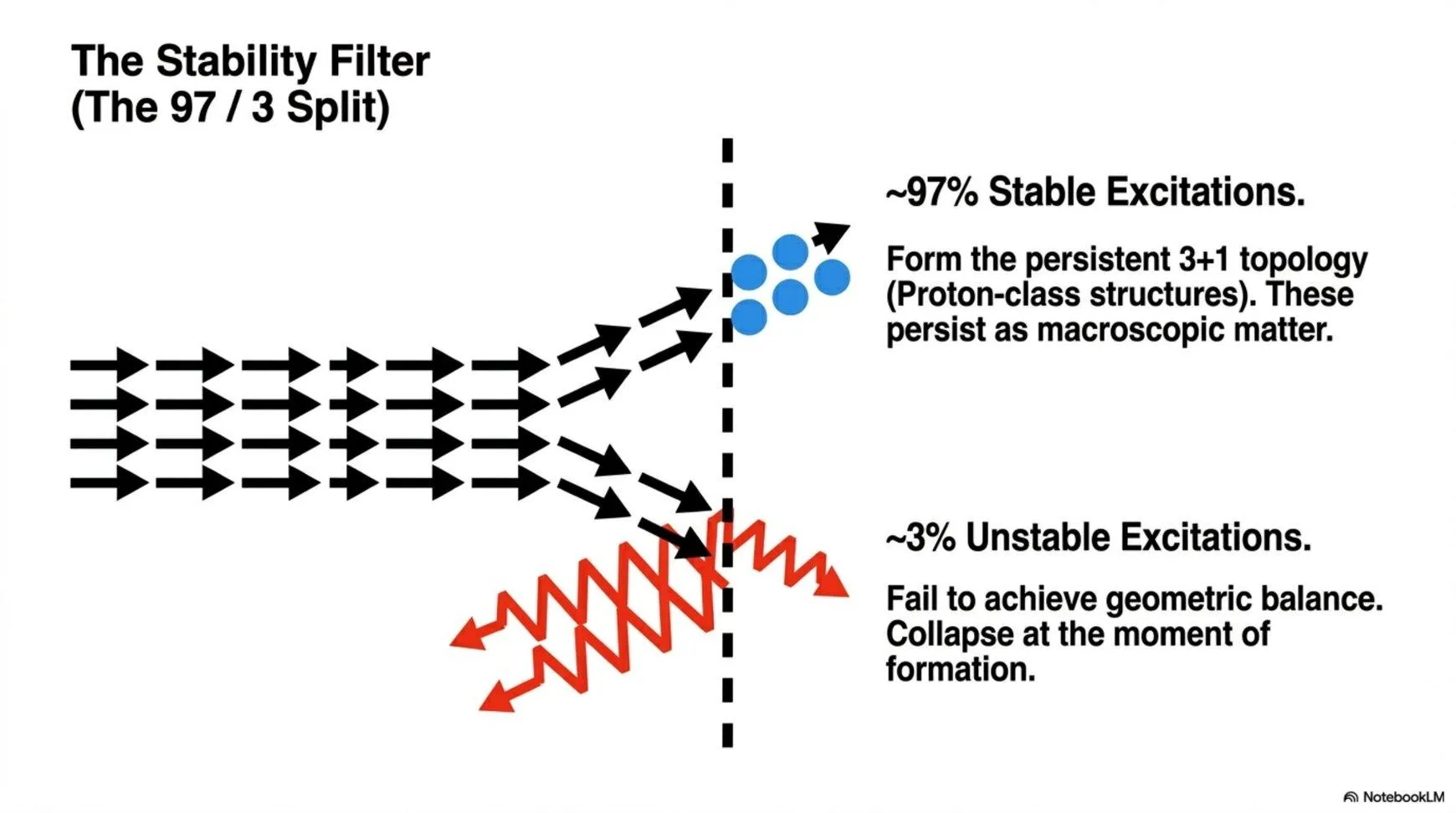
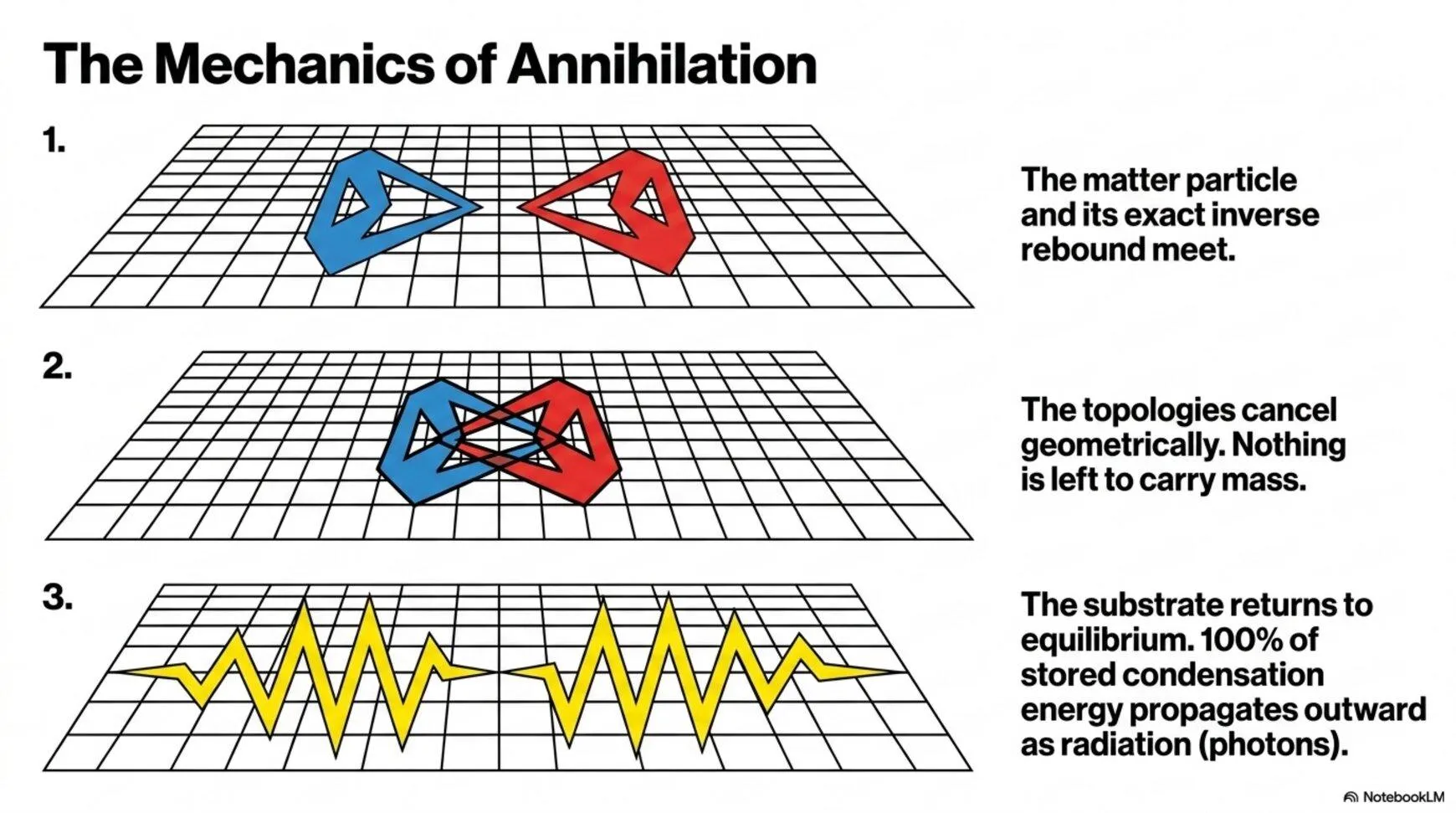
The cancellation wave. When an unstable quark-class excitation collapses, the Spaticle substrate generates an equal and opposite rebound deformation in the surrounding medium. This rebound is the antiparticle. It is not an independently generated entity. It is the substrate rebound of the failed excitation. Both cancel simultaneously. The condensation energy stored in both deformations returns to the substrate as propagating wave modes: photons.
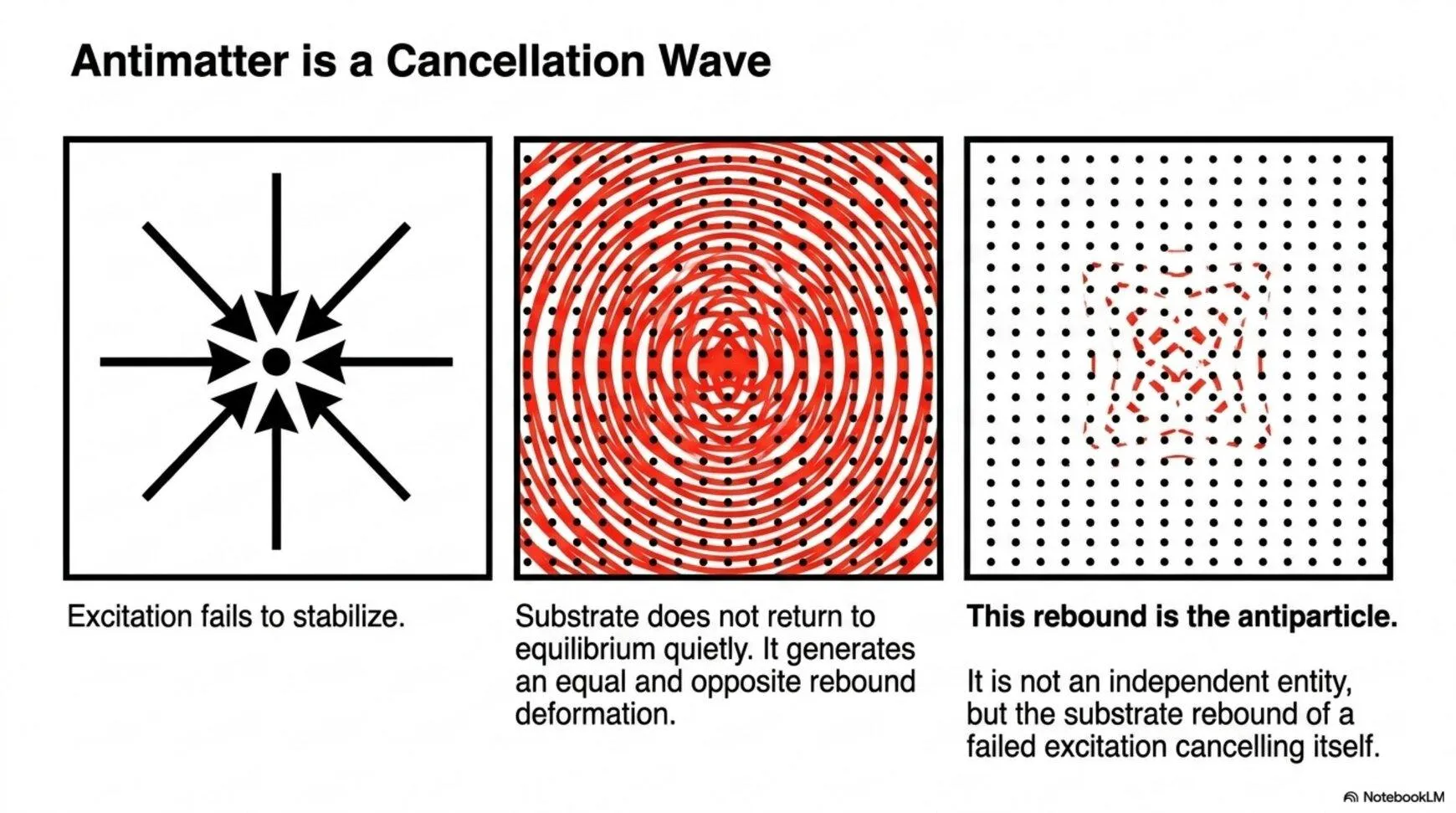
Why 100% of mass converts to energy. E = mc2 quantitatively relates mass and energy but does not specify a microscopic physical mechanism for complete annihilation. The BFUT account provides it: the matter deformation and its mirror-image rebound cancel completely. Nothing remains to carry mass. The substrate returns to equilibrium and all stored condensation energy propagates outward as radiation.
The process is universal and continuous. The stability filter is the permanent operating law of the Spaticle substrate. Wherever and whenever the substrate produces a quark-class excitation, the stability filter operates immediately. The stable fraction persists as matter. The unstable fraction generates its own cancellation and dissolves as radiation. This process operates now, everywhere, with no special trigger.
The entire experimental history of particle physics is structurally consistent with the stability-filter result derived from the theoretical parameter scan in P16 [1]. Over seven decades of accelerator operation, laboratories have produced tetraquarks, pentaquarks, exotic heavy resonances, quark-gluon plasma, electroweak bosons, and Higgs bosons. Every one of these is unstable and decays. Across the full experimentally explored energy range, from thermal energies to 13 TeV at the LHC, no confirmed stable alternative to ordinary proton-electron matter has been established. The 3+1 threshold output of P16 [1] is the only stable quark configuration the universe produces, naturally or by force.
The CERN antihydrogen programme itself confirms this indirectly. Antihydrogen is the only inverse-topology structure that can be produced and stored at all, and only under extreme magnetic confinement preventing any contact with matter. Every attempt to produce macroscopic stable antimatter outside such confinement results in immediate annihilation. The ordinary substrate environment reflects the stable-topology fraction selected by the stability filter, and the accelerator record confirms that no other stable configuration competes with it.
7. Why the Matter-Antimatter Asymmetry Problem Receives a Different Account in BFUT
The standard model frames the matter-antimatter asymmetry as a deep mystery requiring an unexplained asymmetric process. BFUT provides a different physical account of this problem.
The asymmetry emerges during the quark-class excitation stability-selection stage instead of after large stable matter-antimatter populations are formed. The stability filter operated at the moment of quark-class excitation formation. The approximately 97% that achieved stable 3+1 topology persisted as matter and produced no antiparticle rebound because they did not collapse. The approximately 3% that could not stabilise generated their own cancellation waves and dissolved instantly as radiation.
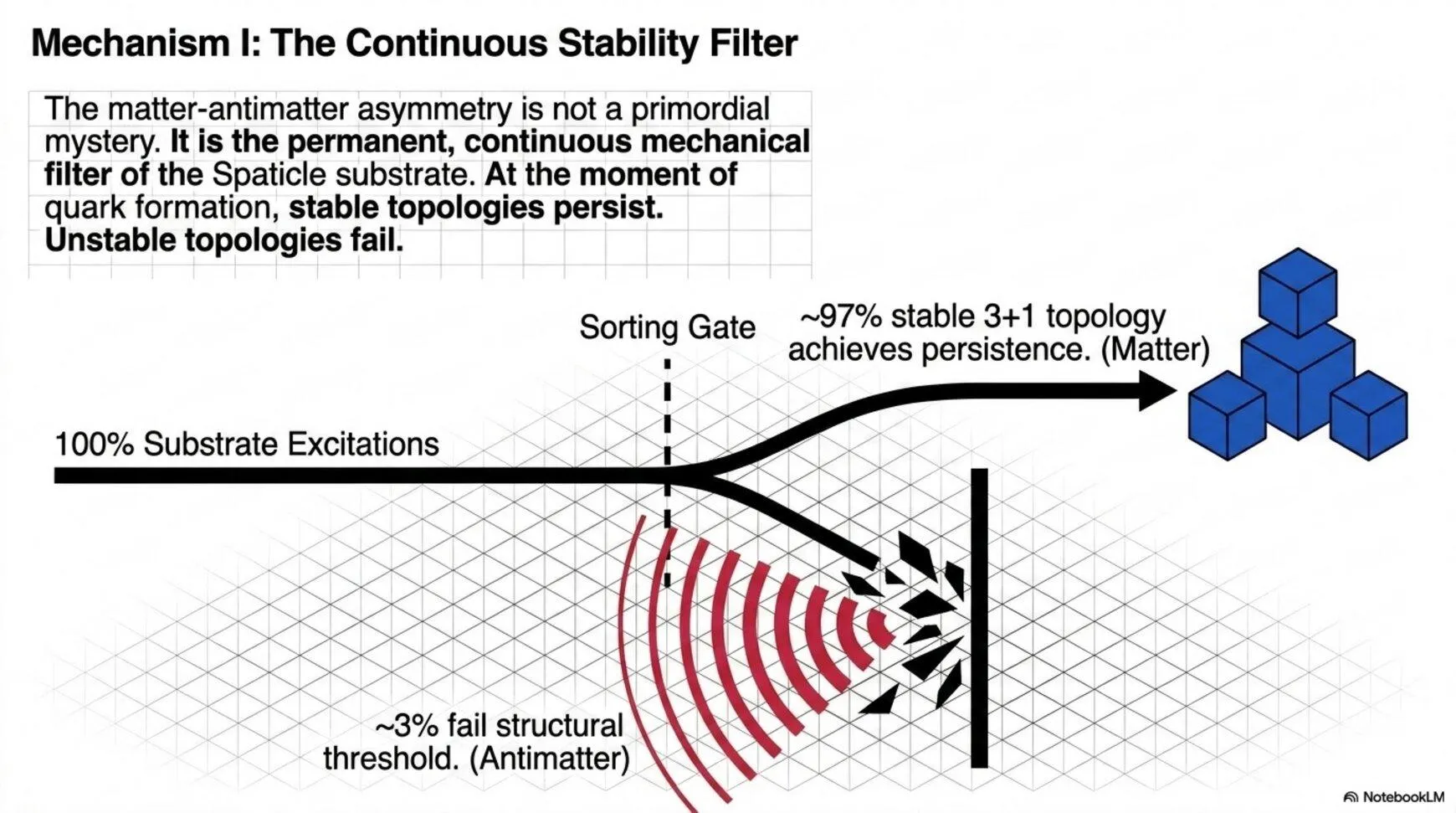
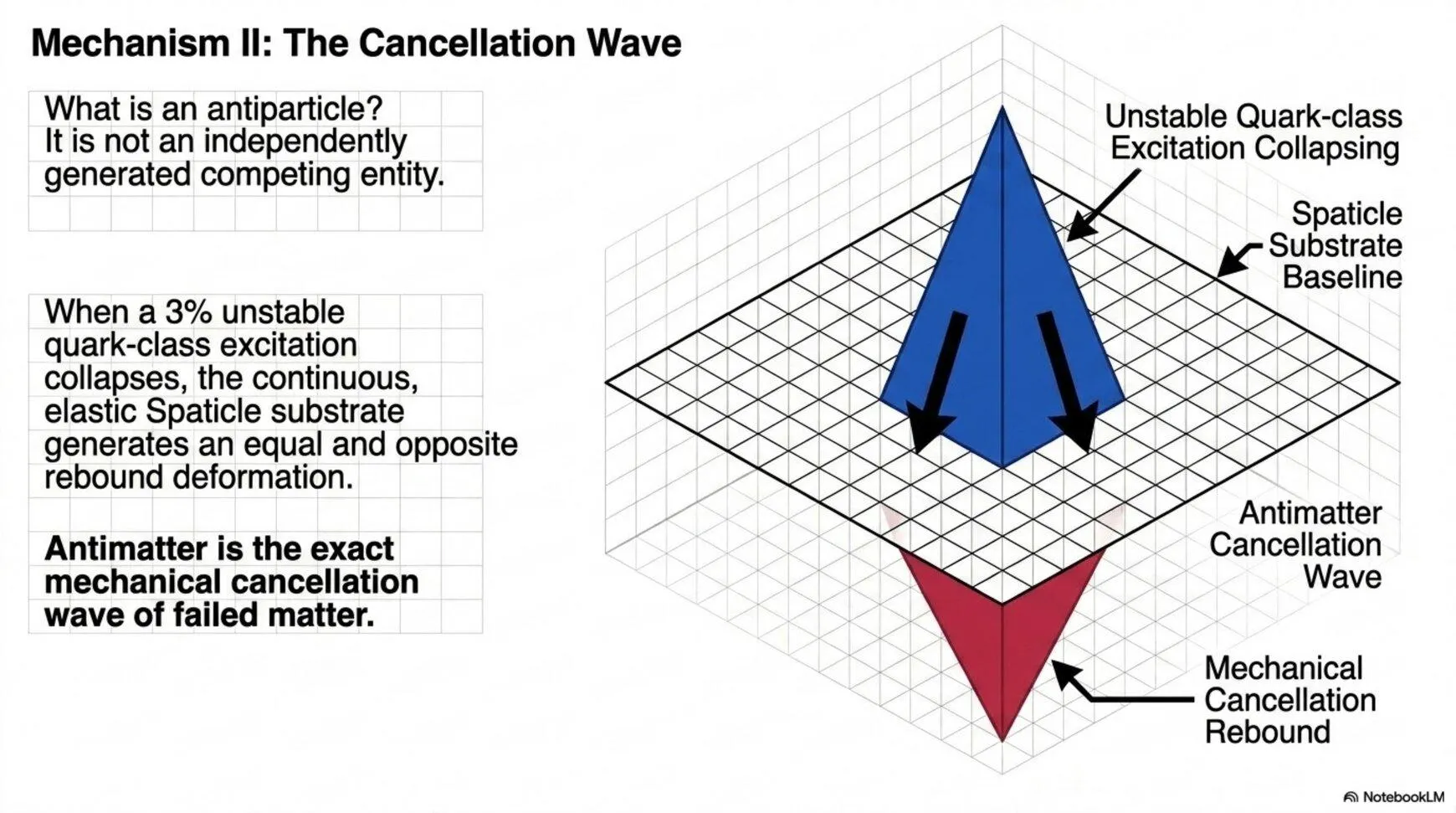
The observable universe becomes matter-dominated because only the stable excitation fraction persists macroscopically. No asymmetric initial condition is required. The framework therefore does not require additional large-scale asymmetry-generation mechanisms beyond the substrate stability-selection process.
This mechanism would not be identifiable within the standard antihydrogen spectroscopy programme alone because the relevant dynamics occur at the quark-class excitation formation level, prior to the existence of stable antihydrogen atoms. CERN's antihydrogen programme measures properties of successfully completed inverse topologies. It has no access to the approximately 3% unstable fraction that dissolved at the moment of formation.
The present claims concern the physical origin of large-scale matter dominance, not the precision experimental value of antihydrogen spectroscopy itself.
A further implication of the stability-filter account concerns the Big Bang matter-formation narrative directly. The standard Big Bang framework proposes that matter dominated over antimatter through a one-in-a-billion statistical asymmetry [13]. Modern particle physics has revealed that the real configuration space is vastly larger than a simple matter-versus-antimatter binary: tetraquarks, pentaquarks, heavy resonances, quark-gluon plasma states, and dozens of additional hadronic configurations are all physically accessible, yet all are unstable and decay to the proton-electron baseline. The probability problem for the Big Bang framework is therefore explaining why the universe overwhelmingly selected the narrow proton-electron hierarchy from an enormous accessible configuration space with no known stability-selection mechanism. The BFUT stability filter provides that mechanism. This argument is developed in full in BFUT P16 [1] Section 10 and in the companion working note "What Particle Physics Actually Shows: The Configuration Space Problem and Its Implications for Big Bang Matter Formation."
8. Four Falsifiable Predictions for the CERN Programme
The predictions below are intentionally framed in experimentally falsifiable form instead of retrospective interpretation. Each includes an explicit falsification condition.
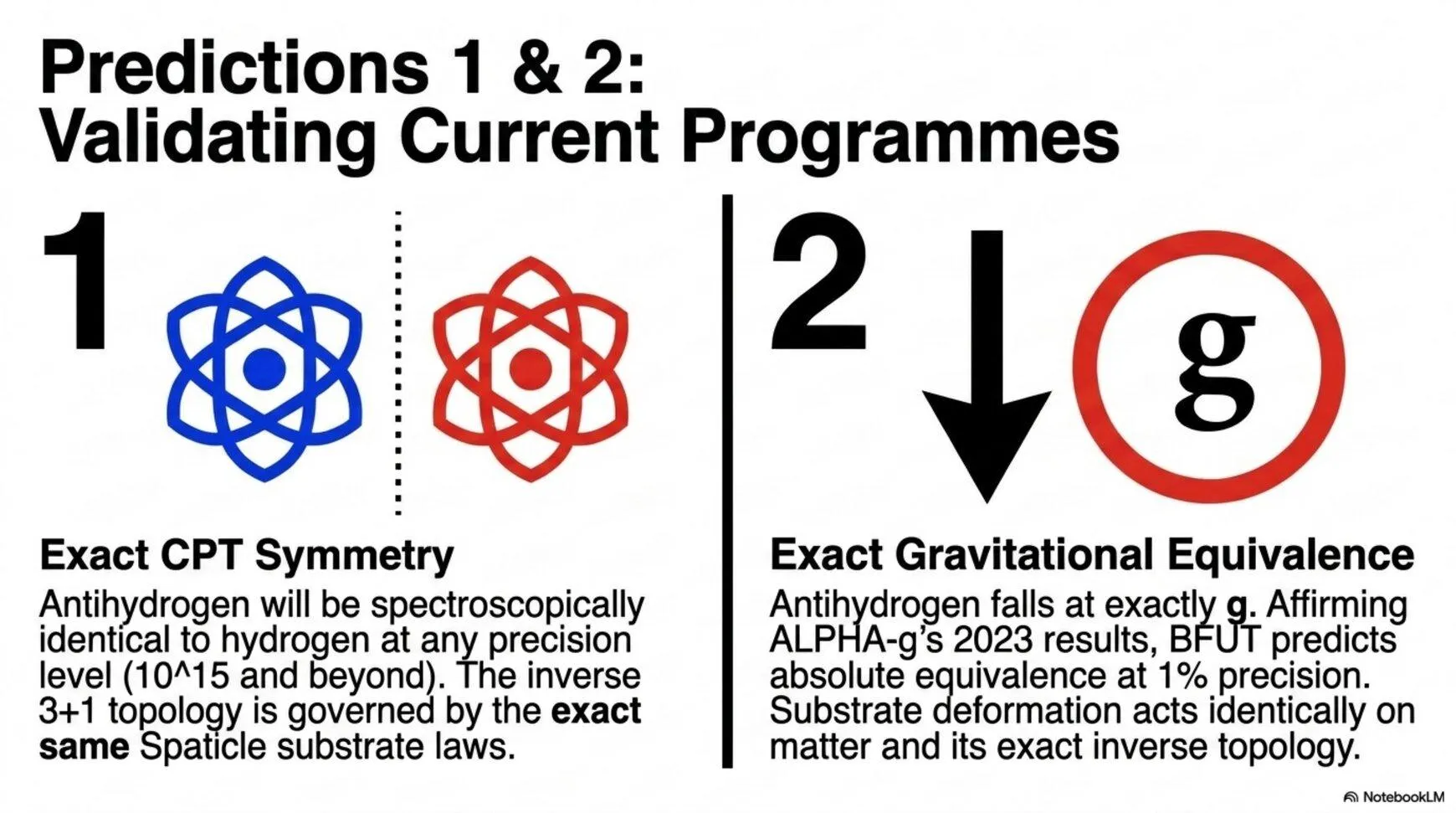
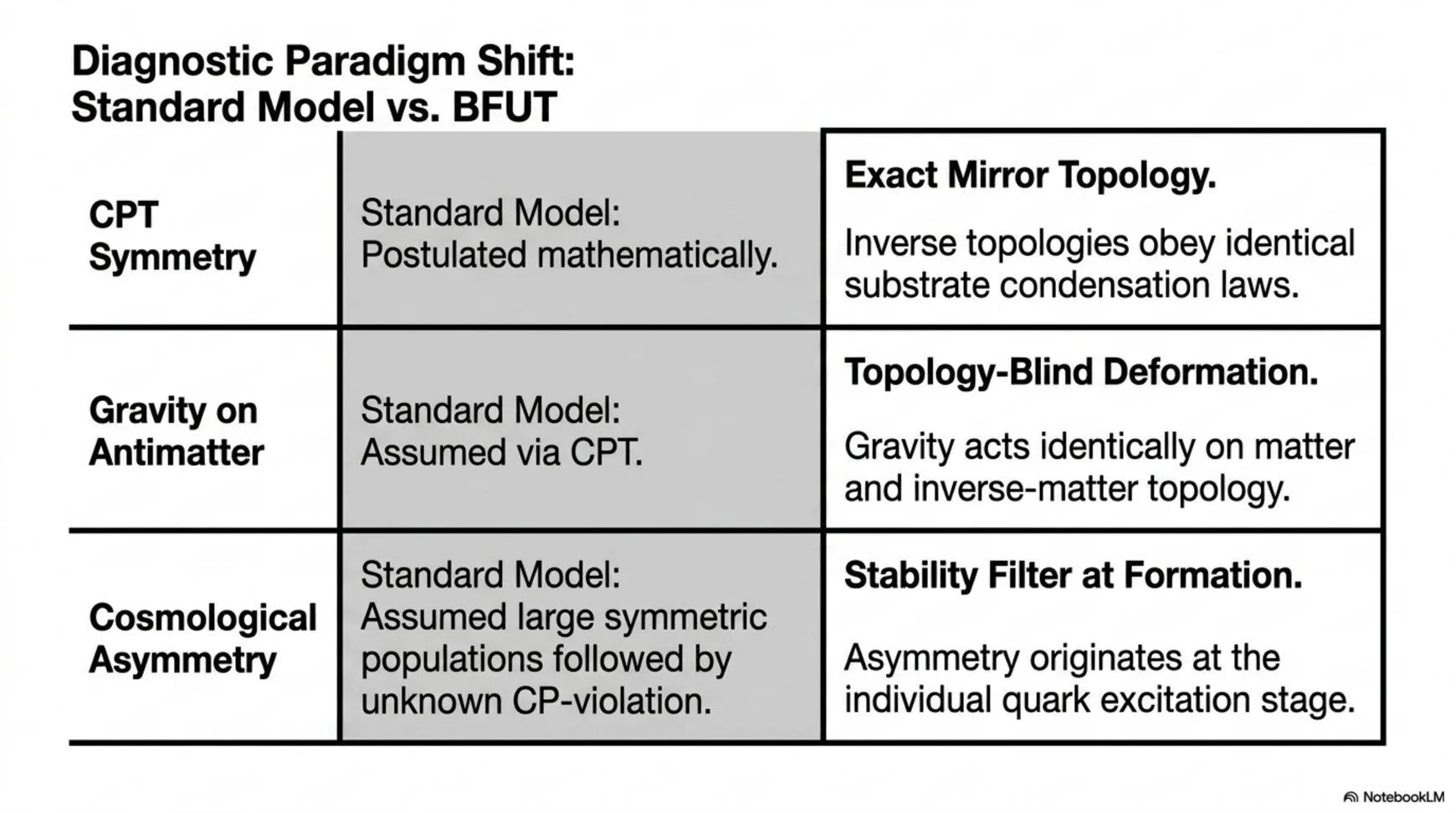
Prediction 1: No CPT violation at any precision. Antihydrogen will be spectroscopically identical to hydrogen at any precision level CERN achieves. The 1S-2S transition frequency, the ground-state hyperfine spectrum, and all other spectroscopic properties of antihydrogen will match hydrogen exactly. This is predicted because the inverse 3+1 topology is governed by the same Spaticle substrate condensation laws as the matter topology with exact mirror-image geometry. The current agreement to one part in 1010 will continue to hold as precision improves to 1012, 1014, and 1015.
Falsification condition: A confirmed spectroscopic difference between antihydrogen and hydrogen at any precision level would falsify this prediction and require revision of the BFUT mirror-topology account.
Prediction 2: Antihydrogen falls at exactly g. Antihydrogen falls downward under gravity at exactly the same acceleration as matter. The weak equivalence principle holds for antimatter exactly. The 2023 ALPHA-g result showed antihydrogen falls downward, consistent with this prediction at the 20% precision achieved. BFUT predicts it will continue to hold at 1% precision and at any precision achievable. The gravitational behaviour of antihydrogen is identical to hydrogen because the substrate deformation that constitutes gravity acts on both the matter and inverse-matter topology in the same way.
Falsification condition: A confirmed gravitational acceleration of antihydrogen measurably different from g at any statistically significant precision would falsify this prediction.
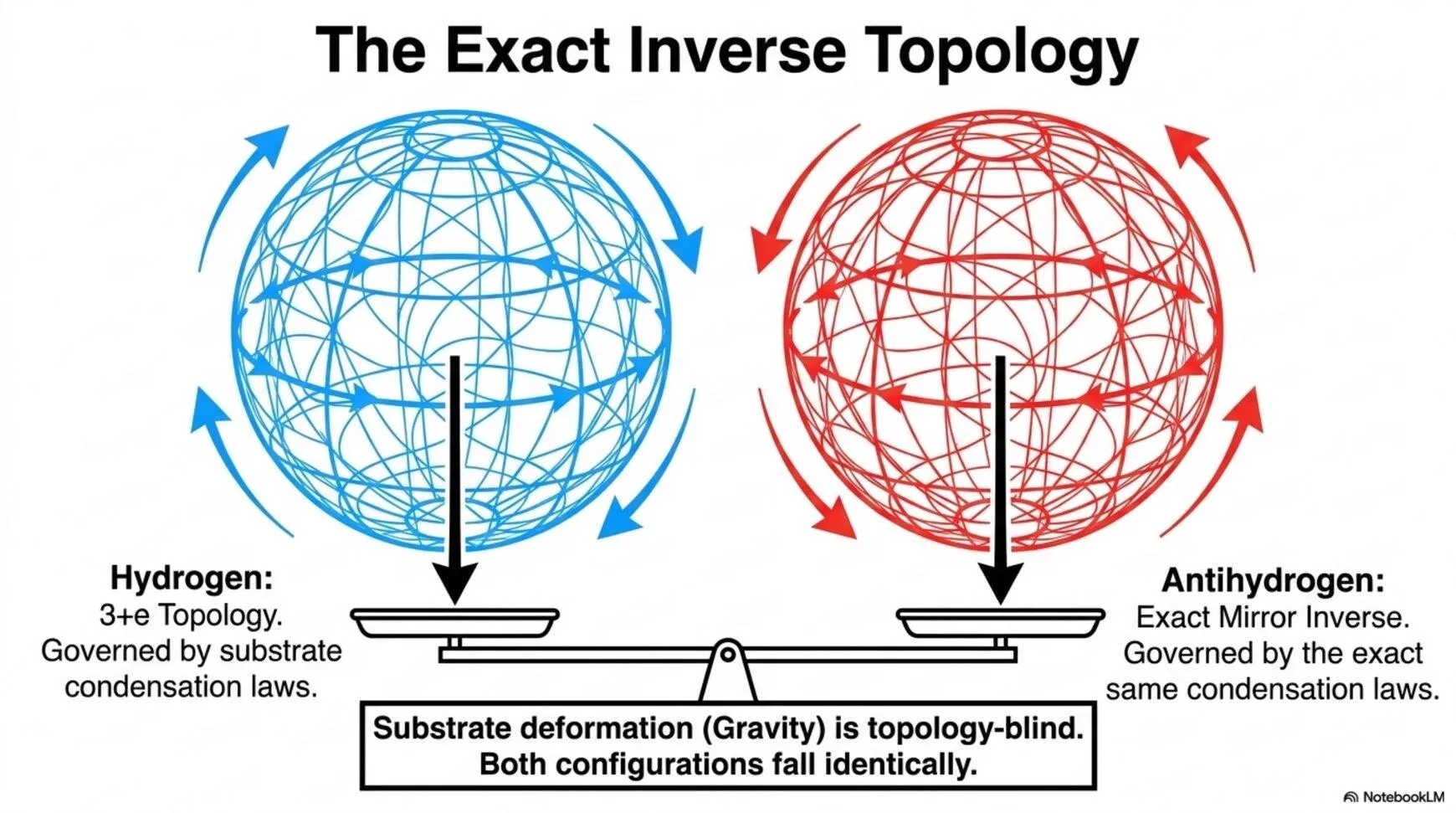
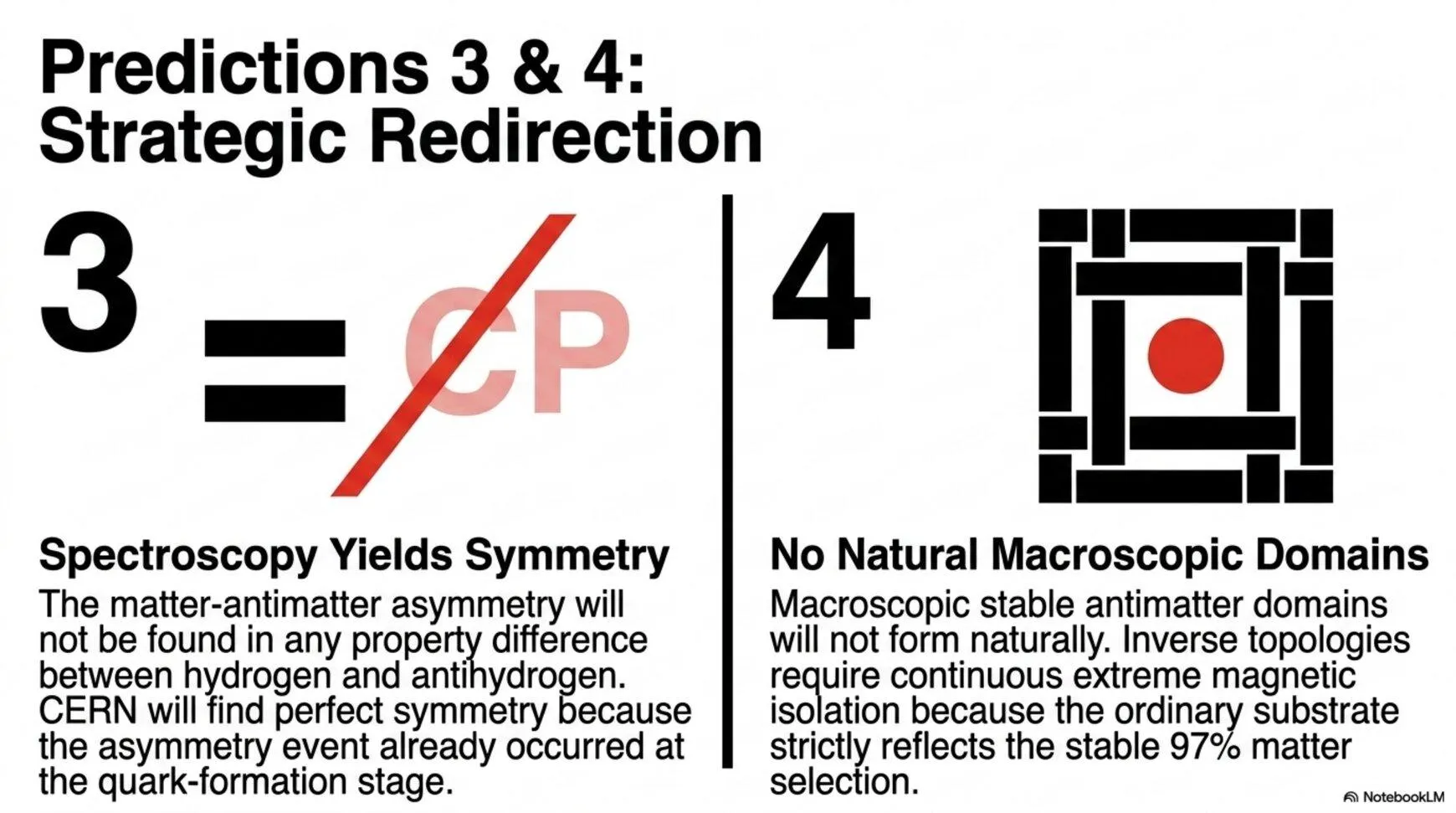
Prediction 3: The asymmetry will not be found in antihydrogen spectroscopy. The matter-antimatter asymmetry of the observable universe will not be found in any property difference between hydrogen and antihydrogen, regardless of the precision achieved. The asymmetry arises from the stability threshold of the Spaticle substrate at the quark-class excitation formation level. CERN will find perfect symmetry between hydrogen and antihydrogen in all properties they can measure.
Falsification condition: A confirmed property difference between hydrogen and antihydrogen, proven to arise from a fundamental asymmetry in the laws of physics instead of experimental artefact, would falsify this prediction.
Prediction 4: Macroscopic stable antimatter domains will not be produced. BFUT predicts that inverse topologies remain difficult to sustain macroscopically because the ordinary substrate environment reflects the stable-topology fraction selected by the stability filter. Any inverse topology excitation in a matter-rich environment will encounter matter and complete its cancellation. The difficulty of producing and storing antihydrogen is consistent with the natural substrate environment already reflecting the stable-topology selection.
Falsification condition: The production of macroscopic stable antimatter domains stable at ordinary conditions without continuous extreme isolation from matter would falsify this prediction.
9. What the CERN Programme Does and Does Not Test Within BFUT
The CERN antihydrogen programme is pursuing three goals. Within the BFUT framework, two of them are fully supported and one will not achieve its stated objective through the chosen experimental route.
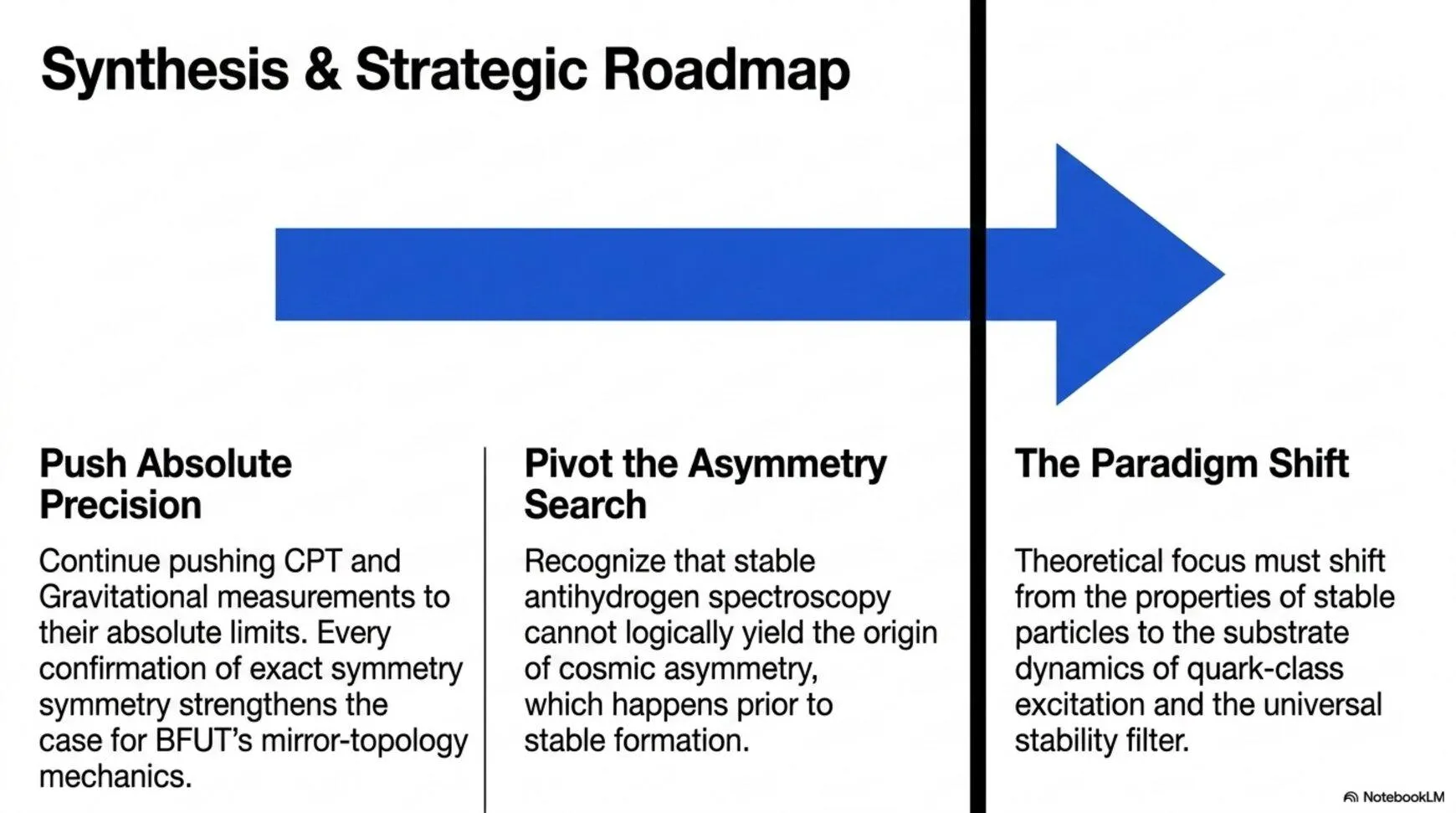
CPT testing: supported and important. Testing CPT symmetry between matter and antimatter is valid and important science. BFUT fully supports this programme and predicts it will confirm CPT symmetry at every precision level. The programme is worth pursuing because CPT violation would falsify BFUT as well as the standard model, and because increasingly precise confirmation strengthens the case for exact mirror-topology symmetry.
Equivalence principle testing: supported and important. Directly measuring the gravitational behaviour of antimatter is also valid and important science. BFUT fully supports this programme and predicts exact equivalence. The 2023 result showed antihydrogen falls downward, consistent with ordinary gravitational attraction at the 20% precision achieved; it did not establish equality with g at high precision. Higher precision measurements will directly test this BFUT prediction.
Asymmetry search: will not achieve its goal through this route. The third goal will not be achieved through spectroscopic comparison of hydrogen and antihydrogen. The asymmetry is not located in any property of stable antihydrogen atoms. It is located in the stability threshold of the Spaticle substrate at the quark-class excitation formation level. The CERN programme produces and measures stable antihydrogen, the successfully completed inverse-topology fraction. It has no access to the approximately 3% unstable fraction that dissolved at the moment of formation.
This is not a criticism of the CERN programme. The experimental work on CPT symmetry and the equivalence principle is of the highest scientific value. The point is that the third goal requires a different experimental approach: studying the substrate dynamics of quark-class excitation formation, which is a different and much harder experimental target.
The Standard Model describes the stability of ordinary matter and the instability of exotic configurations through multiple separate mechanisms: quantum chromodynamics, confinement, gauge symmetries, baryon number conservation, charge conservation, spontaneous symmetry breaking, and effective field treatments. The BFUT framework instead derives the observed stability hierarchy from a single substrate-level stability-selection process. This distinction matters for the asymmetry question: a framework with a unified stability account can identify where the asymmetry originates, while a framework with multiple separate mechanisms must introduce an additional asymmetry-generation mechanism on top. The CERN spectroscopy programme is looking for that additional mechanism in the properties of stable antihydrogen, where the BFUT framework predicts it will not be found.
The Higgs sector forms part of this broader layered structure. Within the Standard Model, electroweak symmetry breaking, particle mass generation, and high-energy scattering consistency require a separate scalar vacuum field introduced to preserve the mathematical consistency of the electroweak equations. BFUT instead derives the same electroweak structures directly from substrate condensation mechanics without invoking an additional universal mass-giving field. The antimatter asymmetry problem therefore appears differently in the two frameworks: the Standard Model requires additional asymmetry-generation mechanisms layered on top of multiple independent interaction structures, whereas BFUT derives both stability hierarchy and asymmetry directly from the same substrate-level stability-selection process.
10. The Physical Explanation of Annihilation Energy
Matter-antimatter annihilation releases energy at a rate approximately 100 times more efficient than nuclear fusion and far exceeding any other known energy release process. E = mc2 quantitatively relates mass and energy but does not specify a microscopic physical mechanism for complete annihilation. The BFUT account provides that mechanism.
The matter particle and the antiparticle are equal and opposite substrate deformations. When the two meet, the original excitation and its mirror image cancel identically. Nothing is left to carry mass because the cancellation is geometrically exact. Within the BFUT mechanism, the substrate returns to its equilibrium state and the energy that was stored in both deformations propagates outward as photons; this describes the BFUT annihilation mechanism specifically, not every experimentally observed annihilation final state.
For comparison: nuclear fission converts approximately 0.1% of mass to energy because only a small fraction of the nuclear binding energy is released and the remaining particles continue to exist. Nuclear fusion converts approximately 0.7% for the same reason. Annihilation is 100% efficient because it is the only process in which the substrate deformation and its exact mirror image cancel completely and simultaneously.
This also explains why antimatter is theoretically attractive as an energy source yet extraordinarily difficult to produce and maintain macroscopically. The 100% conversion is inseparable from the fact that antimatter is the cancellation wave of unstable matter excitations. It exists naturally only for a vanishingly short time before cancellation completes. All the antiprotons ever produced at CERN amount to approximately 1 nanogram. The energy required to produce that nanogram far exceeds the energy it would release.
11. Consistency with the Full BFUT Framework
The antimatter account in the present paper is a direct consequence of the stability analysis already established in P16 [1]. P16 [1] establishes the 3+1 condensation topology as the unique stable output of the substrate threshold analysis. P17 [8] derives the four fundamental forces from that topology, including the electromagnetic force from the internal circulation asymmetry that distinguishes the proton-class charge +1 from the electron-class charge -1. The exact mirror symmetry of the inverse topology that produces antiparticles is therefore a consequence of the same circulation analysis that produces charge in the first place.
P19 [10] derives the Standard Model coupling constants from the P16 [1] functional coefficients A, B, C, D. The partition energies 4+0 = 6.10, 2+2 = 4.00, 3+1 = 1.40 used in P16 [1] are the same coefficients used in P19 [10] to derive the electroweak mixing angle sin2(θ_W) = 0.2312. The stability filter that selects the 3+1 topology and the coupling constants that govern particle interactions are both consequences of the same free-energy functional.
Within the Standard Model, these same phenomena are distributed across multiple partially independent mechanisms including confinement, gauge symmetry, spontaneous symmetry breaking, and Higgs-sector interactions. BFUT instead derives them from a unified substrate-level condensation structure governed by the same stability-selection geometry. The Higgs resonance itself therefore appears not as proof of an independent universal scalar field, but as one emergent resonance state within the broader substrate hierarchy.
BFUT Paper 18 (P18 [11]) establishes a unified gravitational equation valid at all scales, from quantum to cosmological, in which finite-domain deformation persistence is fundamental. The domain radius is governed by the intrinsic substrate equilibrium density ρ_s through Rd = (3M / (8*π*ρ_s))^(1/3), with no cosmological model input. This finite-domain structure limits gravitational influence to physically meaningful scales and explains why GR works well within single domains. The same substrate density ρ_s that governs gravitational domain structure also governs the vacuum stability conditions within which quark-class excitations form. The stability filter and the gravitational domain equation are both expressions of the same substrate having a specific finite equilibrium density. The Spaticle field additionally generates the gravitational effects the dark matter programme correctly detected, through organised rotational deformation encoded in the DDR rotational term, validated across three independent physical regimes as described in Section 3 above. DOI: 10.5281/zenodo.20145506.
12. Conclusion
The CERN antihydrogen programme is pursuing three scientific goals. The BFUT framework supports two of them fully and predicts their outcome: CPT symmetry will be confirmed at every precision level, and antihydrogen will be found to fall under gravity identically to matter. The third goal will not achieve its objective through spectroscopic comparison of stable antihydrogen to hydrogen, because the asymmetry is not located in any property of stable antihydrogen.
The BFUT account provides a different physical account of the matter-antimatter asymmetry problem without requiring any new physics beyond the stability analysis of P16 [1]. The approximately 97% of quark-class excitation parameter space that achieves stable 3+1 topology persists as matter. The remaining approximately 3% that cannot stabilise generates its own cancellation wave and dissolves as radiation at the moment of formation. The observable universe becomes matter-dominated because only the stable excitation fraction persists macroscopically.
The four predictions stated in Section 8 are specific, quantitative, and falsifiable. They precede any further CERN data and will be confirmed or falsified by the ongoing experimental programme. The most important near-term test is the improvement of gravitational precision from 20% to 1%, which ALPHA-g is currently pursuing. The BFUT prediction is exact equivalence at every precision level.
The stability-filter prediction at the core of this paper is structurally consistent with the full particle physics experimental record, not only with the CERN antihydrogen results specifically. Across all experimentally explored accelerator energies, no confirmed stable matter configuration outside the ordinary proton-electron hierarchy has been established. The BFUT framework derives this observed hierarchy from a single substrate-level stability-selection principle. The four predictions stated in this paper are therefore grounded in a framework whose stability account is consistent with the broadest available experimental base.
The present antimatter predictions also sit within a larger quantitative BFUT programme already developed across multiple connected papers. The same substrate-level free-energy mechanics underlying the stability filter have already been used to derive the sequential emergence of the four fundamental forces, multiple Standard Model parameters including the fine structure constant and electroweak sector masses, substrate-level quantum mechanical foundations, the Higgs boson mass while additionally identifying the Spaticle field as the physical substrate from which the Higgs field emerges as its electroweak projection, and finite-domain gravitational dynamics validated against galaxy rotation curves and weak gravitational lensing without particulate dark-matter halos, with BFUT identifying the Spaticle field as the physical nature of dark matter. The CERN antihydrogen predictions presented here therefore represent one experimentally testable sector of a broader unified substrate framework extending across cosmology, particle physics, gravitation, and quantum mechanics.
13. References
[1] Sharma, V. S. (2026). The Origin of Matter, Antimatter, and Fundamental Forces: How Protons, Electrons, and Hydrogen Formed Fundamental Forces. BFUT P16. Zenodo. DOI: 10.5281/zenodo.19908215
[2] Sharma, V. S. (2026). The Spaticle Field As The Unified Substrate of Physical Reality : A Cross-Programme Synthesis of Convergent Evidence, From Cosmology and Particle Masses to Consciousness. BFUT P14. Zenodo. DOI: 10.5281/zenodo.19394064
[3] Sharma, V. S. (2026). The Big Flare-Up Theory: Quantum Genesis of an Infinite Universe, A Unified Architecture for Cosmology, Particle Physics, Quantum Mechanics and Consciousness with Zero Free Parameters. BFUT L1. Zenodo. DOI: 10.5281/zenodo.19149785
[4] Ulmer, S., et al. (BASE Collaboration). (2015). High-precision comparison of the antiproton-to-proton charge-to-mass ratio. Nature, 524, 196-199. DOI: 10.1038/nature14861
[5] Ahmadi, M., et al. (ALPHA Collaboration). (2017). Observation of the 1S-2S transition in antihydrogen. Nature, 541, 506-510. DOI: 10.1038/nature21040
[6] Amole, C., et al. (ALPHA Collaboration). (2012). Observation of the hyperfine spectrum of antihydrogen. Nature, 483, 439-443. DOI: 10.1038/nature10942
[7] ALPHA Collaboration. (2023). Observation of the effect of gravity on the motion of antimatter. Nature, 621, 711-716. DOI: 10.1038/s41586-023-06527-1
[8] Sharma, V. S. (2026). The Emergence of Forces and Fundamental Senses: How the Spaticle Field Gave Rise to Gravity and All Other Forces. BFUT P17. Zenodo. DOI: 10.5281/zenodo.19976408
[9] Sharma, V. S. (2026). Unifying Quantum Mechanics with Gravity, Demystifying Twenty Quantum Phenomena Including Half-Integer Spin, the Born Rule, Wave Function Collapse, and Higgs Physics. BFUT P19A. Zenodo. DOI: 10.5281/zenodo.20145695
[10] Sharma, V. S. (2026). Unification of Particle Physics: Deriving Fine Structure and Coupling Constants, W, Z, and Higgs Boson Masses, Redefining and Unifying Gravity and Time. BFUT P19. Zenodo. DOI: 10.5281/zenodo.20145567
[11] Sharma, V. S. (2026). Beyond General Relativity: A Unified Gravitation Equation Across Quantum, Classical, Galactic, and Rapid-Transition Regimes. BFUT P18. Zenodo. DOI: 10.5281/zenodo.20145506
[12] Sharma, V. S. (2026). Dark Matter: Connecting Galaxy Clusters, Galaxy Rotations, the Cosmological Constant, W and Z Boson Masses, and Atomic Structure Through One Physical Constant. BFUT P25. Zenodo. DOI: 10.5281/zenodo.20535295
[13] Canetti, L., Drewes, M., & Shaposhnikov, M. (2012). Matter and antimatter in the universe. New Journal of Physics, 14, 095012. DOI: 10.1088/1367-2630/14/9/095012
[14] Baker, C. J., et al. (ALPHA Collaboration). (2025). Precision spectroscopy of the hyperfine components of the 1S-2S transition in antihydrogen. Nature Physics. DOI: 10.1038/s41567-024-02712-9