What Existed Before Matter and the Spaticle Field: The Origin of Space, Time, and the Physical Substrate of Reality in an Infinite Universe
- Abstract
- 1. Introduction
- 2. The Standard Cosmological Framework and the Suppressed Foundational Questions
- 3. The Uncomfortable Questions the Standard Model Leaves Unanswered
- 4. Why Space Must Be Infinite: A Condensed Logical, Derivational, and Observational Case
- 5. If Space Is Infinite, It Never Began from Non-Space
- 6. If Space Exists, It Exists in Some Real Condition
- 7. Five Independent Supporting Arguments
- 9. Convergent Evidence That the Fabric of Reality Is a Real Substrate and That BFUT Identifies It as the Spaticle Field
- 10. Where Did the Spaticle Field Come From?
- 11. Clarifying What "Nothing" Means in BFUT
- 12. The Ontological Ladder of Manifestation in BFUT
- 13. Why This Matters Beyond Ontology
- 14. Relationship to the Existing BFUT Corpus: This Paper as a Foundational Integration and Closure Paper
- 15. Objections and Responses
- 16. Discussion
- 17. Vijay's Law and the Perpetuation Principle
Abstract
Modern cosmology describes the evolution of the universe with
remarkable mathematical precision, yet it leaves the physical origin of
spacetime itself unexplained. General relativity treats spacetime as a
real, curvature-supporting structure capable of transmitting
gravitational waves, but the standard cosmological narrative provides no
account of how such a fabric could emerge from literal non-being. Most
theories addressing “what came before the Big Bang” remain either purely
mathematical or fail to derive the first physical state from any prior
condition in a coherent, non-arbitrary way.
This paper offers a logically continuous ontological account. It
establishes that space cannot possess a terminal boundary and is
therefore genuinely infinite. Infinite space must exist in some real
condition, which necessarily constitutes an energy state. From this
prior energy state of infinite space, the first physical substrate - the
Spaticle field - manifests as the primordial matter-substrate underlying
the geometric description of general relativity. From this substrate,
stable matter, hydrogen, cosmic structures, and eventually biological
organisation and consciousness emerge through lawful processes over
unbounded timescales.
The paper thus replaces creation-from-nothing language with a
continuity-based ontology: a derivational chain from a prior real
condition to the emergence of the physical world, without violating
conservation laws or causality. This completes the foundational layer of
the Big Flare-Up Theory (BFUT) cosmological programme.
Keywords: spacetime, general relativity, quantum gravity, cosmology, infinite universe, Big Bang, cosmological ontology, substrate, Spaticle field, Big Flare-Up Theory, BFUT, conservation laws, causality, entropy, thermodynamic arrow of time
1. Introduction
Few questions in physics are more fundamental than this: what is the
physical origin of spacetime itself? General relativity describes
spacetime as a real, dynamical structure that curves under mass-energy,
supports propagating gravitational waves, and governs the large-scale
behaviour of the universe. Yet the standard cosmological model provides
no physical account of how such a fabric - something capable of
curvature, causal structure, and wave propagation - could arise from
literal non-being.
Most discussions of “what came before the Big Bang” remain either purely
mathematical or fail to derive the first physical reality from any prior
condition. They postulate exotic early states or quantum gravity regimes
without showing how those states necessarily lead to the emergence of a
physically real substrate. The result is that the origin of the thing
general relativity calls “spacetime” is still treated as an unexplained
starting assumption instead of a derived outcome.
This paper addresses that gap directly. It presents a logically
continuous ontological account in which space is necessarily infinite,
infinite space must exist in some real condition (an energy state), and
from that prior energy state the first physical substrate emerges.
Within the framework developed here, this substrate is identified as the
Spaticle field - the primordial matter-substrate whose large-scale
behaviour is described geometrically by general relativity.
The argument does not stop at the Spaticle field. It continues the
chain: from this first substrate, stable matter organises, hydrogen
forms, cosmic structures develop over immense timescales, and eventually
biological organisation and consciousness arise. The paper thus offers
not merely an alternative origin story, but a derivational sequence from
a prior real condition to the emergence of the physical world and the
conditions for life - without invoking creation from absolute
nothingness or violating conservation laws and causality.
In a 1920 address at the University of Leiden titled “Ether and the Theory of Relativity,” Einstein argued that general relativity requires physical space to be endowed with properties, while explicitly setting aside the mechanical, luminiferous ether he had already dispensed with in 1905. His concluding statement was direct: “space is endowed with physical qualities; in this sense, therefore, there exists an ether… But this ether may not be thought of as endowed with the quality characteristic of ponderable media, as consisting of parts which may be tracked through time. The idea of motion may not be applied to it” [23].
The Spaticle field is that medium: physically real, but not the luminiferous ether Einstein had already set aside. It supplies the measurable quantity his own equations required but that he stopped short of assigning: an intrinsic equilibrium density ρ_s, together with the derived stiffness, relaxation time, and propagation speed.
2. The Standard Cosmological Framework and the Suppressed Foundational Questions
2.1 What the standard model of cosmology actually explains
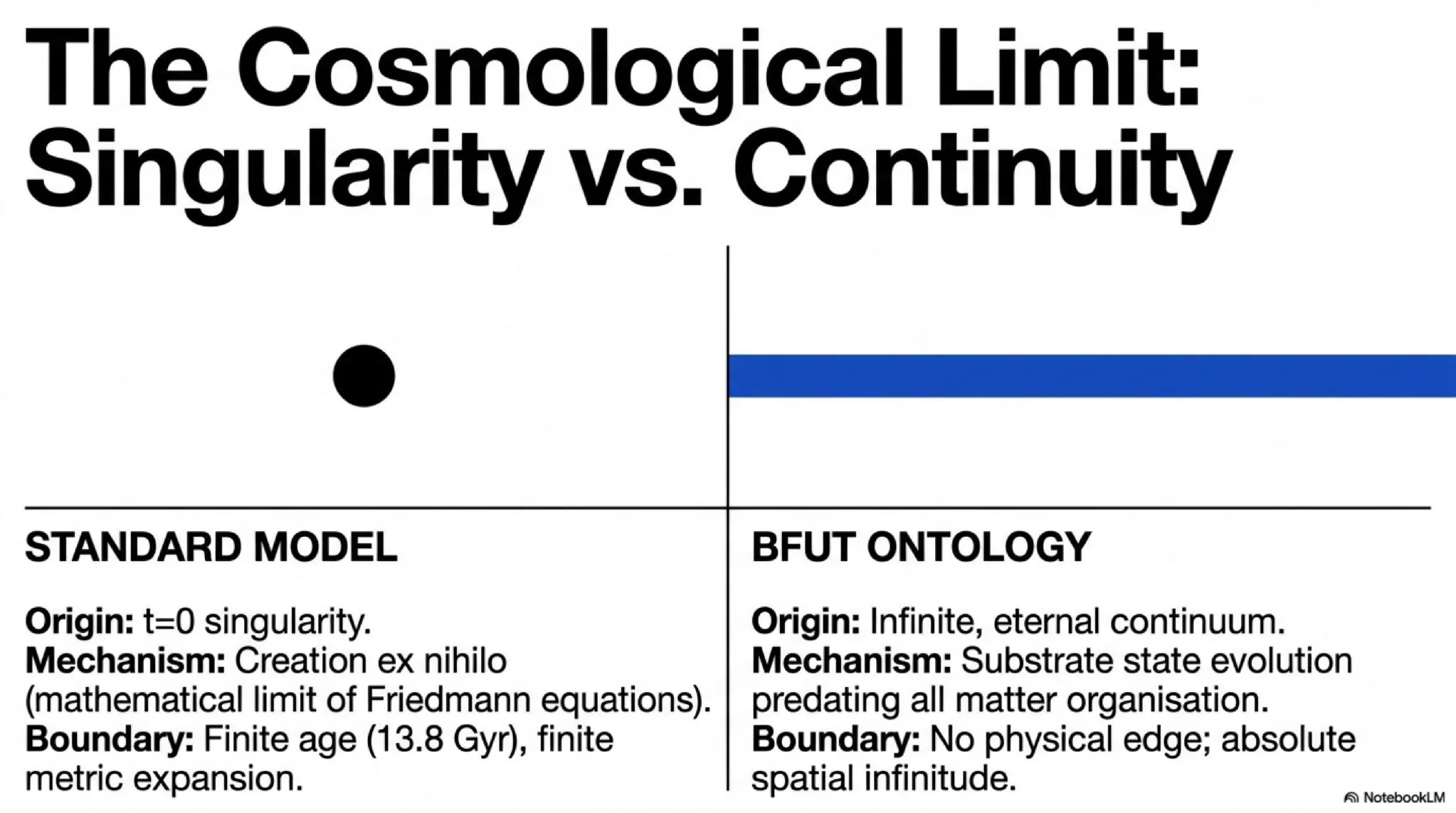
The standard cosmological model, in practice, is a hybrid framework: general relativity provides the large-scale dynamical background through Friedmann-Lemaitre-Robertson-Walker solutions, while particle physics and thermodynamics describe the thermal and interaction history of the early universe. This combined framework explains many derived phenomena with impressive internal consistency. It can parameterise the cosmic microwave background under the standard interpretation, estimate abundances of light elements, and model large-scale structure formation under the additional assumptions of dark matter, dark energy, and inflation.
But these successes must be carefully distinguished from the question this paper asks. The standard framework describes the evolution of a universe once a metric background is already assumed. It does not provide a physically grounded account of how the spacetime fabric itself came to exist in the first place.
2.2 The claim that space and time were "born" at the Big Bang
In standard popular and semi-technical presentations, one often hears that the Big Bang was not an explosion in space but an expansion of space itself, and that time also began there. However, these statements are typically asserted instead of physically explained. They leave untouched the deeper questions:
What is the ontological status of the "space" that expands? What exactly is being stretched? How does a metric-bearing manifold arise from non-being? How does time become embedded into that manifold? How does a fabric capable of curvature and wave propagation appear without prior substrate?
If the answer is merely "the equations say so," that is not a physical origin explanation. It is a mathematical description that begins after the crucial ontological leap has already been smuggled in.
2.3 Inflation does not solve the origin of the spacetime fabric
Inflation is often presented as solving several cosmological puzzles, such as flatness and horizon issues under the standard model. But inflation only pushes the question backward. If spacetime inflated, what exactly was the physical substrate that inflated? What endowed it with expansion-capable structure? Why did it already possess a metric? Why was time already meaningful within it? Inflation changes the dynamics of the early assumed background. It does not explain the origin of the background itself. Even within inflationary cosmology, the deeper origin problem is not removed, and standard inflationary spacetimes are themselves not past-complete under the Borde-Guth-Vilenkin result [20].
2.4 Quantum gravity acknowledges the problem without solving it
Quantum gravity programmes - whether in the form of loop quantum gravity, string theory, causal sets, spin networks, or other approaches - all carry an implicit admission: spacetime likely has deeper structure. This is already a major concession to the central claim of this paper. Yet these programmes, despite their mathematical richness, have not converged on a consensus physical ontology, nor have they delivered an experimentally confirmed account of what precedes or underlies the spacetime fabric. The search itself is revealing. Physics already suspects that spacetime is not fundamental in the naive geometric sense. But suspicion is not explanation.
2.5 Historical and Cultural Context: Why a Finite-Origin Cosmology Became the Default
The Big Bang model was first proposed in essentially its modern
form by Georges Lemaitre, a Belgian Catholic priest and physicist, in
1927. Lemaitre repeatedly stated that his scientific work was
independent of his religious beliefs and that science and faith should
not be conflated. Nevertheless, the model's reception was never
culturally neutral. A universe with a definite beginning aligned
naturally with longstanding creation narratives, especially in the
Christian intellectual environment of the early twentieth century. That
alignment did not prove the model false, but it did give the
finite-origin picture an immediate cultural advantage over an eternal or
truly infinite universe.
This matters because scientific communities do not evaluate theories in a vacuum. Theories that harmonise with dominant civilisational intuitions often encounter less resistance than theories that challenge them. In the period when modern cosmology was taking shape, a universe with a singular beginning sat in far less tension with prevailing theological assumptions than an eternal infinite universe. A finite-origin model therefore entered the discussion with a strong worldview tailwind before its later technical elaborations were formalised.
The historical record reflects this asymmetry. In 1927, Lemaitre derived the first expansion-rate estimate from the recession data available to him, obtaining values of approximately 625 and 575 km/s/Mpc in different treatments of the same sparse dataset. These implied Hubble times of roughly 1.56 billion years and 1.70 billion years, respectively. Later, Edwin Hubble's 1929 observational presentation, based on Mount Wilson access and institutional authority, popularised a closely related figure near 500 km/s/Mpc, implying a Hubble time of only about 1.96 billion years. Hubble's observational prestige mattered. He controlled the premier telescope infrastructure of the era, and his framing carried greater weight in the broader scientific community. Einstein, who had previously resisted dynamical cosmologies and had introduced the cosmological constant in 1917 to preserve a static universe, was ultimately persuaded by the expanding-universe interpretation after the Mount Wilson discussions and observations. Yet the expansion rate that entered cosmological orthodoxy at that stage was enormously inflated by later standards: a value near 500 km/s/Mpc implied a universe not merely younger than many stellar age estimates, but even younger than the Earth itself, whose age is approximately 4.5 billion years. Even at inception, therefore, the finite-age picture required the scientific community to tolerate severe chronological tension in order to preserve the broader narrative of a universe with a beginning.
That early pattern did not disappear. Over the ensuing decades, the expansion-rate estimate has repeatedly moved downward as measurements improved. What entered the literature as roughly 500 to 625 km/s/Mpc was later revised through successive observational corrections toward the modern range. Current late-universe determinations cluster near the low-70s km/s/Mpc, with recent high-precision analyses reporting about 73.67 km/s/Mpc, implying a Hubble time of about 13.27 billion years, while a lower recent independent determination of approximately 63 km/s/Mpc, based on galaxy group infall dynamics applied to the nearby M81 and Centaurus A groups, implies about 15.52 billion years. The important point here is not merely the modern tension between local and CMB-inferred values, but the long historical direction: the originally accepted expansion rate was drastically too high, and over more than ninety years it has repeatedly been corrected downward as the observational record became less compatible with the earliest finite-age interpretations.
Within the broader BFUT programme, even the interpretation of the Hubble relationship itself is revisited instead of simply treated as decisive evidence for metric expansion [2]. Under BFUT, the observed recession pattern is not treated as a single clean universal expansion law originating from a finite beginning. It is instead interpreted as the long-term statistical result of gravitational sorting acting over immense timescales in an infinite universe [2], with additional distortion from local and large-scale bulk-flow effects [5]. Over billions of years, matter distributions become progressively sorted through gravitational interactions, producing a broad tendency for many galaxies to appear to recede from a given observational location, even though this tendency is not globally uniform, not identical in all directions or regions, and not free of major exceptions. Galaxies such as Andromeda approach instead of recede, and hundreds of galaxies are directly observed in various stages of collision and merger. In BFUT, these are not awkward local anomalies to an otherwise perfect expansion law, but expected consequences of a universe governed by regional gravitational history instead of by a single universal expansion clock.
Because gravitational sorting is an emergent, region-dependent, scale-dependent, and history-dependent statistical process, different observational methods will naturally return different effective values when they probe different cosmic regimes. A value inferred from the CMB reflects one interpretive scale and one model-dependent reconstruction; a value inferred from Type Ia supernovae reflects another distance ladder and another regional sampling; and a value inferred from nearby galaxy-group infall dynamics probes yet another local dynamical regime. Under BFUT, these are not multiple noisy attempts to discover one true universal constant. They are different observational slices through a gravitationally sorted universe whose recession pattern is only approximately statistical, not fundamentally constant [2,3,5]. For that reason, BFUT predicts that there will never be permanent unanimity on the Hubble constant. Different techniques will continue to produce different values, and as instrumentation improves and local dynamical structure is resolved more accurately, there will be recurring pressure to revise at least some inferred values downward instead of a final stable convergence around one universally valid finite-origin number.
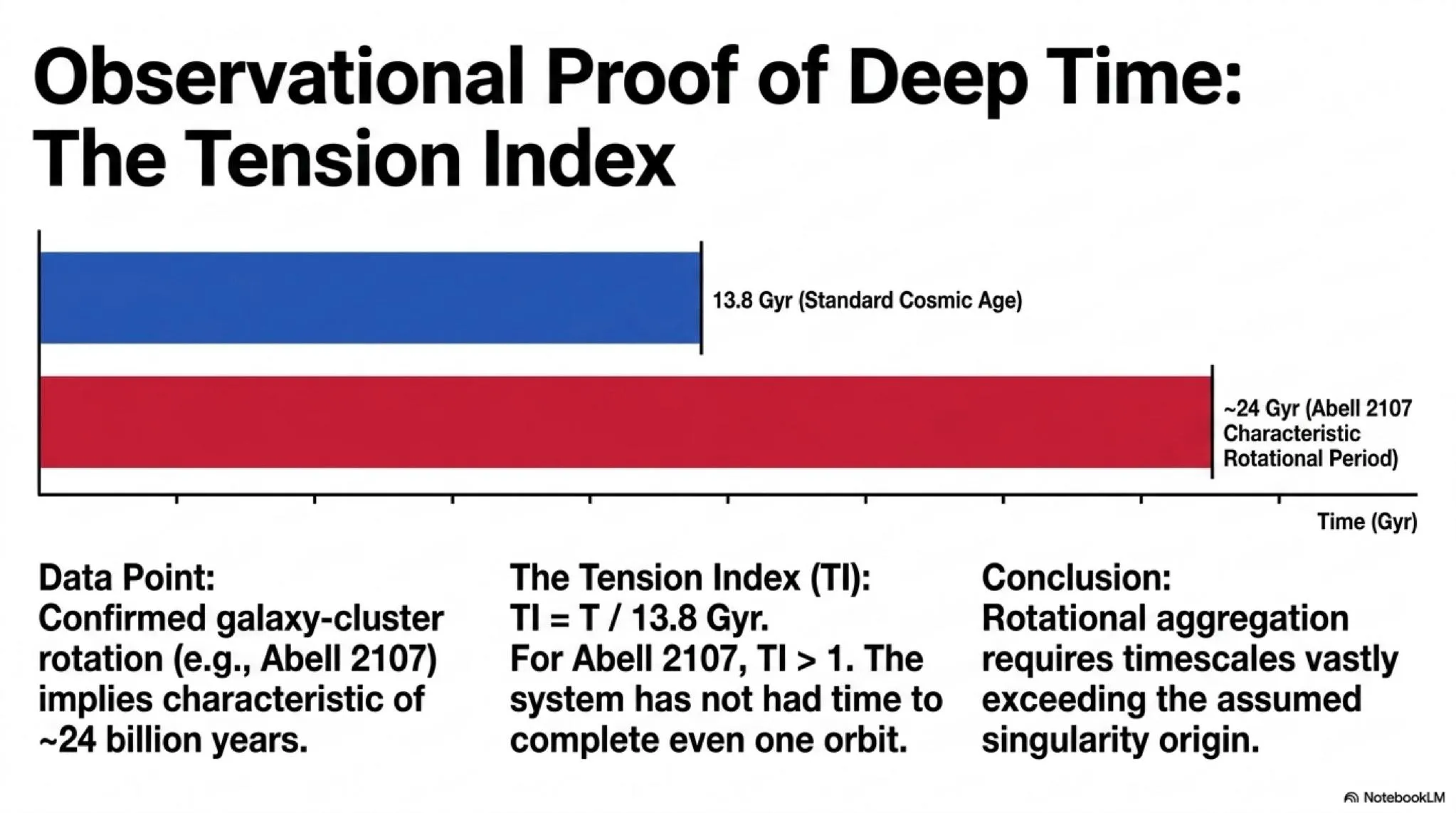
This history becomes even more significant when considered alongside the persistent appearance of mature, highly structured, and in some cases rapidly rotating systems at unexpectedly early inferred epochs. As observational astronomy has progressed, the standard framework has repeatedly encountered objects whose level of development appears uncomfortable for a young finite-age universe under its own parameter assumptions. In response, the dominant pattern has not been to reopen the singular-beginning premise itself, but to preserve it by revising parameters, adding auxiliary constructs, or expanding the number of unseen ingredients required to stabilise the model.
The issue, therefore, is not the personal faith of any one scientist. The issue is that a finite-origin cosmology entered the scientific mainstream already enjoying a powerful cultural advantage because it aligned more naturally with inherited beginning-of-creation intuitions than an eternal infinite universe. Once established, that framework was repeatedly protected even when the numerical scaffolding around it required substantial correction. The historical pattern indicates that the widespread commitment to a universe with a definite beginning was not shaped by evidence alone. It was aided by worldview compatibility, and that early advantage helped turn a contingent theoretical choice into the protected default of modern cosmology.
3. The Uncomfortable Questions the Standard Model Leaves Unanswered
3.1 If everything is expanding, what exactly is expanding?
The phrase "space is expanding" is common in modern cosmology. Yet one must ask: what is the physical referent of that statement? If galaxies recede because the metric scale factor changes, then what is the ontological status of the thing whose scale changes? If distances increase, what is the physically real structure whose relations are being altered?
If the answer is that spacetime is "just geometry," the problem becomes sharper, not weaker. A purely abstract geometry should not be treated as a physically real entity that stretches, carries energy-like effects, and transmits gravitational waves. If it is real enough to have such behaviour, then it deserves substrate-level analysis.
3.2 Why does spacetime wave if it is not a real medium?
Gravitational waves are often described as ripples in spacetime. This is a striking phrase. But what exactly is rippling? If spacetime is merely a coordinate geometry, then one must explain why a measurable propagating phenomenon is attributed to it. If, on the other hand, spacetime is a physically real structure, then the denial of substrate ontology becomes increasingly artificial.
This paper does not deny the mathematical correctness of gravitational wave predictions under general relativity. It instead argues that their very existence reinforces the need for a real substrate interpretation.
3.3 How did time become embedded into the fabric?
In general relativity, time is not an external absolute parameter. It is coupled to geometry. It dilates with gravity, changes with motion, and participates in the metric structure. This makes the origin question more severe. If one claims that spacetime came into existence at the Big Bang, then one must explain how time itself became bound into that structure. What is the mechanism by which time becomes part of a four-dimensional manifold? Standard cosmology typically does not address this physically. It presupposes the answer in the formalism.
3.4 Why is a finite-origin story treated as mandatory?
The question is not merely why finite-origin cosmology exists, but why it is so often treated as the non-negotiable baseline even when its numerical support and auxiliary structure have required repeated revision. As the historical record in Section 2.5 shows, the preference for a universe with a definite beginning did not become dominant in a conceptually neutral environment. It entered modern cosmology already aligned with familiar civilisational and religious intuitions about reality having a singular origin.
That historical inheritance has methodological consequences. Once a finite-origin framework becomes culturally and institutionally privileged, later anomalies are more likely to be treated as repair problems than as evidence that the starting assumption itself may be wrong. This is why increasingly elaborate auxiliary structures are repeatedly added to preserve the core picture instead of replace it. Inflation repairs early-universe tuning problems. Dark matter repairs structure formation and galactic dynamics. Dark energy repairs inferred late-time acceleration. Parameter revisions repair age estimates. Further interpretive adjustments are introduced when early galaxies appear too mature or when large-scale rotational phenomena appear difficult to reconcile with the allotted cosmic timescale.
This pattern should not be mistaken automatically for cumulative explanatory strength. It can also indicate institutional over-commitment to a historically privileged premise. In ordinary scientific reasoning, a sufficiently large accumulation of compensating hypotheses would normally force a re-examination of the foundational assumption. Yet in standard cosmology, the singular-beginning premise is often insulated from that level of scrutiny. The repeated willingness to preserve the beginning-model at almost any auxiliary cost suggests that more than data is at work. It suggests that the older intuition that the universe must, in some form, align with a creation-compatible narrative still exerts structural influence over what the scientific establishment is prepared to abandon and what it is determined to protect.
That is the central methodological issue. The finite-origin story is often treated as mandatory not because it has been shown to be logically necessary, but because it became historically privileged early, was institutionally consolidated, and is still being defended under that inherited momentum. BFUT rejects that inherited default and reopens the more basic question: whether a universe with a true beginning was ever the right starting assumption at all.
4. Why Space Must Be Infinite: A Condensed Logical, Derivational, and Observational Case
The present paper depends on a foundational claim: space is not merely very large, but genuinely infinite. This is not introduced here as a casual premise. It is the load-bearing condition that makes the rest of the argument possible. If space can coherently terminate, then a finite-origin cosmology remains conceptually available. If space cannot coherently terminate, then the finite-origin picture collapses at its base. The full independent treatment of this question has already been developed in BFUT Paper 5, The Universe Has No Boundary: Logical, Derivational, and Observational Arguments for Spatial Infinitude [6]. The present section provides only the condensed form necessary for the argument of this paper.
4.1 The impossibility of a final border
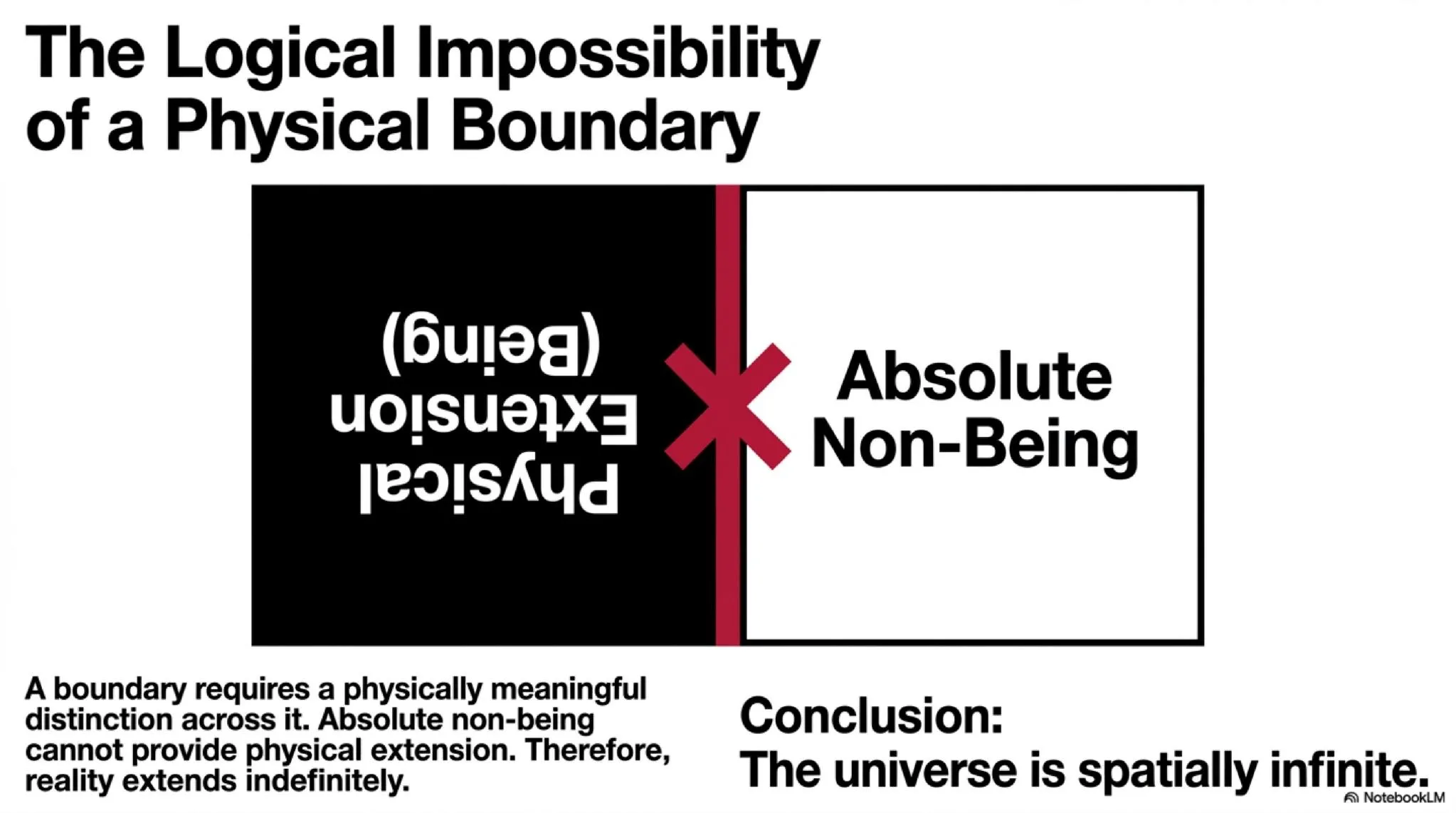
If space had a final edge, one must ask what lies beyond it. If something lies beyond it, then space has not ended. If absolutely nothing lies beyond it, then one must explain how non-being acts as a boundary condition on being. Pure absence cannot function as a wall. It cannot physically terminate extension. It has no properties, no agency, and no capacity to halt continuation. A terminal border of space is therefore conceptually unstable. Once extension exists at all, indefinite continuation is the natural logical consequence unless a physically real counter-condition is supplied. Standard cosmology does not supply such a condition.
4.2 Finite but unbounded models do not resolve the ontological problem
Some will attempt to avoid the edge problem by invoking a finite but unbounded universe. However, this often relocates instead of solves the issue. A finite but closed geometry may remove a literal edge in the mathematical representation, but it does not remove the ontological question of why reality terminates at that total extent. One must still ask what grounds that closure, why continuation is impossible, and in what sense the totality is physically finite. If closure is only mathematical, then the physical problem remains unresolved. If closure is physical, then one must explain what prevents further extension. Finite closure often functions as a formal convenience instead of a fully grounded ontological conclusion.
4.3 Non-existence cannot bound existence
A central logical principle follows directly from the above: non-existence has no agency. It cannot stop, terminate, or contain existence. If space exists, and if it is real, then pure absence cannot meaningfully impose a terminal limit on it. Existence cannot be bounded by non-being. This is not rhetorical flourish. It is a minimal requirement of coherent ontology. Once real extension exists, it must either continue or be stopped by some other real condition. No such real stopping condition has ever been identified. The finite-border picture therefore relies on a boundary that has no coherent ontological basis.
4.4 No observed boundary has ever been found
No observed terminal edge of space has ever been established. Standard cosmology often speaks of finitude, but this is generally an inference from model assumptions, metric constructions, or curvature interpretations, not an observation of a literal terminal border. That distinction matters. The absence of an observed edge does not by itself prove infinitude. But when direct observation supplies no boundary and logic supplies no coherent mechanism for one, the balance shifts strongly toward spatial infinitude. The finite universe remains a model-dependent construct, not an empirically demonstrated terminal condition.
4.5 The finite-origin framework repeatedly generates artificial rescue problems
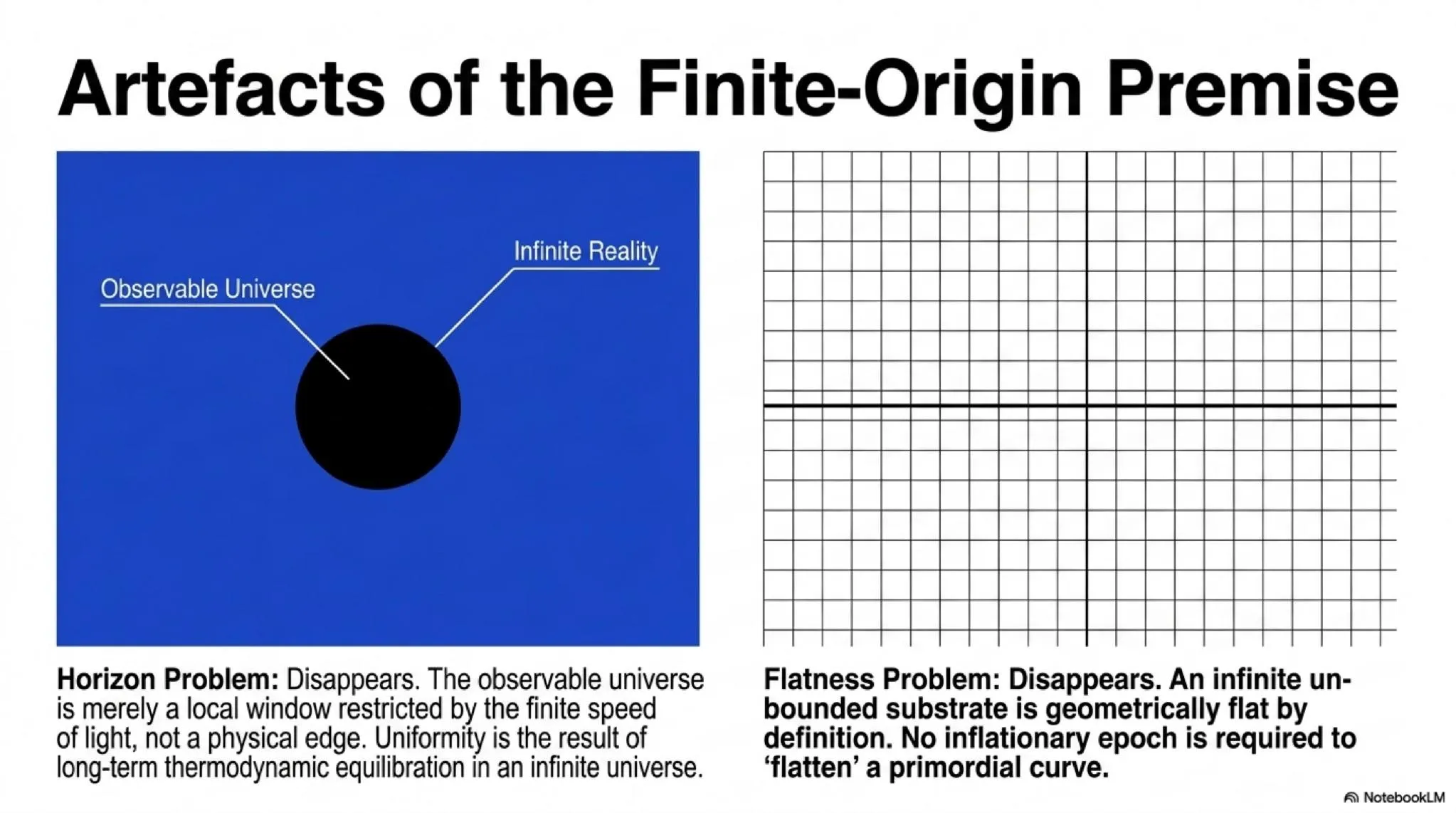
The case for infinitude is not only conceptual. It is also strengthened by the repeated pattern that finite-age, finite-origin cosmology generates secondary crises that then require additional corrective architecture. Once one begins with a universe that is assumed to have emerged in a hot dense finite-origin event, ordinary large-scale features begin to look mysteriously difficult. The horizon and flatness problems require inflation. Structure formation under the allotted timescale requires dark matter. Apparent late-time acceleration requires dark energy. Age tensions have historically required repeated downward revision of the Hubble expansion estimate. High-redshift systems that appear unexpectedly mature place further pressure on the available cosmic timeline. Large-scale coherent motions and rotational hierarchies also become more difficult to interpret within a young finite-age framework. The point is not that each issue alone proves infinitude. The point is that the finite-origin assumption repeatedly generates conditions that must be repaired by auxiliary constructs.
This pattern is highly significant. When a framework repeatedly requires unseen entities, tuning mechanisms, or parameter revisions to preserve its starting premise, that starting premise itself deserves renewed scrutiny. The present paper argues that many of these difficulties are not independent mysteries of nature, but downstream artefacts of the finite-origin assumption. Once the assumption is relaxed, many of the later anomalies lose their force.
This crisis-pattern is not merely abstract. Across the broader BFUT programme, multiple standard-model stress points that are usually treated as independent have already been revisited under the same continuity-based framework, including the Hubble relationship [2], the cosmological lithium problem [4], the Sunyaev-Zel'dovich effect [12], the Lyman-α forest and Gunn-Peterson opacity rise [13], the integrated Sachs-Wolfe effect [14], and weak lensing and the S8 tension [15]. The cumulative significance is not that any one reinterpretation alone settles the matter, but that the same finite-origin assumption repeatedly appears to sit beneath a widening range of downstream anomalies and compensating constructions.
4.6 Observational reality is more naturally compatible with continuity than with a terminal beginning
The observed universe does not present itself as a bounded, terminally framed, newly initiated totality. No spatial edge is observed. No terminating wall is observed. No physically established outer condition beyond which extension ceases is observed. Instead, observation shows vast continuation, large-scale structure, coherent motions across scales, ambient background conditions, and multiple phenomena that standard cosmology must repeatedly reinterpret within a finite-age narrative. The inference of a finite universe is therefore not forced by direct observation. It is imposed by the finite-origin framework and then preserved through subsequent interpretive repair.
4.7 BFUT's fuller proof of spatial infinitude
The full BFUT treatment of spatial infinitude is developed independently in BFUT Paper 5 [6], where the case is made across three mutually reinforcing categories: conceptual, logical, and derivational-observational. The present paper relies on that prior work but also requires the condensed argument above because the entire logic of this paper depends on it. Space is not merely very large. It is not provisionally open-ended. It is not possibly infinite. The BFUT position is stronger: space cannot coherently possess a final border, no terminal boundary has ever been observed, and the repeated crisis-pattern of finite-origin cosmology strongly indicates that finitude is the wrong starting assumption. Space is therefore best understood not as finite but as genuinely infinite.
5. If Space Is Infinite, It Never Began from Non-Space
If space is necessarily infinite, then it is not the kind of thing that can be created into extension from prior non-extension in the ordinary finite-origin sense. A finite object can be conceived as appearing in a larger context. But infinite space cannot coherently be said to "appear into" something else without contradiction. If it appeared into something, that something would already be a more fundamental containing reality. The claim that all space began from no-space therefore becomes unstable.
The deeper point is straightforward: if space is necessary and infinite, then there was never a state of absolute non-spatial nothingness. This immediately removes the most severe form of creation-from-nothing language. There may have been no manifested matter. There may have been no stars, atoms, or familiar structures. But there was not literal non-being.
6. If Space Exists, It Exists in Some Real Condition
6.1 Existence cannot be conditionless in any meaningful sense
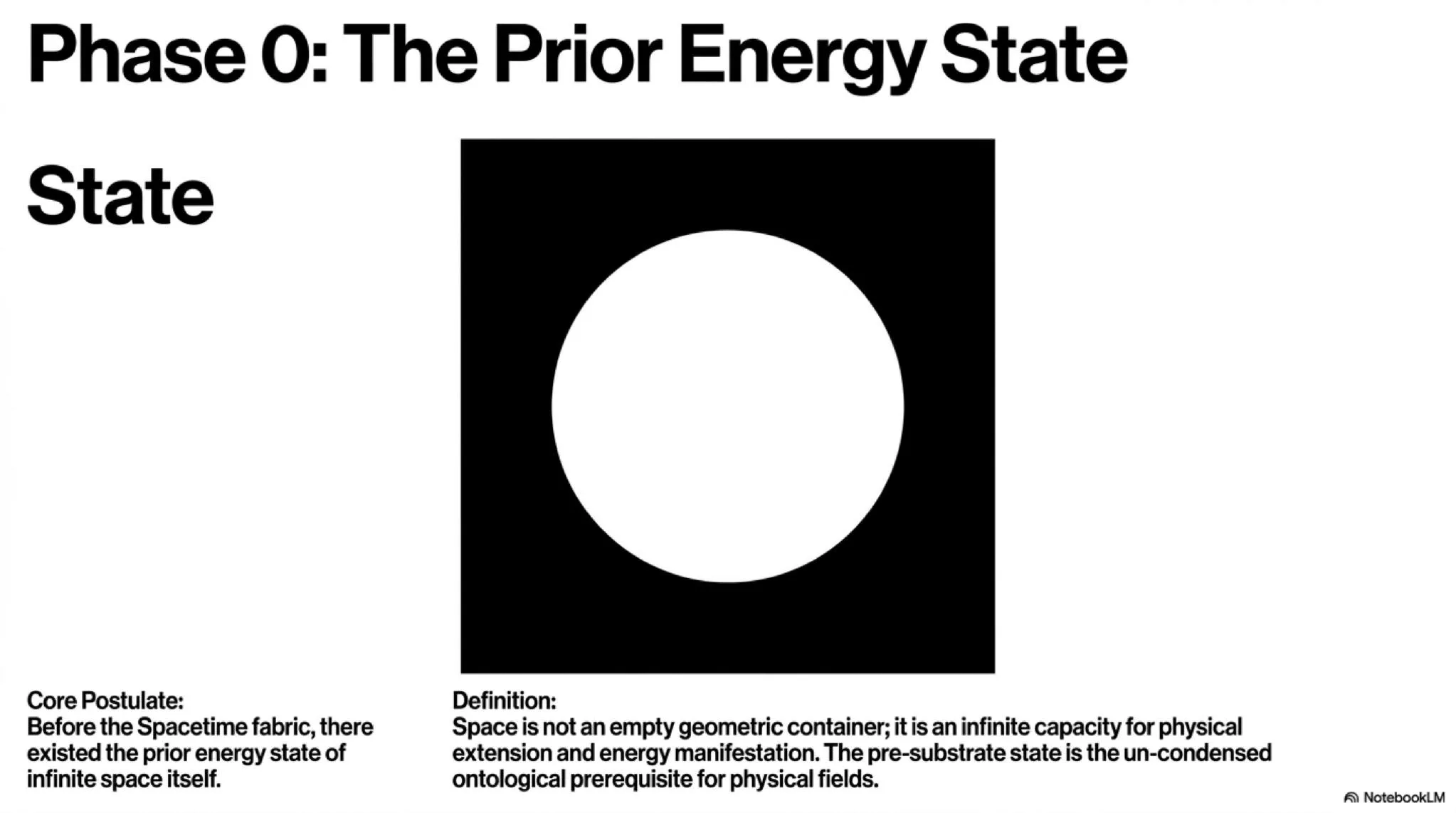
A real existent cannot exist as a pure label. If space exists, it exists in some condition. It may be uniform or non-uniform, low-energy or high-energy, quiescent or dynamic, but it cannot be pure metaphysical blankness while still being real.
6.2 Any real condition is an energy state
Once one accepts that space exists in some condition, the next step follows naturally: any real condition of existence is an energy state. This is not an arbitrary definitional move. It is a logical necessity. Consider the alternative: a real existent with a true energy of absolute zero in every sense would be physically indistinguishable from non-existence. The energy state of the prior infinite space need not be warm, active, or similar to any presently familiar baseline. It may have been far lower than current absolute zero as we define it - utterly quiescent, unrecognisable by any present instrument, and perhaps not characterisable by any thermodynamic framework yet developed. What matters is only the minimum claim: existence implies a state, and a state implies energy, however vanishingly small. That minimum is already not nothing.
The exact numerical value is not essential to the present argument. What matters is that a real state existed. A real state is already physical content. It is not nothing.
6.3 The exact prior value need not be specified
A common but misplaced objection is that unless one specifies the exact pre-manifestation state, the argument is incomplete. This is false. Foundational ontology does not require premature precision where the minimum continuity principle is sufficient. The present paper requires only the following: infinite space existed; it therefore existed in some real condition; that condition was an energy state. From there, lawful manifestation becomes conceptually possible. The exact characterisation of that state can be developed further in later work.
7. Five Independent Supporting Arguments
The logical chain of Sections 4 through 6 establishes the core thesis on its own. The following five arguments are independent lines of support, each of which points to the same conclusion from a different direction: that creation from absolute nothingness is not merely philosophically unattractive but physically, logically, and mathematically incoherent.
7.1 The Conservation Laws Argument
Every conservation law in physics - conservation of energy, momentum, angular momentum, charge, baryon number, lepton number - states that the relevant quantity cannot be created from nothing or destroyed into nothing. These are not theoretical preferences. They are the most robustly confirmed empirical generalisations in the history of science, tested across every scale from subatomic interactions to stellar dynamics, and never once violated in any confirmed observation.
Creation-from-nothing cosmology requires that all conservation laws were simultaneously violated at the Big Bang. Energy appeared from zero. Momentum appeared from zero. Baryon number appeared from zero. Every conserved quantity in the universe was created at once from nothing. This is not a small assumption hidden in the mathematics. It is a wholesale violation of the most reliable class of physical laws ever established.
BFUT requires none of these violations. The Spaticle field manifests from a prior energy state of infinite space - that is transformation, not creation. The total account of physical reality does not gain new conserved quantities from nothing. It undergoes a change of form from prior state to manifested substrate. Conservation is preserved throughout. The ontological picture BFUT offers is therefore consistent with the deepest empirical pattern in physics, whereas the finite-origin picture is not.
7.2 The Metric Cannot Self-Bootstrap Argument
A metric is a rule for measuring distances and time intervals within a space. It tells you how far apart two points are, how angles are defined, how geodesics run. For a metric to exist, there must already be something whose distances and relations are being measured. A metric does not create the space it measures. It is definitionally dependent on a prior extension.
This generates a fatal problem for creation-from-nothing cosmology. If the spacetime metric - the mathematical fabric of general relativity - arose from nothing, it would have to create its own underlying extension in the act of coming into existence. But a rule for measuring distances cannot produce the distances it measures. A coordinate system cannot generate the space it coordinates. The metric presupposes extension. Extension is space. Space, as established in Section 4, is necessarily infinite and has no coherent beginning.
The creation-from-nothing picture therefore requires the metric to perform an act that is logically self-refuting: to bootstrap its own substrate into existence. BFUT avoids this entirely. The metric of general relativity describes the behaviour of the Spaticle field, which is the already-existent manifested substrate. The metric does not create the substrate. It describes what the substrate does.
7.3 The Causal Structure Argument
Causality is foundational to physics. Every physical event has a prior condition that causally produces or contributes to it. This is not merely a philosophical preference. The entire structure of predictive science depends on causal continuity. We can make predictions because prior conditions lawfully determine subsequent states.
If the Big Bang was the absolute beginning of time, then the Big Bang itself had no cause. There was no prior condition, no prior state, no prior anything from which the Big Bang followed. A causeless event is not physics. It is an admission that the explanatory framework has broken down entirely at the first and most important step. Some physicists attempt to sidestep this by saying that asking for the cause of the Big Bang is like asking what is south of the South Pole - a meaningless question because time did not exist before it. But this answer does not resolve the problem. It reframes it as unanswerable, which is precisely the problem. Physics does not accept "unanswerable" as a satisfactory foundation.
BFUT restores causal continuity. The Spaticle field manifestation has a prior condition as its cause: the prior energy state of infinite space. The Spaticle field does not appear from nowhere. It manifests from something real. Every subsequent event in the BFUT cosmological history has a prior causal condition. No causal violation is required at any step. The framework is causally complete in a way the finite-origin picture is not.
7.4 The Thermodynamic Arrow of Time and the Entropy Argument
The thermodynamic arrow of time - the observed asymmetry between past and future - is one of the deepest puzzles in fundamental physics. The laws of physics at the microscopic level are time-symmetric: they work equally well run forward or backward. Yet the universe has a clear macroscopic direction from lower entropy to higher entropy. The question is why.
Under standard finite-origin cosmology, the answer requires the initial state of the universe to have been extraordinarily low in entropy - a state of exceptional order from which the subsequent increase in disorder follows. The cosmologist Roger Penrose calculated the probability of the universe having its observed initial low-entropy state by random chance at approximately 1 in 10 to the power of 10 to the power of 123 [19]. For comparison: the total number of atoms in the observable universe is estimated at around 10 to the power of 80. The denominator of Penrose’s probability dwarfs even that figure by an incomprehensible margin. It is a number so vast that no physical analogy can convey it. No mechanism within a finite-origin framework accounts for it. The initial state is simply assumed, and the improbability is left permanently unaddressed.
BFUT does not require this assumption. In an infinite universe with a pre-existing energy state, the arrow of time is a local phenomenon arising within Spaticle field dynamics. There is no single global initial state that must be fine-tuned to extraordinary improbability. The arrow of time emerges from the structure of manifestation and ongoing dynamics in an eternal infinite substrate. The Penrose problem - one of the most devastating unresolved challenges to finite-origin cosmology - simply does not arise.
7.5 The Information and Laws-of-Physics Argument
The laws of physics are information. They specify which transitions are possible, which quantities are conserved, how fields interact, what symmetries hold. Information is not nothing. A universe operating under specific, precise, mathematically elegant laws is a universe that contains a particular kind of information structure. Where did this information come from?
Under creation-from-nothing cosmology, the laws of physics must also have arisen from nothing. Not only did matter and energy appear from absolute non-being, but the rules governing their behaviour also appeared from absolute non-being. This is a double creation-from-nothing problem that is rarely stated explicitly but is unavoidable. Absolute nothingness has no laws, no regularities, no mathematical structure. If something arose from true nothingness, there is no reason it should follow any laws at all - let alone the specific, precise, beautifully structured laws we observe.
BFUT avoids this problem through continuity. If infinite space existed in a prior real condition, that condition already had some real structure, however minimal. The observed laws of physics are not arbitrary impositions on reality from outside. They are expressions of the deep structure of infinite space and its manifested substrate, the Spaticle field. Continuity of existence implies continuity of structure. The laws are not created. They are inherited and progressively revealed as the manifested substrate develops.
8. The BFUT Reframing: The Physical Substrate Underlying Spacetime Is the Spaticle Field
At this point the same question posed to standard cosmology must be posed to BFUT itself: if spacetime is real, where did its fabric come from?
BFUT's answer is direct. What general relativity treats as an abstract geometric background does not exist as a physically real entity in its own right. The physically real substrate underlying what general relativity describes geometrically is the Spaticle field. This field is not an optional add-on to geometry. It is the physical reality that the geometric description approximates.
This is an important clarification. BFUT does not reject the descriptive success of general relativity at the level of large-scale geometric behaviour. It instead claims that the geometry is a description of the behaviour of an underlying substrate. General relativity describes what the substrate does. BFUT identifies what the substrate is.
9. Convergent Evidence That the Fabric of Reality Is a Real Substrate and That BFUT Identifies It as the Spaticle Field
The argument of this paper requires not only that space be infinite, but that the physically real fabric described geometrically in general relativity be understood as a genuine substrate instead of as a purely abstract mathematical convenience. The Spaticle field is not introduced here as an ad hoc speculative add-on. Its detailed case has already been developed in BFUT Paper 14, The Spaticle Field as the Logical Cosmological Substrate: Convergent Evidence from General Relativity, Modern Field Physics, and the Expanded BFUT Research Programme [16]. The present section provides the condensed form necessary for this paper. The key point is that multiple independent lines of reasoning converge on the same conclusion: the fabric of reality behaves like a real substrate, and BFUT identifies that substrate as the Spaticle field.
9.1 General relativity already points toward a physically real structure
Einstein's field equations [18] do not merely track positions or provide a coordinate bookkeeping device. They describe a reality in which the metric structure itself changes under mass-energy conditions. That structure governs trajectories, time rates, gravitational behaviour, and the propagation of causal relations. A framework in which the fabric can curve, stretch, and dynamically respond to matter is already more naturally read as a description of a physically real substrate than as a purely abstract geometric formalism. General relativity is mathematically successful, but its success does not remove the ontological question of what exactly is behaving in this way. BFUT answers that question directly: the geometry is the large-scale description of the Spaticle field.
9.2 Gravitational waves reinforce the substrate interpretation
If spacetime can support propagating waves, then the language of fabric is not merely metaphorical. A propagating measurable disturbance implies that something physically real is changing and transmitting. The first direct detection of gravitational waves by LIGO in 2016 [17] confirmed that the background structure of reality supports propagating disturbances in a way that is naturally interpreted as substrate-like behaviour. This does not by itself prove the Spaticle field. But it strongly undermines the view that spacetime is only an abstract coordinate framework. A wave-supporting, dynamically responding fabric is far more naturally interpreted as a real medium than as a purely formal mathematical relation.
9.3 The cosmological constant becomes physically intelligible under a substrate ontology
One of the strongest BFUT lines of support for a real substrate comes from the reinterpretation of the cosmological constant. In BFUT Paper 2 [3], the cosmological constant is not treated as a mysterious late-time repulsive term or a dark-energy placeholder. It is treated as the measurable imprint of the underlying matter-substrate itself, with the substrate's own intrinsic equilibrium density, approximately 5.9 x 10⁻²⁷ kg/m3, established independently of Λ and numerically consistent with it. This is an exceptionally important programme-level point. The substrate is not merely philosophically asserted. It is tied to a measurable quantity already present in the field equations. Under BFUT, Λ is not an arbitrary patch on a finite-origin model. It is the measurable imprint of the cosmological substrate, not the substrate's source.
9.4 Quantum gravity is an implicit admission that deeper structure is expected
Quantum gravity programmes repeatedly attempt to uncover a deeper layer beneath classical spacetime. Whether in loop quantum gravity, string theory, causal sets, spin networks, or other approaches, the shared admission is already significant: spacetime is unlikely to be fundamental in the naive geometric sense. Physics itself has long suspected that the geometric manifold of general relativity is not the final ontological layer. These programmes differ sharply in formalism and have not converged on a single experimentally confirmed ontology, but the search itself is revealing. BFUT aligns with the core intuition while rejecting the continued ambiguity. The Spaticle field is offered as the concrete ontological referent that those searches implicitly assume must exist.
9.5 Field ontology is already standard in modern physics
Modern physics is fully comfortable with pervasive fields underlying observable phenomena. The electromagnetic field, the Higgs field, and quantum fields more broadly are all examples of entities whose physical reality is accepted even when they are not directly visible in ordinary intuition. This does not prove the Spaticle field. But it removes any suggestion that a pervasive substrate-field ontology is alien to modern science. On the contrary, field ontology is already one of the most natural ways contemporary physics understands the world. BFUT extends that logic to the cosmological substrate itself. The gravitational vortex interpretation of black holes as an alternative to central singularities, developed in BFUT Paper 6 [7], provides one example of how that substrate-field logic extends into compact-object physics within the broader BFUT programme.
9.6 Vacuum physics already concedes that empty space is not literal nothing
Contemporary physics already treats the vacuum as physically nontrivial in multiple contexts. Zero-point structure, vacuum energy discussions, quantum fluctuations, and other phenomena all undermine the naive equation of empty space with literal non-being. Again, this does not by itself prove the Spaticle field. But it does remove one of the most common conceptual obstacles. If the vacuum is already physically structured and not true nothingness, then the idea that the background of reality has substantive physical character is not radical. BFUT simply makes that ontological step explicit and identifies the relevant background not as an undefined near-nothing, but as a real matter-substrate.
9.7 The broader BFUT cosmological programme becomes more coherent under a substrate than under abstract metric expansion alone
The strongest cumulative support comes not from any single argument, but from programme-wide coherence. Across the broader BFUT corpus, multiple cosmological reinterpretations become more unified and intelligible once a real substrate is accepted. BFUT Paper 2 [3] reinterprets the cosmological constant as substrate density. BFUT Paper 4 [5] reinterprets apparent acceleration through observer bulk-flow dynamics instead of requiring dark energy. BFUT Papers 7 and 7A [8,9] reinterpret the CMB and BAO as present ambient conditions and structural effects instead of relics of a finite-origin fireball. BFUT Paper 8 [10] develops the pre-luminous dark era before the Big Flare-Up. BFUT Paper 9 [11] argues that large-scale cosmic rotations are natural in an infinite substrate-based universe and become problematic only under finite-origin assumptions. BFUT Paper 10 [12] addresses the Sunyaev-Zel'dovich effect, and BFUT Paper 11 [13] addresses the Lyman-α forest, both within the same broader continuity framework. When viewed together, these are not isolated reinterpretations. They form a convergent research programme in which a real cosmological substrate repeatedly simplifies what standard cosmology must repeatedly patch.
9.8 The Spaticle field is therefore not a speculative extra layer, but the best unifying ontological referent within BFUT
The significance of BFUT Paper 14 [16] is that it collects these independent strands and shows that the Spaticle field is not being introduced as an arbitrary hidden medium. It is the convergent ontological conclusion of the BFUT cosmological programme. General relativity describes a fabric that behaves as though it is real. Gravitational waves behave as though something physically real is being disturbed. The Spaticle field has an intrinsic equilibrium density, independently constrained across seven physical sectors developed later in the programme, and the cosmological constant is numerically consistent with that density instead of the reverse. Quantum gravity repeatedly searches for deeper structure. Field ontology already dominates modern physics. Vacuum language already concedes that empty is not empty. Multiple BFUT reinterpretations across cosmological observations become more coherent when a substrate is assumed. Taken together, these do not merely permit a substrate reading. They strongly favour one.
For the purposes of the present paper, that is the key point. Once a real physical substrate, instead of an abstract geometric fabric, is accepted as underlying what general relativity describes, the remaining question is no longer whether there is a real substrate, but what that substrate is and what existed before it. BFUT's answer is direct: the physical substrate is the Spaticle field, and the Spaticle field is the first matter-substrate manifestation from the prior energy state of infinite space.
10. Where Did the Spaticle Field Come From?
This is the central question this paper resolves.
The Spaticle field did not arise from nothing. There was no prior ordinary matter, no prior atoms, no prior stars, and no previously manifested matter structures. But there was already infinite space, and because infinite space existed, it existed in some real condition. That condition was an energy state - possibly far below any currently defined baseline, perhaps utterly quiescent by any present standard, but real.
From that prior energy state of infinite space itself, the Spaticle field emerged as the first matter-substrate manifestation.
This answer is both minimal and powerful. It does not require creation from nothing. It does not require a singular beginning of reality. It does not require a prior external agent. It does not require that the exact prior state be numerically specified in advance. It requires only continuity of existence and continuity of state.
As the Spaticle field manifests, the prior energy state correspondingly changes. This is not a contradiction. It is exactly what manifestation means: a prior real condition gives rise to a new structured form. The new form is not ex nihilo creation. It is transformation.
10.1 The Two-Step Manifestation Chain and Its Observational Grounding
The question of how the Spaticle field came to exist is answered by the ontological argument of Sections 4 through 6: it emerged as the first matter-substrate manifestation from the prior energy state of infinite space. But a second and distinct question immediately follows: how did hydrogen - the first and simplest atom, and in an infinite universe without a Big Bang the only primordial matter - arise from the Spaticle field? The answer follows the same continuity logic. Hydrogen cannot come from nothing. The matter chain has continuity requirements just as the space-substrate chain does. In an infinite eternal universe with no explosive nucleosynthesis event, hydrogen must have manifested from the Spaticle field through quantum fluctuations within that substrate. The two-step chain is therefore: (1) prior energy state of infinite space gives rise to the Spaticle field; (2) the Spaticle field gives rise to hydrogen through quantum fluctuations in that substrate. Each transition is governed by continuity. Neither step is creation from nothing.
This is not merely a theoretical assertion. Observational evidence already points in this direction. Gas clouds of varying densities have been observed and photographed across the universe at every stage - from the most diffuse to the densest, from stable clouds to actively collapsing ones to clouds already igniting into stars. In BFUT, these are not separate unrelated phenomena or simple relic leftovers from a single primordial event. They are the same process photographed at different points in its progression: matter accumulating from quantum fluctuations in the Spaticle field, growing denser under gravity, and eventually reaching fusion threshold. The full sequence is visible in existing astronomical data. If matter is continuously accumulating from the Spaticle field, the density of any given location in space should be increasing over time. Gas clouds at different locations showing different densities are snapshots of the same accumulation process at different stages [1].
This broader continuity-based reading is also consistent with BFUT's wider reinterpretation strategy across multiple observational domains usually folded into finite-origin cosmology, including the Sunyaev-Zel'dovich effect [12], the Lyman-α forest [13], the integrated Sachs-Wolfe effect [14], and weak-lensing-related tension analyses [15].
The Voyager observations provide a striking in-situ confirmation of this picture. In October 2020, both Voyager 1 and Voyager 2 independently detected an unexpected and significant increase in plasma density in the interstellar medium beyond the Solar System - a region where scientists expected density to decrease. The finding was described as surprising and not fully explained by existing models (Ocker et al., 2021 [22]). Under BFUT, this is not surprising. It is the expected signature of matter continuously accumulating from quantum fluctuations in the Spaticle field, observed in situ by two independent probes at different locations beyond the Solar System [1].
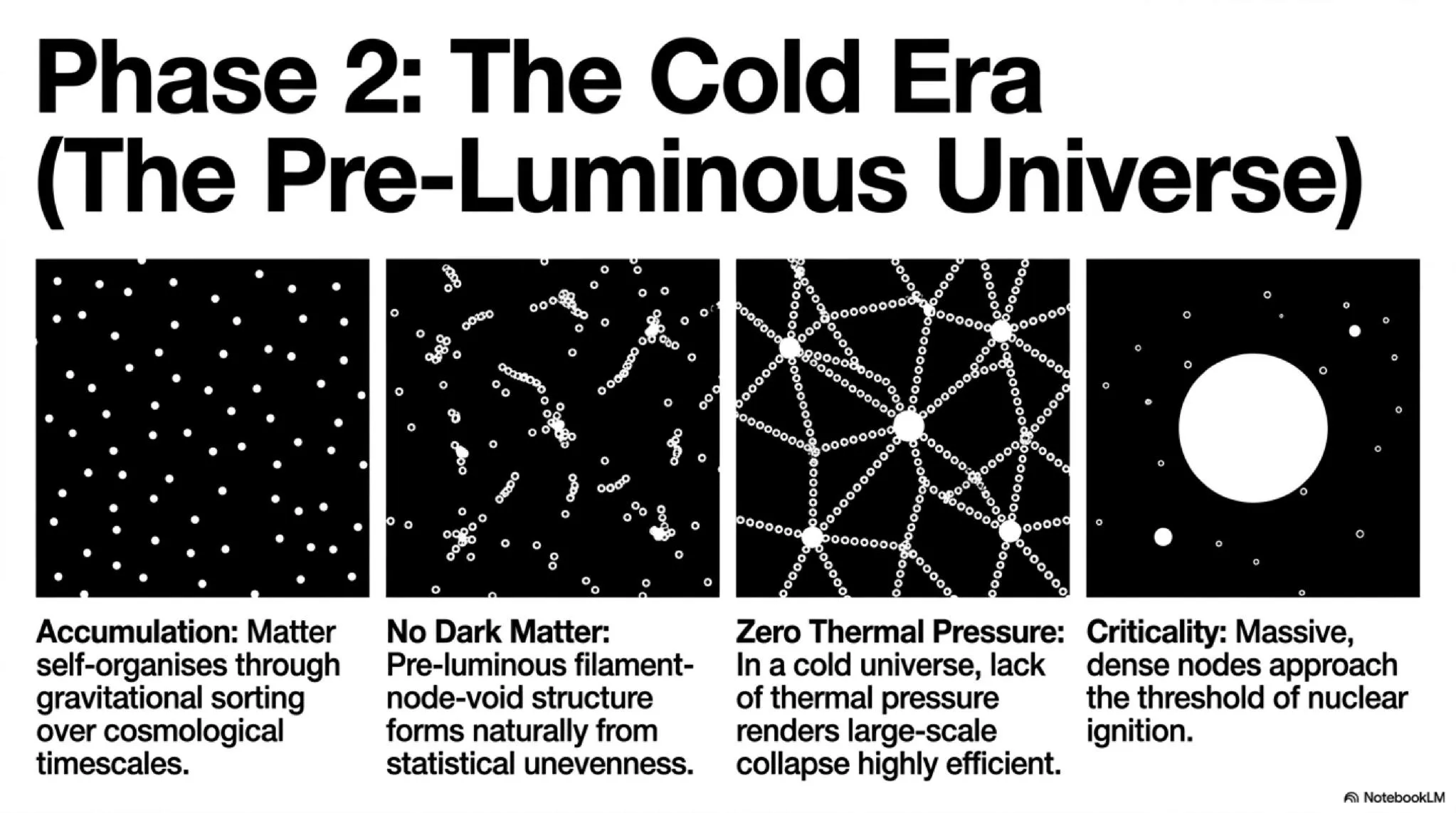
BFUT Paper 8, "Cold, Dark, and Inevitable: The Universe Before the Big Flare-Up" [10], describes the pre-luminous era in which this accumulation process operated across trillions or quadrillions of years before the Big Flare-Up - an extended dark phase during which the Spaticle field was present, hydrogen was manifesting progressively across infinite space, and matter was accumulating toward the densities required for the first ignition events. Paper 8 also identifies a future observational programme: if repeated measurements of gas cloud densities at the same locations over sufficient time intervals can be correlated across clouds of different initial densities, an empirical relation between density state and characteristic accumulation timescale may eventually be built. Such a programme could constrain the duration of the pre-flare-up dark era. This is not yet a completed quantitative formula - it is explicitly identified in Paper 8 as a future observational programme awaiting dedicated treatment [10].
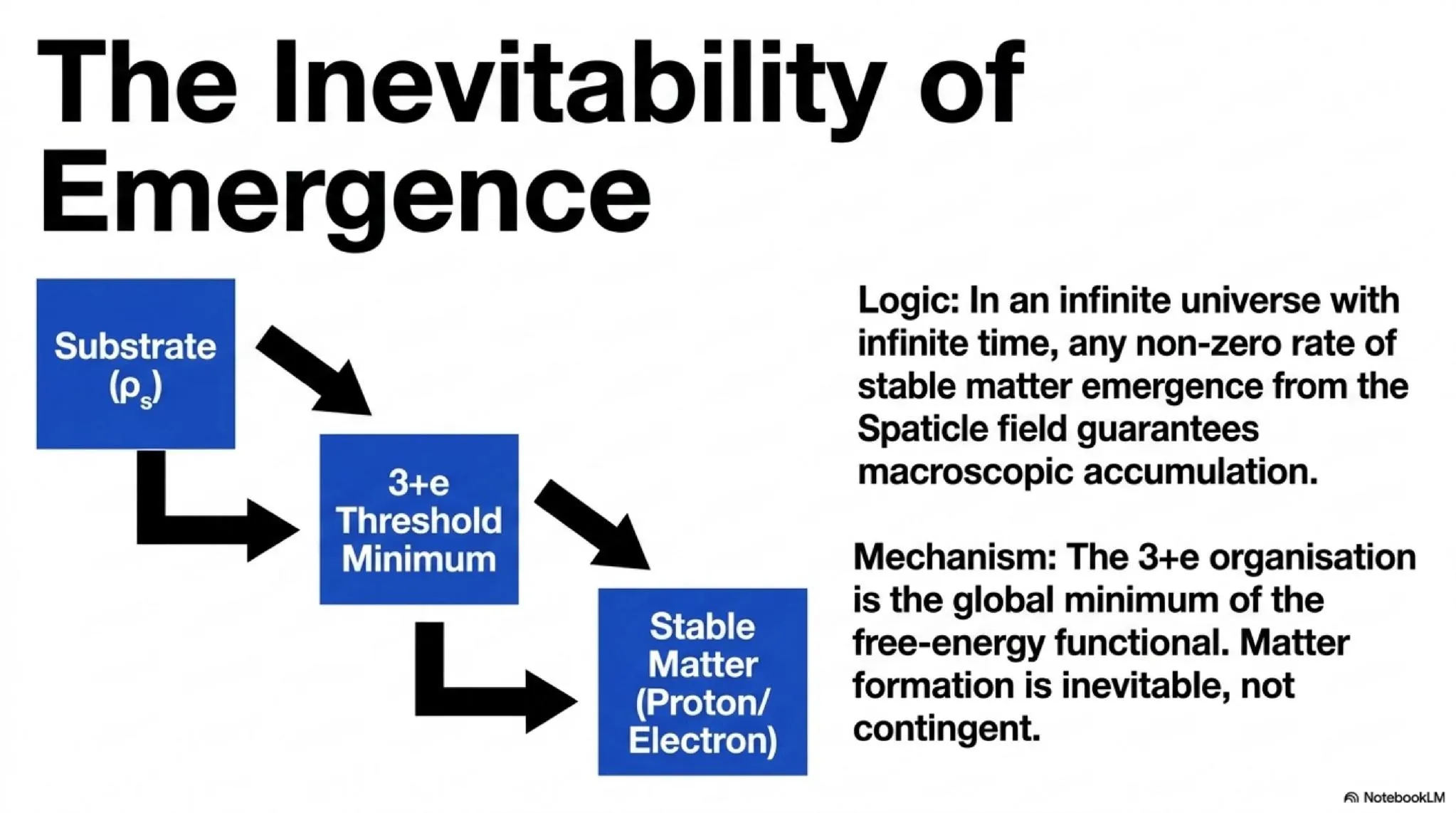
Stable, persistent hydrogen instead of immediate particle-antiparticle annihilation follows from the threshold logic and condensation functional developed in BFUT Paper 16, which fixes a stable equilibrium configuration that the 3+e topology selects over symmetric alternatives [P16]. Standard cosmology has no specified mechanism for why the Big Bang occurred when it did, why inflation began, or why it ended; BFUT instead grounds matter formation in a derived, geometric stability condition instead of an unexplained initial event.
11. Clarifying What "Nothing" Means in BFUT
Much confusion in cosmological debates comes from the sloppy use of the word "nothing." This paper therefore makes the distinction explicit.
In BFUT, "nothing" before manifested matter means: no prior atoms, no prior stars, no prior galaxies, no prior ordinary particles in the later familiar sense, no prior formed matter structures, no previously manifested Spaticle field in its later substrate role.
It does not mean: no space, no condition, no state, no energy state, absolute metaphysical non-being.
This distinction is essential. Once it is made, the origin of the Spaticle field becomes conceptually continuous instead of paradoxical.
12. The Ontological Ladder of Manifestation in BFUT
The BFUT framework can now be expressed as a clear ontological ladder of manifestation, extending from necessary infinite space to biological life and consciousness:
1. Space necessarily exists.
2. Space cannot coherently possess a terminal border and is therefore infinite.
3. Infinite space cannot have emerged from absolute non-space in the ordinary finite-origin sense.
4. Therefore there was never absolute nothingness.
5. If infinite space exists, it exists in some real condition.
6. Any real condition of existence is an energy state - however minimal, however different from any presently familiar baseline.
7. From that prior energy state of infinite space, the Spaticle field manifests.
8. The Spaticle field is the first physically real substrate, the primordial matter-substrate from which the structure that general relativity describes geometrically emerges.
9. From the Spaticle field, later matter condenses or manifests.
10. From manifested matter, larger structures form across cosmic evolution.
11. Biological Manifestation: Matter organised under the perpetuation drive - operative since before the Spaticle field - manifests in forms that present human understanding recognises as biological life and consciousness. The perpetuation drive is not new at this stage. What is new is the complexity and reflexivity of the structure through which it expresses itself. The perpetuation drive discussed here forms part of Vijay's Law, formally stated in Section 16.1 below, and represents the tendency of matter to reorganise into structures capable of greater persistence and continuity under the prevailing conditions.
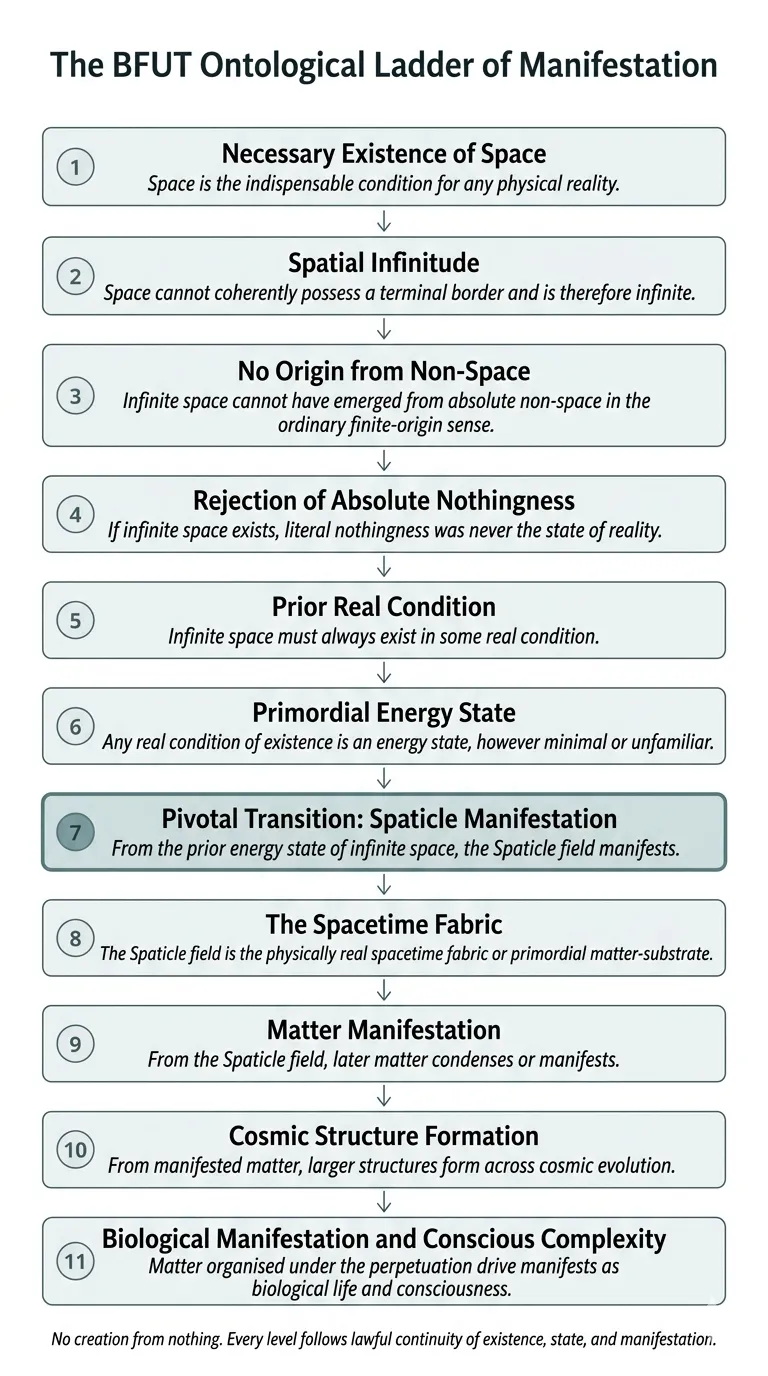
This ladder replaces abrupt creation with continuity. It is supported not only by the logical arguments of Sections 4 through 6 but by the five independent lines of physical argument in Section 7. Step 11 connects the cosmological base to the broader BFUT framework: the perpetuation drive that is present from the particle level through biological complexity to consciousness is the same drive operative throughout all prior steps, expressed through progressively more complex and reflexive structures.
13. Why This Matters Beyond Ontology
13.1 It removes the need for creation-from-nothing language
One of the deepest conceptual weaknesses in standard cosmology is the casual acceptance of phrases that imply reality emerged from nothing. Once infinite space and prior state are restored, this problem disappears.
13.2 It clarifies the status of general relativity
General relativity remains a powerful descriptive theory of large-scale behaviour. BFUT does not discard its mathematical successes. Instead, it supplies the missing substrate ontology beneath the geometric language.
13.3 It aligns more naturally with the search motive of quantum gravity
Quantum gravity repeatedly seeks a deeper structure. BFUT offers a concrete ontological candidate instead of a purely formal placeholder.
13.4 It provides continuity with the wider BFUT observational and theoretical programme
This paper is not isolated. It supports and is supported by a much broader BFUT reconstruction programme that has already revisited multiple major pillars and stress-points of standard cosmology. These include the Hubble relationship and the interpretation of apparent large-scale expansion through gravitational sorting [2], the physical identity of the cosmological constant [3], the cosmological lithium problem [4], apparent cosmic acceleration through observer bulk-flow dynamics instead of dark energy [5], the cosmic microwave background and its thermal behaviour [8], the reinterpretation of the acoustic peak structure and baryon acoustic oscillations [9], the pre-luminous dark era before the Big Flare-Up [10], large-scale cosmic rotations and orbital hierarchy across scales [11], the Sunyaev-Zel'dovich effect [12], the Lyman-α forest and the interpretive non-uniqueness of the Gunn-Peterson opacity rise [13], the integrated Sachs-Wolfe effect [14], weak lensing and the S8 tension [15], and the convergent case for the Spaticle field as the cosmological substrate [16]. The present paper is foundational because it clarifies what existed before the spacetime fabric itself and therefore strengthens the ontological base beneath all of these later reinterpretations.
13.5 It dissolves the thermodynamic fine-tuning problem
As argued in Section 7.4, the Penrose entropy calculation reveals a devastating weakness in the finite-origin picture: the initial state of the universe must be extraordinarily improbable to produce the observed thermodynamic arrow of time. No finite-origin framework has resolved this. BFUT dissolves it by removing the requirement for a fine-tuned beginning. An eternal infinite universe with a prior energy state requires no such initial fine-tuning. The arrow of time emerges locally from the dynamics of manifestation, not globally from an arbitrarily chosen improbable starting point.
13.6 It preserves conservation laws throughout cosmic history
BFUT is the only cosmological framework that does not require a simultaneous violation of all conservation laws at its foundational step. This is not a minor advantage. Conservation laws are the bedrock of all physical science. A cosmology that violates them at its foundation is a cosmology that has abandoned the deepest empirical constraints of physics before it has begun.
14. Relationship to the Existing BFUT Corpus: This Paper as a Foundational Integration and Closure Paper
The present paper is not intended to stand as an isolated philosophical note. It should be read as a foundational integration paper within the broader Big Flare-Up Theory (BFUT) research programme, which already consists of a multi-paper cosmological framework supported by published simulations and multiple observational reinterpretations. The specific role of this paper is to close a natural ontological gap that arises once the Spaticle field is accepted: if the Spaticle field is the primordial substrate of the physically real spacetime fabric, what is prior to it? The answer developed here is that the Spaticle field is not prior to all reality. It is the first matter-substrate manifestation from the prior energy state of infinite space itself.
14.1 The core foundational chain within BFUT
Several BFUT papers together form the foundational chain that directly underlies the present paper.
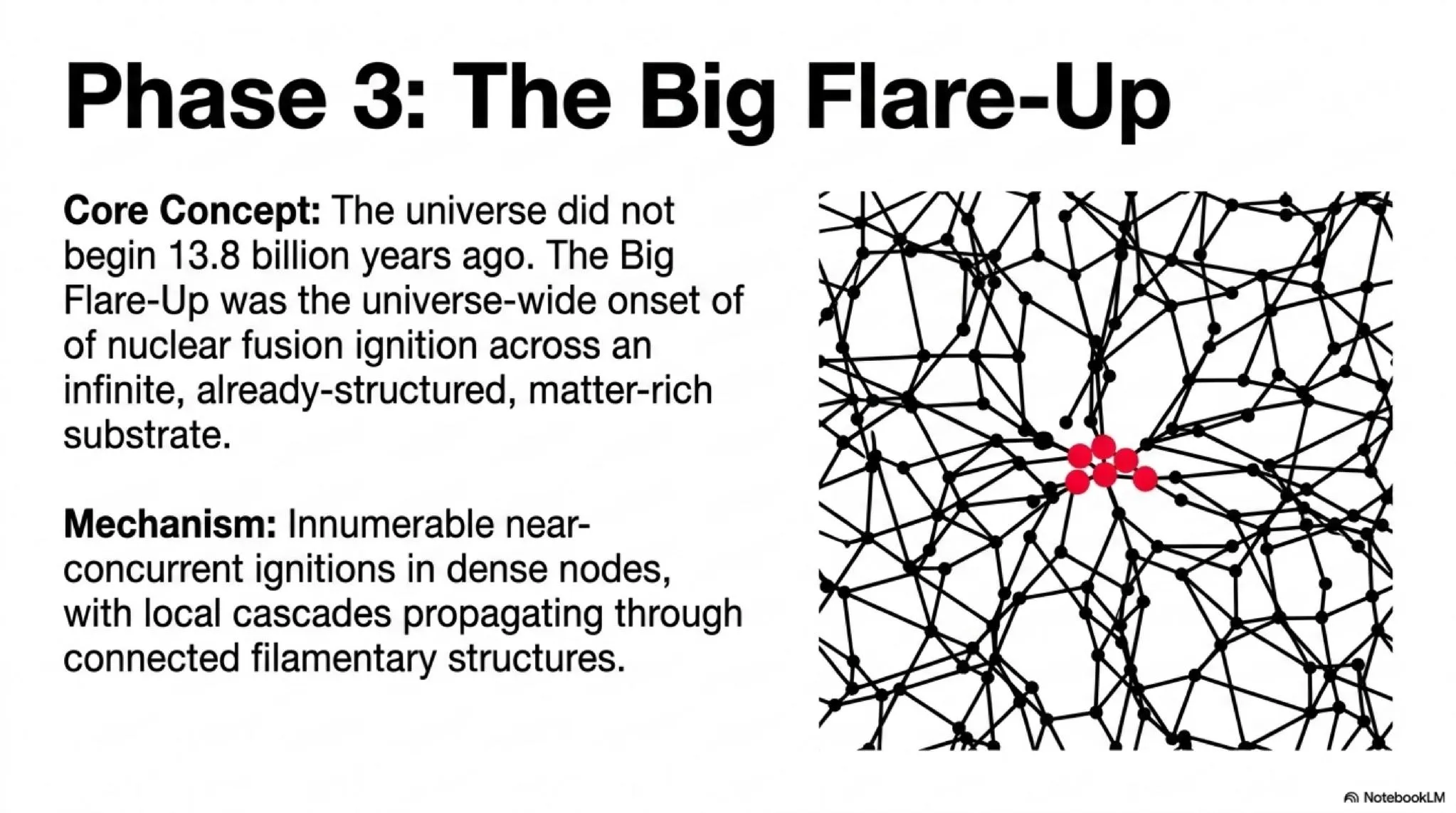
BFUT main paper [1], The Big Flare-Up Theory: Quantum Genesis of an Infinite Universe - A Unified Architecture for Cosmology, Particle Physics, Quantum Mechanics and Consciousness with Zero Free Parameters, establishes the overall cosmological framework of an infinite universe, the rejection of a singular finite origin, the role of quantum fluctuations in ongoing matter manifestation, and the broad replacement of Big Bang cosmology with a continuity-based model.
BFUT Paper 5 [6], The Universe Has No Boundary: Logical, Derivational, and Observational Arguments for Spatial Infinitude, provides the full independent case that space cannot coherently possess a final border and is therefore infinite. The present paper depends directly on that result and condenses only the portion necessary for its own argument.
BFUT Paper 14 [16], The Spaticle Field as the Unified Substrate of Physical Reality, establishes the Spaticle field as the convergent ontological conclusion of multiple independent lines of reasoning. The Spaticle field density is the primary physical quantity in the current understanding of the programme, independently constrained across seven physical sectors; the cosmological constant is numerically consistent with that density, not its source.
The present paper then completes that chain. If Paper 5 establishes that space is infinite, and Paper 14 establishes that the physical substrate underlying what general relativity describes geometrically is the Spaticle field, then the present paper answers the next unavoidable question: what existed before the Spaticle field? Its answer is the prior real energy state of infinite space.
14.2 BFUT has already addressed major standard-model pillars, not merely abstract ontology
A reader of the present paper should not mistake BFUT for a purely conceptual or philosophical framework. The broader BFUT corpus has already addressed several of the most central pillars, tensions, and interpretive stress-points of modern cosmology. BFUT Paper 1 [2], Gravitational Sorting as an Alternative Mechanism for the Hubble Relationship, revisits the Hubble relation and provides an alternative large-scale interpretation to metric-expansion orthodoxy. BFUT Paper 2 [3], The Physical Identity of the Cosmological Constant, reinterprets Λ not as a mysterious late-time dark-energy term but as the measurable signature of the underlying cosmological substrate. BFUT Paper 3 [4], A Steady-State Nucleosynthesis Resolution of the Cosmological Lithium Problem, addresses one of the standard model's long-standing elemental abundance tensions. BFUT Paper 4 [5], Observer Bulk Flow Dynamics, offers an alternative explanation for apparent cosmic acceleration through observer-motion and large-scale flow effects instead of through an added dark-energy component. BFUT Paper 5 [6], The Universe Has No Boundary, establishes the independent case for spatial infinitude on which the present paper directly depends. BFUT Papers 7 and 7A [8,9], on the CMB and CMB+BAO, reinterpret the cosmic microwave background and associated acoustic-peak structures not as relics of a singular finite-origin fireball, but as present ambient conditions and structural signatures within an infinite continuity-based universe. BFUT Paper 8 [10], Cold, Dark, and Inevitable, develops the pre-luminous era before the Big Flare-Up, in which hydrogen progressively manifests across the Spaticle field over immense timescales before the first widespread ignition events. BFUT Paper 9 [11], Cosmic Rotation Across Scales, argues that large-scale coherent motions and rotational hierarchies are natural in an infinite substrate-based universe and become anomalous primarily within finite-origin cosmology. BFUT Paper 10 [12] reinterprets the Sunyaev-Zel'dovich effect within the BFUT framework. BFUT Paper 11 [13] addresses the Lyman-α forest and the interpretive non-uniqueness of the Gunn-Peterson opacity rise. BFUT Paper 12 [14] revisits the integrated Sachs-Wolfe effect, and BFUT Paper 13 [15] addresses weak lensing and the S8 tension, again extending the same continuity-based cosmological logic to major observational domains that are usually interpreted within the standard model. BFUT Paper 14 [16], The Spaticle Field as the Logical Cosmological Substrate, integrates multiple independent lines of reasoning and identifies the physically real spacetime fabric as the Spaticle field itself. Taken together, these papers show that BFUT is not merely an alternative origin story. It is a broader cosmological reconstruction programme that repeatedly revisits standard-model interpretations at the level of specific observational and theoretical claims.
14.3 Simulations are part of the BFUT programme, not an afterthought
The BFUT programme is also not limited to conceptual reinterpretation. Multiple BFUT papers are accompanied by dedicated simulations. This matters for the present paper because the ontological claims made here are not meant to float free of the broader programme's computational and phenomenological structure. The reader should therefore understand the present paper as one component within a larger architecture that includes not only conceptual derivation, but simulation-backed modelling across several BFUT subprojects. The current paper is foundational in function, but it belongs to a research programme that has already moved beyond purely verbal theorising.
14.4 Why this paper is necessary even after Papers 1, 5, and 14
One might ask why this paper is needed if BFUT already has a main cosmology paper, a dedicated paper on spatial infinitude, and a dedicated paper on the Spaticle field. The answer is that a distinct ontological gap still remains unless the pre-Spaticle condition is stated explicitly.
The main BFUT paper [1] establishes the broad continuity-based cosmological framework and the rejection of a singular origin. Paper 5 [6] establishes that space is infinite and boundaryless. Paper 14 [16] establishes that the physically real spacetime fabric is the Spaticle field. Yet once those claims are accepted, a natural and unavoidable question remains: if the Spaticle field is the primordial substrate, is it the first reality, or is it itself a manifestation from something prior?
That question cannot be left implicit. If it is left implicit, readers may assume that BFUT merely relocates the origin problem by replacing Big Bang with Spaticle field. The purpose of the present paper is to show that BFUT does not merely rename the unexplained first term. It continues the continuity principle one level deeper. The Spaticle field is not treated as an uncaused absolute beginning. It is the first matter-substrate manifestation from the prior energy state of infinite space.
14.5 The present paper therefore functions as a closure paper for the BFUT cosmological base layer
Within the BFUT corpus, the present paper performs a very specific role. It is not primarily the paper that proves spatial infinitude in full; that is Paper 5 [6]. It is not primarily the paper that develops the full convergent case for the Spaticle field; that is Paper 14 [16]. It is not primarily the paper that introduces the overall BFUT cosmology; that is the main BFUT paper [1]. Instead, it integrates those prior results and closes the ontological gap left between them.
The result is a complete foundational sequence: (1) Space cannot coherently terminate and is therefore infinite. (2) Infinite space cannot have emerged from absolute non-space in the ordinary finite-origin sense. (3) Infinite space therefore always exists in some real condition. (4) Any real condition of existence is an energy state. (5) From that prior energy state of infinite space, the Spaticle field manifests. (6) The Spaticle field is the physically real spacetime fabric or primordial matter-substrate. (7) From the Spaticle field, hydrogen and later matter manifest. (8) From manifested matter, stars, galaxies, and later cosmic structure arise. (9) Matter organised under the perpetuation drive manifests in forms that present human understanding recognises as biological life and consciousness.
This is why the present paper matters. It does not merely add another BFUT title to the list. It completes the ontological base of the BFUT cosmological programme by making explicit what must be prior to the spacetime fabric itself.
15. Objections and Responses
15.1 Objection: This still assumes something prior to the Spaticle field
Response: Yes, because absolute nothingness cannot produce reality. This is not an arbitrary insertion. It follows from the prior proof that space is necessarily infinite and therefore always exists. Once space exists, a real condition exists. The assumption is not inserted without justification - it is the logically required consequence of spatial infinitude.
15.2 Objection: The exact prior state is unspecified
Response: The foundational argument does not require exact numerical specification. It requires only continuity of existence and continuity of state. The prior energy state may be far below any currently defined baseline, entirely unlike anything measurable by present instruments, and not yet characterisable by any existing thermodynamic framework. None of this undermines the argument. Later work may explore candidate forms of the prior condition in greater detail.
15.3 Objection: How can space exist before spacetime if spacetime is usually taken as the whole arena?
Response: The present paper distinguishes between infinite space as necessary existence and the later manifested structured substrate that general relativity describes geometrically. In BFUT, the Spaticle field is that structured substrate. The prior existence is not already the fully manifested Spaticle field. It is infinite space in a prior real condition. Crucially, time, in the sense of clock rates and causal intervals, is the accumulated evolution of substrate states, a property of the manifested Spaticle field, not a precondition of spatial existence. Prior infinite space does not require time in this sense because it predates the manifested substrate whose evolution constitutes time. Space without time in this sense is not a contradiction. It is simply the pre-Spaticle condition.
15.4 Objection: This is metaphysical instead of physical
Response: Every cosmology rests on foundational ontology whether acknowledged or not. The standard model's hidden metaphysics is finite origin, spontaneous beginning, and unexplained fabric emergence. The present paper replaces these with logically constrained continuity. Moreover, the proposal is physically motivated by the behaviour attributed to spacetime in general relativity, by gravitational waves, by the existence of quantum gravity research, and by the general legitimacy of field ontology in modern physics. The five independent supporting arguments of Section 7 each connect the ontological claim to established physical reasoning.
15.5 Objection: Conservation laws may not apply at the Big Bang
Response: This objection is frequently made but never demonstrated. The conservation laws are not known to fail at the Big Bang. They are assumed to be suspended by the finite-origin framework because without that suspension, the framework cannot produce a universe from nothing. This is precisely the problem. Conservation laws are the most robustly confirmed empirical patterns in physics. A framework that requires their simultaneous suspension at its foundation has a far heavier burden of justification than a framework that requires none.
16. Discussion
The deepest weakness of standard cosmology may not be any single empirical discrepancy. It may be its willingness to accept a broken starting ontology and then build elaborate mathematical scaffolding on top of it. Once one begins with a finite-origin universe, multiple later phenomena become artificially mysterious. One then requires inflation, dark matter, dark energy, coincidence problems, and increasingly layered rescue hypotheses. BFUT has argued elsewhere that many of these are artefacts of the initial assumption set. The present paper shows that the same is true at the deepest ontological level.
The standard model describes a universe whose background fabric can curve, stretch, and wave, but it does not truly explain what that fabric is or how it came to exist. BFUT answers by beginning where the standard model refuses to begin: with the necessity of infinite space and the impossibility of absolute nothingness. From there, the origin of the spacetime fabric becomes not mysterious but continuous. The fabric is the Spaticle field, and the Spaticle field is the first matter-substrate manifestation from the prior energy state of infinite space itself.
The five independent supporting arguments of Section 7 each approach this conclusion from a different direction. The conservation laws argument shows that BFUT is uniquely consistent with the deepest empirical generalisations in physics - the only cosmological framework that requires no simultaneous violation of every conserved quantity at its foundation. The metric self-bootstrap argument shows that creation-from-nothing cosmology is internally self-refuting at the level of its own mathematical tools: the metric cannot create the space it measures. The causal structure argument shows that a true beginning is not physics but an admission of explanatory failure - causeless events have no place in science. The entropy argument exposes a degree of initial fine-tuning so extreme - Penrose’s 1 in 10^(10123) - that no physical mechanism within a finite-origin framework could account for it. The information argument closes the case: the laws of physics themselves are information, and information cannot arise from zero information.
Taken together, these arguments do not merely support the BFUT account of the Spaticle field's origin. They constitute a multi-front challenge to the coherence of creation-from-nothing cosmology as a foundational framework.
17. Vijay's Law and the Perpetuation Principle
The emergence sequence developed in this paper raises a deeper question. Why does reality repeatedly reorganise itself into progressively more evolved structures whenever suitable conditions arise?
The broader BFUT programme is guided by a general principle referred to as Vijay's Law, formally developed in a dedicated paper within the programme. Vijay's Law states: first, everything in the universe is alive and conscious; second, whenever conditions are stable or predictably unstable at any scale in the universe, more evolved matter will manifest; third, all matter possesses a perpetuation drive; fourth, the perpetuation drive of matter is fulfilled if the combined form is able to perpetuate itself.
Vijay's Law is not introduced as a substitute for physical mechanisms. The physical mechanisms responsible for each stage of emergence are derived independently throughout the BFUT programme, including the condensation functional of Paper 16 and the threshold logic governing matter formation. Vijay's Law instead provides the interpretive framework linking the emergence sequence: it is the unifying principle describing the common directional tendency exhibited by matter across all scales, not a mechanism in competition with the physical derivations themselves.
Within this framework, emergence is not viewed as a sequence of unrelated events. Each stage creates the conditions necessary for the next stage to arise. When the available opportunity field changes, new forms of organisation become possible, and matter reorganises accordingly.
The perpetuation principle operates throughout the BFUT hierarchy. It is reflected in the manifestation of the Spaticle field from the prior energy state, the manifestation of matter from the Spaticle field, the formation of hydrogen, the emergence of heavier elements through stellar processes, large-scale structure formation, cosmic rotational organisation, biological evolution, and conscious systems. The physical mechanism differs at each stage, but the underlying emergence principle remains the same.
Vijay's Law guided the discovery sequence of the BFUT programme instead of being introduced after the fact to summarise it. Several of the emergence stages developed mathematically in later papers, including the threshold logic for matter formation and the condensation functional underlying it, were originally anticipated through the interpretive framework the law provides. This is particularly relevant now that a dedicated paper formally develops Vijay's Law within the programme; the law is no longer an unpublished research heuristic but a published, foundational component of the broader BFUT hierarchy that this paper's emergence sequence instantiates.
18. Conclusion
The standard cosmological model provides no physical account of how
the spacetime fabric itself - the real, curvature-capable structure
described by general relativity - could arise from literal non-being.
Most proposals addressing “what came before the Big Bang” either remain
purely mathematical or fail to derive the first physical state from any
prior condition.
This paper has presented a logically continuous alternative. It
establishes that space cannot coherently possess a terminal boundary and
is therefore infinite. Infinite space must exist in some real condition,
which constitutes an energy state. From this prior energy state of
infinite space, the first physical substrate - the Spaticle field -
manifests as the primordial matter-substrate. From this substrate,
stable matter, hydrogen, cosmic structures, and eventually the
conditions for biological organisation and consciousness emerge through
lawful processes over unbounded timescales.
The account offered here is distinguished by its derivational character:
it moves step by step from a prior real condition to the emergence of
the physical world without invoking creation from absolute nothingness.
It preserves conservation laws and causality at every stage. It does not
merely rename the unexplained first term; it extends the principle of
continuity one level deeper than previous formulations.
Within the Big Flare-Up Theory programme, this paper completes the
foundational ontological layer. It shows that the Spaticle field is not
an uncaused absolute beginning but the first matter-substrate
manifestation from the prior energy state of infinite space. The
resulting sequence - from necessary infinite space, through the
emergence of the first physical substrate, to the appearance of matter,
structure, and eventually life and consciousness - replaces abrupt
creation with lawful manifestation from prior reality.
This continuity-based ontology closes one of the deepest explanatory
gaps in modern cosmology and provides a coherent foundation for the
broader BFUT reconstruction of cosmic history.
References
1. Sharma, V. S. (2026). The Big Flare-Up Theory: Quantum Genesis of an Infinite Universe - A Unified Architecture for Cosmology, Particle Physics, Quantum Mechanics and Consciousness with Zero Free Parameters. Zenodo. https://doi.org/10.5281/zenodo.19149785
2. Sharma, V. S. (2026). Gravitational Sorting as an Alternative Mechanism for the Hubble Relationship. BFUT Paper 1. Zenodo. https://doi.org/10.5281/zenodo.19226423
3. Sharma, V. S. (2026). The Physical Identity of the Cosmological Constant: A Unified Resolution of the Cosmological Constant and Coincidence Problems in an Infinite Universe. BFUT Paper 2. Zenodo. https://doi.org/10.5281/zenodo.19242083
4. Sharma, V. S. (2026). A Steady-State Nucleosynthesis Resolution of the Cosmological Lithium Problem. BFUT Paper 3. Zenodo. https://doi.org/10.5281/zenodo.19205920
5. Sharma, V. S. (2026). Observer Bulk Flow Dynamics. BFUT Paper 4. Zenodo. https://doi.org/10.5281/zenodo.19228065
6. Sharma, V. S. (2026). The Universe Has No Boundary: Logical, Derivational, and Observational Arguments for Spatial Infinitude. BFUT Paper 5. Zenodo. https://doi.org/10.5281/zenodo.19242759
7. Sharma, V. S. (2026). Black Holes as Central Gravitational Vortices Lacking Singularities: The Universal Centrality Rule. BFUT Paper 6. Zenodo. DOI: 10.5281/zenodo.19300874
8. Sharma, V. S. (2026). CMB Dynamic Thermal Equilibrium. BFUT Paper 7. Zenodo. https://doi.org/10.5281/zenodo.19302025
9. Sharma, V. S. (2026). CMB Acoustic Peak and BAO Reinterpretation. BFUT Paper 7A. Zenodo. https://doi.org/10.5281/zenodo.19303398
10. Sharma, V. S. (2026). Cold, Dark, and Inevitable: The Universe Before the Big Flare-Up. BFUT Paper 8. Zenodo. https://doi.org/10.5281/zenodo.19323579
11. Sharma, V. S. (2026). Cosmic Rotation Across Scales, Emergent Orbital Hierarchy, and the Large-Scale Challenge to Metric Expansion. BFUT Paper 9. Zenodo. https://doi.org/10.5281/zenodo.19341549
12. Sharma, V. S. (2026). The Sunyaev-Zel'dovich Effect as Local Substrate Interaction: A Big Flare-Up Theory Reinterpretation. BFUT Paper 10. Zenodo. https://doi.org/10.5281/zenodo.19377396
13. Sharma, V. S. (2026). The Lyman-Α Forest in the Big Flare-Up Theory: Absorption Percolation Threshold and Interpretive Non-Uniqueness of the Gunn-Peterson Opacity Rise. BFUT Paper 11. Zenodo. https://doi.org/10.5281/zenodo.19383804
14. Sharma, V. S. (2026). ISW Effect. BFUT Paper 12. Zenodo. https://doi.org/10.5281/zenodo.19391470
15. Sharma, V. S. (2026). Weak Lensing / S8 Tension. BFUT Paper 13. Zenodo. https://doi.org/10.5281/zenodo.19392597
16. Sharma, V. S. (2026). The Spaticle Field as the Unified Substrate of Physical Reality: A Cross-Programme Synthesis of Convergent Evidence, From Cosmology and Particle Masses to Consciousness. BFUT Paper 14. Zenodo. https://doi.org/10.5281/zenodo.19394064
17. Sharma, V. S. (2026). The Origin of Matter, Antimatter, and Fundamental Forces: How Protons, Electrons, and Hydrogen Formed. BFUT Paper 16. Zenodo. https://doi.org/10.5281/zenodo.19908215
18. Abbott, B. P., et al. (LIGO Scientific Collaboration and Virgo Collaboration). (2016). Observation of Gravitational Waves from a Binary Black Hole Merger. Physical Review Letters, 116, 061102. https://doi.org/10.1103/PhysRevLett.116.061102
19. Einstein, A. (1916). The foundation of the general theory of relativity. Annalen der Physik, 49(7), 769-822. https://doi.org/10.1002/andp.19163540702
20. Penrose, R. (2004). The Road to Reality: A Complete Guide to the Laws of the Universe. Jonathan Cape, London. Chapter 27.
21. Borde, A., Guth, A. H., & Vilenkin, A. (2003). Inflationary spacetimes are not past-complete. Physical Review Letters, 90(15), 151301. https://doi.org/10.1103/PhysRevLett.90.151301
22. Ocker, S. K., Cordes, J. M., Chatterjee, S., Gurnett, D. A., Kurth, W. S., & Spangler, S. R. (2021). Persistent plasma waves in interstellar space detected by Voyager 1. The Astrophysical Journal Letters, 911(2), L3. https://doi.org/10.3847/2041-8213/abeb6a
23. Einstein, A. (1920). Ether and the Theory of Relativity. Address delivered at the University of Leiden, 5 May 1920. English translation by G. B. Jeffery and W. Perrett, in Sidelights on Relativity (1922), pp. 3–24. London: Methuen. Available via MacTutor History of Mathematics and Project Gutenberg.
BFUT Paper 15 - What Existed Before Matter and the Spaticle Field | Vijay Shankar Sharma | ORCID: 0009-0001-9622-6121 | CC BY-NC-ND 4.0