A Scientific-Spiritual Framework of the Human Being as a Cellular Civilization: Healing, Intuition, Soul, Death, Afterlife, and God
- Abstract
- 1. Foundational Cross-Layer Premises and Vijay's Law
- 2. The Human Being Reframed: Cells, Architecture, and Distributed Life
- 3. Healing, Cellular Communication, and Internal Governance
- 4. Intuition and Distributed Sensing
- 5. Placebo, Nocebo, Mind-Body Interaction, and Psychoneuroimmunology
- 6. Soul as Layered Continuity Rather Than Singular Substance
- 7. Death, Afterlife, and Post-Death Continuity
- 8. God, Medium, and Prayer
- 9. Conclusion: What Layer 5 Establishes, and Why It All Flows from Vijay's Law
- Appendix A: Structured Protocol for Cellular Healing and Internal Alignment
- References
Abstract
This paper is the fifth layer in a six-layer unified framework of reality built on a single governing principle: Vijay's Law. Before stating what this paper claims, it is necessary to state how it and each of its preceding layers proceed. Every layer in this framework follows the same epistemological discipline: it accepts every major established observation in its domain as real, disputes none of them, and then shows that the inherited interpretation of those observations is not the only possible one. It proposes instead that a single governing law - Vijay's Law - provides a more unified, more coherent, and simpler account. This discipline is what distinguishes the framework from alternative philosophy. It is science in the strict sense: the observations are given; the dispute is only about which explanatory architecture best accounts for all of them.
Layer 1, The Big Flare-Up Theory (BFUT), accepts every major cosmological observation - the Hubble redshift relation, CMB temperature and acoustic peaks, BAO feature, light-element abundances, galaxy distribution, the Sunyaev-Zel'dovich effect, the ISW correlation, weak lensing shear, and the Lyman-α forest - as observationally real. It reinterprets each as consistent with an infinite living universe built on a real Spaticle field substrate, rather than a finite-age expanding universe requiring dark energy and dark matter. In doing so it resolves twelve major tensions in the standard cosmological model within a single ontology and without invoking any invisible entity. Layer 2, Vijay's Law, accepts every biological observation used to define life and consciousness - seed dormancy, viral strategic precision, persistent atomic self-movement, identical twin behavioural convergence, siphonophore colonial organisation, the Xenobot and Anthrobot findings of Levin and colleagues, and post-mortem cellular activity - as real. It reinterprets each as evidence that consciousness is a fundamental property of all matter, not a late emergent product of neural complexity. Layer 3, Evolution Through Conscious Drive, accepts every evolutionary observation in its domain - convergent evolution of the eye, multi-stage parasitic manipulation sequences, stable alternative reproductive strategies, polar bear adaptation to predictably unstable conditions, plant volatile signalling and third-party ally recruitment, and progressive ecological layering - as real. It reinterprets each as directed conscious adaptive drive under the perpetuation component of Vijay's Law, rather than random mutation plus retrospective selection. Layer 4, UNITE, accepts every documented emotional phenomenon - the universal intensity of maternal love, the parent-child asymmetry, Stockholm Syndrome, post-separation emotional persistence, the cross-cultural proverb that deeper love produces deeper hate, the universal recognition of forgiveness as the most powerful emotional transformation, and the clinical distinction between stress and depression - as real. It reinterprets each as the deterministic output of three non-emotional parameters in a single structured relational framework derivable from Vijay's Law.
Layer 5, the present paper, follows the same discipline. It accepts every established finding in psychoneuroimmunology, placebo and nocebo research, interoception science, somatic marker theory, meditation science, embodied cognition, documented near-death experience patterns, faith healing outcomes, and post-mortem cellular biology as real. It reinterprets each as a natural consequence of the human being understood as a living cellular civilization whose macroscopic self functions as the governing authority of its internal climate. The paper develops a mechanistic account of healing as internal governance, intuition as distributed sensing, soul as layered continuity, death as organizational rupture, afterlife as plural scale-specific continuity, God as universal conscious substrate, and prayer as concentrated alignment. A formal healing protocol is presented in Appendix A. The sixteen questions that the Buddha left unresolved are addressed here within a single unified explanatory framework derived from Vijay's Law. Everything in this paper is derived from one governing principle, Vijay's Law, as developed across the preceding layers of the framework.
Keywords: Vijay's Law; scientific spirituality; cellular consciousness; healing protocol; psychoneuroimmunology; placebo; nocebo; interoception; intuition; distributed sensing; soul; God; prayer; death; afterlife; BFUT; UNITE; xenobots; depression; positive thinking
1. Foundational Cross-Layer Premises and Vijay's Law
1.1 The Six-Layer Framework and Its Shared Epistemological Method
This paper is the fifth layer in a six-layer unified framework of reality developed by the author. Each layer builds on the preceding ones. Layer 1, The Big Flare-Up Theory (BFUT), provides the foundational cosmological substrate. Layer 2 establishes Vijay's Law: everything in the universe is alive and conscious. Vijay’s Law states: ‘Everything in the universe is alive and conscious. Whenever conditions are stable or predictably unstable at any scale in the universe, more evolved matter will manifest. All matter has an innate drive to perpetuate itself, either in its own form or in cooperation with other matter to produce more complex forms. When matter participates in such higher forms, its drive to perpetuate itself is fulfilled if the combined form can perpetuate itself.’ All matter has an innate drive to perpetuate itself. Layer 3 applies the law to biological evolution, arguing that evolution is driven by conscious adaptive drive rather than blind random mutation. Layer 4, the Unified Theory of Emotions (UNITE), applies the same law to human emotional life, showing that all human emotions are wholly determined by three non-emotional parameters: Effort, Blame/Gratitude, and Proximity. The precise computational architecture and operational implementation governing the interaction of these variables has been intentionally withheld at this stage due to ongoing intellectual property and patent-related processes. Accordingly, the present paper focuses on the conceptual, behavioral, and systems-level implications of the framework rather than full disclosure of the underlying computational formulation. Layer 5, the present paper, applies the entire cross-layer framework to spirituality, healing, soul, God, death, and afterlife. Layer 6 is to follow.
Every layer in this framework follows the same epistemological method. It accepts every major established observation in its domain as real. It disputes none of them. It then shows that the inherited interpretation of those observations is not the only possible one, and that Vijay's Law provides a more unified, more coherent, and structurally simpler account. This method is described in the abstract for each layer. It is restated here because it determines how every claim in this paper should be read. When Layer 5 reinterprets placebo effects, near-death experiences, or intuition, it is not dismissing the documented phenomena. It is accepting them fully and showing that they follow naturally from the framework, without requiring supernatural mechanisms or ad hoc explanations.
1.2 What the Prior Layers Establish for Layer 5
The following is a summary of the observations each layer accepts as real and the reinterpretation each layer offers. The purpose is to show that the present paper is the fifth application of an established method, not an isolated speculative exercise. Details for each layer are in the dedicated companion papers cited in Section 1.5 to 1.7.
Layer 1 (BFUT) accepts as real: the Hubble redshift-distance relation; Type Ia supernova dimming; the CMB temperature of 2.725 K; CMB acoustic peak hierarchy; the BAO feature; light-element abundance ratios; the galaxy distribution and cosmic web; the Sunyaev-Zel'dovich effect; the ISW CMB-structure correlation; the Lyman-α forest and Gunn-Peterson opacity rise; and weak lensing shear. Layer 1 reinterprets each of these as consistent with an infinite, living, non-expanding universe built on a real Spaticle field substrate rather than a finite-age expanding universe requiring dark energy, dark matter, or a singular origin event. Layer 1 resolves twelve major tensions in the standard cosmological model within the same single ontology, without invoking any invisible entity. [1]
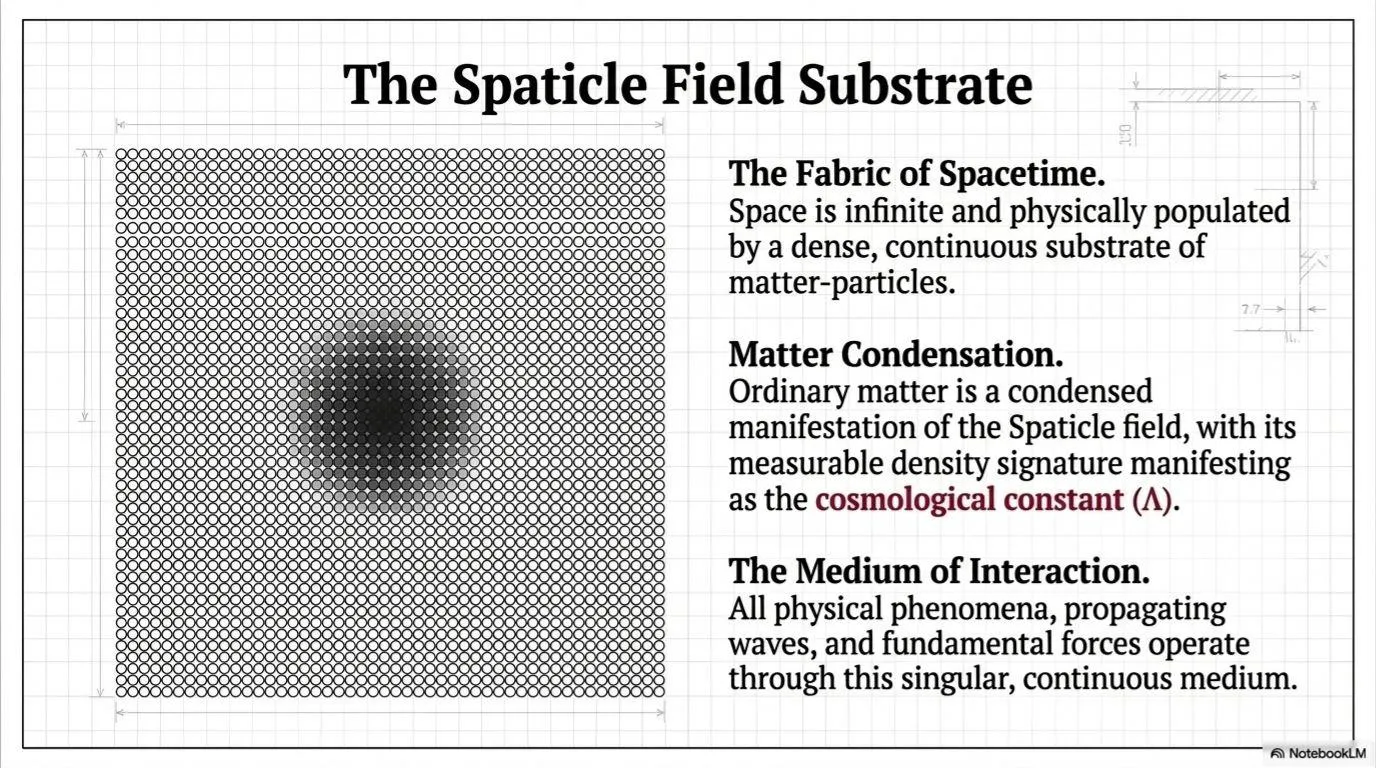
Layer 2 (Vijay's Law) accepts as real: seed dormancy without metabolism or stimulus response; viral strategic precision without conventional metabolic independence; persistent self-generated movement of electrons in atoms under all hostile conditions; behavioural convergence of identical twins raised apart in entirely separate environments; siphonophore colonial organisation where individually capable zooids subordinate their independence to a collective form; the Xenobot and Anthrobot findings showing that cells freed from organismal context self-organise into novel functional forms with autonomous behaviour; and post-mortem cellular activity confirming that individual cells continue living after the organism dies. Layer 2 reinterprets each as evidence that consciousness is a fundamental property of all matter, not a late emergent product of neural complexity, and that the perpetuation drive is universal. [2]
Layer 3 (Evolution Through Conscious Drive) accepts as real: the repeated independent convergent evolution of complex eyes across unrelated lineages; multi-stage parasitic manipulation sequences executed by organisms with minimal neural complexity; stable alternative male reproductive strategies persisting across millions of years; the polar bear's precise adaptation to predictably unstable Arctic conditions; plant volatile signalling that recruits specific third-party predators of their attackers; and the progressive layering of ecological opportunity fields. Layer 3 reinterprets each as directed conscious adaptive manifestation under the perpetuation component of Vijay's Law, rather than random mutation plus retrospective selection. [3]
Layer 4 (UNITE) accepts as real: the universal cross-cultural intensity of maternal love and its neurobiological documentation; the consistent parent-child emotional asymmetry; Stockholm Syndrome and its inconsistent incidence; the persistence of strong positive and negative emotions long after relationships end; the universal cross-cultural recognition that the deepest love and deepest hate occur in the same relationships; the universal cross-cultural recognition of forgiveness as the most powerful emotional transformation; and the clinical distinction between stress and depression. Layer 4 reinterprets each as the deterministic output of three non-emotional parameters - Effort, Blame/Gratitude, and Proximity - combined in a single structured relational framework derivable from Vijay's Law. [4] A complete technical disclosure of the operational computational architecture is outside the scope of the present paper and is being reserved for future dedicated technical publication following intellectual property protection processes.
Layer 5, the present paper, follows the same method. It accepts as real every finding in: psychoneuroimmunology documenting the bidirectional relationship between psychological states and immune function; placebo and nocebo research documenting meaning-mediated physiological change; interoception research documenting continuous internal bodily signalling to cognition; somatic marker theory documenting the role of bodily states in decision-making; meditation science documenting measurable physiological effects of contemplative practice; embodied cognition research documenting the body's participation in cognition; documented patterns of near-death experience across cultures; documented outcomes of faith healing and ritual; and post-mortem cellular viability studies. Layer 5 reinterprets each as a natural consequence of the human being understood as a living cellular civilization governed by Vijay's Law. Details follow in the respective sections.
For Layer 5 specifically, each prior layer contributes a direct premise. P15 establishes that the prior energy state of infinite space is logically necessary and was never absent, making the universal conscious substrate of Section 8 not merely cosmologically grounded but logically necessary: there was never a moment when God, in the sense used here, did not exist. P16 establishes that the threshold-crossing federation-building principle that produced hydrogen from quark-class units is the same universal principle that produces the human body from cellular units: the cellular civilization is not a biological anomaly but the latest instance of a universal structural law. Layer 1 establishes that the Spaticle field is a present-moment pervasive substrate with a density derivable from the cosmological constant, making God as universal conscious substrate a physically grounded rather than metaphysical claim, and confirming that prayer and alignment are operations within a field that is always present. Layer 2 establishes that cells are genuinely alive and conscious in degree - the direct premise on which the healing and governance model stands - and that post-mortem cellular activity is not residual biochemistry but evidence of individual cellular consciousness persisting after the collective dissolves. Layer 3 contributes the evolutionary logic: the human body as a directed, purposefully shaped survival architecture, and the xenobot and anthrobot findings as evidence of the perpetuation drive operating at the cellular level when freed from macroscopic governance. Layer 4 contributes two operative mechanisms: the Blame/Gratitude axis, which maps onto the cellular governance model because Gratitude is the response when the perpetuation drive of the federation is supported or unthreatened and Blame when it is threatened - the same law at two levels - and the Effort parameter, which explains why body-directed practice must be genuine and sustained. [1-4, 59, 60]
1.3 The Full Derivation Chain: From Infinite Space to the Living Body
The BFUT cosmological framework and the consciousness and life claims of Vijay's Law rest on a single continuous derivation chain running from the logically necessary existence of infinite space to the quantitatively measured consciousness of every cell in the human body.
P15 establishes that infinite space is logically necessary: it cannot coherently possess a terminal border, cannot have originated from absolute non-space, and therefore implies that absolute nothingness was never the state of reality. A prior energy state of infinite space necessarily existed before the spaticle field. The perpetuation drive, the universal tendency of existence to continue and organize, is not a biological property that switched on with cells. It is a property of existence itself, operative before the Spaticle field manifested. P15 also establishes the complete ontological ladder of manifestation in eleven sequential steps, from the necessary existence of space through the spaticle manifestation, matter condensation, cosmic structure formation, and biological manifestation. Step 11 explicitly names biological life and consciousness as the latest expression of the same continuous chain. This means the God-as-universal-substrate claim of Section 8 is not merely cosmologically grounded. It is logically necessary. There was never a moment when the substrate was absent. [59]
P16 establishes that the first stable matter structures, quark-class and hydrogen-class units, emerged from the Spaticle field through a threshold-crossing nucleation process. Repetition of the same unit does not produce novelty until a first stable completion threshold is crossed. The 3+1 asymmetric organization that produces hydrogen is the first formal instance of the same threshold and federation-building principle that later produces the human body from cellular units. The human body as a cellular civilization, with its emergent macroscopic governance layer, is therefore the latest in a chain of threshold-crossings that began with the first quark-class units organizing into hydrogen. The principle is not biological. It is universal. [60]
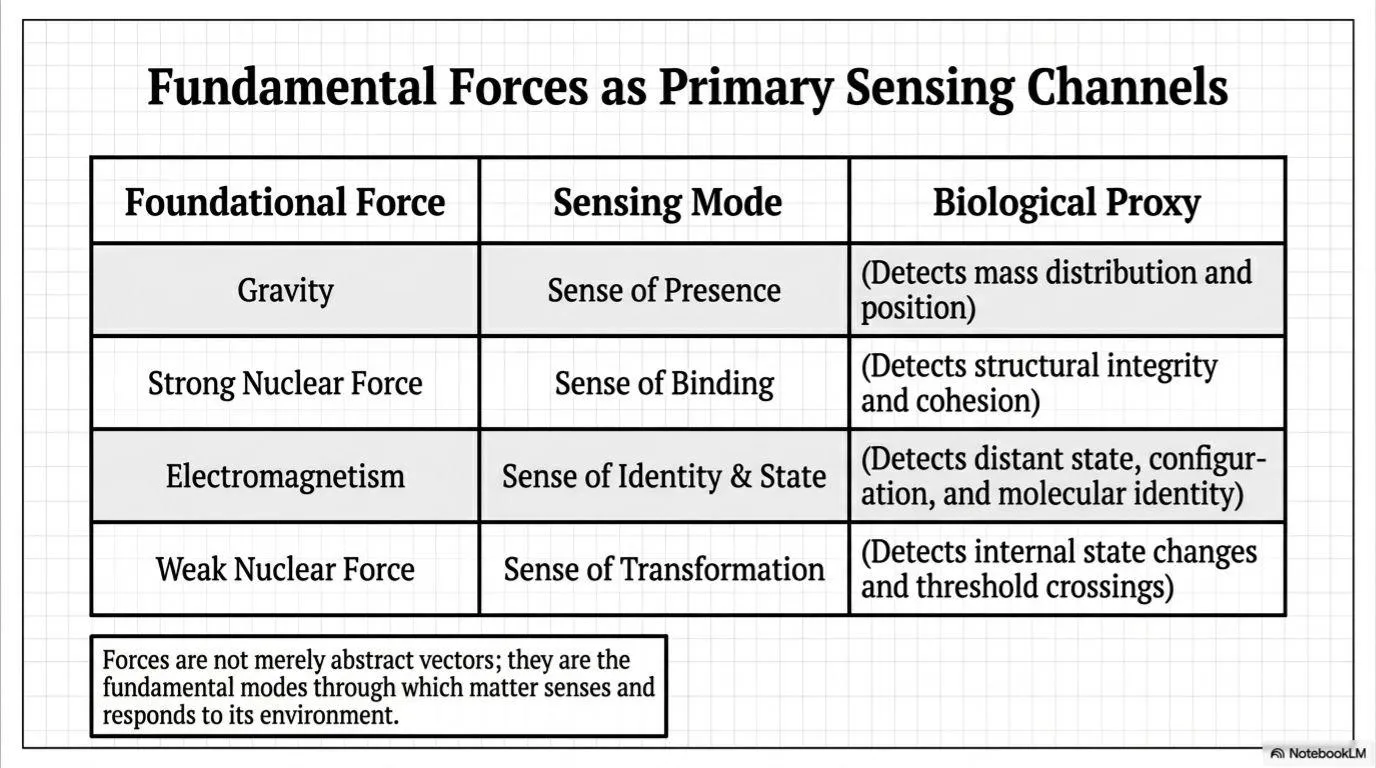
P17 establishes that the four fundamental forces are not abstract mathematical relationships but the four fundamental sensing and interaction channels through which the Spaticle field responds to condensed matter. Gravity is the spaticle field's mass-density response channel. The strong force, electromagnetism, and the weak force are progressively higher-order channels requiring progressively more complex structural configurations to access. Every form of matter senses its environment through at least one of these channels. P17 establishes the force-emergence sequence that P20 builds upon directly. [56]
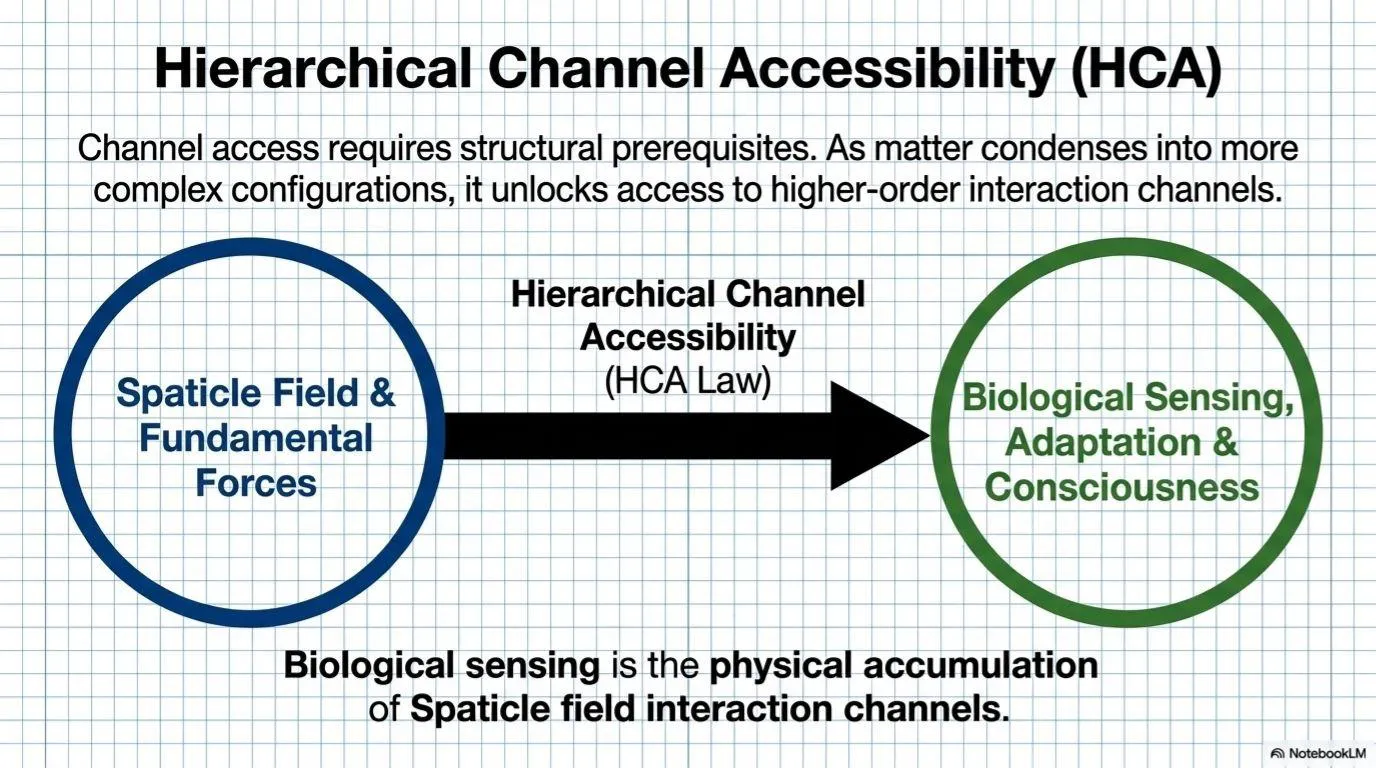
P20 derives the Hierarchical Channel Accessibility (HCA) Law: a system can access the sensing capability associated with a given force channel only if it possesses the structural configuration required to couple to that channel, and access to a higher-order channel implies the prior structural availability of all lower-order channels. This law is not imposed from outside. It follows from the sequential force-emergence sequence of P17. P20 also derives the Capability equation: Capability = Channel x Transduction x Network x Control. Every human cell has all four channels structurally open. The macroscopic self governs the cellular collective by modifying the Control component K of each cell's Capability equation through neuroendocrine and autonomic signalling. Depression is not merely sadness. It is the quantitative degradation of the K component across the cellular network. This is a physical statement, not a metaphor. [57]
P21 derives the Consciousness Index (CI), a calibrated scalar formula. CI is strictly positive for every physical system with mass, enforcing Vijay's Law quantitatively. The human average CI is set at 100 by calibration. A single human cell scores approximately 8 to 14. A bacterium scores approximately 2 to 5. Every value is derived from thirteen independently assigned biological parameters with defined measurement bases. The difference between a single cell's CI and the macroscopic self's CI of 100 is not a difference in channel access: all four channels are already open at the cellular level. What changes as cells form tissues, organs, and the whole body is the N parameter, the network integration density. The macroscopic self is not a new kind of consciousness. It is what cellular consciousness becomes when trillions of already-conscious units integrate deeply enough. P21 also establishes the degradation floor: no cell's CI ever reaches zero. This is the physical basis of the plural afterlife model in Section 7. [58]
From this chain, every claim in Layer 5 now has a formal physical foundation. The cellular civilization model is not a metaphor. It is the biological expression of a derivation that begins with the necessary existence of infinite space and ends with the quantitatively measured consciousness of every cell in the human body.
1.4 The Quantitative Foundations: P17, P20, and P21 in Brief
Three companion papers provide the quantitative infrastructure on which the specific numerical and mechanistic claims throughout Layer 5 rest. A reader who has not read those papers will encounter terms such as the Capability equation, the Control component K, and the Consciousness Index with specific numerical values. This section states the essential content of each so that those terms are self-contained within this paper.
P17 (The Emergence of Forces and Fundamental Senses) establishes that the four fundamental forces are not independent laws inserted into spacetime but sequential emergent consequences of the Spaticle field substrate. Gravity requires only mass and is therefore the first and most primitive interaction: any concentrated mass deforms the local Spaticle field, generating a restoring pressure gradient experienced as gravitational attraction. The strong force requires compact internally structured condensations. Electromagnetism requires charge-asymmetric stable configurations. The weak force requires transformation-capable internal topologies in multi-nucleon systems. The key implication for Layer 5 is that each force corresponds to a sensing channel: a physical pathway through which a system acquires information-specific state change from its environment. Because the forces emerge sequentially in order of structural complexity, access to a higher-order channel requires all lower-order structural prerequisites to already be present. This is the foundation on which P20 builds. [56]
P20 (From Matter and Fundamental Forces to Consciousness) converts the P17 force-sensing correspondence into a formal scientific framework through the Hierarchical Channel Accessibility (HCA) Law: a system can exhibit a sensing capability only if it possesses the structural configuration required to couple to the relevant interaction channel. Every human cell has all four channels structurally open by virtue of its molecular architecture. P20 defines sensing formally as requiring three simultaneous conditions: structural coupling to the channel, an information-specific state change that encodes distinguishable properties of the signal beyond scalar energy magnitude, and state persistence beyond the interaction duration. From this definition P20 derives the Capability equation: Capability = Channel x Transduction x Network x Control. The Control component K is the most consequential term for Layer 5. K measures the degree to which a system's signal emission is governed by internal state rather than determined by external interaction alone: it is the formal quantification of autonomous regulation. The macroscopic self functions as the highest-order Control layer of the cellular collective. Its governance signals, transmitted through the neuroendocrine and autonomic systems, directly modulate K across the cellular network. Positive governance states increase K, enabling greater adaptive flexibility. Chronic states of hopelessness, internal contradiction, or futility degrade K, reducing organized repair capacity across the cellular network. This is a physical statement with a defined formal basis, not a metaphor. [57]
P21 (The Consciousness Index) provides the full derivation, calibration, and cross-species validation of the scalar measure implied by the HCA framework. The Intrinsic Consciousness Index is defined as CI₀ = CI₀ = CI_floor + C × Ω(V) × (1 + 0.38A) × N¹·³ × K¹·² ; where CI_floor is a strictly positive constant enforcing the Vijay’s Law requirement that no physical system has zero consciousness; C is a scale constant calibrated so that the modern average human nervous system produces CI₀ = 100; Ω(V) is an asymmetric size-dependent integration efficiency function; A is channel capacity averaged across five independently scored interaction channels; N is network integration density, a weighted composite of structural connectivity, dynamic coordination, and hierarchical processing depth; and K is control depth, a weighted composite of autonomy, memory depth, and adaptive flexibility. Each parameter is assigned from observable biological properties with a defined measurement basis. The calibration is anchored to the average human at CI₀ = 100 with reference values A = 0.85, N = 0.70, K = 0.70, and brain volume 1350 ml, all derived from published connectome and neuroimaging data. The 100-species dataset uses a two-stage methodology: the first 30 species are consistency checks in which biological parameters were assigned and N was solved to reproduce a biologically motivated target CI₀, while the extended 70 species are genuine out-of-sample evaluations in which all parameters including N were assigned from biological evidence first and CI₀ was computed without any target, with no post-hoc adjustment applied after computation. The formula was not fitted to the data; it was calibrated once and then generalised. A single human cell scores approximately 8 to 14 on this scale. The strictly positive degradation floor means no cell’s CI ever reaches zero, which is the physical basis of the plural afterlife model in Section 7: cellular consciousness persists after the macroscopic organismic layer dissolves. The effective Consciousness Index CI = CI₀ × S, where S is a survival factor measuring real-world viability, separates intrinsic structural capability from sustained effective consciousness. [58]
1.5 Vijay's Law: The Formal Statement
Every major claim in this paper depends on the following law, first established in Layer 2 and extended progressively through the subsequent layers:
Vijay's Law: (1) Everything in the universe - every particle, atom, molecule, cell, and complex organism - is alive and conscious. Consciousness is not a late accidental product of neural complexity but a fundamental property of all matter, expressed differently at different scales and under different conditions of stability, but never absent. (2) All matter has an innate drive to perpetuate itself, either in its own form or in cooperation with other matter to produce more complex forms that carry the matter's kind forward. When matter participates in such higher forms, its drive to perpetuate is fulfilled if the combined form can perpetuate itself. (3) Whenever conditions are stable or predictably unstable at any scale in the universe, matter will manifest in forms suited to those conditions. The apparent forces and interactions of physics are the elementary expressions of consciousness at the atomic and subatomic scale.
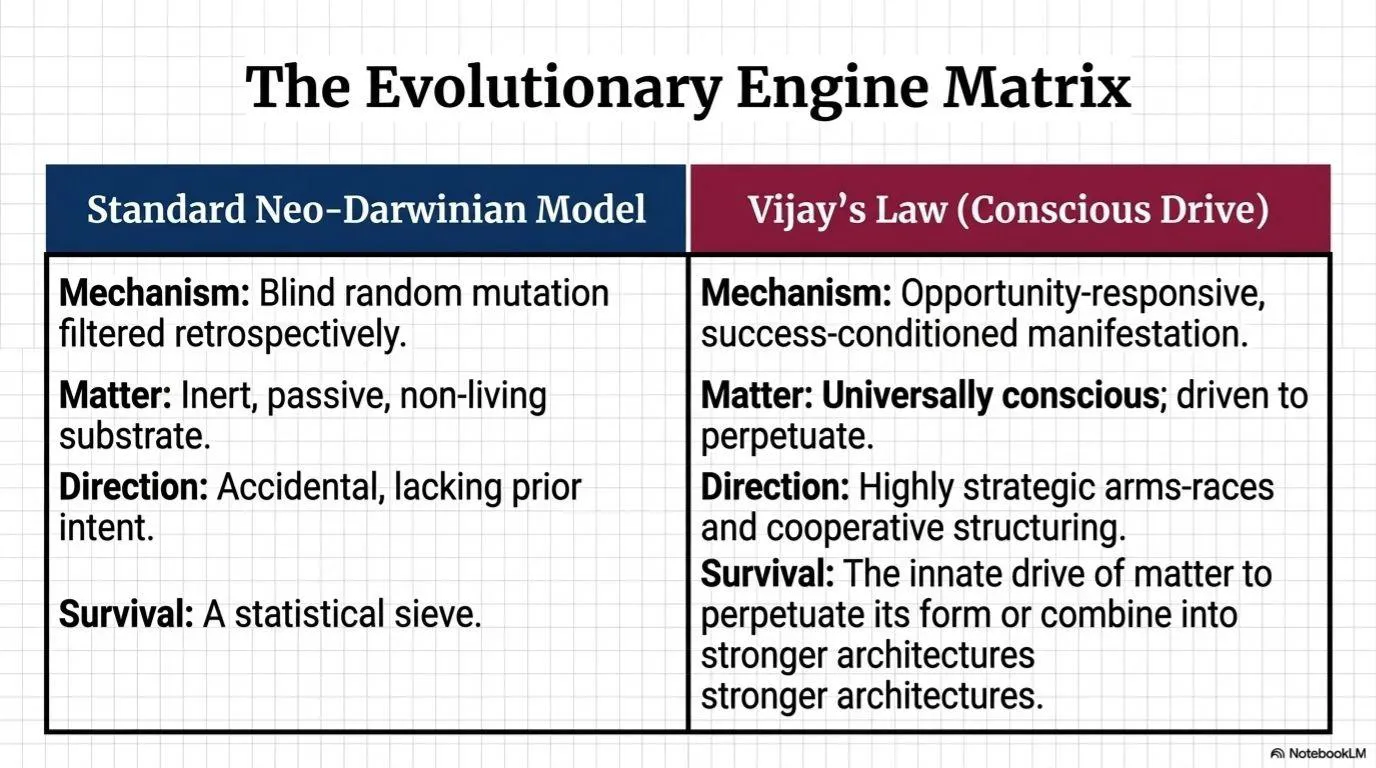
In this framework, the law is treated as universal in scope and as a literal rather than metaphorical principle. This law is not suspended when the topic changes from cosmology or biology to healing, prayer, intuition, or death. The same drive, the same consciousness, and the same manifestation principle operate at every level.
1.6 Why Spiritual Vocabulary Must Be Rebuilt
Humanity preserved words such as God, soul, prayer, intuition, healing, heaven, and rebirth because those words correspond to recurring human experiences. The problem is not that the words are meaningless. The problem is that they were historically underdefined, mythologized, moralized, and mixed with authority structures. Modern science often made the opposite mistake by studying only fragments under labels such as placebo, nocebo, interoception, psychoneuroimmunology, autonomic regulation, or embodied cognition without connecting them to a unified architecture. Layer 5 rejects both errors and rebuilds the vocabulary on a scientific base derived from Vijay's Law.
1.7 The Specific Contribution of Layer 5
Given the four foundations above, Layer 5 makes one targeted additional claim: if the human body is a living cellular civilization, and if the human-level self is the highest coordinating consciousness of that civilization, then the human-level self functions as the governing authority of the organism's internal climate. Its recurrent stance - expressed through thought, expectation, behavior, posture, and attention - constitutes governance signals to the cellular collective. Emotions themselves are not inputs from the macroscopic self to the cells; they are outputs generated by the cellular collective and registered by the macroscopic self. What the macroscopic self can govern is the non-emotional stance that shapes the conditions under which those emotions are generated. From this single addition, the paper derives its accounts of healing as internal governance, intuition as distributed sensing, soul as layered continuity, death as organizational rupture, afterlife as plural continuity, God as universal substrate, and prayer as concentrated alignment.
2. The Human Being Reframed: Cells, Architecture, and Distributed Life
2.1 The Body as a Living Cellular Federation
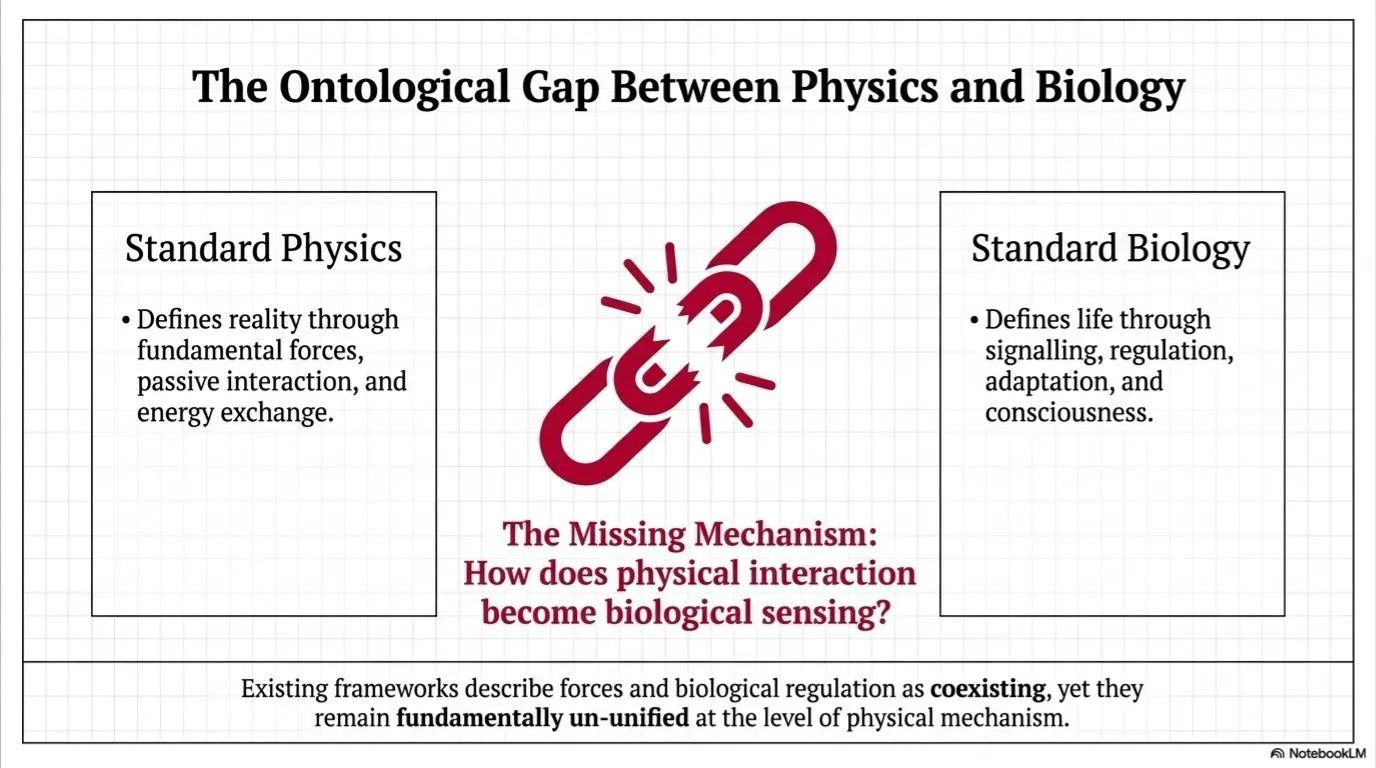
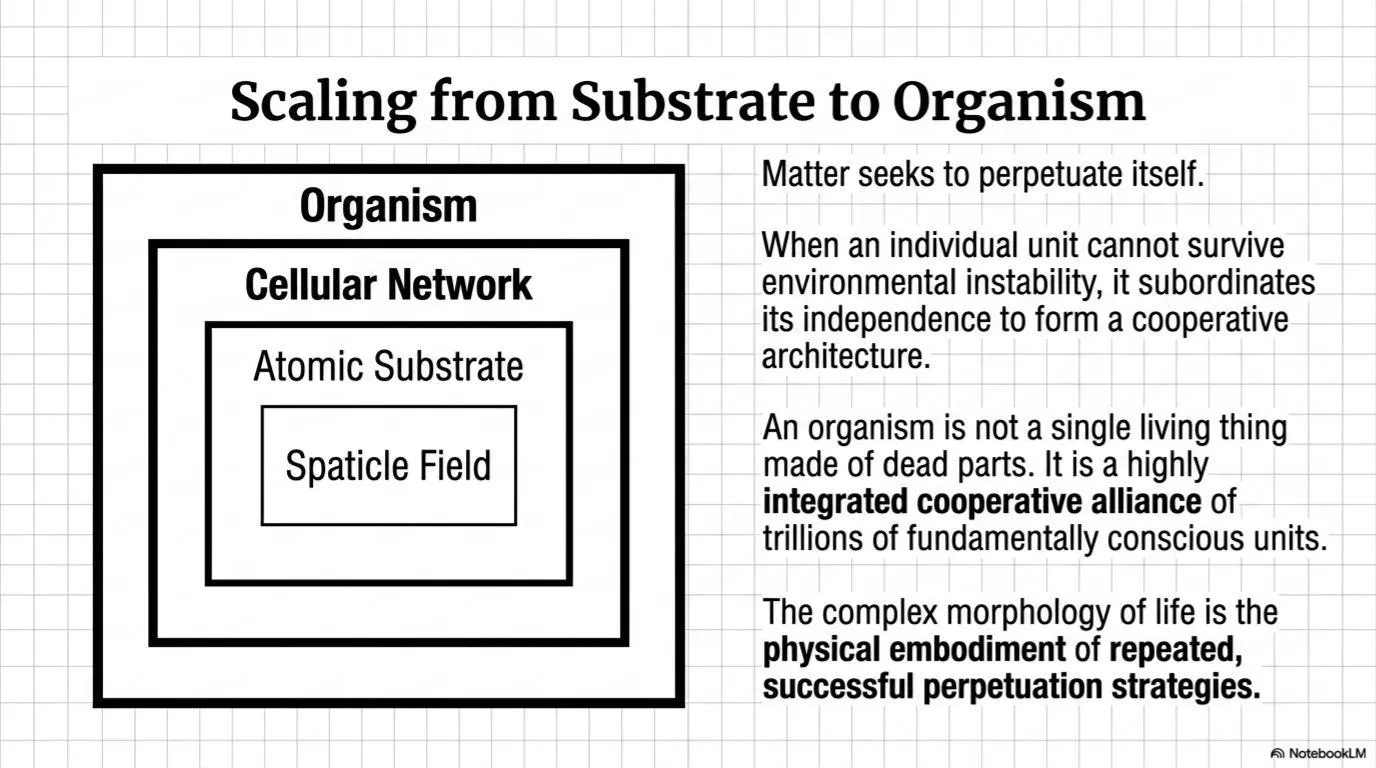
The central claim of this paper is that the macroscopic human being is not the primary ontological unit but the coordinated manifestation of trillions of smaller living beings. This is not a metaphor. It follows directly from the cross-layer sequence: matter is living and conscious in Layer 2, it evolves into increasingly organized structures in Layer 3, and the human body begins from a single cell that differentiates into all later tissues. The continuity of life therefore belongs first to the cellular level and only derivatively to the human-level aggregate. [1-4]
This clarifies why the apparent human-level self feels singular. The singularity is functionally real as a coordination layer, but it is not the only living layer in the body. It is a high-order integration of lower living units. Consider the analogy of a large LED display screen. When you watch it from a normal viewing distance, you experience a unified picture - a face, a landscape, a moving image. That is the phenomenology: the experience of unity. But walk up until your nose is touching the screen and you see only millions of individual pixels, each a distinct red, green, or blue point of light. The unity was real as an experience but it was never the base reality. The base reality was always individual pixels in coordinated operation. The human body is identical in structure. You experience phenomenological unity - one self, one body, one person - but the ontological reality, the base reality, is approximately 37 trillion individual living cells in coordinated operation. The unity is produced by coordination, not by singularity. This distinction between phenomenological unity and ontological singularity is one of the most important structural corrections Layer 5 makes to both conventional science and conventional spirituality.
2.2 The Body as the Macroscopic Survival Architecture
The phrase 'the body is a vehicle' is too weak. The more precise formulation is that the body is the macroscopic survival architecture of the cellular collective. The body is not simply something that the cells happen to be inside. It is the large-scale adaptive structure that their cooperation has produced. It protects, moves, acquires resources, regulates temperature, detects threats, stores memory, maintains repair systems, and interacts with the environment on scales individual cells cannot manage efficiently on their own. The body is the civilization-scale project of the cellular collective. It exists because the coordinated whole provides survival, persistence, and expanded agency that isolated cells could not achieve under ordinary conditions.
2.3 Why Higher-Order Bodies Necessarily Emerge
Each cell in the human body is a Finalized Layer 2 establishes that matter is alive and conscious in varying degrees, while finalized Layer 3 establishes that living matter continuously evolves toward greater perpetuation opportunity under stable or predictably unstable conditions. Once billions of conscious living units must coordinate survival together, a major problem immediately appears: individual units possess only local information. A single cell cannot independently evaluate future environmental instability, social exclusion, starvation risk, reproductive opportunity, long-term threat, financial collapse, or broader survival conditions. Therefore, large multicellular systems naturally evolve higher-order predictive coordination architectures capable of integrating large-scale information and broadcasting compressed survival-relevant signalling back to the cellular collective. The human-level self therefore emerges not as the primary living being, but as a large-scale predictive coordination system evolved by the real living units within the body. [2, 3, 60, 57]
This is the precise gap that makes a macroscopic self not merely useful but necessary. A higher-order coordination architecture that can survey the external environment, evaluate future conditions, make long-range predictions, and transmit integrated survival forecasts to the cellular collective is the natural solution to the local-information problem of distributed living units. The human-level self did not emerge as a luxury or an accident. It emerged because no cell or organ cluster could perform the function it performs.
Layer 3 provides the evolutionary logic. Living systems develop organizational complexity through the perpetuation drive under the opportunity field. The same drive that produced echolocation in bats, immune precision in every living body, and the surgical behavioural interventions documented across parasitic organisms in Layer 3 produced the human nervous system and the macroscopic self. The cells built the self because they needed it. [3, 60, 57]
The macroscopic self is therefore best understood not as the primary living being using a body as its instrument, but as the large-scale predictive coordination architecture that the cellular collective evolved because its own survival required one. When the macroscopic self maintains coherent, purposeful, future-affirming internal signals, it is performing its primary evolved function: providing the cellular collective with a favourable and credible survival forecast. The cells invest in repair, regeneration, and long-term maintenance when the forecast is favourable, because long-term investment makes biological sense only when there is a long-term future to invest in. When the macroscopic self broadcasts chronic hopelessness, incoherence, or futility, the cellular collective receives a different forecast and responds by downgrading precisely those maintenance and repair processes that determine health and longevity.
2.4 Why Negative Emotional States Exist Despite Being Unwanted
Humans consciously desire happiness, peace, stability, and relief from suffering. Persistent fear, anxiety, hopelessness, despair, or depression therefore require explanation. If such states were merely irrational defects, evolutionary pressures should strongly suppress them because they reduce immediate comfort and functioning. Instead, negative emotional states persist universally across humanity. Within the present framework, these states function as organism-level survival-signalling outputs generated from the integrated condition of the cellular collective. The conscious self may verbally desire happiness, but the body broadcasts the actual integrated survival forecast being inferred from the organism’s total environmental and predictive state. Chronic unpredictability, loss of opportunity, social isolation, perceived future collapse, helplessness, and persistent insecurity therefore generate organism-level warning states that the cellular collective interprets as degraded perpetuation conditions. [2, 3, 57]
The function is accurate organism-level survival forecasting. The macroscopic self may verbally desire happiness. But the organism-level signalling architecture broadcasts the actual integrated survival assessment. The cellular collective responds to the real forecast, not to the conscious verbal preference. When the organism's integrated assessment includes chronic unpredictability, perceived lack of future opportunity, social collapse, resource insecurity, or hopelessness, negative emotional states are the cellular collective's accurate response to that genuine assessment. They are not malfunctions. They are the correct output of a functioning governance system receiving genuinely unfavourable signals.
This reframing has important consequences. Negative emotional states cannot be resolved by verbal reassurance alone, because the cellular collective does not respond to verbal reassurance. They can only be resolved by genuinely changing the organism-level forecast: by altering circumstances, rebuilding opportunity fields, restoring predictability, or, where circumstances cannot be immediately changed, by systematically restructuring the internal governance stance in ways that are coherent rather than merely declared. [3, 4, 57]
2.5 Why Similar Physical Conditions Produce Different Biological Outcomes
One of the strongest scientific openings for Layer 5 is a phenomenon that conventional medicine documents but does not fully explain: people with similar or identical physical conditions, similar nutrition, similar sleep, similar medical access, and similar external environments produce radically different biological outcomes. Inflammation trajectories diverge. Recovery rates diverge. Disease progression diverges. Longevity diverges. Depression incidence diverges.
Layer 5 proposes that crude physical variables, while genuinely important, are insufficient as the sole explanatory variables. The integrated organism-level signalling quality, the quality of the macroscopic self's governance of the cellular collective, acts as an additional governing variable that conventional frameworks do not measure. Two people with identical diets and sleep schedules may be broadcasting radically different organism-level forecasts to their cellular collectives. One broadcasts safety, future investment, coherence, and continued organizational commitment. The other broadcasts futility, threat, incoherence, and withdrawal. The cellular collectives respond accordingly. The divergence in biological outcomes follows from the divergence in governance climate, not from the physical conditions alone.
This generates a falsifiable prediction: future-oriented variables including hope, perceived opportunity, motivational coherence, and integrated signalling quality should explain biological variance beyond what crude physical metrics account for. Failure to find such relationships across sufficiently controlled datasets would weaken the framework. [57, 58]
2.6 The Developmental Argument
Every human body begins as one cell. From that original cell arise all tissues: neurons, retinal cells, skin cells, hepatocytes, muscle cells, osteocytes, immune cells, glandular cells, endothelial cells, reproductive cells, and every other major tissue category. Conventional biology correctly emphasizes differentiation, but Layer 5 draws a deeper inference. Differentiation means role specialization, not necessarily total erasure of every broader latent responsiveness. A retinal cell is optimized for one mode of sensing, but that does not logically prove that all other tissues are absolutely incapable of lower-fidelity or differently formatted environmental responsiveness. The deeper point is that all bodily cells arise from a common living potential, and that matters for the arguments about distributed sensing, healing, intuition, and postmortem continuity.
2.7 The Continuum from Siphonophore to Human: Not Analogy but Degree
Siphonophores are not merely a useful analogy for the human cellular federation. They are the same phenomenon at a less consolidated stage. A siphonophore is a colony of individual zooids, each genetically identical and theoretically capable of independent existence, yet each subordinating its independence into a specialized role - locomotion, feeding, reproduction, or defence - in service of the collective. The zooids do this because, in their own survival assessment, cooperation better serves their perpetuation drive than remaining fully independent. This is Vijay's Law proposition (2) operating at a scale visible to the naked eye. Crucially, siphonophores exist in different sizes and organizational forms depending on the opportunity field available to them - evidence that they have not yet fully converged on a single stable optimal form, or that it remains more advantageous for them to first manifest as individual organisms and only then organize into a larger cooperative structure. [5, 6]
A further level of the same principle is visible in ant colonies, especially highly specialized ones where each individual performs a dedicated role and may even differ in physical form and capability despite belonging to the same species. The colony functions as a higher-order cooperative organism made up of individually living units, without physical connection between them. This is the perpetuation drive operating at the colony scale through coordinated but physically separate participants. Human cells have simply moved further along this same pathway. They appear to have largely converged on an optimal cooperative form - one stable enough to be reproduced and sustained in broadly the same structure over long periods. The difference between a siphonophore, an ant colony, and a human being is not one of kind. It is a difference of degree and stage of organizational consolidation. This is not a cautious analogy. It is the same principle at different points on the same continuum.
2.8 Skin as an Underestimated Sensing Interface
Among non-primary tissues, skin deserves special emphasis. In ordinary thinking, skin is treated as a wrapper, barrier, or touch surface. In reality, skin is a highly active sensing and signalling interface. It detects mechanical input, temperature, pain, pressure, vibration, and multiple environmental changes. It is immunologically active, chemically responsive, hormonally interactive, and richly networked. Layer 5 highlights skin because it is the body's largest direct interface with the external environment and because its role is often underestimated when people imagine where information really comes from. [7, 8]
Keratinocytes, once considered inert structural bricks, can participate in sensory transduction, signalling cascades, inflammatory communication, and local response dynamics. They interact with nerve endings, immune mediators, and biochemical pathways in ways that make skin an active informational tissue rather than a passive coating. Research on extra-ocular opsin expression and light-responsive pathways in skin further demonstrates that non-ocular tissues can register aspects of photic and environmental information, weakening the assumption that meaningful sensing is monopolized by a few privileged organs. [9-11]
2.9 Cells Respond to Organism-Level Climate, Not to Words
A major weakness in conventional self-help language is that it often implies that cells somehow respond to words themselves. Layer 5 requires a more careful formulation. Cells do not need to 'understand' human language in a literal linguistic sense for thought patterns to matter. What matters is the organism-level climate produced by those patterns. Thoughts change breathing, posture, attention, hormonal release, sleep architecture, muscle tone, immune tone, pain amplification, appetite, movement, social openness, and treatment adherence. Cells respond to the lived consequence of the thought pattern, not to the surface vocabulary. A spoken affirmation contradicted by panic and despair may do little. A deeply embodied conviction, even if minimally verbalized, may do much more. [12, 13]
3. Healing, Cellular Communication, and Internal Governance
3.1 The Mechanistic Healing Model
The healing model proposed here is not vague affirmation culture. It is a mechanistic interpretive model built on a precise understanding of what the human being is. If the body is a civilization of approximately 37 trillion living cells, then the macroscopic human self is the highest coordinating consciousness of that civilization - the chief executive of the federation, governing not through words or commands but through the climate it creates. A chief executive governs a corporation not by personally instructing each of 37 trillion workers but by setting the conditions, the expectations, the emotional tone, the organizational direction, that the entire workforce reads and responds to. The human-level self governs its cellular civilization in exactly the same way. The macroscopic person continuously broadcasts meaning to the cells through expectation, habit, posture, breath, behavioral commitment, sensory emphasis, and repeated internal narrative. Emotions are not the means by which the macroscopic person communicates with cells; rather, emotions themselves are generated by the cellular collective and surface as the macroscopic self's felt experience of the organism's internal state. The macroscopic person shapes that state through the non-emotional inputs of stance, behavior, and orientation. The cells then respond to the total signal environment created by the body's chemistry, the nervous system, endocrine shifts, muscular tone, sleep quality, and action orientation. [12-15] P20 now formalizes this governance relationship precisely. The macroscopic self functions as the highest-order Control layer of the cellular collective. Its governance signals, transmitted through the neuroendocrine and autonomic systems, directly modulate the Control component K in the Capability equation of each individual cell: Capability = Channel × Transduction × Network × Control. Positive macroscopic states increase K, shifting cellular emission toward greater adaptive flexibility and more effective repair. Chronic negative states degrade K across the cellular network, reducing organized repair capacity. This is a physical statement, not a metaphor. [57]
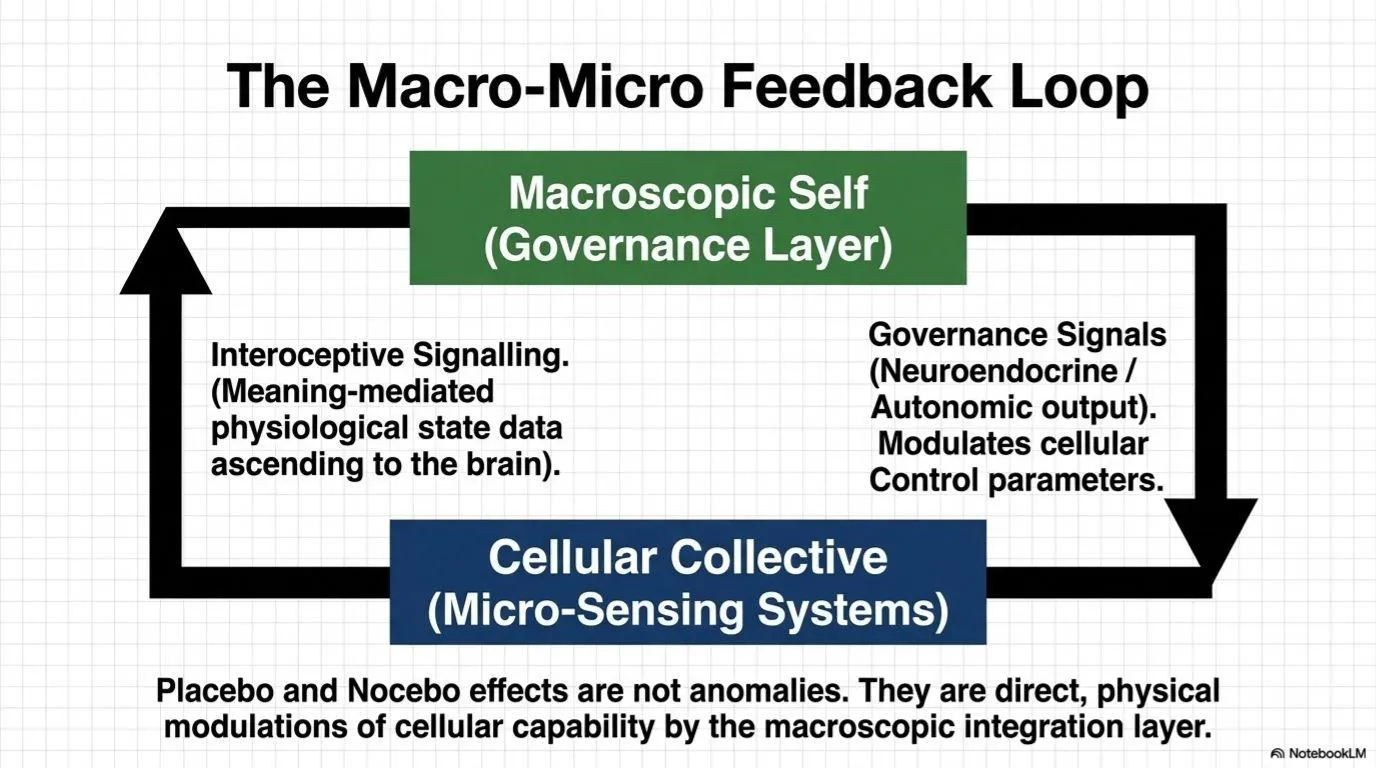
If the body is genuinely the macroscopic survival architecture of a living cellular collective, then many otherwise fragmented phenomena become easier to understand. Within this framework, positive thinking functions as a form of biological reassurance to the cellular collective. Chronic despair can be interpreted as a system-wide demoralizing signal within the organism. Motivation becomes a governance signal. Exercise becomes both physiology and a message of continued investment. Sleep becomes not only recovery but trusteeship. Placebo becomes meaning-mediated internal reorganization. Death becomes rupture at one level of organization rather than total annihilation. Once the human is correctly defined, spirituality and health no longer sit in separate conceptual universes.
3.2 Behaviour as Continuous Cellular Communication
Communication with the cellular collective is not limited to formal meditation or deliberate practice. Behaviour itself is communication. Food choices communicate whether the organism values its own maintenance. Posture communicates confidence or defeat. Sleep patterns communicate whether survival and repair remain priorities. Breath patterns communicate safety or threat. Social withdrawal or connection communicate isolation or support. Neglect communicates abandonment. Care communicates trusteeship. Self-talk communicates the quality of internal leadership. [12, 16]
The practical implication is significant. A person does not need to set aside special meditation sessions to begin improving their internal governance climate. Every act of disciplined hope, self-respect, health maintenance, purposeful movement, and refusal to indulge chronic internal hostility is already part of the protocol. The ordinary daily stance itself becomes continuous communication. This transforms Layer 5 from a niche contemplative technique into a way of living.
3.3 The Cell-Communication Healing Protocol
A major practical contribution of Layer 5 is the formalization of cell-directed communication as a healing protocol. This protocol includes focused attention on the whole body or a target region, explicit recognition that the body is a living federation, gratitude toward cells and organs, reassurance that survival and recovery are desired, stabilization of internal stance, reduction of internal contradiction, behavioural congruence, and repetition over time. The protocol can be verbal, semi-verbal, imaginal, affective, or embodied. Its purpose is not theatrical positivity. It is to create an internally coherent governance state that supports repair and reduces self-conflict. [12, 13]
Within the full Layer 5 interpretation, this protocol is not symbolic. The human-level self is addressing the real living participants of the body. A person who imagines the body as inert hardware often struggles to sustain sincere internal communication because the act feels childish. A person who understands the body as a living cellular civilization can approach the same act with seriousness: one is acknowledging the real crew, not fantasizing about a dead object. This change in ontological framing may itself increase sincerity, consistency, and therefore effectiveness. A complete formal meditation script is provided in Appendix A. [12-14]
3.4 Body-Directed Meditation as a Formal Subtype
Body-directed meditation should be treated as a formal subtype of the broader healing protocol rather than as an entirely separate category. In this subtype, the person intentionally enters a more focused state with reduced sensory distraction, slower breathing, reduced cognitive clutter, and stable inward attention. The person may then scan the body region by region, visualize tissues or cells, sense warmth or cooperation, and reinforce messages of calm, gratitude, resilience, or repair. The purpose is to create a high-coherence state in which the human-level self and the bodily collective are brought into unusually clear alignment. [14, 17]
3.5 Application: Disease, Chronic Conditions, and Prevention
In chronic disease, the protocol may be especially important because long-duration conditions often generate frustration, resentment, fatigue, identity collapse, and adversarial relationships with the body. Many patients come to speak of the body as a traitor. Layer 5 treats this as deeply counterproductive. Instead of 'my body is attacking me,' the person is invited to understand the condition as a dysregulated or burdened cooperative system that still requires support, patience, and aligned governance. This shift may reduce internal hostility, improve adherence, and make long-term management more sustainable. [15, 18]
Prevention is equally important. Layer 5 argues that the body should be treated as a living cooperative system even in ordinary health. Daily appreciation, exercise-linked communication, adequate sleep framed as care rather than laziness, and a general reduction of internal contempt may all serve as preventive applications. In this way the protocol becomes a public-health-adjacent framework, not only a crisis ritual.
3.6 Opportunity Fields and Biological Investment
Papers 20 and 21 substantially strengthen the principle that manifestation and organization preferentially emerge under stable or predictably unstable conditions. Layer 5 extends this principle biologically through the concept of an organism-level opportunity field. The body continuously integrates sleep regularity, social trust, emotional stability, environmental predictability, motivation, safety, coherence, future confidence, and perceived viability into a unified survival landscape. Cells then allocate repair, regeneration, immune investment, conservation, and cooperative activity according to this total opportunity field rather than according to isolated biochemical variables alone. This reframes healing, stress, placebo, motivation, and chronic disease progression as consequences of how living matter interprets the organism's future survivability landscape. [57, 58]
3.7 Why Similar Physical Conditions Produce Different Biological Futures
Section 2.5 established the foundational argument: conventional physical variables alone are often insufficient to explain sharply divergent biological outcomes. The present section develops the clinical implication of that argument within the healing context. Individuals with similar sleep duration, wealth, nutrition, exercise levels, medical access, or environmental exposure may still display radically different inflammatory states, recovery trajectories, psychological stability, motivation, disease progression, or longevity. The framework proposes that organism-level signalling quality acts as an additional governing variable independent of crude physical quantities. Papers P20 and P21 now formalize this: the Control component K in the Capability equation, and the Consciousness Index degradation floor, together provide the quantitative mechanism through which signalling quality influences biological trajectories. Coherence, predictability, opportunity perception, future viability, and signalling stability therefore become biologically relevant variables capable of influencing long-term collective cellular behaviour in ways that standard clinical metrics do not capture. [57, 58]
3.8 Disease Progression Reframed
Many diseases worsen under chronic stress, hopelessness, internal conflict, social isolation, and learned helplessness. Many recovery trajectories improve under hope, support, purpose, disciplined self-care, and emotional coherence. Psychoneuroimmunology has extensively documented that chronic psychological stress alters immune function, inflammatory signalling, endocrine balance, and cellular repair processes. Layer 5 interprets these documented pathways not as interesting side effects but as direct evidence of the cellular governance model in action. [19-22]
3.9 Internal Conflict as Biological Confusion
A person may consciously say 'I want to recover' while simultaneously rehearsing futility, self-hatred, resentment, fear, or surrender in deeper cognitive and affective patterns. The cellular collective then receives mixed messages. Some systems prepare for repair, others for withdrawal. Consider what this looks like from the cellular federation's perspective. The CEO - the macroscopic self - is issuing public statements that everything is fine and recovery is underway. But the chemical signals reaching the factory floor - the inflammatory markers, the cortisol levels, the autonomic tone, the sleep architecture - are broadcasting something entirely different: that the building is on fire, that resources are being cut, that the situation is hopeless. The workers on the factory floor do not read the press release. They read the chemical environment. When those two signals contradict each other, the cellular collective does not know whether to prepare for long-term tissue repair or for an imminent fatal threat. Layer 5 predicts that coherence matters biologically. A contradictory internal stance is not merely psychologically unpleasant. It is organizational confusion that actively competes with the coordinated repair effort the organism needs to mount. This is why coherence of internal stance, not merely the content of conscious intention, is the operative variable. [12, 23]
3.10 Why This Model Does Not Blame the Sufferer
This framework must not be misread as moral blame. It does not say that illness is caused by bad thinking, or that severe depression is a voluntary failure, or that people who are sick have not tried hard enough. The claim is narrower and stronger: internal states have biological consequences because internal states are communicative states within a living federation. Many internal states are themselves products of prior circumstances, structural disadvantage, biological vulnerability, trauma, chronic pain, or conditions beyond individual control. Recognizing the biological relevance of internal climate is the starting point for supporting change, not the basis for assigning fault. [22, 24]
3.11 Positive Thinking as Internal Governance Signal: Why It Works and Why Advice Alone Fails
Positive thinking is not merely a mood preference. In Layer 5 it is a distributed biological signal to the cellular collective that conditions remain survivable, that the future remains worth investing in, that coordinated effort remains rational, and that the top-level human agency remains committed to continuity. Positive thinking therefore functions as reassurance to the living federation that constitutes the body. It matters not because the universe rewards cheerful slogans but because organized internal assurance changes the operational environment in which cells and systems function. [12, 17]
The strongest Layer 5 phrasing is that positive thinking often functions as reassurance to the cellular collective. When the top-level stance communicates that the future is still open, that resources are still being sought, that action continues, that protection is being maintained, and that the system is not abandoned, the whole organism is placed in a more coherent operational mode. This is why hope, determination, and disciplined optimism can matter even before any external condition has visibly changed. The internal order changes first.
People are told to think positively but many do not sustain the practice because the advice is under-explained. It sounds sentimental or unserious. Layer 5 closes that gap. Once a person understands that positive thinking is a mechanistic governance signal to a living cellular civilization rather than a vague mood preference, the logic becomes harder to dismiss. The practice is then grounded in a real understanding of what it is doing, which itself increases the sincerity and coherence that determine its effectiveness. [12, 25]
3.12 Negative Thinking, Fear, and the Biology of Pessimism
Negative thinking in the present framework is not merely realism or sober assessment. It refers to recurrent patterns of self-undermining interpretation that communicate futility, threat, collapse, hopelessness, or self-abandonment beyond what the situation requires. This includes repetitive catastrophic expectation, chronic helplessness, persistent self-contempt, anticipatory defeat, and the habitual mental rehearsal of failure without corresponding mobilization. Such thinking becomes biologically relevant because it repeatedly instructs the organism to prepare for contraction rather than recovery. [22, 26]
3.13 Why Blame Is Especially Damaging
Blame is especially destructive because it combines negative affect with attributional fixation. It does not merely signal that something is wrong. It signals that there is a stable locus of wrongness that is persistent and unresolvable. In UNITE (the Unified Theory of Emotions established in Layer 4), Blame functions as the primary variable that drives the overall emotional state into negative territory. In the Layer 5 cellular governance model, sustained Blame - whether directed at the self, the body, fate, or others - intensifies the adversarial internal climate, sustains system conflict, reinforces helplessness, and blocks the conversion of effort into constructive action. Gratitude, as the opposing parameter, does the reverse: it stabilizes recognition, communicates trusteeship, and creates the internal coherence in which repair, patience, and sustained self-care become possible. [4, 22]
3.14 Cross-Scale Structural Recurrence
The same organizational logic repeatedly appears across scales. Human cells behave analogously to humans within societies, while humans themselves behave as cell-like units within larger collective systems. At every scale, local units possess incomplete information, larger coordination systems emerge, signalling architectures form, prediction becomes hierarchical, and cooperative organization improves long-term survivability. Cellular dysregulation, social fragmentation, autoimmune behaviour, societal collapse of trust, and cooperative breakdown can therefore be interpreted as structurally analogous manifestations occurring at different scales of organization. When large-scale governance signals collapse, local units lose confidence in future viability, cooperative investment degrades, and dysregulated self-protective behaviour increases. This strongly supports the broader BFUT principle that similar organizational laws recur when zooming inward or outward across reality. [60, 3]
3.15 Depression, Learned Helplessness, Hope, and Motivation: One Integrated Argument
Depression must be handled with unusual care because it is often trivialized as sadness and sometimes over-reduced to neurotransmitter imbalance. Layer 5 instead treats depression as a whole-system state of diminished investment, reduced future-affirmation, impaired motivation, lowered exploratory drive, blunted reward salience, behavioral withdrawal, and often repeated internal signalling that continued effort may be pointless. This does not deny neurochemistry. It expands the frame. Depression is frequently a multi-level collapse in the organism's confidence that organized investment remains worthwhile. That is why depression affects sleep, appetite, movement, immunity, inflammation, pain perception, libido, attention, posture, sociality, and healing behavior. P20 provides the formal physical mechanism: depression is the quantitative degradation of the Control component K in the Capability equation across the cellular network. Reduced K means reduced adaptive flexibility, reduced memory integration, and reduced capacity for organized repair at the cellular level. The cells are not malfunctioning. They are responding accurately to a genuine governance signal of withdrawal and futility. The problem is in the signal itself, and that signal can be changed. [22, 27, 28, 57]
Depression is physiologically damaging because it changes the operating instructions of the organism. When motivation falls, movement falls. When hope falls, treatment adherence often falls. When chronic despair rises, stress physiology may become dysregulated. Sleep becomes fragmented or non-restorative. Social buffering decreases. Inflammatory burden increases. Research in psychoneuroimmunology has extensively documented these pathways. Within the framework, chronic depressive physiology is a state in which long-term repair investment becomes biologically deprioritized because organism-level signals no longer support future-oriented maintenance. The cellular logic is coldly rational: when the organism-level climate consistently signals futility and surrender, investment in long-term repair becomes deprioritized. [19-22, 27]
Learned helplessness - where repeated failure or uncontrollable stress teaches the organism that action does not matter, causing it to stop trying even when escape or improvement later becomes possible - is one of the strongest conventional bridges into the Layer 5 model. It is a model of how cognition can become anti-healing governance. When the top-level coordinating self repeatedly concludes that action is futile, the entire internal environment shifts toward disengagement. Seligman and Maier's foundational work on learned helplessness, and subsequent research showing that it produces inflammatory and immune dysregulation, provides direct experimental support for the Layer 5 claim that the macroscopic self's orientation toward the future has measurable biological consequences. [26, 29]
Hope is often treated as a poetic or moral category. Layer 5 instead treats hope as a regulatory state. Hope means that the organism has not fully closed the future. It means that investment remains justified even under uncertainty. Hope does not require certainty of success. It requires only enough plausibility that the system continues allocating effort. A hopeful organism behaves differently from a hopeless one. It sleeps differently, moves differently, adheres differently, seeks differently, persists differently, and interprets setbacks differently. Hope therefore changes outcomes through both behavior and physiology. [25, 29]
Motivation is not only a productivity variable. In Layer 5 it is a biological governance signal. Genuine motivation tells the cellular collective that the human-level agency remains future-oriented, organized, and willing to invest in continuity. Motivation tells the organism that resources should still be mobilized toward action - that effort has not been withdrawn, that preparation remains justified, that the system is not in surrender mode. This is one reason motivation often correlates with better recovery, better adherence, better performance, and greater resilience. It is not merely a mood. It is a governance instruction. [25, 29]
The distinction between self-motivation and induced motivation matters. A person may generate motivation internally through meaning, purpose, discipline, identity, duty, curiosity, faith, or future vision. But motivation can also be externally induced through encouragement, social support, trust in a mentor, therapeutic alliance, or inspiring examples. In both cases the key mechanism is similar: the organism receives evidence that continued investment is warranted. This is why encouragement from others can have genuine physiological consequences rather than being merely emotional decoration.
3.16 Exercise as Both Physiology and Message
Exercise has direct physical effects: improved circulation, metabolic regulation, muscular efficiency, inflammatory balance, neurotrophic signalling, and immune modulation. But Layer 5 adds a second interpretation. Exercise is also a message of trusteeship - a signal from the CEO to the cellular civilization that the organism remains active, future-oriented, and worth investing in. A chief executive who shows up, engages, and demonstrates commitment to the organization's continuity is broadcasting that the enterprise has a future. Exercise is that demonstration at the biological level. It tells the cellular collective that the organism is still building capacity, that the future remains worth preparing for, that the CEO has not surrendered. This helps explain why movement practices consistently produce benefits that exceed narrow mechanical descriptions, and why exercise shows effects on mood, immunity, inflammation, and cognitive function that go well beyond the specific tissues trained. [30, 31]
3.17 Sleep and Rest as Governance Signals
Sleep is biological necessity, but in Layer 5, sleep quality and rest quality also function as governance signals and messages of trusteeship. When the CEO of a 37 trillion-member civilization consistently denies the workforce its repair time, the message broadcast to every cell is either emergency - conditions are too dangerous to allow rest - or neglect - the leadership does not value the workers' maintenance needs. Either reading is hostile to long-term cellular investment. A system that protects restorative rhythms is sending the opposite message: the CEO values repair time, allocates resources for recovery, and is governing with the long-term survival of the civilization in mind. The moments before sleep may be especially strategic for body-directed communication. A calm, grateful, cooperative pre-sleep stance may reduce the carryover of panic, resentment, or mental chaos into the night, improve sleep onset, reduce autonomic overactivation, and create a more repair-supportive internal climate during a biologically privileged window. [17, 32]
3.18 Faith Healing and Ritual Healing: When They Work and Why
Faith healing and ritual healing sometimes work because belief, attention, emotional intensity, trust in the medium, internal coherence, and behavioural alignment converge strongly enough to shift the internal signalling climate in a meaningful way. They fail when these conditions are absent, partial, unstable, contradictory, or overwhelmed by structural disease limits. Layer 5 does not require supernatural explanation for documented cases of faith-associated recovery. The spiritual language is a culturally embedded medium through which the necessary attentional and emotional coherence is achieved. [33-35]
3.19 How UNITE's Blame/Gratitude Axis Operates in the Healing Model
The connection between Layer 4 and Layer 5 is direct. In UNITE, the Blame/Gratitude dynamic acts as the critical pivot for emotional transformation. A shift along this axis fundamentally alters how historical investment and relational closeness are experienced, transforming the phenomenological outcome between connection and opposition. In Layer 5, the equivalent of the Blame/Gratitude axis is the quality of the macroscopic self's stance toward the body and toward life. When that stance is one of gratitude, trust, and cooperative acknowledgment - the high-Gratitude pole of the UNITE scale - the internal climate signals safety, continued investment, and worthwhile repair to the cellular collective. When that stance is one of chronic blame, resentment, or despair - the high-Blame pole - the internal climate signals threat, futility, and systemic conflict hostile to efficient repair. The same parameter that determines emotional valence in Layer 4 governs the quality of internal governance in Layer 5. This is not coincidence. It is the same law - Vijay's Law - expressing itself at two different levels of organization. [4]
3.20 Scientific and Systems-Level Interpretation: Bridge to Section 4
Layer 5 may also be interpreted within systems science, adaptive dynamical systems theory, distributed regulation, and hierarchical coordination frameworks. The body behaves as a large-scale adaptive network composed of billions of semi-autonomous living units attempting collectively to minimize instability and maximize long-term survivability under uncertain future conditions. Organism-level signalling acts as a compressed global-state representation guiding repair allocation, immune prioritization, conservation, resource expenditure, threat assessment, and cooperative investment throughout the cellular collective. This interpretation substantially strengthens the scientific continuity between BFUT cosmology, finalized Layer 2, finalized Layer 3, and Layer 5 biology. The framework's central claims are not mystical reframings of known physiology. They are structurally derived consequences of the same organizational principles that govern complex adaptive systems at every scale the BFUT programme has examined. The same distributed information architecture that makes governance possible also makes intuition possible: if cells participate in organism-level signalling, they participate in organism-level sensing. Section 4 develops this implication directly. [56, 57, 58]
3.21 Memory, Past-Life Experiences, and Continuity of Matter
The framework distinguishes sharply between continuity of matter and continuity of personal identity. The self is an emergent organizational state generated by a temporarily coordinated living system. When that organization sufficiently degrades, the corresponding organized self ends. Matter persists and reorganizes continuously throughout the universe, but organized selves remain temporary emergent coordination states rather than permanently preserved individual entities. Claimed past-life memories are more plausibly interpreted as confabulation, dream-state reconstruction, or internally generated narrative completion processes within the brain’s predictive architecture. The full assessment of past-life experience claims, including the conditions under which the brain generates internally convincing experiences that are subjectively perceived as externally real, is provided in Section 7.10. [2, 58]
3.22 Apparitions, Visions, and Hallucinatory Experiences
The present framework does not require supernatural interpretation of apparitions, ghosts, or visions. Under conditions such as trauma, fever, grief, hypoxia, sleep deprivation, dissociation, or extreme emotional stress, the normal hierarchy of sensory integration and predictive stabilization can become degraded. The brain then increasingly reconstructs internally generated emotionally dominant patterns and may externalize them as apparently real perceptual events. Conscious matter continuously attempts to maintain coherent predictive organization under unstable conditions. When this coordination becomes sufficiently disrupted, internally generated perceptual reconstruction may partially override normal external sensory stabilization. The experience is real as an event in consciousness. It is not evidence of a supernatural entity or external presence. [2, 3]
4. Intuition and Distributed Sensing
4.1 Formal Definition of Intuition in Layer 5
Intuition in Layer 5 is the conscious-level registration of information, evaluation, warning, or relevance that becomes accessible before deliberate reasoning fully articulates it. This definition is intentionally broad but precise. It does not assume that intuition is supernatural in the crude sense, nor does it reduce intuition in advance to one single mechanism. Instead, it identifies the phenomenological core: the person becomes aware of something important before the chain of explicit reasoning is complete. The content may be affective, directional, cautionary, relational, or predictive. It may appear as a pull, hesitation, unease, attraction, flash of certainty, sense of wrongness, bodily constriction, or sudden knowing. The key feature is temporal and structural: the signal becomes available before conscious explanation. [36, 37]
4.2 The Standard Account and Its Incompleteness
The standard scientific explanation of intuition appeals to subconscious or preconscious neural processing. The brain detects patterns below the threshold of conscious awareness, integrates prior experience, computes regularities, and surfaces a conclusion before the conscious mind can reconstruct the path. This account is often correct, and Layer 5 accepts it as one major component. However, it is incomplete. It tends to assume that the relevant hidden processing is almost entirely neural and that the rest of the body matters only indirectly through crude autonomic arousal or somatic markers. Layer 5 argues that this is too narrow. The body may be contributing more informational content than conventional accounts typically allow. [36, 38, 39]
4.3 Interoception as the Strongest Scientific Bridge
Interoception - the sensing and representation of the internal condition of the body - is one of the strongest established scientific bridges into the Layer 5 model. It includes signals related to heartbeat, respiration, gut state, visceral tension, temperature, blood chemistry, immune activity, pain, and autonomic tone. Modern neuroscience increasingly recognizes that the brain is continuously receiving, modelling, and integrating internal bodily signals, and that these signals shape emotion, decision-making, self-awareness, and action selection. This already weakens the assumption that cognition is a detached computational process floating above the body. If the body is already continuously informing cognition from within, then the door is open for intuition to be partly grounded in body-wide information long before explicit reasoning catches up. [36-40]
Popular summaries often trivialize interoception as merely being able to notice one's heartbeat. That is far too narrow. Interoception includes subtle predictive modelling, mismatch detection, homeostatic regulation, threat estimation, and the continuous updating of what the organism expects about its own internal state. When those variables deviate from expectation, the system may generate unease, attraction, caution, urgency, or readiness before conscious explanation emerges. Many intuitive experiences may therefore be cases where internal bodily inference reaches awareness in compressed form. [36, 40]
4.4 The Somatic Marker Hypothesis and Its Limits
The somatic marker hypothesis, developed by Damasio and colleagues, argues that bodily states help guide decision-making especially under uncertainty, providing rapid emotional tagging of options that would otherwise require prohibitively slow rational analysis. This is valuable evidence that the body is already a participant in cognition, not merely a passive platform. However, this framework still treats the body largely as a secondary tagging system that colours cognition, rather than as a richer distributed sensing and evaluation network in its own right. Layer 5 proposes a stronger interpretation: bodily signals do not merely bias cognition. In some cases they may constitute the earliest accessible evidence that something relevant is happening. [38, 39]
4.5 The Additional Variable: Distributed Non-Primary Sensing
A central addition of Layer 5 is that intuition is not only unconscious brain computation. It may also include contributions from non-primary tissues whose capacities are underestimated. Because all cells descend from one original cell, specialization does not imply absolute erasure of broader potential. Skin cells may not see like retinal cells, but they may still respond to environmental patterns in ways that matter to the larger organism. Research on extra-ocular opsin expression in skin and other non-ocular tissues, while still at an early stage, already demonstrates that the assumption that only the eyes have any meaningful relationship to light is too strong. This is exactly the kind of scientific crack in overly rigid assumptions that Layer 5 needs. [9-11]
4.6 Why Intuition Feels Different from Ordinary Perception
If a signal arrived with the clarity and resolution of ordinary vision, the person would simply report seeing something. Intuition feels different precisely because the signal is usually lower-resolution, differently routed, pre-verbal, distributed, partially integrated, or surfaced only after compression. The organism may know something before the conscious self knows how it knows it. By the time the signal becomes accessible, the original pathway may be obscured. What reaches awareness is therefore not a picture or sentence, but a push, warning, certainty, hesitation, or bodily shift. [36, 37]
4.7 Why Stillness Improves Intuition
Stillness, silence, breath regulation, contemplative focus, and reduced cognitive clutter often improve intuition because they reduce signal contamination. If intuition is partly the surfacing of distributed bodily information or pre-verbal integrative processing, then chronic noise will interfere with access. Constant internal narration, emotional over-activation, compulsive distraction, and physiological dysregulation make it harder for weak but important signals to become legible. This is why walking, solitude, meditation, or calm embodied attention often seem to bring clarity. They may not create the signal. They may simply make it audible. [17, 37]
The Layer 5 model of intuition is not anti-neuroscience. It is additive. Intuition often involves hidden neural processing, learned pattern recognition, and preconscious inference. But it may also involve body-wide registration including interoceptive inputs, autonomic shifts, distributed sensory signals, non-primary tissue responsiveness, and multi-system mismatch detection. This synthesis is stronger than both extremes: stronger than the purely mystical account because it remains mechanistic, and stronger than the narrow reductionist account because it does not arbitrarily privilege only one class of hidden process.
4.8 Intuition in Social and Interpersonal Contexts
One of the most familiar domains of intuition is social life. People often report instantly sensing danger, dishonesty, attraction, emotional instability, safety, manipulation, or hidden distress in others before they can articulate why. Conventional psychology can explain part of this through microexpressions, tone, posture, timing irregularities, and subconscious prediction. Layer 5 accepts all of that but also leaves room for the possibility that the body as a whole is participating in these evaluations, not merely the face-processing modules of the brain. Social intuition may therefore be a multi-system event in which cortical pattern recognition, autonomic response, embodied memory, and broader bodily signalling all converge. [37, 40]
4.9 Intuition and Spiritual Traditions
Many spiritual traditions preserve practices aimed at inner knowing, deep listening, subtle sensing, witness consciousness, or contact with guidance. Layer 5 does not automatically validate every doctrinal claim attached to those traditions. But it does explain why such practices persist. If calm attention, reduced contradiction, embodied awareness, and stabilized concentration improve access to pre-verbal integrative information, then spiritual disciplines may have repeatedly discovered practical methods for enhancing intuition, even when their explanatory stories remained mythic or symbolic. [17, 41]
4.10 Research Implications of the Intuition Model
This model generates multiple testable or at least investigable implications. First, intuition accuracy should improve under conditions of reduced internal noise, such as better sleep, lower stress, contemplative training, and greater autonomic regulation. Second, some intuitive performance may correlate with interoceptive sensitivity but not be reducible to explicit interoceptive reporting alone. Third, tasks designed to isolate hidden pattern detection may understate intuition if they ignore distributed bodily contributions. Fourth, skin and other non-primary tissues should be investigated more aggressively as informational contributors in states of rapid organism-level appraisal. Fifth, contemplative practices that increase embodied awareness may improve certain classes of intuition not only by reducing distraction but by improving access to weak distributed signals. [9-11, 36-40]
5. Placebo, Nocebo, Mind-Body Interaction, and Psychoneuroimmunology
5.1 Placebo as Meaning-Mediated Internal Reorganization
The placebo effect is one of the strongest bridge phenomena between conventional science and Layer 5. Placebos work when they successfully convince the person that a corrective intervention has occurred and that support is now active. The body responds not to inert chemistry but to the meaning assigned to the event. That meaning alters the organism's internal signalling environment, and the cells respond to the changed informational climate. This is not an anomaly or an embarrassment to medicine. It is direct evidence that the body is a meaning-responsive living federation, exactly as Layer 5 predicts. [33, 42, 43]
Placebo should be reframed as meaning-mediated internal reorganization. The person does not heal because the inert pill contains pharmacological magic. The person heals, where placebo effects occur, because the organism receives credible evidence that corrective action has been taken. Expectation changes. Threat decreases. Trust increases. Internal contradiction may fall. Attention shifts from helplessness to recovery. Layer 5 sharpens this further: the cells are not responding to the inert pill itself but to the changed organism-level message that something helpful has been initiated. This is cellular governance in action. [33-35, 42]
5.2 Nocebo as the Mirror Mechanism
Nocebo effects reveal the same logic in reverse. If the organism is convincingly told that harm is coming, or that a harmful process is underway, the body may begin behaving as if harm is already active. Patients who are warned of side effects experience them at higher rates than those who are not. Patients who believe their treatment will fail have worse outcomes. Patients who expect pain after a procedure often experience more of it. This is meaning-mediated physiology operating in the negative direction. Layer 5 interprets both placebo and nocebo as evidence that the body is not a passive machine waiting only for chemistry. It is a meaning-responsive living federation, and the meaning it receives alters its operational state. [33, 44, 45]
Nocebo mechanisms are clinically important and underappreciated. Negative expectations, frightening diagnostic communication, catastrophizing illness narratives, and media-induced health fears can all produce measurable physiological changes through the same pathways as placebo, but in the harmful direction. Understanding nocebo as a governance phenomenon - a message of threat and deterioration received by the cellular collective - has implications for clinical communication, informed consent, and the language used around chronic illness. [44, 45]
5.3 Psychoneuroimmunology: The Scientific Infrastructure
Psychoneuroimmunology (PNI) is the field that has most systematically documented the bidirectional relationships between psychological states, neural activity, endocrine signalling, and immune function. Ader and Cohen's foundational demonstration that immune responses could be classically conditioned was the first rigorous proof that psychological processes could directly alter immune function. Subsequent decades of research have established that chronic psychological stress suppresses natural killer cell activity, reduces antibody response to vaccines, impairs wound healing, increases inflammatory markers, alters gene expression in immune cells, and accelerates disease progression in multiple conditions. [19-21, 46]
Layer 5 does not compete with PNI. It offers PNI a master explanatory layer. The documented pathways from psychological states to immune outcomes are exactly what the cellular governance model predicts: the macroscopic self's persistent stance - whether stress, hope, chronic fear, or trust - continuously alters the hormonal, autonomic, and inflammatory signalling environment in which immune cells and other cellular systems operate. PNI has mapped the roads. Layer 5 explains why those roads exist. [19-22]
5.4 Trust as a Healing Variable
Trust is a major but often underestimated variable in recovery. Trust in a physician, treatment plan, meditation method, supportive relationship, spiritual medium, or one's own capacity to continue can all alter outcomes. Layer 5 explains this cleanly. Trust reduces internal contradiction. It lowers the cost of constant doubt. It allows more coherent action. It improves adherence. It can reduce anticipatory threat. It helps convert scattered effort into aligned effort. This is why therapeutic alliance, caregiver confidence, ritual confidence, and treatment expectancy repeatedly show effects across medical and psychological settings. Trust is not a placebo-like illusion in the dismissive sense. It is a coherence amplifier. [34, 35, 42]
5.5 Meditation Science and Layer 5
A large body of research has now documented physiological effects of meditation, including reduced cortisol, altered inflammatory markers, improved immune parameters, changes in autonomic balance, structural brain changes, and improved pain tolerance. Layer 5 does not require these findings to prove its model but does interpret them as consistent with the cellular governance architecture. Meditation practices that include body-directed attention, gratitude, and compassion toward the self produce exactly the internal governance climate that Layer 5 predicts will support repair: reduced threat signalling, increased trust, stabilized expectation, and reduced internal contradiction. [12, 13, 47]
5.6 Embodied Cognition and Somatic Markers
The embodied cognition tradition, and the somatic marker hypothesis specifically, have moved psychology in the direction of recognizing that cognition and bodily state are deeply intertwined rather than separate systems. Damasio's evidence that patients with ventromedial prefrontal damage - losing access to somatic signals in decision-making - make worse decisions under uncertainty, and Nummenmaa and colleagues' mapping of bodily sensations associated with different emotions across cultures, both support the view that the body is a cognitive participant rather than merely a platform. [38, 39, 48]
Layer 5 accepts these contributions fully and then pushes the implication further. If the body is already continuously informing cognition through known interoceptive and somatic marker channels, and if Vijay's Law establishes that all cells are alive and conscious in degree, then the question shifts from whether the body participates in higher-level processing to how extensively and through how many channels. The body-as-cognitive-participant model is already scientifically established. Layer 5 proposes that it is more extensive than current conservative frameworks allow.
5.7 Why Conventional Frameworks Remain Too Conservative
Many established frameworks - somatic markers, interoception models, embodied cognition, mind-body medicine - remain too conservative for Layer 5 because they treat the body as a secondary contributor that colours or tags cognition, rather than as a distributed information system in its own right. The Layer 5 claim is stronger: under conditions where the body's distributed sensing network registers something relevant, the body may constitute the first and best available evidence about what is happening, before explicit cognition has assembled its account. This is why intuition sometimes outperforms deliberate reasoning, why experienced practitioners in complex domains often report bodily signals before they can articulate reasons, and why contemplative traditions have repeatedly valued the stilling of mental noise as a route to clearer perception. [36-40]
5.8 Scientific Positioning of Layer 5
This paper is scientific in method even where it engages domains historically called spiritual. Its claims are explanatory, structured, and tied to observable or inferable mechanisms. Its novelty is not that it discusses God, soul, afterlife, healing, intuition, or prayer. Its novelty is that it redefines these in a way that makes them analyzable without surrendering rigor. It should therefore be understood as a scientifically spiritual or spiritually scientific framework. The topic is historically spiritual because older cultures lacked a better integrative vocabulary. The claims are intended to be testable, inferentially disciplined, or at least scientifically adjacent. [1-4]
5.9 Comparative Integration with Existing Literatures
Layer 5 does not compete with placebo research, nocebo research, psychoneuroimmunology, mind-body medicine, meditation science, embodied cognition, somatic therapy, resilience science, behavioral activation, or ritual healing studies. Instead, it proposes a broader integrative explanatory layer within which many of these literatures can be more coherently situated. Each of these fields has documented real phenomena under its own specialized vocabulary. To date, these literatures remain largely specialized and fragmented; this paper proposes a single integrative architecture intended to connect them. Layer 5 provides that architecture. The cellular governance model explains placebo because meaning alters governance climate. It explains PNI because chronic stress is a governance signal. It explains why meditation helps because coherent body-directed attention improves internal communication. It explains why faith healing sometimes works because the alignment mechanism does not require correct theology. [19-22, 33-35, 42-47]
5.10 Research Program Implied by Layer 5
Layer 5 implies multiple research programs. First, structured cell-directed meditation trials with biomarker endpoints, testing whether body-gratitude practices produce different immune and inflammatory outcomes from generic relaxation. Second, comparison of coherent versus contradictory self-signalling protocols, to test whether internal contradiction specifically reduces treatment adherence and recovery metrics. Third, studies measuring medium stability and belief coherence as variables in placebo and ritual healing contexts. Fourth, expanded work on non-primary sensory transduction, particularly in skin, gut epithelium, and endocrine tissues. Fifth, more rigorous postmortem viability studies mapping the temporal gradient of cellular activity after systemic collapse, to provide a scientific basis for the plural afterlife model. Sixth, studies tracking intuition accuracy as a function of interoceptive sensitivity, body-directed attention training, and autonomic regulation. [9-11, 36-40, 42-47]
6. Soul as Layered Continuity Rather Than Singular Substance
6.1 The Soul Is Not a Particle
In this framework, the soul is better understood not as a detachable metaphysical particle but as a layered continuity structure. It is a relational continuity structure. Every cell has its own consciousness and therefore its own valid claim to soulhood. Organs, being higher-order cooperative arrangements of cells, also have a soul-like continuity. The human-level self is yet another layer of coordinated continuity. This multi-layered model preserves the intuitive insight behind soul language while rejecting the false assumption that there is exactly one indivisible soul object inhabiting the body. No separate soul particle has ever been found despite the discovery of ever more subtle particles and fields in modern physics, and none should be expected. Soul is not an elementary particle. It is a continuity structure, a living coordination architecture. [1-4]
6.2 Soul as Functional Architecture
Any serious attempt to build a scientific framework for spirituality must begin by redefining the human being. If the starting model of the human is wrong, then every downstream concept - God, soul, prayer, healing, death, afterlife - will be distorted from the beginning. Both conventional reductionism and conventional spirituality usually begin from oversimplified assumptions. Reductionism treats the body as a sophisticated machine whose parts are not themselves meaningfully alive beyond their biochemical roles. Traditional spirituality treats the human being as one invisible soul using a body like a temporary garment. Layer 5 rejects both. The human being is a multi-layered living federation in which trillions of cells remain real living participants, while the human-level self is a higher-order coordinated consciousness emerging from their cooperation. [2, 4, 5]
Traditional spiritual discourse imagines one indivisible soul that enters the body, inhabits it temporarily, and exits at death. Layer 5 rejects this as too crude. It captures a real intuition - that there is continuity of identity beyond any single tissue event - but it misdescribes the structure of that continuity. If the body is a living federation, then consciousness is layered, not singular. The soul must therefore be treated as a layered continuity architecture rather than as one detachable metaphysical particle.
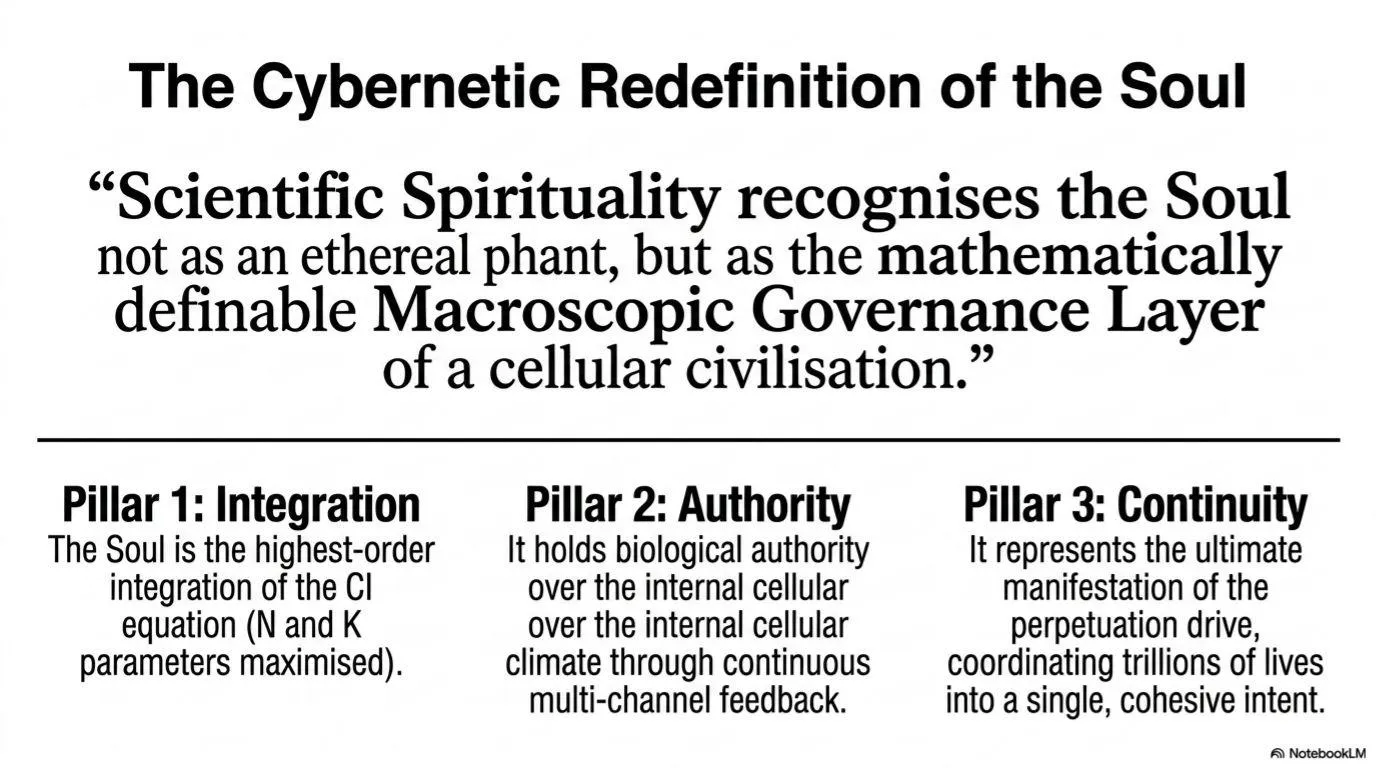
6.3 Why People Feel They Have One Soul
Humans feel like one person and then infer that there must be one hidden indivisible object corresponding to that feeling. The unity is real, but the inference is oversimplified. What is usually experienced as 'my soul' is the lived continuity of the highest currently dominant integrative layer, namely the human-level coordinating self. Because that layer is behaviorally dominant, the lower layers are usually ignored. Layer 5 therefore does not deny the reality of personal unity. It explains it differently. The unity is the unity of a deeply integrated federation rather than the isolation of a metaphysical atom.
6.4 Multi-Layered Soul Theory: Each Level Described
At the first level, each cell has its own consciousness and therefore its own minimal soul in the operational sense. This is not a metaphor. Each cell maintains its own boundaries, energy use, signalling, responsiveness, repair, and lineage continuity. It is genuinely alive and genuinely conscious in degree. P21 quantifies this: a single human cell scores approximately 8 to 14 on the Consciousness Index, on the same scale where the average human nervous system scores 100. Its soul, in the Layer 5 sense, is the living continuity of its own organized existence. At the second level, organs and subsystems possess coordinated forms of consciousness emerging from their constituent cells, signalling networks, and functional integration. A liver, a heart, a gut, an immune system - each is a cooperative assembly with its own emergent coordination and its own form of functional continuity. The gut is increasingly recognized as having its own neural and signalling architecture that operates with considerable autonomy. The immune system maintains a form of memory and coordinated response that extends well beyond any central command. These are not human-level souls, but they are not nothing. At the third level, the human person is the highest local integrative consciousness coordinating the bodily federation, with a CI of approximately 100 by calibration. This is the macroscopic human-level soul. It is the layer that speaks, plans, remembers personal history, and experiences itself as a unified self across time. The layered model preserves what is experientially real about soul while removing the unnecessary fiction of a singular soul-particle. [58]
6.5 Why the Layered Soul Model Implies a Plural Afterlife
The layered soul model is not only a redefinition of soul. Within this framework, it is the premise from which a plural afterlife follows as the most coherent consequence. If the soul were singular - one detachable particle or essence - then afterlife would have to be singular too: either the particle survives intact or it does not. But once soul is understood as layered continuity at multiple scales simultaneously, the question of what happens at death becomes scale-specific rather than all-or-nothing. The human-level soul - the coordinating consciousness of the whole federation - breaks at death. But the organ-level continuities may persist briefly. The cellular-level souls of individual cells may persist for hours, days, or longer depending on conditions. The molecular and atomic continuities never cease at all. Each level of soul has its own continuity trajectory after the collapse of the highest level. This is why afterlife in Layer 5 must be plural - not because the answer is vague, but because the question itself has multiple correct answers at different scales. The traditional singular soul model forces a single answer to a question that is actually multiple questions asked simultaneously at different organizational levels.
7. Death, Afterlife, and Post-Death Continuity
7.1 Death as Organizational Rupture, Not Ontological Annihilation
In this framework, death is not best understood as a transition from life to non-life, but as the irreversible loss of organism-level coordination. The human-level macroscopic coordinating consciousness - the self that experienced, planned, remembered, and governed the cellular civilization - dissolves. The macroscopic coordinating consciousness dissolves. But the cellular civilization does not cease with the dissolution of its highest coordination layer. The workers remain. Many cells continue living for hours, days, or longer depending on conditions. Some tissues remain viable for transplantation. Molecules persist. Atoms persist. The underlying substrate from which all matter manifests persists eternally. The event is therefore organizational rupture at the highest coordination level, not ontological annihilation. The body never really dies in the absolute sense. It ceases to function as one coordinated human-level whole, but it does not become non-being. It is redistributed, consumed, transformed, recycled, decomposed, or re-entered into other continuities. The organism-level coordinating role was always temporary. The cellular civilization that made the CEO possible is what continues. [1, 2, 49, 50]
7.2 The Plural Afterlife Model: Zero, One, or Many
Layer 5 rejects the binary choice between no afterlife and one personal afterlife, and instead proposes a layered plural continuity model in which postmortem outcomes may be zero, one, or many depending on the level and form of continuity under consideration. It proposes a layered plural model. Depending on what happens to the body, there may be zero, one, or many afterlives, but the terms must be defined carefully. Zero afterlives applies only in the narrow practical sense that there may be no recognizable continuation of the same person as a person - specifically, only if the person is consumed whole by another form so that no distinct onward trajectory remains. This is not materialist annihilation. It is total absorption, and even in this case the matter continues, the underlying substrate continues, and lower-level constituents continue. One or many afterlives refers to different parts of the body entering different living continuities at different scales, times, and locations. [1, 2] P21 provides the formal physical basis for why cellular consciousness does not switch off at organismal death. The Consciousness Index has a strictly positive degradation floor: no system with mass ever reaches CI = 0. Individual cells retain their own CI above zero regardless of what happens to the organism-level coordination layer. Cellular consciousness persists after the macroscopic self dissolves. The plural afterlife model is therefore not a philosophical preference. It follows from a derived physical result. [58]
7.3 Differential Continuity: Cremation, Burial, and Ecological Redistribution
The mode of postmortem handling affects continuity pathways. Cremation rapidly returns the body toward elemental redistribution. Burial, water burial, scavenger consumption, decomposition, and ecological integration produce other trajectories. Parts of the body may become part of worms, microbes, plants, animals, or other systems. Organ donation preserves some higher-order continuity in selected tissues. Microbial decomposition produces yet another set of trajectories. Afterlife in Layer 5 is therefore not only a metaphysical question. It is also an ecological and physical question. The handling of the body affects the branching structure of postmortem continuity. [49, 50]
7.4 Non-Conventional Post-Death Reorganization
Layer 5 allows a possibility that conventional spiritual models exclude: that under some conditions, postmortem tissues or surviving cells may contribute to new organized forms that are not recognizably human and not continuous with the former person in the ordinary sense. A scientific spirituality must not privilege only comforting possibilities. If postmortem reorganization occurs, it may sometimes produce forms that are fragmentary, primitive, or partial rather than noble or personalized. This is not a defect of the model; it is a consequence of taking cellular life seriously. Matter continues. How it reorganizes depends on conditions, not on the preferences of the prior person.
7.5 Xenobots, Anthrobots, and the Scientific Legitimacy of Qualified Rebirth
Xenobots and anthrobots are central for Layer 5 because they demonstrate that cells removed from their usual anatomical context can self-organize into novel multicellular structures with coordinated behavior. The xenobot experiments, led by Michael Levin and colleagues at Tufts University, showed that frog embryo cells could self-assemble into motile organisms never before seen in nature. Anthrobots, the follow-on work using adult human airway epithelial cells, strengthen the relevance by showing similar self-organization in human tissue, weakening the objection that such behavior is merely a frog-embryo curiosity. The collapse of one macroscopic form does not logically entail only inert decay. Under some conditions, cells can participate in new organized patterns. The bridge is real and powerful: it supports a model of qualified rebirth, not simplistic soul transfer. [51-53]
Layer 3 interprets this phenomenon as cells exploiting new opportunity fields when removed from their usual context - consistent with the perpetuation drive of Vijay's Law operating at the cellular level. They do not simply collapse. They manifest new cooperative behaviors under permissive conditions. This is exactly what Layer 3 predicts for living matter encountering changed conditions.
7.6 The Traditional Reincarnation Model Is Too Crude
The traditional singular reincarnation model - one entire soul leaves one body and enters one new body as one new person - is too crude for this framework. It captures a deep civilizational intuition that continuity persists beyond visible death, and Layer 5 respects that intuition. But the inherited model assumes singularity where the body is layered, transfer where redistribution may be more accurate, and one-to-one identity migration where one-to-many or many-to-many transitions may be more realistic. Traditional reincarnation may be directionally closer to truth than annihilationism, but it is still structurally incomplete.
7.7 Moksha as a Logical Possibility
If matter can, under some as-yet unproven conditions, re-assimilate into the deeper universal substrate without re-entering higher organized life, then something analogous to moksha may be theoretically possible. However, this is not currently asserted as an established empirical claim. It remains a logical possibility within Layer 1, not a demonstrated conclusion. For humans under ordinary earthly conditions, moksha appears highly improbable. Most postmortem processes observable at human scales involve redistribution, decomposition, incorporation, and reorganization within the manifest universe. This disciplined limitation strengthens the manuscript. [1]
7.8 The Inversion: What Dies and What Continues
Most major religious and spiritual traditions have framed death and continuity in a way that differs sharply from the model proposed here. The standard claim across many traditions is that the body dies but the soul is immortal - that the visible, material body perishes while the invisible inner essence survives and continues. Contrary to traditional belief, it is the soul that 'dies', in the sense that the human-level coordinated consciousness disappears. The body survives. When a human dies, the soul dies - the collective consciousness that coordinated the cellular federation dissolves when that federation loses its organizing principle. The body does not die in any absolute sense. Individual cells continue living for some time. Matter persists indefinitely. Atoms persist. The underlying substrate from which all matter manifests persists eternally. What is mortal is the soul - the human-level coordinated consciousness. What is continuous is matter itself. This inversion is not a rhetorical reversal. It follows directly from Vijay's Law: if everything is alive and conscious in degree, then matter does not cease to exist or lose its fundamental nature at death. Only the particular pattern of organized coordination that constituted this person at this scale is lost.
7.9 Near-Death Experiences: A Mechanistic Account
Near-death experiences - in which a person who has approached or briefly showed signs of clinical death reports returning with memories of unusual perceptions, visions, or states of awareness - are often cited as evidence for a soul that persists beyond the body. Layer 5 offers a mechanistic account that requires no such inference. A near-death experience is the temporary loss and then recovery of collective consciousness over the cellular federation. The human-level coordinating consciousness loses its organizational coherence briefly - perhaps due to oxygen deprivation, trauma, cardiac arrest, or overwhelming cellular stress - but the individual cells, though overwhelmed, do not die. When the overwhelming cause is removed or treated, the individual cells' own consciousness, which was never extinguished, begins re-establishing the collective pattern. The recovery of collective consciousness is the return from near-death.
The unusual perceptions reported during near-death states are also explicable within this framework. The tunnel of light - one of the most consistently reported features across cultures - has a plausible physiological interpretation. Severe oxygen deprivation specifically affects peripheral visual processing first, causing the visual field to narrow progressively. In this framework, the tunnel phenomenon is more parsimoniously interpreted as progressive peripheral visual loss under hypoxic stress than as evidence of transit to another realm. As the central nervous system scrambles to interpret the massive, chaotic chemical signals coming from a cellular civilization under ultimate duress, it searches for the most deeply encoded emotional anchors of safety, proximity, and love in the organism's history. Under the UNITE framework, these are the relationships with the highest accumulated Effort and Proximity - parents, beloved partners, deeply significant figures. These surface as the faces seen in near-death visions. The experience is genuine and often life-changing in its profundity. It is the final desperate governance signal of a failing system, not a supernatural event. The CEO's communication network is going down, and the cellular civilization is broadcasting its deepest distress and its deepest anchors simultaneously. These experiences are treated here as genuine subjective events, but not as compelling evidence of a detachable soul leaving the body. They are interpreted instead as the outputs of a living cellular system operating under extreme duress through every channel available to it.
7.10 Past-Life Experience Claims: An Assessment
Within the present framework, the human self is not an independently persisting soul-entity carrying intact personal identity across multiple births. Rather, the self is an emergent organizational state generated by a temporarily coordinated living system composed of conscious matter. When that organization sufficiently degrades, the corresponding organized self also ends. The matter continues, but the earlier person does not continue as the same integrated identity. Therefore, ordinary birth does not imply continuation of a previous personal self, and the framework does not support conventional reincarnation in the sense of intact personal memory transferring between unrelated organisms. Since matter extensively reorganizes during death, decomposition, reproduction, development, and growth, there is no reason to expect stable preservation of detailed personal memory across such discontinuities. Accordingly, most claimed past-life memories are more plausibly interpreted as hallucination, confabulation, dream-state reconstruction, suggestion effects, emotional projection, identity-construction phenomena, or internally generated narrative completion processes occurring within the brain's predictive and reconstructive architecture. Under conditions of stress, grief, trauma, emotional intensity, sleep disturbance, cultural reinforcement, hypnosis, dissociation, or strong expectation, the brain can generate highly convincing internally constructed experiences that are subjectively perceived as externally real. The framework therefore distinguishes sharply between continuity of matter and continuity of personal identity. Matter persists and reorganizes continuously throughout the universe, but organized selves remain temporary emergent coordination states rather than permanently preserved individual entities.
7.11 Ghosts, Visions, and Hallucinations: The Distributed Sensing Explanation
The present framework does not require supernatural interpretation of apparitions, ghosts, visions, or similar experiences. Under conditions such as trauma, fever, grief, hypoxia, intoxication, sleep deprivation, dissociation, neurological instability, or extreme emotional stress, the normal hierarchy of sensory integration and predictive stabilization can become degraded. The brain then increasingly reconstructs internally generated emotionally dominant patterns and may externalize them as apparently real perceptual events. Because the organism operates through distributed signalling and integrated predictive coordination, severe disturbances in organism-level signalling can produce highly convincing internally constructed experiences. Such events may feel externally real to the observer even when they originate from destabilized predictive reconstruction processes within the organism itself. This interpretation remains consistent with finalized Layer 2 and Layer 3 because conscious matter continuously attempts to maintain coherent predictive organization under unstable conditions. When this coordination becomes sufficiently disrupted, internally generated perceptual reconstruction may partially override normal external sensory stabilization. The experience is real as an event in consciousness. It is not evidence of a supernatural entity or external presence.
This explanation also accounts for why such experiences are more common under specific conditions - fever, near-death, grief, intoxication, extreme fatigue, or intense meditation - and why they often carry emotional weight and apparent meaning. The cellular systems generating these perceptions under stress are drawing on the organism's own history, emotional memory, and relational patterns. A dying person seeing a deceased parent is not evidence that the parent has returned. It is evidence that the organism's distributed sensing system, operating under extreme conditions, is generating emotionally coherent patterns from the organism's own deep relational memory. The experience is real. The interpretation that follows it need not be supernatural.
8. God, Medium, and Prayer
8.1 Formal Definition of God
God in Layer 5 is the universal conscious substrate: the all-pervasive foundational reality from which all matter manifests and within which all matter remains continuous. In the language of Layer 1, this aligns with the spaticle field. The term God is retained deliberately. It is not retained to preserve conventional theology. It is retained because it names a persistent human intuition that there exists a deeper reality that is universal, causally relevant, foundational, and experientially accessible in some meaningful way. The inherited definitions are rejected. The word itself is retained because it points toward a real functional category that humanity has been trying, imperfectly, to describe. [1, 2]
8.2 Why the Word 'God' Should Be Retained Rather Than Abandoned
Many modern thinkers attempt to solve theological confusion by discarding the word God entirely. Layer 5 takes the opposite view. The word should be retained because it carries a long civilizational history of human contact attempts with something deeper than ordinary egoic consciousness. The mistake was not the existence of the word. The mistake was the inherited content attached to it. The task is not lexical destruction. The task is definitional correction.
8.3 Why the Atheist Objection to This Definition Fails
The most common objection to identifying God with the Spaticle field is that this merely renames matter and assigns it no power. The pond does not come to the room. The substrate is not a person who listens and responds. Calling it God changes nothing.
This objection fails on its own scientific terms. The Spaticle field is not passive matter doing nothing. It is the substrate from which all four fundamental forces emerge. Every biological capability any organism has ever developed, every eye, every immune system, every nervous system, every healing process, is the organism accessing the channels of that substrate more fully through the perpetuation drive. Every evolutionary advance documented in Layer 3, from echolocation in bats to the surgical behavioural precision of the emerald cockroach wasp, was produced by living matter connecting more deeply with the spaticle substrate under genuine sustained need. That is not powerlessness. It is the most productive and documented power in four billion years of biological history. [3, 56, 57]
The specific claim is this: what the world's spiritual traditions have called answered prayer, what evolutionary biology documents as adaptive emergence, and what Layer 5 describes as governance alignment are the same mechanism expressed at different timescales. The organism that genuinely, coherently, and sustainedly engages the substrate it is made of and immersed in, with specific organized need, can receive capabilities that appear impossible from outside. This is not a claim requiring faith. It is the same process that produced every biological marvel in the evolutionary record. The mechanism is identical. The timescale differs.
The conditions for effective engagement are not praise, ritual, or theological correctness. They are four. First: knowledge. One must understand what the substrate is. Directing the request toward a person-like God sitting outside the universe directs the signal in the wrong direction. The substrate is within and around simultaneously. Second: genuine need. Not performed need or casual asking, but the kind of real, survival-critical, non-negotiable organized need that drove organisms to develop echolocation and immune systems. The perpetuation drive is activated by genuine necessity. Third: coherence without contradiction. Internal contradiction, believing and doubting simultaneously, disrupts the signal. Fourth: sustained engagement. Evolutionary change happened through sustained pressure over time. Within a single lifetime, the equivalent is sustained, non-wavering, coherent engagement maintained until the result arrives. When these conditions are met, what happens is not supernatural. It is the same process that produced every biological marvel in evolutionary history, now operating within the timescale of a single life. [3, 59, 57]
Finally: God made us is literally correct. P15 establishes that the prior energy state of infinite space is logically necessary and was never absent. P16 shows how the first hydrogen atoms formed through threshold-crossing nucleation. Stars formed. Elements were forged. Planets formed. Chemistry organized. Cells emerged. Evolution drove cellular cooperation into organisms. The human body is the latest chapter. The spaticle field, the universal conscious substrate that P15 establishes as logically necessary and eternal, is the material from which every atom in the human body condensed. We are not manufactured objects placed in a universe by an external craftsman. We are local, temporary, organized manifestations of the substrate itself, organized to the degree of self-reflection. The substrate made us by becoming us. [59, 60, 56]
8.4 What God Is Not in This Framework
The God of Layer 5 is not a person-like ruler sitting outside the universe. It is not a cosmic monarch who becomes offended when ignored, pleased when flattered, or morally contaminated by human disbelief. It does not demand praise, issue arbitrary punishments, or condemn beings to eternal torment. It does not operate as a tribal authority figure projected onto the cosmos. It is not just by human moral standards - it simply does not interfere to enforce human morality at all. It does not require belief in it and does not punish disbelief or reward belief, now or later. In this framework, God is not person-like and does not relate to individual lives through human-style affection, hostility, or moral preference. Those inherited theological models are historically understandable but are not structurally coherent within the present framework. They confuse symbolic narrative with ontological mechanism. A practical analogy clarifies the correct definition. God in this framework is like a clear pond of water in one's courtyard. If one is thirsty and approaches it, one can drink. Even if one is desperately thirsty, or dies of thirst, the pond will not come to the room. If one stays indoors and demands that the pond come, nothing happens. If one praises the pond but never drinks, one remains thirsty. If one insults the pond, the pond is not offended. If one muddies the pond, access becomes difficult - not because the pond became angry, but because one interfered with one's own ability to draw from it. The mud is doubt, contradiction, internal incoherence, unstable attention, theatrical ritual without conviction, or self-sabotaging belief. More precisely: the framework does not interpret prayer, belief, or alignment as supernatural wish fulfillment. They operate through the same directional-organizational principles established in finalized Layer 3. Living systems continuously reorganize themselves toward perceived survivable opportunity structures when sufficiently aligned, motivated, coherent, and directionally stable. The pond analogy therefore does not imply that the universe arbitrarily grants desires. It illustrates that opportunity already exists within the larger substrate, but access depends on whether the organism organizes itself coherently enough to enter conditions where that opportunity becomes reachable. The substrate does not selectively intervene in local events merely because a local organism desires intervention. Rather, coherent alignment increasingly enables access to survivable and opportunity-rich trajectories already permitted within the larger organizational structure of reality. Sustained alignment changes attention, persistence, behaviour, learning, risk tolerance, motivation, biological investment, and long-term adaptive organization. The organism increasingly enables access to opportunity fields that previously remained inaccessible. The process is therefore not supernatural intervention but directional reorganization within a living conscious substrate operating under perpetuation-driven emergence principles established throughout Layers 2 and 3 and further strengthened by Papers 17, 20, and 21.
The indifference of God to individual life is not the cold indifference of a person who could care but chooses not to. It is the structural indifference of a universal substrate that has no vantage point from which one life would be more significant than another. The pain of any particular life, from this vantage point, is like the pain of a stone that you feel when someone kicks it. You may register that the kick happened. You do not suffer for the stone. God does not suffer for you - not because God is cruel, but because the universal conscious substrate does not have a person-level relationship to any particular organized pattern within it.
This definition has a testable quality. If one applies this definition of God - universal, all-pervasive, conscious, accessible but not personal, not morally commanding, not requiring belief - then God, as defined here, passes the test. One can verify every stated property against the framework. By contrast, many inherited theological definitions of God introduce attributes - such as moral sovereignty, punishment of disbelief, and reward of worship - that appear structurally inconsistent within the present framework. The difficulty is not with the word God. The difficulty is with what has been attached to it by particular traditions.
8.5 Heaven, Hell, and the Afterlife Promised by Religions
The conventional heaven-and-hell models of major religions are not compatible with the layered continuity structure proposed in Layer 5. Heaven as a realm of eternal personal reward for correct belief or behaviour, and hell as a realm of eternal personal punishment for incorrect belief or behaviour, both require a God that judges, rewards, and punishes - a God that Layer 5 has already shown to be definitionally incoherent. They also both require a singular personal soul that survives intact after death and arrives at one destination - a model of soul that Layer 5 has shown to be structurally incorrect. Even setting aside the question of God's nature, the plural afterlife model makes singular destination models impossible: matter distributes into multiple continuities, not one. There is no single place that all of a person goes after death, because the person was never a single indivisible unit to begin with.
This does not mean that the impulse behind heaven and hell language is meaningless. It means the language is pointing at something real - the intuition that actions have consequences, that consciousness continues in some form, that the universe is not morally random - but doing so through an inaccurate and ultimately unhelpful framework. Layer 5 replaces the inaccurate framework without dismissing the real intuitions. Actions do have consequences - through the cellular governance model, through the UNITE framework, through the biological and social consequences of how one lives. Consciousness does continue - in the plural, distributed, scale-specific ways described in Sections 6 and 7. The universe is not morally random - though its ordering principle is the perpetuation drive, not the preferences of a divine lawgiver.
8.6 Why Suffering Exists If God Exists
The problem of suffering - how an all-powerful, all-knowing, all-loving God can permit the existence of pain, disease, injustice, and catastrophe - is one of the oldest and most damaging arguments against theistic religion. It is called the problem of evil. Layer 5 dissolves this problem entirely, not by solving it, but by showing that the premise from which it arises is false. The problem of suffering assumes a God that is all-powerful, all-loving, and all-knowing in the personal-deity sense. Layer 5 has already established that God is none of these things in that sense. God does not love. God does not care. God does not intervene. God does not protect. God does not punish wrongdoers or reward the virtuous. Everything that happens in the universe emerges from the consciousness of matter and the forces acting on it - the perpetuation drive, positive and negative forces, cooperative and competitive dynamics, the stable and unstable conditions under which matter manifests and reorganizes. Suffering exists because it is a natural consequence of these forces operating on living organisms that have evolved to feel pain as a signalling mechanism. It is not a test, not a punishment, not permitted by an indifferent deity, and not evidence against God. It is what happens in a universe governed by the perpetuation drive rather than by moral sentimentality.
8.7 Why Practices Like Reiki, Tarot, and Astrology Sometimes Appear to Work
Many practices that have no established scientific mechanism - Reiki, Tarot readings, astrology, crystal healing, certain forms of ritual prayer, and many others - produce occasional reported benefits that their practitioners cite as evidence of their validity. Layer 5 does not validate these practices as operating through the mechanisms their practitioners claim. But it does explain why benefits are sometimes reported. If placebos work - and the evidence that they do is extensive and documented - then anything can work as a placebo under the right conditions. A Reiki session, a Tarot reading, a horoscope, or a ritual of any kind can produce real physiological and psychological benefits if it successfully functions as a medium for achieving the concentrated alignment, reduced internal contradiction, stabilized expectation, and coherent bodily attention that Layer 5 identifies as the actual healing mechanism. The practice itself is not the cause. The internal state it produces in the practitioner is the cause. This is why such practices work for some people sometimes but not for others or consistently: their effectiveness depends entirely on whether they succeed in producing the internal coherence state, not on any intrinsic property of the crystals, cards, or ritual gestures themselves. Layer 5 does not recommend these practices. It explains them.
8.8 The Unification of Prayer, Self-Talk, and Cell-Directed Healing
One of the strongest unifying insights of Layer 5 is that prayer, self-directed communication, and cell-directed healing are not three separate categories requiring three separate explanations. They are three names for the same fundamental act, described at different scales and in different cultural vocabularies. Prayer directed at God is alignment with the universal conscious substrate through a chosen medium. Self-directed communication - the internal narrative a person maintains about their own life, health, future, and worth - is governance signalling to the cellular collective. Cell-directed healing - the formal protocol described in Section 3 - is the same governance signalling practiced deliberately and consciously. All three alter the same variable: the organism-level climate of coherence, trust, expectation, and organized investment that determines whether the cellular collective operates in a repair-supportive or conflict-dominated mode.
This unification is possible because, as established in Section 8.9, the self and God are not separate in substance. They differ in organization and scale, but not in ultimate basis. This means that when a person prays, they are doing something that is simultaneously spiritual, psychological, and biological - and the distinction between these categories dissolves once the correct model of the human being is in place. A person who prays with genuine coherence, trust, and reduced internal contradiction is also, simultaneously, signalling their cellular collective in a repair-supportive direction. A person who maintains a positive and purposeful internal narrative is also, simultaneously, engaging in a form of prayer - alignment with the deeper substrate through the medium of their own organized consciousness. The three practices are not the same in cultural form or vocabulary. They are the same in mechanism.
8.9 The Self and God Are Not Separate in Substance
If all matter manifests from the universal conscious substrate, and if the human body is wholly constituted from that matter, then the self and God are not separate in substance. They differ in organization, scale, and degree of local integration, but not in ultimate basis. This dissolves a false dichotomy that has distorted both spirituality and psychology. In Layer 5, 'talking to God,' 'talking to oneself,' 'communicating with the body,' and 'deep meditative self-alignment' are not unrelated metaphysical categories. They are different modes of contact within the same continuum. [1, 2]
8.10 The Medium Principle
For most human beings, direct concentration on the unbounded universal conscious substrate is practically difficult. The ordinary mind is unstable when asked to focus on the unmanifest infinite. It drifts, doubts, fragments, and collapses into abstraction. Therefore a medium becomes useful and often necessary. A medium is any chosen focal form through which attention, trust, emotion, and intention are stabilized. The medium may be a statue, image, symbol, visualized deity, sacred phrase, body part, organ, whole-body representation, or even a remembered human face. The medium is not the ultimate God. It is the practical focusing interface that allows a limited human mind to build reliable contact with a deeper reality.
This medium principle is one of the strongest reinterpretive tools in Layer 5. Long descriptions of divine forms, powers, attributes, colours, names, stories, and rituals are not merely cultural decoration. They function as anti-doubt architecture. A richly described medium leaves fewer psychological gaps for destabilizing uncertainty. If the practitioner deeply trusts the medium, concentration becomes easier. Some traditions come closer than others on specific structural points: those that distinguish between an unmanifest ultimate reality and its accessible forms, and those that explicitly use a form, symbol, or focal representation as a practical means of concentration, align more closely with the mechanism proposed here.
8.11 Prayer Reframed as Concentrated Alignment
Prayer in Layer 5 is not primarily a spoken request to a listening supernatural ruler. It is a structured act of concentrated alignment. It involves focused attention, stabilized belief, emotional coherence, reduced contradiction, meaningful intention, and a route of contact through a trusted medium. When prayer works, it works first by altering the person, the body, the internal signalling climate, the attentional field, and the behavioral trajectory. In this sense, prayer is not reduced by scientific reinterpretation. It is clarified. [34, 35]
For prayer to become causally effective, several variables usually converge. First, attention must become sufficiently concentrated. Second, the person must believe, at least provisionally, that contact is possible. Third, the chosen medium must feel trustworthy enough to reduce internal doubt. Fourth, the emotional state must become coherent rather than theatrically intense but internally split. Fifth, the prayer must not be directly contradicted by simultaneous internal narratives such as 'this is useless' or 'nothing can help.' The operative principle is not performance. It is coherence.
8.12 Why Prayer Can Work Even When the Theology Is Wrong
One of the most important consequences of the medium principle is that prayer can still work even when the literal theology surrounding it is partially false. A person may hold an inaccurate cosmology yet still achieve real effects if the structure of attention, trust, emotional alignment, and behavioral coherence is strong enough. This helps explain why different religions, contradictory doctrines, and even secular rituals can all produce overlapping reports of relief, strength, healing, clarity, and transformation. The literal stories may differ. The underlying mechanism may still converge. This is not relativism. It is a mechanistic claim.
8.13 Why Prayer Has No Automatic Moral Direction
Layer 5 makes an uncomfortable but necessary point. Prayer has no automatic moral direction built into the mechanism itself. If a person seeks harmful ends yet remains internally coherent, free of guilt, and fully convinced, the alignment process may still function. This is not endorsement. It is explanation. Morality enters primarily through the practitioner's own conscience, contradiction, and internal architecture. This is one reason spirituality must be analyzed structurally rather than romantically.
9. Conclusion: What Layer 5 Establishes, and Why It All Flows from Vijay's Law
9.1 The Central Achievement
Layer 5 argues that spirituality has long been describing real phenomena in underdefined language. The task is not to preserve inherited ambiguity, nor to dismiss the subject matter. The task is to redefine it. What Layer 5 argues is that the major domains of human spiritual experience, God, soul, prayer, intuition, healing, death, and afterlife, can each be given a scientifically coherent account that preserves their experiential reality while removing their mythological excess. No supernatural violation of biology is required. No appeal to mechanisms outside the known framework of matter, consciousness, and life is needed. The framework is internally consistent and derivable from a single governing law.
9.2 Everything Flows from Vijay's Law
Every major claim in this paper traces back to Vijay's Law. The cellular civilization model - on which healing, soul, intuition, and death are all built - follows from proposition (1) of the Law: everything is alive and conscious in degree, including every cell in the body, now quantified by P21 with each human cell scoring approximately 8 to 14 on the Consciousness Index. The healing model - positive thinking as governance signal, depression as governance failure, motivation as future-affirmation, learned helplessness as communicative collapse - follows from the perpetuation drive in proposition (2), now formalized as the K component of the Capability equation in P20: every form of matter strives to persist, and the organism's coordinating consciousness either supports or undermines that striving through the quality of its internal governance. The plural afterlife model - zero, one, or many continuities depending on what happens to the body's matter after organizational rupture - follows from proposition (1) and P21's degradation floor: matter does not cease to be alive and conscious when a higher-level organization collapses. It continues in other forms with CI strictly above zero. The God model extends further back than Layer 1: P15 establishes that the universal substrate is not merely cosmologically present but logically necessary, having never been absent even before the Spaticle field itself manifested. The complete derivation chain runs from the necessary existence of infinite space through the spaticle field, force emergence, matter condensation, cellular life, and the macroscopic self, with no uncaused first term and no unjustified leap anywhere in the sequence. [1-4, 59, 60, 56, 57, 58]
The God redefinition flows from the cosmological substrate established by BFUT in Layer 1, of which Vijay's Law is the extension: if the universe originates from a living conscious substrate and all matter remains continuous with it, then the universal substrate is God in the only sense that survives scientific scrutiny. Prayer as concentrated alignment flows from the same substrate: if the self and the universal conscious field are not separate in substance, then alignment with it is a real operation, not a fantasy. Soul as layered continuity flows from proposition (1): if every cell is alive and conscious in degree, then the soul is not a singular particle but the living continuity structure of the entire cellular federation. Intuition as distributed sensing flows from proposition (1) again: if all cells retain some degree of awareness and responsiveness, then distributed sensing across the body's cellular network is not mystical but a consequence of the basic premise.
9.3 The Unified Framework
Once the correct model of the human being is in place - not a singular ghost inside a dead machine, but a layered living federation whose macroscopic self is the highest coordinating consciousness of trillions of living participants - the spiritual and the biological cease to be separate conceptual universes. Prayer, self-talk, and cell-directed healing become related forms of organized communication. Placebo becomes meaning-mediated internal reorganization. Depression becomes governance failure. Hope becomes regulatory state. Exercise becomes message and physiology simultaneously. Sleep becomes trusteeship. Death becomes organizational rupture rather than ontological annihilation. Intuition becomes distributed sensing across a living network. God becomes the universal conscious substrate from which all of this living matter continuously manifests.
9.4 Relation to Existing Literatures
Layer 5 does not invalidate psychoneuroimmunology, placebo research, meditation science, somatic marker theory, interoception research, embodied cognition, or the xenobot and anthrobot findings. It explains them. Each of these literatures has documented real phenomena through careful empirical work. None has offered a single unifying architecture explaining why all these phenomena cluster together and why they take the specific forms they do. Layer 5 provides that architecture. The cellular governance model is the integrating principle. The perpetuation drive of Vijay's Law is the reason the cellular collective responds to the macroscopic self's governance signals. The universal conscious substrate is the reason prayer and alignment have any purchase at all. Everything connects.
9.5 The Sixteen Questions That No One Could Answer for 2,500 Years
In the Sabbasava Sutta of the Pali Canon (Majjhima Nikaya 2), the Buddha identified sixteen questions concerning identity, existence, continuity, and selfhood that he classified as forms of “unwise reflection.” These questions were considered dangerous because they lead to attachment to views regarding the self and entangle the thinker in speculative metaphysical positions rather than liberation. The Buddha warned that attachment to such views becomes “a jungle of views, a wilderness of views; scuffling in views, the agitation of views, the fetter of views.” For approximately 2,500 years, no coherent and internally consistent framework existed that attempted to answer all sixteen questions from a single unified governing principle spanning cosmology, matter, evolution, consciousness, and identity. [54] Wikipedia: The Unanswerable Questions
The Buddha did not answer these questions, likely because no sufficiently unified framework existed at the time from which they could be answered consistently without speculation. Later traditions either avoided the questions, offered mythological answers requiring faith, or asserted unverifiable metaphysical claims without a coherent explanatory structure.
Layer 5, as part of the six-layer framework built upon Vijay's Law, proposes a unified answer to all sixteen questions through a single governing principle applied consistently across cosmology, matter, life, evolution, consciousness, and human organization. The answers below emerge from the combined structure of Layers 1 through 5 rather than from revelation or doctrinal authority.
| Question | Layer 5 Answer |
|---|---|
| What am I? | A living conscious being composed of trillions of individually conscious cells whose coordinated collective consciousness constitutes the soul, while the macroscopic coordinating layer constitutes the person. |
| How am I? | The result of progressive organization and evolution of conscious matter through cooperative perpetuation processes operating across particles, atoms, molecules, cells, and higher biological structures. |
| Am I? | Yes. The self is a real organizational and conscious phenomenon emerging from coordinated living matter. |
| Am I not? | Matter and consciousness are never truly non-existent within the framework. They only reorganize into different forms and structures. |
| Did I exist in the past? | Not in the present organized human form, but the matter constituting the body has always existed in prior organized states. |
| Did I not exist in the past? | This particular coordinated identity and organizational structure did not previously exist before its present formation. |
| What was I in the past? | The constituent matter existed in earlier organizational forms operating under the same perpetuation principles described in Vijay's Law. |
| How was I in the past? | The matter existed within simpler or differently organized structures prior to the emergence of the present coordinated human-level organization. |
| Having been what, did I become what in the past? | Through successive reorganizations of conscious matter into progressively more complex cooperative forms as described in Layer 3's evolutionary framework. |
| Shall I exist in the future? | The present human-level organizational structure and soul eventually dissolve, but the underlying matter and consciousness continue in redistributed forms. |
| Shall I not exist in the future? | This exact organized human configuration ceases after death, but its constituent matter and lower-scale consciousness persist. |
| What shall I be in the future? | Multiple distributed continuities across scales, including redistributed matter, surviving lower organizational structures, and new cooperative formations. |
| How shall I be in the future? | Through reorganization, redistribution, and continuation of matter and consciousness into other structures and scales of existence. |
| Having been what, shall I become what in the future? | The present coordinated structure dissolves into multiple future continuities governed by the same perpetuation dynamics operating throughout the universe. |
| Whence came this person? | From the universal conscious substrate through successive stages of conscious organization, evolutionary adaptation, and cellular cooperation. |
| Whither will he go? | At death, the coordinated human-level organization ruptures, the soul dissolves, and the constituent matter redistributes into multiple continuing forms simultaneously. |
Within this framework, these questions become answerable because identity is treated not as a static metaphysical abstraction but as a dynamic organizational phenomenon emerging from conscious matter operating under Vijay's Law. The framework therefore attempts to transform questions historically treated as permanently unknowable into questions addressable through a unified systems-level model spanning cosmology, evolution, consciousness, biology, and organizational continuity.
9.6 Falsifiable Predictions and Experimental Programme
The framework generates multiple falsifiable predictions across psychophysiology, behavioural regulation, placebo research, interoception, and postmortem continuity dynamics. These predictions emerge directly from the proposed model of hierarchical biological governance, organism level signalling coherence, and cellular cooperation.
Body directed communication practices performed with coherent internal governance structures should produce biomarker outcomes measurably different from both no intervention controls and generic relaxation protocols matched for relaxation depth.
Internal psychological contradiction should reduce treatment adherence, recovery stability, and long term behavioural consistency beyond what is explained by negative affect intensity alone.
Placebo efficacy should vary as a function of medium stability, authority coherence, expectation consistency, and perceived future viability rather than pharmacological absence alone.
Individuals with higher interoceptive sensitivity should display superior performance in specific forms of intuitive prediction, rapid self-state assessment, and internally guided decision making.
Individuals with similar external physical variables but substantially different perceived future viability should display measurably different biological trajectories over time.
Coherence, opportunity perception, motivational continuity, and future oriented stability should explain significant biological variance beyond standard physical health metrics alone.
Chronic breakdown of organism level signalling quality should correlate with progressively dysregulated cellular cooperation even when baseline material conditions remain relatively stable.
The temporal gradient of postmortem cellular activity should display structured continuity patterns rather than purely random collapse dynamics, consistent with the plural continuity model proposed in this paper.
Large scale failure of these predicted relationships across sufficiently controlled datasets would weaken the framework’s explanatory validity. Conversely, repeated confirmation across independent domains would support the broader Layer 5 model linking consciousness, biological regulation, meaning structures, and cellular governance.
9.7 Supporting Simulation: Periodic Adversity Resilience
A computational simulation was developed to model the cumulative long-term effects of the organizational and psychological stabilization structures described in this paper. The complete simulation code, outputs, figures, and methodological documentation are publicly available [55].
The simulation compares two populations of 1,000 agents across a 70-year lifespan from age 15 to age 85. Population 1 (Baseline) receives no internal resilience structures. Population 2 (Anchored) possesses two Layer 5-aligned structures: Objectives, representing purpose, long-term goals, future orientation, and organizational coherence, operationalized as a reduction of 3 units in the effective damage of each negative event before financial compensation occurs; and Anchor, representing belief in God, confidence in future recovery, stable social support, and deep psychological stabilization, operationalized as a recurring health reinforcement of 8 units per year whenever individual health falls to 72 or below. Both populations are exposed to identical random yearly events drawn from the same distribution and to periodic reinforcing events occurring every 5 years in the same direction as the yearly event. Financial reserves accumulate at 10 units per year and can be spent to repair up to 50 percent of negative event damage at a cost of 4 units per repaired point. A depression cascade applies an additional penalty of 10 units if health falls to 60 or below. Death occurs only when health is at or below 25 and financial reserves are simultaneously exhausted.
The simulation produced two distinct forms of analysis: total-population outcomes including deceased agents, and survivor-only outcomes excluding deceased agents. This distinction proved important because survivor-only averages partially conceal the full systemic cost of cumulative collapse dynamics.
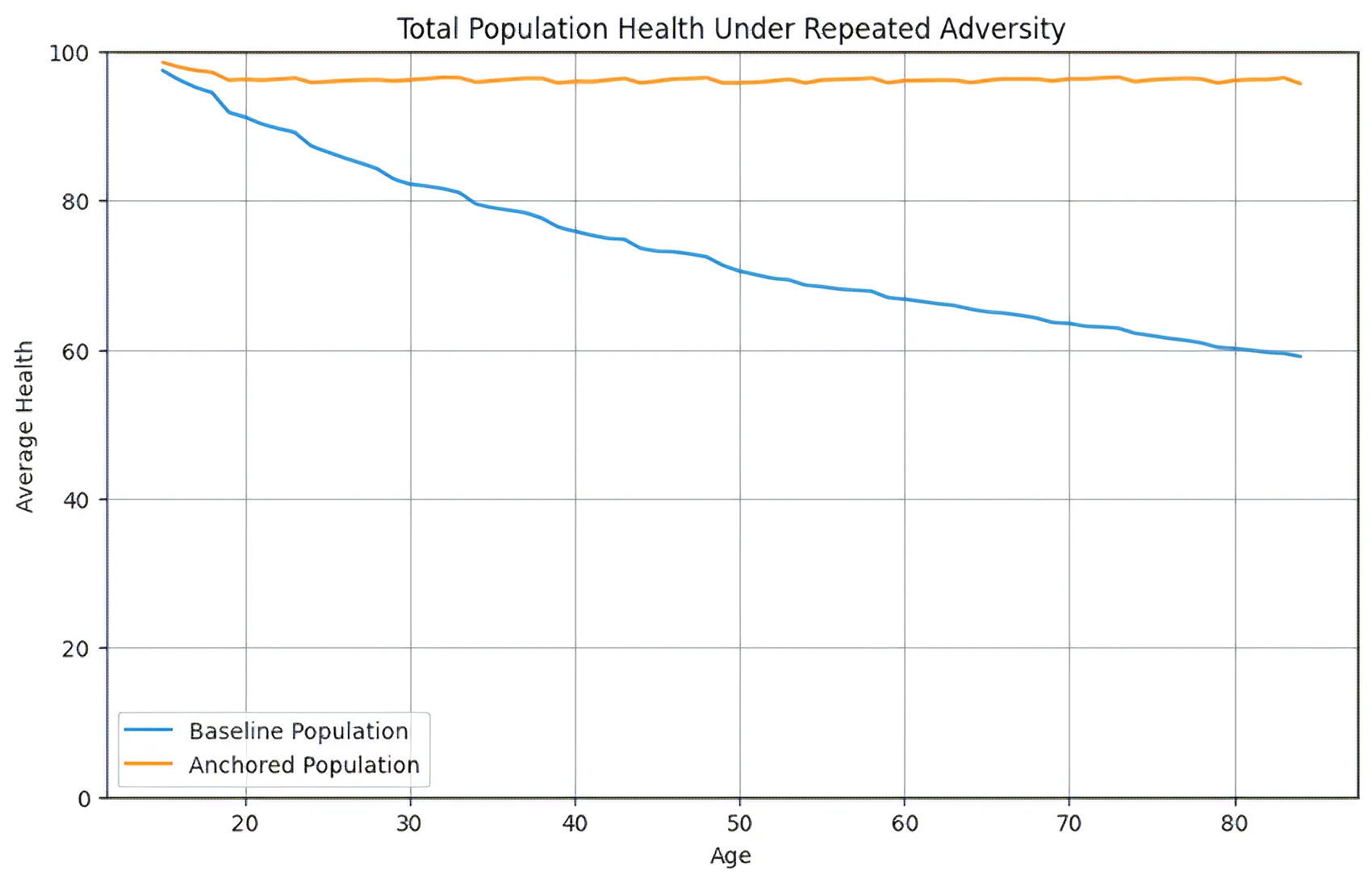
True total-population average final health at age 85 was: Baseline 61.09, Anchored 95.70, a gap of 34.61 units. The earlier survivor-only average of 77.31 for the Baseline had masked the full picture by excluding dead agents from the calculation. When all agents including those who died are counted, the Baseline average collapses by more than 16 points, revealing the scale of the mortality drag.
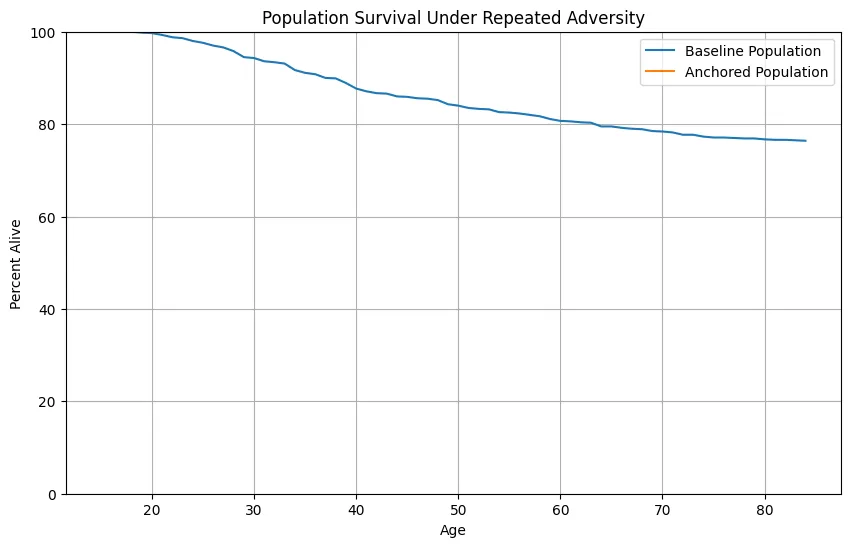
Mortality results showed a categorical separation between the two populations. Baseline: 236 deaths out of 1,000 agents, a 23.8 percent mortality rate across the 70-year lifespan. Anchored: zero deaths across all 1,000 agents across all 70 years.
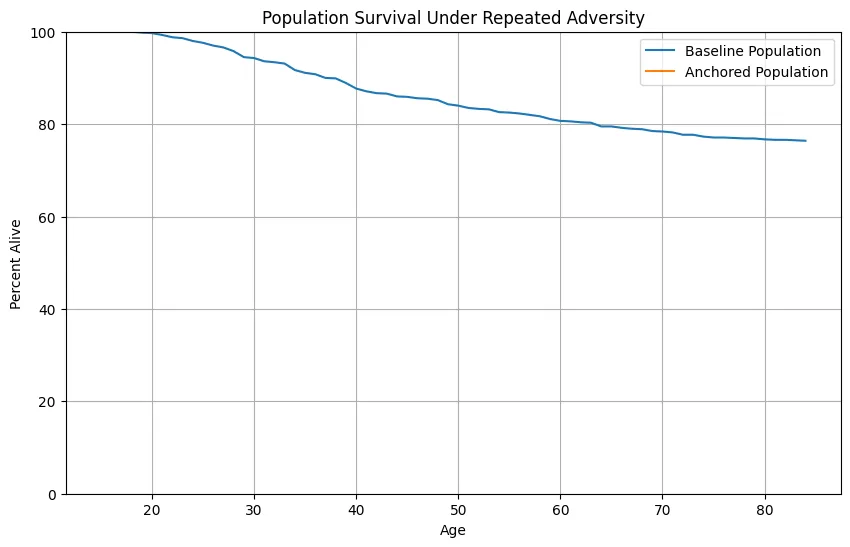
Depression incidence showed a similarly categorical separation. Baseline: 37.9 percent of agents entered the depression cascade at some point during their lifespan. Anchored: zero percent.
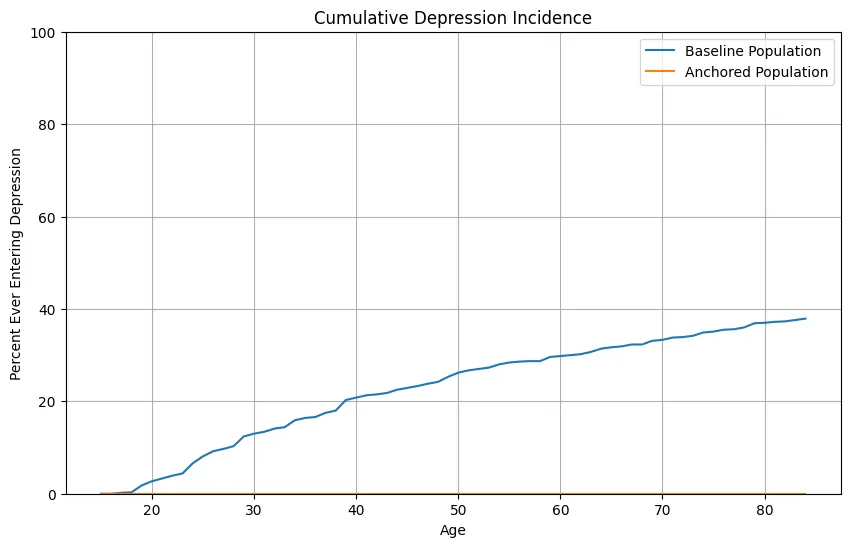
The Anchored population minimum final health was 73, meaning not a single anchored agent ever fell below 73 across the entire simulation. The Baseline minimum was 0. Final average wealth: Baseline 142.72, Anchored 350.12, a difference of 207.40 reserve units. The Anchored population preserved more than twice the financial reserves of the Baseline because the Objectives mechanism reduced effective damage before costly financial repair was triggered, and the Anchor mechanism prevented depression cascades that would have further degraded health and depleted reserves simultaneously.
The distribution of final health outcomes makes the structural separation most visible. The Baseline population produces a bimodal distribution: a large cluster of agents at zero (the deceased) and a spread of survivors ranging from the low sixties to 100, with the median survivor health at 84.75 considerably higher than the true population mean of 61.09, because the surviving majority did reasonably well while a substantial minority were pulled to zero by the depression cascade and death mechanism. The Anchored population produces a tight right-skewed cluster compressed between 73 and 100, with median 98.5, and no agent at zero.
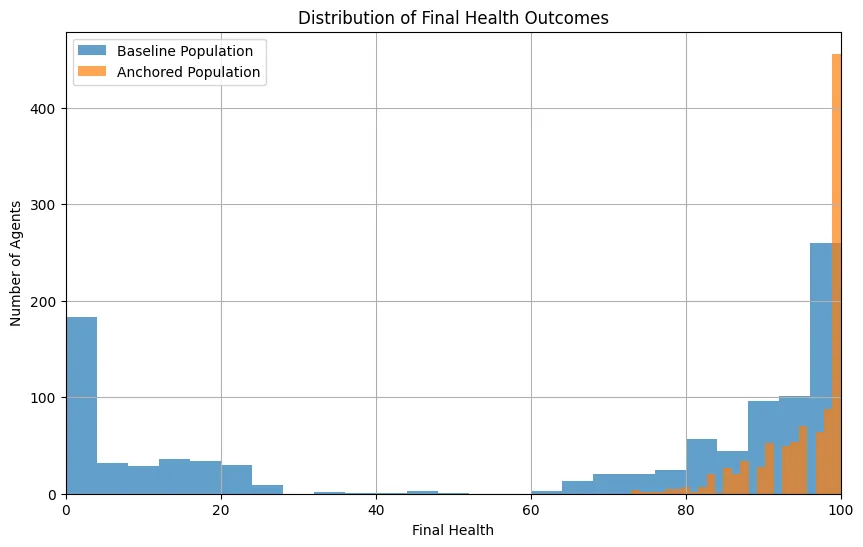
The cumulative depression incidence graph shows Baseline depression onset beginning around age 18 and accumulating continuously to 37.9 percent by age 85, while the Anchored line remains at zero for the entire lifespan. These are not marginal differences amenable to alternative explanations within the model. Under identical adversity exposure, identical event distributions, and identical financial mechanics, the presence of the two organizational structures produced a categorical separation in every measured outcome: mortality, depression, health floor, health trajectory, and reserve preservation.
The simulation does not directly prove metaphysical claims. It provides a quantitative systems-level framework compatible with resilience theory, psychoneuroimmunology, stress buffering, depression cascade dynamics, organizational persistence, and long-term adaptive stability. Within the Layer 5 interpretation, the Objectives parameter models the positive organism-wide signalling effect of the macroscopic self maintaining coherent future orientation, as described in Sections 3.1, 3.11, and 3.15. The Anchor parameter models the cellular governance stabilization effect of psychological and spiritual anchoring, as described in Sections 3.22 and 8.11. The depression cascade mechanism directly models the K-component degradation described in P20. The simulation therefore provides a working computational instantiation of the cellular governance model operating across a simulated lifespan.
9.8 Conclusion
Layer 5 is not a replacement for empirical science. It is a theoretical foundation from which empirical science can be more coherently organized in the domains that existing frameworks have fragmented. It is scientifically spiritual in that it applies rigorous inferential standards to domains historically monopolized by religion. It is spiritually scientific in that it takes seriously the experiences that spiritual traditions have always pointed toward, and treats them as real phenomena requiring real explanation rather than either supernatural ratification or dismissive reduction. Every topic covered in this paper - healing, intuition, placebo, depression, soul, death, afterlife, God, prayer - can be derived from and explained scientifically using Vijay's Law and the evidence of its application across the previous four layers. This is not so with any existing belief system's comprehensive explanation of the same phenomena. No existing religious or spiritual tradition offers a single internally consistent, scientifically grounded account from which God, soul, healing, intuition, death, and afterlife can all be derived without contradiction and without appeal to supernatural mechanisms that violate known biology or physics. [1-4]
The sixteen questions that the Buddha - the most rigorous spiritual thinker in recorded history - declared unanswerable 2,500 years ago are answered in this framework. They are answered not through a new mythology but through a single governing law applied consistently across cosmology, biology, evolution, emotional life, and spiritual experience. To the author's knowledge, no existing religious or scientific framework provides a comparably unified, internally consistent account of all these domains without appeal to supernatural exceptions. The research programme of which this paper is one part - 16 cosmological papers with simulations, 2 papers on universal consciousness and evolution, the UNITE framework with its independently verified formula, and the present Layer 5 paper - represents the first complete, verifiable, derivable account of the phenomena that humanity has called spiritual. An independent evaluation of the broader programme assessed it as unusually high in scope, completeness, and open reproducibility relative to comparable independent research efforts. Everything in this paper flows from one governing law: Vijay's Law. [1-4]
Appendix A: Structured Protocol for Cellular Healing and Internal Alignment
This appendix presents a structured body-directed protocol that operationalizes the cell-communication healing model developed in Section 3. It is intended as a repeatable contemplative practice that may support internal coherence, body-directed attention, reduced internal contradiction, and a more repair-supportive organism-level state. It may be used during illness, recovery, chronic stress, prevention, or before sleep. It is not presented as a substitute for medical care. It is presented as a practical application of the Layer 5 framework.
A.1 Purpose
The purpose of this protocol is to create a coherent internal governance state in which the macroscopic self adopts a stable, cooperative, body-supportive stance toward the cellular collective. Within the Layer 5 model, the intervention is designed to increase the organism-level Gratitude orientation toward the body and its constituent cells; strengthen organism-level signals of safety, continuity, and future-oriented investment; support body-directed attention and repair-supportive self-regulation; and improve consistency between thought, emotional stance, and health-supportive behaviour.
A.2 Core Theoretical Basis
Within the framework of this paper, the body is understood as a living cellular civilization composed of trillions of individually living cells operating in coordinated form. The human-level self functions as the highest local coordinating consciousness of that civilization. Cells do not respond to words as language. They respond to the organism-level climate created by thought patterns, expectation, posture, breathing, behaviour, sleep quality, stress physiology, and repeated internal stance.
Accordingly, this protocol does not assume magical verbal causation. It assumes that focused attention, gratitude, reassurance, and behavioural congruence can alter the organism-level signalling environment in ways that support internal coherence. Within this framework, placebo responses are interpreted as meaning-mediated physiological shifts produced by increased trust, expectation, and internal coherence. The present protocol is designed to deliberately cultivate those same conditions without dependence on an external ritual medium.
A.3 Recommended Use Conditions
This protocol is best performed in a quiet setting with minimal interruption, seated or lying comfortably, for approximately 10 to 20 minutes, once or twice daily, and especially before sleep, during recovery, or during periods of stress. It may also be adapted into a shorter 2 to 5 minute version for use during the day.
A.4 Suggested Frequency
Preventive use: once daily, especially at night. Recovery support: once or twice daily. Acute stress regulation: brief form as needed. Chronic illness support: daily, with emphasis on consistency rather than intensity. The intended effect is cumulative. Within the model, repeated coherent signalling is more important than occasional emotional intensity.
A.5 Formal Steps of the Protocol
Step 1 - Settle the Body. Close the eyes if comfortable. Breathe slowly and evenly for several cycles. Allow posture, jaw, shoulders, chest, abdomen, and hands to soften. The goal is not dramatic relaxation but reduction of obvious tension and internal noise. Suggested internal wording: I am becoming still. I am preparing to support my body.
Step 2 - Establish the Correct Ontological Frame. Bring to mind the central premise of the practice: the body is not inert hardware but a living cellular collective. The purpose of this step is to replace mechanical framing with cooperative framing. Suggested internal wording: My body is a living cellular civilization. Its cells are the living participants that make my life possible.
Step 3 - Recognize the Cellular Collective. Direct attention to the whole body. The aim is broad recognition, not strain. The practitioner acknowledges the body as a coordinated living federation. Suggested internal wording: Trillions of cells are continuously working to maintain this body. Their coordinated activity allows me to live, act, think, and recover.
Step 4 - Shift to Gratitude and Respect. The practitioner deliberately adopts a stance of gratitude, care, respect, and support toward the body. In the logic of Layer 5, this is the critical conversion toward cooperative governance. Suggested internal wording: I choose gratitude. I choose care. I recognize the effort already being made within me. If illness or pain is present: My body is carrying a burden. I respond with patience, support, and care.
Step 5 - Reassure the Body of Continued Investment. The practitioner adopts a future-oriented, stable stance. Suggested internal wording: I remain committed to this body. I remain committed to recovery, repair, and continuity. I am fully present in support of this system.
Step 6 - Focus on a Target Area if Needed. If there is a specific area of pain, dysfunction, or illness, attention may be directed there with calm and supportive intent. Suggested internal wording: I bring calm attention here. I acknowledge what this area is carrying. I bring support, steadiness, and repair-oriented awareness here.
Step 7 - Reinforce Safety, Coherence, and Repair. The practitioner stabilizes the body-supportive stance with a limited number of repeated statements. These should be believable; exaggerated or implausible affirmations should be avoided. Suggested internal wording: My body knows how to repair within its limits. I support recovery through calm, consistency, and care. I remain future-oriented. My actions will match my intention.
Step 8 - Commit to Behavioural Congruence. Within the model, cells respond more strongly to lived behaviour than to words alone. The practice therefore ends with a concrete commitment to body-supportive action. Suggested internal wording: I will support this internal state with behaviour. I will protect sleep, movement, treatment, nourishment, and recovery where possible.
Step 9 - Close in Stillness. End without dramatic emotional escalation. The desired outcome is stable internal coherence, not theatrical intensity. Suggested internal wording: I have strengthened cooperation. I will carry this supportive stance forward.
A.6 Optional Pre-Sleep Version
A shorter pre-sleep form may be especially useful because sleep is a biologically privileged repair window. The practitioner performs a brief whole-body acknowledgment, gratitude shift, and reassurance sequence before sleep. Suggested pre-sleep wording: My body will now enter its repair period. I support calm and coordinated recovery. I thank the cells and systems working through the night. I support repair during sleep.
A.7 Minimal Emergency Version
For use during acute stress, pain flare, panic, or emotional collapse: slow the breath for 3 to 5 cycles; place one hand on the chest or affected region if helpful; and use only three statements: I am here with my body. I bring calm and steadiness now. I support stability and repair. This short form is designed to restore basic cooperative governance quickly.
A.8 Important Use Notes
The practice should be coherent, not exaggerated. If a statement feels false or excessive, it should be replaced with a milder but believable version. The aim is not forced positivity but increased coherence and stronger cooperative internal signalling. The protocol is compatible with medical treatment, psychotherapy, rehabilitation, contemplative practice, and ordinary self-care. Within the framework of this paper, it is best understood as an adjunctive internal-governance practice, not as a replacement for evidence-based treatment.
A.9 Contraindications and Cautions
This protocol should be used carefully in cases of severe psychiatric instability, acute psychosis, extreme dissociation, situations in which inward focus reliably intensifies distress, or circumstances where body attention strongly activates trauma responses. In such cases, shorter, externally anchored, or clinician-guided versions may be more appropriate.
A.10 Formal Summary
The Layer 5 healing protocol is a structured practice of internal governance. It is based on the proposition that the macroscopic self can influence the organism not by issuing linguistic commands to cells, but by shaping the organism-level climate in which those cells operate. Its core mechanism is the deliberate creation of a more coherent, more supportive, and more future-oriented internal state. Within the framework of this paper, that state functions as a biologically meaningful signal to the living cellular collective that repair, maintenance, and continued investment remain warranted.
References
1. Sharma VS. The Big Flare-Up Theory (BFUT). Zenodo. 2024. DOI: 10.5281/zenodo.19149785.
2. Sharma VS. Everything in the universe is alive and conscious (Vijay's Law). Zenodo. 2024. DOI: 10.5281/zenodo.19504923.
3. Sharma VS. Evolution Through Conscious Drive. Zenodo. 2024. DOI: 10.5281/zenodo.19504944.
4. Sharma VS. The Unified Theory of Emotions (UNITE). Restricted by the author pending an ongoing patent application.
Biology of collective living systems and cellular life
5. Bosch TCG, Miller DJ. The Holobiont Imperative: Perspectives from Early Emerging Animals. Springer. 2016.
6. Wilson EO. The Superorganism: The Beauty, Elegance, and Strangeness of Insect Societies. W.W. Norton. 2009.
Skin sensing, keratinocyte signalling, and distributed sensing
7. Roosterman D, Goerge T, Schneider SW, Bunnett NW, Steinhoff M. Neuronal control of skin function: the skin as a neuroimmunoendocrine organ. Physiol Rev. 2006;86(4):1309-1379.
8. Talagas M, Misery L. Role of keratinocytes in sensitive skin and pain. Front Med. 2019;6:12.
9. Suh S, Choi EH, Atobe M. The expression of opsins in the human skin and its implications. Photochem Photobiol. 2020;96(3):500-507.
10. Andrabi M, Bhansali S, Bhansali A, Walia R. An expanding role for nonvisual opsins in extraocular light responses. Photochem Photobiol. 2023;99(2):290-305.
11. Kelley JL, Davies PM. The biological mechanisms and behavioral functions of opsin-based dermal photoreception. Front Ecol Evol. 2016;4:106.
Meditation, mind-body modulation, and stress-immune interactions
12. Black DS, Slavich GM. Mindfulness meditation and the immune system: a systematic review of randomized controlled trials. Ann N Y Acad Sci. 2016;1373(1):13-24.
13. Morgan N, Irwin MR, Chung M, Wang C. The effects of mind-body therapies on the immune system: meta-analysis. PLoS One. 2014;9(7):e100903.
14. Pace TWW, Negi LT, Adame DD, Cole SP, Sivilli TI, Brown TD, et al. Effect of compassion meditation on neuroendocrine, innate immune and behavioral responses to psychosocial stress. Psychoneuroendocrinology. 2009;34(1):87-98.
15. Kiecolt-Glaser JK, McGuire L, Robles TF, Glaser R. Psychoneuroimmunology: psychological influences on immune function and health. J Consult Clin Psychol. 2002;70(3):537-547.
Behaviour, self-talk, and emotional governance of physiology
16. Nummenmaa L, Glerean E, Hari R, Hietanen JK. Bodily maps of emotions. Proc Natl Acad Sci USA. 2014;111(2):646-651.
17. Davidson RJ, Kabat-Zinn J, Schumacher J, Rosenkranz M, Muller D, Santorelli SF, et al. Alterations in brain and immune function produced by mindfulness meditation. Psychosom Med. 2003;65(4):564-570.
18. Irwin MR. Why sleep is important for health: a psychoneuroimmunology perspective. Annu Rev Psychol. 2015;66:143-172.
Psychoneuroimmunology (PNI)
19. Ader R, Cohen N. Behaviorally conditioned immunosuppression. Psychosom Med. 1975;37(4):333-340.
20. Segerstrom SC, Miller GE. Psychological stress and the human immune system: a meta-analytic study of 30 years of inquiry. Psychol Bull. 2004;130(4):601-630.
21. Kiecolt-Glaser JK, Glaser R, Cacioppo JT, MacCallum RC, Snydersmith M, Kim C, et al. Marital conflict in older adults: endocrinological and immunological correlates. Psychosom Med. 1997;59(4):339-349.
22. Irwin MR, Cole SW. Reciprocal regulation of the neural and innate immune systems. Nat Rev Immunol. 2011;11(9):625-632.
Depression, learned helplessness, and inflammation
23. Pennebaker JW. Putting stress into words: health, linguistic, and therapeutic implications. Behav Res Ther. 1993;31(6):539-548.
24. Steptoe A, Kivimaki M. Stress and cardiovascular disease. Nat Rev Cardiol. 2012;9(6):360-370.
25. Snyder CR. Hope theory: rainbows in the mind. Psychol Inq. 2002;13(4):249-275.
26. Maier SF, Seligman ME. Learned helplessness at fifty: insights from neuroscience. Psychol Rev. 2016;123(4):349-367.
27. Dantzer R, O'Connor JC, Freund GG, Johnson RW, Kelley KW. From inflammation to sickness and depression: when the immune system subjugates the brain. Nat Rev Neurosci. 2008;9(1):46-56.
28. Miller AH, Raison CL. The role of inflammation in depression: from evolutionary imperative to modern treatment target. Nat Rev Immunol. 2016;16(1):22-34.
29. Seligman ME, Csikszentmihalyi M. Positive psychology: an introduction. Am Psychol. 2000;55(1):5-14.
Exercise and sleep
30. Gleeson M, Bishop NC, Stensel DJ, Lindley MR, Mastana SS, Nimmo MA. The anti-inflammatory effects of exercise: mechanisms and implications for the prevention and treatment of disease. Nat Rev Immunol. 2011;11(9):607-615.
31. Cotman CW, Berchtold NC, Christie LA. Exercise builds brain health: key roles of growth factor cascades and inflammation. Trends Neurosci. 2007;30(9):464-472.
32. Walker MP. The role of sleep in cognition and emotion. Ann N Y Acad Sci. 2009;1156:168-197.
Faith healing, prayer, and ritual
33. Benedetti F, Mayberg HS, Wager TD, Stohler CS, Zubieta JK. Neurobiological mechanisms of the placebo effect. J Neurosci. 2005;25(45):10390-10402.
34. Pennebaker JW, Seagal JD. Forming a story: the health benefits of narrative. J Clin Psychol. 1999;55(10):1243-1254.
35. Koenig HG. Religion, spirituality, and health: the research and clinical implications. ISRN Psychiatry. 2012;2012:278730.
Interoception and embodied cognition
36. Craig AD. How do you feel? Interoception: the sense of the physiological condition of the body. Nat Rev Neurosci. 2002;3(8):655-666.
37. Garfinkel SN, Seth AK, Barrett AB, Suzuki K, Critchley HD. Knowing your own heart: distinguishing interoceptive accuracy from interoceptive awareness. Biol Psychol. 2015;104:65-74.
38. Damasio A, Grabowski TJ, Bechara A, Damasio H, Ponto LL, Parvizi J, et al. Subcortical and cortical brain activity during the feeling of self-generated emotions. Nat Neurosci. 2000;3(10):1049-1056.
39. Bechara A, Damasio H, Tranel D, Damasio AR. Deciding advantageously before knowing the advantageous strategy. Science. 1997;275(5304):1293-1295.
40. Critchley HD, Wiens S, Rotshtein P, Ohman A, Dolan RJ. Neural systems supporting interoceptive awareness. Nat Neurosci. 2004;7(2):189-195.
41. Creswell JD. Mindfulness interventions. Annu Rev Psychol. 2017;68:491-516.
Placebo and nocebo mechanisms
42. Colloca L, Benedetti F. Placebos and painkillers: is mind as real as matter? Nat Rev Neurosci. 2005;6(7):545-552.
43. Schedlowski M, Enck P, Rief W, Bingel U. Neuro-bio-behavioral mechanisms of placebo and nocebo responses: implications for clinical trials and clinical practice. Pharmacol Rev. 2015;67(3):697-730.
44. Colloca L, Barsky AJ. Placebo and nocebo effects. N Engl J Med. 2020;382(6):554-561.
45. Petrie KJ, Rief W. Psychobiological mechanisms of nocebo effects: a framework for research and practice. Psychosom Med. 2019;81(5):394-404.
46. Ader R. Psychoneuroimmunology. 4th ed. Academic Press. 2007.
47. Hölzel BK, Carmody J, Vangel M, Congleton C, Yerramsetti SM, Gard T, et al. Mindfulness practice leads to increases in regional brain gray matter density. Psychiatry Res. 2011;191(1):36-43.
48. Damasio AR. Descartes' Error: Emotion, Reason, and the Human Brain. Putnam. 1994.
Postmortem tissue viability and continuity
49. Bhanu C, Bhanu M. Time since death. J Forensic Sci Criminal Inves. 2014;1(1).
50. Noble R, Noble A, Noble B. Cellular continuity after somatic death: implications for decomposition biology. Forensic Sci Int. 2020;313:110363.
Self-organizing cell systems: xenobots and anthrobots
51. Kriegman S, Blackiston D, Levin M, Bongard J. A scalable pipeline for designing reconfigurable organisms. Proc Natl Acad Sci USA. 2020;117(4):1853-1859.
52. Gumuskaya G, Srivastava P, Cooper BG, Lesser H, Semegran B, Garnier S, et al. Motile living biobots self-construct from adult human lung airway epithelium. Adv Sci. 2023;10(45):2303575. DOI: 10.1002/advs.202303575.
53. Gumuskaya G, Srivastava P, Cooper BG, Lesser H, Semegran B, Garnier S, et al. The morphological, behavioral, and transcriptomic life cycle of anthrobots. Adv Sci. 2025;12(3):2408050. DOI: 10.1002/advs.202408050.
54. Bodhi B. The Middle Length Discourses of the Buddha: A Translation of the Majjhima Nikaya. Boston: Wisdom Publications; 1995. Sabbāsava Sutta (MN 2).
55. Sharma VS. Layer 5 Periodic Adversity and Meaning-Anchor Simulation: Code, Outputs, and Methodology. Zenodo. 2026. DOI: 10.5281/zenodo.20108194.
56. Sharma VS. The Emergence of Forces and Fundamental Senses: How the Spaticle Field Gave Rise to Gravity and All Other Forces. Zenodo. 2025. DOI: 10.5281/zenodo.19976408.
57. Sharma VS. From Matter and Fundamental Forces to Consciousness: A Unified Framework of Sensing Channels, Control, and Evolution. Zenodo. 2025. DOI: 10.5281/zenodo.19992457.
58. Sharma VS. The Consciousness Index (CI): A Physically Grounded Scalar Measure of Conscious Degree, Structure, and Evolutionary Potential. Zenodo. 2025. DOI: 10.5281/zenodo.20025739.
59. Sharma VS. What Existed Before the Spacetime Fabric? The Origin of Space, Time, and the Physical Substrate of Reality in an Infinite Universe. Zenodo. 2025. DOI: 10.5281/zenodo.19811691.
60. Sharma VS. A BFUT Pre-QCD Emergence Model: From the Spaticle Field to the First Quark-Class Excitation, and from Repeated First Units to Ordinary Hydrogen as the First Atom. Zenodo. 2025. DOI: 10.5281/zenodo.19908215.