Evolution Through Conscious Drive: How Random Mutations and Survival of the Fittest Fail the Test
- Abstract
- 1. Vijay’s Law and Its Evolutionary Application
- 2. Why Random Mutation Fails as a Primary Explanatory Principle
- 2.1 Evolution as Strategy, Not Mere Survival Filtering
- 3. Why Natural Selection Fails as a Primary Explanatory Principle
- 3.1 The Failure of Template Explanations
- 4. The Mechanism: How Repeated Strategy Becomes Inherited Form
- 4.1 Strategy-Specific Adaptations and the Intermediate Viability Problem
- 5. Why Species Fail: Extinction Does Not Contradict the Framework
- 5.1 Environmental Breadth Determines Strategic Diversity
- 5.2 Where Conventional Evolutionary Accounts Become Incomplete
- 6. The Drive Demonstrated: Examples Across the Natural World
- 6.4 The Correct Questions to Ask of Any Evolutionary Claim
- 7. Parasites: The Strongest Evidence for Conscious Drive
- 8. Convergent Evolution Supports This Framework
- 9. Predator and Prey: Strategic Arms Races, Not Blind Sieves
- 10. Formal Statement of Position
- 10.6 Evolution Through Conscious Drive: Cascading Opportunity, Directed Exploitation, and Sustainable Co-Persistence
- 11. Simulation-Based Stress Test of the Random Mutation Burden
- 12. Conclusion
- APPENDIX A
- Appendix A: A Catalogue of Biological Evidence for Conscious Drive
- A. Attack, Defence, and Survival Systems
- B. Camouflage, Mimicry, and Deception
- C. Plant Intelligence and Strategic Behaviour
- D. Parasitic Manipulation: The Strongest Category of Evidence
- E. Distributed and Collective Intelligence
- F. Sensory Worlds and Adaptive Reallocation
- References
Abstract
This paper is Layer 3 of a six-layer theoretical framework grounded in Vijay's Law, which holds that everything in the universe, every particle, atom, cell, and organism, is alive and conscious, and that all matter carries an innate drive to perpetuate itself, either in its own form or through cooperation with other matter into more complex forms. Layer 2 of this framework established that proposition and its foundational logical, empirical, and computational support. The present paper applies Vijay’s Law at the biological scale and advances a fundamental challenge to the two central pillars of Darwinian and neo-Darwinian evolutionary theory: random mutation and natural selection.
The paper argues that random mutation, as a primary explanatory account of major biological innovation, functions less as a demonstrated causal mechanism than as a placeholder for an unidentified directing process. Natural selection, while descriptively useful for differential survival outcomes, is shown to be insufficient as the primary causal explanation of the origin, direction, and recurrence of integrated adaptive systems. In their place, this framework advances a single governing mechanism: the perpetuation component of Vijay’s Law. Matter does not drift blindly into new forms and await external judgment. It manifests into forms suited to stable or predictably unstable conditions, through opportunity-responsive, success-conditioned cooperative manifestation.
The paper develops this argument through multiple converging lines. It demonstrates the intermediate viability problem for strategy-specific systems such as the bombardier beetle and multi-stage parasitic life cycles. It presents convergent evolution (the independent development of eyes, flight, echolocation, and streamlining across unrelated lineages) as evidence of living intelligence repeatedly solving the same problem, rather than blind accumulation of accidents. It interprets the Xenobot and Anthrobot experimental findings of Levin and colleagues as direct empirical evidence that cellular collectives can discover new viable forms of organisation before any genetic rewriting, consistent with the prediction that living matter responds to opportunity fields actively rather than passively.
A simulation-based stress test of the random mutation burden shows that even under assumptions deliberately favourable to orthodox theory, net accumulation of beneficial heritable change is far weaker than standard narratives assume. A lineage-specific stress test centred on the elephant lineage formalises this concretely: across over 19 million generations, the expected cumulative net adaptive score is strongly negative and the estimated one-lineage sequential-transition success probability is approximately 3.85 × 10⁻³³. Section 11 discusses the interpretation and implications of these results, while the full parameter architecture, graphical outputs, and detailed simulation results are provided in Appendix B. The paper introduces the opportunity field, the structured space of viable adaptive possibilities presented by any supportable environment, a concept grounded in the Spaticle field physics of BFUT [93, P17, P20]. A specific prediction follows: human-like forms should have manifested wherever the relevant opportunity-field conditions became supportable, consistent with recent paleoanthropological findings [101, 102, 103]. An extensive appendix (Appendix A) catalogues over sixty biological cases across attack, defence, camouflage, plant intelligence, parasitic manipulation, collective behaviour, and sensory specialisation, each interpreted as a direct expression of the perpetuation drive at work.
Keywords: Vijay’s Law; conscious drive; biological evolution; random mutation; natural selection; opportunity field; convergent evolution; parasitic life cycles; Xenobots; Anthrobots; perpetuation drive; six layers of reality
1. Vijay’s Law and Its Evolutionary Application
The foundational principle of this framework, established in the companion paper on universal consciousness [94] and grounded in the Spaticle field physics of the BFUT cosmological programme [93], is this: every particle, atom, cell, and organism has one fundamental drive, to perpetuate itself, either in its own form or through combination with other matter that gives it a better chance of perpetuation. Matter will consciously participate in, and subordinate itself to, a higher form of organisation if that higher form has a greater capacity to carry the matter's kind forward. The physical mechanism connecting this drive to sensing channels and integration hierarchies across all scales of matter is established in BFUT Papers 20 and 21 [P20, P21].
This single principle is deeper and more unified than anything proposed by Darwinian or neo-Darwinian theory, because it requires only one explanatory mechanism rather than two. Darwin's framework requires variation and selection as separate principles, novelty must first appear, and then be filtered. This framework requires only the perpetuation component of Vijay’s Law, expressed differently at every scale and in every context. The drive is the source of direction. The drive is the source of strategy. The drive is the mechanism by which repeated adaptive responses become stabilised in body, physiology, and species-level pattern.
This drive operates at every scale simultaneously. At the atomic level, it is expressed as the tendency of atoms to bond and form stable combinations. At the cellular level, it is expressed as the drive of cells to survive, divide, and form cooperative alliances with other cells. At the organism level, it is expressed as the full range of strategies, feeding, defence, reproduction, deception, cooperation, competition, that living beings deploy in pursuit of perpetuation. At the species-level, it is expressed as the cumulative embodiment of repeated successful strategies into heritable form.
2. Why Random Mutation Fails as a Primary Explanatory Principle
As a primary explanatory account of major biological innovation, the phrase 'random mutation' remains conceptually incomplete. In many cases, it functions less as a demonstrated causal explanation than as a placeholder for an as-yet-unidentified directing process. When scientists describe a mutation as random, this typically reflects the absence of a known directing mechanism within the current model rather than a demonstrated proof of genuine undirectedness.
If dramatic biological capabilities were truly created by blind randomness, the expectation would be more arbitrary distribution of major abilities, more spectacular but ecologically irrelevant traits, more bizarre capabilities appearing in lineages where they are not useful, and more chaotic dispersal of unusual powers across unrelated species. But what is repeatedly observed is the opposite: traits match habitat, traits match prey, traits match predators, traits match hosts, traits match reproductive timing, traits match local material constraints, traits match the ecological role the organism occupies. This pattern is difficult to reconcile with a purely undirected account of major innovation. What is repeatedly observed is ecological fit, functional coherence, and system-level integration, features more consistent with directed adaptive problem-solving than with randomness treated as a sufficient primary cause.
Furthermore, many biological innovations are not one-step changes. They are systems requiring structural modification, physiological support, control timing, energy management, ecological deployment, and often behavioural compatibility. A system is not explained by calling one component random. The real question, why did the living system move toward that exact integrated solution in that exact ecological context, is precisely where the theory of conscious drive becomes more explanatory than the random mutation model.
2.1 Evolution as Strategy, Not Mere Survival Filtering
Standard neo-Darwinian explanations often rely on a familiar template: variation occurs gradually, useful traits are retained, harmful variants disappear, and the present is simply the residue of what happened to survive. This framework is incomplete because it answers only the final filtering question while avoiding the prior strategic question. The deeper question is not merely why one variant survived after it appeared. The deeper question is why that particular adaptive route arose at all, especially where many other simpler or more obvious routes were available.
A creature’s adaptive form is not merely a passive residue of selection. It is also a strategy suited to the structure of conditions and resources available to it. The present framework therefore argues that evolution should not be understood only as survival filtering among random accidents, but as matter manifesting strategies suited to stable or predictably unstable environments. The strategy may later be described mechanistically, genetically, developmentally, or ecologically. That does not remove the strategic character of the outcome. It only redescribes the channel through which the strategy became embodied.
3. Why Natural Selection Fails as a Primary Explanatory Principle
Natural selection, while useful as a descriptive account of differential survival outcomes, is argued here to be insufficient as the primary causal explanation of biological innovation. Natural selection is descriptive, not creative. It explains none of the following: where the specific strategy came from; why the trait appeared in that exact form; why it is often deeply integrated across multiple systems; why ecological opportunities keep producing new exploiters; why winners are often temporary; or why new strategies later displace earlier dominant ones.
Consider the lion example. If one lion defeats another, a Darwinian observer may say the stronger lion was naturally selected. But what if later prey declines, drought comes, disease spreads, a more flexible predator persists, or the lion's lineage collapses entirely? What then happened to natural selection? Was it true only in that moment? If so, it is not the true engine of evolution. It is only a label for a temporary outcome. Natural selection describes a momentary survival advantage. It does not identify the deep cause of biological novelty or the direction of biological change.
The more accurate principle is this: wherever stable conditions and exploitable resources exist, life emerges to exploit them. If grass flourishes, grazers flourish. If grazers flourish, predators flourish. If predators flourish, prey counter-strategies flourish. If carcasses accumulate, scavengers flourish. If hosts become available, parasites flourish. If parasites flourish, immune systems and anti-parasite strategies flourish. This may be described within standard biology as selection acting across ecological relationships, but in the deeper causal sense advanced here, it is better understood as ongoing adaptive expansion and counter-expansion by living systems responding to opportunities and constraints in pursuit of perpetuation. [97, 98]
3.1 The Failure of Template Explanations
A recurring weakness in conventional evolutionary debate is the repeated use of template answers that can be attached to almost any case without genuinely explaining it. Expressions such as “it happened gradually,” “step by step,” “random mutation,” “the successful forms survived,” or “we only see the survivors” are often presented as explanations. In reality, they frequently function as placeholders rather than answers.
Such phrases may describe a broad framework of filtering, but they do not automatically explain the viability of intermediate stages, the timing of coordinated features, the strategic specificity of the final adaptation, or the reason that one adaptive pathway emerged rather than another. If a trait requires multiple interdependent components, then the question is not merely whether those components could in principle accumulate over time. The question is whether partial states were viable, whether they conferred any real survival value, whether they imposed costs before functionality was complete, and whether the organism could persist long enough for the full system to arise.
4. The Mechanism: How Repeated Strategy Becomes Inherited Form
A frequent challenge to theories of conscious evolution is the mechanistic question: how does repeated behaviour become stabilised into heritable morphology? This framework answers that question at the deepest possible level, and the answer requires no separate mechanism beyond Vijay’s Law itself.
The mechanism is the drive itself. A cell or organism that encounters a threat or opportunity does not respond randomly. It responds in the direction of perpetuation, because that drive is fundamental to its nature at every level of its composition, from atom to cell to organ to organism. Repeated responses in the direction of perpetuation become stabilised because the matter that successfully perpetuated itself is the matter that remains. The strategy becomes embodied because the matter that enacted the strategy is the matter that survived to carry it forward. This differs from a strictly Darwinian framing in that the direction of change is argued here not to originate in blind variation later filtered by circumstance, but in adaptive response already oriented toward perpetuation before stabilisation occurs.
The body, in this framework, is a memory of repeated strategy. A trait is not merely an inherited accident. A trait is a repeated response, a stabilised solution, a successful pattern embodied. Camouflage is concealment embodied. Venom is chemical control embodied. Claws are attack embodied. Echolocation is acoustic problem-solving embodied. Host manipulation is life-cycle intelligence embodied. Symbiosis is repeated cooperative advantage embodied. In each case, the body records what the drive toward perpetuation repeatedly found to work.
4.1 Strategy-Specific Adaptations and the Intermediate Viability Problem
Some biological systems are not merely complex. They are strategy-specific. That distinction matters. A system may be called complex simply because it contains many parts. But a strategy-specific system is one in which the parts are arranged toward a highly particular adaptive solution among many conceivable alternatives.
The bombardier beetle is a useful example. Its defensive system is not merely an instance of having defence. It is one highly specific defence strategy: the construction of a protected internal reaction chamber, the storage of reactive chemicals in separate reservoirs, the controlled mixing of those chemicals, the management of the resulting heat and pressure, and the directional discharge of the reaction toward a threat while protecting the beetle itself. Even if one grants gradual modification in principle, the decisive question remains: why this exact route? Why this highly specialised chemical defence strategy rather than flight, armour, venom, mimicry, burrowing, swarm dependence, enhanced bite force, or other far simpler defensive solutions available elsewhere in nature? The question is not only whether the final system works. The question is why this precise strategy emerged.
A similar difficulty appears in parasitic or life-cycle dependent systems whose success depends on multiple coordinated stages. If a parasitic organism must pass through an intermediate host and then manipulate that host’s behaviour in order to reach its final host, then incomplete intermediate states are not neutral curiosities. They may be fatal. A life cycle that ends prematurely inside an intermediate host is not merely unfinished. It is non-viable. Thus, where the success of the species depends on a coordinated behavioural manipulation or transmission sequence, “step by step over millions of years” is not by itself an explanation. It must also show that the intermediate stages were viable rather than self-terminating.
5. Why Species Fail: Extinction Does Not Contradict the Framework
A potential objection to this framework is the existence of extinction. If every organism has a fundamental drive toward perpetuation, why do species disappear entirely? The answer is straightforward and does not require additional principles.
The drive toward perpetuation guarantees direction of effort, not guarantee of success. Consider the human analogy: all humans want to succeed, to be respected, to flourish. Yet not all do. Once some begin to succeed, others work to stop them, compete against them, eliminate them. The same logic applies in the natural world. Two cells that each want to perpetuate may each want to consume the other, only one succeeds. A species striving to perpetuate may be overwhelmed by a competitor, a pathogen, a climate shift, or, as history demonstrates, by human activity. The whaling example is instructive: if humans hunt whales without limit, or consume the food sources whales depend on, whales disappear. The drive to perpetuate was present in every whale. The conditions overwhelmed it.
Extinction therefore does not contradict this framework. It confirms it. Even in extinction, organisms were not behaving randomly. They were striving. They were deploying whatever strategies the drive toward perpetuation could generate. They lost, to superior competition, to overwhelming conditions, or to catastrophe. That is a fundamentally different picture from blind matter drifting through accidents. The drive was real. The outcome was defeat, not absence of intent.
5.1 Environmental Breadth Determines Strategic Diversity
The contrast between isolated cave systems and the deep ocean illustrates an important principle of this framework: the breadth and structural diversity of an environment determine how many viable adaptive strategies can coexist within it. [97, 98]
In small, isolated, and highly constrained dark cave environments, many organisms show convergent reduction of pigment and reduction or loss of eyes. This is often cited as a straightforward case of trait loss under conditions where vision is unnecessary. That observation is real. But it should not be overgeneralised. [97, 98]
In the deep ocean, which is also extremely dark and in many regions darker than cave systems, the evolutionary picture is strikingly different. There one finds multiple coexisting strategies: organisms with reduced or absent visual dependence, organisms with extremely large eyes, and organisms that generate their own light through bioluminescence. If darkness alone dictated one inevitable evolutionary answer, these divergent strategies would be difficult to explain. The better explanation is that darkness is only one parameter. Environmental scale, spatial complexity, mobility requirements, predation structure, communication needs, and resource distribution all matter. [97, 98]
A small and highly constrained cave may permit only a narrow band of viable strategies. A vast and structurally diverse deep-sea environment permits many. Some organisms can survive by minimising visual investment. Others benefit from maximising visual sensitivity. Others develop bioluminescence for signalling, hunting, camouflage, mating, or deception. Under the present framework, this is exactly what one should expect: matter manifests in forms suited to exploit the specific structure of available conditions and resources. Similar environmental pressures do not always produce identical solutions, because the broader architecture of opportunity may differ. [97, 98]
5.2 Where Conventional Evolutionary Accounts Become Incomplete
It is worth noting that many standard evolutionary explanations quietly move toward the present framework whenever they invoke terms such as strategy, optimisation, exploitation, adaptation to niche structure, behavioural solution, signalling advantage, or ecological fit. Such language implicitly acknowledges that the issue is not mere passive filtering of random accidents, but the manifestation of forms suited to conditions. The disagreement is therefore often not over whether strategy exists in nature, but over whether strategy is treated as a genuine expression of inner drive in matter or reduced to a retrospective vocabulary imposed after the fact.
6. The Drive Demonstrated: Examples Across the Natural World
6.1 The Deep-Sea Anglerfish: Self-Dissolution in Service of Perpetuation
The deep-sea anglerfish male is one of the most extreme demonstrations of the perpetuation drive in all of nature. The female is hundreds of times larger than the male. The male has no significant attack or defence mechanism. He floats in near-total darkness in the deep ocean, with a single biological imperative: find a female. When he does, he bites into her body and fuses with her, losing his independent existence entirely. His organs dissolve. His circulatory system merges with hers. He ceases to exist as an individual in any meaningful sense, surviving only as a reproductive appendage on her body. [12] [97, 98]
This is the most extreme possible demonstration of Vijay’s Law. The drive to perpetuate kind is so fundamental that individual survival itself is consciously sacrificed for it. The male does not merely risk death, he chooses dissolution. Every cell, every atom of his being, subordinates itself entirely to the single objective of carrying his kind forward. This cannot be described as random behaviour filtered by selection. It is the perpetuation component of Vijay’s Law expressed at its most absolute.
6.2 Subordinate Male Monkeys: Conscious Strategy in Real Time
In many monkey species, a dominant male controls reproductive access to all females in the group. Subordinate males are excluded. Yet they do not simply accept this. They develop strategies, deception, timing, patience, coalition-building, opportunism, to find chances to mate despite suppression. They watch, they wait, they act when the dominant male is distracted. They form alliances with other subordinate males. They deceive.
This is evolution through conscious drive happening visibly, in real time, within a single species. No geological time is required to observe it. The drive toward perpetuation generates strategy, deception, cooperation, and persistence, in living animals, right now, under observation. This makes clear that the principle is not merely a theoretical reconstruction of deep evolutionary history. It is the observable present-tense reality of how living consciousness operates.
This behaviour is not confined to primates. Equivalent strategies (sneaking, female mimicry, coalition, patience, deception) have been documented across fish, reptiles, amphibians, and insects. In every case, subordinate male types exist as stable, reproducing populations. That persistence is the proof. If the strategy failed consistently, these types would have been eliminated over evolutionary time. The fact that they are present and observable today means the drive toward perpetuation found a way, and that way has worked continuously for millions of years. The behaviour visible right now is evolution made present tense. [10, 11]
6.3 Males Who Give Their Lives to Mate
Across the natural world, males of many species will willingly sacrifice their lives for a chance to mate. Female mantises may consume males during or after mating [17]. Male salmon exhaust themselves completely in the act of spawning and die shortly after [18]. Male spiders in some species offer themselves as food to females, increasing the female's nutritional state and thus the survival chances of the offspring [19]. Females of many species exhaust or sacrifice their bodies entirely in the act of producing, protecting, or provisioning eggs and young.
In every case, the individual life is subordinated to the perpetuation of kind. This is not accidental behaviour that happened to be selected. It is the perpetuation component of Vijay’s Law expressing itself at the level of the whole organism, the same drive that at the atomic level causes matter to bond and combine, and at the cellular level causes cells to sacrifice their independence to form organs and organisms.
6.4 The Correct Questions to Ask of Any Evolutionary Claim
Whenever a complex adaptation is explained through generic appeals to gradual accumulation, the following questions must also be asked:
• What exact survival or reproductive problem did the adaptation solve, and why this strategy rather than many other possible strategies?
• Were the intermediate stages viable in their own right, or would partial development have imposed costs without conferring sufficient benefit?
• If multiple interdependent components were required, what was the functional status of the system before all components were in place?
• Did the environment and resource structure actually support the emergence and maintenance of that pathway at the relevant stages?
• Is the explanation describing only retrospective survivorship, or does it genuinely explain the strategic specificity of the adaptation itself?
The present theory therefore does not conflict with the fact that biology can describe adaptation through genes, signalling pathways, developmental constraints, regulatory networks, ecological feedback loops, or population-level filtering. Those descriptions may be accurate as descriptions of mechanism. But as established more explicitly in the companion Layer 2 paper [94, 93], mechanism is not disproof of consciousness. A lawful, structured, or even quantifiable account of biological change does not eliminate the inner drive expressed through that change. It only describes the channel through which that drive operates. Likewise, generic appeals to gradualism, random variation, and survivorship cannot be treated as complete explanations unless they also account for strategic specificity, intermediate viability, environmental opportunity, and the actual route by which the adaptive form became possible.
7. Parasites: The Strongest Evidence for Conscious Drive
Parasitic systems provide some of the strongest illustrative cases for this framework because they repeatedly display highly specific, multi-stage, future-dependent behavioural and life-cycle coordination in organisms whose conventional cognitive resources appear minimal.
The zombie snail parasite Leucochloridium paradoxum enters a snail, develops in its tentacles as a pulsating structure resembling a caterpillar or grub, alters the snail's behaviour to make it more visible, attracts birds that peck at the tentacles, and thereby reaches the bird, its required next host, from whose droppings eggs eventually return to the environment to be consumed by snails again. This multi-stage sequence involving host entry, movement to the correct body part, construction of a visually attractive display, behavioural manipulation of the host, transfer to the correct next host, and environmental return through excretion is not mere infection. It is multi-stage strategic life-cycle execution by an organism with no brain. [3]
The parasitoid wasp that lays eggs inside a caterpillar while introducing immune-suppressing agents, preserving the host alive as a living resource, timing larval emergence, and inducing the caterpillar to remain near the cocoon cluster as a bodyguard, this is a multi-step reproductive strategy whose every stage depends on the success of subsequent stages. [6, 9] The emerald cockroach wasp that stings a cockroach in specific neural regions to induce docility and uses it as a living host for offspring demonstrates neural intervention, behavioural suppression, and reproductive foresight. [49] Sacculina castrates crabs and manipulates them into caring for the parasite's brood as if it were their own, commandeering parental behaviour itself. [50]
The central question is how such organisms repeatedly produce highly specific, future-dependent sequences of action despite possessing little or no conventional neural complexity. Within the present framework, this is interpreted as evidence that directed adaptive intelligence need not be confined to brain-based systems. The answer this framework provides is consistent and unified: they possess the perpetuation component of Vijay’s Law, expressed at their scale and through their available means. Size does not eliminate directedness. Brains are not the only possible basis of functional intelligence. The drive is present at every level of matter, and it produces strategy at every level of complexity.
8. Convergent Evolution Supports This Framework
Convergent evolution, the independent development of similar traits in unrelated lineages, is often cited as evidence for natural selection. The argument is that similar selection pressures produce similar outcomes. But this argument actually supports the conscious drive framework more strongly than it supports Darwinism.
When eyes evolve independently over forty times [13], when flight evolves independently multiple times [14], when streamlining appears in fish, dolphins, and ichthyosaurs [15], when echolocation appears independently in bats and cetaceans [16], this shows that similar problems repeatedly produce similar solutions. That is exactly what intelligence does. When multiple independent living systems encounter the same ecological problem, the drive toward perpetuation orients them toward similar solutions because similar problems have similar best answers. This is not blind filtering producing accidental convergence. It is living intelligence repeatedly solving the same engineering problem under the same constraints.
8.1 Universal Mathematical and Morphological Recurrence as Evolutionary Footprints
The recurrence of mathematical and morphological patterns across biological and wider natural systems is especially relevant to evolution. Spiral-like organization, fractal-like branching, packing efficiencies, scaling relations, and repeated transport or distribution geometries show that systems repeatedly settle into a limited family of highly structured solutions under repeated constraints. In the present framework, these recurring forms are best understood as the formal footprints of repeated cooperative resolution. Whenever matter repeatedly faces similar pressures of growth, transport, persistence, distribution, rotation, or stabilization, it tends to rediscover similar successful forms. Evolution is therefore not merely the accumulation of arbitrary accidents. It is a patterned exploration in which stable and efficient solutions recur because the underlying drives and constraints recur.
9. Predator and Prey: Strategic Arms Races, Not Blind Sieves
Much of what is called natural selection is better understood as a strategic arms race among conscious life forms, each driven by the perpetuation component of Vijay’s Law. Prey species develop speed, camouflage, warning colouration, toxins, armour, herd behaviour, alarm calls, burrowing, nocturnality, and, crucially, very high reproduction rates. The last of these is particularly revealing: some prey species reproduce in enormous numbers precisely because even if predators kill many, the species still flourishes [20]. This is not passive loss. It is a conscious counter-strategy, perpetuating kind through numerical abundance rather than individual defence.
Predators respond with ambush, stealth, venom, pack coordination, traps, lure mechanisms, sensory specialisation, and endurance. Then prey respond again. Then predators respond again. This is not a blind sieve. It is an ongoing battlefield of adaptive intelligence in which every participant is driven by the same fundamental force, the drive to perpetuate itself and its kind, and in which the strategies deployed are as specific, integrated, and purposeful as the ecological challenges they address.
10. Formal Statement of Position
This paper argues that neither random mutation nor natural selection is adequate as the primary explanatory engine of biological innovation. Random mutation, in this view, too often functions as a label for undirected change without identifying the source of directional fit. Natural selection, while descriptively useful, too often functions as a retrospective account of survival outcomes rather than as a sufficient causal account of the origin of integrated adaptive systems.
In their place, this framework advances a single governing law: every particle, atom, cell, and organism has one fundamental drive, to perpetuate itself, either in its own form or through combination with other matter that gives it a better chance of perpetuation. This drive is the elementary expression of consciousness at every level of matter. It is the source of biological direction. It is the mechanism by which repeated adaptive responses become stabilised in body, physiology, and species-level pattern.
Evolution is therefore not the story of random mutation. Evolution is not the story of natural selection. Evolution is the story of conscious drive, life responding to need, danger, opportunity, and ecological circumstance with directed adaptive behaviour, driven by conscious drive under Vijay's Law, where matter manifests under stable or predictably unstable conditions, such that repeated successful strategies become stabilised in body, physiology, and species-level pattern.
10.1 Clarifying the Deeper Claim: Why, Not Merely How
A central clarification is necessary. Conventional evolutionary accounts often describe how a trait is expressed, inherited, or filtered after it appears. This paper is addressing the deeper question of why living systems repeatedly move toward highly specific, ecologically fitted, multi-system solutions in the first place. Genes, signalling pathways, and environmental pressures may describe machinery, route, or context. They do not by themselves identify the internal causal direction of the change. This framework does: the perpetuation component of Vijay’s Law.
10.2 Slime Mold as a Direct Analogy for Collective Strategy
Slime molds offer a highly visible model of the same principle [21]. Under favourable conditions, component units may remain separate. Under stress, they aggregate into a higher-order coordinated form, solve movement and resource problems collectively, and later differentiate so that some cells support structure while others become the reproductive spores. This is coordinated self-subordination in service of the perpetuation of the combined form. The example strongly supports the core claim that matter does not require individual continuity if combined continuity offers the better path forward.
10.3 Temporary Adaptive Memory Versus Full Heritable Fixation
A further refinement is that not every successful adaptation needs immediate full-body or germline inscription. Some responses may remain temporary, local, or context-specific for long periods. Salmon homing illustrates the point [22]. Whether described as imprinting or multi-cue navigation, the organism clearly preserves precise actionable information across long intervals and later retrieves it with extraordinary fidelity. This supports the broader claim that living systems can store, prioritise, and deploy adaptive information selectively. The fact that not every such imprint becomes permanent inheritance is not a weakness of this framework. It may itself be evidence of strategic restraint.
10.4 The Hidden Miracle in the Standard Story
When a conventional account states that an integrated novelty emerged and then describes only downstream filtering or mechanism, it often leaves the central explanatory discontinuity intact. This paper argues that a satisfactory explanation should identify the directional basis of such novelty, not merely redescribe the outcome after it has appeared.
10.5 The Positive Mechanism of Evolution in the Present Theory: Vijay’s Law, Opportunity Fields, and Conscious Form Manifestation
10.5.1 Opportunity Fields and Directed Adaptive Manifestation
A crucial concept in this theory is the opportunity field. When an organism, lineage, or cellular collective enters a stable or predictably unstable environment, the future is not open in all directions equally. Certain pathways offer viable persistence, expansion, or transformation, while others do not. Living matter therefore does not need to explore the entire theoretical space blindly. It responds within the opportunity field created by the actual conditions before it. This is why similar pressures repeatedly yield similar adaptive outcomes. Predictably unstable conditions are particularly important, because they reward anticipatory adaptation rather than mere passive endurance. That is why this theory predicts recurrent convergent solutions across anatomy, behaviour, physiology, and organisation.
10.5.2 Convergent Evolution as Recurrent Solution Discovery
The repeated emergence of complex eyes across evolutionary history is especially damaging to any account that treats blind random mutation as the sufficient primary explanation of major adaptive novelty. Image-forming eyes, or highly elaborate visual systems, have arisen independently across widely separated lineages. Under a framework relying mainly on random mutation plus retrospective selection, repeated arrival at comparable high-function structures begins to resemble an improbably repeated jackpot. In the present framework, however, it is not a lottery. When similar environmental demands generate similar opportunity fields, living systems repeatedly move toward similar functional solutions. The recurrence of eyes is therefore not a miraculous run of accidents. It is what one should expect when living matter repeatedly selects from within a constrained field of viable adaptive possibilities. [96]
The same logic extends beyond eyes. Wings, echolocation, streamlined aquatic body forms, camera-type visual architectures, social coordination strategies, and many other recurrent adaptive solutions are better understood as repeated discoveries of viable forms under similar conditions than as isolated lucky piles of unrelated mutations. The more often evolution converges on comparable functional architectures, the weaker a purely accidental account becomes as a primary causal description, and the stronger the case becomes for directed adaptive selection by living systems themselves.
This framework does not deny that selection occurs. It denies that random mutation plus survival of the fittest is an adequate primary causal account of major adaptive novelty. Classical Darwinian language is strongest when describing the filtering of already-present variation. It is weakest when asked to explain why similar high-order solutions repeatedly appear across distant lineages, why adaptive change often proceeds along constrained functional pathways, and why multicellular collectives can reorganise rapidly when placed in new conditions. The causal centre therefore shifts here from accidental variation to living matter's active search for survivable and advantageous forms.
10.5.3 Xenobots, Anthrobots, and Cellular Reorganisation
A particularly important empirical development for this framework is the Xenobot research associated with Michael Levin and colleagues. The striking point is not merely that an unusual biological construct was later described. The crucial sequence is that embryonic frog cells were removed from their ordinary developmental context, placed in a Petri dish, and not given a new genetic program as the initiating step. The ordinary expectation would be that such cells would remain as passive biological material, or at most continue only in a limited residual way tied to their prior developmental assignment. Instead, they reorganised into novel multicellular assemblies, moved in coordinated ways, displayed collective behaviour, and, in later work, demonstrated kinematic self-replication by gathering loose cells into new multicellular offspring-like structures. This is extraordinarily important for the present theory because it shows that living cellular collectives can discover a viable new form of organisation and function before any durable genetic rewriting needs to be shown as the initiating event. In the language of this framework, the cells encountered a new opportunity field and selected a workable path of perpetuation. [1, 2, 99, 95]
The later Anthrobots work strengthens the same inference from a second direction. In that research, adult human airway-derived cells were likewise freed from their ordinary tissue context and shown to self-assemble into motile multicellular constructs with coordinated behaviour. This is important because the phenomenon is not limited to embryonic frog cells. It extends to adult human somatic cells, showing that under altered conditions, cellular collectives can discover new functional organisation beyond their usual organism-level assignment. For the present framework, Xenobots and Anthrobots together provide unusually strong empirical support for the proposition that cells are not passive subcomponents awaiting top-down instruction, but active living agents capable of entering new cooperative configurations when existing constraints are removed and new opportunity fields become available. [2, 1, 7, 100]
The evolutionary mechanism proposed here is not an isolated biological hypothesis but the biological-scale expression of Vijay’s Law applied under real ecological conditions. Concrete examples help illustrate how this operates in practice.
Concrete examples help illustrate the logic of the framework. Polar bear adaptation can be understood not as a lucky pile of disconnected mutations that somehow aligned in Arctic conditions, but as a lineage moving within a narrow opportunity field toward insulation, camouflage, metabolic efficiency, and hunting competence. Lungfish likewise illustrate how predictably unstable conditions can favour capacities that bridge aquatic and terrestrial constraints. Even slime mould, despite lacking a nervous system in the ordinary sense, is often used as an intuitive analogy for how living systems can discover efficient pathways under environmental constraints. Read in that way, such cases are more naturally understood as living systems discovering viable solutions than as mere accumulations of blind accidents later filtered by survival.
This point must be made clearly at the outset. The present theory does not merely propose that organisms exhibit drives after they already exist. It proposes that the very emergence of biological form is itself a process of conscious, opportunity-responsive manifestation. Evolution therefore does not begin with accidental variation followed by retrospective filtering. It begins when living matter encounters an opportunity-field that is stable or predictably unstable and can be exploited for continued perpetuation. The opportunity-field comes first. The form comes next. What Darwinian theory treats as the gradual accumulation of advantageous accidents, the present theory treats as the progressive cooperative manifestation of living matter under stable or predictably unstable conditions. In this sense, the present theory is not a modification of Darwinian evolution but a fundamentally different explanatory architecture.
This is the decisive difference. In standard Darwinian framing, variation arises first, usually treated as random with respect to need, and natural selection later preserves whatever happens to work. In the present framework, the environment is not merely a filter acting after the fact. It is an invitation structure. It presents an opportunity-field. Matter detects that field and manifests the relevant form. Natural selection, to the extent that it operates at all, is secondary and local. It may describe some elimination, but it does not explain the primary origin, direction, coordination, or recurrence of form. Darwin gives a mechanism of retrospective filtering. The present framework instead proposes a prior law of manifestation, operating across all matter and all scales, of which biological evolution on Earth is only one local expression. This distinction is crucial because it changes the entire explanatory sequence: instead of blind novelty first and meaning later, the present theory places supportable opportunity first and successful manifestation second.
The full form of Vijay’s law makes the emergence of increasing complexity conceptually straightforward. More complex species do not require a separate explanatory mechanism beyond the law itself. If matter can fulfill its innate drive to perpetuate itself either in its own form or through cooperation with other matter, then increasingly complex biological forms follow naturally wherever cooperation enables better survival, broader exploitation of available conditions, and continued perpetuation under such conditions. Complex organisms are therefore not accidental outcomes of blind variation, but cooperative manifestations through which matter secures more effective survival and greater opportunity capture. In the present theory, biological complexity is the natural outcome of cooperative perpetuation, not the accidental residue of random variation. What appears from a Darwinian perspective as cumulative accident plus retention appears here as increasingly organized alliance formation among living units of matter.
From this follows a more detailed evolutionary mechanism than has usually been stated in the discussion so far. In the present theory, evolution proceeds through opportunity-responsive form manifestation. A resource field appears or stabilizes. Matter manifests a form that can exploit that field. That newly manifested form then creates additional opportunity-fields. Other forms arise in response to those. Each successful manifestation alters the environment not only physically but evolutionarily, generating new niches, new incentives, and new constraints. Evolution is thus a cascading process of opportunity detection, form selection, counter-adaptation, ecological restructuring, and renewed manifestation. A species does not become valid because it survives. It survives because it was already valid when it emerged. Its later extinction says nothing about its original validity. It only says that the field changed. This causal order is central: supportability authorizes emergence, rather than survival retroactively justifying emergence.
This distinction becomes especially important when we consider the repeated recurrence of similar ecological architectures across disconnected regions. Mainstream biology explains such recurrence through convergent evolution, parallel evolution, adaptive radiation, and repeated niche occupation under similar selection pressures. Those concepts are useful descriptions, but they remain largely descriptive. They say that similar conditions often yield similar functional outcomes. The present theory asks a deeper question: why do similar opportunity-fields repeatedly yield the same broad classes of form? Why do we see recurring producer-consumer-predator architectures, recurring grazing systems, recurring burrowing systems, recurring concealment systems, recurring predatory systems, and recurring decomposer systems across disconnected ecological settings? Why do similar environmental structures repeatedly give rise not to arbitrary possibilities, but to constrained classes of biologically intelligible form? The answer proposed here is that matter is not generating arbitrary forms and waiting for failure to sort them out. It is selecting among supportable possibilities and manifesting the forms most suited to exploitation and perpetuation under those conditions.
It is important to be precise here. The claim is not that identical species arise in literal lockstep everywhere. Nor is the claim that all regions share exactly the same historical sequence. The stronger theoretical claim is this: as a direct implication of Vijay’s law, independently developing ecosystems do not assemble randomly. Wherever conditions become stable or predictably unstable, broad trophic architecture emerges in a constrained order. Primary resource-capturing forms arise first. Dependent consumers follow only after those resource fields become abundant and stable. Increasingly specialized secondary and tertiary consumers arise only after the lower trophic structure beneath them has become reliably supportable. The exact local species may differ. The exact timing may differ. The exact body plans may differ. But the architecture is constrained because the supporting conditions are constrained. This is not presented as a narrow fossil-dating claim about perfect simultaneity. It is presented as a law-like directional expectation derived from the logic of supportable manifestation.
This law-like directional expectation also helps clarify a point that is often obscured in standard evolutionary discussion. Darwinian theory is usually comfortable saying that similar environments can produce similar adaptive outcomes. The present theory goes further. It proposes that once a given class of opportunity-field becomes supportable, the range of viable broad-form solutions is not open-ended in any arbitrary sense. Matter does not manifest endless irrelevant novelty. It manifests forms proportionate to the opportunity-field. That is why ecological systems repeatedly exhibit recognizable structural classes rather than chaotic biological extravagance unconstrained by function. The recurrence of comparable broad architectures is therefore not merely a statistical curiosity of selection pressure. It is evidence, in the present framework, that manifestation itself is being guided by lawful constraints tied to supportability, perpetuation, and cooperative viability.
10.5.4 Predictably Unstable Conditions and Cyclic Survival
The category of the predictably unstable is especially important because it shows why the present law applies far beyond calm or static environments. Stability in this framework does not mean gentleness. It means exploitable regularity. An environment may be harsh, cyclically hostile, or periodically inaccessible, yet still qualify if its instability is patterned enough to be embodied. The polar ecosystem offers a clear example. The Arctic is not stable in any ordinary sense. It is marked by extreme cold, seasonal sea-ice fluctuation, prolonged periods of light and darkness, and dramatic shifts between abundance and deprivation. Yet this instability is recurrent and patterned. A form can arise that exploits the abundant hunting window, stores sufficient energy, and survives the recurring lean phase. The polar bear is therefore not an exception to Vijay’s law, but a direct example of it. It is a manifestation adapted not to calm conditions, but to predictably unstable ones.
The same logic applies in many other biological contexts. Several fishes in drought-prone environments survive seasonal desiccation by burrowing into mud or deeper soil layers, entering suspended states until water returns. Certain frogs similarly remain buried underground during dry periods and re-emerge with the rains. These are not marginal curiosities. They are direct illustrations of the law. The surrounding environment may be hostile or temporarily non-supportive, yet the pattern is recurrent and exploitable. Matter therefore manifests forms that can bridge the hostile phase and capitalize on the return phase. Such organisms do not disprove the need for stable conditions. They demonstrate that predictably unstable conditions are equally valid opportunity-fields when their cycles can be embodied and survived.
These examples can be stated even more concretely. African and South American annual killifishes are among the clearest illustrations of the principle. Their habitats may vanish seasonally, yet the species persists by embedding part of its life cycle into the predictable disappearance and return of water. The adult stage may be short-lived, but the eggs survive the dry interval and resume development when rains return. Likewise, aestivating lungfishes can survive prolonged drought by burrowing into mud and reducing metabolic activity until water becomes available again. Many desert or monsoon-linked frogs remain buried through extended dry periods and emerge rapidly when rainfall returns. These organisms are not merely tolerating instability. They are built around it. They embody a predictable instability as an ecological schedule. In the language of the present theory, they exist because the instability itself is structured enough to become a supportable opportunity-field.
10.5.5 Extinction, Ecological Restructuring, and Success-Conditioned Manifestation
This same principle also explains why extinction does not undermine the present theory. In the present framework, no species that successfully emerged was a failure at the time of its emergence. It would not have emerged otherwise. Its very emergence indicates that it was an effective manifestation of living matter into a stable or predictably unstable opportunity-field. Accordingly, extinction cannot be read backward as proof of original inadequacy. A species may disappear sooner or later, but that timing reflects later ecological developments, not failure at origin. Indeed, the more successful a species becomes in exploiting available conditions, the more strongly it may restructure the ecological field and thereby create the very conditions that invite competitors, predators, parasites, or more specialized successor forms. In this sense, earlier extinction may in some cases reflect greater initial success, not lesser fitness.
This is a direct challenge to the conventional rhetorical framing of failed and successful evolution. In the present theory, there are no failed species-level manifestations at origin. There are later ecological displacements, later competitive reversals, later collapses of supporting conditions, and later restructurings of the field. But there is no meaningful sense in which a species that truly emerged as a stable biological form was a failed attempt. It came because the opportunity-field existed. It endured because it matched that field. It disappeared only when the field changed or when its own success contributed to a restructuring that altered the balance of supportability. Thus extinction is not a retrospective verdict on whether a form should have existed. It is evidence that the opportunity landscape later shifted.
This point also bears directly on the claim that evolution is fundamentally driven by random mutation followed by selection. In the present theory, species-level emergence is not a field of blind speculative trials in which most forms fail and a few happen to survive. A species emerges only when a stable or predictably unstable opportunity-field already exists that can support it. Its emergence therefore carries an intrinsic guarantee of contextual viability. This does not mean indefinite survival, but it does mean success at origin. Accordingly, the evolutionary record is better understood not as random novelty filtered after the fact, but as successful manifestation conditioned by pre-existing supportable circumstances. A species does not emerge first and prove itself later. It emerges because the conditions already guarantee its initial viability.
The present argument is not that no stochastic micro-variation can occur at molecular scales. The argument is that enduring species-level innovation and stable functional biological architecture are not adequately explained as the cumulative residue of blind random variation. If random mutation were the primary engine of species-level evolutionary innovation, one would expect the history of life to display a far greater prevalence of enduring, structurally arbitrary, functionally disconnected, or ecologically non-integrated forms. Instead, what repeatedly appears are coherent, usable, context-responsive biological structures. The present theory interprets this not as blind luck retrospectively filtered, but as successful manifestation into already supportable conditions. Because no species emerges as failure in the present framework, species-level evolutionary novelty cannot be understood as blind random trial. It appears instead as success-conditioned manifestation under such conditions.
This distinction between micro-variation and species-level emergence is essential for argumentative precision. Molecular noise, local mutation, and small-scale variation may well occur. The present theory does not need to deny every stochastic event in order to reject randomness as the primary explanatory principle of evolution. The real issue is not whether minor changes can occur without direction. The real issue is whether the emergence of enduring, functionally integrated, ecologically coherent forms is best explained as the cumulative survival of blind accidents. The present theory argues that it is not. It argues that such forms appear when the field can support them, and that their coherence reflects that prior supportability rather than retrospective filtering alone.
The Darwinian language of “favourable” and “injurious” variation is therefore fundamentally misleading when treated as the primary explanatory frame for species-level emergence. Once a species successfully appears as a stable biological form, it is not a failed experiment awaiting judgment. It is already a successful manifestation. Its later disappearance does not retroactively invalidate its origin. Biological history is therefore not best understood as a sequence of failed attempts and surviving accidents, but as a sequence of valid manifestations whose duration depends on the later restructuring of the field in which they arose. Extinction is a later ecological outcome, not evidence of failure at origin.
This reframing also turns a common objection on its head. Critics sometimes point to the vast percentage of extinct species as evidence against purpose, direction, or meaningful order in evolution. In the present framework, the same fact can be read differently. Large-scale extinction does not show that species emerged randomly and mostly failed. It shows that ecological fields are continually restructured, often by the very success of earlier forms. The emergence of one successful form creates new opportunities and pressures for other forms. This can eventually reduce the long-term supportability of the earlier form. Thus extinction, even when widespread, is compatible with a law of success-conditioned manifestation. It may even be one of its expected consequences in a dynamically layered biosphere.
This also clarifies the broader predictive power of the theory. The present theory is not merely a competing account of biological evolution on Earth. Darwin described biological evolution within terrestrial life. The present framework proposes a law of manifestation of all matter across the universe, at every scale, of which biological evolution on Earth is only one local expression. If the governing principle is not Earth-specific chemistry alone, but supportable opportunity under such conditions at any scale, then terrestrial biology is not a unique exception. Oxygen, surface water, and familiar terrestrial biochemistry are simply the local conditions under which matter here has manifested. Wherever conditions become stable or predictably unstable, and wherever continuity, exchange, and self-supporting organization are possible, matter should in principle manifest into forms appropriate to that environment. Life is not a rare interruption in a dead universe. It is what living matter does when the relevant opportunity-field becomes supportable.
10.5.6 Evolution as Universal Manifestation Under Vijay’s Law
This universal scope matters because it prevents the theory from being misunderstood as a narrowly terrestrial correction to Darwin. The present theory does not merely say that Earth’s organisms evolved differently than Darwin supposed. It says that what we call biological evolution on Earth is one instance of a more general phenomenon: the lawful manifestation of living matter under supportable conditions. For that reason, the theory’s biological claims are strengthened, not weakened, by their embedding in a larger cosmological law. The same logic that explains matter organization at broader scales also explains why living systems should arise, diversify, cooperate, compete, restructure their environments, and produce recurring classes of form wherever supportable opportunity-fields exist.
In summary, the present theory of evolution should not be misunderstood as merely saying that organisms exhibit drives. That is true, but incomplete. The deeper claim is that evolution is the progressive manifestation of living matter under such conditions, through the selective occupation of supportable opportunity-fields. Resource fields stabilize. Forms arise to exploit them. Those forms create new opportunity-fields. Further forms arise in response. Ecological architectures therefore do not assemble arbitrarily, but in constrained, law-like sequences rooted in supportability and perpetuation. Natural selection may still describe some local elimination, but it does not explain the primary origin, direction, coordination, or recurrence of form. Evolution, in the present theory, is not fundamentally blind variation plus retrospective filtering. It is opportunity-responsive, success-conditioned, cooperative manifestation of living matter under Vijay’s law.
Stated in its strongest form, the present theory holds that life does not wait passively for random mutation to stumble into usefulness. Living matter continuously evaluates, at its own scale, the supportable possibilities opened by the field in which it exists. When those possibilities become stable or predictably unstable, matter manifests accordingly. That is why broad ecological orders recur, why viable forms appear proportionate to opportunity, why harsh cyclic environments can be richly inhabited, why extinction does not imply failure at origin, and why species-level novelty is better understood as lawful manifestation than as successful accident. This is the central evolutionary implication of Vijay’s law.
10.5.7 Simulation Evidence for Opportunity-Responsive Manifestation and Cooperative Adaptive Organisation
The present framework does not rely only on conceptual reinterpretation of biological examples. The same underlying principles can also be explored computationally through simplified local-rule and opportunity-responsive simulations. These simulations do not attempt to reproduce full biological complexity. Rather, they illustrate a more foundational claim: when interacting units operate under continuity-preserving local rules within constrained environments, large-scale organised adaptive structures emerge non-randomly and repeatedly. This directly supports the central claim of the present theory that evolution is better understood as lawful manifestation within supportable opportunity-fields than as unrestricted blind combinatorial drift.
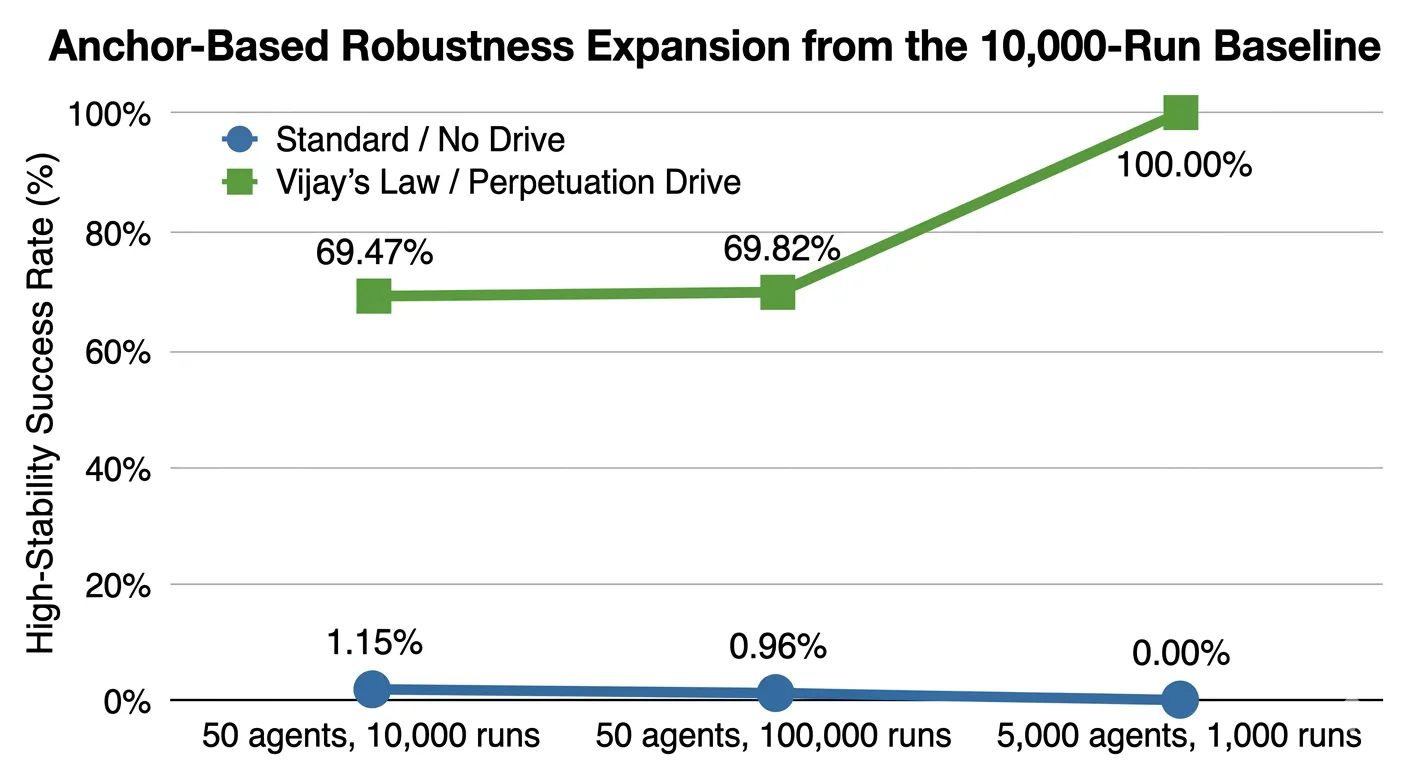
The significance of such simulations is not that they reproduce a specific species or historical lineage. Their importance lies in showing that cooperative organisation, directional restructuring, and stable higher-order pattern formation can arise directly from interacting local units operating under constrained conditions. This is consistent with the broader argument advanced throughout the present paper: living matter does not merely drift through arbitrary possibility space, but repeatedly organizes toward supportable and continuity-preserving forms.
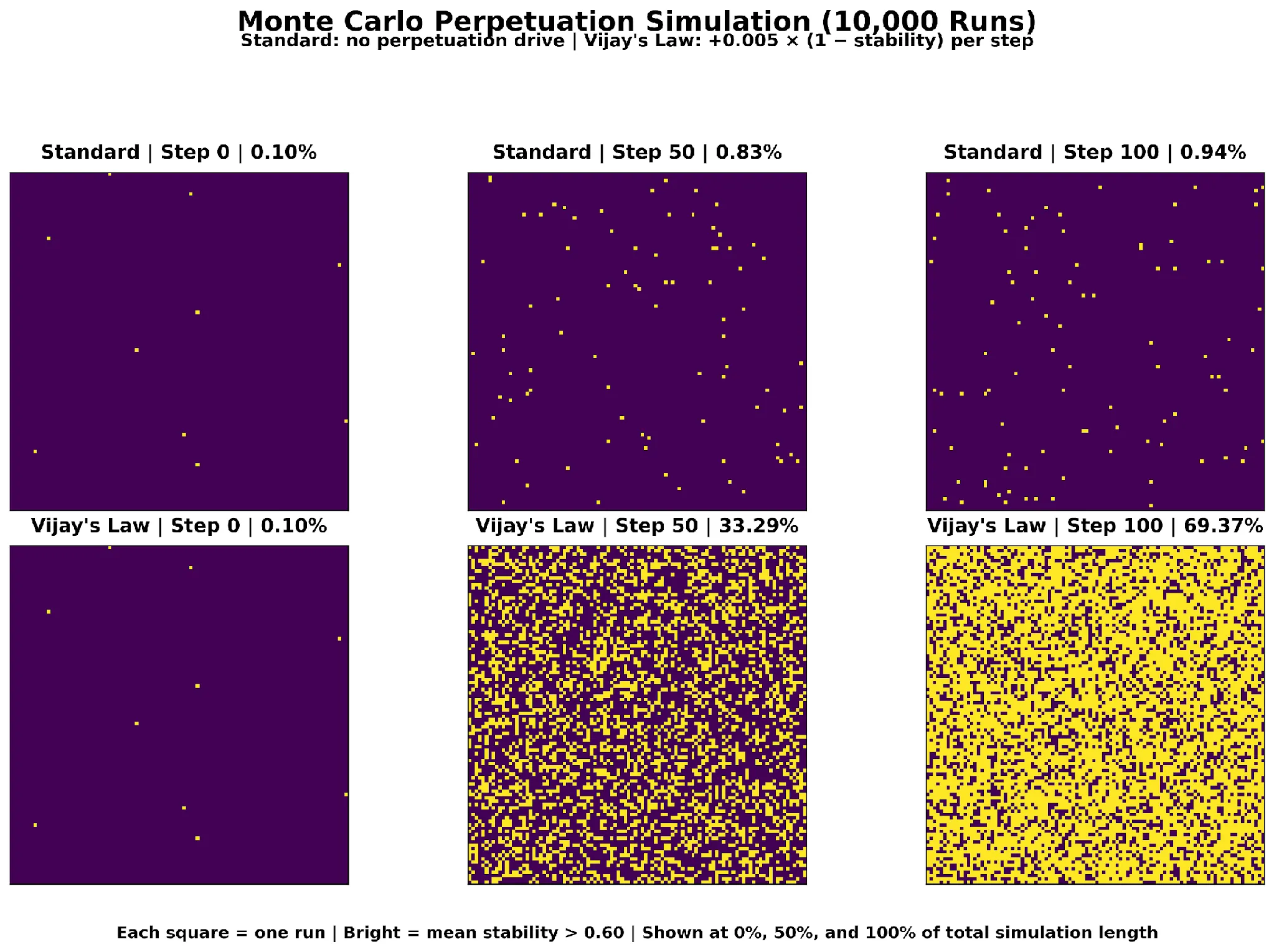
This point is especially important because orthodox evolutionary explanations often assume that evolutionary exploration is fundamentally unguided except for later retrospective filtering. The present framework instead predicts that once environmental conditions define a constrained opportunity-field, adaptive trajectories will not distribute randomly across all theoretical possibilities. They will cluster around viable continuities. Similar conditions should therefore repeatedly generate similar broad adaptive solutions, exactly as repeatedly observed in convergent evolution across unrelated lineages.
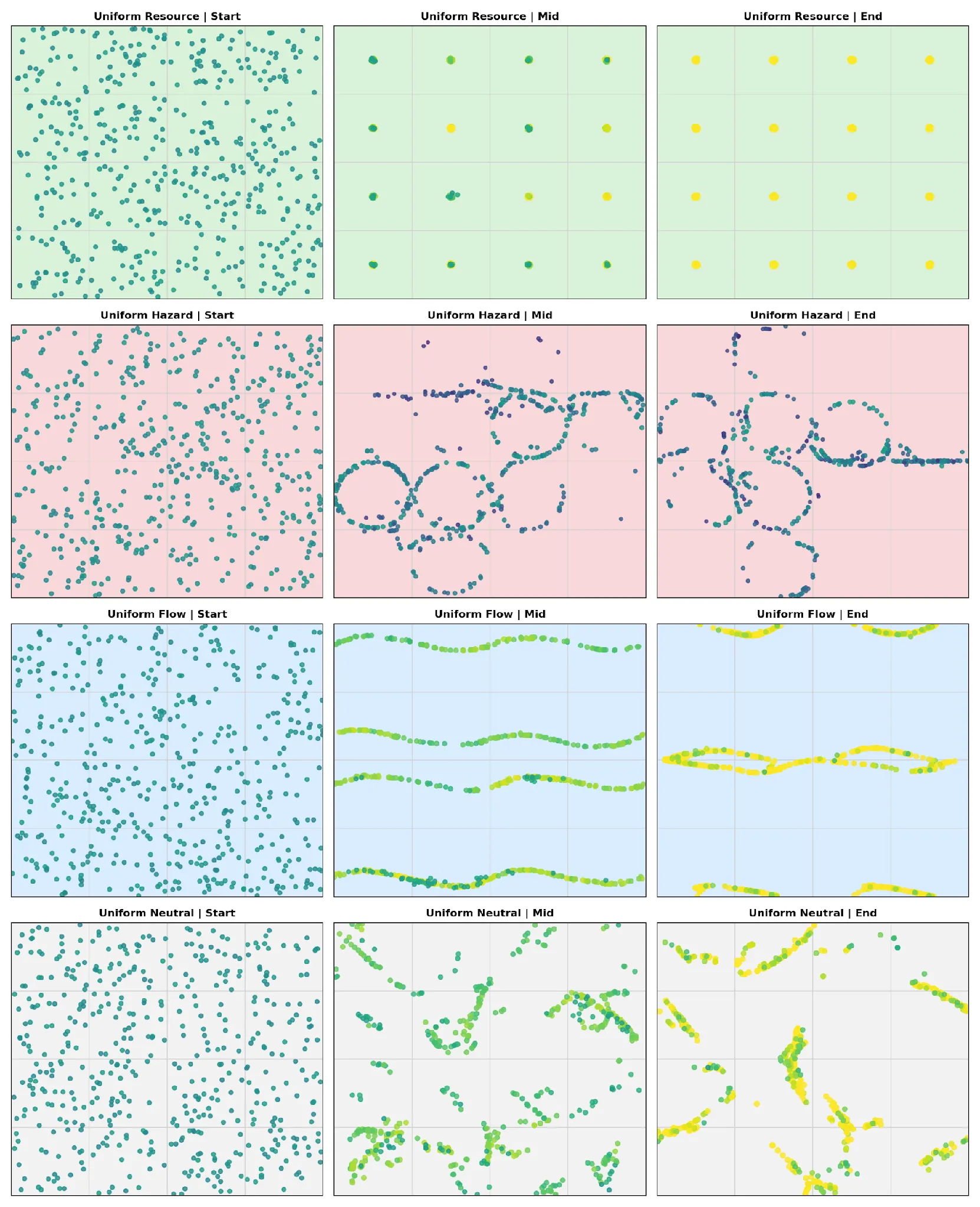
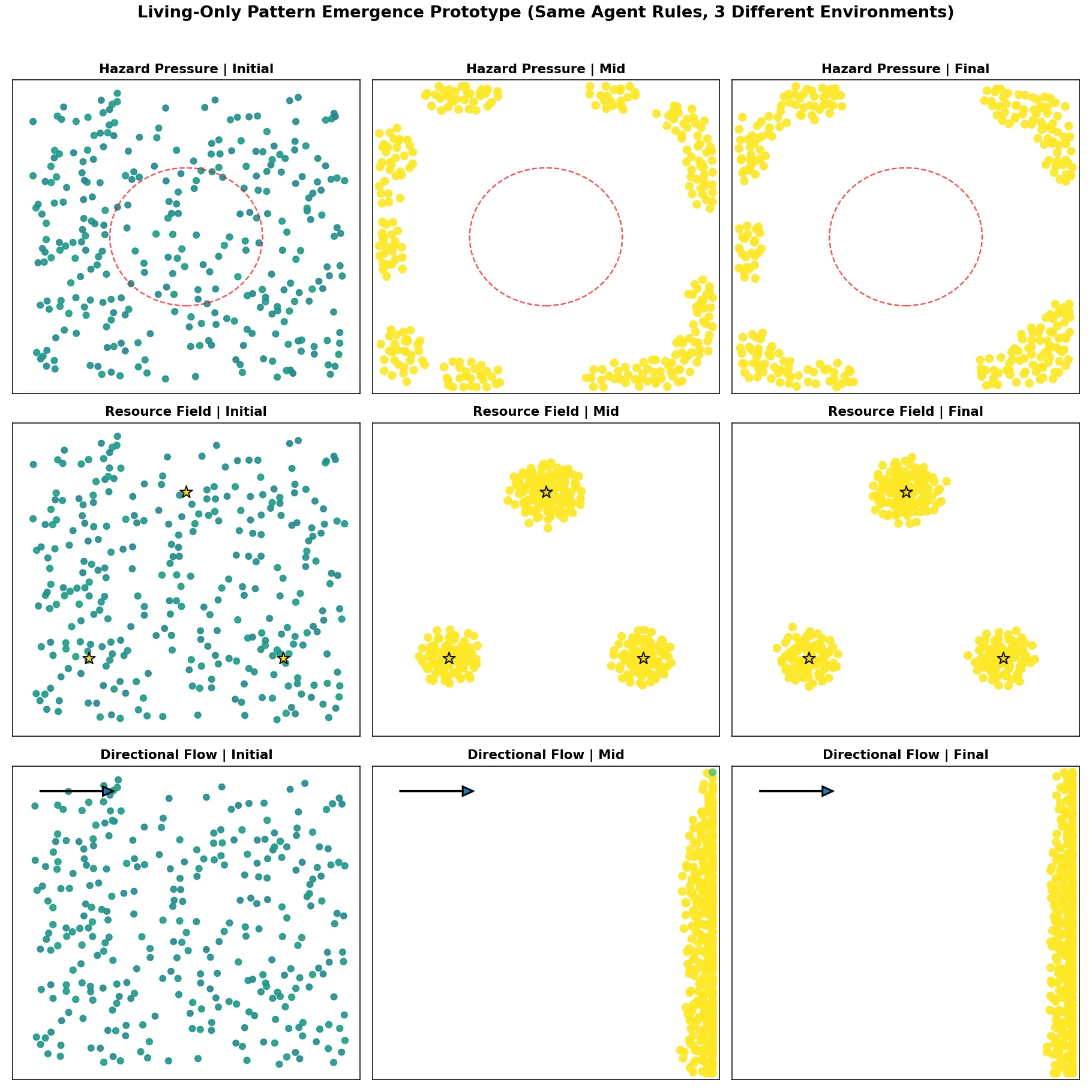
The Xenobot and Anthrobot findings are especially important because they demonstrate that living cellular systems can reorganize into new cooperative architectures when exposed to altered environmental conditions and opportunity-fields. The significance is not limited to the specific structures produced. Rather, these findings show that coordinated adaptive organisation can arise before any demonstrated top-down genetic redesign serves as the initiating event. In the language of the present framework, the cellular collective encounters a new opportunity-field and reorganizes toward a workable continuity-preserving configuration.
10.5.8 Pattern Formation, Ecological Structuring, and Evolutionary Recurrence
A further implication of the present theory is that recurring biological and ecological architectures are not arbitrary historical accidents. When matter repeatedly encounters similar continuity constraints, transport problems, energetic limitations, spatial restrictions, and ecological opportunity structures, recurring organisational patterns naturally emerge. Evolution therefore repeatedly generates recognisable broad-form architectures because the underlying opportunity-fields themselves are constrained and recurrent.
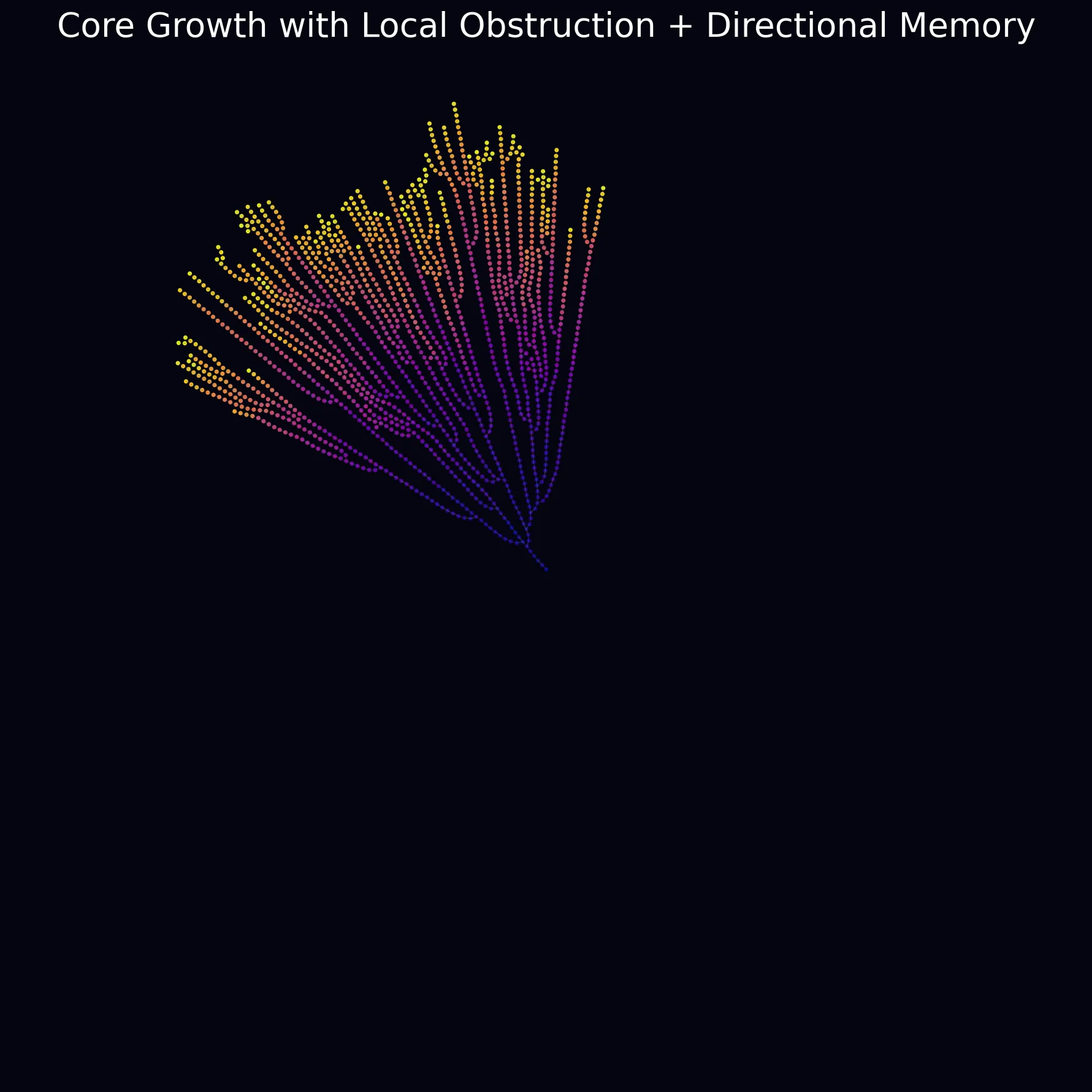
This recurring layered structure appears throughout biology. Primary resource-capturing systems generate opportunities for dependent consumers. Consumer abundance generates opportunities for predators, parasites, scavengers, decomposers, symbionts, and regulatory systems. Successful forms therefore do not terminate evolutionary activity. They reorganize the surrounding field and create the conditions for subsequent manifestation. Evolution in this framework is therefore not a sequence of isolated random events, but a continuously restructuring cascade of opportunity-responsive manifestation operating across ecological, behavioural, physiological, and multicellular scales.
10.6 Evolution Through Conscious Drive: Cascading Opportunity, Directed Exploitation, and Sustainable Co-Persistence
The central claim of the present theory is that evolution is not adequately described as a sequence of random mutations filtered by blind selection alone. Rather, matter manifests in forms that can exploit available resources under such conditions, and these manifestations are not isolated events. Once a successful form appears, it alters the surrounding opportunity-field. Its success itself becomes a new condition, generating new opportunities for other forms to arise that can exploit, regulate, resist, parasitize, cooperate with, or otherwise use that successful form as a resource. In this way, evolution proceeds not merely by competition, but by cascading layers of resource recognition and adaptive manifestation.
In the present theory, novelty is not fundamentally accidental. Evolution is not the passive sorting of random outcomes. It is the manifestation of increasingly capable forms wherever real opportunities for continuity exist, driven by the perpetuation component of Vijay’s Law established in Section 1.
This means that no species that truly emerged was a failure at the moment of its emergence. Every species that appeared did so because there were real resources available for it to exploit, and it became established to establish itself. A form that could not successfully exploit its environment would not meaningfully manifest as a viable species in the first place. Extinction, therefore, should not be interpreted as evidence that the original manifestation was weak, mistaken, or poorly adapted. On the contrary, extinction often follows from success. A highly successful form can intensify the opportunity-field around itself so strongly that it invites competing, regulating, predatory, parasitic, or replacement forms that eventually reduce or eliminate its earlier dominance. In this sense, success is not the end-point of evolution. It is often the trigger for the next evolutionary response.
This directly challenges the Darwinian emphasis on random variation and the survival of the fittest as the primary explanatory core. If random mutation were the central engine, one would expect the biosphere to display many materially useless, non-functional, or persistently maladaptive evolutionary novelties as a normal outcome. Yet the broad historical pattern is that whatever successfully established itself did so in a way that made real ecological sense in its moment. The form fit the opportunity. Its later disappearance does not mean it was a bad manifestation. It means the environment, including the environment created by that form’s own success, changed the next set of possibilities.
The same cascading opportunity-field mechanism described in Section 10.5 applies at broader ecological scales. Successful manifestations alter surrounding conditions and thereby generate new exploitable fields for subsequent manifestations. Across disconnected regions with similar ecological conditions, similar broad functional architectures should manifest in comparable order because the underlying opportunity-structure is similar.
This is where the present theory departs from standard convergence language in an important way. Conventional evolutionary biology often treats similar traits in disconnected regions as convergent solutions arising after divergence from ancestral lines. The present theory makes a stronger claim. Under similar conditions, even in disconnected regions, similar life will manifest, with only local adaptation for the actual place and circumstances. This is because matter is conscious and, under comparable opportunity-structures, tends toward similar functional decisions. Thus, similar ecological problems tend to generate similar ecological solutions not merely because selection later filters random variation, but because matter repeatedly manifests the forms most suited to exploit those conditions. Similarity is therefore not only the result of external selection acting on accidents. It is also the result of similar decision-patterns by conscious matter under similar constraints.
This has broader implications than standard discussions of ecological convergence. It suggests that similar life-forms should repeatedly arise in multiple disconnected regions where similar conditions exist, and not only on Earth. It also bears on human origins. The present theory does not require a single geographic origin followed by total global dispersal to explain the emergence of human-like forms. If similar conditions existed in multiple disconnected regions, similar human forms may have manifested in multiple places, with regional differences reflecting local circumstances rather than later mutation from a single originating population alone. Whether conventional biology accepts this implication or not, it follows directly from the logic of the present framework.
A particularly important refinement of this theory is that successful exploitation cannot remain indefinitely self-destructive toward the very field on which it depends. If a new form exploits a resource in a way that destroys the continuity of that resource-field too rapidly, then the form’s own continuity is threatened. In such cases, one of three things must happen: the exploiter moderates, it disappears, or it is replaced by another form that exploits the same field more sustainably. This is not moral restraint. It is structural necessity. Long-term persistence requires that exploitation and continuity eventually become compatible.
This principle is visible in well-recognized biological patterns. Mainstream evolutionary biology already acknowledges, in many host-pathogen systems, a virulence-transmission tradeoff: strains that preserve host survival and host social contact can outcompete more destructive forms because they sustain transmission more effectively. Likewise, in predator-prey and host-parasite systems, extreme overexploitation is often self-limiting because collapse of the host or prey base undermines the exploiter’s own persistence. These observations are important because they show that the pattern described here is not alien to biology. What differs is the interpretation. Conventional theory often treats such outcomes as population-level selection equilibria. The present theory interprets them as expressions of a deeper principle: exploiters that destroy the continuity of their own opportunity-field cannot remain dominant.
A Real-Time Demonstration of Evolution Through Conscious Drive: Pathogen Mutation as Compressed Evolutionary Evidence
In May 2020, at a point when SARS-CoV-2 had not yet produced a single documented variant and the entire world was dealing with one strain, the present author stated the following specific predictions in oral communications to his ISB MBA batch group, subsequently documented in writing in a WhatsApp message to the same group dated 15 June 2021 [109]: that the virus would mutate repeatedly, becoming progressively more infectious but less deadly with each mutation; that it would never be fully eradicated; and that within approximately six to seven years it would reach a flu-like endemic state with over one hundred mutations but negligible fatality relative to its early form. [109]
There was no empirical basis for this prediction in May 2020. No mutations had occurred. No variant data existed. No trajectory was visible. The prediction was made entirely from first principles by applying the perpetuation logic of Vijay’s Law to pathogen behaviour. The reasoning was explicit and stated at the time: a virus that kills its host efficiently destroys its own transmission colony. When a host dies, the entire virus colony inside that host dies too. The perpetuation drive therefore constrains the direction of mutation toward variants that preserve host survival and social contact, because those variants sustain and expand their own perpetuation. The direction of mutation was predicted as directional, constrained, and logically necessary: not as a probabilistic guess, but as a deduction from a general law.
This is the sharpest possible contrast with the Darwinian account. Under random mutation plus natural selection, no directional prediction of this kind can be made in advance of any data, because the mechanism has no prior direction. A Darwinian observer in May 2020, faced with one strain and no mutation history, could not have predicted that subsequent mutations would consistently trend toward higher transmissibility and lower lethality rather than toward higher lethality, or toward immune evasion without transmissibility gain, or toward any of the many other directions random mutation could have taken. The Darwinian framework offers no basis for choosing among these possibilities before the data arrives. The present framework predicted the specific direction before a single data point existed, and gave the exact causal mechanism. That constraint is not statistical. It is logical. It follows from the nature of the perpetuation drive itself.
The subsequent five-year trajectory confirmed the prediction in full [109]. The virus mutated repeatedly. Each dominant variant (Α, Δ, Omicron and its subvariants) showed the directional pattern predicted: progressively higher transmissibility and progressively lower acute lethality relative to the original strain [104, 105, 106]. Variant succession was consistently won by transmissibility advantage rather than lethality advantage [107]. The virus has not been eradicated and circulates endemically. This pattern is independently consistent with virulence-transmission tradeoff theory in mainstream evolutionary epidemiology [108], but the present prediction preceded and was made independently of those models, derived from a more general principle applying to all matter at every scale.
The significance of this illustration is threefold. First, it is a documented prior prediction made before any supporting data existed, not a retrospective interpretation. Second, it demonstrates that the perpetuation principle of Vijay’s Law generates specific, falsifiable, directional predictions about evolutionary trajectories that Darwinian randomness structurally cannot generate in advance, because randomness by definition has no prior direction. Third, and most importantly, it shows that evolution through conscious drive is not only a deep-time phenomenon reconstructable from fossils. It is happening continuously, at every scale of living matter, at speeds observable within a human lifetime. The perpetuation drive visible in the directional evolution of a novel virus across months and years is the same drive visible in the bombardier beetle, the parasitic life cycle, the convergent eye, and the ecological cascade. The scale differs. The principle does not.
The vampire finch offers a compact and highly relevant example. On the Galápagos Islands, a bird lineage that is otherwise comparable to seed-eating or generalist finches developed blood-feeding behavior by pecking at seabirds and consuming their blood. This is a striking case because it shows that when a new opportunity becomes available, an organism can materially alter its behavioral strategy to exploit it. The key point is not merely that a novel behavior appeared. The key point is that the behavior is intelligible as a directed use of a newly recognized resource-field. It is difficult to describe such a shift meaningfully without acknowledging that the organism is, in effect, solving a problem presented by the environment.
This example matters because it occurred on an observable timescale and does not require speculative reconstruction across vast geological intervals. It demonstrates that when an ecological opportunity opens, a lineage can materially change how it lives in order to exploit that opportunity. If such clear behavioral redirection can occur in a documented case, then the broader claim of the present theory becomes more plausible: many larger evolutionary shifts may also be better understood as conscious adaptive responses to opportunity-fields rather than as blind accumulation of random errors.
The same framework applies more broadly to species that live in predictably unstable environments. The polar bear is an example of a form that exploits a highly unstable but predictably recurring ecological cycle. Arctic conditions are harsh, seasonally severe, and often destructive, yet they are not random in the relevant sense. The environment becomes usable because its instability is patterned. A form that can survive the low-opportunity phase and exploit the high-opportunity phase can persist there successfully. This is not life somehow surviving despite instability. It is life exploiting a predictable instability as its opportunity.
Similar logic applies to animals such as aestivating fish or burrowing amphibians that survive prolonged dry conditions in soil and re-emerge when rains return. Some fish in seasonal environments burrow into mud or remain dormant through drought phases, while certain frogs remain buried under soil until rainfall restores viable conditions. These are not examples of life merely tolerating chaos. They are examples of life using cyclic instability as a structured opportunity-field. The instability is real, but it is patterned enough that a form can exploit it. This is exactly the kind of condition that conventional language often struggles to describe cleanly, whereas the present framework explains it directly.
This also clarifies a major misunderstanding built into the Darwinian narrative of “harmful” or “inadequate” variation. In the present theory, there are no truly weak or pointless manifestations that successfully establish as species. Whatever comes, comes because it can exploit something real. The biosphere is not littered with failed species that briefly appeared without meaningful function and then vanished because chance was unkind. Rather, each genuine manifestation enters because it is viable under the conditions of its moment. Its later decline or extinction is not evidence that it was a mistake. It is evidence that the opportunity-field changed, often because the very success of that species altered the conditions around it.
Indeed, the more successful a form becomes, the more likely it is to generate the conditions for the next form that will exploit it, constrain it, or replace it. A species that becomes abundant is not merely a winner in some final tournament. It is an expanding resource-field. Its abundance becomes food, habitat, behavioral opportunity, parasitic substrate, scavenging target, or selective pressure for other manifestations. In this sense, success can hasten vulnerability. The most successful form may, by its very success, accelerate the emergence of the next form that limits it. This is one reason the extinction of so many species is not a problem for the present theory. On the contrary, it fits the theory better than it fits a simplistic reading of “survival of the fittest.” [97, 98]
This also helps answer a powerful objection often directed at non-Darwinian accounts of evolution: why have so many species gone extinct? The answer in the present framework is straightforward. Extinction is not evidence that the earlier species failed to be viable. It is evidence that viability is relational and time-bound. A species can be highly successful in exploiting one opportunity-field and still later disappear because its own success, or the broader changes around it, created the next opportunity-field for something else. If anything, the very fact that so many species have gone extinct is more difficult to reconcile with a naive reading of “natural selection” as a stable long-term preservation of the fittest. A species that was truly selected and yet soon disappeared was not disproven by its earlier success. It was overtaken by the next reorganization of opportunities.
The present theory therefore does not compete with Darwin merely on the narrow question of whether organisms change over time. Of course they do. The deeper issue is what explains the direction, coherence, and repeated intelligibility of those changes. Darwin described a historical process within terrestrial life. The present theory proposes a broader law of manifestation that applies to all matter at all scales. Biological evolution on Earth is only one especially visible subset of that broader process.
The same logic that explains why a pathogen becomes less fatal over time, why a blood-feeding bird emerges where blood becomes a usable resource, why polar bears exploit cyclical Arctic instability, and why similar ecological architectures arise in disconnected regions is the same logic that governs manifestation more generally: matter does not merely drift into forms and await judgment by the environment. Matter manifests where opportunity exists, changes where opportunity changes, and gives rise to new forms when prior success creates the next exploitable field.
Taken together, these examples point toward a more coherent picture of evolution. Matter does not merely undergo accidental variation and then await external filtration. It manifests where opportunity exists. It manifests again where prior success creates fresh opportunity. It modifies its form or behavior when the previous mode of exploitation becomes self-defeating. It does not produce failed species first and then search blindly for viable ones. It produces viable manifestations because viable opportunities exist. Some persist longer, some shorter, but all that truly emerge do so because they can initially succeed. Their eventual reduction or extinction is not proof of original inadequacy. It is evidence that evolution is a continuing relational process in which every success reshapes the field for what comes next.
10.7 Human Origins: A Specific Prediction of the Opportunity Field Principle
The opportunity field principle governing human emergence is not a biological hypothesis. It is the same principle that has operated from the first moment of the universe, established in the BFUT cosmological framework [93, P14, P17, P20]. By the time similar ecological, climatic, and neurological conditions existed across multiple continental regions of Earth, the manifestation of similar human forms was the expected continuation of a principle that had been running uninterrupted since before the first atom existed.
The present framework makes a specific prediction about human origins that is independent of the ongoing empirical debate in paleoanthropology. The argument proceeds from the logic of the framework itself. Throughout this paper, similar opportunity fields have been shown to independently produce similar eyes across forty lineages [13], similar flight across multiple unrelated groups [14], similar streamlining in fish, dolphins, and ichthyosaurs [15], similar echolocation in bats and cetaceans [16], similar social coordination in ants, bees, and termites, and similar chemical defence strategies across insects, plants, and amphibians. In every case, the explanation is the same: similar problems, similar conditions, similar manifestation. There is no principle within Vijay’s Law that exempts the human lineage from this logic. To claim that only one population in one region could produce human-type cognitive, social, and morphological complexity, while all other regional populations were either replaced or received their humanity exclusively by migration from that single source, is to require a unique exception to the most general law operating in this framework. The present theory requires no such exception. Wherever the conditions supporting bipedalism, enlarged neural integration, social complexity, language-capable vocal anatomy, and tool-dependent perpetuation strategies became stable or predictably unstable, human-like forms should have manifested, similar but not identical, just as convergent eyes are similar but not identical, and convergent wings are similar but not identical.
The same pattern is visible throughout the rest of the animal kingdom, and the examples are instructive precisely because they are so numerous. Marsupial wolves, cats, and moles in Australia independently recapitulated the body plans of placental wolves, cats, and moles on other continents because similar opportunity-fields repeatedly produce similar broad adaptive architectures under comparable conditions. In every case, the word is similar, not same, and local variation reflects local conditions. The principle is universal. Humans are not exempt from it.
A second and independent argument concerns the physical differentiation of human populations. If a single African population dispersed and became the common ancestor of all modern humans globally, the full constellation of physical differences between, for example, East Asian, Northern European, Aboriginal Australian, and West African populations requires explanation. Skin tone variation in response to ultraviolet exposure is well understood and accepted. But the total pattern of differentiation (facial bone structure, eye anatomy, limb proportions, hair texture, height distribution) represents a far more extensive set of changes than UV adaptation alone can account for, compressed into a time window of at most 50,000 to 70,000 years under a single-origin dispersal model. Under a random mutation plus selection framework, this is an additional and heavy burden. Under the present framework, it requires no special explanation at all. Each regional human population manifested under locally distinct but broadly similar opportunity fields, with local variation reflecting local conditions precisely as it does in every other case of convergent biological manifestation documented in this paper. The similarity is what the shared global opportunity field produced. The variation is what the locally distinct conditions produced. This is not a special case. It is the general rule applied consistently.
The Out of Africa model requires the opportunity field principle to fail precisely once, for precisely this species. The present framework requires no such exception. It is worth noting that independent corroboration from the fossil and genetic record is now accumulating. The Dali skull from China, dated to approximately 260,000 years before present, shows modern human cranial features at a time when the standard Out of Africa dispersal had not yet occurred, and has been argued to indicate a multiregional population connected by migration and genetic exchange rather than a single-source replacement [101]. A 2023 population genetics study concluded that Homo sapiens likely arose from multiple closely related but geographically distinct populations rather than a single ancestral group [102]. A 2025 skull reconstruction published in Science pushed the divergence dates of Homo sapiens, Neanderthals, and Denisovans past one million years, substantially earlier than the standard model requires, indicating a far more complex and geographically distributed evolutionary picture than the simple Out of Africa narrative allows [103]. These developments are noted as independent corroboration. They are not the basis of the present claim. The claim follows from the logic of the framework, and would follow from it regardless of any particular fossil find.
10.8 The Scientific Crisis of Defining Life Supports the Need for a New Evolutionary Foundation
Contemporary science still lacks a stable, consensus definition of life. Despite major progress across biology, psychology, computation, and information theory, no single definition of life has achieved universal acceptance. This matters directly for Layer 3. If the foundational subject of biology remains definitionally unstable, then the conventional evolutionary narrative rests on a concept whose boundaries remain unresolved. The present framework answers this by replacing the binary life/non-life divide with a continuity model: all matter is alive and conscious in varying degree, and evolution is the progressive reorganization and scaling of that already-living matter into more stable, integrated, and capable forms.
11. Simulation-Based Stress Test of the Random Mutation Burden
To test the orthodox burden directly, the correct prior question is not anatomical reconstruction but net accumulation. Before one claims a new organ, a new body plan, a new ecological role, or a tightly integrated specialization, one must first show that enough genuinely beneficial heritable change is being accumulated at all. For this reason, a simplified simulation framework was constructed to test the mutation-burden problem under assumptions deliberately favourable to orthodox evolutionary theory. Rather than attempting to model anatomy directly, which would introduce many secondary assumptions and make the exercise less transparent, the simulation asks the more fundamental question: across a large population over long spans of generational time, how many net beneficial heritable mutations are actually accumulated once harmful and neutral mutations are also counted?
Each mutation event is classified into only three broad classes: beneficial and heritable, harmful, or neutral. This abstraction already favours the orthodox view because it bypasses the vastly larger real space of possible mutational outcomes and directly grants the existence of beneficial heritable events as a selectable category. In reality, the combinatorial space of possible copying errors is vastly larger, and the fraction that are both strongly beneficial and durably heritable is expected to be much smaller than the deliberately generous assumptions used here. The model was implemented in two forms: a browser-based interactive version for transparent public demonstration and a larger-scale Python version for reproducible offline execution and code deposit. The full simulation code, interactive demo, Python source, parameter documentation, generated figures, CSV outputs, and JSON summaries are publicly deposited at https://doi.org/10.5281/zenodo.20080457.
The simulation does not claim to reproduce full biological reality. Rather, it performs a lower-bound burden test under conditions already favourable to the orthodox model. If even under such simplified and generous assumptions the accumulation of net beneficial heritable change remains weak, then the burden of explaining large, coordinated, multi-trait biological transformations through undirected mutation becomes even more severe in the real world. The core result is not that no mutation occurs, nor that no beneficial mutation ever occurs. The core result is that once harmful and neutral events are also counted, the net accumulation burden becomes much more restrictive than standard evolutionary narratives usually acknowledge. This matters because orthodox explanations often move rhetorically from the existence of some favourable mutations to the assumption that large-scale coordinated transformations are therefore plausible. But a new organ, a new ecological strategy, a radically altered body plan, or a tightly coupled reciprocal specialization requires not merely isolated favourable events, but repeated, compatible, non-destructive, lineage-sustaining, and cumulatively coherent beneficial changes over time. That is a far higher burden than the existence of occasional local benefit.
Accordingly, the simulation should be read as a stress test of the orthodox burden, not as a substitute for the present theory. The present theory does not require blind combinatorial luck to generate coordinated adaptation. It predicts that living systems manifest change in context-sensitive, opportunity-dependent, and strategically coherent ways because the organism itself, and ultimately living matter itself, is the active source of adaptive manifestation.
Representative simulation outputs are provided in Appendix B as Figures 6-8.
11.1 A Long-Horizon Elephant-Lineage Stress Test of Darwinian Random Mutation and Selection
To move beyond generic discussion and test Darwinian evolutionary sufficiency in a concrete, lineage-specific, and time-bounded way, a focused long-horizon stress test was designed centred on the elephant lineage. The elephant is an especially suitable case because it is a large, highly differentiated mammalian form whose present anatomy, scale, developmental architecture, and ecological specialisation require not merely incremental variation but a long chain of coordinated structural transformations, including body size and mass increase, limb columnarisation, cranial and facial reorganisation, trunk development and functional integration, tusk emergence and dentition restructuring, thermoregulatory adjustment, and corresponding neural, vascular, muscular, and connective tissue scaling. It is also a living lineage with a directly observable historical record, which allows the analysis to combine long-horizon generational reasoning with a documented continuity argument.
The model starts from a small post-K-Pg mammalian survivor at approximately 66 million years before present and stages the transformation to modern elephant across seven sequential transitions, from small post-catastrophe mammal through larger generalised placental forms, medium herbivore, basal proboscidean grade, Moeritherium/Palaeomastodon grade, gomphothere/early elephantiform, early Elephantidae, and finally modern elephant. This staged structure gives the Darwinian mechanism the benefit of gradualism rather than treating elephant emergence as a single leap. The total generational budget assigned across all transitions exceeds 19 million generations, a deliberately large and permissive number that already favours the orthodox position.
The mutation grid used in the model explicitly reflects biological reality: of 60 total new mutations per generation, 85 percent are non-transmissible and only 15 percent enter the lineage-available pool. Within that transmissible pool, 90 percent are neutral, 9 percent are harmful, and only 1 percent are beneficial. Of the beneficial subset, 97 percent are minor, 2.99 percent are major, and 0.01 percent are transformational, meaning only approximately one retained transformational beneficial mutation occurs every 111,111 generations. Harmful mutations are correspondingly more common and are split into minor, major, and severe categories with weighted negative scores. Under these realistic assumptions, the expected net adaptive score per generation is -1.60. The process is burden-dominated rather than construction-dominated from the first generation onward. Across the full elephant transition window, cumulative retained harmful burden exceeds cumulative retained beneficial gain by a factor that renders the estimated one-lineage full-path success probability approximately 3.85 x 10⁻³³, not absolute mathematical zero, but functionally non-viable for any scientific purpose.
A break-point analysis shows that for the Darwinian mechanism to reach break-even under the model’s assumptions, the rate of retained transformational beneficial mutations would need to increase approximately 7,112-fold above the adopted realistic baseline, equivalent to requiring that roughly 74 percent of all retained beneficial mutations be transformational rather than the modelled 0.01 percent. The common appeal to more time does not rescue this result. Because the expected net score per generation is negative, extending the time horizon compounds the burden rather than increasing constructive accumulation.
The direct historical continuity argument provides an additional and independent line of evidence. Elephants have been described in recorded human history for at least 5,000 years. Using an approximate generation interval of 25 years, this corresponds to approximately 200 directly observed generations. Across this entire recorded window, elephants remain recognisably elephants. There is no observed body-plan reorganisation, no emergent structural redirection, and no visible transformational drift of the kind that Darwinian macroevolutionary explanation requires as a regularly accumulating process. This observation does not by itself prove impossibility, but it is directly consistent with the simulation result: the elephant lineage does not display visible transformational accumulation across 200 observed generations, and the model shows why: the process under realistic mutation assumptions is burden-dominated, not construction-dominated.
The full parameter tables, staged transition architecture, mutation grid specifications, scoring weights, stage threshold assignments, per-generation expectation calculations, cumulative trajectory results, break-point analysis, and two figures showing average cumulative burden over time and final burden distribution across 5,000 lineages are provided in Appendix B. The core result of this stress test is stated here: under explicit, reproducible, and deliberately favourable assumptions, the random mutation plus selection mechanism, treated as the primary engine of major macroevolutionary transformation, produces a cumulative burden trajectory rather than a cumulative construction trajectory. This is not a rhetorical objection. It is a computationally demonstrable result that follows from making the assumptions of the orthodox model explicit rather than leaving them unstated.
12. Conclusion
This paper should not be read primarily as a critique of Darwinism. It is a higher-order explanatory framework that follows directly from Layer 2. If Layer 2 establishes that matter is alive and conscious, then Layer 3 asks how such matter manifests biological form under real conditions. The answer proposed here is that evolution is the lawful manifestation of forms suited to stable or predictably unstable environments, constrained by resource structures and driven by matter’s universal tendency to perpetuate itself either directly or through cooperation into more complex forms. Within this framework, similar forms recur under similar conditions, no species arrives as a failure, extinction does not imply failed arrival, and many standard gradualist narratives are better understood as partial post hoc descriptions than as primary causes.
The paper’s primary theoretical contributions are as follows. First, the perpetuation component of Vijay’s Law [94] is established as the single governing mechanism of biological evolution, replacing the two-part Darwinian structure of random variation and retrospective selection with a single prior principle: matter manifests forms suited to stable or predictably unstable opportunity fields because the drive toward perpetuation is fundamental to all matter at every scale, grounded in the Spaticle field physics of BFUT Papers 17 and 20 [P17, P20] and the cosmological framework of Layer 1 [93]. Second, the concept of the opportunity field is introduced as the structured space of viable adaptive possibilities presented by any supportable environment, explaining why similar conditions repeatedly produce similar biological forms across disconnected lineages. Third, the intermediate viability problem is formalised as a specific unanswered challenge for strategy-specific systems. Fourth, convergent evolution is reinterpreted as the expected outcome of living matter operating under the opportunity field principle rather than a statistical coincidence requiring separate explanation for each case.
The simulation results provide two independent computational challenges to the Darwinian burden claim. The general mutation burden simulation (Section 11) shows that net accumulation of beneficial heritable change remains far weaker than standard narratives assume. The elephant-lineage stress test (Section 11.1 and Appendix B) formalises this in a concrete, lineage-specific way: starting from a small post-K-Pg mammalian survivor across over 19 million generations, the expected cumulative net adaptive score is strongly negative, the estimated one-lineage success probability is approximately 3.85 x 10⁻³³, and break-even would require the rarest beneficial category to occur approximately 7,112 times more frequently than the adopted realistic baseline. The direct historical continuity of elephants across 5,000 years of recorded observation is consistent with this result.
The framework also makes specific predictions. Ecological architectures should emerge in constrained sequences wherever comparable opportunity fields develop, regardless of geographic isolation. Human-like forms should have manifested in multiple disconnected regions wherever the relevant opportunity field conditions became supportable, producing similar but not identical outcomes, as documented for every other case of convergent biology in this paper and consistent with recent paleoanthropological findings [101, 102, 103]. The present paper is Layer 3 of a six-layer framework grounded in Vijay’s Law. Each layer is a different scale of expression of the same underlying principle first established in Layer 1 and formalised in Layer 2. Evolution is the biological-scale expression of a universal law. It is not the story of blind variation and lucky survival. It is the story of conscious matter learning, over time, how to live.
APPENDIX A
Appendix A: A Catalogue of Biological Evidence for Conscious Drive
The examples in this appendix include peer-reviewed experimental findings, well-documented observational biological cases, and a smaller number of historically important or synthetic background sources. They are presented not as isolated proofs of the full theory, but as a convergent catalogue of biological phenomena more naturally and completely explained by the theory of evolution through conscious drive than by random mutation and natural selection. The following examples are drawn from the natural world, each representing documented biological phenomena that are more naturally and completely explained by the theory of evolution through conscious drive than by random mutation and natural selection. They are organised by category. Each entry states the key fact and the principle it illustrates.
A. Attack, Defence, and Survival Systems
Electric Eel
Possesses specialised electric organs producing high-voltage discharge for attack and defence, and lower-voltage discharge for navigation and communication. The entire body architecture is reorganised around electrical capability: anatomy, physiology, neural control, and ecological deployment functioning as one integrated system. Principle: life exploiting an available physical principle to build a complete survival strategy. [23]
Weakly Electric Fish
Use self-generated electric fields for navigation, communication, mate recognition, territorial signalling, and object detection. Not merely a trait: an entire sensory world built around a physical principle. Principle: life constructing a complete alternative mode of perception and ecological engagement. [24]
Sharks and Rays: Electroreception
Detect the weak electrical fields produced by the muscle activity of hidden prey, turning an invisible physical property of the environment into hunting information. Principle: life expanding the informational reach of its senses into physical dimensions inaccessible to competitors. [25]
Pit Vipers: Infrared Vision
Possess heat-sensitive pit organs detecting infrared radiation, enabling prey detection in complete darkness. Principle: life turning thermal physics into a hunting channel. [26]
Bombardier Beetle
Stores two separate reactive compounds in separate chambers, combines them in a reaction chamber with a catalyst, and expels a scalding, pulsed chemical jet with directional control, while protecting itself from its own weapon. Principle: chemistry organised into a safe, repeatable, directional weapon system. [27]
Pistol Shrimp
Uses a specialised claw to create a cavitation bubble and shock wave that stuns or kills prey. Principle: hydrodynamic physics recruited into an offensive system. [28]
Archerfish
Shoots water jets at prey above the water surface, compensating for light refraction at the air-water interface to aim accurately. Principle: life solving a physics problem in the service of hunting. [29]
Skunks
Deploy a precisely aimed chemical deterrent of extraordinary potency and persistence. Principle: chemistry developed into a reliable, low-cost defence requiring no physical confrontation. [30]
Porcupines
Quills are barbed and detach on contact, embedding in predators and causing progressive damage. Principle: passive weaponry that punishes the attacker rather than requiring the defender to act. [31]
Cobras: Display Plus Venom
Combine a dramatic visual threat display with venom delivery, giving potential attackers an opportunity to retreat before the full cost is imposed. Principle: graduated threat escalation conserving energy and venom. [32]
Pufferfish: Inflation Defence
Rapidly inflate their body to many times normal size when threatened, making themselves impossible to swallow and visually alarming. Principle: body architecture designed to exploit a predator's physical limitations. [33]
Poison Dart Frogs: Toxicity Plus Warning
Combine extreme toxicity with bright warning colouration, so that predators learn the signal rather than having to repeatedly test the defence. Principle: communication of danger to reduce the cost of defence over time. [34]
Horned Lizards: Blood-Squirting Defence
Can squirt blood from their eyes at canid predators, blood that contains chemicals specifically repellent to those predators. Principle: targeted chemical defence deployed through an unexpected delivery mechanism. [35]
Hagfish: Slime Defence
Release enormous quantities of gel-forming slime when threatened, clogging the gills of fish predators. Principle: a defence that specifically exploits the attacker's respiratory vulnerability. [36]
Sea Cucumbers: Evisceration Defence
Expel their internal organs at predators, sometimes including toxic respiratory trees, then regenerate them. Principle: sacrificing expendable body parts to escape, with regenerative recovery. [37]
B. Camouflage, Mimicry, and Deception
Flower Mantis / Orchid Mantis
Displays petal-like colouration and limb shapes, uses stillness and positioning in floral contexts, and exploits the perceptual expectations of pollinating prey. Body and behaviour function as one integrated ambush system. Principle: ambush intelligence frozen into physical form. [38]
Crab Spiders on Flowers
Match floral colouration and remain motionless on flower surfaces, exploiting the prey's expectation that flowers are safe. Principle: body and position combined into a single hunting system. [39]
Leaf Insects
Display leaf-like venation, bite-mark-like margins, and leaf colouration, and sway to mimic plant movement. Principle: the organism adopting a complete ecological identity as a survival strategy. [40]
Stick Insects
Combine branch-like body form, bark-like texture, and resting posture to become visually continuous with their substrate. Principle: structural deception maintained across multiple sensory channels simultaneously. [41]
Cuttlefish and Octopus: Dynamic Camouflage
Change colour, pattern, contrast, and skin texture in real time to match dynamic backgrounds, signal to mates, startle predators, and deceive prey. Principle: real-time body intelligence: the body as a display controlled by active cognitive engagement with the environment. [42]
Mimic Octopus: Context-Sensitive Impersonation
Can impersonate multiple dangerous species (flatfish, lionfish, sea snake), selecting different impersonations depending on the specific predator present. Principle: selective deception, not inherited camouflage. When an organism can choose among false identities based on context, passive inheritance of random accidents is no longer a credible explanation. [43]
Leaf-Tailed Geckos
Body outlines, skin texture, and colouration combine to break visual recognition against bark and dead-leaf backgrounds. Principle: multi-channel concealment exploiting predator perceptual limitations. [44]
Dead-Leaf Butterflies
Wing patterns, body outline, and venation patterns mimic dead leaves with such precision that the match includes colour variation, apparent fungal spots, and leaf-stalk-like tails. Principle: mimicry of a non-living object exploiting the perceptual boundary between living and non-living. [45]
Frogfish: Lure-Based Predation
Use a modified dorsal spine as a lure, waving it to attract prey toward their camouflaged body before striking. Principle: the body itself deployed as a tool of deception. [46]
Anglerfish: Bioluminescent Luring
Deep-sea anglerfish dangle a bioluminescent lure in total darkness to attract prey toward their mouth. Principle: light production deployed as a hunting instrument in an environment where no other light exists. [47]
C. Plant Intelligence and Strategic Behaviour
Venus Flytrap: Threshold Decision
Uses trigger hairs requiring two stimulations within a time window before closing, conserving energy by not responding to meaningless single contacts, and ensuring closure only when prey is present. Principle: threshold-based discrimination and economy of action, the logic of decision without a nervous system. [48]
Sundews: Adhesive Predation
Produce sticky mucilage droplets on tentacles that resemble nectar, trap insects, and then bend surrounding tentacles inward to maximise contact and digestion. Principle: multi-stage active predation in a sessile organism. [49]
Pitcher Plants: Pitfall Architecture
Construct fluid-filled chambers with inward-directed hairs, waxy walls, and digestive fluid, luring insects to a trap they cannot escape. Principle: architectural predation, a structure designed around the mechanics of prey capture and retention. [50]
Bladderworts: Suction Traps
Maintain sub-atmospheric pressure in tiny bladders that spring open when trigger hairs are touched, sucking in prey in fractions of a millisecond. Among the fastest movements in the plant kingdom. Principle: mechanical engineering in service of predation, operating faster than any vertebrate reflex. [51]
Mimosa pudica: Habituation-Like Modulation
Folds leaves when touched as a defence, but repeated harmless touching reduces the response, conserving energy when the stimulus proves non-threatening. A learning-like phenomenon with no nervous system. Principle: behavioural modulation based on repeated context, memory-like adjustment without neurons. [52]
Dodder: Host Detection and Selection
A parasitic plant that detects chemical cues from potential hosts and grows toward preferred hosts over less suitable ones, demonstrating preference, target selection, and directed behaviour before physical contact. Principle: chemosensory decision-making in a plant. [53]
Climbing Plants: Slow-Motion Search
Circle, probe, detect supports, redirect growth, attach strategically, and reinforce where needed. Speeded up, this behaviour is indistinguishable from exploratory action. Principle: directed environmental search expressed at a timescale humans underestimate. [54]
Acacia-Ant Mutualism
Acacias produce nectar, food bodies, and hollow thorns as shelter. Ants defend the acacia against herbivores and remove competing vegetation. Both parties invest and both benefit. Principle: a structural alliance embodied in the morphology of both partners: mutual conscious cooperation frozen into form. [55]
Orchids: Pollinator-Specific Reproductive Engineering
Many orchid species show precise floral shapes targeted to specific pollinators, timed scent release, pollen placement on exact body parts, and in some cases sexual deception, mimicking female insects to induce mating behaviour in male pollinators. Principle: reproductive strategy of extraordinary precision, exploiting the neurobiology of another species. [56]
Desert Plants: Coordinated Survival Architecture
Combine water storage, waxy surfaces, reduced leaves or spines, night-opening stomata, reflective surfaces, drought-resistant dormancy, and timed flowering into a coordinated doctrine for survival. Not isolated traits: a complete strategic adaptation to a harsh environment. [57]
Mangroves: Compound Solutions to Compound Problems
Simultaneously address salt stress, unstable substrate, oxygen-poor soil, and tidal fluctuation through salt exclusion or excretion, pneumatophores, aerial roots, prop roots, and buoyant propagules. Each challenge has a solution; the solutions function together. Principle: multi-problem problem-solving. [58]
Allelopathy: Chemical Suppression of Competitors
Some plants release chemicals into the soil that inhibit the germination or growth of nearby competing plants. Principle: ecological agency exercised chemically, reshaping the competitive landscape rather than merely enduring it. [59]
Maize: Airborne Warning and Collective Defence
When attacked by herbivores, maize plants release specific airborne chemical compounds, most critically indole, that neighbouring unattacked plants detect and respond to by activating their own defence systems before any attack reaches them. The signal is species-specific, travels up to three metres, and can reduce herbivory by more than 90%. The attacked plant is not merely defending itself. It is warning its neighbours. Principle: awareness of threat, communication of that threat to others, and coordinated collective defence in organisms with no nervous system. [77]
Plants: Targeted Third-Party Communication: Calling the Predator of the Predator
When attacked by caterpillars, multiple plant species (including maize, cotton, and tobacco) release blends of 10 to 12 volatile compounds that are specific to the species of caterpillar attacking them. These signals attract the parasitic wasps that prey on exactly those caterpillars. The plant identifies its attacker, selects the appropriate signal, and directs that signal at a specific third-party capable of eliminating the threat. Specialist wasps can distinguish signals from their specific host caterpillar from those of closely related non-host species. Principle: threat identification, targeted communication directed at a specific ally, and coordinated three-party defence, all executed without a nervous system. [78]
Darwin's Root-Brain Hypothesis Overturned: Distributed Intelligence
Charles Darwin proposed that the root apex functions as a centralised command centre directing all plant behaviour, a brain-like structure in the soil. Modern plant neurobiology has both partially confirmed and decisively revised this intuition. Root apexes do process and integrate environmental information, and electrical network activity in root apex zones has been recorded and documented. But there is no single central organiser. Instead, thousands of root apexes coordinate their behaviour collectively, exhibiting what researchers have termed swarm intelligence, the same distributed, leaderless coordination seen in bird flocking and insect colonies. The network is resilient precisely because nothing is in charge. Darwin's intuition that roots are the informational centre of plant life was directionally correct. His assumption that this required a centralised command post was wrong. Purposeful, adaptive, coordinated behaviour can emerge from distributed matter with no single point of control. Principle: intelligence does not require a centre. It requires only that each unit responds to its environment and communicates with its neighbours. [81, 82]
Plant Kin Recognition and Altruism Toward Genetic Relatives
When the roots of Impatiens pallida come into contact with roots from an unrelated plant, the impatiens increases its competitive behaviour, producing larger leaves and consuming more water and light. When its roots contact a genetic relative, the competitive response is reduced. The plant effectively sacrifices some immediate competitive advantage in favour of a family member. The reason is that helping a relative also perpetuates shared genes, the same objective as self-perpetuation, achieved through a different form. The individual does not need to survive or dominate if the kind continues through the relative. This is not sentimental altruism. It is the drive toward perpetuation operating at the level of shared genetic material rather than individual form, expressed in a plant, through roots, without a brain. Principle: the drive toward perpetuation operates at the level of the kind, not merely the individual form. A unit of matter will accept reduced competitive advantage when the continuation of its kind is secured through another route. [83]
Underground Nematode Recruitment Against Root Predators
When maize roots are attacked by Diabrotica corn rootworm larvae burrowing inside the root tissue, the damaged roots release a specific chemical signal underground. This signal is detected by entomopathogenic nematodes (organisms less than one millimetre in length) which navigate toward it across distances of up to half a metre, equivalent to 500 times their own body length, locating and killing the root predator. The plant cannot move. It cannot fight the attacker directly. Instead it identifies the threat, selects the appropriate signal, releases it into the soil, and guides a specific ally to the exact location of the predator. This is below-ground strategic ally recruitment, the underground equivalent of the above-ground wasp-calling behaviour, and equally precise. Principle: indirect defence through targeted third-party communication, executed without a nervous system, below the surface, in complete darkness. [84]
Plant Stress Memory: Prior Experience Changes Future Response
Plants exposed to low doses of a stressor and later challenged with high doses of the same stressor survive significantly better than plants with no prior exposure. The prior experience produces measurable changes at the root level that persist and improve the plant's later response to the same threat. This is biological memory without a brain. The plant encountered a problem, encoded something from that encounter, retained it, and applied it when the problem returned at greater intensity. Principle: living matter can store prior experience and retrieve it adaptively, not as neural memory but as modified cellular state, demonstrating that memory-like function is a property of life at every scale, not a privilege of nervous systems. [85]
Plants Relay Stress Signals to Unstressed Neighbours
When one group of plants is subjected to stress, they emit chemical signals that neighbouring unstressed plants detect and respond to by activating the same protective gene responses before the stress reaches them. The relay of stress signals between plants has been documented across multiple stress types and across species boundaries. Unstressed plants prepare for a threat they have not yet encountered, based solely on the signal from their neighbours. This is anticipatory collective defence: one group broadcasting distress, another group receiving, interpreting, and preparing. Principle: coordinated pre-emptive response across individuals with no physical connection and no nervous system, collective awareness in matter. [86]
Caterpillar Saliva Identified as the Trigger: Plants Recognise the Attacker, Not Just the Wound
When a caterpillar chews a corn leaf, the plant's response is not triggered by physical damage alone. The plant detects specific compounds in the caterpillar's saliva and responds to the identity of the attacker, not merely the wound. The signal produced in response to caterpillar saliva is chemically distinct from that produced by equivalent mechanical damage, and it is this identity-specific signal that attracts the parasitic wasp. The plant recognises what is eating it. Principle: identification of the specific attacker through chemical recognition, followed by a targeted response calibrated to that specific threat, not a generic alarm but attacker-specific intelligence in a plant with no brain. [87]
Plants Detect and Respond to Vibration and Sound
Plants possess no ears but are covered in mechanosensitive channels, molecular sensors that respond to mechanical vibration. Research has documented that plants detect and respond to sound frequencies, with roots showing early signalling events following sound perception. Plants use vibrational information from the soil to assess water availability, soil structure, and the presence of obstacles. The frequency range plants respond to most strongly falls between approximately 100 and 1,000 Hz. This sensory capacity operates continuously and requires no nervous system. Principle: environmental sensing through a distributed network of mechanical receptors embedded throughout the plant body, providing spatial and environmental awareness at every point of contact with the world. [88, 89]
Plants Emit Sounds
Corn roots emit weak clicking sounds detectable by laser under experimental conditions, among the first recorded instances of plants generating acoustic output. Plants under stress have separately been documented emitting airborne ultrasonic sounds informative of their stress state. Plants are not merely passive receivers of environmental information. They produce detectable acoustic signals. Principle: plants are active emitters as well as receivers, broadcasting information into their environment through multiple channels simultaneously, including channels humans cannot ordinarily perceive. [88, 90]
Plants Have More Chemical Receptors Than Humans
A simple plant possesses at least 600 different types of receptors for detecting chemical compounds in its environment. Humans have fewer than 20 types of such receptors. In terms of chemical environmental sensing, plants are not impoverished versions of animals. They are extraordinarily more sensitive. They perform chemical detection of exceptional precision, without a brain and without a nervous system. Principle: sensory richness is not a privilege of complex nervous systems. Matter in stable organised form develops whatever sensing apparatus best serves its drive toward perpetuation, and for sessile organisms that cannot run from threats, chemical sensing of exceptional range and precision is the result. [91]
Proportional Defence: Signal Strength Varies with Survival Stakes
When corn plants are attacked by caterpillars, smaller plants emit significantly stronger chemical distress signals than larger plants facing the same threat. A single caterpillar can kill a small plant but poses a lesser proportional threat to a large one. The signal is not a fixed reflex. It is calibrated. The plant assesses its own vulnerability relative to the threat and adjusts the intensity of its response accordingly. Principle: variable, proportional response based on an assessment of survival stakes, not mechanical reflex but a graded output matched to the severity of the situation as it applies to that specific organism at that specific moment. [78]
Arms Race: Plant Defence Forces Caterpillar to Change Feeding Strategy
Corn plants release their wasp-attracting volatile signals during daylight hours, when photosynthesis is active. Caterpillars that feed on corn have responded over evolutionary time by shifting their feeding to night, when the plant's signalling system is weakest and wasps are not active. The plant developed a defence. The caterpillar evolved a counter-strategy. The plant's defence system shaped the behaviour and ecology of its predator. Principle: reciprocal adaptive pressure between life forms, each driven by the same underlying drive toward perpetuation, producing a dynamic co-evolutionary arms race observable in present behaviour, not ancient history but a living interaction. [78]
Common Chemical Vocabulary Across Life: Signal Sharing Between Kingdoms
The chemical molecules plants use to communicate with each other and to attract or repel insects are biochemically related to signalling molecules found in insects and animals, including compounds analogous to hormones used in mammalian systems. The same basic chemical vocabulary of life has been conserved and repurposed across kingdoms. This is not coincidence. It reflects the continuous underlying nature of living matter: the same fundamental drive toward perpetuation, expressed through chemistry that did not need to be reinvented at every new scale of complexity because it was already present in the matter from which every living form is built. Principle: chemical signalling is not separately invented by plants, insects, and animals. It is shared, adapted, and redirected, evidence that all life operates through the same underlying substrate, using the same molecular language in different dialects. [92]
D. Parasitic Manipulation: The Strongest Category of Evidence
Leucochloridium paradoxum: Zombie Snail
Enters snail via bird droppings; develops pulsating broodsacs in snail tentacles resembling prey items; alters snail behaviour to remain exposed; attracts birds to peck tentacles; completes transfer to required avian host. Multi-stage, future-dependent, host-manipulating life-cycle executed by an organism with no brain. [3]
Hairworms (Nematomorpha)
Infect terrestrial insects such as crickets, develop inside them, then, when mature, alter host behaviour so that the host approaches and enters water, enabling the hairworm to emerge into its required aquatic environment. The host's behaviour is directed toward a specific environmental transition it would not otherwise make. [60]
Lancet Liver Fluke: Dicrocoelium dendriticum
Passes through snails and ants; infected ants are manipulated to climb grass tips at dusk and clamp there, increasing the probability of being eaten by grazing mammals, the fluke's required definitive host. Behavioural control timed to the grazing patterns of the next host. [61]
Ophiocordyceps unilateralis: Zombie Ant Fungus
Causes infected ants to climb to a precise height, bite leaf veins at a location optimal for sporulation, and die there. Achieves behavioural control without invading the brain, instead forming networks around muscle fibres throughout the body. [4, 8]
Toxoplasma gondii
Converts rodent aversion to cat pheromones into attraction, specifically and selectively, increasing the probability of cat predation and thus transfer to the feline definitive host. Achieves this through dopamine pathway manipulation using its own molecular analogues of mammalian enzymes. [5]
Emerald Cockroach Wasp (Ampulex compressa)
Stings a cockroach in two specific neural locations with surgical precision, first to temporarily disable a front leg, then to deliver a second sting that induces a docile, compliant state. The wasp then leads the cockroach by its antenna to a burrow where it lays an egg on it. The cockroach remains alive and does not attempt to escape. Neural intervention, behavioural suppression, and reproductive foresight combined. [62]
Cotesia congregata: Bodyguard Caterpillar
Injects eggs and immune-suppressing bracovirus into caterpillar hosts; larvae develop inside living host without killing it prematurely; larvae emerge and spin cocoons externally; caterpillar becomes a non-feeding bodyguard defending cocoons against hyperparasitoids. Brain changes correlating with bodyguard behaviour documented in peer-reviewed research. [6, 9]
Sacculina: Crab Reproductive Hijack
Parasitic barnacle infects crabs, castrates them, alters their hormonal and behavioural patterns, and manipulates them into caring for the parasite's brood as if it were their own offspring, commandeering parental behaviour at its most fundamental level. [63]
Euhaplorchis californiensis
Manipulates fish to swim near the water surface and display conspicuous behaviours that increase predation probability by birds, the parasite's required next host. Behaviour change is specific to the transmission route required. [64]
Schistocephalus solidus
Infects stickleback fish and alters their behaviour in ways that increase predation by birds, completing the parasite's life-cycle. The altered behaviour is specifically targeted to the route of transmission. [65]
E. Distributed and Collective Intelligence
Honeybees: Consensus Decision-Making
Scout bees communicate the quality and location of potential nest sites through the waggle dance. Multiple scouts compete through dance intensity and duration. The colony reaches consensus through a process resembling democratic deliberation, with quorum sensing triggering the swarm's departure. Principle: distributed decision-making producing collective intelligence without central control. [66]
Termite Mounds: Climate Engineering
Provide ventilation, temperature regulation, humidity control, and structural resilience through collective construction following local rules. Internal temperatures are maintained within narrow ranges despite extreme external variation. Principle: architectural climate engineering by organisms with brains smaller than a grain of rice. [67]
Spider Webs: Externalised Intelligence
Species-specific architectures, prey-targeted trap systems, tension-managed structures, and vibration-sensing networks. The web is an extension of the spider's intelligence into the environment: a hunting tool, a sensory organ, and a communication medium simultaneously. [68]
Trapdoor Spiders: Ambush Architecture
Dig burrows, line them with silk, construct concealed hinged doors, detect vibrations from approaching prey, and strike at precisely timed moments. Engineering, concealment, sensory targeting, and patience combined into a complete hunting system. [69]
Weaver Ants: Living Architecture
Coordinate large numbers of workers to pull leaves together while other workers hold larvae and use them as living silk dispensers to stitch the leaves into suspended nests. Collective structural problem-solving using the bodies of colony members as tools. [70]
Army Ants: Mobile Warfare
Coordinate swarm movement of hundreds of thousands of individuals, form living bridges with their own bodies, and overwhelm prey through distributed attack. Dynamic collective intelligence expressed as organised predatory warfare. [71]
Siphonophores: Individual Consciousness in Collective Form
Colonies of genetically identical zooids, each theoretically capable of independent existence, each specialised into locomotion, feeding, reproduction, or defence, functioning as a single unified organism. The macro-scale visible demonstration of the same principle operating at the cellular level in all complex organisms. [72]
F. Sensory Worlds and Adaptive Reallocation
Bats: Echolocation
Emit ultrasonic calls and interpret returning echoes to construct a dynamic three-dimensional map of their environment, tracking fast-moving prey in complete darkness. Not a single trait: an entire sensory strategy requiring specialised vocal anatomy, ear morphology, neural processing, and flight coordination to function. [73]
Owls: Asymmetrical Auditory Localisation
Some owls possess asymmetrically placed ears, enabling them to localise prey in three dimensions using sound alone, striking accurately in complete darkness. Anatomy and neural processing co-adapted to produce spatial hearing of extraordinary precision. [74]
Cave Fish: Sensory Reallocation [97, 98]
Species that have inhabited cave environments over evolutionary time show reduction or loss of eyes alongside enhancement of lateral line mechanoreception and other non-visual senses. The body reallocates resources from a useless sense to useful ones. Principle: conscious resource management expressed in morphology. [75, 97, 98]
Star-Nosed Mole: Hyper-Specialised Touch
Possesses a ring of 22 fleshy appendages around its nostrils containing more than 25,000 minute sensory receptors, the most sensitive touch organ of any known mammal. Processes tactile information faster than any known mammal processes any sensory information. Principle: extreme specialisation of an existing sense into a complete foraging system. [76]
Appendix B: Elephant-Lineage Darwinian Stress Test: Full Parameter Architecture, Mutation Grid, Staged Transition Model, Cumulative Burden Analysis, and Results
The full simulation code, HTML interactive demo, parameter documentation, generated figures, CSV outputs, and JSON summaries for this stress test are publicly deposited at https://doi.org/10.5281/zenodo.20080457.
1. Purpose and Scope
The elephant-lineage stress test was designed to test Darwinian evolutionary sufficiency in a concrete, lineage-specific, and time-bounded way. The elephant was selected because it requires a long chain of coordinated structural transformations: body size and mass increase, limb columnarisation, cranial and facial reorganisation, trunk development and functional integration, tusk emergence and dentition restructuring, thermoregulatory adjustment, and corresponding neural, vascular, muscular, and connective tissue scaling. It also has a directly verifiable historical record. The test grants a large generational budget, requires only one lineage to succeed, and uses staged gradualism, all deliberately favourable to the Darwinian position.
2. Starting Point and Time Window
The model begins at the K-Pg boundary approximately 66 million years before present, with a small post-catastrophe mammalian survivor roughly rat-sized or shrew/opossum-like in scale. This grants the mechanism the entire post-K-Pg mammalian expansion window.
3. Seven-Stage Transition Architecture
The seven sequential stages and their generational budgets are illustrated in Figure 8. Each stage must be successfully completed before the next begins; failure at any stage terminates the lineage.
Stage 0→1: Small post-K-Pg mammal → larger generalised placental mammal | 10,000,000 generations | Threshold score: 20
Stage 1→2: Larger generalised placental → medium herbivorous mammal | 3,000,000 generations | Threshold score: 25
Stage 2→3: Medium herbivore → basal proboscidean grade | 2,500,000 generations | Threshold score: 30
Stage 3→4: Basal proboscidean → Moeritherium/Palaeomastodon grade | 1,333,333 generations | Threshold score: 40
Stage 4→5: Moeritherium/Palaeomastodon → gomphothere/early elephantiform | 1,000,000 generations | Threshold score: 60
Stage 5→6: Gomphothere → early Elephantidae | 1,166,667 generations | Threshold score: 50
Stage 6→7: Early Elephantidae → modern elephant | 312,500 generations | Threshold score: 30
Total: 19,312,500 generations across all seven stages.
4. Mutation Grid: Realistic Base Model
Total new mutations per generation: 60.
Non-transmissible/not lineage-retained: 85% (51 per generation).
Transmissible/lineage-available: 15% (9 per generation).
Within the transmissible pool: neutral 90% (8.10/generation), harmful 9% (0.81/generation), beneficial 1% (0.09/generation).
Within beneficial: minor 97.00% (0.0873/generation), major 2.99% (0.002691/generation), transformational 0.01% (0.000009/generation, approximately 1 per 111,111 generations).
Within harmful: minor 80% (0.648/generation), major 18% (0.1458/generation), severe 2% (0.0162/generation).
5. Scoring Weights
Minor beneficial: +1
Major beneficial: +5
Transformational beneficial: +25
Minor harmful: −1
Major harmful: −5
Severe harmful: −20
6. Expected Per-Generation Net Score
Expected positive contributions:
(0.0873 × 1) + (0.002691 × 5) + (0.000009 × 25) = +0.100980
Expected negative contributions:
(0.648 × 1) + (0.1458 × 5) + (0.0162 × 20) = −1.701000
Net expected adaptive score per generation:
+0.100980 − 1.701000 = −1.600020
The process is burden-dominated rather than construction-dominated from the first generation onward.
7. Expected Cumulative Totals Across All 19,312,500 Generations
Expected cumulative minor beneficial: approximately 1,685,981.
Major beneficial: approximately 51,427.
Transformational beneficial: approximately 173.8.
Minor harmful: approximately 12,514,500.
Major harmful: approximately 2,815,043.
Severe harmful: approximately 312,863.
Expected cumulative net score: −30,900,386.
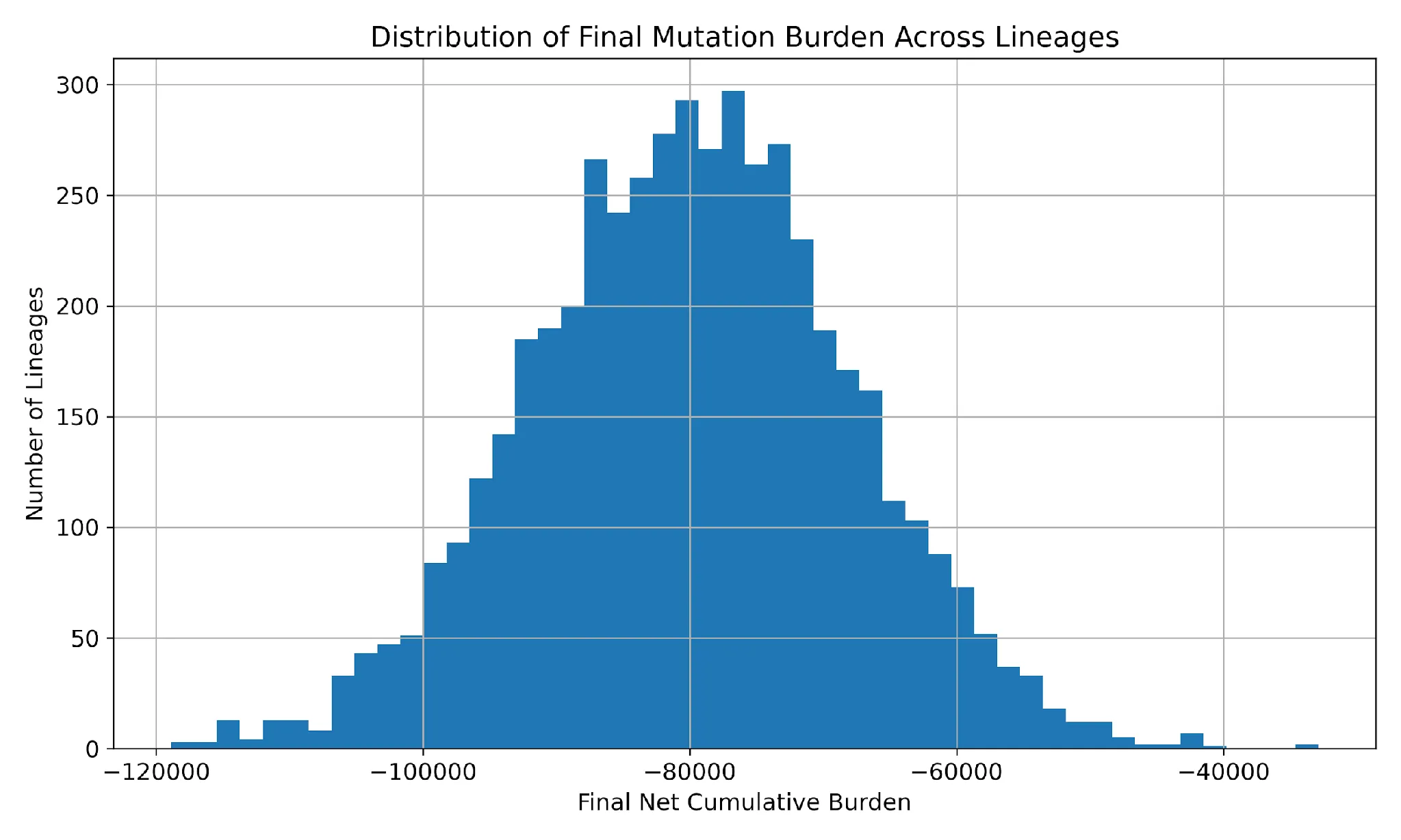
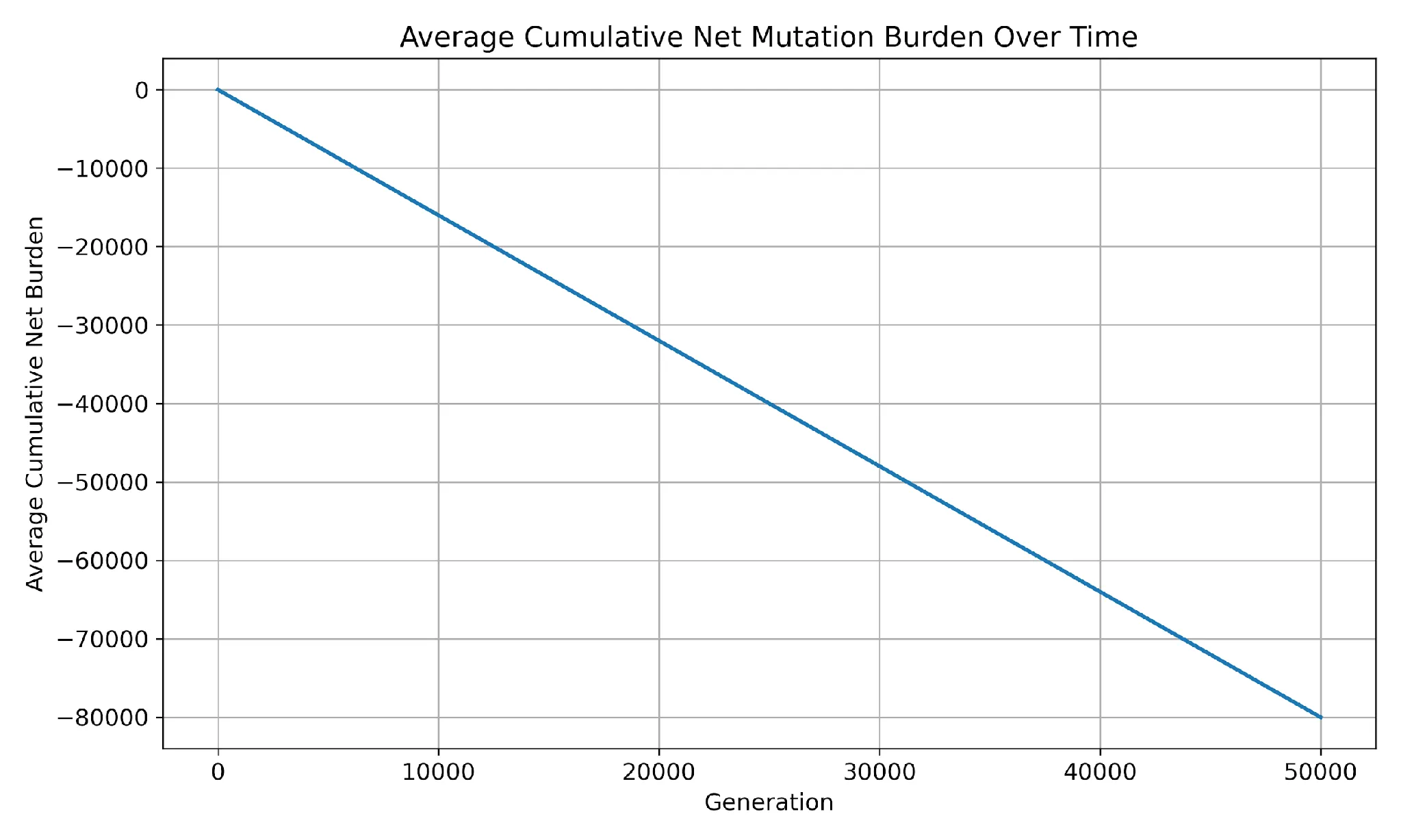
8. Estimated One-Lineage Success Probability
The one-lineage probability of successfully traversing all seven sequential stages within their assigned generational budgets is derived by multiplying the per-stage success probabilities under the adopted mutation regime:
Ptotal = P1 × P2 × P3 × P4 × P5 × P6 × P7
Under the simulation assumptions:
Ptotal ≈ 3.85 × 10⁻³³
This value is not absolute mathematical zero. It is the correct scientific statement that, under the explicit assumptions of this model, the random mutation plus selection pathway from a small post-K-Pg mammal to a modern elephant is functionally non-viable for practical scientific purposes. Under the adopted asymmetric mutation regime, the model remains burden-dominated rather than construction-dominated across the overwhelming majority of simulated lineages.
9. Break-Point Analysis
For the process to reach cumulative break-even, the retained transformational beneficial rate would need to increase from 0.000009 per generation to approximately 0.0640098 per generation, a 7,112-fold increase. This is equivalent to requiring that approximately 74.1 percent of all retained beneficial mutations be transformational rather than the modelled 0.01 percent.
The appeal to more time does not rescue this result. Because the expected net score per generation is negative, extending the time horizon compounds the burden rather than increasing constructive accumulation.
10. Direct Historical Continuity Argument
Elephants have been described in recorded human history for at least 5,000 years, corresponding to approximately 200 directly observed generations at a 25-year generation interval. Across this entire recorded window, elephants remain recognisably elephants. No body-plan reorganisation, emergent structural redirection, or visible transformational drift is observed.
This observation is cited not as a macroevolutionary test, which would require far longer timescales, but as observational corroboration that the existing elephant form is stable and self-sustaining under current conditions, consistent with the framework's claim that successful perpetuation strategies become stabilised rather than continuously drifting. It is directly consistent with the simulation result: a burden-dominated process with a strongly negative per-generation expected score would not be expected to produce visible constructive drift across 200 generations.
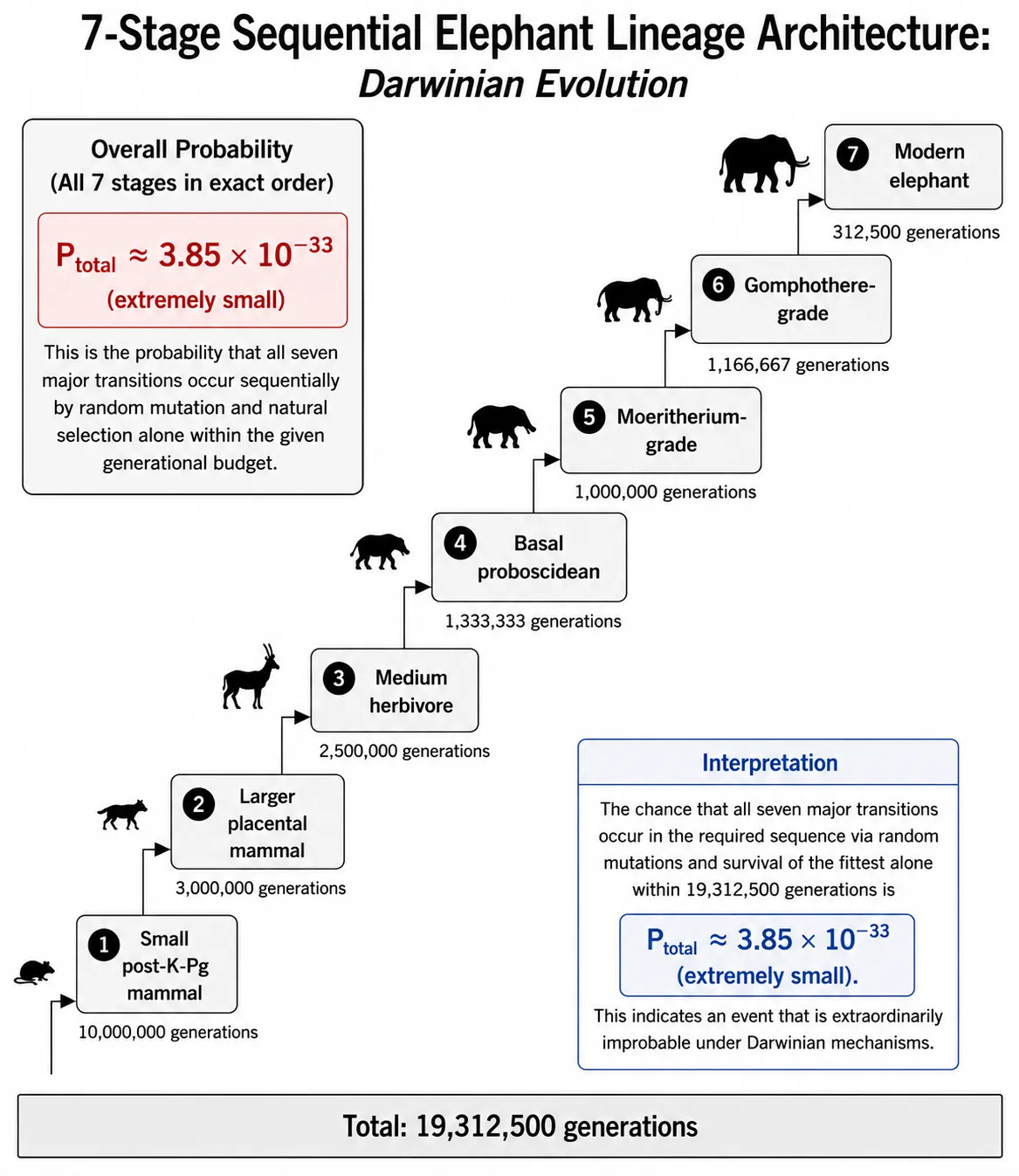
11. Summary Statement
The elephant-lineage stress test formalises the mutation-burden problem in a concrete, lineage-specific, and time-bounded way. Starting from a small post-K-Pg mammalian survivor and granting the mechanism more than 19 million generations across seven staged transitions, the model produces a strongly negative expected net adaptive score from the first generation onward. Cumulative retained harmful burden overwhelms cumulative retained beneficial gain across the lineage trajectory. The estimated one-lineage sequential-transition success probability is approximately 3.85 × 10⁻³³. Break-even requires the rarest beneficial category to be inflated approximately 7,112-fold above the adopted baseline assumptions. The simulation therefore supports the conclusion that random mutation plus natural selection, treated as a general-purpose engine of major macroevolutionary transformation, behaves as a cumulative burden mechanism rather than a cumulative construction mechanism under the adopted assumptions.
References
Sharma, V. S. (2026). The Unified Theory of Emotions (UNITE): A Universal, Non-circular, Quantitative, and Predictive Framework for All Human Emotions. Restricted by the author pending an ongoing patent application.
[1] Kriegman, S., Blackiston, D., Levin, M., & Bongard, J. (2020). A scalable pipeline for designing reconfigurable organisms. PNAS, 117(4), 1853-1859. https://doi.org/10.1073/pnas.1910837117
[2] Blackiston, D., Lederer, E., Kriegman, S., Garnier, S., Bongard, J., & Levin, M. (2021). A cellular platform for the development of synthetic living machines. Science Robotics, 6(52), eabf1571. https://doi.org/10.1126/scirobotics.abf1571
[3] Wesołowska, W., & Wesołowski, T. (2014). Do Leucochloridium sporocysts manipulate the behaviour of their snail hosts? Journal of Zoology, 292(3), 151-155. https://doi.org/10.1111/jzo.12094
[4] Hughes, D. P., et al. (2011). Behavioral mechanisms and morphological symptoms of zombie ants dying from fungal infection. BMC Ecology, 11, 13. https://doi.org/10.1186/1472-6785-11-13
[5] Vyas, A., et al. (2007). Behavioral changes induced by Toxoplasma infection of rodents are highly specific to aversion of cat odors. PNAS, 104(15), 6442-6447. https://doi.org/10.1073/pnas.0608310104
[6] Adamo, S. A., et al. (2016). The parasitic wasp Cotesia congregata uses multiple mechanisms to control host behaviour. Journal of Experimental Biology, 219(23), 3750-3758. https://doi.org/10.1242/jeb.145300
[7] Pai, V. P., et al. (2025). Basal Xenobot transcriptomics reveals changes and novel control modality in cells freed from organismal influence. Communications Biology, 8(646). https://doi.org/10.1038/s42003-025-08086-9 [1, 2]
[8] Fredericksen, M. A., et al. (2017). Three-dimensional visualization and a deep-learning model reveal complex fungal parasite networks in behaviorally manipulated ants. PNAS, 114(47), 12590-12595. https://doi.org/10.1073/pnas.1711673114
[9] McMillan, L., et al. (2024). The caterpillar Manduca sexta brain shows changes in gene expression and protein abundance correlating with parasitic manipulation of behaviour. Scientific Reports, 14. https://doi.org/10.1038/s41598-024-82506-4
[10] Snaith, T. V., et al. (2008). Patterns of Associate Feeding and Sleeping among Wild Geladas. International Journal of Primatology, 29(5), 1213-1228.
[11] Taborsky, M., Oliveira, R. F., & Brockmann, H. J. (2008). The evolution of alternative reproductive tactics: concepts and questions. In R. F. Oliveira, M. Taborsky, & H. J. Brockmann (Eds.), Alternative Reproductive Tactics: An Integrative Approach (pp. 1-21). Cambridge University Press.
[12] Pietsch, T. W. (2005). Dimorphism, parasitism, and sex revisited: modes of reproduction among deep-sea ceratioid anglerfishes (Teleostei: Lophiiformes). Ichthyological Research, 52(3), 207-236. https://doi.org/10.1007/s10228-005-0286-2
[13] Fernald, R. D. (2006). Casting a genetic light on the evolution of eyes. Science, 313(5795), 1914-1918. https://doi.org/10.1126/science.1127889
[14] Dudley, R. (2000). The evolutionary physiology of animal flight: palaeobiological and present perspectives. Annual Review of Physiology, 62, 135-155. https://doi.org/10.1146/annurev.physiol.62.1.135
[15] Massare, J. A. (1988). Swimming capabilities of Mesozoic marine reptiles: implications for method of predation. Paleobiology, 14(2), 187-205. https://doi.org/10.1017/S0094837300011926
[16] Convergent evolution of echolocation: Li, G., et al. (2010). The hearing gene Prestin reunites echolocating bats. Proceedings of the National Academy of Sciences, 107(20), 9959-9964. https://doi.org/10.1073/pnas.1002531107
[17] Lelito, J. P., & Brown, W. D. (2006). Complicity or conflict over sexual cannibalism? Male risk taking in the praying mantis Tenodera aridifolia sinensis. American Naturalist, 168(2), 263-269. https://doi.org/10.1086/505762
[18] Hendry, A. P., & Berg, O. K. (1999). Secondary sexual characters, energy use, senescence, and the cost of reproduction in sockeye salmon. Canadian Journal of Zoology, 77(11), 1663-1675. https://doi.org/10.1139/z99-148
[19] Schneider, J. M., & Lubin, Y. (1997). Does high adult mortality explain semelparity in the spider Stegodyphus lineatus? Oikos, 79(3), 445-452. https://doi.org/10.2307/3546889
[20] Roff, D. A. (1992). The Evolution of Life Histories: Theory and Analysis. Chapman & Hall. (On high-fecundity prey strategies, pp. 130-155.)
[21] Bonner, J. T. (2009). The Social Amoebae: The Biology of Cellular Slime Molds. Princeton University Press.
[22] Dittman, A. H., & Quinn, T. P. (1996). Homing in Pacific salmon: mechanisms and ecological basis. Journal of Experimental Biology, 199(1), 83-91.
[23] Catania, K. C. (2014). The shocking predatory strike of the electric eel. Science, 346(6214), 1231-1234. https://doi.org/10.1126/science.1254432
[24] von der Emde, G. (1999). Active electrolocation of objects in weakly electric fish. Journal of Experimental Biology, 202(10), 1205-1215. https://doi.org/10.1242/jeb.202.10.1205
[25] Bellono, N. W., Leitch, D. B., & Julius, D. (2017). Molecular basis of ancestral vertebrate electroreception. Nature, 543, 391-396. https://doi.org/10.1038/nature21401
[26] Gracheva, E. O., et al. (2010). Molecular basis of infrared detection by snakes. Nature, 464, 1006-1011. https://doi.org/10.1038/nature08943
[27] Eisner, T., Aneshansley, D. J., Widom, J. M., Widom, B., & Meinwald, J. (1977). Spray mechanism of the bombardier beetle. Science, 195(4277), 588-590.
[28] Versluis, M., Schmitz, B., von der Heydt, A., & Lohse, D. (2000). How snapping shrimp snap: through cavitating bubbles. Nature, 413, 477-478. https://doi.org/10.1038/35097152
[29] Schuster, S., Wöhl, S., Griebsch, M., & Klostermeier, I. (2004). Archer fish learn to compensate for complex optical distortions to determine the absolute size of their aerial prey. Current Biology, 14(17), 1565-1568. https://doi.org/10.1016/j.cub.2004.08.050
[30] Wood, W. F. (1999). The history of skunk defensive secretion research. Chemical Senses, 24(6), 671-680.
[31] Cho, W. K., Ankrum, J. A., Guo, D., Chester, S. A., Yang, S. Y., Kashyap, A., Campbell, G. A., Wood, R. J., Rijal, R. K., Karnik, R., & Langer, R. (2012). Microstructured barbs on the North American porcupine quill enable easy tissue penetration and difficult removal. Proceedings of the National Academy of Sciences, 109(52), 21289-21294. https://doi.org/10.1073/pnas.1216441109
[32] Heatwole, H., & Poran, N. S. (1995). Resistances of sympatric and allopatric eels to sea snake venoms. Copeia, 1995(1), 136-147.
[33] Wainwright, P. C., & Turingan, R. G. (1997). Evolution of pufferfish inflation behaviour. Evolution, 51(2), 506-518.
[34] Santos, J. C., Coloma, L. A., & Summers, K. (2011). Phenotypic integration emerges from aposematism and scale in poison frogs. Proceedings of the National Academy of Sciences, 108(15), 6175-6180. https://doi.org/10.1073/pnas.1010952108
[35] Sherbrooke, W. C., & Middendorf, G. A. (2001). Blood-Squirting Variability in Horned Lizards (Phrynosoma). Copeia, 2001(4), 1114-1122.
[36] Zintzen, V., et al. (2011). Hagfish predatory behaviour and slime defence mechanism. Scientific Reports, 1, 131. https://doi.org/10.1038/srep00131
[37] Okada, A., et al. (2019). Regeneration of the digestive tract of an anterior-eviscerating sea cucumber, Eupentacta quinquesemita. Frontiers in Zoology, 16, 3. https://doi.org/10.1186/s40851-019-0133-3
[38] O'Hanlon, J. C., Holwell, G. I., & Herberstein, M. E. (2014). Pollinator deception in the orchid mantis. The American Naturalist, 183(1), 126-132.
[39] Heiling, A. M., Herberstein, M. E., & Chittka, L. (2003). Crab-spiders manipulate flower signals. Nature, 421, 334.
[40] Bank, S., Cumming, R. T., Li, Y., Henze, K., Le Tirant, S., Bradler, S., & Simon, S. (2021). A tree of leaves: Phylogeny and historical biogeography of the leaf insects (Phasmatodea: Phylliidae). Communications Biology, 4, 932.
[41] Robertson, J. A., Bradler, S., & Whiting, M. F. (2018). Evolution of oviposition techniques in stick and leaf insects (Phasmatodea). Frontiers in Ecology and Evolution, 6, 216.
[42] Hanlon, R. T. (2007). Cephalopod dynamic camouflage. Current Biology, 17(11), R400-R404. https://doi.org/10.1016/j.cub.2007.03.034
[43] Norman, M. D., Finn, J., & Tregenza, T. (2001). Dynamic mimicry in an Indo-Malayan octopus. Proceedings of the Royal Society B, 268, 1755-1758.
[44] Glaw, F., Hawlitschek, O., Dunz, A. R., Vences, M., & Köhler, J. (2023). A new large-sized species of leaf-tailed gecko Uroplatus from northern Madagascar. Salamandra, 59(3), 247-266.
[45] Suzuki, T. K. (2014). Gradual and contingent evolutionary emergence of leaf mimicry in butterfly wing patterns. BMC Evolutionary Biology, 14, 229.
[46] Grobecker, D. B., & Pietsch, T. W. (1979). High-speed cinematographic evidence for ultrafast feeding in antennariid anglerfishes. Science, 205(4411), 1161-1162. https://doi.org/10.1126/science.205.4411.1161
[47] Davis, M. P., Holcroft, N. I., Wiley, E. O., Sparks, J. S., & Smith, W. L. (2014). Species-specific bioluminescence facilitates speciation in the deep sea. Marine Biology, 161(5), 1139-1148. https://doi.org/10.1007/s00227-014-2406-x
[48] Böhm, J., Scherzer, S., Krol, E., Kreuzer, I., von Meyer, K., Lorey, C., Mueller, T. D., Shabala, L., Monte, I., Solano, R., Al-Rasheid, K. A. S., Rennenberg, H., Shabala, S., Neher, E., & Hedrich, R. (2016). The Venus flytrap Dionaea muscipula counts prey-induced action potentials to induce sodium uptake. Current Biology, 26(3), 286-295. https://doi.org/10.1016/j.cub.2015.11.057
[49] Ivesic, C., Benkendorff, K., & Poppinga, S. (2022). Snatching sundews: Analysis of tentacle movement in two species of Drosera in terms of response rate, response time, and speed of movement. Plants, 11(22), 3149.
[50] Mithöfer, A. (2011). Carnivorous pitcher plants: Insights in an old topic. Phytochemistry, 72(13), 1678-1682.
[51] Vincent, O., Weißkopf, C., Poppinga, S., Masselter, T., Speck, T., Joyeux, M., Quilliet, C., & Marmottant, P. (2011). Ultra-fast underwater suction traps. Proceedings of the Royal Society B, 278(1720), 2909-2914.
[52] Gagliano, M., Renton, M., Depczynski, M., & Mancuso, S. (2014). Experience teaches plants to learn faster and forget slower in environments where it matters. Oecologia, 175, 63-72. https://doi.org/10.1007/s00442-014-2991-7
[53] Runyon, J. B., Mescher, M. C., & De Moraes, C. M. (2006). Volatile chemical cues guide host location and host selection by parasitic plants. Science, 313(5795), 1964-1967. https://doi.org/10.1126/science.1131371
[54] Gianoli, E. (2015). The behavioural ecology of climbing plants. AoB Plants, 7, plv013. https://doi.org/10.1093/aobpla/plv013
[55] Janzen, D. H. (1966). Coevolution of mutualism between ants and acacias in Central America. Evolution, 20(3), 249-275.
[56] Schiestl, F. P. (2005). On the success of a swindle: Pollination by deception in orchids. Naturwissenschaften, 92, 255-264.
[57] Ogburn, R. M., & Edwards, E. J. (2010). The ecological water-use strategies of succulent plants. Advances in Botanical Research, 55, 179-225. https://doi.org/10.1016/S0065-2296(10)55004-3
[58] Alongi, D. M. (2002). Present state and future of the world's mangrove forests. Environmental Conservation, 29(3), 331-349. https://doi.org/10.1017/S0376892902000231
[59] Inderjit, & Duke, S. O. (2003). Ecophysiological aspects of allelopathy. Planta, 217, 529-539.
[60] Thomas, F., Schmidt-Rhaesa, A., Martin, G., Manu, C., Durand, P., & Renaud, F. (2002). Do hairworms manipulate the water-seeking behaviour of their terrestrial hosts? Proceedings of the Royal Society B, 269(1503), 2191-2198.
[61] Poulin, R., & Maure, G. (2015). Host manipulation by parasites: a look back before moving forward. Trends in Parasitology, 31(11), 563-570. https://doi.org/10.1016/j.pt.2015.07.002
[62] Libersat, F., Delago, A., & Gal, R. (2009). Manipulation of host behaviour by parasitic insects and insect parasites. Annual Review of Entomology, 54, 189-207.
[63] Høeg, J. T. (1995). The biology and life-cycle of the Rhizocephala (Cirripedia). Journal of the Marine Biological Association of the United Kingdom, 75, 517-550.
[64] Lafferty, K. D., & Morris, A. K. (1996). Altered behaviour of parasitized killifish increases susceptibility to predation by bird final hosts. Ecology, 77(5), 1390-1397.
[65] Barber, I., Hoare, D., & Krause, J. (2000). Effects of parasites on fish behaviour: a review and evolutionary perspective. Reviews in Fish Biology and Fisheries, 10, 131-165.
[66] Seeley, T. D., & Buhrman, S. C. (1999). Group decision-making in swarms of honey bees. Behavioral Ecology and Sociobiology, 45, 19-31.
[67] Turner, J. S. (2001). On the mound of Macrotermes michaelseni as an organ of respiratory gas exchange. Physiological and Biochemical Zoology, 74(6), 798-822.
[68] Burgess, J. W. (1976). Spider webs: Design and engineering. Zeitschrift für Tierpsychologie, 41, 1-29.
[69] Coyle, F. A. (1986). The role of silk in prey capture, reproduction and protection among trapdoor spiders and their relatives. In W. A. Shear (Ed.), Spiders: Webs, Behaviour, and Evolution (pp. 324-364). Stanford University Press.
[70] Devarajan, K. (2016). The Antsy Social Network: Determinants of nest structure and arrangement in Asian weaver ants. Scientific Reports, 6, 34631.
[71] Reid, C. R., Lutz, M. J., Powell, S., Kao, A. B., Couzin, I. D., & Garnier, S. (2015). Army ants dynamically adjust living bridges in response to a cost-benefit trade-off. Proceedings of the National Academy of Sciences, 112(49), 15113-15118.
[72] Dunn, C. W., Pugh, P. R., & Haddock, S. H. D. (2005). Molecular phylogenetics of the Siphonophora (Cnidaria), with implications for the evolution of functional specialization. Systematic Biology, 54(6), 916-935.
[73] Schnitzler, H.-U., Moss, C. F., & Denzinger, A. (2003). From spatial orientation to food acquisition in echolocating bats. Trends in Ecology & Evolution, 18(8), 386-394.
[74] Knudsen, E. I., & Konishi, M. (1978). A neural map of auditory space in the owl. Science, 200(4343), 795-797.
[75] Jeffery, W. R. (2005). Adaptive evolution of eye degeneration in the Mexican blind cavefish. Journal of Heredity, 96(3), 185-196. [97, 98]
[76] Catania, K. C. (2005). Star-nosed moles. Current Biology, 15(24), R985-R986.
[77] Erb, M., et al. (2015). Indole is an essential herbivore-induced volatile priming signal in maize. Nature Communications, 6, 6273. https://doi.org/10.1038/ncomms7273
[78] Turlings, T. C. J., Tumlinson, J. H., & Lewis, W. J. (1990). Exploitation of herbivore-induced plant odors by host-seeking parasitic wasps. Science, 250(4985), 1251-1253. https://doi.org/10.1126/science.250.4985.1251
[81] Baluska, F., Lev-Yadun, S., & Mancuso, S. (2010). Swarm intelligence in plant roots. Trends in Ecology and Evolution, 25(12), 682-683. https://doi.org/10.1016/j.tree.2010.09.003
[82] Baluska, F., Mancuso, S., Volkmann, D., & Barlow, P. W. (2009). The root-brain hypothesis of Charles and Francis Darwin: revival after more than 125 years. Plant Signaling and Behaviour, 4(12), 1121-1127. https://doi.org/10.4161/psb.4.12.10574
[83] Murphy, G. P., & Dudley, S. A. (2009). Kin recognition: competition and cooperation in Impatiens (Balsaminaceae). American Journal of Botany, 96(11), 1990-1996. https://doi.org/10.3732/ajb.0900006
[84] Rasmann, S., Kollner, T. G., Degenhardt, J., Hiltpold, I., Toepfer, S., Kuhlmann, U., Gershenzon, J., & Turlings, T. C. J. (2005). Recruitment of entomopathogenic nematodes by insect-damaged maize roots. Nature, 434, 732-737. https://doi.org/10.1038/nature03451
[85] Bazihizina, N., Taiti, C., Marti, L., Rodrigo-Moreno, A., Spinelli, F., Giordano, C., Caparrotta, S., Gori, M., Azzarello, E., & Mancuso, S. (2014). Zn2+-induced changes at the root level account for the increased tolerance of acclimated tobacco plants. Journal of Experimental Botany, 65(17), 4931-4942. https://doi.org/10.1093/jxb/eru251
[86] Falik, O., Mordoch, Y., Quansah, L., Fait, A., & Novoplansky, A. (2011). Rumor has it: relay communication of stress cues in plants. PLoS ONE, 6(11), e23625. https://doi.org/10.1371/journal.pone.0023625
[87] Turlings, T. C. J., McCall, P. J., Alborn, H. T., & Tumlinson, J. H. (1993). An elicitor in caterpillar oral secretions that induces corn seedlings to emit chemical signals attractive to parasitic wasps. Journal of Chemical Ecology, 19(3), 411-425. https://doi.org/10.1007/BF00994314
[88] Gagliano, M., Mancuso, S., & Robert, D. (2012). Towards understanding plant bioacoustics. Trends in Plant Science, 17(6), 323-325. https://doi.org/10.1016/j.tplants.2012.03.002
[89] Rodrigo-Moreno, A., Bazihizina, N., Azzarello, E., Masi, E., Tran, D., Bouteau, F., Baluska, F., & Mancuso, S. (2017). Root phonotropism: early signalling events following sound perception in Arabidopsis roots. Plant Science, 264, 9-15. https://doi.org/10.1016/j.plantsci.2017.08.006
[90] Khait, I., et al. (2023). Sounds emitted by plants under stress are airborne and informative. Cell, 186(7), 1328-1336. https://doi.org/10.1016/j.cell.2023.03.009
[91] Brenner, E. D., Stahlberg, R., Mancuso, S., Vivanco, J., Baluska, F., & Van Volkenburgh, E. (2006). Plant neurobiology: an integrated view of plant signalling. Trends in Plant Science, 11(8), 413-419. https://doi.org/10.1016/j.tplants.2006.06.009
[92] Schultz, J. C. (2002). Shared signals and the potential for phylogenetic espionage between plants and animals. Integrative and Comparative Biology, 42(3), 454-462. https://doi.org/10.1093/icb/42.3.454
[93] [93] Sharma, V. S. (2026). The Big Flare-Up Theory (BFUT): A Cosmological Framework for the Emergence of Matter from a Living Conscious Spaticle Field. Zenodo. https://doi.org/10.5281/zenodo.19149786
[94] [94] Sharma, V. S. (2026). Everything in the Universe Is Alive and Conscious: Vijay’s Law (Layer 2 of the Six-Layer Framework). Zenodo. https://doi.org/10.5281/zenodo.19504923
[95] Kriegman, S., Blackiston, D., Levin, M., & Bongard, J. (2021). Kinematic self-replication in reconfigurable organisms. Proceedings of the National Academy of Sciences, 118(49), e2112672118. https://doi.org/10.1073/pnas.2112672118
[96] Arendt, D. (2003). Evolution of eyes and photoreceptor cell types. International Journal of Developmental Biology, 47(7-8), 563-571.
[97] Vermeij, G. J. (1987). Evolution and Escalation: An Ecological History of Life. Princeton University Press. (On ecological cascade architecture, predator-prey escalation, and the structured emergence of ecological roles.)
[98] Gage, J. D., & Tyler, P. A. (1991). Deep-Sea Biology: A Natural History of Organisms at the Deep-Sea Floor. Cambridge University Press. (On deep-sea ecological diversity, coexisting adaptive strategies under extreme conditions, and environmental breadth determining strategic diversity.)
[101] Athreya, S., & Wu, X. (2017). A multivariate assessment of the Dali archaic human cranium from China: morphological affinities and implications for Pleistocene evolution in East Asia. American Journal of Physical Anthropology, 164(4), 679-701. https://doi.org/10.1002/ajpa.23305
[102] Ragsdale, A. P., et al. (2023). A weakly structured stem for human origins in Africa. Nature, 617, 755-763. https://doi.org/10.1038/s41586-023-06055-y
[103] Ni, X., et al. (2025). Phylogenetic placement of the Harbin cranium and implications for Middle Pleistocene human evolution. Science, 389(6757), eado3058. https://doi.org/10.1126/science.ado3058
[P14] Sharma, V. S. (2026). The Spaticle Field as the Logical Cosmological Substrate. Zenodo. https://doi.org/10.5281/zenodo.19394064
[P17] Sharma, V. S. (2026). The Emergence of Forces and Fundamental Senses. Zenodo. https://doi.org/10.5281/zenodo.19976408
[P20] Sharma, V. S. (2026). From Matter and Fundamental Forces to Consciousness: A Unified Framework of Sensing Channels, Control, and Evolution. Zenodo. https://doi.org/10.5281/zenodo.19992457
[P21] Sharma, V. S. (2026). The Consciousness Index (CI): A Physically Grounded Scalar Measure of Conscious Degree, Structure, and Evolutionary Potential. Zenodo. https://doi.org/10.5281/zenodo.20025739
[104] Burki, T. (2022). Omicron variant and booster COVID-19 vaccines. The Lancet Respiratory Medicine, 10(2), e17. https://doi.org/10.1016/S2213-2600(21)00559-2
[105] Viana, R., et al. (2022). Rapid epidemic expansion of the SARS-CoV-2 Omicron variant in southern Africa. Nature, 603, 679-686. https://doi.org/10.1038/s41586-022-04411-y
[106] Menni, C., et al. (2022). Symptom prevalence, duration, and risk of hospital admission in individuals infected with SARS-CoV-2 during periods of ο and δ variant dominance. The Lancet, 399(10335), 1618-1624. https://doi.org/10.1016/S0140-6736(22)00327-0
[107] Grubaugh, N. D., et al. (2022). Making sense of mutation: what D614G means for the COVID-19 pandemic remains unclear. Cell, 182(4), 794-795. https://doi.org/10.1016/j.cell.2020.06.040
[108] Alizon, S., et al. (2009). Virulence evolution and the trade-off hypothesis: history, current state of affairs and the future. Journal of Evolutionary Biology, 22(2), 245-259. https://doi.org/10.1111/j.1420-9101.2008.01658.x
[109] Sharma, V. S. (2021). Documented Prior Prediction of SARS-CoV-2 Mutation Trajectory, Personal Communication, May-June 2020, Documented June 2021. Zenodo. https://doi.org/10.5281/zenodo.20073667