Cosmic-Scale Rotation and the Age of the Universe: A Timescale Argument
Abstract
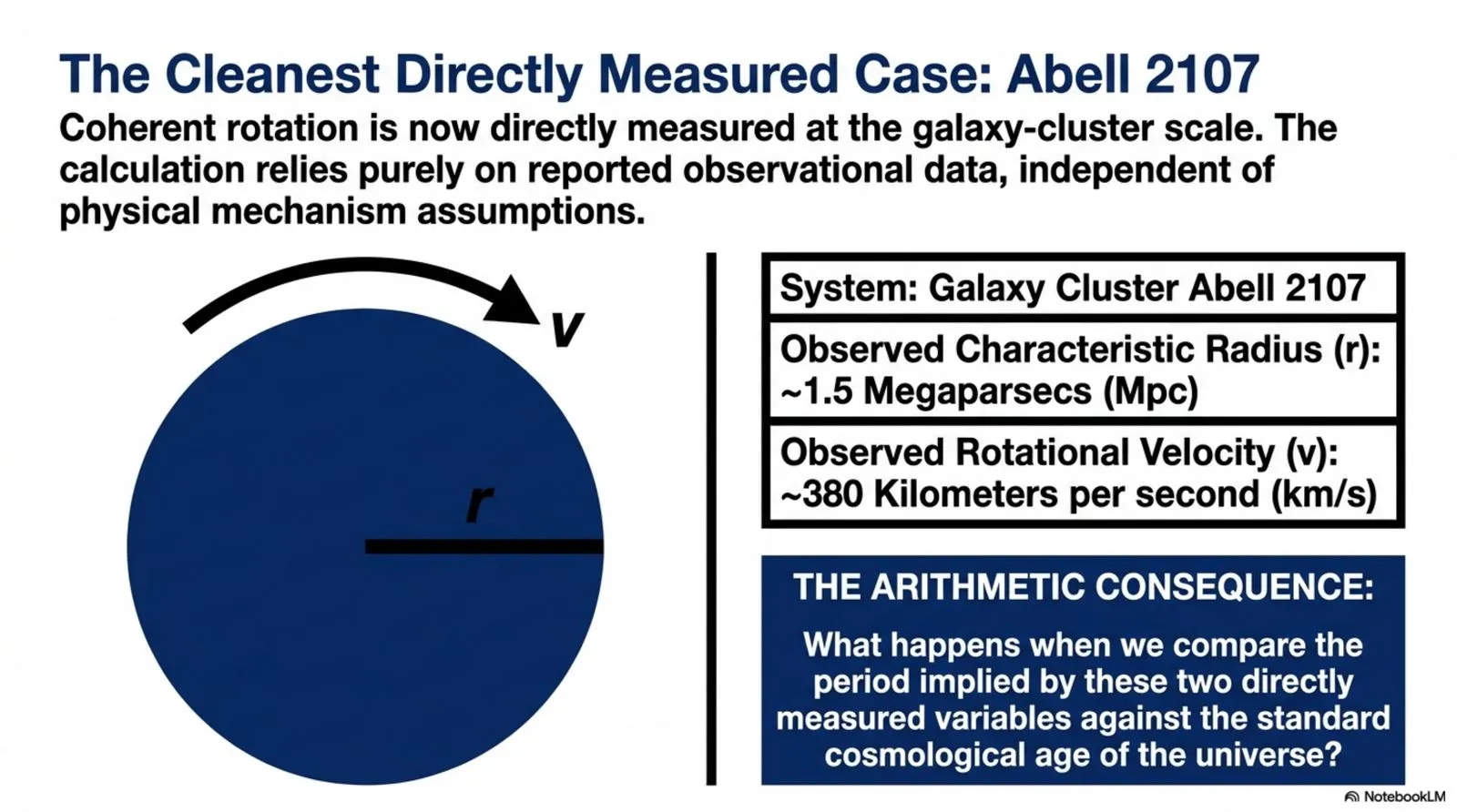
Coherent rotation has now been directly measured at galaxy-cluster scale, with rotational signatures reported out to radii of order 1 to 1.5 megaparsecs. This paper examines the straightforward arithmetic consequence of these measurements: the characteristic rotational period implied by a measured radius and rotational velocity, compared directly against the standard cosmological age of the universe, 13.8 billion years. For the cleanest currently available directly measured case, the galaxy cluster Abell 2107, a radius of approximately 1.5 megaparsecs and a rotational velocity of approximately 380 kilometres per second imply a characteristic rotational period of approximately 24.2 billion years — longer than the entire age of the universe under the standard cosmological timeline. We formalise this comparison through a simple Tension Index, the ratio of characteristic rotational period to the standard cosmic age, and show that Abell 2107 alone gives a Tension Index of approximately 1.75: the cluster has not had sufficient time, under the standard timeline, to complete even one full characteristic rotation since the birth of the universe. We show that this tension is not resolved, but is in fact worsened, by accounting for the fact that a presently observed structure of this size did not reach its current scale instantaneously, and that invoking cosmic expansion to explain the structure’s size does not remove the timing difficulty but relocates it to the question of how rotational coherence could survive differential stretching across the structure’s formation history. We discuss the broader observational context, including detected angular momentum in cosmic filaments extending hundreds of millions of light-years, address the objection that a single measured system is not decisive evidence, and specify falsifiable predictions distinguishing continued escalation of this timing tension from its resolution as observational precision improves.
Keywords: cosmic rotation, galaxy clusters, angular momentum, cosmological age, Abell 2107, tension index
1. Introduction
Rotation and orbital organisation are observed at every physical scale that has been directly measured, from planetary systems to galaxies. Galaxies themselves are well known to rotate, with rotation curves providing one of the classic pieces of evidence motivating the dark matter hypothesis [1], and the physical origin of galactic angular momentum has been studied extensively since the earliest tidal-torque models [7]. Whether coherent rotational organisation extends meaningfully beyond the scale of individual galaxies, to galaxy clusters and the larger cosmic web, has been a less settled observational question, but has become directly testable in recent years as velocity-field mapping techniques have improved [2,3].
This paper examines a specific, narrow, and purely arithmetic consequence of recent direct measurements of galaxy-cluster-scale rotation: the characteristic rotational period implied by a measured radius and rotational velocity, compared against the standard cosmological age of the universe. This comparison requires no assumption about the physical mechanism responsible for the observed rotation, and no commitment to any specific alternative cosmological model; it follows directly from the observed radius and velocity of a rotating structure, and the textbook relationship between orbital radius, orbital velocity, and orbital period.
The paper is organised as follows. Section 2 reviews the observational evidence for cluster-scale and larger-scale coherent rotation. Section 3 presents the Tension Index and evaluates it for the best currently available directly measured case. Section 4 discusses why invoking cosmic expansion does not resolve the timing tension. Section 5 discusses the broader observational context. Section 6 addresses anticipated objections. Section 7 presents falsifiable predictions. Section 8 concludes.
2. Observational Evidence for Large-Scale Coherent Rotation
Coherent rotational signatures at galaxy-cluster scale have been reported in multiple independent observational studies, using both individual well-resolved clusters and statistical samples of cluster velocity fields [2,3]. The galaxy cluster Abell 2107 provides one of the more directly usable individual cases: rotational signatures have been reported at a characteristic radius of approximately 1.5 megaparsecs, with an inferred rotational velocity of approximately 380 kilometres per second [2].
Beyond individual cluster measurements, coherent rotation has also been reported in cosmic filaments, the elongated large-scale structures connecting galaxy clusters within the cosmic web, with detected angular momentum on structures extending hundreds of millions of light-years [4]. In these cases, the presently measurable signature is generally axial spin around the filament’s long axis, rather than a fully mapped large-radius orbit of the entire extended structure; nonetheless, the detection of coherent angular momentum at this scale demonstrates that rotational organisation is not confined to individual galaxies or clusters.
3. The Tension Index
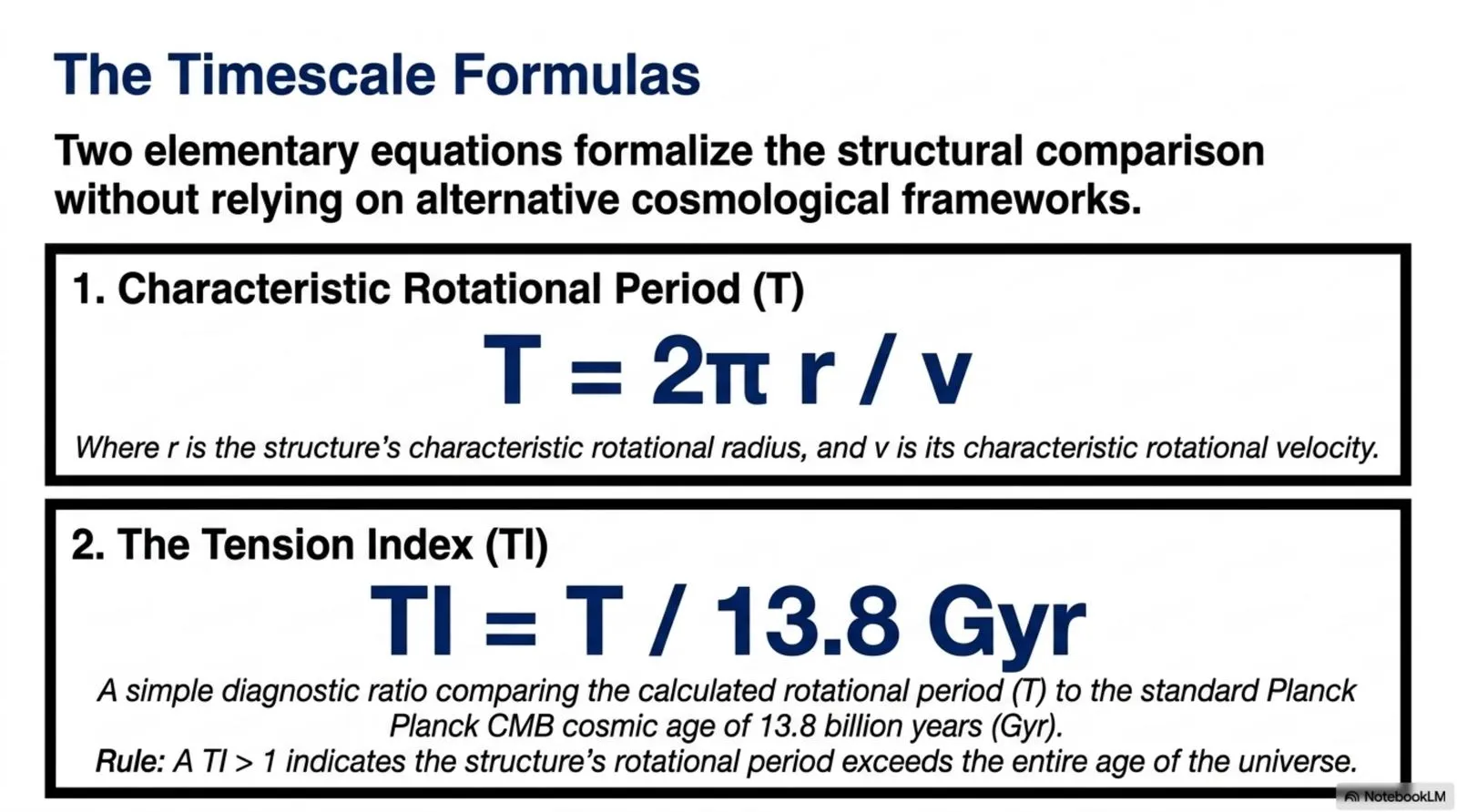
We define a simple diagnostic quantity, the Tension Index, as the ratio of a structure’s characteristic rotational period to the standard cosmological age of the universe:
TI = T / 13.8 Gyr, where T = 2πr / v (1)
Here r is the structure’s characteristic rotational radius, v is its characteristic rotational velocity, and 13.8 billion years is the standard cosmological age of the universe from Planck cosmic microwave background measurements [5]. A value of TI greater than 1 indicates that the structure’s characteristic rotational period exceeds the entire age of the universe under the standard timeline: the structure has not had sufficient time to complete even one full characteristic rotation since the beginning of cosmic history.
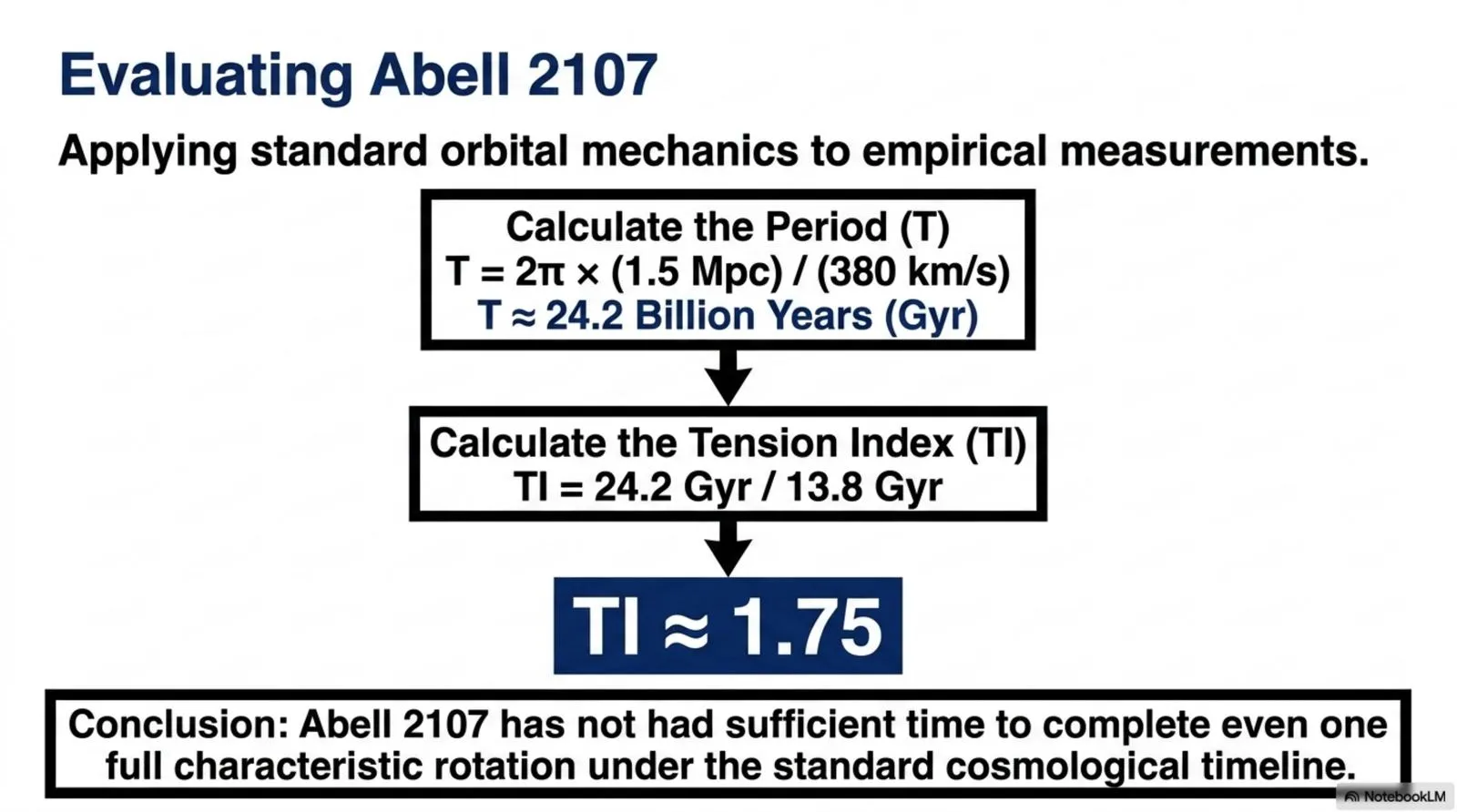
Applying equation (1) to the Abell 2107 measurements of Section 2, r ≈ 1.5 Mpc and v ≈ 380 km/s:
T = 2π × (1.5 Mpc) / (380 km/s) ≈ 24.2 Gyr (2)
TI = 24.2 Gyr / 13.8 Gyr ≈ 1.75 (3)
Table 1 summarises this calculation alongside the broader range of Mpc-scale cluster rotation estimates reported in the literature.
| System | Radius | Velocity | Period T | Tension Index TI |
|---|---|---|---|---|
| Abell 2107 (cleanest case) | ~1.5 Mpc | ~380 km/s | ~24.2 Gyr | ~1.75 |
| Broader Mpc-scale cluster estimates | ~1–1.5 Mpc | literature range | tens of Gyr | >1 in several cases |
| Standard cosmic age (reference) | — | — | 13.8 Gyr | 1.00 (by definition) |
We emphasise what this calculation does and does not claim. It does not require every reported large-scale rotating structure to individually exceed a Tension Index of 1; the broader literature values are reported with the qualification that they are less directly usable and less precisely measured than the Abell 2107 case specifically. What the calculation establishes is that at least one directly measured, individually reported case already produces a characteristic rotational period exceeding the standard cosmic age by a substantial margin, using only the reported radius and velocity and elementary orbital mechanics.
4. Why Cosmic Expansion Does Not Resolve the Tension
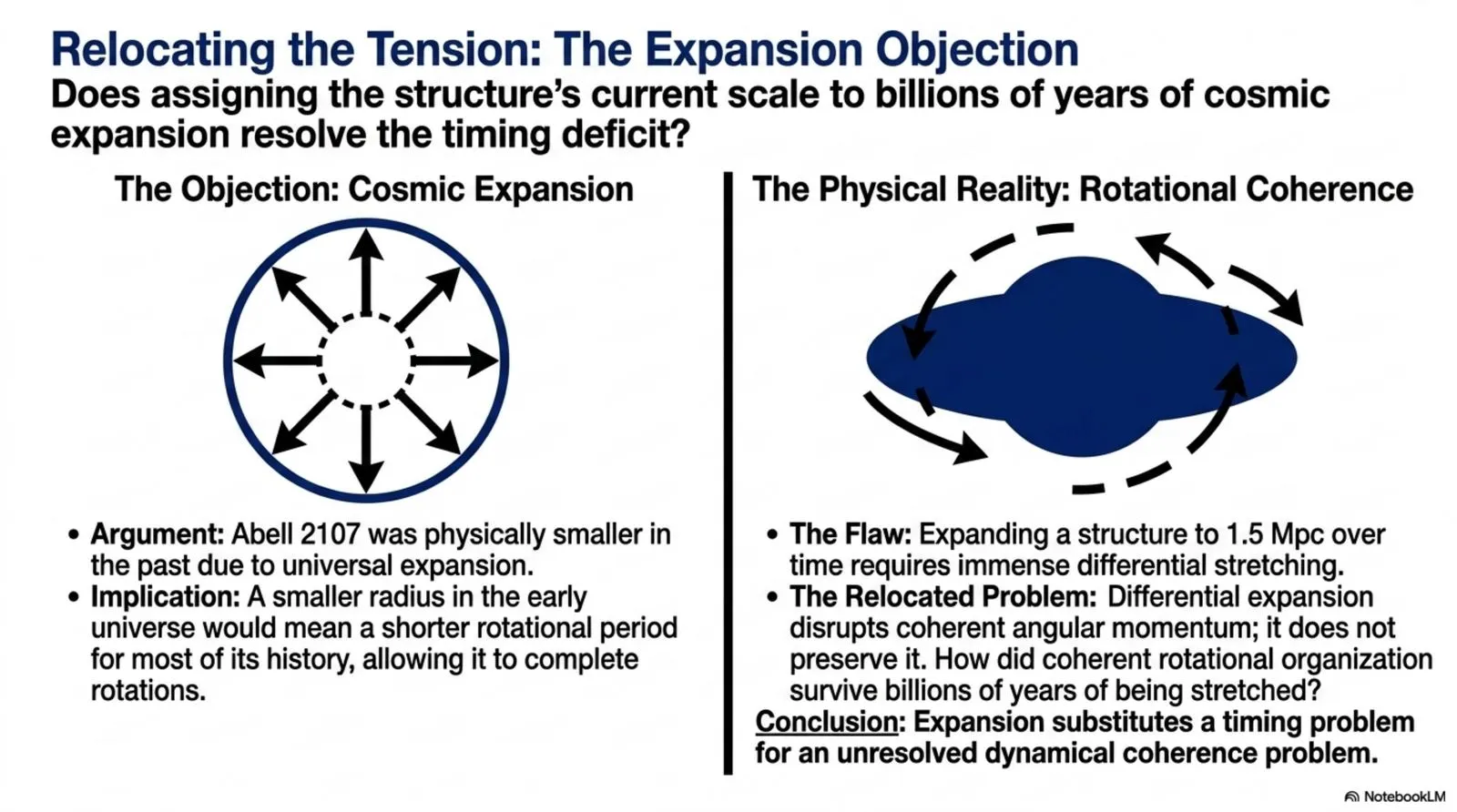
A natural response to the calculation of Section 3 is that the present-day scale of a structure like Abell 2107 reflects billions of years of cosmic expansion, and that the structure was correspondingly smaller, with a correspondingly shorter rotational period, for most of its history. This response, examined carefully, does not remove the timing difficulty identified in Section 3; it relocates it.
If a structure’s present radius is attributed substantially to expansion since its formation, then an account is required of how the structure’s rotational coherence survived that expansion: differential stretching across an extended rotating structure would be expected to disrupt coherent rotational organisation, not preserve it, unless the structure’s internal dynamics remained self-consistent throughout the expansion process in a way that has not, to our knowledge, been independently demonstrated for a structure of this scale. Invoking expansion to explain the structure’s current size, without also demonstrating that rotational coherence and internal dynamical self-consistency were maintained throughout that expansion, does not resolve the tension identified in Section 3; it substitutes one open question — why is the rotational period so long relative to the cosmic age — for another of comparable difficulty — how did coherent rotation survive the expansion history invoked to explain the structure’s present scale.
5. Broader Observational Context
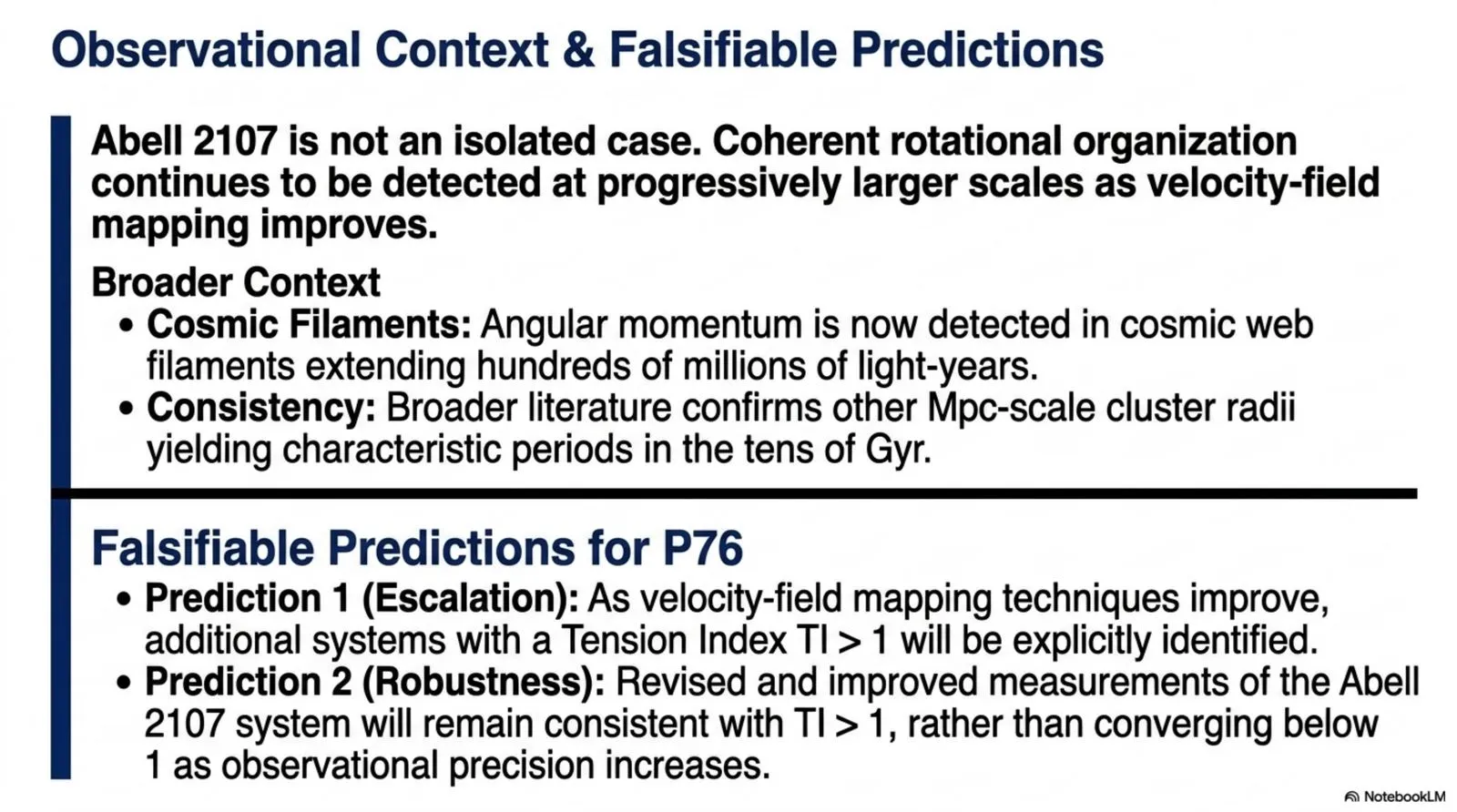
The Abell 2107 case of Section 3 is presented as the cleanest currently available directly measured example, not as an isolated anomaly. Coherent angular momentum has also been reported in cosmic filaments at scales of hundreds of millions of light-years [4], with galaxy spin orientations showing measurable alignment relative to the surrounding filament and sheet structure [8], and historical supercluster-scale rotational interpretations, while not representing current measurement consensus and accordingly treated here as suggestive rather than decisive, imply characteristic timescales at least as large if taken at face value [2], consistent with independently reported large-scale peculiar velocity coherence extending to comparable scales [6]. The pattern across these independent lines of evidence is consistent: as observational techniques have improved and been applied to progressively larger structures, coherent rotational organisation has continued to be detected, rather than disappearing, at every scale examined so far.
6. Discussion: Anticipated Objections
6.1 "Is a single measured system sufficient evidence for a general timing tension?"
This is a fair and important qualification. The calculation of Section 3 depends on the specific reported radius and velocity measurements for Abell 2107, and any single measurement carries observational uncertainty. We do not claim that this single case, by itself, definitively establishes a general cosmological problem; we claim that it establishes, using standard measurements and elementary arithmetic, that the timing tension is real and substantial for at least this one directly measured system, and that this result is representative of a broader pattern across the multiple independent lines of evidence discussed in Section 5, rather than an isolated statistical fluctuation.
6.2 "Could the reported radius or velocity measurements for Abell 2107 be revised with improved observation?"
This is possible in principle, and the falsifiable predictions of Section 7 address this directly: if improved measurement of Abell 2107, or of comparable cluster-scale rotating systems, systematically revises reported rotational velocities upward or radii downward relative to currently reported values, the Tension Index of equation (3) would correspondingly decrease, and a sufficiently large revision could bring it below 1. The present paper reports the calculation using currently published measurements and does not assume those measurements are beyond revision.
6.3 "Does this argument depend on any non-standard cosmological model?"
No. The calculation of Section 3 uses only the standard cosmological age from Planck measurements [5], the standard relationship between orbital radius, velocity, and period, and directly reported observational measurements of Abell 2107’s rotation [2]. It does not assume, and is independent of, any alternative cosmological framework; the tension it identifies is a comparison entirely internal to currently accepted measurements and standard orbital mechanics.
7. Falsifiable Predictions
The cosmic-rotation timescale argument makes the following falsifiable predictions.
Prediction 1. As velocity-field mapping techniques improve and are applied to additional galaxy clusters, additional directly measured systems with Tension Index exceeding 1 are expected to be identified, rather than the Abell 2107 case remaining an isolated outlier; a systematic failure to identify further such systems, despite improved observational capability, would weaken the broader pattern claimed in Section 5.
Prediction 2. Improved velocity-field mapping of cosmic filaments is expected to extend the detected scale of coherent angular momentum in the cosmic web, consistent with the pattern noted in Section 5 of continued detection at progressively larger scales as observational capability improves.
Prediction 3. No confirmed physical mechanism will be demonstrated by which large-scale rotational coherence, of the kind measured in Abell 2107, survives substantial differential expansion across the structure’s formation history, absent a specific, independently testable dynamical model showing how such coherence is preserved; the continued absence of such a demonstration is consistent with the difficulty identified in Section 4.
Prediction 4. Revised or improved measurements of the Abell 2107 rotational radius and velocity are expected to remain consistent, within observational uncertainty, with a Tension Index exceeding 1, rather than converging toward a value at or below 1 as measurement precision improves.
8. Conclusions
We have shown that the currently best available directly measured case of galaxy-cluster-scale coherent rotation, the galaxy cluster Abell 2107, implies a characteristic rotational period of approximately 24.2 billion years, using only its reported radius of approximately 1.5 megaparsecs, its reported rotational velocity of approximately 380 kilometres per second, and elementary orbital mechanics. This period exceeds the standard cosmological age of the universe, 13.8 billion years, giving a Tension Index of approximately 1.75: the cluster has not had sufficient time, under the standard cosmological timeline, to complete even one full characteristic rotation since the beginning of cosmic history.
We have shown that this tension is not resolved by attributing the structure’s present scale to cosmic expansion, since doing so requires an independent demonstration that rotational coherence survived the differential stretching such expansion would imply, a demonstration not currently available. This argument depends on no non-standard cosmological model and no alternative physical framework; it follows directly from currently reported, standard observational measurements and elementary orbital mechanics. The falsifiable predictions of Section 7, particularly the expectation that further directly measured systems with Tension Index exceeding 1 will continue to be identified as observational capability improves, provide a clear, ongoing empirical test of whether this timing tension persists, escalates, or is resolved by future measurement.
References
[1] Rubin, V.C., Ford, W.K., and Thonnard, N. (1980). Rotational properties of 21 SC galaxies with a large range of luminosities and radii. The Astrophysical Journal, 238, 471–487.
[2] Manolopoulou, M. and Plionis, M. (2017). Rotation in galaxy clusters. Monthly Notices of the Royal Astronomical Society, 465(2), 2616–2626.
[3] Baumgardt, H., Cote, P., Hilker, M., et al. (2019). Rotation in globular clusters and cluster velocity dispersion profiles. Monthly Notices of the Royal Astronomical Society, 482(4), 5138–5155.
[4] Wang, P., Libeskind, N.I., Tempel, E., Kang, X., and Guo, Q. (2021). Possible observational evidence for cosmic filament spin. Nature Astronomy, 5, 839–845.
[5] Planck Collaboration (2020). Planck 2018 results VI: Cosmological parameters. Astronomy & Astrophysics, 641, A6.
[6] Kashlinsky, A., Atrio-Barandela, F., Kocevski, D., and Ebeling, H. (2008). A measurement of large-scale peculiar velocities of clusters of galaxies: Results and cosmological implications. The Astrophysical Journal Letters, 686(2), L49—L52.
[7] Peebles, P.J.E. (1969). Origin of the angular momentum of galaxies. The Astrophysical Journal, 155, 393–401.
[8] Tempel, E. and Libeskind, N.I. (2013). Galaxy spin alignment in filaments and sheets: Observational evidence. The Astrophysical Journal Letters, 775(2), L42.