Is the Universe Larger Than We Think? A Logical and Observational Case Against a Bounded Origin
Abstract
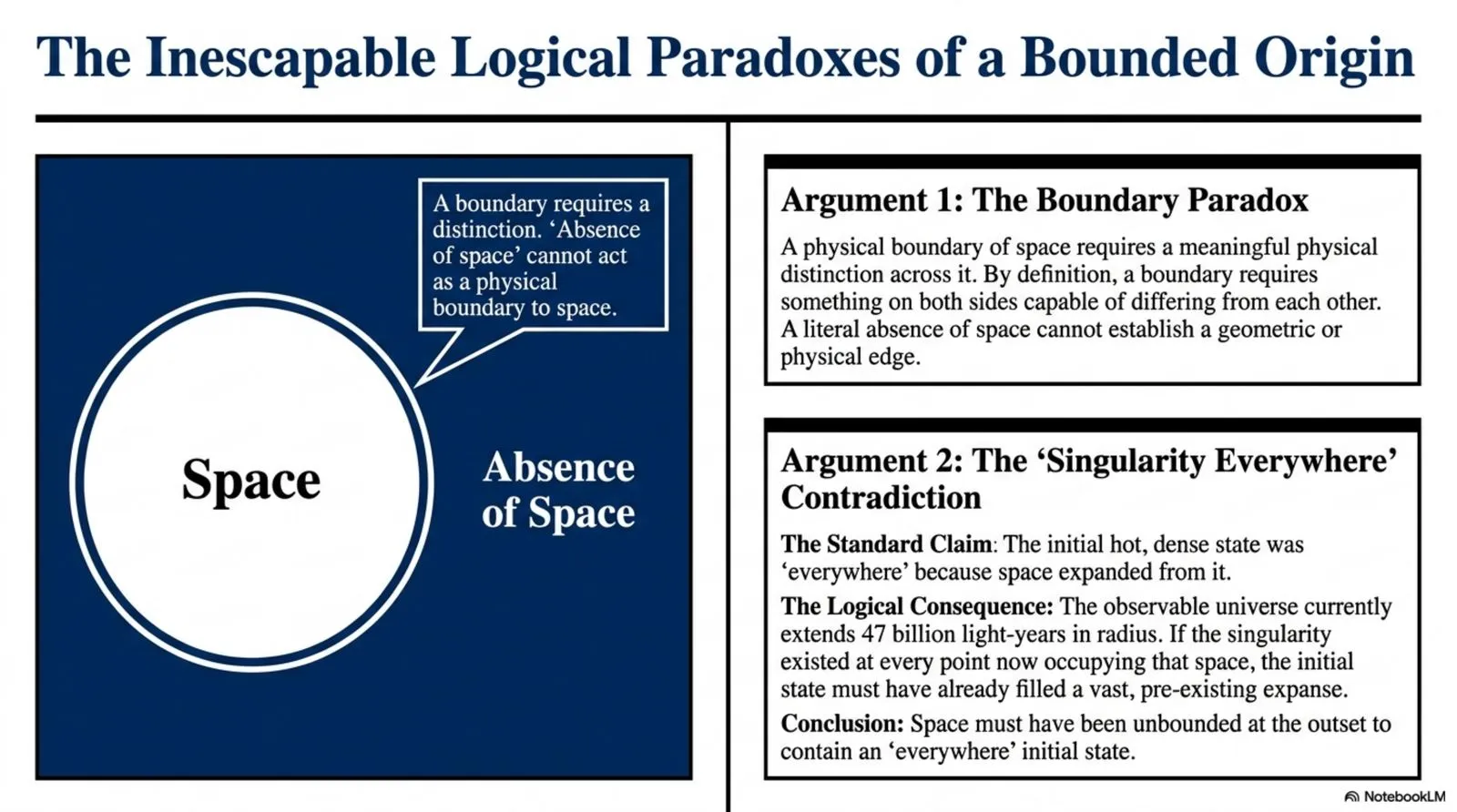
Whether the universe is spatially infinite or has a finite extent remains formally unresolved by current observation: no confirmed measurement has detected a spatial edge, and none has excluded one beyond the roughly 47 billion light-year radius of the observable universe. This paper argues that the question is nonetheless already substantially decided in favour of an unbounded universe, on logical and structural grounds independent of any specific cosmological model. We present two independent arguments. The first is conceptual: a physical boundary of space requires a meaningful physical distinction across it, and no coherent account exists of what could constitute such a distinction between space and a literal absence of space, since a boundary by definition requires something on both sides capable of differing from each other. The second is a direct internal inconsistency in the standard cosmological narrative itself: when asked where the initial hot, dense state was located, the standard response is that it was everywhere — but this response, taken seriously, implies that the initial state already filled all of space at every subsequent epoch, including the space now occupied by the most distant visible structures, which is only coherent if space was already unbounded at the outset. We examine the three standard responses available to preserve a finite origin — finite-but-unbounded topology, the breakdown of General Relativity at extreme density, and cosmic inflation — and show that each either relocates the boundary question rather than resolving it, or, in the specific case of inflation, is shown by the Borde-Guth-Vilenkin theorem to require its own past boundary, reproducing the identical difficulty one level removed. We discuss supporting large-scale observational considerations, note that the strongest conventional evidential pillar for a bounded early universe, drawn from the Lyman-α forest, has been shown elsewhere to admit an alternative interpretation not requiring spatial boundedness, and specify falsifiable predictions distinguishing a genuinely unbounded universe from one with an undetected finite extent.
Keywords: spatial infinitude, cosmological topology, singularity location, Borde-Guth-Vilenkin theorem, inflation, boundary conditions
1. Introduction
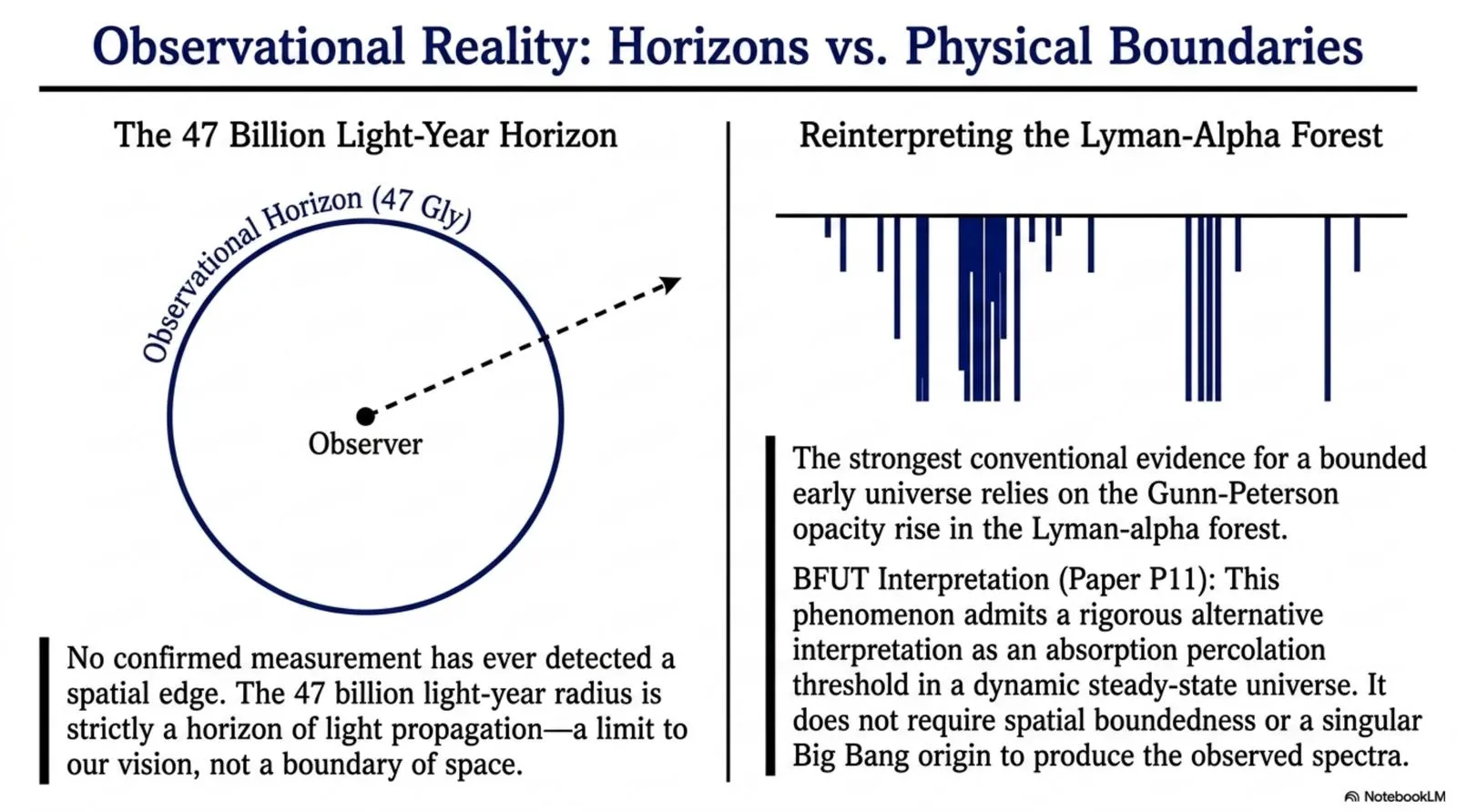
The observable universe extends approximately 47 billion light years in every direction from any observer, set by the distance light has been able to travel since the universe became transparent, combined with the intervening cosmic expansion [1]. This is a horizon of observation, not a claim about the physical extent of the universe itself: standard cosmology is explicit that the universe may extend, and by some analyses of the cosmic microwave background curvature measurements is considered likely to extend, considerably further than what is observable, and possibly without any limit at all [1,2]. Whether the universe has a genuine spatial boundary somewhere beyond this horizon, or is truly infinite in extent, is not currently settled by direct observation, and may not be settled by observation in principle, since no signal from beyond the observable horizon can ever reach us.
This paper argues that the question, while not observationally decided, is nonetheless substantially decided by considerations independent of any specific observational test: a conceptual analysis of what a physical boundary of space would have to be, and an internal examination of the standard cosmological narrative’s own account of where the early universe’s hot, dense initial state was located. Both arguments are logically independent of each other and of any particular cosmological model beyond the minimal, essentially universally accepted claim that the universe had some form of hot, dense early epoch.
The paper deliberately does not engage with the physical mechanism or detailed history of that early epoch; the arguments presented here apply regardless of the specific physics assumed for it, and are intended to isolate the boundary question from separate and more model-dependent debates about the universe’s earliest moments.
The paper is organised as follows. Section 2 presents the conceptual boundary-incoherence argument. Section 3 presents the singularity-location argument. Section 4 examines the three standard responses available to preserve a finite origin. Section 5 discusses supporting observational considerations. Section 6 addresses anticipated objections. Section 7 presents falsifiable predictions. Section 8 concludes.
2. The Boundary-Incoherence Argument
A physical boundary, in every confirmed physical context, is a meaningful distinction between two different physical states or regions: the surface of a solid object is the boundary between matter and the surrounding medium; the edge of a magnetic field is the boundary between a region of non-zero field strength and a region of zero field strength, both of which are still physically meaningful states of the same underlying space. In every such case, a boundary requires two things capable of differing from one another, with the boundary marking the transition between them.
A proposed spatial boundary of the universe itself faces a distinct difficulty: what lies on the far side is not a different physical state of space, but the literal absence of space, and by extension the absence of any physical concept — distance, direction, or "far side" — capable of giving that absence meaning relative to what lies within the boundary. A boundary of space cannot function analogously to the boundary of an object within space, because an object’s boundary presupposes an ambient space in which both sides of the boundary are located; a boundary of space itself has no such ambient context available to it. This is not a claim that a bounded universe is logically impossible in some absolute, unconditional sense; it is the narrower claim that no coherent physical account currently exists, or has been proposed, of what specifically constitutes the transition at such a boundary, given that the standard physical notion of a boundary requires exactly the kind of two-sided physical distinction that a true edge of space cannot supply.
3. The Singularity-Location Argument
Standard cosmology holds that the universe passed through an extremely hot, dense early state, and that this state, whatever its detailed physical description, must be located within the space that currently exists, since it stands in the causal history of everything now observable [1]. A natural question follows: where, specifically, within the presently observable universe was this initial state located?
No specific location can be given without violating the observed large-scale isotropy of the universe, which shows no preferred direction or centre at the precision current surveys are capable of measuring [1]. The standard and essentially universal response is that the initial state was not located at a specific point at all, but was, in the relevant sense, everywhere: every point in the space that exists today traces back to that same initial state, because space itself is understood to have originated together with it, rather than the initial state having occupied a pre-existing spatial location.
This response, while addressing the immediate question of a preferred centre, generates a further and more difficult question when examined carefully. If the initial state was, in the relevant sense, present at every point of the space that exists today, this includes every point at the current edge of the observable universe, approximately 47 billion light years from any observer in any direction. For the initial state to have been present at that location as well as at our own, in the same sense in which the standard response intends, the initial state must already have been coextensive with a spatial extent at least as large as the observable universe is today — which is only a coherent description if space, even at that earliest moment, was not confined to some small, bounded region, but was already unbounded, or at minimum already far larger than has any specific finite size consistent with a single, localised point of origin.
The alternative reading, that the initial state literally was a single, localised point from which all subsequent space expanded outward, reintroduces the difficulty the "everywhere" response was invoked to resolve: a single point requires a location, and any specific location, within an isotropic universe with no observed preferred centre, requires an explanation for why that particular point rather than any other. The "everywhere" response and the "single point" response cannot both be correct; examined together, they point toward an early universe that was already spatially unbounded, or at least far more extensive than a localised origin would require, rather than toward a confirmed finite point of origin.
4. Standard Responses and Their Limitations
4.1 Finite-But-Unbounded Topology
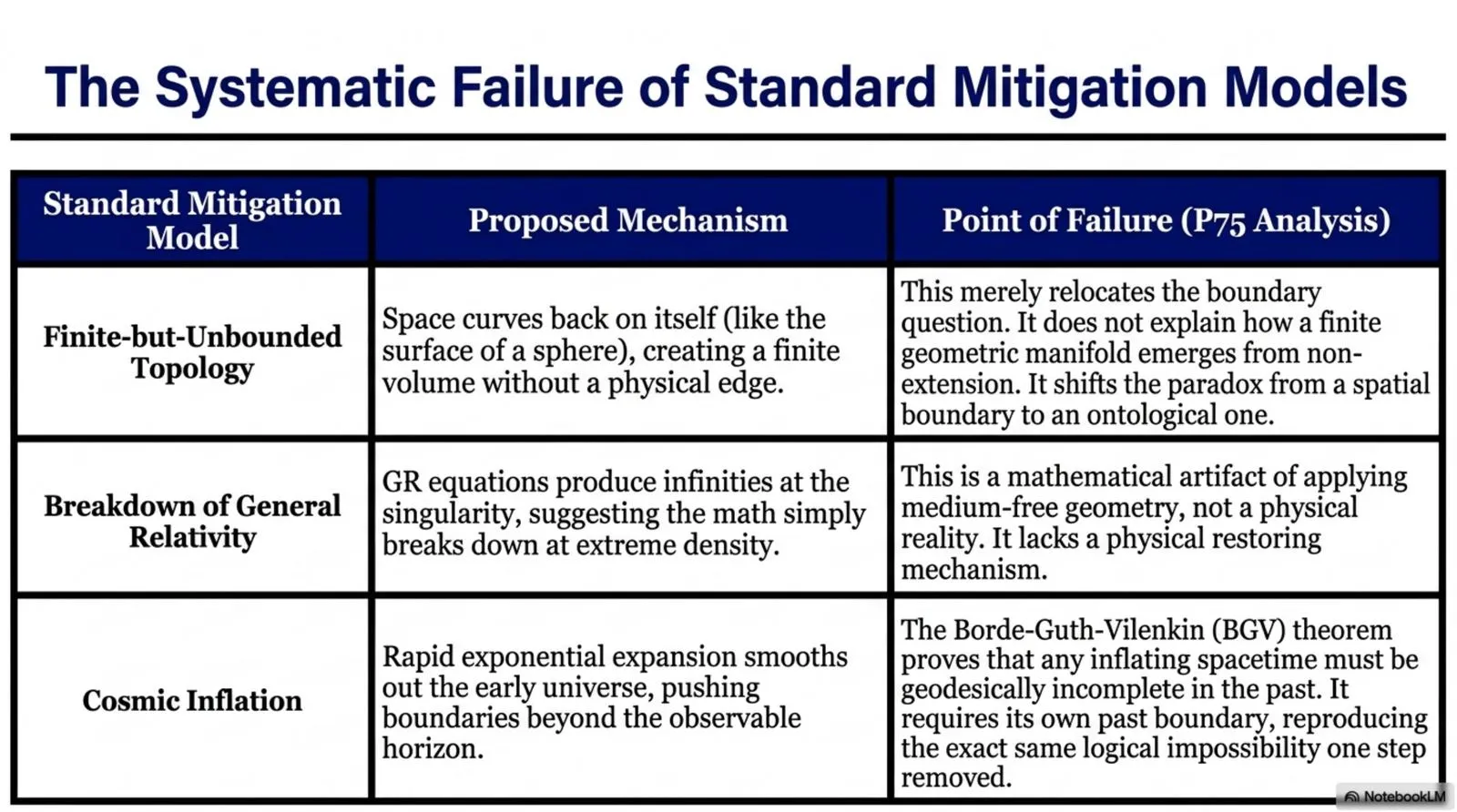
One standard response proposes that the universe has a finite volume but no boundary, analogous to the surface of a sphere, which has finite area but no edge [1]. This is a mathematically coherent proposal and, if correct, would resolve the boundary-incoherence argument of Section 2 directly, since a finite-but-unbounded space has no edge for that argument to apply to. Current observational constraints on the curvature of space are consistent with a flat, and hence infinite, universe, and place lower bounds on the radius of curvature for any closed, finite-but-unbounded alternative that place such a topology’s finite volume, if it exists, at a scale vastly larger than the observable universe [1]. This response does not resolve the singularity-location argument of Section 3, which concerns the location of the early hot, dense state within the space that exists, independent of whether that space is topologically open or closed.
4.2 Breakdown of General Relativity at Extreme Density
A second response holds that the mathematical singularity predicted by classical General Relativity at the initial state is an artefact of extrapolating the classical theory beyond its domain of validity, and that a complete theory of quantum gravity, not yet available in confirmed form, would replace the classical singularity with some other, non-singular physical description [3], with specific proposed mechanisms including a quantum bounce replacing the classical singularity while keeping the underlying equations well-defined throughout [8]. This response is intellectually honest about the limits of current theory, but it relocates rather than resolves the boundary question addressed in this paper: whatever non-singular state quantum gravity ultimately predicts in place of the classical singularity, that state must still be located somewhere, and the singularity-location argument of Section 3 applies to it with the same force it applies to the classical singularity.
4.3 Cosmic Inflation
A third response invokes cosmic inflation, a period of extremely rapid exponential expansion proposed to have stretched a small, causally connected region to a size larger than the presently observable universe, addressing several otherwise puzzling features of the observed universe, including its large-scale uniformity [4]. Inflation is a well-developed and observationally supported component of standard cosmology; it does not, however, resolve the boundary question, for two reasons. First, the small pre-inflationary region itself had a location, and the singularity-location argument of Section 3 applies to that region’s location with the same force it applies to a non-inflationary initial state. Second, and more decisively, the Borde-Guth-Vilenkin theorem establishes that any spacetime which is, on average, expanding cannot be extended indefinitely into the past without encountering a boundary; since inflation requires sustained average expansion, inflationary cosmology requires its own past boundary, reproducing the identical structural difficulty this paper addresses, one step further back rather than resolving it [5].
5. Supporting Observational Considerations
Beyond the logical arguments of Sections 2 and 3, several observational considerations are consistent with, though not independently decisive for, an unbounded universe. Large-scale surveys of galaxy orientations and cosmic microwave background anisotropies have not established a single, robust, global preferred axis of the kind that might be expected as a residual signature of a genuinely finite, bounded spatial extent [1]. Coherent large-scale motion, including rotating cosmic filaments and cluster-scale coordinated dynamics, persists at scales large enough that naive expectations based on a straightforwardly finite, uniformly expanding universe would predict such coherence to have been washed out [6].
We note explicitly that the strongest conventional observational pillar sometimes cited in favour of a bounded, finite-origin early universe, the Gunn-Peterson opacity rise observed in the Lyman-α forest of distant quasar spectra, has been shown elsewhere to admit an alternative interpretation, based on an absorption percolation threshold in the distribution of intervening absorbing structures, that does not require or uniquely imply a bounded spatial origin [7]. The present paper does not re-examine that argument in detail; it is addressed fully in the cited companion work, and readers seeking a direct response to the Lyman-α evidence specifically are referred there.
6. Discussion: Anticipated Objections
6.1 "Does this dispute that the universe had a hot, dense early epoch?"
No. Both arguments presented in this paper are compatible with, and do not dispute, the extensive and well-confirmed observational evidence for a hot, dense early universe, including the cosmic microwave background and the observed abundances of the light elements [1]. The arguments concern only whether that early epoch was spatially bounded, not whether it occurred.
6.2 "Is the boundary-incoherence argument merely a semantic point about the word ‘boundary’?"
This is a reasonable concern, and the response is that the argument is intended as a physical claim, not a purely semantic one: it identifies a specific structural requirement, present in every other confirmed physical use of the concept of a boundary, that a proposed spatial boundary of the universe cannot satisfy, namely a meaningful physical distinction between two sides. This is a substantive physical claim about what any successful account of a cosmic boundary would need to supply, capable of being met by a sufficiently detailed future proposal, rather than a claim that the word "boundary" is being misused, a distinction consistent with broader methodological discussions of what constitutes a well-posed cosmological question [9].
6.3 "Doesn’t finite-but-unbounded topology already resolve this without requiring an infinite universe?"
It resolves the boundary-incoherence argument of Section 2, as noted in Section 4.1, since a closed, finite-but-unbounded topology genuinely has no edge. It does not resolve the singularity-location argument of Section 3, and current curvature constraints, while not excluding this topology outright, place any such closed universe’s scale far beyond the observable horizon, at minimum [1]. The present paper’s conclusion is compatible with either a genuinely infinite universe or a finite-but-unbounded one at a scale vastly exceeding current observational limits; what it argues against is a universe with a genuine edge at any scale.
7. Falsifiable Predictions
The unbounded-universe case makes the following falsifiable predictions.
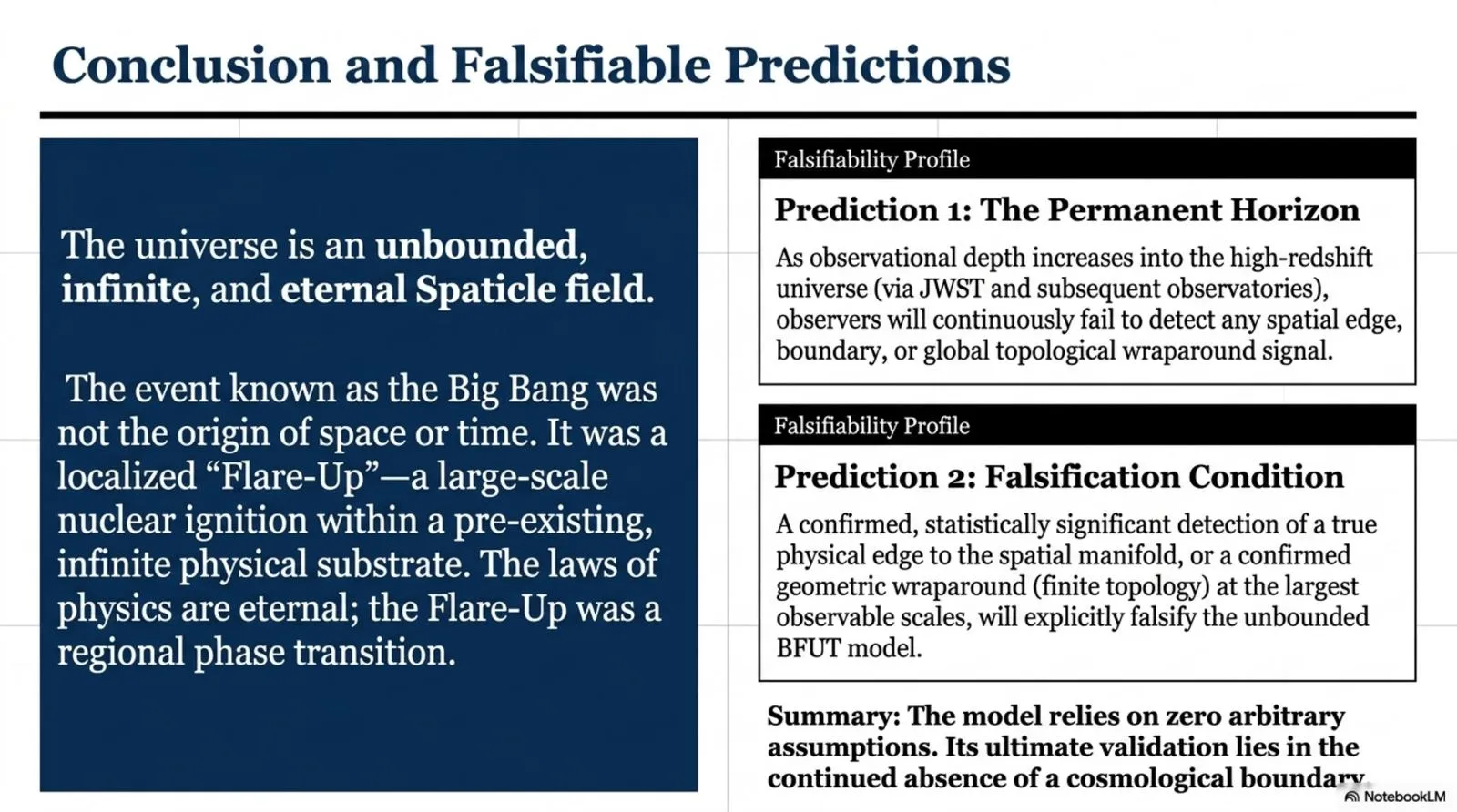
Prediction 1. No confirmed observation, at any achievable observational depth, will detect a genuine spatial edge, in any direction. As instruments improve and the observable horizon extends, the universe is expected to continue showing more of the same large-scale structure, matter distribution, and cosmic microwave background uniformity already observed, rather than any signature of approaching a boundary.
Prediction 2. No confirmed observation will detect a wraparound signal — the same large-scale structure observed twice, from two different apparent directions and distances, which would be the specific observational signature of light having circled a genuinely finite, closed spatial topology. The continued absence of any such signal, at increasing observational precision, is consistent with the case argued here.
Prediction 3. No future large-scale survey will establish a single, robust, statistically dominant global preferred axis in galaxy orientation or cosmic microwave background structure of the kind that would be a natural signature of proximity to a genuine finite boundary; continued isotropy at all observed scales is expected.
Prediction 4. Curvature measurements of the cosmic microwave background are expected to remain consistent with a flat or very nearly flat universe as precision improves, rather than converging toward a value indicating strong positive curvature consistent with a small, finite, closed universe at a scale approaching the observable horizon.
8. Conclusions
We have argued that the question of whether the universe has a genuine spatial boundary is substantially decided, independent of any specific cosmological model or direct observational test of the boundary itself, by two considerations. First, a physical boundary of space requires a meaningful physical distinction between two sides, a requirement no proposed account of a cosmic edge has been able to satisfy, since what lies beyond such an edge is not a different physical state but the absence of space and of the physical concepts, including distance and direction, that would be needed to give such an absence meaning. Second, the standard cosmological account’s own answer to the question of where the early hot, dense state was located — that it was, in the relevant sense, everywhere — is only coherent if space was already unbounded, or at minimum already far more extensive than a localised point of origin, at that earliest moment.
We have examined the three standard responses available to preserve a finite, bounded origin — finite-but-unbounded topology, the breakdown of General Relativity at extreme density, and cosmic inflation — and shown that each either relocates the boundary question to a different physical state without resolving it, or, in the specific and well-established case of inflation, is shown by the Borde-Guth-Vilenkin theorem to require its own past boundary, reproducing the same difficulty one step removed rather than eliminating it. This account disputes nothing about the well-confirmed evidence for a hot, dense early universe; it argues only that this early universe, whatever its detailed physical description, was not spatially bounded. The falsifiable predictions of Section 7, particularly the continued absence of any detected spatial edge or wraparound signal as observational depth increases, provide a clear, ongoing observational test of this conclusion.
References
[1] Planck Collaboration (2020). Planck 2018 results VI: Cosmological parameters. Astronomy & Astrophysics, 641, A6.
[2] Weeks, J., Lehoucq, R., and Uzan, J.-P. (2003). Detecting topology in a nearly flat spherical universe. Classical and Quantum Gravity, 20(8), 1529–1542.
[3] Ashtekar, A. and Singh, P. (2011). Loop quantum cosmology: A status report. Classical and Quantum Gravity, 28(21), 213001.
[4] Guth, A.H. (1981). Inflationary universe: A possible solution to the horizon and flatness problems. Physical Review D, 23(2), 347–356.
[5] Borde, A., Guth, A.H., and Vilenkin, A. (2003). Inflationary spacetimes are not past-complete. Physical Review Letters, 90(15), 151301.
[6] Tempel, E., Stoica, R.S., Martinez, V.J., Liivamagi, L.J., Castellan, G., and Saar, E. (2014). Detecting filamentary pattern in the cosmic web: A catalogue of filaments for the SDSS. Monthly Notices of the Royal Astronomical Society, 438(4), 3465–3482.
[7] Sharma, V.S. (2026). The Lyman-Α Forest: A Percolation Threshold Interpretation. Zenodo. doi:10.5281/zenodo.19383804
[8] Bojowald, M. (2001). Absence of a singularity in loop quantum cosmology. Physical Review Letters, 86(23), 5227–5230.
[9] Ellis, G.F.R. (2007). Issues in the philosophy of cosmology. In Philosophy of Physics, Handbook of the Philosophy of Science, Elsevier, Amsterdam, 1183–1285.