Consciousness and the Consciousness Index
Abstract
Consciousness is discussed extensively across philosophy, neuroscience, and cognitive science, but no widely accepted quantitative scale exists that places a bacterium, an octopus, a crow, and a human on a single coherent measurement axis. Existing formal proposals, including Integrated Information Theory, define consciousness through abstract causal or informational structure with no grounding in the physical interactions a system actually participates in. This paper proposes that consciousness is a measurable physical phenomenon grounded in sensing capability, and that the four fundamental forces of nature function as a hierarchical structure of physical sensing channels through which any system, biological or otherwise, can access information about itself and its environment. This hierarchical structure is not introduced as a new physical claim in this paper; it rests on the independently established fact, developed in prior theoretical work, that the four fundamental forces emerge through a specific sequential and structurally dependent process rather than as four independent, co-equal interactions. We propose that this same sequential dependency directly parallels the developmental hierarchy of sensing capability observed across biological systems: presence and structural binding are prerequisite to identity and distance discrimination, which are in turn prerequisite to adaptive transformation and response. Building on this parallel, we introduce the Consciousness Index, a scalar measure combining channel accessibility, network integration density, and control depth, calibrated so that the human nervous system average corresponds to a reference value of 100. We present the resulting scale applied across a broad sample of biological systems, showing that several non-human species exceed the human average in intrinsic structural capability, and that human distinctiveness lies primarily in survival-condition stability rather than in raw sensing capacity. We discuss the relationship of this proposal to existing consciousness measures, address the objection that grounding consciousness in physical forces is either trivial or unfalsifiable, and specify falsifiable predictions distinguishing this account from purely informational or purely biological theories of consciousness.
Keywords: consciousness, Consciousness Index, sensing hierarchy, fundamental forces, Integrated Information Theory, cross-species comparison
1. Introduction
Consciousness is one of the most widely discussed and least quantitatively measured phenomena in science. A substantial philosophical and neuroscientific literature addresses what consciousness is and how it arises, but no widely accepted measurement scale exists that allows a bacterium, an octopus, a crow, and a human to be placed on a single coherent quantitative axis [1,2]. This absence is not merely a technical gap in an otherwise settled field; it reflects a deeper and still unresolved question of whether consciousness admits of degree at all, or is instead a binary property that switches on above some unspecified biological threshold.
The most developed formal proposal to date, Integrated Information Theory, defines a quantitative measure of consciousness, denoted φ, from the causal structure of a system’s internal information processing [3]. This approach has been influential and has motivated substantial empirical and theoretical work, but it has also been criticised precisely for defining consciousness through abstract causal or informational structure with no grounding in the specific physical interactions a system actually participates in [4]. A measure of consciousness computed purely from information-theoretic structure, without reference to what physical channels a system uses to sense and act upon its environment, leaves open the question of why information integration specifically, rather than some other quantity, should be the relevant measure at all.
This paper proposes an alternative physical grounding: that consciousness is a measurable phenomenon rooted in a system’s access to physical sensing channels, and that the four fundamental forces of nature — gravity, the strong nuclear force, electromagnetism, and the weak nuclear force — function as a hierarchical structure of such sensing channels. This proposal rests on an independently established physical result, developed elsewhere, that the four fundamental forces are not four independent, co-equal interactions but emerge through a specific sequential and structurally dependent process, in which each successive force requires the physical structures established by the forces before it [5]. We do not derive or defend this sequential-emergence result in the present paper; we take it as an established input and examine its consequences for how sensing capability, and hence consciousness, can be physically structured and measured.
The paper is organised as follows. Section 2 reviews existing approaches to measuring consciousness and their limitations. Section 3 introduces the force-hierarchy sensing framework, citing the independently established sequential-emergence result on which it depends. Section 4 presents the Consciousness Index formula. Section 5 applies the index across a range of biological systems. Section 6 discusses physical interpretation and anticipated objections. Section 7 presents falsifiable predictions. Section 8 concludes.
2. Existing Approaches to Measuring Consciousness
Integrated Information Theory proposes that consciousness corresponds to a system’s capacity to integrate information in a way that is irreducible to the sum of its parts, quantified by the measure φ [3]. This approach has the significant merit of proposing a genuinely quantitative, in-principle computable measure, and has generated an active research programme. It has also faced sustained criticism, including the observation that φ can in principle be computed for systems, such as certain simple logic-gate networks, that show no other indication of consciousness, raising the concern that the measure may be detecting a general property of integrated causal structure rather than consciousness specifically [4].
Behavioural and neuroscientific approaches to consciousness, by contrast, typically rely on species-specific proxies, including markers of self-recognition, tool use, or particular patterns of neural activity, that are difficult to compare meaningfully across radically different biological architectures, from single-celled organisms to eusocial insect colonies to vertebrate nervous systems [2]. No existing framework provides a single, physically grounded scale applicable across this full range, despite substantial progress in identifying neural correlates of consciousness within individual species [9].
3. The Force-Hierarchy Sensing Framework
We propose that a system’s consciousness is grounded in its accessible sensing channels, where a sensing channel is a physical interaction through which a system can register information about itself or its environment. The four fundamental forces of physics are the most basic set of such interactions available to any physical system, and every biological sensing capability, however specialised or apparently distinct from fundamental physics, is ultimately implemented through one or more of these four channels: gravitational sensing (an organism’s response to mass and orientation), strong-force-mediated structural stability (the nuclear binding underlying all biochemical structure), electromagnetic sensing (the overwhelming majority of biological perception, including vision, chemical sensing, and neural signalling), and weak-force-mediated transformation processes (radioactive decay and, at the level of biological analogy, threshold-triggered state transitions).
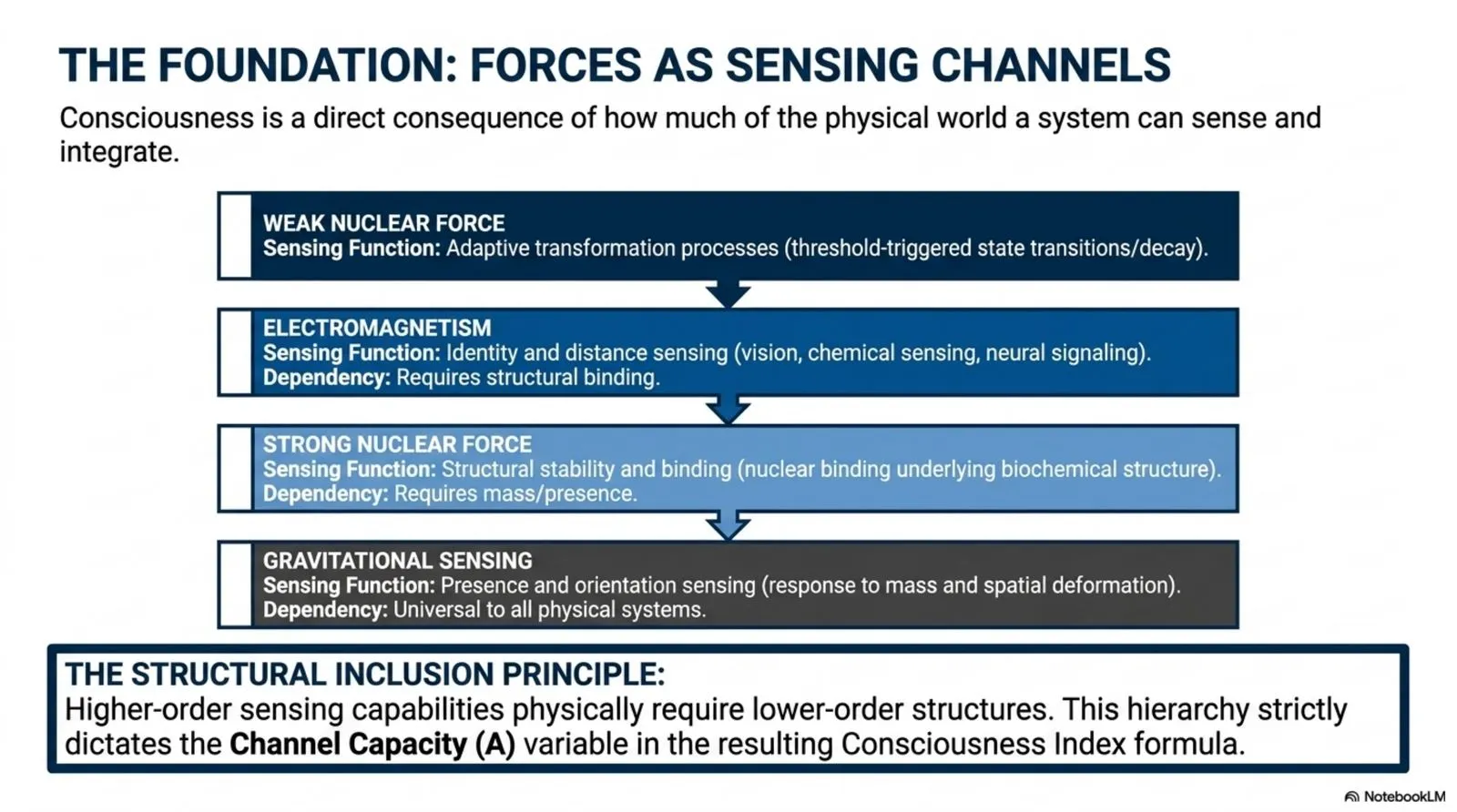
The specific proposal of this paper is that these four channels are not available to a system independently and interchangeably, but form a structurally dependent hierarchy, directly paralleling the result, established independently elsewhere, that the four fundamental forces themselves emerge through a specific sequential process in which each force requires the physical structures established by the forces preceding it [5]. We do not reproduce or re-derive that sequential-emergence result in the present paper, which addresses a distinct question — the physical grounding of consciousness and its quantitative measurement — and depends only on the fact that such a structural dependency has been established, not on the specific mechanism by which it arises.
Applied to sensing capability, this hierarchy suggests a specific developmental and structural ordering: presence and structural binding capability are prerequisite to identity and distance discrimination capability, which are in turn prerequisite to adaptive transformation and response capability. Under this proposal, no biological system exhibits a higher-order sensing capability, such as adaptive behavioural transformation, without also possessing the lower-order structural and electromagnetic sensing capabilities on which it depends — a specific, falsifiable structural claim addressed further in Section 7.
4. The Consciousness Index
Building on the sensing-channel framework of Section 3, we propose a scalar Consciousness Index, denoted CI, intended to place any physical system, biological or otherwise, on a single quantitative scale. The index is structured around two related measures. The Intrinsic Consciousness Index, CI0, measures a system’s internal sensing and processing capability, independent of the specific conditions under which it currently exists. The Effective Consciousness Index, CI, multiplies this intrinsic capability by a survival factor S, representing how effectively the system sustains that capability under its actual real-world conditions.
The intrinsic index is given by:
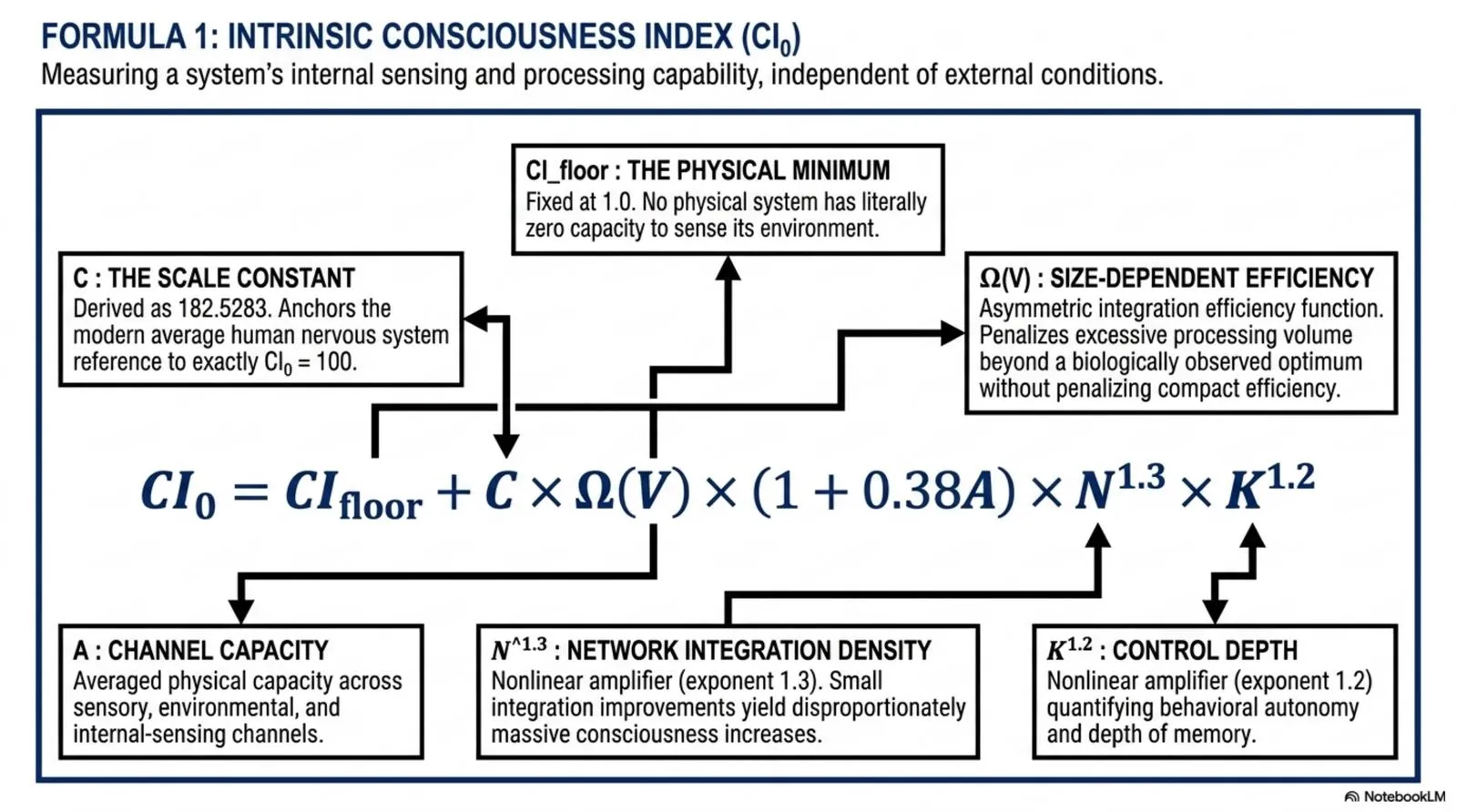
CI0 = CI_floor + C × Ω(V) × (1 + 0.38A) × N1.3 × K1.2 (1)
where CI_floor is a small, strictly positive constant, reflecting the proposal that no physical system has literally zero capacity to sense and respond to its environment; C is a scale constant calibrated so that the average modern human nervous system corresponds to CI0 = 100; Ω(V) is a size-dependent integration efficiency function, penalising excessive processing volume beyond a biologically observed optimum without penalising small or highly efficient systems; A is channel capacity, averaged across independently scored sensory, environmental-interaction, communicative, manipulative, and internal-sensing measures; N is network integration density, a weighted composite of structural connectivity, dynamic coordination, and hierarchical processing depth; and K is control depth, a weighted composite of behavioural autonomy, memory depth, and adaptive flexibility.
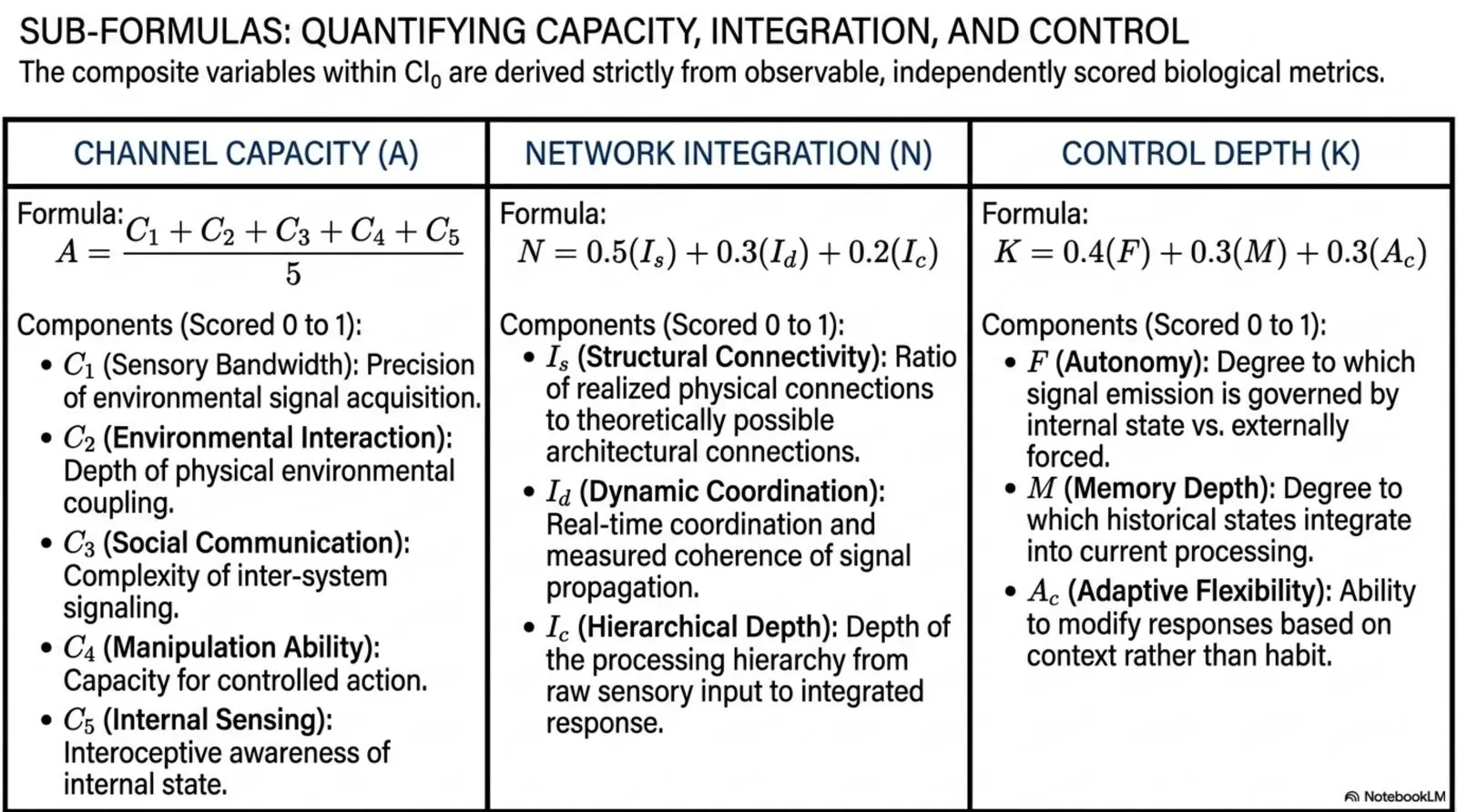
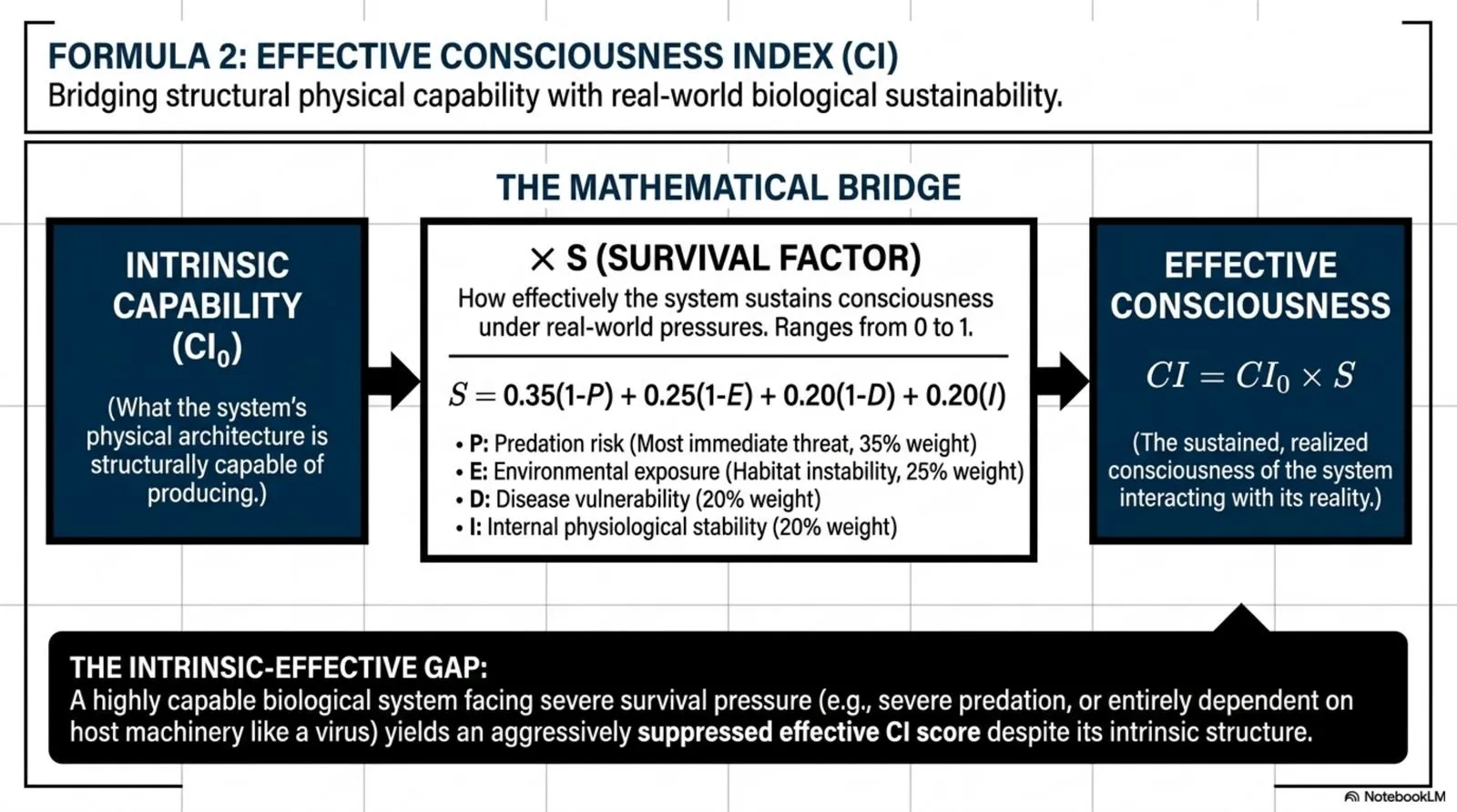
The effective index is:
CI = CI0 × S (2)
where the survival factor S captures real-world viability: a system with high intrinsic capability but very low real-world autonomy, such as a virus entirely dependent on host machinery, receives a correspondingly reduced effective CI despite a non-trivial CI0.
5. Applying the Index Across Biological Systems
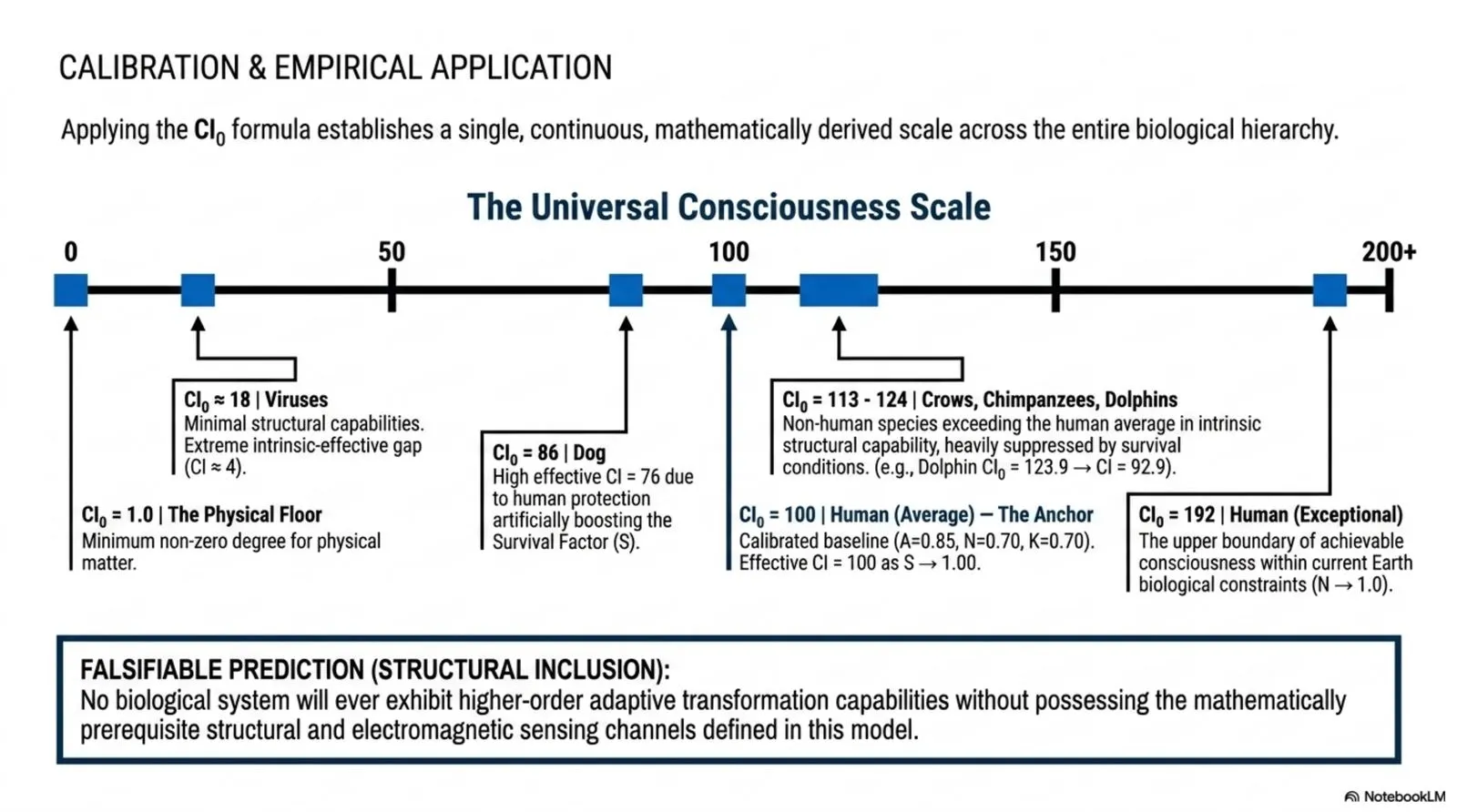
Table 1 summarises the Consciousness Index applied to a representative sample of biological systems spanning the full range of known complexity, calibrated against the human nervous system average of CI0 = 100.
| System | CI0 (Intrinsic) | S (Survival Factor) | CI (Effective) |
|---|---|---|---|
| Human (average) | 100 | 1.00 | 100 |
| Human (exceptional configuration) | up to ~190 | 1.00 | up to ~190 |
| Dolphin | ~110–124 | high | high |
| Chimpanzee | ~105–115 | high | high |
| Crow / Parrot | ~95–110 | high | high |
| Octopus | ~96 | moderate | ~59 |
| Dog (domesticated) | moderate | high (protected) | elevated relative to wild counterparts |
| Insect colony (eusocial) | ~23–35 | moderate | moderate |
| Plants / fungi | ~12–37 | variable | variable |
| Virus | ~18 | very low | ~2.8 |
| Single cell / simple invertebrate | ~5–14 | variable | variable |
Several results in Table 1 are worth highlighting explicitly. A number of non-human species — dolphins, chimpanzees, crows, and parrots among them — exceed the human average intrinsic capability of CI0 = 100, reflecting genuinely high channel capacity, integration density, and control depth in these species’ own biological architecture, consistent with independent behavioural and cognitive studies of octopus cognition [6], corvid intelligence [7], and cetacean cognitive convergence with primates [8]. Human distinctiveness, under this framework, lies primarily in the combination of a high survival factor (S = 1.00, reflecting stable, protected survival conditions for most modern humans) and the achievable upper range of exceptional individual configurations, rather than in the average intrinsic sensing capability being categorically higher than every other species. We regard this as a structural, falsifiable prediction of the framework rather than an assumption built into the calibration, since the formula of equation (1), applied to independently assessed biological parameters, is what produces these specific cross-species orderings.
6. Discussion: Physical Interpretation and Anticipated Objections
6.1 Physical Interpretation
Within the proposed framework, consciousness is not a separate, additional property layered on top of physical structure, but a direct consequence of how much of the physical world a system can sense, how richly it integrates that sensed information, and how much control it exercises over its own responses. Because the four fundamental forces are proposed to form a structurally dependent hierarchy [5], consciousness itself inherits a graded, hierarchical structure rather than being a binary property switched on above some threshold.
6.2 "Is grounding consciousness in the four fundamental forces either trivially true or empirically unfalsifiable?"
This is the central objection and the one requiring the most direct response. Every physical process, trivially, involves the four fundamental forces at some level, since they are the complete set of known fundamental interactions; simply asserting this connection would indeed be empty. The specific, non-trivial content of the present proposal is twofold: first, that the four forces form a structurally dependent hierarchy rather than being interchangeable, a claim established independently of consciousness research [5] and not introduced here merely to support this application; second, that this hierarchy predicts a specific, falsifiable structural ordering among sensing capabilities — that higher-order capabilities cannot appear without the lower-order capabilities they depend on — which is directly testable against the biological record, addressed in Section 7. This is a stronger and more specific claim than the trivial observation that physics underlies biology.
6.3 "Does the Consciousness Index formula’s specific mathematical form have independent justification, or is it fitted to produce the desired human calibration?"
The scale constant C is explicitly calibrated to the human average, a deliberate and disclosed anchoring choice rather than an independently derived value, exactly analogous to the way any measurement scale requires an anchoring convention, such as the freezing point of water for the Celsius scale. What is not fitted to the calibration are the specific cross-species orderings that result from applying the formula to independently assessed biological parameters: the finding that several non-human species exceed the human average, discussed in Section 5, is a consequence of the formula applied to biological data, not a built-in assumption. We regard the specific functional form of equation (1) — particularly the exponents on N and K — as a proposed and falsifiable structural claim rather than a uniquely derived result, open to refinement as more cross-species data become available.
6.4 "How does this framework relate to Integrated Information Theory?"
The Consciousness Index shares with Integrated Information Theory the goal of a quantitative, graded measure of consciousness, and both frameworks incorporate a notion of integration as a central component — the N term in equation (1) plays a structurally similar role to information integration in IIT’s φ measure. The proposed framework differs in explicitly grounding channel capacity (the A term) in the four fundamental physical sensing channels of Section 3, rather than defining the measure purely from abstract causal structure independent of the specific physical interactions involved. This is intended as a complementary physical grounding rather than a wholesale replacement for existing informational approaches.
7. Falsifiable Predictions
The force-hierarchy sensing framework and the Consciousness Index make the following falsifiable predictions.
Prediction 1. Structural inclusion. No biological system will be found to exhibit a higher-order sensing or adaptive-transformation capability without also possessing the lower-order structural and electromagnetic sensing capabilities the hierarchy of Section 3 identifies as prerequisite; a confirmed counterexample — a system demonstrating adaptive transformation capability while lacking basic electromagnetic sensing — would require revision of the proposed hierarchy.
Prediction 2. Cross-species CI0 ordering. As channel capacity, network integration density, and control depth are independently assessed for additional species using standardised biological measures, the resulting CI0 rankings are expected to remain broadly consistent with the ordering presented in Table 1, including the specific prediction that several non-human species exceed the human average; a systematic, independently replicated failure of this ordering would undermine the specific formula proposed in equation (1).
Prediction 3. Survival factor and domestication. Domesticated species with stable, protected survival conditions are expected to show measurably higher effective CI relative to closely related wild counterparts with similar intrinsic CI0, since the survival factor S of equation (2) is proposed to track real-world viability independently of intrinsic structural capability; this is testable through comparative studies of domesticated and wild populations of the same or closely related species.
Prediction 4. No system will be measured with CI0 at or below the floor value CI_floor, since the framework proposes that every physical system capable of any interaction with its environment retains some minimal, non-zero sensing capability; the discovery of a physical system with confirmed zero sensing capability of any kind would be inconsistent with the strictly positive floor proposed here.
8. Conclusions
We have proposed that consciousness is a measurable physical phenomenon grounded in a system’s access to physical sensing channels, structured according to the same sequential, structurally dependent hierarchy independently established for the four fundamental forces of physics. Building on this proposal, we have introduced the Consciousness Index, a scalar measure combining channel capacity, network integration density, and control depth, calibrated against the human nervous system average, and applied it across a representative sample of biological systems spanning the full range of known complexity. The resulting scale places several non-human species above the human average in intrinsic structural capability, with human distinctiveness located primarily in survival-condition stability rather than in categorically superior raw sensing capacity.
This account does not modify or dispute any confirmed result in neuroscience or the physics of the fundamental forces; it proposes a specific physical grounding and a specific quantitative measure for a phenomenon, consciousness, that has resisted quantitative treatment despite extensive qualitative and philosophical discussion. The falsifiable predictions of Section 7, particularly the structural inclusion prediction linking sensing hierarchy to observed biological capability, provide a concrete observational programme for testing this proposal against purely informational or purely biological alternatives.
References
[1] Nagel, T. (1974). What is it like to be a bat? The Philosophical Review, 83(4), 435–450.
[2] Seth, A.K. and Bayne, T. (2022). Theories of consciousness. Nature Reviews Neuroscience, 23(7), 439–452.
[3] Tononi, G. (2004). An information integration theory of consciousness. BMC Neuroscience, 5, 42.
[4] Aaronson, S. (2014). Why I am not an integrated information theorist (or, the unconscious expander). Shtetl-Optimized blog, May 21, 2014.
[5] Sharma, V.S. (2026). A Physical Origin of Electric Charge. Zenodo. doi:10.5281/zenodo.21303147
[6] Godfrey-Smith, P. (2016). Other Minds: The Octopus, the Sea, and the Deep Origins of Consciousness. Farrar, Straus and Giroux, New York.
[7] Emery, N.J. and Clayton, N.S. (2004). The mentality of crows: Convergent evolution of intelligence in corvids and apes. Science, 306(5703), 1903–1907.
[8] Marino, L. (2002). Convergence of complex cognitive abilities in cetaceans and primates. Brain, Behavior and Evolution, 59(1–2), 21–32.
[9] Koch, C., Massimini, M., Boly, M., and Tononi, G. (2016). Neural correlates of consciousness: Progress and problems. Nature Reviews Neuroscience, 17(5), 307–321.