Why Singularities Cannot Form
- Abstract
- 1. Introduction
- 2. The Singularity Theorems and the Status of the Problem
- 3. The Physical Substrate and Relation to the Michelson-Morley Experiment
- 4. Physical Mechanisms Preventing Unbounded Compression
- 5. The Finite Maximum Compression Density
- 6. The Four-Region Replacement Structure
- 7. Discussion: Physical Interpretation and Anticipated Objections
- 8. Falsifiable Predictions
- 9. Conclusions
Abstract
General Relativity predicts that sufficiently massive collapsing matter forms a spacetime singularity, a point of infinite density and curvature at which the theory itself ceases to make physical predictions. This is not a peripheral feature of the theory but a proven, generic outcome of gravitational collapse under broad conditions, established by the Penrose-Hawking singularity theorems. The prediction of a genuine infinity is widely regarded, including by many of General Relativity’s own practitioners, as a signal of the theory’s incompleteness rather than a description of physical reality, since no confirmed physical process is known to produce a true infinity. This paper proposes a physical mechanism preventing singularity formation, from the finite compressibility of a universal physical substrate, following the framework developed in earlier work. Under this proposal, collapsing matter is not empty spacetime undergoing pure geometric contraction but a compression of a physically real, elastic medium, and that medium develops increasing restoring pressure, higher-order repulsion, and outward redistribution of organised deformation as compression increases, exactly the response any real compressible medium exhibits under extreme compression. We show that these effects combine to produce a finite maximum compression density, replacing the point singularity with a specific four-region structure: a compressed core of finite maximum density, a redistribution shell, a coherence boundary analogous to but physically distinct from the classical event horizon, and an outer entrainment region, with no additional postulate beyond the substrate’s own governing dynamics. We discuss the relationship of this proposal to the confirmed predictions of General Relativity outside the collapse region, address the objection that avoiding singularities requires new, undiscovered physics, and specify falsifiable predictions distinguishing a finite-core compact object from a true General-Relativistic singularity.
Keywords: black hole singularities, gravitational collapse, Penrose-Hawking theorems, physical substrate, finite compressibility, event horizon
1. Introduction
The prediction that gravitational collapse produces a singularity — a region of infinite density and infinite spacetime curvature — is one of the most striking and most discussed consequences of General Relativity. This is not merely a mathematical curiosity confined to idealised, perfectly symmetric collapse scenarios; the Penrose-Hawking singularity theorems established that singularity formation is a generic, unavoidable outcome of gravitational collapse under quite general physical conditions, holding regardless of the specific symmetry or matter content of the collapsing system, provided only that certain broad energy conditions are satisfied [1,2].
The physical significance of this result has long been debated within the relativity community itself. A true singularity is a point at which General Relativity’s own predictive power breaks down entirely: physical quantities that should be finite, such as curvature and density, are predicted to become infinite, and the equations of the theory can no longer be evaluated. This is widely interpreted, including by Penrose and Hawking themselves in subsequent commentary, not as evidence that nature actually produces physical infinities, but as a signal that General Relativity is incomplete in the extreme-curvature regime, requiring some additional physical input — widely assumed to be quantum gravitational in origin — to correctly describe what collapsing matter actually does at very high densities [3].
This paper proposes a physical mechanism preventing singularity formation from the finite compressibility of a universal physical substrate, following the framework developed in earlier work [4]. Under this proposal, gravitational collapse is not the contraction of empty geometric spacetime but the compression of a physically real, elastic medium, and that medium responds to extreme compression exactly as any real compressible medium does: with increasing restoring pressure, higher-order repulsion at extreme densities, and outward redistribution of organised structure, jointly preventing density from ever reaching a true infinity.
The paper is organised as follows. Section 2 reviews the singularity theorems and the status of the singularity problem in General Relativity. Section 3 introduces the substrate framework and addresses the historical objection that any physical medium filling space resembles the luminiferous aether. Section 4 presents the physical mechanisms preventing unbounded compression. Section 5 derives the finite maximum compression density. Section 6 describes the resulting four-region replacement structure. Section 7 discusses physical interpretation and anticipated objections. Section 8 presents falsifiable predictions. Section 9 concludes.
2. The Singularity Theorems and the Status of the Problem
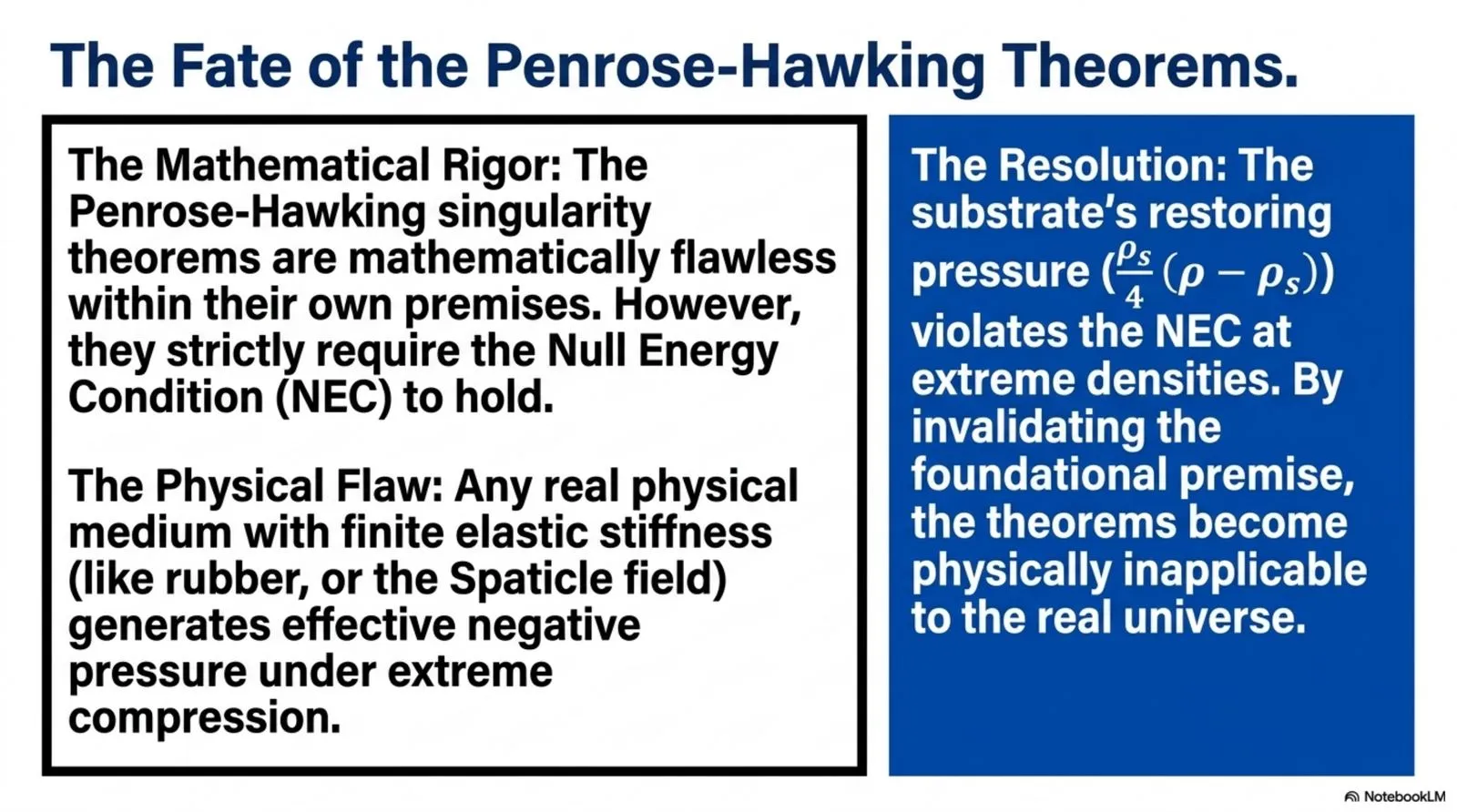
The Penrose singularity theorem of 1965 established that the formation of a trapped surface during gravitational collapse implies the existence of a singularity in the resulting spacetime, under the assumption that matter satisfies the null energy condition, a physically reasonable requirement satisfied by all known forms of ordinary matter [1]. Hawking subsequently extended this result to cosmological contexts, showing that the expanding universe implies a past singularity under similarly general conditions [2]. These theorems are mathematically rigorous consequences of General Relativity’s own field equations; they are not artefacts of oversimplified collapse models.
The near-universal expectation within the relativity community is that these theorems reveal a genuine limitation of General Relativity rather than a true feature of physical reality: infinite density and infinite curvature are not observed anywhere in nature, and no confirmed physical measurement has ever detected an actual physical infinity of any kind [5]. The standard resolution proposed within mainstream physics is that quantum gravitational effects, not yet incorporated into a complete and confirmed theory, become important at extremely small scales and prevent the classical singularity from actually forming, replacing it with some quantum-gravitational structure not yet definitively characterised [3,5], a problem discussed extensively in the standard black hole physics literature [10].
3. The Physical Substrate and Relation to the Michelson-Morley Experiment
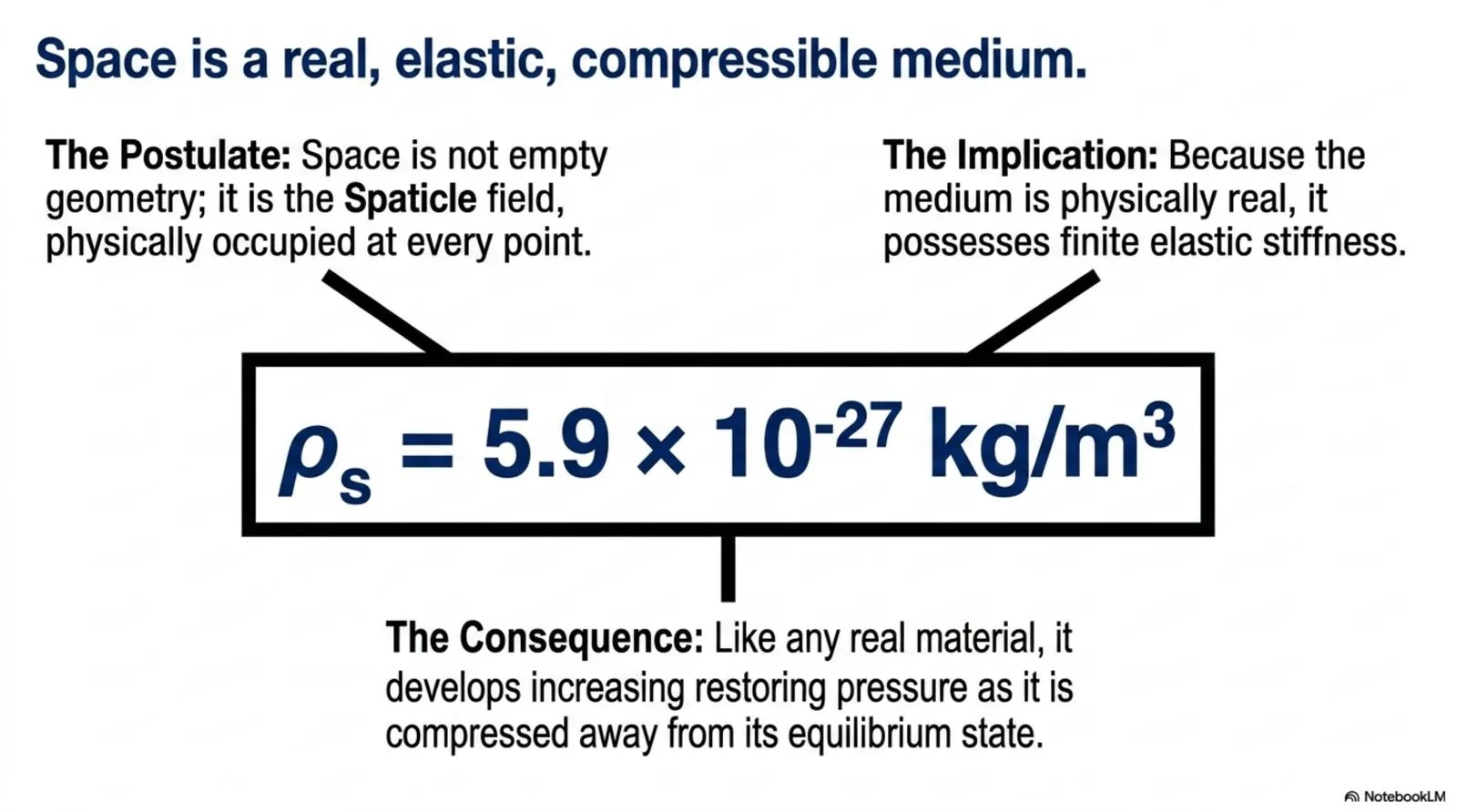
The mechanism proposed in this paper is derived from a physical substrate framework proposed in earlier work [4], in which the universe is proposed to possess a universal physical matter substrate, termed the Spaticle field, with equilibrium density ρs = 5.9 × 10^{-27} kg m^{-3}. Any proposal invoking a physical medium filling space invites an immediate and reasonable historical comparison to the luminiferous aether, decisively excluded by the Michelson-Morley experiment and its many high-precision successors [6,7]. This comparison deserves a direct response rather than a footnote.
The luminiferous aether, as originally conceived, was a medium at rest relative to some preferred, absolute reference frame, through which the Earth and all material bodies moved; light was expected to propagate at a fixed speed relative to this aether frame, producing a detectable directional variation in the measured speed of light as the Earth’s motion through the aether changed with the seasons [6]. The null result of the Michelson-Morley experiment, and of every subsequent interferometric test at ever-increasing precision [7], rules out exactly this specific structure: a medium establishing a preferred rest frame detectable through directional light-speed anisotropy.
The substrate proposed in [4] does not have this structure. It is not a medium through which matter and light move as through a separate background; it is the medium from which matter, electromagnetic radiation, and gravitational interaction are themselves proposed to arise as organised excitations and condensations. Under this proposal, an observer, a measuring apparatus, and the collapsing matter being studied are all, without exception, organised states of the same substrate; there is no configuration in which an observer moves "through" the substrate in the sense required for the Michelson-Morley experiment to detect a directional anisotropy, because the observer’s own physical existence is already a substrate phenomenon, not an object embedded in and moving relative to an independent background medium. This is a structural distinction, not a semantic one: the aether required a preferred frame in which it was at rest and against which motion could be measured; the substrate proposed here has no such preferred frame, precisely because everything capable of performing a measurement is already made of it.
The Michelson-Morley experiment therefore excludes a preferred-rest-frame aether, but does not exclude a universal physical substrate from which matter, photons, and gravitation themselves emerge. Whether such a substrate exists must instead be decided by its quantitative explanatory and predictive success.
Convergence With, Not Departure From, Existing Physics
The proposal that space possesses physical substance is not a departure from established physics. It is a convergence with it. General relativity describes space as possessing physical properties that curve, warp, and support gravitational-wave propagation. Loop quantum gravity reaches a related conclusion by an unrelated route, proposing that space is a discrete physical structure at the Planck scale [14]. Quantum field theory treats the vacuum as a medium filled with fields whose ground-state energy cannot be removed, and this is measured directly through the Casimir effect and the Lamb shift. The Higgs field, confirmed at CERN in 2012, is a scalar field that permeates all of space and interacts with matter [15,16]; its existence is no longer a proposal but a detected fact. Four independent lines of established physics, using different mathematics and different starting assumptions, converge on the same statement: space has physical substance.
Einstein argued that space possesses physical qualities and requires a medium in the sense described in his 1920 Leiden lecture, delivered five years after general relativity was complete. There he stated that according to the general theory of relativity, space is endowed with physical qualities, and that space without such a medium would permit no propagation of light and no physical meaning for measuring rods or clocks [17]. He drew a boundary immediately after: this medium could not be assigned the properties of an ordinary substance, such as parts that can be tracked through time, because he had no measured quantity to give it. The substrate proposed in this paper extends that concept by assigning the medium a specific, independently constrained equilibrium density, ρ_s = 5.9 × 10⁻²⁷ kg/m³, which is what converts an unquantified physical medium into a falsifiable one.
Why the Michelson-Morley Null Result Does Not Apply Here
The Michelson-Morley result excludes a medium with an absolute rest frame against which motion can be detected, the specific mechanical property the nineteenth-century aether was built on. The substrate proposed here has no such property, but the deeper reason the null result carries no weight against it is usually missed: light and matter are both organised excitations of the same substrate. Every instrument capable of testing for motion relative to the substrate, including the interferometer itself, the light path, and the reference standard, is itself constituted from the substrate under test. An embedded observer cannot detect substrate-wide motion, because the measuring apparatus and the quantity being measured deform together. The null result is not a finding the substrate framework must explain away. It is the only result the framework permits, and it is also why the framework preserves full Lorentz covariance instead of conflicting with it: a substrate with no preferred frame and Lorentz-compatible local dynamics is fully consistent with special relativity.
3.1 Independent Cross-Validation of the Substrate Framework
The same substrate makes multiple independent quantitative predictions, each evaluated against observations in unrelated areas of physics. These include a single-substrate resolution of the cosmological constant problem, reconciling the quantum field theory vacuum energy prediction with the observed value without fine-tuning [4]; a non-circular consistency derivation of the speed of light from independently established electromagnetic and condensation-geometry quantities, agreeing with the measured value to 0.0003 percent [8]; and a rotational-support mechanism accounting for the S8 structure growth tension through independently established halo dynamics [9]. Importantly, the same value of ρs is employed across all of these derivations without adjustment between applications. Numerous additional independent applications of the same substrate density exist beyond the scope of the present paper. We cite these specific results because each is a quantitative, independently falsifiable claim evaluated against measured data unconnected to gravitational collapse; their cumulative consistency is offered as evidence that the substrate parameter used throughout this paper is not an ad hoc construction introduced to avoid the singularity problem, but a fixed quantity whose value is consistent across independent applications.
4. Physical Mechanisms Preventing Unbounded Compression
We propose that gravitational collapse compresses the substrate away from its equilibrium density ρs, and that this compression is opposed by three physically distinct mechanisms operating simultaneously, each becoming more significant as compression increases, jointly preventing density from ever reaching a true mathematical infinity.
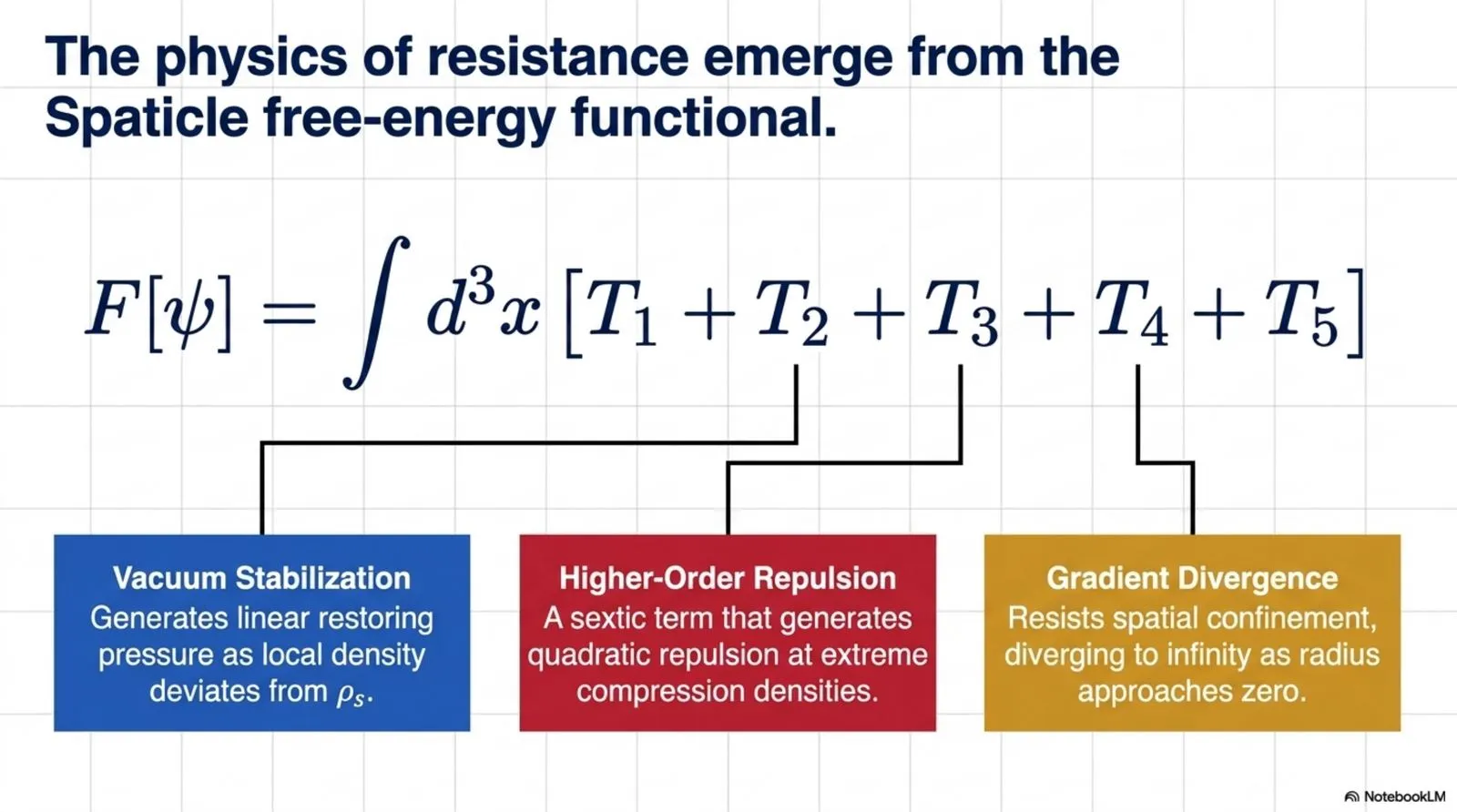
The central physical argument is straightforward. Infinite compression has never been observed in any known physical material. Every real medium develops increasing resistance as compression increases. If gravitation acts through a physical substrate rather than empty geometry, the natural expectation is therefore not unlimited collapse but progressively increasing resistance culminating in a finite equilibrium state.
4.1 Substrate Restoring Pressure
Compression of the substrate away from its equilibrium density generates a restoring pressure that increases linearly with the degree of compression:
P_restore = (ρs / 4)(ρ − ρs) (1)
This is the same physical response any real elastic medium exhibits when compressed away from its equilibrium configuration: a restoring force proportional to displacement, the substrate analogue of Hooke’s law.
4.2 Higher-Order Repulsion at Extreme Density
At densities substantially above ρs, a higher-order repulsive term becomes significant, scaling as the square of the density:
P_repulsion = 3C rho² (2)
The quadratic dependence is essential because it grows faster than the inward gravitational compression. Consequently, beyond a sufficiently high density, further collapse becomes progressively more difficult rather than progressively easier.
where C is a coefficient fixed independently by the substrate’s governing dynamics [4]. This superlinear scaling ensures that repulsive pressure grows faster than linear restoring pressure at extreme compression, becoming the dominant stabilising mechanism precisely in the regime where General Relativity predicts runaway collapse toward infinite density.
4.3 Outward Redistribution Through Entrainment Flux
Increasing compression drives an outward flux of organised substrate deformation, redistributing structure from the compressed core into the surrounding medium:
ρeff(r) = ρ(r) − div J_entrain (3)
As compression increases, the outward entrainment flux J_entrain increases correspondingly, continuously removing organised deformation from the core and reducing the effective density below what pure inward collapse, unopposed by redistribution, would otherwise produce. This mechanism is substantially more effective for a fully three-dimensional, volumetrically immersed collapsing system than for a two-dimensional analogue, since outward redistribution operates across the full 4*π steradians solid angle surrounding the collapsing region [4].
5. The Finite Maximum Compression Density
Combining the three mechanisms of Section 4, the evolution of substrate density during collapse is governed by:
d(ρ)/dt = Cin − Cout − P_restore − P_repulsion (4)
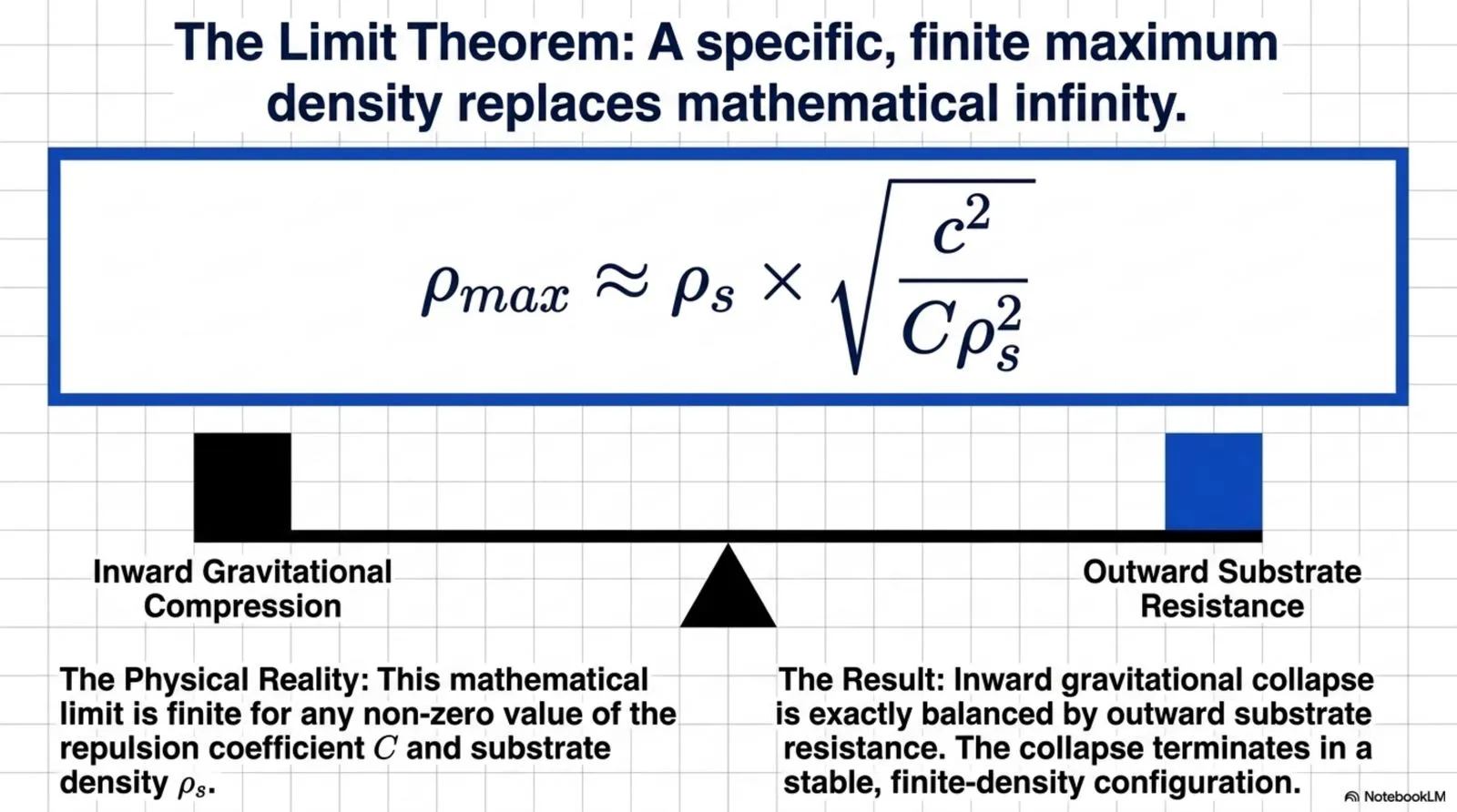
where Cin is the inward collapse pressure driving compression and Cout is the outward redistribution flux of Section 4.3. As density increases, all three opposing terms — Cout, P_restore, and P_repulsion — increase correspondingly, while Cin, for a fixed total collapsing mass, does not increase without bound. Collapse terminates when the total restoring pressure equals the inward gravitational pressure, giving a finite equilibrium density:
ρmax ~ ρs × (c² / (C × rho_s²))^(1/2) (5)
Equation (5) therefore has an important physical implication. The existence of a finite maximum density follows directly from the competition between inward gravitational compression and outward substrate resistance. No additional limiting principle or external cutoff is required. An interactive simulation of these collapse dynamics is available online [13].
This is finite for any non-zero value of the repulsion coefficient C and the substrate density ρs, both fixed independently of the collapse problem itself. The mathematical limit predicted by General Relativity, an unbounded density as radius approaches zero, is replaced by a specific, finite maximum density reached at a finite core radius, with no additional postulate beyond the substrate’s own governing dynamics established independently in related work in this framework [4].
6. The Four-Region Replacement Structure
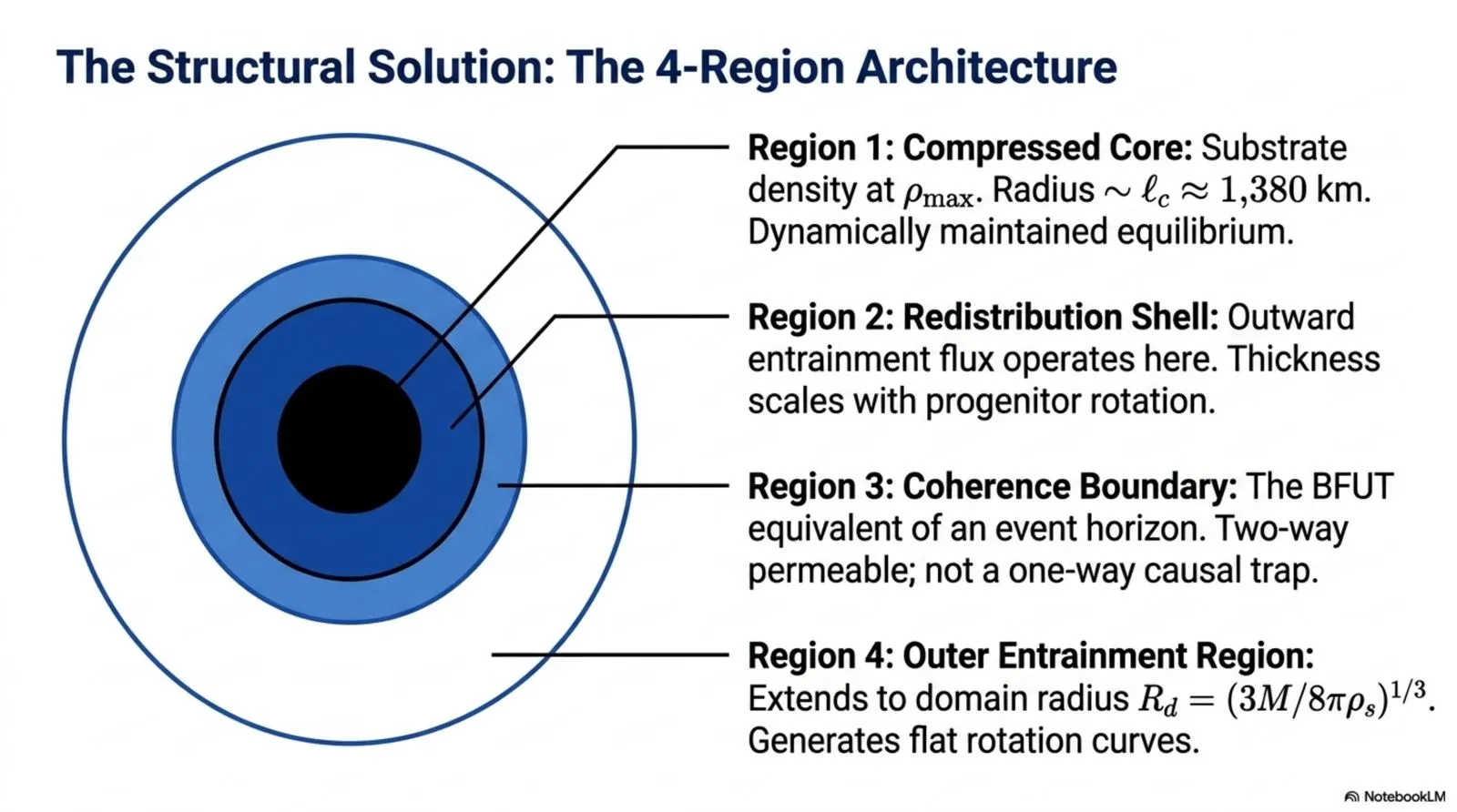
We propose that the object replacing the classical point singularity has a specific internal structure consisting of four physically distinct regions, rather than being a featureless finite-density blob.
The finite-density equilibrium naturally gives rise to internal structure rather than a featureless compact object. Different physical processes dominate at different distances from the centre, producing four physically distinct regions.
The compressed core is the innermost region, where the substrate density has reached the finite maximum of equation (5). The core radius is set by the coherence length ell_c = c*τc, of order 1.38 × 10⁶ m for a stellar-mass collapsing object, within which the substrate circulates at its maximum coherent rate and the restoring pressure of equation (1) balances the inward collapse pressure in a dynamically maintained equilibrium, not a static structure.
The redistribution shell surrounds the core, the region into which the outward entrainment flux of equation (3) continuously moves organised deformation away from the compressed core.
The coherence boundary lies further out, playing a role broadly analogous to, but physically distinct from, the classical General-Relativistic event horizon. At the classical horizon, the propagation efficiency for outward-directed signals is exactly zero for a distant observer under General Relativity. In the present framework, propagation efficiency at the coherence boundary is very small but not exactly zero, since the substrate retains a residual capacity for highly attenuated signal propagation even in this extreme regime.
The outer entrainment region is the outermost of the four, where the substrate’s response to the compact object transitions smoothly to the ordinary, weak-field gravitational behaviour recovered at large distances, consistent with General Relativity’s well-confirmed predictions outside the immediate vicinity of the collapsed object.
7. Discussion: Physical Interpretation and Anticipated Objections
7.1 Physical Interpretation
Within the proposed interpretation, a singularity does not form because collapsing matter is compressing a physically real, elastic medium rather than contracting empty geometric spacetime, and any real elastic medium develops increasing resistance to further compression as it is driven away from its equilibrium configuration. The four-region structure of Section 6 is the specific, calculable outcome of this resistance, replacing an unphysical mathematical infinity with a finite, internally structured compact object.
7.2 "Does avoiding the singularity require new, undiscovered physics?"
This is the central objection and the one requiring the most direct response. The standard expectation within mainstream physics is that avoiding the classical singularity requires a complete and confirmed theory of quantum gravity, not yet available [3,5]. The present proposal differs in that it does not invoke quantum gravity; it invokes the finite compressibility of a specific, independently motivated classical substrate, with restoring pressure, higher-order repulsion, and redistribution flux all following from the same substrate dynamics already applied, in related work in this framework, to the cosmological constant, the speed of light, and structure growth [4,8,9]. The mechanism proposed here is a classical field-theoretic one, evaluated using the substrate’s own governing equations rather than a not-yet-established quantum gravitational framework; whether this specific classical mechanism, rather than a genuinely quantum one, is what actually prevents singularity formation in nature is precisely the falsifiable question addressed in Section 8. We note that non-singular classical collapse solutions have been explored previously within General Relativity itself, using matter sources chosen specifically to avoid the singularity theorems’ energy conditions [11]; the present proposal differs in deriving the non-singular outcome from the independently motivated substrate dynamics of Section 4, rather than from a matter source chosen to avoid the theorems. The proposal therefore replaces the assumption that new quantum-gravitational physics must intervene with the alternative possibility that finite compressibility is already sufficient. Determining which of these alternatives is realised in nature is ultimately an observational question.
7.3 "Does this proposal modify General Relativity’s confirmed predictions?"
No established prediction of General Relativity outside the immediate collapse region is affected. External observers cannot distinguish a finite-core compact object of the kind proposed here from a classical black hole at any distance where General Relativity has been tested: the external gravitational field, orbital dynamics of surrounding matter, and gravitational lensing are unchanged, since these depend only on the total mass and are identical between the two pictures [4]. The difference between the two proposals lies entirely in the interior structure, in a regime inaccessible to any confirmed observational test of General Relativity to date. Accordingly, the proposal preserves General Relativity wherever its predictions have been experimentally confirmed and differs only in the internal structure of collapsed objects, where no direct observational confirmation of a singularity presently exists.
7.4 "What happens to information falling into the compact object under this proposal?"
Within the proposed framework, infalling information is not destroyed, since no genuine singularity or spacetime termination point exists. Information carried by infalling matter is proposed to be encoded in the organised compression state of the core and redistribution shell described in Section 6, potentially contributing to substrate relaxation signatures detectable during and after collapse or merger events [4]. We note this as a structural consequence of the proposed framework rather than a fully worked-out resolution of the black hole information paradox, which remains an area for further development, an open problem also actively addressed within quantum-gravitational approaches to black hole evaporation [12].
8. Falsifiable Predictions
The finite-compressibility account of gravitational collapse makes the following falsifiable predictions.
Prediction 1. No confirmed observation will directly detect a true point of infinite density or infinite curvature; every future observation of extreme gravitational collapse is expected to remain consistent with a finite, if very large, maximum compression density, as given by equation (5), rather than confirming an unbounded value.
Prediction 2. If compact objects possess a finite-density core rather than a true singularity, future observations of horizon-scale phenomena are expected to reveal small but finite departures from the behaviour predicted for an ideal event horizon, consistent with residual propagation through the coherence boundary. Persistent agreement with an exactly perfect event horizon under arbitrarily increasing observational precision would be inconsistent with the proposed mechanism.
Prediction 3. Substrate relaxation signatures, of the kind searched for directly in gravitational wave post-merger data in related work, are expected to be present following collapse and merger events, tracing the internal dynamics of the compressed core and redistribution shell of Section 6; the confirmed, complete absence of any such relaxation signature across a large sample of high-precision merger observations would be inconsistent with the internal structure proposed here.
Prediction 4. The core radius, of order the coherence length ell_c established independently in the related substrate framework [4], is expected to scale consistently across compact objects of different mass in a manner distinguishable from any purely quantum-gravitational length scale, such as the Planck length, providing a further observational avenue for distinguishing this classical mechanism from a quantum gravitational one.
9. Conclusions
We have proposed a physical mechanism preventing the formation of true gravitational singularities, from the finite compressibility of a universal physical substrate. Under this proposal, three physically distinct mechanisms — substrate restoring pressure, higher-order repulsion at extreme density, and outward redistribution through entrainment flux — combine to produce a finite maximum compression density, replacing the classical point singularity with a specific four-region structure: a compressed core, a redistribution shell, a coherence boundary, and an outer entrainment region. This mechanism requires no complete or confirmed theory of quantum gravity; it follows from the same classical substrate dynamics already applied, in related work, to the cosmological constant, the speed of light, and large-scale structure growth.
Within this interpretation, gravitational singularities are not physical objects but mathematical consequences of modelling gravitational collapse without the finite resistance of an underlying physical medium. Once finite substrate compressibility is included, collapse approaches a stable finite-density configuration rather than an infinite one, while preserving the successful external predictions of General Relativity.
References
[1] Penrose, R. (1965). Gravitational collapse and space-time singularities. Physical Review Letters, 14(3), 57–59.
[2] Hawking, S.W. (1967). The occurrence of singularities in cosmology. III. Causality and singularities. Proceedings of the Royal Society A, 300(1461), 187–201.
[3] Hawking, S.W. and Penrose, R. (1970). The singularities of gravitational collapse and cosmology. Proceedings of the Royal Society A, 314(1519), 529–548.
[4] Sharma, V.S. (2026). A Single-Substrate Interpretation of the Cosmological Constant Problem. Zenodo. doi:10.5281/zenodo.21280358
[5] Wald, R.M. (1984). General Relativity. University of Chicago Press, Chicago.
[6] Michelson, A.A. and Morley, E.W. (1887). On the relative motion of the Earth and the luminiferous ether. American Journal of Science, 34(203), 333–345.
[7] Müller, H., Herrmann, S., Braxmaier, C., Schiller, S., and Peters, A. (2003). Modern Michelson-Morley experiment using cryogenic optical resonators. Physical Review Letters, 91, 020401.
[8] Sharma, V.S. (2026). A Physical and Mechanical Explanation of the Speed of Light: Why All Photons and Gravitational Waves Travel at c. Zenodo. doi:10.5281/zenodo.21292900
[9] Sharma, V.S. (2026). Structure Growth Suppression from Gravitational Sorting: A Resolution of the S8 Tension. Zenodo. doi:10.5281/zenodo.21280670
[10] Frolov, V.P. and Novikov, I.D. (1998). Black Hole Physics: Basic Concepts and New Developments. Kluwer Academic Publishers, Dordrecht.
[11] Bardeen, J.M. (1968). Non-singular general-relativistic gravitational collapse. In Proceedings of the International Conference GR5, Tbilisi, USSR.
[12] Ashtekar, A. and Bojowald, M. (2005). Black hole evaporation: A paradigm. Classical and Quantum Gravity, 22(16), 3349–3362.
[13] Sharma, V.S. (2026). Code: Finite-Density Gravitational Collapse — Interactive Simulation. Zenodo. doi:10.5281/zenodo.21337976. Simulation available at vijayshankarsharma.com/focus/gravitational-collapse.
[14] Rovelli, C. (2004). Quantum Gravity. Cambridge University Press, Cambridge.
[15] ATLAS Collaboration (2012). Observation of a new particle in the search for the Standard Model Higgs boson with the ATLAS detector at the LHC. Physics Letters B, 716(1), 1–29.
[16] CMS Collaboration (2012). Observation of a new boson at a mass of 125 GeV with the CMS experiment at the LHC. Physics Letters B, 716(1), 30–61.
[17] Einstein, A. (1920). Äther und Relativitätstheorie. Address delivered at the University of Leiden, 5 May 1920. Springer, Berlin.