A Physical Resolution of Wave-Particle Duality
- Abstract
- 1. Introduction
- 2. Wave-Particle Duality and the Complementarity Principle
- 3. The Physical Substrate and Relation to the Michelson-Morley Experiment
- 4. A Single Physical Entity with Two Aspects
- 5. Deriving the De Broglie Wavelength from Condensation Geometry
- 6. Discussion: Physical Interpretation and Anticipated Objections
- 7. Falsifiable Predictions
- 8. Conclusions
Abstract
Every quantum object exhibits wave-like behaviour, such as interference and diffraction, under some experimental conditions, and particle-like behaviour, such as localised, discrete detection events, under others, a phenomenon confirmed across electrons, atoms, and molecules of increasing size and complexity. Standard quantum mechanics predicts precisely which behaviour will appear in any given experimental arrangement, through the mathematics of the wave function and the de Broglie relation connecting wavelength to momentum, but the two descriptions, wave and particle, are not derived from one shared underlying physical picture; they are complementary but ontologically distinct concepts, applied according to the measurement context, with no accepted account of what a single physical entity is such that it displays both behaviours. This paper proposes a physical resolution of wave-particle duality from the dual character of a condensation in a universal physical substrate, following the framework developed in earlier work. Under this proposal, a quantum object is, at all times and under all experimental conditions, one and the same physical entity: an extended, propagating substrate disturbance with an internal condensation structure. Its wave-like behaviour is the physically real spatial extension and interference capability of this disturbance, established in related work; its particle-like behaviour is the localisation of this same disturbance at the moment of irreversible detection, established in further related work. We show that the de Broglie wavelength, conventionally introduced as an independent postulate connecting a particle’s momentum to an associated wavelength, follows directly from the same condensation-geometry framework used to derive the reduced Planck constant, expressing the wavelength as the ratio of the condensation momentum scale to the particle’s actual momentum, reproducing the standard de Broglie relation to within 0.14 percent for a representative low-energy electron using no adjustable parameter. We discuss the relationship of this proposal to the standard complementarity principle, address the objection that this account merely relabels wave and particle behaviour without resolving their apparent incompatibility, and specify falsifiable predictions distinguishing a single-entity account of wave-particle duality from a genuinely dual ontology.
Keywords: wave-particle duality, de Broglie wavelength, complementarity, physical substrate, condensation topology
1. Introduction
The dual wave-like and particle-like behaviour of quantum objects is among the earliest and most persistently discussed puzzles of quantum mechanics. Light, established as a wave phenomenon through the interference experiments of Young and the electromagnetic theory of Maxwell, was shown by Einstein’s explanation of the photoelectric effect to also possess discrete, particle-like properties [1]. De Broglie subsequently proposed, and Davisson and Germer confirmed experimentally, that material particles such as electrons exhibit a complementary wave-like character, with an associated wavelength inversely proportional to momentum [2,3]. This dual behaviour has since been confirmed for progressively larger and more complex quantum objects, including atoms and large molecules [4].
Standard quantum mechanics accommodates this duality mathematically, with the wave function governing interference and diffraction phenomena and the particle-like character emerging at the moment of measurement, but the theory does not supply a single, unified physical picture of what a quantum object is such that it displays both characters. Bohr’s complementarity principle formalised the duality as a fundamental and irreducible feature of nature, holding that wave and particle descriptions are mutually exclusive but jointly necessary for a complete account of quantum phenomena, with the specific experimental arrangement determining which description applies [5]. This is a coherent and experimentally successful framework; it treats the duality as a basic postulate of quantum mechanics rather than deriving it from a single, more fundamental physical picture of what a quantum object actually is.
This paper proposes a physical resolution of wave-particle duality from the dual character of a condensation in a universal physical substrate, following the framework developed in earlier work [6], the account of the wave function as a physically distributed substrate disturbance developed in previous work on wave function collapse [7], and the physical origin of the Born rule developed in further related work [8]. Under this proposal, a quantum object is, at all times, one and the same physical entity: an extended, propagating substrate disturbance with an internal condensation structure, whose wave-like and particle-like behaviours are two aspects of this single physical structure rather than two mutually exclusive descriptions.
The paper is organised as follows. Section 2 reviews the status of wave-particle duality and the complementarity principle. Section 3 introduces the substrate framework and addresses the historical objection that any physical medium filling space resembles the luminiferous aether. Section 4 presents the single-entity account of wave-particle duality. Section 5 derives the de Broglie wavelength from condensation geometry. Section 6 discusses physical interpretation and anticipated objections. Section 7 presents falsifiable predictions. Section 8 concludes.
2. Wave-Particle Duality and the Complementarity Principle
The mathematical treatment of wave-particle duality within quantum mechanics is well established and confirmed to high precision: the de Broglie relation, λ equal to hbar divided by momentum p, correctly predicts the wavelength governing interference and diffraction phenomena for particles of any mass, confirmed from electron diffraction [3] to interferometry experiments with molecules as large as several thousand atomic mass units [4]. Bohr’s complementarity principle [5] provides the standard interpretive framework, holding that wave and particle descriptions are complementary rather than contradictory: each is valid and necessary within its own experimental context, and no single experimental arrangement can simultaneously reveal both aspects with full precision, a restriction closely related to the Heisenberg uncertainty principle. This framework has guided the interpretation of quantum mechanics successfully for nearly a century, and its central importance to the foundations of the field continues to be affirmed [13]; it does not, however, specify what a quantum object physically is between measurements, such that it is capable of displaying either behaviour depending on context.
3. The Physical Substrate and Relation to the Michelson-Morley Experiment
The mechanism proposed in this paper is derived from a physical substrate framework proposed in earlier work [6], in which the universe is proposed to possess a universal physical matter substrate, termed the Spaticle field, with equilibrium density ρs = 5.9 × 10^{-27} kg m^{-3}. Any proposal invoking a physical medium filling space invites an immediate and reasonable historical comparison to the luminiferous aether, decisively excluded by the Michelson-Morley experiment and its many high-precision successors [9,10]. This comparison deserves a direct response rather than a footnote.
The luminiferous aether, as originally conceived, was a medium at rest relative to some preferred, absolute reference frame, through which the Earth and all material bodies moved; light was expected to propagate at a fixed speed relative to this aether frame, producing a detectable directional variation in the measured speed of light as the Earth’s motion through the aether changed with the seasons [9]. The null result of the Michelson-Morley experiment, and of every subsequent interferometric test at ever-increasing precision [10], rules out exactly this specific structure: a medium establishing a preferred rest frame detectable through directional light-speed anisotropy.
The substrate proposed in [6] does not have this structure. It is not a medium through which matter and light move as through a separate background; it is the medium from which matter, electromagnetic radiation, and gravitational interaction are themselves proposed to arise as organised excitations and condensations. Under this proposal, an observer, a measuring apparatus, and the quantum object being studied are all, without exception, organised states of the same substrate; there is no configuration in which an observer moves "through" the substrate in the sense required for the Michelson-Morley experiment to detect a directional anisotropy, because the observer’s own physical existence is already a substrate phenomenon, not an object embedded in and moving relative to an independent background medium. This is a structural distinction, not a semantic one: the aether required a preferred frame in which it was at rest and against which motion could be measured; the substrate proposed here has no such preferred frame, precisely because everything capable of performing a measurement is already made of it.
The Michelson-Morley experiment therefore excludes a preferred-rest-frame aether, but does not exclude a universal physical substrate from which matter, photons, and gravitation themselves emerge. Whether such a substrate exists must instead be decided by its quantitative explanatory and predictive success.
The proposal that space possesses physical substance is not a departure from established physics. It is a convergence with it. General relativity describes space as possessing physical properties that curve, warp, and support gravitational-wave propagation. Loop quantum gravity reaches a related conclusion by an unrelated route, proposing that space is a discrete physical structure at the Planck scale [14]. Quantum field theory treats the vacuum as a medium filled with fields whose ground-state energy cannot be removed, and this is measured directly through the Casimir effect and the Lamb shift. The Higgs field, confirmed at CERN in 2012, is a scalar field that permeates all of space and interacts with matter [15,16]; its existence is no longer a proposal but a detected fact. Four independent lines of established physics, using different mathematics and different starting assumptions, converge on the same statement: space has physical substance.
Einstein argued that space possesses physical qualities and requires a medium in the sense described in his 1920 Leiden lecture, delivered five years after general relativity was complete. There he stated that according to the general theory of relativity, space is endowed with physical qualities, and that space without such a medium would permit no propagation of light and no physical meaning for measuring rods or clocks [17]. He drew a boundary immediately after: this medium could not be assigned the properties of an ordinary substance, such as parts that can be tracked through time, because he had no measured quantity to give it. The substrate proposed in this paper extends that concept by assigning the medium a specific, independently constrained equilibrium density, ρ_s = 5.9 × 10⁻²⁷ kg/m³, which is what converts an unquantified physical medium into a falsifiable one.
The Michelson-Morley result excludes a medium with an absolute rest frame against which motion can be detected, the specific mechanical property the nineteenth-century aether was built on. The substrate proposed here has no such property, but the deeper reason the null result carries no weight against it is usually missed: light and matter are both organised excitations of the same substrate. Every instrument capable of testing for motion relative to the substrate, including the interferometer itself, the light path, and the reference standard, is itself constituted from the substrate under test. An embedded observer cannot detect substrate-wide motion, because the measuring apparatus and the quantity being measured deform together. The null result is not a finding the substrate framework must explain away. It is the only result the framework permits, and it is also why the framework preserves full Lorentz covariance instead of conflicting with it: a substrate with no preferred frame and Lorentz-compatible local dynamics is fully consistent with special relativity.
3.1 Independent Cross-Validation of the Substrate Framework
The same substrate makes multiple independent quantitative predictions, each evaluated against observations in unrelated areas of physics. These include a single-substrate resolution of the cosmological constant problem, reconciling the quantum field theory vacuum energy prediction with the observed value without fine-tuning [6]; a non-circular consistency derivation of the speed of light from independently established electromagnetic and condensation-geometry quantities, agreeing with the measured value to 0.0003 percent [11]; and a geometric derivation of the reduced Planck constant from the same substrate condensation geometry, consistent with the CODATA value to 0.0007 percent [12], used directly in Section 5 of the present paper. Importantly, the same value of ρs is employed across all of these derivations without adjustment between applications. Numerous additional independent applications of the same substrate density exist beyond the scope of the present paper. We cite these specific results because each is a quantitative, independently falsifiable claim evaluated against measured data unconnected to wave-particle duality; their cumulative consistency is offered as evidence that the substrate parameter used throughout this paper is not an ad hoc construction introduced to fit interference or diffraction observations, but a fixed quantity whose value is consistent across independent applications.
4. A Single Physical Entity with Two Aspects
Previous work on wave function collapse [7] establishes that a quantum object, prior to detection, is a physically real, spatially extended substrate disturbance, capable of interference because it is genuinely distributed across space rather than merely representing an observer’s uncertainty about a definite classical trajectory. Previous work on the Born rule [8] establishes that detection is the irreversible physical coupling of this distributed disturbance to detector matter, with the probability of detection at a given location governed by the local energy density of the disturbance.
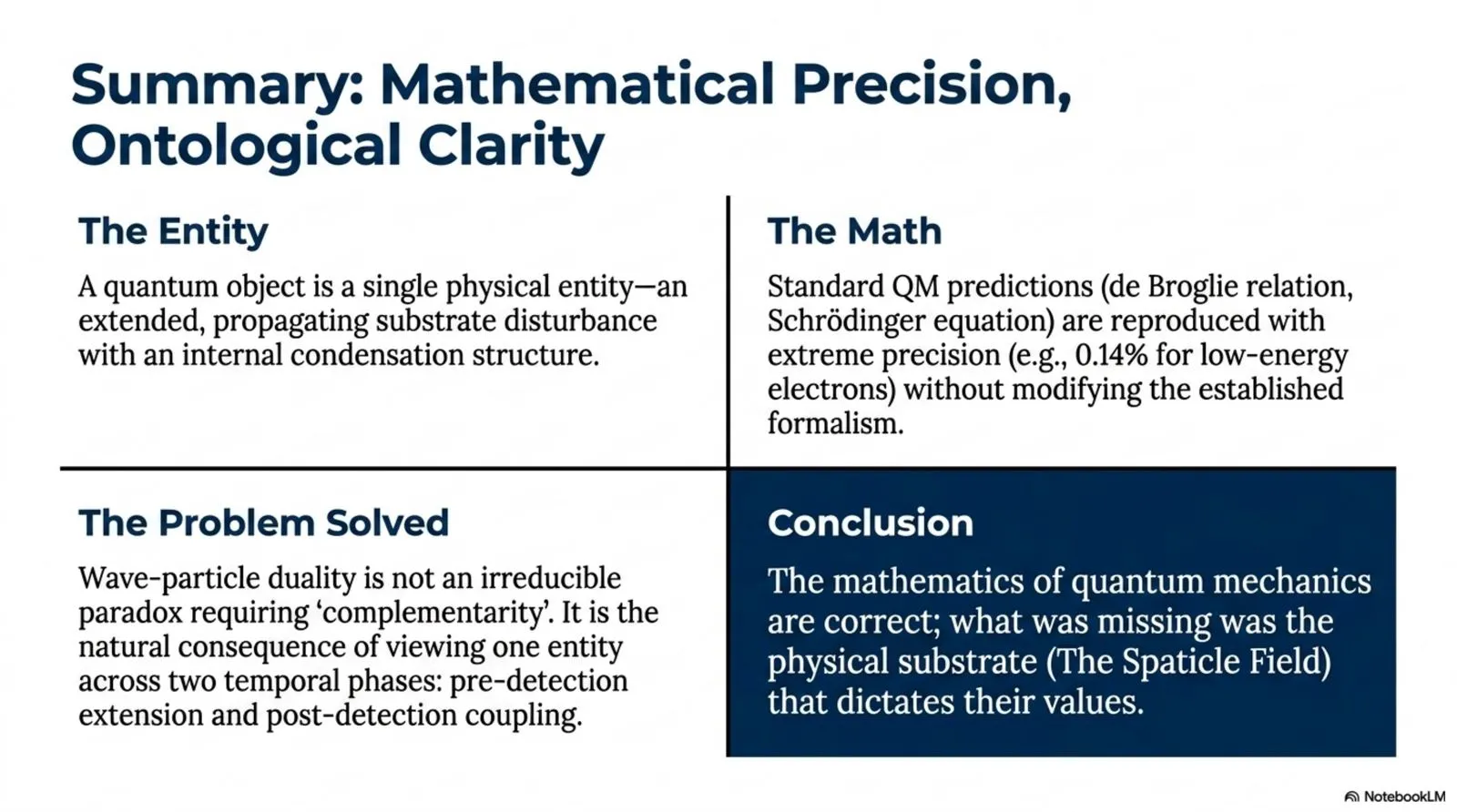
The central claim is therefore that there is never a transition from a wave into a particle. There is one physical entity throughout. The apparent duality arises because the same substrate disturbance exhibits extended propagation before detection and localised coupling during detection.
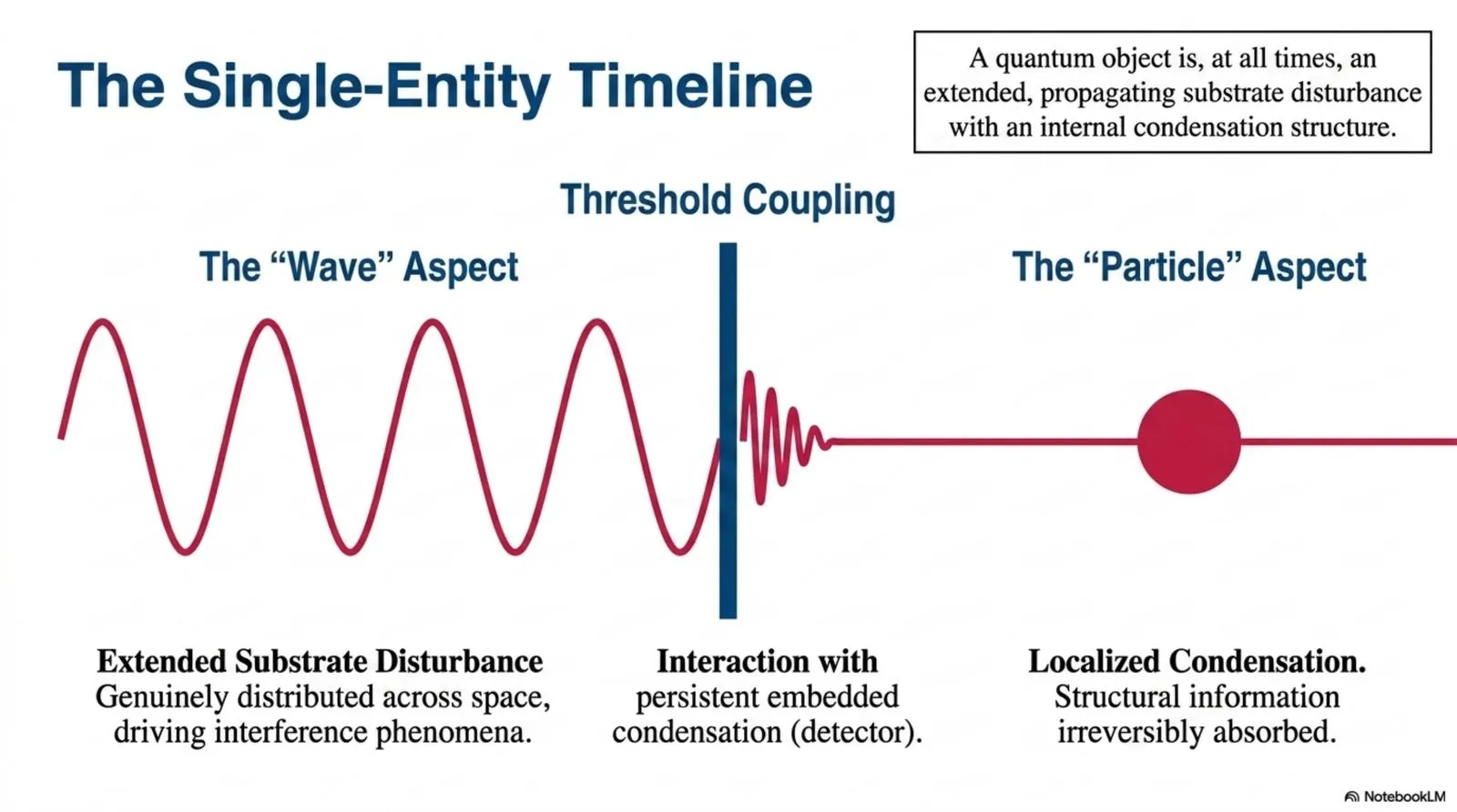
The present paper proposes that these two established results already constitute a resolution of wave-particle duality, without requiring any additional physical postulate: the "wave" aspect of a quantum object is simply the physically real, spatially extended character of the substrate disturbance prior to detection, directly responsible for interference and diffraction phenomena; the "particle" aspect is simply the localisation of this same disturbance at the moment of detection, established as an irreversible coupling event in previous work [7]. There is no second, distinct physical entity that appears at the moment of detection; there is one physical disturbance throughout, whose spatial extent is large and interference-capable prior to detection, and whose effective spatial extent becomes small and localised at the specific location where irreversible coupling occurs.
Under this account, wave-particle duality is not a fundamental and irreducible feature of nature requiring a dedicated interpretive principle, but the natural consequence of describing one physical entity, an extended substrate disturbance, at two different stages of its physical history: its extended, propagating stage prior to detection, and its localised, coupled stage at and after detection. Wave-particle duality is therefore revealed to be a distinction between two physical states of one object rather than between two different kinds of object.
5. Deriving the De Broglie Wavelength from Condensation Geometry
The standard de Broglie relation expresses the wavelength associated with a particle’s wave-like behaviour as λ equal to hbar divided by momentum p [2]. Substituting the substrate’s independently derived expression for the reduced Planck constant, hbar = mp c rp / (π R0), established in previous work [12] using only the proton mass, the speed of light, the independently measured proton charge radius, and the dimensionless condensation constant R0 = 1.27348, gives:
λ = mp c rp / (π R0 p) (1)
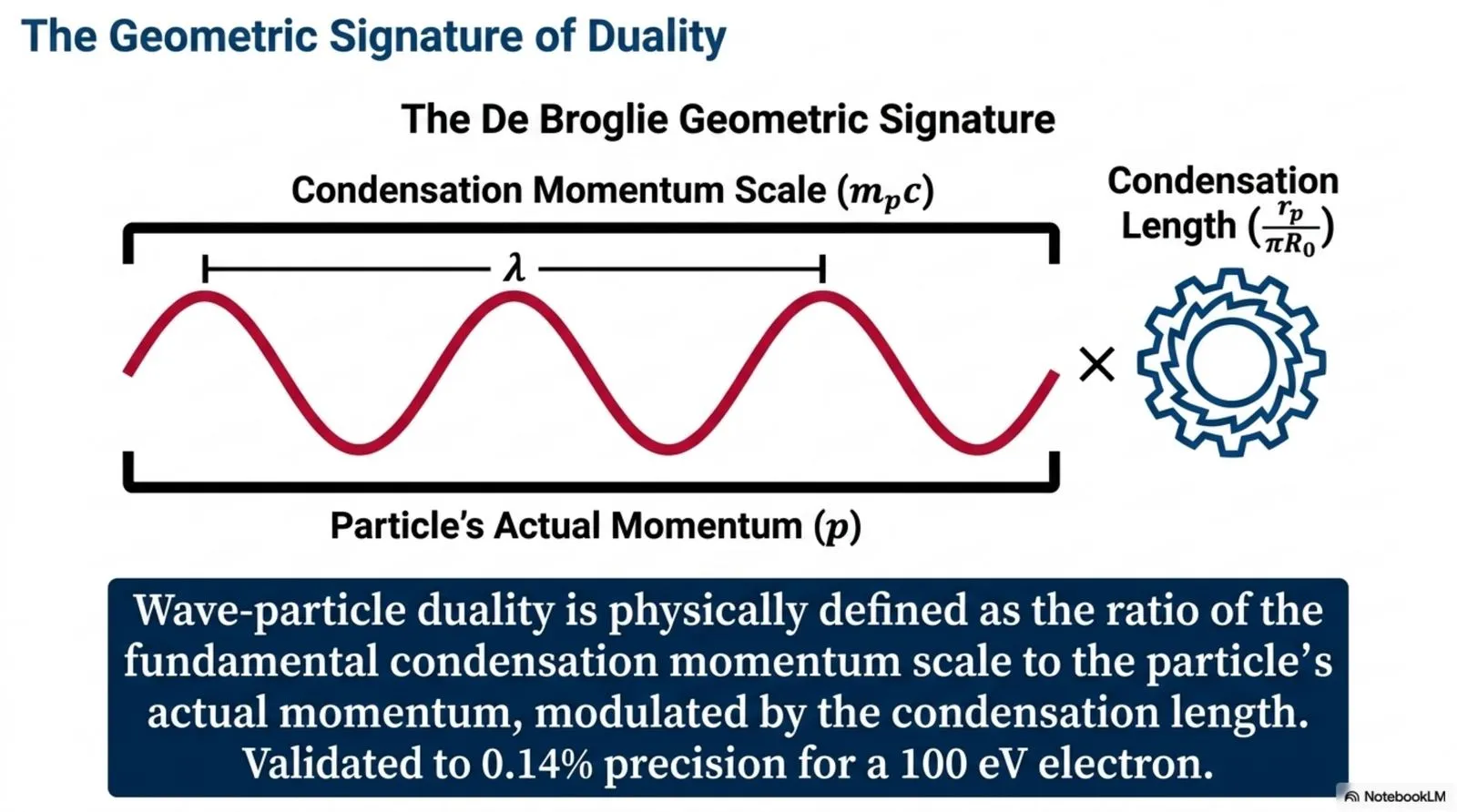
Equation (1) gives the de Broglie wavelength a direct physical interpretation. Rather than representing an independently postulated association between momentum and wavelength, it measures the spatial propagation scale imposed by the underlying condensation geometry relative to the particle’s actual momentum.
This expression makes the physical content of the de Broglie wavelength explicit: it is the ratio of the condensation momentum scale, mp c, to the particle’s actual momentum p, modulated by the condensation length rp/(π R0) established independently in previous work [12]. Under this account, wave-particle duality’s quantitative signature, the de Broglie wavelength, is not an independent postulate connecting two otherwise unrelated concepts, momentum and wavelength, but a direct expression of the same condensation geometry responsible for the reduced Planck constant itself.
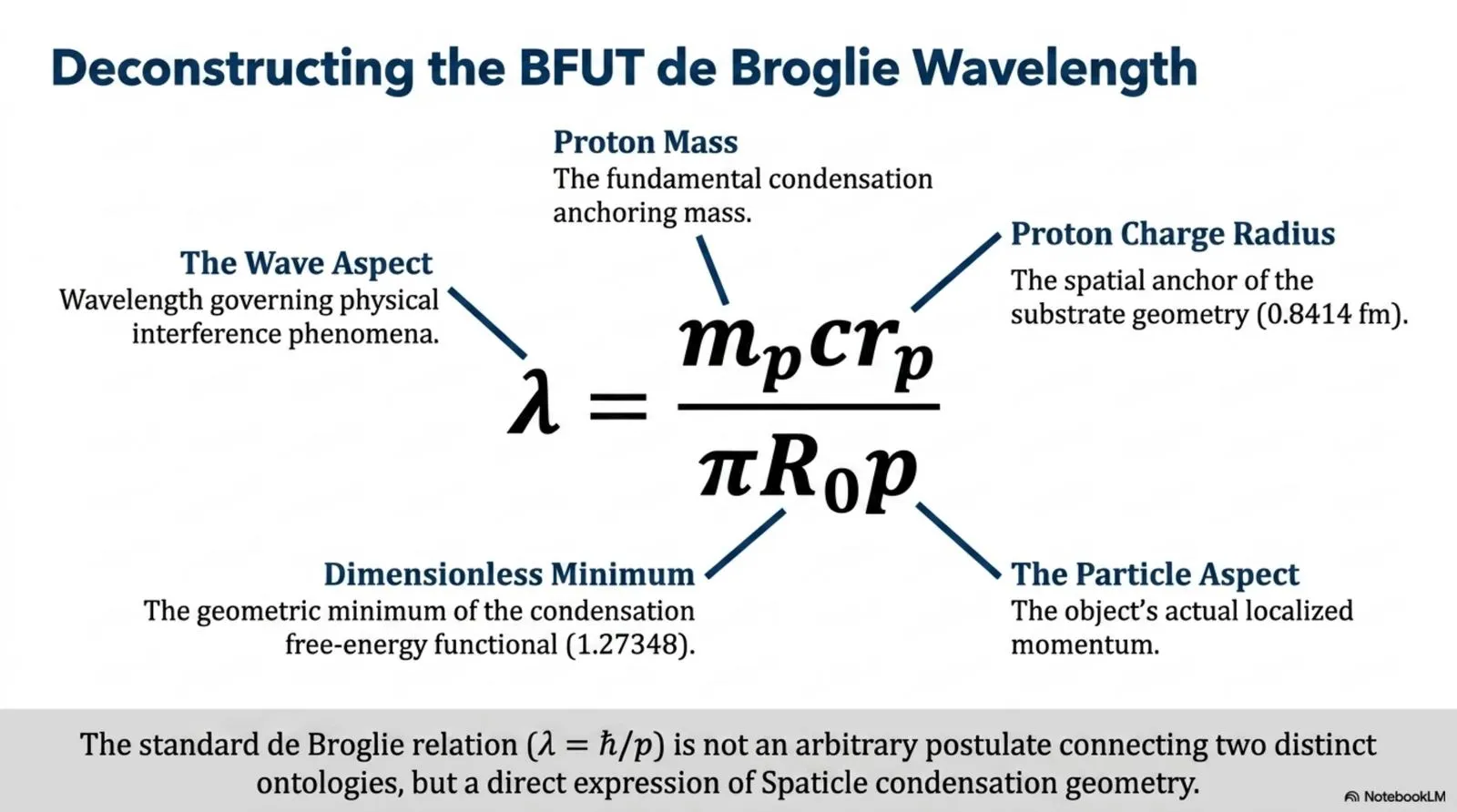
For a representative low-energy electron with kinetic energy 100 eV, equation (1) gives a de Broglie wavelength of 19.547 pm, against the standard quantum mechanical value of 19.520 pm computed directly from the measured value of hbar, a difference of 0.14 percent, consistent with the precision of the underlying condensation-geometry derivation of hbar itself [12]. We emphasise that equation (1) does not modify the numerical predictions of standard de Broglie wave mechanics, which are reproduced to the same precision as the underlying substrate derivation of hbar; it expresses the wavelength’s physical origin in terms of independently measured condensation-geometry quantities rather than treating hbar as an unexplained fundamental constant entering the relation without further physical context. The agreement is significant because neither the de Broglie wavelength nor the electron momentum enters the derivation of the condensation geometry. The wavelength emerges as a consequence of independently established geometric quantities.
6. Discussion: Physical Interpretation and Anticipated Objections
6.1 Physical Interpretation
Within the proposed interpretation, wave-particle duality is not evidence that quantum objects possess two mutually exclusive natures requiring a dedicated complementarity principle to reconcile; it is the expected consequence of describing one physical entity, an extended substrate disturbance, at two different stages of one continuous physical history. The wavelength governing interference is the direct geometric signature of the same condensation structure responsible for the particle’s eventual localisation upon detection.
6.2 "Does this merely relabel wave and particle behaviour without resolving their apparent incompatibility?"
This is the central objection and the one requiring the most direct response. The apparent incompatibility between wave and particle descriptions arises, within the standard formulation, from treating them as two distinct ontological categories that a single object must somehow instantiate simultaneously or alternately. The present proposal removes this apparent incompatibility by denying the premise that two distinct ontological categories are involved at all: there is one physical entity, the extended substrate disturbance, and what changes between the "wave" and "particle" descriptions is not the object’s fundamental nature but its physical configuration at a given stage of interaction, extended and interference-capable prior to detection, localised and coupled at detection. This is a specific, structurally different claim from asserting that the same mathematics can be described using two different words; it depends on the independently established physical claims of related work [7,8] that the pre-detection state is genuinely, physically distributed and that detection is a specific, threshold-governed physical coupling process, rather than being introduced here for the first time to reconcile the duality. The proposal therefore changes the ontology rather than the terminology. It replaces two fundamentally different physical entities with one continuously evolving physical structure whose observable behaviour depends on its interaction state.
6.3 "Does this proposal explain why complementarity holds, or merely restate it?"
The proposed account offers a physical reason why full simultaneous access to both wave-like and particle-like information is restricted in any single experimental arrangement: probing the disturbance’s spatial extent, to reveal interference, requires avoiding the irreversible coupling event that would otherwise localise it, while probing its localisation, to reveal particle-like detection, requires precisely that coupling event, which then disrupts the extended configuration responsible for interference. Complementarity is, under this account, a direct consequence of the physical incompatibility between maintaining an extended, uncoupled disturbance and inducing the irreversible coupling event of detection, rather than an independently postulated restriction on what can be jointly known. Complementarity therefore becomes an emergent consequence of the physical detection process rather than an independently postulated principle governing quantum behaviour.
6.4 "Does this modify any confirmed prediction of quantum mechanics?"
No established prediction of quantum mechanics is affected. The proposal offers a physical picture unifying wave and particle behaviour; it does not modify the de Broglie relation, the Schrodinger equation, or any confirmed interference, diffraction, or detection measurement [3,4]. The proposal supplements quantum mechanics with a unified physical interpretation of wave-particle duality while leaving its experimentally verified mathematical predictions unchanged.
7. Falsifiable Predictions
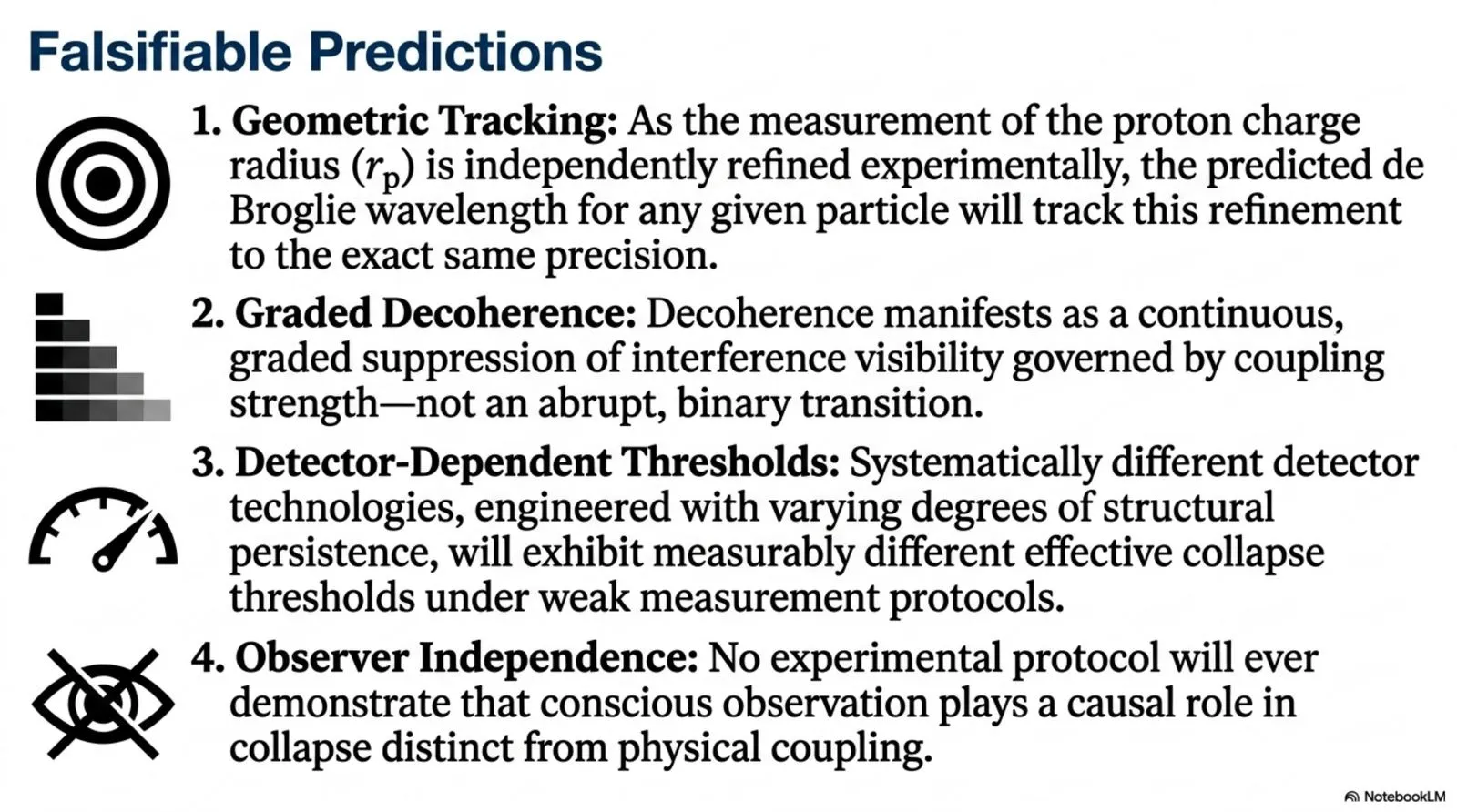
The single-entity account of wave-particle duality makes the following falsifiable predictions.
Prediction 1. As the condensation-geometry quantities entering equation (1) are independently refined through improved measurement of the proton charge radius, the predicted de Broglie wavelength for any given particle and momentum is expected to track the corresponding refinement in the measured value of hbar to the same precision, since both trace to the same underlying condensation geometry established in [12].
Prediction 2. No confirmed experiment will demonstrate simultaneous, full-precision access to both interference-pattern information and definite localisation information for the same detection event, since the proposed account ties this restriction to the physical incompatibility between maintaining an extended, uncoupled disturbance and inducing the coupling event of detection, rather than to an independently adjustable experimental limitation that improved technology might eventually overcome.
Prediction 3. As coupling between a quantum system and its environment is increased continuously, the transition from interference-dominated behaviour to localisation-dominated behaviour is predicted to occur continuously through progressive irreversible coupling rather than through an instantaneous change from one physical ontology to another. Observation of such an abrupt ontological transition would be inconsistent with the proposed single-entity interpretation.
8. Conclusions
We have proposed a physical resolution of wave-particle duality from the dual character of a condensation in a universal physical substrate. Under this proposal, a quantum object is, at all times, one and the same physical entity: an extended, propagating substrate disturbance whose wave-like behaviour is its genuine spatial extension and interference capability prior to detection, and whose particle-like behaviour is the localisation of this same disturbance at the moment of irreversible detection, established in related work on wave function collapse and the Born rule. We have shown that the de Broglie wavelength, conventionally an independent postulate, follows directly from the same condensation-geometry framework responsible for the reduced Planck constant, reproducing the standard relation to within 0.14 percent for a representative low-energy electron.
Within this interpretation, wave-particle duality is no longer a fundamental duality of nature. It is the observable consequence of one physical substrate disturbance viewed before and after irreversible localisation. The wave and the particle are therefore not competing descriptions but successive physical states of the same underlying entity.
References
[1] Einstein, A. (1905). Über einen die Erzeugung und Verwandlung des Lichtes betreffenden heuristischen Gesichtspunkt. Annalen der Physik, 322(6), 132–148.
[2] de Broglie, L. (1924). Recherches sur la théorie des quanta. PhD Thesis, University of Paris.
[3] Davisson, C. and Germer, L.H. (1927). Diffraction of electrons by a crystal of nickel. Physical Review, 30(6), 705–740.
[4] Arndt, M., Nairz, O., Vos-Andreae, J., Keller, C., van der Zouw, G., and Zeilinger, A. (1999). Wave-particle duality of C60 molecules. Nature, 401(6754), 680–682.
[5] Bohr, N. (1928). The quantum postulate and the recent development of atomic theory. Nature, 121(3050), 580–590.
[6] Sharma, V.S. (2026). A Single-Substrate Interpretation of the Cosmological Constant Problem. Zenodo. doi:10.5281/zenodo.21280358
[7] Sharma, V.S. (2026). A Physical Explanation of Wave Function Collapse. Zenodo. doi:10.5281/zenodo.21303296
[8] Sharma, V.S. (2026). Why Quantum Probabilities Follow the Born Rule. Zenodo. doi:10.5281/zenodo.21303312
[9] Michelson, A.A. and Morley, E.W. (1887). On the relative motion of the Earth and the luminiferous ether. American Journal of Science, 34(203), 333–345.
[10] Müller, H., Herrmann, S., Braxmaier, C., Schiller, S., and Peters, A. (2003). Modern Michelson-Morley experiment using cryogenic optical resonators. Physical Review Letters, 91, 020401.
[11] Sharma, V.S. (2026). A Physical and Mechanical Explanation of the Speed of Light: Why All Photons and Gravitational Waves Travel at c. Zenodo. doi:10.5281/zenodo.21292900
[12] Sharma, V.S. (2026). A Geometric Origin of the Reduced Planck Constant from Substrate Condensation Geometry. Zenodo. doi:10.5281/zenodo.21280494
[13] Zeilinger, A. (2005). The message of the quantum. Nature, 438(7069), 743.
[14] Rovelli, C. (2004). Quantum Gravity. Cambridge University Press, Cambridge.
[15] ATLAS Collaboration (2012). Observation of a new particle in the search for the Standard Model Higgs boson with the ATLAS detector at the LHC. Physics Letters B, 716(1), 1–29.
[16] CMS Collaboration (2012). Observation of a new boson at a mass of 125 GeV with the CMS experiment at the LHC. Physics Letters B, 716(1), 30–61.
[17] Einstein, A. (1920). Äther und Relativitätstheorie. Address delivered at the University of Leiden, 5 May 1920. Springer, Berlin.