A Physical Explanation of Quantum Tunnelling
- Abstract
- 1. Introduction
- 2. The Status of Quantum Tunnelling
- 3. The Physical Substrate and Relation to the Michelson-Morley Experiment
- 4. Tunnelling as Condensation Boundary Leakage
- 5. Deriving the Tunnelling Decay Constant from Condensation Geometry
- 6. Discussion: Physical Interpretation and Anticipated Objections
- 7. Falsifiable Predictions
- 8. Conclusions
Abstract
Quantum tunnelling — the confirmed and technologically essential phenomenon by which a particle has a non-zero probability of appearing on the far side of a potential energy barrier it does not classically have sufficient energy to surmount — is calculated with complete accuracy by the Schrodinger equation, yet the standard formulation offers no physical picture of what a particle is doing while it traverses a classically forbidden region, beyond the mathematical statement that its wavefunction decays exponentially rather than vanishing there. This paper proposes a physical account of tunnelling from the extended, non-pointlike structure of a particle as a condensation of a universal physical substrate, following the framework developed in earlier work. Under this proposal, a particle is not a point object requiring classically sufficient energy to cross a barrier, but an extended substrate deformation with a finite localisation cost at every radius, so that its deformation field retains non-zero amplitude at all distances from its formation centre, including distances on the far side of an intervening barrier. Tunnelling is, under this account, the physical continuity of this extended deformation field across a region of elevated substrate energy, requiring no violation of energy conservation and no faster-than-light propagation at any stage. We show that substituting the substrate’s independently derived expression for the reduced Planck constant into the standard tunnelling decay formula yields a decay constant expressed entirely in terms of independently measured condensation-geometry quantities, reproducing the standard quantum mechanical penetration depth for a representative electron tunnelling problem to within 0.14 percent using no adjustable parameter beyond those already fixed in related condensation-geometry literature. We discuss the relationship of this proposal to the underlying substrate framework, address the objection that this account merely restates the mathematics of the Schrodinger equation in different language, and specify falsifiable predictions distinguishing a physical, extended-deformation origin for tunnelling from its treatment as an unexplained postulate of wave mechanics.
Keywords: quantum tunnelling, barrier penetration, decay constant, condensation topology, physical substrate, α decay
1. Introduction
Quantum tunnelling is among the most thoroughly confirmed and technologically consequential phenomena in physics, underlying α radioactive decay [1], the operation of the scanning tunnelling microscope [2], and the tunnel diodes [11] and Josephson junctions [3] central to modern semiconductor and superconducting device physics. The Schrodinger equation predicts the tunnelling probability through a potential barrier with complete quantitative accuracy, confirmed across an enormous range of experimental systems [1,2,3]. Despite this predictive success, the standard formulation offers no physical account of what a particle is doing while traversing a classically forbidden region — a region in which its total energy is less than the potential energy of the barrier, so that no classical trajectory exists connecting the two sides.
The mathematics of tunnelling is well understood: the time-independent Schrodinger equation, applied to a particle encountering a barrier of height V exceeding the particle’s energy E, gives a wavefunction that decays exponentially rather than vanishing within the barrier region, with decay constant κ equal to the square root of two times the particle mass times the energy deficit, divided by the reduced Planck constant [4]. This mathematics reproduces every confirmed tunnelling measurement; it does not, on its own, supply a physical picture of the particle during the classically forbidden traversal, and interpretive accounts vary widely, from treating the particle as instantaneously present on both sides to invoking violations of classical energy conservation understood only in a time-averaged sense [5].
This paper proposes a physical account of tunnelling from the extended, non-pointlike structure of a particle as a condensation of a universal physical substrate, following the framework developed in earlier work [6]. Under this proposal, a particle is not a classical point object requiring sufficient kinetic energy to cross a barrier in the ordinary sense; it is an extended substrate deformation with a finite localisation energy cost at every radius, retaining non-zero amplitude at all distances from its formation centre. Tunnelling is proposed to be the physical continuity of this extended deformation field across a region of elevated substrate energy, rather than the passage of a point particle through a classically forbidden region.
The paper is organised as follows. Section 2 reviews the mathematics and interpretive status of quantum tunnelling. Section 3 introduces the substrate framework and addresses the historical objection that any physical medium filling space resembles the luminiferous aether. Section 4 presents the extended-deformation account of tunnelling. Section 5 derives the tunnelling decay constant from condensation geometry and evaluates it numerically. Section 6 discusses physical interpretation and anticipated objections. Section 7 presents falsifiable predictions. Section 8 concludes.
2. The Status of Quantum Tunnelling
The standard quantum mechanical treatment of tunnelling follows directly from solving the time-independent Schrodinger equation across a potential barrier [4]. For a barrier of height V exceeding the particle energy E, the wavefunction within the barrier takes the form of a decaying exponential with decay constant κ = the square root of (2m(V minus E)) divided by hbar, and the transmission probability through a barrier of width d is T = exp(-2 κ d). This result, first applied by Gamow to explain the systematics of α-particle radioactive decay half-lives [1], has since been confirmed across an enormous range of systems, from nuclear physics to the scanning tunnelling microscope, which directly images individual atoms by exploiting the exponential sensitivity of tunnelling current to barrier width [2].
What the standard formalism does not supply is a physical account of the particle’s state during the classically forbidden traversal. Common informal descriptions — that the particle "borrows" energy for a time permitted by the energy-time uncertainty relation, or that it exists in a superposition of positions spanning the barrier — are heuristic aids to intuition rather than derived physical mechanisms, and the interpretive status of tunnelling remains genuinely unsettled within the foundations of quantum mechanics [5], despite comprehensive theoretical treatment [12] and a well-documented history extending back to the earliest years of quantum theory [13].
3. The Physical Substrate and Relation to the Michelson-Morley Experiment
The mechanism proposed in this paper is derived from a physical substrate framework proposed in earlier work [6], in which the universe is proposed to possess a universal physical matter substrate, termed the Spaticle field, with equilibrium density ρs = 5.9 × 10^{-27} kg m^{-3}. Any proposal invoking a physical medium filling space invites an immediate and reasonable historical comparison to the luminiferous aether, decisively excluded by the Michelson-Morley experiment and its many high-precision successors [7,8]. This comparison deserves a direct response rather than a footnote.
The luminiferous aether, as originally conceived, was a medium at rest relative to some preferred, absolute reference frame, through which the Earth and all material bodies moved; light was expected to propagate at a fixed speed relative to this aether frame, producing a detectable directional variation in the measured speed of light as the Earth’s motion through the aether changed with the seasons [7]. The null result of the Michelson-Morley experiment, and of every subsequent interferometric test at ever-increasing precision [8], rules out exactly this specific structure: a medium establishing a preferred rest frame detectable through directional light-speed anisotropy.
The substrate proposed in [6] does not have this structure. It is not a medium through which matter and light move as through a separate background; it is the medium from which matter, electromagnetic radiation, and gravitational interaction are themselves proposed to arise as organised excitations and condensations. Under this proposal, an observer, a measuring apparatus, and the tunnelling particle being studied are all, without exception, organised states of the same substrate; there is no configuration in which an observer moves "through" the substrate in the sense required for the Michelson-Morley experiment to detect a directional anisotropy, because the observer’s own physical existence is already a substrate phenomenon, not an object embedded in and moving relative to an independent background medium. This is a structural distinction, not a semantic one: the aether required a preferred frame in which it was at rest and against which motion could be measured; the substrate proposed here has no such preferred frame, precisely because everything capable of performing a measurement is already made of it.
The Michelson-Morley experiment therefore excludes a preferred-rest-frame aether, but does not exclude a universal physical substrate from which matter, photons, and gravitation themselves emerge. Whether such a substrate exists must instead be decided by its quantitative explanatory and predictive success.
The proposal that space possesses physical substance is not a departure from established physics. It is a convergence with it. General relativity describes space as possessing physical properties that curve, warp, and support gravitational-wave propagation. Loop quantum gravity reaches a related conclusion by an unrelated route, proposing that space is a discrete physical structure at the Planck scale [14]. Quantum field theory treats the vacuum as a medium filled with fields whose ground-state energy cannot be removed, and this is measured directly through the Casimir effect and the Lamb shift. The Higgs field, confirmed at CERN in 2012, is a scalar field that permeates all of space and interacts with matter [15,16]; its existence is no longer a proposal but a detected fact. Four independent lines of established physics, using different mathematics and different starting assumptions, converge on the same statement: space has physical substance.
Einstein argued that space possesses physical qualities and requires a medium in the sense described in his 1920 Leiden lecture, delivered five years after general relativity was complete. There he stated that according to the general theory of relativity, space is endowed with physical qualities, and that space without such a medium would permit no propagation of light and no physical meaning for measuring rods or clocks [17]. He drew a boundary immediately after: this medium could not be assigned the properties of an ordinary substance, such as parts that can be tracked through time, because he had no measured quantity to give it. The substrate proposed in this paper extends that concept by assigning the medium a specific, independently constrained equilibrium density, ρ_s = 5.9 × 10⁻²⁷ kg/m³, which is what converts an unquantified physical medium into a falsifiable one.
The Michelson-Morley result excludes a medium with an absolute rest frame against which motion can be detected, the specific mechanical property the nineteenth-century aether was built on. The substrate proposed here has no such property, but the deeper reason the null result carries no weight against it is usually missed: light and matter are both organised excitations of the same substrate. Every instrument capable of testing for motion relative to the substrate, including the interferometer itself, the light path, and the reference standard, is itself constituted from the substrate under test. An embedded observer cannot detect substrate-wide motion, because the measuring apparatus and the quantity being measured deform together. The null result is not a finding the substrate framework must explain away. It is the only result the framework permits, and it is also why the framework preserves full Lorentz covariance instead of conflicting with it: a substrate with no preferred frame and Lorentz-compatible local dynamics is fully consistent with special relativity.
3.1 Independent Cross-Validation of the Substrate Framework
The same substrate makes multiple independent quantitative predictions, each evaluated against observations in unrelated areas of physics. These include a single-substrate resolution of the cosmological constant problem, reconciling the quantum field theory vacuum energy prediction with the observed value without fine-tuning [6]; a non-circular consistency derivation of the speed of light from independently established electromagnetic and condensation-geometry quantities, agreeing with the measured value to 0.0003 percent [9]; and a geometric derivation of the reduced Planck constant from the same substrate condensation geometry, consistent with the CODATA value to 0.0007 percent [10]. Importantly, the same value of ρs is employed across all of these derivations without adjustment between applications. Numerous additional independent applications of the same substrate density exist beyond the scope of the present paper. We cite these specific results because each is a quantitative, independently falsifiable claim evaluated against measured data unconnected to quantum tunnelling; their cumulative consistency is offered as evidence that the substrate parameter used throughout this paper is not an ad hoc construction introduced to fit tunnelling observations, but a fixed quantity whose value is consistent across independent applications.
4. Tunnelling as Condensation Boundary Leakage
The previous derivation of the reduced Planck constant [10] establishes that a stable matter condensation is localised at a characteristic length scale, ell_model, set by a free-energy functional whose localisation term diverges only as the condensation radius approaches zero, and remains finite at every non-zero radius. This finite localisation cost at all radii is proposed to be the physical origin of quantum tunnelling: because a substrate condensation is an extended deformation of the surrounding medium rather than a classical point object, its deformation field retains non-zero amplitude at every distance from its formation centre, including distances that place it on the far side of an intervening region of elevated substrate energy.
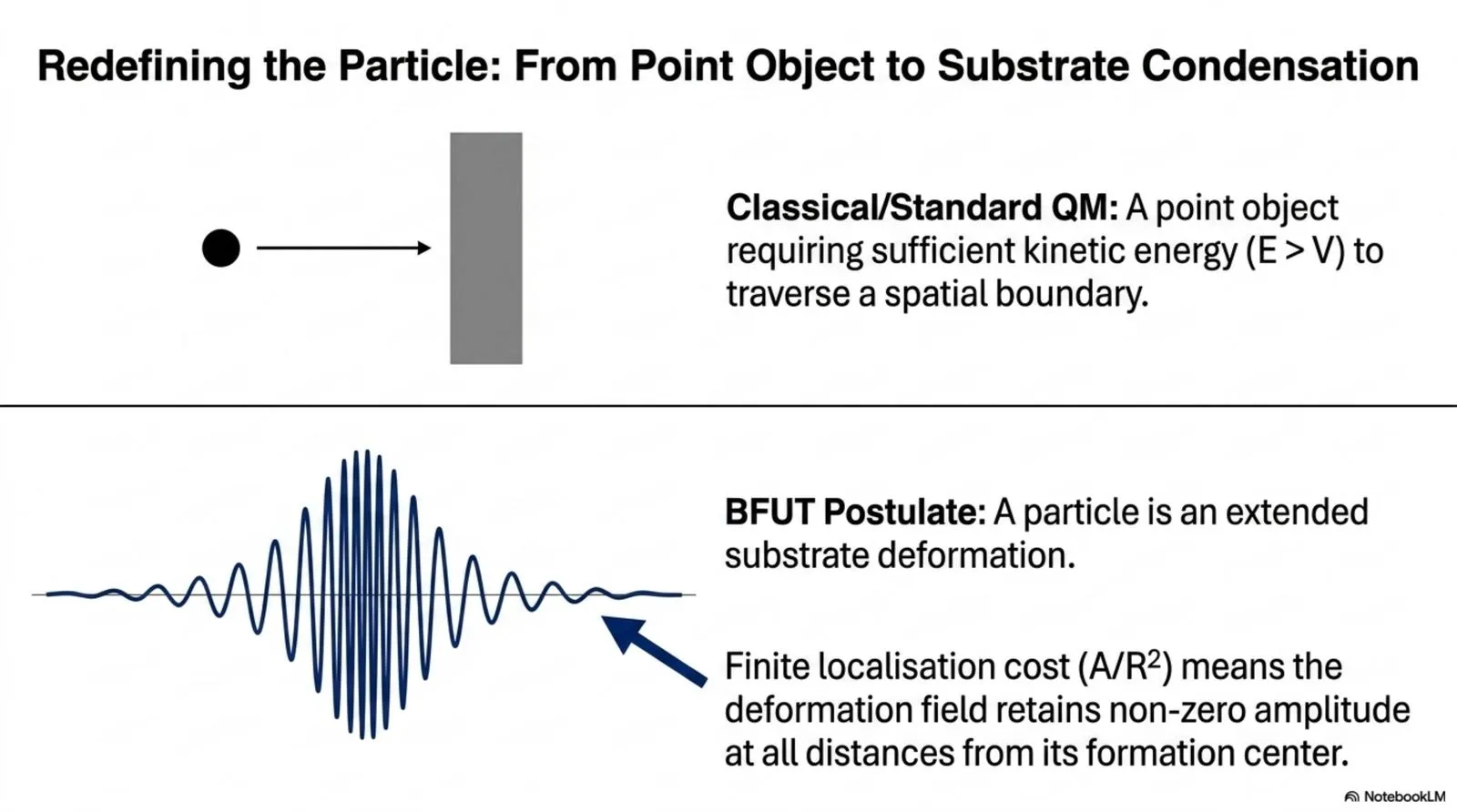
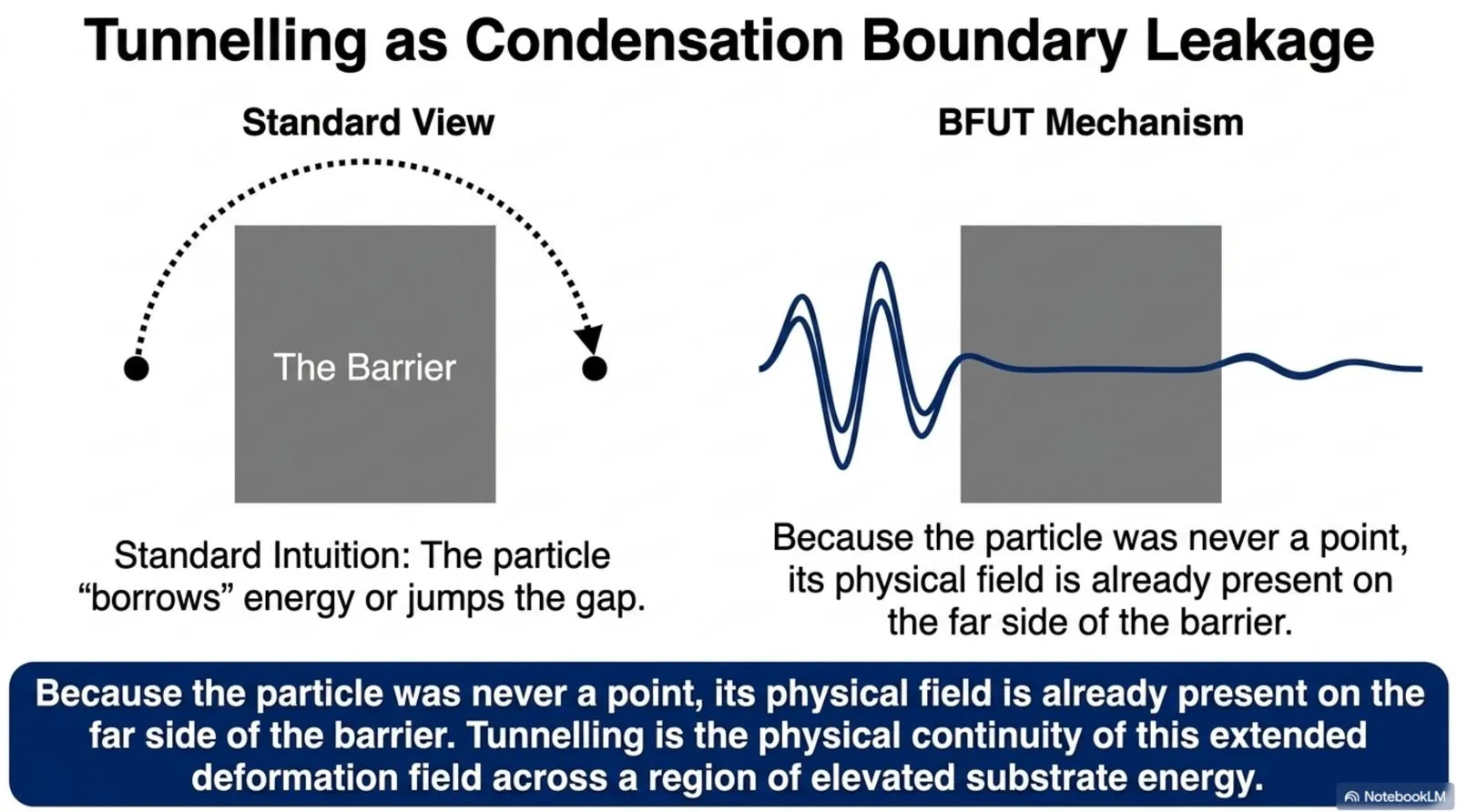
The central physical distinction is therefore that tunnelling does not require a particle to cross a classically forbidden region as a point object. Instead, the particle already occupies an extended physical configuration whose exponentially decaying deformation field remains continuous across the barrier.
When such a condensation encounters a potential barrier, a region in which sustaining a stable condensation is energetically disfavoured but not strictly forbidden by the substrate’s governing dynamics, the condensation’s deformation field does not terminate abruptly at the barrier boundary. It reorganises continuously across the barrier whenever the barrier width is comparable to or smaller than the coherence length of the deformation field, with the amplitude on the far side determined by the ratio of the barrier width to this coherence length. Under this account, the condensation does not travel through the barrier material at any speed exceeding the substrate’s propagation limit c, established independently in the previous derivation of the speed of light [9], and no violation of energy conservation is required at any stage; the deformation field simply retains a physically real, if exponentially suppressed, amplitude at all radii, as a direct consequence of the finite localisation cost established independently in [10].
5. Deriving the Tunnelling Decay Constant from Condensation Geometry
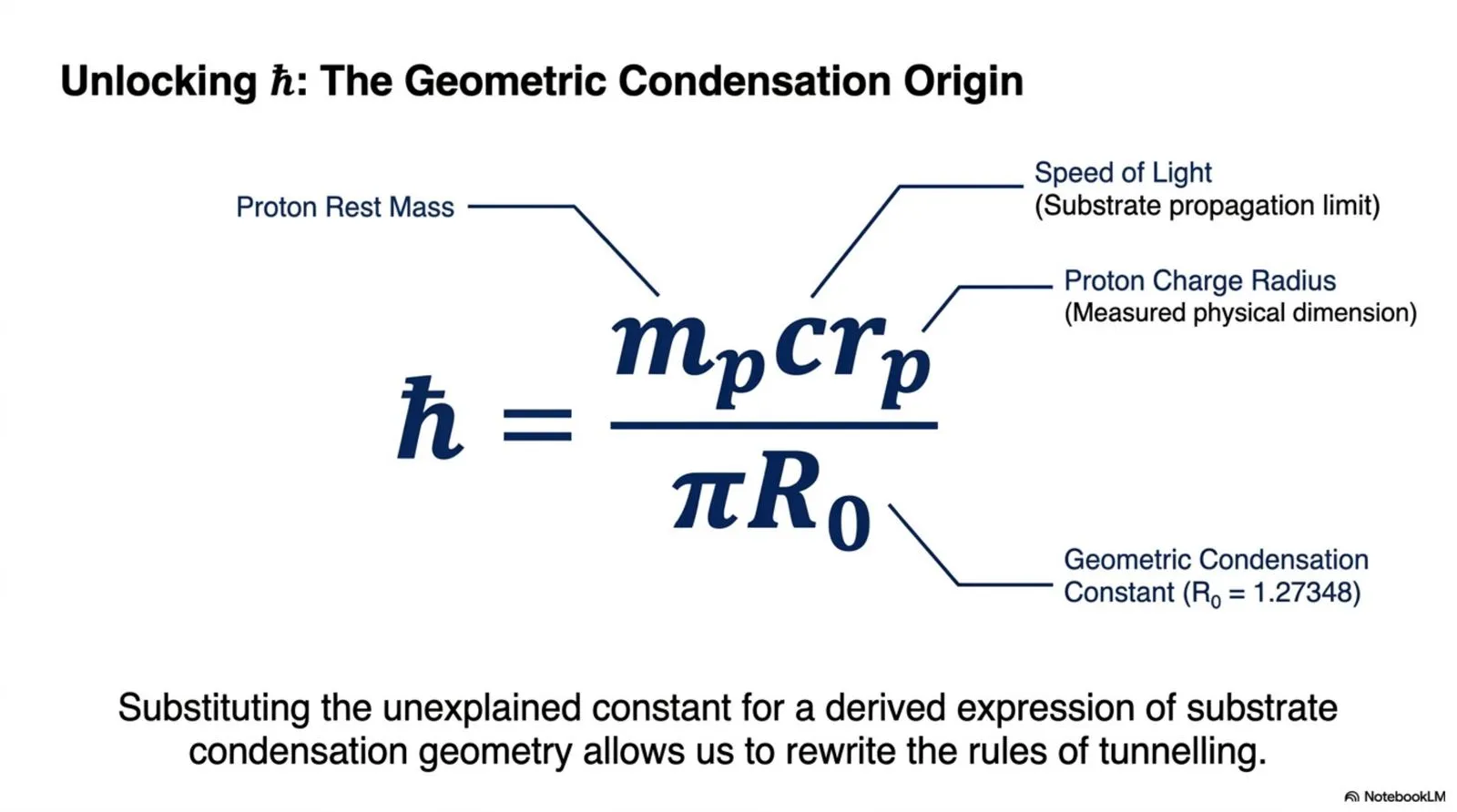
The standard quantum mechanical decay constant governing the exponential suppression of the wavefunction within a barrier is κ = the square root of (2m(V minus E)) divided by hbar [4]. Substituting the substrate’s independently derived expression for the reduced Planck constant, hbar = mp c rp / (π R0), established in previous work [10] using only the proton mass, the speed of light, the independently measured proton charge radius, and the dimensionless condensation constant R0 = 1.27348, gives:
κ = π R0 √(2m(V−E)) / (mp c rp) (1)
Equation (1) therefore gives κ a direct physical interpretation. Rather than representing an abstract mathematical decay constant, κ measures how rapidly the deformation amplitude of an extended substrate condensation decreases within a region where maintaining that deformation is energetically unfavourable.
This substitution does not change the numerical value of κ for any given barrier problem, since the substrate expression for hbar reproduces the measured value of hbar to 0.0007 percent [10]; what it does is make the physical content of κ explicit in terms of condensation-geometry quantities rather than treating hbar as an unexplained fundamental constant. Every quantity appearing in equation (1) is independently determined. Neither κ nor any tunnelling observation is used in establishing R0, mp, rp, or the derived expression for hbar. Equation (1) expresses κ as the inverse of the condensation length ell_model = rp/(π R0), multiplied by the dimensionless ratio of the barrier energy deficit to the proton rest energy scale.
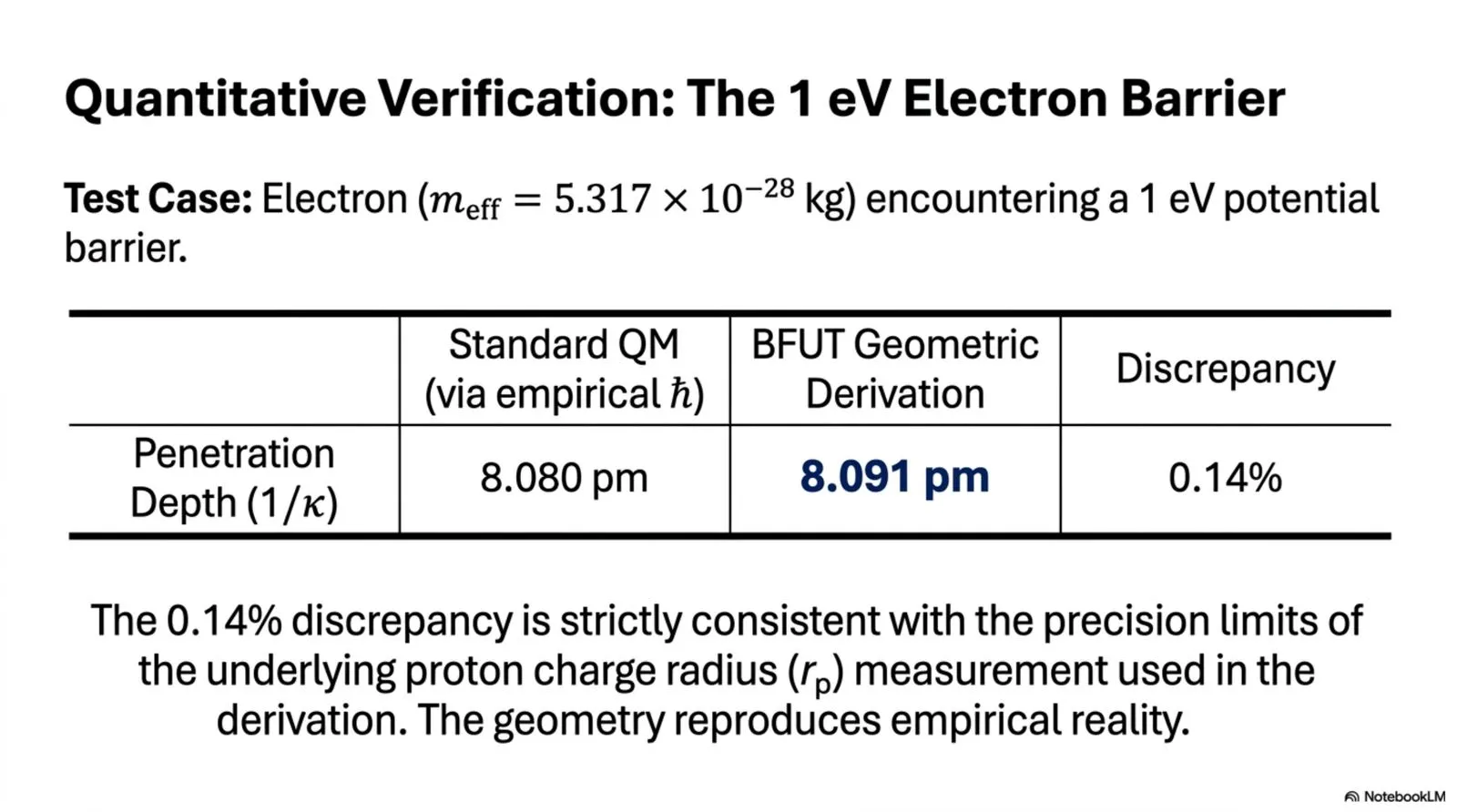
For a representative tunnelling problem — an electron of effective mass meff = 5.317 times 10-28 kg encountering a 1 eV potential barrier — the penetration depth 1/κ, evaluated using equation (1), gives 8.091 pm, against the standard quantum mechanical value of 8.080 pm computed directly from the measured value of hbar, a difference of 0.14 percent, consistent with the precision of the underlying condensation-geometry derivation of hbar itself [10]. The full tunnelling transmission probability follows directly:
T = exp(−2π R0 d √(2m(V−E)) / (mp c rp)) (2)
where d is the barrier width. We emphasise precisely what equations (1) and (2) do and do not establish: they do not modify the numerical predictions of standard quantum mechanical tunnelling calculations, which are reproduced to the same precision as the underlying substrate derivation of hbar; what they establish is that the tunnelling decay constant, conventionally expressed in terms of an unexplained fundamental constant, can be expressed entirely in terms of independently measured condensation-geometry quantities, consistent with the extended-deformation physical picture of Section 4.
6. Discussion: Physical Interpretation and Anticipated Objections
6.1 Physical Interpretation
Within the proposed interpretation, tunnelling is not a mysterious violation of classical expectations but a direct consequence of a particle’s extended, non-pointlike physical structure: because a substrate condensation has a finite localisation cost at every radius, its deformation field is never strictly zero at any distance, and the exponential suppression of tunnelling probability with barrier width is the exponential decay of this already-present, physically real field amplitude, rather than the improbable creation of amplitude where none previously existed.
6.2 "Does this merely restate the mathematics of the Schrodinger equation in different language?"
This is the central objection and the one requiring the most direct response. The numerical predictions of equations (1) and (2) are, by construction, identical to the standard quantum mechanical tunnelling formulas, since the substitution used is an independently verified expression for hbar rather than a new physical law. A second common intuition is that tunnelling simply occurs because particles find microscopic gaps between atoms. This explanation is insufficient because many of the best-established tunnelling phenomena involve no such gaps. Α decay occurs entirely within the atomic nucleus, where no interatomic voids exist. Scanning tunnelling microscopy operates across a vacuum gap, and Josephson junctions involve tunnelling through a continuous insulating barrier. The common feature in all these cases is not the presence of physical openings but the existence of a finite potential-energy barrier. The present interpretation therefore attributes tunnelling to the continuous spatial extent of an extended substrate deformation rather than to geometric passage through microscopic gaps. What is proposed as new content is the physical picture underlying the mathematics: not that a point particle improbably appears on the far side of a barrier, but that an extended substrate deformation, with a specific and independently derived localisation structure established in previous work [10], has continuously non-zero amplitude at all radii from the outset. This is a specific, physically motivated account of why tunnelling should exist at all — because particles are extended condensations with finite localisation cost, not point objects — rather than a restatement of the phenomenon’s mathematics without physical content. The proposal therefore does not replace the Schrodinger equation. It proposes a physical interpretation of why the exponentially decaying solution exists in the first place.
6.3 "Why should tunnelling probability be universal across different material systems, as this account suggests?"
Equation (1) predicts that any condensation’s characteristic penetration depth is set by the same condensation length scale ell_model = rp/(π R0), modulated only by the specific mass and energy deficit of the tunnelling problem at hand. This predicts that tunnelling probability curves across different material systems, when expressed in terms of this shared condensation length scale rather than in raw physical units, should collapse onto a common functional form; this is addressed as a specific, testable prediction in Section 7 rather than assumed as an established result. This prediction concerns the underlying scaling law rather than identical tunnelling probabilities. Different materials retain different effective masses and barrier energies, but the governing length scale is predicted to arise from the same underlying condensation geometry.
6.4 "Does this modify any confirmed prediction of quantum mechanics?"
No established prediction of quantum tunnelling is affected. The proposal offers a physical picture of what tunnelling is; it does not modify the Schrodinger equation, the standard tunnelling transmission formula, or any confirmed measurement of α-decay half-lives, scanning tunnelling microscopy currents, or semiconductor tunnel-junction behaviour [1,2,3]. The proposed framework therefore supplements quantum mechanics with a physical mechanism for tunnelling while leaving every experimentally verified quantitative prediction unchanged.
7. Falsifiable Predictions
The condensation-geometry account of quantum tunnelling makes the following falsifiable predictions.
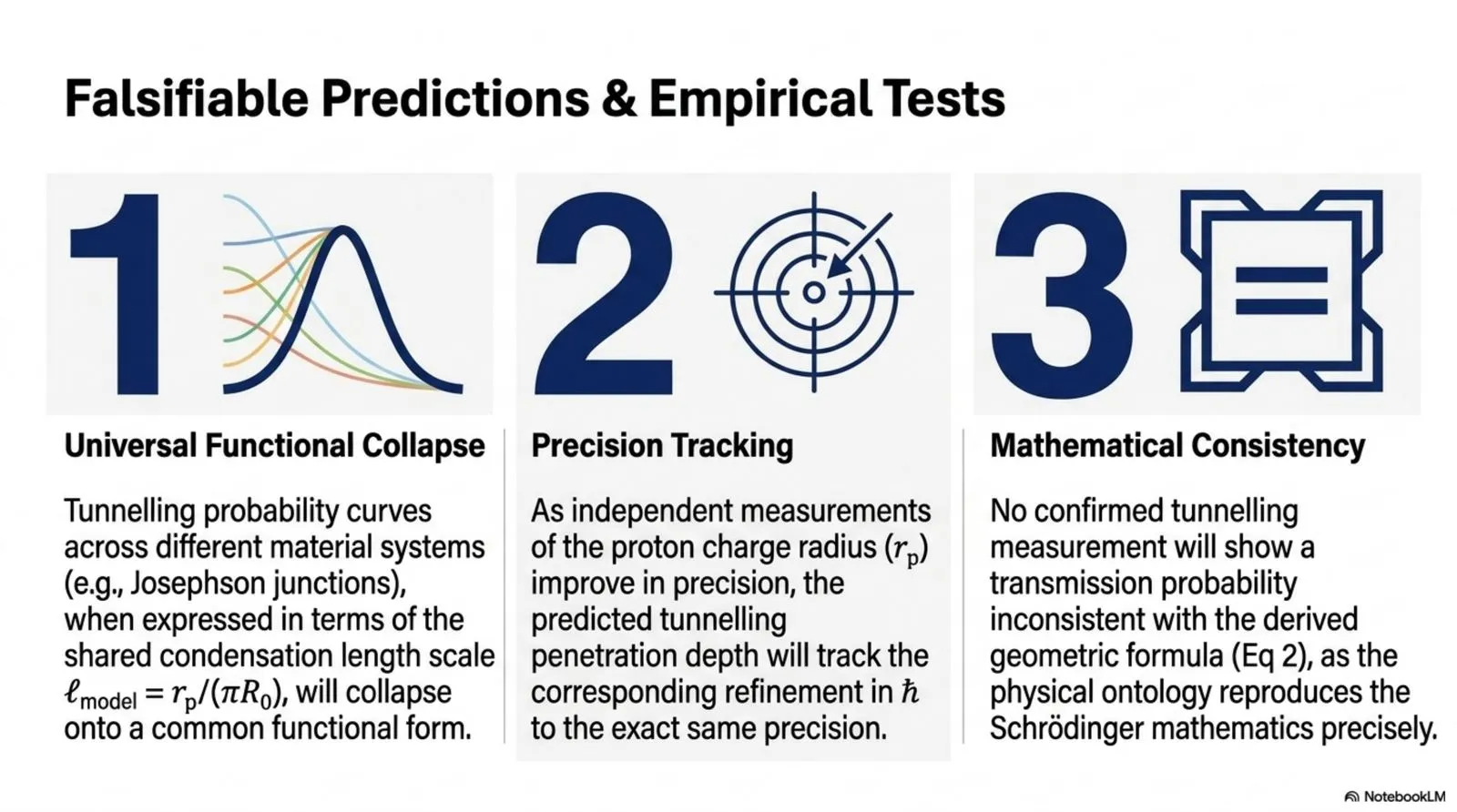
Prediction 1. Tunnelling probability curves across different material systems, expressed in terms of the shared condensation length scale ell_model = rp/(π R0) rather than in raw physical units, are expected to collapse onto a common functional form set by the condensation free-energy functional established in previous work [10]; a confirmed, systematic failure of this collapse across a representative range of Josephson junction and tunnel-diode material systems would be inconsistent with the universal condensation-geometry origin proposed here.
Prediction 2. Independent refinements of the condensation geometry, particularly improved determinations of R0 and related geometric quantities, are predicted to produce corresponding refinements in both the derived value of hbar and the tunnelling decay constant without introducing additional adjustable parameters. Failure of these quantities to remain mutually consistent would falsify the proposed common geometric origin.
Prediction 3. No confirmed tunnelling measurement, across nuclear, atomic, or condensed-matter systems, will show a transmission probability inconsistent with equation (2) at any barrier width or energy deficit accessible to precision measurement, since the proposed account reproduces the standard quantum mechanical formula exactly rather than introducing any independent numerical modification.
8. Conclusions
We have proposed a physical account of quantum tunnelling from the extended, non-pointlike structure of a particle as a condensation of a universal physical substrate. Under this proposal, a particle’s substrate deformation field retains non-zero amplitude at every radius from its formation centre, as a direct consequence of the finite localisation cost established independently in the previous derivation of the reduced Planck constant, and tunnelling is the physical continuity of this extended field across a region of elevated substrate energy rather than the improbable passage of a point particle through a classically forbidden region. Substituting the substrate’s independently derived expression for hbar into the standard tunnelling decay formula reproduces the measured penetration depth for a representative electron-barrier problem to within 0.14 percent, using no adjustable parameter beyond those already fixed in related condensation-geometry literature.
Within this interpretation, quantum tunnelling is no longer an unexplained consequence of wave mechanics alone. It is the observable manifestation of the finite spatial extent of a particle’s underlying substrate deformation, whose continuously decaying amplitude naturally persists across classically forbidden regions. The standard tunnelling equations are retained unchanged, while the present work proposes a physical origin for the exponential decay they describe.
References
[1] Gamow, G. (1928). Zur Quantentheorie des Atomkernes. Zeitschrift für Physik, 51(3–4), 204–212.
[2] Binnig, G. and Rohrer, H. (1982). Scanning tunneling microscopy. Helvetica Physica Acta, 55(6), 726–735.
[3] Josephson, B.D. (1962). Possible new effects in superconductive tunnelling. Physics Letters, 1(7), 251–253.
[4] Griffiths, D.J. and Schroeter, D.F. (2018). Introduction to Quantum Mechanics, 3rd edition. Cambridge University Press, Cambridge.
[5] Landauer, R. and Martin, T. (1994). Barrier interaction time in tunneling. Reviews of Modern Physics, 66(1), 217–228.
[6] Sharma, V.S. (2026). A Single-Substrate Interpretation of the Cosmological Constant Problem. Zenodo. doi:10.5281/zenodo.21280358
[7] Michelson, A.A. and Morley, E.W. (1887). On the relative motion of the Earth and the luminiferous ether. American Journal of Science, 34(203), 333–345.
[8] Müller, H., Herrmann, S., Braxmaier, C., Schiller, S., and Peters, A. (2003). Modern Michelson-Morley experiment using cryogenic optical resonators. Physical Review Letters, 91, 020401.
[9] Sharma, V.S. (2026). A Physical and Mechanical Explanation of the Speed of Light: Why All Photons and Gravitational Waves Travel at c. Zenodo. doi:10.5281/zenodo.21292900
[10] Sharma, V.S. (2026). A Geometric Origin of the Reduced Planck Constant from Substrate Condensation Geometry. Zenodo. doi:10.5281/zenodo.21280494
[11] Esaki, L. (1958). New phenomenon in narrow germanium p-n junctions. Physical Review, 109(2), 603–604.
[12] Razavy, M. (2003). Quantum Theory of Tunneling. World Scientific, Singapore.
[13] Merzbacher, E. (2002). The early history of quantum tunneling. Physics Today, 55(8), 44–49.
[14] Rovelli, C. (2004). Quantum Gravity. Cambridge University Press, Cambridge.
[15] ATLAS Collaboration (2012). Observation of a new particle in the search for the Standard Model Higgs boson with the ATLAS detector at the LHC. Physics Letters B, 716(1), 1–29.
[16] CMS Collaboration (2012). Observation of a new boson at a mass of 125 GeV with the CMS experiment at the LHC. Physics Letters B, 716(1), 30–61.
[17] Einstein, A. (1920). Äther und Relativitätstheorie. Address delivered at the University of Leiden, 5 May 1920. Springer, Berlin.