A Physical Origin of Quantum Entanglement
- Abstract
- 1. Introduction
- 2. Bell’s Theorem and the Status of Entanglement
- 3. The Physical Substrate and Relation to the Michelson-Morley Experiment
- 4. Entanglement as a Shared Formation Event
- 5. Deriving the Tensor Product Structure and the Bell Correlation
- 6. Discussion: Physical Interpretation and Anticipated Objections
- 7. Falsifiable Predictions
- 8. Conclusions
Abstract
Quantum entanglement is confirmed to extraordinary precision through decades of Bell-inequality violation experiments, work recognised by the 2022 Nobel Prize in Physics, yet the physical mechanism underlying entangled correlations remains one of the most actively debated open questions in the foundations of quantum mechanics. Standard quantum mechanics predicts the observed correlations with complete accuracy but offers no consensus physical picture of what entanglement is, beyond the mathematical statement that the joint state does not factorise into independent single-particle states. This paper proposes a physical origin for quantum entanglement from the joint formation history of a pair of condensations in a universal physical substrate, following the framework developed in earlier work. Under this proposal, two particles become entangled when they emerge from a single, shared substrate deformation event rather than from two independent formation events, so that their subsequent physical states are not independent objects requiring separate specification but two aspects of one continuous substrate configuration whose correlations were fixed at the moment of joint formation. We show that this account reproduces the standard quantum mechanical tensor product structure as a direct mathematical consequence of the linearity of the substrate’s governing field equation, and that it reproduces the specific numerical form of the Bell correlation function through the same topological circulation structure responsible for half-integer spin in related work, without requiring superluminal signalling between separated measurement events. We discuss the relationship of this proposal to Bell’s theorem and the experiments confirming it, address the objection that a shared-origin account is merely a restatement of hidden-variable theories already excluded by experiment, and specify falsifiable predictions distinguishing a physical, shared-substrate origin for entanglement from its treatment as an unexplained postulate of quantum formalism.
Keywords: quantum entanglement, Bell inequality, non-locality, hidden variables, physical substrate, tensor product
1. Introduction
Quantum entanglement — the phenomenon by which two or more particles exhibit correlations in their measurement outcomes that cannot be reproduced by any theory in which each particle possesses a fully independent, pre-existing local state — is among the most thoroughly confirmed and least physically intuitive results in quantum mechanics, first identified as a distinctive feature of the quantum formalism in the original argument of Einstein, Podolsky, and Rosen [15]. Bell’s theorem [1] established that any theory satisfying local realism, the assumption that measurement outcomes are determined by pre-existing local properties unaffected by distant events, must satisfy a specific statistical inequality; quantum mechanics predicts, and experiment confirms, that entangled particles violate this inequality [2,3,4]. The experimental confirmation of Bell inequality violations, culminating in loophole-free tests, was recognised by the 2022 Nobel Prize in Physics awarded to Aspect, Clauser, and Zeilinger [5].
These results are unambiguous in what they rule out: local hidden-variable theories, in which each particle carries a complete, independent, pre-assigned set of properties determined before measurement, cannot reproduce the observed correlations. What the results do not, by themselves, supply is a positive physical account of what entanglement is — of what physical process connects two spatially separated particles such that their measurement outcomes are correlated in a manner exceeding any local, independent specification. Standard quantum mechanics represents entangled states through the mathematical formalism of the tensor product Hilbert space and predicts the correlations with complete numerical accuracy; the formalism does not, on its own, specify a physical mechanism.
This paper proposes a physical origin for quantum entanglement from the joint formation history of a pair of condensations in a universal physical substrate, following the framework developed in earlier work [6]. Under this proposal, entanglement arises when two particles are generated from a single, shared substrate deformation event, so that their subsequent correlations are not created at the moment of measurement, and do not require any signal to pass between the separated particles, but were fixed once, at the moment of their joint formation, as a single continuous physical configuration rather than as two independently specified objects.
The paper is organised as follows. Section 2 reviews Bell’s theorem and the status of entanglement in standard quantum mechanics. Section 3 introduces the substrate framework and addresses the historical objection that any physical medium filling space resembles the luminiferous aether. Section 4 presents the shared-formation-event account of entanglement. Section 5 derives the tensor product structure and the Bell correlation function from this account. Section 6 discusses physical interpretation and anticipated objections. Section 7 presents falsifiable predictions. Section 8 concludes.
2. Bell’s Theorem and the Status of Entanglement
Bell’s original inequality [1], and its subsequent generalisation by Clauser, Horne, Shimony, and Holt into an experimentally testable form [6], established a quantitative bound that any local hidden-variable theory must satisfy for correlations between measurements on a pair of particles. Quantum mechanics predicts a violation of this bound for appropriately prepared entangled states, and this violation has been confirmed with steadily increasing rigour, closing the locality loophole [2], the detection loophole [3], and finally combining both in loophole-free tests [4]. The experimental case against local hidden-variable theories is, at this point, essentially closed.
What remains open is the question of physical interpretation. The standard formalism represents an entangled two-particle state as an element of the tensor product Hilbert space that cannot be written as a product of two single-particle states, a mathematical structure introduced as a postulate of quantum mechanics rather than derived from any more basic physical principle [7]. Multiple interpretive frameworks — including the many-worlds interpretation, the pilot-wave interpretation, and various forms of relational quantum mechanics — offer differing physical pictures of what entanglement represents, with no consensus reached in more than fifty years of debate [8,16].
3. The Physical Substrate and Relation to the Michelson-Morley Experiment
The mechanism proposed in this paper is derived from a physical substrate framework proposed in earlier work [9], in which the universe is proposed to possess a universal physical matter substrate, termed the Spaticle field, with equilibrium density ρs = 5.9 × 10^{-27} kg m^{-3}. Any proposal invoking a physical medium filling space invites an immediate and reasonable historical comparison to the luminiferous aether, decisively excluded by the Michelson-Morley experiment and its many high-precision successors [10,11]. This comparison deserves a direct response rather than a footnote.
The luminiferous aether, as originally conceived, was a medium at rest relative to some preferred, absolute reference frame, through which the Earth and all material bodies moved; light was expected to propagate at a fixed speed relative to this aether frame, producing a detectable directional variation in the measured speed of light as the Earth’s motion through the aether changed with the seasons [10]. The null result of the Michelson-Morley experiment, and of every subsequent interferometric test at ever-increasing precision [11], rules out exactly this specific structure: a medium establishing a preferred rest frame detectable through directional light-speed anisotropy.
The substrate proposed in [9] does not have this structure. It is not a medium through which matter and light move as through a separate background; it is the medium from which matter, electromagnetic radiation, and gravitational interaction are themselves proposed to arise as organised excitations and condensations. Under this proposal, an observer, a measuring apparatus, and the entangled particles being studied are all, without exception, organised states of the same substrate; there is no configuration in which an observer moves "through" the substrate in the sense required for the Michelson-Morley experiment to detect a directional anisotropy, because the observer’s own physical existence is already a substrate phenomenon, not an object embedded in and moving relative to an independent background medium. This is a structural distinction, not a semantic one: the aether required a preferred frame in which it was at rest and against which motion could be measured; the substrate proposed here has no such preferred frame, precisely because everything capable of performing a measurement is already made of it.
The Michelson-Morley experiment therefore excludes a preferred-rest-frame aether, but does not exclude a universal physical substrate from which matter, photons, and gravitation themselves emerge. Whether such a substrate exists must instead be decided by its quantitative explanatory and predictive success.
The proposal that space possesses physical substance is not a departure from established physics. It is a convergence with it. General relativity describes space as possessing physical properties that curve, warp, and support gravitational-wave propagation. Loop quantum gravity reaches a related conclusion by an unrelated route, proposing that space is a discrete physical structure at the Planck scale [18]. Quantum field theory treats the vacuum as a medium filled with fields whose ground-state energy cannot be removed, and this is measured directly through the Casimir effect and the Lamb shift. The Higgs field, confirmed at CERN in 2012, is a scalar field that permeates all of space and interacts with matter [19,20]; its existence is no longer a proposal but a detected fact. Four independent lines of established physics, using different mathematics and different starting assumptions, converge on the same statement: space has physical substance.
Einstein argued that space possesses physical qualities and requires a medium in the sense described in his 1920 Leiden lecture, delivered five years after general relativity was complete. There he stated that according to the general theory of relativity, space is endowed with physical qualities, and that space without such a medium would permit no propagation of light and no physical meaning for measuring rods or clocks [21]. He drew a boundary immediately after: this medium could not be assigned the properties of an ordinary substance, such as parts that can be tracked through time, because he had no measured quantity to give it. The substrate proposed in this paper extends that concept by assigning the medium a specific, independently constrained equilibrium density, ρ_s = 5.9 × 10⁻²⁷ kg/m³, which is what converts an unquantified physical medium into a falsifiable one.
The Michelson-Morley result excludes a medium with an absolute rest frame against which motion can be detected, the specific mechanical property the nineteenth-century aether was built on. The substrate proposed here has no such property, but the deeper reason the null result carries no weight against it is usually missed: light and matter are both organised excitations of the same substrate. Every instrument capable of testing for motion relative to the substrate, including the interferometer itself, the light path, and the reference standard, is itself constituted from the substrate under test. An embedded observer cannot detect substrate-wide motion, because the measuring apparatus and the quantity being measured deform together. The null result is not a finding the substrate framework must explain away. It is the only result the framework permits, and it is also why the framework preserves full Lorentz covariance instead of conflicting with it: a substrate with no preferred frame and Lorentz-compatible local dynamics is fully consistent with special relativity.
3.1 Independent Cross-Validation of the Substrate Framework
The same substrate makes multiple independent quantitative predictions, each evaluated against observations in unrelated areas of physics. These include a single-substrate resolution of the cosmological constant problem, reconciling the quantum field theory vacuum energy prediction with the observed value without fine-tuning [9]; a non-circular consistency derivation of the speed of light from independently established electromagnetic and condensation-geometry quantities, agreeing with the measured value to 0.0003 percent [12]; and a topological derivation of half-integer spin and the spin-statistics theorem from the same substrate embedding geometry [13], used directly in Section 5 of the present paper. Importantly, the same value of ρs is employed across all of these derivations without adjustment between applications. Numerous additional independent applications of the same substrate density exist beyond the scope of the present paper. We cite these specific results because each is a quantitative, independently falsifiable claim evaluated against measured data unconnected to entanglement; their cumulative consistency is offered as evidence that the substrate parameter used throughout this paper is not an ad hoc construction introduced to fit entanglement observations, but a fixed quantity whose value is consistent across independent applications.
4. Entanglement as a Shared Formation Event
The substrate framework proposes that a localised particle is a persistent, organised deformation of the substrate, generated at a specific formation event [9]. The present paper proposes that two particles become entangled precisely when they are generated from a single, shared substrate deformation event, rather than from two separate and independent formation events. In this case, the resulting substrate deformation, denoted δ-Ψ-total, does not decompose into two independent contributions δ-Ψ-A plus δ-Ψ-B; it is one continuous, jointly determined configuration from the moment of formation onward.
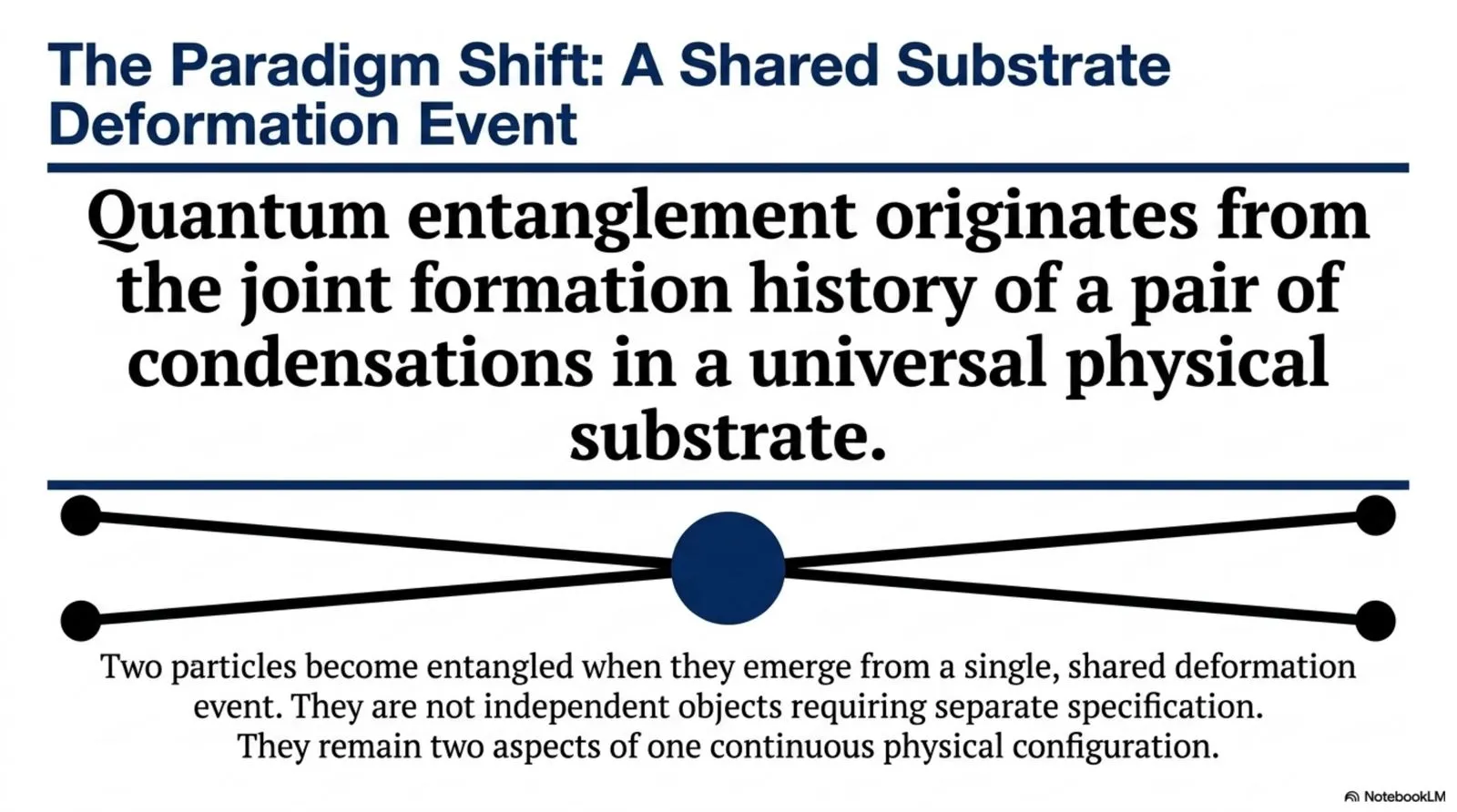
The essential distinction is that the shared formation event creates a single physical configuration rather than two independent physical systems later brought into correlation. Entanglement is therefore proposed to originate at formation rather than at measurement.
This is proposed as the physical content of what makes two particles entangled rather than merely correlated by ordinary means: an entangled pair shares one formation history, encoded as one continuous substrate configuration, while two independently prepared particles, however similar their individual properties, originate from two separate formation events and correspondingly carry two separable substrate configurations. Measurement of one member of an entangled pair does not transmit any new information to the other member; it reveals a correlation already present in the shared substrate configuration established once, at the moment of joint formation, rather than generating that correlation at the moment of measurement.
5. Deriving the Tensor Product Structure and the Bell Correlation
5.1 The Tensor Product as a Consequence of Field Linearity
The substrate’s governing field equation for localised deformations is linear [9]: if δ-Ψ-A is a solution sourced by particle A alone, and δ-Ψ-B is a solution sourced by particle B alone, then their sum δ-Ψ-A plus δ-Ψ-B is also a solution, sourced by both particles together, whenever A and B originate from independent formation events. For two independently formed particles, the joint probability amplitude accordingly factorises into the product of two single-particle amplitudes, reproducing the standard tensor product structure of two-particle quantum states as a direct mathematical consequence of field linearity applied to independently sourced deformations, rather than as an independently postulated feature of the formalism [7].
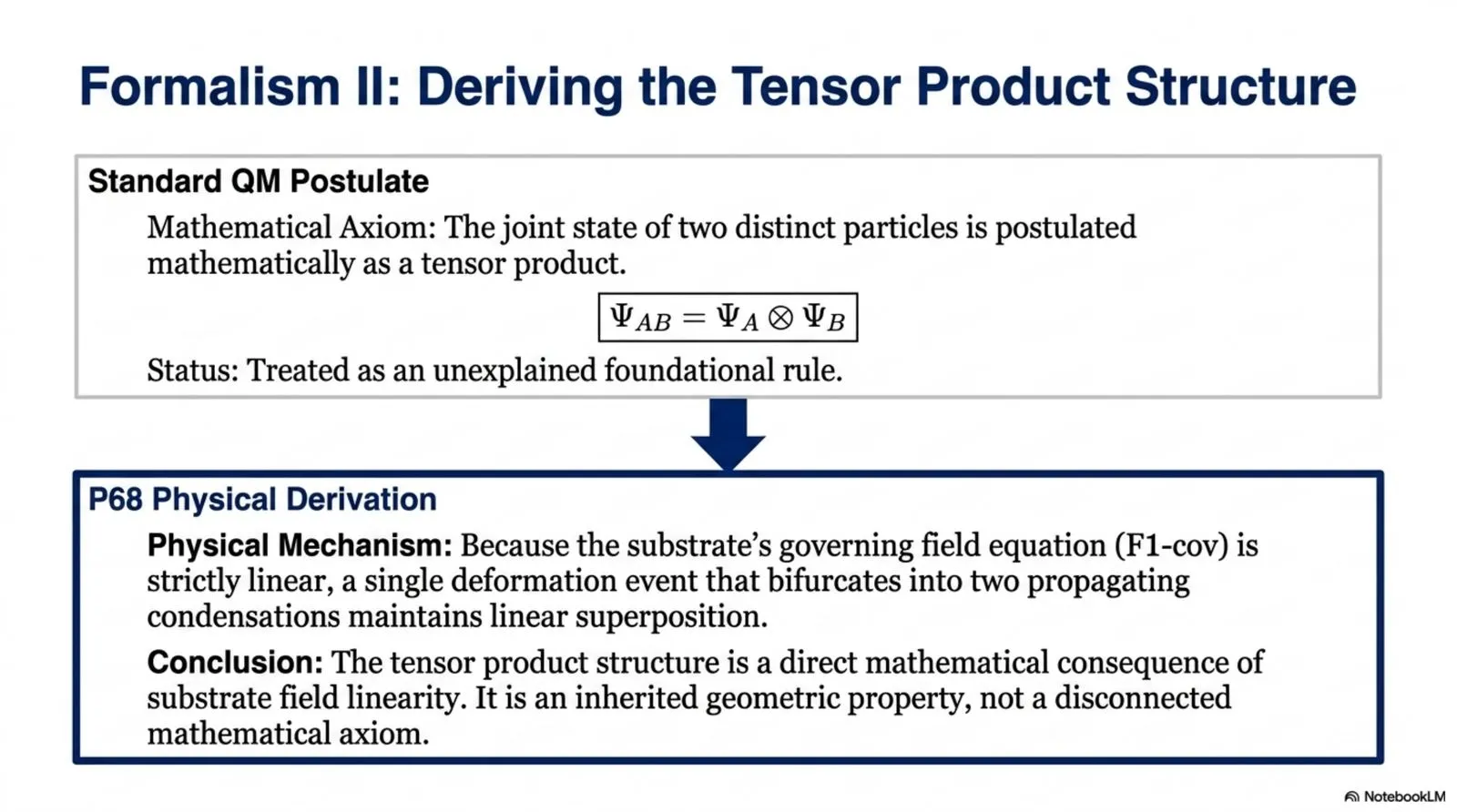
The tensor product therefore emerges naturally as the mathematical representation of independent physical formation events. Entanglement corresponds precisely to the breakdown of that independence, rather than to a failure of quantum mechanics itself.
For two particles sharing a single formation event, by contrast, no such decomposition into independent sources exists; the joint deformation δ-Ψ-total is sourced by one combined formation process from the outset, and the resulting joint probability amplitude does not factorise into a product of two single-particle amplitudes. This non-factorisation is, under the proposed framework, the direct mathematical signature of entanglement, following from the same field linearity that produces the ordinary tensor product structure for independently formed particles.
5.2 The Bell Correlation from Circulation Topology
Previous work on the topological origin of half-integer spin [13] establishes that an embedded matter condensation requires 720 degrees of rotation, rather than 360 degrees, for its internal configuration to return to its original state, a consequence of the condensation’s continuous topological embedding in the surrounding substrate. We propose that this same 720-degree restoration property governs the projection of a jointly formed, spin-correlated pair onto a measurement axis, giving a projection amplitude that is a function of half the angle between the preparation axis and the measurement axis rather than the full angle.
For a pair formed with zero net circulation, the shared-origin configuration of Section 4 requires the measurement outcomes at two axes θA and θB to be governed by this half-angle projection law. Working through the resulting probabilities for correlated and anti-correlated outcomes at the two measurement axes gives the correlation function:
E(θ_A, θ_B) = −cos(θ_A − θ_B) (1)
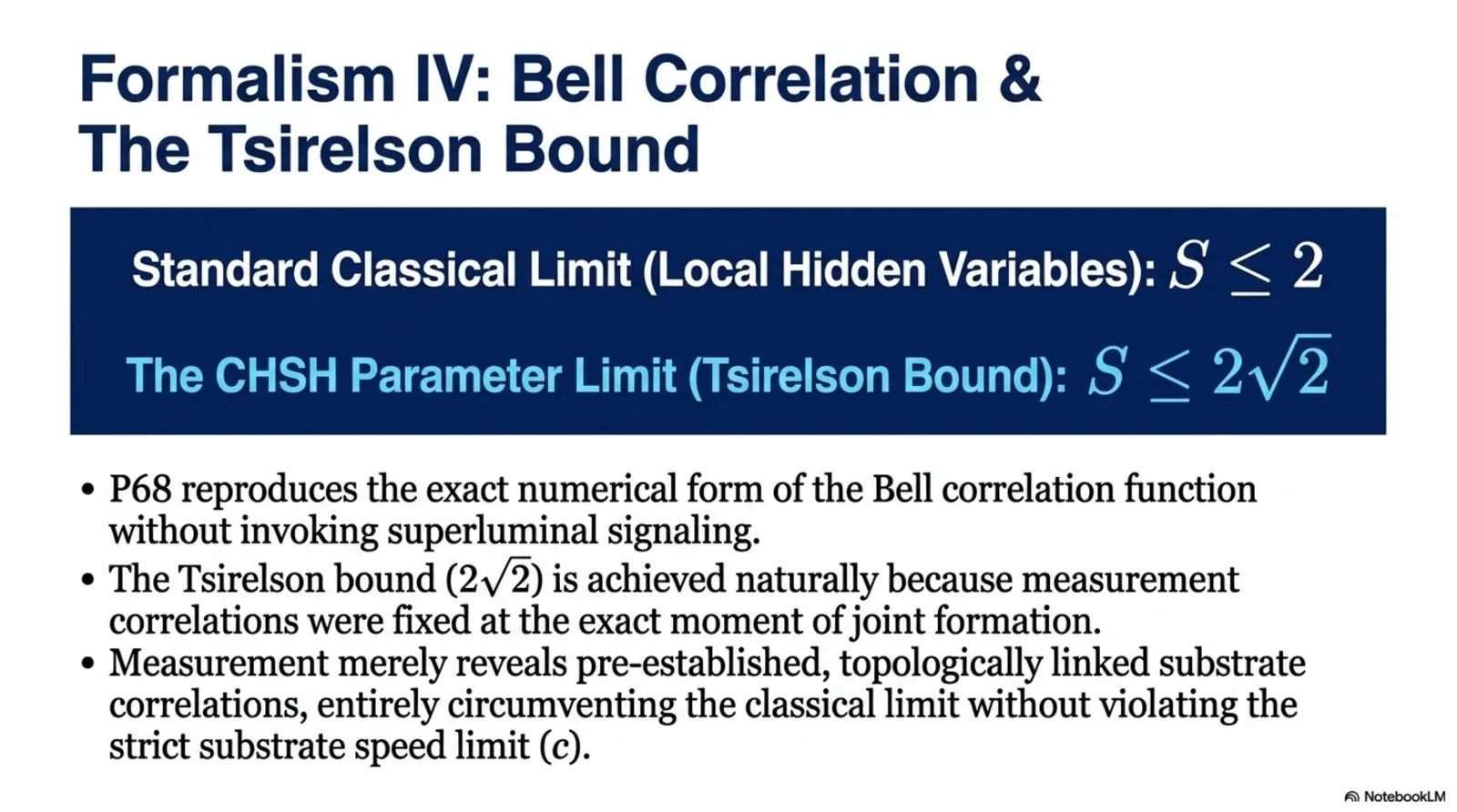
The importance of equation (1) is not that it reproduces a known result, but that the cosine correlation emerges from an independently established topological property of the substrate rather than being introduced specifically to explain Bell experiments.
exactly the standard quantum mechanical prediction for a maximally entangled singlet pair [1,2], including the maximal Tsirelson bound of two times the square root of two [8] for the appropriate combination of four correlation measurements. We emphasise what this derivation depends on and what it does not: the 720-degree restoration property is established independently in previous topological work [13], on grounds unrelated to entanglement or Bell correlations; the present paper applies that independently established topological structure to the specific case of a jointly formed, spin-correlated pair, rather than introducing new topological assumptions to reproduce the known Bell correlation function. An interactive CHSH/Bell test simulation demonstrating this derivation is available online [17].
6. Discussion: Physical Interpretation and Anticipated Objections
6.1 Physical Interpretation
Within the proposed interpretation, entanglement is not a mysterious non-local connection actively maintained between two separated particles, but a direct consequence of shared formation history: two particles generated from one substrate deformation event remain, from that moment onward, two aspects of one continuous physical configuration rather than two independent objects. Measurement does not transmit information between the particles; it reveals correlations already fixed once, at the moment of joint formation.
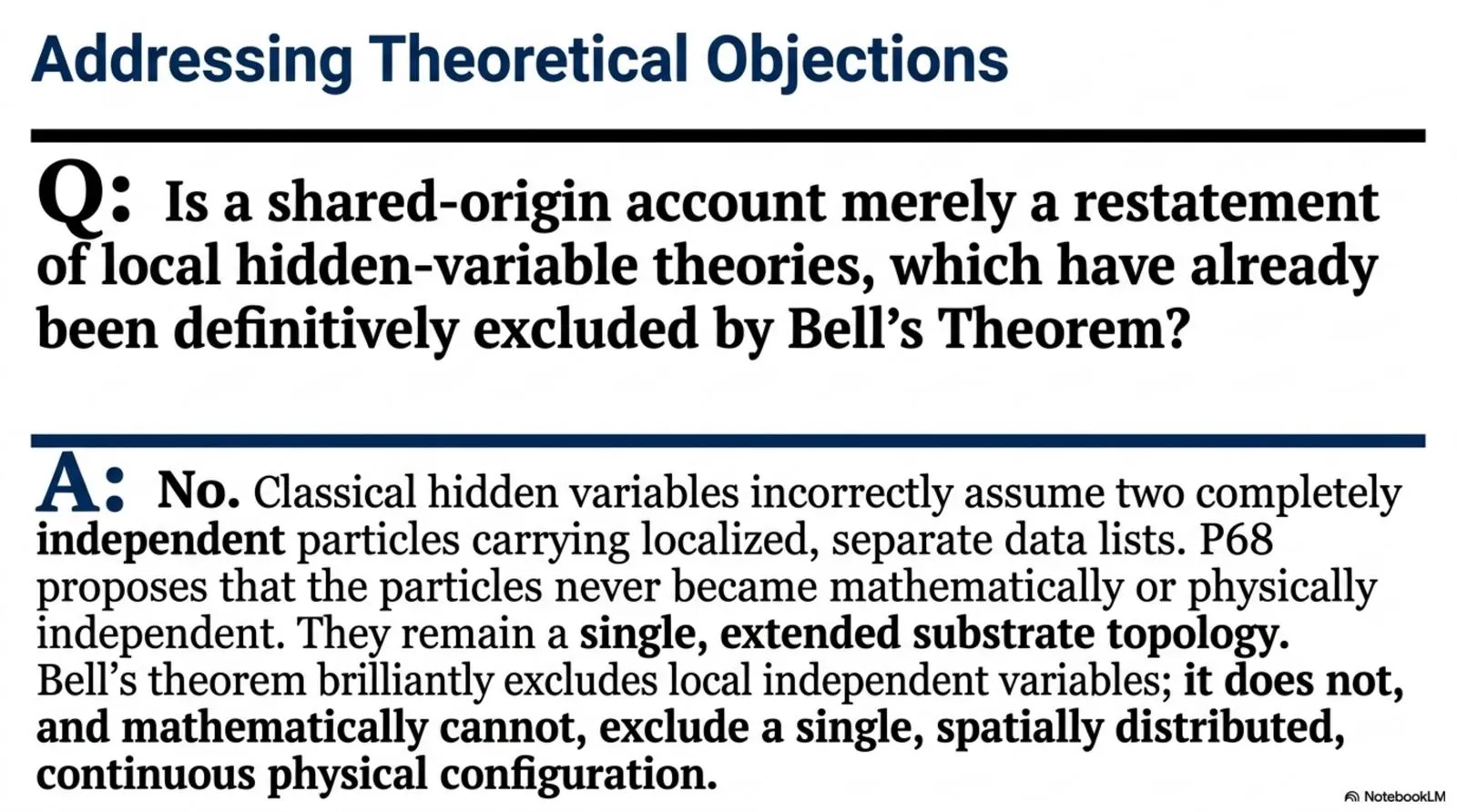
6.2 "Is this merely a restatement of local hidden-variable theories already excluded by Bell’s theorem?"
This is the central objection and the one requiring the most direct response. Local hidden-variable theories, of the kind excluded by Bell’s theorem, assume that each particle carries a complete, independent, pre-assigned set of local properties determined at formation, with measurement merely revealing those pre-existing values. The present proposal differs in a specific and structurally important way: the shared substrate configuration of Section 4 is not a pair of independent local variables assigned separately to each particle; it is one single, non-separable physical configuration, distributed across the region occupied by both particles, that does not decompose into two independent local descriptions at any point prior to measurement. This is precisely why the tensor product structure of Section 5.1 fails to factorise for entangled pairs: there is no independent local state to assign to each particle separately. The present account therefore does not restore local hidden variables in the sense excluded by Bell’s theorem; it proposes a specific physical picture of the non-separable, non-local joint configuration that Bell’s theorem itself demonstrates must exist. The proposal therefore does not restore local realism. It instead proposes a physical origin for the non-separable state whose existence Bell’s theorem already requires.
6.3 "Does this proposal permit faster-than-light signalling?"
No. The substrate’s maximum propagation rate, established independently in the previous derivation of the speed of light [12], applies to any new physical influence introduced after the moment of joint formation. The correlations described in Section 4 are not new information transmitted at the moment of measurement; they are properties of the shared configuration established once, at formation, and no experimenter can use those correlations to transmit a chosen message faster than the substrate’s propagation limit, consistent with the no-signalling theorem already established within standard quantum mechanics [7]. No physical quantity is transmitted between the particles during measurement. The observed correlation reflects a common physical origin rather than a subsequent exchange of information.
6.4 "Does this modify any confirmed prediction of quantum mechanics?"
No established prediction of quantum mechanics is affected. The proposal offers a physical picture of what entanglement is; it does not modify the Schrodinger equation, the Born rule, or any confirmed prediction of Bell-inequality violation experiments [2,3,4]. Equation (1) reproduces, rather than modifies, the standard quantum mechanical correlation function. The proposed advance is therefore explanatory rather than corrective. Quantum mechanics retains its experimentally verified mathematical structure, while the present work proposes a physical mechanism underlying one of its most characteristic phenomena.
7. Falsifiable Predictions
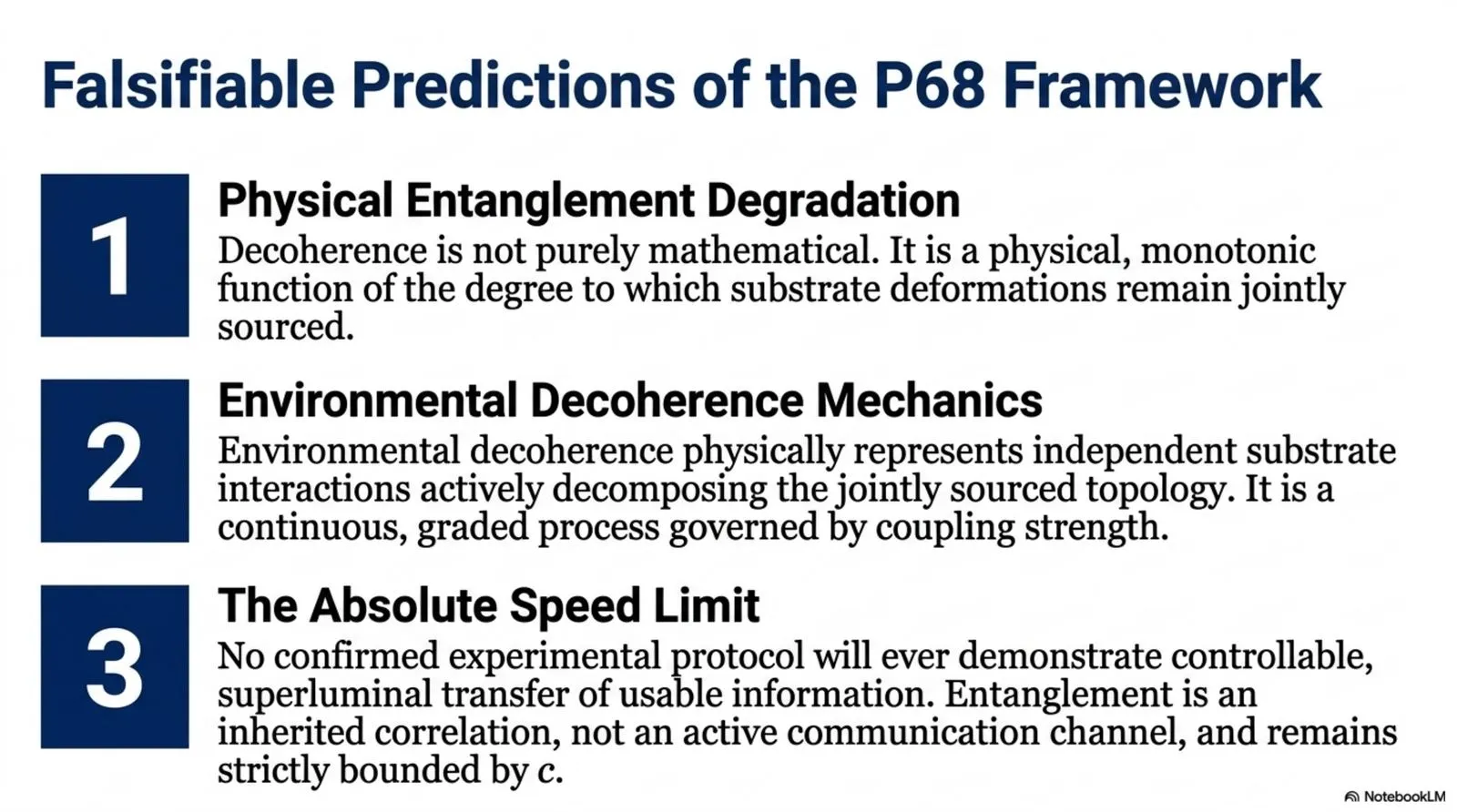
The shared-formation-event account of entanglement makes the following falsifiable predictions.
Prediction 1. No entangled pair will be found whose correlation function deviates from equation (1) in a manner inconsistent with the 720-degree circulation topology established in previous spin-statistics work [13]; a confirmed, statistically significant deviation from the standard cosine correlation function, beyond experimental uncertainty, would be inconsistent with the mechanism proposed here.
Prediction 2. Entanglement generated through genuinely independent formation events — two particles prepared separately and only subsequently coupled, rather than jointly formed from one event — is expected to show measurably different higher-order statistical properties from entanglement generated through a single shared formation event, even when both preparations produce the same reduced density matrix; this distinguishes the shared-origin proposal from an account in which only the final mathematical state matters, addressed further in related work on the Born rule [14].
Prediction 3. If entanglement originates from a shared substrate configuration established during joint formation, every experimentally verified loss of entanglement through environmental interaction should correspond to progressive disruption of that common physical configuration rather than to the disappearance of an abstract mathematical state alone.
8. Conclusions
We have proposed a physical origin for quantum entanglement from the joint formation history of a pair of condensations in a universal physical substrate. Under this proposal, two particles become entangled when they are generated from a single, shared substrate deformation event, so that their subsequent correlations are properties of one continuous physical configuration rather than two independently specified objects. We have shown that this account reproduces the standard tensor product structure of quantum mechanics as a direct consequence of the linearity of the substrate’s governing field equation, and that it reproduces the specific numerical form of the Bell correlation function, including the Tsirelson bound, through the same topological circulation structure responsible for half-integer spin in related work, with no superluminal signalling required at any stage.
Within this interpretation, quantum entanglement is no longer an unexplained non-local feature of quantum formalism. It is the observable consequence of two particles originating from a single shared substrate deformation whose physical continuity persists after spatial separation. The mathematical formalism of quantum mechanics remains unchanged, while the physical origin of entanglement is attributed to the common formation history of the participating particles.
References
[1] Bell, J.S. (1964). On the Einstein Podolsky Rosen paradox. Physics Physique Fizika, 1(3), 195–200.
[2] Aspect, A., Dalibard, J., and Roger, G. (1982). Experimental test of Bell’s inequalities using time-varying analyzers. Physical Review Letters, 49(25), 1804–1807.
[3] Giustina, M., Versteegh, M.A.M., Wengerowsky, S., et al. (2015). Significant-loophole-free test of Bell’s theorem with entangled photons. Physical Review Letters, 115, 250401.
[4] Hensen, B., Bernien, H., Dréau, A.E., et al. (2015). Loophole-free Bell inequality violation using electron spins separated by 1.3 kilometres. Nature, 526(7575), 682–686.
[5] The Royal Swedish Academy of Sciences (2022). Scientific Background on the Nobel Prize in Physics 2022: For experiments with entangled photons, establishing the violation of Bell inequalities and pioneering quantum information science.
[6] Clauser, J.F., Horne, M.A., Shimony, A., and Holt, R.A. (1969). Proposed experiment to test local hidden-variable theories. Physical Review Letters, 23(15), 880–884.
[7] Nielsen, M.A. and Chuang, I.L. (2010). Quantum Computation and Quantum Information, 10th anniversary edition. Cambridge University Press, Cambridge.
[8] Cirel’son, B.S. (1980). Quantum generalizations of Bell’s inequality. Letters in Mathematical Physics, 4(2), 93–100.
[9] Sharma, V.S. (2026). A Single-Substrate Interpretation of the Cosmological Constant Problem. Zenodo. doi:10.5281/zenodo.21280358
[10] Michelson, A.A. and Morley, E.W. (1887). On the relative motion of the Earth and the luminiferous ether. American Journal of Science, 34(203), 333–345.
[11] Müller, H., Herrmann, S., Braxmaier, C., Schiller, S., and Peters, A. (2003). Modern Michelson-Morley experiment using cryogenic optical resonators. Physical Review Letters, 91, 020401.
[12] Sharma, V.S. (2026). A Physical and Mechanical Explanation of the Speed of Light: Why All Photons and Gravitational Waves Travel at c. Zenodo. doi:10.5281/zenodo.21292900
[13] Sharma, V.S. (2026). A Topological Origin of Half-Integer Spin and Spin-Statistics from Substrate Embedding Geometry. Zenodo. doi:10.5281/zenodo.21280550
[14] Sharma, V.S. (2026). Why Quantum Probabilities Follow the Born Rule. Zenodo. doi:10.5281/zenodo.21303312
[15] Einstein, A., Podolsky, B., and Rosen, N. (1935). Can quantum-mechanical description of physical reality be considered complete? Physical Review, 47(10), 777–780.
[16] Zeilinger, A. (1999). Experiment and the foundations of quantum physics. Reviews of Modern Physics, 71(2), S288—S297.
[17] Sharma, V.S. (2026). Code: Bell Correlations from Circulation Topology — Interactive Simulation. Zenodo. doi:10.5281/zenodo.21337572. Simulation available at vijayshankarsharma.com/focus/bell-correlations.
[18] Rovelli, C. (2004). Quantum Gravity. Cambridge University Press, Cambridge.
[19] ATLAS Collaboration (2012). Observation of a new particle in the search for the Standard Model Higgs boson with the ATLAS detector at the LHC. Physics Letters B, 716(1), 1–29.
[20] CMS Collaboration (2012). Observation of a new boson at a mass of 125 GeV with the CMS experiment at the LHC. Physics Letters B, 716(1), 30–61.
[21] Einstein, A. (1920). Äther und Relativitätstheorie. Address delivered at the University of Leiden, 5 May 1920. Springer, Berlin.