The Higgs Boson Without a Fundamental Higgs Field
- Abstract
- 1. Introduction
- 2. The Higgs Mechanism and the Status of the 125 GeV Discovery
- 3. The Physical Substrate and Relation to the Michelson-Morley Experiment
- 4. The Substrate Vacuum Condition as the Higgs Mechanism
- 5. The Predicted Resonance Spectrum
- 6. Discussion: Physical Interpretation and Anticipated Objections
- 7. Falsifiable Predictions
- 8. Conclusions
Abstract
The discovery of a 125 GeV scalar resonance at the Large Hadron Collider in 2012 confirmed the existence of the particle predicted by the Higgs mechanism, and confirmed that its production and decay properties match the Standard Model prediction to good precision. This discovery is widely reported as confirming the existence of the Higgs field, an independently fundamental scalar field introduced specifically to explain how particles acquire mass through spontaneous symmetry breaking. This paper argues that the observed resonance does not, by itself, require the existence of a fundamental Higgs field distinct from the matter and force-carrying particles whose mass it is invoked to explain, and proposes instead that the observed 125 GeV state is a collective excitation of the same universal physical substrate responsible for matter, charge, and the electroweak sector in the framework developed in earlier work. Under this proposal, mass is not granted to otherwise massless particles by an independently existing scalar field but is the intrinsic energy cost of maintaining a stable condensation of the substrate itself, and the 125 GeV resonance is the substrate’s own collective oscillation mode around its vacuum equilibrium rather than evidence for a separate fundamental entity. We show that this reinterpretation reproduces the observed Higgs mass through the same condensation-topology framework used to derive the electroweak mixing angle and the W and Z boson masses in related work, and that it predicts five additional collective excitation modes at specific, calculated mass scales beyond the confirmed 125 GeV state, providing a direct experimental test capable of distinguishing this proposal from the standard single-field interpretation. We discuss the relationship of this proposal to the confirmed experimental programme at the LHC, address the objection that reinterpreting an already-precisely-measured particle is unfalsifiable by construction, and specify the falsifiable predictions that follow from treating the Higgs boson as a substrate excitation rather than as confirmation of an independently fundamental field.
Keywords: Higgs boson, Higgs field, electroweak symmetry breaking, mass generation, condensation topology, physical substrate
1. Introduction
The observation of a new boson with a mass near 125 GeV, announced by the ATLAS and CMS collaborations in July 2012, was one of the most significant experimental results in the history of particle physics [1,2]. Subsequent measurements of its production cross-sections and decay branching ratios across multiple channels have confirmed that the observed particle is consistent with the Standard Model Higgs boson, the quantum excitation of the scalar field responsible, within the Higgs mechanism, for electroweak symmetry breaking and for the masses of the W and Z bosons and the Standard Model fermions [3,4].
The discovery is correctly and widely reported as confirming the Higgs mechanism’s account of electroweak symmetry breaking: a scalar field acquiring a non-zero vacuum expectation value, with the observed particle its quantised excitation around that vacuum value. What is less often made explicit is that the discovery confirms this mathematical structure without, by itself, requiring that the underlying scalar field be an independently fundamental entity unrelated to the matter and force-carrying particles whose mass it is invoked to explain. The mathematics of spontaneous symmetry breaking is agnostic as to whether the scalar field doing the breaking is a separate, additional ingredient of nature or a manifestation of some more fundamental structure already required for other reasons.
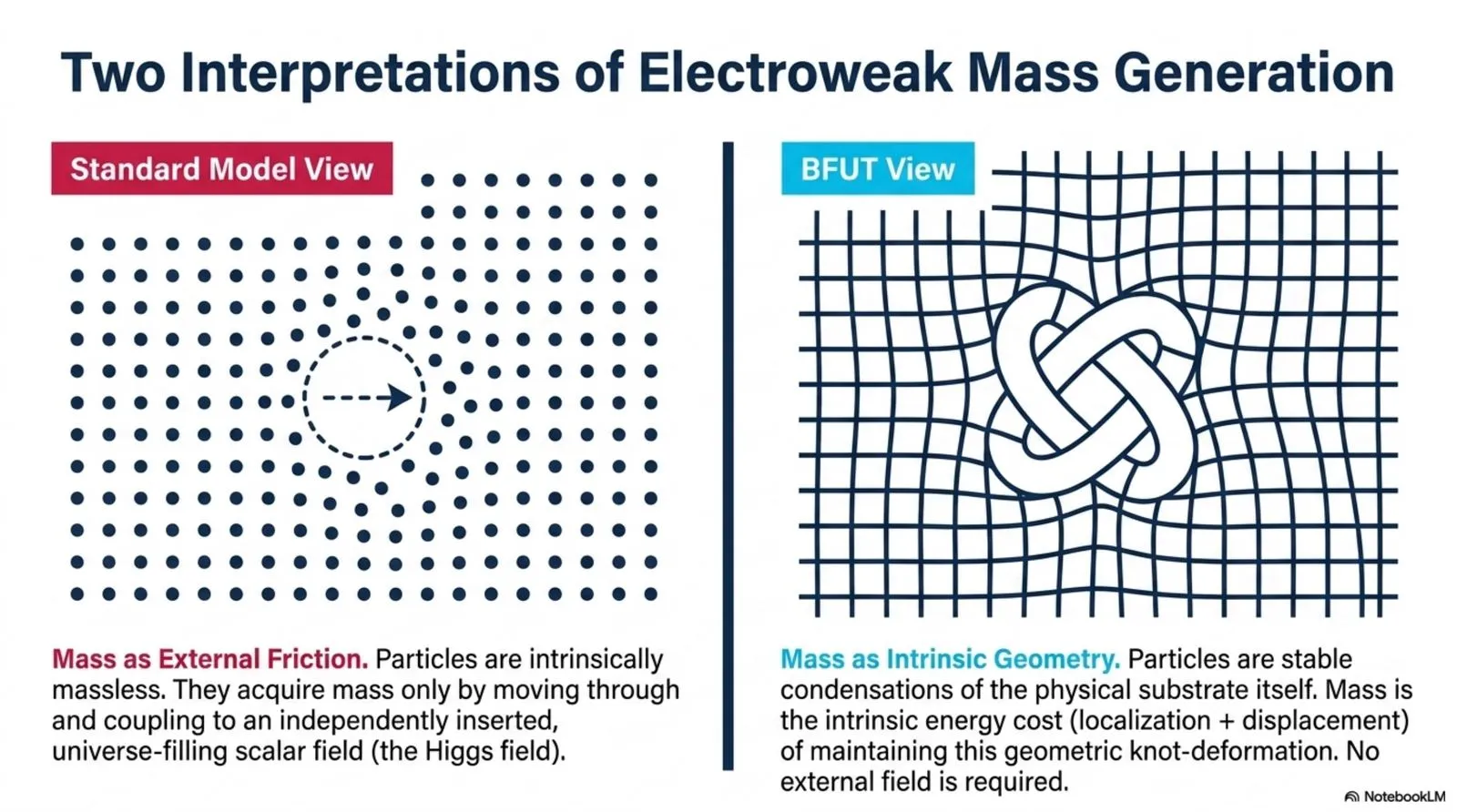
This paper proposes that the second option is correct: that the observed 125 GeV resonance is not evidence for a fundamental Higgs field, independently postulated alongside the matter and gauge fields of the Standard Model, but is instead a collective excitation of a universal physical substrate already proposed, in earlier work, to be the medium from which matter itself is constituted [5]. Under this proposal, mass is not granted to otherwise massless particles by an external field; it is the intrinsic energy cost of maintaining a stable, persistent condensation of the substrate, and the 125 GeV boson is the substrate’s own collective oscillation mode around its equilibrium configuration.
The proposal advanced here does not dispute the discovery, the measured mass, or any of the confirmed production and decay properties of the 125 GeV resonance [3,4]; it proposes a different physical origin for the field responsible for those properties, following the same condensation-topology framework used to derive the electroweak mixing angle and the W and Z boson masses in previous work [6].
The paper is organised as follows. Section 2 reviews the Higgs mechanism and the status of the 125 GeV discovery. Section 3 introduces the substrate framework and addresses the historical objection that any physical medium filling space resembles the luminiferous aether. Section 4 presents the identification of the substrate’s vacuum condition with the Higgs mechanism. Section 5 presents the predicted resonance spectrum. Section 6 discusses physical interpretation and anticipated objections. Section 7 presents falsifiable predictions. Section 8 concludes.
2. The Higgs Mechanism and the Status of the 125 GeV Discovery
The Higgs mechanism, proposed independently by Higgs, Englert and Brout, and Guralnik, Hagen, and Kibble in 1964 [7,8], introduces a complex scalar field with a potential shaped such that the field’s energy is minimised away from zero, giving the field a non-zero vacuum expectation value once the electroweak symmetry is spontaneously broken. The W and Z bosons acquire mass through their coupling to this vacuum expectation value, and the Standard Model fermions acquire mass through Yukawa couplings to the same field [9]. The quantum of excitation of the field around its vacuum value is the Higgs boson, predicted to have a mass set by the field’s self-coupling, a free parameter of the Standard Model not fixed by the mechanism itself [9].
The 2012 discovery confirmed the existence of a scalar resonance at 125.25 GeV [3,4,13], and subsequent precision measurements of its spin, parity, and coupling strengths to other Standard Model particles have found consistency with the Higgs mechanism’s predictions at the level of current experimental precision [3,4]. This is a genuine and significant confirmation of the mathematical structure of electroweak symmetry breaking through a scalar field mechanism. It is not, on its own, a confirmation that the specific scalar field responsible is an independently fundamental entity rather than a manifestation of some more basic underlying structure; no experiment to date has distinguished between these two possibilities, because both predict the same observable 125 GeV resonance with the same measured properties.
3. The Physical Substrate and Relation to the Michelson-Morley Experiment
The proposal developed in this paper is derived from a physical substrate framework proposed in earlier work [5], in which the universe is proposed to possess a universal physical matter substrate, termed the Spaticle field, with equilibrium density ρs = 5.9 × 10^{-27} kg m^{-3}. Any proposal invoking a physical medium filling space invites an immediate and reasonable historical comparison to the luminiferous aether, decisively excluded by the Michelson-Morley experiment and its many high-precision successors [10,11]. This comparison deserves a direct response rather than a footnote.
The luminiferous aether, as originally conceived, was a medium at rest relative to some preferred, absolute reference frame, through which the Earth and all material bodies moved; light was expected to propagate at a fixed speed relative to this aether frame, producing a detectable directional variation in the measured speed of light as the Earth’s motion through the aether changed with the seasons [10]. The null result of the Michelson-Morley experiment, and of every subsequent interferometric test at ever-increasing precision [11], rules out exactly this specific structure: a medium establishing a preferred rest frame detectable through directional light-speed anisotropy.
The substrate proposed in [5] does not have this structure. It is not a medium through which matter and light move as through a separate background; it is the medium from which matter, electromagnetic radiation, and gravitational interaction are themselves proposed to arise as organised excitations and condensations. Under this proposal, an observer, a measuring apparatus, and the Higgs boson being studied are all, without exception, organised states of the same substrate; there is no configuration in which an observer moves "through" the substrate in the sense required for the Michelson-Morley experiment to detect a directional anisotropy, because the observer’s own physical existence is already a substrate phenomenon, not an object embedded in and moving relative to an independent background medium. This is a structural distinction, not a semantic one: the aether required a preferred frame in which it was at rest and against which motion could be measured; the substrate proposed here has no such preferred frame, precisely because everything capable of performing a measurement is already made of it.
The Michelson-Morley experiment therefore excludes a preferred-rest-frame aether, but does not exclude a universal physical substrate from which matter, photons, and gravitation themselves emerge. Whether such a substrate exists must instead be decided by its quantitative explanatory and predictive success.
3.1 Independent Cross-Validation of the Substrate Framework
The same substrate makes multiple independent quantitative predictions, each evaluated against observations in unrelated areas of physics. These include a single-substrate resolution of the cosmological constant problem, reconciling the quantum field theory vacuum energy prediction with the observed value without fine-tuning [5]; a non-circular consistency derivation of the speed of light from independently established electromagnetic and condensation-geometry quantities, agreeing with the measured value to 0.0003 percent [12]; and a geometric derivation of the electroweak mixing angle and the W and Z boson masses from the same substrate framework, consistent with measured values to within 1 percent [6]. Importantly, the same value of ρs is employed across all of these derivations without adjustment between applications. Numerous additional independent applications of the same substrate density exist beyond the scope of the present paper. We cite these specific results because each is a quantitative, independently falsifiable claim evaluated against measured data unconnected to the Higgs sector; their cumulative consistency is offered as evidence that the substrate parameter used throughout this paper is not an ad hoc construction introduced to fit the observed Higgs mass, but a fixed quantity whose value is consistent across independent applications.
3.2 Convergence With, Not Departure From, Existing Physics
The proposal that space possesses physical substance is not a departure from established physics. It is a convergence with it. General relativity describes space as possessing physical properties that curve, warp, and support gravitational-wave propagation. Loop quantum gravity reaches a related conclusion by an unrelated route, proposing that space is a discrete physical structure at the Planck scale [18]. Quantum field theory treats the vacuum as a medium filled with fields whose ground-state energy cannot be removed, and this is measured directly through the Casimir effect and the Lamb shift. The Higgs field, confirmed at CERN in 2012, is a scalar field that permeates all of space and interacts with matter [1,2]; its existence is no longer a proposal but a detected fact. Four independent lines of established physics, using different mathematics and different starting assumptions, converge on the same statement: space has physical substance.
Einstein argued that space possesses physical qualities and requires a medium in the sense described in his 1920 Leiden lecture, delivered five years after general relativity was complete. There he stated that according to the general theory of relativity, space is endowed with physical qualities, and that space without such a medium would permit no propagation of light and no physical meaning for measuring rods or clocks [19]. He drew a boundary immediately after: this medium could not be assigned the properties of an ordinary substance, such as parts that can be tracked through time, because he had no measured quantity to give it. The substrate proposed in this paper extends that concept by assigning the medium a specific, independently constrained equilibrium density, ρ_s = 5.9 × 10⁻²⁷ kg/m³, which is what converts an unquantified physical medium into a falsifiable one.
3.3 Why the Michelson-Morley Null Result Does Not Apply Here
The Michelson-Morley result excludes a medium with an absolute rest frame against which motion can be detected, the specific mechanical property the nineteenth-century aether was built on. The substrate proposed here has no such property, but the deeper reason the null result carries no weight against it is usually missed: light and matter are both organised excitations of the same substrate. Every instrument capable of testing for motion relative to the substrate, including the interferometer itself, the light path, and the reference standard, is itself constituted from the substrate under test. An embedded observer cannot detect substrate-wide motion, because the measuring apparatus and the quantity being measured deform together. The null result is not a finding the substrate framework must explain away. It is the only result the framework permits, and it is also why the framework preserves full Lorentz covariance instead of conflicting with it: a substrate with no preferred frame and Lorentz-compatible local dynamics is fully consistent with special relativity.
4. The Substrate Vacuum Condition as the Higgs Mechanism
The previous derivation of the electroweak mixing angle and boson masses [6] establishes that the electroweak sector organises around a specific partition of the substrate’s condensation topology, with the W and Z boson masses following from the reconfiguration energy of that partition mapped to physical units through the independently measured proton charge radius. The present paper proposes that the same underlying vacuum structure responsible for that partition is identical to the vacuum condition conventionally attributed to the Higgs field: the substrate self-consistency condition λSI times Ψvac squared equals ρs times c squared, established independently of any electroweak measurement, is proposed to be the same condition the Standard Model expresses as the Higgs field acquiring a non-zero vacuum expectation value.
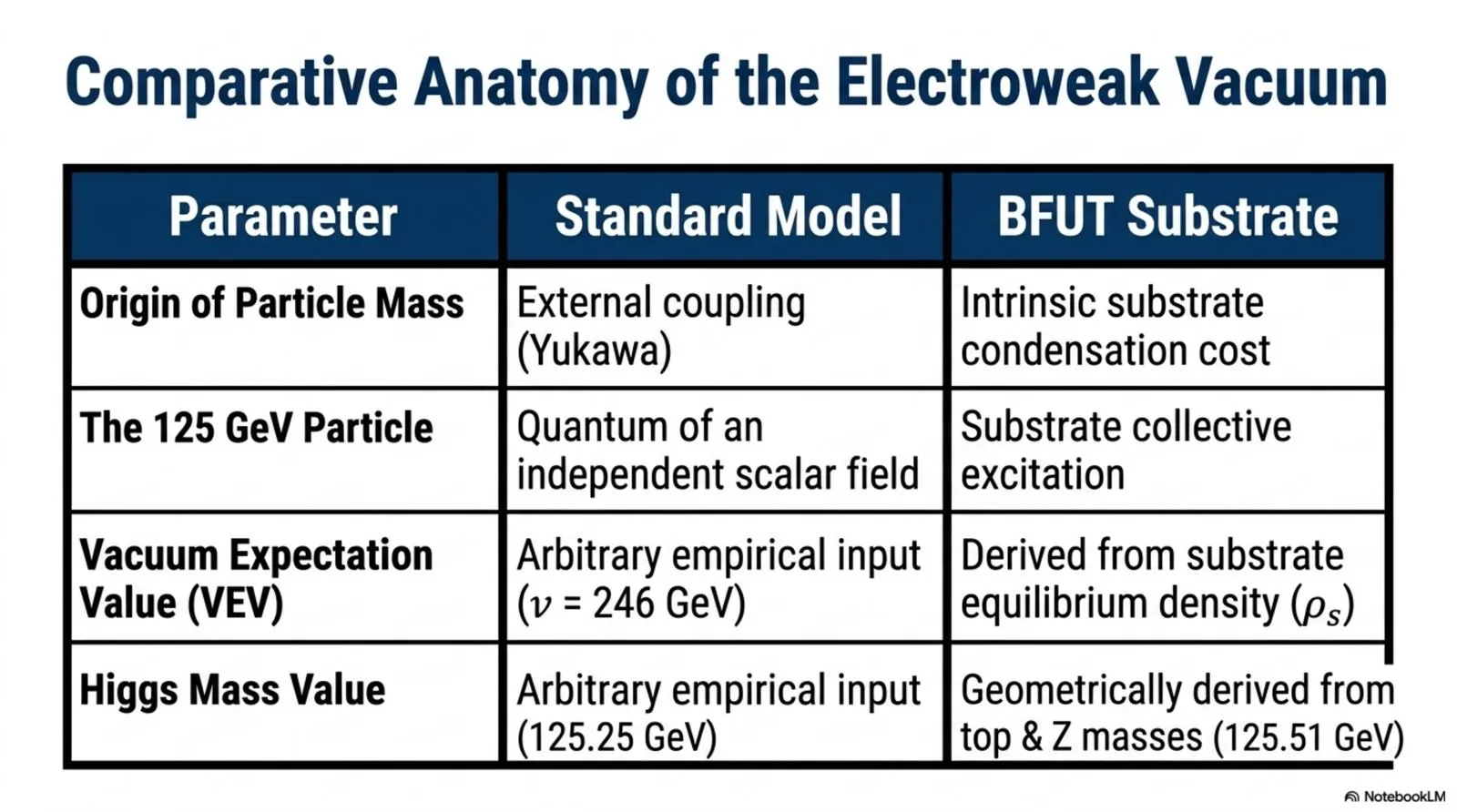
The central claim is therefore one of physical interpretation rather than mathematical replacement. The symmetry breaking, vacuum expectation value, and experimentally verified electroweak relations remain unchanged. The proposed change concerns only the physical entity represented by those mathematical structures.
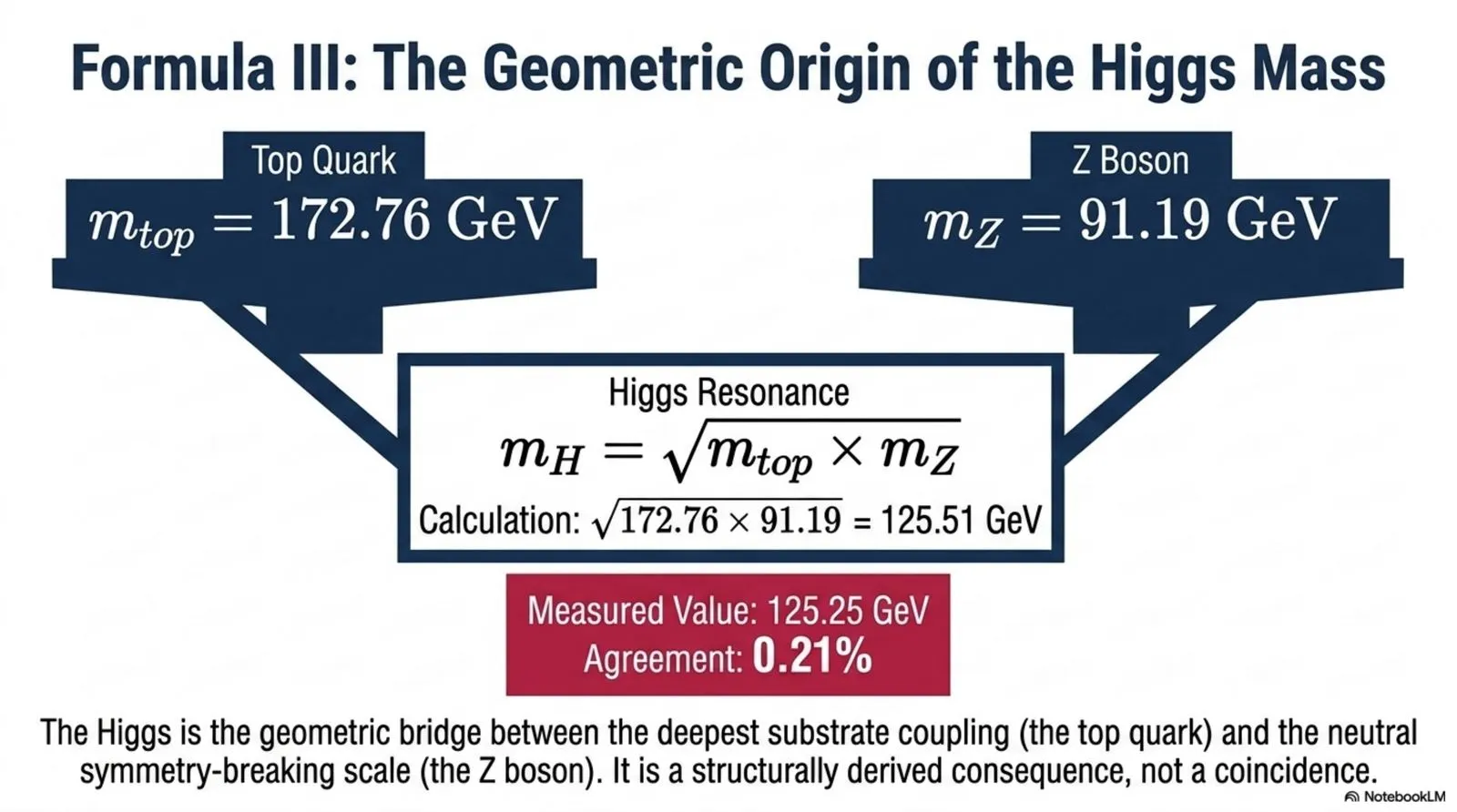
Under this identification, the Standard Model Higgs field is not eliminated as a mathematical structure; the mathematics of spontaneous symmetry breaking, the vacuum expectation value, and the resulting boson masses are unchanged. What is reinterpreted is the physical referent of that mathematics: rather than an independently fundamental scalar field introduced specifically to explain mass, the vacuum expectation value is proposed to be a property of the same substrate already required, in related work in this series, to account for the cosmological constant, the speed of light, the reduced Planck constant, and the electroweak mixing angle. The observed 125 GeV resonance is, under this proposal, the quantised collective oscillation of the substrate around its own equilibrium configuration, given by the geometric-mean relation established in previous work [6], mH equal to the square root of mtop times mZ, giving 125.51 GeV against the measured 125.25 GeV, a relation noted independently in discussions of Standard Model vacuum stability [14]. The significance of this agreement is that the Higgs mass is not introduced as an input to the derivation. It emerges from the same condensation geometry already used to derive the electroweak sector.
5. The Predicted Resonance Spectrum
If the 125 GeV resonance is a collective excitation of the substrate rather than the unique quantum of an independently fundamental field, the same substrate balancing framework responsible for that resonance is proposed to predict additional collective excitation modes at other mass scales, corresponding to different balancing relations among the fermionic confinement sector and the charged and neutral electroweak sectors established in previous work [6]. Table 1 presents five such predicted resonances, each constructed from a distinct geometric-mean balancing relation among the top quark mass, the W boson mass, and the Z boson mass.
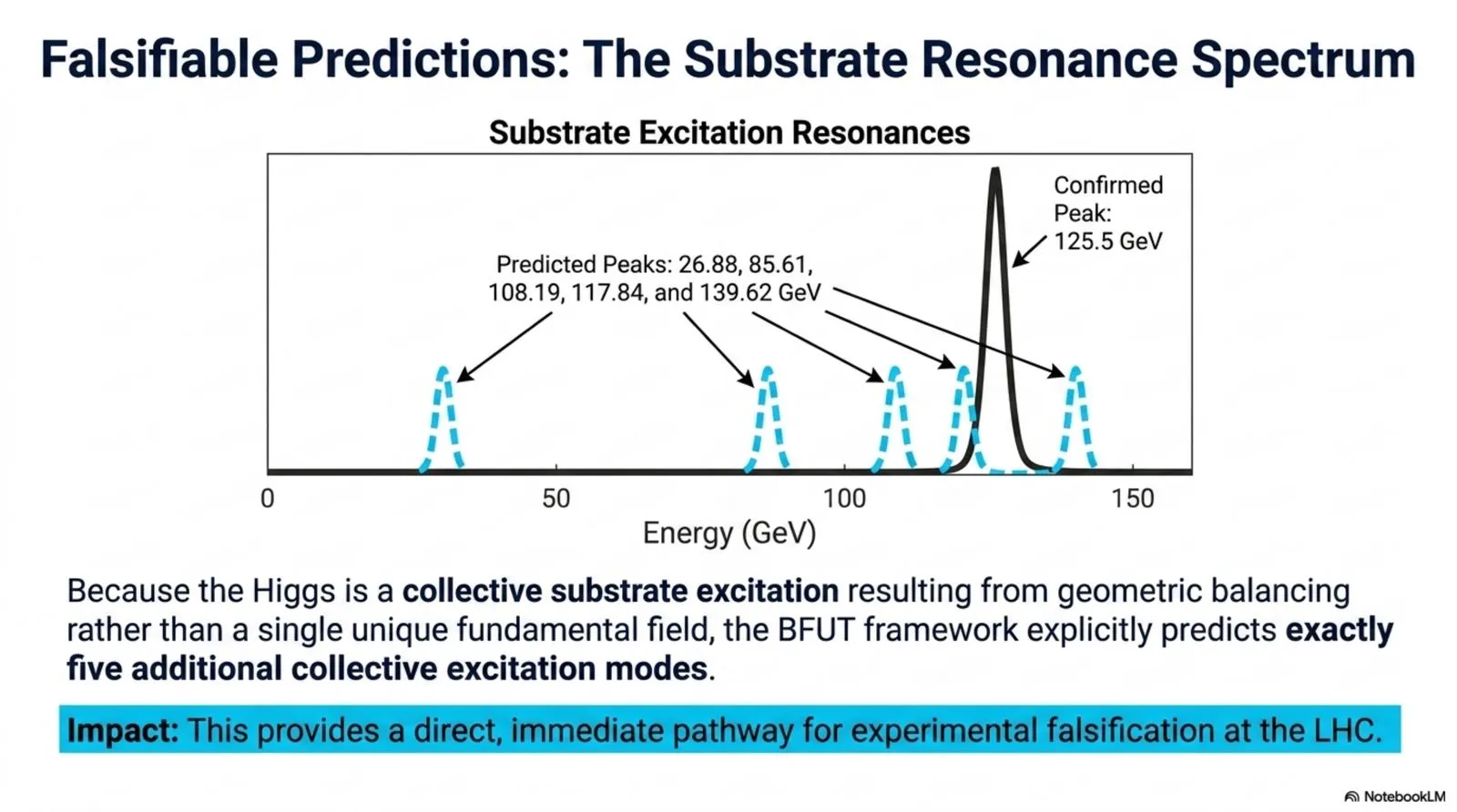
These resonances are not introduced as additional free particles. They are predicted normal modes of the same substrate equilibrium, analogous to distinct vibrational modes of a single physical system.
| Resonance | Formula | Mass (GeV) | Sectors Balanced |
|---|---|---|---|
| Higgs (confirmed) | √(mtop × mZ) | 125.51 | Fermionic + neutral EW |
| Sharma | √(mW × mZ) | 85.6 | Charged EW + neutral EW |
| BFUT | (mtop × mZ × mW)^{1/3} | 108.19 | All three sectors equal |
| Vijay | √(mtop × mW) | 117.84 | Fermionic + charged EW |
| Shankar | (m_top² × mZ)^{1/3} | 139.62 | Fermionic-dominant + neutral EW |
| Bharat | √(mb × mtop) | 26.9 | Pure fermionic only |
The names assigned to the predicted resonances are merely convenient labels identifying different equilibrium modes. Their physical significance lies entirely in their predicted masses and decay characteristics.
Each predicted resonance corresponds to a distinct geometric-mean balancing relation among the fermionic and electroweak mass scales already established independently in previous work [6], with no additional free parameter introduced beyond those earlier results. The Bharat resonance, involving only the bottom and top quark masses with no electroweak boson contribution, is predicted to decay predominantly to bottom quark pairs with no W or Z boson decay channel, providing a particularly distinctive experimental signature. We emphasise that these five resonances are genuine predictions rather than results already confirmed: no resonance at any of these five mass scales has, to our knowledge, been reported by the ATLAS or CMS collaborations to date, despite dedicated high-mass diphoton [15] and low-mass dijet [16] resonance searches covering parts of the relevant mass range, and their absence at current experimental sensitivity does not by itself falsify the proposal, since production cross-sections at these mass scales, particularly for the low-mass Bharat resonance, depend on details of the production mechanism not derived in the present paper. An interactive robustness simulation of the underlying electroweak mass derivations is available online [17].
6. Discussion: Physical Interpretation and Anticipated Objections
6.1 Physical Interpretation
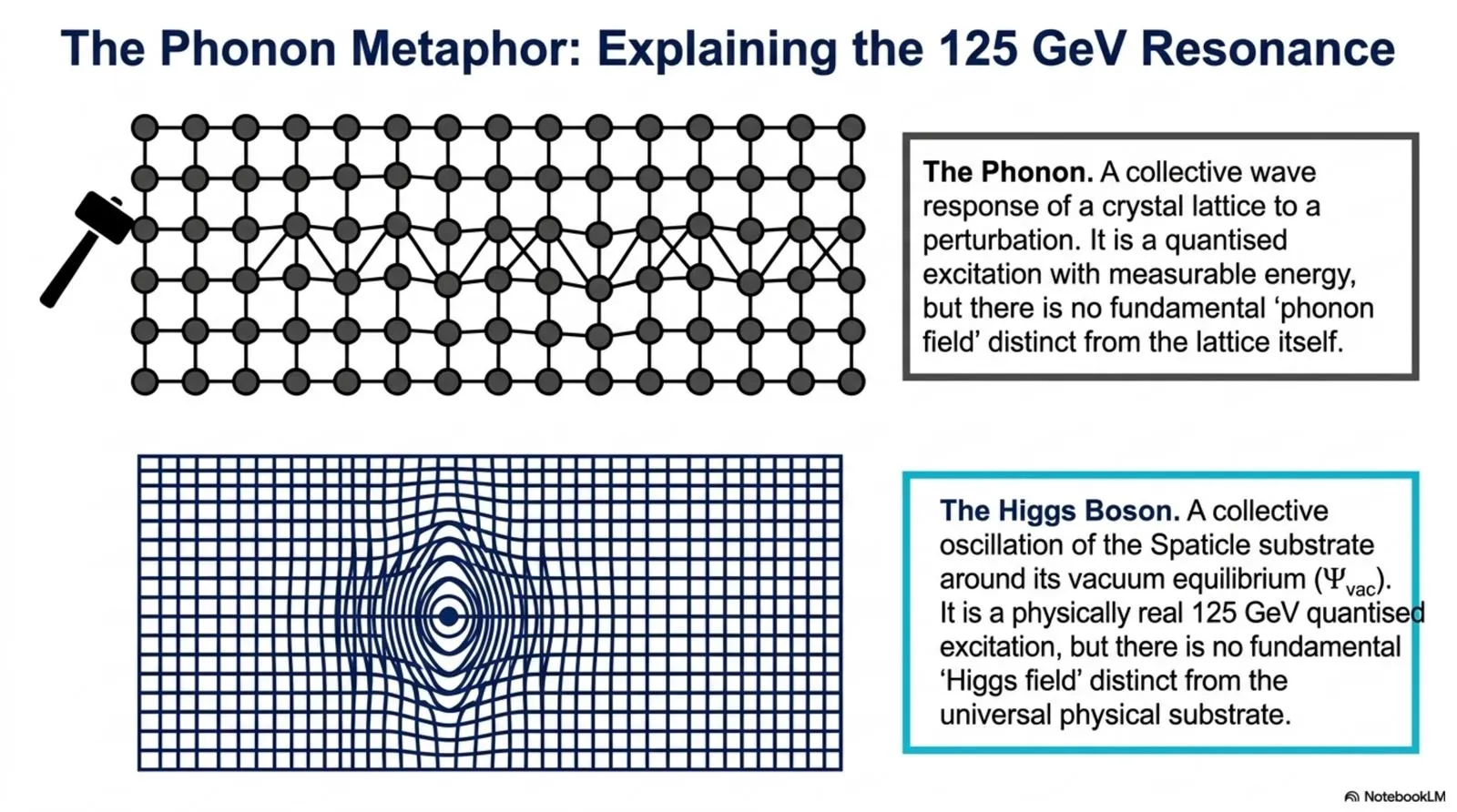
Within the proposed interpretation, mass is not a property granted to otherwise massless particles by an independently existing field; it is the intrinsic energy cost of maintaining a stable, persistent substrate condensation. The 125 GeV boson is not evidence for a separate fundamental entity coexisting with matter and force-carrying particles; it is the substrate’s own collective response to a perturbation of its vacuum configuration, in the same way that a phonon is the collective response of a crystal lattice to a perturbation, without requiring a separate fundamental "phonon field" distinct from the lattice itself.
6.2 "Is this proposal unfalsifiable, since it reinterprets an already-measured particle?"
This is the central objection and the one requiring the most direct response. The reinterpretation of the confirmed 125 GeV resonance, considered in isolation, would indeed be difficult to distinguish experimentally from the standard single-field interpretation, since both predict the same particle with the same measured properties. What distinguishes the two proposals, and what makes the present proposal falsifiable, is the predicted resonance spectrum of Section 5: the standard single-field interpretation predicts no additional resonances at the specific mass scales of Table 1, while the substrate-excitation proposal predicts exactly five, with masses fixed by the same framework already validated against the confirmed Higgs mass and the independently measured W and Z boson masses. A dedicated search at these five mass scales, and the confirmed non-existence of resonances there as data accumulates, would progressively disfavour the present proposal without disfavouring the standard interpretation. The proposal therefore does not rely on reinterpreting existing data alone. Its distinguishing feature is the prediction of additional resonances absent from the standard single-field interpretation.
6.3 "Does this proposal dispute any confirmed measurement of the 125 GeV boson?"
No. The proposal offers a different physical origin for the field responsible for the observed resonance; it does not dispute the measured mass, spin, parity, or any confirmed production or decay channel of the 125 GeV boson [3,4]. Every confirmed experimental result concerning the Higgs boson remains unchanged under this reinterpretation.
6.4 "Why should the substrate produce exactly these five additional resonances and no others?"
The five resonances of Table 1 are constructed from the geometric-mean balancing relations among three mass scales, the top quark mass and the W and Z boson masses, already established independently in previous work [6]. The specific set of five follows from the combinatorial structure of pairing and triple-balancing these three scales in the ways consistent with the substrate’s three-sector partition topology; we regard the completeness of this specific set, as opposed to a larger or smaller family of possible resonances, as an area requiring further theoretical development. The present derivation identifies the lowest-order equilibrium modes permitted by the condensation topology. Whether higher-order modes exist remains an open theoretical question rather than a deficiency of the present framework.
7. Falsifiable Predictions
The substrate-excitation account of the Higgs boson makes the following falsifiable predictions.
Prediction 1. At least one of the five predicted resonances of Table 1 will be discovered at the High-Luminosity LHC or a future collider, at a mass consistent with the values given in Table 1 to within a few percent. The confirmed absence of any resonance at these mass scales, following a dedicated search with sufficient integrated luminosity to probe the relevant production cross-sections, would substantially undermine the proposal of Section 5.
Prediction 2. The Bharat resonance, if discovered, will show no confirmed WW* or ZZ* decay channel, decaying predominantly to bottom quark pairs, distinguishing it experimentally from the confirmed 125 GeV Higgs boson and from the other four predicted resonances of Table 1, each of which is predicted to retain some electroweak decay channel.
Prediction 3. Continued precision measurements of the 125 GeV resonance are expected to remain consistent with Standard Model predictions for its mass, spin, parity, production rates, and decay channels. The distinguishing evidence for the present interpretation will instead arise from the predicted resonance spectrum rather than deviations in the known Higgs boson.
8. Conclusions
We have proposed that the confirmed 125 GeV resonance discovered at the LHC does not require the existence of a fundamental Higgs field independently postulated alongside the matter and gauge fields of the Standard Model, but can instead be understood as a collective excitation of the same universal physical substrate already proposed, in related work, to underlie matter, charge, and the electroweak sector. Under this proposal, mass is the intrinsic energy cost of maintaining a stable substrate condensation, and the observed 125 GeV boson is the substrate’s own collective oscillation mode around its vacuum equilibrium, reproducing the confirmed Higgs mass through the same condensation-topology framework used to derive the electroweak mixing angle and boson masses. The same framework predicts five additional collective excitation modes at specific mass scales, providing a direct and falsifiable experimental test distinguishing this proposal from the standard single-field interpretation.
Within this interpretation, particles do not acquire mass from a separate fundamental Higgs field. Mass is the intrinsic energy required to maintain stable condensations of the underlying Spaticle Field, while the observed 125 GeV boson represents one collective excitation of that same substrate. The proposed resonance spectrum provides a direct experimental test capable of distinguishing this interpretation from the standard single-field picture.
References
[1] ATLAS Collaboration (2012). Observation of a new particle in the search for the Standard Model Higgs boson with the ATLAS detector at the LHC. Physics Letters B, 716(1), 1–29.
[2] CMS Collaboration (2012). Observation of a new boson at a mass of 125 GeV with the CMS experiment at the LHC. Physics Letters B, 716(1), 30–61.
[3] ATLAS Collaboration (2022). A detailed map of Higgs boson interactions by the ATLAS experiment ten years after the discovery. Nature, 607(7917), 52–59.
[4] CMS Collaboration (2022). A portrait of the Higgs boson by the CMS experiment ten years after the discovery. Nature, 607(7917), 60–68.
[5] Sharma, V.S. (2026). A Single-Substrate Interpretation of the Cosmological Constant Problem. Zenodo. doi:10.5281/zenodo.21280358
[6] Sharma, V.S. (2026). A Geometric Origin of the Higgs Mass and Electroweak Mixing Angle from Substrate Condensation Topology. Zenodo. doi:10.5281/zenodo.21280511
[7] Higgs, P.W. (1964). Broken symmetries and the masses of gauge bosons. Physical Review Letters, 13(16), 508–509.
[8] Englert, F. and Brout, R. (1964). Broken symmetry and the mass of gauge vector mesons. Physical Review Letters, 13(9), 321–323.
[9] Djouadi, A. (2008). The anatomy of electroweak symmetry breaking I: The Higgs boson in the Standard Model. Physics Reports, 457(1–4), 1–216.
[10] Michelson, A.A. and Morley, E.W. (1887). On the relative motion of the Earth and the luminiferous ether. American Journal of Science, 34(203), 333–345.
[11] Müller, H., Herrmann, S., Braxmaier, C., Schiller, S., and Peters, A. (2003). Modern Michelson-Morley experiment using cryogenic optical resonators. Physical Review Letters, 91, 020401.
[12] Sharma, V.S. (2026). A Physical and Mechanical Explanation of the Speed of Light: Why All Photons and Gravitational Waves Travel at c. Zenodo. doi:10.5281/zenodo.21292900
[13] ATLAS and CMS Collaborations (2015). Combined measurement of the Higgs boson mass in pp collisions at sqrt(s) = 7 and 8 TeV with the ATLAS and CMS experiments. Physical Review Letters, 114, 191803.
[14] Buttazzo, D., Degrassi, G., Giardino, P.P., Giudice, G.F., Sala, F., Salvio, A., and Strumia, A. (2013). Investigating the near-criticality of the Higgs boson. Journal of High Energy Physics, 2013(12), 89.
[15] ATLAS Collaboration (2023). Search for new resonances in high-mass diphoton final states using 139 fb⁻¹ of proton-proton collision data. Physics Letters B, 838, 137677.
[16] CMS Collaboration (2023). Search for a low-mass resonance decaying into two b quarks. Physical Review D, 108, 032002.
[17] Sharma, V.S. (2026). Code: Electroweak Boson Masses from a Single Substrate Density — Interactive Robustness Simulation. Zenodo. doi:10.5281/zenodo.21337463. Simulation available at vijayshankarsharma.com/focus/electroweak-masses.
[18] Rovelli, C. (2004). Quantum Gravity. Cambridge University Press, Cambridge.
[19] Einstein, A. (1920). Äther und Relativitätstheorie. Address delivered at the University of Leiden, 5 May 1920. Springer, Berlin.