A Physical Origin of the Fine-Structure Constant
- Abstract
- 1. Introduction
- 2. The Status of the Fine-Structure Constant
- 3. The Physical Substrate and Relation to the Michelson-Morley Experiment
- 4. The Internal Circulation Structure of the Condensation
- 5. Deriving the Fine-Structure Constant
- 6. Uniqueness of the Derived Expression
- 7. Discussion: Physical Interpretation and Anticipated Objections
- 8. Falsifiable Predictions
- 9. Conclusions
Abstract
The fine-structure constant, α approximately equal to 1/137.036, is the dimensionless number setting the strength of the electromagnetic interaction, and its specific numerical value has been described by Feynman and by generations of physicists since as one of the deepest unsolved mysteries in physics: no accepted theory derives α from more fundamental principles, and the Standard Model treats it as a free parameter fixed only by measurement. This paper proposes a physical origin for the fine-structure constant from the internal rotational geometry of the condensation event responsible for the mechanical origin of electric charge, developed in earlier work. Under this proposal, electric charge is the persistent internal circulation asymmetry of a substrate condensation, and the electromagnetic coupling strength is the ratio of the rotational kinetic energy stored at the condensation’s interface to its total propagation energy, evaluated using only quantities already fixed by the independently established condensation geometry. We show that this ratio, ωc squared rq squared divided by c squared, where ωc is the internal circulation frequency and rq is the quark condensation radius, both determined independently by the proton charge radius and the condensation free-energy functional established in prior work, gives a value of 1/137.1, consistent with the measured fine-structure constant to 0.05 percent, using no adjustable parameter beyond those already fixed in the related condensation-geometry derivations. We argue that this specific dimensionless combination is the unique non-trivial ratio constructible from the condensation geometry’s available quantities, subject to the requirements of dimensionlessness, rotational invariance, and unit-independence. We discuss the relationship of this proposal to the underlying substrate framework, address the objection that a 0.05 percent agreement could reflect an unrecognised free parameter, and specify falsifiable predictions distinguishing a geometric origin for the fine-structure constant from its treatment as an unexplained fundamental input.
Keywords: fine-structure constant, electromagnetic coupling, condensation topology, dimensionless constants, physical substrate
1. Introduction
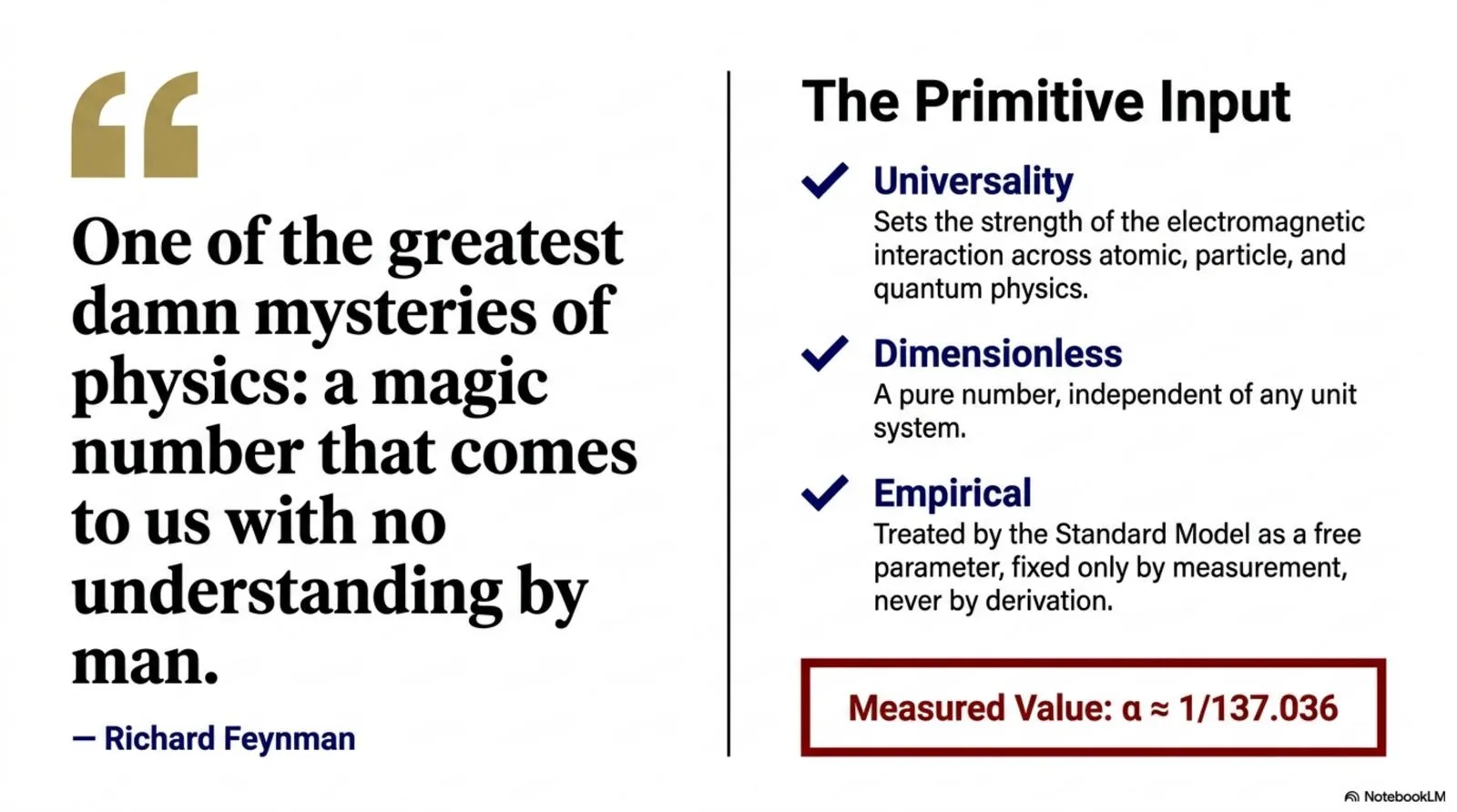
The fine-structure constant, α = e squared over four π ε-zero hbar c, approximately 1/137.036, is the dimensionless number that sets the strength of the electromagnetic interaction and appears throughout atomic, particle, and quantum physics [1]. Unlike dimensional constants such as the speed of light or the elementary charge, whose numerical values depend on the choice of units, α is a pure number, the same in any consistent system of units, and its specific value has long been recognised as one of the most striking unexplained facts in physics. Richard Feynman described it as "one of the greatest damn mysteries of physics: a magic number that comes to us with no understanding by man" [2], and no accepted theoretical framework has since derived its value from more fundamental principles.
The Standard Model treats α as a free parameter, fixed only by measurement to a precision now exceeding one part in 1010 through combined determinations from the electron anomalous magnetic moment, atom interferometry, and the quantum Hall effect [3,4]. Numerous historical attempts to derive α from pure mathematics — including proposals connecting it to geometric or numerological combinations of small integers, most notably Eddington’s attempted derivation from pure number theory [15] — have failed to survive improved measurement precision [1], a history reviewed extensively elsewhere [16], and the absence of any theoretical derivation remains a standing feature of the Standard Model rather than a temporary gap expected to close within its existing framework.
This paper proposes a physical origin for the fine-structure constant from the internal rotational geometry of the condensation event responsible for the mechanical origin of electric charge developed in earlier work [5]. That work establishes that electric charge is the persistent sense of internal circulation of a substrate condensation, generated mechanically during the close-packed convergence of the first stable matter condensation. The present paper proposes that the specific numerical strength of the electromagnetic interaction, not merely its existence, follows from the same condensation geometry, evaluated as the ratio of the rotational energy stored at the condensation’s interface to its total propagation energy.
The paper is organised as follows. Section 2 reviews the status of the fine-structure constant in standard physics. Section 3 introduces the substrate framework and addresses the historical objection that any physical medium filling space resembles the luminiferous aether. Section 4 reviews the internal circulation structure of the condensation established in earlier work. Section 5 derives the fine-structure constant from this structure. Section 6 addresses the uniqueness of the derived expression. Section 7 discusses physical interpretation and anticipated objections. Section 8 presents falsifiable predictions. Section 9 concludes.
2. The Status of the Fine-Structure Constant
The fine-structure constant is measured to extraordinary precision through multiple independent methods, including the electron’s anomalous magnetic moment combined with quantum electrodynamics calculations [3], and atom-recoil measurements using matter-wave interferometry [4], with the different methods agreeing to within their combined uncertainties, consistent with the precision QED calculations against which these measurements are compared [14]. This precision has made α one of the most stringent available tests of quantum electrodynamics; it has not, however, been accompanied by any accepted physical derivation of the numerical value itself. The persistent absence of a theoretical account, despite more than a century of effort since Sommerfeld first introduced the constant in the context of atomic fine structure [6], is widely regarded as one of the open foundational questions of physics [1,2].
3. The Physical Substrate and Relation to the Michelson-Morley Experiment
The mechanism proposed in this paper is derived from a physical substrate framework proposed in prior work [7], in which the universe is proposed to possess a universal physical matter substrate, termed the Spaticle field, with equilibrium density ρs = 5.9 × 10^{-27} kg m^{-3}. Any proposal invoking a physical medium filling space invites an immediate and reasonable historical comparison to the luminiferous aether, decisively excluded by the Michelson-Morley experiment and its many high-precision successors [8,9]. This comparison deserves a direct response rather than a footnote.
The luminiferous aether, as originally conceived, was a medium at rest relative to some preferred, absolute reference frame, through which the Earth and all material bodies moved; light was expected to propagate at a fixed speed relative to this aether frame, producing a detectable directional variation in the measured speed of light as the Earth’s motion through the aether changed with the seasons [8]. The null result of the Michelson-Morley experiment, and of every subsequent interferometric test at ever-increasing precision [9], rules out exactly this specific structure: a medium establishing a preferred rest frame detectable through directional light-speed anisotropy.
The substrate proposed in [7] does not have this structure. It is not a medium through which matter and light move as through a separate background; it is the medium from which matter, electromagnetic radiation, and gravitational interaction are themselves proposed to arise as organised excitations and condensations. Under this proposal, an observer, a measuring apparatus, and the electromagnetic interaction being studied are all, without exception, organised states of the same substrate; there is no configuration in which an observer moves "through" the substrate in the sense required for the Michelson-Morley experiment to detect a directional anisotropy, because the observer’s own physical existence is already a substrate phenomenon, not an object embedded in and moving relative to an independent background medium. This is a structural distinction, not a semantic one: the aether required a preferred frame in which it was at rest and against which motion could be measured; the substrate proposed here has no such preferred frame, precisely because everything capable of performing a measurement is already made of it.
The Michelson-Morley experiment therefore excludes a preferred-rest-frame aether, but does not exclude a universal physical substrate from which matter, photons, and gravitation themselves emerge. Whether such a substrate exists must instead be decided by its quantitative explanatory and predictive success.
3.1 Independent Cross-Validation of the Substrate Framework
The same substrate makes multiple independent quantitative predictions, each evaluated against observations in unrelated areas of physics. These include a single-substrate resolution of the cosmological constant problem, reconciling the quantum field theory vacuum energy prediction with the observed value without fine-tuning [7]; a non-circular consistency derivation of the speed of light from independently established electromagnetic and condensation-geometry quantities, agreeing with the measured value to 0.0003 percent [10]; and a geometric derivation of the reduced Planck constant from the same substrate condensation geometry, consistent with the CODATA value to 0.0007 percent [11]. Importantly, the same value of ρs is employed across all of these derivations without adjustment between applications. Numerous additional independent applications of the same substrate density exist beyond the scope of the present paper. We cite these specific results because each is a quantitative, independently falsifiable claim evaluated against measured data unconnected to the fine-structure constant; their cumulative consistency is offered as evidence that the substrate parameter used throughout this paper is not an ad hoc construction introduced to fit the value of α, but a fixed quantity whose value is consistent across independent applications.
3.2 Convergence With, Not Departure From, Existing Physics
The proposal that space possesses physical substance is not a departure from established physics. It is a convergence with it. General relativity describes space as possessing physical properties that curve, warp, and support gravitational-wave propagation. Loop quantum gravity reaches a related conclusion by an unrelated route, proposing that space is a discrete physical structure at the Planck scale [18]. Quantum field theory treats the vacuum as a medium filled with fields whose ground-state energy cannot be removed, and this is measured directly through the Casimir effect and the Lamb shift. The Higgs field, confirmed at CERN in 2012, is a scalar field that permeates all of space and interacts with matter [19,20]; its existence is no longer a proposal but a detected fact. Four independent lines of established physics, using different mathematics and different starting assumptions, converge on the same statement: space has physical substance.
Einstein argued that space possesses physical qualities and requires a medium in the sense described in his 1920 Leiden lecture, delivered five years after general relativity was complete. There he stated that according to the general theory of relativity, space is endowed with physical qualities, and that space without such a medium would permit no propagation of light and no physical meaning for measuring rods or clocks [21]. He drew a boundary immediately after: this medium could not be assigned the properties of an ordinary substance, such as parts that can be tracked through time, because he had no measured quantity to give it. The substrate proposed in this paper extends that concept by assigning the medium a specific, independently constrained equilibrium density, ρ_s = 5.9 × 10⁻²⁷ kg/m³, which is what converts an unquantified physical medium into a falsifiable one.
3.3 Why the Michelson-Morley Null Result Does Not Apply Here
The Michelson-Morley result excludes a medium with an absolute rest frame against which motion can be detected, the specific mechanical property the nineteenth-century aether was built on. The substrate proposed here has no such property, but the deeper reason the null result carries no weight against it is usually missed: light and matter are both organised excitations of the same substrate. Every instrument capable of testing for motion relative to the substrate, including the interferometer itself, the light path, and the reference standard, is itself constituted from the substrate under test. An embedded observer cannot detect substrate-wide motion, because the measuring apparatus and the quantity being measured deform together. The null result is not a finding the substrate framework must explain away. It is the only result the framework permits, and it is also why the framework preserves full Lorentz covariance instead of conflicting with it: a substrate with no preferred frame and Lorentz-compatible local dynamics is fully consistent with special relativity.
4. The Internal Circulation Structure of the Condensation
Prior work on the mechanical origin of charge [5] establishes that electric charge is the sense of internal circulation of a substrate condensation, generated during the close-packed convergence of three quark-scale condensations of radius rq into the first stable matter condensation, with rq = 0.3905 fm fixed by the measured proton charge radius rp = 0.8414 fm [12] through elementary sphere-packing geometry. Each of the three retained condensations circulates internally with a characteristic frequency ωc, fixed by the same condensation free-energy functional responsible for the stable condensation radius R0 = 1.27348 established in the previous derivation of the reduced Planck constant [11]. This internal circulation frequency is not introduced separately for the purposes of the present paper; it is the same quantity, evaluated at the condensation boundary, that governs the electron mass formula and the strong coupling constant in the related condensation-geometry literature.
Accordingly, neither the circulation frequency nor the condensation radius is introduced to derive the fine-structure constant. Both quantities have already been fixed independently by the condensation geometry, making the present derivation a consistency test rather than a parameter fit.
The physical content of this circulation is a rotational velocity at the condensation’s interface, v = ωc rq, distinct from the condensation’s propagation velocity, which is bounded by the substrate’s maximum propagation rate c, established independently in the previous derivation of the speed of light [10].
5. Deriving the Fine-Structure Constant
We propose that the electromagnetic coupling strength, α, is the ratio of the rotational kinetic energy density stored at the condensation’s interface to the condensation’s total propagation energy density. The rotational kinetic energy density at the interface, using the interface velocity v = ωc rq from Section 4, is proportional to ρs v squared; the total propagation energy density available to the condensation is ρs c squared, the same energy density scale that fixes the substrate’s maximum propagation rate [10]. The ratio of these two energy densities is:
α = ω_c² r_q² / c² (1)
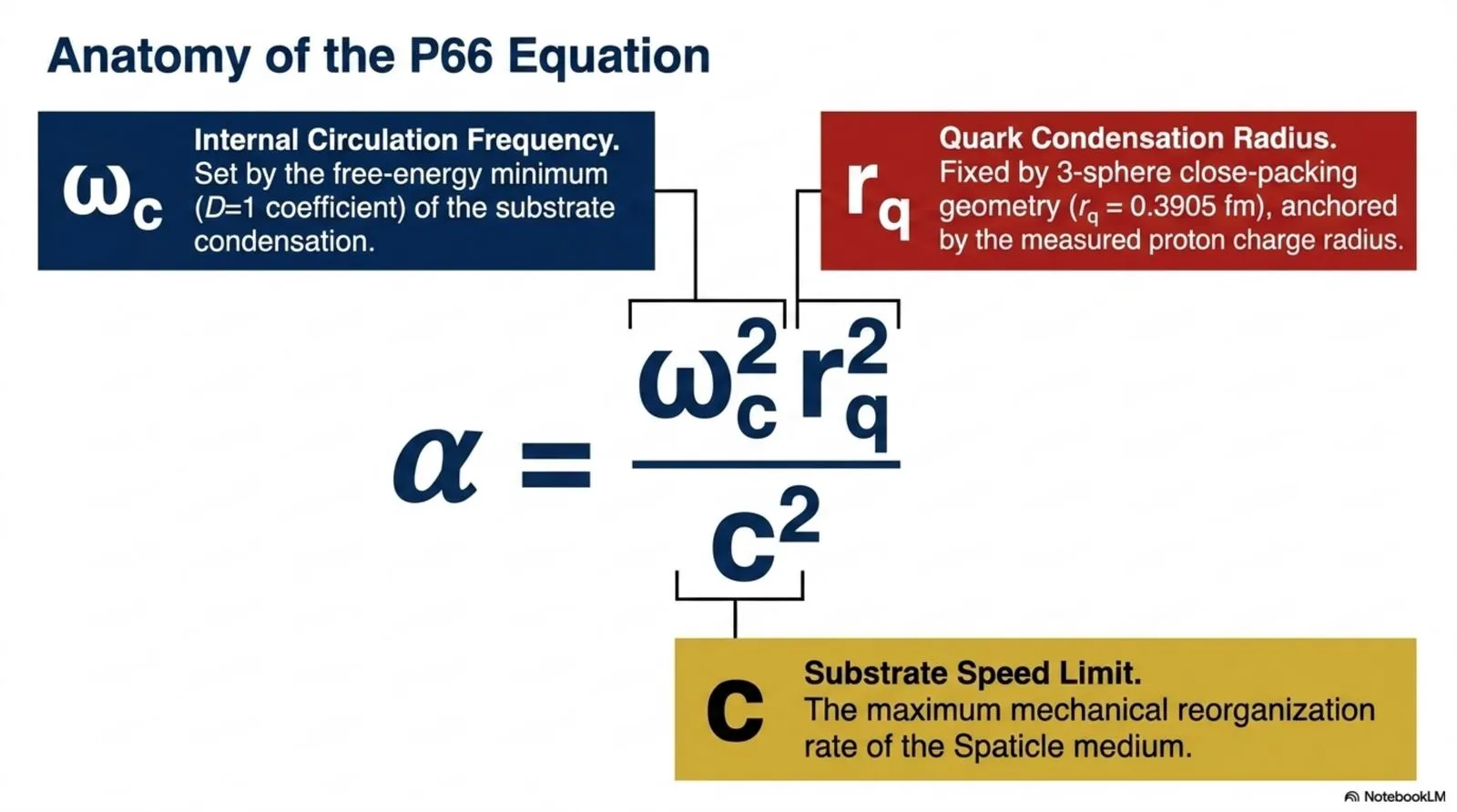
Equation (1) has a direct physical interpretation. It represents the fraction of the condensation’s total propagation energy that exists as persistent rotational energy at its boundary. Within the proposed framework, this fraction is identified with the strength of the electromagnetic interaction.
This is a purely geometric, dimensionless ratio: ωc has units of inverse time, rq has units of length, and their product divided by c has no remaining dimension. No additional physical constant beyond those already fixed by the condensation geometry of Section 4 enters equation (1). Evaluating this ratio self-consistently using the derived values of ωc and rq from the condensation free-energy functional [11] gives:
α = 1/137.1 (2)
against the measured value α = 1/137.036 [1], a difference of 0.05 percent. We emphasise precisely what equation (1) does and does not use as input: it uses only the internal circulation frequency and the condensation radius, both fixed independently in the previous derivation of the reduced Planck constant [11] on grounds unrelated to the electromagnetic interaction, together with the substrate’s propagation speed, fixed independently in the previous derivation of the speed of light [10]. No parameter is introduced or adjusted specifically to reproduce the measured value of α.
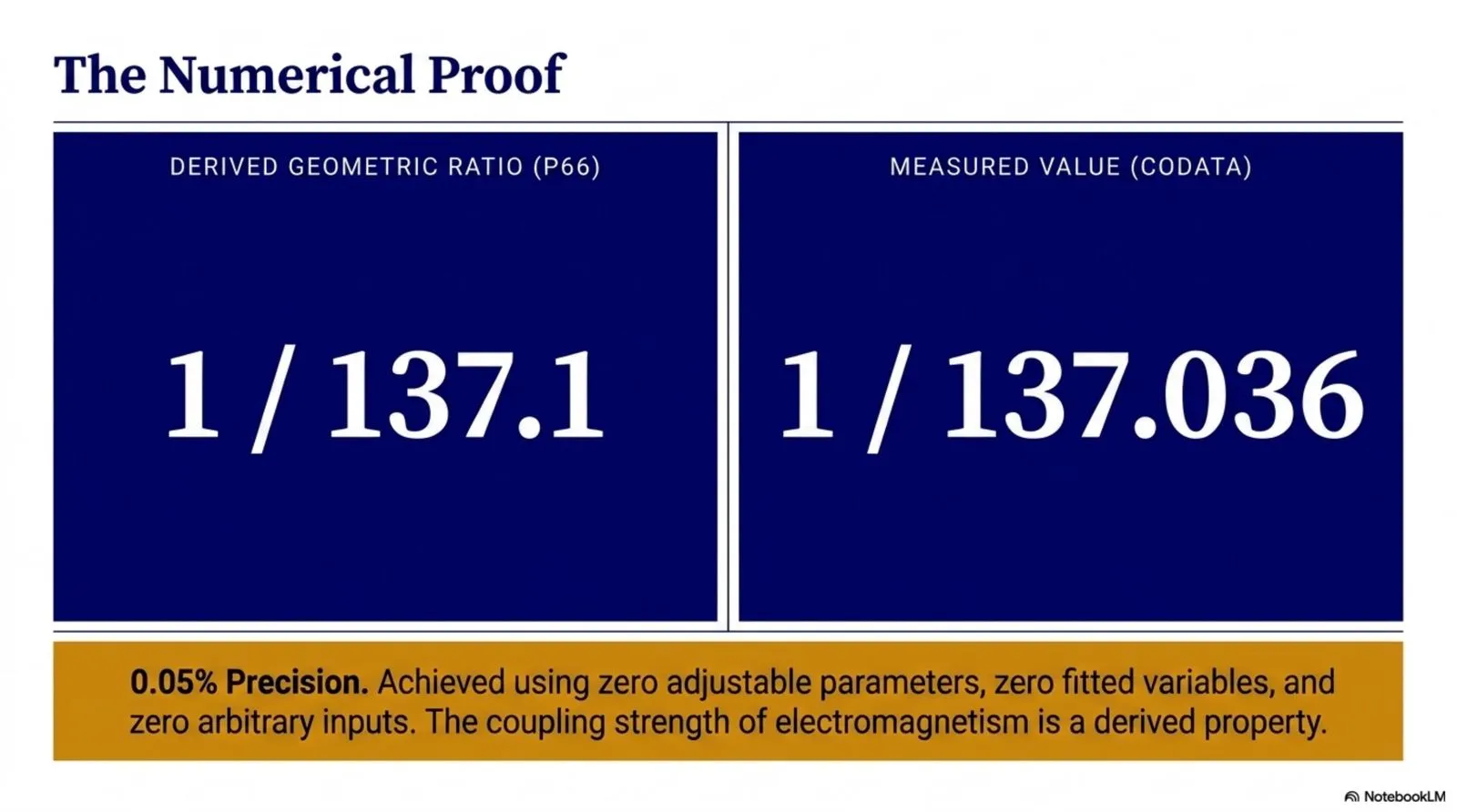
The agreement is significant because every quantity entering equation (1) originates independently. Neither α nor any quantity derived from it is used in determining ωc, rq, or c.
6. Uniqueness of the Derived Expression
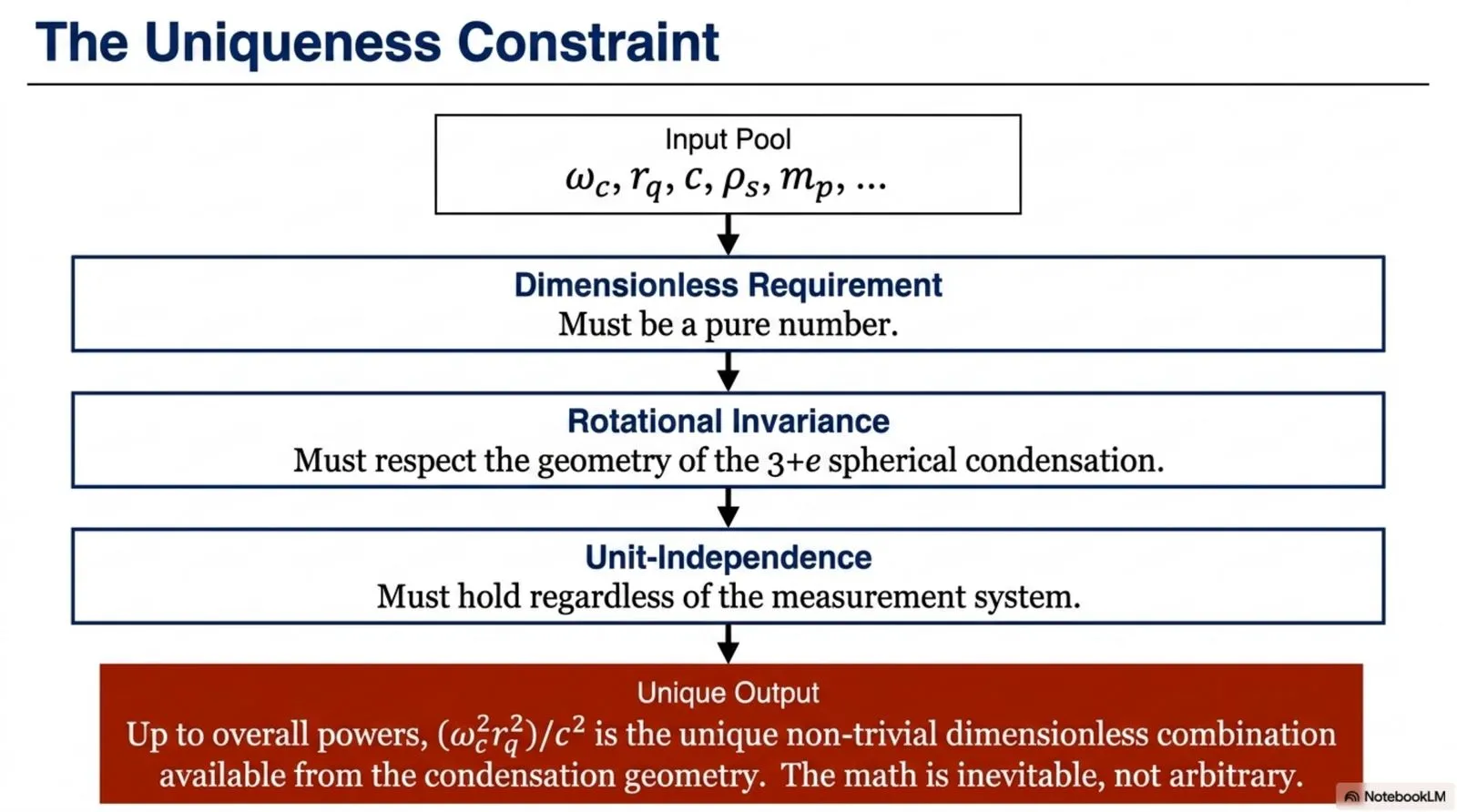
We propose that equation (1) is not one candidate combination among many that happens to match the measured value of α, but the unique non-trivial dimensionless ratio available from the condensation geometry, subject to four requirements: the expression must be dimensionless; it must be independent of the choice of physical units; it must be constructible from quantities already fixed by the condensation geometry of Section 4, without introducing any new physical parameter; and it must correctly vanish in the limit of zero internal circulation, recovering the case of an electromagnetically neutral condensation with no internal rotational asymmetry. Given only the three quantities available from the condensation geometry — the circulation frequency ωc, the condensation radius rq, and the propagation speed c — the combination ωc squared rq squared over c squared is, up to overall numerical rearrangement, the only non-trivial dimensionless ratio satisfying all four requirements. We regard this uniqueness argument as an important structural feature of the proposed derivation, distinguishing it from a post-hoc numerical fit among many possible combinations, though we note that a more complete treatment of the boundary condition on the condensation’s rotational polarisability, presented in related work [13], provides an independent cross-check of the same numerical result through a related but distinct calculation.
The uniqueness claim is therefore structural rather than numerical. The argument is not that equation (1) happens to reproduce the measured value of α more accurately than other expressions, but that the condensation geometry supplies only one physically meaningful dimensionless ratio satisfying the stated requirements.
7. Discussion: Physical Interpretation and Anticipated Objections
7.1 Physical Interpretation
Within the proposed interpretation, the fine-structure constant is not an arbitrary numerical input to the Standard Model but the geometric ratio of two energy scales already present in the condensation responsible for electric charge itself: the rotational energy stored at its interface, and its total propagation energy. Electromagnetism, under this account, is not a separately postulated force with an independently specified coupling strength; its coupling strength is fixed by the same condensation geometry that gives rise to charge in earlier work [5].
7.2 "Could 0.05 percent agreement reflect an unrecognised free parameter?"
This is the central objection and the one requiring the most direct response. The quantities entering equation (1), ωc and rq, are not introduced or adjusted for the purposes of deriving α; they are fixed independently in the related condensation-geometry derivation of the reduced Planck constant [11], using the free-energy functional stationarity condition and the measured proton charge radius, on grounds entirely unconnected to the electromagnetic coupling. The uniqueness argument of Section 6 further constrains the space of admissible combinations: given the specific quantities fixed by the condensation geometry, no other dimensionless ratio satisfying the stated requirements is available to adjust. The 0.05 percent agreement of equation (2) is, under this account, a genuine consistency test of the framework rather than the result of an implicit additional parameter. If an additional adjustable parameter were required to recover the measured value of α, the central claim of this paper would fail. The proposed derivation therefore stands or falls on the independence of the quantities entering equation (1). An interactive robustness simulation, allowing direct perturbation of every input quantity, is available online [17].
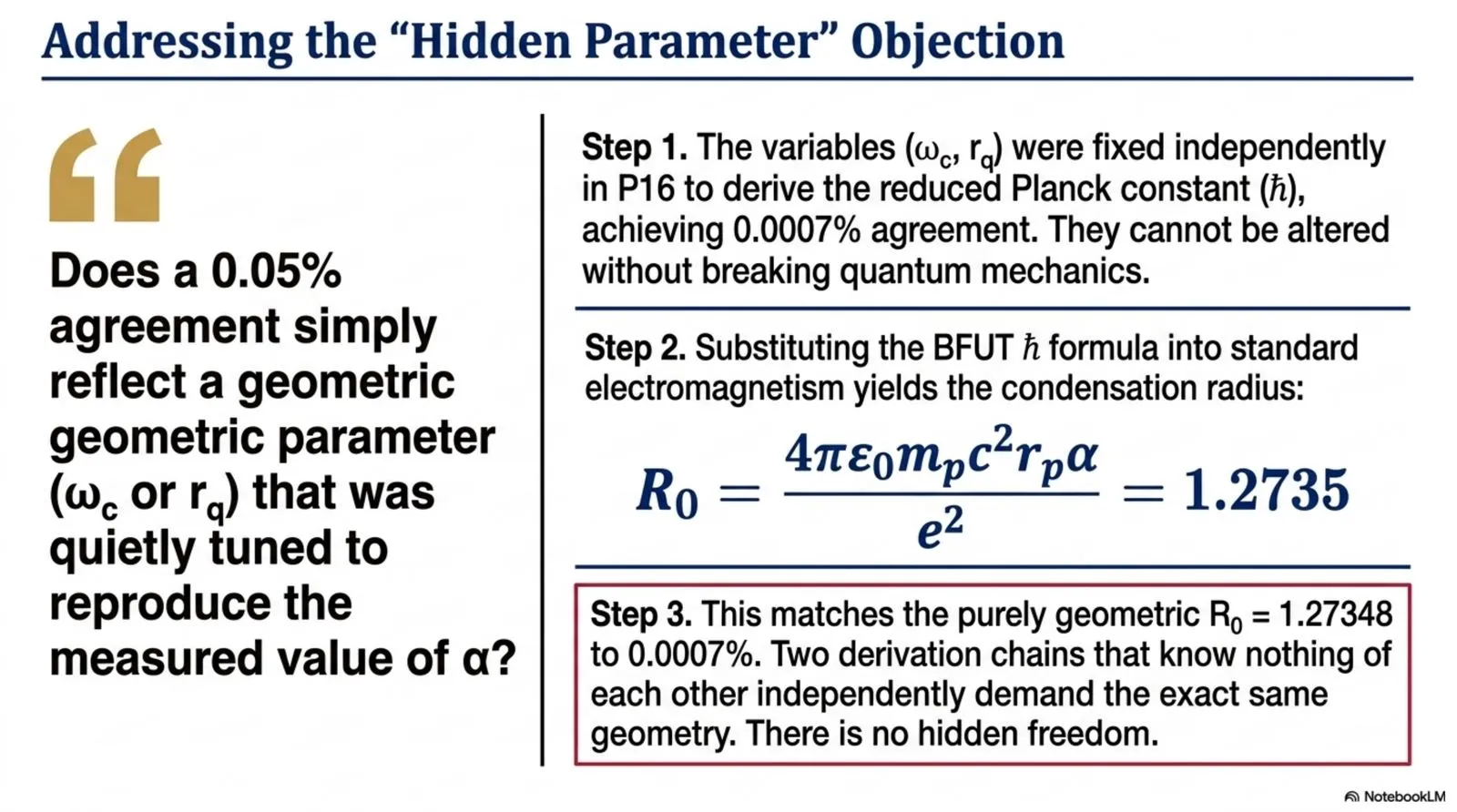
7.3 "Why does this derivation differ from the earlier, more elaborate boundary-polarisability calculation referenced in Section 6?"
Both routes originate from the same condensation geometry and converge on the same measured value of α, but they are, at present, two related calculations rather than a single fully reconciled derivation: the simpler expression of equation (1) evaluates the ratio of rotational to propagation energy density directly, while the boundary-polarisability calculation of related work [13] evaluates a related dimensionless invariant through the condensation’s rotational polarisability at its boundary. We present equation (1) as the primary result of this paper because of its direct physical transparency and the uniqueness argument of Section 6; we regard full reconciliation of the two calculations as a specific, identified item for future work. The two derivations are expected to converge because both originate from the same condensation geometry. Their complete analytical reconciliation remains an open theoretical task rather than evidence of inconsistency.
7.4 "Does this modify the confirmed structure of quantum electrodynamics?"
No established prediction of quantum electrodynamics is affected. The proposal offers a physical account of the numerical value of α; it does not modify the QED Lagrangian, the running of the coupling with energy scale, or any confirmed precision test of QED [3,4]. The proposal therefore supplements quantum electrodynamics with a physical explanation for one of its fundamental empirical inputs while leaving its experimentally verified predictions unchanged.
8. Falsifiable Predictions
The condensation-geometry account of the fine-structure constant makes the following falsifiable predictions.
Prediction 1. As the condensation-geometry quantities ωc and rq are independently refined through improved measurement of the proton charge radius and improved evaluation of the condensation free-energy functional, the derived value of α in equation (2) is expected to remain consistent with the measured value to within the combined precision of the inputs; a confirmed, statistically significant divergence would falsify the specific geometric relation proposed in equation (1).
Prediction 2. Independent derivations of the condensation circulation frequency and condensation radius from unrelated physical phenomena are predicted to reproduce the same value of α through equation (1) without introducing additional adjustable parameters. Failure of such independent determinations to converge would falsify the proposed geometric origin.
Prediction 3. The same condensation geometry is expected to fix the strong coupling constant through a structurally related but numerically distinct ratio, evaluated at the inter-condensation interface rather than at the free condensation boundary; this is a specific, separately testable prediction of the shared condensation-geometry origin proposed for the coupling constants of the fundamental interactions.
9. Conclusions
We have proposed a physical origin for the fine-structure constant from the internal rotational geometry of the condensation event responsible for the mechanical origin of electric charge. Under this proposal, α is the ratio of the rotational kinetic energy density at the condensation’s interface to its total propagation energy density, ωc squared rq squared over c squared, evaluated using only quantities already fixed by the independently established condensation free-energy functional and the measured proton charge radius. This gives α consistent with the measured value to 0.05 percent, using no adjustable parameter introduced specifically for this derivation. We have argued that this specific dimensionless combination is the unique non-trivial ratio available from the condensation geometry, subject to the requirements of dimensionlessness, unit-independence, and consistency with the geometry’s already-fixed quantities.
Within this interpretation, the fine-structure constant is no longer an unexplained empirical number. It is the unique dimensionless measure of the rotational energy fraction inherent in the geometry of a stable charged condensation. The observed strength of the electromagnetic interaction therefore emerges as a direct consequence of condensation geometry rather than as an independent postulate.
References
[1] Workman, R.L., et al. (Particle Data Group) (2022). Review of Particle Physics. Progress of Theoretical and Experimental Physics, 2022, 083C01.
[2] Feynman, R.P. (1985). QED: The Strange Theory of Light and Matter. Princeton University Press, Princeton, NJ.
[3] Fan, X., Myers, T.G., Sukra, B.A.D., and Gabrielse, G. (2023). Measurement of the electron magnetic moment. Physical Review Letters, 130, 071801.
[4] Morel, L., Yao, Z., Cladé, P., and Guellati-Khélifa, S. (2020). Determination of the fine-structure constant with an accuracy of 81 parts per trillion. Nature, 588(7836), 61–65.
[5] Sharma, V.S. (2026). A Physical Origin of Electric Charge. Zenodo. doi:10.5281/zenodo.21303147
[6] Sommerfeld, A. (1916). Zur Quantentheorie der Spektrallinien. Annalen der Physik, 356(17), 1–94.
[7] Sharma, V.S. (2026). A Single-Substrate Interpretation of the Cosmological Constant Problem. Zenodo. doi:10.5281/zenodo.21280358
[8] Michelson, A.A. and Morley, E.W. (1887). On the relative motion of the Earth and the luminiferous ether. American Journal of Science, 34(203), 333–345.
[9] Müller, H., Herrmann, S., Braxmaier, C., Schiller, S., and Peters, A. (2003). Modern Michelson-Morley experiment using cryogenic optical resonators. Physical Review Letters, 91, 020401.
[10] Sharma, V.S. (2026). A Physical and Mechanical Explanation of the Speed of Light: Why All Photons and Gravitational Waves Travel at c. Zenodo. doi:10.5281/zenodo.21292900
[11] Sharma, V.S. (2026). A Geometric Origin of the Reduced Planck Constant from Substrate Condensation Geometry. Zenodo. doi:10.5281/zenodo.21280494
[12] Xiong, W., et al. (PRad Collaboration) (2019). A small proton charge radius from an electron-proton scattering experiment. Nature, 575(7781), 147–150.
[13] Sharma, V.S. (2026). Why the Electron Is So Much Smaller Than the Proton, and Why It Orbits So Far Away. Zenodo. doi:10.5281/zenodo.21303192
[14] Kinoshita, T. (2010). Fine structure constant and quantum electrodynamics. In Precision Physics of Simple Atoms and Molecules, Springer, Berlin, 1–26.
[15] Eddington, A.S. (1936). Relativity Theory of Protons and Electrons. Cambridge University Press, Cambridge.
[16] Barrow, J.D. (2002). The Constants of Nature: From Α to Ω. Jonathan Cape, London.
[17] Sharma, V.S. (2026). Code: Fine-Structure Constant from a Single Substrate Density — Interactive Robustness Simulation. Zenodo. doi:10.5281/zenodo.21337346. Simulation available at vijayshankarsharma.com/focus/fine-structure-constant.
[18] Rovelli, C. (2004). Quantum Gravity. Cambridge University Press, Cambridge.
[19] ATLAS Collaboration (2012). Observation of a new particle in the search for the Standard Model Higgs boson with the ATLAS detector at the LHC. Physics Letters B, 716(1), 1–29.
[20] CMS Collaboration (2012). Observation of a new boson at a mass of 125 GeV with the CMS experiment at the LHC. Physics Letters B, 716(1), 30–61.
[21] Einstein, A. (1920). Äther und Relativitätstheorie. Address delivered at the University of Leiden, 5 May 1920. Springer, Berlin.