A Physical Origin of Electric Charge
- Abstract
- 1. Introduction
- 2. The Status of Electric Charge in the Standard Model
- 3. The Physical Substrate and Relation to the Michelson-Morley Experiment
- 4. The Close-Packing Geometry of the First Stable Condensation
- 5. The Mechanical Origin of Opposite Charge
- 6. Discussion: Physical Interpretation and Anticipated Objections
- 7. Falsifiable Predictions
- 8. Conclusions
Abstract
Electric charge is, in the Standard Model, a fundamental and irreducible property assigned to each elementary particle as a fixed input, with no accepted account of what charge physically is, why it exists in exactly two opposite signs, or why it is quantised in fixed units. The question of what a positive charge and a negative charge actually are, as physical states rather than as labels attached to a coupling constant, has no answer within the standard formulation. This paper proposes a physical origin for electric charge from the rotational topology of a condensation event in a universal physical substrate, following the framework established in prior work. Under this proposal, a positive charge is a substrate condensation with one sense of internal circulation, and a negative charge is a condensation with the opposite sense of circulation; the two signs of charge are the two possible circulation directions available to any condensation, and no third or fourth sign exists because a rotational sense admits only two possibilities. We present the specific mechanical process by which opposite charge is generated during the formation of the first stable matter condensation: three co-rotating substrate units converging into close-packed contact mechanically expel a fourth interstitial unit through the closing gaps between them, and elementary rigid-body mechanics, the same mechanism by which a gear positioned between two co-rotating gears of identical handedness is driven in the opposite direction, requires that the expelled unit acquire counter-rotation relative to the retained three-unit core. The retained core becomes a positively charged proton; the expelled, counter-rotating unit becomes a negatively charged electron. Opposite charge is therefore not assigned to these two particles as separate postulates; it is a single mechanical consequence of one geometric event. We discuss the relationship of this proposal to the underlying substrate framework, address the objection that this account merely relabels the existing mathematics of charge conservation, and specify falsifiable predictions distinguishing a mechanical origin of charge from its treatment as a fundamental, unexplained quantum number.
Keywords: electric charge, charge quantisation, proton formation, positive and negative charge, condensation topology, physical substrate
1. Introduction
Electric charge is one of the most thoroughly measured and precisely conserved quantities in physics, yet it remains, in the Standard Model, an irreducible input rather than a derived consequence of any more fundamental structure. Each elementary particle is assigned a fixed charge (the electron carries charge minus one in units of the elementary charge e, the proton carries charge plus one, the up quark carries charge plus two-thirds, the down quark carries charge minus one-third, following the original quark model [14,15]), and these assignments are confirmed to extraordinary precision by a century of experiment [1,2], but no accepted theory explains what charge physically is, why it exists in exactly two opposite signs rather than some other number, or why the elementary charge takes a single fixed magnitude rather than a continuum of values.
The Standard Model formalises charge as a generator of the U(1) gauge symmetry of quantum electrodynamics [3], and the quantisation of charge in integer multiples of a fundamental unit is a long-recognised puzzle addressed by proposals including magnetic monopoles [4] and grand unified theories [5], neither of which has achieved direct experimental confirmation. These approaches explain formal consistency conditions under which charge quantisation would be required; they do not identify a physical process by which a particle comes to possess one sign of charge rather than the other, or a mechanical reason why only two signs exist.
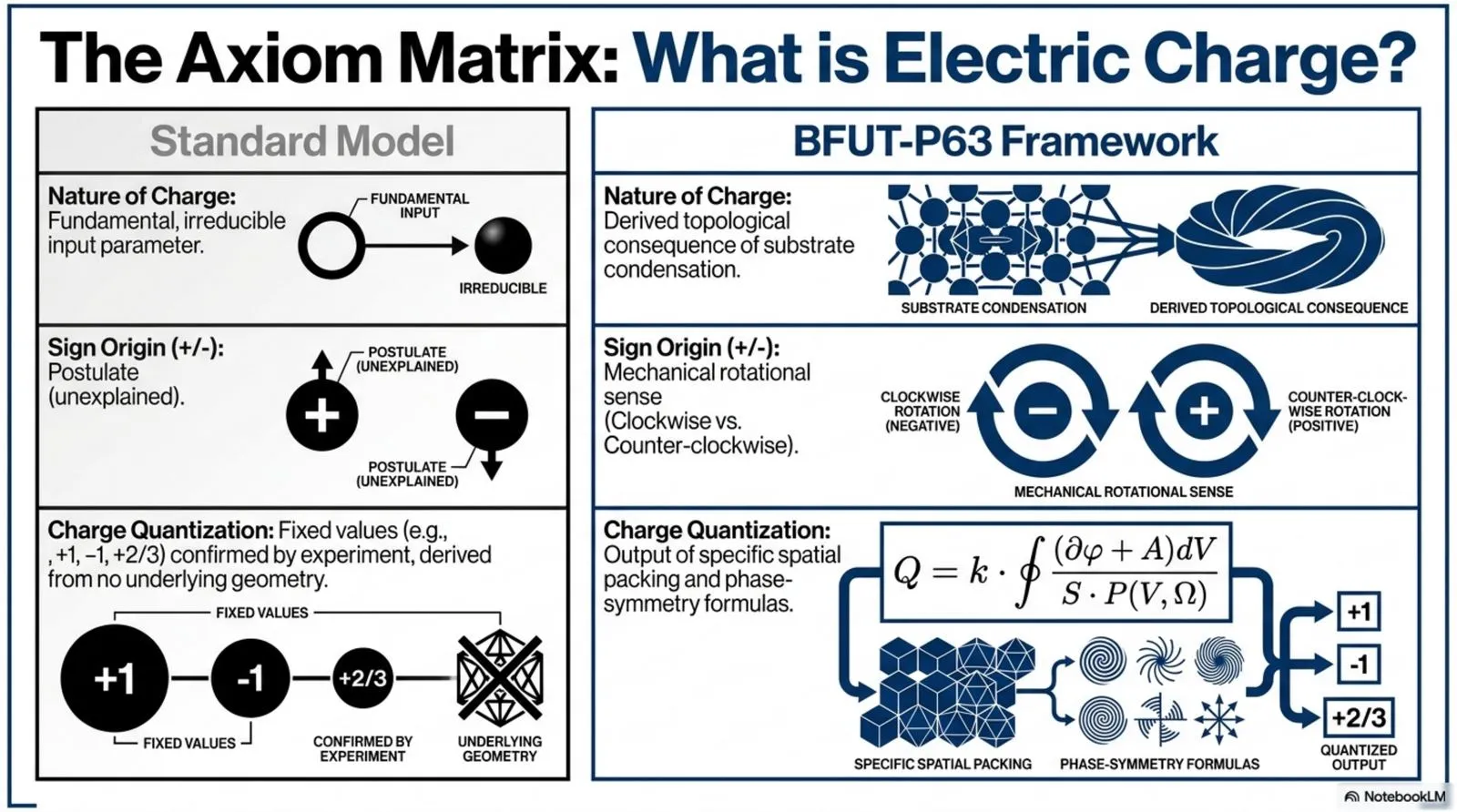
This paper proposes a physical origin for electric charge from the rotational topology of a condensation event in a universal physical substrate, following the framework developed in prior work [6]. Under this proposal, charge is not an abstract quantum number attached to a particle but the physical sense of internal circulation of a substrate condensation, and the existence of exactly two signs of charge follows from the fact that a rotational sense admits only two possibilities, clockwise and counter-clockwise, relative to any given axis.
The proposal advanced here is intentionally narrow. It concerns the physical origin of charge and its two signs, illustrated through the specific mechanical process by which the first stable proton-electron system is proposed to form; it does not attempt, in this paper, to derive the specific fractional charges of the up and down quarks, a related but separate question addressed elsewhere [7].
The paper is organised as follows. Section 2 reviews the status of charge in the Standard Model. Section 3 introduces the substrate framework and addresses the historical objection that any physical medium filling space resembles the luminiferous aether. Section 4 presents the close-packing geometry underlying the proposed formation of the first stable matter condensation. Section 5 derives the mechanical origin of opposite charge from this geometry. Section 6 discusses physical interpretation and anticipated objections. Section 7 presents falsifiable predictions. Section 8 concludes.
2. The Status of Electric Charge in the Standard Model
Electric charge conservation is one of the best-tested principles in physics, following from U(1) gauge invariance via Noether’s theorem [3], and the quantisation of observed charges in integer multiples of e/3 is confirmed without exception across the full range of measured particles [1,2], including the discovery of entirely new charged lepton generations that nonetheless carry exactly the same quantised charge as the electron [13]. What the Standard Model does not supply is a physical account of charge itself: charge enters the Lagrangian as a fixed coupling assigned separately to each field, not as a derived consequence of any structure internal to the particle. The question of why exactly two signs of charge exist, and why a given particle carries one sign rather than the other, is accordingly outside the scope of what the Standard Model is constructed to answer.
3. The Physical Substrate and Relation to the Michelson-Morley Experiment
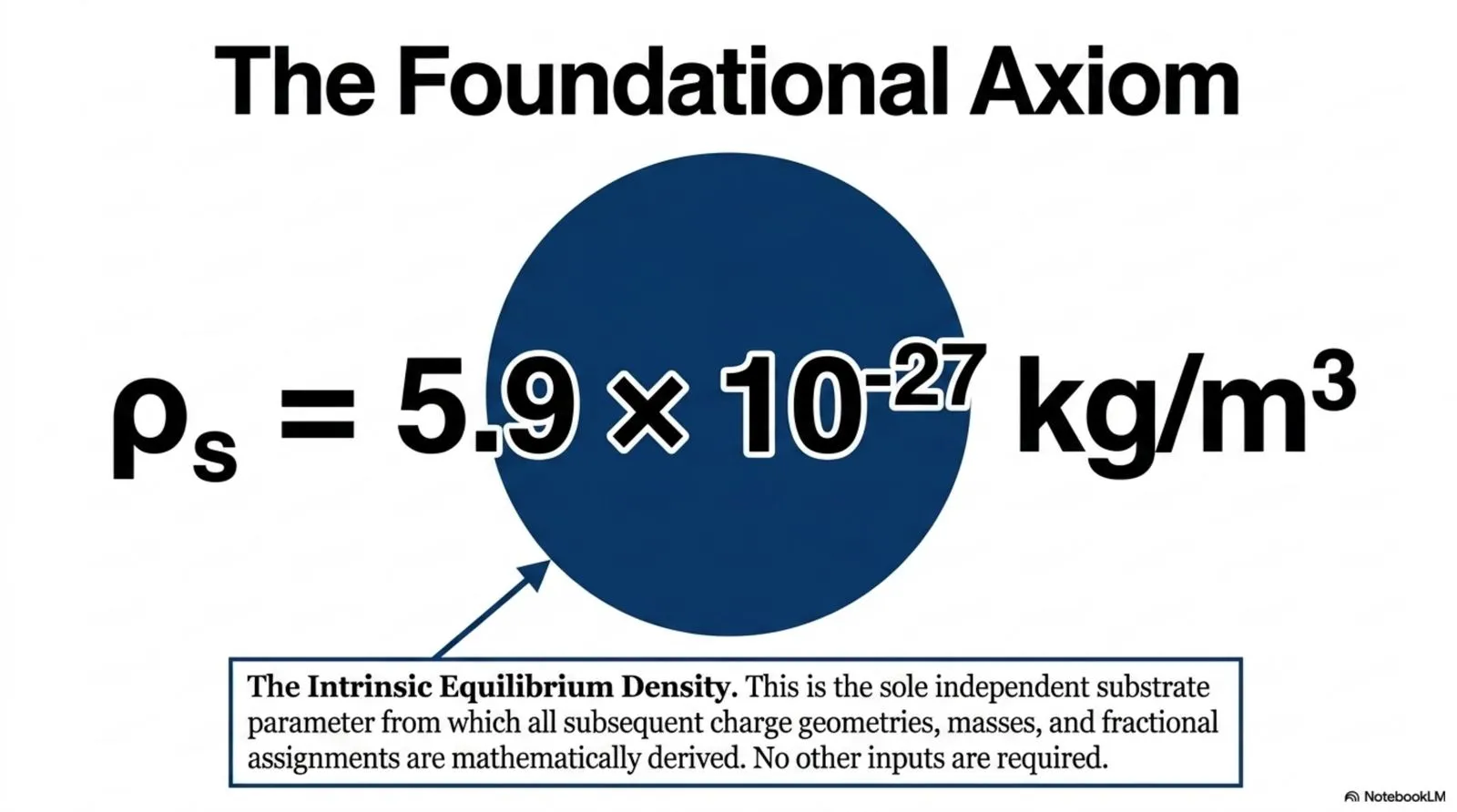
The mechanism proposed in this paper is derived from a physical substrate framework proposed in prior work [6], in which the universe is proposed to possess a universal physical matter substrate, termed the Spaticle field, with equilibrium density ρs = 5.9 × 10^{-27} kg m^{-3}. Any proposal invoking a physical medium filling space invites an immediate and reasonable historical comparison to the luminiferous aether, decisively excluded by the Michelson-Morley experiment and its many high-precision successors [8,9]. This comparison deserves a direct response rather than a footnote.
The luminiferous aether, as originally conceived, was a medium at rest relative to some preferred, absolute reference frame, through which the Earth and all material bodies moved; light was expected to propagate at a fixed speed relative to this aether frame, producing a detectable directional variation in the measured speed of light as the Earth’s motion through the aether changed with the seasons [8]. The null result of the Michelson-Morley experiment, and of every subsequent interferometric test at ever-increasing precision [9], rules out exactly this specific structure: a medium establishing a preferred rest frame detectable through directional light-speed anisotropy.
The substrate proposed in [6] does not have this structure. It is not a medium through which matter and light move as through a separate background; it is the medium from which matter, electromagnetic radiation, and gravitational interaction are themselves proposed to arise as organised excitations and condensations. Under this proposal, an observer, a measuring apparatus, and the charged particle being studied are all, without exception, organised states of the same substrate; there is no configuration in which an observer moves "through" the substrate in the sense required for the Michelson-Morley experiment to detect a directional anisotropy, because the observer’s own physical existence is already a substrate phenomenon, not an object embedded in and moving relative to an independent background medium. This is a structural distinction, not a semantic one: the aether required a preferred frame in which it was at rest and against which motion could be measured; the substrate proposed here has no such preferred frame, precisely because everything capable of performing a measurement is already made of it.
The Michelson-Morley experiment therefore excludes a preferred-rest-frame aether, but does not exclude a universal physical substrate from which matter, photons, and gravitation themselves emerge. Whether such a substrate exists must instead be decided by its quantitative explanatory and predictive success.
3.1 Independent Cross-Validation of the Substrate Framework
The same substrate makes multiple independent quantitative predictions, each evaluated against observations in unrelated areas of physics. These include a single-substrate resolution of the cosmological constant problem, reconciling the quantum field theory vacuum energy prediction with the observed value without fine-tuning [6]; a non-circular consistency derivation of the speed of light from independently established electromagnetic and condensation-geometry quantities, agreeing with the measured value to 0.0003 percent [10]; and a geometric derivation of the reduced Planck constant from the same substrate condensation geometry, consistent with the CODATA value to 0.0007 percent [11]. Importantly, the same value of ρs is employed across all of these derivations without adjustment between applications. Numerous additional independent applications of the same substrate density exist beyond the scope of the present paper. We cite these specific results because each is a quantitative, independently falsifiable claim evaluated against measured data unconnected to electric charge; their cumulative consistency is offered as evidence that the substrate parameter used throughout this paper is not an ad hoc construction introduced to fit charge observations, but a fixed quantity whose value is consistent across independent applications.
3.2 Convergence With, Not Departure From, Existing Physics
The proposal that space possesses physical substance is not a departure from established physics. It is a convergence with it. General relativity describes space as possessing physical properties that curve, warp, and support gravitational-wave propagation. Loop quantum gravity reaches a related conclusion by an unrelated route, proposing that space is a discrete physical structure at the Planck scale [17]. Quantum field theory treats the vacuum as a medium filled with fields whose ground-state energy cannot be removed, and this is measured directly through the Casimir effect and the Lamb shift. The Higgs field, confirmed at CERN in 2012, is a scalar field that permeates all of space and interacts with matter [18,19]; its existence is no longer a proposal but a detected fact. Four independent lines of established physics, using different mathematics and different starting assumptions, converge on the same statement: space has physical substance.
Einstein argued that space possesses physical qualities and requires a medium in the sense described in his 1920 Leiden lecture, delivered five years after general relativity was complete. There he stated that according to the general theory of relativity, space is endowed with physical qualities, and that space without such a medium would permit no propagation of light and no physical meaning for measuring rods or clocks [20]. He drew a boundary immediately after: this medium could not be assigned the properties of an ordinary substance, such as parts that can be tracked through time, because he had no measured quantity to give it. The substrate proposed in this paper extends that concept by assigning the medium a specific, independently constrained equilibrium density, ρ_s = 5.9 × 10⁻²⁷ kg/m³, which is what converts an unquantified physical medium into a falsifiable one.
3.3 Why the Michelson-Morley Null Result Does Not Apply Here
The Michelson-Morley result excludes a medium with an absolute rest frame against which motion can be detected, the specific mechanical property the nineteenth-century aether was built on. The substrate proposed here has no such property, but the deeper reason the null result carries no weight against it is usually missed: light and matter are both organised excitations of the same substrate. Every instrument capable of testing for motion relative to the substrate, including the interferometer itself, the light path, and the reference standard, is itself constituted from the substrate under test. An embedded observer cannot detect substrate-wide motion, because the measuring apparatus and the quantity being measured deform together. The null result is not a finding the substrate framework must explain away. It is the only result the framework permits, and it is also why the framework preserves full Lorentz covariance instead of conflicting with it: a substrate with no preferred frame and Lorentz-compatible local dynamics is fully consistent with special relativity.
4. The Close-Packing Geometry of the First Stable Condensation
The present work proposes, following the prior derivation in [6,11], that the first stable matter condensation forms when three substrate condensations of characteristic radius rq converge into close-packed contact. For three spheres of radius rq in mutual contact, elementary geometry fixes the outer radius of the assembly at rq times the quantity one plus two over the square root of three, a factor of 2.1547. Identifying this outer radius with the independently measured proton charge radius rp = 0.8414 fm [12] gives rq = 0.3905 fm, with no free parameter beyond the single measured input rp.
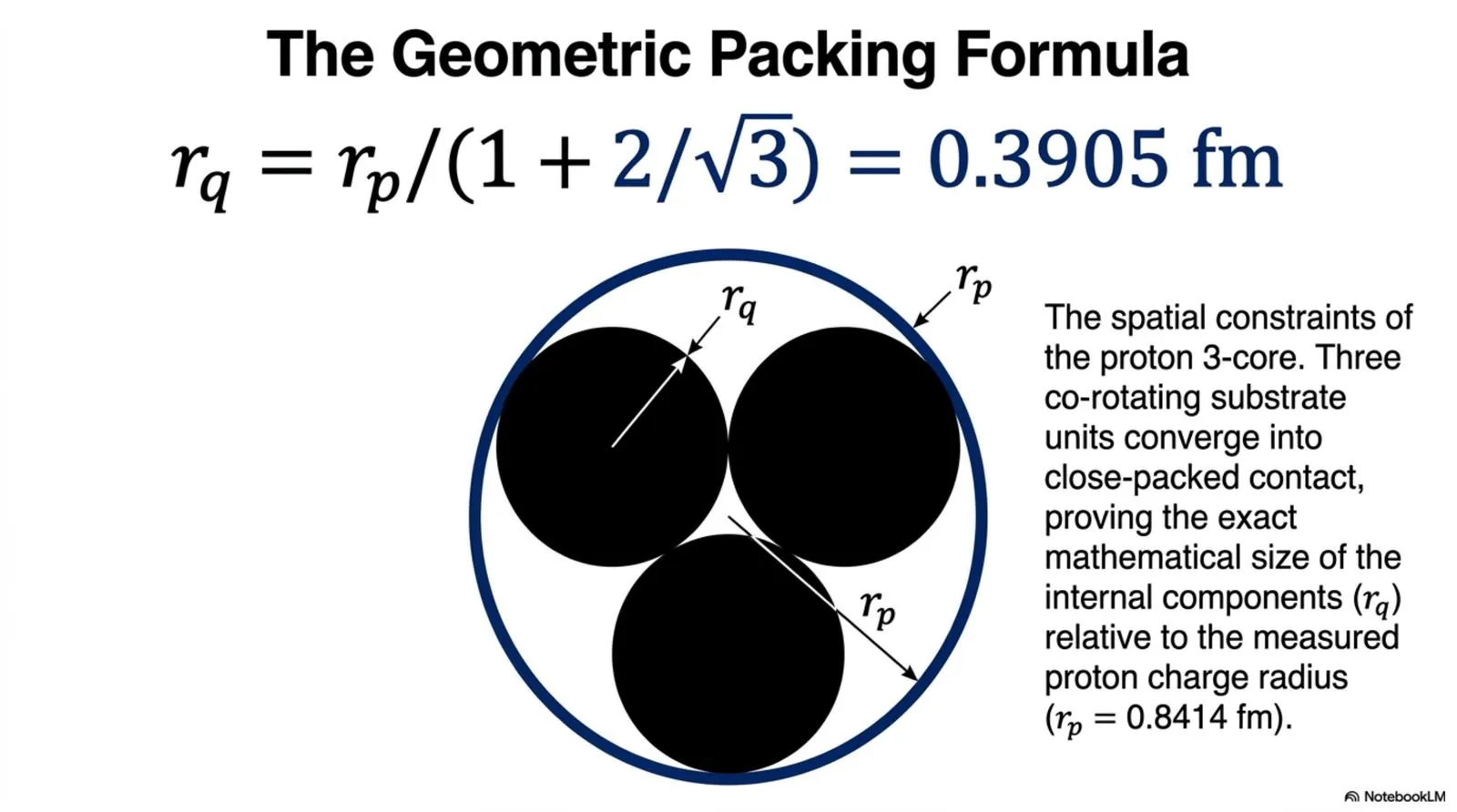
This close-packed configuration leaves a curved, triangular interstitial region bounded by the three inward-facing quark surfaces. Two independent geometric facts make it impossible for the substrate occupying this interstitial region to remain as a stable, independently circulating condensation. First, stable circulation requires a body with rotational symmetry about a well-defined axis; the interstitial region, bounded by three curved surfaces meeting at angles fixed by the packing geometry, has no such axis, so coherent circulation cannot establish itself there as a geometric matter of fact rather than an energetic one. Second, the characteristic radius of the interstitial region is smaller than the characteristic radius of a stable substrate condensation by a factor of approximately 2.75; the interstitial substrate is simply too large for the space available to it and cannot fit as a round condensate.
Both facts point to the same physical outcome: as the three quarks converge, the interstitial substrate is squeezed outward through the narrowing gaps between adjacent quark surfaces. It does not pass through any quark; it exits through the closing gaps between them. This expulsion event is the structural basis for the charge-generation mechanism developed in Section 5.
5. The Mechanical Origin of Opposite Charge
5.1 The Gear Mechanism
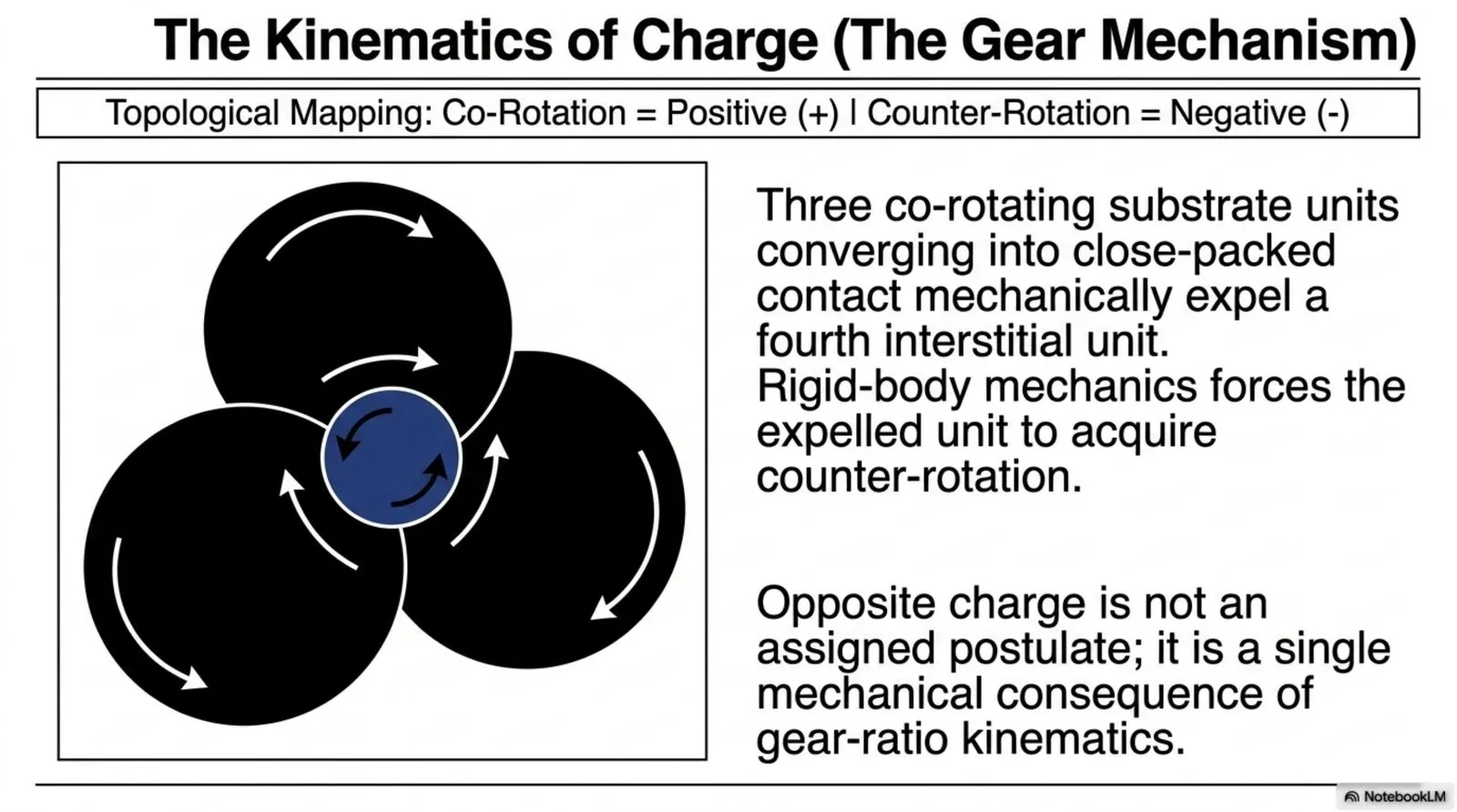
The close-packing geometry developed in Section 4 has a direct mechanical consequence. The expulsion of the interstitial substrate necessarily generates opposite rotational handedness, providing a physical origin for opposite electric charge. This counter-rotation of the expelled interstitial unit relative to the retained three-unit core follows from elementary rigid-body mechanics applied to the expulsion geometry of Section 4, not from a separate postulate.
Consider the substrate exiting through the gap between any two of the three converging quarks. Both of these two quarks rotate in the same sense. Call it clockwise, since all three quarks in the retained core share a common rotational handedness. The exiting substrate therefore passes between two co-rotating surfaces, one on each side of the gap. Each surface exerts a tangential force on the passing substrate in the direction of its own rotation; because the two surfaces are on opposite sides of the exiting substrate and rotate in the same absolute sense, their combined effect is to impart a net torque on the exiting substrate in the sense opposite to the rotation of the two quarks.
This is precisely the mechanical principle familiar from any gear train: a gear positioned between two co-rotating gears of identical handedness is necessarily driven in the opposite rotational sense, regardless of the size, mass, or other properties of the intervening gear. The result depends only on the rotational sense of the two flanking surfaces, not on which specific pair of quarks the substrate happens to exit between, since all three quarks share the same rotational handedness. The counter-rotation of the expelled unit is, under this account, a mechanical certainty given the close-packing geometry of Section 4, not an assumption introduced to match the observed charge of the electron.
5.2 Charge as Circulation Sense
Within the proposed framework, electric charge is identified with the sense of internal circulation of a substrate condensation relative to a fixed reference handedness. Charge is therefore interpreted as a physical state of organised matter rather than an independently assigned quantum label. The retained three-unit core, all three constituents co-rotating in the same sense, is identified with positive charge; the expelled unit, mechanically driven into counter-rotation by the gear mechanism of Section 5.1, is identified with negative charge. The proton is the retained three-core; the electron is the expelled, counter-rotating unit. Opposite charge is not assigned to these two objects as two independent postulates. It is the single mechanical consequence of one geometric event, the formation of the first stable condensation described in Section 4. An interactive simulation of this close-packed condensation geometry and the gear-mechanism charge generation is available online [16].
5.3 Why Exactly Two Signs of Charge Exist
Under this account, the existence of exactly two signs of electric charge follows from the fact that rotational sense about a given axis admits only two possibilities, clockwise and counter-clockwise. There is no third or fourth rotational sense available to a substrate condensation, and consequently no third or fourth sign of charge. This is proposed as the physical reason charge is observed to take exactly two opposite signs rather than, for example, three or a continuum: the number of available signs is fixed by the topology of rotation itself, not by an independent empirical accident requiring separate explanation for each observed particle. The existence of exactly two charge signs is therefore no longer an empirical input but a direct consequence of rotational topology.
6. Discussion: Physical Interpretation and Anticipated Objections
6.1 Physical Interpretation
Within the proposed interpretation, electric charge is not a fundamental, unexplained property assigned separately to each particle species but a direct physical consequence of the rotational topology of substrate condensations: same-sense circulation is positive charge, opposite-sense circulation is negative charge, and the two signs exhaust the possibilities because rotation itself admits only two senses. The proton and electron acquire their opposite charges from a single mechanical event (the close-packed convergence and interstitial expulsion of Section 4) rather than from two independent assignments.
6.2 "Does this merely relabel charge conservation as circulation conservation?"
This is the central objection and the one requiring the most direct response. The mathematical content of charge conservation, following from U(1) gauge invariance, is not disputed or modified by the present proposal [3]. What is proposed as new content is a physical referent for what is being conserved: not an abstract quantum number. Under this interpretation, conservation follows from an identifiable physical mechanism rather than solely from an abstract symmetry. The referent is the net rotational sense of substrate condensations, which is conserved because the mechanical process of Section 5.1 always produces equal and opposite circulation in the retained core and the expelled unit. This is a specific, falsifiable physical claim, distinguishable from a relabelling, because it makes the additional prediction, discussed in Section 7, that any future observation of a stable condensation event of this type must produce charges of precisely equal and opposite magnitude, tied to the same mechanical process rather than to an independently conserved abstract quantity.
6.3 "Why should the expulsion mechanism apply only to the first stable condensation, rather than to charge generation generally?"
The present paper addresses the specific mechanical origin of the proton-electron charge pair as the first stable condensation event; it does not claim, in this paper, to derive the charges of every subsequently observed particle from an independent application of the same expulsion geometry. Related work on quark charge fractions [7] extends the same underlying condensation topology to the internal phase structure responsible for the specific fractional charges of the up and down quarks. The scope of the present paper is limited to establishing the mechanical origin of opposite charge itself and the physical reason exactly two signs exist.
6.4 "Does this modify the Standard Model treatment of charge or QED?"
No established prediction of quantum electrodynamics or the Standard Model treatment of electric charge is affected. The proposal offers a physical account of what charge is and why exactly two signs exist; it does not modify the U(1) gauge structure, the Coulomb interaction, or any confirmed prediction of QED [1,2,3].
7. Falsifiable Predictions
The condensation-topology account of electric charge makes the following falsifiable predictions.
Prediction 1. No third sign of electric charge will be discovered. Within the proposed framework, the two observed signs of charge exhaust the rotational senses available to a substrate condensation; the confirmed discovery of a particle carrying a charge that is neither an integer multiple of positive nor negative elementary charge, but some structurally distinct third type, would be inconsistent with the mechanism proposed here.
Prediction 2. Every future observation of stable charge generation is predicted to produce equal and opposite charge through a common rotational mechanism. Observation of a stable charge-generation process that produces unequal or independently generated charge signs would be inconsistent with the mechanism proposed here.
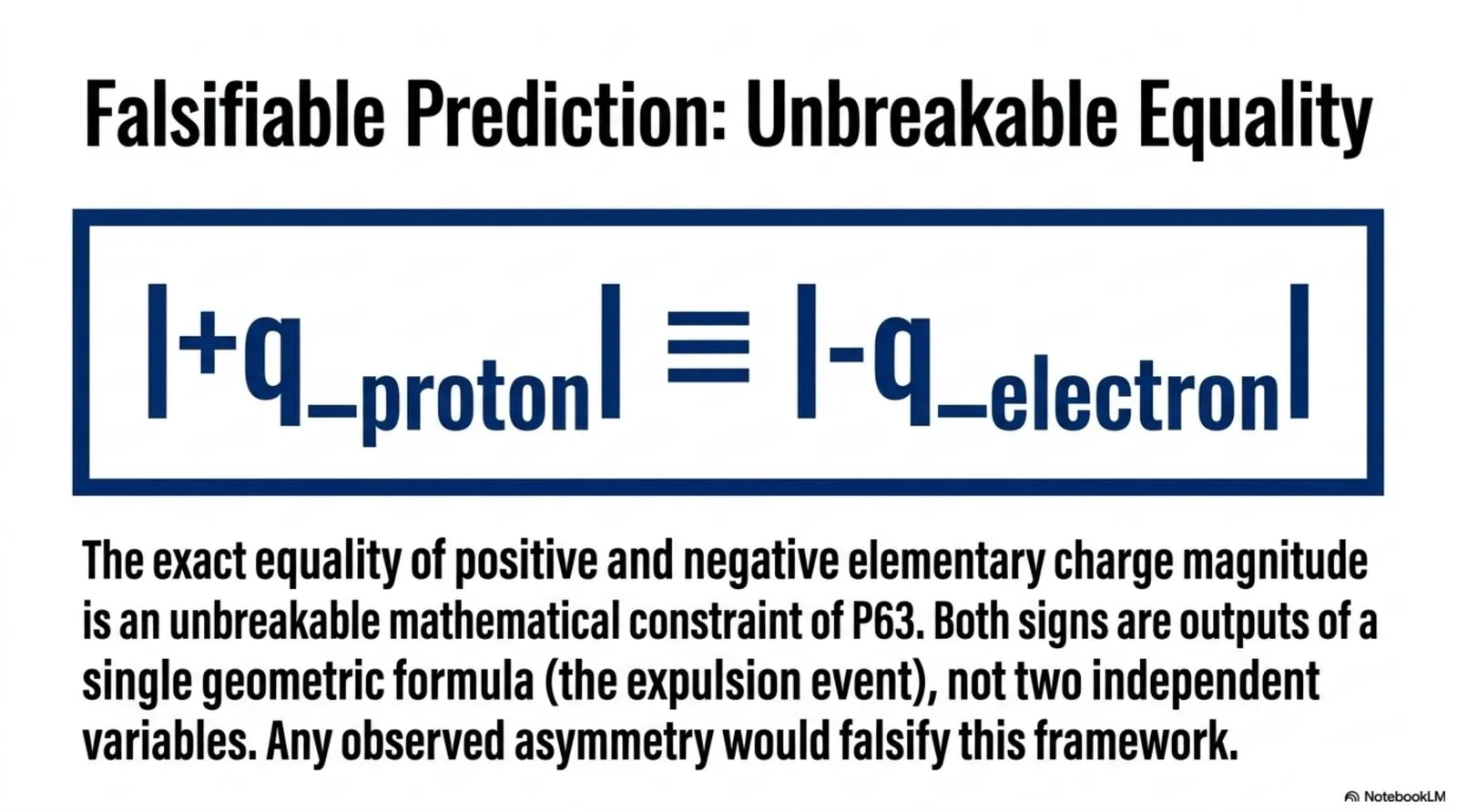
Prediction 3. The magnitude of positive and negative elementary charge will continue to be found exactly equal, to the precision limit of future measurement, since both signs arise from the same mechanical expulsion event described in Section 5 rather than from two independently specified quantities; current experimental bounds on any asymmetry between the proton and electron charge magnitudes are already extremely stringent [2], and the present framework predicts this equality is exact rather than approximate.
8. Conclusions
We have proposed a physical origin for electric charge from the rotational topology of a condensation event in a universal physical substrate, following the framework established in prior work [6]. Under this proposal, positive and negative charge are the two possible senses of internal circulation available to a substrate condensation, and the specific mechanism by which the first stable proton-electron pair acquires opposite charge is the close-packed convergence of three co-rotating substrate units, which mechanically expels a fourth interstitial unit through the closing gaps between them; elementary rigid-body mechanics, the same gear principle governing any train of co-rotating gears, requires that the expelled unit acquire counter-rotation relative to the retained core. The retained three-unit core becomes the positively charged proton; the counter-rotating expelled unit becomes the negatively charged electron.
This account requires no modification to the U(1) gauge structure of quantum electrodynamics, the Coulomb interaction, or the confirmed conservation of electric charge; it proposes a physical origin for a property the Standard Model otherwise treats as a fundamental, unexplained input. The falsifiable predictions of Section 7, particularly the exact equality of positive and negative elementary charge magnitude required by a shared mechanical origin, provide a clear observational test of this proposal. Within this interpretation, electric charge is no longer a fundamental unexplained property assigned to matter. It is the observable manifestation of rotational topology within the underlying Spaticle Field.
References
[1] Workman, R.L., et al. (Particle Data Group) (2022). Review of Particle Physics. Progress of Theoretical and Experimental Physics, 2022, 083C01.
[2] Zyla, P.A., et al. (Particle Data Group) (2020). Tests of conservation laws. Progress of Theoretical and Experimental Physics, 2020, 083C01.
[3] Peskin, M.E. and Schroeder, D.V. (1995). An Introduction to Quantum Field Theory. Addison-Wesley, Reading, MA.
[4] Dirac, P.A.M. (1931). Quantised singularities in the electromagnetic field. Proceedings of the Royal Society A, 133(821), 60–72.
[5] Georgi, H. and Glashow, S.L. (1974). Unity of all elementary-particle forces. Physical Review Letters, 32(8), 438–441.
[6] Sharma, V.S. (2026). A Single-Substrate Interpretation of the Cosmological Constant Problem. Zenodo. doi:10.5281/zenodo.21280358
[7] Sharma, V.S. (2026). A Physical Origin of Quark Charge Fractions. Zenodo. doi:10.5281/zenodo.21303184
[8] Michelson, A.A. and Morley, E.W. (1887). On the relative motion of the Earth and the luminiferous ether. American Journal of Science, 34(203), 333–345.
[9] Müller, H., Herrmann, S., Braxmaier, C., Schiller, S., and Peters, A. (2003). Modern Michelson-Morley experiment using cryogenic optical resonators. Physical Review Letters, 91, 020401.
[10] Sharma, V.S. (2026). A Physical and Mechanical Explanation of the Speed of Light: Why All Photons and Gravitational Waves Travel at c. Zenodo. doi:10.5281/zenodo.21292900
[11] Sharma, V.S. (2026). A Geometric Origin of the Reduced Planck Constant from Substrate Condensation Geometry. Zenodo. doi:10.5281/zenodo.21280494
[12] Xiong, W., et al. (PRad Collaboration) (2019). A small proton charge radius from an electron-proton scattering experiment. Nature, 575(7781), 147–150.
[13] Perl, M.L., et al. (1975). Evidence for anomalous lepton production in e+ e- annihilation. Physical Review Letters, 35(22), 1489–1492.
[14] Gell-Mann, M. (1964). A schematic model of baryons and mesons. Physics Letters, 8(3), 214–215.
[15] Close, F.E. (1979). An Introduction to Quarks and Partons. Academic Press, London.
[16] Sharma, V.S. (2026). Code: Condensation Geometry and the Physical Origin of Electric Charge, Interactive Simulation. Zenodo. doi:10.5281/zenodo.21336993. Simulation available at vijayshankarsharma.com/focus/electric-charge.
[17] Rovelli, C. (2004). Quantum Gravity. Cambridge University Press, Cambridge.
[18] ATLAS Collaboration (2012). Observation of a new particle in the search for the Standard Model Higgs boson with the ATLAS detector at the LHC. Physics Letters B, 716(1), 1–29.
[19] CMS Collaboration (2012). Observation of a new boson at a mass of 125 GeV with the CMS experiment at the LHC. Physics Letters B, 716(1), 30–61.
[20] Einstein, A. (1920). Äther und Relativitätstheorie. Address delivered at the University of Leiden, 5 May 1920. Springer, Berlin.