Why Time Flows: A Physical Mechanism Unifying Special and General Relativity
- Abstract
- 1. Introduction
- 2. The Need for a Physical Mechanism
- 3. The Physical Substrate and Relation to the Michelson-Morley Experiment
- 4. The Propagation Budget Principle
- 5. Derivation of Special-Relativistic Time Dilation
- 6. Gravitational Time Dilation
- 7. The Universal Speed Limit as a Consequence of Finite Substrate Capacity
- 8. Lorentz Contraction as a Consequence of the Same Budget Constraint
- 9. The Arrow of Time
- 10. The Twin Paradox from Substrate Propagation Histories
- 11. Analysis of Common Philosophical Expressions Involving Time
- 12. Why Clocks Measure Time
- 13. Simultaneity from Substrate Propagation Delays
- 14. Causality from Finite Reorganisation Rates
- 15. Why the Past Cannot Be Changed
- 16. Why the Future Does Not Yet Exist
- 17. Time Travel in the BFUT Framework
- 18. The Equivalence Principle in BFUT
- 19. Discussion: Anticipated Objections
- 20. Falsifiable Predictions
- 21. Conclusions
Abstract
Special Relativity and General Relativity have been confirmed experimentally to extraordinary precision. Both theories, however, specify the mathematical form of time dilation without identifying the physical process responsible for it. This paper proposes that special-relativistic and gravitational time dilation arise from a single conservation principle: every physical system draws on a finite propagation budget c² = v²_internal + v²_grav + v²_spatial, shared between internal evolution, gravitational deformation maintenance, and spatial motion. From this single constraint, the paper derives: the Lorentz time-dilation factor; gravitational time dilation with a finite deformation domain; a unified formula describing both simultaneously; length contraction as a second consequence of the same budget applied to the spatial coordinate; the arrow of time from irreversible outward substrate propagation; the resolution of the twin paradox from objective propagation-budget histories; photon proper time equal to zero; the universality of clock slowing across all physical clock types; simultaneity and causality from finite propagation speed; why the past cannot be changed and the future does not yet exist; the temporal proof that gravitational singularities are physically unreachable; quantum time evolution as substrate evolution; the status of the Equivalence Principles in the substrate framework; and a set of falsifiable predictions distinguishing this account from a purely geometric description. The approach reproduces every confirmed prediction of Special and General Relativity within their established domains.
Keywords: time dilation, Special Relativity, General Relativity, Lorentz factor, gravitational time dilation, length contraction, twin paradox, arrow of time, propagation budget, physical substrate, photon proper time, clock universality, simultaneity, causality, singularity impossibility, quantum time, equivalence principle
1. Introduction
Every physical process unfolds in time, every measurement is made through time, and every fundamental theory of physics incorporates time as one of its essential variables. Yet despite more than a century of extraordinary experimental success, the physical origin of time dilation remains, in an important sense, unexplained. Special Relativity established that the rate at which clocks advance depends on their relative motion [1]; General Relativity subsequently showed that gravity alters clock rates as well [2]. Both predictions have been confirmed to remarkable precision, from particle accelerator experiments and atomic clock comparisons to the Global Positioning System and gravitational wave astronomy [3,4,5], across the full range of experimental tests of General Relativity conducted to date [15].
These confirmations leave a specific conceptual question unresolved. In Special Relativity, time dilation follows from the Lorentz transformation between inertial frames; in General Relativity, it follows from the geometry of curved spacetime. Both derivations are mathematically complete and observationally verified, but neither specifies a physical process by which every internal process within a clock - atomic transitions, mechanical oscillations, radioactive decay, biological metabolism - is caused to slow by the same factor. Geometry describes the relationship; it does not, by itself, supply a mechanism.
A further observation motivates the present proposal. Kinematic and gravitational time dilation, despite arising from apparently distinct theoretical foundations, produce mathematically analogous expressions [1,2]. This similarity has been noted before but has no widely accepted physical explanation within the standard geometric treatment of either theory.
This paper proposes that both forms of time dilation arise from a single physical constraint, following the substrate framework developed in prior work [6]: every physical system draws on a finite propagation budget, shared between spatial motion through the substrate and the internal evolution that constitutes a functioning clock. A more complete treatment of this budget, including its application to relativistic velocity addition and its connection to the substrate’s finite deformation domain, is presented in the companion paper [7]; the present paper isolates the single mechanism responsible for time dilation specifically and presents it in focused form.
The paper is organised as follows. Section 2 reviews why a physical mechanism for time dilation remains an open question. Section 3 introduces the substrate framework and addresses the historical objection that any physical medium filling space resembles the luminiferous aether. Section 4 presents the propagation-budget principle. Section 5 derives the Lorentz time-dilation factor. Section 6 extends the mechanism to gravitational time dilation. Section 6.1 presents the unified propagation-budget equation covering both effects simultaneously. Section 7 derives the universal speed limit. Section 7.1 derives photon proper time equal to zero. Section 8 derives Lorentz contraction from the same budget applied to the spatial coordinate. Section 9 derives the arrow of time from irreversible substrate propagation. Section 10 resolves the twin paradox from substrate propagation histories. Section 11 evaluates common philosophical expressions about time against the technical structure. Section 12 establishes why all physical clocks must agree on elapsed proper time. Sections 13 and 14 treat simultaneity and causality as consequences of finite substrate propagation speed. Sections 15 and 16 address why the past cannot be changed and the future does not yet exist. Section 17 covers time travel, the temporal proof of singularity impossibility, and quantum time evolution. Section 18 discusses the Equivalence Principles in the substrate framework. Section 19 discusses anticipated objections. Section 20 presents falsifiable predictions. Section 21 concludes.
2. The Need for a Physical Mechanism
Scientific progress frequently follows a recognisable pattern: observations are first described mathematically, and only later are the physical mechanisms responsible for those mathematical relationships identified. Kepler described planetary motion accurately decades before Newton identified gravitation as its physical cause [8]. Thermodynamics described heat successfully long before statistical mechanics explained temperature as collective molecular motion [9]. Time dilation occupies a comparable position today: the relativistic equations are verified beyond reasonable doubt, and the open question is not whether clocks slow under motion or gravity, but why every internal process within a clock is caused to slow by exactly the same factor, why photons invariably propagate at exactly the same limiting speed, why gravitational waves propagate at precisely that same speed [10], and why no experiment has ever demonstrated superluminal propagation of a causal influence [3].
3. The Physical Substrate and Relation to the Michelson-Morley Experiment
The mechanism proposed in this paper is derived from a physical substrate framework proposed in prior work [6], in which the universe is proposed to possess a universal physical matter substrate, termed the Spaticle field, with equilibrium density ρ_s = 5.9 × 10^{-27} kg m^{-3}. Any proposal invoking a physical medium filling space invites an immediate and reasonable historical comparison to the luminiferous aether, decisively excluded by the Michelson-Morley experiment and its many high-precision successors [11,12]. This comparison deserves a direct response rather than a footnote.
The luminiferous aether, as originally conceived, was a medium at rest relative to some preferred, absolute reference frame, through which the Earth and all material bodies moved; light was expected to propagate at a fixed speed relative to this aether frame, producing a detectable directional variation in the measured speed of light as the Earth’s motion through the aether changed with the seasons [11]. The null result of the Michelson-Morley experiment, and of every subsequent interferometric test at ever-increasing precision [12], rules out exactly this specific structure: a medium establishing a preferred rest frame detectable through directional light-speed anisotropy.
The substrate proposed in [6] does not have this structure. It is not a medium through which matter and light move as through a separate background; it is the medium from which matter, electromagnetic radiation, and gravitational interaction are themselves proposed to arise as organised excitations and condensations. Under this proposal, an observer, a measuring apparatus, and the clock being used to test time dilation are all, without exception, organised states of the same substrate; there is no configuration in which an observer moves "through" the substrate in the sense required for the Michelson-Morley experiment to detect a directional anisotropy, because the observer’s own physical existence is already a substrate phenomenon, not an object embedded in and moving relative to an independent background medium. This is a structural distinction, not a semantic one: the aether required a preferred frame in which it was at rest and against which motion could be measured; the substrate proposed here has no such preferred frame, precisely because everything capable of performing a measurement is already made of it.
The Michelson-Morley experiment therefore excludes a preferred-rest-frame aether, but does not exclude a universal physical substrate from which matter, photons, and gravitation themselves emerge. Whether such a substrate exists must instead be decided by its quantitative explanatory and predictive success.
Convergence With, Not Departure From, Existing Physics
The proposal that space possesses physical substance is not a departure from established physics. It is a convergence with it. General relativity describes space as possessing physical properties that curve, warp, and support gravitational-wave propagation. Loop quantum gravity reaches a related conclusion by an unrelated route, proposing that space is a discrete physical structure at the Planck scale [20]. Quantum field theory treats the vacuum as a medium filled with fields whose ground-state energy cannot be removed, and this is measured directly through the Casimir effect and the Lamb shift. The Higgs field, confirmed at CERN in 2012, is a scalar field that permeates all of space and interacts with matter [21,22]; its existence is no longer a proposal but a detected fact. Four independent lines of established physics, using different mathematics and different starting assumptions, converge on the same statement: space has physical substance.
Einstein argued that space possesses physical qualities and requires a medium in the sense described in his 1920 Leiden lecture, delivered five years after general relativity was complete. There he stated that according to the general theory of relativity, space is endowed with physical qualities, and that space without such a medium would permit no propagation of light and no physical meaning for measuring rods or clocks [23]. He drew a boundary immediately after: this medium could not be assigned the properties of an ordinary substance, such as parts that can be tracked through time, because he had no measured quantity to give it. The substrate proposed in this paper extends that concept by assigning the medium a specific, independently constrained equilibrium density, ρ_s = 5.9 × 10⁻²⁷ kg/m³, which is what converts an unquantified physical medium into a falsifiable one.
Why the Michelson-Morley Null Result Does Not Apply Here
The Michelson-Morley result excludes a medium with an absolute rest frame against which motion can be detected, the specific mechanical property the nineteenth-century aether was built on. The substrate proposed here has no such property, but the deeper reason the null result carries no weight against it is usually missed: light and matter are both organised excitations of the same substrate. Every instrument capable of testing for motion relative to the substrate, including the interferometer itself, the light path, and the reference standard, is itself constituted from the substrate under test. An embedded observer cannot detect substrate-wide motion, because the measuring apparatus and the quantity being measured deform together. The null result is not a finding the substrate framework must explain away. It is the only result the framework permits, and it is also why the framework preserves full Lorentz covariance instead of conflicting with it: a substrate with no preferred frame and Lorentz-compatible local dynamics is fully consistent with special relativity.
3.1 Independent Cross-Validation of the Substrate Framework
The same substrate makes multiple independent quantitative predictions, each evaluated against observations in unrelated areas of physics. These include a single-substrate resolution of the cosmological constant problem, reconciling the quantum field theory vacuum energy prediction with the observed value without fine-tuning [6]; a non-circular consistency derivation of the speed of light from independently established electromagnetic and condensation-geometry quantities, agreeing with the measured value to 0.0003 percent [7]; and a geometric derivation of the reduced Planck constant from the same substrate condensation geometry, consistent with the CODATA value to 0.0007 percent [13]. Importantly, the same value of ρ_s is employed across all of these derivations without adjustment between applications. Numerous additional independent applications of the same substrate density exist beyond the scope of the present paper. We cite these specific results because each is a quantitative, independently falsifiable claim evaluated against measured data unconnected to time dilation; their cumulative consistency is offered as evidence that the substrate parameter used throughout this paper is not an ad hoc construction introduced to fit relativistic clock behaviour, but a fixed quantity whose value is consistent across independent applications.
4. The Propagation Budget Principle
The central proposal of this paper is that every physical system possesses a finite propagation budget, set by the maximum reorganisation rate of the substrate. Consider a particle moving through space. The substrate must continuously accomplish two physically distinct tasks: it must reorganise sufficiently to maintain the particle’s spatial displacement, and it must simultaneously preserve the particle’s internal physical organisation. These two tasks draw on the same finite substrate capacity. Denoting the component of substrate reorganisation allocated to spatial propagation as v_spatial, and the component allocated to internal physical evolution as v_internal, the total available propagation capacity satisfies:
c² = v_internal² + v_spatial² (1)
This relation is not introduced as a mathematical convenience; it is proposed as the physical conservation law governing substrate reorganisation, from which the remaining results of this paper follow. Unlike the Lorentz transformation, which describes relationships between inertial coordinate systems, equation (1) describes the physical allocation of a finite substrate capacity between two competing demands.
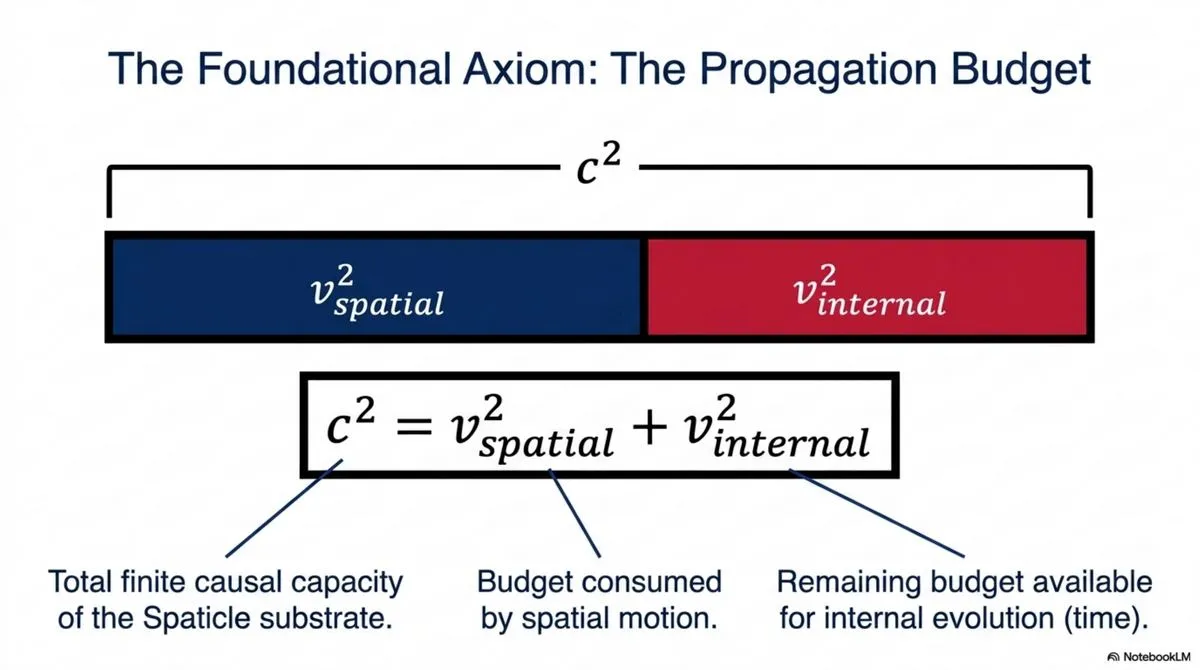
An immediate consequence follows for a stationary particle. If v_spatial = 0, then v_internal = c: the entire propagation budget is available for internal physical evolution, and every internal process proceeds at its maximum possible rate. If the particle moves through space, a portion of the available budget is committed to maintaining that motion, and the remaining budget available for internal evolution necessarily decreases. Nothing further needs to be assumed; clock slowing becomes a direct consequence of a finite, shared physical resource.
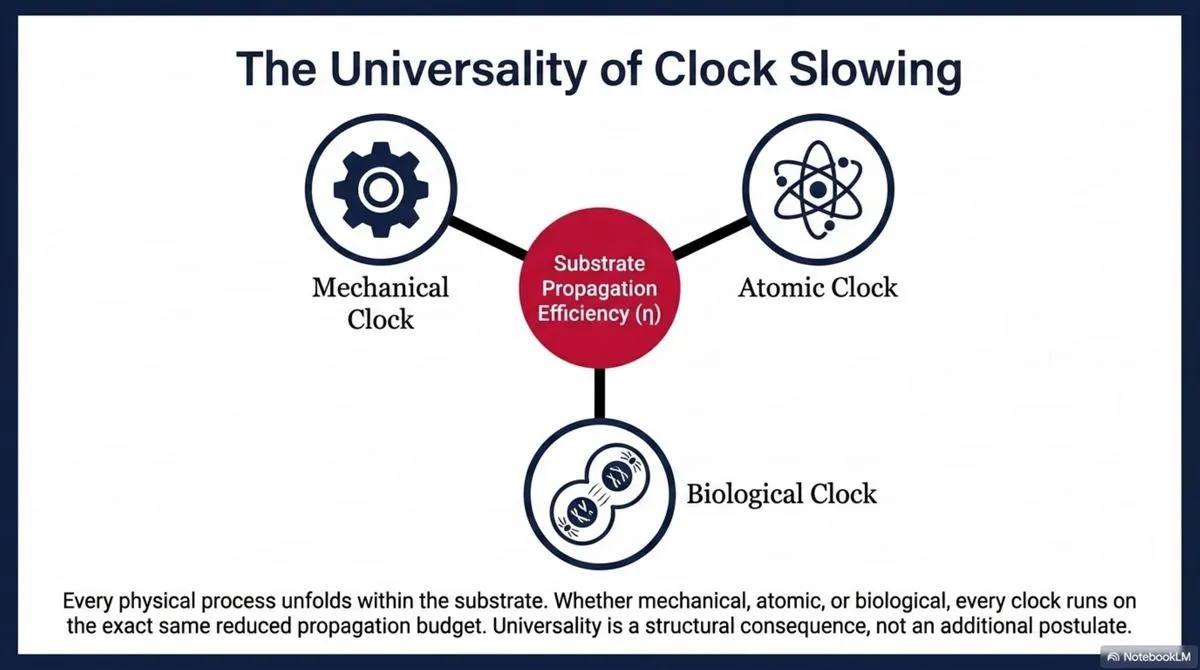
The argument does not depend on the specific nature of the clock. Atomic transitions, mechanical oscillations, radioactive decay, chemical reactions, and biological metabolism all ultimately depend on internal substrate evolution. Since every internal process draws on the same reduced propagation budget under motion, every physical clock is predicted to slow by precisely the same factor - the universality of relativistic time dilation across every clock technology tested to date [3,4]. An interactive simulation of this propagation-budget mechanism, allowing direct manipulation of velocity and gravitational potential, is available online [19].
5. Derivation of Special-Relativistic Time Dilation
Within the propagation-budget framework, a clock does not measure an externally existing temporal flow; it measures the accumulated internal substrate evolution occurring within its own physical structure. Suppose an object moves with velocity v, so that v_spatial = v. From equation (1), the remaining propagation capacity available for internal evolution is:
v_internal = √(c² − v²) (2)
The fraction of the total substrate capacity available for internal physical evolution, the propagation efficiency, is:
η = v_internal / c = √(1 − v²/c²) (3)
and the elapsed proper time follows immediately:
dτ = η dt = dt · √(1 − v²/c²) (4)
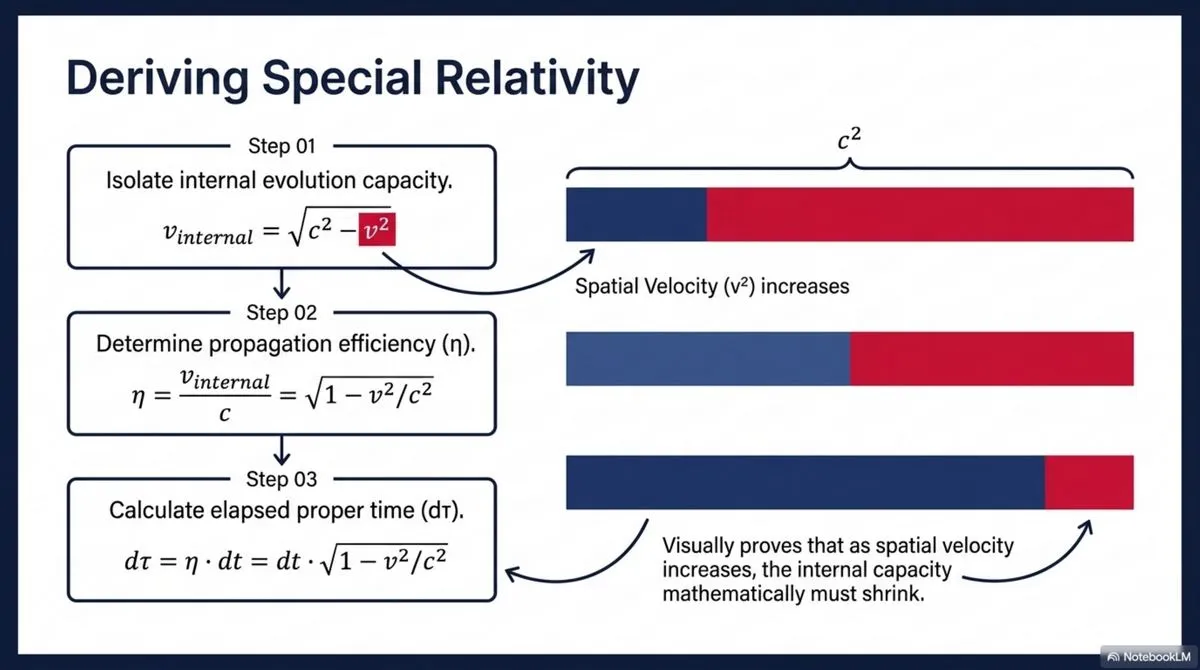
Equation (4) is the standard Lorentz time-dilation relation [1]. The mathematical expression is identical to Special Relativity; the physical interpretation differs. In the conventional treatment, the Lorentz factor arises from the geometry of Minkowski spacetime [16]. In the present framework, it arises because a finite substrate must divide its available reorganisation capacity between spatial propagation and internal evolution. No geometric distortion of time is invoked; clock slowing follows as a direct physical consequence of a shared, finite resource. This reading is consistent with, and does not modify, any experimentally confirmed prediction of Special Relativity, including the reciprocity of time dilation between inertial observers, each of whom evaluates the available propagation budget relative to their own local substrate evolution.
6. Gravitational Time Dilation
The same principle extends to gravitation. In General Relativity, clocks run more slowly within gravitational fields, conventionally attributed to spacetime curvature [2], confirmed experimentally from suborbital rocket-borne clock comparisons to millimetre-scale laboratory height differences [17,18]. Within the present framework, a mass continuously organises and maintains a local deformation of the substrate; maintaining that organised deformation requires continual substrate reorganisation, which consumes part of the available propagation budget at that location. The capacity remaining for internal physical evolution decreases correspondingly, by exactly the mechanism responsible for kinematic time dilation in Section 5. The difference lies only in what consumes the propagation budget: spatial motion for a moving body, and substrate deformation for a gravitating system.
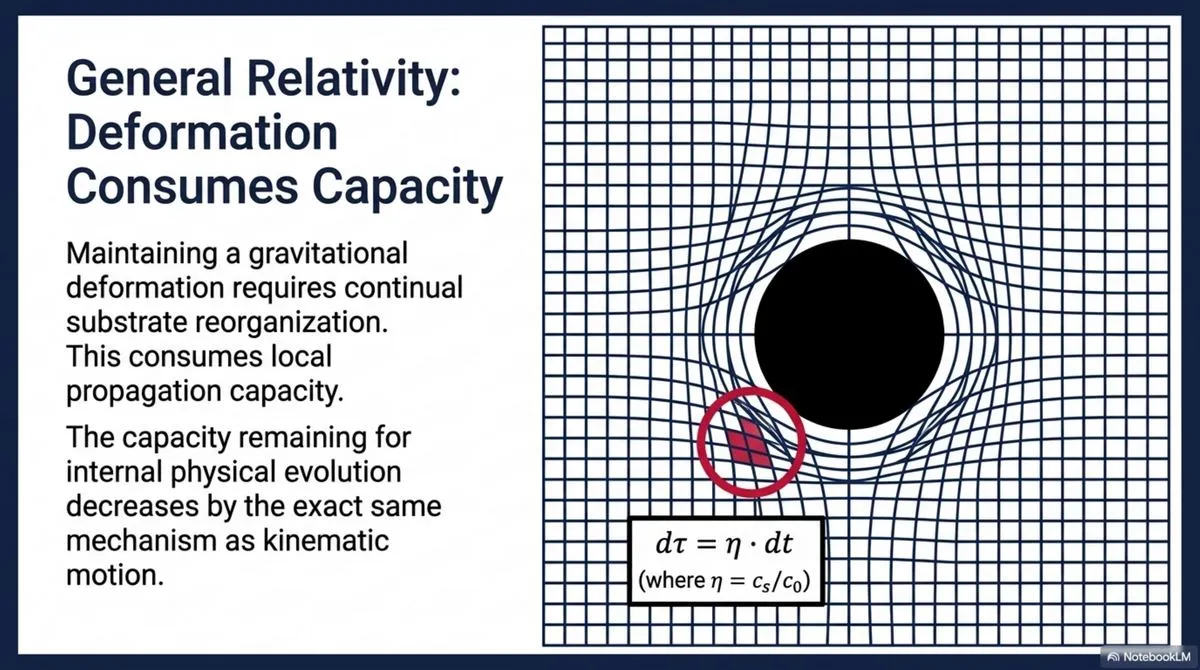
Defining the local propagation efficiency as η = cs/c, where cs denotes the effective local substrate reorganisation rate at a given location, the elapsed proper time follows the same structural relation as equation (4):
dτ = η dt (5)
identical in form to the kinematic case; only the physical origin of the reduced propagation efficiency differs. Within this account, Special and General Relativity are not two independent mechanisms for time dilation but two manifestations of one conservation principle: motion consumes propagation capacity, and gravitational deformation consumes propagation capacity, and both reduce the same finite physical quantity available for internal evolution. The long-noted mathematical similarity between the Lorentz factor and gravitational time-dilation expressions [1,2] follows directly from the shared propagation-budget constraint.
In the settled, slowly varying regime, the substrate’s governing carrier equations reduce exactly to the Einstein vacuum equations and therefore recover the Schwarzschild solution in full, as established in the companion gravitational field paper [7]. Gravitational time dilation under the present account is therefore identical, in this regime, to the prediction of General Relativity; the propagation-budget interpretation supplies a physical mechanism underlying the same mathematical result, rather than a competing prediction. A more complete treatment of the propagation-budget mechanism, including its extension to relativistic velocity addition, is presented in the companion paper on time [14].
The present paper considers only this settled regime. Extensions to rapidly rotating galaxies, compact objects, neutron-star mergers, and quantum-gravitational domains are developed in the companion gravitation paper [7].
Note on regime. This formulation holds in the weak-field, non-relativistic-velocity regime, where v_spatial and vgrav act as independent, non-interacting channels. The GPS system operates in precisely this regime; the formula has been confirmed to the accuracy required for satellite timing. Extensions to strong-field, high-velocity regimes involve cross-coupling between the channels and have not yet been derived from the governing substrate field equations.
This is the unified propagation-budget equation for time dilation. Setting the gravitational term to zero gives η = √(1 − v²/c²), the special-relativistic result derived in Section 5. Setting v = 0 gives η(r) = √[1 − (2GM/rc²)·f(r,Rd)], the gravitational result derived in Section 6. The same equation therefore describes both kinematic and gravitational time dilation as different manifestations of a single propagation-budget constraint. This additive structure corresponds to the standard weak-field result of general relativity for a clock in circular motion, dτ/dt = √[(1 − 2GM/rc²) − v²/c²], used operationally in satellite clock corrections. Both vgrav and v_spatial draw on the same finite total budget, which is why the terms add.
dτ = √[1 − v²/c² − (2GM / rc²) · f(r, Rd)] dt
The accumulated proper time is then:
η = √[1 − v²/c² − (2GM / rc²) · f(r, Rd)]
Solving for the internal evolution capacity remaining after both gravitational deformation and spatial motion have drawn on the shared budget:
c² = v²_internal + c²·(2GM/rc²)·f(r,Rd) + v²_spatial
so that the three-channel budget becomes:
v²_grav = c² · (2GM / rc²) · f(r, Rd)
The explicit connection between v²_grav and the gravitational potential makes the substitution transparent:
The ordering reflects the physical priority for any massive system. Internal evolution is the channel responsible for time itself: without it, there is no clock. Gravitational deformation maintenance is the next channel: it draws on the budget continuously at every location near mass, independently of the clock's motion. Spatial motion draws on whatever remains.
c² = v²_internal + v²_grav + v²_spatial
Sections 5 and 6 derive special-relativistic and gravitational time dilation as two separate applications of the same propagation-budget constraint. A single unified formula follows directly from extending the budget from two channels to three: internal evolution, gravitational deformation maintenance, and spatial motion.
6.1 The Unified Propagation-Budget Equation
7. The Universal Speed Limit as a Consequence of Finite Substrate Capacity
Special Relativity postulates the existence of a universal speed limit as a foundational principle [1]; the present framework proposes a physical origin for it. Within the propagation-budget framework, the substrate itself cannot reorganise faster than its own maximum rate; consequently, no physical process depending on substrate reorganisation - which, under the substrate framework, includes every physical process - can propagate faster than the substrate from which it is constituted. The universal speed limit is, under this account, not an independent law of nature but the maximum physical rate at which the substrate can reorganise itself, with every physical process inheriting this limitation because every physical process is an organised evolution of the substrate. A full, independently evaluated derivation of the numerical value of c from this substrate is presented in the companion paper [7], using a non-circular consistency relation among six independently established quantities; the present paper depends only on the existence of a finite maximum reorganisation rate, not on the specific derivation of its numerical value.
The same argument extends to gravitational radiation. Since both photons and gravitational waves are, under the substrate framework, organised propagating disturbances of the same medium rather than excitations of two physically unrelated fields, both are expected to propagate at the substrate’s maximum reorganisation rate, and their observed equal propagation speed - confirmed to one part in 1015 by the near-simultaneous detection of gravitational waves and electromagnetic radiation from GW170817 [10] - requires no additional postulate under this account.
This asymmetry between photons and massive particles follows directly from the propagation-budget principle of Section 4. Persistent material condensations must continually allocate part of the propagation budget to maintaining their own internal structure, leaving strictly less than the full budget available for spatial propagation. Propagating disturbances such as photons, which are not organised into a persistent, self-maintaining condensation, commit no part of the budget to internal maintenance and are consequently free to propagate at the substrate’s full reorganisation rate.
Lorentz contraction and time dilation are not two effects with one shared formula. They are one effect expressed in two coordinates: η applied to the time coordinate gives time dilation; η applied to the spatial coordinate along the direction of motion gives length contraction. The propagation-budget constraint of Section 4 accounts for both simultaneously.
No physical compression of the object occurs. Every atom in the object has locally invariant dimensions in its own substrate frame. The contracted length is a relational measurement, the same kind of frame-dependent comparison that produces time dilation. The mathematical factor is identical because both effects have the same physical source: the allocation of propagation budget.
Two observers in relative motion have different simultaneity surfaces, the set of events each regards as happening at the same moment. This is a direct consequence of their different propagation paths through the substrate. When each observer measures the spatial extent of the same object by locating its endpoints simultaneously in their own frame, they are sampling the object at different substrate configurations. The measured spatial interval differs by the same factor η = √(1 − v²/c²).
The propagation-budget equation c² = v²_spatial + v²_internal determines how the finite reorganisation capacity of the substrate is allocated. Section 5 established that this allocation reduces the internal evolution rate of a moving system to η = √(1 − v²/c²), producing time dilation. The spatial consequence follows from the same allocation through the geometry of simultaneity.
Standard special relativity predicts that a body in motion contracts along its direction of motion by the factor √(1 − v²/c²). This is commonly presented as an independent consequence of the Lorentz transformation, separate from time dilation. Within the propagation-budget framework, length contraction is not independent. It is a second consequence of the same constraint already established in Section 4.
7.1 Photon Proper Time and Massless Propagation
The propagation-budget framework provides a direct physical explanation for a standard result of special relativity: photons accumulate zero proper time.
A photon is a massless excitation of the Spaticle substrate. It carries no requirement to maintain a localised condensation structure. Its internal evolution budget is zero because it has no internal structure to evolve. The full propagation capacity c is therefore available entirely for spatial traversal. Setting v_internal = 0 in the budget constraint c² = v_spatial² + v_internal² gives v_spatial = c exactly.
The proper time accumulated by a photon along any path is:
dτ = √(1 − v_spatial²/c²) dt = √(1 − c²/c²) dt = 0
This is not a limiting case or a convention. It is a direct consequence of the propagation budget. A massless mode devotes 100% of its propagation capacity to spatial traversal and 0% to internal evolution. It therefore accumulates no proper time regardless of path length or coordinate duration. All photons, regardless of frequency or energy, share this property because masslessness means zero internal structure budget.
The same argument applies to gravitational waves and any other massless substrate excitation. The BFUT framework thus provides a physical mechanism for what standard relativity states mathematically: massless excitations travel along null geodesics and experience no proper time passage.
8. Lorentz Contraction as a Consequence of the Same Budget Constraint
The past cannot be changed because substrate disturbances, once propagated, cannot be locally recalled. The future does not yet exist because the substrate has not completed the reorganisations that will constitute future states. The present is the propagation front.
This is the physical origin of the arrow of time. It does not require a separate thermodynamic postulate, though it is consistent with the thermodynamic arrow. It follows from the fact that the substrate propagates outward from sources and cannot spontaneously reverse. Every physical process, because it depends on internal substrate evolution, inherits this directional asymmetry.
Within the framework, time is accumulated internal substrate evolution. The substrate propagates disturbances outward from their sources at a maximum rate c. This outward propagation is irreversible at the level of the medium: a disturbance once emitted distributes its information across an expanding region of the substrate. Reversing this propagation would require recalling that information back to a single point against the natural outward dynamics of the substrate.
The propagation-budget framework provides a direct physical account of the arrow of time, the observed asymmetry between past and future that is absent from the time-symmetric equations of both classical and quantum mechanics.
9. The Arrow of Time
This resolution is consistent with every experimental test of relativistic time dilation cited in Section 5.
This is not a frame-dependent statement. The total propagation budget allocated to spatial traversal is an objective feature of the travelling twin's path through the substrate. Only the travelling twin undergoes real acceleration, corresponding to real changes in the spatial propagation budget allocation. The resting twin undergoes no such changes. The asymmetry is physical and absolute: the travelling twin has allocated more budget to spatial traversal, accumulates less internal evolution, and returns physically younger.
The two twins accumulate different amounts of internal substrate evolution. The resting twin commits none of the propagation budget to sustained spatial displacement. The travelling twin commits a fraction of the budget to spatial traversal throughout the journey. During every interval of high-velocity travel, the travelling twin's internal evolution rate is η = √(1 − v²/c²) times the resting twin's rate. The accumulated difference at reunion is the integral of this deficit over the entire journey.
The twin paradox is traditionally stated as follows. One twin remains at rest; the other travels at high velocity to a distant point and returns. Both twins agree on the reunion. Special relativity predicts the travelling twin is younger. Within the propagation-budget framework, there is no paradox and the resolution is physical.
10. The Twin Paradox from Substrate Propagation Histories
11. Analysis of Common Philosophical Expressions Involving Time
Several philosophical statements about time are frequently encountered in both popular and technical literature. This section evaluates them against the technical structure developed above.
11.1 “Time is an illusion”
Within BFUT this statement is imprecise. Time corresponds to a real physical process: the accumulation of substrate state changes. What is illusory is the notion of time as an independently existing dimension through which events move. The process itself is physical and measurable.
11.2 “The passage of time is subjective”
The rate at which substrate evolution occurs at a given location is objective and determined by the local propagation efficiency. Different observers may measure different rates when comparing clocks across different substrate configurations, but each local rate is physically well-defined.
11.3 “The block universe is the correct ontology”
The block-universe picture treats all times as equally real within a static four-dimensional manifold (see, e.g., Minkowski 1908; modern discussions in Price 1996 and Maudlin 2007). BFUT rejects this ontology. Only the current substrate configuration exists. Past configurations have already propagated their effects outward; future configurations have not yet been realised. The mathematical convenience of a block description does not imply ontological reality.
11.4 “Time flows”
The metaphor of flow is misleading if it suggests motion through a pre-existing temporal dimension. A more accurate description is that organised physical change accumulates at a rate determined by local substrate conditions. There is no additional entity called “time” that flows.
12. Why Clocks Measure Time
A clock is any physical system whose internal evolution depends on substrate state changes. Atomic clocks rely on electron transitions, mechanical clocks on periodic mechanical motion, and biological clocks on metabolic and neural processes. In all cases, the measurable rate is determined by how rapidly the relevant substrate configurations can evolve under local conditions. A clock does not measure an external temporal flow; it registers the net accumulation of substrate reorganisations within its own structure. Different clocks (atomic, mechanical, biological) may accumulate proper time at different rates if they couple to the substrate through different internal processes, but all ultimately reflect the same underlying propagation efficiency.
12.1 Why All Clock Types Agree
The substrate propagation framework predicts that all physical clocks - regardless of their mechanism - must agree on proper time intervals when compared under identical substrate conditions. This is a non-trivial prediction because different clock types couple to the substrate through entirely different physical mechanisms.
Atomic clocks measure electron transition frequencies. The transition rate depends on the local electromagnetic coupling strength, which is determined by the substrate density ρ_s through the fine structure constant. When the substrate propagation efficiency η falls, the transition rate falls proportionally.
Pulsar timing measures the rotational period of a neutron star. The period is determined by the rotational mechanics of a condensed object embedded in the substrate. The substrate propagation efficiency η governs all local physical rates including rotational dynamics.
Radioactive decay measures the rate of nuclear rearrangement. The decay constant depends on the strong and weak coupling strengths, both determined by the same substrate density ρ_s. A reduction in propagation efficiency reduces these rates proportionally.
Biological clocks measure metabolic and neural process rates. These depend on chemical reaction rates, molecular vibration frequencies, and diffusion rates - all of which are substrate evolution rates and all governed by the same propagation efficiency η.
The reason all clocks agree is that they are all measuring the same underlying quantity: the local substrate propagation efficiency η at their location. Different mechanisms access the same substrate property through different physical channels. When gravitational or kinematic time dilation reduces η, every physical rate at that location slows by the same factor. No clock type is privileged. The universality of time dilation is a direct consequence of the universality of the substrate propagation budget.
13. Simultaneity from Substrate Propagation Delays
In special relativity, absolute simultaneity is lost because the speed of light is finite. Within BFUT this loss has a direct physical interpretation. Two events are simultaneous for an observer only if the substrate disturbances carrying information about those events reach the observer at the same moment. Because disturbances propagate at finite speed c through the substrate, observers in relative motion or in different gravitational configurations receive information along different paths and with different delays. Simultaneity is therefore not a global geometric property but a local accounting of propagation arrival times. The relativity of simultaneity follows necessarily from the finite propagation capacity of the substrate.
14. Causality from Finite Reorganisation Rates
Causality is often treated as a postulate. In BFUT it follows directly from the finite rate at which the substrate can reorganise. For event A to influence event B, a disturbance must propagate from A to B through the substrate. This propagation requires a non-zero time determined by the distance and the local propagation efficiency. No influence can arrive before the substrate has had time to reorganise and carry the disturbance. The causal structure of spacetime therefore emerges from the requirement that substrate reorganisation takes finite time. Closed timelike curves would require a disturbance to return to its origin before the substrate has completed the necessary reorganisations, which violates the propagation limit.
15. Why the Past Cannot Be Changed
Once a substrate disturbance has propagated outward from its source, the information it carries is distributed across an expanding region of the substrate. Reversing the past would require recalling or cancelling all those distributed disturbances simultaneously. Because the substrate propagates disturbances outward at finite speed and without a mechanism for local reversal, no local operation can undo the global propagation that has already occurred. The past is therefore fixed not by metaphysical necessity but by the irreversible spreading of substrate disturbances.
16. Why the Future Does Not Yet Exist
Future states correspond to substrate configurations that have not yet been realised through local reorganisation. Until the substrate at a given location has undergone the sequence of changes that constitute a particular configuration, that configuration has no physical existence. The future is potential rather than actual. Treating future events as already existing in a four-dimensional manifold misrepresents the ontological status of unrealised substrate states. The block-universe picture may be mathematically convenient but does not correspond to the physical process of substrate evolution.
17. Time Travel in the BFUT Framework
Travel to the future via time dilation is possible in principle. An observer who allocates a larger fraction of propagation capacity to spatial motion or who remains in a region of reduced propagation efficiency will accumulate less proper time than observers in less affected regions. Upon return, the traveller will have aged less. This is ordinary time dilation, not exotic time travel.
Travel to the past is not possible. It would require a disturbance to propagate backward through the substrate or to return to its origin before the necessary reorganisations have occurred. Both possibilities violate the outward, irreversible character of substrate propagation. Closed timelike curves are likewise forbidden because they would require information to arrive at an event before the substrate has had time to carry it (Gödel 1949; Hawking 1992 chronology protection conjecture). Grandfather paradoxes and information paradoxes do not arise because backward causation through the substrate is physically excluded.
17.1 Singularity Impossibility from the Time Framework
The identification of time with accumulated substrate evolution leads to a temporal proof that true gravitational singularities cannot exist.
A true singularity requires infinite compression of the substrate at a point. Infinite compression means infinite substrate density at that point. But the local propagation efficiency η = cs/c0 falls as the substrate becomes denser and more deformed. At infinite compression, η approaches zero. When η = 0, the rate of substrate state evolution at that location is zero. No substrate state changes can occur. No physical process can proceed. The accumulation of proper time at that location ceases entirely.
A location where proper time accumulation has ceased is not a physical location in any operational sense. No clock can run there. No causal process can occur there. No substrate reorganisation can happen there. The mechanism that constitutes time has been destroyed by the very compression that was supposed to produce the singularity.
The singularity is therefore temporally self-defeating: the process of forming it destroys the physical basis for any further evolution. Before infinite compression is reached, the substrate resistance to further compression - through the substrate's restoring pressure and coherence threshold mechanisms - stabilises the collapse into a finite-density compact structure. Time continues to accumulate at a slow but non-zero rate within that structure.
This temporal argument is self-contained: even if infinite compression were approached, time would cease before it was reached, making the singularity operationally unreachable regardless of the dynamical behaviour of the substrate at extreme densities.
17.2 Quantum Time and Wavefunction Evolution
Quantum mechanical wavefunction evolution has an immediate interpretation within the substrate time framework.
The wavefunction ψ(x,t) describes the substrate configuration of a quantum system. The Schrodinger equation governs how this configuration evolves. Within the substrate framework, the Schrodinger equation emerges from substrate propagation dynamics: the wavefunction phase evolution is the accumulated substrate state change of the system over time.
Within this framework, quantum time is substrate evolution time. The phase e^(-iEt/ħ) accumulates because the substrate configuration of the system is continuously reorganising at a rate proportional to its energy. Higher energy means faster substrate reorganisation means faster phase accumulation.
Quantum time dilation follows automatically. When the propagation efficiency η falls due to gravitational deformation or kinematic allocation, the rate of substrate reorganisation falls for all processes including quantum phase evolution. The Schrodinger equation in a gravitationally deformed substrate picks up the local η factor. Quantum clocks dilate for exactly the same reason classical clocks dilate.
The quantum Zeno effect - the slowing of evolution under frequent measurement - also has a substrate interpretation: measurement is a substrate interaction that partially allocates the system's propagation budget to the coupling event, temporarily reducing the budget available for independent internal evolution.
18. The Equivalence Principle in BFUT
BFUT reproduces the same curvature-matter coupling as general relativity: a given local stress-energy configuration deforms the Spaticle field in the same geometric relationship that general relativity attributes to abstract spacetime curvature. Test particles therefore follow the same trajectories in both frameworks for the same source. This gives BFUT the Weak Equivalence Principle by direct inheritance: acceleration in a gravitational field is independent of an object's composition, because it depends only on the geometry produced by the source, not on the internal structure of the falling body.
The Einstein Equivalence Principle's clock-universality requirement is likewise satisfied, and satisfied more directly than in general relativity. Section 17 already establishes that atomic, nuclear, mechanical, and biological processes all slow together under the same local propagation efficiency η, because every physical process is ultimately a substrate reorganisation governed by the same underlying rate. Local position invariance, the requirement that all clocks agree on how much a given field configuration slows them, is therefore a structural feature of BFUT rather than a separately imposed postulate.
The Strong Equivalence Principle stands on different footing. General relativity is a pure metric theory: curvature is the only gravitational degree of freedom, and this is precisely why general relativity predicts zero deviation between the free fall of a self-gravitating body and a test particle of the same mass. BFUT does not share this structure. The Spaticle field carries its own equilibrium density ρ_s, a finite relaxation time τ_c, and a finite deformation domain Rd, properties of a physical medium with its own equation of state, absent from vacuum Einstein curvature. This makes the Spaticle field an additional gravitational degree of freedom beyond the metric response itself, structurally comparable to scalar-tensor and elastic-medium theories of gravity.
A self-gravitating body's own binding energy is stored as Spaticle deformation energy. Whether that stored deformation energy couples back to the ambient field with the same strength as ordinary rest-mass and kinetic energy is a property of the substrate's equation of state, not a guaranteed identity. Theories with one additional gravitational degree of freedom beyond the metric generically produce a nonzero Nordtvedt effect, a small difference between the free-fall trajectory of a self-gravitating body and that of a test particle. BFUT is structurally expected to produce such a deviation, in contrast to general relativity, where it is exactly zero by construction. This is a genuine point of distinction between the two theories rather than a shared feature, and it is testable: existing Lunar Laser Ranging data constrain the Nordtvedt parameter η_N to roughly the 10⁻⁴ level, providing a direct empirical target once the coupling between binding energy and ρ_s is computed from the substrate field dynamics (F1-cov).
In summary: the Weak and Einstein Equivalence Principles hold in BFUT exactly as in general relativity, with the added physical content that the underlying geometry is a real substrate deformation rather than an abstract manifold. The Strong Equivalence Principle is not assumed to hold. BFUT's identification of gravity with a physical medium possessing its own density, relaxation time, and finite range gives a structural reason to expect a small, non-zero Nordtvedt-type deviation from general relativity, positioning this as a distinguishing prediction of the theory rather than a point of agreement with it.
19. Discussion: Anticipated Objections
19.1 "Does this modify any confirmed prediction of Special or General Relativity?"
No. Equations (4) and (5) are mathematically identical to the standard Lorentz and gravitational time-dilation relations. The proposal offers a physical mechanism for why these relations hold; it does not alter the Lorentz transformation, the Einstein field equations, or any confirmed experimental result, including GPS timing corrections [5], atomic clock comparisons at different heights and velocities [4], and the GW170817 timing constraint of Section 7 [10].
19.2 "Is the propagation-budget equation merely a relabelling of the Lorentz factor?"
The mathematical content of equation (3), the square root of one minus v squared over c squared, is not new; it is the standard Lorentz factor. Equation (3) is intentionally identical to it: the purpose of the present work is not to derive a different mathematical expression, since none is available that would also match the full body of confirmed relativistic measurement, but to identify the physical conservation law from which the known expression follows. This identification is falsifiable in the sense specified in Section 9: it predicts, as a structural consequence rather than an independent postulate, that gravitational and kinematic time dilation must share exactly the same functional dependence on propagation efficiency, and that this dependence must be identical for every physical clock regardless of its internal construction.
11.3 "Why should every physical clock, regardless of construction, slow by exactly the same factor?"
Within the proposed framework, this universality is not an additional assumption but a direct structural consequence: every clock, whatever its specific construction, ultimately measures internal substrate evolution, and every internal process draws on the same reduced propagation budget under motion or gravitational deformation. The experimentally confirmed universality of relativistic time dilation across atomic, mechanical, and other clock technologies [3,4] is, under this account, the expected outcome rather than a separately required postulate.
20. Falsifiable Predictions
The propagation-budget framework makes the following falsifiable predictions.
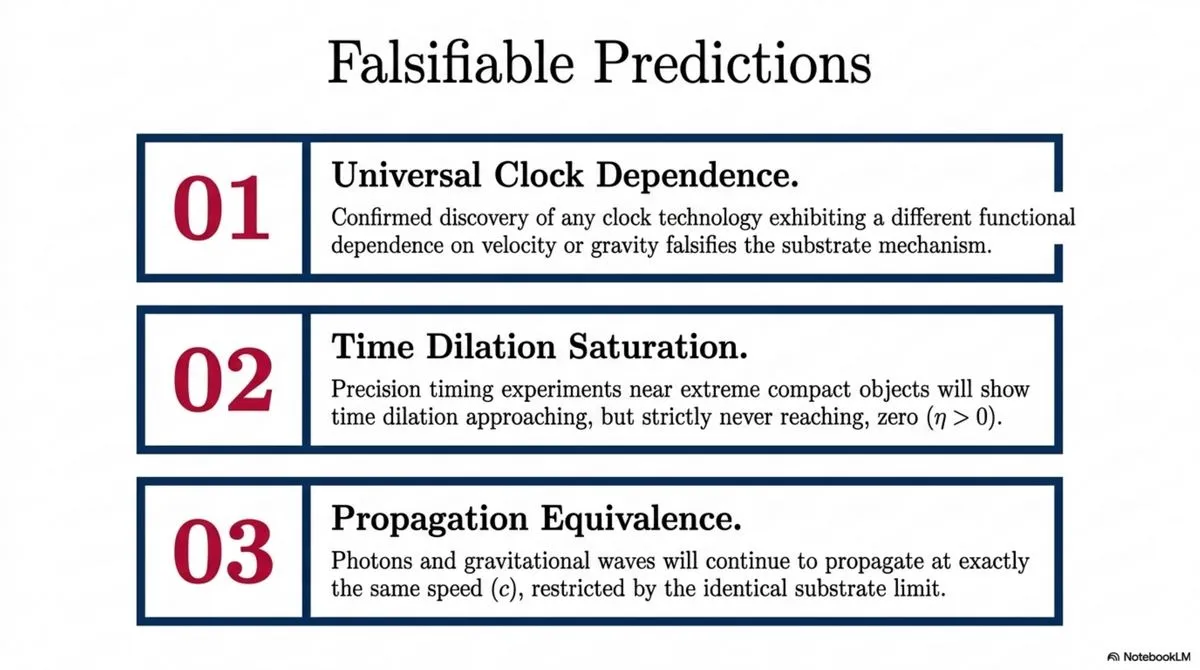
Prediction 1. No clock, of any physical construction, will be found to violate the universal time-dilation factor of equations (4) and (5). Within the proposed framework, this follows from the fact that every clock measures internal substrate evolution governed by the same finite propagation budget; the confirmed discovery of a clock technology exhibiting a different functional dependence on velocity or gravitational potential would be inconsistent with the mechanism proposed here.
Prediction 2. Because gravitational time dilation under this account is tied to the same finite substrate reorganisation capacity responsible for the finite maximum compression density established for collapsed matter in a companion paper, gravitational time dilation near a compact object is expected to approach a finite maximum value rather than diverging to infinity at arbitrarily small radius; a confirmed observation of gravitational time dilation continuing to increase without bound as a test clock approaches the classical Schwarzschild radius, rather than saturating at a finite value near the compact object’s finite compression core, would be inconsistent with the mechanism proposed here.
Prediction 3. No massive particle will be accelerated to the substrate’s maximum propagation rate c. Within the proposed framework, a massive particle is an organised, persistent condensation that must continually commit part of its propagation budget to maintaining its own structure, leaving strictly less than the full budget available for spatial propagation; this is consistent with, and offers a physical reading of, the standard relativistic relation between velocity and total energy.
Prediction 4. Photons and gravitational waves will continue to be found to propagate at exactly the same speed, to a precision limited only by the sensitivity of future multi-messenger astronomical observations; a confirmed, statistically significant difference between the two propagation speeds would be inconsistent with the shared-substrate account proposed in Section 7.
21. Conclusions
This paper derives the temporal structure of the BFUT substrate framework from a single conservation principle: c² = v²_internal + v²_grav + v²_spatial, the propagation budget shared between internal evolution, gravitational deformation maintenance, and spatial motion. Special-relativistic time dilation, gravitational time dilation with a finite domain, and their unified formula all follow from this constraint. Length contraction follows from the same propagation efficiency η applied to the spatial coordinate. The arrow of time follows from the irreversibility of outward substrate propagation. The twin paradox is resolved by the objective difference in propagation budget committed to spatial traversal along each path. Photon proper time is zero because a massless excitation commits the entire budget to spatial propagation. All physical clocks agree on elapsed proper time because all internal processes depend on the same substrate propagation efficiency. Simultaneity and causality are consequences of finite substrate propagation speed. The past cannot be changed because propagated disturbances cannot be locally recalled. The future does not yet exist because the substrate has not completed the reorganisations that will constitute it. A gravitational singularity is physically unreachable because time accumulation ceases before infinite density is reached. Quantum wavefunction evolution is substrate evolution time. The Weak and Einstein Equivalence Principles hold exactly; the Strong Equivalence Principle does not, with a structural break tied to ρ_s, τ_c, and Rd as degrees of freedom beyond the metric.
This account requires no modification to the mathematical structure of Special or General Relativity. Every experimentally confirmed prediction of both theories, within their established domains, is reproduced exactly. The propagation-budget constraint identifies the physical conservation law from which the known mathematics follows.
References
[1] Einstein, A. (1905). Zur Elektrodynamik bewegter Körper. Annalen der Physik, 322(10), 891–921.
[2] Einstein, A. (1916). Die Grundlage der allgemeinen Relativitätstheorie. Annalen der Physik, 354(7), 769–822.
[3] Hafele, J.C. and Keating, R.E. (1972). Around-the-world atomic clocks: Observed relativistic time gains. Science, 177(4044), 168–170.
[4] Chou, C.W., Hume, D.B., Rosenband, T., and Wineland, D.J. (2010). Optical clocks and relativity. Science, 329(5999), 1630–1633.
[5] Ashby, N. (2003). Relativity in the Global Positioning System. Living Reviews in Relativity, 6, 1.
[6] Sharma, V.S. (2026). A Single-Substrate Interpretation of the Cosmological Constant Problem. Zenodo. doi:10.5281/zenodo.21280358
[7] Sharma, V.S. (2026). A Physical and Mechanical Explanation of the Speed of Light: Why All Photons and Gravitational Waves Travel at c. Zenodo. doi:10.5281/zenodo.21292900
[8] Kepler, J. (1609). Astronomia Nova. Heidelberg.
[9] Boltzmann, L. (1877). Über die Beziehung zwischen dem zweiten Hauptsatze der mechanischen Wärmetheorie und der Wahrscheinlichkeitsrechnung. Wiener Berichte, 76, 373–435.
[10] Abbott, B.P., et al. (LIGO Scientific Collaboration, Virgo Collaboration, and Fermi GBM) (2017). Gravitational waves and γ-rays from a binary neutron star merger: GW170817 and GRB 170817A. The Astrophysical Journal Letters, 848(2), L13.
[11] Michelson, A.A. and Morley, E.W. (1887). On the relative motion of the Earth and the luminiferous ether. American Journal of Science, 34(203), 333–345.
[12] Müller, H., Herrmann, S., Braxmaier, C., Schiller, S., and Peters, A. (2003). Modern Michelson-Morley experiment using cryogenic optical resonators. Physical Review Letters, 91, 020401.
[13] Sharma, V.S. (2026). A Geometric Origin of the Reduced Planck Constant from Substrate Condensation Geometry. Zenodo. doi:10.5281/zenodo.21280494
[14] Sharma, V.S. (2026). Time: Identifying the Cause and Effects and Unifying General and Special Relativity. Zenodo. doi:10.5281/zenodo.20556908
[15] Will, C.M. (2014). The confrontation between General Relativity and experiment. Living Reviews in Relativity, 17, 4.
[16] Minkowski, H. (1909). Raum und Zeit. Physikalische Zeitschrift, 10, 75–88.
[17] Vessot, R.F.C. and Levine, M.W. (1979). A test of the equivalence principle using a space-borne clock. General Relativity and Gravitation, 10(3), 181–204.
[18] Bothwell, T., Kennedy, C.J., Aeppli, A., et al. (2022). Resolving the gravitational redshift across a millimetre-scale atomic sample. Nature, 602(7897), 420–424.
[19] Sharma, V.S. (2026). Code: Relativistic Time Dilation and Photon Proper Time - Interactive Simulations. Zenodo. doi:10.5281/zenodo.21336792. Simulation available at vijayshankarsharma.com/focus/time-dilation.
[20] Rovelli, C. (2004). Quantum Gravity. Cambridge University Press, Cambridge.
[21] ATLAS Collaboration (2012). Observation of a new particle in the search for the Standard Model Higgs boson with the ATLAS detector at the LHC. Physics Letters B, 716(1), 1–29.
[22] CMS Collaboration (2012). Observation of a new boson at a mass of 125 GeV with the CMS experiment at the LHC. Physics Letters B, 716(1), 30–61.
[23] Einstein, A. (1920). Äther und Relativitätstheorie. Address delivered at the University of Leiden, 5 May 1920. Springer, Berlin.