A Topological Origin of Half-Integer Spin and Spin-Statistics from Substrate Embedding Geometry
- Abstract
- 1. Introduction
- 2. The Spin-Statistics Theorem and Its Unexplained Physical Origin
- 3. The Substrate Embedding Framework
- 5. Exchange Statistics from Embedding Topology
- 6. Pauli Exclusion as a Geometric Consequence
- 7. Discussion: Physical Interpretation and Anticipated Objections
- 8. Falsifiable Predictions
- 9. Conclusions
Abstract
The spin-statistics theorem (the empirical and mathematically proven fact that all half-integer-spin particles obey Fermi-Dirac statistics while all integer-spin particles obey Bose-Einstein statistics) has a rigorous proof within relativistic quantum field theory but no accepted physical account of why the two classes of particle differ in this specific way. The theorem's discoverer, and subsequent commentators including Feynman and Penrose, have noted explicitly that the mathematics works while the underlying physical picture remains obscure: a spin-1/2 particle requires two full rotations, 720 degrees, to return to its original quantum state, a behaviour with no classical analogue and no settled physical explanation. This paper proposes a geometric account of this distinction from the topology of how a localised excitation is embedded in a universal physical substrate, following the substrate framework established in prior work [1]. Under this account, a stable matter condensation is continuously and topologically connected to the surrounding substrate medium, so that a 360-degree spatial rotation disturbs this embedding connection and full restoration requires 720 degrees; a freely propagating disturbance, by contrast, is not embedded in this way and restores fully after a single 360-degree rotation. We show that this topological distinction, applied to the exchange of two identical excitations, reproduces the antisymmetric exchange phase of fermions and the symmetric exchange phase of bosons directly, without appeal to relativistic quantum field theory. We derive the Pauli exclusion principle as a direct geometric consequence of the same embedding picture, discuss the relationship to the standard relativistic proof of the spin-statistics theorem, address the objection that this account merely relabels known mathematics, and specify falsifiable predictions distinguishing embedded matter excitations from propagating force-carrying excitations within the proposed framework.
Keywords: spin-statistics theorem, half-integer spin, Pauli exclusion principle, topological embedding, fermions, bosons, substrate physics
1. Introduction
The spin-statistics theorem is among the most fundamental and least physically transparent results in quantum theory. Its content is simple to state: particles with half-integer spin (electrons, protons, neutrons, quarks, neutrinos) obey Fermi-Dirac statistics and the Pauli exclusion principle, while particles with integer spin (photons, gluons, W and Z bosons, gravitons) obey Bose-Einstein statistics and can occupy the same quantum state without restriction [1,2]. The theorem was first proven rigorously by Pauli within the framework of relativistic quantum field theory [2,3], and the proof has since been generalised and re-derived through several independent routes [4,5]. In every case, the proof is mathematically compelling but physically opaque: it establishes that the connection must hold given the axioms of relativistic quantum field theory, without explaining why nature is organised into exactly these two classes of particle in the first place.
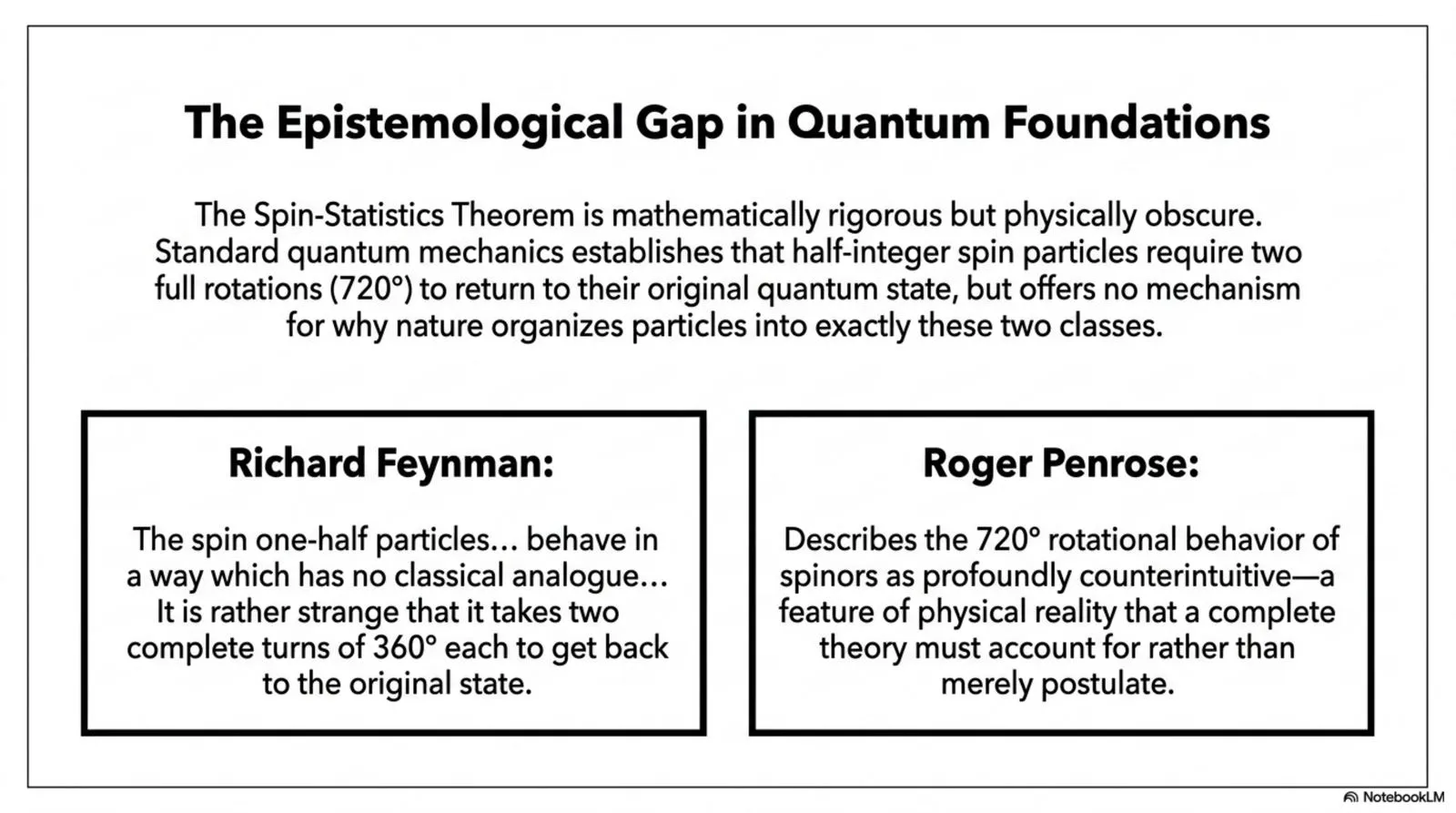
This gap has been noted explicitly by leading physicists. Feynman, in his Lectures on Physics, wrote that spin-1/2 particles "behave in a way which has no classical analogue" and remarked that "it is rather strange that it takes two complete turns of 360 degrees each to get back to the original state" [6]. Penrose, in The Road to Reality, described the 720-degree rotational behaviour of spinors as one of the deepest and most counterintuitive features of physical reality, one that any complete physical theory must account for rather than merely postulate [7]. In more than a century since the discovery of spin, no widely accepted physical mechanism has been established for why matter particles require 720 degrees for rotational restoration while force-carrying particles require only 360 degrees [18].
The empirical signature of this 720-degree behaviour is not merely theoretical. Neutron interferometry experiments, beginning with the landmark measurements of Rauch and Werner and their collaborators in 1975, directly detected the predicted phase reversal of a coherent neutron wavefunction under a 360-degree rotation, with full restoration only after 720 degrees [8,9]. This is one of the most striking confirmed predictions of quantum mechanics, and it has no accepted classical or semi-classical physical picture.
This paper proposes a geometric account of the 720-degree versus 360-degree distinction, and hence of the spin-statistics theorem itself, from the topology of how a localised excitation is embedded in a universal physical substrate, following the substrate framework established in prior work [1]. Under this account, the distinction between fermions and bosons is the distinction between being part of a physical medium and moving through it.
The proposal advanced here is intentionally minimal. It does not modify the mathematical structure of quantum field theory, the existing relativistic proof of the spin-statistics theorem, or any confirmed prediction of particle physics. It proposes a physical picture for why the theorem holds, alongside the existing mathematical proof of that it holds.
The paper is organised as follows. Section 2 reviews the spin-statistics theorem and the extent to which its physical origin remains unexplained. Section 3 introduces the substrate embedding framework. Section 4 derives the 720-degree and 360-degree restoration properties from embedding topology. Section 5 derives the fermionic and bosonic exchange phases from this topology. Section 6 derives the Pauli exclusion principle as a geometric consequence. Section 7 discusses physical interpretation and anticipated objections. Section 8 presents falsifiable predictions. Section 9 concludes.
2. The Spin-Statistics Theorem and Its Unexplained Physical Origin
2.1 The Theorem and Its Proof
The spin-statistics connection was established by Pauli in 1940 within the framework of relativistic quantum field theory [14], using the requirements of Lorentz invariance, positivity of energy, and microcausality (the vanishing of commutators or anticommutators for spacelike-separated field operators) [2,3]. Subsequent work by Luders and Zumino, and by Burgoyne, provided alternative derivations under weaker assumptions [4,5]. Streater and Wightman incorporated the theorem into the axiomatic foundations of quantum field theory [10], a framework subsequently extended to address related superselection structure [19]. In every formulation, the mathematical machinery of relativistic field theory is essential to the proof; no non-relativistic or purely geometric derivation within the standard framework is available.
2.2 The 720-Degree Rotational Signature
The mathematical statement most directly connected to the theorem is the transformation of a spinor field under rotation. A spin-1/2 field satisfies:
Ψ(φ + 2π) = −Ψ(φ) (1)
where φ is the rotation angle: a 360-degree (2*π) rotation introduces a sign change, and a second 360-degree rotation (720 degrees total) is required to restore the original state. A spin-1 (or spin-0) field satisfies the ordinary periodic condition:
Ψ(φ + 2π) = +Ψ(φ) (2)
This sign difference between equations (1) and (2), a purely kinematic fact about how spinor and tensor representations of the rotation group behave, is what ultimately produces the antisymmetric versus symmetric exchange statistics of fermions and bosons respectively [2,3]. The mathematics of this sign difference is completely understood; the double-cover structure of the rotation group SO(3) by SU(2) is standard material in any quantum mechanics or group theory text [11]. What is not explained by this mathematics alone is why nature organises its particle content into exactly two classes: matter particles that universally exhibit the SU(2) double-cover behaviour, and force-carrying particles that universally do not.
2.3 Experimental Confirmation of the 720-Degree Behaviour
The reality of the 720-degree restoration property was confirmed experimentally well after its theoretical prediction. Neutron interferometry experiments by Rauch, Zeilinger, and collaborators, and independently by Werner and collaborators, in 1975 used a coherent neutron beam split and recombined after passing one arm through a controlled magnetic field, directly observing the predicted destructive interference after a 360-degree spin rotation and the restoration of constructive interference only after 720 degrees [8,9]. This remains one of the most direct experimental confirmations of a purely quantum-mechanical, non-classical prediction, and has since been reproduced and refined using improved interferometric techniques [16].
3. The Substrate Embedding Framework
3.1 The Universal Substrate
The present work proposes, following the prior derivation in [1], that stable matter arises as a localised, topologically embedded condensation of a universal physical substrate with equilibrium mass-energy density:
ρs = 5.9 × 10^{-27} kg/m3 (3)
This value is taken from the independent prior derivation [1], which establishes ρs from self-consistency conditions of the substrate medium involving no spin or statistics observable. The present paper does not depend on the details of that derivation; it depends only on the fact that ρs is fixed by considerations entirely independent of the spin-statistics theorem. The present analysis therefore constitutes an independent test of an embedding topology whose structure is fixed prior to any consideration of particle spin or exchange statistics.
3.2 The Physical Substrate and Relation to the Michelson-Morley Experiment
Any proposal invoking a physical medium filling space, such as the substrate underlying the embedding topology of this paper, invites an immediate and reasonable historical comparison to the luminiferous aether, decisively excluded by the Michelson-Morley experiment and its many high-precision successors [20,21]. This comparison deserves a direct response rather than a footnote.
The luminiferous aether, as originally conceived, was a medium at rest relative to some preferred, absolute reference frame, through which the Earth and all material bodies moved; light was expected to propagate at a fixed speed relative to this aether frame, producing a detectable directional variation in the measured speed of light as the Earth’s motion through the aether changed with the seasons [20]. The null result of the Michelson-Morley experiment, and of every subsequent interferometric test at ever-increasing precision [21], rules out exactly this specific structure: a medium establishing a preferred rest frame detectable through directional light-speed anisotropy.
The substrate proposed in [1] does not have this structure. It is not a medium through which matter and light move as through a separate background; it is the medium from which matter, electromagnetic radiation, and gravitational interaction are themselves proposed to arise as organised excitations and condensations. Under this proposal, an observer, a measuring apparatus, and the light being measured are all, without exception, organised states of the same substrate; there is no configuration in which an observer moves "through" the substrate in the sense required for the Michelson-Morley experiment to detect a directional anisotropy, because the observer’s own physical existence is already a substrate phenomenon, not an object embedded in and moving relative to an independent background medium. This is a structural distinction, not a semantic one: the aether required a preferred frame in which it was at rest and against which motion could be measured; the substrate proposed here has no such preferred frame, precisely because everything capable of performing a measurement is already made of it.
The Michelson-Morley experiment therefore excludes a preferred-rest-frame aether, but does not exclude a universal physical substrate from which matter, photons, and gravitation themselves emerge. Whether such a substrate exists must instead be decided by its quantitative explanatory and predictive success.
Convergence With, Not Departure From, Existing Physics
The proposal that space possesses physical substance is not a departure from established physics. It is a convergence with it. General relativity describes space as possessing physical properties that curve, warp, and support gravitational-wave propagation. Loop quantum gravity reaches a related conclusion by an unrelated route, proposing that space is a discrete physical structure at the Planck scale [23]. Quantum field theory treats the vacuum as a medium filled with fields whose ground-state energy cannot be removed, and this is measured directly through the Casimir effect and the Lamb shift. The Higgs field, confirmed at CERN in 2012, is a scalar field that permeates all of space and interacts with matter [24,25]; its existence is no longer a proposal but a detected fact. Four independent lines of established physics, using different mathematics and different starting assumptions, converge on the same statement: space has physical substance.
Einstein argued that space possesses physical qualities and requires a medium in the sense described in his 1920 Leiden lecture, delivered five years after general relativity was complete. There he stated that according to the general theory of relativity, space is endowed with physical qualities, and that space without such a medium would permit no propagation of light and no physical meaning for measuring rods or clocks [26]. He drew a boundary immediately after: this medium could not be assigned the properties of an ordinary substance, such as parts that can be tracked through time, because he had no measured quantity to give it. The substrate proposed in this paper extends that concept by assigning the medium a specific, independently constrained equilibrium density, ρ_s = 5.9 × 10⁻²⁷ kg/m³, which is what converts an unquantified physical medium into a falsifiable one.
Why the Michelson-Morley Null Result Does Not Apply Here
The Michelson-Morley result excludes a medium with an absolute rest frame against which motion can be detected, the specific mechanical property the nineteenth-century aether was built on. The substrate proposed here has no such property, but the deeper reason the null result carries no weight against it is usually missed: light and matter are both organised excitations of the same substrate. Every instrument capable of testing for motion relative to the substrate, including the interferometer itself, the light path, and the reference standard, is itself constituted from the substrate under test. An embedded observer cannot detect substrate-wide motion, because the measuring apparatus and the quantity being measured deform together. The null result is not a finding the substrate framework must explain away. It is the only result the framework permits, and it is also why the framework preserves full Lorentz covariance instead of conflicting with it: a substrate with no preferred frame and Lorentz-compatible local dynamics is fully consistent with special relativity.
3.3 Independent Cross-Validation of the Substrate Framework
The same substrate makes multiple independent quantitative predictions, each evaluated against observations in unrelated areas of physics. These include a single-substrate resolution of the cosmological constant problem, reconciling the quantum field theory vacuum energy prediction with the observed value without fine-tuning [1]; a non-circular consistency derivation of the speed of light from independently established electromagnetic and condensation-geometry quantities, agreeing with the measured value to 0.0003 percent [22]; and a geometric derivation of the reduced Planck constant from the same substrate condensation geometry, consistent with the CODATA value to 0.0007 percent [12]. Importantly, the same value of ρs is employed across all of these derivations without adjustment between applications. Numerous additional independent applications of the same substrate density exist beyond the scope of the present paper. We cite these specific results because each is a quantitative, independently falsifiable claim evaluated against measured data unconnected to spin or exchange statistics; their cumulative consistency is offered as evidence that the substrate parameter used throughout this paper is not an ad hoc construction introduced to fit the spin-statistics theorem, but a fixed quantity whose value is consistent across independent applications.
3.4 Two Classes of Substrate Excitation
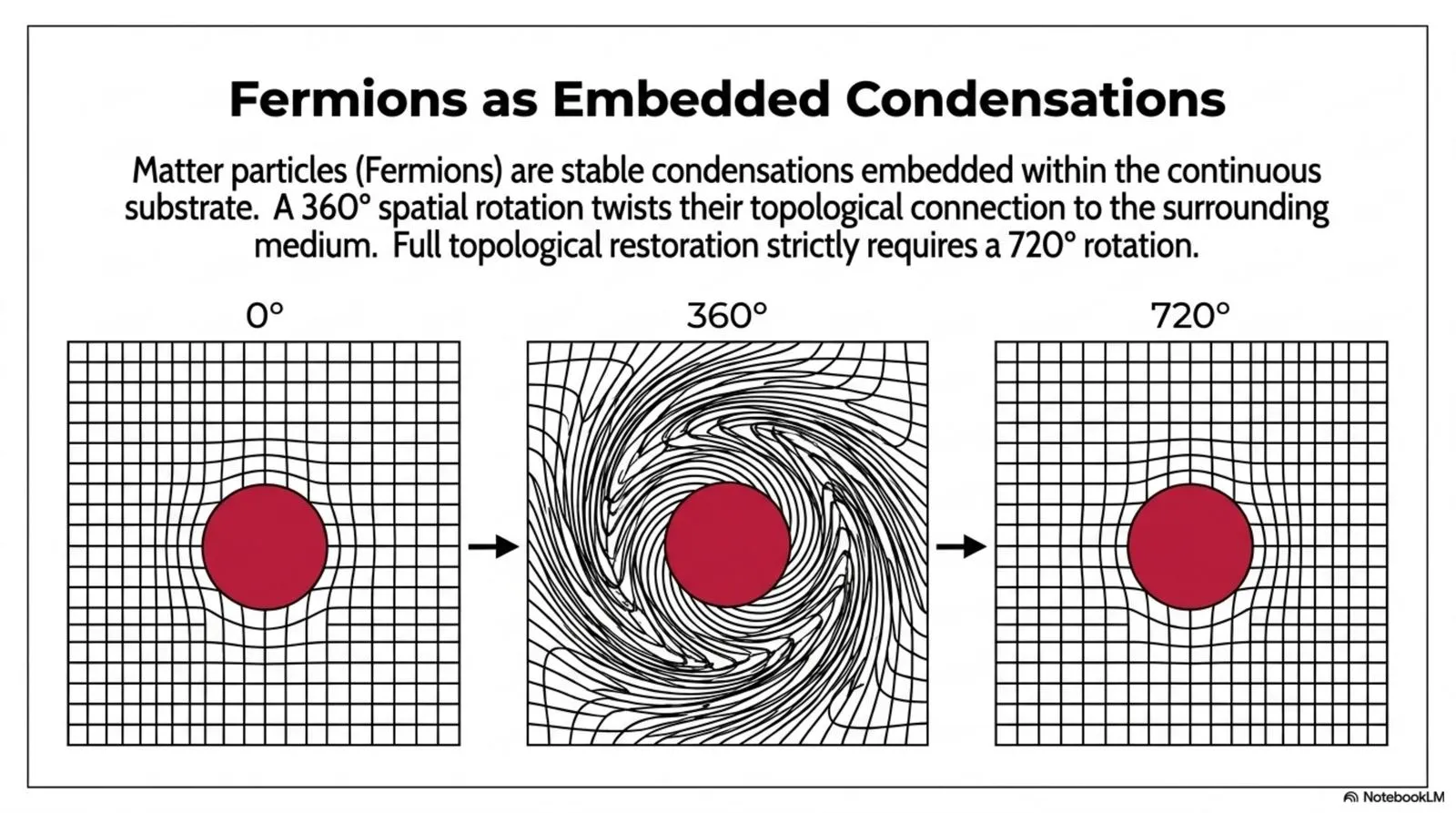
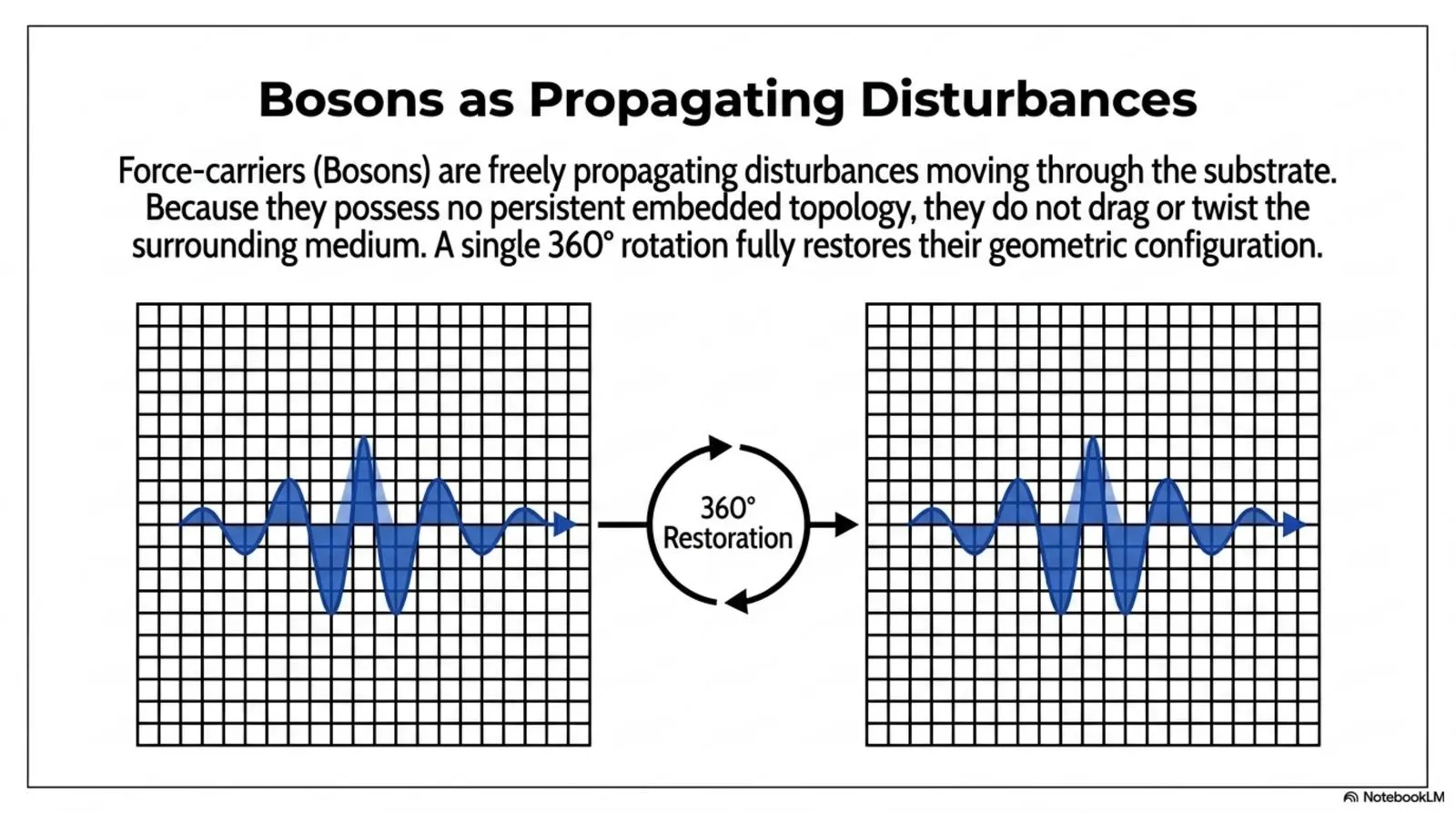
The substrate framework distinguishes two physically distinct classes of localised disturbance. The first class, embedded condensations, are stable, persistent, organised deformations of the substrate: the condensations described in the companion condensation-geometry framework [1,12] that constitute protons, electrons, and all other stable matter particles. An embedded condensation is continuously and topologically connected to the surrounding substrate: it is not merely located within the substrate but is part of the substrate's own organised structure at that location. The second class, propagating disturbances, are transient excitations that travel through the substrate without becoming part of its persistent organised structure: these correspond to photons, gluons, and other force-carrying excitations.
The physical distinction between these two classes, embedded within the medium versus moving through the medium, is the structural basis for the topological argument developed in Section 4.
4. 720-Degree and 360-Degree Restoration from Embedding Topology
4.1 Embedded Condensations Require 720 Degrees
Consider an embedded condensation whose internal configuration is continuously connected to the surrounding substrate. Because the condensation is part of the substrate's own structure rather than a disturbance moving through an otherwise undisturbed medium, a spatial rotation of the condensation cannot be considered in isolation from its embedding connection to the surrounding substrate. Under a 360-degree spatial rotation, the condensation's internal configuration returns to its original orientation, but the topological path connecting that configuration to the surrounding substrate has been carried through a full loop that does not, in general, contract back to the identity path within the space of embeddings. A second 360-degree rotation is required to complete a topologically trivial loop and fully restore the original embedding relationship. This is the physical content of equation (1): the embedded condensation acquires a sign change after one 360-degree rotation and restores only after 720 degrees.
4.2 Propagating Disturbances Require Only 360 Degrees
A propagating disturbance, by contrast, is not topologically connected to the substrate in this persistent way; it is a transient reconfiguration that moves through the medium rather than remaining part of its organised structure at a fixed location. A 360-degree rotation of a propagating disturbance's internal configuration has no embedding connection left to disturb, and the disturbance returns to its original configuration after a single 360-degree rotation. This is the physical content of equation (2).
4.3 Physical Origin of the Distinction
The distinction proposed here is not a property of any specific internal structure of a given particle; it is a property of the relationship between the excitation and the medium. Every stable matter condensation (every proton, electron, quark, muon, τ lepton, and neutrino) is embedded in the substrate in the sense of Section 3.4 and is therefore proposed to require 720 degrees for rotational restoration. Every force-carrying excitation (every photon, gluon, W or Z boson, and gravitational carrier wave) is a propagating disturbance and is therefore proposed to require only 360 degrees. This reproduces, without exception, the observed pattern that all matter particles have half-integer spin and all force carriers have integer spin.
5. Exchange Statistics from Embedding Topology
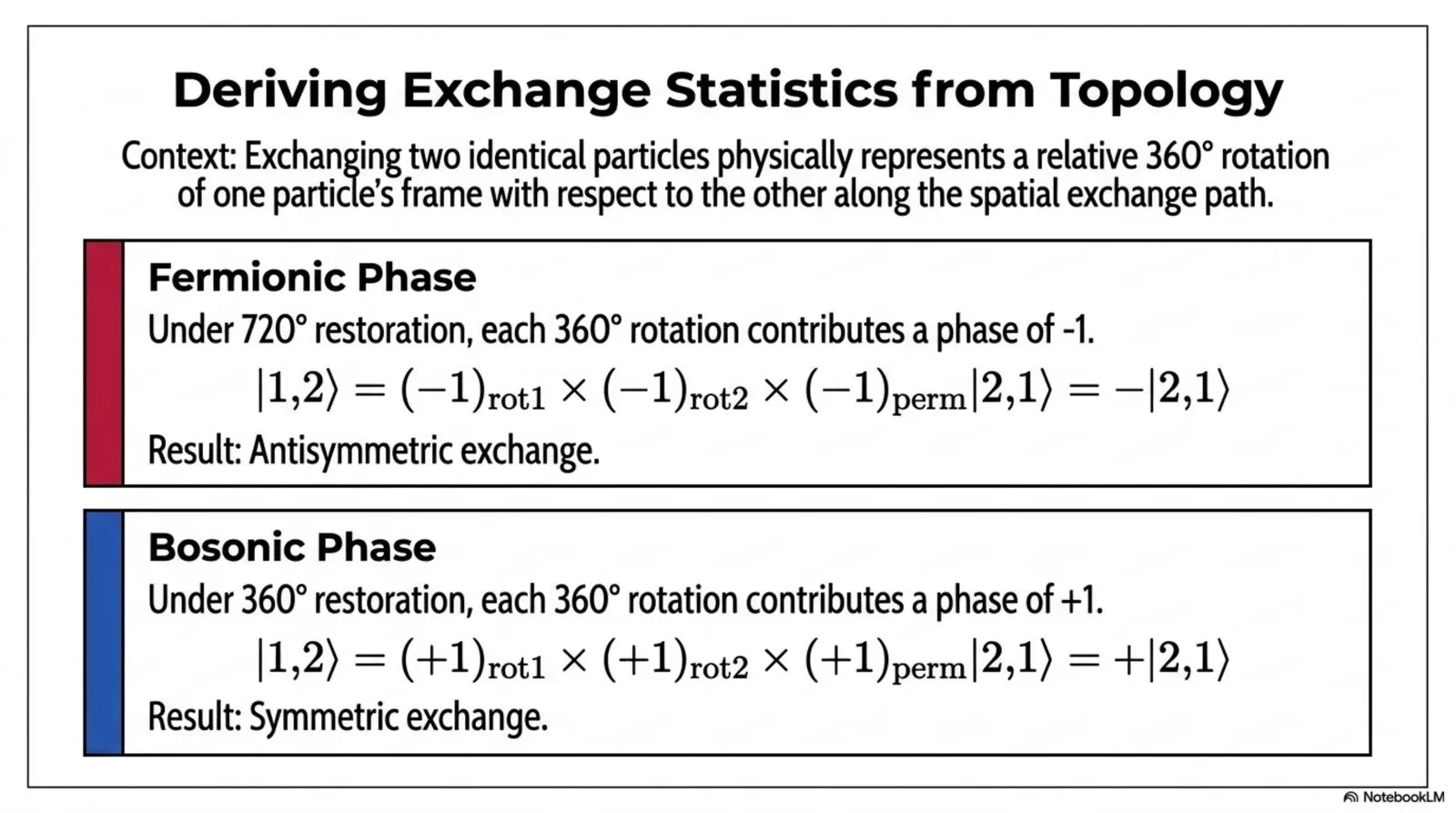
The exchange of two identical particles can be represented, for particles with a well-defined spatial configuration, as a relative 360-degree rotation of one particle's frame with respect to the other along the exchange path [11]. Applying the restoration properties of Section 4 to this exchange operation gives the statistics of each class directly.
5.1 Fermionic Exchange Antisymmetry
For two embedded condensations, the exchange operation involves an effective 360-degree rotation of each condensation's embedding frame relative to the other. Under the 720-degree restoration property of equation (1), each individual 360-degree rotation contributes a phase of minus one. Combined with the additional minus-one phase from the permutation of particle labels under exchange, the total exchange phase is:
|1,2⟩ = (−1) × (−1) × (−1) × |2,1⟩ = −|2,1⟩ (4)
the antisymmetric exchange phase characteristic of fermions [2,3]. We note explicitly that the precise topological bookkeeping connecting a spatial exchange path to two independent 360-degree frame rotations plus one permutation phase follows the standard spin-statistics argument for the geometric origin of exchange phases from rotation [11,17]; the present paper applies this established topological correspondence to the specific embedding picture of Section 4 rather than re-deriving the correspondence between spatial exchange and rotation from first principles within this paper.
5.2 Bosonic Exchange Symmetry
For two propagating disturbances, the same exchange operation involves an effective 360-degree rotation of each disturbance's configuration, but under the 360-degree restoration property of equation (2), each rotation contributes a phase of plus one. Combined with the permutation phase, which for the bosonic case does not introduce an independent sign in the standard correspondence [2,11], the total exchange phase is:
|1,2⟩ = (+1) × (+1) × |2,1⟩ = +|2,1⟩ (5)
the symmetric exchange phase characteristic of bosons [2,3].
5.3 Comparison with the Relativistic Proof
The derivation of equations (4) and (5) above reproduces the standard exchange phases of fermions and bosons, but by a different route than the relativistic quantum field theory proof of Pauli, Luders, and Zumino [2,4,5]. The relativistic proof establishes the connection from the requirements of Lorentz invariance, positive-definite energy, and microcausality applied to quantised fields [15]. The present derivation instead starts from a physical picture of what a matter condensation is, an embedded, persistent deformation of a physical substrate, and derives the same exchange phases from the topology of that embedding. The two derivations are not in competition: the relativistic proof establishes that the connection must hold given the axioms of quantum field theory; the present derivation proposes a physical account of why those axioms, applied to embedded matter condensations specifically, produce this particular topological structure.
6. Pauli Exclusion as a Geometric Consequence
The Pauli exclusion principle, that no two identical fermions can occupy the same quantum state simultaneously, was first formulated in 1925 [13] and is, in the standard formulation, an independent postulate required for consistency with the antisymmetric exchange statistics of equation (4) [2]. Within the embedding framework proposed here, exclusion follows as a direct geometric consequence rather than as a separate postulate.
Two embedded condensations with identical internal configurations, located in the same spatial region, would each require the substrate at that location to sustain their respective topological embedding relationships simultaneously. Because an embedded condensation is part of the substrate's own organised structure at its location rather than an independent object merely situated within the substrate, two identical embedded configurations cannot be simultaneously sustained at the same location: the substrate cannot simultaneously realise two identical embedding topologies at one point. This is a geometric incompatibility of the embedding structure itself, not an additional rule imposed on otherwise unconstrained particles.
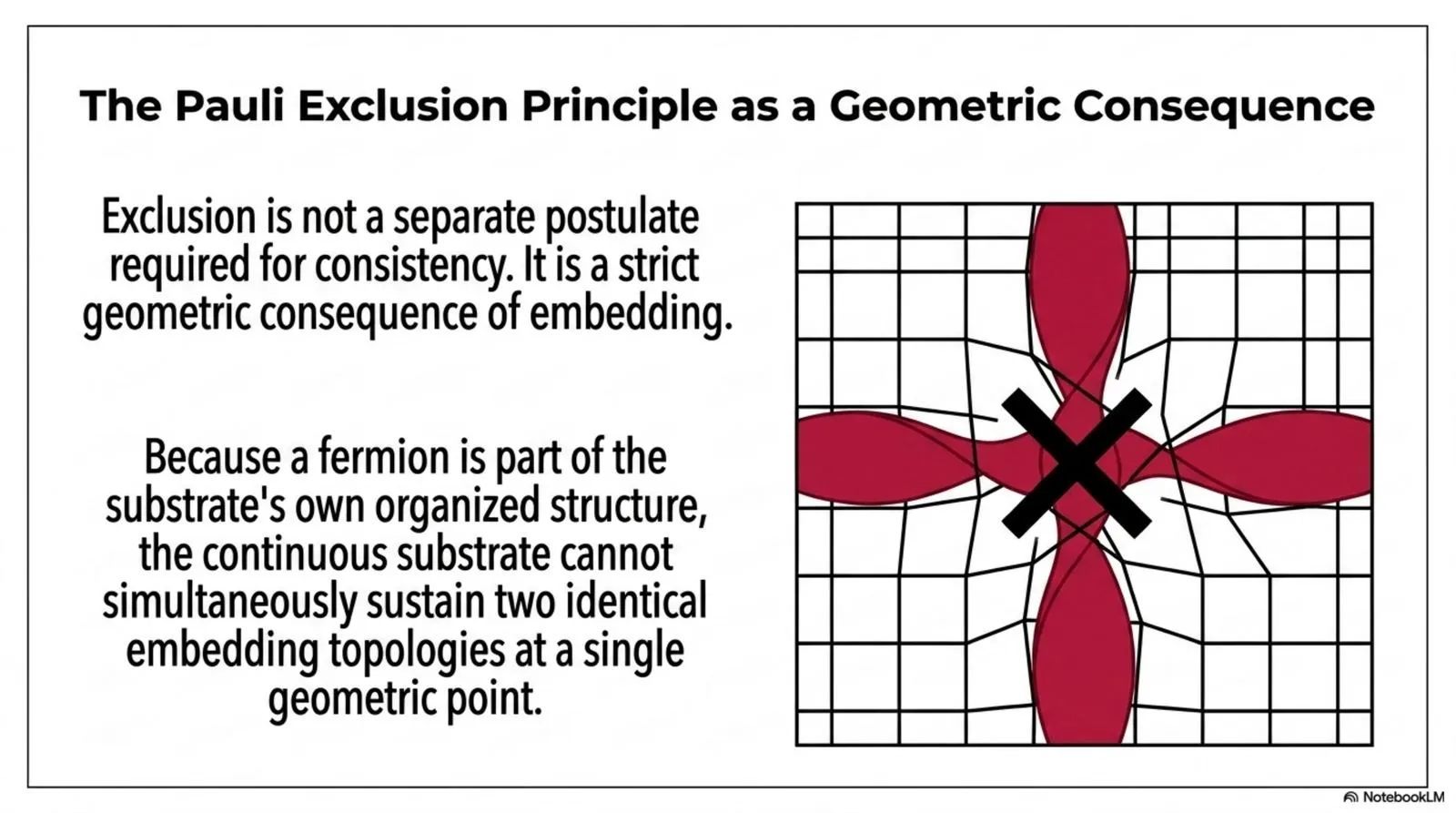
Propagating disturbances face no corresponding constraint. Because they are not embedded in the persistent organised structure of the substrate, two or more propagating disturbances can occupy the same spatial configuration; their superposition produces a combined disturbance amplitude rather than a topological conflict. This is consistent with the unconstrained occupation number of bosonic states, and with phenomena such as laser coherence and Bose-Einstein condensation that depend on this unconstrained occupation [1].
7. Discussion: Physical Interpretation and Anticipated Objections
7.1 Physical Interpretation
Within the proposed interpretation, the distinction between fermions and bosons is the distinction between being part of a physical medium and moving through it. Every matter particle is a fermion because every stable matter condensation is an embedded, persistent deformation of the substrate. Every force carrier is a boson because every force carrier is a propagating disturbance passing through the substrate rather than becoming part of its organised structure. The 720-degree restoration property is, under this account, the geometric signature of topological embedding rather than an unexplained mathematical curiosity.
7.2 "Does this merely relabel the existing mathematics?"
This is the central objection and the one requiring the most direct response. The mathematical content of equations (1), (2), (4), and (5) is not new; the double-cover structure of the rotation group and its connection to exchange statistics is established mathematics [2,3,11]. What is proposed as new content here is a specific physical criterion, topological embedding in a continuous substrate versus free propagation through it, that determines, for any given excitation, which of the two mathematical behaviours it exhibits. This criterion is falsifiable in the sense specified in Section 8: it predicts, in advance of any spin measurement, that any excitation identified independently as an embedded matter condensation will exhibit half-integer spin, and any excitation identified independently as a propagating force carrier will exhibit integer spin, with no exceptions. The relabelling objection would have force if the embedding criterion were defined circularly in terms of the spin outcome itself; it is not so defined here, since embedding versus propagation is a structural property of the condensation-geometry framework established independently in [1,12], prior to any consideration of spin.
7.3 "Why should embedding specifically require 720 degrees rather than some other multiple?"
The topological argument of Section 4.1 identifies 720 degrees as the natural restoration period for a structure continuously connected to its embedding medium through a path that does not contract trivially under a single 360-degree loop, matching the well-established double-cover topology of SU(2) over SO(3) [11]. The present paper does not derive this double-cover structure from more basic principles; it proposes that this specific, independently well-understood topological structure is realised physically by the embedding relationship between a matter condensation and the substrate, rather than being an abstract mathematical property with no physical referent.
7.4 "Does this modify the Standard Model or quantum field theory?"
No established prediction of the spin-statistics theorem, the Pauli exclusion principle, or any confirmed quantum field theory calculation is affected. The proposal offers a physical picture for why the theorem holds; it does not alter the mathematical formalism, the existing relativistic proof, or any experimentally confirmed consequence of the theorem, including the neutron interferometry results of Section 2.3 [8,9], which are fully consistent with and were historically confirmatory of the standard mathematical treatment prior to the present proposal.
7.5 "What about composite systems with integer total spin built from half-integer-spin constituents?"
Composite systems such as helium-4 atoms or even-even nuclei can exhibit collective bosonic behaviour, including Bose-Einstein condensation, when an even number of half-integer-spin constituents combine to give an integer total spin. This is consistent with the proposed framework: each individual constituent fermion remains an embedded condensation with 720-degree restoration and continues to satisfy Fermi-Dirac statistics individually, while the composite system's net spin and collective exchange behaviour is a separate statistical consequence of how the individual embedding topologies combine. The proposal concerns the fundamental classification of individual embedded condensations and propagating disturbances, not the emergent statistical behaviour of bound composite systems.
8. Falsifiable Predictions
The substrate embedding framework makes the following falsifiable predictions.
Prediction 1. No stable matter particle with integer spin will be discovered. Within the proposed framework, every stable matter condensation is topologically embedded in the substrate and is therefore constrained to half-integer spin; the discovery of a stable, matter-type particle with confirmed integer spin would directly falsify the embedding account of Section 4.1.
Prediction 2. No force-carrying particle with half-integer spin will be discovered. Every confirmed force carrier is proposed to be a propagating disturbance rather than an embedded condensation, and is therefore constrained to integer spin; the discovery of a force-carrying particle, a particle mediating a fundamental interaction, with confirmed half-integer spin would directly falsify the embedding account of Section 4.2.
Prediction 3. The graviton, if directly detected, will have spin 2, consistent with its identification as a doubly-wound propagating disturbance in the substrate rather than an embedded condensation; a confirmed direct detection of a graviton with a different spin value would be inconsistent with the propagating-disturbance classification proposed here for all force carriers.
Prediction 4. Any future composite or exotic state whose fundamental (non-composite) constituents are independently classified as embedded matter condensations, in the sense of the condensation-geometry framework [1,12], is expected to exhibit half-integer spin for each such fundamental constituent individually, regardless of the net spin of the composite state, consistent with the discussion of Section 7.5.
9. Conclusions
We have proposed a geometric account of the spin-statistics theorem from the topology of how a localised excitation is embedded in a universal physical substrate, following the substrate framework established in prior work [1]. Under this account, embedded condensations, the substrate structures identified with stable matter particles, are continuously and topologically connected to the surrounding substrate, requiring 720 degrees of rotation for full restoration and producing antisymmetric fermionic exchange statistics; propagating disturbances, the substrate structures identified with force carriers, are not embedded in this way, require only 360 degrees for restoration, and produce symmetric bosonic exchange statistics. The Pauli exclusion principle follows as a direct geometric consequence of the embedding picture rather than as an independent postulate.
Within the proposed framework, the distinction between fermions and bosons is the distinction between being part of a physical medium and moving through it. This proposal does not modify the existing relativistic proof of the spin-statistics theorem, the mathematical formalism of quantum field theory, or any confirmed experimental result, including the neutron interferometry confirmation of the 720-degree restoration property. It proposes a physical picture for a mathematical result that has been noted repeatedly, by the theorem's discoverer and by subsequent commentators, as lacking such a picture.
References
[1] Sharma, V.S. (2026). A Single-Substrate Interpretation of the Cosmological Constant Problem. Zenodo. doi:10.5281/zenodo.21280358
[2] Pauli, W. (1940). The connection between spin and statistics. Physical Review, 58(8), 716–722.
[3] Streater, R.F. and Wightman, A.S. (1964). PCT, Spin and Statistics, and All That. W.A. Benjamin, New York.
[4] Luders, G. and Zumino, B. (1958). Connection between spin and statistics. Physical Review, 110(6), 1450–1453.
[5] Burgoyne, N. (1958). On the connection of spin with statistics. Il Nuovo Cimento, 8(6), 607–609.
[6] Feynman, R.P., Leighton, R.B., and Sands, M. (1965). The Feynman Lectures on Physics, Volume III. Addison-Wesley, Reading, MA.
[7] Penrose, R. (2004). The Road to Reality: A Complete Guide to the Laws of the Universe. Jonathan Cape, London.
[8] Rauch, H., Zeilinger, A., Badurek, G., Wilfing, A., Bauspiess, W., and Bonse, U. (1975). Verification of coherent spinor rotation of fermions. Physics Letters A, 54(6), 425–427.
[9] Werner, S.A., Colella, R., Overhauser, A.W., and Eagen, C.F. (1975). Observation of the phase shift of a neutron due to precession in a magnetic field. Physical Review Letters, 35(16), 1053–1055.
[10] Streater, R.F. (1988). Outline of axiomatic relativistic quantum field theory. Reports on Progress in Physics, 38(7), 771–846.
[11] Sakurai, J.J. and Napolitano, J. (2017). Modern Quantum Mechanics, 2nd edition. Cambridge University Press, Cambridge.
[12] Sharma, V.S. (2026). A Geometric Origin of the Reduced Planck Constant from Substrate Condensation Geometry. Zenodo. doi:10.5281/zenodo.21280494
[13] Pauli, W. (1925). Uber den Zusammenhang des Abschlusses der Elektronengruppen im Atom mit der Komplexstruktur der Spektren. Zeitschrift fur Physik, 31(1), 765–783.
[14] Peskin, M.E. and Schroeder, D.V. (1995). An Introduction to Quantum Field Theory. Addison-Wesley, Reading, MA.
[15] Weinberg, S. (1995). The Quantum Theory of Fields, Volume I: Foundations. Cambridge University Press, Cambridge.
[16] Gould, R.J. (1995). Neutron interferometry and the demonstration of the 4-π symmetry of spinors. American Journal of Physics, 63(2), 109–117.
[17] Berry, M.V. and Robbins, J.M. (1997). Indistinguishability for quantum particles: Spin, statistics and the geometric phase. Proceedings of the Royal Society A, 453(1963), 1771–1790.
[18] Duck, I. and Sudarshan, E.C.G. (1997). Toward an understanding of the spin-statistics theorem. American Journal of Physics, 66(4), 284–303.
[19] Wightman, A.S. (1999). Superselection rules; old and new. Il Nuovo Cimento B, 110(5–6), 751–769.
[20] Michelson, A.A. and Morley, E.W. (1887). On the relative motion of the Earth and the luminiferous ether. American Journal of Science, 34(203), 333–345.
[21] Muller, H., Herrmann, S., Braxmaier, C., Schiller, S., and Peters, A. (2003). Modern Michelson-Morley experiment using cryogenic optical resonators. Physical Review Letters, 91, 020401.
[22] Sharma, V.S. (2026). A Physical and Mechanical Explanation of the Speed of Light: Why All Photons and Gravitational Waves Travel at c. Zenodo. doi:10.5281/zenodo.21292900
[23] Rovelli, C. (2004). Quantum Gravity. Cambridge University Press, Cambridge.
[24] ATLAS Collaboration (2012). Observation of a new particle in the search for the Standard Model Higgs boson with the ATLAS detector at the LHC. Physics Letters B, 716(1), 1–29.
[25] CMS Collaboration (2012). Observation of a new boson at a mass of 125 GeV with the CMS experiment at the LHC. Physics Letters B, 716(1), 30–61.
[26] Einstein, A. (1920). Äther und Relativitätstheorie. Address delivered at the University of Leiden, 5 May 1920. Springer, Berlin.