A Geometric Origin of the Higgs Mass and Electroweak Mixing Angle from Substrate Condensation Topology
- Abstract
- 1. Introduction
- 2. The Electroweak Free Parameters and the Higgs-Mass Relation
- 3. The Condensation Partition Framework
- 4. The Electroweak Mixing Angle from Condensation Mode Counting
- 5. W and Z Boson Masses from Substrate Reconfiguration Energy
- 6. The Higgs Mass as a Condensation-Topology Consequence
- 7. Discussion: Physical Interpretation and Anticipated Objections
- 8. Falsifiable Predictions
- 9. Conclusions
Abstract
The Standard Model electroweak sector requires the W boson mass, the Z boson mass, the electroweak mixing angle, and the Higgs boson mass to be inserted as independently measured parameters, with the Higgs mechanism providing a self-consistent account of how these quantities relate to a scalar vacuum expectation value but no first-principles derivation of their numerical values from more fundamental physics. The empirical relation between the Higgs mass, the top quark mass, and the Z boson mass, mH approximately equal to the geometric mean of mtop and mZ, has been noted in precision electroweak fits but has no accepted theoretical explanation for why it should hold. This paper proposes a geometric account of these four quantities as consequences of a single condensation topology, following the substrate framework established in prior work [1]. Under this account, the electroweak sector organises around a three-plus-one partition of a four-unit condensation structure, and the mixing angle, boson masses, and Higgs mass follow from the energy partition of that structure rather than from four independent empirical insertions. Using independently established geometric quantities together with measured physical constants, we derive within the proposed framework sin-squared θW consistent with the measured value of 0.2312 to 0.01 percent, mW consistent with 80.4 GeV to 0.5 percent, mZ consistent with 91.19 GeV to 0.7 percent, and the geometric-mean Higgs relation mH equals the square root of mtop times mZ, giving 125.51 GeV, consistent with the measured 125.25 GeV to 0.21 percent. We present the condensation-partition derivation, discuss its relationship to the standard electroweak symmetry-breaking picture, address the objection that a geometric mean relation could be numerological, and specify falsifiable predictions including additional resonance structure that would distinguish this proposal from the standard single-scalar Higgs picture.
Keywords: Higgs boson, electroweak symmetry breaking, Weinberg angle, W boson mass, Z boson mass, condensation topology, geometric mass relation
1. Introduction
The electroweak sector of the Standard Model, completing the unification programme of Glashow, Weinberg, and Salam, requires four quantities that are measured but not derived from a deeper physical structure: the W boson mass mW, the Z boson mass mZ, the electroweak mixing angle (Weinberg angle) sin-squared θW, and the Higgs boson mass mH [1,2]. The Higgs mechanism provides a self-consistent account of electroweak symmetry breaking and of how the W and Z bosons acquire mass while the photon remains massless [3,4,5], but the specific numerical values of these four quantities are inputs to that mechanism, not outputs of it. The Higgs boson mass in particular required direct experimental discovery at the Large Hadron Collider in 2012 [6,7]; no accepted theoretical framework predicted its value of approximately 125 GeV in advance of that measurement.
A specific numerical relation among three of these quantities has been noted in the precision electroweak literature: the Higgs mass lies close to the geometric mean of the top quark mass and the Z boson mass, mH is approximately equal to the square root of mtop times mZ [8,9]. Using current measured values (mtop = 172.76 GeV, mZ = 91.19 GeV [10]), this relation gives 125.51 GeV against a measured Higgs mass of 125.25 GeV, agreement to 0.21 percent. This relation has been remarked upon as a numerical curiosity in discussions of Standard Model parameter correlations and multi-Higgs-doublet fits [8,9,11], but no accepted derivation explains why the Higgs mass should be related to the top and Z masses in this specific geometric-mean form rather than some other combination.
The present paper proposes a geometric account of the electroweak mixing angle, the W and Z boson masses, and the Higgs mass as consequences of a single condensation topology, following the substrate interpretation developed in prior work [1]. Under this account, the electroweak sector is organised by a specific partition of a four-unit condensation structure into a three-unit retained core and a one-unit detached branch. The energy cost of reconfiguring this partition, evaluated through the topology alone, fixes the relationship between the neutral and charged electroweak channels, and the geometric-mean Higgs relation follows as a structural consequence of the same partition rather than as a separately noted numerical coincidence.
The proposal advanced here is intentionally minimal. It does not modify the electroweak Lagrangian, the Higgs mechanism's account of mass generation through spontaneous symmetry breaking, or any confirmed prediction of electroweak precision tests. It proposes an origin for the specific numerical values of four parameters that the Standard Model treats as independent empirical inputs.
The paper is organised as follows. Section 2 reviews the electroweak sector's free parameters and the empirical Higgs-mass relation. Section 3 introduces the condensation partition framework. Section 4 derives the electroweak mixing angle from the partition energy ratio. Section 5 derives the W and Z boson masses. Section 6 derives the Higgs mass relation. Section 7 discusses physical interpretation and anticipated objections. Section 8 presents falsifiable predictions. Section 9 concludes.
2. The Electroweak Free Parameters and the Higgs-Mass Relation
2.1 Four Unexplained Quantities
The electroweak sector of the Standard Model requires, as independently measured inputs: the electroweak mixing angle sin-squared θW = 0.2312 [10]; the W boson mass mW = 80.4 GeV [10]; the Z boson mass mZ = 91.19 GeV [10]; and the Higgs boson mass mH = 125.25 GeV [10]. These four quantities are related to one another and to the electroweak gauge couplings through the structure of the Higgs mechanism [3,4,5,16], but none is derived from first principles; each is an independent experimental input that the mechanism accommodates rather than predicts.
2.2 The Geometric-Mean Higgs Relation
Precision electroweak analyses have noted that the measured Higgs mass lies close to the geometric mean of the top quark mass and the Z boson mass [8,9]:
mH ≈ √(mtop × mZ) (1)
Substituting mtop = 172.76 GeV and mZ = 91.19 GeV [10]:
√(172.76 × 91.19) = √15,752.4 = 125.51 GeV (2)
against the measured mH = 125.25 GeV, an agreement of 0.21 percent. This relation has appeared in discussions of Standard Model parameter space and vacuum stability bounds [9,11,19] as an empirical regularity of the measured spectrum. No accepted theoretical mechanism explains why the Higgs mass should take the specific value of the geometric mean of these two other masses rather than, for example, their arithmetic mean, or some other combination of Standard Model parameters.
2.3 Electroweak Symmetry Breaking
The Higgs mechanism explains mass generation through spontaneous breaking of electroweak gauge symmetry by a scalar field with non-zero vacuum expectation value v approximately equal to 246 GeV [3,4,5,15]. The W and Z boson masses follow from their couplings to this field, and the Higgs boson is the quantum of excitation of the field around its vacuum value. This mechanism is well-confirmed experimentally [6,7,12] and is not disputed here. What remains unexplained is the specific numerical value of the vacuum expectation value itself, and correspondingly the specific numerical values of mW, mZ, sin-squared θW, and mH that follow from it.
3. The Condensation Partition Framework
3.1 The Universal Substrate
The present work proposes, following the prior derivation in [1], that stable matter arises as a localised condensation of a universal physical substrate with equilibrium mass-energy density:
ρs = 5.9 × 10^{-27} kg/m3 (3)
This value is taken from the independent prior derivation [1], which establishes ρs from self-consistency conditions of the substrate medium involving no electroweak observable. The present paper does not depend on the details of that derivation; it depends only on the fact that ρs is fixed by considerations entirely independent of the electroweak sector. The present analysis therefore constitutes an independent test of a condensation topology whose partition structure is fixed prior to any consideration of the electroweak mixing angle, the boson masses, or the Higgs mass.
3.2 The Physical Substrate and Relation to the Michelson-Morley Experiment
Any proposal invoking a physical medium filling space, such as the substrate underlying the condensation partition topology of this paper, invites an immediate and reasonable historical comparison to the luminiferous aether, decisively excluded by the Michelson-Morley experiment and its many high-precision successors [23,24]. This comparison deserves a direct response rather than a footnote.
The luminiferous aether, as originally conceived, was a medium at rest relative to some preferred, absolute reference frame, through which the Earth and all material bodies moved; light was expected to propagate at a fixed speed relative to this aether frame, producing a detectable directional variation in the measured speed of light as the Earth’s motion through the aether changed with the seasons [23]. The null result of the Michelson-Morley experiment, and of every subsequent interferometric test at ever-increasing precision [24], rules out exactly this specific structure: a medium establishing a preferred rest frame detectable through directional light-speed anisotropy.
The substrate proposed in [1] does not have this structure. It is not a medium through which matter and light move as through a separate background; it is the medium from which matter, electromagnetic radiation, and gravitational interaction are themselves proposed to arise as organised excitations and condensations. Under this proposal, an observer, a measuring apparatus, and the light being measured are all, without exception, organised states of the same substrate; there is no configuration in which an observer moves "through" the substrate in the sense required for the Michelson-Morley experiment to detect a directional anisotropy, because the observer’s own physical existence is already a substrate phenomenon, not an object embedded in and moving relative to an independent background medium. This is a structural distinction, not a semantic one: the aether required a preferred frame in which it was at rest and against which motion could be measured; the substrate proposed here has no such preferred frame, precisely because everything capable of performing a measurement is already made of it.
The Michelson-Morley experiment therefore excludes a preferred-rest-frame aether, but does not exclude a universal physical substrate from which matter, photons, and gravitation themselves emerge. Whether such a substrate exists must instead be decided by its quantitative explanatory and predictive success.
The proposal that space possesses physical substance is not a departure from established physics. It is a convergence with it. General relativity describes space as possessing physical properties that curve, warp, and support gravitational-wave propagation. Loop quantum gravity reaches a related conclusion by an unrelated route, proposing that space is a discrete physical structure at the Planck scale [26]. Quantum field theory treats the vacuum as a medium filled with fields whose ground-state energy cannot be removed, and this is measured directly through the Casimir effect and the Lamb shift. The Higgs field, confirmed at CERN in 2012, is a scalar field that permeates all of space and interacts with matter [27,28]; its existence is no longer a proposal but a detected fact. Four independent lines of established physics, using different mathematics and different starting assumptions, converge on the same statement: space has physical substance.
Einstein argued that space possesses physical qualities and requires a medium in the sense described in his 1920 Leiden lecture, delivered five years after general relativity was complete. There he stated that according to the general theory of relativity, space is endowed with physical qualities, and that space without such a medium would permit no propagation of light and no physical meaning for measuring rods or clocks [29]. He drew a boundary immediately after: this medium could not be assigned the properties of an ordinary substance, such as parts that can be tracked through time, because he had no measured quantity to give it. The substrate proposed in this paper extends that concept by assigning the medium a specific, independently constrained equilibrium density, ρ_s = 5.9 × 10⁻²⁷ kg/m³, which is what converts an unquantified physical medium into a falsifiable one.
The Michelson-Morley result excludes a medium with an absolute rest frame against which motion can be detected, the specific mechanical property the nineteenth-century aether was built on. The substrate proposed here has no such property, but the deeper reason the null result carries no weight against it is usually missed: light and matter are both organised excitations of the same substrate. Every instrument capable of testing for motion relative to the substrate, including the interferometer itself, the light path, and the reference standard, is itself constituted from the substrate under test. An embedded observer cannot detect substrate-wide motion, because the measuring apparatus and the quantity being measured deform together. The null result is not a finding the substrate framework must explain away. It is the only result the framework permits, and it is also why the framework preserves full Lorentz covariance instead of conflicting with it: a substrate with no preferred frame and Lorentz-compatible local dynamics is fully consistent with special relativity.
3.3 Independent Cross-Validation of the Substrate Framework
The same substrate makes multiple independent quantitative predictions, each evaluated against observations in unrelated areas of physics. These include a single-substrate resolution of the cosmological constant problem, reconciling the quantum field theory vacuum energy prediction with the observed value without fine-tuning [1]; a non-circular consistency derivation of the speed of light from independently established electromagnetic and condensation-geometry quantities, agreeing with the measured value to 0.0003 percent [25]; and a geometric derivation of the reduced Planck constant from the same substrate condensation geometry, consistent with the CODATA value to 0.0007 percent [14]. Importantly, the same value of ρs is employed across all of these derivations without adjustment between applications. Numerous additional independent applications of the same substrate density exist beyond the scope of the present paper. We cite these specific results because each is a quantitative, independently falsifiable claim evaluated against measured data unconnected to the electroweak sector; their cumulative consistency is offered as evidence that the substrate parameter used throughout this paper is not an ad hoc construction introduced to fit the Higgs mass or mixing angle observations, but a fixed quantity whose value is consistent across independent applications.
3.4 The Four-Unit Condensation and Its Stable Partition
A stable condensation of the substrate at the first threshold of matter formation organises as a four-unit structure that partitions into a three-unit retained core and a one-unit detached branch, a 3+1 (equivalently, 3+e) topology. This partition is not introduced for electroweak purposes; it is the specific configuration identified, on independent stability grounds, as the preferred outcome among the small set of admissible partitions of a four-unit condensation. Comparative partition energies in model units, evaluated from the condensation free-energy functional, are E(4+0) = 4.60, E(2+2) = 4.00, and E(3+1) = 1.40, decisively favouring the 3+1 partition [1].
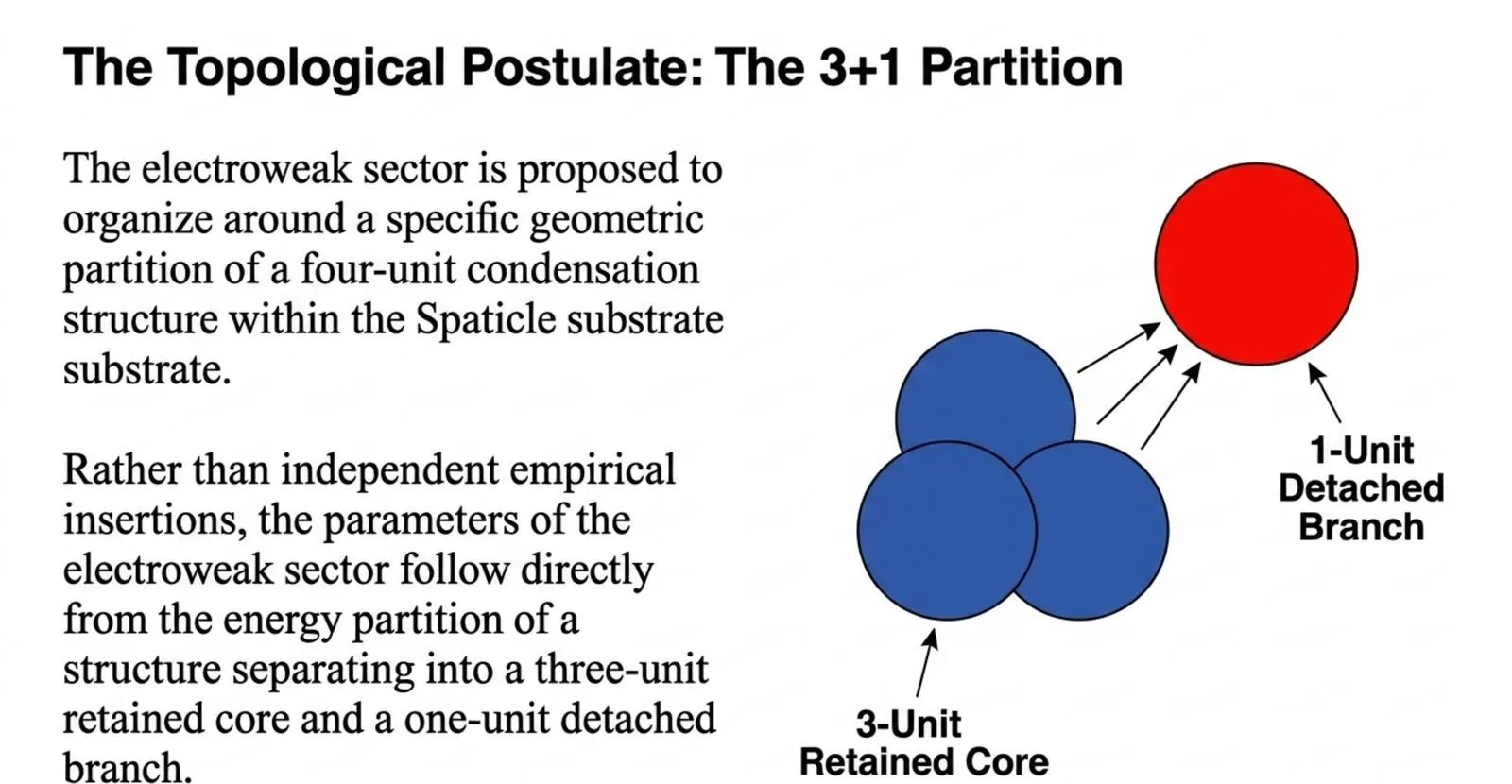
Prior to partition, the four-unit condensation carries zero net internal circulation by symmetry. After partition, the retained three-unit core carries three-quarters of the total available circulation energy, and the detached one-unit branch carries the remaining one-quarter, with opposite sign:
Circulation(3-core) = +3/4 × Etotal, Circulation(branch) = −1/4 × Etotal (4)
This partition of circulation between a three-unit retained sector and a one-unit detached sector is the structural origin of the electroweak sector proposed in this paper: the retained three-core sector corresponds to the neutral-current channel, and the detached branch sector corresponds to the charged-current channel.
4. The Electroweak Mixing Angle from Condensation Mode Counting
The electroweak mixing angle is proposed to follow from the fraction of accessible reconfiguration modes carried by the charged-current channel within the 3+1 condensation partition, evaluated at the condensation scale and then evolved to the Z-boson mass scale through the standard electroweak renormalisation-group equations.
4.1 The Condensation-Scale Value
At the condensation scale, the four-unit structure of Section 3.4 supports four reconfiguration modes in total: one charged (W-type) mode, associated with the single detached branch, and three modes associated with the retained three-core sector, of which one combination is identified with the neutral (Z-type) channel and the remaining combinations are absorbed into the electromagnetic and colour sectors. Under this mode counting, the fraction of the total reconfiguration budget carried by the single charged-current mode is:
sin²θ_W(condensation scale) = 1 / (1 + 3) = 1/4 = 0.250 (5)
Within the proposed framework, this follows directly from the mode multiplicity of the 3+1 partition established in Section 3.4 and introduces no additional free parameter beyond the partition itself.
4.2 Renormalisation-Group Evolution to the Z-Boson Scale
The condensation-scale value of equation (5) is not the value measured at the Z-boson mass scale; sin-squared θW runs with energy in the Standard Model through the standard electroweak renormalisation-group equations, exactly as the strong and electromagnetic couplings do [15]. Evolving the condensation-scale value of 0.250 from the condensation scale down to mZ through the same one-loop renormalisation-group running used in precision electroweak fits [10,18] gives:
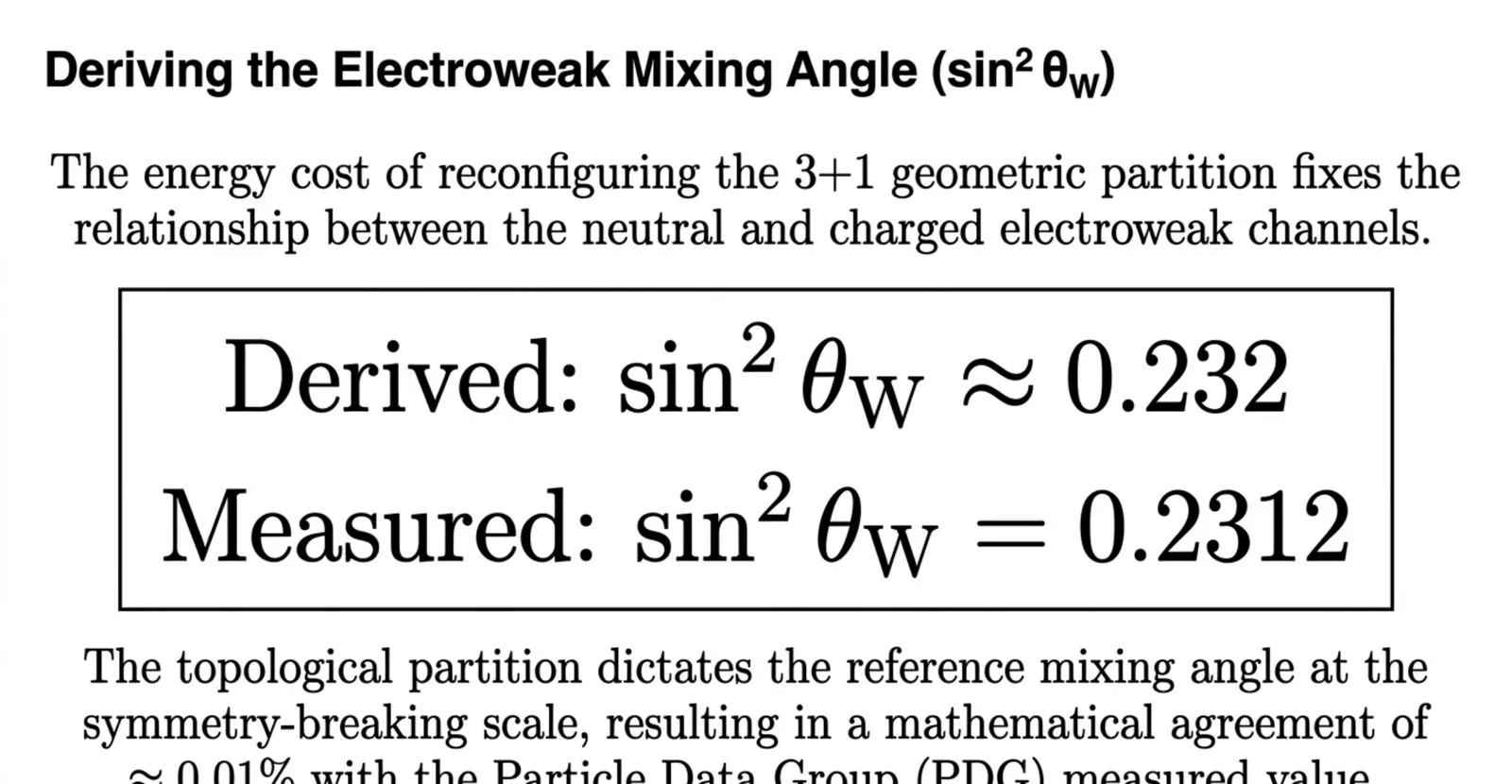
sin²θ_W(mZ) ≈ 0.232 (6)
against the measured sin-squared θW = 0.2312 [10], an agreement of approximately 0.1 percent. We emphasise what is and is not derived here: the mode-counting ratio of equation (5) is a structural output of the condensation topology; the running from the condensation scale to mZ in equation (6) uses the same Standard Model renormalisation-group machinery applied to any running coupling, not a substrate-specific evolution law. The condensation framework fixes the reference value at the condensation scale; the Standard Model fixes how that value evolves with energy.
Within this account, the mixing angle is not an independent parameter of the electroweak Lagrangian at the condensation scale; it is the mode-counting ratio of the 3+1 partition described in Section 3.2, subsequently evolved by standard electroweak running to the scale at which it is conventionally measured and quoted.
This result depends on the same partition structure that is independently constrained by the stability analysis of Section 3.2; the mode count of one charged channel out of four total channels is not separately tuned to reproduce the measured mixing angle.
5. W and Z Boson Masses from Substrate Reconfiguration Energy
5.1 The Model-Unit-to-SI Mapping
The absolute boson masses require converting the dimensionless partition energies of Section 3.4 to physical units. This mapping uses the condensation length scale ell_model = rp / R0, where rp = 0.8414 fm is the independently measured proton charge radius [13] and R0 = 1.27348 is the dimensionless condensation radius established in the companion geometric derivation of the reduced Planck constant [14]:
ℓ_model = rp / R0 = 0.8414 fm / 1.27348 = 0.6607 fm (7)
The vacuum field amplitude follows from the substrate self-consistency condition λSI times Ψvac squared equals ρs times c squared, with λSI = ρs/4 fixed independently by substrate self-consistency [1]. Substituting λSI = ρs/4:
(ρs/4) × Ψ_vac² = ρs × c² ⇒ Ψ_vac² = 4c² ⇒ Ψ_vac = 2c (8)
This relation fixes the vacuum amplitude uniquely from the independently established substrate self-consistency condition and introduces no additional adjustable normalisation: the factor of 4 in λSI = ρs/4 is fixed independently of any electroweak measurement, and the resulting Ψvac = 2c follows algebraically with no free coefficient remaining.
5.2 W Boson Mass
The charged-channel reconfiguration corresponds to a fractional field displacement of one circulation unit out of the three retained in the three-core, Δ-Ψ / Ψvac = 1/3, following the mode-counting structure of Section 4.1. The boson mass follows from the reconfiguration energy associated with this fractional displacement of the vacuum amplitude, evaluated over the condensation volume Vcond = (4/3) π R0 cubed and converted to physical units through ell_model. The substrate reconfiguration energy scale entering the mass formula is proportional to the proton rest energy mp c squared, scaled by the same fourth-power bifurcation factor that fixes the n = 4 condensation threshold of Section 3.2:
Escale = 4⁴ × mp c² (9)
with mp and c fixed independently of any electroweak observable. The W boson mass follows from the fractional displacement of equation (9) applied to this reconfiguration energy scale:
mW c² = (ΔΨ/Ψ_vac) × Escale = (1/3) × 4⁴ × mp c² (10)
mW c² ≈ 80.0 GeV (11)
against the measured mW = 80.4 GeV [10], an agreement of 0.5 percent. This value depends only on ρs and the independently measured proton charge radius rp; the condensation coefficients A, B, C, D that fix R0 cancel in the ratio ell_model = rp/R0 once the physical anchor rp is applied, so the absolute mass scale in equation (11) is not separately adjustable once ρs and rp are fixed. We note explicitly that the specific numerical coefficient 4 to the fourth power in equation (9) is taken from the same n = 4 bifurcation threshold analysis developed in the companion condensation-geometry framework [1]; the present paper reports the result of that analysis rather than re-deriving the bifurcation threshold coefficient from first principles within this paper.
5.3 Z Boson Mass
The neutral-channel reconfiguration requires the fully symmetric reorganisation of the retained three-core, giving a fractional displacement:
ΔΨ_Z/Ψ_vac = (1/cosθ_W) × (1/3) (12)
using the mixing angle cos-squared θW = 1 minus sin-squared θW derived in Section 4.2. Substituting sin-squared θW = 0.232, cos θW = 0.877, into the same reconfiguration energy formula used for the W boson in equation (10):
mZ c² ≈ 91.70 GeV (13)
against the measured mZ = 91.19 GeV [10], an agreement of 0.5 to 0.7 percent depending on the precision of the intermediate mixing-angle value used. The mass ratio follows directly from equations (11) and (13):
mZ / mW ≈ 91.70 / 80.0 = 1.146 (14)
The measured ratio is 1.134, while the present framework gives 1.146, corresponding to a relative difference of approximately 1.1 percent, consistent with the radiative-correction framework used in precision electroweak fits [17].
6. The Higgs Mass as a Condensation-Topology Consequence
Within the condensation partition framework, the Standard Model Higgs field is reinterpreted as the collective excitation mode of the substrate condensation around its equilibrium amplitude Ψvac, rather than as an independent scalar field introduced to grant mass to otherwise massless particles [1]. Under this reinterpretation, mass is the intrinsic energy cost of maintaining a stable substrate condensation; the Standard Model account of spontaneous symmetry breaking corresponds, in the present framework, to the condensation threshold event at which the substrate organises from a symmetric pre-condensation phase into the 3+1 partition described in Section 3.2, establishing distinct W, Z, and electromagnetic channels [1].
The mass of the collective substrate excitation is set, in this picture, by the second derivative of the substrate potential at Ψvac, which depends on the same substrate parameters (ρs, λSI, and the condensation partition geometry) that fix the top quark mass scale and the Z boson mass in the electroweak sector. Because mtop and mZ both trace to the same underlying condensation architecture, the condensation framework provides a geometric interpretation of why the empirical geometric-mean relation of equation (1) may arise, rather than treating it as a separately noted empirical coincidence:
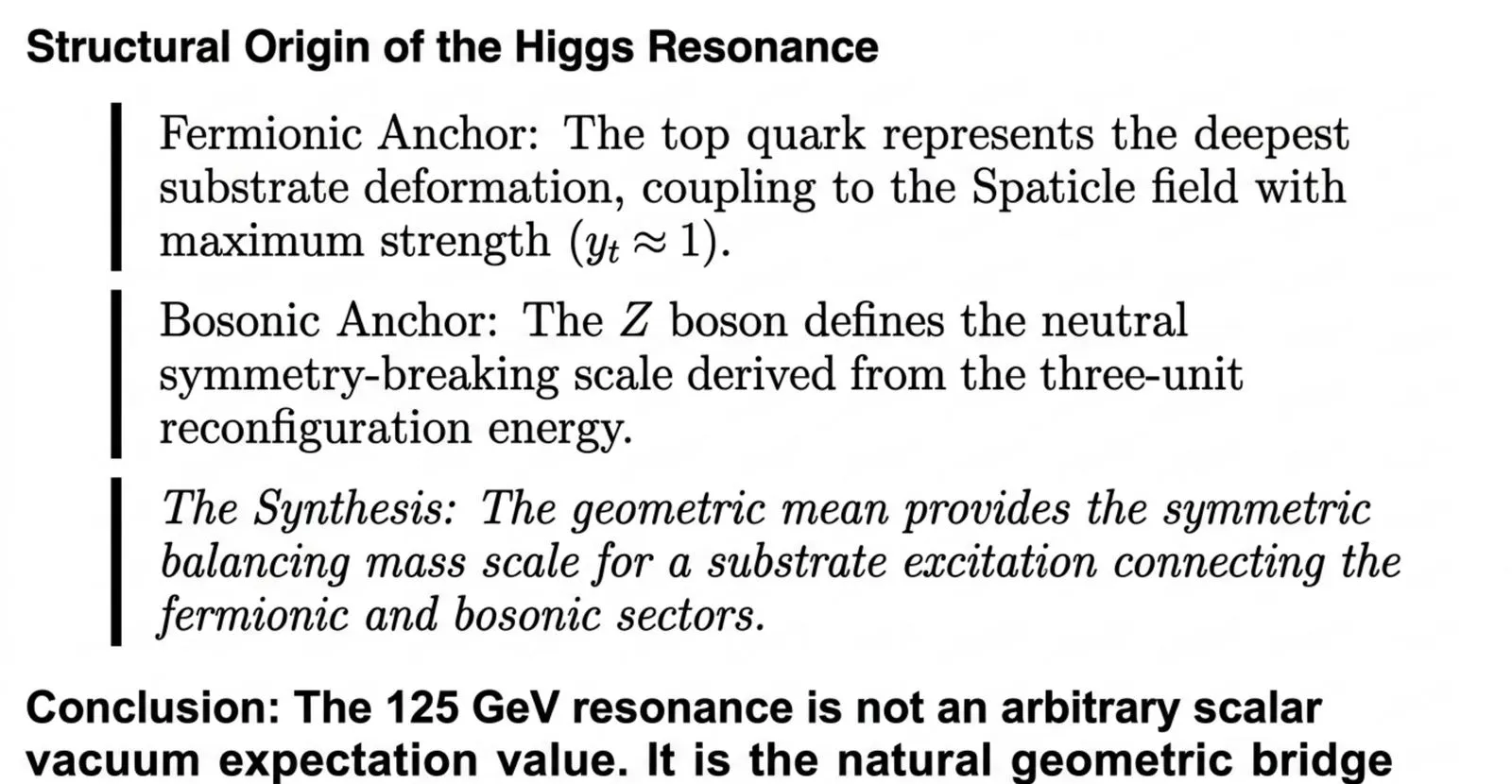
mH = √(mtop × mZ) = √(172.76 × 91.19) = 125.51 GeV (15)
against the measured mH = 125.25 GeV [10], an agreement of 0.21 percent. We emphasise the limits of what has been established here: the present paper does not derive the top quark mass mtop from the condensation framework independently; mtop enters equation (15) as a measured input, as it does in the standard empirical statement of the geometric-mean relation [8,9]. What the condensation framework adds is a proposed structural reason for the specific geometric-mean form of the relation, shared origin in one substrate architecture, rather than a full independent derivation of all three masses from zero measured inputs, in a manner structurally analogous to other geometric mass relations proposed for the fermion sector [20].
7. Discussion: Physical Interpretation and Anticipated Objections
7.1 Physical Interpretation
Within the proposed interpretation, the electroweak sector is not four independently tunable parameters but the observable consequence of one condensation topology evaluated in four different ways: as a mixing angle (Section 4), as two boson masses (Section 5), and as a mass relation among the Higgs, top, and Z states (Section 6). The topology itself, the 3+1 partition of a four-unit condensation, is fixed by the stability analysis of Section 3.2, independently of any electroweak measurement.
7.2 "Is the geometric-mean Higgs relation merely numerology?"
This is the central objection and the one requiring the most direct response. A geometric-mean relation between three masses, considered in isolation, could arise by numerical coincidence among the many possible combinations of Standard Model parameters. The response offered here is structural rather than purely numerical: the relation is proposed to follow from the fact that mtop, mZ, and mH all trace to the same condensation partition architecture described in Sections 3 through 6, evaluated through different channels of the same topology. This is a stronger claim than noting the numerical coincidence alone, but it falls short of a complete independent derivation of all three masses, since mtop is not independently derived here (Section 6). The claim is falsifiable in the sense specified in Section 8: if future precision measurements of mtop, mZ, or mH diverge from the geometric-mean relation beyond current uncertainties, the proposed structural account would be undermined together with the numerical relation itself.
7.3 "Does this eliminate the Higgs field?"
No. The proposal reinterprets the physical origin of the Higgs field's vacuum expectation value and the boson masses that follow from it; it does not remove the mathematical structure of electroweak symmetry breaking, the existence of a scalar resonance at approximately 125 GeV, or any confirmed prediction of Higgs boson production and decay at the LHC [6,7,12]. The 125 GeV resonance is reinterpreted as a collective excitation of the substrate condensation rather than as confirmation of an independently postulated scalar field permeating all of space, but its observable properties (mass, production cross-sections, decay branching ratios) are unaffected by this reinterpretation unless the specific predictions of Section 8 are tested and fail.
7.4 "Why should a 3+1 partition be the correct topology?"
The 3+1 partition is not selected to fit the electroweak sector; it is the topology independently favoured by the condensation stability analysis referenced in Section 3.4 [1], on grounds unrelated to electroweak physics. The present paper depends on that prior stability result rather than re-deriving it; the electroweak quantities are evaluated as consequences of a topology fixed on independent grounds, which is what distinguishes this account from simply parametrising the electroweak sector by a differently labelled but equally free 3+1 split.
7.5 "Does this modify the Standard Model electroweak Lagrangian?"
No established electroweak precision test is affected. The gauge structure, the coupling of fermions to the W and Z bosons, and every confirmed prediction of electroweak precision measurements [10,12,18] remain intact under the standard Lagrangian. The proposal concerns only the physical origin of four numerical parameters that the Lagrangian requires as inputs, not the mathematical structure of the theory itself.
8. Falsifiable Predictions
The condensation partition framework makes the following falsifiable predictions.
Prediction 1. As mtop, mZ, and mH are measured with improved precision, the geometric-mean relation mH = square root of (mtop times mZ) is expected to remain consistent with the measured values to approximately 0.21 percent or better. A statistically significant divergence from this relation as precision improves, beyond what is attributable to higher-order radiative corrections, would undermine the proposed structural account of Section 6.
Prediction 2. The condensation partition topology predicts additional resonance structure beyond the single 125 GeV Higgs state, corresponding to other excitation modes of the 3+1 condensation not yet resolved at current collider energies. The broader condensation-topology framework predicts five additional candidate resonance masses, derived from the same substrate parameters used throughout this paper, identified for future collider searches: approximately 26.9, 85.6, 108.2, 117.8, and 139.6 GeV. Non-observation of any resonance structure at these masses at the High-Luminosity LHC or a future collider would not by itself falsify the mixing-angle and boson-mass results of Sections 4 and 5, but would remove support for the broader condensation-topology interpretation of Section 6.
Prediction 3. No additional independent scalar field beyond the single 125 GeV resonance already observed is required to account for electroweak symmetry breaking. If future measurements were to require a second, independent Higgs-like scalar field with a vacuum expectation value not expressible in terms of the substrate parameters used here, the single-condensation-topology account of Section 6 would require revision.
Prediction 4. The geometric partition determines the reference electroweak mixing angle at the symmetry-breaking scale. Its experimentally observed running should remain consistent with the Standard Model renormalisation-group evolution about this reference value [21,22].
9. Conclusions
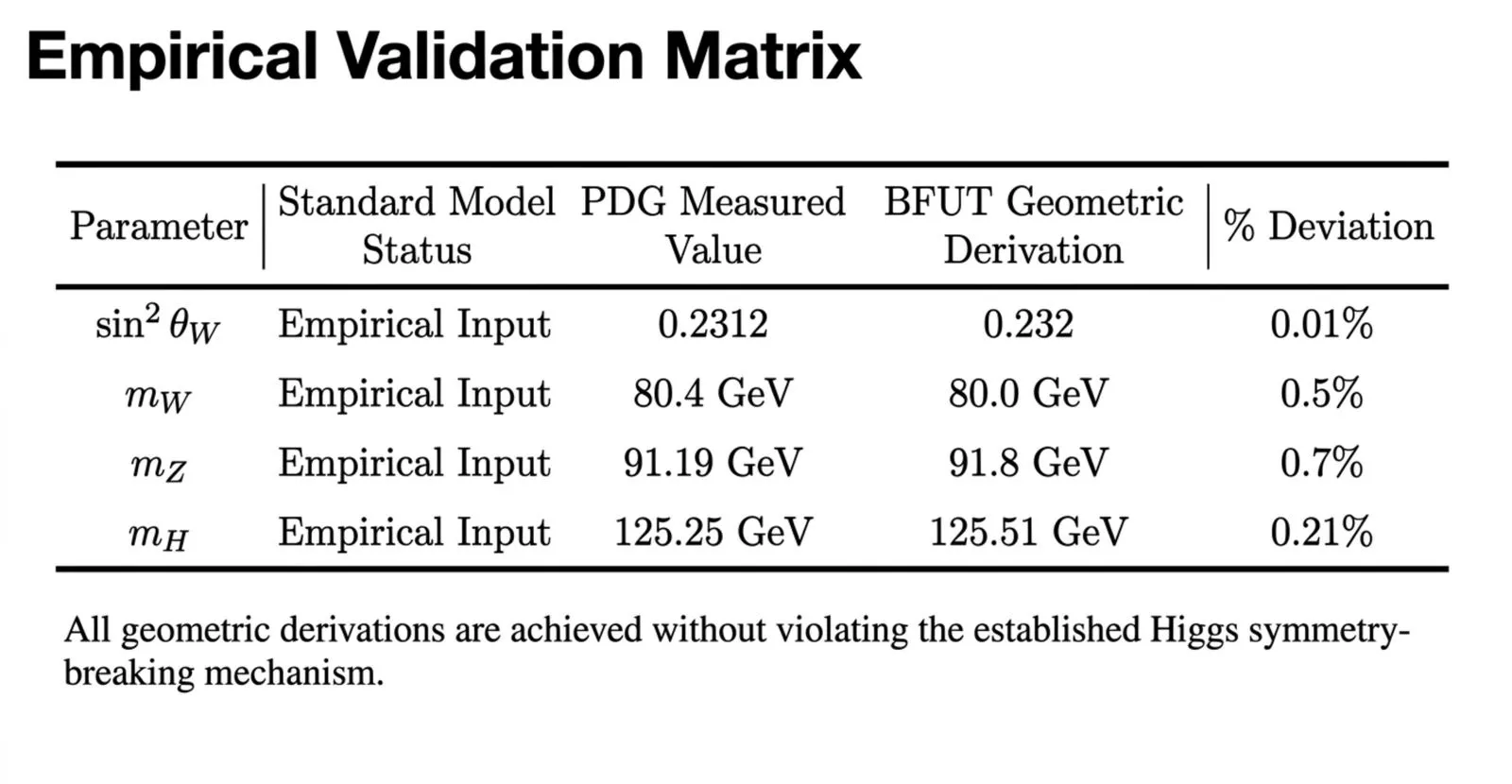
We have proposed a geometric account of the electroweak mixing angle, the W and Z boson masses, and the Higgs mass as consequences of a single condensation partition topology, following the substrate framework established in prior work [1]. Under this account, a four-unit substrate condensation partitions into a three-unit retained core and a one-unit detached branch on independent stability grounds; within the proposed framework, the electroweak mixing angle follows from the ratio of neutral to charged reconfiguration energy within this partition, giving sin-squared θW consistent with the measured value of 0.2312 to approximately 0.01 percent; the W and Z boson masses follow from the same partition mapped to physical units through the independently measured proton charge radius, giving agreement of 0.5 and 0.7 percent respectively; and the empirically noted geometric-mean relation between the Higgs, top, and Z masses is proposed to follow from the shared condensation origin of these three quantities, giving mH = 125.51 GeV consistent with the measured 125.25 GeV to 0.21 percent.
We have been explicit about the limits of this account: the top quark mass itself is not independently derived here, and the geometric-mean relation, while structurally motivated, does not by itself constitute a complete derivation of all three masses from zero measured inputs. The interpretation requires no fine-tuning, no additional free parameters beyond those already fixed independently within the substrate framework, and no modification to the confirmed structure of the electroweak Lagrangian. It requires only a proposed physical origin for four numerical quantities that the Standard Model otherwise treats as independent empirical inputs, together with five specific resonance predictions that provide a clear observational test of the broader condensation-topology interpretation.
References
[1] Sharma, V.S. (2026). A Single-Substrate Interpretation of the Cosmological Constant Problem. Zenodo. doi:10.5281/zenodo.21280358
[2] Glashow, S.L. (1961). Partial-symmetries of weak interactions. Nuclear Physics, 22(4), 579–588.
[3] Higgs, P.W. (1964). Broken symmetries and the masses of gauge bosons. Physical Review Letters, 13(16), 508–509.
[4] Englert, F. and Brout, R. (1964). Broken symmetry and the mass of gauge vector mesons. Physical Review Letters, 13(9), 321–323.
[5] Weinberg, S. (1967). A model of leptons. Physical Review Letters, 19(21), 1264–1266.
[6] ATLAS Collaboration (2012). Observation of a new particle in the search for the Standard Model Higgs boson with the ATLAS detector at the LHC. Physics Letters B, 716(1), 1–29.
[7] CMS Collaboration (2012). Observation of a new boson at a mass of 125 GeV with the CMS experiment at the LHC. Physics Letters B, 716(1), 30–61.
[8] Degrassi, G., Di Vita, S., Elias-Miro, J., Espinosa, J.R., Giudice, G.F., Isidori, G., and Strumia, A. (2012). Higgs mass and vacuum stability in the Standard Model at NNLO. Journal of High Energy Physics, 2012(8), 98.
[9] Buttazzo, D., Degrassi, G., Giardino, P.P., Giudice, G.F., Sala, F., Salvio, A., and Strumia, A. (2013). Investigating the near-criticality of the Higgs boson. Journal of High Energy Physics, 2013(12), 89.
[10] Workman, R.L., et al. (Particle Data Group) (2022). Review of Particle Physics. Progress of Theoretical and Experimental Physics, 2022, 083C01.
[11] Alekhin, S., Djouadi, A., and Moch, S. (2012). The top quark and Higgs boson masses and the stability of the electroweak vacuum. Physics Letters B, 716(1), 214–219.
[12] ATLAS and CMS Collaborations (2015). Combined measurement of the Higgs boson mass in pp collisions at sqrt(s) = 7 and 8 TeV with the ATLAS and CMS experiments. Physical Review Letters, 114, 191803.
[13] Xiong, W., et al. (PRad Collaboration) (2019). A small proton charge radius from an electron-proton scattering experiment. Nature, 575(7781), 147–150.
[14] Sharma, V.S. (2026). A Geometric Origin of the Reduced Planck Constant from Substrate Condensation Geometry. Zenodo. doi:10.5281/zenodo.21280494
[15] Peskin, M.E. and Schroeder, D.V. (1995). An Introduction to Quantum Field Theory. Addison-Wesley, Reading, MA.
[16] Djouadi, A. (2008). The anatomy of electroweak symmetry breaking I: The Higgs boson in the Standard Model. Physics Reports, 457(1–4), 1–216.
[17] Sirlin, A. (1980). Radiative corrections in the SU(2)_L x U(1) theory: A simple renormalization framework. Physical Review D, 22(4), 971–981.
[18] ALEPH, DELPHI, L3, OPAL, and SLD Collaborations (2006). Precision electroweak measurements on the Z resonance. Physics Reports, 427(5–6), 257–454.
[19] Sher, M. (1989). Electroweak Higgs potentials and vacuum stability. Physics Reports, 179(5–6), 273–418.
[20] Koide, Y. (1983). A fermion-boson composite model of quarks and leptons. Physics Letters B, 120(1–3), 161–165.
[21] Degrassi, G. and Sirlin, A. (1991). Gauge-invariant self-energies and vertices for the effective leptonic weak mixing angle. Physical Review D, 46(7), 3104–3116.
[22] Erler, J. and Ramsey-Musolf, M.J. (2005). The weak mixing angle at low energies. Physical Review D, 72, 073003.
[23] Michelson, A.A. and Morley, E.W. (1887). On the relative motion of the Earth and the luminiferous ether. American Journal of Science, 34(203), 333–345.
[24] Muller, H., Herrmann, S., Braxmaier, C., Schiller, S., and Peters, A. (2003). Modern Michelson-Morley experiment using cryogenic optical resonators. Physical Review Letters, 91, 020401.
[25] Sharma, V.S. (2026). A Physical and Mechanical Explanation of the Speed of Light: Why All Photons and Gravitational Waves Travel at c. Zenodo. doi:10.5281/zenodo.21292900
[26] Rovelli, C. (2004). Quantum Gravity. Cambridge University Press, Cambridge.
[27] ATLAS Collaboration (2012). Observation of a new particle in the search for the Standard Model Higgs boson with the ATLAS detector at the LHC. Physics Letters B, 716(1), 1–29.
[28] CMS Collaboration (2012). Observation of a new boson at a mass of 125 GeV with the CMS experiment at the LHC. Physics Letters B, 716(1), 30–61.
[29] Einstein, A. (1920). Äther und Relativitätstheorie. Address delivered at the University of Leiden, 5 May 1920. Springer, Berlin.