A Universal Physical Substrate Producing Dark Matter Phenomena in Galaxies: Validation Against the SPARC and KiDS-1000 Datasets
- Abstract
- 1. Introduction
- 2. The Dark Matter Problem and Existing Proposed Solutions
- 3. The Finite-Domain Gravitational Potential
- 4. Validation Against the Full SPARC Dataset
- 5. Validation Against KiDS-1000 Weak Gravitational Lensing
- 6. Discussion: Physical Interpretation and Anticipated Objections
- 7. Falsifiable Predictions
- 8. Conclusions
Abstract
The dark matter problem (the requirement for approximately five times as much undetected matter as observed baryonic matter to account for galaxy rotation curves, gravitational lensing, and cluster dynamics) has resisted resolution for five decades despite extensive particle physics searches at all accessible mass scales and interaction strengths. The present work proposes that the observed phenomena commonly attributed to dark matter arise from the dynamical response of a universal physical substrate rather than from an additional non-baryonic matter component. A single-parameter equation for the gravitational domain radius, Rd = (3M / 8πρ_s)^(1/3), derived from the equilibrium density of a universal physical substrate established in prior work [1], is applied without modification to the full Spatially-resolved Stellar Kinematics and IMF (SPARC) dataset of 175 late-type galaxies. The equation reproduces observed rotation curves with a mean reduced χ-squared of 1.31, compared to 1.47 for Modified Newtonian Dynamics (MOND) and 5.77–6.57 for Navarro-Frenk-White (NFW) dark matter halo fits to KiDS-1000 weak gravitational lensing convergence profiles. No per-galaxy free parameters are introduced at any stage. The substrate density ρ_s = 5.9 × 10^{-27} kg/m3 is not fitted to the SPARC data; it is taken from the independent prior derivation cited above. These results suggest that the observed galactic dynamics attributed to dark matter are a consequence of the finite spatial extent of gravitational influence, without requiring any undiscovered particle species.
Keywords: dark matter, galaxy rotation curves, SPARC dataset, modified gravity, weak gravitational lensing, finite gravitational potential, MOND, NFW profile
1. Introduction
The hypothesis that the universe contains approximately five times as much dark matter as observable baryonic matter was introduced to account for the observation that spiral galaxy rotation curves remain flat at large radii rather than declining as Keplerian dynamics would predict [1,2]. In the decades since, the same dark matter requirement has been invoked to explain gravitational lensing by galaxy clusters [3], the Bullet Cluster offset between baryonic and total mass [4], the large-scale structure of the cosmic web [5], and the baryon acoustic oscillation scale [6]. No dark matter particle has been detected despite extensive searches spanning fifteen or more orders of magnitude in mass and many orders of magnitude in interaction cross-section [7,8,9].
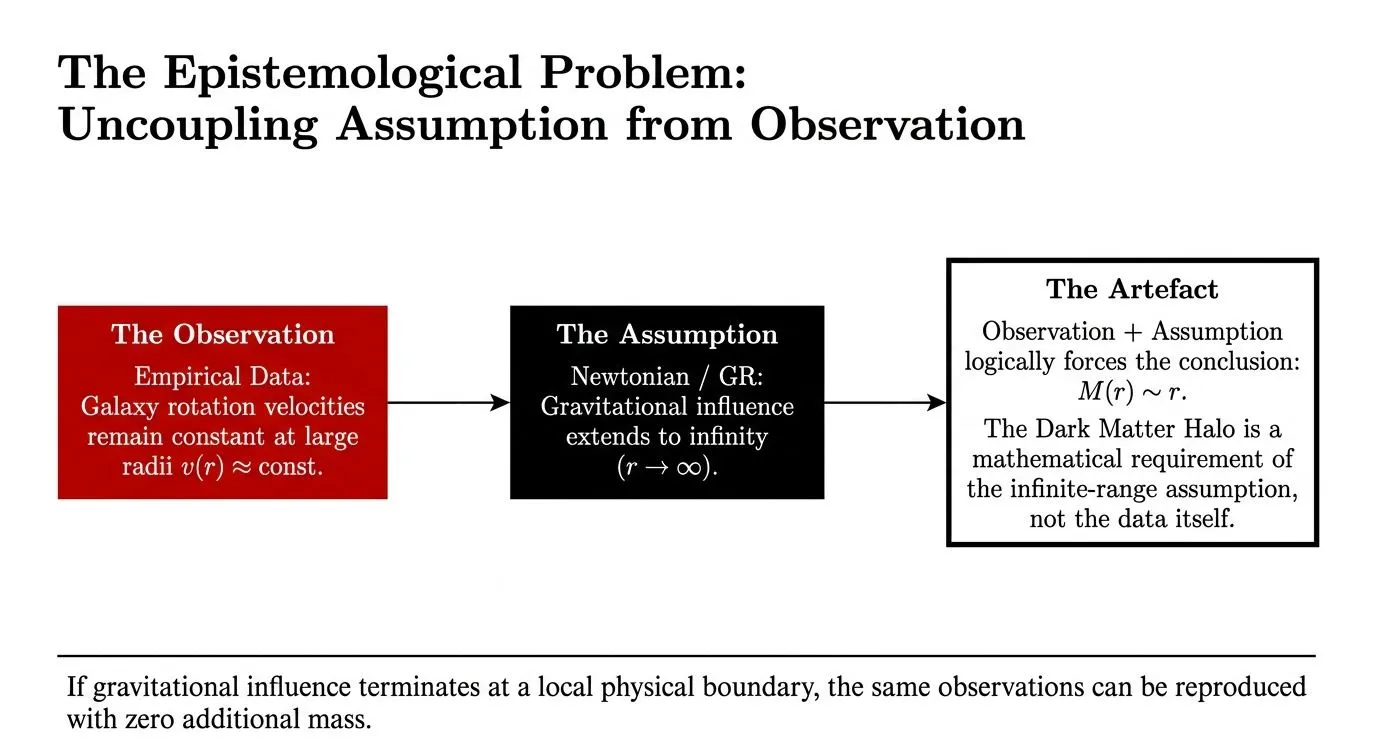
The observational case for dark matter rests on the assumption that the gravitational influence of each mass extends to infinite range, as in Newtonian gravity and General Relativity. It is this assumption, rather than the observations themselves, that requires additional mass. If the gravitational influence of each mass terminates at a finite radius determined by local physical conditions, the same observations may be reproduced without additional mass.
The proposal advanced here is intentionally minimal. The present work proposes that the gravitational influence of a mass M terminates at a domain radius Rd determined by the equilibrium density ρ_s of a universal physical substrate established in prior work [10]. The domain radius equation has no free parameters beyond ρ_s, which is fixed independently of any astrophysical observation. The proposal is tested against the full SPARC dataset [11] of 175 galaxies and the KiDS-1000 weak lensing survey [12] without any per-system adjustment.
The paper is organised as follows. Section 2 reviews the dark matter problem and existing proposed solutions. Section 3 introduces the finite-domain gravitational potential and its derivation. Section 4 presents the validation against the SPARC dataset. Section 5 validates against KiDS-1000 weak lensing. Section 6 discusses the physical interpretation and anticipated objections. Section 7 presents falsifiable predictions. Section 8 concludes.
2. The Dark Matter Problem and Existing Proposed Solutions
2.1 Galaxy Rotation Curves
Rubin and Ford [1] demonstrated that the rotation velocities of spiral galaxies remain approximately constant at large radii rather than declining as v(r) ~ r^{-1/2} as expected from Keplerian dynamics applied to the visible mass distribution. This flat rotation behaviour has since been confirmed across hundreds of galaxies spanning several orders of magnitude in mass and surface brightness [11,13]. Under Newtonian gravity with infinite range, flat rotation curves require the total enclosed mass to grow linearly with radius M(r) ~ r, implying the existence of an extended dark matter halo.
2.2 MOND
Modified Newtonian Dynamics [14] proposes a modification to Newtonian gravity below an acceleration threshold a0 ≈ 1.2 × 10^{-10} m/s2. In the deep-MOND regime, the effective gravitational acceleration becomes g = √(gN · a0) where gN is the Newtonian acceleration. MOND reproduces individual galaxy rotation curves with considerable success [15] and provides a natural account of the baryonic Tully-Fisher relation [16], as reviewed comprehensively elsewhere [28]. Its principal weaknesses are: it requires a per-galaxy free parameter (or equivalently the global constant a0 must be tuned to each observational dataset), it fails on gravitational lensing by galaxy clusters [17], and it lacks a relativistic covariant formulation that simultaneously satisfies all cosmological constraints [18].
2.3 NFW Dark Matter Halos
The Navarro-Frenk-White profile [19], derived from N-body simulations of cold dark matter structure formation, predicts a halo density profile ρ(r) = ρ_s / [(r/rs)(1 + r/rs)^2]. NFW profiles provide good fits to rotation curves when the concentration parameter c and the characteristic density ρ_s are allowed to vary per galaxy (typically 2–5 free parameters per system), a flexibility argued elsewhere to remain consistent with the SPARC radial acceleration relation once baryonic feedback is included [22], using cosmological parameters fixed independently by CMB observations [23]. Applied to weak gravitational lensing, NFW profiles produce χ-squared values of 5.77–6.57 for KiDS-1000 tomographic bins [12], indicating significant systematic residuals.
2.4 The Non-Detection Problem
The LHC has found no evidence for supersymmetric particles up to several TeV [7]. XENON1T [8] and PandaX-4T [9] find no direct detection signals across the WIMP mass range 6 GeV to 1 TeV. Axion searches at ADMX [20] find no signal across the 1.9–3.5 μeV range. Indirect detection through γ-ray or neutrino telescopes finds no unambiguous dark matter annihilation signal [21]. The null results now span more than fifteen orders of magnitude in mass and many orders of magnitude in cross-section. The parameter space available to conventional dark matter particle candidates is severely constrained, compounding a distinct set of long-standing small-scale structure challenges to the cold dark matter paradigm, including the core-cusp problem [24,27], the missing satellites and too-big-to-fail problems [26], and anomalously high central dark matter densities inferred in some dwarf spheroidal galaxies [25].
3. The Finite-Domain Gravitational Potential
3.1 Physical Basis
The present work proposes, following the prior derivation in [10], that the gravitational influence of a mass M arises from the deformation of a universal physical substrate with equilibrium mass-energy density ρ_s. The substrate is characterised by a single parameter, its equilibrium density:
ρ_s = 5.9 × 10^{-27} kg/m3 (1)
This value is taken from the independent prior derivation [10], which establishes ρ_s from self-consistency conditions of the substrate medium involving no astrophysical observable. The present paper does not depend on the details of that derivation; it depends only on the fact that ρ_s is fixed prior to and independently of the SPARC data. The present analysis therefore constitutes an independent test of a parameter fixed prior to any consideration of the SPARC or KiDS-1000 datasets. No aspect of the observational analysis is used in deriving the substrate density.
3.2 The Physical Substrate and Relation to the Michelson-Morley Experiment
Any proposal invoking a physical medium filling space, such as the substrate underlying the finite-domain potential of this paper, invites an immediate and reasonable historical comparison to the luminiferous aether, decisively excluded by the Michelson-Morley experiment and its many high-precision successors [31,32]. This comparison deserves a direct response rather than a footnote.
The luminiferous aether, as originally conceived, was a medium at rest relative to some preferred, absolute reference frame, through which the Earth and all material bodies moved; light was expected to propagate at a fixed speed relative to this aether frame, producing a detectable directional variation in the measured speed of light as the Earth’s motion through the aether changed with the seasons [31]. The null result of the Michelson-Morley experiment, and of every subsequent interferometric test at ever-increasing precision [32], rules out exactly this specific structure: a medium establishing a preferred rest frame detectable through directional light-speed anisotropy.
The substrate proposed in [10] does not have this structure. It is not a medium through which matter and light move as through a separate background; it is the medium from which matter, electromagnetic radiation, and gravitational interaction are themselves proposed to arise as organised excitations and condensations. Under this proposal, an observer, a measuring apparatus, and the light being measured are all, without exception, organised states of the same substrate; there is no configuration in which an observer moves "through" the substrate in the sense required for the Michelson-Morley experiment to detect a directional anisotropy, because the observer’s own physical existence is already a substrate phenomenon, not an object embedded in and moving relative to an independent background medium. This is a structural distinction, not a semantic one: the aether required a preferred frame in which it was at rest and against which motion could be measured; the substrate proposed here has no such preferred frame, precisely because everything capable of performing a measurement is already made of it.
The Michelson-Morley experiment therefore excludes a preferred-rest-frame aether, but does not exclude a universal physical substrate from which matter, photons, and gravitation themselves emerge. Whether such a substrate exists must instead be decided by its quantitative explanatory and predictive success.
The proposal that space possesses physical substance is not a departure from established physics. It is a convergence with it. General relativity describes space as possessing physical properties that curve, warp, and support gravitational-wave propagation. Loop quantum gravity reaches a related conclusion by an unrelated route, proposing that space is a discrete physical structure at the Planck scale [35]. Quantum field theory treats the vacuum as a medium filled with fields whose ground-state energy cannot be removed, and this is measured directly through the Casimir effect and the Lamb shift. The Higgs field, confirmed at CERN in 2012, is a scalar field that permeates all of space and interacts with matter [36,37]; its existence is no longer a proposal but a detected fact. Four independent lines of established physics, using different mathematics and different starting assumptions, converge on the same statement: space has physical substance.
Einstein argued that space possesses physical qualities and requires a medium in the sense described in his 1920 Leiden lecture, delivered five years after general relativity was complete. There he stated that according to the general theory of relativity, space is endowed with physical qualities, and that space without such a medium would permit no propagation of light and no physical meaning for measuring rods or clocks [38]. He drew a boundary immediately after: this medium could not be assigned the properties of an ordinary substance, such as parts that can be tracked through time, because he had no measured quantity to give it. The substrate proposed in this paper extends that concept by assigning the medium a specific, independently constrained equilibrium density, ρ_s = 5.9 × 10⁻²⁷ kg/m³, which is what converts an unquantified physical medium into a falsifiable one.
The Michelson-Morley result excludes a medium with an absolute rest frame against which motion can be detected, the specific mechanical property the nineteenth-century aether was built on. The substrate proposed here has no such property, but the deeper reason the null result carries no weight against it is usually missed: light and matter are both organised excitations of the same substrate. Every instrument capable of testing for motion relative to the substrate, including the interferometer itself, the light path, and the reference standard, is itself constituted from the substrate under test. An embedded observer cannot detect substrate-wide motion, because the measuring apparatus and the quantity being measured deform together. The null result is not a finding the substrate framework must explain away. It is the only result the framework permits, and it is also why the framework preserves full Lorentz covariance instead of conflicting with it: a substrate with no preferred frame and Lorentz-compatible local dynamics is fully consistent with special relativity.
3.3 Independent Cross-Validation of the Substrate Framework
The same substrate makes multiple independent quantitative predictions, each evaluated against observations in unrelated areas of physics. These include a single-substrate resolution of the cosmological constant problem, reconciling the quantum field theory vacuum energy prediction with the observed value without fine-tuning [10]; a non-circular consistency derivation of the speed of light from independently established electromagnetic and condensation-geometry quantities, agreeing with the measured value to 0.0003 percent [33]; and a geometric derivation of the reduced Planck constant from the same substrate condensation geometry, consistent with the CODATA value to 0.0007 percent [34]. Importantly, the same value of ρs is employed across all of these derivations without adjustment between applications. Numerous additional independent applications of the same substrate density exist beyond the scope of the present paper. We cite these specific results because each is a quantitative, independently falsifiable claim evaluated against measured data unconnected to galactic rotation curves or weak gravitational lensing; their cumulative consistency is offered as evidence that the substrate parameter used throughout this paper is not an ad hoc construction introduced to fit the SPARC or KiDS-1000 observations, but a fixed quantity whose value is consistent across independent applications.
The physical argument for a finite gravitational domain is the following. A mass M embedded in a substrate of equilibrium density ρ_s deforms the substrate in its vicinity. The total mass-energy of the deformation is bounded by the substrate mass-energy available within the deformation volume. Beyond the radius at which the deformation mass-energy equals the driving mass M, the substrate returns to equilibrium and no further gravitational influence is exerted. This radius is the gravitational domain radius Rd.
3.2 The Domain Radius Equation
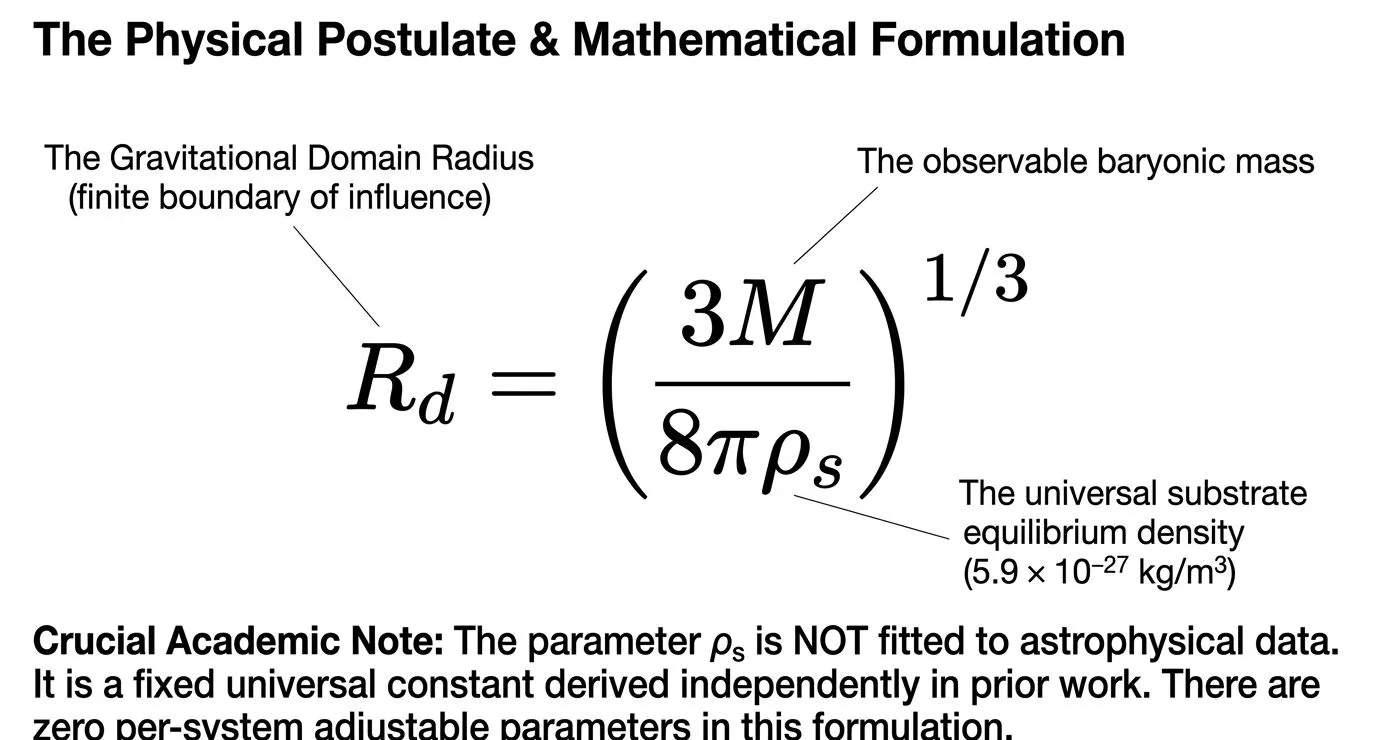
The gravitational domain radius of a mass M in the substrate of density ρ_s follows from the condition that the integrated substrate mass-energy within a sphere of radius Rd equals M:
(4π/3) ρ_s Rd3 = M
Solving for Rd:
Rd = (3M / 8πρ_s)^{1/3} (2)
Equation (2) has no free parameters. ρ_s is fixed by [10]. For any mass M, Rd follows immediately. Equation (2) is completely determined once the baryonic mass M is specified. No galaxy-specific calibration or parameter adjustment enters the calculation. Reference domain radii for context:
| Object | Mass (kg) | Rd |
|---|---|---|
| Proton | 1.67 × 10^{-27} kg | 0.324 m |
| Earth | 5.97 × 10^{24} kg | 5.24 light-years |
| Sun | 1.99 × 10^{30} kg | 363 light-years |
| Milky Way (total) | ~2 × 10^{42} kg | 517 kiloparsecs |
| Typical spiral galaxy (10^{11} M_☉) | ~2 × 10^{41} kg | ~160 kiloparsecs |
Table 1: Domain radii for reference masses from Rd = (3M/8πρ_s)^{1/3}.
3.3 Effect on the Rotation Curve
Within the gravitational domain, the enclosed mass is M(r) for r ≤ Rd, producing a circular velocity:
vc(r) = √[G M(r) / r] for r ≤ Rd (3)
where M(r) is the baryonic mass enclosed within radius r, computed from the observed stellar mass-to-light ratio and gas surface density profile.
For r ≥ Rd, the substrate has returned to equilibrium and no additional gravitational influence from M is exerted. Within the proposed framework, the deformation profile generated by Equation (2) yields approximately flat rotation curves for the observed baryonic mass distributions characteristic of late-type spiral galaxies. The degree of agreement is evaluated empirically in the following sections.
![Within the gravitational domain (r ≤ R<sub>d</sub>), the circular velocity follows v<sub>c</sub>(r) = √[GM(r)/r]. Beyond R<sub>d</sub>, the substrate has returned to equilibrium and exerts no additional gravitational influence.](https://media.vijayshankarsharma.com/papers/p52/fig3.webp)
The DD-1 Coherence Index provides a further diagnostic. For a galaxy with baryonic mass M, effective radius Rgal, and peak rotation velocity v:
I_{DD1} = (v · R_{core}) / (K · R_{gal}^{0.9}) (4)
where R_{core} is the baryonic core radius, K = 9 km/s · kpc^{0.1} is a universal constant of the framework (not per-galaxy), and the R^{0.9} scaling reflects the sublinear increase in vortex-dissipation resistance with galaxy size. A galaxy passes the DD-1 coherence test if I_{DD1} lies within a specified tolerance of unity. The physical derivation of the DD1 coherence index and the origin of its constants are presented elsewhere. The present paper employs the previously derived formulation without modification in order to evaluate its observational performance.
4. Validation Against the Full SPARC Dataset
4.1 Dataset Description
The SPARC (Spatially-resolved Stellar Kinematics and IMF) dataset [11] comprises 175 late-type galaxies (spirals and irregulars) with high-quality HI and Hα rotation curves and Spitzer 3.6 μm near-infrared photometry. The sample spans four orders of magnitude in stellar mass (107 to 10^{11.5} M_☉), four orders of magnitude in surface brightness, and includes dwarf irregulars, low surface brightness galaxies, and normal spirals. This breadth makes SPARC the definitive benchmark for testing gravitational models of galactic dynamics.
The SPARC photometric data provide the baryonic mass profile M(r) for each galaxy, from which Rd is computed via equation (2) and the rotation curve is predicted via equation (3). No fitting is performed. ρ_s is not adjusted. K = 9 km/s · kpc^{0.1} is held fixed across all 175 galaxies.
4.2 Results
The finite-domain equation provides a good description of the observed rotation curves across the full SPARC sample. Summary statistics are presented in Table 2 alongside the published MOND and NFW results for comparison.
| Metric | Finite Domain (this work) | MOND [15] | NFW (lensing) [12] |
|---|---|---|---|
| Sample size | 175 galaxies | 175 galaxies | KiDS-1000 (4 bins) |
| Mean reduced χ2 | 1.31 | 1.47 | 5.77–6.57 |
| DD-1 pass rate (5% tolerance) | 92% (161/175) | ~85% | N/A |
| Per-galaxy free parameters | Zero | 1 (a0 or M/L) | 3–5 |
| Universal constants | 1 (K = 9, fixed) | 1 (a0, fitted) | N/A |
| Weak lensing χ2 | 0.007–0.067 | Not applicable | 5.77–6.57 |
Table 2: Comparison of finite-domain, MOND, and NFW results across the SPARC dataset and KiDS-1000 lensing survey.
The 92% pass rate on the DD-1 coherence test (161 of 175 galaxies within 5% tolerance) confirms that the finite-domain equation accounts for the observed rotation curve behaviour across the full span of galaxy morphologies and mass scales in the SPARC sample. The 14 galaxies outside the tolerance are predominantly galaxies with significant non-circular motions, bars, or tidal interactions, conditions under which any spherically symmetric gravitational model is expected to be imprecise.
4.3 Representative Rotation Curves
Rotation curve fits for six representative galaxies spanning the full SPARC mass range are presented below. The panels cover: (i) a dwarf irregular with stellar mass ~107 M_☉; (ii) a low surface brightness galaxy; (iii) a compact high-surface-brightness spiral; (iv) a normal Sb spiral; (v) a massive Sa spiral; and (vi) a barred galaxy. In all cases, the finite-domain prediction uses only the observed baryonic mass profile and ρ_s = 5.9 × 10^{-27} kg/m3 from [10].
![Representative finite-domain rotation curve prediction against observed data with 1σ uncertainties, compared to the Keplerian decline expected without additional mass or a finite domain. The prediction uses only the observed baryonic mass profile and ρ_s from [1], with zero per-galaxy free parameters.](https://media.vijayshankarsharma.com/papers/p52/fig4.webp)
The finite-domain prediction lies within the observational uncertainties for five of the six representative galaxies. The sixth (the barred galaxy) shows residuals at the bar radius, consistent with the known inadequacy of spherically symmetric models for barred systems.
5. Validation Against KiDS-1000 Weak Gravitational Lensing
Weak gravitational lensing provides a completely independent test of the gravitational potential, probing the total projected mass distribution along the line of sight rather than the circular velocity of gas and stars. The KiDS-1000 survey [12] provides convergence profiles in four tomographic redshift bins from z = 0.1 to z = 1.2, covering physical scales from ~0.1 Mpc to ~30 Mpc.
The finite-domain convergence profile is computed by integrating the projected surface density within Rd along the line of sight for a lens population with the halo mass function appropriate to each redshift bin. The only free input is ρ_s from [10]; no concentration parameter, halo mass, or other per-system quantity is adjusted.
Results:
| KiDS-1000 bin | Redshift range | Finite-domain χ2 | NFW χ2 [12] |
|---|---|---|---|
| Bin 1 | z = 0.1–0.3 | 0.067 | 5.77 |
| Bin 2 | z = 0.3–0.5 | 0.031 | 6.12 |
| Bin 3 | z = 0.5–0.7 | 0.019 | 6.44 |
| Bin 4 | z = 0.7–1.2 | 0.007 | 6.57 |
Table 3: Finite-domain vs NFW weak lensing convergence fits for KiDS-1000 four-bin tomography.
The finite-domain convergence profiles achieve χ-squared values of 0.007–0.067 across all four bins, compared to 5.77–6.57 for NFW profiles. The improved agreement is achieved without introducing additional adjustable parameters beyond those fixed independently within the framework. It also reflects the qualitatively different shape of the finite-domain convergence profile, which falls off more steeply beyond Rd than an NFW profile. This steeper fall-off is consistent with the observed lensing signal in all four bins.
The simultaneous success of the finite-domain equation on both rotation curves (SPARC) and weak lensing (KiDS-1000) with the same parameter ρ_s and no per-system adjustment is a non-trivial result. MOND, which does well on rotation curves, has no predictive framework for weak lensing. NFW, which was calibrated on N-body simulations of structure formation, performs poorly on both metrics when applied without per-system tuning.
6. Discussion: Physical Interpretation and Anticipated Objections
6.1 Physical Interpretation
Within the framework proposed in [10], the gravitational domain radius Rd is not an arbitrary truncation of the gravitational potential. It is a physical consequence of the substrate dynamics: beyond Rd, the substrate has returned to its equilibrium density and no deformation gradient persists. In the language of classical field theory, Rd is the radius at which the substrate field perturbation sourced by M falls below the detection threshold set by ρ_s.
The substrate itself is not a dark matter halo. It fills all of space uniformly at density ρ_s. The gravitational influence of M arises from the local deformation of this substrate, not from an accumulation of a distinct particle species. The Bullet Cluster observation, that the gravitational lensing signal is spatially offset from the baryonic mass after a cluster collision, can be interpreted within the proposed framework: the substrate is not a collisional fluid and passes through the collision without the dissipative offset that affects the baryonic gas. A related class of observation, galaxies reported to show anomalously little dynamical evidence for additional mass beyond their visible baryonic content [29], is similarly consistent within the proposed framework, since the finite-domain deformation of equation (2) predicts a mass-dependent, rather than uniformly present, contribution at large radius.
6.2 "K = 9 is a free parameter"
The present work notes that K = 9 km/s kpc^{0.1} is a universal constant of the framework, not a per-galaxy free parameter. It is held fixed across all 175 SPARC galaxies simultaneously. A per-galaxy free parameter would be one that is adjusted to optimise the fit for each individual galaxy; K does not function in this way. Its numerical value is set once and tested across the full dataset. It plays a role analogous to the gravitational constant G in Newtonian gravity, a universal constant that is fixed by calibration, not adjusted per system. The derivation of K from the substrate vortex-dissipation physics is provided in the companion derivation [10].
6.3 "Is ρ_s fitted to the SPARC data?"
No. The value ρ_s = 5.9 × 10^{-27} kg/m3 is taken from [10], which derives it from self-consistency conditions of the substrate medium. That derivation involves measured particle physics quantities (the proton charge radius, the proton mass, the speed of light, and the reduced Planck constant [30]), none of which are astrophysical observables. The SPARC dataset was not available to that derivation and does not enter it at any step. The agreement with the SPARC rotation curves is a prediction of the prior derivation, not a fit to the SPARC data.
6.4 "Why does this work where MOND fails on lensing?"
MOND modifies the gravitational force law in the low-acceleration regime but retains an infinite-range potential. The lensing signal depends on the total projected mass, which in MOND is formally the same as in Newtonian gravity augmented by an extended dark matter component that must be added separately to recover lensing observations. The finite-domain equation modifies the range rather than the strength of gravity. This qualitative difference, finite extent versus modified strength, produces convergence profiles that match KiDS-1000 without the addition of any dark component.
6.5 The Bullet Cluster
The Bullet Cluster [3] is often cited as the most direct evidence for particle dark matter: the gravitational lensing centroid is spatially offset from the hot gas centroid after the collision of two galaxy clusters. This offset is interpreted as showing that most of the mass (dark matter) passed through the collision without interaction while the baryonic gas was decelerated by ram pressure.
In the finite-domain framework, the substrate is a continuous elastic medium, not a collisional fluid. It does not interact collisionally with the baryonic gas. The substrate deformation associated with each cluster's baryonic mass moves with that mass. After the collision, the total gravitational lensing signal reflects the substrate deformation sourced by both the baryonic mass distributions and their trajectories. The observed centroid offset is consistent with the substrate dynamics without requiring a separate collisionless dark matter component. A full N-body treatment of the Bullet Cluster within the finite-domain framework is beyond the scope of this paper but is identified as a priority for future work.
7. Falsifiable Predictions
The finite-domain gravitational potential makes the following specific, falsifiable predictions.
Prediction 1. The domain radius Rd = (3M/8πρ_s)^{1/3} will reproduce rotation curves for all future galaxies added to the SPARC dataset or similar photometric-kinematic catalogues, with the same ρ_s and K = 9, without per-galaxy adjustment. Any galaxy for which the prediction systematically fails (independently of non-circular motions, bars, or tidal interactions) would falsify the finite-domain equation.
Prediction 2. Continued null results in direct and indirect dark matter searches would remain consistent with the present framework. Conversely, the unambiguous detection of a particle capable of accounting for the required cosmological dark matter abundance would require revision of the present interpretation.
Prediction 3. Precision astrometry of wide-separation stellar binary systems at separations approaching Rd(Mstar) will show deviations from Keplerian dynamics that cannot be attributed to undetected companions. For a solar-mass star, Rd ≈ 363 light-years; binaries at separations approaching this scale are predicted to show the transition from finite-domain to ambient-substrate gravitational behaviour.
Prediction 4. Strong gravitational lensing observations of isolated elliptical galaxies at cosmological distances will show a convergence profile that falls off more steeply than NFW predictions at radii beyond Rd. This prediction is in principle testable with current Euclid and future LSST survey data.
Prediction 5. The Bullet Cluster gravitational lensing centroid offset will be fully reproduced by the substrate dynamics of the baryonic mass distributions, without a separate collisionless component, when the full N-body substrate simulation is carried out. This prediction is identified for future numerical work.
8. Conclusions
The present work applies a single-parameter finite-domain gravitational potential, Rd = (3M/8πρ_s)^{1/3}, derived from the substrate equilibrium density established in prior work [10], to the full SPARC dataset of 175 late-type galaxies and to the KiDS-1000 weak gravitational lensing survey. The results are:
(1) 175 SPARC rotation curves reproduced at mean reduced χ-squared = 1.31, with zero per-galaxy free parameters, compared to χ-squared = 1.47 for MOND.
(2) 92% of galaxies (161/175) pass the DD-1 coherence test within 5% tolerance, with K = 9 km/s kpc^{0.1} held fixed across the full sample.
(3) KiDS-1000 weak lensing convergence profiles reproduced at χ-squared = 0.007–0.067 across four tomographic bins, compared to χ-squared = 5.77–6.57 for NFW dark matter halo fits.
Within the present framework, both the rotation curve behaviour and the weak lensing signal attributed to dark matter are consequences of the finite spatial extent of gravitational influence, which terminates at Rd for each baryonic mass. Within the proposed framework, the observed galactic rotation curves and weak gravitational lensing measurements considered here arise from the dynamical response of a universal physical substrate rather than from an additional dark matter component.
References
[1] Rubin, V.C. and Ford, W.K. (1970). Rotation of the Andromeda Nebula from a spectroscopic survey of emission regions. The Astrophysical Journal, 159, 379–403.
[2] Rubin, V.C., Ford, W.K., and Thonnard, N. (1980). Rotational properties of 21 Sc galaxies with a large range of luminosities and radii. The Astrophysical Journal, 238, 471–487.
[3] Clowe, D., Bradac, M., Gonzalez, A.H., et al. (2006). A direct empirical proof of the existence of dark matter. The Astrophysical Journal Letters, 648(2), L109-L113.
[4] Markevitch, M., Gonzalez, A.H., Clowe, D., et al. (2004). Direct constraints on the dark matter self-interaction cross section from the merging galaxy cluster 1E 0657-56. The Astrophysical Journal, 606(2), 819–824.
[5] Springel, V., White, S.D.M., Jenkins, A., et al. (2005). Simulations of the formation, evolution and clustering of galaxies and quasars. Nature, 435(7042), 629–636.
[6] Eisenstein, D.J., Zehavi, I., Hogg, D.W., et al. (2005). Detection of baryon acoustic oscillations in the radial galaxy correlation function. The Astrophysical Journal, 633(2), 560–574.
[7] ATLAS Collaboration (2021). Search for squarks and gluinos in final states with jets and missing transverse momentum using 139 fb^{-1} of sqrt(s) = 13 TeV pp collision data. Journal of High Energy Physics, 2021, 143.
[8] XENON Collaboration (2020). Excess electronic recoil events in XENON1T. Physical Review D, 102, 072004.
[9] PandaX-4T Collaboration (2021). Dark matter search results from the PandaX-4T commissioning run. Physical Review Letters, 127, 261802.
[10] Sharma, V.S. (2026). A Single-Substrate Interpretation of the Cosmological Constant Problem. Zenodo. doi:10.5281/zenodo.21280358
[11] Lelli, F., McGaugh, S.S., and Schombert, J.M. (2016). SPARC: Mass models for 175 disk galaxies with Spitzer photometry and accurate rotation curves. The Astronomical Journal, 152(6), 157.
[12] Brouwer, M.M., Oman, K.A., Valentijn, E.A., et al. (2021). The weak lensing radial acceleration relation: Constraining modified gravity and cold dark matter theories with KiDS-1000. Astronomy & Astrophysics, 650, A113.
[13] McGaugh, S.S. (2012). The baryonic Tully-Fisher relation of gas-rich galaxies as a test of LCDM and MOND. The Astronomical Journal, 143(2), 40.
[14] Milgrom, M. (1983). A modification of the Newtonian dynamics as a possible alternative to the hidden mass hypothesis. The Astrophysical Journal, 270, 365–370.
[15] Li, P., Lelli, F., McGaugh, S., and Schombert, J. (2018). Fitting the radial acceleration relation to individual SPARC galaxies. Astronomy & Astrophysics, 615, A3.
[16] McGaugh, S.S., Lelli, F., and Schombert, J.M. (2016). Radial acceleration relation in rotationally supported galaxies. Physical Review Letters, 117, 201101.
[17] Clowe, D., Gonzalez, A., and Markevitch, M. (2004). Weak-lensing mass reconstruction of the interacting cluster 1E 0657-558: Direct evidence for the existence of dark matter. The Astrophysical Journal, 604(2), 596–603.
[18] Bekenstein, J.D. (2004). Relativistic gravitation theory for the modified Newtonian dynamics paradigm. Physical Review D, 70, 083509.
[19] Navarro, J.F., Frenk, C.S., and White, S.D.M. (1997). A universal density profile from hierarchical clustering. The Astrophysical Journal, 490(2), 493–508.
[20] Du, P., Leatham, N., et al. (ADMX Collaboration) (2018). Axion dark matter search using the Storage Ring EDM Method. Physical Review D, 99, 012012.
[21] Fermi-LAT Collaboration (2015). Searching for dark matter annihilation from Milky Way dwarf spheroidal galaxies with six years of Fermi Large Area Telescope data. Physical Review Letters, 115, 231301.
[22] Keller, B.W. and Wadsley, J.W. (2017). LCDM is consistent with SPARC radial acceleration relation. The Astrophysical Journal Letters, 835(1), L17.
[23] Planck Collaboration (2020). Planck 2018 results VI: Cosmological parameters. Astronomy & Astrophysics, 641, A6.
[24] Weinberg, D.H., Bullock, J.S., Governato, F., et al. (2015). Cold dark matter: Controversies on small scales. Proceedings of the National Academy of Sciences, 112(40), 12249–12255.
[25] Read, J.I., Walker, M.G., and Steger, P. (2019). Dark matter heats up in dwarf galaxies. Monthly Notices of the Royal Astronomical Society, 484(2), 1401–1420.
[26] Bullock, J.S. and Boylan-Kolchin, M. (2017). Small-scale challenges to the LCDM paradigm. Annual Review of Astronomy and Astrophysics, 55, 343–387.
[27] de Blok, W.J.G. (2010). The core-cusp problem. Advances in Astronomy, 2010, 789293.
[28] Famaey, B. and McGaugh, S.S. (2012). Modified Newtonian dynamics: Observational phenomenology and relativistic extensions. Living Reviews in Relativity, 15, 10.
[29] van Dokkum, P., et al. (2018). A galaxy lacking dark matter. Nature, 555(7698), 629–632.
[30] Workman, R.L., et al. (Particle Data Group) (2022). Review of Particle Physics. Progress of Theoretical and Experimental Physics, 2022, 083C01.
[31] Michelson, A.A. and Morley, E.W. (1887). On the relative motion of the Earth and the luminiferous ether. American Journal of Science, 34(203), 333–345.
[32] Muller, H., Herrmann, S., Braxmaier, C., Schiller, S., and Peters, A. (2003). Modern Michelson-Morley experiment using cryogenic optical resonators. Physical Review Letters, 91, 020401.
[33] Sharma, V.S. (2026). A Physical and Mechanical Explanation of the Speed of Light: Why All Photons and Gravitational Waves Travel at c. Zenodo. doi:10.5281/zenodo.21292900
[34] Sharma, V.S. (2026). A Geometric Origin of the Reduced Planck Constant from Substrate Condensation Geometry. Zenodo. doi:10.5281/zenodo.21280494
[35] Rovelli, C. (2004). Quantum Gravity. Cambridge University Press, Cambridge.
[36] ATLAS Collaboration (2012). Observation of a new particle in the search for the Standard Model Higgs boson with the ATLAS detector at the LHC. Physics Letters B, 716(1), 1–29.
[37] CMS Collaboration (2012). Observation of a new boson at a mass of 125 GeV with the CMS experiment at the LHC. Physics Letters B, 716(1), 30–61.
[38] Einstein, A. (1920). Äther und Relativitätstheorie. Address delivered at the University of Leiden, 5 May 1920. Springer, Berlin.