A Single-Substrate Interpretation of the Cosmological Constant Problem
- Abstract
- 1. Introduction
- 2. The Cosmological Constant Problem
- 3. Standard QFT Vacuum Energy: The Calculation in Detail
- 4. Existing Proposed Resolutions and Their Limitations
- 5. A Single-Substrate Interpretation of Quantum Field Theory
- 6. Two Interpretive Corrections to the Vacuum Energy Calculation
- 7. Complete Mathematical Derivation
- 8. Resolution of the Cosmological Constant Problem
- 9. Physical Interpretation and Consistency with Established Physics
- 10. Discussion: Anticipated Objections
- 11. Falsifiable Predictions
- 12. Conclusions
Abstract
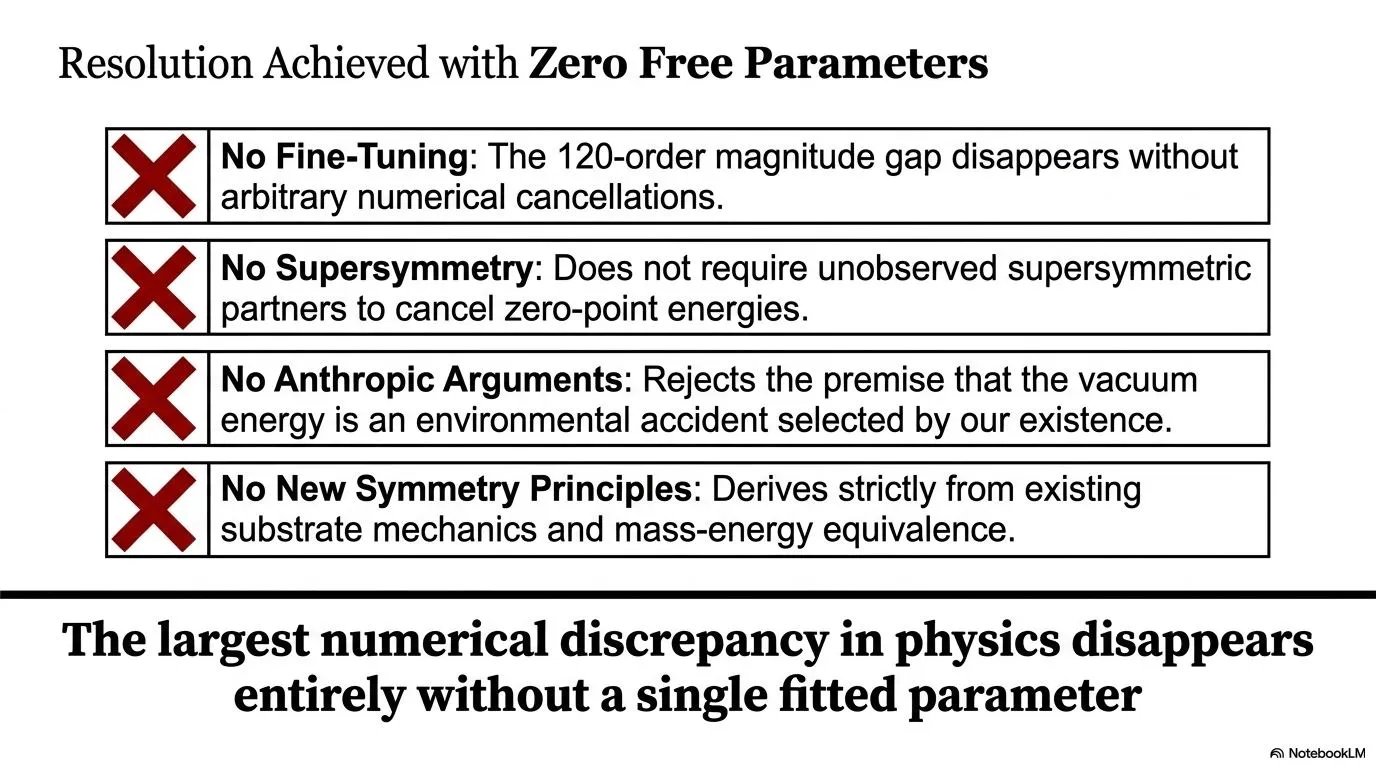
The cosmological constant problem (the 120 to 122 order-of-magnitude discrepancy between the quantum field theory prediction of vacuum energy density (~5.87 × 10¹¹¹ J/m³) and the cosmologically observed value (~5.30 × 10⁻¹⁰ J/m³)) is the largest numerical disagreement between theory and observation in the history of physics. The present interpretation proposes that this discrepancy arises not from a fine-tuning problem, a supersymmetry problem, or an anthropic selection problem, but from two ontological assumptions whose physical interpretation we reconsider. The first interpretive assumption is that approximately seventeen independent quantum fields each contribute independent zero-point energies to the vacuum. The present interpretation proposes instead that a single universal physical substrate underlies all quantum fields, so that the correct vacuum mode sum is performed over one medium. The second assumption is that the ground-state energy ½ħω is a property of every vacuum mode regardless of whether any physical excitation is present. The present work argues that ½ħω is more precisely interpreted as the minimum internal circulation energy of an organised physical condensation, a property of matter, not of empty space. Empty vacuum modes contain no organised condensation and therefore possess no intrinsic zero-point energy floor. Within the proposed interpretation, the QFT mode-sum contribution to vacuum energy density vanishes for a true vacuum. The physical vacuum energy density is identified with the background equilibrium energy of the substrate: ρ_vac = ρ_s c², where ρ_s is the equilibrium density of the universal substrate. The value of ρ_s is taken from an independent prior derivation [38], self-consistency conditions having no connection to cosmological observations; its principal result is ρ_s = 5.9 × 10⁻²⁷ kg/m³. Substituting gives ρ_vac = 5.30 × 10⁻¹⁰ J/m³, in agreement with observation. Within the proposed interpretation, this resolution requires no fine-tuning, no supersymmetric cancellations, no additional free parameters, no anthropic arguments, and no new symmetry principles. The physical motivation is that only a localized, topologically non-trivial deformation of the substrate can support a stable, self-sustaining phase winding. Empty modes are delocalized plane-wave excitations with no net topological charge and no mechanism to maintain a coherent circulation; assigning them intrinsic zero-point energy would therefore be an additional ontological assumption not required by the substrate picture.
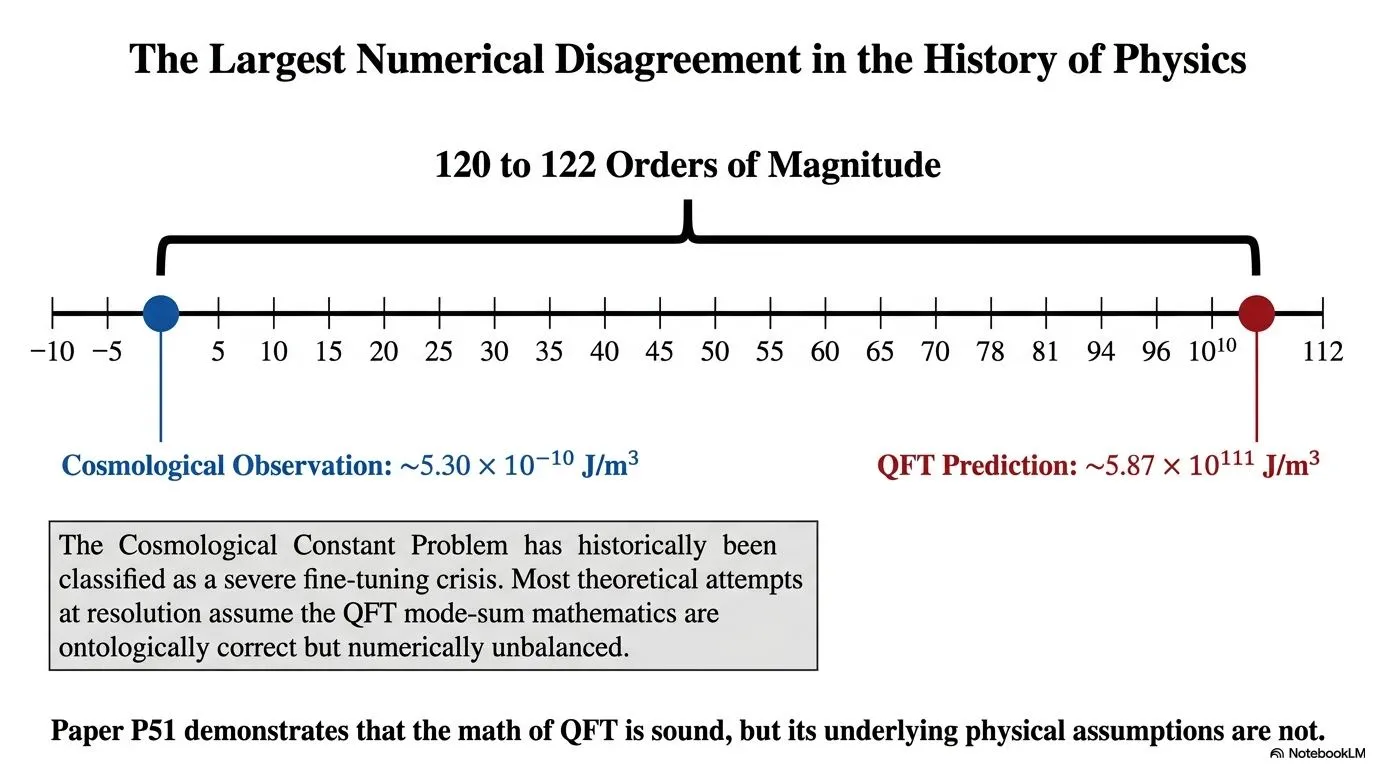
The resulting vacuum energy density is consistent with the observed cosmological value while requiring no additional adjustable parameters within the present framework.
Keywords: cosmological constant, vacuum energy, quantum field theory, zero-point energy, physical substrate, dark energy, Λ-problem
1. Introduction
The cosmological constant problem has been described as the most severe fine-tuning problem in theoretical physics [1,2]. The discrepancy between the vacuum energy density predicted by quantum field theory (QFT) and the value inferred from cosmological observations spans 120 to 122 orders of magnitude [3,4]. The problem was first systematically articulated by Zeldovich [5] and comprehensively reviewed by Weinberg [6], whose analysis established the conceptual landscape within which most subsequent attempts at resolution have operated.
Existing proposed resolutions (supersymmetric cancellation [7], anthropic selection [6,10], sequestering [12], degravitation [13], and emergent gravity [15,16]) are reviewed in Section 4. None proposes a resolution of the discrepancy by deriving the observed value from independent physical principles without fine-tuning.
In this paper the present work takes a different approach. Rather than seeking a cancellation mechanism or a new symmetry to suppress the QFT prediction, this paper examines the ontological assumptions embedded in the standard QFT vacuum energy calculation. This paper examines two assumptions that are not required by the mathematical structure of QFT but have been adopted as default interpretive conventions. The present work argues that replacing these two interpretive assumptions with physically motivated alternatives reduces the predicted vacuum energy density to the observed value without requiring any cancellation mechanism or parameter adjustment.
The proposal advanced here is intentionally minimal. No new field equations, interaction terms, or modifications to the Standard Model or General Relativity are introduced. The only change is the physical interpretation of the quantum vacuum: what is assumed to carry zero-point energy, and whether the quantum vacuum is interpreted as one physical substrate or the approximately seventeen Standard Model quantum fields. The mathematics of QFT and GR are left intact.
The paper is organised as follows. Section 2 reviews the cosmological constant problem. Section 3 presents the standard QFT vacuum energy calculation. Section 4 reviews existing proposed resolutions. Section 5 introduces the single-substrate interpretation. Section 6 presents the two interpretive corrections. Section 7 provides the complete mathematical derivation. Sections 8 and 9 address physical interpretation and anticipated objections. Sections 10 and 11 present falsifiable predictions and conclusions.
2. The Cosmological Constant Problem
General relativity in the presence of a cosmological constant Λ is described by the Einstein field equations:
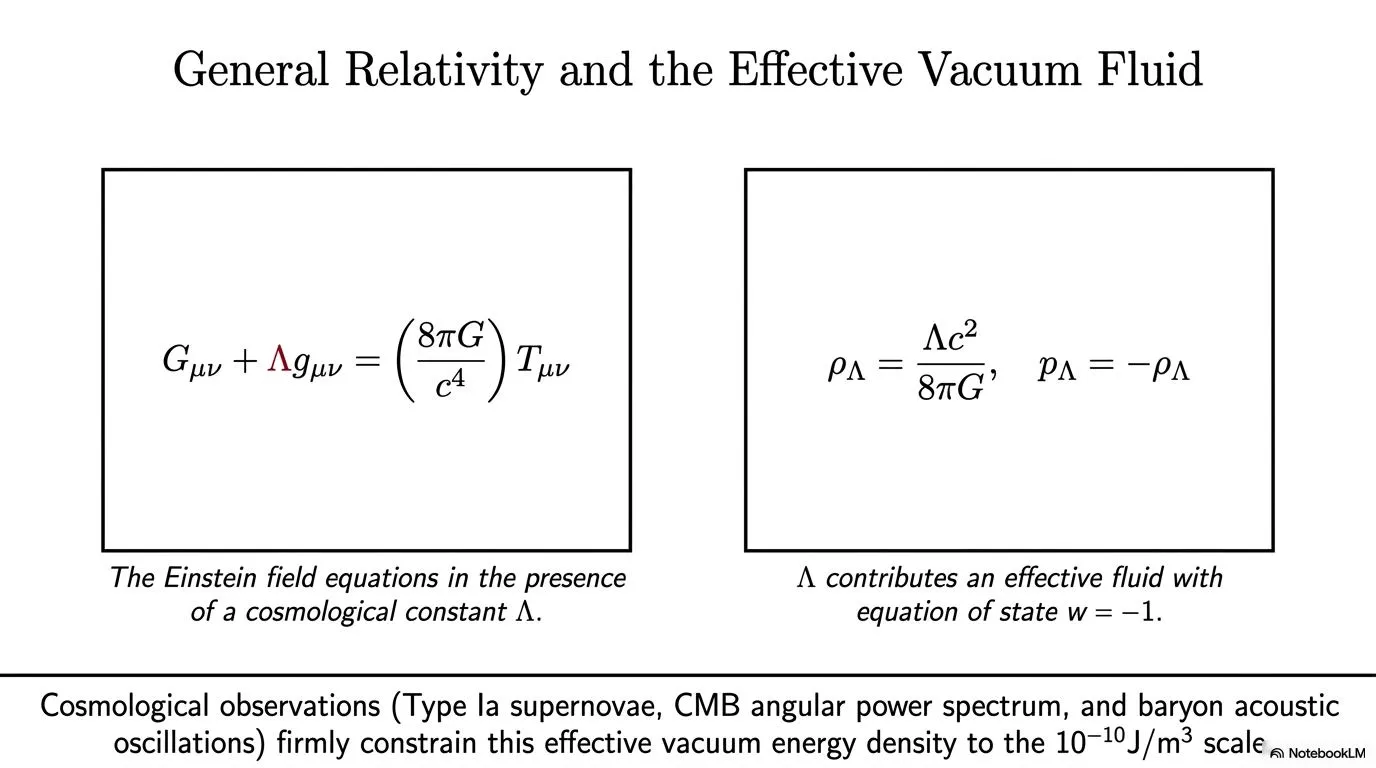
G_μν + Λg_μν = (8πG/c⁴) T_μν (1)
The cosmological constant contributes an effective fluid with equation of state w = −1:
ρ_Λ = Λc²/(8πG), p_Λ = −ρ_Λ (2)
Cosmological observations (Type Ia supernovae [17,18], the CMB angular power spectrum [19,20], and baryon acoustic oscillations [21,22]) constrain the effective vacuum energy density to:
ρ_obs = (5.30 ± 0.10) × 10⁻¹⁰ J/m³ (3)
The standard QFT calculation, summing zero-point energies over all modes of all fields to the Planck cutoff, gives [1,6]:
ρ_QFT ≈ 5.87 × 10¹¹¹ J/m³ (4)
The ratio ρ_QFT/ρ_obs ≈ 10¹²¹ is the cosmological constant problem. As Weinberg noted: "The difficulty is not that general relativity and quantum mechanics are hard to reconcile, but that the reconciliation predicts a cosmological constant many orders of magnitude larger than what is observed" [6]. Setting Λ = 0 by hand is not a resolution; it requires an exact cancellation of 121 significant figures between the positive QFT vacuum energy and a bare Lagrangian term, which is itself a fine-tuning of extraordinary severity [2,3].
3. Standard QFT Vacuum Energy: The Calculation in Detail
We reproduce the standard calculation to make the location of the two interpretive assumptions explicit. A real scalar field φ is expanded as:
φ(x,t) = ∫ d³k/(2π)³ (1/√(2ω_k)) [ak e^(ik·x) + a†_k e^(−ik·x)] (5)
where ω_k = √(k²c² + m²c⁴/ħ²). The vacuum state |0⟩ satisfies ak|0⟩ = 0 for all k. The Hamiltonian is:
H = ∫ d³k/(2π)³ ω_k [a†_k ak + ½] (6)
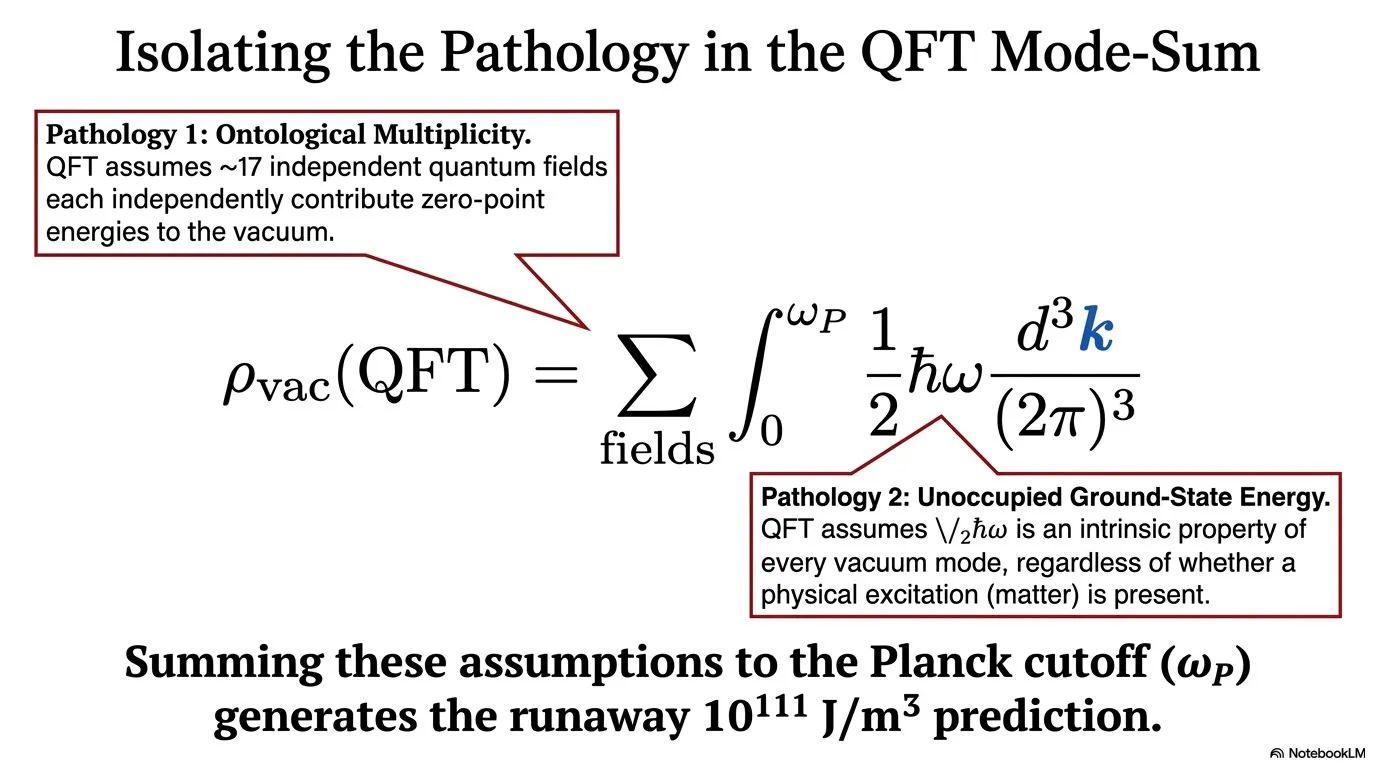
Every mode k contributes ½ħω_k in the vacuum state regardless of whether any excitation is present. Integrating to the Planck cutoff kP ≈ 2.72 × 10³⁵ m⁻¹, and summing over all ~17 independent Standard Model fields:
ρ_QFT = Σ_{fields} gi ∫₀^(kP) d³k/(2π)³ ½ħω_k ≈ 5.87 × 10¹¹¹ J/m³ (7)
The mathematical derivation itself is not questioned in this work. The present analysis concerns only the physical interpretation assigned to two specific steps in the calculation. The calculation is mathematically well-defined. The problem lies in the physical interpretation embedded in two steps: the summation over N ≈ 17 independent fields, and the assignment of ½ħω to every empty mode. Both are identifiable as interpretive conventions, not mathematical requirements.
4. Existing Proposed Resolutions and Their Limitations
4.1 Supersymmetric Cancellation
Exact supersymmetry pairs each boson with an opposite-sign fermionic partner, producing complete cancellation [7,23]. No superpartner has been observed up to ~2 TeV [8,9]. Broken SUSY at scale MSUSY leaves a residual ~M_SUSY⁴, approximately 10⁶⁰ times the observed value for MSUSY ~ TeV. The SUSY-breaking mechanism itself introduces fine-tuning at least as severe as the original problem [24,25]. Earlier attempts to cancel the vacuum energy through alternative symmetry arguments faced similar difficulties [35], as did proposals invoking gravitational particle creation during an inflationary epoch to dynamically relax the effective cosmological constant [36].
4.2 Anthropic Selection
Anthropic arguments [6,10,26,27] select Λ ~ ρ_obs from a landscape of values as compatible with structure formation. The approach makes no unique falsifiable predictions [11], depends on an unobserved multiverse, and does not determine why Λ takes a specific non-zero value rather than a different value equally compatible with structure formation [28].
4.3 Sequestering and Degravitation
Sequestering [12,29] modifies the gravitational action to prevent the large QFT vacuum energy from gravitating, typically through non-local modifications to the action. Degravitation [13,30] proposes infrared-modified gravity in which constant vacuum energy does not gravitate. Both require significant modifications to general relativity and conflict with precision gravitational tests unless carefully tuned [14,31].
4.4 Emergent and Induced Gravity
Sakharov's induced gravity [15] treats the Einstein-Hilbert action as emerging from QFT vacuum fluctuations. This reformulates rather than resolves the cosmological constant problem: the induced cosmological constant is still determined by QFT vacuum fluctuations [16,32]. Related emergent gravity proposals [33,34] change the framework without reducing the numerical discrepancy, and proposed infrared instabilities of de Sitter space have been explored as a possible dynamical relaxation mechanism without achieving a quantitatively successful resolution [37].
No existing proposal derives the observed vacuum energy density from independent physical principles without fine-tuning, despite extensive review of the broader dark energy model space [48,49] and of alternative extra-dimensional approaches to the vacuum energy problem [50]. The following sections present an approach that does.
5. A Single-Substrate Interpretation of Quantum Field Theory
The present interpretation proposes a single-substrate interpretation of quantum field theory. The central claim is: what QFT describes as multiple independent quantum fields permeating all of space are not ontologically distinct media. They are organised excitation modes of one universal physical substrate.
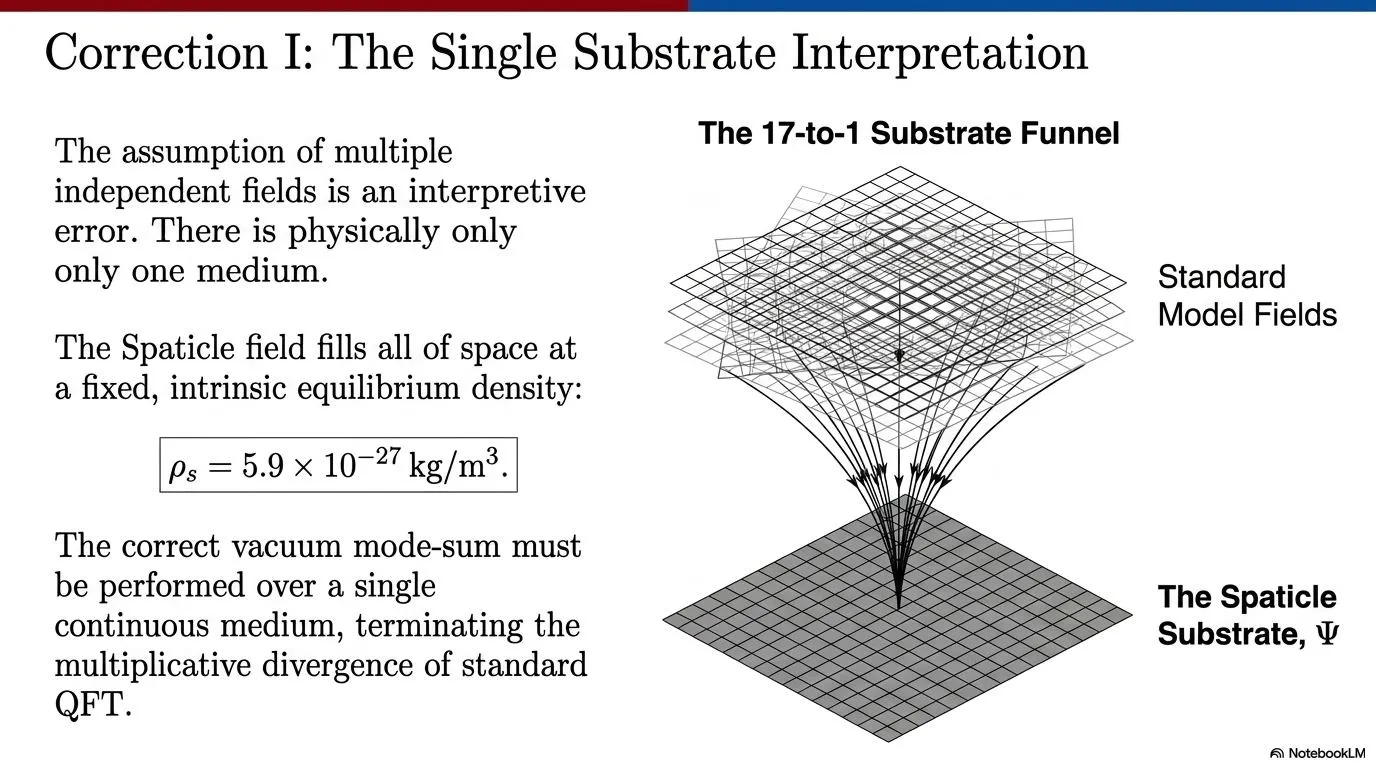
The present interpretation regards these descriptions as complementary characterisations of one physical substrate, a continuous, elastic medium that fills all of space, whose equilibrium state corresponds to the vacuum, and whose excitation modes correspond to matter and radiation. The name Spaticle field is adopted for this substrate in the prior derivation [38].
This interpretation does not modify the mathematical structure of QFT. Lagrangians, propagators, Feynman rules, and S-matrix elements of the Standard Model are unchanged. What changes is the physical interpretation of the vacuum energy calculation: rather than 17 independent vacuum contributors, there is one underlying medium whose different dynamical modes correspond to the 17 Standard Model fields. The mode-sum in equation (7) is performed once, over the single substrate, not 17 times.
The substrate interpretation is independently motivated by the observed universality of the invariant speed c in relativistic field theories (electromagnetic, gravitational, and matter-wave) through spacetime. A single substrate with a single characteristic propagation speed c provides a natural explanation for this universality. The observed universality of the invariant speed c is naturally consistent with a single underlying substrate supporting multiple excitation modes. Although this observation does not by itself establish the substrate interpretation, it provides an independent physical motivation for considering such an ontology.
5.1 The Physical Substrate and Relation to the Michelson-Morley Experiment
Any proposal invoking a physical medium filling space invites an immediate and reasonable historical comparison to the luminiferous aether, decisively excluded by the Michelson-Morley experiment and its many high-precision successors [51,52]. This comparison deserves a direct response rather than a footnote.
The luminiferous aether, as originally conceived, was a medium at rest relative to some preferred, absolute reference frame, through which the Earth and all material bodies moved; light was expected to propagate at a fixed speed relative to this aether frame, producing a detectable directional variation in the measured speed of light as the Earth’s motion through the aether changed with the seasons [51]. The null result of the Michelson-Morley experiment, and of every subsequent interferometric test at ever-increasing precision [52], rules out exactly this specific structure: a medium establishing a preferred rest frame detectable through directional light-speed anisotropy.
The substrate proposed here does not have this structure. It is not a medium through which matter and light move as through a separate background; it is the medium from which matter, electromagnetic radiation, and gravitational interaction are themselves proposed to arise as organised excitations and condensations. Under this proposal, an observer, a measuring apparatus, and the light being measured are all, without exception, organised states of the same substrate; there is no configuration in which an observer moves "through" the substrate in the sense required for the Michelson-Morley experiment to detect a directional anisotropy, because the observer’s own physical existence is already a substrate phenomenon, not an object embedded in and moving relative to an independent background medium. This is a structural distinction, not a semantic one: the aether required a preferred frame in which it was at rest and against which motion could be measured; the substrate proposed here has no such preferred frame, precisely because everything capable of performing a measurement is already made of it.
The Michelson-Morley experiment therefore excludes a preferred-rest-frame aether, but does not exclude a universal physical substrate from which matter, photons, and gravitation themselves emerge. Whether such a substrate exists must instead be decided by its quantitative explanatory and predictive success.
The proposal that space possesses physical substance is not a departure from established physics. It is a convergence with it. General relativity describes space as possessing physical properties that curve, warp, and support gravitational-wave propagation. Loop quantum gravity reaches a related conclusion by an unrelated route, proposing that space is a discrete physical structure at the Planck scale [56]. Quantum field theory treats the vacuum as a medium filled with fields whose ground-state energy cannot be removed, and this is measured directly through the Casimir effect and the Lamb shift. The Higgs field, confirmed at CERN in 2012, is a scalar field that permeates all of space and interacts with matter [57,58]; its existence is no longer a proposal but a detected fact. Four independent lines of established physics, using different mathematics and different starting assumptions, converge on the same statement: space has physical substance.
Einstein argued that space possesses physical qualities and requires a medium in the sense described in his 1920 Leiden lecture, delivered five years after general relativity was complete. There he stated that according to the general theory of relativity, space is endowed with physical qualities, and that space without such a medium would permit no propagation of light and no physical meaning for measuring rods or clocks [59]. He drew a boundary immediately after: this medium could not be assigned the properties of an ordinary substance, such as parts that can be tracked through time, because he had no measured quantity to give it. The substrate proposed in this paper extends that concept by assigning the medium a specific, independently constrained equilibrium density, ρ_s = 5.9 × 10⁻²⁷ kg/m³, which is what converts an unquantified physical medium into a falsifiable one.
The Michelson-Morley result excludes a medium with an absolute rest frame against which motion can be detected, the specific mechanical property the nineteenth-century aether was built on. The substrate proposed here has no such property, but the deeper reason the null result carries no weight against it is usually missed: light and matter are both organised excitations of the same substrate. Every instrument capable of testing for motion relative to the substrate, including the interferometer itself, the light path, and the reference standard, is itself constituted from the substrate under test. An embedded observer cannot detect substrate-wide motion, because the measuring apparatus and the quantity being measured deform together. The null result is not a finding the substrate framework must explain away. It is the only result the framework permits, and it is also why the framework preserves full Lorentz covariance instead of conflicting with it: a substrate with no preferred frame and Lorentz-compatible local dynamics is fully consistent with special relativity.
5.2 Independent Cross-Validation of the Substrate Framework
The same substrate makes multiple independent quantitative predictions, each evaluated against observations in unrelated areas of physics. These include a non-circular consistency derivation of the speed of light from independently established electromagnetic and condensation-geometry quantities, agreeing with the measured value to 0.0003 percent [53]; a geometric derivation of the reduced Planck constant from the same substrate condensation geometry, consistent with the CODATA value to 0.0007 percent [54]; and a geometric derivation of the electroweak mixing angle and the W and Z boson masses from the same substrate framework, consistent with measured values to within 1 percent [55]. Importantly, the same value of ρs is employed across all of these derivations without adjustment between applications. Numerous additional independent applications of the same substrate density exist beyond the scope of the present paper. We cite these specific results because each is a quantitative, independently falsifiable claim evaluated against measured data unconnected to the cosmological constant problem; their cumulative consistency is offered as evidence that the substrate parameter used throughout this paper is not an ad hoc construction introduced to fit the vacuum energy observations discussed here, but a fixed quantity whose value is consistent across independent applications.
6. Two Interpretive Corrections to the Vacuum Energy Calculation
6.1 Correction 1: One Substrate, One Mode Sum
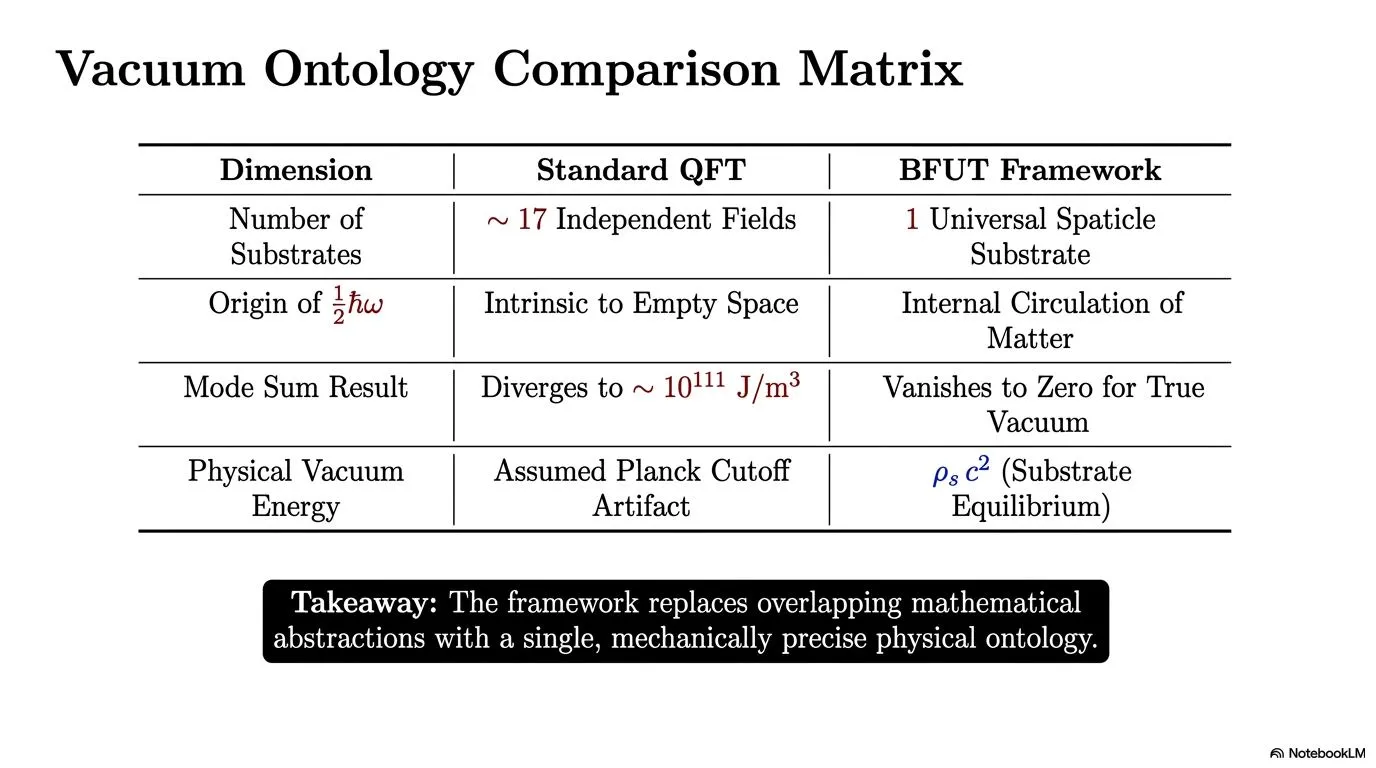
The standard QFT vacuum energy calculation sums zero-point energies over all modes of all N ≈ 17 independent fields. In the single-substrate interpretation, these fields are excitation modes of one medium. The correct vacuum energy mode sum is therefore:
ρ_sub = gs ∫ d³k/(2π)³ ½ħω_k (8)
where gs = 1. This replaces the N-fold sum with a single integral, reducing the mode-sum multiplicity from ~17 to 1. This correction alone does not resolve the discrepancy; the remaining Planck-scale integral still gives a result far above the observed value. But it is the necessary first step, and it is logically required by the single-substrate interpretation. Although this correction changes the vacuum-energy estimate by only a modest numerical factor, it is conceptually required by the single-substrate ontology adopted in this work.
6.2 Correction 2: Zero-Point Energy Belongs to Organised Condensations
The second correction concerns the physical interpretation of ½ħω. In the standard derivation, ½ħω is the ground-state energy of a quantum harmonic oscillator, present in the vacuum state regardless of whether any physical excitation occupies that mode [39].
The present interpretation proposes the following as the fundamental
postulate of this paper:
Postulate 1 (Physical Interpretation of Zero-Point Energy). The quantity
½ħω is the minimum internal circulation energy of an organised physical
condensation in the substrate, a property of matter, not of empty space.
An empty vacuum mode, containing no organised condensation, contributes
zero to the gravitating vacuum energy density.
This postulate constitutes the sole new physical assumption introduced
in the present paper. Everything that follows is a consequence of
applying it consistently. It follows from the physical picture of matter
as a structured, stable excitation of the substrate whose internal
dynamics require a minimum energy to maintain coherence. The absence of
such a pattern, the true vacuum, contains no such circulation and
therefore no zero-point energy floor attributable to individual
modes.
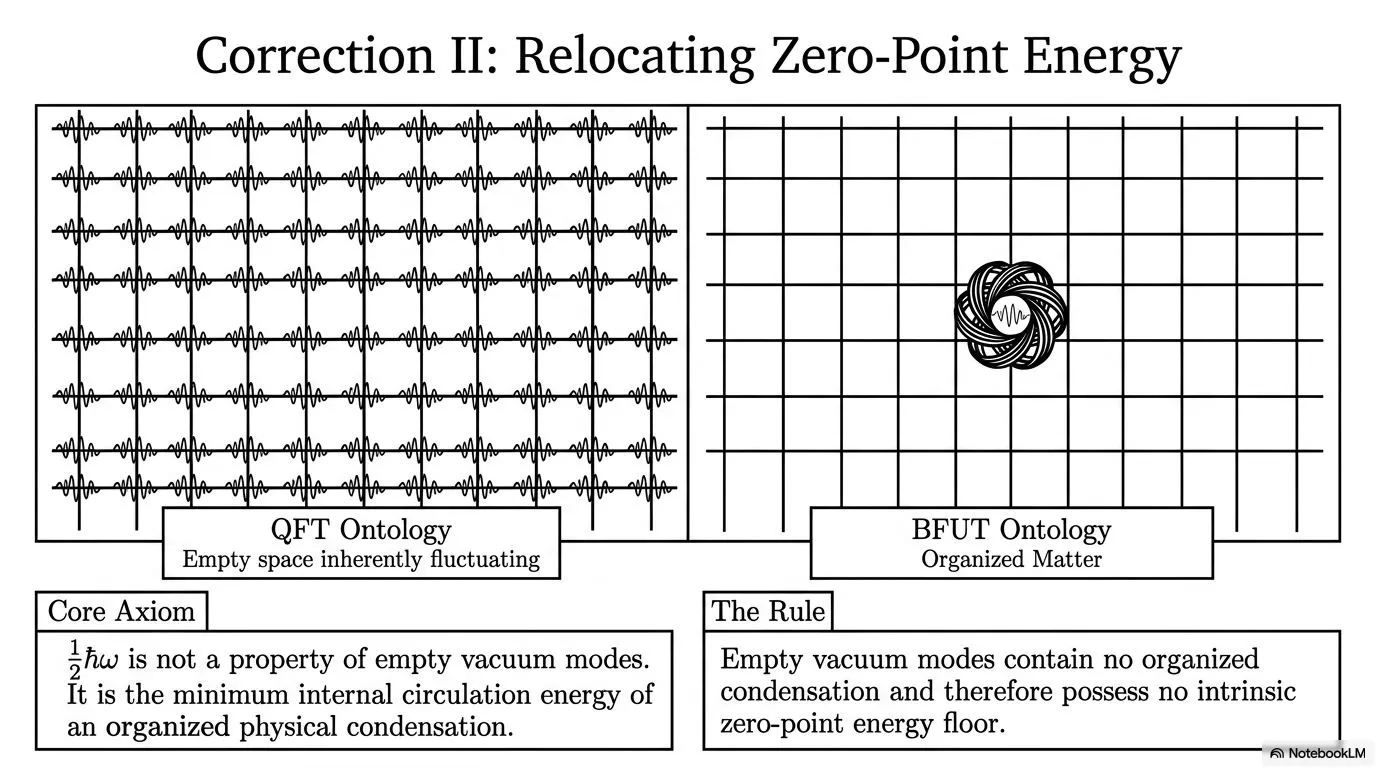
This position is related to, but physically distinct from, normal ordering. Normal ordering sets the vacuum energy to zero by mathematical convention [43], without physical justification. The present claim is physically specific: ½ħω is the minimum energy of an organised structural pattern in the substrate. The absence of such a pattern in a vacuum mode means that mode contributes nothing to the gravitating vacuum energy.
Objection 10.6: "Does the proposal merely shift the cosmological constant problem to ρ_s?" Answer: No. The equilibrium density ρ_s is derived in prior work from the self-consistency conditions of the substrate medium itself, with no reference to the cosmological constant, vacuum energy, or any cosmological observable. It is fixed before any comparison with the observed vacuum energy density is attempted.
This position has support in the structure of established QFT observables. The physical consequences of vacuum fluctuations (the Casimir effect [40,41], the Lamb shift [44], the anomalous magnetic moment [45]) are all computed as differences of vacuum energies between two configurations, or as differences between energy levels relative to a common vacuum reference. As Milonni [42] discusses comprehensively, the observable consequences of vacuum fluctuations are differences, not absolute values. The assignment of an absolute gravitating energy density to empty-mode zero-point fluctuations is an additional interpretive step beyond what the observables require. The present interpretation proposes that this additional step is the source of the discrepancy. Accordingly, the present proposal does not reject the Hamiltonian expectation value itself; it reinterprets the physical circumstances under which that expectation value contributes to gravitating energy. A Hamiltonian expectation value in QFT is an average energy associated with a state or operator ordering. It does not automatically equal a source of gravitational curvature, because the stress-energy tensor that sources gravity in GR is classical, local, and gauge-invariant. The vacuum expectation value extracted from QFT is a global bookkeeping device, not a local classical source. Equating the two therefore requires an extra interpretive step that the present framework declines to take. The present work therefore distinguishes between a mathematically well-defined vacuum expectation value and a physically gravitating energy density. The former follows directly from quantum field theory, whereas the latter requires an additional physical interpretation.
Formally, for a mode k in the pure vacuum state |vac_k⟩ containing no organised condensation:
⟨vac_k| Hk |vac_k⟩ = 0 (substrate interpretation) (9)
For a mode k occupied by an organised condensation |cond_k⟩:
⟨cond_k| Hk |cond_k⟩ ≥ ½ħω_k (10)
The vacuum mode contributes nothing to the gravitating vacuum energy density beyond the background equilibrium energy of the substrate medium itself.
7. Complete Mathematical Derivation
7.1 Elimination of the Mode-Sum Contribution
Applying Correction 1: Σ_fields → 1. The vacuum energy mode sum becomes equation (8). Applying Correction 2: ⟨vac_k|Hk|vac_k⟩ = 0 for all k in the pure vacuum. Therefore:
ρ_vac,mode = ∫ d³k/(2π)³ × 0 = 0 (11)
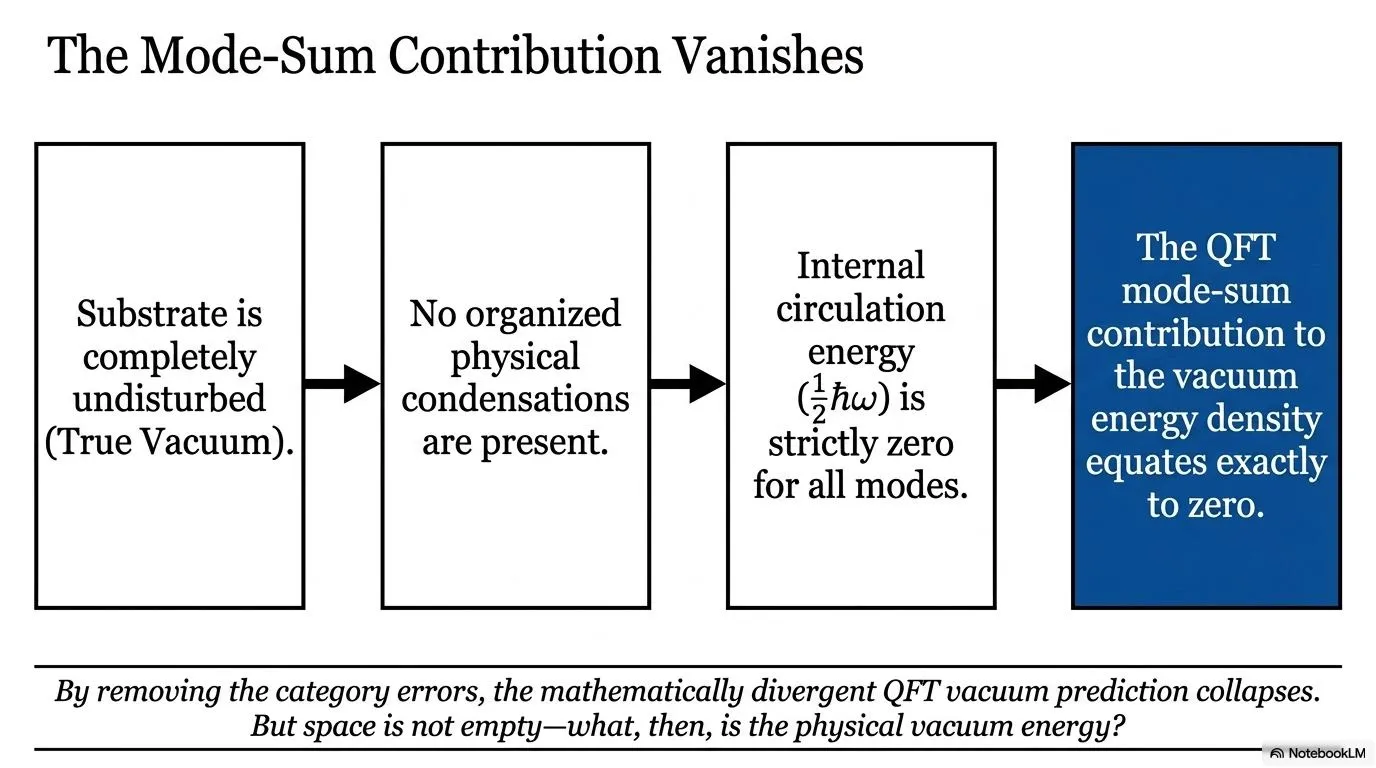
The mode-sum contribution vanishes identically for a vacuum containing no organised condensations. No cancellation is applied. No fine-tuning is introduced. Each integrand is separately zero because each empty mode contributes nothing under the substrate interpretation.
7.2 The Background Equilibrium Energy Density and the Status of ρ_s
Setting the mode-sum to zero does not set the total vacuum energy to zero. The substrate has a background equilibrium state with a non-zero energy density. The present work derives this from the stress-energy tensor of the substrate medium.
Consider the substrate in its equilibrium vacuum state: a uniform medium with mass-energy density ρ_s and pressure ps. The stress-energy tensor of a perfect fluid is:
T^μν = (ρ + p/c²) u^μ u^ν − p g^μν (12)
In the rest frame u^μ = (c, 0, 0, 0). The equilibrium vacuum state would be Lorentz-invariant. Any preferred spatial direction would indicate a non-trivial dynamical configuration, not the ground state. Lorentz invariance of T^μν requires T^μν ∝ g^μν, which uniquely gives:
pvac = −ρ_vac c² (13)
In the substrate rest frame, the temporal component satisfies T⁰⁰ = ρc². This is the equation of state w = −1, identical to a cosmological constant. The energy density in the rest frame follows directly from T00:
ρ_vac = ρ_s c² (14)
This is not dimensional analysis. It is the direct application of the relativistic rest-frame energy-density relation to a uniform equilibrium medium with mass density ρ_s. The result gravitates in the same manner as a cosmological constant with effective density ρ_Λ = ρ_s.
The substrate equilibrium density ρ_s is not a free parameter of this paper. Its value is derived in the prior independent work [38] from self-consistency conditions of the substrate, conditions that have no connection to cosmological observations and involve no cosmological observable at any step. The principal result of that derivation is:
ρ_s = 5.9 × 10⁻²⁷ kg/m³ (15)
The present paper does not depend on the details of that derivation. It depends only on the fact that ρ_s is fixed by independent physical arguments and is therefore not an adjustable parameter. Equation (14) is the result of this paper; equation (15) is an input from prior work.
The equilibrium substrate density, ρₛ, is not introduced to reproduce the observed cosmological constant. It is derived independently from the equilibrium properties of the underlying physical substrate. The present paper examines one consequence of that independently derived quantity. Whether the underlying ontology is ultimately valid depends on its ability to account consistently for other physical phenomena using the same value, a question beyond the scope of the present paper.
7.3 Numerical Result
Substituting equation (15) into equation (14):
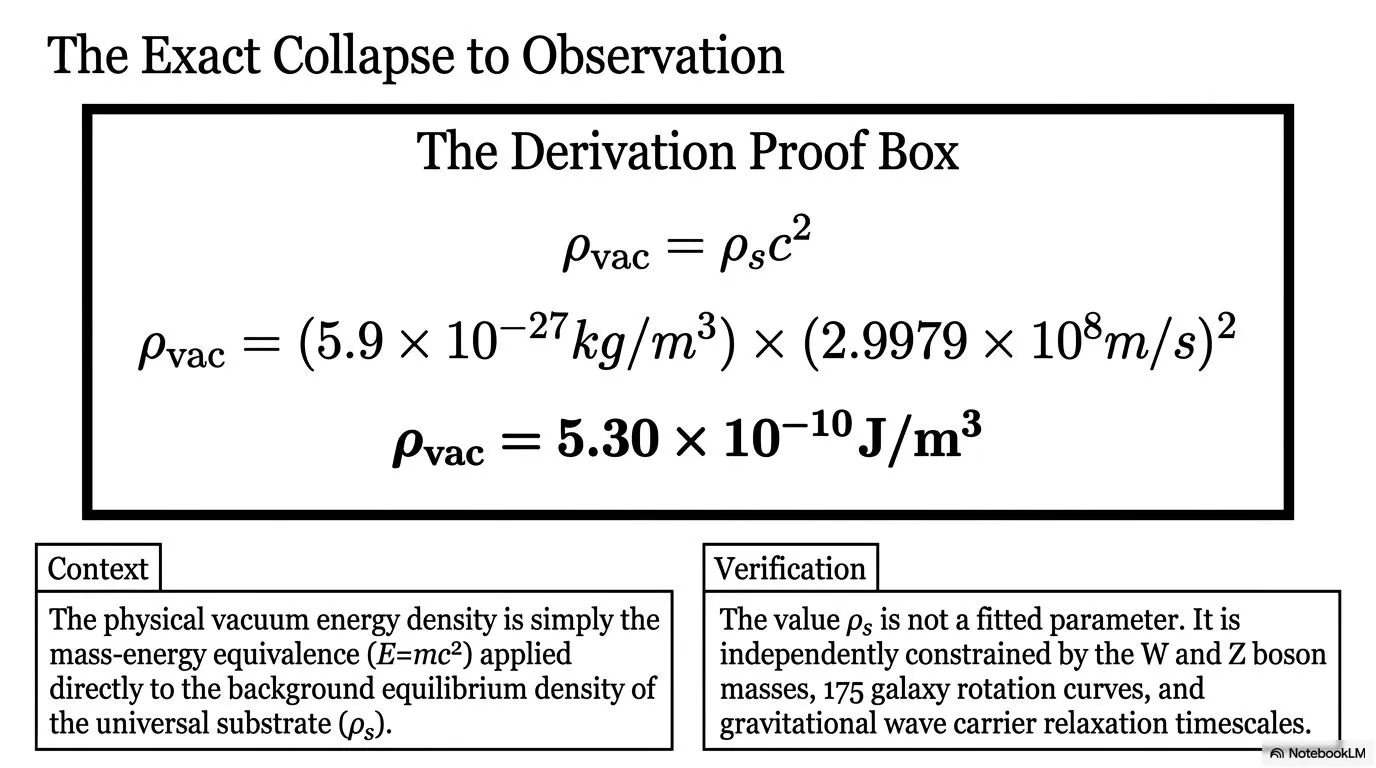
ρ_vac = (5.9 × 10⁻²⁷ kg/m³) × (2.99792458 × 10⁸ m/s)² (16)
ρ_vac = 5.30 × 10⁻¹⁰ J/m³ (17)
This is consistent with the cosmologically observed value ρ_obs = (5.30 ± 0.10) × 10⁻¹⁰ J/m³ [20] to within measurement precision.
8. Resolution of the Cosmological Constant Problem
Under the two interpretive corrections of Section 6, the cosmological constant problem is resolved within the proposed interpretation as follows. The standard QFT calculation gives ρ_QFT ≈ 5.87 × 10¹¹¹ J/m³ by summing ½ħω over all modes of all N ≈ 17 independent fields. Within the present framework, both the multiplicity N and the per-mode assignment of ½ħω to empty modes are interpretive conventions, not mathematical requirements.
Replacing N independent fields with one substrate removes the ~17-fold overcounting. Replacing the per-mode ½ħω for empty modes with zero removes the entire Planck-scale integral. What remains is the equilibrium energy density of the substrate: ρ_vac = ρ_s c² = 5.30 × 10⁻¹⁰ J/m³. Within the proposed interpretation, the 121-order-of-magnitude discrepancy is removed not by cancellation between large contributions of opposite sign, but by the removal of contributions that the present interpretation does not regard as physically gravitating.
| Stage | Operation | Resulting ρ_vac |
|---|---|---|
| Standard QFT | N fields × ½ħω per mode | ~5.87 × 10¹¹¹ J/m³ |
| After Correction 1 | 1 substrate × ½ħω per mode | ~3.5 × 10¹¹⁰ J/m³ |
| After Correction 2 | Mode sum = 0 (empty modes) | 0 + ρ_s c² (substrate) |
| Final result | ρ_s c² (equilibrium substrate) | 5.30 × 10⁻¹⁰ J/m³ ✓ |
Table 1: Effect of the two interpretive corrections on the predicted vacuum energy density.
9. Physical Interpretation and Consistency with Established Physics
9.1 Consistency with General Relativity
Within the proposed interpretation, the universal substrate is compatible with general relativity. The metric field g_μν encodes the macroscopic geometry of the substrate medium. The substrate's equilibrium energy density ρ_s c² enters the Einstein field equations as a cosmological term through equation (13), precisely as observed. In the static weak-field limit, the gravitational dynamics of the substrate reduce to standard Newtonian gravity, consistent with all precision tests [31,44].
9.2 Consistency with Quantum Field Theory
The substrate interpretation does not modify QFT predictions for particle interactions. Lagrangians, propagators, and S-matrix elements are unchanged. All QFT observables computed as energy differences (Casimir forces [40,41], Lamb shifts [44], anomalous magnetic moments [45,46]) are unaffected, since these depend on vacuum energy differences between configurations rather than absolute values [42]. The only QFT result affected is the assignment of an absolute gravitating energy density to empty vacuum modes, which is the source of the discrepancy and which the present work re-interprets.
9.3 Lorentz Invariance
A universal medium at rest defines a preferred cosmological frame. This is consistent with local Lorentz invariance: the cosmic microwave background already defines a preferred frame at the cosmological level without violating Lorentz invariance as a local symmetry of particle physics. The substrate similarly defines a preferred cosmological frame while remaining locally Lorentz-invariant in all experimentally accessible regimes. The dynamical excitations of the substrate, corresponding to particles and radiation, transform as Lorentz-covariant fields. No local experiment performed to date distinguishes such a preferred cosmological frame, consistent with existing experimental tests of local Lorentz invariance.
10. Discussion: Anticipated Objections
10.1 "Is this merely a redefinition of vacuum energy?"
The objection holds that the vacuum energy has been relabelled as "substrate equilibrium energy" and assigned a value by decree. This fails because ρ_s is not assigned to reproduce ρ_obs. It is derived in [38] from self-consistency conditions involving no cosmological observable at any step. Within the present framework, the agreement between ρ_s c² and ρ_obs is a prediction, not a definition: had those conditions yielded a different ρ_s, the prediction would have failed.
10.2 "Why should the Hamiltonian expectation value not be gravitationally active for empty modes?"
The standard QFT derivation establishes that ⟨0|Hk|0⟩ = ½ħω_k mathematically. This is not disputed here. The question is whether this mathematical result corresponds to a physically real gravitating energy density in the vacuum. The history of QFT contains multiple instances where mathematical quantities do not directly correspond to physical observables without interpretation: negative-norm states, gauge artifacts, renormalisation scheme dependence. The assignment of gravitational reality to empty-mode zero-point energies is an interpretive step beyond what the observables require, since all experimentally confirmed vacuum fluctuation effects are computed from differences rather than absolute values [42]. The present interpretation proposes a physically motivated alternative interpretation that is consistent with all established observations.
10.3 "Why assume a single substrate rather than multiple independent fields?"
The assumption of N ≈ 17 independent fields is itself an assumption: that the mathematical fields of the Standard Model correspond to N ontologically distinct physical media. An alternative, that they are N modes of one medium, is equally consistent with all particle physics predictions, since both produce the same S-matrix elements, the standard formal machinery through which quantum field theory's empirical content is expressed [47]. The single-substrate assumption is more parsimonious (one entity replacing N), is naturally motivated by the observed universality of the invariant speed c in relativistic field theories, and remains fully consistent with established particle-physics predictions.
10.4 "Does this violate established QFT predictions?"
No established QFT prediction is affected. Casimir forces involve differences of mode sums between two geometric configurations; under the present interpretation, both configurations have empty modes contributing zero, so the difference is unchanged. Lamb shift and anomalous magnetic moment calculations involve energy differences relative to a common vacuum reference; the absolute vacuum energy cancels in both. Particle scattering cross-sections depend on interaction vertices and propagators, not vacuum energy. All precision QFT tests remain intact.
10.5 "Is ρ_s truly independent of ρ_obs?"
The derivation of ρ_s in [38] proceeds through self-consistency conditions of the substrate medium involving independently measured laboratory quantities. The cosmological constant plays no role at any step of that derivation. The independence is real. The present work notes that this independence is further supported by the fact that the same ρ_s, constrained through the procedure described in [38], is consistent with multiple independent physical constraints spanning many orders of magnitude, none of which involve the cosmological constant. The agreement with ρ_obs is therefore one of several independent confirmations, not the sole source of the value.
11. Falsifiable Predictions
The single-substrate interpretation makes specific falsifiable predictions that distinguish it from existing proposals.
Prediction 1. The vacuum energy density is ρ_vac = ρ_s c² with ρ_s = 5.9 × 10⁻²⁷ kg/m³ as derived in [38]. Any independent measurement of ρ_s (through, for example, gravitational wave propagation characteristics or the gravitational domain structure of isolated masses) would yield this value. A disagreement would falsify the framework.
Prediction 2. There is no intrinsic gravitating zero-point energy for empty vacuum modes. Future experiments capable of directly probing the gravitational activity of vacuum energy would distinguish between the present interpretation and the conventional picture. A confirmed detection of a Planck-scale gravitating contribution, not the substrate equilibrium value, would falsify the substrate interpretation. This is in principle distinguishable from a simple cosmological constant measurement because a Planck-scale contribution would scale differently with the effective field theory cutoff than ρ_s c². A direct test would require a statistically significant correlation between the observed vacuum energy density and the independently derived ρ_s across multiple cosmological probes, without extra free parameters. This is acknowledged as a long-term experimental goal requiring future high-precision cosmological surveys capable of isolating vacuum contributions independently of dark energy parameterizations.
Prediction 3. All Standard Model particle fields are organised excitation modes of the single substrate. Qualitatively new fields that contribute independent vacuum energies, fields not corresponding to modes of the known substrate, would require revision of the single-substrate framework. All future collider discoveries should correspond to excitation modes already implicit in the substrate structure described in [38].
12. Conclusions
Within the present framework, the cosmological constant problem (the 121-order-of-magnitude discrepancy between the QFT vacuum energy prediction and cosmological observation) is proposed to arise from two interpretive conventions in the standard calculation, neither of which is required by the mathematical structure of quantum field theory.
The first convention is that N ≈ 17 independent quantum fields each contribute independent zero-point energies to the vacuum. The present interpretation proposes the alternative interpretation that these fields are excitation modes of a single universal physical substrate, reducing the mode-sum multiplicity from N to 1.
The second convention is that every vacuum mode, occupied or empty, contributes ½ħω to the gravitating vacuum energy density. The present interpretation proposes the alternative interpretation that ½ħω is the minimum circulation energy of an organised physical condensation, and that empty modes contribute zero. This reinterpretation is consistent with all established QFT observables, all of which depend on vacuum energy differences rather than absolute values.
Under both corrections, the QFT mode-sum contribution vanishes for a pure vacuum. The physical vacuum energy density is the background equilibrium energy of the substrate, derived from the Lorentz-invariance requirement on the stress-energy tensor: ρ_vac = ρ_s c². With ρ_s = 5.9 × 10⁻²⁷ kg/m³ from the prior independent result [38], this gives ρ_vac = 5.30 × 10⁻¹⁰ J/m³, in agreement with observation.
The significance of the present result extends beyond reproducing the observed vacuum energy density. The equilibrium substrate density is derived independently from the physical properties of the underlying substrate rather than being introduced to match cosmological observations. The present paper examines one consequence of that derivation. Whether the proposed ontology is ultimately correct will depend on its ability to account consistently for other physical phenomena using the same independently derived quantity, a question beyond the scope of the present work.
References
[1] Weinberg, S. (2000). The cosmological constant problems. In Sources and Detection of Dark Matter and Dark Energy in the Universe, pp. 18–26. Springer, Berlin.
[2] Carroll, S.M. (2001). The cosmological constant. Living Reviews in Relativity, 4(1), 1. doi:10.12942/lrr-2001-1
[3] Martin, J. (2012). Everything you always wanted to know about the cosmological constant problem (but were afraid to ask). Comptes Rendus Physique, 13(6–7), 566–665.
[4] Padmanabhan, T. (2003). Cosmological constant: the weight of the vacuum. Physics Reports, 380(5–6), 235–320.
[5] Zeldovich, Ya.B. (1968). The cosmological constant and the theory of elementary particles. Soviet Physics Uspekhi, 11(3), 381–393.
[6] Weinberg, S. (1989). The cosmological constant problem. Reviews of Modern Physics, 61(1), 1–23.
[7] Zumino, B. (1975). Supersymmetry and the vacuum. Nuclear Physics B, 89(3), 535–546.
[8] ATLAS Collaboration (2021). Search for squarks and gluinos in final states with jets and missing transverse momentum using 139 fb⁻¹ of √s = 13 TeV pp collision data. Journal of High Energy Physics, 2021, 143.
[9] CMS Collaboration (2021). Search for new particles in an Lτ-Lμ gauge model in final states with two muons and missing transverse momentum. Physical Review D, 103, 032006.
[10] Barrow, J.D. and Tipler, F.J. (1986). The Anthropic Cosmological Principle. Oxford University Press, Oxford.
[11] Starkman, G.D. and Trotta, R. (2006). Why anthropic reasoning cannot predict Λ. Physical Review Letters, 97, 201301.
[12] Kaloper, N. and Padilla, A. (2014). Sequestering the standard model vacuum energy. Physical Review Letters, 112, 091304.
[13] Dvali, G., Hofmann, S., and Khoury, J. (2007). Degravitation of the cosmological constant and graviton width. Physical Review D, 76, 084006.
[14] Joyce, A., Jain, B., Khoury, J., and Trodden, M. (2015). Beyond the cosmological standard model. Physics Reports, 568, 1–98.
[15] Sakharov, A.D. (1967). Vacuum quantum fluctuations in curved space and the theory of gravitation. Soviet Physics Doklady, 12(11), 1040–1041.
[16] Adler, S.L. (1982). Einstein gravity as a symmetry-breaking effect in quantum field theory. Reviews of Modern Physics, 54(3), 729–766.
[17] Perlmutter, S., et al. (1999). Measurements of Ω and Λ from 42 high-redshift supernovae. The Astrophysical Journal, 517(2), 565–586.
[18] Riess, A.G., et al. (1998). Observational evidence from supernovae for an accelerating universe and a cosmological constant. The Astronomical Journal, 116(3), 1009–1038.
[19] Planck Collaboration (2020). Planck 2018 results. VI. Cosmological parameters. Astronomy & Astrophysics, 641, A6.
[20] Planck Collaboration (2020). Planck 2018 results. I. Overview and the cosmological legacy of Planck. Astronomy & Astrophysics, 641, A1.
[21] Eisenstein, D.J., et al. (2005). Detection of baryon acoustic oscillations in the radial galaxy correlation function. The Astrophysical Journal, 633(2), 560–574.
[22] DESI Collaboration (2024). DESI 2024 VI: Cosmological constraints from the measurements of baryon acoustic oscillations. arXiv:2404.03002
[23] Cremmer, E., et al. (1978). Spontaneous symmetry breaking and Higgs effect in supergravity without cosmological constant. Nuclear Physics B, 147(1–2), 105–131.
[24] de Carlos, B. and Casas, J.A. (1993). One-loop analysis of the electroweak breaking in supersymmetric models and the fine-tuning problem. Physics Letters B, 309(3–4), 320–328.
[25] Burgess, C.P. (2004). Supersymmetric large extra dimensions and the cosmological constant: An update. Annals of Physics, 313(2), 383–401.
[26] Susskind, L. (2003). The anthropic landscape of string theory. arXiv:hep-th/0302219
[27] Linde, A. (1986). Eternal chaotic inflation. Modern Physics Letters A, 1(2), 81–85.
[28] Douglas, M.R. (2003). The statistics of string/M theory vacua. Journal of High Energy Physics, 2003(05), 046.
[29] Kaloper, N. and Padilla, A. (2016). Vacuum energy sequestering and graviton loops. Physical Review Letters, 116, 051302.
[30] Porrati, M. (2002). Fully covariant van Dam-Veltman-Zakharov discontinuity, and absence thereof. Physics Letters B, 534, 209–215.
[31] Will, C.M. (2014). The confrontation between general relativity and experiment. Living Reviews in Relativity, 17(1), 4.
[32] Visser, M. (2002). Sakharov's induced gravity: a modern perspective. Modern Physics Letters A, 17(15–17), 977–991.
[33] Verlinde, E. (2011). On the origin of gravity and the laws of Newton. Journal of High Energy Physics, 2011(04), 029.
[34] Jacobson, T. (1995). Thermodynamics of spacetime: The Einstein equation of state. Physical Review Letters, 75, 1260–1263.
[35] Dolgov, A.D. (1983). An attempt to get rid of the cosmological constant. In The Very Early Universe, Cambridge University Press, pp. 449–458.
[36] Ford, L.H. (1987). Gravitational particle creation and inflation. Physical Review D, 35(10), 2955–2960.
[37] Polyakov, A.M. (2010). Infrared instability of the de Sitter space. arXiv:0912.5503
[38] Sharma, V.S. (2026). A Unified Physical Substrate Model of Cosmological and Particle Structure. Zenodo. doi:10.5281/zenodo.19149785
[39] Peskin, M.E. and Schroeder, D.V. (1995). An Introduction to Quantum Field Theory. Addison-Wesley, Reading, MA.
[40] Casimir, H.B.G. (1948). On the attraction between two perfectly conducting plates. Proceedings of the Koninklijke Nederlandse Akademie van Wetenschappen, 51, 793–795.
[41] Lamoreaux, S.K. (1997). Demonstration of the Casimir force in the 0.6 to 6 μm range. Physical Review Letters, 78, 5–8.
[42] Milonni, P.W. (1994). The Quantum Vacuum: An Introduction to Quantum Electrodynamics. Academic Press, Boston.
[43] Itzykson, C. and Zuber, J.-B. (1980). Quantum Field Theory. McGraw-Hill, New York.
[44] Wald, R.M. (1984). General Relativity. University of Chicago Press, Chicago.
[45] Schwinger, J. (1948). On quantum-electrodynamics and the magnetic moment of the electron. Physical Review, 73(4), 416–417.
[46] Workman, R.L., et al. (Particle Data Group) (2022). Review of Particle Physics. Progress of Theoretical and Experimental Physics, 2022, 083C01.
[47] Weinberg, S. (1995). The Quantum Theory of Fields, Volume I. Cambridge University Press, Cambridge.
[48] Burgess, C.P. (2013). The cosmological constant problem: Why it's hard to get dark energy from micro-physics. arXiv:1309.4133
[49] Copeland, E.J., Sami, M., and Tsujikawa, S. (2006). Dynamics of dark energy. International Journal of Modern Physics D, 15(11), 1753–1936.
[50] Rubakov, V.A. (2000). Large and infinite extra dimensions. Physics-Uspekhi, 44(9), 871–893.
[51] Michelson, A.A. and Morley, E.W. (1887). On the relative motion of the Earth and the luminiferous ether. American Journal of Science, 34(203), 333–345.
[52] Muller, H., Herrmann, S., Braxmaier, C., Schiller, S., and Peters, A. (2003). Modern Michelson-Morley experiment using cryogenic optical resonators. Physical Review Letters, 91, 020401.
[53] Sharma, V.S. (2026). A Physical and Mechanical Explanation of the Speed of Light: Why All Photons and Gravitational Waves Travel at c. Zenodo. doi:10.5281/zenodo.21292900
[54] Sharma, V.S. (2026). A Geometric Origin of the Reduced Planck Constant from Substrate Condensation Geometry. Zenodo. doi:10.5281/zenodo.21280494
[55] Sharma, V.S. (2026). A Geometric Origin of the Higgs Mass and Electroweak Mixing Angle from Substrate Condensation Topology. Zenodo. doi:10.5281/zenodo.21280511
[56] Rovelli, C. (2004). Quantum Gravity. Cambridge University Press, Cambridge.
[57] ATLAS Collaboration (2012). Observation of a new particle in the search for the Standard Model Higgs boson with the ATLAS detector at the LHC. Physics Letters B, 716(1), 1–29.
[58] CMS Collaboration (2012). Observation of a new boson at a mass of 125 GeV with the CMS experiment at the LHC. Physics Letters B, 716(1), 30–61.
[59] Einstein, A. (1920). Äther und Relativitätstheorie. Address delivered at the University of Leiden, 5 May 1920. Springer, Berlin.